Toxicity

School of Rock performs System of a Down’s “Toxicity” (2022)

Actors Martin and Janet Sheen, John Cusack and Slovenian philosopher Slavoj Žižek have signed an open letter urging Russian prison officials to end the solitary confinement of jailed activist Mikhail Kriger, who has been on a dry hunger strike for more than a week.

They join Garbage frontwoman Shirley Manson, who earlier this week called on the local prison chief to end Kriger’s isolation.

Kriger, 65, first launched a hunger strike in late September. He started a dry hunger strike — meaning abstention from both food and water — last Friday after a planned visit with his daughter was canceled.

Kriger has accused prison authorities of deliberately trying to isolate him to prevent contact with other inmates. 

The latest signatories of the letter to the head of Correctional Colony No. 5 in Russia’s Oryol region claimed Kriger’s condition “has now become critical,” according to the letter published by the exiled news website Mediazona.

“[Kriger’s] speech has slowed, his gaze is unfocused and he is extremely weak. Dry hunger strikes cause organ failure and quickly lead to shock and death,” the Sheens, Cusack and Žižek wrote.

Kriger was in 2023 sentenced to seven years in prison for “justifying terrorism” and “inciting hatred” over anti-Kremlin social media posts. The activist said during trial that he was being persecuted for his anti-war views and open pro-Ukrainian position.

The Nobel Peace Prize-winning human rights group Memorial designated Kriger a political prisoner.

The anti-Kremlin activist group Pussy Riot raised alarm over Kriger’s hunger strike earlier this week, calling on followers to write letters to him and the prison administration. 

It was not immediately clear whether authorities in the Oryol region prison colony intended to respond to the international appeals.

It was also not clear when Kriger was expected to be moved out of solitary confinement and whether his medical condition was being properly monitored.

Kriger’s support group said the activist was taken to a regional hospital on Wednesday for tests, the results of which have not been shared.

Kriger’s lawyer said he was “cheerful, wrote poems and even offered to hop on one leg to show his strength,” the support group said in an update Thursday.

“Forced feeding will only begin if he loses consciousness or doctors deem his condition critical,” Kriger’s support group wrote on Telegram.

Source: “Hollywood Stars Back Jailed Russian Activist on Hunger Strike,” Moscow Times, 17 October 2025


Yegor Shramko holding a placard that reads “No to the war with Ukraine” in Petersburg’s Palace Square

Our correspondent reports that activist Yegor Shramko did an anti-war picket in Palace Square and was detained.

The Petersburg man held a blue-and-yellow placard bearing the slogan “No to the war in Ukraine” and stood this way for around an hour. Shramko told our correspondent that although passersby supported him, the police were summoned by animateurs dressed as Russian emperors and empresses who offer to take photos with them for money on the square.

“I cannot keep silent. A life in which you have to fear everything, keep quiet, and be afraid of every little noise has no value for me,” Shramko explained to Bumaga.

He told RusNews that he had been wanting to stage the protest for four months but only worked up the nerve today.

This past summer, Shramko was jailed for twenty-four hours on charges of “displaying extremist symbols.” The “extremist symbol” in this case was the portrait of Alexei Navalny which Shramko brought to the Solovetsky Stone on the murdered politician’s birthday. At the time, Shramko told Bumaga that Navalny’s own words—”I’m not afraid, and you shouldn’t be afraid either”—had encouraged him to take the plunge and risk arrest by carrying out the proteest.

Source: Bumaga (Facebook), 17 October 2025. Thanks to Hanna Perekhoda for the heads-up.


The activist held a solo picket for about an hour. St. Petersburg residents approached him—some offered words of support, while others began arguing with him. More than 50 minutes after the picket began, security forces in full uniform arrived and detained Yegor.

Source: “Security forces detained activist Yegor Shramko, who was holding a pacifist picket | St. Petersburg,” RusNews (YouTube), 18 October 2025


As you have probably heard, recently, on a Swiss train, a Russian man (with Latvian citizenship) attacked a family. The family was speaking Ukrainian among themselves. He started threatening to kill them and their baby.

It’s easy to dismiss this as just another “fait divers” (which, in a sense, it is), but I think it says something larger. To understand his actions, you have to understand where it comes from.

For centuries, the inhabitants of the Russian state lived in a situation where order depended on fear and extreme forms of violence. This was true in much of the world, but while many countries began to change over the last century (let’s put aside the reasons behind the change), in the Russian/Soviet empire the situation actually became worse. Much worse.

The rules were never something people agreed to follow together (after all, you need to feel a part of a society and thus to share common imaginary to do it, and it is impossible to do it if you live in the empire, however much some contemporary researchers might wish it). It is something they were imposed from above, by the state, or by whoever had power over you at the moment. People learned that laws only mattered when someone strong was watching. So when a person raised in that kind of world finds themselves in a place like Switzerland, where rules work because the majority respects them voluntarily, they see the absence of fear and coercion as a sign that anything goes.

The man in that train was in a setting where no one was looking as capable to physically stop him and he took that as permission to dominate others, those people that he hates for the mere fact of their existence.

This same pattern plays out on a global scale. The Russian state elites see Europe much like that man saw the train: as a place without explicit “real” (military) force. It looks fake, easy to break, like a house of cards, because it relies on trust, and thus, in their view, on NOTHING.

People and societies shaped by fear and domination can’t imagine relationships built on any agreements (that require trust). They assume that if no one is dominating explicitly, it’s an invitation to act.

The man on the train and Putin’s crew are two versions of the same story. Both come from a social setting that sees respect as submission, peace as weakness, agreements as empty shells and absence of explicit force as an invitation to unlimited violence.

Source: Hanna Perekhoda (Facebook), 18 October 2025


Donald Trump told Ukrainian President Volodymyr Zelensky on Friday to make a deal with Russia, pouring cold water on Kyiv’s push for Tomahawk missiles as the U.S. leader pursues a diplomatic solution to the war.

Trump said as recently as last month that he believed Ukraine could take back all its territory — but a day after agreeing to meet Russian President Vladimir Putin for a new summit the American had changed his tune.

After meeting with Zelensky at the White House, Trump said on social media that their talks were “very interesting, and cordial, but I told him, as I likewise strongly suggested to President Putin, that it is time to stop the killing, and make a DEAL!”

Trump also appeared to suggest both sides should accept their current front lines. “They should stop where they are. Let both claim Victory, let History decide!” he said.

Zelensky said after the meeting that Russia was “afraid” of the U.S.-made long-range Tomahawk cruise missiles, but that he was “realistic” about receiving the weapons from Washington.

He told reporters that while he and Trump talked about long-range weapons they “decided that we don’t speak about it because… the United States doesn’t want escalation.”

‘Get the war over’

Zelensky came to Washington after weeks of calls for Tomahawks, hoping to capitalize on Trump’s growing frustration with Putin after a summit in Alaska failed to produce a breakthrough.

But the Ukrainian left empty-handed as Trump eyes a fresh diplomatic breakthrough on the back of last week’s Gaza peace deal.

Trump has appeared far more upbeat about the prospects of a deal since his two-and-a-half hour call with Putin on Thursday, in which they agreed to meet in Budapest.

“Hopefully we’ll be able to get the war over with without thinking about Tomahawks,” Trump told journalists including an AFP reporter as he hosted Zelensky at the White House.

Trump added that he believed Putin “wants to end the war.”

Zelensky, who came to the White House to push for the long-range U.S.-made weapons, said however that he would be ready to swap “thousands” of Ukrainian drones in exchange for Tomahawks.

Zelensky congratulated Trump on his recent Middle East peace deal in Gaza and said he hoped he would do the same for Ukraine. “I hope that President Trump can manage it,” he said.

‘Many questions’

Diplomatic talks on ending Russia’s invasion have stalled since the Alaska summit.

The Kremlin said Friday that “many questions” needed resolving before Putin and Trump could meet, including who would be on each negotiating team.

But it brushed off suggestions Putin would have difficulty flying over European airspace.

Hungary said it would ensure Putin could enter and “hold successful talks” with the United States despite an International Criminal Court arrest warrant against him for alleged war crimes.

Since the start of his second term, Trump’s position on the Ukraine war has shifted dramatically back and forth.

Initially Trump and Putin reached out to each other as the U.S. leader derided Zelensky as a “dictator without elections.”

Tensions came to a head in February, when Trump accused his Ukrainian counterpart of “not having the cards” in a rancorous televised meeting at the Oval Office.

Relations between the two have since warmed as Trump has expressed growing frustration with Putin.

But Trump has kept a channel of dialogue open with Putin, saying that they “get along.”

The U.S. leader has repeatedly changed his position on sanctions and other steps against Moscow following calls with the Russian president.

Putin ordered a full-scale invasion of Ukraine in February 2022, describing it as a “special military operation” to demilitarize the country and prevent the expansion of NATO.

Russia now occupies around a fifth of Ukrainian territory — much of it ravaged by fighting.

On Friday the Russian Defense Ministry announced it had captured three villages in Ukraine’s Dnipropetrovsk and Kharkiv regions.

Source: Danny Kemp (AFP), “Trump Tells Zelensky to ‘Make a Deal’ as Tomahawk Plea Misfires,” Moscow Times, 18 October 2025


All last week, Republican leaders tried to portray the No Kings protests scheduled for Saturday, October 18, as “Hate America” rallies. G. Elliott Morris of Strength in Numbers partnered with Atlanta-based science newsroom The Xylom to estimate that as many as 8.2 million people turned out yesterday to oppose the Trump administration. The mood at the protests was joyful and peaceful, with protesters holding signs that championed American principles of democracy, free speech, equality, and the rule of law. As the Grand Junction, Colorado, Daily Sentinel put it in a front-page headline: “‘This is America’ ‘No Kings’ protests against Trump bring a street party vibe to cities nationwide.”

Then last night, after the protests, the president’s social media account posted an AI-generated video showing Trump in a fighter jet with “KING TRUMP” painted on the side. The president sits in the airplane in front of something round that could be seen as a halo. He is wearing a gold crown; weirdly, the oxygen mask is over his mouth and chin, rather than mouth and nose.

Once in the air, the plane drops excrement on American cities, including what seems to be New York City. The excrement drenches protesters, one of whom is 23-year-old liberal political commentator and influencer Harry Sisson. Journalist Aaron Rupar of Public Notice, who shares media clips that reflect politics, commented: “Trump posts AI video showing him literally dumping sh*t on America.” Historian Larry Glickman noted that media outlets make much of alleged Democratic disdain for ordinary Americans, but have had little to say about the disdain for Americans embodied by Trump’s video.

Several administration videos and images have responded to Americans saying “No Kings” by taking the position “Yes, We Want Kings,” an open embrace of the end of democracy. But they are more than simple trolling. Led by Trump, MAGA Republicans have abandoned the idea of politics, which is the process of engaging in debate and negotiation to attract support and win power. What is left when a system loses the give and take of politics is force.

The idea that leaders must attract voters with reasoned arguments to win power and must concede power when their opponents win has been the central premise of American government since 1800. In that year, after a charged election in which each side accused the other of trying to destroy the country, Federalist John Adams turned the reins of government over to the leader of the opposition, Thomas Jefferson. That peaceful transfer of power not only protected the people, it protected leaders who had lost the support of voters, giving them a way to leave office safely and either retire or regroup to make another run at power.

The peaceful transfer of power symbolized the nation’s political system and became the hallmark of the United States of America. It lasted until January 6, 2021, when sitting president Trump refused to accept the voters’ election of Democrat Joe Biden, the leader of the opposition.

Now back in power, Trump and his loyalists are continuing to undermine the idea of politics, policies, and debate, trying instead to delegitimize the Democratic opposition altogether. Yesterday, during the protests, President Donald Trump, Vice President J.D Vance, and the official White House social media account posted a video of Trump placing a royal crown on his head, draping a royal robe around his shoulders, and unsheathing and brandishing a sword (an image that raises questions about why Trump wanted one of General Dwight D. Eisenhower’s swords so badly that he had the museum director who refused to hand it over fired). In the video, Democratic leaders including former House speaker Nancy Pelosi (D-CA) and what appears to be Senate minority leader Chuck Schumer (D-NY) first kneel and then bow to Trump.

Administration imagery doesn’t simply insult opposition leaders; it undermines the idea of politics by suggesting that Democrats are un-American. Last night the White House continued its racist crusade against Democratic leaders by posted an AI-generated image of Trump and Vance wearing jewel-encrusted crowns positioned above an image of House minority leader Hakeem Jeffries (D-NY) and Senate minority leader Chuck Schumer (D-NY) wearing Mexican sombreros. The caption reads: “We’re built different.”

The administration’s hostility to loyal opposition is translating into direct assaults on our government. House speaker Mike Johnson is refusing to seat a member of the opposition. Voters chose representative-elect Adelita Grijalva (D-AZ) on September 23 to fill a vacant House seat, but Johnson has come up with one reason after another not to seat her. Until she is sworn in, she has no access to government resources and cannot represent her constituents. She also cannot be the 218th signature on a discharge petition that would force a vote on whether to demand the release of the Epstein files, the final signature needed.

Grijalva recorded a video reinforcing the political system, saying: “We need to get to work, get on the floor, and negotiate so we can reopen the government.”

But Republican congressional leaders are refusing even to talk with Democrats to reopen the government, let alone to negotiate with them. They are trying to force Democrats simply to do as they say, despite the fact that 78% of Americans, including 59% of Republicans, support the Democrats’ demand for an extension of the tax credit that lowers the cost of healthcare premiums on the Affordable Care Act markets. Lindsay Wise, Anna Wilde Mathews, and Katy Stech Ferek of the Wall Street Journal reported today that more than three quarters of those who are insured through the ACA markets live in states that voted for Trump.

A video of Trump in a bomber attacking American cities carries an implied threat that the disdain of throwing excrement doesn’t erase. This morning, Trump reinforced that threat when he reminded Fox News Channel host Maria Bartiromo: “Don’t forget I can use the Insurrection Act. Fifty percent of the presidents almost have used that. And that’s unquestioned power. I choose not to, I’d rather do this, but I’m met constantly by fake politicians, politicians that think that, that you know they it’s not like a part of the radical left movement to have safety. These cities have to be safe.”

That “safety” apparently involves detaining U.S. citizens without due process. On Thursday, Nicole Foy of ProPublica reported that more than 170 U.S. citizens have been detained by immigration agents. She reports they “have been dragged, tackled, beaten, tased and shot by immigration agents. They’ve had their necks kneeled on. They’ve been held outside in the rain while in their underwear. At least three citizens were pregnant when agents detained them. One of those women had already had the door of her home blown off while Department of Homeland Security Secretary Kristi Noem watched.”

On Friday, the Trump administration pushed its attempt to use the military in Democratic-led cities, asking the Supreme Court to let it deploy troops in Chicago immediately. Chris Geidner of Law Dork notes that four judges, two appointed by Democrats and two appointed by Republicans, have rejected the administration’s arguments for why they must send in troops. Now the Department of Justice has appealed to the Supreme Court, asking for a decision on the so-called shadow docket, which would provide a fast response, but one without any hearings or explanation.

The administration’s appeal to the Supreme Court warned that there was “pressing risk of violence” in Chicago—a premise the judges rejected—and said preventing Trump from going into the city “improperly impinges on the President’s authority.”

How much difference will the No Kings Day protests, even as big as they were, make in the face of the administration’s attempt to get rid of our democratic political system and replace it with authoritarianism? What good is an inflatable frog against federal agents?

Scholar of social movements Lisa Corrigan noted that large, fun marches full of art and music expand connections and make people more willing to take risks against growing state power. They build larger communities by creating new images that bring together recognizable images from the past in new ways, helping more people see themselves in such an opposition. The community and good feelings those gatherings develop help carry opposition through hard moments. Corrigan notes, too, that yesterday “every single rally (including in the small towns) was bigger than the surrounding police force available. That kind of image event is VERY IMPORTANT if you’re…demonstrating social coherence AGAINST a fascist government and its makeshift gestapo.”

Such rallies “bring together multigenerational groups and the playfulness can help create enthusiasm for big tent politics against the monoculture of fascism,” Corrigan writes. “The frogs (and unicorns and dinosaurs) will be defining ideographs of this period of struggle.”

Source: Heather Cox Richardson, Letters from an American, 19 October 2025

System of a Down, “Toxicity” (2001)

Victory Day 2025

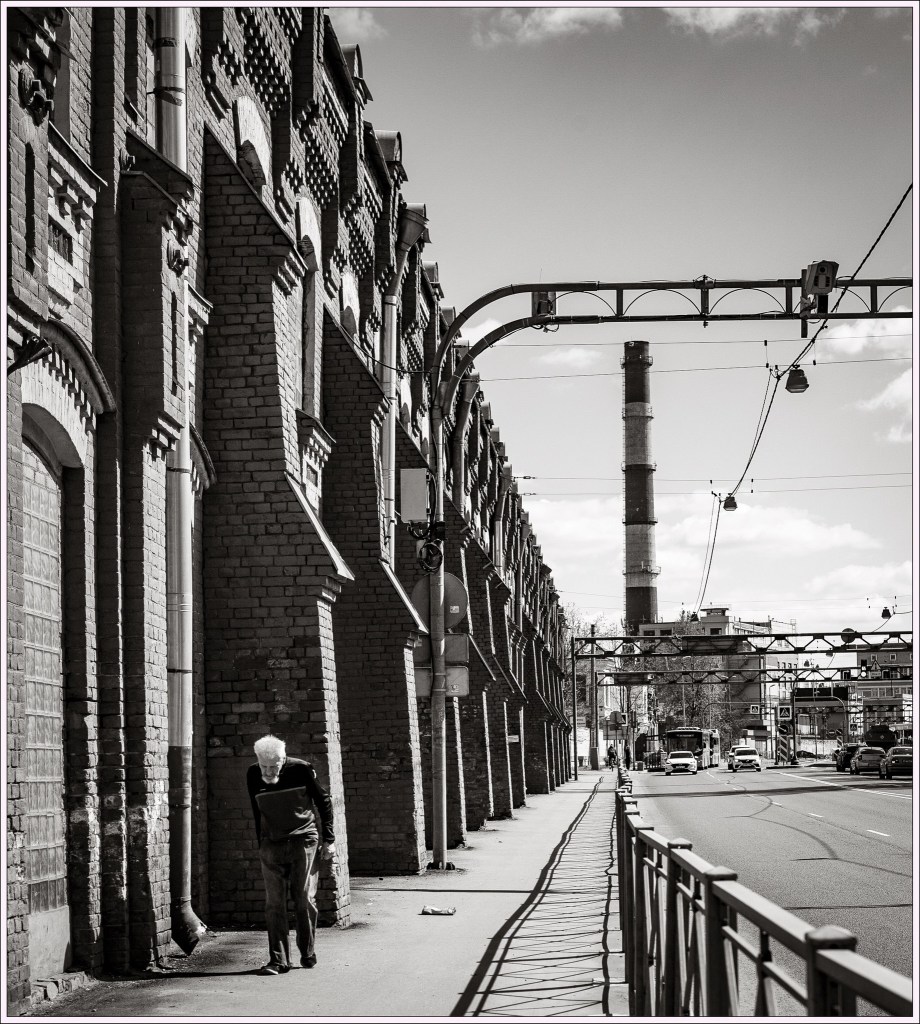
Sergei Podgorkov, Outside the Obukhov Factory (St. Petersburg), 9 May 2025

Source: Sergei Podgorkov (Facebook), 9 May 2025


On Friday, May ninth, Treptow Park was perhaps the most heavily guarded place in Berlin. Hundreds of police officers kept the peace at Germany’s most famous memorial to Soviet soldiers on the day Russia marked the eightieth anniversary of the end of the Second World War in Europe, known as the Great Patriotic War in the Soviet tradition. Because Russia has employed symbols of that earlier war in its current war against Ukraine, visitors were banned from displaying or wearing Soviet and Russian flags, military uniforms, and St George’s ribbons at the Berlin memorial this year. An exception was made for veterans and diplomats.

Soviet May ninth traditions and German pacifists

At about half past ten in the morning, a wreath was laid at the monument to the Soviet soldier by Russia’s ambassador to Germany, Sergei Nechayev. The day before, when Germany remembered the Wehrmacht’s surrender and the end of the war, Nechayev and the Belarusian ambassador were not invited to the memorial event at the Bundestag. In his speech, German President Frank-Walter Steinmeier thanked the Allies for liberating his country and recalled the Red Army’s sacrifices, but harshly criticized Russian attempts to justify the war in Ukraine in terms of the fight against the Nazis in the Second World War.

The flood of people in Treptow Park seemed endless: hundreds were there at any one time, and thousands came and went over the course of the day. Many brought scarlet carnations, while some bore wreaths. Russian and German were heard. Most of the visitors were elderly—immigrants from the former USSR living in Germany and Germans. There were also many leftist and ultra-leftist German political activists brandishing placards opposing NATO and calling for “peace with Russia.”

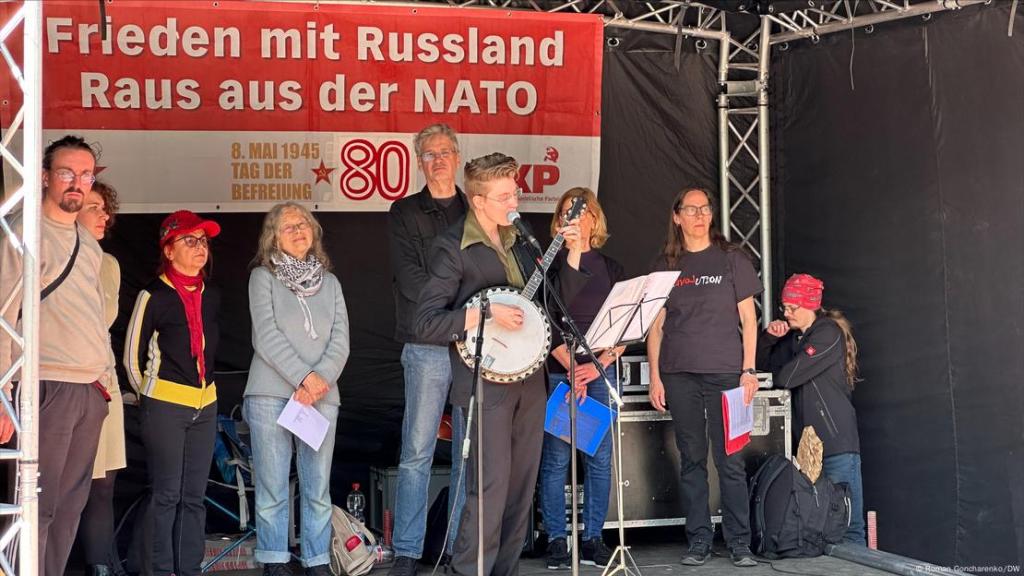
German ultra-leftists rally for “peace with Russia” and Germany’s exit from NATO, 9 May 2025.
Photo: Roman Goncharenko/Deutsche Welle

Against this backdrop, the scene resembled a mixture of a traditional Russian May ninth celebration and a political protest by German pacifists, many of whom had clearly lived most of their lives in the GDR.

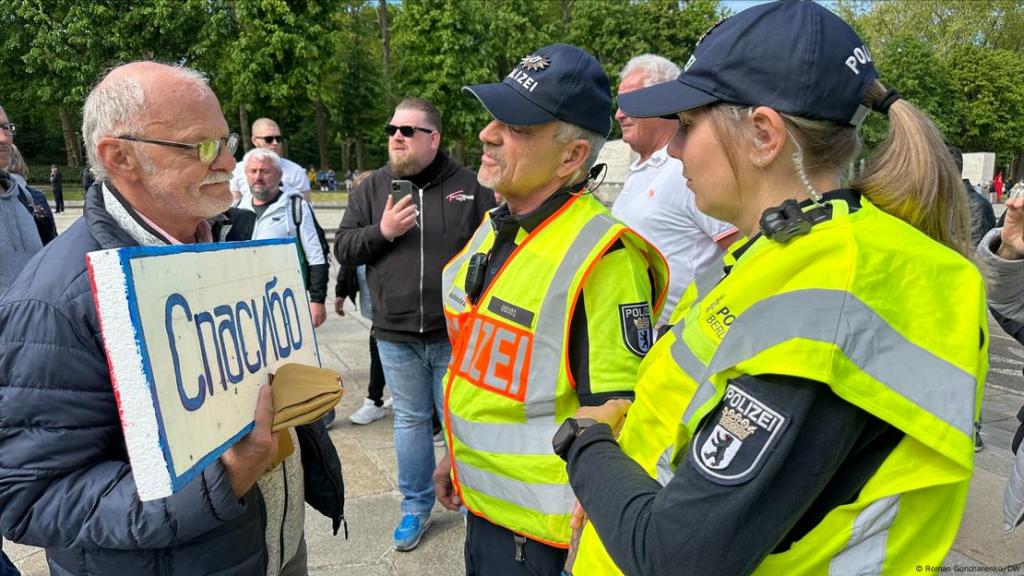
“I was a policeman in the GDR,” said a man in his sixties who held a placard that read “Thank you” in Russian. The policemen asked him to doff his Soviet cap, which sported a red star and a St. George’s ribbon.

“All people want peace, so the politicians should don their own military uniforms and crawl into the trenches,’ the man said.

Soviet wartime songs sounded from loudspeakers and were played live. One man, aged forty-five, climbed atop a mound to get a better view, but a policeman asked him to get off the lawn, explaining, “This is a grave.” The man cursed in Russian but climbed off the mound.

Another man played played “Arise, Great Country” on his clarinet. When he began quietly playing the melody of the Soviet and Russian national anthem, the police literally took him aside, after which he returned to the group of people who had gathered. They were outraged at the restrictions that had been adopted. From time to time, someone chanted “Russia, Russia!” and many other people would join in.

An ex-East German police office (holding a sign that says “Thanks!” in Russian): “All people want peace.”
Photo: Roman Goncharenko/Deutsche Welle

Bikers in Treptow Park

Your correspondent saw men and a woman in leather jackets who looked like bikers from the Russian motorcycle gang Night Wolves. They were in small groups and were escorted by a large number of police officers. They posed for pictures in front of the wreaths and left. They could have been someone from a local “support group.” The Berlin press had written that only a small group of bikers made the trip to Berlin to visit the Soviet memorials this year. No incidents had been reported as this article went to press.

Treptow Park, 9 May 2025. The crimson and gold banners at the back of the crowd are inscribed with the names of the various “fronts” in the Red Army’s campaign against the Wehrmacht. Photo: Roman Goncharenko/Deutsche Welle

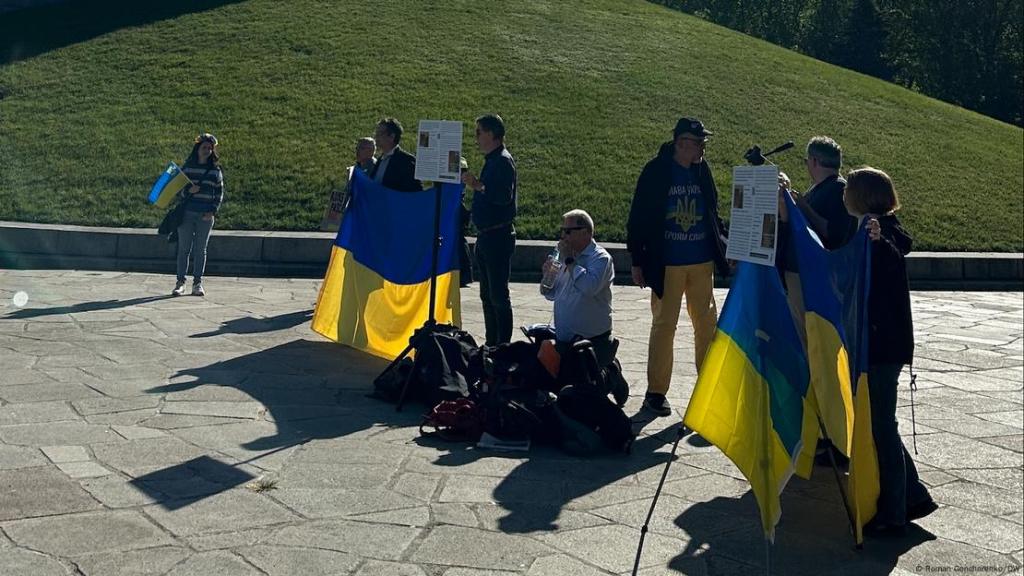
For the first half of the day, at least, things seemed relatively calm. Your correspondent had the impression that most people had come to Treptow Park not for political reasons, but to commemorate the war. And yet the atmosphere was tense. To the right and left of the monument to the Soviet warrior stood a dozen and a half activists holding placards and the flags of Ukraine and NATO.

Activists with placards and Ukrainian flags at the monument to Soviet soldiers in Treptow Park, 9 May 2025.
Photo: Roman Goncharenko/Deutsche Welle

They said they wanted to draw attention to the Ukrainian Red Army soldiers who had perished in the Second World War, as well as to Russia’s war against Ukraine.

“I am here to prevent this event from being turned into a Russian propaganda stunt,” said a woman, aged thirty-five. According to her, insults had been hurled at her and the pro-Ukrainian activists.

“Some people regard our presence here as a provocation,” said the woman. “We are not here to change anyone’s mind, but to make Ukraine visible.”

One of their posters read: “Russia has usurped the memory of May eighth and ninth. But it was not Russia who liberated us from the yoke of National Socialism eighty years ago in Berlin. It was the Red Army, in whose ranks many Ukrainians served.”

The poster tells the story of Ukrainian soldier Fyodor Karpenko, who left his name on the walls of the destroyed Reichstag building in May 1945.

Source: Roman Goncharenko, “May Ninth in Berlin’s Treptow Park: A War of Words,” Deutsche Welle Russian Service, 9 May 2025. Translated by the Russian Reader


Since the Maidan uprising and Russia’s illegal annexation of Crimea in 2014, Kremlin propaganda has consistently portrayed Ukrainian leaders as Nazis or fascists. Russia also accused the Ukrainian authorities of “genocide” of the population of Donbass. On 24 February 2022, while announcing the full-scale invasion, the “denazification” of Ukraine was presented as the primary goal of the war, which is itself portrayed merely as a continuation of the Great Patriotic War: a conflict embedded in a cyclical conception of time in which Russia, eternally under threat from a Western enemy, fights for its very survival — on Ukrainian soil.

On the ground, there is no evidence to support Moscow’s accusations: nobody has ever documented a “genocide” against ethnic Russians or Russian speakers, whether in Ukraine or elsewhere. As for the Ukrainian far-right, its political influence remains minimal: in the 2019 parliamentary elections, the main ultra-nationalist parties, running together on a joint list, received just over 2% of the vote, well below the threshold required to enter Parliament. In short, the image of a “Nazi regime” in Kyiv is based on a glaring mismatch between rhetoric and reality.

So why do the Russian authorities repeatedly invoke references to the Second World War — or, in Russian parlance, the “Great Patriotic War” — when speaking about Ukraine? Understanding this memory dynamic is essential to grasp the power of a rhetoric that, despite lacking any factual basis, continues to shape the official Russian worldview.

The Soviet and Russian insistence on using the term “Great Patriotic War” to refer exclusively to the period from 1941 to 1945 erases the twenty-one months that preceded Nazi Germany’s invasion of the USSR. Between the Molotov–Ribbentrop Pact of August 23, 1939, and Operation Barbarossa on June 22, 1941, Moscow and Berlin were de facto allies: they engaged in extensive economic cooperation, diplomatic coordination, jointly invaded and partitioned Poland in September 1939, and the Soviet Union proceeded to annex the Baltic countries and wage war against Finland. By reducing the war to the period 1941–1945, the USSR and Russia could deny any responsibility in the outbreak of the Second World War and present itself solely as the victim of Nazi aggression and the primary liberator of Europe.

The Great Patriotic War — and especially the victory in 1945 — became the founding event of Soviet history and the cornerstone of collective memory. Yet this memory, often portrayed as monolithic and universally shared, is anything but uniform. A Ukrainian from the west, who endured two successive occupations between 1939 and 1944, remembers a war very different from that of an eastern Ukrainian, whose experience was shaped primarily by Nazi destruction. The memory of a Russian bears little resemblance to that of a Crimean Tatar, who was deported along with his entire community and denied the right of return for decades. As for Soviet Jews, whose families and communities were annihilated in the Holocaust, they were long forced to remain silent — official narratives left no room for the specificity of their suffering.

The collective experience of the war and the official discourse surrounding it deeply reshaped the Soviet population’s understanding of “fascism” and “antifascism.” Rather than referring to a specific political doctrine of the inter-war period, the term “fascism” had become a catch-all label for the ultimate enemy. Trotsky or the British Conservatives could just as easily be branded as “fascists,” as well as domestic and international opponents after 1945 — including even the Chinese Communists. The word “Nazi” itself was rarely used. In everyday life, calling someone a “fascist” served more as the gravest possible insult rather than as a statement of ideological substance.

Under Vladimir Putin, the cult of the Great Patriotic War has been revived. Following the pro-democracy protests of 2011 and Putin’s bid for a third presidential term in 2012, the regime instituted a deliberate policy of historical narrative construction, aimed at grounding its legitimacy in a vision of the nation as under siege. The glorification of the 1945 victory also allowed the regime to purge collective memory of its specifically socialist elements: by retaining only the narrative of national triumph, the Soviet period could be seamlessly integrated into a continuous national history without any revolutionary rupture. At the same time, the rehabilitation of Joseph Stalin as a legitimate victor served to validate autocracy. The mass repressions and genocidal policies that claimed millions of lives were reframed as a tragic but necessary step: they had made the USSR a global superpower, capable of defending civilization against the “brown plague.”

The Kremlin has multiplied its legal instruments to enforce this narrative. Since 2020, the Russian Constitution mandates “respect for the memory of the defenders of the Fatherland” and prohibits “diminishing the importance of the heroism” of the Soviet people. In April 2021, Putin signed a law increasing penalties for “insults” or “false claims” about the Second World War and its veterans. In December 2019, Putin himself gathered some leaders of post-Soviet states around a pile of archival documents that he said proved historical truths long ignored in the West — selectively quoting them to justify, in retrospect, the USSR’s annexation of Poland and the Baltic states. In this way, Putin has weaponized history, which has become inseparable from national interest. To challenge his interpretation is tantamount to treason.

Every year on May 9, Russians march in the Immortal Regiment carrying portraits of relatives who fought between 1941 and 1945. Increasingly, the faces of those who fought — or died — in the war against Ukraine are added to these ranks, as though both wars were part of a single, endless struggle. Past and present warfare are merged, and the victory of 1945 becomes the lens through which all events — past, present, and future — are interpreted in a continuous historical timeline. This symbolic fusion also explains the surreal images of Russian occupation forces who, in recent weeks, have placed propaganda banners in destroyed Ukrainian cities. An uninhabitable Bakhmut was transformed into a stage for celebrating the 80th anniversary of Russia’s victory in the “Great Patriotic War.” 

The cult of victory is not only a central element of the Putinist imaginary — it functions as an operating system for both domestic governance and external aggression, with all of Russia’s actions on the international stage framed as part of an eternal war against fascism. A telling example of this is the installation of a giant screen on the Estonian border, broadcasting Victory Day celebrations in a loop — an attempt to remind Estonians, as well as Latvians and Lithuanians, that the Soviet victory represents an unassailable moral superiority. In the Russian collective imagination, the word “fascism” has lost all connection with a specific political ideology and now refers only to an abstract, absolute threat: the desire to destroy Russia. It has become synonymous with “enemy” or “Russophobe,” always denoting the Other, never a historically defined movement. This separation between word and meaning allows the regime to simultaneously glorify the antifascist victory and openly promote xenophobic, homophobic, or ultraconservative rhetoric, without any perceived contradiction.

The word “denazification,” used by Vladimir Putin on February 24, 2022, to justify the invasion, initially puzzled many Russians, most of whom were unfamiliar with the term in this context. Shortly afterwards, the state news agency RIA Novosti published an article by Timofey Sergeytsev — “What Russia Should Do with Ukraine” — aimed at clarifying its meaning: “denazification” was described as a “total cleansing,” targeting not only alleged Nazi leaders but also “the popular masses who are passive Nazis,” deemed guilty of having supported the “Nazi government.” According to Sergeytsev, modern Ukraine is able to hide its Nazism behind aspirations for “independence” and “European development.” To destroy this Nazism, he argues, is to “de-Europeanise” Ukraine. In this logic, denazification becomes synonymous with eliminating all Western influence from Ukraine and dismantling the country’s existence as a nation-state and a distinct society. Incubated on official state platforms, this narrative reveals the true scope of “denazification”: a large-scale project aimed at erasing any trace of Ukrainian singularity, a blueprint for the genocide.

The article recently published on the official website of the Russian Foreign Intelligence Service (SVR), entitled “Eurofascism, Today as 80 Years Ago, Is a Common Enemy of Moscow and Washington,” strikingly illustrates the expansion of the “denazification” discourse far beyond Ukraine. The accompanying image depicts a grotesque hybrid monster: its body is shaped like a black swastika with the EU’s circle of stars in the centre, while its head is a caricature of Ursula von der Leyen. The creature, with its blood-stained claws outstretched, is caught between two bayonets — one American, the other Russian/Soviet. This grotesque image is not merely a provocation: it reflects a narrative deeply entrenched in Russian state propaganda, where “Eurofascism” becomes an operational concept encompassing all European societies.

“Eurofascism, Today as 80 Years Ago, Is a Common Enemy of Moscow and Washington.” Screenshot courtesy of Meduza

The 2022 tipping point revealed these discourses for what they truly are: the ideological foundation of a large-scale invasion, long prepared within the informational sphere. Today, part of European society — particularly elements of the pacifist left — is falling into the same trap: underestimating or ignoring the ongoing propaganda dynamic. But the machine is already in motion. The language of fascism is being broadened daily to include new designated enemies, and the ideological war is shifting: it is no longer stopping at Ukraine — it is now targeting all of Europe. In the face of this brutal reconfiguration of the official Russian narrative, complacency or passivity have themselves become forms of strategic blindness.

Source: Hanna Perekhoda, “From Kyiv to Brussels: The Great Patriotic War as Putin’s Propaganda,” in “Victory Day: Three Interventions from the Left,” Posle, 7 May 2025. Ms. Perekhoda is a Ukrainian historian, researcher, and activist.


Russia’s consolidated military registration registry website, Reestrpovestok.rf, is fully operational. On Friday, 9 May 2025, the human rights project Get Lost, which helps Russians avoid conscription into the army, reported that the notifications that it was operating in test mode had disappeared from the website, and the online resource appeared to have been fully launched.

Upon arrival on the website, users can log in to their personal accounts, check summonses, and obtain copies of records. Earlier, the website indicated that it was functioning in beta mode only in three regions—Sakhalin, Ryazan, and the Republic of Mari El. This notification has now disappeared.

“So far no one who has received a summons through this site or faced automatic restrictions has contacted us,” the human rights activists added. The registry’s launch has not been officially announced.

Recipients of summonses to face restrictions if they fail to report to military recruitment center

The law establishing a consolidated registry of persons subject to conscription and introducing electronic summonses was signed by Russian President Vladimir Putin in April 2023. The text of the document, in particular, states that conscripts who do not report to a military enlistment office within twenty days of receiving a summons may be prohibited from registering as an individual entrepreneur, registering vehicles and real estate, driving a vehicle, and getting a bank loan. In addition, they will not be able to leave Russia until they report to a military enlistment office.

A screenshot of the military enlistment summons website, outlining the penalties imposed on Russians who fail to respond.

The full-fledged launch of the electronic summonses registry was planned for last autumn, but was subsequently postponed.

The registry contains data on all Russian nationals who are already registered and are subject to military registration, as well as those who are not yet registered but are obliged to do so. Lawyers stress that the law and the decree apply to the delivery of any summonses, both for compulsory service and to clarify military registration status, and as part of the wartime mobilization, which Putin has not yet signed a decree to end.

This data will be collected from military enlistment offices. The decree digitizing their databases was signed by Putin back in November 2022. As Defense Ministry officials told the Federation Council, various databases are used for this purpose, including those of the Interior Ministry, the Federal Tax Service, civil registries, and pension funds.

Source: Daniil Sotnikov, “Electronic summonses registry fully operational in Russia,” Deutsche Welle Russian Service, 9 May 2025. Translated by the Russian Reader

Guilty

I made a terrible mistake. I addressed a Ukrainian film director in Russian, and he recoiled from me in such a way that I felt like the girl in the Charles Perrault fairy tale from whose mouth snakes and 🐸 fell.

Mikhail Epstein said that Russia is a crime in itself, a country-slash-crime.

Now I’m wondering whether the Russian language is a weapon in a crime. It’s a pretty unbearable thought. It’s like someone was scalped with a knife that you’ve been innocently peeling potatoes with all your life. But yes, this bloody knife was bagged and admitted into evidence, and a verdict will soon be returned.

Source: Dmitry Volchek (Facebook), 7 March 2023. Translated by the Russian Reader


“guilty”
This so-called vanity card appears on screen in the final second of season 12, episode 10 of “The Big Bang Theory.”
Source: Chuck Lorre Productions

My native tongue is Russian.

It is a language of violence and murder. A language of war and death. The language of an empire in the throes of death.

I’ve said it before, but I often think with a shudder that the last thing the people killed in Ukraine heard were the sounds of my native language — commands barked out, probably, and most likely interlarded with obscenities. This conjecture once frightened me, but I know from reading the investigations that it’s true.

Kaputt… Hände hoch… Ein, zwei, drei… Wasn’t it us who, as Soviet schoolchildren playing in the courtyard, used to associate the German language with SS squads in movies about the Second World War? This is the now the Russian language’s plight.

Every time I speak Russian outside the house, I remember this. I must remember. It doesn’t matter that I speak five languages and write in [Russian and] three others. I still have only one native language.

I think in its words. And about its words.

Life in the mother tongue is so emphatic that in a way which is rationally not conceivable, which is even rationally refutable, I feel co-responsible for what Russians do and have done.

The last paragraph that you read was not written by me. It is a quotation. Just replace “Russians” with “Germans” and you will get an excerpt from Karl Jaspers’s book The Question of German Guilt [trans. D.B. Ashton (New York: Fordham University Press, 2000), p. 74.]

What comes next?

Does the language of empire — a language of violence and murder, of war and death — have any future at all?

What about the Russian language of Ukrainians, a native language for many of them?

Alas, even here the war has not left much room for maneuver.

In response to my texts on social media, I’ve been getting a lot of letters from Ukraine, sometimes in Ukrainian, but more often in Russian. The letters begin with the indispensable proviso. The Russian language is off-putting… I thought I would never be able to read anything or anyone in Russian… The sounds of the Russian language are nauseating, but out of personal respect (gratitude, as a sign of support) I have been reading you and am writing in Russian.

According to polls, since the start of the invasion, a significant percentage of people in Ukraine have switched completely to Ukrainian, while people who were originally Russophones (members of the older generation mainly, that is, people over forty-five) have strenuously been learning to use it as their primary language or studying it nearly from scratch. Many refuse to read anything in Russian on principle.

Recently, I received this testimony: “There is the phrase my daughter used in 2014 […]: ‘Mom, thank you very much for raising me on Russian literature. Chekhov, Tolstoy, and Dostoevsky are a wonderful tuning fork, a catalyst that helps me to distinguish good from evil. Thanks, it has come in handy. Now I’m ready for battle.”

(It is telling that the function of classical Russian literature as an ethical tuning fork, as noted in the above passage, is exactly the opposite of the anti-ethical rhetoric — “culture is not to blame” — that Russians have been practicing vis-a-vis the selfsame literature, which they call their own.)

In the spring, when I translated for the first refugees, blushing and apologizing, I babbled that, unfortunately, I didn’t know Ukrainian. I could only translate from Italian into Russian or, if push came to shove, into Polish. I always heard the same response: “Are you kidding? Thank you, but it’s your language after all.”

Shortly after February 24, one of my correspondents, having written the first part of his message to me in Ukrainian, switched to Russian himself and invited me to do the same — “You can speak Russian, it’s our language too” — thereby completely turning the language situation around. It was as if he had removed the curse of the Russian language from the conversation by inviting me to speak in his (!) Russian and thus delicately rescuing me from a situation where I would have imposed on him the need to speak the same language, but as the language of empire and occupiers.

Later, it happened quite often. But in the midst of a war, amidst the smoking ruins, it can only be a one-time individual communicative act of goodwill. It cannot and should not become an indulgence.

I have repeatedly observed how Ukrainians speaking to each other in their native Russian in the presence of a third person (whether me or when asked a question by a Russophone outsider of unknown origin) instantly responded in Ukrainian. Switching to it, they would continue the interrupted conversation amongst themselves in Ukrainian.

The bilingualism of Ukraine and the fate of this bilingualism is a purely Ukrainian matter.

But what should I do? As I have said, I speak five languages fluently, and I write in four, but I have only one native language. And only in Russian am I me to my last syllable and my last breath.

“Preserve my speech…” But how?

How to preserve Russian speech with all its rhetoric about the special, “mighty, truthful and free” Russian language, rhetoric that has glommed onto and penetrated it and today is tragicomically outdated? (How can it even occur to us to write about ourselves like that?) How to preserve a language poisoned by the criminal argot of the last decades, which always turns into a shiv in the back? How to liberate it so that it becomes the language of a continuous, uninterrupted tradition and simultaneously open to the new, which is much bigger than it and us?

It is already too late for us to speak it without being tongue-tied, but our children and students still have a chance. What the language of civilization and education will be in the life of a particular student — Ukrainian, Georgian, Kazakh, Italian, Turkmen, Kyrgyz, French, Chuvash, Udmurt, Estonian, English, or German — is a technical matter more than anything.

In days of doubt and painful reflection, moved to despair by everything happening at home, it is difficult to believe. However, as I continue to write and teach, including in Russian, it is impossible not to believe at all that our native language is given to us not only as an eternal reproach, but also as a gift: to once and for all evict the word “great” from it and be able to put Russia at least somewhere in the above list.

There won’t be another chance.

Update. I quoted it not so long ago, but I will do it again. Recently, I read this original reflection by Hanna Perekhoda in her article “Can Russia become non-imperial?”

“The war has pushed those who had not made a conscious choice earlier to make an uncompromising choice in favor of Ukrainian identity. It has also given millions of Ukrainians the experience of grassroots solidarity, self-organization and horizontal cooperation, in the process of which a ‘nation’ is formed, if we understand it as a political community of solidarity. These Ukrainians could tell Russians in their own language how to build a political community and how to live without empire. Ukrainians could use the Russian language, which is not the property of [ethnic] Russians, and even less so Putin’s property, in order to create a radically decolonial and emancipatory culture in Russian. Perhaps it could be the key to turning the space of the former empire into a space of radical liberation.”

From today’s perspective it seems like a beautiful utopia. But the future is in a fog.

The future is really foggy, but if we don’t try to take a hard look at ourselves, then there will be no way.

Here is the link to an interview [in which Margolis discusses this issue at length with Russian liberal journalist Yevgeny Kiselyov]:

Russian journalist in exile Yevgeny Kiselyov interviews Katia Margolis in February 2023

Source: Katia Margolis (Facebook), 19 February 2023. Translated by the Russian Reader. A much longer French version of this essay, which I discovered because the author cited both it and this text in a comment to Mr. Volchek’s Facebook post, above, has been published by Desk Russie.

The Snow Wouldn’t Say That Fire Is Its Friend


This is a post for Russian citizens. Jean-Luc Mélenchon’s party held a press conference in the National Assembly, where the floor was given to three Russians. The names are familiar to you: Alexei Sakhnin, Andrei Rudoy, and Elizaveta Smirnova, who were presented as members of a “coalition of Russian socialists against the war.” The moderator of the discussion was His Majesty “La République, c’est moi!” Oh, sorry, Mélenchon. I can only congratulate him on this successful PR operation. One of Putin’s main underlings in French politics shall now be able to say not only something like “Look, I’m not a racist a defender of the Putin regime’s interests. I even have friends who are Negroes Russian anti-war activists.”

I don’t know whether the featured activists fully understand what they got themselves tangled up in, but hey, that’s not my problem. In any case, I can only be glad for them, and happy that they managed to leave Russia, albeit with JLM’s help. I can put myself in their shoes and understand their choice. But that’s not the problem. What does their “anti-war discourse” amount to now that they can speak freely on French soil?

Suffice it to say that the anti-war activists roundly ignored Ukraine and Ukrainians. But they were able to discuss with the French exactly how they would like to build a new democratic world after the war. They could have even shown the audience a map, for greater clarity, but for some reason it didn’t dawn on them to do that.

Thirty-five minutes into the news conference, a journalist asked a question, and it even seemed that he was perturbed: “Do you have anything to say to Ukrainians?” Rudoy replied: “The working-class majority of Russia and Ukraine have nothing to fight over. Our regimes are our principal enemies. The working-class majority of Russia and Ukraine must unite against the bourgeois authorities. “

Need I explain what the problem is with this museum-quality specimen of pseudo-internationalist Russian jingoism? If it is still not obvious to anyone, I can explain it to them one on one.

I don’t know this person. If you do happen to know him, let him know that Ukrainian socialists are already quite tired of watching Russian socialists perform their traditional dance on the same rake.

No, the fucking Ukrainian authorities are not our principal enemies. Our principal enemies are the Russian authorities, who are waging an aggressive war on our territory. We would sincerely like to help you worm your way out of your imperialist cocoon and help you realize, finally, a simple truth that would enable you to exit your political impasse. Ukraine’s victory, the liquidation of Russia’s colonial empire, and the liberation of the peoples enslaved by the empire are the first and only conditions for the Russian people’s liberation. And it is impossible to jump over this step into your “socialist Russia of the future.”

But if, during the past nine months of a war of conquest, you have not yet figured out that you are not the French in 1914, but the Germans in 1939, then I can only pity you that you have such gaps in your historical education. If you want to continue playing at awakening class consciousness among proletarians living in a fascist state, no one has the right to stop you. But do not be surprised when the steamroller of a reality that you painstakingly avoid comprehending runs over you. Russian society is permeated through and through with a colonialist mindset, jingoism, and messianic imperialism. This ideology has poisoned people on all floors of your caste-based state and until you directly stand up and fight it, you will be able to do nothing but lead the Russian socialist movement to another round of failures.

Ukrainian socialists are ready to extend their hand to you and invite you to join us in our struggle against Russian expansionism and imperialism, the victory over which is the first prerequisite for any struggle for a just society, both in Russia and in Ukraine. We Ukrainians are now losing our best people, including leftists. These people have taken up arms, among other things, to save you from your principal perennial misfortune — an empire that imagines itself to be a nation-state. But what are you doing for this cause?

It’s sad, but it seems we will again have to wistfully watch you making a disgrace of yourselves and solve the problem of the crazy empire ourselves. I would like to be wrong, of course.

Source: Hanna Perekhoda, Facebook, 28 October 2022. Translated by the Russian Reader


The leader of La France Insoumise Jean-Luc Mélenchon and several dozen Insoumise deputies welcomed three Russian opponents of Vladimir Putin, members of a “coalition of Russian socialists against the war,” to the Assembly on Tuesday evening.

Mélenchon expressed his “emotion” in welcoming Alexei Sakhnin, Andrei Rudoy, and Elizaveta Smirnova, Russian radical left activists who had arrived in France the same day.

“Those who are here are those who resist,” said Mélenchon. “They say to themselves, fortunately there are French people like us. And we say to ourselves, fortunately there are Russians like them,” he added.

Mélenchon thanks Macron

“It is Putin and his oligarchy, they alone, who bear the responsibility for the war in Ukraine,” reminded Mathilde Panot leader of the LFI group in the Assembly, calling on [whom?] “to work to isolate the Russian regime. Welcoming and supporting its opponents is part of it.”

“It is a great joy to have them in our midst safe and sound,” added Mélenchon, assuring the audience that “the struggle would continue for them, and we are committed to their side.”

“Once doesn’t count,” the Insoumise leader said, thanking President Macron “for helping us, from beginning to end,” to bring the Russian opposition activists to France.

“The fear of talking about politics” in Russia

“You cannot imagine the atmosphere that reigns in our country,” said Sakhnin, via a translator, referring to “the fear of talking about politics,” and the fear of being mobilized for the war in Ukraine.

“The news that we are in Paris will cause a sensation in Russia,” explained Rudoy, an activist and blogger, who hopes to “create a new International that could unify the leftists of different countries.”

Elizaveta Smirnova added that “all the work we can do is to enable all the Russian people, who live in fear, to have a voice.”

All three indicated that the international economic sanctions had had “consequences” for the lives of Russians. “The standard of living has collapsed by ten percent,” said Rudoy.

Source: “At the Assembly, La France Insoumise Deputies and Mélenchon Welcome Three Russian Opponents of Putin,” BFMTV, 26 October 2022. Translated by the Russian Reader

Internationalism à la russe

Kirill Medvedev

At the moment I’m worried by the sense that there is no way out of the situation at the regional level—the war between Russia and Ukraine can go on indefinitely long. Continuing within the pre-established framework of geopolitical nationalism, Russia wants to expand its borders or fortify them with new puppet buffer entities; Ukraine wants to preserve existing territories and get back lost ones; other countries in the region are concerned about preserving themselves as nation-states; and finally, there are territories that someone hopes become new nation-states. We understand some of the above while condemning others, but all of it together is a nationalistic impasse in globalization from which there is no global way out.

A sensible global response to the crisis will emerge only if the situation (no matter how scary this is to say) actually escalates into a global confrontation, into a Third World War. And then those who abstractly and dogmatically insist today that everyone is to blame for the new insane war and the new arms race—Putin, NATO, Ukrainian and European elites—will be proven right. Because the global war, which has been going on for a long time and has lost even a semblance of meaning, naturally provokes peoples and nations who are worse off to ask questions of elites who are still well off or even better off than they were before.

Apparently, this is the only way the one big question to the world order of the last thirty years can be posed and give rise to a big answer—in the form of a new global anti-war, anti-imperialist, redistributive, climate, human rights, unifying federalist, etc., agenda, which would be articulated by new international bodies fueled by genuinely widespread grassroots discontent.

It would be just terrible if different parts of humanity had to kill and maim each other even more in order to feel unity again, embrace common challenges, and suggest common responses.

[Comments]

Hanna Perekhoda Here the Western left has been looking and looking for an anti-war movement on the Russian left. They have searched high and low, wondering how to help them and guessing that those poor people are thinking how to stop the war and undoubtedly need support. With your permission, I will show them this post as an illustration of the ardent zeal on the Russian left to accelerate the defeat of its own fascist regime and stop the war in Ukraine.

Hanna Perekhoda I reread [this post] and was even more gobsmacked. Has helplessness really crushed your brain so much that you are practicing at imagining exactly how the Third World War would solve problems that you no longer have the courage to try and solve, let alone to think about normally? Have even basic moral and ethical principles fallen by the wayside? This is the living end, and a pathetic one at that. No fucking war indeed. Game over.

Source: Kirill Medvedev, Facebook, 11 July 2022. Translated by the Russian Reader


In an existential crisis and looking to solve a cold case, Max checks into a secretive hotel with elaborate assisted suicide fantasies. He uncovers a disturbing truth, questioning the nature of life, death, and his perception of reality.

Source: IMDb


Mindfulness has never been more important.

[…]

“There used to be diasporas, now there are communities,” say newcomers in Kas. Some of them organize traditional guided tours, some are in charge of taxi services jointly with locals or are developing food delivery companies.

Maksim Zaikin creates co-living spaces for people with similar habits and values by subletting villas. Maksim, a mentor for several projects in Moscow and St. Petersburg, creator of Co eco-system, arrived in Kas in November 2020 to pass the winter. He first organized a party in the neighboring town of Kalkan attended by 45 people mostly from Kas. Maksim then realized that it’s better to move there.

“All people that I am talking to here say that it’s a sort of place of power,” he says. “Kas gives you energy and helps you grow. Everyone in my circle can feel it. I was meeting people that I knew through Facebook but never had personal contacts with when Russians were arriving here in big numbers. Now, the trend has reversed — people stayed in Turkey for the officially allowed 90 days and decided to move back home or change the location.”

“We often see people leave, realise what they really want and come back. In the time of war, Kas has become not just an isle of calmness but also a space for development.”

At their peak, Maksim and his business partner Nikita had 6 villas on the peninsula and apartments in the centre. Prices start from $1,000 per month for a double room outside of the tourist season. When it gets hotter, prices go up as well to at least $1,700. Coworking spaces that host events, lectures and workshops are also available. It has essentially transformed into a home for the community or a culture centre. “It’s very easy for us to find speakers, they themselves come looking because Kas is a place with a lot of fantastic people.”

The team is planning to set up camps with experts on their villas and launch educational programs for kids. Maksim himself has two, 8- and 10-year-olds, they are currently studying online. But the entrepreneur is dreaming of creating an offline program for education.

Many Russians come with kids but the nearest school offering education in Russian is located in Antalya.

“I am not thinking of going back to Russia,” Maksim concludes. “I want to create a lifestyle where I can move between hubs: Kas, Bali, Portugal. We go where there’s a market for it, where Russians go. I want to live on the planet, not in a country.”

Source: Olga Grigoryeva, “Russians in Kas: A small town in southern Turkey turned into a hub of Russian intellectuals,” Novaya Gazeta. Europe, 14 July 2022

Hanna Perekhoda: Freedom and Social Identity in the Donbas

Freedom and Social Identity
Hanna Perekhoda
August 11, 2014
OpenLeft.ru

don-1
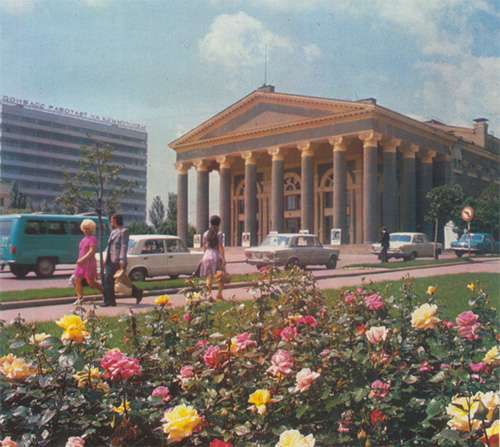
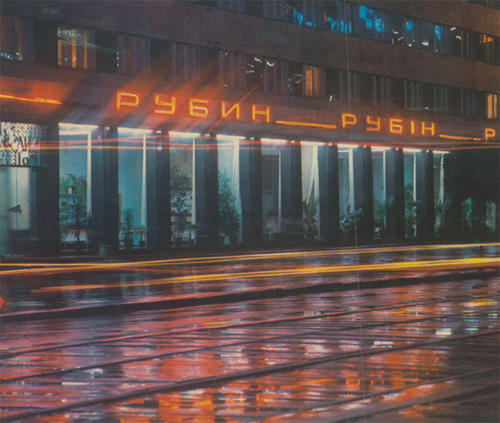
Donetsk. Photo from an album of the 1970s

The past is the locomotive that pulls the future. Sometimes it is someone else’s past to boot. You go backwards and see only what has already disappeared. And to get off the train you need a ticket. You hold it in your hands. But whom are you going to show it to?
—Victor Pelevin, The Yellow Arrow

I was born in Donetsk to a family in whose home there were two diplomas on the bookshelf: a factory furnace builder’s and an artist’s. The holders of these diplomas desperately tried to build their happiness on the ruins of a communism that might have been. But what seemed like temporary measures turned into permanent professions, and now my father is a taxi driver with years of experience, and my mom has been selling flowers for fifteen years. Earnings were laid away; I studied foreign languages, graduated from a lyceum, got into university in Kyiv, and then went to Europe to study. It is time, in my self-imposed exile, to reflect on where I come from and how to live with it.

The Donbas, where I lived for eighteen years and where my friends and family still live, has now borne the brunt of post-Soviet society’s collective hysteria. And so I feel all the consequences of the conflict that has broken out in my country and that rages in the hearts of many of my countrymen. Attempting to analyze what has happened is primarily a way of understanding myself, this flimsy construction of memories, desires, and ideas that threatens to crumble with each new surge of emotions.

In the most difficult moments of internal fragmentation and rethinking, I remember what French writer Amin Maalouf wrote on this subject in his essay “Deadly Identities”: “The identity cannot be compartmentalized; it cannot be split in halves or thirds, nor have any clearly defined set of boundaries. I do not have several identities, I only have one, made of all the elements that have shaped its unique proportions.” However, I have trouble with my identity, and finding its advantages and positive aspects is a matter of survival and mental health.

Today, the line between absurdity and reality has seamlessly disappeared for a long time to come, obviously, and one spends all one’s mental energy only on understanding the causes of what has happened. For example, why did the separatist movement turn from a marginal idea in the east of the country into the cause of a political and military conflict that has riveted the world’s attention for several months? Why does the line of fire run along the borders of the Donetsk and Luhansk regions? What exactly does this line separate? Russia and Ukraine? Asia and Europe? The Soviet Union and the capitalist West? The best minds (and not only the best minds) in different countries have been strenuously and almost fruitlessly reflecting on these questions day after day, especially in Ukraine, for which the situation proved indecently unexpected. I won’t hidе the fact it was a surprise for me as well, and for all the people in Donetsk I know.

Donetsk is a city that had always lived comfortably without any ethnic identity. It is a city of immigrants, ex-prisoners, and a totally impoverished proletariat that owns nothing but the strength of its own hands. Its center was never a church or town hall, and for a long time no public square was provided in the city plan for assemblies or celebrations. The heart of Donetsk was the factory, something terrible, dangerous, and unpredictable, and at the same time necessary, generous, and paternal. The factory and the mine played the role of idols and taboos: they gave life and had the right to take it away.

don-2
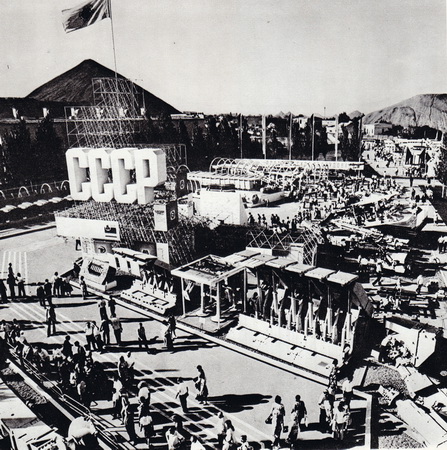
Donetsk. Coal ’75 Expo

Self-definition was based primarily on the principle of “private property,” which clearly divided the proletarianized city and the kulak villages long before these concepts were adopted by the Bolsheviks. The total opposites of the townspeople psychologically, culturally, and economically, the villagers spoke Ukrainian to boot. Few people nowadays know (and usually just deny the fact) that people who spoke Ukrainian had also inhabited the region. The reasons for this memory lapse largely lie in the policy of collectivization, “dizziness with success,” and the famine of 1932–1933. My great-grandmother, a resident of the village of Chicherino in the Donetsk region, was one of three survivors in a family of eleven children. The first time she talked about what she had been through was at the age of ninety, when she was finally convinced the hammer and sickle had been removed from the village council building for good and the yellow-and-blue flag had been hanging there for several years. It was already her grandchildren and great-grandchildren to whom she told her story. She talked about executions and cannibalism, finishing her story with the phrase, “If only Stalin had known.”

According to those whose children and parents had died of hunger, none of it would have happened if Stalin had known. It is quite scary to realize it is the regions that were most affected by the man-made famine that deny this crime most furiously. I am not willing to support Ukrainian politicians who claim it was a genocide of the Ukrainian people. The people who spoke Ukrainian back then did not always think of themselves as a nation, but they did feel the land belonged to them and they held onto it until the bitter end. My great-grandmother’s family suffered not because they spoke Ukrainian, but because they did not want to give up their patch of black earth and their cow. It was easier to nurture the new “Soviet” man on this scorched earth, and it was not hard to convince my grandfather to speak Russian and be ashamed of his uneducated mother, babbling in a dialect alien to the mighty country.

I was born to a Russian-speaking family, but I went to a Ukrainian-language school (then one of fifteen in a city of a million people) only because it was close to home. I never cease thanking the heavens that my teachers were people with “double” identities who gave us the ability to think critically and try on different “folk costumes.” Thanks to our history lessons, Bandera is not a dirty word to me, but nor is he a guiding light. I was never faced with the question of choosing heroes and ideals, because I felt my future should not and would not depend on my country’s past. And the issue of countries never came up. I always loved the Russia “we had lost,” while contemporary Russia mostly inspired pity and disgust, increasingly causing me to try on the Ukrainian embroidered blouse known as “it’s not much of a democracy, but it’s a democracy all the same,” because it obviously fit better.

don-3
Donetsk. Photo from an album of the 1970s

While I was wearing embroidered blouses, speaking Russian in Lviv, studying French in Kyiv, and insisting on my proletarian background in the company of European students, life went on its own way in the Donbas. When revolution began in Ukraine, I once again actively reconstructed my identity, organizing fellow citizens to demonstrate outside a UN building in Geneva, giving fiery speeches about my love for Ukraine, feeling I was needed, and also feeling guilty towards those who were risking their lives for our country.

Then one day some Donetsk friends sent me a video. A column of several hundred people with foreign flags and shouting the name of a foreign country march down Ilyich Avenue, where I was born and where I went through more than one stage of socialization. A woman at a bus stop ostentatiously displays her Ukrainian passport, which the marchers snatch from the woman, violently insulting her in the process. I can use bare facts, surveys, and other data to analyze why this happened, but I cannot get my head around the fact that it happened on my street.

As a native of Donetsk, what has surprised me about this situation is the demand of the regions to grant them greater economic and cultural powers. Over many years, not counting the Kravchuk and Yushchenko administrations, the Donbas received unprecedented subsidies, since the Donetsk and Dnipropetrovsk clans were in power. But the local bosses, who tirelessly chanted the mantra that Donbas money was going to feed the idlers in Lviv and Kyiv, pocketed the money. The region’s economy was totally controlled by the local authorities. What greater powers could there be to give? And to whom could they be given? To the same local bosses who all these twenty-three years, working like dogs, “raised the Donbas from its knees”?

They say each region should decide what language to speak and what heroes to honor. But in order to decentralize one fine day, it would be first necessary to centralize the country around a common cultural concept. Complaints about excessive Ukrainization of the region not only do not correspond to reality, but contradict it. Ukrainian was more exotic sounding than Arabic in Donetsk: I never heard anyone speaking Ukrainian on the streets there. No newspapers were published in the language, and the local TV stations did not broadcast in Ukrainian. To find the books I needed on Ukrainian literature, I had to order them from Kyiv. The last step to de-Ukrainization was removing the Ukrainian flags from government buildings, which were the few signs of Ukraine’s presence in its eastern lands. And the popular masses took this step to de-Ukrainization.

The Ukrainian project failed because it did not succeed in making the Donbas part of Ukraine over these twenty-three years. No unifying idea based on a vision of a common future, rather than on the historical legacy, on ethnic and linguistic identity, was found. So Ukraine lived for its heroic and tragic history of the struggle for freedom, while the Donbas was left to dream about returning to the Soviet Union.

don-4
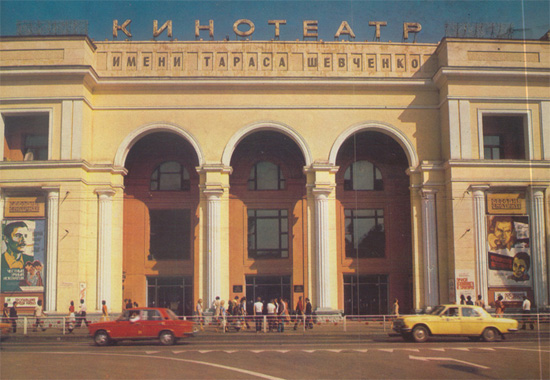
Taras Shevchenko Cinema, Donetsk. Photo from an album of the 1970s

The project of creating a “Soviet people” was a success in the Donbas, and now the hour has come to reap its fruits. The fact that the “Kyiv junta” is being warded off there with two iconic images simultaneously—those of Stalin and Christ—should not be taken seriously. They are merely symbols, shells, talismans, and amulets. People in the Donbas are motivated by the honest desire, which no one makes any bones about, to obey someone who can embody the image of the “father” (or batya, in the common parlance).

Whence this desire for a strong hand? Increasingly, journalists provide a simple explanation: it is all because mentally, physiologically, and almost genetically they are slaves, sovoks (homo Sovieticus), irrational, and uneducated besides. I find explanations like this unacceptable. They render this gap almost biologically insurmountable, and doom attempts to find common ground to failure before they start.

First of all, it is worth remembering this society had no experience of building horizontal social ties. This chance was first given in 1991, but the criminal clans quickly took advantage of it. They grabbed the “strong hand” baton, leaving behind, in terms of social welfare, the working people, who were totally out of their depth and utterly discouraged.

A government that controls nothing, but instead shifts responsibility to its citizens, is a weak government. For example, many people in Donetsk consider democracy a weak form of government. Why are the local housing authorities dysfunctional? Why are there no light bulbs in the stairwells of residential buildings? Because all that has multiplied like rabbits is democracy and freedom, they think. Freedom turned out to be something no one needed, because it was confused with the liberty to do what you want and survive as you can.

Thanks to the experience of living in a European country, I became aware of the inconsistencies in this understanding of freedom. I once had to explain to a Western classmate the perennial dilemma of our society: the question of whether order or freedom was more important. He saw such reflections as something out of the Middle Ages, because for many Europeans it is evident that the freedom of each citizen is the sole guarantee of order. Freedom of choice and democracy are, in fact, the mechanisms that enable society to control those it elects to leadership positions.

don-5
Donetsk. Photo from an album of the 1970s

It seems the Donbas lived until 1991, and after that it only survived and was more like a terminally ill patient. It was not only high salaries that disappeared along with prosperity but also the meaning of life, which had been based on a belief in slogans about the invaluable contribution of miners and workers to building the bright communist future. And then it was gone: the privileges, the confidence in the future, and the pride in one’s work. Poverty is easy to manipulate, and the people who stated at every opportunity that “the Donbas feeds Ukraine” and that it “could not be brought to its knees” have secured a comfortable future for themselves at the expense of the region’s population, who live below the poverty line.

All these twenty-odd years, people of the Donbas who had been born in the Soviet Union recalled it with nostalgia, reviving only the good things in their memories. My mother often recalled how there was such delicious fatty milk every day in kindergarten, and how she had been paid a phenomenally high salary for frescoes depicting athletes and cosmonauts on the walls the Mariupol House of Young Pioneers. Even queues for dish sets and rugs, and then for sausage and bread, were recalled as something bright, as a symbol of the people’s unity amidst its misfortune. After all, almost everyone stood in queues for sausage, and those who did not stand in them avoided flaunting their wealth.

People are not looking for politicians who tell them uncomfortable truths. And the truth is that the coal industry has long been a loss-making dead end. The whole industrial structure of the Donbas has to be changed and the process of retraining the region begun: there are no other chances. It is not hard to guess that the population has preferred to be robbed, but consoled. In Orwell’s anti-utopia 1984, there is the following passage: “[Winston] knew in advance what O’Brien would say. That the Party […] sought power because men in the mass were frail, cowardly creatures who could not endure liberty or face the truth, and must be ruled over and systematically deceived by others who were stronger than themselves. That the choice for mankind lay between freedom and happiness, and that, for the great bulk of mankind, happiness was better.” Maybe those born in the Donbas can fully sense the meaning of these lines.

The Soviet-era rhetoric came back pretty quickly, while the standard of living increased very slowly: the population contented itself with the myth of the good life more than the real thing. My neighbors on the landing spoke with pride of what a pretty stadium Rinat Akhmetov (the oligarch and “boss” of the Donbas) had built, and how nice it was that the European football championship was being held in our city. They were genuinely happy, although they had no way of buying a ticket to any of the matches and had no idea who had footed the bill for building stadiums they could only look at from afar.

All reputable political forces in the Donbas persistently promised one thing: union with Russia. No one dared promise a return to the Soviet Union, but the descriptions of Russia were exact copies of a landscape from the lost Soviet paradise. In this fairytale Russia, everyone was equal, loved the motherland and the supreme leader, despised the rotten West, and belonged to the Moscow Patriarchy of the Orthodox Church (the real patriarchy). But most importantly, everything was stable in Russia: there was a normal life there without shocks and unnecessary hassles. Well yes, there were parasites there, too, who scoffed at the government and the church, demanding some kind of freedom, but they were quickly isolated from normal healthy society, thank God.

don-6

Honest naïve citizens believed in this caricature of the Soviet Union. They took the flagrant mockery at face value and raised it on a pedestal as a national idea. This unimaginably grotesque amalgam of tsarism, Stalinism, National Bolshevism, Eurasianism, the cult of victory in World War Two, and Orthodoxy was crowned with the name of Putin, who subsequently betrayed the sincere faith of Donetsk’s people.

I am faced with a lot of questions. First, how will these deceived people go on living if the twenty year-old promises of the Russian world do not come true? Second, how will those who never believed in these fairytales live alongside them? How can I return to my hometown? After all, my age-mates, who once waited outside the entrance to my building to scare or insult me for the fun of it are now toting machine guns and having fun the adult way. Who knows when I will get answers to my questions, when I will be able to live at home and not travel in search of gracious hosts willing to shelter me. Who knows when my parents will again find work in desolated Donetsk, where no one takes a taxi nowadays, and flowers are bought only for funerals.

Identity comes at a high price to us. Thousands of people have been killed, and one of the reasons is so that more and more Russian-speaking people in the country can say with confidence, “We are Ukrainians,” not because we speak Ukrainian, but because we want to be free. People are not free if they do not want to know the truth and are comfortable living in ignorance. People who began to think become free. That is why I want Ukraine to become free in the search for truth, which often hurts the eyes, but cleanses the soul.

Hanna Perekhoda, a native of Donetsk, is a student at the University of Lausanne. Translated by the Russian Reader. Images courtesy of OpenLeft.ru.