Terror in the Life of Yuri Dmitriev
Tatiana Kosinova Cogita.ru
June 1, 2017
On May 28, 2017, the Anna Akhmatova Museum in Fountain House in Petersburg hosted a presentation of books of remembrance, edited by Yuri Dmitriev, chair of the Memorial Society’s Petrozavodsk branch, who was arrested on trumped-up charges in December 2016.
The presentation was organized and emceed by Anatoly Razumov, head of the Returned Names Center at the Russian National Library and editor of the Leningrad Martyrology.
Agreeing to Razumov’s request to host the event, the Akhmatova Museum decided not to mention Dmitriev’s name in the event’s poster, on its website, and its mailing lists, as if it were already clear to everyone anyway what and who would be discussed. The event’s ostensible occasion was the eightieth anniversary of the Great Terror. Until the late spring of 2017, this had seemed possible in a museum dedicated to the life of the woman who wrote, “I would like to name all of them by name.” Unnoticed by the majority, however, a new wave of state terror has touched not only Yuri Dmitriev but also Petersburg, far from Petrozavodsk. A public museum risks providing a venue for an event in support of a man persecuted by the state, while making this man a figure of silence.
When the Petersburg Memorial Society found about this approach to Dmitriev, it was too late to find a new venue. It managed only to send out its own mailing list. The newspaper Moi Rayon mentioned the editor of the Karelian memorial books in its notice of the presentation, and the radio station Echo of Moscow in Petersburg mentioned the presentation as well. Unlike Petrozavodsk, where the presentation was poorly attended, the small hall at Fountain House was nearly packed, and reporters were present.
Dmitriev’s daughter Ekaterina Klodt came from Petrozavodsk for the event, joined by Dmitriev’s defense attorney Viktor Anufriev from Moscow, and Dmitriev’s colleague Nikolai Olshansky, director of the Novgorod Regional Society of Rehabilitated Political Prisoners and editor-in-chief of the Book of Remembrance of Victims of Political Repression of Novgorod Region. Irina Flige, director of the Memorial Research Center, was also involved. TV editor Bella Kurkova, who was scheduled to attend, did not come. In the early 2000s, she had filmed Dmitriev for a program, and Razumov showed an excerpt of this program to the audience.
Razumov has been friends with Dmitriev for fifteen years and considers him an astonishing man not only in terms of Karelia but also nationally. Razumov was involved with Dmitriev in searching for the prison camp cemetery on Sekirnaya Hill on the Solovki Islands. He continues to hope that Dmitriev will find the burial sites of the so-called second and third Solovki quotas of 1937–1938. Razumov still considers his friend’s most surprising find the cemetery of the tortured Belomorkanal construction workers at Lock No. 8.
“When he found himself in his present circumstances, he was accorded incredible support, and I haven’t met a man who would doubt his honest, kindness, and personal qualities,” Razumov said when opening the evening.
Razumov brought two books previously published by Dmitriev to the presentation and displayed them as historical artifacts. The first of these was the Memorial Lists of Karelia, 1937–1938, edited by Dmitriev and Ivan Chukhin, chair of the Karelian branch of Memorial. Dmitriev was Chukhin’s search expert and right-hand man, and after Chukin’s premature death in a car accident in May 1997, Dmitriev also had to master the skill of searching the archives. The book was published only in 2002 and is now rightly regarded as one of the best of its kind.
The second of Dmitriev’s main books, The Sandarmokh Execution Site, originally published in 1999 and long a bibliographic rarity, will be republished. Dmitriev has approved aplan to republish the book under a new title, The Sandarmokh Memorial Site. The new book will be a revised and expanded version of the first book about the memorial cemetery.
“I don’t know what else we can do. But we have managed to do something. We have turned some of the execution sites into memorial sites. May they remain memorial sites forever. That was Yuri’s dream,” said Razumov.
Anatoly Razumov
Razumov discussed two new books by Dmitriev, completed through the efforts of colleagues and friends: The Krasny Bor Memorial Site, which lists people executed at the site, and The Motherland Remembers Them: A Book of Remembrance of the Karelian People. Dmitriev had compiled both books before his arrest, and his friends and colleagues finished editing them and hastily published them in May of this year, before the start of his court trial. The books were presented in Petrozavodsk on May 24. The book will be available in Moscow in a week’s time both as DVDs and paper books. Roman Romanov, director of the Gulag Museum, has found the means to publish them. Five hundred copies will be printed in Moscow for the presentation, which takes place at the museum on June 6, 2017. It took Dmitriev many years to write these books. Krasny Bor was discovered twenty years ago, like Sandarmokh, in 1997. The site of mass executions in 1937–1938, it is located in a forest four kilometers from the village of Derevyannoye in the Prionezhsky District of the Republic of Karelia and nineteen kilometers from its capital city, Petrozavodsk.
According to the website of the Virtual Gulag Museum, Dmitriev conducted a detailed survey of the burials there. On the basis of typical depressions in the topsoil, he discovered around forty burial pits, each of them approximately eight meters in diameter and two and a half meters in depth. The Prionezhsky District Prosecutor’s Office confirmed that the Soviet NKVD had carried out mass executions at the site. According to prosecutors, the executions had been carried out during two periods: August 9–October 15, 1937, and September 26–October 11, 1938. During the digs, Dmitriev ascertained the number of people who had been shot (1,193) and most of their names, which are now included in the book Krasny Bor Memorial Site. After Dmitriev’s arrest on December 13, 2016, Jan Rachinsky, co-chair of Moscow Memorial, and Anatoly Razumov worked on the book. Dmitriev was able to carry out the final corrections in the Petrozavodsk Pretrial Detention Facility.
Razumov also presented The Book of Remembrance of the Karelian People. Dmitriev favors a geographical principle when drawing up lists of the executed, rather than alphabetical order. In his opinion, it is easier for people to find loved ones this way: the book is thus literally localized and bound up with Karelian history. The Motherland Remembers Them contains lists of Karelians who perished during the Great Terror.
The discs were available at the presentation, and they can also be obtained at the Returned Names Center and Memorial in Petersburg. Razumov reminded the audience that Dmitriev had always handed out all his remembrance books for free, but only to people who could say something about their perished loved ones and who had thus preserved their memory.
Sandarmokh Memorial Cemetery. Photo courtesy of Virtual Gulag Museum
Special Settlers in Karelia is Dmitriev’s latest massive work, on which he has been working for years. It deals with all those who were exiled to Karelia during the Soviet period: dekulakized peasants, deportees, and forced settlers—tens of thousands of people. Dmitriev launched his work on the book in the 1990s, but a great deal remains to be done.
Yuri Dmitriev’s house in Petrozavodsk “has been turned from a workplace into ruins. The police came, stomped about in their boots, and confiscated his computer, which contained his old and new remembrance book, on which work was still underway. But we shall continue the work,” Razumov said as he concluded his opening remarks.
Eldest Daughter
Ekaterina Klodt, Yuri Dmitriev’s eldest daughter
Ekaterina Klodt, Dmitriev’s eldest daugther, is very proud of her dad.
She and her friends were always struck by her father’s deep, penetrating eyes. Outwardly harsh and headstrong, Klodt’s father is a very kind and caring man on the inside.
“He’s a friend, a friend to everyone: colleagues, children, and grandchildren. He puts himself in everyone’s shoes. You can talk to him about anything.”
Klodt is the only person allowed to visit Dmitriev at the pretrial detention facility.
“I’m used to seeing him with his hair grown out and a long beard, like a lumberjack. But in there, his beard has been shaven and his hair cut short. He looks fifteen years younger. He’s had time off from sitting at the computer. At first, of course, I burst into tears, and he burst into tears. It is very difficult to talk through the tiny window.
“But his spirit, as always, is determined and militant. Father has always been someone we can all look up to, a paragon of strength and self-confidence.”
Klodst visits her father along with her own children.
“When his grandson and then this granddaughter followed me into the room, his eyes lit up. I had never seen Dad cry. He was genuinely happy.”
Klodt said prison was not a place where grandchildren should see their grandfather.
“That’s the reality. The children know where their grandfather is. They come with me to see him and will keep coming with me.”
The last time Klodt saw her father was in mid April.
Klodt said she has been communicating with her younger sister. Adopted by Dmitriev, she loves her dad very much, misses him a lot, and is worried about him. The girl hopes this ridiculous story will soon end, and she will again live with her dad.
“We lived side by side for so many years, as a single family. My children are her age. She and my son are the same age, and my daughter is a year younger. I treat her like one of my children, although she regards me as her sister. She is great friends with my children.”
Klodt cannot see her sister.
“She writes,” Razumov added.
Klodt feels sorriest of all for the confiscated computer. Day after day, she saw her father working, and his work was everything to him.
“The man spent a huge number of hours at the computer. His entire life was working on the computer and the digs. Knowing how much time he worked on the computer, I was constantly worried how he would get along in the pretrial detention facility without his dead ones.”
Klodt was twelve years old when Sandormokh was discovered twenty years ago. Her father took her along on the expedition to the area near Medvezhyegorsk. Klodt’s eldest son, Danya, had recently been traveling into “that huge forest, teeming with gadflies.” Danya is as old now as she was in 1997. This year, whatever the court decides, Klodt and her children will travel to Sandormokh on August 5 for the International Day of Remembrance.
Two Searches
Irina Flige (left)
Irina Flige and Yuri Dmitriev met exactly twenty years ago, in the spring of 1997 at the FSB archives in Petrozavodsk, “a normal place to meet if you’re people working on the memory of the Gulag.”
“That meeting was a point where two searches converged.”
“Such a narrow circle of people has gathered here today that I want to use the familiar mode of address, so I will refer to Yura rather than to Yuri Alexeyevich. At this time, Yura and Ivan Chukhin had located the main sites where executions and burials had taken place in Karelia during the Great Terror. Karelia is the only region or one of two or three regions where the documents stipulate the places where the sentences were carried out, that is, they indicate they occurred in the vicinity of a village or town. By this time, they had managed to compile a complete list of these places. And by 1997, many of the actual locations had been ascertained. For its part, the Memorial Research Center moved from the Solovki in search of the place where the so-called 1937 Solovki quota was executed. This was where our searches converged. We planned a joint expedition of the Petersburg and Petrozavodsk branches of Memorial to an area near Medvezhyegorsk on July 1, 1997. There were four of us who traveled there, not counting Yura’s dog. The expedition was led by Veniamin Iofe, who had done all the preliminary research before we traveled to the site. He had pinpointed the search area to within a kilometer. We set out on the expedition, thinking we would be working there all summer,” Flige recounted, continuing Klodt’s story of the search for Sandarmokh.
Anatoly Razumov took the opportunity to note that all the particulars of the expedition are extremely important, because “Yura was arrested due to Sandarmokh, to put it crudely, due to the fact that the place had become such an irritant.”
Flige illustrated her account with images from the website Sandormokh [sic], which was launched with Dmitriev’s involvement in November 2016. One of the long articles on the website describes the search for Sandarmokh.
Screenshot from the website Sandormokh
“Yura is a restless, active person. At some point, he grabbed the dog and ran off round the forest. Yura has a fantastic intuition. He was running in circles around a place where we had marked out a grid and started systematically digging meter by meter. He ran up to us at some point. ‘Come on, I think I’ve found it.’ Indeed, the place was quite striking. Common grave pits subside in a way that resembles saucers. Yura had seen there many such places there,” recalled Flige.
Sandarmokh was found on the very first day of the expedition, July 1, 1997. The shooting pits, marked by lathe fence, its pales numbered in red lacquer by Flige and Klodt, still constitute the basis of the memorial cemetery.
The lathe fence has given way to poles topped with dovecote-shaped wooden monuments, resembling Orthodox crosses in northern cemeteries.
In 1997, memory was quite alive all over Russia and functioned instantaneously, argues Flige.
“Knowledge and memory were closely related processes. One process immediately followed the other,” she said.
Sandarmokh was officially opened on October 27, 1997. In the four short months since its discovery, road builders had built a paved road to the site in record time, a log chapel had been erected, and the dovecote-shaped memorial markers were all in place. The Republic of Karelia hastily enacted a decree declaring the memorial cemetery open to the public.
“I ran around with the forest managers to mark off the border. I would add space all the time, because what if we had missed a pit? But they would add another thirty meters. It was a breakthrough in common, a breakthrough of knowledge, respect, and memory all at the same time.”
Sandarmokh is the only place in Russia where the August Fifth International Day of Remembrance is held. It has been held since 1998. The people who were shot there were not immediately sentenced to be shot after their arrests, but had spent time in the camps on Solovki and the Beltbaltlag. They had come to the camps from different parts of the Soviet Union. For the last twenty years, delegations from different countries and different parts of Russia have come to Sandarmokh on August 5. It has become the “only venue where people of different ethnic groups and faiths can meet and still speak the same same language, the language of memory.”
The website about the memorial cemetery includes a separate section, “Killed in Sandarmokh,” created by Yuri Dmitriev. It features biographical information about the residents of Karelia executed on this spot in 1937–1938.
It is also telling that Kurkova filmed her program on Sandarmokh with Yuri Dmitriev’s involvement.
A Colleague from Novgorod
Nikolai Olshansky
In Novgorod the Great, The Book of Remembrance has been published since 1993. Late 2015 saw the publication of its fourteenth volume, and there are plans to publish a comprehensive index to the previous volumes that would include information about residents of Novgorod Region subjected to state terror from 1917 to 1970. Nikolai Olshansky, the editor of these volumes, met Dmitriev eight years ago.
Olshansky also continues to pin his hopes on the genius of his Karelian colleague for finding burial sites in his own region. In Novgorod Region, the internment site of fifteen hundred Novgorodians shot during the Great Terror in Novgorod itself has not been ascertained (five thousand Novgorod residents were taken to Leningrad to be shot), nor has the execution site of five hundred residents of Borovichi been located.
Olshansky believes that he once “prophesied” his colleague’s misfortune.
“Yura, your directness and harshness are going to get you put in jail someday,” he told Dmitriev.
During the event at the Akhmatova Museum, Olshansky wished Dmitriev the will to withstand all the trials of detenition. Olshansky does not believe the prosecution’s charges. Under the Soviet regime, he himself was sentenced to four and half years of compulsory treatment in a psychiatric hospital on the basis of a denunciation, an experience from which he has never fully recovered.
The Defense Lawyer
Attorney Viktor Anufriev appeared at the event, answering the audience’s questions. He argued that the law in Russia still exists autonomously from law enforcement. Dmitriev’s rights as someone who has been accused of a crime are observed to the extent they permit the authorities to keep him under arrest by constantly extending the term of his detention. Anufriev is certain of his client’s innocence. There is no evidence of a crime in Dmitriev’s actions.
The case began with one charge, but now there are four, said Anufriev. The case file now consists of five volumes. The indictment now includes an illegal firearms possession charge: the firearm in question is a piece of a hunting rifle, which had been lying around Dmitriev’s house for twenty years and which the prosecution itself does not consider capable of firing. Once upon a time, Dmitriev had confiscated it from the lads in the yard, to keep it out of harm’s way. Why has he been charged with its possession? Anufriev argued that there are two hypotheses. In Soviet times, this article of the criminal code was brought into play if the main charge had been dropped to justify the arrest and pretrial detention. In our times, on the contrary, the court can find a defendant not guilty on this charge, to make a show of his objectivity.
“But the entire machine of repression is rigged against Dmitriev in such a way that there are very good chances he will remain in custody,” said Anufriev.
Anufriev argued that his job was to prove his client’s innocence on the basis of the law. Analyzing the circumstances with which Dmitriev’s persecution were fraught is not part of that job. But those who follow the trials underway in Russia see that, nationwide, similar things have been happening to people whose work the regime considers unnecessary and harmful.
The upcoming trial will be closed to the public. The first hearing on the merits of the case will take place in Petrozavodsk tomorrow, June 1, 2017, at 2:30 p.m.
Anufriev believes that no one’s testimony would help Dmitriev in making his case. His adopted daughter has said nothing bad about her father. The situation was such that Dmitriev adopted her when she was in a very poor physical state. It was hard for Dmitriev to adopt her: to become her foster father, he had to attend a number of court hearings. Until his own adoption, Dmitriev himself had been raised in an orphanage. Having raised his own children, Dmitriev felt obliged to raise another child. The authorities, who gave him custody of the child through the courts, initially tried to take her away. Three or four months after Dmitriev adopted, “bruises” from “beatings” were suddenly discovered on the girl’s body. They proved to be traces left by a newspaper through which her foster parents had applied mustard plasters to her body. Having gone through this experience, Dmitriev periodically photographed the girl from all four sides, storing the photographs in a file in his computer according to month and year. He did this in case children’s protective services made any complaints about his treatment of the girl. He showed the photos to no one. Over the years, he made fewer and fewer photographers. It would not occur to a normal person that these snapshots could be interpreted as pornographic. According to police investigators, there are 144 photographs, only nine of which investigators have interpreted as “pornographic.” This is the basis of the trumped-up charges that he committed perverse actions by clicking his camera. He clicked it three times a year, and has been charged with violating three articles of the criminal code that could send him to prison for up to fifteen years. The case kicked off with anonymous letter (a denunciation, as we say in Russia) that so-and-so, allegedly, has naked snapshots of his foster daughter stored on his computer.
“As someone who has lived a fairly long life and as the father of several children, I can say there is nothing pornographic about those photos,” said Anufriev.
“Yuri Alexeyevich feels well, as well as he can feel in the place where he is and given his age. He has not lost his optimism and perseverance, either. He understands the situation soberly. As a scholar of the Terror, he has seen and read his fill and could understand that it might affect him as well. Such is our country’s history. I could joke about it and say that the one good thing is people are no longer executed in Russia. But the practice is such that if someone was in custody before his trial, his complete acquittal would be someone else’s complete punishment. That is why it happens so rarely. We would be glad if the case were allowed to fade away.”
You can exchange letters with Yuri Dmitriev. Send your letters to: Respublika Kareliya, Petrozavodsk, ul. Gertsena, 47, SIZO No. 1.
Hyphotheses
Ekaterina Klodt cannot explain who would want to file charges against her father. She doesn’t know the answer to that question, but, according to her, “what he does might not suit everyone.” She regards the criminal prosecution of her father as “completely absurd.”
“It’s frightening, very frightening,” she said.
She said she knows nothing about the search for those did the killing (according to one hypothesis, the charges against Dmitriev were occasioned by his work on drawing up lists of executioners, of the people who implemented the Terror in Karelia).
“We never discussed it, and I don’t think he searched for the executioners. They were not so interesting to him. He always searched for the victims, the people who had been shot. They were the dead who interested him. He wanted to preserve their memory and believed everyone of them should have a grave. He was very concerned for the living, for the descendants, so they would be able to come to a cemetery, to a burial site, pay tribute to their ancestors and remember their loved ones,” said Klodt.
“In Russia, the truth usually becomes obvious after several decades. We can only guess whose toes Yuri Alexeyevich stepped on, and with what upcoming events it is connected. We can analyze our regime’s level of thinking and focus in terms of this case, as well as the direction in which it is headed, and the measures it takes to preserve itself. Yuri Dmitriev was not a member of the opposition in the Republic of Karelia. He did his work in the sincere certainty that it was of use to people and to his country. But it turns that at one point the state says that this work is necessary, that we have to establish what happened, that we have to publish books of remembrance of the victims of the Terror, but time passes and all of this becomes inconvenient to the state. The shadow of the past hinders the current regime. And Yuri Alexeyevich’s work has become not very popular, not so vital, and seemingly unnecessary. By looking for execution sites, Yuri Alexeyevich discredited the previous regime. The time has come when someone has deemed his work unnecessary and even harmful,” argued Viktor Anufriev. “The people who cooked up this case for their own purposes should have long ago understood that the case is so crazy that public opinion has been aroused. I have worked for a long time and know how easy it is to put someone away by planting a bullet or narcotics on him, but trampling a man like this…”
Anufriev argued that the best outcome in the case would be complete acquittal on the pornography charges. Despite the fact that cases involving depraved actions with respect to minors go badly against teachers and priests, this case stands apart.
Anatoly Razumov noted that Karelian children’s protective services had no complaints against Dmitriev during all the years he had custody of his foster daughter. This transpired during a special session of the Presidential Human Rights Council in Petrozavodsk in February of this years, a session in which Razumov, Flige, and Anufriev were involved as invited experts. According to Razumov, Sandarmokh had become the “main sore spot and irritant in the region.” But the authorities were mistaken. Dmitriev had proven to be a man with a man with a strong spirit who loved his children and grandchildren, and almost nobody has believed the accusations.
If Razumov was sure that Dmitriev was arrested over Sandarmokh, whose annual fuss bothered the authorities, Flige argued that closing Sandarmokh by putting Dmitriev in prison was unrealistic. On the contrary, the case had led to a renewed interest in the place, an interest only deepened by speculation as to the reasons for Dmitriev’s persecution. This year, the authorities have createda prisoner of conscience for the memorial cemetery. According to Flige, Dmitriev became a political prisoner the day the TV channel Rossiya 24 broadcast a made-to-order news segment entitled “What Is Memorial Hiding?”
Event photos courtesy of Nadezhda Kiselyova and Cogita.ru. Translated by the Russian Reader
The Dmitriev Affair
Anna Yarovaya 7X7
March 1, 2017
March 12 is, technically, the last day of historian Yuri Dmitriev’s term in police custody during the investigation of the accusations made against him. The 61-year-old researcher has spent nearly the last three months in Pretrial Detention Facility No. 1 in Petrozavodsk. During this time, solo pickets supporting Dmitriev have been held on the streets of the Karelian capital, his case has been discussed at a traveling session of the Presidential Human Rights Council, and the republic got a new governor.
According to Dmitriev’s attorney, the historian will probably be indicted and his case sent to court. Yuri Dmitriev has been accused of producing pornography.
Neither his colleagues, friends or people who have worked at some time with Yuri Dmitriev believe the charges are true. Many link his arrest to the work he has done his whole life: searching for the places where political prisoners were shot, compiling lists of victims of political crackdowns during the Soviet period, and heading Memorial’s Karelian branch.
***
But this article is not about the criminal case, which falls within the jurisdiction of law enforcement. Hoping for a objective investigation, we can only wait for a fair resolution to this situation. We decided it was important to tell readers about the cause to which the arrested historian has devoted his life.
This article might be called a series of interviews about Dmitriev. It has transpired we knew almost nothing about him. On the other hand, it has become clear why a man like him might have been seen as “inconvenient” by the current regime.
From the Author
I met Yuri Dmitriev in 2012. I was on assignment, shooting a story about the construction of houses on the site of a former cemetery, and it led me to the historian. The story first grew into a ten-minute TV program, and then ballooned into an investigative film. We visited archives and former burial sites, traveled to working cemeteries, sat at a computer for hours on end searching for documents, read articles from conventions and laws, and basically worked on the film, Northern Point, together.
What always struck me about Dmitriev was his enthusiasm, which materialized less in the help he gave me and more in his attitude to history, to events that had occurred many years ago. For example, in the same cemetery where I shot the film, he found the remains of a POW. None of the local authorities was in a hurry to bury the exhumed “youth,” as Dmitriev called him. So Dmitriev put the bones in his garage. A while later, he secured a spot in Peski Cemetery, found a sponsor to help him buy a gravestone, and asked the philologist Valentina Dvinskaya to translate the phrase “To the victims of war, disappeared but not forgotten” into German so that it could be engraved on the headstone. He did all this for an unknown man who had been killed over sixty years ago.
The gravestone Yuri Dmitriev erected on the spot where the POW was reinterred
The news of Dmitriev’s arrest was a shock to me. We had not communicated in a long while. A couple of years ago, we had planned to make a film about the burial of prisoners in the locks of the White Sea-Baltic Channel and the so-called Solovki execution transports. Dmitriev is indefatigable and has always been researching numerous topics. But it turns out that I’m not writing about them now.
Anatoly Razumov: The Solovki Quotas Anatoly Razumov came to Petrozavodsk from Petersburg on Dmitriev’s birthday, January 28. His longtime friend and colleague was not allowed to visit Dmitriev in the pretrial detention facility.
“I am here, nearby, and he knows it,” Razumov said to me then.
Indeed, he was nearby. He held a solo picket in support of his arrested comrade. For over an hour, Razumov stood on Petrozavodsk’s main street holding a placard that read, “Happy birthday, Yuri Dmitriev,” enthusiastically telling passersby about what his friend had worked on his whole life. It would have been an unpardonable mistake to turn down such a conversation.
Razumov and I spoke on the phone a couple of days later. I had a sense of déjà vu. The same thing had happened when Dmitriev had told me about the military cemeteries in Petrozavodsk. He had not just spoken, but had asked me a lot of questions whose answers I hadn’t known. “Ig-no-rance,” he would kindly drawl, ordering me to jot down the title of yet another book I “should have read before meeting” with him.
Razumov did not point out the gaps in my knowledge, but I heard about many things for the first time during our conversation. That was probably why the conversation did not turn into a proper interview. It was more of a monologue, a story about his friend, his cause, and his contribution to history. I decided it was vital to reproduce it verbatim, as Razumov told it to me, so readers could understand what a difficult and profound business Dmitriev had been involved in before his arrest.
The Book of Remembrance
I have worked in the Russian National Library (the Publichka) since 1978, and for over a quarter of a century I have been compiling and publishing The Book of Remembrance of Victims of Political Repression. In 1987, I started gathering material, and in 1990, compiling a card catalogue based on the published lists of the victims. I retyped biographical information about them in their birthplaces: Minsk, Tallinn, Pskov, Petrozavodsk, Murmansk, Tver, Novgorod, Kiev, etc.
The first books of remembrance were published in the late eighties and early nineties. Books of remembrance were only taking shape as a genre then. There had always been lots of talk about the war, about the Great Patriotic War: as a topic it was always at the center of attention. But to compile books of remembrance about the war that included lists of the dead and missing in action was permitted only during the second thaw, in 1985. Prior to this, the names of the dead and the missing were not published. The first books of remembrance about the war were usually quite modest in terms of structure: surname, first name, patronymic. They didn’t even always include information about the place of death, and of course there was no personal information about these people.
But a mere four years passed, and we had permission to publish the names of the victims in newspapers, magazines, and books. We were permitted to clean up the burial sites of those who had been shot or died in captivity that had been found. It had been forbidden to write and say anything about the millions of those who had been killed and gone missing during the purges and crackdowns. Whatever person you asked about, nothing was known about him. Then suddenly we could publish this information.
Different people in different parts of the country were compiling books of remembrance. There were lots of enthusiasts, like me and Yuri Dmitriev, albeit not in every region of Russia. None of us had thought we would live to see this great day.
The first book published, in 1989, was The Book of Remembrance of Soviet Diplomatic Corps Workers, victims of purges during the thirties, forties, and early fifties. There were 130 names in the book.
Other books of remembrance were gradually published, regional books, books dealing with particular ethnic groups, with crackdowns against believers of different faiths, with particular sites where those had been shot were buried.
Sandarmokh
I kept track of all the new publications on the history of the Soviet purges and crackdowns. We also needed a bibliography for Pages of History, a digest, published by Lenizdat, of which I was a co-editor. I kept track of the search for sites where the executed had been buried. I was educated not only as a historian but also as an archaeologist. Of course, I knew about the famous site of the Katyn massacre near Smolensk, which had been found long ago. But it was not common knowledge in the Soviet Union or, rather, you were not supposed to know about it, much less about other burial grounds. Of course, there were such burial sites near every major town and city in the Soviet Union.
In 1988, it was a bombshell when they found Kurapaty, an execution site from the time of the Great Terror near Minsk. I published the Belarusians’ story of the find in the Leningrad newspaper Smena, and we wrote wrote about Kurapaty in the Pages of History digest. Everything was read hot off the presses. The reporters at Leningradskaya Pravda called on Petersburgers to report all suspicious areas and find “our local Kurapaty.” Thus, in the spring of 1989, a special security facility was found in the village of Levashovo near Leningrad. It was the largest burial site of executed prisoners in the Soviet Union.
I followed all these developments closely. I knew, of course, about the work in the Karelia. Even before we had met, I had heard about Yuri and what he was doing.
In 1996, I was editing the second volume of The Leningrad Martyrology, which dealt with October 1937, and I needed to publish a list of the prisoners at Solovki Prison who had been shot. Where were they executed? Even state security officers in Petersburg didn’t know: they had no information about it. Yeah, they had been shot somewhere, and it was clearly not in Leningrad, because there was a record showing that one of the regular executioners, NKVD Captain Matveev, had been seconded to Kem in connection with this list of prisoners. That was all.
The second volume was published in 1996 with a preface by Dmitry Likhachov, and in July 1997 Sandarmokh was found. My Lord! There was no doubt prisoners transported from Solovki had been shot there in October and November 1937. That was the first time I heard Dmitriev’s name: in the reports about the find and from Petersburg members of Memorial, whom I knew quite well.
But I met Dmitriev later, as part of the Returned Names project. In 2000, an attempt was made to compile a single database containing the names of all victims of political persecution in the Soviet Union. It was an international project: we were supported by the Ford Foundation. During an academic conference in Nizhny Tagil, my colleagues asked me to be the project’s regional coordinator for Northwest Russia. I surveyed the entire region, and that was when I met Yuri personally.
Personal
Like Yuri, I’m from a military family. Our family wandered a lot. My father served in different places, mostly in his homeland of Belarus, but also with the Soviet troops in Germany. We lived for a time in Berlin, and then Eberswald. I was never able to make friends with my agemates, and I lost track of many of them. I started to make friends at university, and then on the job, the job I got at the library after finishing university. It was God’s will that I do this, that I found a vocation in life that totally suited me.
I had always been disturbed by the question of why it was wrong to think freely and ask questions, why a person’s life was so little valued that it could be ended just like that. A person should live a long life. Why are the tormented deprived not only of life, but even of a grave? You can imagine how I felt when it was possible to talk about executed prisoners. Nothing had been known about them. Not even their relatives said anything about them: either they lied or didn’t know. I took on the job of restoring memory. All the colleagues I met in this new life became kindred souls, but a select few became close friends. Yura was a close friend from the moment we met.
Yura immediately took me in his jalopy to Sandarmokh. We barely made it to Medvezhyegorsk in that wreck. From time to time, he would roll down the window for Veda (aka the dog Ved’ma, “Witch”), and she would happily bark at everything in the vicinity, thus replacing the horn, which didn’t work in that car, I think.
Yura showed me Sandarmokh. That was important to me. By that time, his book The Karelia Memorial Lists was nearly ready. I soon attended the book’s presentation. I opened up the packages from the printers (Yura taught me not to cut the plastic tapes but undo them), handed copies out to people, and made my own speech. It was a wonderful presentation. Everyone spoke very well, including the relatives of the victims, who regarded Yura as an important, valuable person. Since then he has been one of my greatest friends, and a wonderful person with whom to speak when I want to talk frankly.
He would come to Petersburg for presentations of successive volumes of the Martyrology and do what I had done at his presentation.
I liked Yuri’s position. I absolutely understood him. He would just say, “Old women need to know where their dead are buried, and I’m going to do everything to make that happen.” And he did what he could, and he still does that. I’m more in the habit of listening rather than asking questions, which complements his outgoingness and talkativeness.
Yuri Dmitriev and Anatoly Razumov
The Solovki: A Common Cause
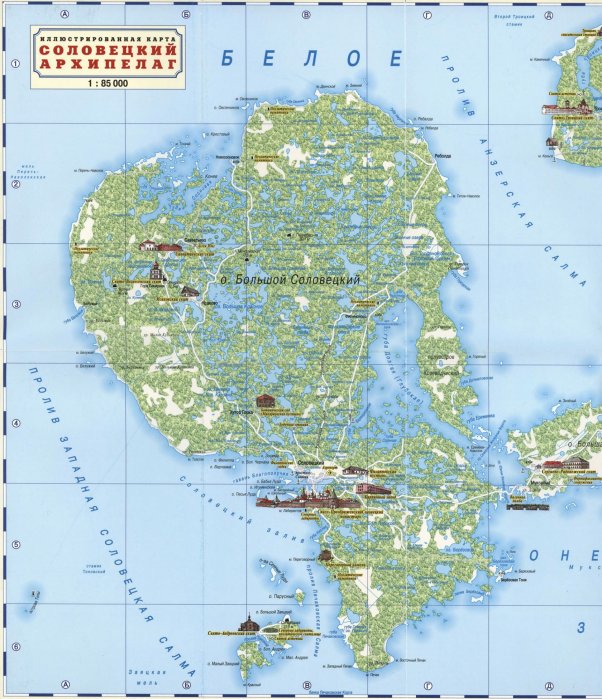
A map of the Solovki Islands
Until the summer of 1937, Karelia was administered by the NKVD’s Leningrad Regional office, meaning that Karelian folk were persecuted here, and people from Leningrad ended up there: their lives crossed. Yura and I exchanged information about the victims: he gave me info about his victims, and I gave him info about mine. Finally, we set about comparing the information about the Solovki execution groups of 1937 and 1938. Sandarmokh had been found, but that was the first group of executed Solovki prisoners. It was the first execution plan, the first “quota.” 1,200 people were supposed to be shot, and 1,111 were shot outside of Medvezhyegorsk. When was the next detachment of executed prisoners? December 1937, the group of prisoners in which Pavel Florensky was shot. Where they were shot remained a mystery. There was no mention of it in the papers I had found in the state security archives in Petersburg. It was forbidden to include information of this sort in the instructions.
Here is an execution order, issued to Commandant Polikarpov: “509 persons [in fact, three people on the list had already been sent to Moscow] from the Solovki Prison should be shot.” But where? Seemingly, since Polikarpov was commandant of the Leningrad office, they would have been sent to Leningrad. At our own peril and risk, when we were editing the fourth volume of the Martyrology (dealing with executions in December 1937), we wrote that the Solovki prisoners had been shot in Leningrad. We published the fourth volume, but questions still remained. After all, there were no documents with accurate information.
A third group of Solovki prisoners, another 200 people, was shot on February 17, 1938. The details about what happened to them were even murkier. If the second group had been transported to the mainland for execution in early December (it was a warm year, and the shipping season ended late), it was altogether unclear where the 200 people were shot in 1938.
In 2004, I decided to go on an expedition. It is each individual’s plight that matters to Yura and me, not statistics. When you read the files, the person appears right before you, and he doesn’t let you go.
Yura and I agreed to travel to Solovki. I couldn’t find a more knowledgeable and closer person to help me look for something on the islands. We were armed with a description of the execution, drawn from the testimony of former Solovki Prisoner officers, interrogated during the Thaw: they claimed the 200 prisoners had been shot on the way from the Solovki Kremlin to the lighthouse on Sekirnaya Hill. I had never been to Solovki. I knew the local places names from looking at maps and papers. So we arrived there in 2004. It was the first tentative expedition. We walked around looking. Yura would immediately stop at any suspicious spot. We would pitch tent in some places and try to probe the soil, but we didn’t find anything.
Anatoly Razumov and Yuri Dmitriev during the 2004 expedition to Solovki
We went again the next year. By then we had become friends with Father Matfei, rector of the Holy Ascension Hermitage, and he showed us all the suspicious spots on Sekirnaya Hill, drawing our attention to the vegetation, trees, and depressions. But I took ill then, and Yura wouldn’t let me go into the field. Yura is the sort of guy who is endlessly concerned about the people around him, albeit sometimes in a rough way. He laid me down with a temperature in a cell in the hermitage, and he went off with the writer Vasily Firsov, who had come along with us on the trip, to investigate one of the suspicious spots. Suddenly, they came running in: “We’ve found them!” Of course, I ran out to have a look and help them with the work. We then uncovered the remains of two prisoners who had been shot.
I was unable to make the trip in 2006: editing the forthcoming volumes of the Martyrology was taking up all my time. Teachers and students from the Moscow International Film School went to Solovki that year. They helped Yura clear the burial site of dry branches, undergrowth, and deadwood, and discovered many more pits. So the discovery of the cemetery where the executed prisoners were buried dates back to then.
And yet our long-standing goal of finding the site where 200 people were executed, the so-called third Solovki quota, has not been fulfiled. There were no more such mass executions on the islands. The site should be a trench or gigantic pit or series of pits. We haven’t found the place, but we’ll find it someday, just like the place where the group in which Florensky was shot, the so-called second Solovki quota. I think we should search near Lodeynoye Field, because the highly decorated executioner Shalygin was dispatched to the vicinity of the Lodeynoye Field Camp. I have told all this to Yura.
This arrest, you see… Not only did they trash his nest, his apartment, brazenly, tramping all over it in their boots, but they also dealt a blow to the work. I’d been helping Yura edit two new books of remembrance and had been sending him information from time to time. Yuri has edited another book of remembrance long ago: it just needs to be printed.
And when it comes to the search for the execution sites, the only hope lies with Yura’s expeditions. I have outlined the range of places to search, and Yura had set about searching. He had got his film school kids involved in the work. Yura and I have work to do together. I hope he will be released in a good frame of mind and finish the two books of remembrance, and I’ll persuade him to publish the third. And if we have the manpower, we will find the places where the second and third Solovki quotas are buried.
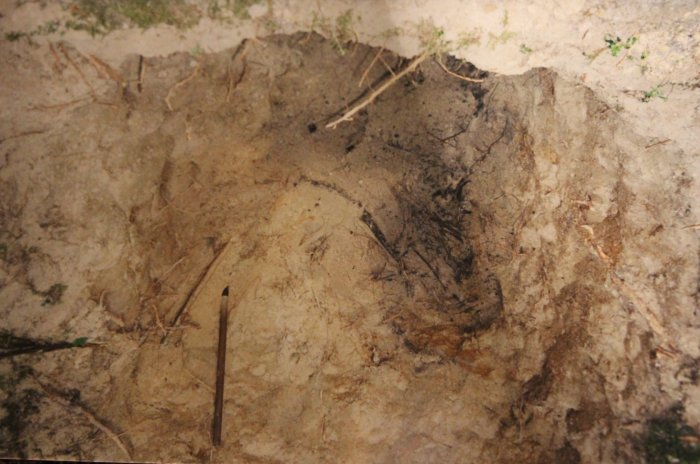
Remains of executed prisoners, Solovki
My Friend’s Arrest
Despite the fact Yuri is easy to get along with, he has keen insight into human nature. He is quite good at sizing up a person, sensing the direction his thoughts are moving. When he comes to Petersburg for the presentation of the latest volume of the Martyrology, what with his speeches, jokes, and irony, people here are just ready to idolize him.
I have thought about why this has happened to Yura now. I have my own opinion on this score, of course: how things were going in that direction, how everything was shaping up. I remember the Brezhnev era. I thought then I would not outlive the Soviet leadership, because I tried to speak my mind. Sometimes you’ll end up sweating like a pig, but if you can, you should try and speak your mind. Yura also acts that way and speaks that way, often in an absolutely denuded, harsh form. I imagine lots of people really don’t like either what he does or how he talks and acts.
Basically, it somehow happened the decision was made to shut him down, to knock him out of his work and life. For Yura is one of a kind, there is no one else like him anywhere else in Russia. And if he is shut down in this way, and it’s done a little more dirtily than usually, everyone else will hunker down. I won’t bother speculating about the specifics, but I’ve read my share of Soviet-era investigative files from the archives, and our modern justice system is based on that Soviet system, alas, not on the old Russian system. I know the clichés, we all remember them. “People don’t go to jail in this country for nothing.” “The prosecutor and the police see eye to eye on the case, and that’s how it should be.” “Our courts are the most humane and fairest in the world.”
I think all this will definitely start to recede someday in connection with some case. Will it be Yura’s case? I don’t know. But there is a chance they hung all this on the wrong man and don’t understand the strength of his spirit.
“They Always Existed”
I think about the horrible purges and persecutions of the Soviet era. I don’t think the crackdowns were harsher during one period and less harsh during a different period. They always existed. Only they existed relative to the political moment, and the persecutions were modified only in those terms. However the regime wanted to crack down on its enemies that was how it cracked down on them.
The current Russian legal system can be described as follows. If we call pre-revolutionary Russia Russia 1, it was followed by the Soviet Union, which wasn’t even Soviet Russia, but let’s call it Russia 2 for argument’s sake. Where do live now? At best, in Russia 2+, because there is no Russia 3. It hasn’t come into being. It hasn’t understood or realized itself. It has its roots in the Soviet past and grows out of that past.
The legal system of the current Russian state doesn’t hold a candle to the system that existed prior to 1917. It’s flesh of the flesh of the Soviet system. I have been interviewed on the subject several times, on the question of whether the purges could happen again and whether they could be even worse. But they are already happening: we have crackdowns right now. Could they intensify? Could they become scarier? You can never say never, but our job is to take a stand against political persecution and stand firm.
Dmitriev’s Daughter Katerina Gleb Yarovoi, my husband and colleague, was the first to meet Katerina. He was the first reporter with whom Yuri Dmitriev’s eldest daughter agreed to talk about her father’s arrest. We then communicated through social networks, and there were money transfers for Dmitriev, which different people sent to Katerina through me. Then we finally met in person at Dmitriev’s house.
“When they came for Dad, they made such a mess there. They ripped out all the wiring, so now the lights don’t work and you have to bring your own,” Katya says by way of explaining the lamp sticking out of her bag.
The last time I had been in the apartment was three years ago. Cigarette smoke, the buzz of the computer, a cup of coffee, and a bar of Osobyi chocolate: that is how I remember working on Northern Point. I cannot imagine how I would have managed without Dmitriev. It was he who showed me an entire period in the history of Petrozavodsk, a time of POW camps, POWs who died in the postwar city from being worked to death and were buried, and the modern residential buildings erected a short time later on top of their remains.
The apartment is completely different now: empty, quiet, gloomy. Disturbed by the police, Dmitriev’s workplace is no longer cosy. A lone pack of Belomorkanal cigarettes lies amidst papers, cables from the computer equipment dangle from his desk, and amongst other books I see the blue cover of The Memorial Lists of Karelia, which Dmitriev and Ivan Chukhin worked on for many years. The apartment’s owner, torn on December 13 from his customary working atmosphere, gazes on the scene reproachfully from a portrait hung on the wall.
“He had a dog then, Veda, short for Ved’ma [“Witch”]. She was with him on all the trips, on all the digs. He found her on Friday the thirteenth, so he called her Ved’ma. He never went anywhere without here. When she died, Dad cried over her,” Katerina tells me, showing me a photo of a dappled mongrel, seated at Dmitriev’s feet.
There are lots of photographs, a whole album. We had come to Dmitriev’s apartment to get them.
Dmitriev’s daughter Katerina
Did your father tell you and your brother what he did, where he would go, what he was investigating?
Of course. I remember that Dad was constantly going on different digs. He was constantly studying skulls, bringing them home. I was still in kindergarten then. We probably didn’t pay much mind to the particulars of his work. But as long as I can remember, he would sleep a couple of hours day. He would sit poring over those cards, he constantly had to dictate something. When we were a bit older, he tried to explain things to us. For example, my great-grandfather, Mom’s grandfather, had been shot. Dad found Great-Granddad’s burial site in a memorial book: the Zaretsk Cemetery next to Exaltation of the Cross Cathedral in Petrozavodsk. I cannot speak for my brother, but I’m a daddy’s girl, and I have always been around him. We would be sitting together, and he would tell me about the plights of people, how they were arrested, and why they might have been arrested then. He was always interesting to be around. His work has always interested me from a personal viewpoint. It’s frightening and, at the same time, interesting.
Did you help him?
It depends. I think sometimes he would have gladly refused our “help.” Say, when my brother and I were teenagers, we were terribly curious about what was on Dad’s computer. We got on the computer and poked the keys. Dad came in, and he was totally shocked: we had accidentally deleted all his files. So then we had to sit there and help him restore everything. It was interesting at one time, but at a certain point it irritated me. Imagine: I was fifteen years old, my friends were waiting to go for a walk, and he would say, “Help me.” And I would sit and dictate to him, and he would be looking for each letter with one finger, hammering out the dates. I would freak out then.
The trips were probably more exciting? Did you often go on the expeditions?
I can’t say I went that often. But as they say, seldom but to the point. One day, Dad said to us, “Who’s going with me tomorrow to Medvezhyegorsk?” My brother and I immediately said neither of us was going, we didn’t want to. But at six in the morning, for reasons I can’t explain, I jumped out of bed when Dad was getting ready to go and said, “Wait! I’m going with you.” And so we set out for the digs. We lived in a cottage on the shore of a lake. Dad’s colleagues from Petersburg and a group of soldiers were with us. The amount of walking we did then was inexpressible. We were constantly on foot. Dad and his colleagues would split up and discuss things amongst themselves. Dad understood, of course, that I needed to eat, that I needed breaks, that it was hard for me, but all the same we walked and searched a great deal. Ultimately, we found what we were looking for. We found Sandarmokh.
Katerina and Dmitriev. Expedition to the Medvezhyegorsk District in search of Sandarmokh, 1997
How did a teenage girl react to such a find?
Probably because Dad was calm about it, I reacted to the remains more or less calmly. The soldiers chuckled nervously when they found bones, and there were people who fainted, wailed, and felt sick. I remember there were very many gadflies and horseflies. The mosquitoes seemed like paradise compared with them. I then had the impression (maybe I believed in the transmigration of souls) that the horseflies were the people we had found. And I felt peaceful and scared at the same time. It’s hard to convey the emotions.
Did you understand why your father did this work?
It came with time. I would often ask him why he was always sitting at the computer and writing or retyping something. He would say, “I don’t know who I was in my past life, but I’ve understood the meaning of my life now, and I know I have to do this.” When I was older, I would constantly tell him to relax and ask him how he could spend so much time sitting poring over the lists and working at the computer. He would say, “I can’t relax. I have to finish the book. They’re waiting for me.” Yet he didn’t do it for money. When The Book of Remembrance came out, people would tell him that he could sell it, maybe even for good money. But he would always reply, “I can’t make money off of people for whom these memories matter, because everyone should know where their loved ones are buried.” I came to a new awareness after his arrest. I knew that Dad had a lot of acquaintances, but I didn’t expect such support. When I told him how much his friends and colleagues had supported him, he even shed a tear.
Did you go on any more trips with your father after Sandarmokh and those finds? Do you have any desire to continue his work?
It’s very difficult. Not everyone is psychologically capable of coping with it. After Sandarmokh, I was in Krasny Bor Forest when the cemetery there was opened. We went there several years ago. They had this program: children sang songs, there was a portable belfry that people played, and very poignant poems were recited. I haven’t been to Sandarmokh for a long time. A lot of people used to go there, crowds of people. But nowadays fewer and fewer people make the trip. The last few years, however, my son has gone there. He is now the same age I was when we found Sandarmokh. So the baton has been passed, as they say.
Valentin Kaiser: The Work Is His First Wife Valentin Kaiser is a longtime friend of Yuri Dmitriev. The news of his friend’s arrest certainly shook him, too. Kaiser has been setting up a shipping museum in a basement room at the River Academy. Now he recalls that he once helped Dmitriev establish a Museum of Victims of Political Repression, but city hall evicted it due to the tenant’s utter pennilessness.
Yura and I met in the 1980s, when the Popular Front formed. Back then, Yura cried, “Clobber the Communists!” He was an assistant to Ivan Chukhin, a deputy to the USSR Supreme Soviet. In his book The Practice of Terror in Karelia, Chukhin wrote, “I took up this question to rehabilitate my father, because I found his signature on thirty-four execution orders.” After Chukhin passed away, Yuri continued his cause.
Have you helped Dmitriev in his work?
I have tried to help Yura, but it’s quite difficult to help him. Working with this stuff, especially digging, is quite difficult. I once traveled with him to Krasny Bor Forest, where we found Japanese spies in a common grave. There were these green lacquered shoes in the grave: there was one Japanese woman in the city then. There were also twelve pairs of leather shoes: they belonged to the Japanese spies. I watched the soldiers digging and dragging them out. It’s not my thing. It’s quite heavy psychologically. There are many investigative files where the pages are covered in blood or torn. Only he alone could cope with this specifics of this, as well as the digging and reburials. Moreover, he did it in keeping with the scientific method, measuring and describing everything.
At one time, Yura had a Museum of Victims of Political Oppresion, at 25 Lenin Prospect, in a basement. He had collected wheelbarrows there, hardware, and God knows what else. But then the mayor’s office leased the space commercially, and Yura dragged everything in bags to a garage.
Valentin Kaiser
Recently, Dmitriev said something was about to happen. Did he share his thoughts and worries with you?
A year ago, Yuri said they were trying to put the squeeze on him. It’s my opinion, but I think the top brass really didn’t like what he was doing. The children of the people involved in the executions are usually amongst the top brass. They really don’t like it when people start making names and surnames public.
There was this incident. When Ivan Chukhin passed away, his last book, The Practice of Terror in Karelia, was published. The book’s final chapter is untitled: it contains the surnames of the men who did the shooting. During the book’s presentation at the university, a young man expressed his outrage: “Who gave you the right to mention my father’s surname?” Yuri said to him, “First, I didn’t write the book. Go to the cemetery and ask Ivan Chukhin why he did it. Second, if you had any brains, you’d keep your mouth shut. If you had a conscience, you’d hang yourself from a rope for having a dad like that.” Yura is an abrupt fellow by nature. He can tell anyone to go frack himself, even a minister.
You think it’s revenge for being too active?
Well, they sentenced someone from Moscow Memorial to seven years in prison [?], and now they’re trying to get at the rest of them to put an end to their cause. But I don’t think it will work out for them, because human souls are immortal. I’ll give you an example. When we took people to Sandarmokh for the first time, we had just stepped onto the path, and it was quiet in the forest, not a hint of a breeze, and suddenly the crowns of the trees stirred so furiously that this roar resounded over the whole forest. Yura said then that people’s souls had waited so many years to be remembered.
I certainly don’t believe Yura could do the things of which he has been accused. First, he’s not stupid: there’s no point being involved in this nonsense. Second, when I spoke with the police investigator, I told him that in order to do what Yura has been accused of, one would need lots of time, but when would he have managed to do the huge amount of work he was doing? Women avoided him because the work was his first wife.
Olga Kerzina: They Have a Pure, Cheerful Relationship Olga Kerzina is director of the Moscow International Film School. Like many of the people with whom I spoke, she was drawn to Yuri Dmitriev by a passion for history and, specificially in her case, an interest in Solovki. But Kerzina is not simply an associate of Dmitriev’s but also the godmother of his youngest daughter.
Everyone with whom I’ve spoken while writing this article has told me about they met Dmitriev? How did you meet?
In the early 2000s, we had a project entitled Freedom. We were trying to understand how freedom was understood by people imprisoned in the 1930s, for these were people from the aristocracy and the intelligentsia, and how the process works nowadays. We made a film about the Solovki Camp, interviewing the convicts who were still alive then. As part of the expedition, we went to a juvenile penal colony in Vologda. That was our itinerary. But there was one other stop, Petrozavodsk. We were trying to figure out who worked on history here, and that’s how we found Dmitriev. He immediately amended our itinerary and took us to Sandarmokh. Thus, in 2000, the first generation of students met him. That’s when we got the idea to make trips to Solovki. All we knew then was that it was the first camp established under Lenin. So of course when we met Yuri in Petrozavodsk, his stories made a big impression on us. He inspired us with the idea of erecting a monument on Solovki. In 2002, we erected a memorial cross (produced in the Solovki cross-making workshop of Georgy Kozhokar) in the Philipp Pustinya. We regard it as an echo of the inspiration we felt after meeting Dmitriev.
Meaning your relationship began as a working relationship?
Yes, and with stories about how to work with history, what its peculiarities and features are. But we really got to know each other and became friends later. In 2005, Yuri found an burial site on Sekirnaya Hill on Solovki. It was a really serious place for us. In 2006, he asked us to work on a memorial. In the summer of 2006, we had seven days of intense work with Dmitriev on Sekirnaya Hill. We had a lot of help from Father Matfei. He and Yuri supervised the work. So you could say our real collaboration began with the establishment of a cemetery on Sekirnaya Hill in 2006.
The film school kids, as many people call them, are in fact teenagers, children, basically. What was their attitude to work that was anything but childish? Even many adults cannot cope with this work psychologically.
The film school students weren’t involved in the digs, because it’s a serious business. A prayer has to be performed, and the whole thing is complicated. But you should realize this place on a hillside was an impenetrable forest, a pine and spruce forest. It was hard even to walk through it without scratching yourself. Basically, we cleared the whole place from scratch. We pruned the dry branches, carried away fallen trees, and made stairs from the boulders. Then we set up benches, dragged sand from a quarry to fill in the graves, and helped erect the crosses. Vasily Firsov and Yuri were doing the excavations then, and we did everything else, but under Dmitriev’s guidance. For example, we marked the premises of the cemetery. First, we wrapped tape around the trees, and then we drafted a map so the cemetery would be included on the map of Solovki.
As far as I understand, work on the Solovki memorial went on for many years?
And it’s still underway. In 2007, we put up a stand there, and then a chapel. In 2008, a memorial cross in memory of the Solovki neo-martyrs was erected next to the cemetery. That cross was also built in Georgy Kozhokar’s studio. The main breakthroughs happened in 2006 and 2007: they were the most dynamic years. Then we took a break, because Yuri adopted Sveta [name changed] then. We resumed work in 2011. But the cemetery is a burial site from 1929, and Dmitriev was looking for the third group of Solovki prisoners transported off the islands and shot, and then the second group as well, the group in which Pavel Florensky was shot.
Meaning there have been other expeditions to find the Solovki quotas?
After Anatoly Razumov hypothesized that Lodeynoye Field was the next place where prisoners were transported and shot, we organized an expedition there. Yuri and Sveta joined us then, and after that she took part in all our summer expeditions. So it turns out that since 2011, we have gone on two summer expeditions, to Lodeynoye Field and Solovki. Yuri tried to be involved in both trips.
We have somehow impercetibly segued to Sveta’s appearance. I know that you’re her godmother, and this choice mattered a lot both to Dmitriev and to the girl herself. How did you make this decision?
He introduced Sveta to us in 2009. She was still small then, and he wasn’t traveling anywhere then. He just came to see us in Petrozavodsk. And when he took her on an expedition for the first time, our kids made friends with her right away, of course. She’s a wonderful child. Yuri had long spoken of the fact he want to baptise her, and he wanted to do on Sekirnaya Hill, because the place meant so much to him, it was so bound up with his work. It was Father Matfei who baptised her. He took it seriously. I know he discussed it with Katya. And the choice was a serious one to him, an important aspect, partly due to the fact that he had been adopted himself, and as long as he had the strength he wanted to give another person the same chance. At the same time, he took great care of her during these trips, and yet it mattered that she be able to do everything herself: cook, dress herself, and clean up. He raised an independent lady.
The decision was obvious for me. After the Solovki expeditions, after all the hard work we had done (hard both physically and emotionally), when you experiece such extreme moments, you come to know a person and get closer.
We have found out what Yuri Dmitriev is like as a friend, colleague, and father. What is he like to you?
Of course, he’s amazing. What do our students find interesting? His determination to pursue his cause, the fact he fears nothing, that he seeks the means to do something even when obstacles arise and things don’t work. Well, and the goal itself is noble. He has a very profound understanding of his cause. Also, you can always count on him. The summer of 2007 was quite chilly. It was raining buckets the whole time, the temperature was around ten degrees Centigrade, and we had to work in the rain, but the bathhouse hadn’t really been set up yet. The students were really freezing. He then fired up the stove and showed how to caulk the windows, how to start a fire in the rain when the firewood is damp, and how to chop firewood generally. Basically, he was an exemplar of how to survive in difficult conditions. And despite the fact that outwardly he seemed harsh and abrupt, it was only outwardly. In fact, he’s a quite sensitive person on the inside, and a truly good father.
I’ll tell you an interesting story. In 2014, when we worked in Lodeynoye Field, he and Sveta came. He was then still working as a guard at a factory. He got his pay once and brought it home, but Sveta took it to school and handed it out to the children. I was stunned by his reaction. He was glad that the child was growing up to be a generous person, that she didn’t take it all for herself, but gave it to her friends. Meaning he wasn’t angry or upset. He was genuinely glad that his child was generous. And the kids gave nearly all the money back.
In a nutshell, how can you call this a father-daughter relationship?
It’s impossible to convey. They have a pure, cheerful relationship. It’s amazing how one can strike out against a loved one like that. It’s hard to live that down.
Are you planning an expedition to Solovki this summer?
Yes, and we hope to be going with Yuri.
Film school kids during expedition with Yuri Dmitriev
Irina Flige: Sandarmokh Irina Flige is head of Memorial’s Petersburg branch. In 1997, she was a member of the expedition to the Medvezyegorsk District during which she, Venianim Iofe, and Yuri Dmitriev discovered Sandarmokh.
When I found out that Flige was coming to Petrozavodsk with the commission from the Presidential Human Rights Council, I had to see her. We met not just anywhere, but in Sandarmokh. It probably could not been any other way.
Irina, tell me how you met and worked with Yuri Dmitriev. We could probably say that Sandarmokh introduced you?
Quite right. The fact is that Sandarmokh was found thanks to the work of two search teams. Starting in the late 1980s, Veniamin Iofe and I searched for huge number of people who had gone missing on Solovki in 1937. Our search was gradual, and by 1997 we were led to the Medvezyegorsk District by different sources, to this place. But what does it mean to be led to a place by archival documents? It means being led to the place with the accuracy of a single square kilometer. And at that moment, the spring of 1997, we met Yura. He and Ivan Chukhin had been working together for many years searching for people shot on verdicts rendered by the so-called Karelian NKVD troika.
Did he have more accurate information about the execution sites?
It wasn’t quite that way. Basically, the execution site was not listed on certificates of implemented death sentences in all regions. Karelia is an exception in this sense. The place of execution is listed on nearly all the certificates, but to the nearest settlements, for example, Petrozavodsky, Segezha, Medvezhyegorsk, and so on. By the time we met, Yura had been searching for the burial sites of people shot after being sentenced to death by the Karelian troika for many years. He had found Krasny Bor, and different points in the vicinity of Petrozavodsk. And he had his own notions of where this place was located in the vicinity of Medvezhyegorsk. When we met, we immediately had a common research interest and we agreed to make a trip here. That was July 1, 1997. The three of us, Yura and I, led by Veniamin Iofe, came here. Although in fact there were five of us, because Yura’s daughter Katya and his dog were with us.
How much time did you spend searching and digging?
One day. You wouldn’t believe it: one day! The fact was that we were fantastically well prepared. We had found this spot in the archive documents and came here. So set to work. In May, however, Iofe had made an agreement with the Medvezhyegorsk District administration. Its head supported the expedition and had agreed with the nearest military unit, which sent soldiers to do the work of uncovering the burial pits.
The soldiers were digging. It was one empty pity after another, and at the same they were giggling. Yura was dubious that we should search near the quarry mentioned in certain documents. He began running around in circles. Then he walked up and said, “I think I’ve found them!” He showed us two saucer-like shapes on the ground. In summer, they were quite visible: as time passed, the mass burial pit was sinking. We moved to this spot with the soldiers. They dug just as cheerfully, giggling as they did. Then suddenly they jumped out of the two-meter-deep pit (the burial was quite deep) as if they were on springs, frightened. That same day we summoned the prosecutor’s office, and the site was designated a mass grave.
Execution pit at SandarmokhSearching at Sandarmokh, 1997
Was the decision that there would be a memorial cemetery here taken promptly?
Yes, a memorial was opened here on October 27. 1997 was the sixtieth anniversay of the Great Terror, the sixtieth anniversary of the executions. At that time, we regarded October 27 as the day the first verifiable executions took, the first executions of the Solovki quota. Later, in 1998, and this is quite important, at Memorial’s behest, the Karelian government and the Medvezhyegorsk District administration established a International Day of Remembrance here at Sandarmokh. Its date, August 5, marks the beginning of mass punitive operations of the Great Terror in 1937. People travel here from every region of Russia and from other countries. This commemoration has gone on for almost twenty years.
How does Sandarmokh differ from other mass execution sites?
Many execution grounds have been located, but many of them do not have clear boundaries. We don’t where they begin and end. Here the entire grounds have been reliably identified and fenced off. The second things is that now we know all the names of the people executed and buried at Sandarmokh.
Are days of remembrance held at all the execution grounds?
Yes, days of remembrance of the victims of the Soviet terror are held in various parts of the country. But these are usually regional commemorative days, attended by people from that region. This is how they are held in Petersburg, Moscow, and all the major cities. Sandarmokh is different, because here there are lots of people who were not inhabitants of Karelia. There were the convicts of Solovki and the Belbaltlag, who were shot in 1937. These people were not free. They were either convicts or so-called special settlers who had remained in Karelia after serving their sentences. So the memory of these people draws people from different parts of Russia and different countries.
Sandarmokh is a unique piece of completed research. It is to Yura’s tremendous merit that he collected all the information, and today we know by name all the people who lie here. In October 2016, we launched the Sandarmokh website and produced a mobile app. We really hope the site will be popular. Indeed, the number of views of the site already shows that it’s popular.
Sandarmokh is unique in another way. When we speak of memory, quite often at many historical commemorative sites these two notions—history and memory— diverge a bit. History and memory only partially intersect, because of traditions, because of legends, because of incomplete historical date, incapable of refuting these legends. This is how it is at Levashovo in Petersburg. If we speak of Levashovo as a commemorative site, it is the Great Terror in Leningrad that is commemorated. If we speak of the historical aspect, it’s all quite confusing. Of the 19,450 people interred there, we can identify only eight thousand. The others are unknown. In this sense, Sandarmokh is also a unique place. The names attached to the site have been completely verified.
You have said that in the past two years the Karelian leadership has either been prejudiced against or has just ignored the days of remembrance held in Sandarmokh. What is the reason for this?
It’s difficult for me to say why this is. I don’t know what motivates them, and I find it hard to assess it. But I can say for certain that the tradition of holding the International Day of Remembrance on August 5 at Sandarmokh cannot be broken. This year marks the eightieth anniversary of the Great Terror and the twentieth anniversary of the discovery of the cemetary at Sandarmokh. So this year the days of remembrance will be especially solemn. In any case, round figures are quite important in human memory. The children of the victims, who are old and have been herew many times, attach a special importance to coming this year. For them, it will be eighty years since their father or grandfather was executed. We’d like to thionk that this year the commeroration will be organized properly, up to par, with the support and involvement of the authorities.
Can you imagine the day without Yuri Dmitriev?
It’s quite hard to imagine. But I’m an optimist, and I think that Yura will be involved in the commemorations on August 5.
There is a rather heated discussion on the political aspect of the case against Dmitriev going on right now in Petrozavodsk, and in Russia per se. What do you think about this?
Like all of us, I am sure that everyone realizes the case is a frame-up. And when a case is a frame-up, it becomes political for that reason alone. But we won’t be guess who ordered the frame-up, although it will come to light sooner or later. Right now we have to do what we can and what we’re able to do: mount a public campaign in defense of Yuri Dmitriev.
Irina Flige at Sandarmokh
Sergei Krivenko: Memorial I had not planned to write about the arrest, but as I wrote the article, the idea that the Dmitriev case was the yet another demonstrative flogging of free-thinking people grew more and more firmly in my head. Many people link Dmitriev’s arrest to Memorial. Memorial itself links the Dmitriev case to the organization’s work.
As Sergei Krivenko, a board member of the International Memorial Society, told me, after the film on nationwide television in which Dmitriev’s case smoothly segued into an account of Memorial, almost no doubts remained that the arrest was linked to the organization’s work.
After Dmitriev’s arrest, there was talk that the Karelian branch of Memorial had not been active, and that Dmitriev himself, allegedly, had nothing to do with the organization’s work. We realize that this is far from the case. As a member of Memorial, tell us how Dmitriev ended up in Memorial?
Yuri Dmitriev has always been in the Memorial movement. We communicated with him, and he took part in events and conferences. There has always been a branch head in Karelia, but in recent years this person was not particularly active since he was elderly. In 2014, however, we underwent re-registration, and we needed a presence in the regions. Dmitriev took over this work in Karelia. He went through the formalities of establishing a Karelian Republican Branch of the Memorial Society and headed it.
So it turns out the opinion that Dmitriev’s arrest is consciously directed against Memorial is not groundless?
You would reach this conclusion based on the segment shown on Rossiya 24. Since two topics, Dmitriev and Memorial, are linked in the segment, you could say there is an underlying cause having to do with Memorial’s work.
At the meetings of the Presidential Human Rights Council in Karelia, when we talked about preserving memory, I detected two clear trends. On the one hand, the local authorities support all commemorative work. Even Dmitriev himself has been awarded a certificate of appreciation from the Republic of Karelia for his work in preserving historical memory. They are grateful for this work. At the same time, however, officials let it slip that this work should not be politicized. We don’t need foreign delegations or any interest on the part of foreigners. We’ll deal with it ourselves. But Dmitriev was quite active. Many foreign delegations went through him. Apparently, this didn’t suit the authorities entirely. At any rate, that was the impression I had.
In mid 2016, the Finnish newspaper Kaleva published an article by Petrozavodsk State University Yuri Kilin, which was subsequently cited by Izvestia and Zvezda TV. These publications argued that Sandarmokh was a place where Finnish invaders executed Soviet prisoners. So again the rhetoric leans toward the notion that Memorial had distorted reality.
I think this is a general trend. There is no single coordination center, where the conspirators sit and lay their plans: now we’ll publish this article, and then we’ll do something else. The article was published in line with the zeitgeist, which is marked by the rehabilitation of Stalin’s name and anti-western rhetoric generally. I think everything has just converged. It resembles the situation in Soviet times when the authorities tried to draw attention away from Katyn, where Polish officers had been executed. The Soviet authorities found a tiny Soviet village called Khatyn, which had been burned to the ground by the Nazis, and they talked about it. It really was burned to the ground: that’s a fact. But subsequently Memorial’s researchers found documents in the archives that confirmed the Central Committee had pushed this news in order to blur the public consciousness: Khatyn/Katyn, either the Germans killed people there or they hadn’t. It is the same thing in this case. They are foisting a certain current of opinion on Sandarmokh. Maybe it was the Finns who did the shooting, maybe not. It produces an ambiguous perception.
What do you know about any changes in Dmitriev’s case after the Human Rights Council’s visit?
I know that during our visit, they sped up the case: they wanted to submit it for trial. That was what the defense attorney said after talking with the police investigator. But after our visit, the case was again sent back for further investigation. They had not filed charges yet. As for Sandarmokh, there will be a request in our recommendations, which are still being drafted, a request we will also send under seperate cover, that the council and the government of Karelia jointly participate in the August 5 International Day of Remembrance at Sandarmokh.
Sergei Krivenko
***
It was interesting to observe society’s reaction after Yuri Dmitriev’s arrest. People seemingly split into two camps, all vying with each other to assert they didn’t or did believe the accusations. Everyone tried to remember something that would tip the majority in his or her favor.
Interestingly, in the arsenal of those who tried to mock Dmitriev, there were no arguments, while many people had never met Dmitriev and knew nothing about him or his work. Yet for some reason they considered it their duty to come up with something and voice it to the public. But let these thoughts remain with the people who thought them.
I decided it was important to publish letters of support from people who knew Dmitriev personally, people who were not afraid to speak out personally in their defense. Of course, these are only a few of them. [The original Russian article contains a selections of such letters — TRR.]
Letters in support of Yuri Dmitriev
This was where I should have ended the article, and I had finished it and nearly published it. But for some reason I put it off. After I found this letter in my mailbox, I understood why. Apparently, it was a sign.
I publish the following letter with the permission of its author, that is, Yuri Dmitriev.
Good day, Anna!
Thanks for your kind words of support.
I could never imagine that such a trivial event as the arrest of Old Khottabych would cause such a public outcry. What matters is the reaction of normal people to the destruction of our family. The family is the most important thing. It shapes the personality and prompts a person to action. Any encroachment on the family by the state causes outrage among normal people. The enormity and impudence of the accusations against me only confirms the “human” essence of our current government.
I’m not afraid of the future. The worst thing that could happen has already come to pass: Sveta [name changed — Anna Yarovaya] has been taken away from us. She has again been deprived of a family and, at the whim of the state, plunged back into the life from I wrested her with great difficulty eight years ago.
Over the eight years spent in our family, Sveta went from being a tiny, sensitive girl to a completely independent young lady with a well-formed worldview, a variety of interests, the capacity to help people, and quite hardy health. Sveta independently chose the Orthodox faither as her main support in life, and she independently made the decision to take up sport. That was also quite a happy decision. In a year, she won three medals and won the city championship in her weight category. Sveta merged so organically with our family that we had forgotten she hadn’t been with us since birth, and Sveta responded to us with the same love.
How to return Sveta to the family? How to raise her and give her a good education? These are the questions that worry me more now than how many years the state is preparing to send me down for my civic stance. I see no other reasons for my “sudden” prosecution. Whose toes did I step on? I haven’t found an answer yet. But I realize that everything happens according to God’s will.
So far I cannot understand what role the Lord has given me for several years of my next life. Either I have been chosen to be a martyr or preacher or some kind of unifying element. The time will come and I will find out for sure. And then He will show me my way. But for the time being my attorney and I are fighting for our rights, fighting against the bias of the investigators and the blatant lies of the charges.
The meetings with Katya, the kind letters of support that have been arriving from different corners of the country, and daily conversations with God have helped me remain a reasonable, sensible person.
I follow the events in Russia with great anxiety. Unfortunately, the worst predictions are coming true, and I’m afraid that a great sorrow (for everyone) is not long in coming.
Translated by the Russian Reader. Thanks to Comrade Koganzon for the heads-up. All photos courtesy of Anna Yarovaya and7X7
_____________________
More Dubious Charges against Jailed Russian Historian of the Terror & Memorial Activist
Halya Coynash Human Rights in Ukraine
March 11, 2017
Three months after Yuri Dmitriev, a Russian historian and head of the Karelia branch of the Memorial Society, was arrested and remanded in custody on bizarre charges, the investigators have come up with two new indictments. There is no evidence to substantiate the original charge, and total mystery over the new accusations. The fact that the prosecutor was originally supposed to have acted on the basis of an anonymous denunciation brings a chilling flashback to the worst Soviet days, as does a great deal about this case. A recent slanderous attack on state-controlled television has only compounded the suspicion that the prosecution is part of a mounted attack on Memorial and its work exposing perpetrators of the Terror.
Everything about Dmitriev’s arrest and the charges elicit concern, and it is no surprise that the Presidential Human Rights Council announced on February 12 that they were taking the case, which appears fabricated, under their personal supervision.
The charges
The 61-year-old was originally accused of producing child pornography, with the charges based solely on a folder filed away on his computer with 49 photos of his adopted (in legal terms, fostered) 11-year-old daughter Natasha.
The photos record her height and weight and certainly appear to confirm his explanation that the photos were like a medical journal kept until 2015. The little girl had been painfully thin and in poor health when taken from the children’s home and the authorities had themselves advised him to monitor her development. The photos show her naked, which is logical if you need to see whether her ribs are protruding, etc. It was also, however, to ensure that the authorities saw that she was well-looked after and that there were no suspicious bruises.
Visits are frequent when children are growing up in foster families. Sergei Krivenko from the Human Rights Council spoke with officials from the childcare department involved who had carried out such monitoring over the entire eight years and had never once found any reason for concern. This was confirmed at the child’s school and clinic.
It is impossible to believe that Natasha’s interests have been considered at all. She has been prevented from seeing Dmitriev’s children and grandchildren whom she views as her family, and has now been sent away to live in a village with a grandmother she had not set eyes on for eight years.
The sudden arrest in the absence of any kind of background of concerns, Krivenko stresses, is one of the reasons for immense scepticism about this supposed blitzkrieg reaction to a single anonymous denunciation.
If one of the new charges is linked with Natasha, then it has been made too late in the day to arouse anything but suspicion. At a closed hearing on March 9, Dmitriev was remanded in custody for a further month with the prosecution citing not only the claim of producing pornographic material using a minor, but also charges under Article 135 of the Criminal Code (depravity without the use of force) and Article 222 (illegal possession of a firearm).
Dmitriev’s lawyer Viktor Anufriev believes that the new charges are meant to acquit Dmitriev on the original charge, which has served as pretext for three months in detention to demonstrate ‘objectivity’ while ensuring a hefty prison sentence. He says that the prosecution are taking a tough line, and that this case has obviously been agreed “at all levels”.
All of this supposedly arose from a highly suspicious denunciation regarding only the photos. Elaborate efforts were taken to ensure that Dmitriev spent a few hours at the police station on December 10 and that his partner was suddenly admitted to hospital for an operation she had long been waiting for. Dmitriev immediately understood on his return that somebody had been there, and had been on his computer.
It became clear why on December 12. An anonymous letter informing police of the photos had supposedly been received and this was deemed sufficient to arrest Dmitriev and take him away in handcuffs.
A background steeped in history
Dmitriev is well-known far beyond Karelia, particularly for his discovery of graves of victims of the Terror at the Sandarmokh Clearing (Karelia). It is thanks to him and his colleagues that we know the fate of 1,111 prisoners of the Solovki Prison, including 290 prominent Ukrainian writers, artists, scientists and others, who were executed ‘by quota’ between 27 October and 4 November 1937.
Over the years since Vladimir Putin first became Russian president, there has been a marked increase in the power of the FSB, Russia’s security service, and a deliberate shift towards emphasising the ‘positive’ features of the Soviet Union and downplaying the crimes committed by the Soviet regime. It is no accident that recent Levada Centre polls have shown a record number of Russians viewing bloody dictator Joseph Stalin positively, and found only 22% of respondents seeing the repression and crimes as something that arouses shame.
All of this has set the Memorial Society and the current regime on a collision course. We see, on the one hand Putin’s choice for education minister, Olga Vasilyeva, questioning the scale of Stalin’s crimes and Putin himself having issued a decree keeping huge amounts of documents about Soviet repression secret for another 30 years. Memorial and historians like Dmitriev, on the other hand, are continuing their work in disclosing not just the victims of the Terror, but those directly involved in implementing it.
Katerina Klodt learned after her father’s arrest that he had long received calls, with the main question being whether he would be publishing material about the perpetrators. She told Novaya Gazeta that she believes Dmitriev’s arrest is linked solely with his work: “repression, Sandarmokh, books about the victims and the executioners.”
There seems to be nobody in Karelia who believes in the charges against Dmitriev. Those who know him mention that he can be difficult, stubborn and direct in his efforts to expose crimes of the past and that he is very much a thorn in the side to local officials and FSB officers.
This is not just about personal scores, however. One of the reasons for resistance to publication of information about perpetrators throughout Russia is the fact that some of the people who wrote anonymous denunciations or arrested innocent people are still alive, or their children or grandchildren are in positions of authority and don’t want the information to be made public.
Attack on Memorial
The scale of the attack and the real target can be gauged from a 15-minute program broadcast on Jan 10, 2017, on the government-controlled Rossiya 24 TV channel. Most of the film is in fact an attack on Memorial, with the five minutes about Dmitriev and the photos clearly aimed at spreading dirt and convincing the audience of his guilt. Such films have been produced about Ukrainian political prisoners, like filmmaker Oleg Sentsov, and they demonstrate a profoundly disturbing level of collaboration between the FSB, the Investigative Committee and state-controlled media.
Challenged after the broadcast, an Investigative Committee official, Vitaly Konovalov, denied any leak from his department and said that the photos shown on the program were not from the investigation.
The photos are accompanied by commentary clearly aimed at ensuring that the audience are convinced of Dmitriev’s ‘guilt’, with this serving to discredit Memorial. Like most of the propaganda on Russian media, the film is very effective. Those who know Memorial are disgusted; others, perhaps not convinced, but influenced by the dirt flung about.
Fellow historian of the Terror Anatoly Razumov says that he immediately understood that all of this could not be the work of some local officials. With respect to the film, he was told by media people in Petrozavodsk that “this is not out material, it’s a Moscow matter”.
Memorial’s publication of 40 thousand former NKVD workers was published in 2016 and was widely reported in the international media. Since then Memorial has been forcibly labelled a ‘foreign agent’ and Dmitriev arrested. The charges, like the film on Rossiya 24, serve to spread dirt among those who know nothing of the historian and Memorial’s work. For those who do, their absurdity is doubtless also a warning of what they too could expect.
On February 7, 1952, the closed trial of members of a Moscow young people’s literary club was held in Moscow. They were accused of disseminating leaflets, produced on a hectograph, about the undemocratic Soviet electoral system. A total of sixteen schoolchildren and university students stood as defendants in the case. They were charged with treason and planning the murder of [Politburo member and Stalin henchman Georgy] Malenkov. The group’s three organizers were sentenced to death. Three other members were sentenced to ten years in the camps, while the remaining ten members were sentenced to twenty-five years in the camps. In addition, Susanna Pechuro was accused of acting as a liaison between youth organizations and Jewish Zionist organizations.
Yevgeny Gurevich, Boris Slutsky, and Vladlen Furman, the group’s three organizers, executed in 1952. Photo courtesy of Sergei Stepanov and Wikipedia
_____________
At the end of World War II and shortly after, Malenkov implemented Stalin’s plan to destroy all political and cultural competition from Leningrad, the former capital of Russia, in order to concentrate all power in Moscow. Leningrad and its leaders earned immense respect and popular support due to winning the heroic Siege of Leningrad. Both Stalin and Malenkov expressed their hatred to anyone born and educated in Leningrad, so they organized and led the attack on the Leningrad elite. Beria and Malenkov together with Abakumov organized massive executions of their rivals in the Leningrad Affair where all leaders of Leningrad and Zhdanov’s allies were killed, and thousands more were locked up in Gulag labour camps upon Stalin’s approval. Malenkov personally ordered the destruction of the Museum of the Siege of Leningrad and declared the 900-day-long defense of Leningrad “a myth designed by traitors trying to diminish the greatness of comrade Stalin.” Simultaneously, Malenkov replaced all communist party and administrative leadership in Leningrad [with] provincial communists loyal to Stalin.
Susanna Pechuro, circa 1950-1951, before her arrest. Photo courtesy of Wikipedia
Susanna Solomonovna Pechuro (22 July 1933, Moscow—1 January 2014, Moscow) was Soviet dissident, political prisoner, and historian.
In 1950, while still a schoolgirl, she became involved in the underground youth organization Union of Struggle for the Revolution (SDR), formed by several 16- and 17-year-olds who had met in a literary club at the Moscow Young Pioneers House. The SDR tasked itself with returning Soviet society and the Soviet state to Leninist principles of organization, which, in their opinion, had been perverted by Stalin’s Bonapartist regime.
On January 18, 1951, Pechuro was arrested along with the organization’s other members. On February 13, 1952, the Military Collegium of the USSR Supreme Court sentenced Pechuro to 25 years in labor camps on charges of treason and planning the murder of Georgy Malenkov[.] The organization’s three leaders, Boris Slutsky (born 1932), Vladlen Furman (born 1932), and Yevgeny Gurevich (born 1931) were shot.
Pechuro served her sentence in various Gulag camps, including camps in Inta, Abez, and Potma. In 1956, the group’s case was reexamined. Pechuro’s sentence was reduced to five years and she was released.
Although she passed the entrance exams to Moscow State University’s history department, she was not enrolled. She graduated from the Moscow State Historical Archives Institute.
At the Historical Archives Institute, Pechuro researched the purges during the reign of Ivan the Terrible. Her work was published in the Proceedings of the Moscow State Historical Archives Institute. In 1961, she successfully defended her thesis, “The Decree Books as a Source on the History of Ivan the Terrible’s Zemshchina,” with Alexander Zimin as her advisor.
Pechuro worked in the Archive of Ancient Documents at the Institute for African Studies.
She was rehabilitated only on July 18, 1989, by the Plenum of the USSR Supreme Court.
The Union of Struggle for the Revolution (SDR) was a radical left-wing anti-Stalinist underground youth organization that existed between 1950 and 1951.
The Union of Struggle for the Revolution (SDR) was organized in Moscow by university students Boris Slutsky, Yevgeny Gurevich, and Vladlen Furman in 1950. The organization drafted a program and manifesto that spoke of socialism’s degeneration into state capitalism, described the Stalinist regime as Bonapartist, and noted the lack of civil liberties, the farcical elections, the imperial nature of [Soviet] foreign policy, and the disastrous state of agriculture. The members of the organization reproduced the documents on a hectograph.
The members of the organization were arrested by the MGB in January and February 1951.
On February 13, 1952, the Military Collegium of the USSR Supreme Court issued a verdict in the case. The verdict stated that a group of Jewish nationalists had established a treacherous terrorist organization whose members had tasked themselves with overthrowing the current Soviet regime by means of an armed uprising and terrorist acts against the leaders of the Soviet government and Communist Party. The only SDR member who did not plead guilty was Maya Ulanovskaya. Slutsky, Gurevich, and Furman were sentenced to death. Ten members of the organization were sentenced to 25 years in prison, and three more, to 10 years. The three leaders of the SDR were shot on March 26, 1952, and their ashes were buried at Donskoe Cemetery. The surviving defendants were released from the camps after a retrial in 1956. In 1989, all the defendants in the case, some posthumously, were rehabilitated “for lack of evidence of a crime.”
SDR Members
Sentenced to death: Yevgeny Gurevich (born 1931) Boris Slutsky (born 1932) Vladlen Furman (born 1931)
Sentenced to 10 years in prison: Tamara Lazarevna (born 1932) Galina Smirnova (born 1931) Nina Uflyand (born 1934)
Sentenced to 25 years in prison: Irena Arginskaya (born 1932) Ida Vinnikova (born 1931) Felix Voin (born 1931) Grigory Mazur (born 1931) Vladimir Melnikov (born 1932) Yekaterina Panfilova (born 1932) Susanna Pechuro (born 1933) Alla Reif (born 1931) Maya Ulanovskaya (born 1932) Inna Elgisser (born 1930)
In 1949, after graduating from high school, Ulanovskaya enrolled in the Moscow Food Industry Institute. There she joined the underground anti-Stalinist youth organization Union of Struggle for the Revolution (SDR).
On February 7, 1951, Ulanovskaya was arrested by the MGB. On February 13, 1952, she was sentenced to 25 years in prison. She served her sentence in Ozerlag.
In February 1956, the case was reviewed, Ulanovskaya’s sentence was reduced to five years, and she and her accomplices were released under an amnesty.
The same year, she married Anatoly Yakobson. In 1959, she gave birth to a son, who later became a historian, journalist, and politician.
In 1973, she emigrated with her husband and son to Israel. In 1974, she divorced her husband.
Ulanovskaya worked at the National Library in Jerusalem. She has translated several books from English (including books by Arthur Koestler), Hebrew, and Yiddish. She and her mother co-authored a memoir entitled The Story of One Family, published in the US in 1982 and later reprinted in Russia. She is author of the book Freedom and Dogma: The Life and Work of Arthur Koestler (Jerusalem Publishing Center, 1996).
All texts except the excerpt about Malenkov translated by the Russian Reader. Thanks to Yuri Albert for the heads-up on Sergei Stepanov’s Facebook post, which got this ball rolling.
Sergey Khakhayev Has Died Cogita.ru
December 5, 2016
Sergey Khakhayev, co-chair of St. Petersburg Memorial, died today, December 5, 2016. His funeral will take place on Friday, December 9.
Petersburg Memorial regretfully announces that Sergey Dmitryevich Khakhayev, co-chair of its board of directors, has passed away. Sergey Dmitryevich was admitted to Alexandrovsky Hospital with a massive stroke on November 13, 2016. This morning, we received word of his death. He never came out of the coma caused by the stroke. Sergey Dmitryevich was seventy-nine years old.
[…]
Sergey Khakhayev was born in Leningrad on September 24, 1938. He graduated from the city’s Technological Institute in 1960 with a degree in chemical engineering, and worked at the Krylov Shipbuilding Research Institute (Krylov State Research Center). Khakhayev was a leader of the Union of Communards, an underground Marxist group (aka the Kolokol Group, the Kolokol Magazine Group, and the Kolokolchiki) and co-authored the group’s program, “From a Dictatorship of the Bureaucracy to a Dictatorship of the Proletariat,” with Valery Ronkin. On November 26, 1965, Leningrad City Court sentenced Khakhayev to seven years in a labor camp and three years in exile. He served his sentence in Dubravlag and his exile in Ust-Abakan. Released in 1975, he was involved in the Soviet civil rights movement. Khakhayev served as co-chair of Petersburg Memorial, as well as on the Petersburg Human Rights Council and the Commission for the Restoration of Rights of Rehabilitated Victims of Political Repression in St. Petersburg and Leningrad Region.
Kolokolchiki, 1965-2015 (in Russian, with English subtitles)
The film’s co-director, Yevgenia Kulakova, wrote the following today:
“Sergey Dmitryevch Khakhayev died today. It is hard to believe he is no longer with us, because he was always in Memorial, and it seemed like he would be there forever. I cannot recall him ever missing a single event, rally, meeting or telephone call. I recently wrote about how, a couple of years ago, I went to the site of Timur Kacharava’s murder on November 13, quite late in evening. No one was left there except Sergey Dmitryevich. He stood there and stood there and would not leave. I was really struck by this. This year, Sergey Dmitryevich did not go to Bukvoyed bookstore [where Kacharava was stabbed to death by neo-Nazis in 2005]. When we got there, we learned from Irina [Flige] that he was in hospital.
“Sergey Dmitryevich was one of the Kolokolchiki. Getting to know them and working with them last year was an important event in my life. Here I’d like to quote part of our interview with Sergey Dmitryevich:
‘The fact is that when a person is still young, he has a thirst for justice. With age, the thirst goes away, but it exists in youth, at any rate, amongst a significant part of the populace. Some people could not care less from the get-go: nothing interests them except a half liter of vodka. But many people want justice, and they react badly to any setbacks and try to fight for justice, locally and more generally. Communist ideas are perennial ideas in this sense. Because this is the fundamental principle: the desire to make the world more just. When push comes to shove you use what comes to hand. Marx was what came to hand in our case.’
“The Kolokolchiki were born in 1962, when Sergey Khakhayev and Valery Ronkin, Communist Youth League members, public order volunteers, and Technology Institute graduates, wrote the pamphlet ‘From a Dictatorship of the Bureaucracy to a Dictatorship of the Proletariat.’ The pamphlet opened as follows: ‘The first thing that strikes a person entering adult life in socialist society is the enormous amount of lies and hypocrisy that have permeated our reality.’ This was followed by leaflets handed out among volunteers traveling to work in the Virgin Lands Campaign, at a rally of camping enthusiasts, and at Leningrad University. Then there were two issues of the magazine Kolokol. The third issue was never published: the manuscript was arrested along with the Kolokolchiki. Khakhayev and Ronkin got the worst of it: seven years in labor camps and three years in exile. Sergey Dmitryevich served his sentence in Mordovia, and his exile in Ust-Abakan in Krasnoyarsk Territory. He was joined in exile by Valeria Chikatuyeva, who had been released earlier. They were married, got a dog, and lived for three years in a tiny eleven-meter-square house. They and the dog moved to Luga, which was located beyond the 101st kilometer restriction zone around Leningrad. I could probably tick off on my fingers the number of times I met with them when the two of them were not together. They were always together. It was in Luga that Khakhayev and Ronkin wrote their last joint article, ‘Socialism’s Past and Future.’ Then came perestroika, and Memorial, with which Khakhayev was involved until his final days.
I see the Kolokolchiki as exemplars of camaraderie, friendship, love, and a zest for life. The way they talk about one another in interviews, the way they call each other on Skype from thousands of kilometers away, the way they miss and talk about their comrades who have already passed away. It is hardest for them right now. Hang in there, my dear friends.”
[…]
Sergey Khakhayev on a work brigade (before his arrest)Sergey Khakhayev, 1960sSergey Khakhayev and his wife Valeria Chikatuyeva, Ust-Abakan, 1970sValery Ronkin and Sergey Khakhayev, Leningrad, 1976
[…]
Translated by the Russian Reader. All photos courtesy of Cogita.ru
A City of Bankrupts
Vladimir Ruvinsky Kommersant Dengi
November 28, 2016
Kotlas, a district center in Arkhangelsk Region, will be one hundred years old in 2017. During the first half of the twentieth century, it was one of the main transit centers for political prisoners, but nowadays it is the capital of individual bankruptcies. There is no work in the city, which over the past ten years has become a local consumer’s paradise, and every fourth resident is up to their ears in debt.
In 2012, Kotlas resident Tatyana and her entire family, including her husband, daughter, and brother, took out a total of five million rubles in loans from banks. She asked we not reveal her surname, since her husband is unaware their daughter also took out a loan. As Tatyana says, they took out the loans not for themselves, but for a friend.
“I worked for two female entrepreneurs who sold clothing. We had known each other for something like twenty years. We would visit each other’s homes, go to each other’s birthday parties, and attend the weddings of each other’s children,” Tatyana recalls. “One of them, in fact, asked me to take out the loans because otherwise, she said, they would have to borrow at an interest rate of eight percent on the black market.”
Tatyana borrowed 1.7 million rubles at Trust, Tinkoff Bank, Home Credit, and OTP Bank.
“I worked for my friends selling luxury clothing. The turnover was good so I was not particularly afraid,” she explains.
Soon afterwards, her friends persuaded to take out additional loans for them. Her husband, daughter, and brother agreed to do this, borrowing 900,000 rubles, 1.8 million rubles, and 700,000 rubles, respectively. The deal was based on trust. Tatyana’s family handed the loan agreements over to the female entrepreneurs, and they paid back the loans themselves. This went on for two years.
“In 2014, the police came and searched our workplace. It turned out the women had been running something like a pyramid. They had been borrowing money on paper to purchase goods. They had not been buying anything, however, but had been cashing out the loans,” say Tatyana. “That is how we got in trouble, although we had not taken out the loans for ourselves.”
The banks demanded repayment of the loans. At first, Tatyana admits, she felt like hanging herself.
“But that is no solution. A woman I know hung herself over a loan. Someone shot himself. Well, if I hung myself, the debt would have been passed on to my relatives. So I got up and went to work.” Continue reading “Kotlas: Russia’s Bankruptcy Capital”→
I’d like to offer you an odd little musical and visual artifact from late Putinism 3.0 to while away a slightly gloomy autumn evening, just as the song and video, below, attempts to conjure away the mounting troubles of the present by returning musically to the allegedly untroubled years immediately after Stalin’s death.
I came upon the song and video through a post sponsored by the Facebook page “Petersburg: Only For Love,” as pictured above.
The Facebook post quotes dialogue from the end of the video, featuring the members of the Petersburg band Proletarian Tango performing Mikhail Matusovsky and Tikhon Khrenikov’s famous 1956 song “Windows of Moscow.”
“Will you go with me to Petersburg?”
“What is there to do in that Petersburg of yours? Drink?”
“Live… Create… Love…”
“Thanks to the band Proletarian Tango for reminding us that the curb capable of dividing Muscovites and Petersburg still hasn’t been laid!” the post concludes. This is a reference to one of few shibboleths that distinguish Moscow Russian from Petersburg Russian—the two cities have different words for “curb” (bordyur and porebrik, respectively).
The still image shows a band member’s hand caressing a poster featuring a photograph of Petersburg singer and actor Mikhail Boyarsky, a vocal supporter of the Putin regime.
Up high the sky darkens again,
And windows have lit up in the dusk.
It is here that my friends live,
And with bated breath
I gaze at the windows at night.
I love to dream under the windows.
I love to read them like books.
And, holding on to the precious light,
Exciting me and enticing me,
Like people, they look at me.
As in years gone by, once again I
Am ready to stand beneath your window.
And to the light of its rays
I alway hurry faster,
As on a date with my youth.
I admire you at night.
I wish you, windows, good luck.
It has been dear to me for many years,
And there is nothing brighter than
The unquenchable light of Moscow’s windows.
This tellingly depressing passage from Wikipedia’s article about the song’s composer, Tikhon Khrennikov, restores everything to the period that Proletarian Tango’s video tries so hard to airbrush out. TRR
By the 1930s, Khrennikov was already treated as a leading official Soviet composer. Typical was his speech during a discussion in February 1936 concerning the Pravda articles “Chaos instead of Music” and “Ballet Falseness”:
“The resolution of April 23, 1932, appealed to the consciousness of the Soviet artist. Soviet artists had not withstood scrutiny. After April 23, young people were inspired to study. The problem was, we had to master the skills and techniques of composition. We developed an enthusiasm for modern western composers. The names of Hindemith and Krenek came to be symbols of advanced modern artists. […] After the enthusiasm for western tendencies came an attraction to simplicity, influenced by composing for the theater, where simple, expressive music was required. We grew, our consciousness also grew, as well as the aspiration to be genuine Soviet composers, representatives of our epoch. Compositions by Hindemith satisfied us no more. Soon after that, Prokofiev arrived, declaring Soviet music to be provincial and naming Shostakovich as the most up-to-date composer. Young composers were confused: on the one hand, they wanted to create simpler music that would be easier for the masses to understand; on the other hand, they were confronted with the statements of such musical authorities as Prokofiev. Critics wrote laudatory odes to Shostakovich. […] How did young composers react to Lady Macbeth [of Mtsensk]? This opera contains several large melodic fragments which opened some creative perspectives to us. But the entr’actes and other things aroused complete hostility.”
Together with other official representatives of Soviet culture […], Khrennikov signed the statement welcoming the “sentence of the Supreme Court of the Soviet Union passed on traitors against the Motherland, fascist hirelings such as Tukhachevsky, Yakir, and others.”
[…]
In 1948, Joseph Stalin appointed Khrennikov Secretary of the Union of Soviet Composers, a job he would keep until the collapse of the Soviet Union in 1991 when the Union of Soviet Composers was disbanded.
The controversial Shostakovich memoir Testimony claims that Khrennikov was so intimidated at a meeting with Stalin that the composer soiled his pants and suffered a nervous breakdown.
For a long time, it was held that no Soviet composers were arrested or prosecuted thanks to Khrennikov’s efforts.
In an interview with pianist Jascha Nemtsov on November 8, 2004, in Moscow, Khrennikov claimed that composer Mieczysław Weinberg, when arrested, had been discharged immediately because of Khrennikov’s protection; according to Khrennikov, the same had happened to Alexander Veprik. The facts are that Veprik spent four years in a prison camp, and Mieczysław Weinberg, who was released in June 1953, had been saved from prosecution, and probably from execution, only because of Stalin’s death. In recent years, information that had been suppressed since 1948 has been published, and documents and facts, now known, confirm that there were extensive prosecutions.
In 1949, Khrennikov officially attacked the young composer Alexander Lokshin, using the rhetoric of one of Stalin’s most notorious ideologists, Paul Apostolov. In his speech, Khrennikov contrasted Lokshin’s “modernist” style with Stepan Razin’s Dream by Galina Ustvolskaya, which he considered an ideal example of true national art.
Khrennikov’s speech aroused great indignation in Mikhail Gnessin, who accused him of duplicity. Not daring to criticize Lokshin in the professional milieu, Khrennikov attacked him ideologically from his position as a leading Soviet official. After this ideological campaign, Lokshin was excluded from academic circles.
Khrennikov did not prevent Prokofiev’s first wife, Lina Ivanovna, being charged as a “spy” following her arrest by the NKVD on February 20, 1948. As head of the Composers Union, Khrennikov made no attempt to have the sentence against Lina Prokofieva quashed or even to mitigate her plight in the Gulag. The Composers Union did not help Prokofiev’s sons, who were forcibly evicted from their apartment. After Lina Prokofieva returned from the Gulag, the Composers Union did nothing to improve the extremely bad living conditions of her family. It was the prominent singers Irina Arkhipova and Zurab Sotkilava who protected Prokofiev’s first family. Afterward, the family was exposed to regular official humiliations. According to Prokofiev’s first son, Sviatoslav, the Composers Union officially refused Lina Prokofieva permission to go to Paris, after she had been personally invited by the French culture minister to the unveiling of a Prokofiev memorial plaque. Instead, Khrennikov took part in that ceremony with his whole family. The Composers Union also refused Lina Prokofieva permission to go to the opening of the Sydney Opera House. At the same time, Sviatoslav Prokofiev noted the typical rationale of the Soviet functionary: sometimes Khrennikov would help if it was not dangerous for his own position and career.
The ideological campaigns of 1948-49 against the so-called formalists in music were directly connected with the offensive against the so-called rootless cosmopolitans, which formed part of the official anti-Semitism in the Soviet Union, which flourished after the Second World War in various shapes: ideological resolutions, declarations by official writers and critics, and offensive caricatures and vulgar anti-Semitic abuse in the satirical magazine Krokodil (Crocodile). Historians of official anti-Semitism in the USSR name Khrennikov among the most active fighters for the “purity of Russian culture.” In Soviet official policy both before and after Stalin’s death, a clear distinction was drawn between “good Soviet Jews” and “Nazi Zionists.” True to this party line, the leadership of the Soviet Composers Union branded composers as “Zionist aggressors” or “agents of world imperialism,” and made accusations against “ideologically vicious” and “hostile” phenomena in Soviet musical culture. The accusation of Zionism was often used as a weapon against people of different nationalities, faiths, and opinions, such as Nikolai Roslavets. The “struggle against the formalists” was pursued in other countries, too. According to György Ligeti, after Khrennikov’s official visit to Budapest in 1948, The Miraculous Mandarin by Béla Bartók was removed from the repertoire, and paintings by French impressionists and others were removed from display in museums. In 1952, Ligeti was almost forbidden to teach after he had shown the score of the proscribed Symphony of Psalms by Igor Stravinsky to his students. Ligeti was saved only because of the personal protection of Zoltán Kodály.
Khrennikov and other functionaries of the Composers Union constantly attacked the heritage of the Russian avant-garde as well as its researchers. For example, the German musicologist Detlef Gojowy (1934–2008) was persecuted because of his promotion in the West of modern Soviet music of the 1920s. Gojowy was proclaimed to be an “anti-Soviet writer.” Until 1989, he was forbidden to visit the Soviet Union, and some of the publications he sent to Soviet colleagues were intercepted by Soviet customs. At the same time, Soviet musicologists engaged in developing the Russian avant-garde tradition were officially prohibited from going abroad. Once again, Nikolai Roslavets was an example.
[…]
In his last years, Khrennikov made extremely negative statements about perestroika, its leaders, the fall of the Soviet Union, and the liquidation of corresponding organizations:
“It was a betrayal by our leaders. I consider Gorbachev and his henchmen, who deliberately organized the persecution of Soviet art, to be traitors to the party and the people […].”
In another interview given to the same newspaper Zavtra […] he described Stalin as a “genius,” an “absolutely normal person,” tolerant of criticism:
“Stalin, in my opinion, knew music better than any of us. […] As in classical Ancient Greece, so too in the Soviet Union music was of the greatest importance to the state. The spiritual influence of the greatest composers and artists in the formation of intelligent and strong-willed people, first of all through the radio, was huge.”
Source: Wikipedia. The above article was lightly edited to make it more readable.
__________
By way of cleansing your palate, I’d like to sign off with a recording by the wonderful Soviet jazz singer and actor Leonid Utyosov performing “Windows of Moscow” with real feeling and dignity.
Felix Franzevich Baginski was a senior communications engineer services on the Kirov Railroad. He was shot in Leningrad on January 5, 1938, at the age of 33. He was rehabilitated in 1962.
Rudolf Petrovich Ruben was an employee of the Urania sewing cooperative. He was shot on January 8, 1938, aged 45, and was rehabilitated in 1989.
Anatoly Eleazarovich Gadzevich led a design team at the State Water Transportation Planning and Surveying Institute (Giprovodtrans). He was shot on November 27, 1937, at the age of 41, and was rehabilitated in 1964.
They had two things in common. Article 58 [of the RSFSR Criminal Code], under which they were convicted. And house number 19 on Pushkinskaya Street in Leningrad, which was their last address.
One can find more epithets in praise of this article than Turgenev once assembled to praise the Russian language, or Nekrasov to praise Mother Russia: great, powerful, abundant, highly ramified, multiform, wide sweeping 58, which summed up the world not so much through the exact terms of its sections as in their extended dialectical interpretation.
Who among us has not experienced its all-encompassing embrace? In all truth, there is no step, thought, action, or lack of action under the heavens which could not be punished by the heavy hand of Article 58.
—Aleksandr Solzhenitsyn, The Gulag Archipelago (NY: Harper & Row, First Edition, 1973), p. 60
__________
You can read more about the Last Address project here, here, and here.
Kommunella “Ella” Markman was born in 1924 in Tbilisi. In 1943–1944, Ella Markman and her friends were members of the underground youth organization Death to Beria. In 1948, all members of the organization were arrested and sentenced to twenty-five years forced labor. Markman served seven years in the Inta camps (Komi Republic), working on logging and construction sites. In 1957, she married an ex-inmate she had met in the camps and returned to Tbilisi. She was rehabilitated in 1968. She lives in Moscow and writes poems.
My dad was a very committed communist and made me the same way. From early childhood, Dad taught me this principle: “What do you think your enemies want? They want you to feel bitter, be in a bad mood, and get you to throw up your paws. If you don’t want to make your enemies happy, always keep your chin up!”
Ella’s father, Moisei Markman, was a senior official in the Transcaucasian Soviet government. In 1937, he was arrested and shot. In 1938, Ella’s mother was sentenced to five years in the camps as a “family member of a traitor.” She served her sentence in a camp in Kazakhstan.
Dad was arrested. They left Mom alone then. She went around looking for work. She would go somewhere and say, “My husband has been arrested. I have two kids and I’m looking for work.” They would tell her they would think it over and to come back in five days or so. She would come back in five days, but there wouldn’t be a single person left there: everyone would have been arrested. Stalin did not like Georgia, and he particularly disliked Tbilisi.
I was at a very good school. Six of us were tried for organizing [Death to Beria], and then two more friends of mine were tacked onto the case just like that because it was convenient. Of those young folks, three of us, Tema Tazishvili, our leader, Yura Lipinsky, and I, were in the same class. Shura Baluashvili was in the class above us. Meaning that four of the six, and I was the fifth, were from the same school.
We were very good friends. What was really valued in those days was the willingness to do something heroic. Everyone just wanted to end up in a situation where they could do something heroic. For example, my friends brought this doggerel back with them from the Literary Institute [in Moscow]:
I’m talking like I’m crazed. For this I am to blame. I’d like to set your house ablaze To save you from the flames.
In 1943, I was in Tbilisi. I met up with my classmates from school, and we decided we could not go on living in fright, our tails tucked between our legs, that something horrible was going on in Georgia. We hated Stalin and Beria furiously. No one believes that at the age of nineteen [we could do these things]. But I am surprised that at the age of nineteen—how should I put it? It was strange not to have seen what was going in. And we decided to fight. We posted leaflets and agitated where we could.
In the late 1930s, clandestine anti-Stalinist youth organizations emerged in the Soviet Union. Their members, high school upper classmen and university students, set themselves the ambitious goal of changing the existing regime. However, in practice they only managed to produce and distribute leaflets before they were arrested, sent to the camps or executed, and their organizations were shut down.
We just made plans. There could be no question of murder, of course. The only thing we could have done was kill Beria, since he was fond of pretty young women, and I was young and had a very good figure. I’ll show you the photographs. I said I would be ready to do that [i.e., seduce him] just to kill him. Beria could have been killed. But my dream was to kill Stalin, too. We all knew it was only a dream, so we called our organization Death to Beria.
Our organization existed only in 1943 and 1944. In 1949, I was arrested, arrested in Batumi and brought to Tbilisi. What was the reason for my arrest? They told me to tell them about my “anti-Soviet activities.” Now I thought, what anti-Soviet activities of mine are they talking about? Since we had not been caught either for passing out leaflets or agitating, I was certain this was not the reason. So much time had passed—1945, 1946, 1947. It was only in April 1948 that we were arrested.
So we could not figure out how they had found us out. We learned this much later, during the trial itself, when Dormishkhan Alshibayev stood up and said, literally, “I ask the esteemed Special Council [of the KGB] to take into account that on April 7”—we were arrested in late April—“that I myself went to the KGB and told them everything.” I was simply stunned!
Yes, we made quite dramatic speeches during the trial. One of us said, “We hope that our blood will show people how those who stand for the truth are punished!” It was something like that. And then suddenly the judge said, “There won’t be any shedding of your blood.”
The judge said, “Although your acts wholly fit the death penalty, it has now been abolished, so [you are sentenced to] twenty-five years in the camps.”
So I ended up in a camp. And it was great, I mean that seriously! I would have never learned so many valuable things otherwise.
I said to myself I wouldn’t do any easy work in the camp. That is not how Dad taught me, I said to myself. And from the first day to the last I always did the work everyone else did.
At first, I worked quite poorly. The first time I swung a pick I nearly hit someone in the head. I was incredibly tired at first: I couldn’t even go to the mess hall. Lyuda busted her guts for me and brought me lunch. This (taking food out of the mess hall) was also forbidden.
All the girls would get tired. Our main job was building roads.
Then one day, I came back [from work] and felt I was tired, but no more tired than the others. And from that day everything became easier and easier. I started doing other people’s work for them.
In 1952, Minlag [Mineralny Camp Directorate, Komi Republic] tightened the rules for prisoners. The books they kept now had to undergo mandatory inspection. Books that passed inspection were marked with a stamp from the camp’s cultural and education unit.
I had this big book by Lermontov. Two female prison wardens came in, one of them normal and decent, the other, a disgusting warden we called the Rat. The Rat took a look at my books, grabbed the Lermontov, and said, “Confiscate this!” The other one said, “But that’s Lermontov!” And the Rat said to her, “Just look at his tsarist epaulettes! Confiscate it: we cannot leave it.” So they confiscated my Lermontov book.
In the evening, I had to go upstairs to the mess hall on some business. We were not allowed to go to the mess hall for no reason. I think I had forgotten something—either gloves (although I don’t think it was cold yet) or a handkerchief—and went looking for it. After a while, I saw the Rat sitting there and reading. She was moving her lips, because she was semiliterate. I glanced at what it was: she was reading [Lermontov’s poem] “The Novice” line by line. And she was crying! That is when I realized what poetry was.
You cannot imagine what a source of support it has been to this day.
We would be building a road in winter. I would recite, for example, four lines of some light verse, Blok, say:
The girls would be carrying their handbarrows thirty meters, all the while repeating [the lines]. Then they would come back, and I would test them to see if they knew it. And so the whole camp was learning poems all the time. Wasn’t that clever of me?
And then, after Stalin’s death. . . Just you try with all your imagination to picture what was going on with the KGB leadership, KGB officers, and our wardens after Khrushchev’s speech [at the 20th Party Congress in 1956]. Stalin’s death was a very, very convenient time for freedom.
Beria was shot. The whole camp knew about my hatred of Beria. I heard something about “enemies of the people,” “Beria,” etc., on the radio. I could have put two and two together, but I didn’t. At first, I thought that 1937 had begun all over again, and Beria had strengthened his power.
Our work team, which had been out cleaning, was coming back [to the camp], and I saw a crowd standing around the doors, by the guard post. I walked in, and there was applause and joy!
But most important is that it’s not so easy even for a force like the KGB to eradicate humanity in human beings. What was the camp meant to do? In Stalin’s time, it was supposed to reform us, to make us tremble before power. They needed to make us submissive. Oh, how they failed!
I have been lucky in life. I had support from poems and from the fact that my parents had taught persistence and told me there could be no greater happiness than overcoming difficulties. So we need difficulties to be happy.