
St. Isaac’s Cathedral Belongs to All Petersburgers

Mstislav Dobuzhinsky, Winter View of the Bronze Horseman with St. Isaac's Cathedral in the Background. Image courtesy of Artnet
Mstislav Dobuzhinsky, Winter View of the Bronze Horseman with St. Isaac’s Cathedral in the Background. Image courtesy of Artnet

Natalia Vvedenskaya
Facebook
January 14, 2017

I realize everyone is already sick to death of the topic of St. Isaac’s Cathedral, and that today is a weekend day to boot. But I’ve been mulling this text over in my head for three days and struggling with the desire to write it down. I’ve been persuading myself there are lots of smart people aroiund who will write what needs to be written. But I can’t get the arguments out of my head, so I’ve given in to my desire.

***

Folks, especially non-Petersburgers, who note melancholically, “Just give it back to the Church. Can’t you spare it?” really amuse me.

Well, no, we can’t spare it.

1. The ROC [Russian Orthodox Church] is not the Vatican, and all comparisons of St. Isaac’s Cathedral with St. Peter’s Basilica are irrelevant in this context. The ROC not only doesn’t know how to preserve architectural landmarks. It doesn’t want to preserve them. It wants to use them, and it preserves them the same way you maintain your apartment, for example. Imagine you’ve decided to put in parquet floors or throw out old furniture. Who is going to stop you? It’s your own business. You can figure out yourself what’s best for you: the new parquet or the old linoleum. This is basically how many church leaders and believers look at it. They believe an icon, however timeworn and whatever the destructive effects shifts in humidity, vibrations, etc., have on it, it should be in a church, not in a museum. Yes, it is has to be handled carefully and respectfully, yet it can be carried in a outdoor religious procession and venerated by parishioners kissing it. If something has happened to it, it means it was God’s will. A new copy of the icon will have to be ordered. I’m not exaggerating. I’m trying to explain that notions of “humanity’s heritage” and “universal value” are empty phrases for most members of the church community. They don’t understand how church property can be the business of unbelievers. Moreover, from their perspective, the right government should be Orthodox. It should maintain churches the way it maintains hospitals and schools.

The problem is not that we know of numerous cases in which the ROC has treated architectural landmarks and museum communities barbarically. The problem is the Church’s leadership has not publicly condemned any of these incidents. It doesn’t condemn them, because it doesn’t consider them important or it even approves them. So it will happen again and again, and heritage preservation authorities are basically powerless.

This is an answer to the exclamation, “Give back to the Church what was taken from it in 1917!”

Parents are given the right to raise their children. But if they treat them irresponsibly, hit them, don’t get them medical care when they’re ill, don’t feed them, etc., society acknowledges the need to restrict the rights of such parents. A hundred years ago, however, this would not have occurred to anyone. But our notions of violence, the value of human life, and children’s rights have changed. Our notions of culture and its right to protection have also changed. The ROC does not guarantee the safety and security of architectural landmarks in the sense regarded as normal in modern society. We cannot hand architectural landmarks over to the Church, at least not until the Church changes.

2. Why should the ROC be the main user of St. Isaac’s Cathedral? If we leave aside money and “historical justice,” the only reason could be to hold services on a full scale—not in the chapel, but in the central nave, for example, with the museum closed on feast days and so on. But think about it. Since the Patriarch can force [Petersburg Governor Georgy Poltavchenko] to give back a church, then of course the Patriarch could also obtain the best conditions for church services. Meaning this is not the issue.

The issue, of course, is money and “status.”

So we have a public museum. We know everything about it: how much money it earns, how much money it spends and what it spends its money on, and how much it pays in taxes. And we have the Church. We don’t know anything about it, and that will go on being the case. No, we do know one thing: it doesn’t pay taxes. So we won’t be able to find out whether the Church has the money for routine repairs and restoration work or not. Going back to my first point, the Church might not think that restoration is necessary. So the city will always have to have the necessary sum of money for repairs on hand. Plus there are the taxes, the taxes the cathedral museum pays now and won’t be paying in the same amount after the cathedral’s transfer to the Church. All this means that the “free” entrance with which the church community has been tempting us, will be free for everyone except Petersburgers. Every Petersburger will pay (via the city’s budget), regardless of whether he or she has visited the cathedral or not.

It would be nifty, beautiful, and right if entry to St. Isaac’s Cathedral were free to everyone. But we can’t afford it. A normal family doesn’t sell its only home to buy a Mercedes to show off to the neighbors, but drives a car it can afford or takes public transport. Similarly, Petersburgers cannot afford, for the time being, We should recognize this and live within our means.

P.S. I’ve come across a reference to Clamoring Stones: The Russian Church and Russian Culture Heritage at the Turn of the Millennium (2006), a book by the archaeologist and art historian Alexander Musin. It is about how restitution of church property has taken place and the consequences this has had for Russia’s cultural heritage. I haven’t read it yet. I haven’t even found where I can buy it. But I think it’s a must read. (Here’s a review.)

Translated by the Russian Reader

__________

Hundreds Protest Giving St. Isaac Cathedral To Russian Orthodox Church
Radio Free Europe/Radio Liberty
January 14, 2017

Several hundred people rallied outside a St. Petersburg landmark cathedral on January 13 to protest plans to give it to the Russian Orthodox Church.

The local governor this week announced the city was transferring the iconic St. Isaac’s Cathedral to the Orthodox Church, sparking a rash of protests in the former imperial city.

Protesters flocked to Isaakiyevskaya Square near St. Isaac’s to protest the move on the evening of January 13. The cathedral is a UNESCO World Heritage site and has been an important museum since Russia’s 1917 Bolshevik Revolution. More than 3.5 million tourists visit it every year.

“The Church should know its place!” one placard read.

Police confiscated one poster but did not otherwise block the protest.

TASS reported that activists have gathered as many as 160,000 signatures on a petition to revoke the local government’s decision to give away the cathedral.

The signatures include people from Moscow, Yekaterinburg, and Krasnodar as well as St. Petersburg, TASS said.

The church takeover of the landmark is part of a growing trend toward social conservatism in Russia. President Vladimir Putin has appealed to traditional values and urged citizens to eschew Western liberalism.
 

History Hysteria Architecture

On July 1, Petersburg developers and architects held a round table to discuss how to eliminate the alleged threat to their happiness and livelihood posed by historical preservationists and local grassroots NIMBY and housing activists, as recounted here by journalist Dmitry Ratnikov.

According to Ratnikov, Elena Smotrova, head of Tellus Group developers, compared the activists to the infamous mafia protection rackets that shook down honest businessmen in the 1990s. Architect Yevgeny Gerasimov recommended calling the police when activists showed up, while Igor Vodopyanov, head of development and management company Teorema, claimed that activists had driven developers from Petersburg. What lay in store for the city, he argued, was a “Cuban historical preservation” scenario, where houses are propped up on wooden stilts (sic), and there is no business.

In fact, pace the anti-populist hysteria of Gerasimov, Vodopyanov, Smotrova and Co., literally everything that has been built and developed in Petersburg in the past fifteen years has been utter garbage by even the most minimal and indulgent international standards.

This is not to mention the ruinous effects of such pseudo-architecture on the historic built environment, but these refined ladies and gentlemen passing themselves off as developers and architects have had the gall to blame the so-called gradozashchitniki (“city defenders”) for their woes. What chutzpah.

So the pushback on the part of local people of good will, had it not happened in the face of such an assault on the city, would have been more mystifying. In fact, practically the only thing worthwhile, in terms of grassroots politics, to come out of Petersburg in the last ten years has been this relatively strong movement of historical preservationists and just plain folk out in the Soviet new estates defending their turf (and the relatively decent Soviet planning therein) from bad developments and even worse architecture.

Given their lack of talent at developing and designing buildings that would complement and enhance one of the world’s most beautiful cities, and their hostility towards the much more refined aesthetical and legal sensibilities of the amateurs who mostly populate the ranks of the activists, it is not surprising that Petersburg’s architects and developers often resort to facile evocations of history to cover up their crimes and misdemeanors, which often involve demolishing listed or perfectly serviceable and comely old buildings and replacing them with variations on post-postmodern listlessness and anomie, whose only real purpose is to occupy as many storeys and square meters as possible and stroke the egos of their “authors” by physically dominating their historic built environments.

And given the current political conjuncture, it is no wonder these historical evocations and gestures are usually deeply reactionary celebrations of Russian imperial history rather than Russian revolutionary history (whose early period produced art, architecture, and theory that people are still marveling over and studying  almost a hundred years later, and whose middle and late periods are, at very least, recognizable as legitimate products of architectural and social history).

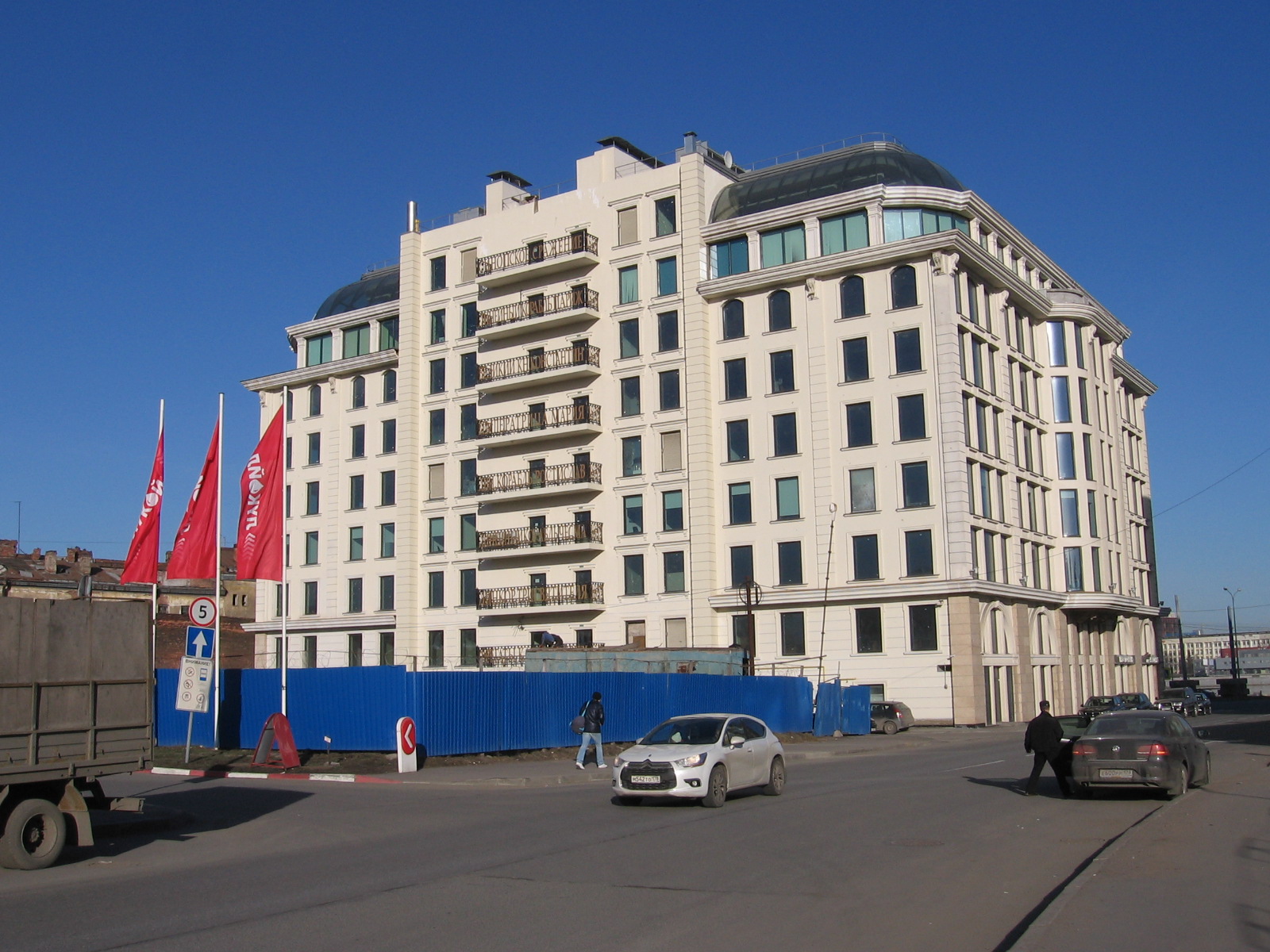
While strolling around the city this past spring, a friend and I came upon this newish oddity on the Sinop Embankment of the Neva River.

sinopskaya 22-back

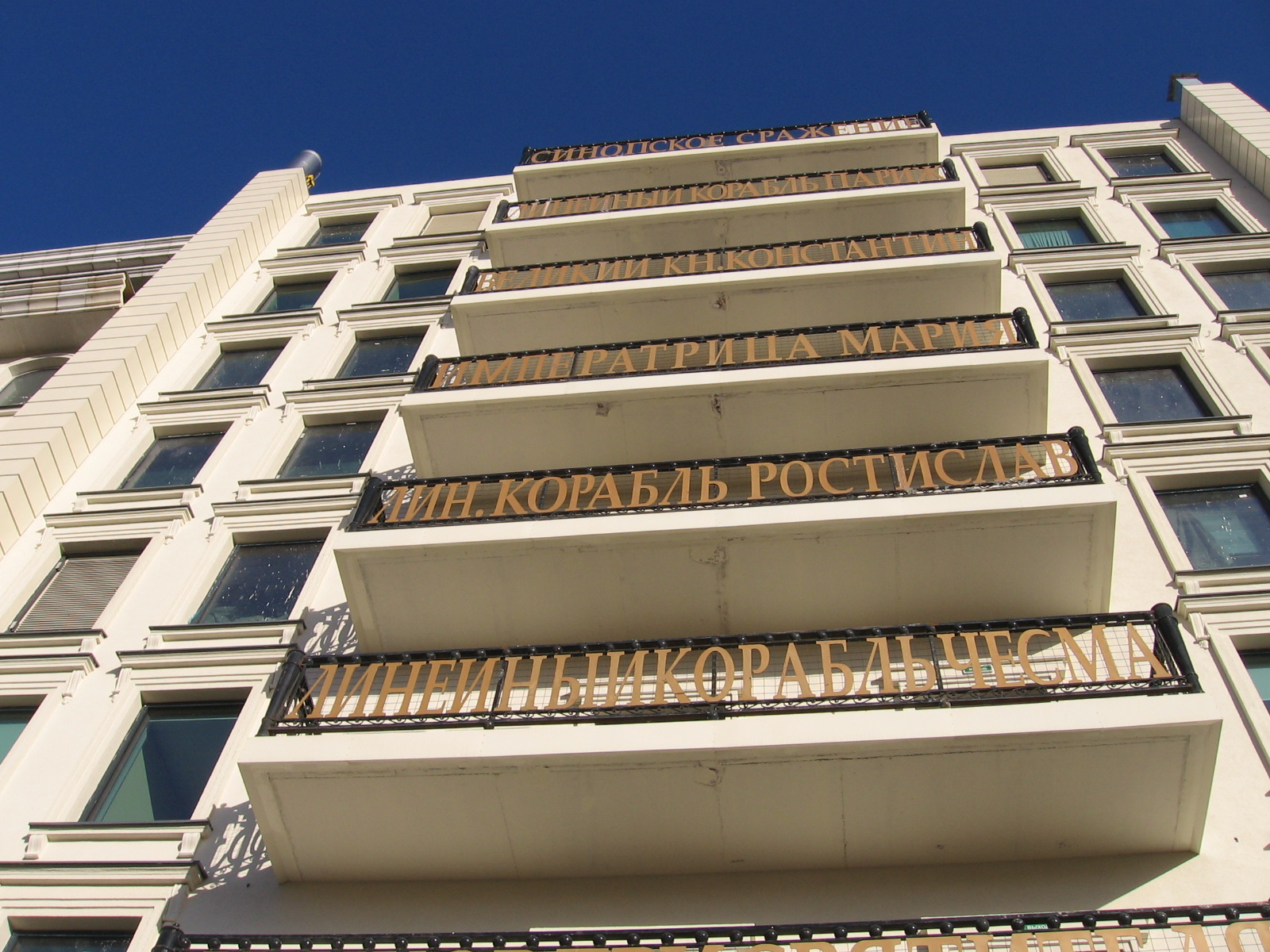
Upon closer inspection, it turned out the grillwork on the balconies were emblazoned with rather odd, at first glance, inscriptions.

sinopskaya 22-balcony
“Battle of Sinop. The Paris, ship of the line. The Grand Duke Konstantin, ship of the line. The Empress Maria. The Rostislav, ship of the line. The Chesma, ship of the line.”

After pondering this funny list for a few minutes, I realized the inscription on the top balcony read, “Battle of Sinop,” and that listed below it were Russian naval ships that, I discovered later, had taken part in this maritime slaughter of Turkish ships during the distant Crimean War.

The building’s designer, “post-neo-Empire style apologist” Dmitry Lagutin, explained the gimcrack notion behind the building in an August 2012 interview with online local architecture and development watchdog publication Karpovka:

The building was intended as a memorial to the Battle of Sinop, the last battle between sailing ships. The idea arose when we had to get the image across to the client and convince them to build a classical building. We wanted to deliver the building before December 1 of this year, for the anniversary of the Battle of Sinop.

There is a two-storey glass dome at the top of the building, an expensive luxury. It can be seen from the other shore. But if you are walking along the embankment, the dome is not visible. It disappears into the depths, and the building becomes smaller. So there will be a smooth segue from Alexander Nevsky Square with its lower built environment. There is a pediment, which, if you look closely, resembles the stern of a ship. It supports a sculpture of Empress Maria, recalling the name of the flagship Empress Maria, which Admiral Nakhimov commanded in the battle. The names of the ships [involved in the battle on the Russian side] will appear on the gridwork of the facade.

sinopskaya 22-sketch
Rendering of the new building on Sinop Embankment, 22. Courtesy of Karpovka.net

[…]

We are communicating with sculptors. There is architecture that includes a place for sculpture. And our building has a lower arcade of six arches. Between the arched windows there are niches that will house sculptures of [four Russian] admirals. Everyone knows Nakhimov. There is Kornilov and Panfilov, whom everyone confuses with Panfilov’s Men. There is Novosilsky. The four admirals who took part in the Battle of Sinop. Real heroes.

Now, as we are selecting sketches, we have to study the story of each admiral to avoid mistakes, starting with how they looked. We have to study every thing down to the epaulettes and buttons. Recently, a monument to Nakhimov was erected on the street of the same name. It was chockablock with crude mistakes.

When the busts of the heroic Russian admirals were unveiled on October 3, 2013, the city’s high and mighty were present for the festivities, as reported by Peterburgskii Dnevnik, the city government’s official newspaper.

Busts of Admiral Kornilov, Pavel Nakhimov, Fyodor Novosilsky, and Alexander Panfilov were unveiled today in a ceremony at Sinop Embankment, 22.

sinopskaya 22-bust

St. Petersburg Governor Georgy Poltavchenko, Russian Museum director Vladimir Gusev, businessman Boris Zingarevich, who initiated the creation and installation of the busts, and sculptor Alexei Arkhipov attended the unveiling.

It is no accident that the sculptures of the great admirals have appeared on the Sinop Embankment. 2013 marks the 160th anniversary of the Battle of Sinop, which was the last battle involving sailing ships. Likewise, sixty years ago, the embankment was named in honor of this naval battle.

“It is twice as nice and important that that we have not forgotten the glorious tradition of the Russian fleet and are unveiling the busts of those who were victorious at Sinop. I thank everyone involved in the project—the architects, designers, and builders—for wanting to recall history and for their initiative,” Georgy Poltavchenko said at the unveiling ceremony.

The designer of the busts, Union of Artists member and sculptor Alexei Arkhipov, said that executing the works was not easy, because there were very few extant images of the admirals. The decorative elements—buttons embossed with coats of arms, and the decorations worn by the admirals—were a particular challenge. In total, the work took around a year.

sinopskaya-ceremony
Petersburg Governor Georgy Poltavchenko (second from left) with naval officials and other dignitaries at unveiling ceremony. October 3, 2013, Sinop Embankment, 22

The dome of the building on Sinop Embankment where the busts of the great admirals have been installed is crowned by a replica of the bas relief from the bowsprit of Admiral Nakhimov’s flagship, which was named after the Empress Maria Feodorovna. In turn, the names of the ships involved in the battle have been inscribed on the railings of the balconies in the building, which will house a business office center.

For what it’s worth, before this recent outburst of collective built patriotism, the lot at Sinop Embankment, 22, was occupied, until 2003, by a much homelier but more more recognizably Petersburgian building. Known as the Alexander Nevsky Lavra House, it was erected in 1860 by architect Karl Brandt (1810–1882).

sinopskaya 22-previous 2
Alexander Nevsky Lavra House in 1993. Photo courtesy of A. Kaidanovskij

And this is what Brandt’s modest building looked like on the eve of its demolition.

sinopskaya 22-previous
Sinop Embankment, 22. Photo courtesy of CityWalls.ru

I was reminded of our springtime encounter with the patriotically dolled-up “business office center” on the Sinop Embankment while investigating one of the Petersburg’s oldest streets, Galernaya, with a group of local psychogeographers a couple weeks ago.

During our drift, we came upon this little Art Nouveau bonbon at Galernaya, 40.

holland-galernya-2

According to CityWalls.ru, it was built by Maxim Kapelinsky in 1905–1907 and 1910 as an apartment building and publishing house for S.M. Propper.

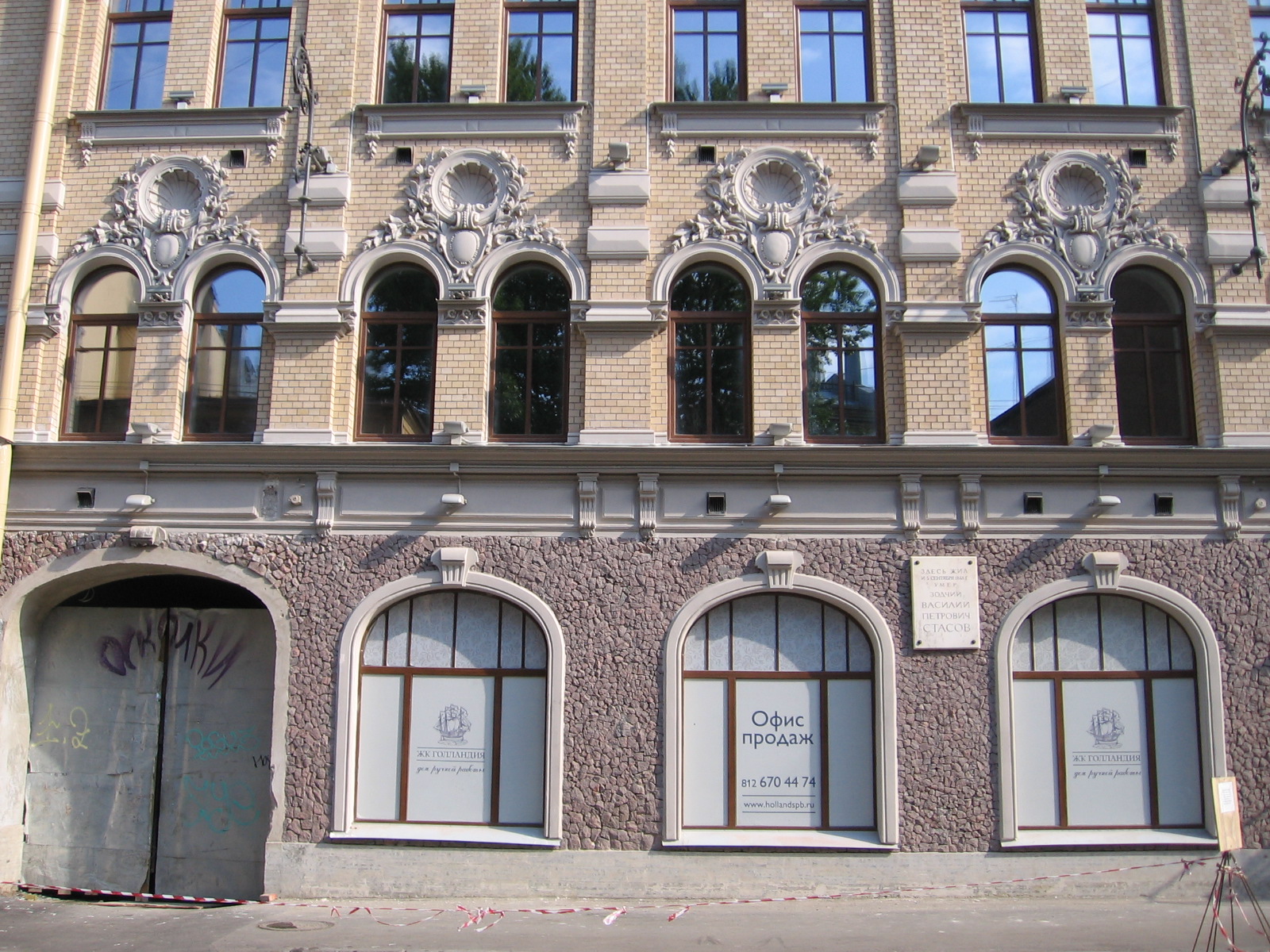
And yet a plaque on the first storey claims that the great Russian architect Vasily Stasov lived and died there on September 5, 1848.

holland-stasov

This apparent contradiction is easily explained. When Stasov lived there, the lot was occupied by the Kireev estate, which extended all the way from Galernaya to the Admiralty Canal Embankment on the other side of the block.

The real mystery, however, is not whether Stasov lived here at the end of his rich life, but whether the building now on the site is the same building that Kapelinsky built over a hundred years ago.

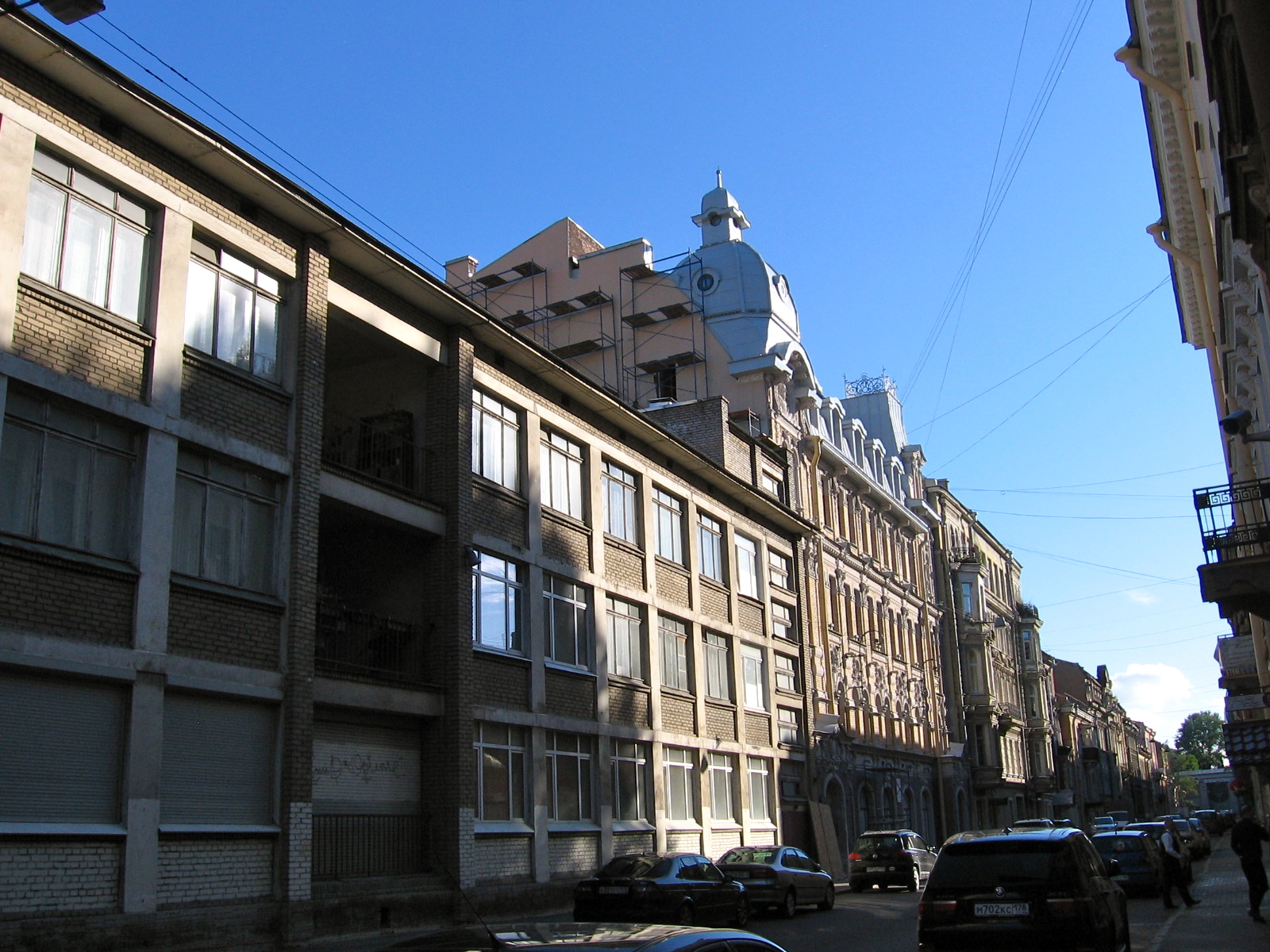
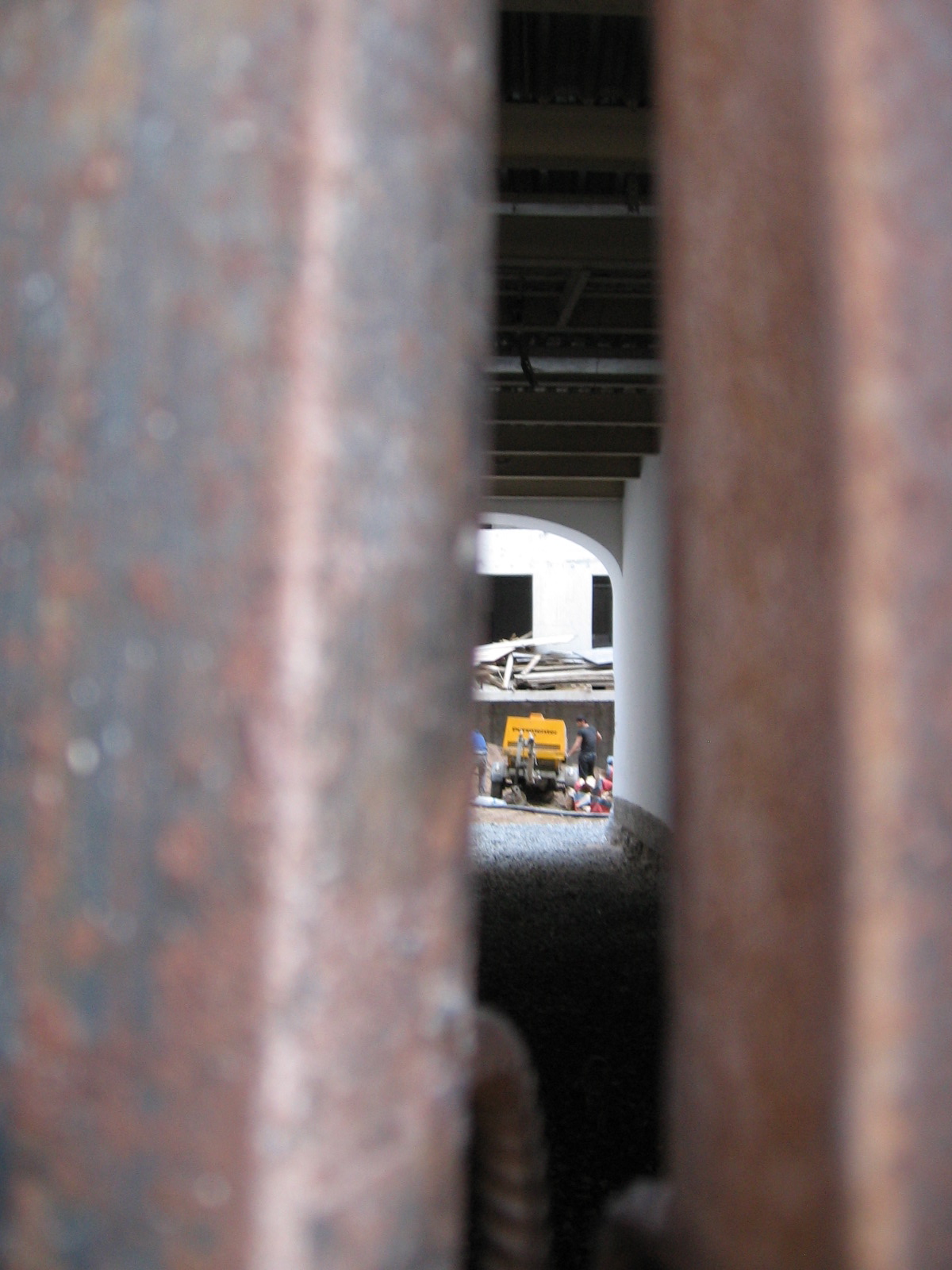
Views from the side and the front, and a glimpse through a crack in the gateway hinted that something fishy might have been afoot at Galernaya, 40.

holland-galernya

holland-sales office
Sales office of Holland apartment complex, Galernaya, 40

holland-work

In fact, it seems that Kapelinsky’s hundred-year-old Art Deco confection has not been restored, as deceptively suggested by the façades on both ends of the block. Instead, it has been partly or totally reconstructed, its original innards replaced with tonier digs, more storeys and square meters, and its “empty” courtyards righted with a lot of infill construction.

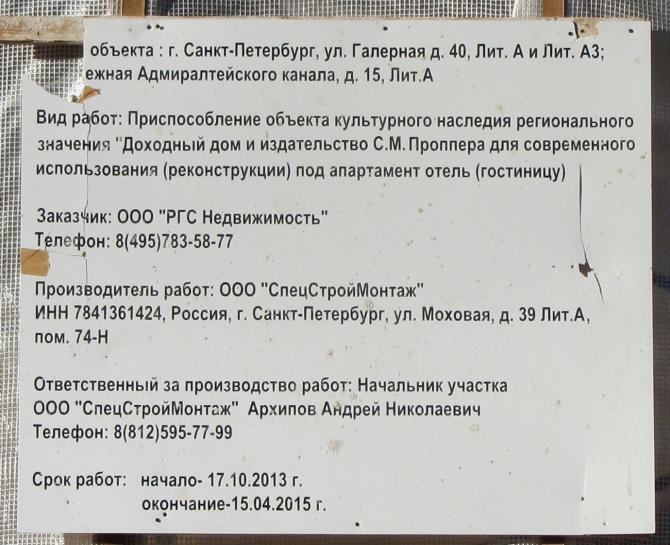
On November 2, 2014, CityWalls.ru user “Vlada” made a snapshot of the official sign that has to be erected, like a permit, outside all such construction sites.

holland-reconstruction

The sign reveals that the Propper House, identified as a listed regional architectural landmark, is being “adapted for modern use (reconstructed) as an apartment hotel.”

As redeveloped by the Clover Group, the Propper House has now been renamed Holland.

I cannot recommend the project’s video presentation (accessed by pressing the big arrow on the home page) or the page where you can select an apartment (and simultaneously take “virtual tours” of various parts of the complex) highly enough, because you will be quickly convinced that the Propper House has indeed been “adapted” (gutted) to make way for a new gentry and their loose cash.

holland-deck
Visualization of penthouse deck, Holland apartment complex, Galernaya, 40

How this brutal approach to a listed regional architectural landmark is compatible with local law, federal law, and the city’s explicit obligations as a UNESCO World Heritage Site, all of which should amply protect the city’s historic center from such predations, is beyond me. This, however, has been the standard practice for the past ten years, a sad fact known all too well by the pesky gradozashchitniki I mentioned at the beginning of this post, and by tens and hundreds of thousands of other Petersburgers who are less active civically, but have seen perfectly well what has been going on and to whose benefit.

But you will not be surprised, I hope, when you learn that Clover Group’s elegant wrecking ball methods have also been sanctified and sanctioned by Russian imperial history, to wit:

The Holland complex consists of three sections, Amsterdam, Hague, and Zandaam, located in historically significant renovated buildings. Ranging in height from five to seven stories, each of the buildings offers luxurious apartments of various sizes (from 27 to 195 meters square). The names given to them were not accidental. These resonant names have their roots in Petrine times. These were the names of the three main stops in Holland during Peter the Great’s Grand Embassy.

If you suspected there might be something in common between the pseudo-historical papering over of what are often latter identified, euphemistically, as “town planning mistakes,” and the current political regime’s uses and abuses of history, you would be on the right track.

Goethe reportedly said that architecture is frozen music. In today’s Russia, new “architecture” is the frozen hysteria of a ruling class and society “enslaved by history” and thus unable to do anything other than salvage and bricolage it to justify its knowingly futureless projects. That this often involves simultaneously destroying real history, such as the historical buildings and cityscapes of the former imperial capital, is only one of the paradoxes generated by this extremely dangerous political moment in Russia. TRR

Blue Turns to Red

Here are my early summer evening snapshots of yet another catastrophic urban anti-development in the ex-Capital of All the Russias, this time on Korolenko Street in the Central District.

These snapshots were taken on an old Nokia 3110 that has long suffered from a ghostly “pillar of flame”-like blemish on the lens. The blemish lends shots an extra creepiness when they are taken at the wrong time of day. Sometimes, it is just what the doctor ordered.

After all, rancid, pretentious crap like LSR’s hideous Russky Dom (Russian House) anti-development on Korolenko, designed by local architectural bureau Evgeny Gerasimov and Partners, does not deserve high-quality photography.

It deserves grassroots resistance, but there has never been enough of that, especially lately, under Putin 3.0, and especially when “projects” like this have been battering the old city and the Soviet new estates hotter and heavier than the beleaguered and outnumbered historic preservationists and other local residents and activists have the time or the forces to handle. (For those who read Russian, here is one local press account of attempts by preservationists to resist the demolition of this block in the UNESCO-protected historic center. This mostly verbal skirmish took place almost exactly three years ago.)

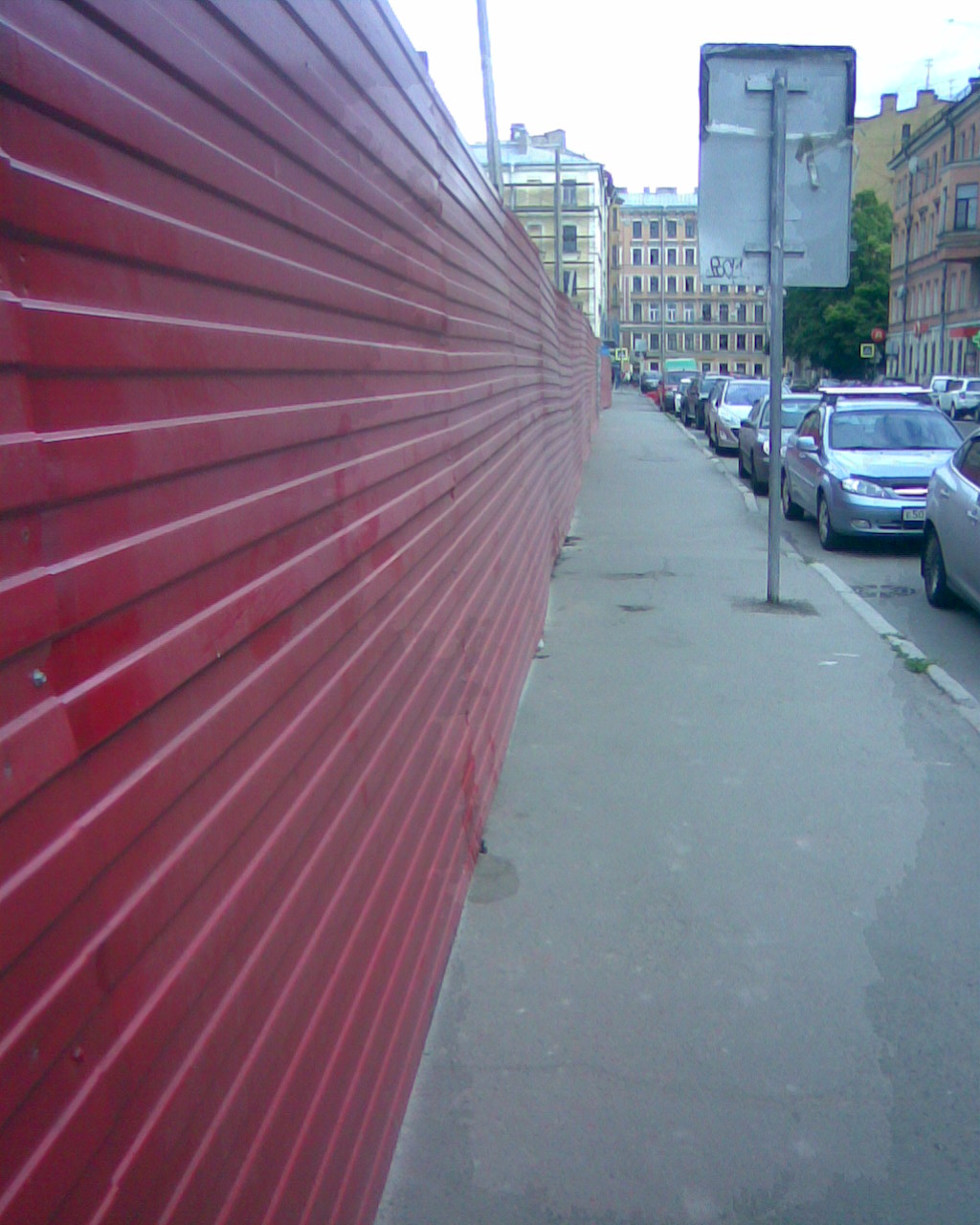
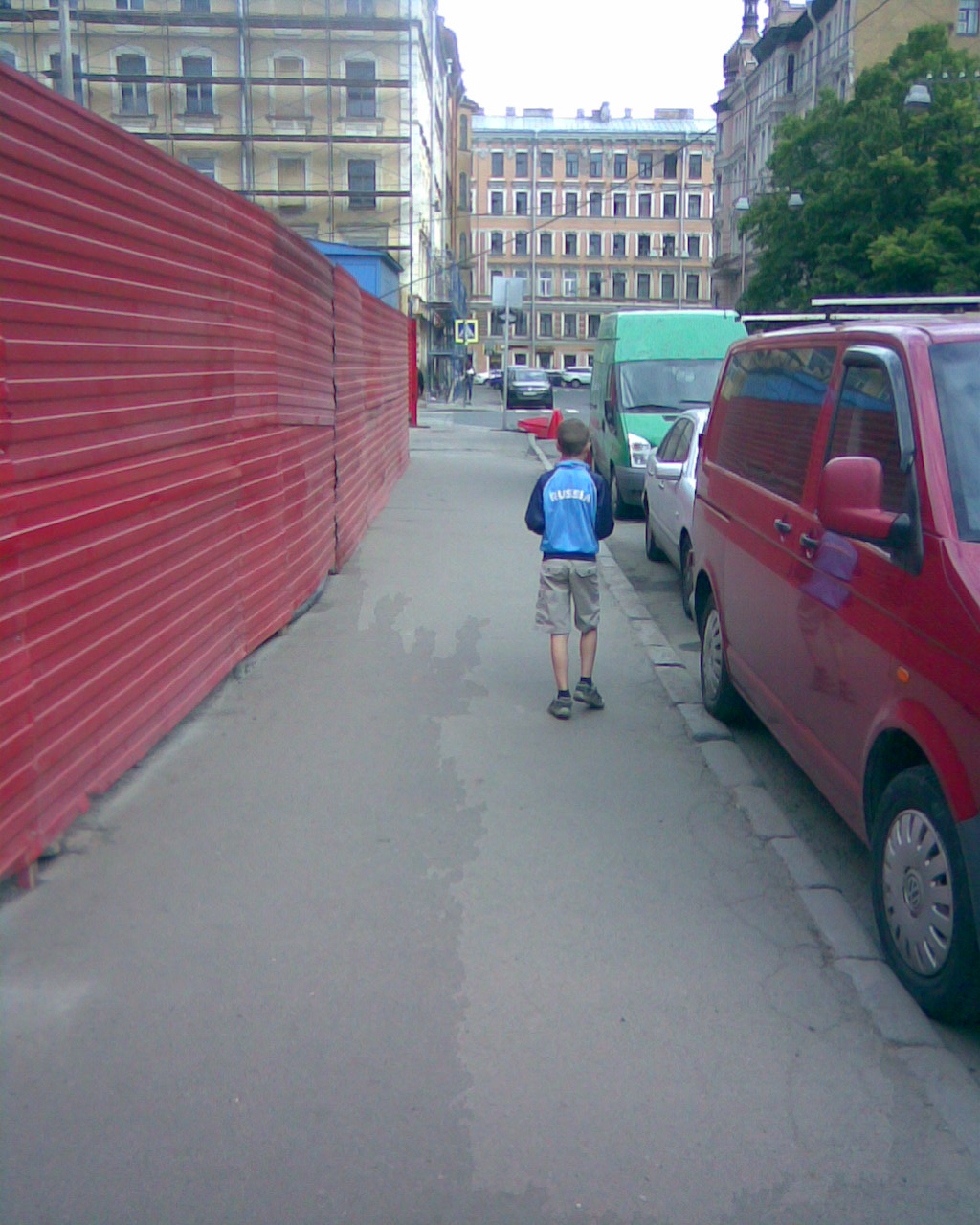
rh-red fenceRed construction site fences are a rarity in Petersburg. Such fences are almost ubiquitously blue.

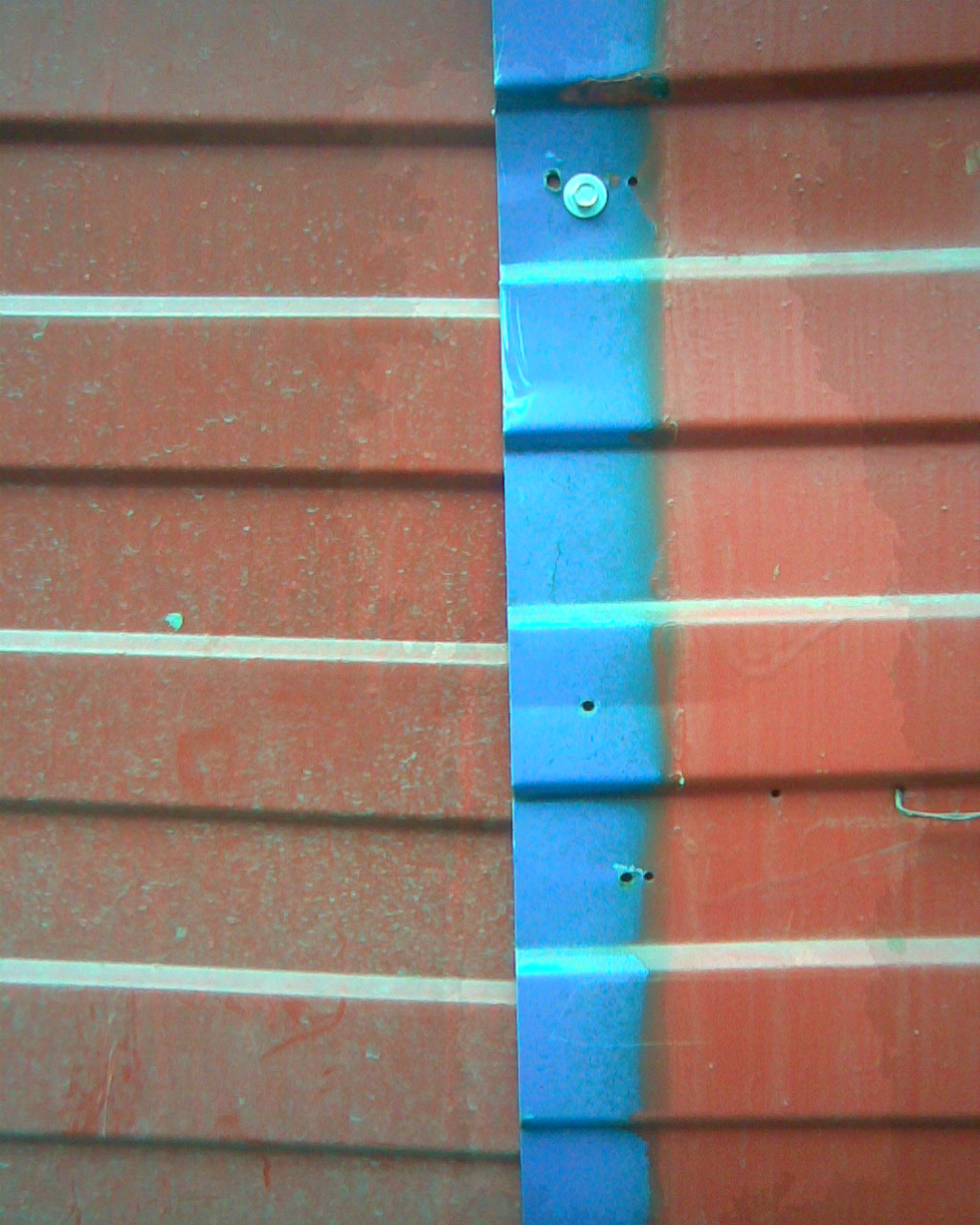
rh-blue turns to red

In fact, this particular fence apparently began life blue, like most of its other local brethren. But then it was painted red.

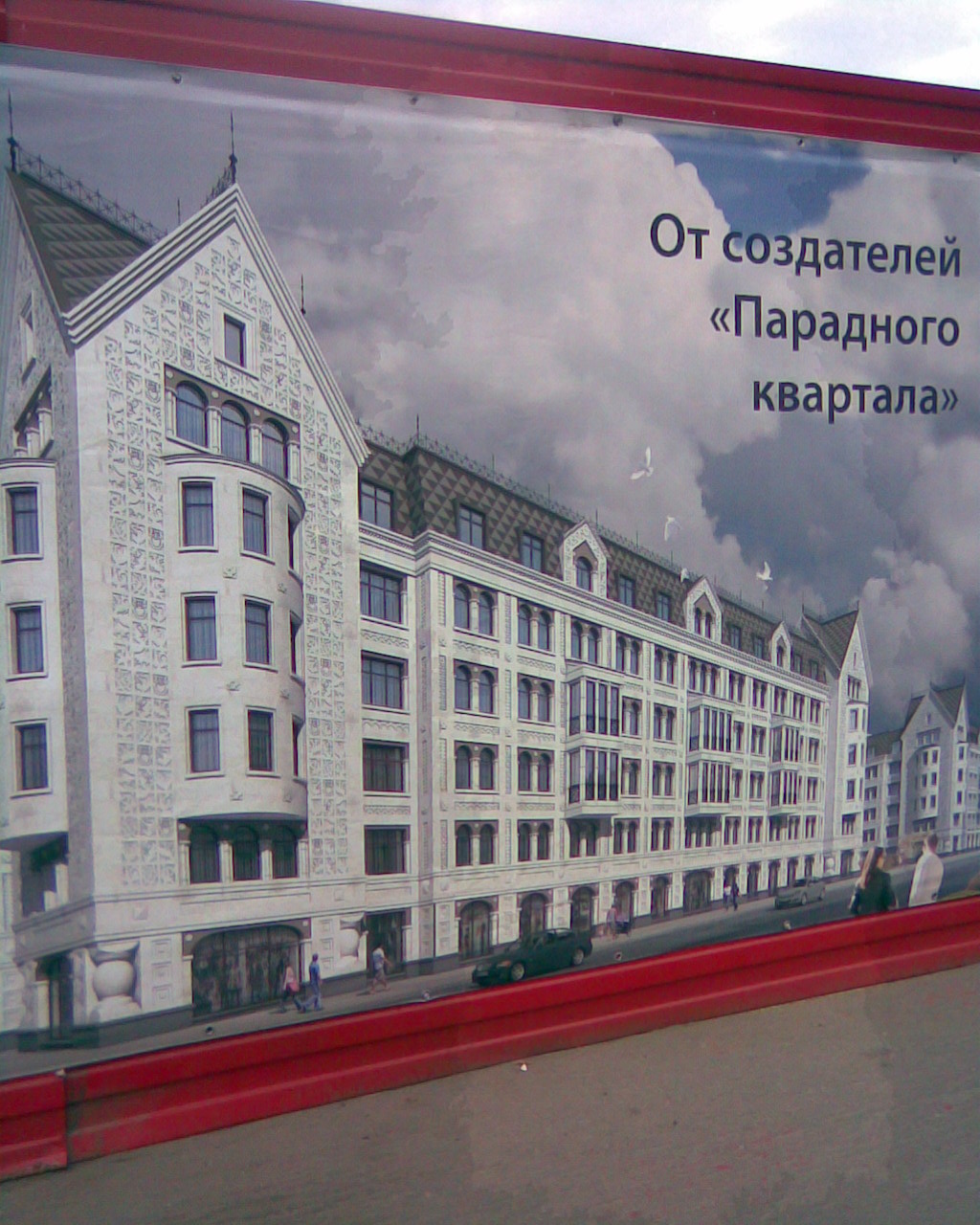
rh-paradny“From the creators of Paradny Kvartal,” reads the caption, a backhanded endorsement if there ever was one.

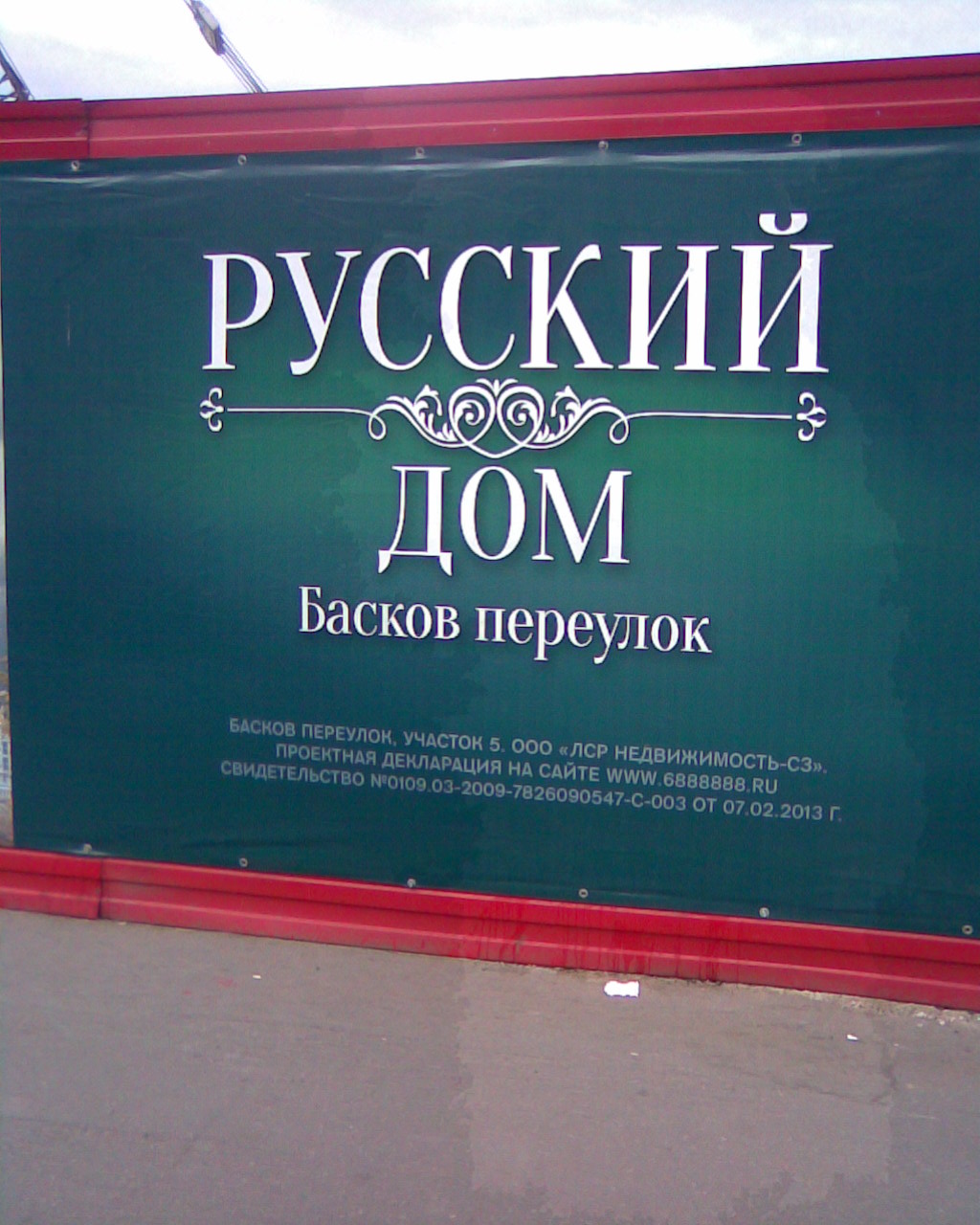
rh-russky domWhatever the ethnically tinted title of the project, Russky Dom, could mean amidst all the ideological, political, economic, social, and physical wreckage of its own site, and its place and time, is beyond me. Except, maybe, that it visually represents the aspirations of the Russian ruling class, their servitors, and their aesthetically stunted fans among the masses. (Whom, I assure you, are far fewer than the eighty-six or eighty-four percent cited by dubious polling organizations and reproduced ad infinitum by Russian and western media alike, who then go further by conjuring up a fake alternate reality to explain these fake ratings.)

rh-spec

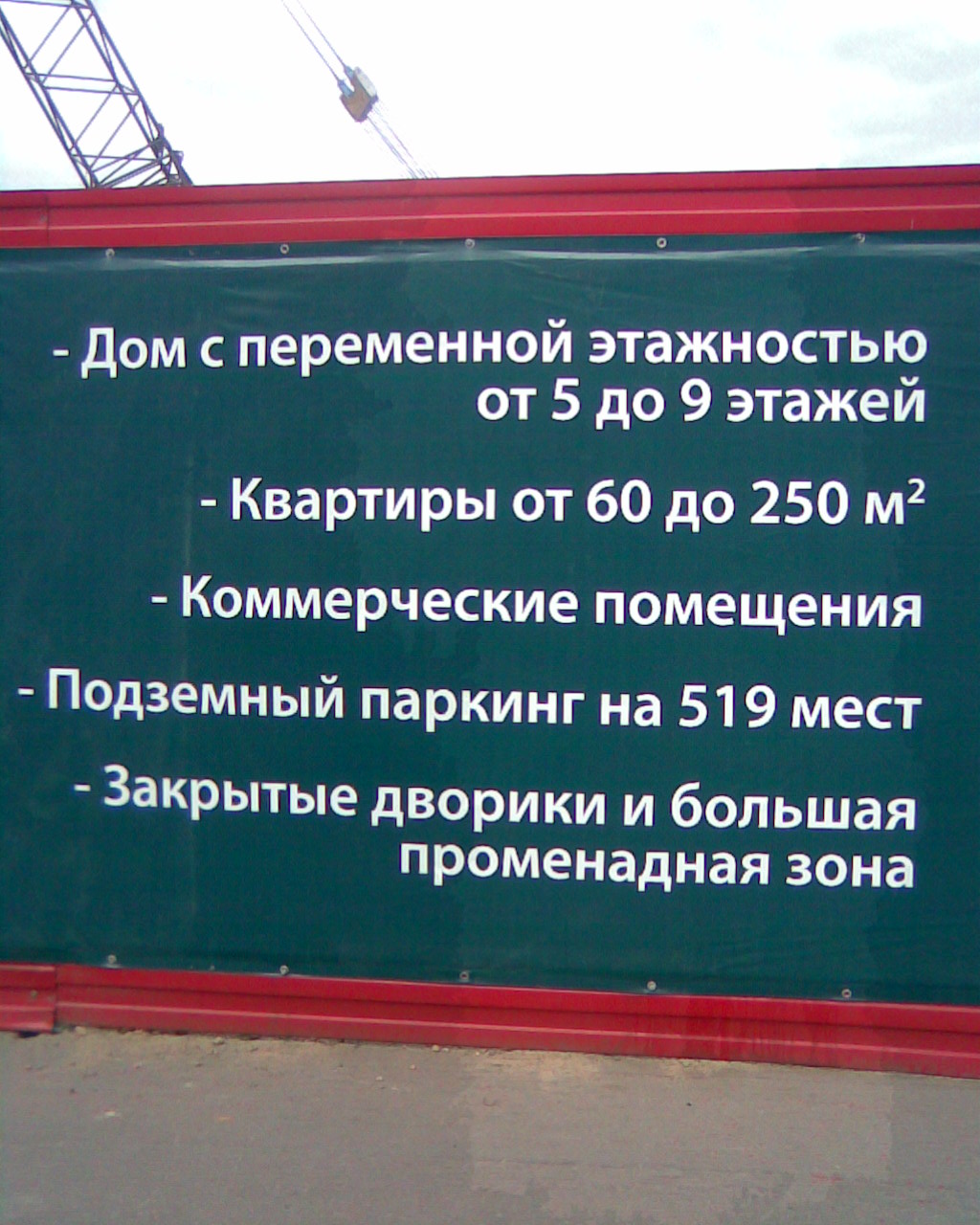
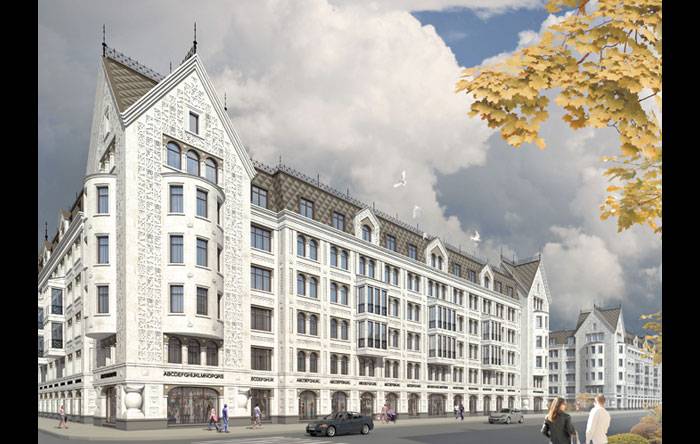
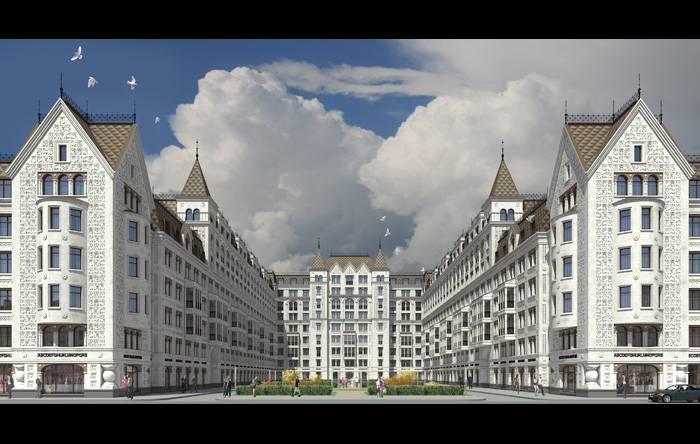
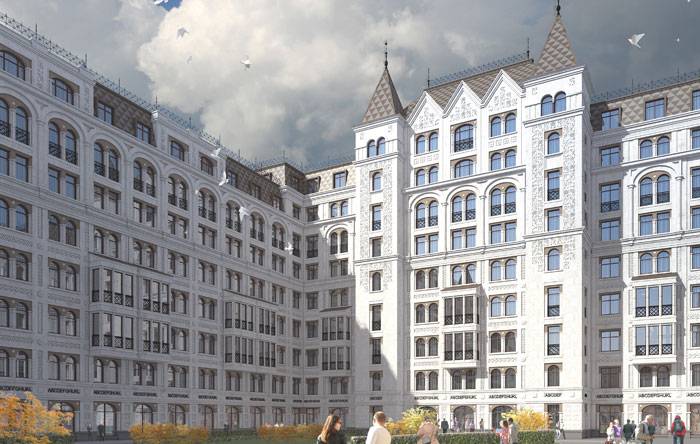
The specs include a variable number of storeys (from five to nine), flats from 60 to 250 square meters in size, an underground parking lot for 519 cars, and commercial spaces, as well as “closed yards and a large promenade zone [sic].”

rh-unusual flats

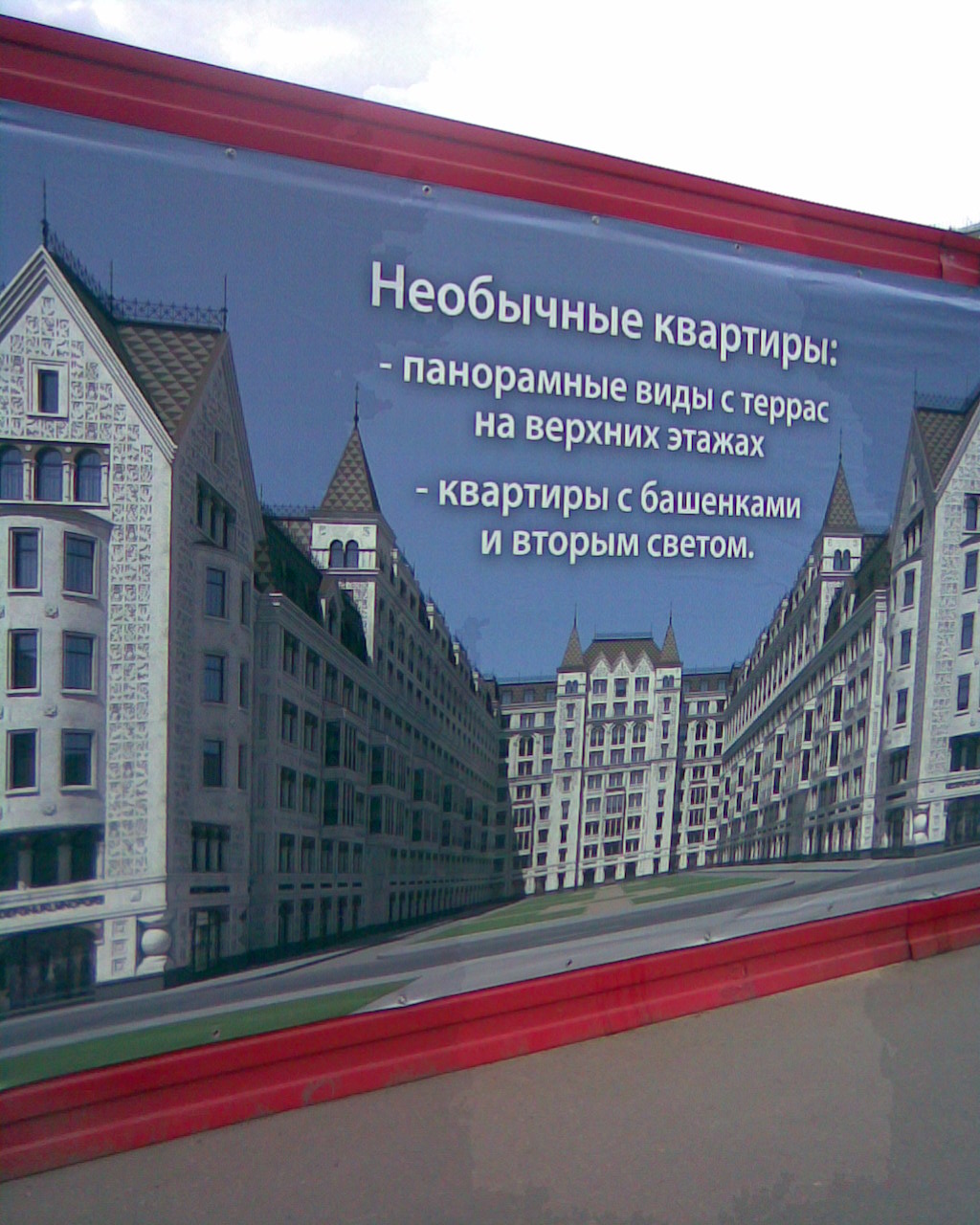
The caption reads, “Unusual flats: panoramic views from terraces on the upper floors; flats with turrets and second levels.”

The description of the project on Gerasimov’s website, aside from the usual boilerplate (e.g., the development is meant to blend into the built environment while also striking a bold pose), reveals, unsurprisingly, that it was inspired by Russian Revival style architecture of the nineteenth and early twentieth centuries.

If this is not an admission of aggressive ideological and aesthetic bankruptcy, I don’t know what is. In this sense, however, Russky Dom tries to blend in not with its built environment but, rather, with the country’s hyper-reactionary zeitgeist.

Duma deputy Irina Yarovaya declared today that Russia’s education system is too “tailored to the study of foreign languages,” according to a report by United Russia, the country’s ruling political party.

www.egp.spb

“How can we expect to preserve our traditions under these circumstances?” Yarovaya asked worriedly, criticizing the Education Ministry’s plan to make a second foreign language compulsory in the school curriculum and require students to pass a standardized exam in at least one foreign language.

www.egp.spb-1The newspaper Moskovsky Komsomolets published an even more radical quotation from Yarovaya’s statement: “While studying in our schools, students spend 866 hours of instruction on the Russian language and 939 hours on foreign languages. Now the Education Ministry wants to introduce a compulsory standardized exam in a foreign language and mandate the study of a second foreign language. My fellow citizens, what kind of country are we raising here?”

www.egp.spb-2Yarovaya also said the state’s current educational standards focus on “students’ personal success,” which she claims is “foreign to the Russian frame of reference,” instead of developing traditional values. Additionally, she expressed concern about the variety of school textbooks used throughout the country to teach the same subject.

rh-russa boy with toy machine gun

This kid was polite, making a point of getting out of the way when I was snapping pictures, but he was wearing a jacket emblazoned with the word “Russia” and toting a toy AK-47.

Whom or what was he planning to go to war against, Yarovaya and her “traditional values,” which are actually designed to keep the current kleptocratic regime in power in perpetuity and keep people like the little kid poor and disempowered, or “foreign frames of reference”?

* * * * *

I (or, rather, my Nokia) tried to peer through a hole someone or something had punched through the red fence to get a sense of how the Russky Dom was shaping up.

rh-peephole

But when I got to the corner of the block, I discovered the construction site’s main gate was wide open, probably because the workday was wrapping up.

rh-work proceeds apace

Work was proceeding apace on the Russian reactionary elite’s dream home.

As well it should have been, because, according to the site’s “passport” (everyone and everything has a passport in Russia, including built and unbuilt buildings), construction is scheduled to be completed in July 2017, a mere two years from now.

rh-passport

So if you are thinking about getting in on the ground floor of this Russian neo-Revivalist reactionary real estate action, the time to call is now.

rh-website

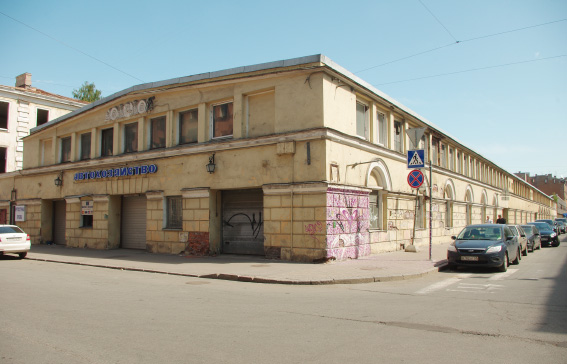
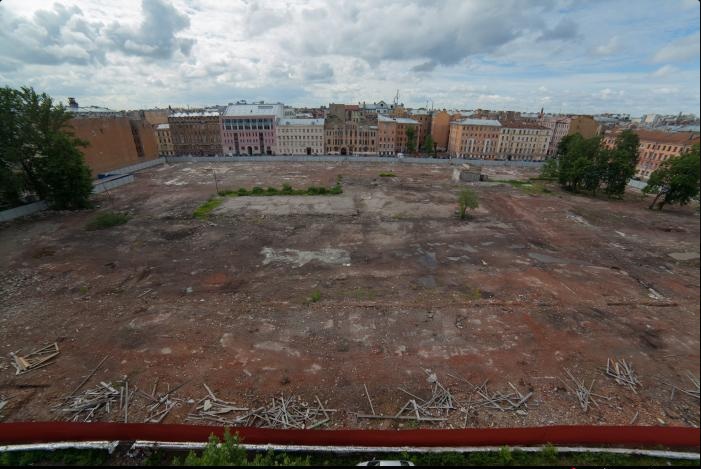
It was not that the Leningrad City Executive Committee and Main Internal Affairs Directorate (i.e., police) motor pool garages that previously occupied the lot were things of great beauty (and until they were threatened with demolition, three years ago, seemingly nobody knew that what was left of the barracks of the First Artillery Brigade Life Guards may or may not have also been taking up otherwise expensive land there), but they served some purpose other than driving up real estate values and giving rich people a venue to offload their extra cash, kids, lovers or themselves while on vacation from Goa or London.

They were also part of the city’s real history, for better or worse.

autohozyastvo

The other day, a friend of mine showed me, on the invaluable but somewhat incomprehensible Regional Geographic Information System, how many “projects” real estate developers had stashed away among the nearly incomprehensible and numerous filings and permit requests they make with the city’s relevant committees.

If all these projects are implemented, Petersburg will be unrecognizable in ten years or fifteen years or so, a bright and shiny Russian Revivalist and “neoconstructivist” no man’s land with lots of elite housing, business centers, entertainment and shopping complexes, and superhighways.

But there will not be much of anything else, because Petersburg’s inner-city light and heavy industries were long ago condemned, under the guise of “developing and preserving” the historic center, to banishment to the far suburbs or even farther, to the outer darkness of the Leningrad Region. The orders were signed by Mayor Anatoly Sobchak, in 1994, and Prime Minister Viktor Chernomyrdin, in 1996, respectively.

The funny thing is that the new powers that be revived this approach a few years ago. As current Governor Georgy Poltavchenko has said recently, “The formula goes like this: ‘Preservation through Development, Development through Preservation.’

Or as a comrade and I have written elsewhere, Petersburg is a “World Heritage Site under permanent reconstruction.”

wikimapia-russky dom scorched earth

All shabby snapshots and main text by the Russian Reader. Additional images and quoted text courtesy of Evgeny Gerasimov and Partners, Meduza, Kanoner, and Wikimapia.

Gathering Dust

Poltavchenko: I have set the task of gathering all the dust
March 28, 2015
Fontanka.ru

Governor Georgy Poltavchenko has set city maintenance services the task of “gathering all the dust.” He stated this in an interview on Saint Petersburg TV.

“Speaking of dust, then, of course, I could also not fail to notice it, because I live in this city. The goal is to gather all the dust. It must first be gathered, and then the city must be washed,” he said.

The last two weeks, Petersburgers have complained of excessive dust in the air. The Smolny said that the city can be washed only after the transition to a sustainable plus temperature.

IMG_6240 IMG_6241 IMG_6242 IMG_6243

Petersburg maintenance workers dustily gathering dust on a very dusty street yesterday, March 27, 2015. Photos by the Russian Reader.

“I Will Find You and Kill You”: How Petersburg Celebrated “Democracy Day”

democracy

“Whatever anybody says, especially our foes from abroad, both you and I know that we live in the most democratic country, in Russia.”

— Georgy Poltavchenko

This past Sunday, September 14, was declared “Democracy Day” in Petersburg, Europe’s fourth largest city. What this meant on paper was that the city’s Kremlin-appointed governor, Georgy Poltavchenko, swept to an overwhelming victory in his first “real” gubernatorial race, while ruling United Party crushed the opposition in elections to the city’s neighborhood councils. Then the victors celebrated “democracy” with a pop concert on Palace Square.

What this meant in practice was that Poltavchenko’s only real challenger had been peremptorily “filtered” from the race two months ago, and the melancholic KGB nonentity was left to face a quartet of stick-figure opponents almost no one had heard of before; the United Russia machine pulled out all the stops doing what it loves best—brazenly rigging elections and just as flagrantly cracking down on anyone who challenges its right to do that; and a band of foreign fascists, ultra-right-wingers, and Stalinist clowns, masquerading as “international monitors,” showed up to rubber stamp this bloody farce. No wonder Robert Mugabe backs Russia.

I received the following letter from a friend whose son celebrated “Democracy Day” by serving as a member of the electoral commission at a polling station in central Petersburg. I have translated the letter and published it here with her permission, but I have changed the names of people and places to protect “Dmitry,” “Lyuba,” and the author from further persecution and harassment.

**********

I don’t know whether you are aware of yesterday’s elections in Petersburg. They were completely hellish.

[Our son] Dmitry was a voting member of the electoral commission at Polling Station No. 86, on Austerlitz Street. His girlfriend Lyuba had the same status at Polling Station No. 85, which was in the same building. A bunch of Dmitry’s friends worked in the same capacity at various other polling stations.

The chairs of the commissions hid from them all the time. On Saturday, the day before the elections, Dmitry went to his polling station, where he immediately faced aggression and intimidation: “We’ll have you removed from the polling station,” “Don’t you dare photograph anything,” “We’ll settle your hash later,” and so on. Dmitry demanded to be shown the certificate for receipt of the envelopes containing the absentee ballots. The chairwoman started screaming that this was a provocation. Saturday ended with the chairwoman turning Dmitry over to the police for allegedly photographing the voter lists.

Dmitry was taken to the eighty-third police precinct on the Old Barge Channel, where he was immediately released because the arrest had been illegal. I went to the precinct to get him.

Then came Sunday [election day]. Right away in the morning, Dmitry wrote to us that there had been a bunch of violations; he was again being threatened, and so forth. He was sent out with a mobile ballot box to make the rounds of the old women [pensioners confined to their homes], and while he was out, the chairwoman sent someone with two unregistered ballot boxes to a hospital. At the end of the day, the ballot boxes came back with twenty additional votes that had appeared out of nowhere, as if people had been admitted to the hospital the day before and were immediately registered as voters at this polling station. It was like this with the ballot boxes at nearly every polling station: two hundred votes apiece, cast by completely unknown people, ended up in them.

In the afternoon, I brought Dmitry coffee, because he was afraid to leave the polling station. Lyuba went out to have tea, and while she was out, two ballot boxes were carried away from her polling station: she was informed of this after the fact.

When I arrived at the polling station, they also made as if they were going to arrest me: “Who the hell are you? His mama?” and so on. I snapped at them and told them they were shameless. Dmitry and I went out onto the porch. Some security guards—not cops—came out after us, as if they were keeping track of us. They smoked and swore. We remarked to them that both smoking and swearing were administrative violations. They cussed us out. When Dmitry started filming them with his telephone, they began pushing us down the stairs, trying to snatch the telephone from Dmitry. They got the telephone from him, and Dmitry hurt his hand. (Also, one of the guards got doused with coffee, meaning that Dmitry was left without coffee.) We called the police. When they heard us doing that, the guard cooled their heels and gave back the telephone, but they had erased the video.

Then a polizei came, and Dmitry and I filed an assault complaint. The polizei said he would charge the men with an administrative violation for smoking.

I told the chairwoman that hopefully she was being well paid for everything, because otherwise I saw no point to this mayhem. To which she replied that she was glad I was concerned about her welfare.

But it got really gnarly after the polls closed. We got reports from everywhere about [opposition electoral commission members and observers] being removed from polling stations during the counting of the votes. When Lyuba’s turn came and she refused to leave the polling station voluntarily, the police were summoned and told that she had spit on a local cop. Lyuba was taken away, and like Dmitry the day before, she was just released. She has filed a bunch of complaints against everyone.

At Dmitry’s polling station, on the contrary, they didn’t start counting the votes for four hours: they were supposedly verifying the voter lists. However, the chair of the Shostakovich Municipal District Electoral Commission, a man who weighs over a hundred kilograms, would come up to Dmitry and whisper in his ear, “I will find you and kill you.” He did this several times. Dmitry was alone against twenty gangsters who insulted and threatened him.

Dmitry called us and said he was being threatened, that they were trying to remove him from the polling station for videotaping and interfering with the commission’s work. I telephoned GOLOS (in general, I spent all of Saturday and Sunday phoning and writing everywhere). The people at GOLOS [a Russian electoral rights NGO] told me I should go to the polling station. At one in the morning, Grigory [her husband] and I ran to Austerlitz Street.

Just as we got there, Dmitry rang to say he was being forcibly dragged from the polling station. A police jeep was already parked outside. Dmitry had also called the police and told them he was being unlawfully removed, but they hadn’t shown up, or rather, they showed up to arrest him.

I was talking to Dmitry on the phone, and he was yelling, “Don’t you dare arrest me, you’re breaking the law.”

The door opened, and Grigory and I saw a cop dragging Dmitry from the polling station. I ran up to the cop and told him he was breaking the law and so on. To make a long story short, Dmitry was again being taken to the eighty-third police precinct. We headed there.

Before leaving, I asked the cop a question.

“Look me straight in the eyes and tell me you aren’t ashamed.”

“I am just doing my job,” he said.

“But what about the law?” Grigory asked.

The cop began to walk away.

“Do you believe in God?” Grigory shouted to him as he walked away.

“Yes,” the cop firmly replied.

Well, then we arrived at the police station. Dmitry was almost immediately released. He also dashed off a bunch of complaints.

We got home at four in the morning. Dmitry ate and drank for the first time in a twenty-hour hellish day. Then we were online until six in the morning watching as his electoral commission kept putting stuff up and erasing and rearranging it. They didn’t even have the obligatory large summary vote tally.

Dmitry’s friends were practically removed from all the polling stations [where they served as electoral commission members and observers]. One friend, Eduard Dubinsky, who was a candidate for the municipal council in the Kamenka district, was arrested for allegedly resisting the police. He spent the night in jail, and the next day a court sentenced him to a five hundred ruble fine. So Dmitry got off lightly. But we are waiting for responses to all his complaints.

P.S. We also found out that there were around two hundred ballots in the unaccounted ballot boxes at Dmitry’s polling station that were secretly sent out and brought back from the hospital, but it is impossible to verify who filled them out and how. Twenty-one of these ballots were allegedly filled out by people who had been admitted to the hospital the day before. It is unclear how they could be entered onto the voter lists. In fact, it couldn’t have been done legally. Plus, now Dmitry has checked and spotted the fact that another one hundred additional voters appeared up out of nowhere. He found this while looking over the final report. Meaning that approximately three hundred fake votes were added to the tally at his polling station. That is roughly fifty percent added to the total. Now I understand why the commission was so aggressive and didn’t allow the results to be known, and whey they were looking for an excuse to kick Dmitry out.

Translated by the Russian Reader. Image courtesy of academichelp.net

The Shipping Forecast

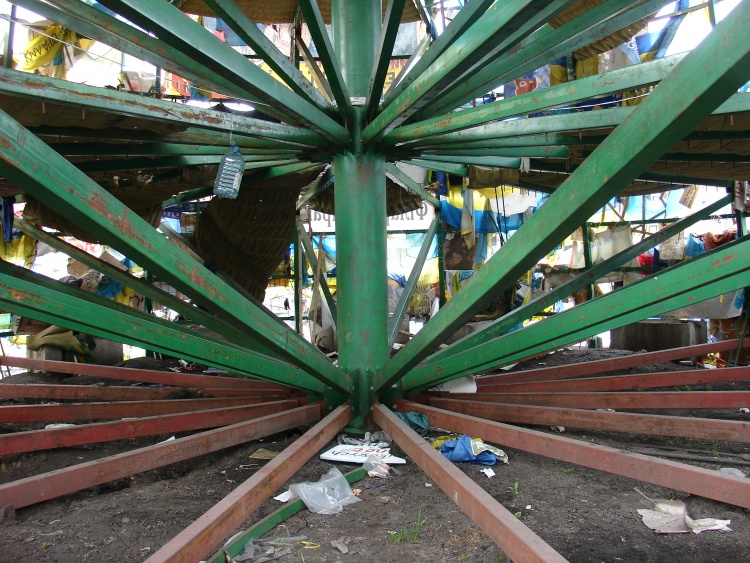
While Manifesta 10’s “public” program sets all that is left of progressive humanity (i.e., the contemporary art world) on fire with its overly provocative metallic Xmas tree, actual public and political life stubbornly and unattractively creaks on in the city that progress and progressive humanity have forgotten, Saint Petersburg, former capital of All the Russias.

kristina_norman_souvenir_2014

This life is of no interest to almost anyone, practically, even in Petersburg itself, so take what follows the way I and many other radio listeners the world over consume the beloved “Shipping Forecast” on BBC Radio 4: as a series of pleasant but ultimately meaningless vocables that have absolutely nothing to do with the way we self-satisfied landlubbers lead our rich, perfectly dry lives.

Gubernatorial and municipal district council elections are scheduled for September 14 in Saint Petersburg. However, even before the pretenders began formally declaring their candidacies this month, many observers, including liberal journalist Vladimir Kara-Murza, argued the fix was in, and the Smolny would never allow any serious opposition to the incumbent (the unelected Kremlin appointee Georgy Poltavchenko) or whatever other candidate the Kremlin might suddenly choose to run for the job.

And indeed that is what has happened. Perhaps the only (mildly) oppositional candidate with the popularity and support to make the race real, Oksana Dmitrieva of A Just Russia party, was nixed before she got to the starting blocks. She did not pass the so-called municipal filter: formal approval of her candidacy by a minimum of 156 district council deputies.

I could not find any report about any of this monkey business in English, but hilariously I did find a badly translated statement from the ruling United Russia party angrily denouncing Dmitrieva for having the temerity to suggest there was something fishy about her failing to get through the filter and demanding an apology from her.

Well, sayonara, fair Oksana. We, the enlightened Petersburg “public,” barely knew who you were anyway, so we won’t miss you.

However, really serious candidates, like Takhir Bikbayev of the “Greens Ecological Party,” a man whose name is synonymous in the minds of Petersburg voters with all things environmental and progressive, (that’s a joke: I really have never heard of him before nor, I gather, has anyone else), easily passed through the dreaded filter.

Meanwhile, opposition candidates are being purged right and left from the district council races or otherwise prevented from registering. One such victim of Putinist vigilance is Fyodor Gorozhanko, a well-known local grassroots housing rights advocate, who was dismissed from the elections after United Russia complained he had “misled” voters who signed a petition supporting his candidacy. A court has upheld the complaint.

How exactly did Gorozhanko “mislead” voters? On the standard-issue petition sheets voters sign to get candidates on the ballot, there is a blank where the candidate has to state whether he or she is “employed” and where. Since Gorozhanko works as a volunteer aide to Petersburg Legislative Assembly deputy Maxim Reznik, he crossed out the word “employed” and pencilled in what he does now in lieu of gainful employment. This is how he “misled” voters. Gorozhanko plans to appeal the court’s decision…

Man, this local politics shit is so, so boring. I am going to switch on the “Shipping Forecast” and wait for a contemporary artist to make another provocative statement in public space about public space and history. Now that will be something to talk about.

P.S. While I was gussying up this post, incumbent Georgy Poltavchenko officially declared his candidacy. He will face stiff competition on September 14 from Irina Ivanova (CPRF), Konstantin Sukhenko (LDPR), Takhir Bikbayev (Greens), and Andrei Petrov (Motherland). I think it’s safe to say the vast majority of Petersburg will have never heard of any of these candidates except for Poltavchenko, of course, although Ivanova and Sukhenko are deputies in the city’s legislative assembly.

Oksana Dmitrieva (A Just Russia) and Anatoly Golov (Yabloko) were refused registration. Dmitrieva has claimed that Poltavchenko pressured municipal deputies into not supporting her candidacy and has filed complaints with the prosecutor general’s office and the central electoral commission. 

The Psychic Governor

166079420

Not is only Georgy Poltavchenko, Petersburg’s unelected governor, a capable administrator and a pious Orthodox Christian, he is also, as he revealed last week during a passionate speech delivered at a special powwow with law enforcement officials and “representatives of ethnic diasporas,” a psychic, a mind reader or remote viewer capable of hearing what migrant workers in Tajikistan and Uzbekistan are saying as they depart for the former capital of All the Russias (apparently, to wreak mayhem, judging by further remarks made the governor and others at the high-level confab):

“So your countrymen travel to our country, to our city, in particular. They travel from distant villages there and so on. And just as they’re about to board the plane or the train going to Russia, they say, ‘We’re going there because the Russians don’t know how to work! They’re all drunkards. They’re all loafers!’ But members of the nation to which I myself belong, the Russian people, over the course of a thousand years created an enormous state along with other peoples. And if those loafers and drunkards hadn’t built the Russian state, who knows what the people who come to our country thinking such thoughts would be doing nowadays. I want everyone to remember what I’m about to say: the Russian people are a people that I won’t permit anyone to walk all over!”*

* As quoted in: Maria Gordyakova, “Make yourselves at home, but don’t forget you’re just visiting,” Gorod 812, December 2, 2013, p. 12; the online version of the article (which has a different title) can be accessed here.

Photo © RIA Novosti and Sergey Subbotin