Taganrog City Court Judge Georgy Serebryanikov sentenced 31-year-old local resident Elizaveta Tsvetkova to a year of corrective labor for disseminating leaflets criticizing the police, reportsCaucasian Knot. As published on the court’s website, the verdict stipulates that fifteen percent of Tsvetkova’s wages will be docked by the state for a year. The activist has also been charged 6,000 rubles in court costs.
Serebryanikov found the defendant guilty under Criminal Code Article 281.2 (incitement of hatred or enmity toward the social group “police officers”), which stipulates a maximum punishment of four years in a penal colony.
During closing arguments on May 16, Taganrog Deputy Chief Prosecutor Vadim Dikaryov asked that Tsetkova be sentenced to one year in a work-release colony. Serebryanikov thus imposed a lighter sentence than was requested by the prosecution.
The activist, however, pleaded not guilty. During her closing statement, on May 27, she stressed she had protested the illegal actions of law enforcement officers. She reminded Judge Serebryanikov of high-profile criminal cases against policemen, including the cases of Major Denis Yevsyukov and the Dalny police station in Kazan.
Lawyer Yuri Chupilkin had also asked the court to acquit his client.
Initially, the reading of the verdict in Tsvetkova’s trial had been scheduled for May 30. However, an hour before the scheduled hearing, the activist was called and informed it would be postponed. The reasons for the delay were not explained to the defendant.
It is unclear whether Tsvetkova would appeal the verdict.
Charges were filed against the activist in January 2015. According to investigators, Tsvetkova downloaded a leaflet criticizing the police from the Vkontakte social network, printed it out, and the day before Law Enforcement Officers Day, in November 2014, posted it at public transport stops and on street lamps.
The investigation was completed in August 2015. However, in September, the acting Taganrog city prosecutor uncovered numerous legal violations in the investigation, refused to confirm the indictment, and sent the case back to the Russian Investigative Committee. The indictment was confirmed the second time round, in November.
However, investigators ignored a sociological forensic study, carried out by Professor Vladimir Kozyrkov at Nizhny Novgorod University. Professor Kozyrkov rejected claims that police officers constitute a social group.
At preliminary hearings in December, Chupilkin insisted on striking a number of pieces of evidence from consideration, in particular, studies done by the regional interior ministry. Judge Serebryanikov, however, rejected the defense’s motions.
The hearing on the merits began on January 15, 2016. During the April 20 hearing, Viktor Chernous, a sociology professor at Southern Federal University in Rostov-on-Don, subpoenaed as an expert witness, also testified that police officers were not a social group, and consequently there had been nothing criminally culpable in the actions imputed to the defendant.
In turn, Elizaveta Koltunova, an assistant professor of linguistics at Nizhny Novgorod University, who was subpoenaed as an expert witness, noted that she could find nothing extremist about the leaflet that had led to the charges filed against Tsvetkova.
Rosfinmonitoring has included Tsvetkova in its list of terrorists and extremists and blocked her bank account.
* * *
An excerpt from the closing statement of activist Elizaveta Tsvetkova (Taganrog) at her trial on charges of extremism, May 27, 2016:
I still think that escapades like my own, the case in Stavropol involving the [alleged] offense to the feelings of religious believers, and other cases, have caused no real harm, but the outcome is that our law enforcement system acquires the image of a satrap for some reason. In addition, people are distracted from real dangers such as identifying terrorists. Perhaps I am an overly sensitive person, but it seems to me that one cannot remain indifferent after such high-profile cases as that of Major Yevsyukov, who gunned down civilians in a supermarket, and the case of torture at the Dalny police station, where a man died. These cases would cause anyone to have a negative attitude towards the illegal actions of police officers. I remain convinced that cases of bribery, torture, and murder must be stopped. People should not be afraid of police officers who break the law and engage in rough justice, but should put a stop to their actions, report their illegal activists, and publicly criticize police officers. Only then we will live in a country under the rule of law and be able to improve life in Russia. Cliquishness and special privileges are always abnormal and generally unfair, especially when it comes to such questions. A divided society cannot function normally. We must realize that if people are be unable to stand up for their rights in any area, if they are forced to put up with lawlessness in policing, housing, and health care, we will never live in a civilized, well-developed country.
Alexander Skobov Don’t Underestimate the Enemy Grani.ru
May 14, 2015
Igor Yakovenko has questioned the sanity of those MPs who supported Red Guardist Irina Yarovaya’s latest amendments to the anti-extremism laws. At issue is a ban on travel abroad for people whom the FSB has issued a warning about the inadmissibility of activities that, in the FSB’s opinion, are potentially fraught with terrorism, war, and genocide. Under the current rules for issuing warnings, no formal grounds are needed except the opinion of the agency issuing the warning. Meaning that if it wishes, the FSB can crank out warnings to anyone whose activities the authorities simply do not countenance.
Yakovenko asks, why not let the undesirables leave the country if you cannot stand them? Let them leave and thus reduce the ranks of the so-called fifth column. These measures will not stop an increase in protests, and if protests do kick off, they will only add fuel to the fire. Yakovenko’s conclusion is that the folks on the other side of politics are completely off their rockers. But I would not underestimate the enemy’s intellectual capacities. Yes, they suffer from an acute totalitarian itch to ban and restrict. But they know what they are doing.
In my opinion, Yarovaya’s notorious amendment to ban travel for “warnees” is absolutely rational and quite precisely calculated. It is targeted at the segment of Russian society that,according to Yakovenko himself, suffers from pathological anemia and dystrophia of the will. These are successful and well-off people who still believe that if they have done nothing unauthorized, they will get off scot-free for their not entirely loyalist public activism. They have become accustomed to the fact that one can be involved in not entirely loyalist but quite respectable and moderate media, cultural, and human rights projects without especially risking one’s own comfort. Our stunted civil society largely rests on such lovers of performing “small deeds” in their spare time.
And now take a guess at what percentage of these outstanding people would be willing to sacrifice travel abroad for the sake of continuing their outstanding social activism, who would be willing to sacrifice the principal attribute of the post-Soviet lifestyle, without which life would be unthinkable? Anyone like Yarovaya would realize that the majority of them will choose either to give up their activism or leave the country before receiving a warning. To predict these people’s future behavior it suffices to recall Ksenia Sobchak’s recent philosophical musings about the lives of frogs.
And where will all these popular newsmakers find themselves if they are banned from leaving the country for the piquant statements they occasionally permit themselves in public? This is not to mention the fact that many civic initiatives will simply be paralyzed if the people involved in them cannot take numerous business trips and attend various international clambakes. The current regime is quite consistently pushing for the complete suffocation of not only the independent but even the semi-independent civic organizations that have managed to stay afloat. The period when Putin’s clique had a stake in maintaining a legal oppositional ghetto on the margins of public life, thus imparting a certain seemliness to its own image, has come to an end. In recent years, this image has become so disfigured the Kremlin has lost interest in touching it up. It has realized it no longer has anything to lose.
And so there will no longer be any legal bounds vouchsafing the opposition from crackdowns. Any public organization that violates the informal ban on discussing issues the regime finds touchy will be crushed. All the Kremlin’s recent significant steps, beginning with Moskalkova’s appointment and ending with the latest round of purges of semi-independent media, have been focused on this. In this long series of steps, however, the ability to ban any undesirable from traveling abroad is a symbolic step. It finally undermines the social milieu whose entire life strategy was built on the proposition that however disgusting Putinist authoritarianism was, it was better than Soviet totalitarianism because the freedom to travel abroad existed. That meant one could live with it, adapt to it, and come to terms with it. By obeying certain rules imposed by the regime, one could maintain a minimal amount of freedom.
This slightly dissatisfied milieu has become used to living high on the hog. Our consumptive civil society must come to its natural biological end. It must be replaced by professional revolutionaries who will have no such problems since their activism conforms with the law as interpreted by people who have arrogated to themselves the exclusive right to interpret it. For them, Yarovaya’s fascist laws will be neither more nor less than a profound insult to their moral sensibilities.
Alexander Skobov, a left-liberal writer and activist, is a former Soviet dissident and political prisoner. Translated by the Russian Reader. Thanks to Comrade AM for the heads-up. Image courtesy of Wikipedia
Another great story from the world’s biggest country, where ordinary people are so helpless that their fate and that of their absolutely humungous, rich, powerful country will be decided in November at the US presidential elections, not by anything they do or do not do between now and then or ever afterwards. Or so I was told earlier today by a smart young cookie.
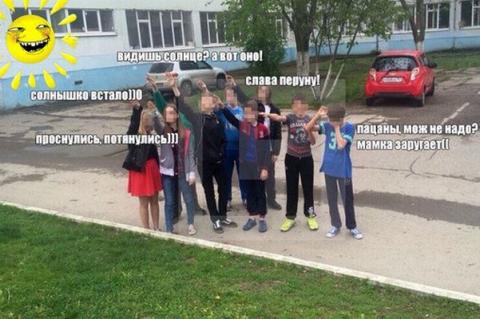
Anyway, those ace detectives at the Investigative Committee’s branch office in Rostov-on-Don have concluded that a group of teeny boppers accused of having celebrated Hitler’s recent birthday by doing the old Nazi stiff-arm salute, having their picture taken while doing it, and posting it online were not actually doing what they seemed to be doing to the few actual antifascists left in this once-proud land that seventy-two years ago defeated fascism.
No, concluded the IC RoD office, the kids were actually playing a game called “Show Me the Sun.”
Here is how the game works if you want to play at home with your kids or at your next neighborhood cookout.
“Anyone in the group suddenly shouts, ‘Show me the sun,’ and everyone else quickly points at the sun. The loser is the person who responds to the command last.”
Thus, IC R-o-D argues in its report, the adolescents did not intend to incite hatred or enmity and promote Nazi symbols.
Besides, the eighth-graders captured in the photograph are from affluent families, have good conduct reports, and “are involved in various historically focused events.”
You see, it is “extremism” when people with no connections and no wads of cash parked offshore do it. When the affluent or their kids do it, they are just having a laugh.
I have sent this to the Echo website. I hope they will post it soon.
I ask you to repost it.
Friday the thirteenth is a black day in the calendar.
It is no coincidence that on the same day the editorial staff of RBC, one of the best and most professional Russian media outlets, was gutted, the latest paranoid law bill authored by Irina Yarovaya was passed by the Duma.
First, if the bill is passed into law, the Federal Security Service (FSB) will have the right, after issuing a so-called official warning, to ban any citizen from traveling abroad for five years.
For your information, according to FSB Order No. 544, dated November 2, 2010, this “warning” can be given “to an individual in the absence of grounds for criminal prosecution in order to prevent the commission of crimes.” Only “pre-confirmed information” about the “outwardly (verbally, written or otherwise) manifested intent to commit a specific offense in the absence of signs of preparation to commit a crime or an attempt to commit a crime” has to exist.
Let’s translate this from legalese into Russian. There are no signs a crime is being prepped, there are no signs of an attempt to commit a crime, and there are no grounds for criminal prosecution. There is only “information” about the “intent to commit a crime,” information that has appeared out of nowhere and has been obtained god knows how.
Under such rules any undesirable or dissenter can be subject to a “warning,” including people shopped by informers to our beloved secret police for “verbally” or “otherwise” (say, by the look on their face) expressing the intention to commit a crime.
Second, criminal liability will be introduced for “failing to report a crime,” meaning for failing to shop someone to the secret police. As Igor Yakovenko has aptly put it, this will turn “squealing into a civic duty.”
Third, revocation of citizenship would be stipulated for crimes of a “terrorist and extremist tenor,” despite the fact that opposing the authorities is easily classifiable as “extremism.”
All three provisions are blatantly unconstitutional, but they were confidently passed in the first reading, with opposition from an overwhelming minority consisting of Dmitry Gudkov, Sergei Petrov, and Ilya Ponomaryov’s voting card.
You can bet your boots there will be a second and third reading, and the president will sign the bill into law.
I would like to say the Constitutional Court would be bound to quash the law, but considering how it has behaved in recent years there are no grounds for such political optimism.
The darkness is deepening.
However, that always happens before the dawn.
Boris Vishnevsky (Yabloko Party) is a member of the Saint Petersburg Legislative Assembly. Translated by the Russian Reader. Thanks to Comrade Nastya for the heads-up.
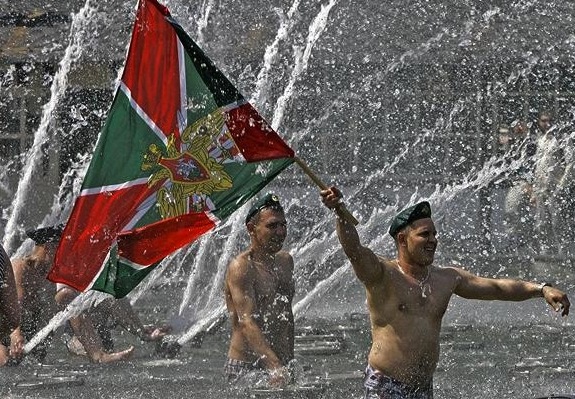
Border Guard Service veterans celebrating their professional holiday, May 28
L’invitation au voyage
Mon enfant, ma soeur,
Songe à la douceur
D’aller là-bas vivre ensemble!
Aimer à loisir,
Aimer et mourir
Au pays qui te ressemble!
Les soleils mouillés
De ces ciels brouillés
Pour mon esprit ont les charmes
Si mystérieux
De tes traîtres yeux,
Brillant à travers leurs larmes.
Là, tout n’est qu’ordre et beauté,
Luxe, calme et volupté.
Des meubles luisants,
Polis par les ans,
Décoreraient notre chambre;
Les plus rares fleurs
Mêlant leurs odeurs
Aux vagues senteurs de l’ambre,
Les riches plafonds,
Les miroirs profonds,
La splendeur orientale,
Tout y parlerait
À l’âme en secret
Sa douce langue natale.
Là, tout n’est qu’ordre et beauté,
Luxe, calme et volupté.
Vois sur ces canaux
Dormir ces vaisseaux
Dont l’humeur est vagabonde;
C’est pour assouvir
Ton moindre désir
Qu’ils viennent du bout du monde.
— Les soleils couchants
Revêtent les champs,
Les canaux, la ville entière,
D’hyacinthe et d’or;
Le monde s’endort
Dans une chaude lumière.
Là, tout n’est qu’ordre et beauté,
Luxe, calme et volupté.
The special holiday for Russian border guards was established by presidential decree in 1994
Invitation to the Voyage
Let us leave this tiresome clime
And quit cities made of stone,
Where you are cold and bored,
And sometimes even scared.
The flowers are softer and stars brighter
In the land where the Southern Cross shines,
In the land rich as the dowry chest
Bestowed on enchanted brides.
We’ll build a house taller than a fir,
And face its corners with stone,
Mahogany will panel its walls,
And we’ll put down rosewood floors.
And among the scattered paths
In the vast rose garden
The speckled beetles’ backs
Shall flicker like the stars.
Let’s leave! Unless you do not need
In that hour when the sun has risen
To hear the terrible ballads,
The tales of Abyssinian roses.
Of ancient fairy queens,
Of lions in crowns of flowers,
Of black angels, and of birds
What weave their nests amid the clouds.
We shall find an ancient Arab,
Chanting in a singsong drone
A verse about Rostam and Sohrab
Or the virgins of Zanzibar.
And when we tire of fables,
Twelve slender little Negroes
Shall dance round us in a whirl
And never want to rest.
And magnificent chieftains,
Decked out in ivory gear,
Shall come to visit us
When in spring the rains begin.
In the mountains merry, where the winds
Cry and shout, I shall chop the trees,
Cedars, redolent of resin,
Plane trees spanning to the skies.
I will alter the streams
Of rivers flowing down the hills,
Teaching them now to please
Me according to my will.
And you, you shall have flowers,
And I will give you a gazelle
With such gentle eyes
That it seems as if a flute trills.
Or a bird of paradise, prettier
Than roses and summer lightning flares,
To flutter over your miraculous
Dark blond bonnet of hair.
And when Death comes, slightly sad,
Sliding along the fateful line,
To stand at our threshold,
We shall say to Death, “What, it’s time?”
And, neither longing nor dreaming,
We shall go to God’s highest paradise,
Clear smiles on our faces, recognizing
Everywhere familiar climes.
The Border Guard Service, created in the 18th century, was a separate ministry until 2003, when it became a branch of Russia’s Federal Security Service (FSB)
Invitation to the Voyage
Start by taking a brick and shattering the glass.
Go from the kitchen (mind the steps!) to the dining room.
Sweep Peter Ilyich and Beethoven from the baby grand,
Unscrew the third leg. That is where you’ll find the loot.
Don’t traipse into the bedroom, don’t rifle the chest of drawers,
Lest you start to masturbate. The bedroom and the wardrobe
Smell of perfume, but except for rags from Dior,
There’s nothing you can hustle in the Old World.
Two hours later, when they announce the flight,
Don’t bolt for the gate. Stretch your legs and feign boredom.
In any crowd of passengers you will usually spy
A Jew with forelocks, kiddies in tow. Join their hora.
The next morning, when Zizi pulls up the venetian blinds
And tells you the Louvre is closed, grab hold of her wet curls,
Bury her stupid mug in the pillow and, snarling, “Bite!”
Do to her the thing that deprives the soprano of her trills.
Andrei Bubeyev (right) in the defendant’s cage at his trial
Tver Resident Sentenced to Two Years in Work-Release Penal Colony for Two Reposts on VKontakte Takie Dela
May 5, 2016
The Zavolzhsky District Court in Tver has sentenced mechanical engineer Andrei Bubeyev to two years and three months in a work-release penal colony for extremism and separatism, writes Kommersant.
The defendant’s lawyer, Svetlana Sidorkina, said the court delivered its verdict “on all the charges summarily and taking into account the verdict in the first criminal case.” In addition, the time Bubeyev has served in a pre-trial detention facility since May 24, 2015, will count toward completion of his sentence. According to Sidorkina, the verdict will be appealed.
The basis for the charges were two reposts Bubeyev made on the VKontakte social network. He posted the article “Crimea Is Ukraine” by writer and political activist Boris Stomakhin on his personal page and a picture of a tube of toothpaste captioned “Squeeze Russia out of you.”
The prosecution argued this was a violation of Russian Federal Criminal Code Article 280.2 (public calls for extremist activities) and Article 280.1.2 (public calls for actions aimed at violating the Russian Federation’s territorial integrity) and requested that Bubeyev be sentenced to three and a half years in prison. Bubeyev pleaded not guilty.
In August 2015, the blogger was found guilty of extremism and sentenced to nine months in a work-release penal colony for reposting similar matter and pictures.
In February 2016, a court in Yekaterinburg ordered the laptop of single mother Ekaterina Vologzheninova destroyed because she had made certain likes and reposts. Investigators claimed that in 2014 Vologzheninova posted images deemed extremist by FSB officers on a social network. The investigators did not report exactly what was in the images. According to the woman’s attorney, one of the images was a caricature in which a person resembling Vladimir Putin was hunched over a map of Donbass with a knife.
Translated by My Left Foot. Image courtesy ofopenrussia.org
_______
Russian Jailed For Reposting ‘Extremist’ Article RFE/RL
May 6, 2016
A court in the Russian city of Tver has sentenced a man to two years and three months in prison for reposting material about Crimea on a social media network.
The court on May 5 found that engineer Andrei Bubeyev reposted an article by publicist Boris Stomakhin that had earlier been deemed “extremist” and “threatening to Russia’s territorial integrity.”
The piece argued that the Ukrainian Black Sea region of Crimea had been illegally annexed by Russia and should be returned to Ukraine.
In April 2015, a Moscow court sentenced Stomakhin to seven years in prison on charges of promoting terrorism and extremism.
Stomakhin says the charges against him were politically motivated.
In the region of Chuvashia, investigators have accused 62-year-old Nikolai Yegorov of inciting national enmity for reposting the same Stomakhin article.
Yegorov denies the accusation and his trial is pending.
Crimean Prosecutor General Natalia Poklonskaya, arguing before the Crimean Supreme Court today, April 26, 2016, on why the Mejlis of the Crimean Tatar People should be declared an extremist organization and banned in the Russian Federation.
Crimean Prosecutor General Natalia Poklonskaya. Photo courtesy of Novaya Gazeta
“The Mejlis receives protection and support from international terrorist organizations,” she said. “It is no coincidence that such organizations, which are banned in Russia, as the Gray Wolves, who killed Russian pilot Oleg Peshkov in Syria, and Hizb ut-Tahrir have spoken out in support of the Mejlis.”
According to Poklonskaya, Mejlis leader Refat Chubarov “has not ceased [his] extremist activities even during proceedings on banning the organization, but on the contrary has continued work aimed at violating Russia’s territorial integrity, participating in the formation of the volunteer Crimean Tatar battalion Asker, whose goal is to tear Crimea away from Russia.”
“Today, may it please the court to hear, we are building a world in which every Crimean will live safely and happily, where roses will bloom and grapes grow,” said Poklonskaya. “The Mejlis is trying with all its might to prevent this. Why do we need this Mejlis?”
Finally, the prosecutor quoted from St. John of Kronstadt.
“If we gather everyone’s will into one will, we will stand our ground! If we gather everyone’s conscience into one conscience, we will stand our ground! If we gather everyone’s love for Russia into one love, we will stand our ground!”
The Mejlis was labeled an “extremist organization” and subsequently banned by the Crimean Supreme Court on April 26, 2016. According to Regional Prosecutor General Natalia Poklonskaya, it was banned because its leaders had sought to destabilize Crimea since the 2014 annexation of Crimea by Russia through the “promotion of aggression and hatred towards Russia, inciting ethnic nationalism and extremism in society.” Also on April 26, 2016, the Council of Europe’s Commissioner for Human Rights, Nils Muižnieks, urged the court to reverse the ban since he believed “equating [the Mejlis] with extremism paves the way for the stigmatization and discrimination of a significant part of the Crimean Tatar community and sends a negative message to that community as a whole.” Exiled in mainland Ukraine, the Chairman of the Mejlis, Refat Chubarov, stated the court’s decision was unjustifiable and that “the occupiers in Crimea are doing everything to crush the Crimean Tatars and force everyone to be silent.” Amnesty International stated the ban “demolishes one of the few remaining rights of a minority that Russia must protect instead of persecute.” The Deputy Chairman of the Mejlis, Nariman Dzhelal, vowed the organization would try to continue its work despite the ban, “it will continue working in Ukraine and other countries.”
Source: Wikipedia (slightly adapted for readability)
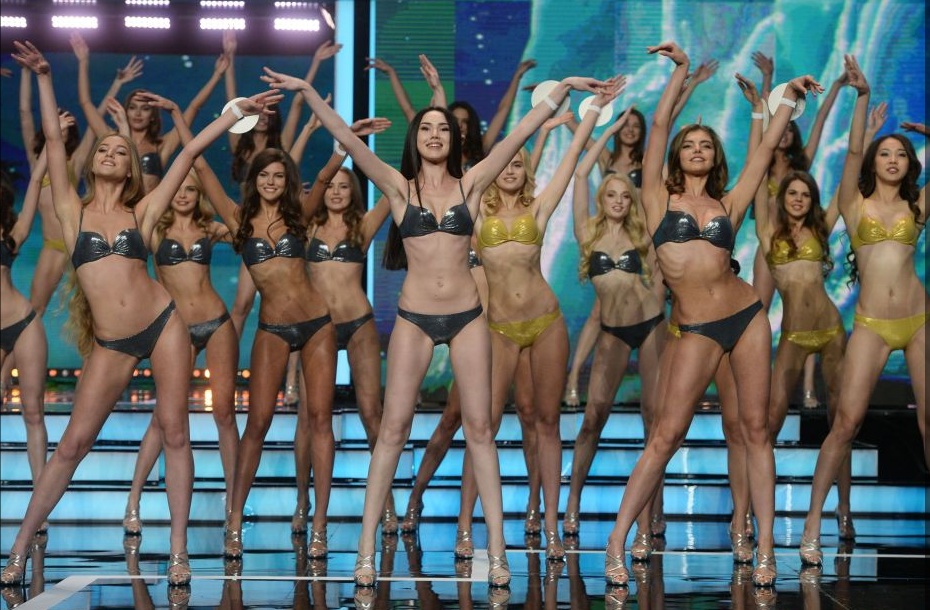
Participants of the national Miss Russia 2016 beauty pageant on the stage of the Barvikha Luxury Village concert hall. Courtesy of Sputnik/Iliya Pitalev
I really like it when a big man in uniform speaks out with fanfare on perennial topics like the structure of society. You think it’s funny they all get Ph.D.s, but they really do consider themselves major theorists and are always willing to teach lessons in wisdom in their spare time. An entire genre has even emerged in Russian newspapers: lessons in political philosophy by generals.
For example, in today’s issue of Kommersant, General Bastrykin casually gives readers an unexpected lesson in democracy.
“For democracy or people power is nothing other than the power of the people itself, realized in its interests. It is possible to achieve these interests only by means of the common good, and not through the absolute freedom and arbitrary will of individual members of society,” he writes.
It must be admitted that this is the pure, unadulterated truth. We might rejoice that democracy in Russia has found a new supporter.
Then, however, Bastrykin the democrat’s argument takes an unexpected turn. He proposes setting things up so that he, Bastrykin, would decide himself what information should be considered extremist, and would limit Internet access without a court order! In addition, he would also decide in which cases providers are obliged to provide him with the personal information of their clients.
There are lots of other tasty tidbits in his article, including innovative tactics for fighting terrorism by confiscating property, but that does not concern us here.
So somebody comes and says, Now I am going to decide who is an extremist and who can read what. You will also be informing me everyone’s personal information. If this is not “absolute freedom and the arbitrary will of an individual member of society,” then what else would you call it?
I am going to have to upset Mr. Bastrykin. Democracy is, in fact, people power. Therefore, the main objective of democratic governance has been and will be preventing the usurpation of power, not defending the people from the machinations of external foes, not hunting down traitors, not surveilling unreliables, but combating usurpers. And so democracy’s main enemy is the guy who comes out and says he is going to decide who the extremists are round here.
The problem with these scholarly generals is that the only form of social organization they are capable of conceiving is the prison camp. And so whether they write about democracy, traditional values or economic progress, the same speech in defense of the prison camp always comes out.
* * * * *
“It’s time to erect an effective barrier against the information war” Alexander Bastrykin, chair of the Russian Federal Investigative Committee, on methods of combating extremism in Russia Kommersant
April 18, 2016
Chair of the Russian Federal Investigative Committee, general of justice of the Russian Federation, doctor of juridical sciences, Professor Alexander Bastrykin, special to Vlast magazine, on the ways and methods of combating extremism in Russia
In 2015, the Russian Federation witnessed negative trends in criminal extremism and terrorism.
1,329 extremist crimes were recorded, which was 28.5% higher than in 2014 (1,034 crimes). A growth in this type of crime was noted in fifty-six regions of the Russian Federation.
The numbers of such crimes as public calls to extremist activity (Russian Federal Criminal Code Article 280) and inciting hatred or hostility, and humiliation of human dignity has soared by nearly forty percent in comparison with 2014.
The crime of organizing an extremist organization was recorded 42 times (+2,4%).
A significant increase (+36.3%) in terrorist crimes committed in the Russian Federation has been noted. A total of 1,538 such crimes was recorded in 2015 (as opposed to 1,128 in 2014).
Seventy such crimes were prevented at the stage of planning or during the attempt. 133 terrorist crimes were committed with the help of the Internet network.
A particularly difficult situation has been observed in the North Caucasus Federal District, which accounts for the bulk of terrorist crimes: 1,168 crimes or 75.9% of all such crimes (leading to an increase of 32.3%). (In 2014, 883 such crimes were committed.)
Both external (geopolitical) and domestic political factors have contributed to the growth of this type of crime.
Over the past decade, Russia and a number of other countries have been living through a so-called hybrid war, unleashed by the US and its allies. The war has been conducted on various fronts, political, economic, informational, and legal. In recent years, it has moved into a new phase of open confrontation.
Professor Bastrykin
The main elements of economic pressure have been commercial and financial sanctions, dumping wars on the hydrocarbons market, and currency wars. Skillfully manipulating the huge number of dollars in circulation, the States have brought down the national currencies of developing countries. Russian organizations have had their access to channels of external long-term financing blocked, channels that formed the basis of investment for developing the real (productive) sectors of the economy. It is noteworthy that restrictions on the movement of financing have not affected short-term financing, which currently has been widedly employed to exert speculative pressure on our national currency. In many respects, the outcome of these measures has been the deep devaluation of the ruble, falling real incomes, a decline in industrial production, and economic recession. There has been a budget deficit and ensuing consequences in the form of cuts in expenditures, as well as an increasing fiscal burden to raise revenues.
Unfortunately, international law and the justice based on it have increasingly become tools of this war.
Obvious examples are the decisions in the Yukos cases, the decision in the murder case of former FSB officer Alexander Litvinenko, the report of the Security Council of Netherlands on the investigation into the crash of Malaysian Airlines Flight 17, the FBI’s investigation of the legitimacy of awarding the right to hold the World Cup to Russia and Qatar in 2018 and 2022, and the extradition of our citizens Victor Bout and Konstanin Yaroshenko to the US and their sentencing to long terms of imprisonment.
However, the information war has caused the most devastating effects. By supporting radical Islamists and other radical ideological tendencies, the US has completely destabilized the situation in the Middle East. The effects of artificially initiated coups, revolutions, and crises in this region are still being experienced by Europe, overrun by mobs of refugees who profess qualitatively alien sociocultural traditions and have displaced the local population. Islamic State, the Al-Nusra Front, Al Qaida, and other terrorist organizations involved in the armed conflict in the Syrian Arab Republic have also been an effect of this policy. Manpower for replenishing these organizations are recruited all over the world, including in Russia.
More than a thousand Russian citizens have gone to the Syrian Arab Republic to participate in the armed conflict. 469 criminal cases have been filed against these persons. 135 of them have been killed in armed clashes with Syrian government troops.
The main channels of entry for Russian citizens into areas of heightened terrorist activity have been Turkey and Egypt, where they travel both directly and through third countries (Georgia, Azerbaijan, Belarus, Ukraine, Moldova) under the pretext of holidaymaking, receiving theological education, doing business, etc.
The main technique of the information war is the manipulation of an ideology that a particular social group finds congenial by radicalizing it. It is clear that the system of religious, ethnocultural, and confessional values is the segment of social existence that defines the most significant feature of any nation (ethnic group) and other such social groups as self-identification. Many of these values were shaped, preserved, and passed from generation to generation for centuries. Therefore, no nation is willing to give up its identity. Perhaps it is the only universal value it is willing to defend with arms and, as they say, until the last drop of blood is spilled.
Aware of the devastating effect of conflicts based on ethnic hatred, the US has bet on this informational element. At the current level of understanding of the issue, it is clear that the subversion of the Soviet Union’s ideological foundations, which were based on the principle of the brotherhood of nations, was also initiated from the outside and based on methods of ethnic strife. It was no accident that in the early 1990s numerous ethnic conflicts (Nagorno-Karabakh, Georgia-Abkhazia, Ossetia-Ingushetia, Transnistria) broke almost simultaneously. At this time, the first mass rallies of nationalist-minded citizens took place in Kiev. In addition, the subversion of state power was carried out by means of anti-Soviet agitation and financing of the political opposition in Latvia, Lithuania, Estonia, Georgia, and other countries.
Of course, in the minds of the local populace, those events were then regarded as local conflicts. However, it is now completely obvious that all these clashes were elements of the initial, as-yet-hidden phase of the information war.
Undoubtedly, the informational-ideological “weapon” will be deployed in the future. This is evidenced by the increase in US government spending on programs for the so-called development of democratic institutions in countries bordering on Russia and in the Central Asian states. The true meaning of these assets becomes clear from the name of this budget item, “Countering Russian aggression through public diplomacy and foreign aid programs, and the creation of stable government in Europe.”
About 4.3 billion dollars have been allocated under his item in 2017, and around a billion dollars will go to programs for the so-called fight against corruption and supporting democracy in countries neighboring Russia.
Funds already received under this program have been spent by by various non-governmental organizations under the guise of promoting education, developing civil society, and other seemingly useful purposes. The outcome has been the incitement of anti-Russian moods in neighboring countries, the shaping of the pro-American and pro-western so-called non-systemic opposition in Russia, and the spread of inter-confessional and political extremism within our country.
Recent events in Nagorno-Karabakh witness to the repeated attempts of forces opposed to Russia to undermine the peace between the Armenian and Azerbaijani peoples and establish yet another hotbed of war on Russian’s borders.
It seems it is time to erect an effective barrier against this information war. We need a tough, appropriate, and balanced response. This is especially relevant in light of the upcoming elections and the possible risks presented by the stepping up of efforts by destabilizing political forces. Enough of playing at pseudo-democracy and following pseudo-liberal values. For democracy or people power is nothing other than the power of the people itself, realized in its interests. It is possible to achieve these interests only by means of the common good, and not through the absolute freedom and arbitrary will of individual members of society.
The following measures can be proposed to counter extremism.
It is extremely important to establish a concept of state ideological policy. Its basic element could be a national idea that would genuinely unite Russia’s unified multinational people. The concept could stipulate specific long-term and medium-term measures, aimed at the ideological education of our younger generation. Conscious resistance to radical religious and other ideologies could knock out the foundations on which current extremist ideologies are constructed. With this protection in place, even the most generous outside financing of destabilizing the situation in Russia will prove useless.
It is also important that youth are regarded by terrorist groups as a natural reserve. From this it follows that everything must be done to seize the initiative, to include young people at risk in the development and implementation of programs for countering armed extremism.
It seems appropriate for the supervisory and regulatory authorities to organize a wide-ranging and detailed verification of the compliance with federal legislation of all religious, ethnocultural, and youth organizations, suspected of engaging in banned extremist activity.
Using the know-how of the Northern Caucasus, we should organize specific and narrowly targeted preventive work with members of informal youth associations in order to adopt measures aimed at procuring information about negative processes underway in the youth milieu and identifying the ideologues and leaders of radical organizations who involved young people in extremist activity.
The positive know-how of the Republic of Ingushetia is also worthy of support. They have established a military-patriotic club that unites the children of law enforcement officers who were killed in the line of duty and children of neutralized members of the bandit underground, which facilitates their rapprochement and shapes an atmosphere of mutual understanding among them.
The proposed concept sees it as expedient to define the limits of censoring the global Internet network in Russia, since at present this problem is causing a heated debate in the light of the stepping up of efforts by advocates of the right to the free receipt and dissemination of information. Interesting in this sense is the know-how of foreign states, opposing the US and its allies. Due to unprecedented pressure from information, they have taken steps to restrict foreign media in order to protect the national information space. Thus, for example, on March 10, 2016, China’s Ministry of Industry and Information Technology introduced a ban on electronic media fully or partly owned by foreign residents. These media will no longer be able to disseminate information through the Internet and, in the best case, by means of print publications. Chinese media will cooperate with foreign online media only with the permission of the ministry. Only Chinese nationals will be able to work in the management of national media. Online media servers can be located only in the People’s Republic of China.
It seems this know-how could be employed in Russia to a reasonable extent.
Internet providers must be furnished with a integrated set of rules for storing the personal information of their clients and users in the right amount in the event that such information is required when investigating cyber security violations.
In public places (libraries, schools, and other educational institutions) with access to the World Wide Web, filters restricting access to sites containing extremist content should be established.
In addition, it seems appropriate to stipulate an extrajudicial (administrative) procedure for including information in the federal list of extremist content and blocking the domain names of sites that disseminate extremist and radical nationalist information. However, if the proprietors of this information do not consider it extremist, they can appeal the relevant actions of the authorized government agencies in court and prove their innocence there. This procedure will enable a faster and more effective response to the promotion of extremism on the Internet. It is necessary to step up work on introducing modern technology for the effective monitoring of the radio waves and the Internet.
It is necessary to expand the range of criminal law measures to stop the illegal actions of terrorist organizations committed on the Internet network involving recruiting. To this end, we should consider the criminalization of possessing such materials, collecting them or uploading them from a computer. Modern evidence technologies make it possible to present to the court and confirm technical elements of intercourse on social networks that testify to the connections between the accused and the relevant electronic messages.
To expose the real aims and intentions of Islamic extremists and establish the insolvency of their theoretical approaches, which contradict the realities of the modern world and the fundamental interests of Islamic countries, it would seem useful for the State Duma to regularly hold special hearings involving experts from the Federal Security Service (FSB), eminent Islamic scholars and authorities, and scholars of Islam. The hearings should be widely covered in the press.
Particular attention should be paid to the migration process. Migrants are often targets of espionage recruiting and radicalization. Many of them have overstayed their limit in Russia, dropping out of the sight of law enforcement. We must analyze the regulatory acts governing the presence of foreign nationals and persons without citizenship in the Russian Federation. Based on our analysis, we should take additional measures for improving the legislation.
It is necessary to improve the work of precinct police with foreign nationals in the realm of monitoring compliance with the established rules of residence in Russia (monitoring of persons letting and renting residential premises in the precinct, and obtaining information about the nature of these persons’ employment). The internal affairs departments of agencies should exclude possible corruption here. Full use of the public’s assistance should be made.
Certain features of extremist activity have taken shape in the Crimea Federal District, where attempts have been made to mold anti-Russian moods, by means of falsifying historical facts and distorting the interpretation of modern events, and call into question the outcome of the referendum on Crimea’s accession to the Russian Federation. This act of the legal expression of the Crimean population’s popular will has become an integral part of Russian constitutionalism. Considering the place of this act in the hierarchal system of values of Russian state and society, it is certainly in need of special legal protection, including by means of criminal legal coercion.
It should be noted that criminalizing the denial or falsification of historical events of particular importance to a state and society is a widespread practice. For example, in many countries, including Russia, criminal punishment is stipulated for promoting fascism. France and a number of other countries have introduced criminal liability for denying the Armenian genocide. The State Duma of the Russian Federal Assembly is considering a similar law bill, No. 938567-6 (“On Criminalization of Public Denial of the Genocide of the Armenian People in Western Armenia and Ottoman Turkey in 1915-1922”). In Israel, it is a crime to deny the Holocaust.
In view of the above, it seems necessary to supplement the notion of extremist activity (extremism) contained in the federal law “On Countering Extremist Activity” with such a manifestation as denial of the outcome of a national referendum. It is necessary to decisively counteract the deliberate falsification of the history of our state. In this connection, we might also propose that Russian Federal Criminal Code Article 280 (public calls for extremist activity) include an additional stipulation, which would qualify the falsification of historical facts and events as a call for extremist activity.
In addition to countering the ideological component of the information war being waged against Russia, it is important to step up efforts to combat financial support for this activity, including tightening control over cross-border capital flows. As experience has shown, terrorism is often financed by virtual cryptocurrency, which has no central issuer, no single point of transactional control, and features anonymous payments. In addition, as a result of their wide dissemination, these currencies can displace legal money from the market, which threatens the state’s financial stability. It is therefore suggested that criminal liability be introduced for the illegal issuance and circulation of cryptocurrency and other money substitutes.
We should also review social security legislation concerning the close relatives of persons involved in terrorism, entitlement to survivor’s pensions, and other benefits. A person who is going to commit such crimes should know that in the event of death not only will he be buried in an unmarked grave but he will also deprive his loved ones of support from the state.
Another measure that would contribute to the effective fight against extremism, terrorism, and other dangerous criminal manifestations is confiscation of property as a form of criminal punishment. As we know, the relevant legislative proposals have been prepared and are in need of speedy legislative implementation. Unfortunately, this process has been unduly delayed.
No less important is improvement of the legal mechanism of international cooperation among law enforcement and other state bodies empowered to counter terrorism and extremism.
Russian law regulates only the procedure for submitting an international request for legal assistance, whereas international acts in this field stipulate the possibility of closer integration, including the establishment of international investigative teams. Such cooperation would help in cases where Russian investigative authorities need to perform a number of investigative procedures or even perform a preliminary investigation in a foreign country and that country has agreed to provide such assistance. This gap became apparent during investigation of the armed conflict between Georgia and South Ossetia in 2008 and the terrorist act committed on board the Russian Airbus 321 over the Sinai Peninsula.
Translated by the Island of Misfit Toys. Thanks to Greg Yudin for his courage.
Prosecution Witness in Brinikh Case Recants Grani.ru
March 24, 2016
77-year-old Mugdin Guchetl, a witness for the prosecution in the extremist case against environmentalist Valery Brinikh, recanted from the testimony identified as his in the case file during a court hearing in Maykop City Court in Adygea, as reported by the international human rights group Agora, who cited Brinikh’s defense attorney Alexander Popkov.
In testimony signed “Guchetl,” given during the investigation, it states that Brinikh has insulted not only the witness but the entire Adyghe people with his article “The Silence of the Lambs.” During the trial, however, the witness said he had not read the article, that he had not been in Adygeisk for around five years (although according to the interrogation report he was questioned in Adygeisk), that he had not given testimony to a police investigator, and that he had not signed the interrogation report.
Presiding Judge Vitaly Galagan pressed Guchetl, telling him that if he did not acknowledge his own signature, he would be summoned to court again. The defense protested the judge’s actions and filed a motion for a handwriting analysis to be performed.
The article “The Silence of the Lambs” was published on the website For Krasnodar! in September 2014. It recounts the environmental problems caused by Kievo-Zhuraki Agribusiness JSC, a large pig-breeding facility in Adygea’s Teuchezhsk District. The company was founded by Vyacheslav Derev, Karachay-Cherkessia’s representative in the Federation Council.
The article contains the following passage: “But who or what has forced the Adyghe to breathe manure-polluted air and swim in ponds poisoned by sewage? Nothing but cowardice and a lack of self-esteem.”
On December 17, 2014, Maykop City Court ruled that “The Silence of the Lambs” was extremist. On March 20, 2015, the Adygea Supreme Court reaffirmed the lower court’s decision. In their rulings, the courts claimed the author of the article had insulted ethnic Adyghe, accusing them of cowardice. On January 12, 2016, Brinikh submitted a written petition to Maykop City Court asking it to reexamine its ruling in the light of new circumstances, but on January 21, Judge Irina Ramazanov refused to consider the petition.
The environmentalist had been charged under Articles 33.5 and 282.1 of the Criminal Code (complicity in inciting hatred and enmity) as he was accused of having help to disseminate the article. Subsequently, Major Konstantin Kustov, senior major case investigator at the regional headquarters of the Russian Federal Investigative Committee, recharged the environmentalist, removing Article 33.5 from the charges and accusing the biologist of having authored “The Silence of the Lambs.”
Defense attorney Popkov has noted that over the past year the Investigative Committee has ordered five forensic examinations in the case. However, the lawyer stressed that data from a wiretap of Brinikh’s telephone, conducted by the Federal Security Service (FSB) a few months before “The Silence of the Lambs” was published, has been subjected to a phonological forensic analysis.
Hearing of the case on the merits began on January 26, 2016. Popkov had insisted on sending the case back to the prosecutor’s office, pointing out that a number of pieces of evidence had been falsified, but Judge Galagan rejected his appeal.
During the February 9 hearing of the case, one of the ethnic Adyghes who was questioned refuted the charges against the defendant.
“The environmentalist’s article caused no enmity,” he said. “On the contrary, Brinikh has help the Adyghes fight for the environment.”
Translated by the Russian Reader. Photo courtesy of8772.ru. See my previous posts on Valery Brinikh and the case against him.
Court Sentences Yekaterinburg Resident to Community Service for Posts on Social Networks and Order Her Laptop Destroyed Mediazona
February 20, 2016
Yekaterinburg’s Zheleznodorozhnyi District Court has found single mother Ekaterina Vologzheninova guilty of inciting social hatred and enmity (Russian Criminal Code Article 282), reports Grani.ru.
Ekaterina Vologzheninova
The court has sentenced the woman to 320 hours of compulsory community service and ordered her laptop, which served as physical evidence in the case, destroyed.
As Grani.ru explains, the court based its verdict on the conclusion reached by a forensic linguist that Vologzheninova had incited “ethnic [sic] hatred and enmity towards volunteers from Russia” who were involved in the armed conflict in eastern Ukraine, as well as towards public officials.
Criminal charges were filed against Vologzheninova after she [re]posted Anatoly Marushkevich’s poem “Katsaps,” along with an image of a young Ukrainian woman and the caption “Death to the Moscow Occupiers,” and a caricature featuring a man resembling Vladimir Putin leaning over the Donbass holding a knife. The last post was later excluded from the evidence.
It’s Dangerous to Quote Voltaire ovdinfo.org
January 10, 2015
Adygean Environmentalist Valery Brinikh
In Adygea, Valery Brinikh, chair of the regional branch of the All-Russian Society for Nature Conversation (VOOP), has been charged with aiding and abetting extremist activity and subjected to travel restrictions. According to investigators, Brinikh “aided unidentified persons in disseminating information aimed at abasing the dignity of a person or group of persons on the basis of ethnicity and origin by creating extremist material.” Abasement of dignity charges (Russian Federal Criminal Code Article 282.1) were filed in December 2014. They were occasioned by publication of the article “The Silence of the Lambs” on the website For Krasnodar! The article details the environmental damaged caused to Adygea’s Teuchezhsky District by pollution from an industrial pig-breeding facility. The company that runs the facility, Kiev0-Zhuraki Agrobusiness JSC, was founded by Vyacheslav Derev, who represents Karachay-Cherkessia in the Federation Council, Russia’s upper house of parliament.
Several days after the charges were filed, the article was deemed extremist. According to Brinikh’s defense attorney, Alexander Popkov, the [next-to-last] sentence in the article, which quotes Voltaire’s argument that God helps those battalions that shoot best, could have been the main reason it was deemed extremist.
“The word ‘shoot’ is forbidden; it is an awful word. ‘Battalions’ is also an awful word. And Voltaire was a freethinker,” Popkov says ironically.
Brinikh was for a long time officially regarded as a suspect in the case. According to Popkov, investigators have no proof that it was his client who wrote the article, but they claim he aided “persons unknown” in disseminating it.
The indictment does not make clear exactly whose dignity was abased by the article. Popkov recounts that, initially, investigators said that Brinikh “had offended public officials.” Ethnic motives were also discussed.
In the written petition, filed by the Adygea Prosecutor’s Office, asking the court to deem the article extremist, it says that “according to the findings of the linguistic analysis carried out by the Main Directorate of Internal Affairs in Krasnodar Krai (No. 17/7-119i, dated September 15, 2014), the text of the article ‘The Silence of the Lambs’ contains statements negatively evaluating a group of persons, united on the basis of ethnicity, the Adyghe (identified in the text as ‘cowards,’ ‘persons who lack self-esteem,’ and ‘lambs’).”
The article’s authors complains about the passivity of the local populace, who refuse to defend their own interests.
Popkov notes Brinikh would not have wanted to humiliate the Adyghe.
“On the contrary,” says Popkov, “he advocated for them and visited them.”
The prosecutor’s petition also claims the article contains “statements that could be understood to incite ethnic Adyghe to take actions, probably involving violence, against a group of persons, i.e., the local authorities.”
According to Popkov, Brinikh’s aiding and abetting persons unknown “is supposedly confirmed by a phonoscopic examination: he allegedly spoke by telephone about posting the article on the Web.”
However, since the article was posted on the Web before criminal charges were filed and before it was declared extremist, it follows that Brinikh’s telephone was bugged before these events took place.
“The question arises: on what basis were they bugging him?” asks Popkov.
Translated by the Russian Reader
Editor’s Note. The following day, January 11, ovdinfo.orgreported that Valery Brinikh’s trial on the above-mentioned charges would begin in Maykop City Court on January 19.
Please read my previous posts on the Brinikh case:







#/media/File:Red_Guards.jpg)