Sergei Krivov: “It Is Not Recommended to Live in This Country”

The other day, a friend of mine who works with kids complained to me that kids in Russia had no real heroes. Like kids most everywhere, they are in love with the wretched, hyper-commercialized Spider-Man and Harry Potter, not with homegrown heroes.

It might be a bit of a reach (because how do you explain this stuff to kids?), but from where I sit there are lots of heroes in modern Russia. Prominent among them are all the people convicted as part of the shameful sham known as the Bolotnaya Square case.

One of those heroes is Sergei Krivov, recently released after serving over four years in prison for the nonexistent crimes of being beaten over the head with a truncheon by a policeman and attempting nonviolently to prevent policemen from doing the same to other peaceable demonstrators in Moscow on May 6, 2012.

In the country I would like to live in, I would go outside and see dozens of people wearing t-shirts with Krivov’s totally ordinary but heroic face emblazoned on them. Krivov’s birthday would be a minor holiday, celebrated with a rousing march down every town’s main thoroughfare, followed by hearty little picnics, to celebrate the fact that Krivov undertook two hunger strikes, nearly dying in the attempt, in order to defend the freedom of speech and assembly in Russia.

Needless to say, Krivov’s would be a household name. Kids would read comics about the adventures of Sergei Krivov, where the hard facts would be mixed with a light helping of fantasy to make them more palatable to childish fancy.

If you have never heard of Sergei Krivov or don’t understand why he is a modern-day Russian hero, you need to read this interview with him. TRR

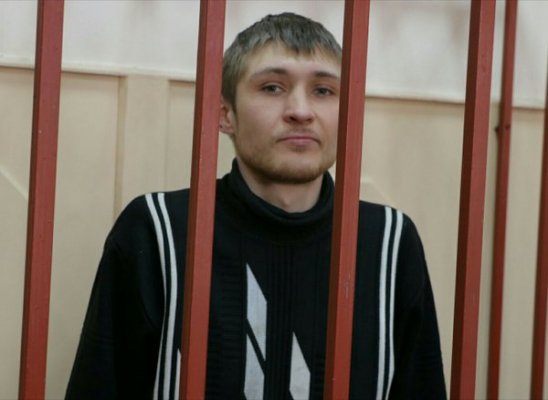
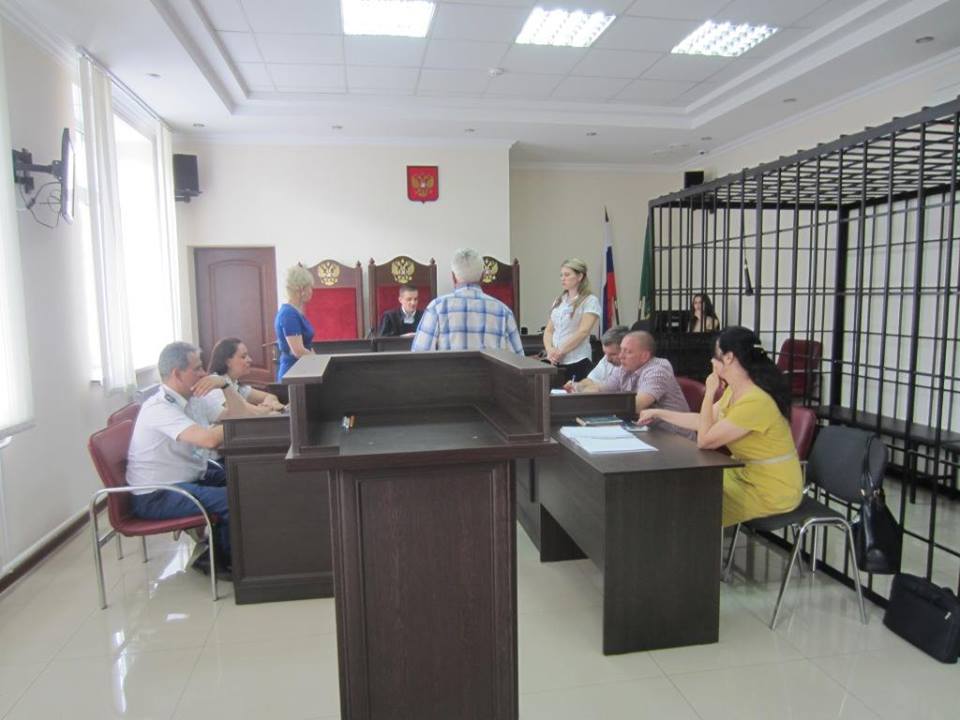
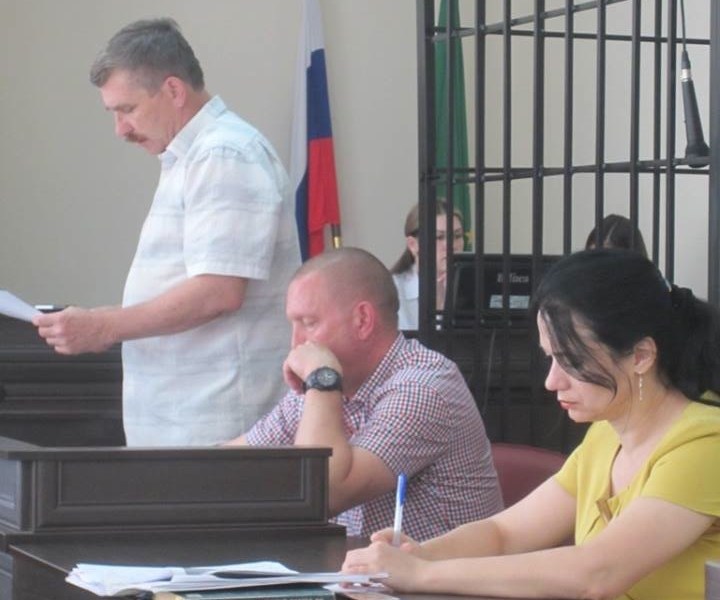
Sergei Krivov, Nikulinsky District Court, Moscow, December 23, 2013
Sergei Krivov, Nikulinsky District Court, Moscow, December 23, 2013. Photo courtesy of Radio Svoboda and TASS

“It Is Not Recommended to Live in This Country”
Natalia Dzhanpoladova and Nikita Tatarsky
Radio Svoboda
July 26, 2016

Yet another person convicted in the so-called Bolotnaya Square case, Sergei Krivov, a 54-year-old with a Ph.D. in physics and mathematics, has been released. Krivov was released from a prison colony in Bryansk Region, having served his sentence in full. In 2014, a court found him guilty of involvement in rioting and using force against police officers during a May 6, 2012, opposition rally on Bolotnaya Square in Moscow.

Krivov received one of the harshest sentences in the case, three years and nine months imprisonment.

His allies explained this was because the authorities avenged Krivov for the uncompromising stand he had taken throughout the trial. Krivov went on two lengthy hunger strikes. The first, to protest his arrest, lasted over forty days. During the second, he did not eat for sixty days in order to secure transcripts of the court proceedings. Krivov suffered two heart attacks during the second hunger strike.

Krivov was arrested as part of the Bolotnaya Square investigation several months after the events, in October 2012. According to police investigators, on May 6, 2012, when the crowd broke through police lines, Krivov seized a rubber truncheon from a policeman and used it to deliver several blows to police officers. Krivov himself repeatedly claimed he had been beaten by police on Bolotnaya Square, but the Investigative Committee refused to investigate his complaint.

Krivov served his sentence in two penal colonies in Bryansk Region, first at a correctional facility in Starodub. He was then transferred to a penal colony in Klintsy. The wardens put him in solitary, because they felt his life was in danger.

In an interview with Radio Svoboda, Kriov admitted his sentence might have been shorter had he “kept [his] mouth shut.” He spoke in detail about the reasons for his uncompromising stance, what happened on Bolotnaya Square, and how much Russia has changed since 2012.

The changes have been quite huge, and for the worse, although I still cannot say I have figured out what is what. I had been gradually following these changes by watching TV and reading Novaya Gazeta newspaper and New Times magazine, so they did not happen all at once for me and were not news. Nevertheless, I am perfectly aware the country as it was in 2012 and the country as it is in 2016 are two fundamentally different countries. There are far fewer freedoms, naturally, and It is nearly impossible to do anything within this framework.

Do you feel you have changed over these years?

In fact, after I got out, changed my clothes, and bathed, I had the feeling everything was as it had been. Although I did have big problems during the middle of my sentence: lots of things happened. But when it is all behind me, when I have come back to the “free” world, I cannot say I have changed. I think I am the same person I was.

Have you managed to meet with friends and relatives since your release? What are your impressions from these meetings and conversations?

Of course I have managed to meet with them. Let me put it is this way: almost no has chewed me out, except my wife, of course. In general, the feelings have been positive, because everyone has been friendly. They all congratulate me and wish me the best.

Naturally, anyone would find this pleasant. I want to say thank you to all the people who wrote me letters, held pickets, and collected money through the Internet, and to the leaders of the PARNAS Party, who paid my lawyers and sent me care packages: Boris Nemtsov, Mikhail Kasyanov, Vladimir Ryzhkov, and Ilya Yashin. In addition, Lyudmila Alexeyeva was involved. Despite her age, she attended the court hearings. A big thank-you to everyone for their support.

Last Wednesday, you also met with activists in Sokolniki Park. You mentioned you had no hope of being paroled. [In March, the court turned down Krivov’s parole application — Radio Svoboda.] Did you pin any hopes on the court in this case, that is, the trial court that heard the Bolotnaya Square case?

No. We had no chance from the get-go. What would have been the point of cooking all this up and then releasing us later? Obviously, the authorities conceived a quite definite plan, and they have been carrying it out. From my point of view, there was no reason to change anything, and nothing changed. I had been detained on misdemeanor charges several times., and I knew perfectly well how such matters were decided. There were no doubts in this case.

And yet your tactics in court were quite different from those of the other fellows. You were one of the most active participants in all the court proceedings.

Yes, I was, because I felt it could not make things any worse. That is how it happened, if you look at the sentences handed down. Naturally, my sentence would have been shorter if I had kept my mouth shut. But here, you know, six months more, six months less do not matter.  Naturally, we had to defend ourselves to the hilt. After all, we did not take to the streets only to snitch on the protest movement, to put it crudely. We did not do what we did to make the court rule in our favor. It was a continuation of the protest. Pavlensky said it: court is a continuation of my protest action. For me, it was simply a continuation of the opposition’s fight. It can happen anywhere: in court, outside of court, on Bolotnaya, away from Bolotnaya. It is like a way of thinking. It is as Solzhenitsyn put it: “Not living a lie.” Every single moment you do what you think is right. The situation changes, but the individual does not change in the situation.

Were your fairly long, serious hunger strikes also a continuation of this same story?

Basically, yes.

What prompted you to do it? Do you remember what you felt when you decided there were no other methods left?

During both hunger strikes, I was perfectly aware my demands would not be met. I got carried away with the second hunger strike: let’s put it that way. But retreating? Chapayev never retreated. So the only way was forward. The main objective was to attract attention, to shake up the situation somehow. Because getting results, especially in the first case, when it was a matter of custody measures, was totally unrealistic. All I was charged with (not what I did, but what I was charged with) was causing the bruise on the back of the hand of a policeman who in fact assaulted me. The policeman’s name is Alexander Ivanovich Algunov. He completely flagrantly hit me over the head with a truncheon. I had three lumps on my head, one of which clearly visible on my temple. It was both videotaped and photographed. And there were eyewitnesses who saw everything.
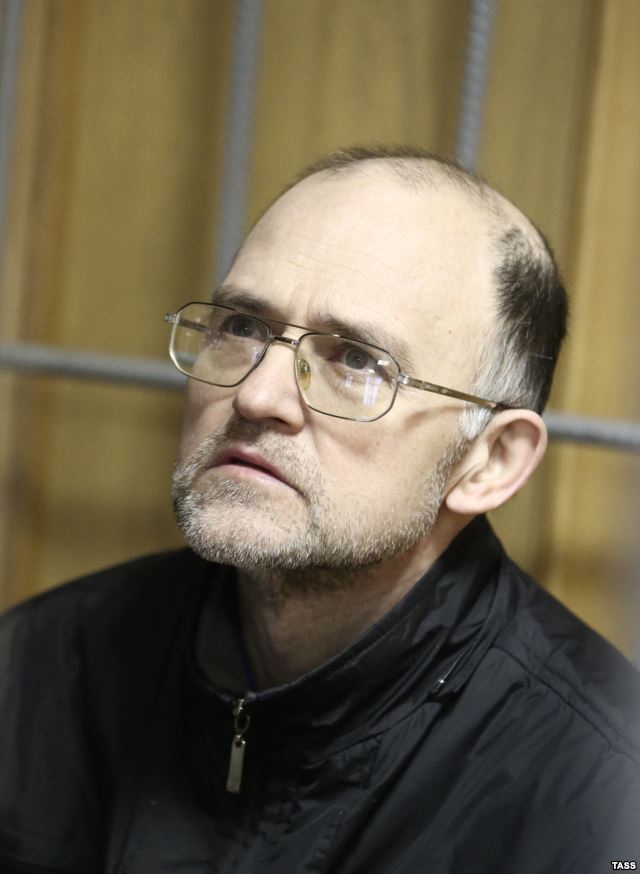
Sergei Krivov during a hunger strike, Nikulinsky District Court, Moscow, November 2013. Photo courtesy of TASS and Radio Svoboda

But when it was matter of conducting a judicial review or investigatining this conflict… The bruise I allegedly caused the policeman was investigated by the Investigative Committee of Russia, meaning the country’s top investigative body. But what he did to me (and they believe that these actions took place at the same time) has been investigated by another committee. When I filed a written complaint against the officer, the case was not just dropped down to the municipal level, but to a neighborhood precinct, where an investigator wrote there was nothing to investigate. The bruise on the policeman’s hand was investigated by the Investigative Committee of Russia, while beating a person with a truncheon was investigated by a completely different division, the lowest on the totem pole, and it said there was nothing to investigate. I am simply a victim in the Bolotnaya Square case. But I was really visible in the video footage. I was in a confrontation with a policeman who was assaulting me. I grabbed the truncheon with which he was beating me, because at one point I nearly fainted. He hit me so hard on the head it felt like I had been hit with a sharp nail, not a truncheon.

You were not the only victim on Bolotnaya Square, and yet the authorities investigated these incidents so unfairly. How do you explain this?

In the trial documents, for example, there is this bit of evidence. There were two ambulance crews on duty on Bolotnaya Square. They kept a record of injuries in which they wrote down the names and addresses of everyone whom they examined. As far as I remember, there are forty-eight civilians in this list, who suffered something like seventeen concussions and thirteen head injuries and injuries to the soft part of the skull, meaning they had mainly been beaten on the head. There were three policemen who sought medical attention on the square. Of the forty-eight civilians, only two people were deemed injured parties by the authorities. One was hit in the back with a stone, while the other person’s trousers caught fire, and he suffered burns on his leg from a Molotov cocktail. We do not know who threw the bottle or the stone. The authorities assume it was the protesters, so only two individuals were deemed victims. The rest were not recognized as victims, because these forty-six individuals were victims of the police. Who the heck is going to investigate injuries caused by the police? That is not how things are done.

The public commission who investigated the events on Bolotnaya Square came to the conclusion it was the Moscow authorities and police who provoked the confrontation? Do you share this point of view?

I also came to the same conclusion. Only I think it was not the Moscow authorities, but the federal authorities [who provoked the conflict]. Moscow, in this case, did not have the authority to decide these questions. There were provocateurs there. I saw a man in a mask step forward, chunks of asphalt in both hands. At the time, I wondered what was so black, because I was looking into the light. At first, I thought he was throwing black earth, because the asphalt everywhere was so clean. This guy stepped forward and tossed one stone. Then he shifted a second stone [to his throwing hand] and threw the second stone. A policeman was standing there. I was standing there looking back and forth between the two. Either I should have said, “Why are you tossing stones?” or I should have gone up to the policeman and said, “Why are you just standing and watching?” The policeman saw what he did, and then turned around and walked away. The police were completely uninterested in the people who were actually throwing stones, just as the people throwing the stones knew the police were not going to do anything to them.

Yes, and the most interesting thing is the authorities alleged the protesters shouted things about attacking the Kremlin and Red Square, and overthrowing someone. I was there. I heard no such cries. There are twenty-six hours of video footage in the case file. There are no such appeals in that footage. When the police cordon fell apart, people did not run to the bridge. This is clearly visible in the footage. People who were squeezed out of the crowd ran ten or fifteen meters away, because there was a crowd behind them and the danger of being crushed. Then, at a leisurely place, these people fixed their clothes or tied their shoelaces or something, and headed towards the square. This, too, is visible in the footage. Yet the investigators continue to claim, and the courts have not refuted it, but take it as a proven fact, that people were shouting to run across the bridge somewhere and were, allegedly, trying to escape.

So it transpires the whole thing was a planned provocation. How do you explain it? What goals was the regime pursuing via this case? Has it achieved them?

It was the first [opposition] rally after the elections. All the major protest rallies had taken place between the December [parliamentary] elections and the March [presidential] election. May 6, 2012, was the eve of the presidential inauguration: the regime no longer had anything to fear. If they had used force before the elections, naturally, it could have turned against them. But there was nothing to fear after the elections, so they were going to put the heat on people and arrest them. This was followed by the adoption of a series of repressive laws and amendments to the laws on elections, and pickets and demonstrations, not to mention the fact they introduced Criminal Code Article 212.1, which they used to put away [Ildar] Dadin.

You were not detained immediately after the events of May, but around five months later. Did you follow what was happening to the guys who were arrested first? Were you afraid you might become a defendant in the case?

Of course, I followed what was happening. I went and picketed outside the Investigative Committee building. I had this routine: one evening at home with the family, the next evening I would go picketing, and so on. At first, I did not take it very seriously. Why did they take so long to arrest me? First, they checked out everyone who had been detained on Bolotnaya. Despite the fact I had been detained, there was no arrest sheet on me; I had refused to sign some of the pages. They tossed out my arrest documents, and so it turned out I had not been detained. So, apparently, this was the reason it took so long to track me down. But the problem was that I was all over the footage. Despite the fact I inflicted no blows—I would like to emphasize I inflicted no blows, and I am absolutely certain I caused no physical pain to any policeman—I did try and prevent them from assaulting other people. I used my hands to restrain the police. Afterwards, when I found footage of myself on the Internet, I thought to myself: yeah, that was me in action.  My emotional sense was that I had prevented beatings without resorting to violence. But when I watched the videos, I did think I had reasons to be worried. But I decided what was the point of worrying now? I should have thought about it then.

Sergei Krivov picketing the Investigative Committee, Moscow, Summer 2012. His placard read, "Prisoners of May 6: Russia will be free!" Photo courtesy of Natalia Dzhanopoladova (RFE/RL)
Sergei Krivov picketing the Investigative Committee, Moscow, summer 2012. His placard reads, “Prisoners of May 6: Russia will be free!” Photo courtesy of Natalia Dzhanopoladova (RFE/RL)

Four years have passed, but the authorities are still prosecuting people [as part of the Bolotnaya Square case], people whose cases have not even gone to trial, for example, Dmitry Buchenkov and Maxim Panfilov. Do you think this will go on for a long time?

No, I don’t think it will go on for long. They are just running on momentum. The case is not so interesting nowadays. There are many new, interesting articles [that have been added to the Criminal Code]. The authorities can charge people to their heart’s content: for slander, for incitement to hatred. The amended laws have now given them such possibilities they can put away any person who says anything the least bit negative or critical.

The latest cycle of elections has kicked off. Considering all the new legislation and the overall climate in the country, what should we expect from these elections?

Basically, the alternatives are this: either just one opposition party will be seated in the parliament or it won’t. There are also the single-mandate districts, which also helps. A party might not get its list into parliament, but someone can get into the Duma by winning a single-mandate district. I have read that [Alexei] Navalny is inclined to boycott the elections. I understand his resentment: his party was not registered, and he himself was not admitted as a candidate. But there are other parties besides his, and they are also opposition parties. I think all fourteen percent [of Russians who, according to the country’s extremely problematic opinion polls, disapprove of President Putin’s performance] definitely have to go and vote. Anyone who can do it should be an election observer, because it is not enough just to go and vote; we also have to monitor the vote. In the current circumstances, the authorities just cannot do without electoral fraud. Maybe we have few opportunities to stop the fraud, but we have to record the incidents and talk about them. Of course, it is very unpleasant the Democratic Coalition was not able to pull it together, but the law is such that for this to happen, people would have had to join another party. Unforunately, the majority was unwilling to do this. I think they should have come to an agreement whatever the conditions, but they didn’t.

As I understand it, this is part of the old conversation about attempts to unite democratic forces, which have been going on since the 1990s.

First, the law is wrong, because it does not allow electoral coalitions. Second, in my opinion, there should be no minimum barrier [for being seated in the Duma] at all. Democracy is a regime in which decisions are taken by the majority, but the problem is the majority is quite often mistaken. For example, on the stock exchange, the majority always lets the big money get away. The minority turns out to be on the money. The majority differs from minorities in the sense that there is one majority, but there can be two, three, four, five minorities, and so on. The minority has to be allowed to speak its mind, and then, perhaps, the majority will reorient itself. So there should be no barriers. The only barrier should be each physical person. The current laws, naturally, are designed to monopolize power, which is convenient to those currently in power. So they have no need of any competitors. Competitors are harassed, persecuted, and forced off the road.

As far as I know, you were educated as a physicist and worked in science for a long time. How did it happen that you switched from science to grassroots activism and began following political events? What prompted you to do this?

A profession is a profession, but one’s own opinion is something else. I first served as an elections observer in 1989.  I was still working at MEPhI (Moscow Engineering Physics Institute) then. One thing did not interfere with the other, and it even helped. I left science, because salaries in the field had completely dried up, and I completely lost interest in what I was working on at the time. There was no future in it. In 1989, I was a member of an election commission for the first time. I went and found the election commission myself. It was perestroika. People had serious doubts and asked what perestroika was all about. They said perestroika would rearrange everything, but everything would be the same, [the Soviet Communist Party] would again get 99.9% of the vote, and so on. Those were the first actual elections, when Sakharov was elected [to the All-Union Congress of People’s Deputies].

What pleasantly surprised me was that there was no electoral fraud at all. In the evening, MEPhI’s Communist Party organizer came to check out the polling station, to see how we were doing. I tensed up, thinking that now they would come up with something. Nothing of the sort! I kept my eyes peeled. Everything was clean. But in 2011, when I also worked as an observer, everything was dirty, beyond dirty. It so dirty that, for example, there was an old woman, an observer from United Russia, working at our polling station. She did not get up to any tricks herself, but she would come up to us and say, “What is she doing?! Imagine the insolence!” She was referring to the woman who chaired our election commission. The old woman was indignant, her blood was boiling, but it did not go beyond that. She was already quite old, but [the electoral fraud] itself was too much for her. I was very glad a United Russia party member was outraged by our chairwoman’s behavior.

During the four years you spent in custody, how hard was it to get information about what was happening in Russia? How did you find out about events?  What events during this time amazed you the most?

I was given subscriptions to Novaya Gazeta and New Times, although they only started to come regularly when I was in the penal colony. I would read these periodicals and try and watch the news. In some places, this was easier; in some places, harder. For example, the last three months, I was basically without TV, because the guys did not want to watch any news. They would turn on MUZ-TV, which would be spinning a popular music video for the hundredth time. I could not stand to listen to it. But the TV, as you know, is a biased source of information. As for events, of course, the annexation of Crimea and the war in Donbass. Incidentally, there were lots of Ukrainians in the penal colony, because the border is nearby. There was a guy in there who was himself from Russia, but his wife was from over there: he had got married in Ukraine. There was fighting in Kramatorsk. I asked him, “When were you there last?” He said, “Five years ago. Everything there was fine.” “Are Russians harassed there?” I asked. “Are you kidding?” he said, “Everyone lived in perfect peace. There were no problems at all.” Meaning no one discriminated against anyone, neither Russians nor Ukrainians. Where did this all come from? Why does the TV tell us that certain people are in danger there, that there is hostility? Russian TV has been kindling hostility between two sister nations. You cannot just go to war for their “bright future,” if everything in their country is okay. They have to say that everything there is bad.

You served your sentence in two penal colonies. Is it true that there are totally different rules depending on the colony?

The rules are different. That is why they say there are “red” colonies and “black” colonies. But those are the extremes, as it were, because the spectrum is continuous. The penal code is one thing, the laws are another, and if they were all obeyed, then it would make no difference where you did your time, but in reality the differences are fundamental. There is constant trench warfare between the convicts and the wardens over wrestling themselves more rights or forbidding more things. Figuratively speaking, for example, in one colony, the convicts march in formation, while in another they don’t. Even on this primitive level, marching in formation or not, there is constant conflict. The convicts try not to march in formation, while the wardens try to force them to march. It turns out different in every colony. And that applies to everything else.

Considering you were convicted as part of the Bolotnaya Square case, how were you treated in these colonies? Was there any talk about the fact you were basically a political prisoner?

The majority could care less. But some talked about it, especially in the pretrial detention facility, where I would come across sensible people. We would talk about who had been convicted and was doing time for no reason at all. When I was in the pretrial detention facility, it seemed there were many such prisoners. First, this was Moscow. Second, I was told, roughly speaking, that the accountants were on that floor, members of some other profession were on some other floor, and so on. Seemingly around thirty percent of the prisoners were in there for nothing. But when I got to Bryansk Region, this figure was no longer thirty percent, but much lower, somewhere between five and ten percent. A lot of guys were in for petty theft and drugs. Over a third were doing time for drugs. Realistically, a maximum of ten percent were doing time for nothing, or even five percent. As for how I was treated, well, I was repeatedly on the verge of a conflict. There were conflicts.

With the convicts or the wardens?

With both the wardens and the convicts. It is just that the wardens foist their rules on you, and the convicts foist theirs. You are a free man, and you realize you cannot abide by either set of rule.s So you don’t want to carry out either set of orders, and you start weaving and dodging. I was involved in several conflicts of that sort. My age was my salvation. Basically, there are all sorts of kids in there, and they could not bring themselves to hurt old people. Or rather, they could: I saw sixty-year-olds get beaten up in there, but it was still much more complicated. They also look at what you have been sent down for, although I cannot say it is so meaningful. But in this case it was a factor that worked in my favor; it was meaningful. I did not conceal the fact I had not assaulted any policemen, but a conviction is a conviction.

Now you are free and in Moscow. What are your plans? Do you see a future for yourself in Russia? Have you had thoughts of leaving the country?

By and large, I realize it is not recommended to live in this country. If a person has the opportunity and the desire, it is in his or interests to emigrate. But I somehow feel inherently Russian. I am afraid in any other country I would feel like an immigrant, an alien, if not like a guest worker. I cannot imagine living somewhere else. I feel it is okay to emigrate, and some people should emigrate, but I am afraid I am incapable of it.

Sergei Krivov is the twelfth person convicted in the Bolotnaya Square case to have been released from prison. A total of thirty-five people were prosecuted as part of the case. Thirteen of them were amnestied. Eight people remain in prison or under investigation.

Translated by the Russian Reader
The People versus the Package

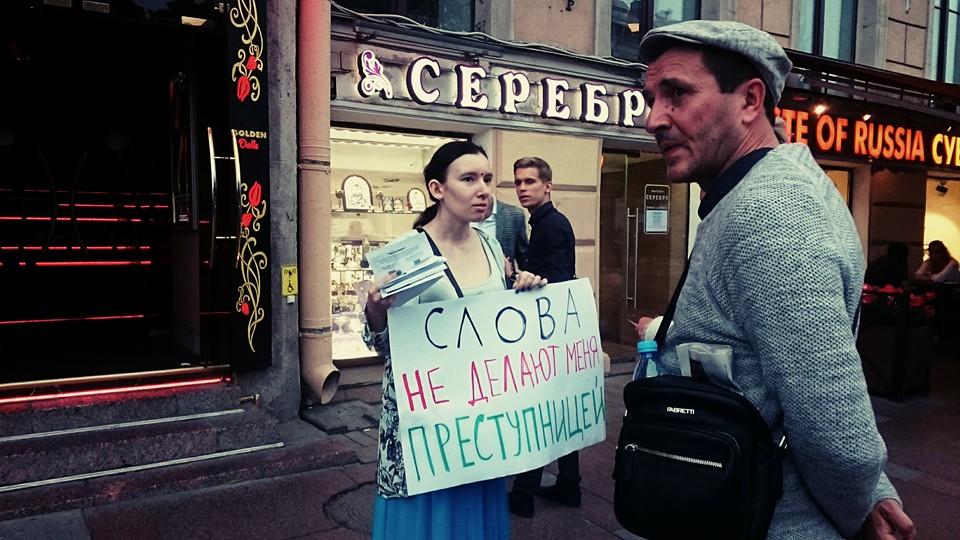
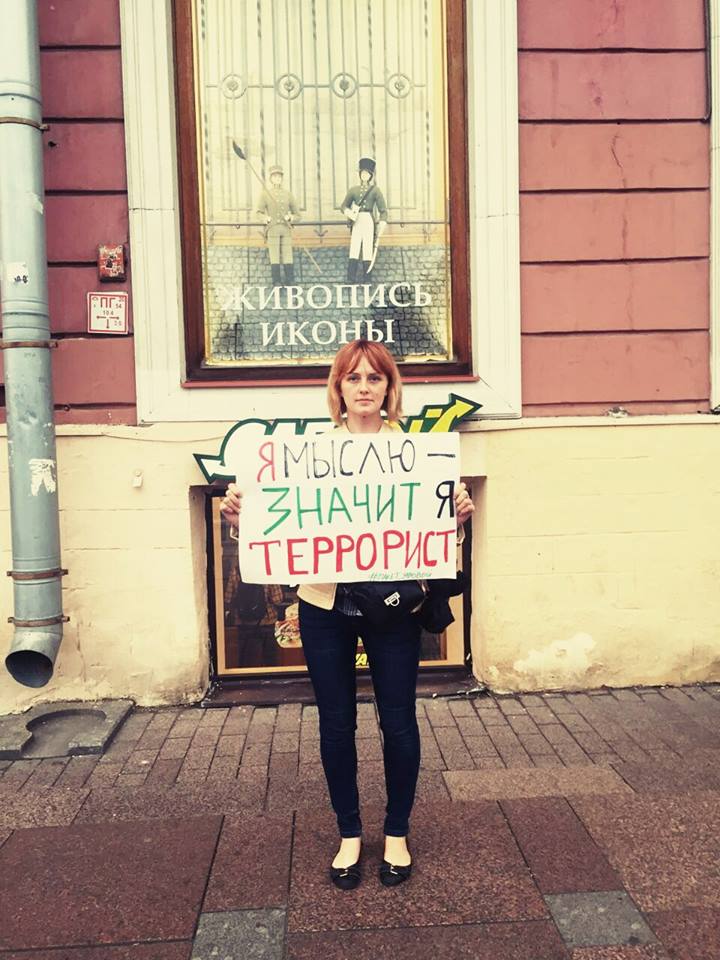
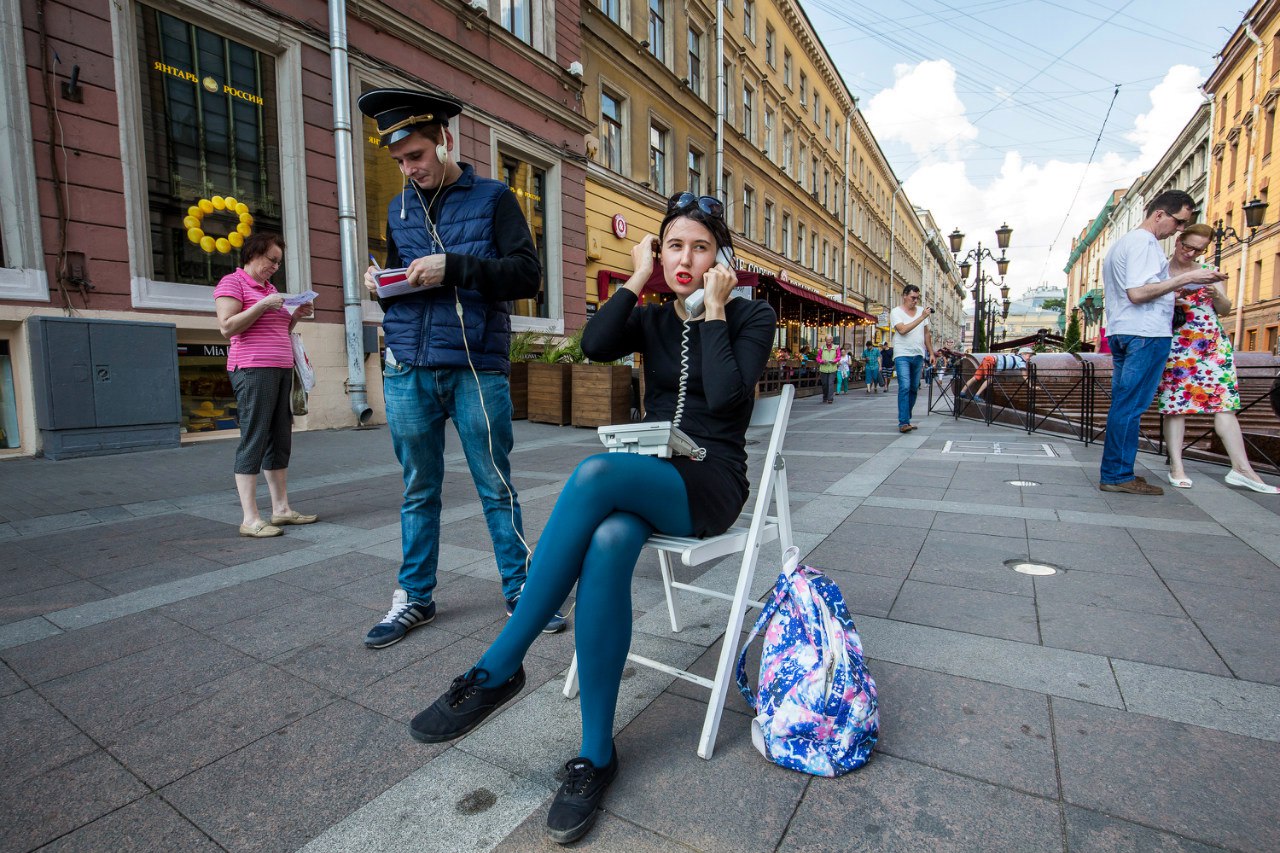
"I think therefore I'm a terrorist." Solo picket on Nevsky Prospect, Petersburg, July 22, 2016
“I think therefore I’m a terrorist.” Solo picket on Nevsky Prospect, Petersburg, July 22, 2016

Varya Mikhaylova
Facebook
July 23, 2016

It doesn’t matter whether you come to the people’s assembly against the so-called Yarovaya package at 7 p.m. on July 26 in front of the arch of the General Staff Building on Bolshaya Morskaya or not. There is already enough evidence to put you away.

***

On July 7, 2016, President Putin signed the so-called Yarovaya package, a series of flagrantly repressive amendments to the Russian Federal Criminal Code. The official objective of the amendments is to combat terrorism.

IF YOU DON’T INFORM YOU’LL GO TO JAIL
An article on non-informing has been added to the Criminal Code. “Failure to report a crime” will entail a sentence of up to one year in prison. This law applies to such crimes as terrorism, seizure of power, and attempts on the life of a public official.

ALL YOUR COMMUNICATIONS WILL BE SAVED AND READ
Monitoring of correspondence has been toughened. Records of all your telephone calls, SMS messages, and emails will be saved for six months, and the security forces will be provided with the means to decode encrypted communications.

"Words don't make me a criminal." Solo picket on Nevsky Prospect, Petersburg, July 22, 2016
“Words don’t make me a criminal.” Solo picket on Nevsky Prospect, Petersburg, July 22, 2016

YOUR PACKAGES WILL BE VETTED
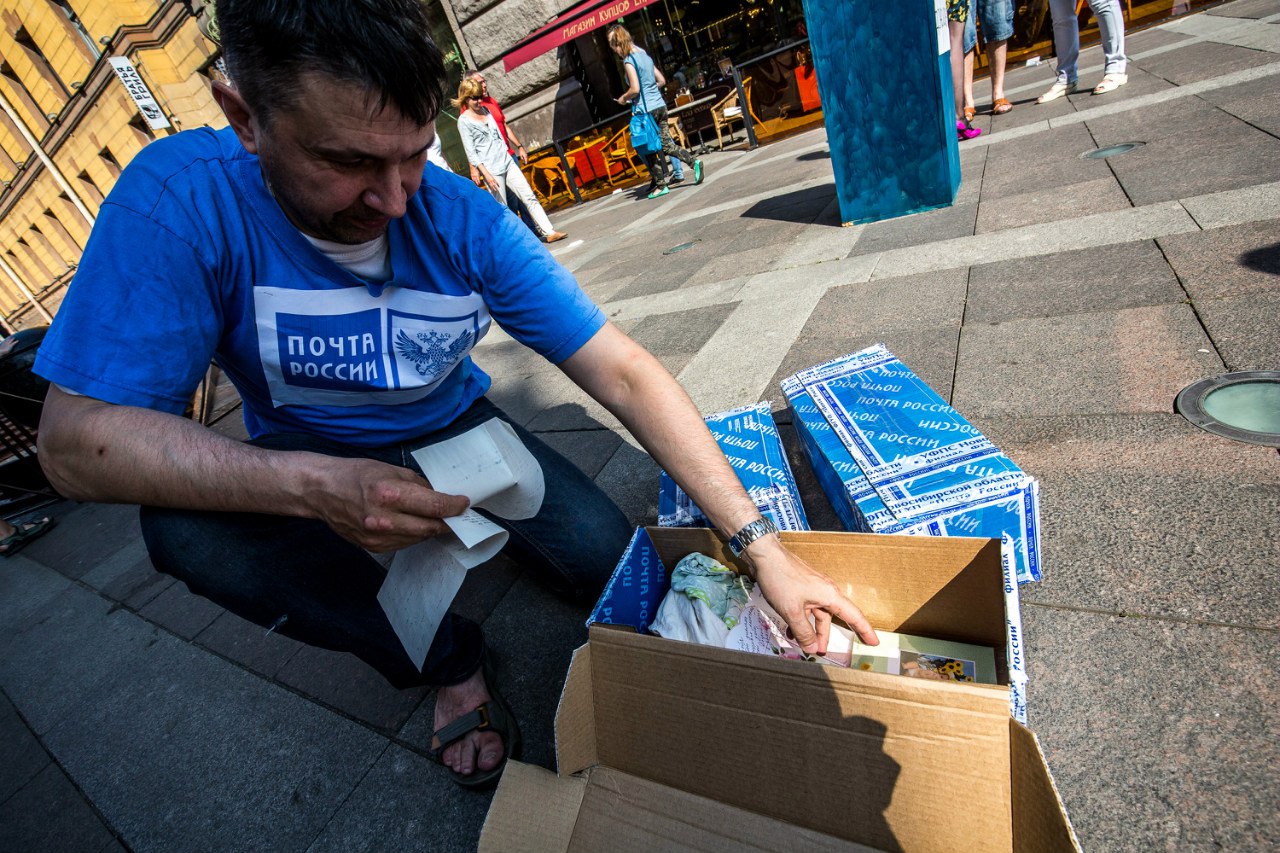
Postal workers will now be obliged to search vigorously for prohibited items in our packages: money, narcotics, weapons, explosives, and “other devices that pose a threat to human life and health.”

YOU INVITED A FRIEND TO A PROTEST RALLY, YOU GO TO JAIL
The Criminal Code will now include an article on “inducing, recruiting or otherwise involving” someone in organizing a “riot.” The law stipulates a penalty of 300,000 to 700,000 rubles or a prison sentence of five to ten years.

YOU REPOST THE “WRONG” THING, YOU GO TO JAIL
The punishments for “extremist” entries, reposts, and comments on the web have been toughened. Despite the fact that freedom of speech is guaranteed by the Russian Constitution, you can now be fined from 300,000 to 500,000 rubles or sent to prison for two to five years for making certain statements. By the way, 369 people were convicted of “enciting hatred by means of the Internet” in 2015.

YOU’RE STILL A KID? YOU’RE GOING TO JAIL ANYWAY
14-year-olds will now be tried as adults not only for serious crimes but also for involvement in riots and non-informing.

At 7 p.m. on July 26, a people’s assembly on behalf of liberty and against the Yarovaya package will be held on Bolshaya Morskaya in the pedestrian area near the arch of the General Staff Building. The people’s assembly format does not permit the use of political symbols and placards. But no one can forbid us from going outside, talking about the Yarovaya package, and hoping the voice of peaceful protest will be heard.

More on the Yarovaya Package:

"Inform on me and maybe  you won't go to jail." Solo picket on Nevsky Prospect, Petersburg,  July 22, 2016
“Inform on me and maybe you won’t go to jail.” Solo picket on Nevsky Prospect, Petersburg, July 22, 2016

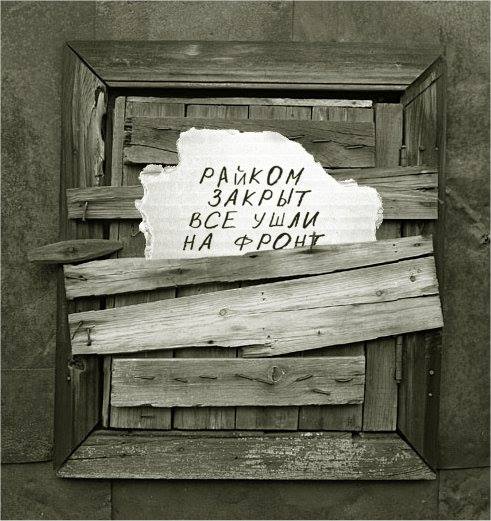
Valery Brinikh: The District Council Has Left for the Front

"The district committee is closed. Everyone has gone to the front." Image courtesy of Valery Brinikh
“The district committee is closed. Everyone has left for the front.” Image courtesy of Valery Brinikh

Valery Brinikh
Facebook
July 5, 2016

Hello!

Yesterday, the latest hearing in my court case took place. It began at 2:15 p.m.

First, Judge Vitaly Galagan read out the findings of the forensic handwriting analysis of signatures made, allegedly, by Mugdin Guchetl, a prosecution witness from the village of Gabukay, who testified at the hearing before last that he had not signed the written record of the testimony he gave to the police investigator. Instead, at the investigator’s request, he had signed blank sheets of paper in the right places. As expected, the signatures were deemed authentic, although there had been the possibility the investigator had forged not only the interrogation records but also the signatures of witnesses.

The judge then returned to my deferred motion to rule the Teuchezhsky District Council an illegitimate injured party. We had requested the prosecution present written grounds for its legal position, as the prosecutors had objected to granting my motion, arguing that the Teuchezhsky District Council was a legitimate injured party.

The prosecution outdid itself, submitting in writing not only its own objections to granting the motion but also those of the so-called injured party. Surprisingly, the arguments made by district council head Khachmamuk and state prosecutors Shvetsov and Orlova were identical down to the details. Someone probably guided their hands from on high as they scribbled away. But, as the saying goes, paper cannot blush.

The point of their objections was so simple and straightforward that it was completely untethered from the case, leading the reader off into the boundless expanses of the fight against terrorism and extremism.

It transpires that “the leading role in the fighting terrorism and extremism has been assigned to the district council,” while my article “has provoked extremist sentiments in society and has had a negative impact on the work of the Teuchezhsky District Council in preventing extremism.”

Talk about the perpetrator blaming the victim, and without establishing any causal link between my article “The Silence of the Lambs” and the work of the Teuchezhsky District Council in preventing terrorism and extremism!

Attempting to demonstrate the absence of logic and common sense in the objections raised by the injured party and the prosecutors, I reminded the court that the case files contained the January 22, 2015, ruling by the Maykop City Court, which has entered into force, rejecting the Teuchezhsky District Council’s lawsuit against me, in my capacity as author of the article “The Silence of the Lambs,” by way of defending its professional reputation. I also pointed out that the article contains no criticism of the Teuchezhsky District Council’s work in general (it is not even mentioned in the article) nor, in particular, of its work in the field of extremism prevention.

In addition, the district council’s authority extends only to events that have occurred within the district itself, while the article was published on the World Wide Web. The events covered in the article (the actions of the Kievo-Zhuraki Agrobusiness hog breeding facility, the inaction of authorities at all levels in dealing with the Teuchezhsky District’s environmental problems, and my meetings with local residents) in no way touch on the Teuchezhsky District Council’s authority in combating terrorism and extremism.

After hearing all this, Judge Vitaly Galagan smiled cutely and retired to chambers at 2:50 p.m. As it turned out, he spent two and a half long hours in there. What could he have been doing all that time? It would be one thing if at least he had been consulting with smart folk on how to reasonably reject my motion. I realize it is illegal, but rehashing arguments that have nothing whatsoever to do with our case as grounds for rejecting my motion is not only illegal but also stupid. Basically, as they say in such instances, the mountain has brought forth a mouse.

According to the prosecution and Judge Galagan, who concurred with their arguments, the article “The Silence of the Lambs,” which I wrote in Maykop and published on the Internet, somehow diminished the vigilant work of the Teuchezhsky District Council in preventing extremism in the Teuchezhsky District, thus damaging the council’s professional reputation. In such cases, the saying goes, children are awfully sensitive. The district’s principle extremism preventer has been turned into a crybaby. Or, on the contrary, has the prosecution designated it the crybaby given the lack of actual injured parties?

As I listened to the prosecution’s counterarguments, I realized why our local councils take such bad care of local residents, why they take such bad care of roads, hot and cold running water, medical care and education, why everything is so bad: because our local authorities have bigger fish to fry. They have all left for the front to combat terrorism and extremism, and until they defeat the hydra of counter-revolution, the people will just have to suffer. And anyone who moans and groans and criticizes the authorities can be charged with violating Article 282 of the Russian Federal Criminal Code.

I want to give one more piece of sage advice to Russian judges. Lubricate the hinges of the doors to your chambers. Otherwise, the damn things squeak, and those of us sitting in the courtroom get all kinds of funny ideas about the secrecy of judicial deliberations being violated. Is their secrecy being violated, or is it just a draught of wind playing tricks with the door?

The next round in this exercise in umpiring is scheduled for today, July 5, at 10:00 a.m.

Translated by the Russian Reader. Read all my previous posts on Valery Brinikh’s extremism case.

Shredding the Russian Constitution in Broad Daylight

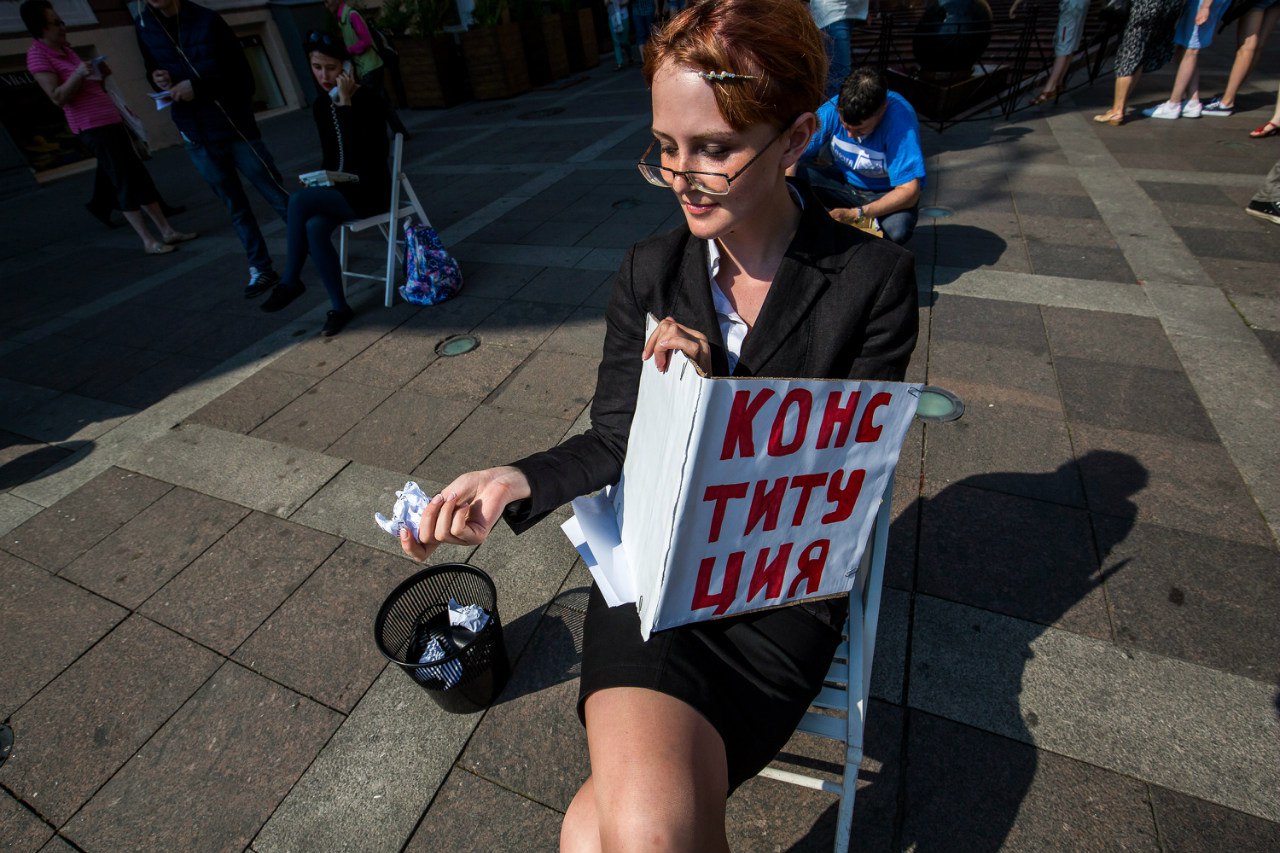
"Irina Yarovaya" tears up Russian Constitution, Petersburg, July 4, 2016. Photo: David Frenkel
Russian MP “Irina Yarovaya” shreds Russian Constitution. Downtown Petersburg, July 3, 2016. Photo: David Frenkel

“Irina Yarovaya” Shreds Russian Constitution in Downtown Petersburg
Spring Movement (Dvizhenie “Vesna”)
July 4, 2016

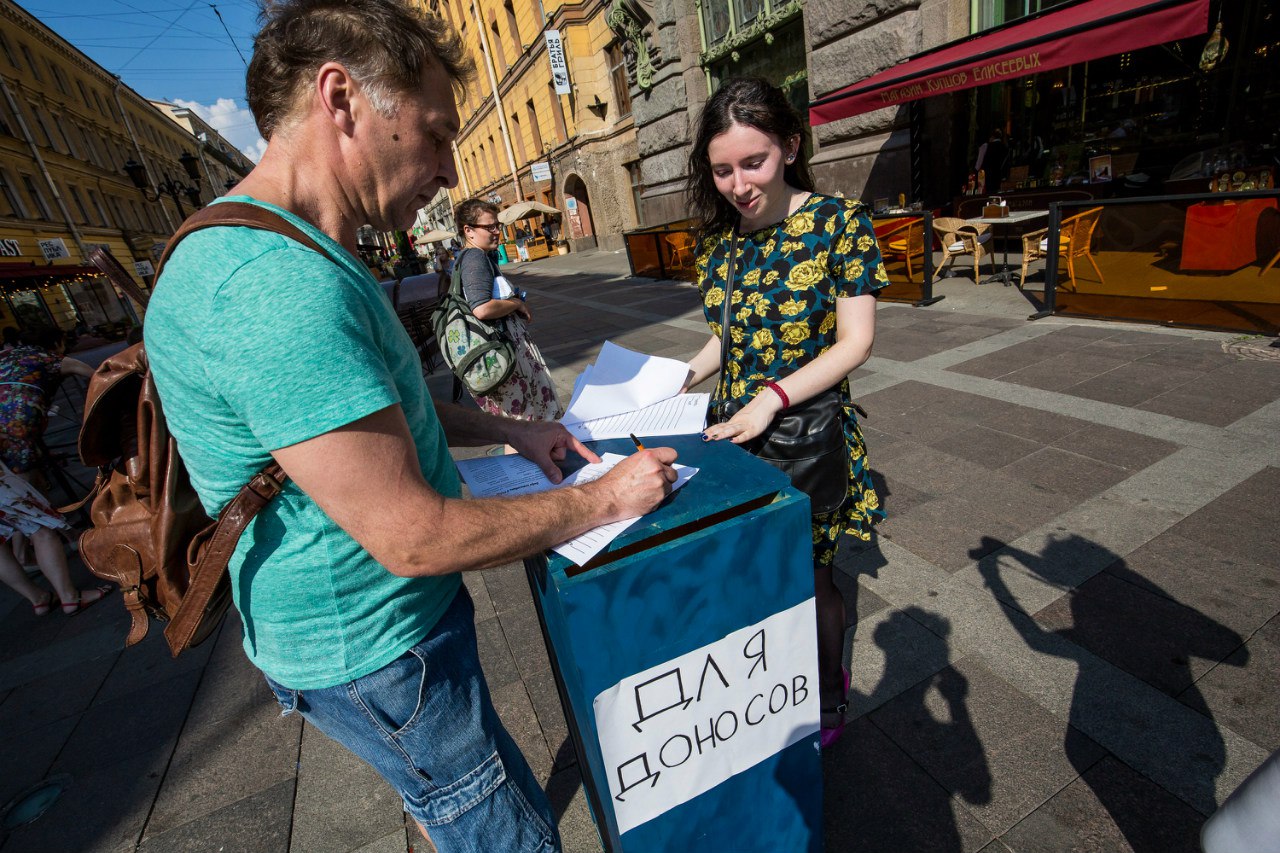
This past Sunday, “Irina Yarovaya” shred the Russian Constitution on Nevsky Prospect in Petersburg. The people’s deputy was joined by characters from her package of “anti-terrorist” laws, who had come to life for the occasion: a postal worker vetting packages, a secret policeman wiretapping a light-minded young lady’s telephone conversations, and an involved ordinary citizen encouraging passersby to write denunciations on their friends, neighbors, and coworkers.

lVjF3a3vanA
“Postal worker” vets suspicious parcels. Downtown Petersburg, July 3, 2016. Photo: David Frenkel

The activists of the Spring Movement thus attempted to draw the attention of their fellow Petersburgers to the flagrantly repressive amendments to the Russian Criminal Code, tabled by a group of MPs led by Irina Yarovaya and now approved by both houses of the Russian parliament, the State Duma and the Federation Council.

wd2SOVlwiHc
Passerby fills out “denunciation” form. Downtown Petersburg, July 3, 2016. Photo: David Frenkel

The package of amendments will not only deal a blow to our country’s constitutional foundations but will also require huge financial subsidies during tough economic times. The screws will be tightened at our expense, at the price of impassable roads, hospitals and kindergartens that will never be built, and pension savings that the state has been confiscating once again. No scientific progress, no innovations, and no quality education are in the cards for our country: only Yarovaya and her hardcore approach to lawmaking.

wQ0izA6I8HA
“Secret policeman” wiretaps an unsuspecting young lady’s phone conversation. Downtown Petersburg, July 3, 2016. Photo: David Frenkel

If the president signs the Yarovaya package into law, “non-informing” will be criminalized, “inducing, recruiting or otherwise involving” others in the “organization of mass disturbances” will be punishable by prison terms, punishment for “extremist” posts on the web and monitoring of personal correspondence will become harsher, and postal workers will be obliged to vigorously vet parcels for prohibited items.

Translated by the Russian Reader. All photos by David Frenkel

In No Mood for Songs and Dialogues (OVD Info)

In No Mood for Songs and Dialogues
OVD Info
July 2, 2016

Hello. We continue to raise money for the work of our monitoring group. Watch the following video, in which Artyom Loskutov, co-founder of the annual Monstrations, talks about what champs we are.

You can donate money to us by heading to this page.

Last week, Moscow courts left two suspects in the Bolotnaya Square case, Dmitry Buchenkov and Maxim Panfilov, in police custody, along with Petersburg architect Sergei Akhmetov, accused of tearing epaulettes from a policeman’s uniform during a gathering in support of Alexei Navalny and Pyotr Ofitserov. Curiously, police investigators have been unable to produce convincing evidence that Buchenkov and Akhmetov were actually at the scene of the crimes of which they have been accused.

Maxim Panfilov. Courtesy of OVD Info

Other Criminal Prosecutions

No less predictable was the rejection of Oleg Navalny’s petition for parole, especially considering the fact that, a week before his court hearing, he received three reprimands for poor conduct at the penal colony where he has been imprisoned.

Totally unpredictable, however, was the return to Moscow of Ildar Dadin, sentenced to two and a half years in a prison colony for “repeated violations” at public protests.  Dadin had been held for over two months in a Petersburg remand prison, and it was anticipated that sooner or later he would be transferred to a penal colony. For some reason, however, this has not happened.

News came of the first criminal charges filed for “willful refusal” to obey the law on “foreign agents.” Charges were filed against Valentina Cherevatenko, chair of Women of the Don Foundation.

Valentina Cherevatenko. Courtesy of Frontline Defenders
Valentina Cherevatenko. Courtesy of Front Line Defenders

Shapi Biyakiyev, a Petersburg trucker involved in the recent nationwide protests by truckers against the new Plato toll system, was charged with using violence against a police officer.

The week would not be complete without news of more “extremism” cases. Yuri Yekishev, a support of Colonel Vladimir Kvachkov, was arrested. He has been accused of having incited hatred with a video recording. Perm resident Vladimir Luzgin was found guilty of rehabilitating Nazism and fined 200,000 rubles for reposting an article about collaboration between “communists and Nazis” during WWII. But the case of Stavropol resident Viktor Krasnov, accused of offending the feelings of religious believers, has been suspended, because the court has expressed its doubts as to the legitimacy of the forensic examination of Krasnov’s statements, taken out of context from an online discussion.

Detentions

In Hurzuf, Crimea, residents upset that a local beach had been transferred to the Artek Young Pioneers Camp were detained by police.  Meanwhile, in Moscow, tempers flared around construction of the so-called Northeast Chord highway. First, a cyclist was detained for protesting the felling of trees in Kuskovo Park, and then people opposed to the felling of trees on Krasny Kazanets Street in Veshnyaki were detained.

“Murder of 200-Year-Old Oak in Kuskovo Park,” posted July 2, 2016, by Ecowalker First

Moscow police also detained people in a hunger strike organized by the Moscow Queue Waiters [i.e., ocheredniki, people on a waiting list for affordable housing—TRR] twice in a single day outside the constituent reception offices of the ruling United Russia party. When the detainees were released from a police station after the first detention, they went back to the reception offices and were rearrested. But Makhachkala outdid everyone: around eighty believers were detained after Friday prayers outside a Salafist mosque.  Meanwhile, Dagestan public figure and parliamentary candidate Rasul Ismailov was detained in Khasavyurt.

Cellist Semyon Lashkin, detained last week while busking in Moscow, was fined 10,000 rubles for “deliberately creating a crowd and preventing pedestrian movement.”

Other Forms of Persecution

An unnamed 23-year-old resident of Salekhard was sentenced to five days in jail for posting “extremist” music, presumably songs by Krovostok and Kolovrat, on a social network.

Daniil Alexandrov, a freelance correspondent for online newspaper Meduza, was ticketed for working without accreditation in Karelia, where he gone to cover the story of the children who died on Lake Syamozero.

FSB agents raided the Mayakovsky Library in Petersburg in connection with the fact that it served as the venue for Dialogues, monthly public discussions of political topics. The project’s founder, Nikolai Solodnikov, resigned his post at the library, which will no longer host the events.

In Krasnodar, people involved in solo pickets against the policies of current Mayor Vladimir Yevlanov and in support of Communist Party MP Sergei Obukhov were assaulted, while in Kemerovo, local opposition activist Stanislav Kaliniсhenko was detained, taken to a police station, and, allegedly, beaten up by police.

Opposition activist Stanislav Kalinichenko after his alleged beating by police in Kemerovo. Courtesy of his blog

Karelian village council member Vladimir Zavarkin, sentenced to a fine for calling for a referendum to decide whether the republic should secede from Russia, was stripped of his mandate.

Read

Two plus two does not always make four: how Russian courts calculate prison terms in criminal cases and jail terms in administrative cases.

Translated by the Russian Reader
The Package

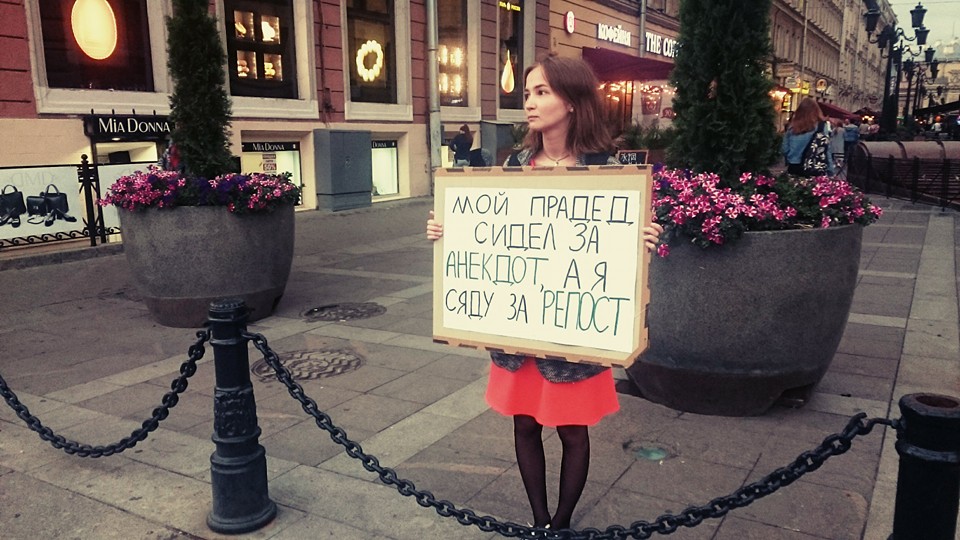
"My grandfather was imprisoned for a joke, while I'll go to jail for a repost."
“My grandfather was imprisoned for a joke, while I’ll be going to jail for a repost.”

Varya Mikhaylova
Facebook
June 24, 2016

As you know, the so-called Yarovaya package, a series of flagrantly repressive amendments to the Russian Federal Criminal Code, whose official aim is combating terrorism, was passed today by the State Duma in its third and final reading.

You can read here why this is bad:


Aleksandra Ermilova and I summarized the worst things about these amendments and went to Nevsky Prospect to hand out leaflets. Or rather, I handed out the leaflets, while Sasha stood holding a remarkable autobiographical placard [pictured, above].

This is what we wrote in the leaflets:

IF YOU DON’T INFORM YOU’LL GO TO JAIL
An article on non-informing has been added to the Criminal Code. “Failure to report a crime” will entail a sentence of up to one year in prison. This law applies to such crimes as terrorism, seizure of power, and attempts on the life of a public official.

ALL YOUR COMMUNICATIONS WILL BE SAVED AND READ
Monitoring of correspondence has been toughened. Records of all your telephone calls, SMS messages, and emails will be saved for six months, and the security forces will be provided with the means to decode encrypted communications.

YOUR PACKAGES WILL BE VETTED
Postal workers will now be obliged to search vigorously for prohibited items in our packages: money, narcotics, weapons, explosives, and “other devices that pose a threat to human life and health.”

YOU INVITED A FRIEND TO A PROTEST RALLY, YOU GO TO JAIL
The Criminal Code will now include an article on “inducing, recruiting or otherwise involving” someone in organizing a “riot.” The law stipulates a penalty of 300,000 to 700,000 rubles or a prison sentence of five to ten years.

YOU REPOST THE “WRONG” THING, YOU GO TO JAIL
The punishments for “extremist” entries, reposts, and comments on the web have been toughened. Despite the fact that freedom of speech is guaranteed by the Russian Constitution, you can now be fined from 300,000 to 500,000 rubles or sent to prison for two to five years for making certain statements. By the way, 369 people were convicted of “enciting hatred by means of the Internet” in 2015.

YOU’RE STILL A KID? YOU’RE GOING TO JAIL ANYWAY
14-year-olds will now be tried as adults not only for serious crimes but also for involvement in riots and non-informing.

Translated by the Russian Reader
Valery Brinikh: A Surprise Witness

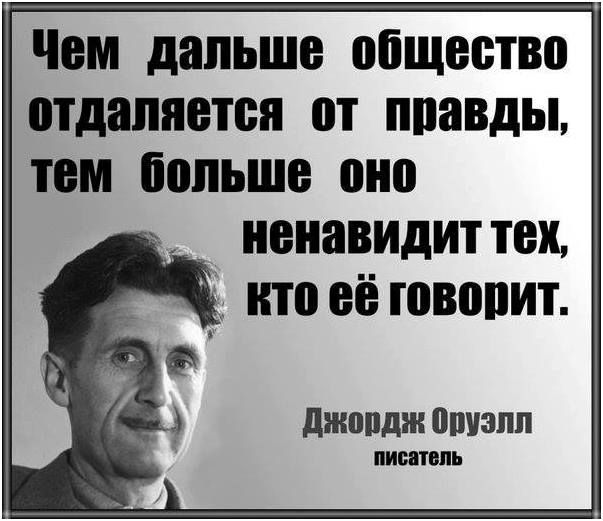
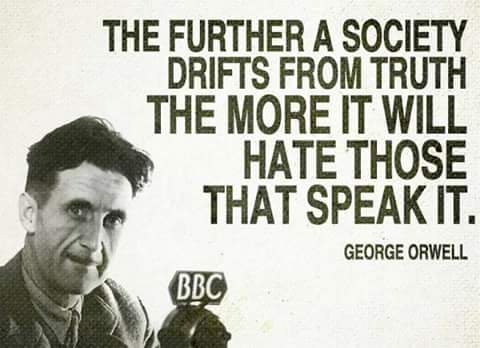
George Orwell, writer: "The further a society drifts from the truth the more it will hate those who speak it."
“George Orwell, writer: ‘The further a society drifts from the truth the more it will hate those who speak it.'” Image from Valery Brinikh’s Facebook page

Valery Brinikh
Facebook
June 25, 2016

Hello!

The latest hearing in my criminal trial took place on June 24, but it was no run-of-the-mill hearing. When, last week, the court turned down defense attorney Andrei Sabinin’s motion to examine a linguistics expert from the beautiful beyond via videoconferencing (although, literally right before this, two prosecution witnesses from Krasnodar had been examined in this manner), neither the prosecutors nor the judge suspected that soon they would have the honor of gazing at this linguistics expert in person. We provided them with this pleasure.

The linguistics expert smashed the so-called findings of official state expert Sergei Fedyayev to smithereens. She immediately pointed out that Fedyayev had violated the fundamental methodological principles of forensic examinations for identifying signs of extremism. First, such forensic examinations should be comprehensive, involving not only a linguist but also a psychologist and, better yet, a sociologist or political scientist (if social groups are at issue). By definition, a linguist cannot cope with all these tasks alone. Nor did linguistic expert Fedyayev cope with his task. His analysis of the article “The Silence of the Lambs” skids on the sharp turns like a Volga car. Hence the large number of mistakes and simple linguistic blunders he made, producing findings that were not only at odds with the principles of linguistics but also with common sense.

During her testimony, our expert pointed to a number of instances where Fedyayev clearly went beyond his competence as a linguist by giving legal evaluations of individual passages in “The Silence of the Lambs” and thus infringing on the court’s realm of responsibility. In addition, his findings contain a definition of the concept of a “group,” something only a sociologist or political scientist is competent to define. The Russian Supreme Court has directly ruled it is inadmissible to define the authorities (state officials) as a “social group.” But what does the Russian Supreme Court mean to Fedyayev when the Adygea Supreme Court is dealing the cards? Fedyayev’s analysis also contains probabilistic conclusions (i.e., dealing with the realm of possibility), which are inadmissible in a linguistic forensic examination.

Apologizing to the judge for infringing on legal issues, our expert noted that the article does not oppose one group to another, one nation to another, and that there is no evidence of incitement to enmity and hatred on ethnic and other grounds in the text.

Our expert also testified that lexical-semantic and lexical-stylistic methods should be used in analyzing the text, while the huge number of other methods listed by Fedyayev either were not employed or were superfluous. In particular, by not using conceptual analysis, Fedyayev was led to erroneous conclusions.

The overall conclusion of the linguistics expert we called to the stand in Maykop City Court yesterday was that the article “The Silence of the Lambs” was highly critical and chockablock with negative assessments of the authorities and the hog breeding business, but there was nothing in the article that could interpreted as inciting enmity and hatred. In particular, she pointed out to the court that the words “Adyghe” and “Adygean” are encountered in different contexts in the article, testifying to the fact that the author distinguishes between the notions, using them in the article to denote different things. While the word “Adyghe” clearly refers to an ethnicity, “Adygean” has several meanings, one of them being a resident of Adygea, without reference to his or her ethnicity, as in krasnodarets, sochinets, stavropolets, and so on. [That is, the Russian terms for residents of Krasnodar, Sochi, and Stavropol, respectively.—TRR.]

What mattered to me was our expert’s answer to the question of whether it was possible, having received an unfamiliar text in the morning, to carry out a forensic examination of it by the evening of the same day and discover grounds for suspecting the text of extremism by using linguistic methods. My question was prompted by the fact that on September 15, 2014, Fedyayev, at the request of the FSB’s regional office in the Republic of Adygea, conducted a linguistic examination of the article “The Silence of the Lambs” in ten hours, and his memorandum to this effect (not even an expert opinion) was the grounds for the Maykop City Court (Judge Irina Ramazanova, presiding) ruling that the article was extremist. Later, on the basis of the very same memorandum, whipped up in a single workday, the very same Fedyayev wrote up the expert findings that served as the basis for my indictment on criminal charges.

The conclusion of the expert we called to the stand was unequivocal: it would be impossible. Sometimes, explained the expert, who is a past master at linguistic and comprehensive forensic examinations, analysis of a single sentence might take three hours. So, personally, she takes two weeks to perform such examinations.

In general, the testimony or, rather, the lecture by the linguistics expert we called to the stand was so thorough that neither the judge nor the prosecutors could think of anything substantive to ask her. Thus, by presenting critical reviews of Fedyayev’s forensic examination, we have drawn a thick line under it, making it completely impossible for it to be used as evidence for the prosecution in the criminal case against me.

The next hearing has been scheduled for 2:15 p.m. on July 4. Most likely, we will file a motion to have the forensic examination redone, asking this time for a comprehensive, rather than linguistic, examination.

Translated by the Russian Reader. Please read my previous posts on the extremism case against Adygean environmentalist Valery Brinikh.

Image courtesy of Twitter

Ivan Pavlov: Ripping Up the Russian Constitution

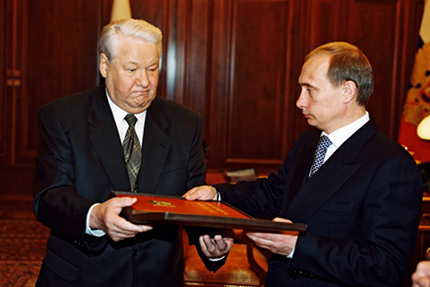
Vladimir_Putin_with_Boris_Yeltsin-Russian-Constitution
“Before leaving the Kremlin, the first Russian president handed over a copy of the Russian constitution, used to swear in the head of state, and the Presidential Emblem to Mr Putin as a symbolic gesture.” “Boris Yeltsin handed over power to Acting President Vladimir Putin in the Kremlin,” December 31, 1999, kremlin.ru

Article 6

1. The citizenship of the Russian Federation shall be acquired and terminated according to federal law; it shall be one and equal, irrespective of the grounds of acquisition.

2. Every citizen of the Russian Federation shall enjoy in its territory all the rights and freedoms and bear equal duties provided for by the Constitution of the Russian Federation.

3. A citizen of the Russian Federation may not be deprived of his or her citizenship or of the right to change it.
—The Constitution of the Russian Federation, “Chapter 1: The Fundamentals of the Constitutional System”

_________

The Constitution Does Not Count: How the Duma Has Planned to Strip Russians of Citizenship
Ivan Pavlov
RBC
June 22, 2016

Anti-terrorism legislation is a legal grey zone in any country. The balance between protecting public security and preserving civil rights is elusive and unsteady. However, Russian MPs, already inclined to shoot from the hip, have surpassed themselves this time by having a go at no less than the foundations of the Russian Federation’s constitutional system.

One of the measures included in the packet of “anti-terrorist” amendments tabled by a group of MPs led by Irina Yarovaya (which should be adopted in its second reading on June 24) would strip Russians of their citizenship. This punishment would be meted out for terrorist and extremist crimes, joining the civil service in other countries, and working with international organizations in which Russia is not involved.

This list, I am sure, will expand as a matter of political necessity.

Previously, a person could waive his or her citizenship only on their own behest by making a written statement. Now the actions listed above have been made equivalent to this personal initiative. The relevant amendments, if adopted, would be incorporated into the law “On Citizenship.”

Depriving a person of his or her citizenship is banned by Chapter 1, Article 6 of the Russian Constitution. Chapter 1 is entitled “The Fundamentals of the Constitutional System,” meaning the ban is among our country’s most basic laws. A Constitutional Convention would have to be called to amend them. Trying to push through a initiative like this via ordinary legislative procedure looks surprisingly brazen even amid the Sixth Duma’s other legislative feats.

The wording of the bill merits special attention.

“Citizenship of the Russian Federation is terminated on the basis […] of the person’s freely declared intent, as expressed in the commission of acts stipulated by this Federal Law.”

The rationale of legislators is extremely farfetched in this case. The point is not to comply with the Basic Law but to come up with a way of bypassing the mandatory prohibition established by the Constitution.

To get a sense of how crooked this end-around would be, imagine similar wording for bypassing the moratorium on the death penalty: “The person’s voluntary departure from life on the basis of his freely declared intent, as expressed in the commission of certain acts.” This is a case when Lenin’s adage (“technically correct, but basically mockery”) applies.

Against this backdrop, the possibilities for interpreting the proposed rule broadly do not appear so dramatic, but they do exist, and they are dangerous.

“Renunciation of Russian Federation citizenship, as expressed in the commission of acts, is not allowed if the Russian Federation citizen has no other citizenship and no guarantees of obtaining it.”

What would be meant by these guarantees in practice? Anything whatsoever: relatives or even just contacts abroad, employment in foreign organizations, etc. We end up with yet another legal cudgel against “foreign agents” and the “fifth column.”

“Work in international organizations (associations) in whose activities the Russian Federation is not involved, without the consent of the authorities, unless otherwise stipulated by an international treaty of the Russian Federation”: this language provides unprecedented scope for stripping undesirables of Russian citizenship.

It is not just a matter of NGOs, although employees of Amnesty International, Greenpeace, and similar organizations risk being the first to be run over by this steamroller. Any commercial company can be construed as an international organization: all that matters is that its operations extend to several countries.

The new legislative initiative is another step toward isolating Russia from the rest of the world.

Ivan Pavlov is an attorney at law and director of Team 29. Translated by the Russian Reader
Valery Brinikh: Report from His Extremism Trial

The extremism trial against environmentalist Valery Brinikh in session. Maykop City Court, June 17, 2016

Valery Brinikh
Facebook
June 18, 2016

Hello!

The latest hearing in my criminal case took place in Maykop from 11 a.m. to 4 p.m. on June 17 of this year. This time, the prosecution’s last two witnesses were finally questioned, albeit by a videoconference link with the Soviet District Court in Krasnodar. Vyacheslav Potapov and Vitaly Isayenko were supposed to answer questions about the operations of the website For Krasnodar, on which the article “The Silence of the Lambs” was posted.

It seemed to me that Sergei Shvetsov, senior deputy prosecutor of the Republic of Adygea, was not prepared to examine the witnesses today and the questions he asked them sounded like childish prattle. Even the judge noted this and advised the public prosecutor to concentrate. Ultimately, however, the second public prosecutor, Inessa Orlova from the Maykop City Prosecutor’s Office, took the microphone from Shvetsov and asked the witnesses specific questions.

I was personally interested in Isayenko’s responses to two sets of questions, first, about the circumstances of his interrogation on December 12, 2014. On that day, after the search [at his house], he was brought from Krasnodar to Maykop and interrogated until evening. It was night when they sent him back home to Krasnodar. As Isayenko, who suffers from Type 1 Diabetes, explained, he spent almost half a day at the Republic of Adygea Investigation Department with no food and, much more dangerously, with no insulin. They gave him only water. And yet they interrogated him intensively, trying to squeeze testimony against me and Vyacheslav Potapov, editor of the website For Krasnodar, from him. I was being interrogated in the next room, and I could hear Senior Investigator Kirill Kustov screaming at him. The stress he underwent and the long period he endured without food and insulin landed Vitaly Isayenko in the hospital the day after his return from Maykop. His diabetes flared up and he suffered from other ailments.

I was also interested in Isayenko’s comments, as a computer specialist, on certain statements in the inspection report on the computers seized at Isayenko’s house, an inspection carried out by Senior Investigator Kustov on the night of December 12, 2014. In particular, the report states that three processors were discovered in one of the computers. Isayenko explained there had been only one processor in the computer. He did not know nothing about any other processors.

In general, the witnesses said nothing new. They only confirmed what was already contained in the minutes of their interrogations.

Valery Brinink (left) and his attorney,
Valery Brinink (left) and his attorney, Andrei Sabinin. Maykop City Court, June 17, 2016

After the witnesses were examined, my attorney, Andrei Sabinin, attempted to request that Elizaveta Koltunova, a linguist from Nizhny Novgorod, be examined via videoconference, but the prosecutors objected, and Judge Vitaly Galagan did their bidding. Our request to examine the linguist by videoconferencing was rejected. According to the defense, this stance on the part of the prosecution and the court contradicts the adversarial nature of judicial proceedings and the principle of the equality of arms.

Much more unexpected and even amusing was the procedural action, which took place after lunch, of obtaining handwriting samples and a signature from prosecution witness Mugdin Mossovich Guchetl, a resident of the village of Gabukay. Everything would have been alright if the witness had simply produced his signature in silence, but instead he recalled another circumstance that I think gave the prosecutors a slight shock. Guchetl recalled that in February of last year, when Investigator A.S. Rudenko of the Investigative Department of the Republican Investigative Committee’s Teuchezsky District office took Guchetl’s written testimony, he asked him to sign blank sheets of paper, because, as Rudenko explained, allegedly, he would later type out Guchetl’s handwritten testimony on the computer, but he needed the signatures right away so he would not have to make a return trip to Adygeisk.

The investigator thus clearly violated the procedure for processing interrogation reports, a procedure strictly regulated by criminal procedural laws. At the same time, the investigator committed forgery by inserting things Guchetl did not say into the report. Today, after reading the interrogation report, which is part of the criminal case file, Guchetl categorically stated he did not say to the investigator what was written in the penultimate paragraph of his printed testimony, which reads as follows: “I want to clarify that I strongly disagree with the contents of the article entitled ‘The Silence of the Lambs,’ because I think the article has defamed my honor and dignity as an Adyghe, as well as insulting all Muslims. The article compares us to pigs and cowards, and claims we have no sense of self-esteem.”

Basically, it was for the sake of this passage that the investigator obtained Guchetl’s testimony. In fact, the investigator could have written something even rougher on Guchetl’s behalf, because he already his signatures on blank interrogation report forms.

Finally, I made a motion to rule the Teuchezhsky District Council an illegitimate injured party in my case, since it did not satisfy the grounds set out in Article 42 of the Russian Federal Criminal Procedure Code. When the prosecutors objected as usual, spouting platitudes about the proper recognition of the local authorities as an injured party, we demanded the prosecution present legal grounds for its stance. We were quite curious to find out how exactly the district council had been injured, if, as they themselves have said, the article had caused moral injury to the residents of the Teuchezhsky District.

The prosecutors drew a blank and requested a time-out until the next hearing, at which they promised to provide a written justification for their objection. That suited us just fine, as it did the judge, who postponed consideration of our motion until next time.

The next court hearing is scheduled for June 24.

Translated by the Russian Reader. Photos courtesy of Valery Brinikh. Please read my previous posts on his case.

Be Kind, Don’t Repost 2: Blessed Are the Ice Hole Bathers

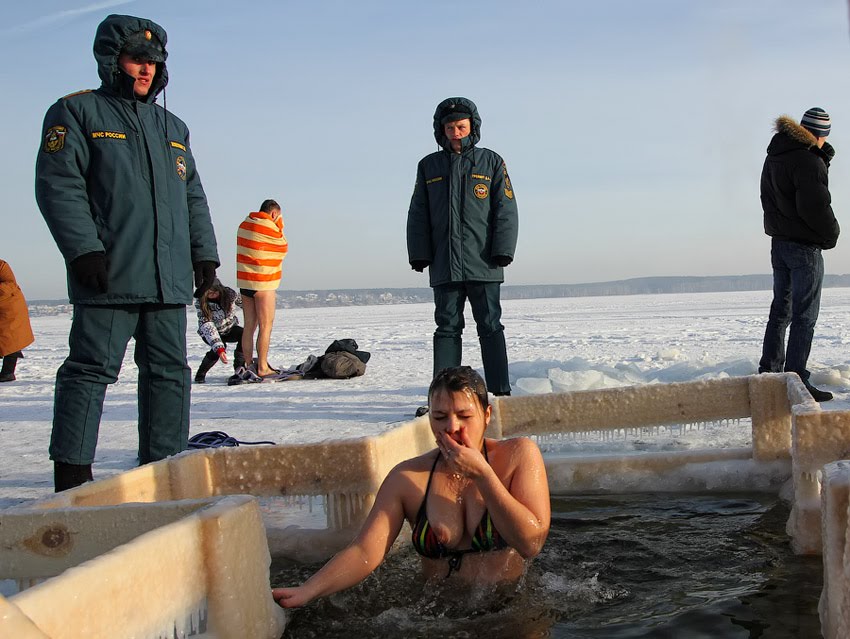
Epiphany ice hole bathing on Lake Shartash in Yekaterinburg, January 2012
Epiphany ice hole bathing on Lake Shartash in Yekaterinburg, January 2012. Officers from the Emergency Situations Ministry (EMERCOM) stand watch.

Berdsk Resident Sentenced to One Year, Three Months in Work-Release Penal Colony for Commenting on Ice Hole Bathing
Mediazona
May 31, 2016

The Berdsk City Court in Novosibirsk Region has sentenced local resident Maxim Kormelitsky, charged with extremism, to one year and three months in a work-release penal colony, reports Radio Svoboda.

Maxim Kormelitsky was accused of posting a captioned pictured on his personal page in the Vkontakte social network. According to police investigators, in January 2016, the young man published a photograph of wintertime Epiphany bathing and in the comments insulted people involved in the religious ritual. According to Kormelitsky, he “simply evaluated the mental state of people who sacrifice their health for the sake of religion.”

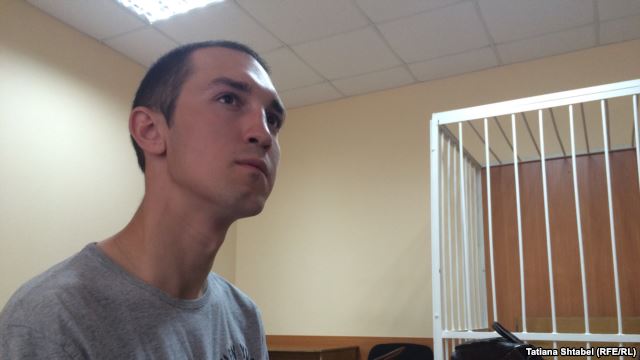
Maxim Kormelitsky in court

During the hearing, the prosecutor argued that Kormelitsky had insulted people who took part in the bathing, since he “is an atheist and feels hatred towards people who profess Christianity.”

“I copied it from another community. Besides me, something like seventy people reposted it. I think it odd that ultimately I am the only one on trial because an Orthodox activist saw my page. There were no calls for violence; there was only the insult. I have acknowledged my wrongdoing, I am sorry for what I did, and I ask the court to sentence me to a punishment not involving deprivation of liberty,” Kormelitsky said in court.

The court found Kormelitsky guilty under Criminal Code Article 282.1 (incitement to hatred on religious grounds) and sentenced him to a year in a work-release penal colony, adding three months to his sentence for a previous conviction.

Translated by the Russian Reader. Photos courtesy of Yuri Vershinin/Panoramio and Tatiana Shtabel (RFE/RL)