Trans(national) Solidarity

“Yara Tychina, a young transgender woman and Astana resident, picketed on Vodno-Zelyoniy Boulevard next to the House of Ministries and the Parliament. Unfurling a handmade transgender flag, she demanded that the Senate, the Presidential Administration, and the President reject the ‘LGBT propaganda’ amendments. She was taken to the Yesilskoye District Precinct of the Astana Police. Further details are in the video.”

[In which video Ms. Tychina says] Hello! I am Yara Tychina. I’m an ordinary citizen of Astana. I work in the coffeehouse [?] industry. I’m an openly trans women. I am protesting peacefully today because there are no other means to impact my country’s repressive policies. I don’t simply oppose this law. [It] violates my rights and freedoms, the rights and freedoms of my friends, my colleagues, the people in my life and, most importantly, my family, over half of whom are members of the LGBT minority community. I have carefully scrutinized this law and I can say truthfully that it has nothing whatsoever to do with ‘propaganda,’ since in black and white it says that any mention of LGBT—in a positive vein, in a neutral vein, it doesn’t matter which; in personal profiles, in personal conversations with people, it doesn’t matter where—is considered ‘propaganda.’ The fact that I’m an openly trans woman makes me a criminal, according to the new amendments. These amendments also don’t have anything whatsoever to do with ‘protecting children,’ since hundreds of Kazakhstani LGBT children, who had no way of influencing [who they are], will find themselves outlawed. They will be banned. They will be forbidden from talking about themselves on social media. They will be forbidden from gathering together in public or in private.

[Ms. Tychina is interrupted by Astana police officers, who claim she is violating the law. She repeatedly states her willingness to go with them to the police station. She then continues.] I heartily and tearfully implore the Presidential Administration, the Senate, and the President of the Republic of Kazakhstan, Kassym-Jomart Tokayev, and the Constitutional Court, if that doesn’t work, to reject these amendments. Otherwise, hundreds of thousands, if not millions, of Kazakhstanis, will unavoidably suffer. With these amendments, you will bridge the gap between Kazakhstan and Russia, but you will also drive away all international investments and significantly harm Kazakhstan’s standing in the international arena. But first of all you will harm people. You will harm my family. I implore you to stop it. Thank you!

[Responding to a reporter, who asks her name, Ms. Tychina says] My name is Yara Tychina. I’m in the coffeehouse [?] industry. I have a small business. I’m an ordinary [female] citizen. [Responding to a question about her flag, she says] It’s a transgender flag, the flag of my identity. It’s homemade. [To the police officers] Let’s go! Thank you! [A police officer explains to the press that Ms. Tychina has not been detained but has voluntarily agreed to go with them to the station.]

Source: werequest.kz (Instagram), 3 December 2025. Translated, from the Russian, by the Russian Reader. Thanks to Peter Leonard for the heads-up.


Police in Kazakhstan’s capital detained a transgender activist for staging a solitary protest against pending legislation prohibiting so-called “LGBT propaganda.” Yara Tychyna held up a handmade transgender flag near government buildings in downtown Astana and called for the Senate and the presidential administration to reject changes to the law, which are designed to proscribe “propaganda of non-traditional relations,” a formulation broad enough that positive portrayals of same-sex relations could be treated as prohibited content. Lawmakers have been debating the measure since the lower house approved it in November. Officials insist the restrictions are framed as child-protection rules. Critics warn that the draft’s language is vague and that equating LGBT themes with harmful content risks legitimising discrimination.

Source: Peter Leonard, “Central Asia’s week that was #82,” Havli, 3 December 2025


On Wednesday, November 12, the [lower house of the] Parliament of Kazakhstan (Mäjilis) unanimously passed a law banning “LGBT propaganda” in the media and on the internet. Violators face fines, and in the case of repeat violations, up to ten days in jail.

“Endeavoring to protect children from information detrimental to their health and development, provisions have been made to restrict the dissemination of information promoting pedophilia and non-traditional sexual orientation in public spaces, as well as via the media, telecommunications networks, and online platforms,” the document states.

The changes will affect nine laws. Violations of the ban will be punishable by a fine of up to forty minimum calculation indices (in 2025, this amounted to 157,000 tenge, or approximately 260 euros, or 24,500 rubles), or up to ten days in jail.

Kazakhstan’s Deputy Minister of Culture Yevgeny Kochetov explained that materials containing “propaganda of non-traditional relationships” would have to be labeled “18+.” Content that violates the law would be blocked.

Kochetov added that the strictures currently apply primarily to those who distribute materials. If minors attend a screening of a film rated 18+, the cinema’s managers, not the parents, would face a fine, he explained.

“If, for example, [men] are holding hands in the park, this is not considered propaganda. These are their personal boundaries, and there are no questions here,” said one of the sponsors of the bill, MP Yelnur Beisenbayev.

The Mäjilis initially sought to ban “LGBT propaganda,” in April 2024, by amending the law “On Mass Media.” They later proposed criminalizing “LGBT propaganda” and equating it with incitement to ethnic, social, or religious hatred.

When MPs began discussing banning “LGBT propaganda,” a petition entitled “We oppose open and covert LGBT propaganda in the R[epublic of] K[azakhstan]” was posted on the website E-Petition.kz. It was the third petition in the country to gather the fifty thousand signatures required for consideration by the government.

The Ministry of Culture and Information decided to partly accede to the petitioners’ demands—when it came to strictures aimed at “protecting and shielding adolescents and children from the promotion and cultivation of sexual relations.”

Consequently, the ban was presented as an amendment to the draft law on archiving.

Traditional values

In recent months, Kazakhstan President Kassym-Jomart Tokayev has repeatedly spoken about the need to protect “traditional values.” The day before the Mäjilis passed the bill, and ahead of his visit to Moscow, Tokayev published an article in Rossiiskaya Gazeta in which he spoke about the friendship between the two countries.

“We are united by a common take on traditional values, similar views on the pressing issues of contemporary life, and cooperation in ensuring the welfare of [our two] brotherly peoples,” Tokayev wrote.

In Russia, the law banning “LGBT propaganda” among minors was first introduced in St. Petersburg in 2011, and then at the federal level in 2013. In 2023, the Russian authorities went so far as to declare the “international LGBT movement” extremist.

As of July 2025, Human Rights Watch had catalogued more than one hundred criminal indictments and convictions [in Russia] for involvement in the “international LGBT movement” or for displaying symbols which the authorities attribute to this movement.

Following Russia’s lead, “LGBT propaganda” was banned in Hungary in 2021, and in Georgia in 2024.

LGBTQ+ in Kazakhstan

Homosexuality was decriminalized in Kazakhstan de facto in 1997 and de jure in 1998. Since 2003, transgender people have been able to change their gender marker in official documents.

In 2021, the Williams Institute at UCLA School of Law ranked Kazakhstan 154th out of 175 countries in terms of public acceptance of LGBTQ+, below Uzbekistan, Russia, and Afghanistan.

The online platform Equaldex, which researches the rights of sexual minorities around the world, writes that “[a]ccording to recent survey data, there appears to be strong opposition to LGBTQ+ rights in Kazakhstan.”

Many human rights organizations have already criticized Kazakhstan’s ban on “LGBT propaganda.”

Human Rights Watch urged lawmakers to reject the bill. The NGO argues that the proposed amendments violate fundamental human rights and could make LGBTQ+ people in Kazakhstan more vulnerable.

Organizations including ILGA-Europe (the European branch of the International Lesbian, Gay, Bisexual, Trans and Intersex Association), the World Organisation Against Torture (OMCT), and TGEU (Trans Europe and Central Asia) have also issued a joint statement against the bill.

The Kazakhstani organization Queer.kz commented on the Mäjilis’s passing the amendments banning “LGBT propaganda” as follows: “We continue to write letters! Our organization will continue to work together with our colleagues to defend human rights and freedom!”

Source: “Kazakhstan parliament votes to ban ‘LGBT propaganda,'” BBC Russian Service, 12 November 2025. Translated by the Russian Reader. Thanks to Peter Leonard for the heads-up.


Over the past four years of America’s modern anti-transgender panic, Missouri has been one of its chief laboratories. Each legislative session brings a flood of new proposals targeting transgender people—with each year opening with often more than a dozen bills—and 2026 is already shaping up to continue that pattern. In the first batch of early bills, lawmakers introduced 21 anti-LGBTQ+ measures, many escalating the state’s enforcement tactics beyond even last year’s cruelties. One stands out in particular: a bill that would ban “social transition” in schools—blocking teachers from using a student’s chosen name or pronouns, even with parental consent.

The bill, SB1085, filed by Senator Joe Nicola, states in its summary that it would prohibit “public school staff members from encouraging minor students in their ‘social transition,’” which the measure defines as engaging in any activity “with the goal of helping a student become perceived as a member of the opposite biological sex.” The text defines social transition broadly—“participating” in a student’s gender transition based on “details such as his or her name, appearance, or behavior”—and bars schools from taking part in any conduct that could contribute to a student “not being perceived and treated as a member of the student’s biological sex.”

The bill explicitly forbids all school staff and faculty from “the use of alternative pronouns or names for the minor student, either in school records or otherwise.” Notably, it contains no provision for parental consent—meaning the restrictions apply not only to unsupportive parents but also to parents who affirm their transgender children. The measure appears to single out trans students exclusively: nothing in its text bars name changes for any other reason unrelated to gender transition.

You can see the provisions here:

The bill marks the latest front in anti-transgender legislation: an effort not just to ban medical transition for trans youth, but to prohibit any form of transition at all, including social transition. Earlier this year, reporting out of Texas showed how a similar law led teachers to suddenly deadname students who had used their affirmed names for years without issue. Variations of this language have surfaced in several states, but Missouri’s proposal is among the most explicit and far-reaching attempts yet to regulate social transition in schools.

The ban on social transition—even with parental permission—underscores a shift in how anti-trans legislation is being sold to the public. For years, supporters of bathroom bans, sports bans, and “don’t say gay” policies framed their efforts as battles for “parental rights.” Increasingly, though, that language has fallen away as lawmakers move to strip supportive parents of any authority at all, mirroring the approach in medical transition bans that override parental consent entirely. Under Missouri’s proposal, parents would have no right to approve their child’s affirmed name or pronouns, and any teacher who honors a family’s wishes could face the loss of their license.

The social-transition ban is just one front in a broader offensive. Missouri lawmakers have already filed bills to outlaw public drag by defining it as prurient “male or female impersonation,” to strip Pride flags from public schools, and to roll back nondiscrimination protections for transgender people in housing, employment, and public accommodations. And more proposals are almost certain to follow. When the legislature gavels in on January 8, the real question for observers won’t be whether these bills appear—they already have—but which ones Republican leadership chooses to fast-track. That early movement will signal just how aggressive Missouri intends to be in advancing its anti-LGBTQ agenda this session.

Source: Erin Reed, “New Missouri Bill Would Ban “Social Transition” In Schools, Even With Parental Permission,” Erin in the Morning, 3 December 2025


On April 27, 2023, Kansas became the first state in the country to institute a statewide definition of sex. “A ‘female’ is an individual whose biological reproductive system is developed to produce ova,” the law declared, “and a ‘male’ is an individual whose biological reproductive system is developed to fertilize the ova of a female.” Since then dozens of state legislatures have introduced similar bills; sixteen have passed. In Indiana and Nebraska governors have issued executive orders to the same end. Each of these measures effectively strips transgender people of legal recognition.

The language of these policies usually distinguishes men from women by their reproductive capacity, which is assumed to be determined at birth or even at conception. Each statute mandates that its definitions of “sex,” “female,” and “male” be used whenever those words appear in any part of the state code. Some purport to be establishing a “women’s bill of rights,” as the titles of Kansas’s and Oklahoma’s bills suggest; Louisiana’s is titled “The Women’s Safety and Protection Act.” (On the other hand, the name of North Dakota’s bill—into which legislators slipped another term they wanted to define—captures the arbitrariness involved: “The Definition of Female, Male, Sex, and Scrap Metal Dealer.”)

This legislation is part of a broader onslaught. In the past few years Republican-controlled state legislatures have introduced thousands of bills targeting trans people, with measures to ban puberty blockers and hormones for trans youth, bar trans girls and women from sports, mandate that bathroom access be based on birth sex, outlaw drag performances, and more. So far more than two hundred of these laws have passed, with grave, often life-changing consequences for the trans residents of red states across the country.

Continue reading “Trans(national) Solidarity”
Trump’s War on Trans: An American Story

Late Monday evening, President Donald Trump signed an executive order that effectively lays the groundwork for a sweeping ban on the 15,000 transgender troops currently serving in the United States military. The order, delegating much of its implementation to Defense Secretary Pete Hegseth, declares that being transgender is “incompatible with service.” It further mandates that all transgender personnel must be misgendered in official military communication and policy. Most notably, the order frames transgender identity as inherently at odds with “a soldier’s commitment to an honorable, truthful, and disciplined lifestyle, even in one’s personal life.”

The executive order, titled “Prioritizing Military Excellence and Readiness,” claims its purpose is to “protect unit cohesion” from “ideologies harmful” to it—explicitly targeting the service of transgender troops. It asserts that the medical needs of transgender individuals are incompatible with military service, despite evidence that treatments like hormone therapy result in no operational downtime. Aware of this contradiction, the order offers an additional justification for the ban, framing transgender individuals as inherently “selfish” and “false.”

See the rationale given by the order here:

Consistent with the military mission and longstanding DoD policy, expressing a false “gender identity” divergent from an individual’s sex cannot satisfy the rigorous standards necessary for military service. Beyond the hormonal and surgical medical interventions involved, adoption of a gender identity inconsistent with an individual’s sex conflicts with a soldier’s commitment to an honorable, truthful, and disciplined lifestyle, even in one’s personal life. A man’s assertion that he is a woman, and his requirement that others honor this falsehood, is not consistent with the humility and selflessness required of a service member.

While the order itself is vague on the specifics of implementation, its intent is clear: to serve as a ban on transgender service members. It declares that being transgender is “inconsistent with service” and mandates that pronouns used by the military must “accurately reflect an individual’s sex.” The order gives Defense Secretary Pete Hegseth 60 days to implement these directives, including ending “invented and identification-based pronoun usage” and prohibiting transgender service members from bunking with others of their gender.

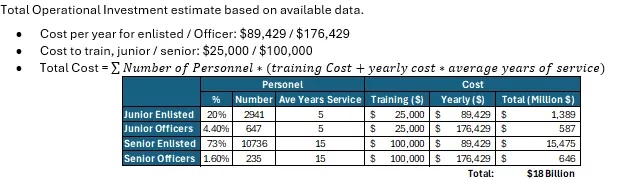
If implemented broadly, the ban will have immediate and damaging consequences for both transgender service members and military readiness across the United States. SPARTA, a leading transgender military advocacy organization, estimates that removing 15,000 transgender service members would result in the loss of an $18 billion capital investment, with the Palm Center projecting an additional $1 billion cost to recruit and train replacements. Notably, up to 73% of these service members are senior enlisted personnel with 12-21 years of experience—expertise that cannot be easily replaced by the U.S. government.

You can see SPARTA’s figures here:

When asked about the potential for a ban when it was first floated in November, Emily Shilling, President of SPARTA, stated, “The most immediate impact is that transgender people serve in every theater of the world. If it were a fairly fast-moving ban, you would be pulling these individuals out of their units, leaving critical gaps in skill sets, experience, and leadership positions that you’re just not going to be able to fill with equivalent people anytime soon, especially given the shortfalls in recruiting,”

A transgender officer with years of military experience, speaking anonymously about the rumors of an impending transgender military ban, shared that she had recently spoken with several transgender service members deeply concerned about the possibility. When asked about claims that transgender people are a liability to the military, she dismissed the notion outright, stating, “Every trans service member that I have observed performing their job excels at their job, and that’s because we have to… Every trans sailor, every trans soldier, every trans Marine, and airman that I have known has excelled at their job.”

It remains unclear how swiftly or extensively Defense Secretary Hegseth will implement these changes, how many transgender service members will face discharge, or whether the administration will revert to a “don’t ask, don’t tell” approach—forcing transgender personnel back into the closet or demanding their detransition. What is clear, however, is the administration’s framing of being transgender not as an inherent aspect of human diversity but as a dishonorable and incompatible choice. This rhetoric signals a chilling disregard for the thousands of transgender service members who have served with distinction for decades, suggesting the administration feels no obligation to temper its actions with respect or restraint.

Source: Erin Reed, “Trump Military Ban Says Being Trans Conflicts With ‘Honorable, Truthful, Disciplined Lifestyle,” Erin in the Morning, 27 January 2025


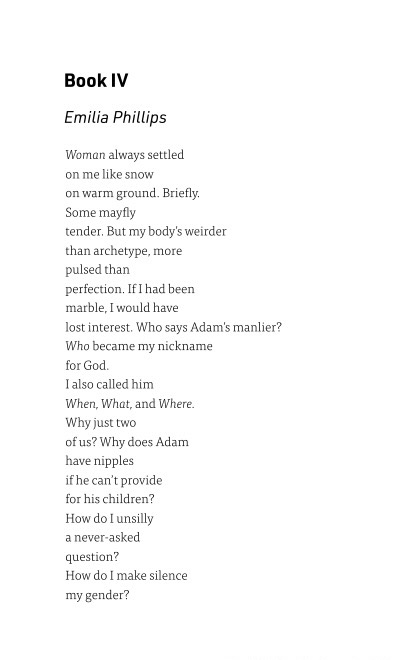
Source: Poetry Daily


Within hours of his inauguration, President Trump signed an executive order titled “Defending women from gender ideology extremism and restoring biological truth to the federal government”, following a whipping up of anti-trans feeling during the US election.

The order states that Trump’s administration will make it “the policy of the United States to recognise two sexes, male and female. These sexes are not changeable and are grounded in fundamental and incontrovertible reality.”

The response from LGBTQ+ groups was dismay and fear. Quoted in the Detroit Free Press, trans woman Rachel Crannell-Crocker remarked that Trump “wants to say we are not real,” while Bobbie Hirsch said “I’m scared, I’m really scared for my future.” Kimberly Frost, co-director of ILGA World, said Trump was “emboldened by anti-gender movements” to “use the lives of trans people as tools to sow divisions in society. Our communities deserve better.”

Trump’s move is not unexpected. During a fraught and divisive election campaign, Republicans spent nearly $215m alone on network TV ads that vilified transgender people, according to recent data from AdImpact. The past few years have seen a rush of anti-trans bills in red states, such as banning changes to birth certificates or defining sex as immutably set at birth. Books featuring LGBTQ+ content have been banned, and drag shows have faced protests and been subject to lurid conspiracy theories by Trump’s far right supporters.

Having spent nearly a decade reporting on far right threats to gender rights, the order’s purpose is clear to me: it sits squarely within the attack on so-called “gender ideology” with the ultimate aim to restore a “natural order” of white male supremacy. And while the target is trans people, the threat goes much wider, potentially laying the groundwork for further attacks on the US’s already degraded abortion rights.

What is gender ideology?

Originating in the mid-1990s in Catholic and other conservative Christian circles, the term “gender ideology” sprung up in response to feminists seeking to place “gender” into a United Nations report on its 1994 women’s conference. Initially the term focused on abortion rights, but quickly expanded to criticise any rights related to gender and sexuality, including LGBTQ+ and trans rights.

As the term gathered momentum, it became framed as a threat to ‘traditional’ – see conservative and Christian nationalist – values. LGBTQ+ activists and feminists were accused of imposing “gender ideology” on everything from schools to families and government, determined to “indoctrinate” children and young people with the “transgender agenda.”

Attacks on “gender ideology” were amplified by conservative writers such as Dale O’Leary who popularised the term in her book Gender Agenda, and picked up by the Vatican, as well as the anti-abortion, anti-LGBTQ+ ‘religious freedom’ organisations such as Alliance Defending Freedom and the Heritage Foundation. The right-wing think tank is behind the controversial Project 2025, with ADF on the project’s advisory board.

The project – which brings “together … over 100 respected organizations from across the conservative movement, to take down the Deep State and return the government to the people” – is key to understanding Trump’s move.

Project 2025 published a “Mandate for Leadership”, providing an anti-rights blueprint for the incoming administration. It offered policy ideas to demolish so-called “gender ideology”, demanding that “enforcement of civil rights should be based on a proper understanding of those laws, rejecting gender ideology.” It demanded that “gender ideology” be removed from school curricula and, in language echoed in Trump’s order, warned “radical gender ideology is having a devastating effect on … young girls.”

The project also called on the government to “reverse the DEI [diversity, equality, inclusion] revolution in Labor policy”. Trump’s order did so willingly, revoking previous executive orders that protected against discrimination and stating that government agencies must “take immediate steps to end Federal implementation of unlawful and radical DEI ideology.”

A threat to abortion?

While the executive order is first and foremost a frightening attack on trans people, its wording sets alarm bells ringing for abortion rights, too. It will be no surprise that curtailing abortion rights is a key focus of Project 2025 – the mandate mentions “abortion” 199 times.

Trump’s previous administration created a conservative-majority Supreme Court that overruled Roe vs Wade, opening the door for individual states to implement deadly and devastating abortion bans across the US. Now, the executive order’s wording suggests a wider attack on reproductive rights.

The order defines “female” as meaning “a person belonging, at conception, to the sex that produces the large reproductive cell”, while male is defined as “a person belonging, at conception, to the sex that produces the small reproductive cell.”

As well as being troubling for trans identity, the wording defines male and female foetal personhood from conception. If the foetus is recognised as a person at conception, then that foetus legally has the same rights as a born person, with catastrophic consequences for pregnant women and people. Foetal personhood means a woman can be prosecuted for murder if she has an abortion, as it violates the right to life. She can face manslaughter charges if she has a miscarriage for which she is blamed.

Bethany Van Kampen Saravia, senior legal and policy adviser at the gender rights NGO Ipas, told openDemocracy that “the language used in this cruel and dehumanising executive order is undoubtedly deliberate and deeply flawed on several counts. Simply put, it is outside of the executive authority to declare a fertilized egg a ‘person’ who has constitutionally protected rights.”

This is not a new threat. So far, 24 US states have included foetal personhood language in laws regulating or banning abortion, while 17 states have foetal personhood by law or judicial decision that applies to either criminal or civil law, or both. There have already been multiple cases where women in the States have been criminalised for miscarriage.

“Personhood arguments have long been used by anti-rights actors in attempts to fully ban and criminalize abortion and to punish pregnant people,” warned Van Kampen Saravia. “This language can also ban some forms of birth control and fertility treatments like IVF. This is a clear and deliberate signal of what is to come from this Administration.”

“It is outside of the executive authority of the President to instate a nationwide abortion ban, yet there is much that he can do to limit access to medication abortion and those threats need to be taken seriously,” she added. “Ipas US condemns these egregious acts of hate and bigotry. These executive orders are nothing shy of human rights violations and the world should be paying very close attention now to what is being feigned as ‘defending women’ and who is actually being targeted and criminalized.”

The ideology behind the ‘natural order’

The attacks on abortion and LGBTQ+ rights are often interlinked, as both pose a threat to the far right idea of a ‘natural order’ which has been undermined by feminism and human rights, and must be returned to through reversing social progress and protections.

The idea that there is a ‘natural order’ which needs to be re-established has its roots in fascist ideology, and its intent is found in almost all attacks on gender rights including from Trump, Putin, and anti-gender ideologues in Europe. It valorises male supremacy, female subordination, and declares the non-existence of LGBTQ+ people.

As I write in my book, the existence of trans people is a grave threat to the natural order and its advocates who want to reassert male supremacy and abolish the rights of LGBTQ+ people. The goal of male supremacist, anti-gender movements is to ‘naturalise’ gendered stereotypes about men’s and women’s behaviour and status: they want to naturalise male supremacy and female inferiority.

The far right wants to tie women’s inferiority to biology, and to claim that harmful gendered stereotypes are biologically innate in order to pin women to specific roles in society. These same stereotypes are used to justify women’s oppression: women are just more nurturing, or they are bad at leadership, for example, they should stay in the domestic sphere and leave the public sphere to the boys. The anti-gender movement wants to claim that women’s oppression is natural, rooted in women’s biology, and therefore cannot be challenged.

But biology is not destiny, as the famous feminist slogan states. The ‘natural order’ of female inferiority and male supremacy is disrupted by feminists saying women can have control over their fertility, or LGBTQ+ people saying one can express their gender identity as they choose. They therefore have to be stopped.

This order has nothing to do with “defending women” from “extreme gender ideology.” The extreme gender ideology is the one that tries to push women into oppressive boxes, ban abortion, and seek to abolish the existence of trans people and the LGBTQ+ community more widely.

The extreme gender ideology is the movement that elects a President after a judge in New York found a rape allegation made against him to be “substantially true”. It is the movement that celebrates his election with the slogan “your body, my choice.”

Source: Sian Norris, “Trump’s new anti-trans executive order is a ‘human rights violation’: Trump’s first act in office is part of the global far-right’s war on so-called ‘gender ideology’,” openDemocracy, 23 January 2025

The Russian Reader Reads: Erin in the Morning

This is the second in a series of posts in which I showcase some of the newsletters, blogs, Substacks, and websites — all of them produced by hardworking, passionate lone wolves or tiny, perpetually underfunded grassroots collectives — which inspire me to continue making the Russian Reader and inform me about parts of the world and communities about which otherwise I would be utterly clueless.

Erin Reed describes Erin in the Morning as a place to “stay up to date on all of the most important pieces of trans and queer news and legislation for the week. I summarize it all complete with links to source documents. I hope to distill the information that you get from me in other places like @erininthemorn on TikTok and Twitter into a digest so that you can be sure you didn’t miss anything!”

Ms. Reed’s latest post on Erin in the Morning, endorsing Kamala Harris for U.S. president, could not be timelier, of course. More importantly, as a blogger who has chronicled the Putin’s regime ferocious war on Russia’s LGBT community and their rights, I cannot help but be inspired by Ms. Reed’s fierce, fact-driven defense of the transgender community and their rights in the U.S. I hope you’ll consider subscribing to Erin in the Morning and supporting it financially, as I have done. \\\ TRR


As one of America’s leading transgender journalists, I have reported on the wave of anti-transgender legislation sweeping across the United States over the past four years. These laws impact nearly every aspect of our lives: from using restrooms in peace to accessing essential medical care, from seeing our histories taught in schools to expressing our identities through art at Pride parades. I’ve listened to thousands of hours of testimony on these bills. Facing the 2024 election, I can’t stay silent on the dangers a second Trump term would pose to my community. For the long-term safety and dignity of transgender Americans, I believe there is only one viable path forward: electing Kamala Harris this November.

In some of my earliest reporting on anti-trans laws, many Republican elected officials were less fanatical than they are today. For instance, the first bill banning transgender healthcare in Arkansas was vetoed by Republican Governor Asa Hutchinson. In his veto statement, Gov. Hutchinson described the bill as “overbroad and extreme,” noting that it would “create new standards of legislative interference with physicians and parents.” In early 2022, Republican Gov. Spencer Cox vetoed a sports ban, making an impassioned plea: “I want them to live.” Many anti-trans bills failed early on, failing to gather enough Republican votes. Even Republican-nominated justices crossed party lines to side with Democratic-nominated justices, affirming that transgender individuals deserve protection under the constitution.

But soon after, the party began waging a fear campaign, leaving countless people in my community harmed in the process. I watched as one Republican-controlled statehouse after another, spurred on by far-right Freedom Caucus members, voted to enact some of the most draconian laws targeting transgender individuals ever seen. I listened as members of my community were labeled “dangerous,” “an infection,” and even “demons.” Gov. Cox no longer “wanted us to live,” and instead quietly signed the first bathroom ban to cross his desk.

I have seen transgender people forced to flee anti-trans states, seeking new lives in places where they are protected. Some of my earliest work involved families in Texas with transgender children who were targeted by Attorney General Ken Paxton, accused of child abuse simply for supporting their kids. Soon, other states followed with healthcare bans, bathroom bans, and more. I reported on these bills as families begged their state legislators for dignity, only to be ignored. I then helped these families raise funds, and I’m glad to report that many now lead fulfilling lives as valued members of their new communities.

I am keenly aware of which states transgender people are fleeing—and which ones they are fleeing to. Every state enacting extreme anti-trans laws has either a Republican trifecta or a Republican supermajority. Meanwhile, transgender people are finding refuge in states where Democrats have established safe havens. One of those havens is Minnesota, thanks to Governor Tim Walz. I know people whose lives were saved by his actions—people who can now live authentically and freely, without fear of government persecution.

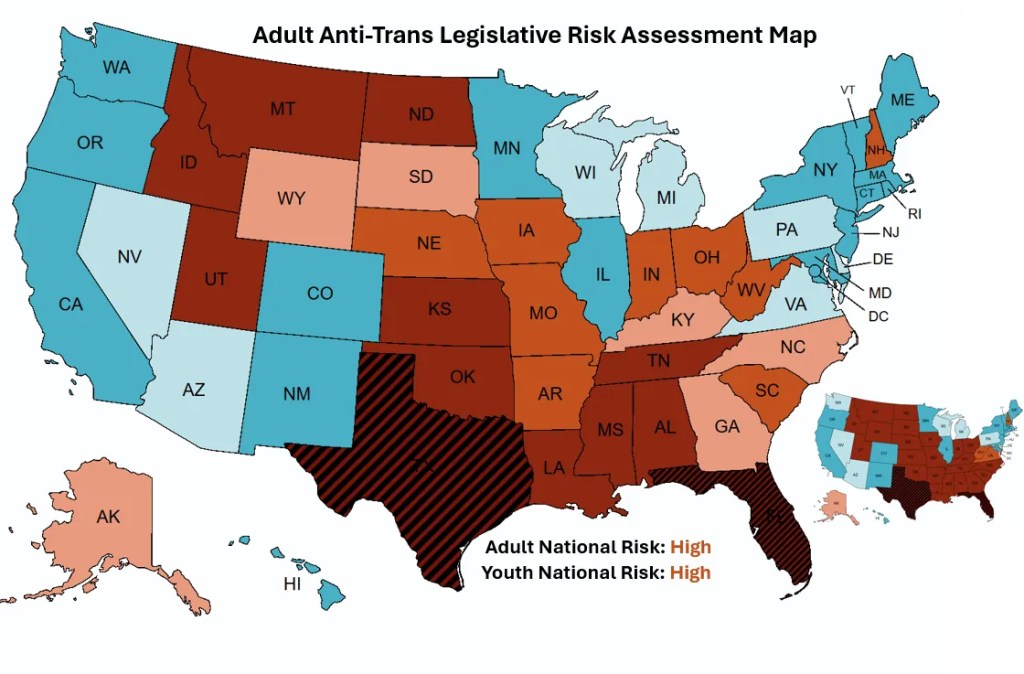
Erin Reed posted the latest edition of this periodically updated map yesterday. It was not included in her endorsement of Ms. Harris, but I’ve inserted it to show what is at stake in the upcoming election.

I have followed this election cycle intently and was among the first to report that transgender people would be a primary target of Trump’s 2024 campaign. In early 2023, Trump released a video outlining a dozen anti-transgender policies he would enact upon taking office, including national bans on trans care for youth, investigations into hormone therapy manufacturers, probes into affirming teachers, and eliminating funding for schools that treat transgender students with dignity and respect. These policies would take the harmful measures I’ve seen in Republican statehouses and nationalize them.

In 2024, it’s clear that the Trump campaign intends to follow through. If you’ve watched any sporting event or turned on the TV in a battleground state, you’ve seen the culmination of this fear campaign against transgender people, now led by Trump himself. Nearly $100 million in anti-trans ads have blanketed the nation, with Trump spending more on these ads than on immigration, housing, and the economy combined. I have seen what other Republican leaders do when they center their focus on my community, and I know the end results are not pretty.

When Kamala Harris was chosen as the Democratic nominee, I watched her closely. While the Biden administration was not flawless on transgender rights—and I often criticized it for these shortcomings—no federal anti-trans laws passed during his presidency. I reported on the defeat of 50 anti-trans and anti-LGBTQ+ policy riders as Republicans threatened to shut down the entire government over transgender issues, and Biden did not back down. His nominees have overturned anti-trans laws and policies. Thanks to Biden, I was able to change my passport, even though my home state of Louisiana doesn’t allow birth certificate changes. I wanted to see if Harris would continue that commitment.

I’m convinced she will. One of Harris’s first moves that reassured me was selecting Gov. Tim Walz as her choice for vice president, fully aware of the Republican attacks against him for making Minnesota a safe haven for those fleeing anti-trans laws in other states. Walz, who campaigned on his record of starting his high school’s first Gay-Straight Alliance decades ago, has consistently been at the forefront of supporting LGBTQIA+ people. He brought that commitment with him to the Governor’s office, where he governed with a focus on making the state welcoming and inclusive for all.

Then in the final weeks of the campaign, she and Tim Walz were asked no less than three times about transgender people in interviews with Fox News, NBC, and Glennon Doyle’s podcast. I was encouraged to see Harris stand on her record of supporting transgender people when questioned. She had ample opportunity to throw us under the bus—as some other Democrats have done this campaign cycle—but she did not.

On Fox News, she criticized Trump for spending $20 million on ads targeting our community. On NBC, echoing her stance on abortion, she emphasized that transgender care is a decision to be made between doctors and patients. Her framework mirrored the approach used by many Democrats—and even some Republicans—to successfully push back against anti-trans bills in dozens of states. Meanwhile, that same week, Walz passionately defended transgender youth, stating that Donald Trump was attempting to “demonize a group of people for being who they are” and pledging that the administration would appoint justices committed to protecting our rights.

With over 1,000 bills introduced in the past three years targeting trans and queer people, undoing the harm they’ve caused will require sustained and strategic effort. The path forward depends on nominating justices who can help reverse these laws, while also protecting our rights in cities and states that offer refuge. For those living in oppressive states where their care, bodily autonomy, and right to exist freely have been threatened, we will continue organizing, supporting each other through mutual aid, and building the foundation to dismantle these discriminatory laws for good. The future rights of transgender people depend on electing Harris, uplifting Walz’s leadership, and securing the justices their administration will appoint.

If Trump wins a second term, we could be bound by his justices for an entire generation. Many transgender adults may never see the day when his court no longer controls our right to exist peacefully in public. Project 2025 could become a national reality, turning the same hateful bills and rhetoric shaping statehouses across the country into federal law. Schools could be defunded for allowing transgender youth to use restrooms in peace, and our very existence could be labeled obscene. There may be no return from the harm he intends to inflict on our community.

Transgender people are in a fight for our lives, and we are a powerful voting force, with millions of us across the United States. In an election that could come down to a few thousand votes in key swing states, we have the numbers to make a difference. In states like Georgia and Arizona, the transgender population is four times the size of the previous vote margins. We cannot afford complacency this election cycle. There is a path forward from the harm inflicted by Republican policies championed by Trump—a path that depends on us showing up and casting our votes for Kamala Harris.

Source: Erin Reed, “As A Leading Transgender Journalist, Here’s Why I’m Endorsing Kamala Harris,” Erin in the Morning, 29 October 2024