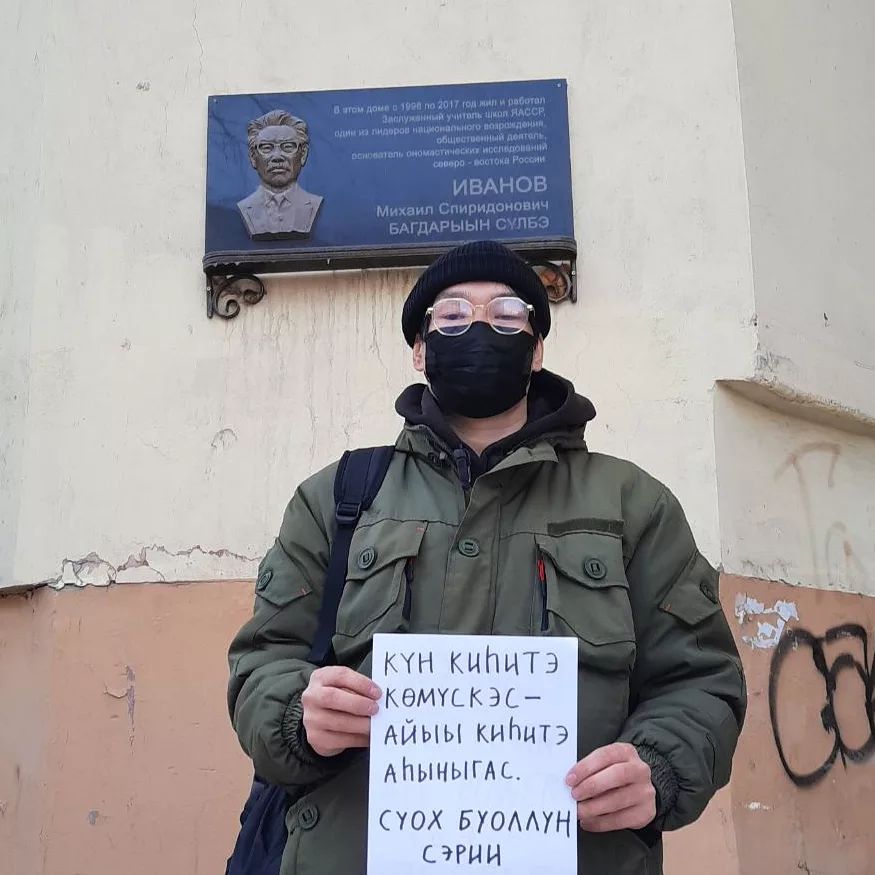
A court in St. Petersburg has begun hearing the case against translator Elena Abramova, who has been charged with repeatedly “discrediting” the Russian army because she engaged in public protests brandishing placards that called for the release of Alexei Navalny and all other political prisoners, and an end to Russia’s war against Ukraine. Because of the criminal case against her, Abramova is no longer permanently employed, although she has stayed in Russia.
Elena Abramova was born and raised in Magadan. Her parents met as students at a teachers institute. Her mom worked as an insurance agent, and her dad, Arnold Yeryomenko, was a Russian language and literature teacher. In the late 1980s, Yeryomenko was imprisoned for two and a half years over his manuscript “October Vanquished,” which detailed “his thoughts on the regime, the Soviet government, and the Soviet legacy.” The family does not have the text of the manuscript: although Abramova’s mother asked the FSB for a copy, she was told that the document had been lost.
“I don’t know for sure whether Dad planned to publish his manuscript officially, or if he was hoping [to publish it] in samizdat. But he definitely talked about it, and someone in his entourage was aware of its contents. That someone was probably an informant, which is how the KGB found out about the manuscript. Informers probably think they are doing something useful in this way, so they inform on people,” Abramova says.
Yeryomenko spoke at protest rallies and led a pro-democracy movement in Magadan, which “held meetings with supporters, but was not involved in electoral politics.” He was asked to run for office but declined.
“I don’t think Dad had any political ambitions. Power never appealed to him. He had his job, which he enjoyed, he spent time with his family, and he read a lot — we had a very extensive library. In short, he had other interests,” says Abramova. “My father’s principled position was that the individual human being had supreme worth. There should be no pressure [on the individual], no compulsion to [hold particular] views or [adhere to] any particular ideology. He always advocated for de-ideologizing society, for the possibility to freely voice one’s thoughts, to speak out freely, to freely participate in peaceful political campaigns. This is what we lack now.”
Yeryomenko’s political activism peaked in the mid-1980s, after he was released from prison, and waned in the 1990s.
“My family welcomed the fall of the Soviet Union,” says Abramova. “I had to wear a Young Pioneer tie for a year, and I remember how we constantly made up excuses to avoid wearing it: that it was supposedly in the laundry, or something else was the matter. When it was all over, I remember the feeling of relief that now I wouldn’t have to do it: there was something contrived about it. I thought that now we would be able to live in peace, without these tokens of the Soviet regime. It seems to me that after the collapse of the Soviet Union, when that short period of freedom dawned, many people just relaxed. It was such a contrast with the past that everyone wanted to get on with their own lives finally, to enjoy the advantages that became available after the regime changed.”
Abramova says that her own views, on the one hand, come from her family, although she was not particularly interested in politics before Russia’s invasion of Ukraine. Her father died in 2008, and five years later she left her job at a large gold mining company and moved to St. Petersburg, where she got a job as a translator. She was buried in her own cares, including working and raising a child.
“I lived my life. Now I look back and recall that my interest in politics emerged not so long ago, and it was provoked by the outbreak of hostilities to a large extent. Before that, I was aware of certain events, of course, and I had opinions on certain issues. I was simply shocked when I heard that [the war in Ukraine] had beguin. At that moment, I was not up to speed at all, I didn’t folloow in detail what was going on. When I saw [the President’s televised] address [announcing the war], I didn’t even realize what was happening. I couldn’t believe that such a thing was even possible, and it took me several days to just to get my head around it. I read news feeds like crazy and watched YouTube. It was a complete surprise, I didn’t think it would happen. The catastrophe is that people are being killed every day,” Abramova says.
Abramova held her first protest picket in late 2022. At the time, she was not only reading news about the hostilities in Ukraine but also following the political trials [in Russia].
“Ilya Yashin was sentenced on December 9. I decided that I had to protest publicly. Although it would be a purely symbolic gesture, I had to do it because I was ashamed. I was ashamed that my country had been plunged into such chaos and darkness. I didn’t know when it would end, and it was clear that this solo picket wouldn’t change anything, but it was a public statement I had to make, which I had to make against all the odds, despite the restrictions. I was a bit scared: I had no prior experience of solo pickets. I had gone to rallies in support of Navalny, and after [Boris] Nemtsov was murdered. But I had not been to the protest rallies that were held at the very outset [of the war]. I was not subscribed to any [social media] communities and didn’t know where they were held, who had made arrangements with whom, or where to go. But this time I decided that I had to go out,” says Abramova.
Abramova’s first picket lasted for only five minutes, although the site — the square outside the Mariinsky Palace — was not very crowded.
“[I stood for] five minutes, maybe a little longer. I soon noticed law enforcement officers approaching me — slowly, demonstratively slowly, as it seemed to me. They detained me quite politely, they weren’t rude. But there was one man in civilian clothes, in a tracksuit, who was also at the police station later, and he asked the most questions. While I was standing there, I saw someone from the opposite side of the street taking a picture of me. Some people walked by and said “thank you” — it was a young couple, I think. Others pretended not to notice. My placard that time out read “No War.” A couple of months later, in February [2023], a court hearing took place, at which I was fined 30,000 rubles [approx. 380 euros at the time],” Abramova recalls.
Abramova was sentenced to another fine for taking part in a protest rally against the military mobilization, and in late April 2023 she held another solo picket outside Gostiny Dvor. She was able to stand there for a few seconds before she was detained. She held her third picket on [June 4], the birthday of politician Alexei Navalny.
Elena Abramova
“I took up my position on the Field of Mars, were there were no police officers at all. Later, I went to Gostiny Dvor, where I was detained immediately. An arrest sheet was drawn up for the second picket, but the case did not go to court. After I left the station, they telephoned me and asked me to come in for ‘additional testimony.’ They probably realized this was already my second arrest. But it was not listed in the arrest sheet, and so I declined to go in. After my third picket I was taken to the same station, and this time the police pulled my rap sheet and opened a criminal case against me,” says Abramova.
Several men in balaclavas, an investigator, and Center “E” officers (officers from the Interior Ministry’s “anti-extremism” unit) soon came to search Abramova’s home.
“I said I had to get dressed, and they said I literally had five seconds to do it. I began to get dressed, but they were banging on the [front] door and practically breaking it down. My child was asleep, so I woke him up, told him not to worry, and explained there was going to be a search. When they were already inside the apartment they behaved themselves, but they confiscated my phone and didn’t even let me call work to warn them I wouldn’t be coming,” says Abramova.
During the investigation, it came to light that the criminal case against Abramova had been launched illegally. Since she is a voting member of an election commission, a criminal case can only be initiated through a special procedure, which had been violated. Formally, then, the case against Abramova was launched twice: first in the summer of 2023, and again in May 2024.
The criminal case against Abramova is currently being heard in court. According to Russian law, for two antiwar pickets she faces a huge fine, forced labor, or up to five years in a penal colony. Abramova attends the court hearings and has no intention of leaving Russia.
“I don’t see any use for myself abroad. I had difficulties finding work in St. Petersburg, especially after the criminal case was opened and I was fired, back in September of last year. I missed a day of work because of the search, and I was immediately asked to turn in my resignation. It was a commercial firm, and the management was probably afraid of scrutiny from law enforcement. But still, I can’t imagine what I would do if I weren’t in Russia. I think that there may come a time when people will need to be here, but the people who need to be here won’t be here. And then, even if I leave, I can’t stifle my feelings. I also feel my share of the guilt for what is happening — for my indifference and lack of involvement. And the pain over the fact that my country unleashed a war against a neighboring country would still remain. I would still have to live with it. Changing locations wouldn’t affect this much,” says Abramova.
Social anthropologist Alexandra Arkhipova conducted an investigation and concluded that Anna Korobkova, renowned for her numerous denunciations of people advocating anti-war stances, is probably a pseudonym of Ivan Abaturov, a journalist from Yekaterinburg. The BBC Russian Service has published the results of Arkhipova’s research.
Arkhipova assembled more than seventy letters, addressed to various institutions and agencies, in which Korobkova accused doctors, teachers, human rights activists, and journalists of “discrediting” the Russian army and called for them to be brought to justice. Among the denouncer’s victims are a doctor at a clinic who made a comment to [banned opposition channel] TV Rain, the mother of an enlisted soldier killed in the war, and Arkhipova herself. In one case, a student was expelled from a university after it received a denunciation alleging that he had been involved in “unauthorized protest rallies.”
In early December 2024, Arkhipova found a page about Korobkova on Wikipedia. With the assistance of linguists, she did a comparative analysis and found that the author of the Wikipedia article was probably the same person who had written the denunciations signed by Korobkova.
Arkhipova and the investigative journalists were able to identify the author of the Wikipedia article. It turned out to be a journalist from Yekaterinburg, Ivan Abaturov.
Abaturov, as the article points out, had already been at the center of a whistleblowing scandal. In the summer of 2022, Sergei Erlich, director of the publishing house Nestor History, said that Abaturov had allegedly detected “false information about the USSR’s actions during the Second World War” in one of his company’s books. Consequently, law enforcement officials visited Nestor History’s offices.
Abaturov himself has never concealed his attitude to denunciations. In 2019, he wrote on social media that “a journalist under Stalin was a walking prosecutor’s office” and that he wanted to be one too.
When asked by a BBC correspondent whether he had been writing denunciations under the name “Korobkova,” Abaturov replied on VKontakte: “Hello. You are mistaken.” Consequently, he stopped replying to messages, and the BBC was unable to reach him by phone.
Since the beginning of their country’s full-scale war with Ukraine, Russians have filed 2,623 complaints with law enforcement agencies about anti-war statements made by their fellow citizens, the investigative journalism website Important Stories (iStories) calculated in June on the basis of open source data. So-called LGBT propaganda (487 complaints) and Russophobia (250 complaints) ranked second and third, respectively, as grounds for denunciations.
According to Important Stories, seventy percent of the complaints were written by subscribers of the anonymous Telegram channel Mrakoborets, which specializes in tracking down anti-war activists. The channel’s daily norm is a minimum of three complaints on its pages on the social networks VKontakte and Odnoklassniki (“Classmates”). Yekaterina Mizulina, head of the Safe Internet League, had personally written 148 denunciations, while sixty were penned by pro-Kremlin activist Vitaly Borodin.
In the autumn of 2022, executives at the Russian Academy of National Economy and Public Administration (RANEPA) received a letter signed “Anna Vasilievna Korobkova.” It began as follows: “I fully support the special operation of the Armed Forces of the Russian Federation on Ukrainian territory. I am against all violations of the law.”
The letter concerned an interview that Alexandra Arkhipova, who had worked for many years as a senior research fellow at RANEPA, had given to the channel TV Rain, which had been designated a “foreign agent” by Russian authorities. (At the time of the interview, the TV channel had not yet been designated an “undesirable organization.”)
In her denunciation, “Korobkova” asked the university to dismiss Arkhipova for “immoral misconduct,” which, in her opinion, consisted in the fact that in the interview with TV Rain she had “disseminated false information discrediting the Special Military Operation [sic] on Ukrainian territory.” Korobkova also suggested that the university send the evidence against Arkhipova to the prosecutor’s office.
“Korobkova” was outraged that Arkhipova did not interrupt TV Rain presenter Anna Nemzer when the latter had called the “special military operation” a “war” (“thus showing she agreed with Nemzer’s false opinion”), mentioned Facebook without mentioning that it had been designated an “extremist organization” in Russia, and uttered the phrase “before the war I would ask.”
“This is a lie, as there is no war,” the letter said.
Upon seeing the text of the denunciation, Arkhipova was surprised by how long and detailed it was. Korobkova’s letter took up two pages, and even the time codes for the points in the interview at which Arkhipova had said certain things that angered Korobkova were noted. As a folklorist and social anthropologist who works extensively with different texts, Arkhipova was struck by the structure of the denunciation and the specific language in which it was written.
“I was reading this denunciation to friends, discussing it as a phenomenon of contemporary political culture, when one of my colleagues looked at me sadly and took a crumpled piece of paper out of his pocket. He unfolded it and read aloud a denunciation. It had the same wording, and was also signed ‘Anna Vasilievna Korobkova,'” Arkhipova tells the BBC.
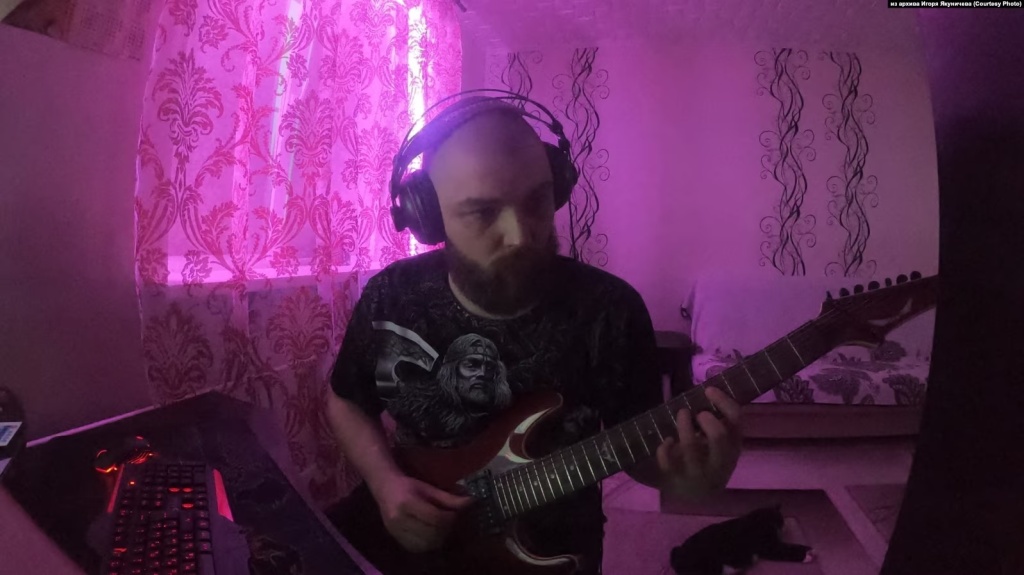
Five criminal cases have been launched against Igor Yakunichev, a resident of the Yamalo-Nenets Autonomous District. In addition to three cases on charges of “disseminating fake news” about the Russian army and “condoning terrorism,” the security services added two more cases on the same charges. On 1 April, Yakunichev, who started the YouTube channel Infinity Is Not the Limit (about the lawlessness of the police and the courts), was forcibly hospitalized in a psychiatric clinic in the Tyumen Region.
Yakunichev’s relatives are convinced that he has been subjected to punitive psychiatry because of his consistent criticism of the current regime. For more than a year, investigators in Yamalia have tried to put Yakunichev in jail on charges of “disseminating fake news” about the military and “condoning terrorism.” However, even a court-appointed defense lawyer could not induce the 35-year-old Yakunichev to “admit everything and mitigate his plight” When the criminal cases began to fall apart, the defendant, who had no psychiatric diagnoses, was shipped off to a mental hospital.
“The police broke into our house twice”
The police started calling Igor Yakunichev and coming to his home (he lived with his mother and father in Pangody, a settlement in Yamalia with a population of 11,000) in early 2023.
Pangody, a village in Yamalia. Photo courtesy of Igor Yakunichev and Radio Svoboda
“They would bring a ‘warning’ for him to sign, or they would summon him for an ‘interrogation’ and question him about his videos and posts. He started the [YouTube] channel when his family was cheated out of their housing,” says Igor’s relative Tatyana (whose name has been changed for security reasons). “Mother and father and son had lived for many years in two rooms in a barracks. Under the dilapidated housing resettlement program they were given a one-room flat. Igor fought against this lawlessness for many years, and he and his mother traveled many kilometers going to the courts. All to no avail. Then he began not only to take an interest in the state system but also to make and post videos about what is going on in Yamalia. He had come head to head with the injustice of the system back in 2015, when he worked at the property management company Our House. Another property management company controlled by them, Garant, was going bankrupt at the time, but for some reason all the employees at Our House were forced to apply to work shorter days (apparently, the whole business was being optimized). Igor refused [to sign], and after three months they up and fired him. He sued them and was reinstated, but he was pressured into leaving anyway.”
The local administration disliked the fact that Yakunichev fought for his own and other people’s rights. Consequently, despite his specialized secondary education, he could only find work as a janitor.
“He helped other residents get their cases through the courts. He became very adept in these matters: he knew all the laws well, especially the Housing Code. But there was no work in Pangody. (Yakunichev graduated from a technical college and worked as a mechanic — Sibir.Realii.) He was promised a job at Gazprom—he is a good mechanic—but then they admitted that they had hired ‘one of their own people,’ meaning somebody’s relative. And that’s how everything goes here. At the time, the cronyism made Igor quite angry, not the fact that he didn’t get the job: his janitor’s salary was enough for him. And in fact, he was already a blogger: he had bought a good camera and set up a studio for editing,” says Tatyana.
All of the Yakunichevs’ expensive electronic equipment was taken away by the police during their first “hard visit.”
“In the summer of 2023, [the police] broke into [the Yakunichevs’ flat] for real and slammed Igor onto the floor. His mother screamed, ‘His spine is broken! Don’t throw him on the floor!’ But what they did care, they hit him as hard as they could. Igor has had an implant instead of one vertebra since he was a student. When he was studying at Omsk University, he lost his keys and climbed through the window in the dormitory. The balcony was dilapidated: it broke off and he fell on his back. Since then he has had a bunch of diagnoses: cervical, thoracic and lumbar osteochondrosis. And when he is worried, he can have a seizure, and it’s like impossible for him to breathe. And so they wrestled this very unwell man, who is practically disabled, and threw him on the floor. Interestingly, the camera that Igor turned on continued to record even after his fall and almost the whole ‘wrestling match’ was captured. Igor later returned from the police station, restored the recording, and posted it on [his YouTube] channel. It made the police squeal to the high heavens!” says his buddy Ivan (whose name has been changed for his own safety). “In the background you can hear them yelling wildly, ‘Hands! Hands on your head!’ Who are they yelling at? A disabled man. And [you hear] Igor asking, ‘The cats! Watch out for the cats!’ so they don’t trample his pets. It’s just brutal!
Igor Yakunichev’s video of the police raid on his family’s flat
After the police’s visit, Yakunichev learned that a criminal case on charges of “disseminating fake news” about the Russian army (per Article 207.3.1 of the Russian Federal Criminal Code) had been launched against him as early as late March 2023. He has published his first social media posts against the war at the very beginning of the war in February 2022.
“He reacted very harshly when someone would voice support for the war in his presence. He would not get into a fight, but he could try and persuade [the person] and talk [to them] until he achieved understanding or until he got tired himself. He was one of those people who never got used to the war. He understood the risks, but he still would stick his neck out. He vented everything to the policeman after [the latter] accused him of disturbing the peace at the [Russia Day] celebrations in June 2023. After [he said] these words about the unjust war with Ukraine, which he threw directly in the face of the ‘representative of the authorities,'” they targeted him specifically,” says Ivan. “They accused him of spreading ‘fake news’ about the army, threatening him with fifteen years in prison for posts on VKontakte about the Russian military’s crimes in Bucha. He and his mother filed complaints about the violations [of his civil rights], about how he had been roughed up during the arrest, how all their electronic equipment, even his mother’s computer and phone, had been cleaned out. Can you imagine, they still haven’t returned it!
As part of the first criminal case, the court banned Yakunichev from performing certain actions. In early March 2024, this case came to court. That was when it transpired that at least four more criminal cases had been launched against Yakunichev. Even prior to this, in the summer of 2023, Igor had been charged with an administrative offense for “discrediting” the army and fined thirty thousand rubles [approx. 300 euros]. Yakunichev and his family were notified about it.
“The grounds [for the charges] were ‘funny’: a video about a memorial featuring a T-54 tank in the village of Pangody. Local vatniks had drawn the letter Z on it. And Igor said in the video[‘s annotation] that it violated the law on the protection of cultural heritage objects,” says Tatyana.
Igor Yakunichev’s silent video condemnation of a WWII memorial in Pangody turned into a pro-war Victory Day display.
Then, in November and December 2023, according to Tatyana, two more criminal cases were brought against Yakunichev under the same article of the Criminal Code (Article 205.2.2, “condoning terrorism”). He faces up to seven years in prison if convicted on these charges.
“The grounds [for the charges] were videos about the Free Russia Legion ([in which a Legionnaire expresses] gratitude for donations in the fight against ‘Putinist Russia’) and about the Kakhovka hydroelectric power plant. They weren’t even his own videos, but reposts of other media on his VKontakte page,” says Tatyana. “Later, we learned of the case launched under the article on repeated ‘discrediting’ of the army (Article 207.3.1), and then they seemingly merged it with one of the cases under Article 205 into a single proceeding. But the number of cases is frightening, don’t you agree? He regularly received notifications that one video or another had been removed from his page ‘by decision of the prosecutor’s office.’ He did not restore them: although he is a principled man, he was just tired and fed up.”
Free Russia Legion, “The Legion Returns Home” (2023)
His relatives are certain that Igor was deliberately driven to distraction with the interrogations and the notifications so that he would “blurt something out.”
“In June, the local beat cop showed up and made a completely delusional accusation. Allegedly, at the celebrations of Russia Day in June, [Igor] had been seen drunken in a public place and a complaint was filed against him. (That day, by the way, many people had seen him and testified that he was sober and orderly, so eventually the prosecutor’s office canceled this humiliating fine.) He videotaped this wannabe policeman, but he did not hold back and said everything he thought about this unjust war against Ukraine,” says a relative of Yakunichev’s. “I believe that this cop was the one who contributed testimony against him in the first case. Now it has gone to court, and Igor has been put away in a mental institution. Because they couldn’t put him under arrest: there was too little evidence of his guilt and ‘danger to society.’ But for some reason [the police] can take him to the madhouse themselves and obtain the court ruling retroactively. His mother has worn herself out filing complaints about such violations. It is urgent to replace the court-appointed lawyer with a normal one. Although [his mother] works as a cleaner, she is ready to pay all the money she has to a decent lawyer. Because the current one is a disaster: he hasn’t even been able to obtain a meeting with Igor once all month. [His family] receive paperwork about the cases against Igor months later, so they don’t know anything about the new cases against Igor.”
Igor Yakunichev’s confrontation with the local beat cop who showed up at his home to hassle him.
According to relatives, Yakunichev’s family is disappointed with the work of the court-appointed defense lawyer and now fears that Igor’s testimony will be extracted from him by torture in the psychiatric clinic, located in the village of Vinzili, Tyumen Region, a thousand kilometers from home.
“Read the reviews of the institution: former patients write such things it makes your hair stand on end—abuse and ill treatment by staff, medication administered without explaining to family and friends what the drug is and what it is used for,” says Ivan. “I think we need to get him out of there as soon as possible. Only a normal lawyer will help. By the way, this is not the first time [the authorities] have tried to subject him to punitive psychiatry. After his anti-war reposts, they were going to mobilize Igor. Yes, with his twisted spine and numbness in his chest! [Yakunichev’s family] went to the courts, got an independent forensics report, confirmed all the diagnoses, and it seemed to go away. And now this. I’m really afraid [the authorities] are not going to give up on this psychiatric hospitalization thing.”
Yakunichev’s relatives fear that the forensic psychological examination at the psychiatric clinic in the Tyumen Region will not be limited to the case and Igor will be kept there “indefinitely”.
The evidence in the last two criminal cases against Igor Yakunichev (on charges of violating Articles 280.1 and 207.3.2 of the Criminal Code) have still not been made available to his family.
“We found out from independent human rights activists—we don’t really know what he’s accused of,” says the relative. “Now they can’t even send you copies of previous cases, because during the search in April [the police] cleaned the Yakunichevs out: [they confiscated] their computer, which his mother had replaced, the telephone, even the TV set! They virtually robbed them so that they could do nothing at all, neither find a lawyer, nor send an electronic complaint.
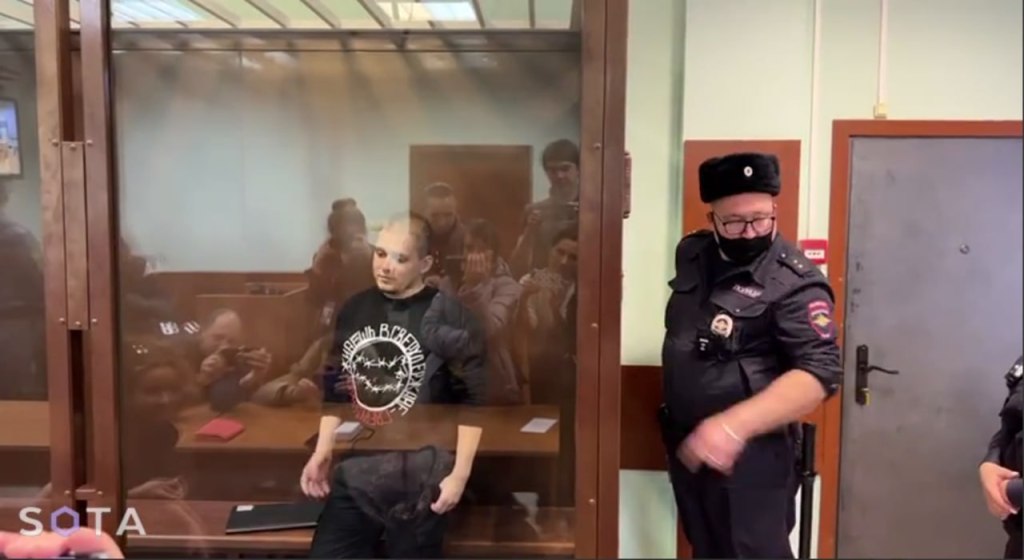
Nikita Tushkanov (above left), in the cage at his trial. Photo courtesy of RFE/RL
Nikita Tushkanov, 29, a history teacher from the town of Mikun in the Komi Republic, has been sentenced to five and a half years in a medium-security penal colony on charges of “repeatedly discrediting” [the Russian army] and “condoning terrorism” over posts and comments he made on the VKontakte social network. It took the court about nine hours to consider all the evidence in the criminal case and render its verdict. Sever.Realii takes a look at the trial and the basis of the prosecution’s case.
The criminal trial against Nikita Tushkanov, a 29-year-old historian and history and social studies teacher from the Komi Republic, ended with this brief closing statement by the defendant:
“I think we know the verdict in advance. So I cannot influence the decisions you make with my closing statement. I will not change my stance on the events in Ukraine. Moreover, I condemn them and consider them criminal. At the outset of the hearing, I asked for a recusal. It was not granted, of course. In this regard, I would like to say that I don’t want to ask you for justice, but I can’t ask you for mercy.”
The next day, a judge with the Second Western District Military Court sentenced Tushkanov to five and a half years in a medium-security penal colony over a post and several comments published on VKontakte about the war in Ukraine and the explosion on the Crimean Bridge on 8 October 2022, which the Russian authorities have declared a terrorist attack. Essentially, the judge needed only a single working day, 10 May, to review the evidence and testimony and reach a verdict. Nikita’s relatives, who were witnesses in the case, were not allowed to attend the first half of the hearing, at which the findings of a forensic examination were read into the record.
“A birthday gift for Putler”
The criminal case against Nikita Tushkanov was launched in December 2022. He was initially accused only of “condoning terrorism” over a post about the bomb blast on the Crimean Bridge, but subsequently he was also charged with “repeated discrediting” of the Armed Forces of the Russian Federation, also over posts he made on VKontakte.
[…]
The Russian authorities declared the blast on the Crimean Bridge a terrorist attack a day after the incident. The entries on Nikita Tushkanov’s social media page were made on 8 October, the day of the blast, when the incident had not yet been declared a terrorist attack.
Tushkanov was arrested in early December 2022. He later recounted that the police had been monitoring his VKontakte page for several months before the criminal case was launched. He had been written up on administrative charges of “discrediting the army” over social media posts.
The accusations were triggered by a post that read, “A birthday present for Putler. Grandpa turned 70 years old. The last anniversary of the last shithead. P.S. The Crimean Bridge was blown up today. De jure, the Ukrainians have destroyed their own bridge, what psychos…,” and discussions of the events in the comments to this post.
What other phrases were cited in the case against Nikita Tushkanov?
In addition to the post about the blast on the Crimean Bridge, the evidence in the case included comments that Tushkanov made beneath the post. Among the comments that were entered into evidence were the following (the original spelling and punctuation have been preserved — SR):
“Desktop photo for phone”
“Crimea was annexed (if you understand such words at all)”
“It’s delightful that the aggressor is getting f*****”
“My country carries out terrorist attacks by attacking peaceful cities in Ukraine. Any more questions?”
“Maybe you consider yourself a part of this state. I don’t. I didn’t elect this president, the government, and all the rest of it. My homeland has been seized by fascists and I don’t consider myself a part of it”
“How is it a terrorist attack? I don’t understand. Destroying the infrastructure and a symbol of Putin’s Russia, that’s a terrorist attack?”
“For what people? Ukraine did not ask [Russia] to build a bridge on its own land”
“Should we be sad?”
“Putin annexed the occupied territories”
“That’s what the ‘partial’ deadening mobilization does!”
“I *** didn’t get it, but it’s very interesting. What information? They weren’t annexed? Or were there no armed people there while the ‘referendum’ was going on? What’s wrong? Are the Armed Forces of the Russian Federation beating the **** out of the Armed Forces of Ukraine? Then why the mobilization? And what about ‘Z Power of PraVda’?”
The criminal case against Tushkanov was based on a forensic examination conducted by an expert from the Federal Security Service’s Komi Republic office. During the trial, Tushkanov asked the expert to explain how “discrediting” differs from ordinary criticism. The expert replied that discrediting involves creating a negative image, while criticism involves making suggestions to rectify a situation.
In the forensic examination itself, the expert found that there was no evidence in Tushkanov’s posts of his calling for the blast, but there were “signs of acknowledging the ideology and practice of perpetrating the blast that warranted support and imitation” and “discrediting” the Armed Forces of the Russian Federation.
The expert detected condoning of terrorism in the phrase about the “gift”: the word “gift” and the phrase “the Ukrainians destroyed their own bridge,” constituted, according to the expert, an attempt to condone the blast.
The purpose of the word “Putler,” according to the expert, was to “destabilize the activities of the authorities of the Russian Federation or impact their decision-making.”
The comment “Desktop photo” constituted “a positive assessment of the explosion on the Crimean Bridge, voiced as a desire to save” the picture.
The expert also detected justification for the explosion on the Crimean Bridge in the phrase “my homeland has been seized by fascists”: it was “expressed by the justification for the explosion: ‘My homeland has been seized by fascists’ (exploding the bridge is a response to the fact that the Russian Federation has been seized by fascists).”
The FSB expert also found evidence of discrediting the Armed Forces of the Russian Federation in Tushkanov’s comments about the annexation of the occupied territories, “the deadening mobilization,” and armed people during the “referendums” on annexation of the Ukrainian territories occupied by Russia.
Tushkanov’s relatives and his close friends were also questioned in court. They described Tushkanov positively and said that they had not touched on political topics in personal conversations.
Nikita Tushkanov. Photo courtesy of the Moscow Times
Testifying in court, Tushkanov again stressed that he had not renounced his comments and did not understand how he could be tried for condoning terrorism if his post had been published a day before the Russian authorities declared the explosion on the Crimean Bridge a terrorist attack. Here is a complete transcript of Tushkanov’s testimony:
I, Nikita Alexeyevich Tushkanov, date of birth 24 April 1994, was born and grew up in the small village of Chuprovo in Komi’s Udora District. My mother was a teacher and, later, the director of the school, while my father was the director of the House of Culture. My grandmother was a home-front worker and the daughter of a frontline soldier who was killed in the fight against Nazism on 1 January 1945 and was awarded the Order of the Red Star. Grandfather was the son of an exiled kulak from Voroshilovgrad (Luhansk), and his mother had been denounced by a neighbor and subjected to political persecution.
I grew up in this environment. From childhood I learned about the horrors of war and the horror of losing parents, through the tears of my grandmother and my grandfather I knew how hard it was for the children of victims of political persecution to live.
With this knowledge and a sense of duty, I joined a search party in 2013 and until 2019 was involved in searching for unburied soldiers and officers of the Winter War of 1939–40 and the Great Patriotic War of 1941–45 and reburying them with full military honors.
I loved my homeland and continue to love it, but my love changed due to the way my country, Russia, has behaved towards its own citizens (including veterans, leaving them on the sidelines of life, without assistance) and in the international arena.
I used to see no difference between the concepts of “State” and “Homeland,” but now they are absolutely opposed concepts for me. How did this happen?
It all started in 2014, and not with the annexation of Crimea, which I accepted, as did the majority of the [Russian] populace. It all started with combat involving unidentified military units in which my comrades served. They told me firsthand about what went on there and who did what.
Strelkov (Girkin)[…] has himself admitted on numerous occasions that he, a former FSB officer, “pressed the button that launched the war.” This was followed by the downing of Flight MH-17 and the emergence in Russian territory of fresh graves for soldiers and military personnel from the “they aren’t there” echelon. Since 2014, my State has supported the separatists and thrown more and more victims into the furnace of war.
[…]
We have had to pay for it all. Sanctions were imposed, and the so-called pension reform was carried out, but they simply confiscated the populace’s hard-earned money. They froze the invested part of pensions, raised the VAT, and much more. In the name of what?
It’s not the sea that drowns people, but the puddle.
I was baffled by the building of the Crimean Bridge. Didn’t we have other places where bridges needed to be built? There were thousands of possible places for this. But [they built the bridge] on territory that Ukraine recognizes as its own, as does the entire international community.
The Russian authorities called construction of the bridge a “historic mission,” one of the key tasks in the “final unification of Crimea and Russia.” Meanwhile, people’s salaries were not paid on time, and roads and bridges fell into disrepair. Why weren’t we building bridges to Sakhalin?
While still engaged in searches [for WWII soldiers still missing in action], I realized that war was pretty only at parades and musters, but in fact it was only DEATH and those whose remains I carried out of forests, fields, and swamps could tell the whole truth about war. Only the dead and the maimed know the truth about war! War is a crime, and unleashing it is a crime for which there is no justification.
The Anschluss of Austria took place in the same way as [Russia’s] “reunification” with Crimea. My state unleashed a war in Ukraine in 2014, and in February 2022, led by the President, it unleashed a full-scale war while simultaneously ensnarling the whole world by unleashing a world war, the third world war. It was my state that doomed tens of thousands of people to death and doomed millions to suffering. And the so-called special military operation has been going on for more than a year.
And now I am charged with violating two articles of the Russian Federal Criminal Code.
Article 205.2.2
I should say that I reject terrorism. I do not approve of acts of terrorism, and I regard them only negatively, no matter who commits them. I have not made calls for terrorist attacks, and I have never sought to condone their goals.
The Russian authorities allegedly declared on 8 October that the damage that had occurred on the Crimean Bridge was a terrorist act, but the media reported this only on the evening of 9 October, and the President of the Russian Federation himself did not refer to the damage to the bridge as a terrorist attack in his initial comments. Information about the terrorist attack also appeared on the [web] page of the Russian Investigative Committee in the late afternoon of 9 October.
The [social media] post in question [in the case against Tushkanov] was published on 8 October at 10:04 a.m. Moscow Time. I could not have foreseen the fact that the damage to the bridge, a military target, would be declared a terrorist attack.
From the very launch of the (auto and rail) bridge, it was used by the Armed Forces of the Russian Federation, including during preparations for the 24 February 2022 invasion of Ukraine. There were relevant publications on this topic, the use of the bridge (logically) as military infrastructure. The bridge is part of the military logistics chain for supplying the Southern Grouping of Troops in the war with Ukraine.
Thus, the damaging of the bridge as a facility used for military purposes (i.e., the transport of equipment, missiles, personnel, and provisions) cannot be declared a terrorist attack, just as is the case with all military facilities that are fair targets for damage and/or destruction. The sinking of the warship Moskva was thus also a “terrorist attack,” judging by the rationale of the Russian authorities.
Despite the fact that terrorism and acts of terrorism pursue clear goals of generating publicity and pressure [on their targets], no one has claimed responsibility for the incident on the bridge, no terrorist organization has made demands, and there have been no statements [of responsibility].
It was an act of sabotage, targeting a site that is still used for military purposes. So I thought at the time [when I published my social media post] and I still think so to this day. But it was in no way an act of terrorism.
Ukraine considers Crimea its own territory and is in the active phase of hostilities, which also points to the fact that [the attack on the Crimean Bridge] was and is an instance of sabotage.
In any military action, bridges are key targets for disrupting the logistics and supplying of enemy troops, as illustrated by the famous “rail wars” on the Berezina River during the Second World War and in this “special military operation,” which has been going on for over a year. The Armed Forces of the Russian Federation blew up and destroyed bridges in the Novomoskovsk District of the Dnipropetrovsk Region (22 April 2022), the Preobrazhensky Bridge in Zaporizzhia, and other bridges even BEFORE the incident on the Crimean Bridge.
In any war, bridges are key supply routes for armies, such as the bridges blown up by the Armed Forces of the Russian Federation, and the bridges under the control of the Armed Forces of the Russian Federation that have been attacked by the Armed Forces of Ukraine.
But while accusing Ukraine of engaging in terrorism by sabotaging the Crimean Bridge, the Russian authorities have continuously launched more than 18,000 missile strikes on Ukraine and, according to the Ukrainian authorities, 97% of those strikes targeted civilian sites, including (just to mention a few) Kyiv thermal power plant no. 5, Zmiivska thermal power plant, Kharkhiv thermal power plant no. 5, Burshtyn thermal power plant, and so on.
In response to the attacks on the Dnieper and the Kremenchuk hydroelectric stations, Russian President Vladimir Putin said that the bombing of civilian infrastructure was a response to a strike by Ukrainian drones on ships of the Russian Black Sea Fleet in Sevastopol. Fifty of [Ukraine’s] energy infrastructure has been damaged, and attacks continue, rendering cities literally uninhabitable.
These strikes did not affect the supplying of weapons and other materiel to the front. They affected such critical [civilian] infrastructure as heating, water supply, and healthcare.
And all of the above attacks on civilian targets took place before the attack on the Crimean Bridge. Who committed a terrorist attack after that?
When I published my post on the explosion on the Crimean Bridge I regarded it as damage to a military target. And I regarded the country [allegedly responsible for the sabotage], a country which is under direct attack from the Armed Forces of the Russian Federation, as involved in a war, as indicated in [my] comments to the text.
According to the Supreme Court of the Russian Federation, public condoning of terrorism constitutes a crime from the moment it is disseminated. [My] post was published on 8 October at 10:04 a.m., while the media reported the declaration of the incident as an act of terrorism on the evening of 9 October 2023.
Article 280.3.1
The concept of “discrediting” the Armed Forces of the Russian Federation is not specified anywhere and is not substantiated. There is no such concept in the case files or the indictment, and it is absent in regulatory acts.
As for the “maintenance of international peace,” after the outbreak of hostilities in Ukraine, Russia was subjected to sanctions that caused great damage to many of its economic structures, and caused many manufacturers to exit the Russian market.
According to the international community, the main purpose of the strikes on Ukraine’s energy grid was the desire to sow fear among the populace and make people’s lives unbearable!
As a result of this “defense of its own interests and its citizens,” Russia has turned into a worse scarecrow than Afghanistan.
On May 22, 2022, the Verkhovna Rada of Ukraine declared Russia a terrorist state.
On August 2, 2022, the Saeima of Latvia declared Russia a sponsor of terrorism.
On October 13 (after the bombing and destruction of a portion of the Ukrainian power grid), the Parliamentary Assembly of the Council of Europe declared the Russian government a terrorist regime.
On October 18, Estonia declared the Russian Federation a state sponsor of terrorism.
On October 26, Poland declared the Russian regime a terrorist regime, and Russia a state that supported and implemented terrorist measures.
On November 13, the Czech Parliament declared the Russian regime a terrorist regime.
On November 21, the NATO Parliamentary Assembly adopted a resolution stating that the Russian Federation and its current regime are acting as a terrorist organization.
On November 23, the European Parliament declared that Russia uses the means of terrorism and is a state sponsor of terrorism, due to Russian strikes on civilian targets in Ukraine, energy infrastructure, hospitals, schools, and shelters.
On November 24, the Netherlands declared the Russian Federation a sponsor of terrorism.
In 2022, after Russian strikes on vital infrastructure sites in Ukraine, from the. legal point of view Russia meets the criteria of a “terrorist state,” as adopted in the United States and the EU.
The world is on the verge of a nuclear war, and it all started with the actions of the Armed Forces of the Russian Federation and personally their commander-in-chief.
However, [the borders of Ukraine] were recognized by both parties (Ukraine and Russia) back in 1992.
[The borders] of the Russian Federation are fixed in the Constitution of the Russian Federation, which can be changed only by means of a referendum, in which the whole country, its entire multinational people, approves them. Amendments to the Constitution and its articles made arbitrarily by the President or anyone else are illegal and constitute a crime.
According to the laws of the Russian Federation, these are also crimes:
Planning, preparing, unleashing, or waging a war of aggression (per Russian Federal Criminal Code Article 353)
Publicly calling for war to be waged (per Russian Federal Criminal Code Article 354)
Genocide (per Russian Federal Criminal Code Article 357)
Engaging in mercenary activities (per Russian Federal Criminal Code Article 359)
Engaging in international terrorism (per Russian Federal Criminal Code Article 361)
Along with all of the aforesaid, I would like to say that no one apart from the authorities of the Russian Federation and the Armed Forces of the Russian Federation threatens international security, but the citizens of the Russian Federation, including myself, have no right or possibility to countervail the actions of the authorities and the Armed Forces of the Russian Federation.
The purpose of my posts was to show my disagreement with the horror that has gone on for over a year, a horror in which hundreds of people die every day. In the name of what?
With the start of the special military operation, war broke out not only on the front lines and in the international arena, but also in the soul of every person. The hearts of millions of Russians are in the firing line. We are all now in a state of mental civil war, a civil war that was unleashed by the Commander-in-Chief of the Armed Forces of the Russian Federation (Vladimir Putin), the Federation Council, the Security Council, and the State Duma of the Russian Federation.
I think we know the verdict in advance. I don’t think I can influence the decisions you make with my closing statement.
I have not changed my stance about the “incident” or, I don’t know, “the events that occurred in Ukraine”: it remains what it was. I condemn the war. I consider it criminal. Just like all aggression.
Well, even in the Criminal Code there is an article about necessary self-defense. Which is being employed by the other side [the Ukrainian military].
At the outset of the hearing, I asked for a recusal. You, of course, did not grant it. In this regard, I would like to say…
I don’t want to ask you for justice, but I can’t ask you for mercy.
I have been in police custody since April of last year. I was formally charged in early June, and since then I have been an “accused” man. I see this word in paperwork, I sign statements containing it, and that is how the prison authorities address me. “Accused” has been my new social status for the past nine months.
A criminal change can be a serious burden. I have met people in prison, albeit a few, who are plagued by a sense of guilt for what they have done. In this sense, though, my case is simple. All the accusations against me are ridiculous and absurd, and the article [in the criminal code] under which I am being tried should not exist, basically. I find it easy and pleasant to take a consistent stance and to tell the truth. I have always adhered to this principle both in public life and in personal matters.
The investigation, whilst trying to accuse me of spreading “fakes,” has constructed one giant fake. Literally the entire indictment, from the first word to the last, is at odds with reality. I subscribe to every word I wrote a year ago. All my emotional assessments have retained their force, and all factual claims have been borne out many times. So there can be no question of any sense of guilt on my part in terms of the present case.
Life, though, is much more complicated than a trumped-up criminal case. A year ago, events happened that shocked the world. In a matter of days, the foundations of life, which had seemed to us unshakable, were destroyed. The most terrible pictures stepped off the pages of history textbooks, reviving the nightmares of bygone years and wars whose fury had long ago been stilled. Unable to stop this ongoing tragedy, tens of millions of Russians have come face to face with an oppressive sense of guilt. It is a normal reaction to the monstrously abnormal situation in which all of us find ourselves.
If you feel guilty, it means that you have a conscience. It means that you cannot see the suffering of innocent people without feeling pain in your heart, that you are able to empathize with someone else’s grief. What is more, a sense of guilt for the actions of one’s country is impossible without a sense of belonging. It means that no matter where you are now, you maintain an emotional connection with your homeland, you realize that you are a citizen of Russia and worry about its fate. You — we — are real patriots of Russia in the true sense of the word! We love our country, and so we are especially hurt and ashamed that this inhuman war is waged on its behalf.
It is vital to remember that the guilt that we cannot help but feel is irrational per see. After all, we are not actually to blame for what is happening. The blame is on those who unleashed and wage this war, on those who issue and carry out criminal orders, on those who commit outrages on foreign soil, as well as on those who condone these crimes by cracking down on their own people and generating an atmosphere of fear and intolerance.
On the contrary, we want to live in a free and peaceful country. We want a better future for ourselves and our neighbors. In order for our hopes to come true, we must move away from a passive sense of guilt, focused on the past, and strive to realize our own civic responsibility. We must move away from regrets about what has happened to solving existing problems and making plans for the future. Yes, right now we are unable to stop the war, but this does not mean that we are powerless. I want each of you to think about what you can do personally. The answer “nothing” is not acceptable. First, if you are not on the side of the scoundrels, if you have remained true to yourself, have kept your wits about you, and have not fallen into despair, if you are listening to me now or reading this text, this is much more than nothing. And second, even I can do something and am doing something. I keep talking, communicating the truth about events to people. I have been using this trial as a platform for public anti-war statements. To the best of my ability, I have been helping those who, due to their civic stance, have found themselves on the same side of the bars as me. You have many more opportunities to act today for the sake of our common better tomorrow.
Our problem is the inability to take the initiative and find allies. We are used to following leaders and waiting for instructions. Don’t wait — act! Become volunteers, help refugees, support political prisoners, form horizontal ties. Get to know your neighbors, colleagues and classmates, set common goals and achieve them together. When someone needs your help, don’t ignore them. Make this world a better place for us and for our children.
We like to repeat, like a mantra, the words “Russia will be free!” But Russia is us, and what it will be depends only on us. The war will inevitably end, and then the regime that unleashed it will cease to exist. This is the law of history. We have a lot of work ahead of us, work which we must start now. This work of ours, I am sure, is bound to succeed. Russia will be free — because we will make it so.
Source: Darya Kornilova (Facebook), 1 March 2023. Thanks to Elena Zaharova for the heads-up. Originally published on the website of the movement For Human Rights. Translated by the Russian Reader. The verdict in Mr. Ivanov’s case is scheduled to be announced on March 7. The prosecutor has asked the court to find him guilty as charged and sentence him to nine years in prison. See my translation of Mediazona‘s detailed account of the case and trial against Mr. Ivanov, below.
Russian lawmakers on Thursday voted in favor of a bill that would make it a criminal offense to “discredit” anyone fighting on Russia’s side in the war in Ukraine, not just the Russian military.
The legislation aims to expand current laws criminalizing the discrediting of the Russian Armed Forces to include mercenaries serving in the ranks of Russia’s growing number of private military companies, such as the Wagner Group.
The bill was unexpectedly introduced by State Duma deputies Wednesday in the form of amendments to two largely unrelated bills that were already due to be voted on in the lower chamber of the Russian parliament.
If signed into law, the amendments would introduce sentences of up to seven years in prison for “public acts aimed at discrediting volunteer formations, organizations or individuals” that are aiding the work of the Russian Armed Forces.
The proposed amendments also increase the maximum punishment for violating the existing law against spreading “false” information about the army.
Those found guilty of “spreading fake information” about the army or a volunteer military formation would then face up to five years in prison instead of the three years outlined in the current law.
The new law would also raise the maximum fine from 700,000 rubles ($9,250) to 1.5 million rubles ($19,830).
In cases in which the dissemination of “false information” is deemed to have had “grave consequences,” violators could face up to 15 years in prison, under the new legislation.
The bill must now pass its third reading in the State Duma on March 14 before going to the upper house of parliament for approval and then finally to the president for his signature.
The trial of Dmitry Ivanov, a mathematics student and creator of the Telegram channel “MSU Protesting,” is nearing completion in Moscow’s Timiryazevsky District Court. Ivanov is accused of disseminating “fake news” about the army. (The investigators claim that reports of war crimes, the killing of civilians and the destruction of Ukraine’s civilian infrastructure are “fake news,” as well as Ivanov’s refusal to call the war a “special operation.”) Today, Prosecutor Yulia Pravosud asked the court to sentence Ivanov to nine years in prison. Mediazona examines the grounds for the case against the activist and how investigators have tried to prove his guilt.
Dmitry Ivanov in the “fish tank” at court. Photo: Alexandra Astakhova/Mediazona
“Don’t betray the Motherland, Dima” was the message painted on 16 March 2022 on the door of the Moscow flat in which the Moscow State University student Dmitry Ivanov had lived all twenty-two years of his life. The message was embellished with three huge Z’s. At the time, Ivanov joked: “We have already washed off the door — a simple Soviet acetone helped us make short work of the paint.” The Telegram channel “MSU Protesting,” which he had created and ran, continued to write about the war and anti-war protests inside Russia, until its author was detained on April 28 as he was leaving the university. He has not been released since.
On April 29, the Nikulinsky District Court jailed Ivanov for ten days for “organizing a rally” — this is how the security forces deemed one of the posts in his channel. He served his jail sentence in the Sakharovo Temporary Detention Center for Foreign Nationals outside of Moscow, but on May 9 he was detained as he was leaving the facility and sentenced again under the same article of the Administrative Offenses Code — this time for twenty-five days. The student missed the state exams and was unable to submit his honor’s thesis. After serving the new sentence, he was immediately detained again on June 2, this time on a criminal charges. He was taken from the detention center to the Investigative Committee for questioning.
Ivanov managed to transfer the admin of “MSU Protesting” to his friend Nikita Zaitsev. Ivanov’s friends later created a separate channel in his support, “Prison MSU.”
“From the very beginning of my imprisonment, I have lucked out in terms of symbolic dates. I was tried on Victory Day and on the day the mobilization began, and I was transferred to the pretrial detention center on Russia Day. Another hearing will be held on the anniversary of Navalny’s return to Russia. Back then it seemed that all the masks had been doffed and there was nothing more that could shock us. If only we had known what would happen a year later,” Ivanov wrote in a letter to our correspondent.
What Dmitry Ivanov is accused of
The case against Ivanov was handled by the Investigative Committee’s First Major Case Department. Like most cases investigated under the article on “fakes about the military,” it was launched on the basis of “law enforcement intelligence.” Еhe report on the student was written by Lieutenant Colonel A.L. Kapustin, a field officer in the FSB’s Moscow and Moscow Region directorate.
Kapustin copied several posts from “MSU Protesting,” and Captain K.A. Myagkov, a major case investigator, concluded that they were sufficient to launch a criminal case.
The prosecution argues that the activist, “motivated by political hatred” and “foreseeing the inevitability of socially dangerous consequences in the form of undermining and discrediting the current state authorities,” is alleged to have disseminated the following claims on Telegram between 4 March and 4 April 2022:
— the Russian army attacked the Zaporizhzhia nuclear power plant;
— The Russian armed forces have been destroying cities and civilian infrastructure and killing civilians in Ukraine;
— Russia is waging a real war, not a “special military operation”;
— Russian aviation has suffered significant losses in the war;
— Russian soldiers committed war crimes in the towns of Bucha and Irpen.
Most of the posts that investigators attributed to Ivanov were reposts of allegations made by other people, including politician Alexei Navalny, Ukrainian president Vladimir Zelensky, BBC journalist Ilya Barabanov, blogger Maxim Katz, and the writers on social media news page Lentach.
From a broken phone to a canceled thesis defense: how field officers and MSU officials persecuted an undesirable student
In 2018, Ivanov was a student majoring in computational mathematics and cybernetics. Along with dozens of other students and lecturers, he protested against construction of a World Cup fan zone outside Moscow State University’s main building. The inhabitants of the building complained that the construction work prevented them from working during the day and sleeping at night, and that the crowds of fans would make their lives unbearable.
It was then that Ivanov launched the initially anonymous Telegram channel “MSU Protesting,” in which he described in detail the struggle of students and lecturers against developers. He would go on to write about other protest actions. On 16 December 2018, Ivanov was detained at a rally outside the FSB building in Moscow: the infamous Center “E” officer Alexei Okopny did not like the fact that the student had photographed him.
The very next day, Ivanov’s channel ceased to be anonymous. “Hi, my name is Dima, I’m 19, I study at Moscow State University, and today I became a victim of torture,” the student wrote. He said that after his arrest the security forces had demanded that he give them the password to his phone; when he refused, they beat him and threatened to rape him with a police baton. Having failed to achieve their goal, they simply broke the phone, and access to “MSU Protesting” was lost. Ivanov created a new channel with the same name and recounted his experiences in detail in his inaugural post.
Ivanov thus became one of the well-known activists whom the security forces snatched from the crowd first during protests. On 2 February 2021, he was detained at a rally in support of Alexei Navalny, who had returned to Russia after recovering from poisoning. It was then that, for the first time, the Meshchansky District Court sent the student to the Temporary Detention Center for Foreign Nationals in Sakharovo for thirty days. At this center for migrants facing deportation, where Moscow opposition activists were taken to serve their administrative sentences that winter, a second charge sheet was drawn up against Ivanov because he argued with the guards. Ten more days were added to the thirty days he had got for attending the rally.
Ivanov’s friends estimated that he spent a total of 101 days under administrative arrest.
Ivanov was scheduled to defend his honor’s thesis on 1 June 2022. The student was supposed to be released from the detention center on the second of June. Ivanov’s defense team asked the court to shorten the term of arrest by at least one day and requested a postponement from the examination commission, but to no avail. In July, Ivanov was expelled from Moscow State University for not having passed the state final certification.
“I got out of the subway, saw a building with paddy wagons, and decided to give evidence”: the prosecution’s witnesses
The investigation into the Ivanov case was completed in two months. During this time, several witnesses were questioned at the Investigative Committee. Only one of them, Yuliaslava Korolevich, a school friend of the activist, testified in his defense. The security forces searched the home of Korolevich and her mother, and then brought the young woman in for questioning. She said only that she knows Dmitry “as a person who can listen and help out in difficult times, and who is intelligent, rational and logical by nature.”
The other witnesses in the case did not have their homes searched. All of them unfailingly identified themselves as “patriots” during questioning, and the wording of their testimony against Ivanov overlaps almost verbatim. All of them described the arrested student “negatively as an anti-Russian fascist,” and his posts in the Telegram channel as “not corresponding to the position of the Defense Ministry of the Russian Federation.”
The most verbose among the witnesses was the former dean of the Faculty of Fundamental Physical and Chemical Engineering at Moscow State University Lyudmila Grigorieva, infamous for her confrontation with student activists. In 2021, she was forced to resign after she called the Initiative Group at the university “western liberasts” who “grunt, crawl and shit constantly for scraps.”
During questioning, Grigorieva labeled herself “a patriot and a person who loves her country very much, and also stands for kindness, state power, unity, and public order.” She thus considered it her duty to testify against a student who, in her opinion, is a “fascist” and “belongs to a political sect.”
“Ivanov hates people who do not share his liberal views, and defends all the dregs of society,” she said.
Later, at the trial, Grigorieva voiced the hope that not only Ivanov, but also another opposition mathematician from Moscow State University, associate professor Mikhail Lobanov, would pay for “anti-Russian activities.”
Three more prosecution witnesses are Grigorieva’s former subordinates Alexander Krasilnikov, Daniil Afanasyev, and her former graduate student Kirill Borisevich. In court, none of them (like the ex-dean herself) could explain how they had ended up in the investigator’s office and had decided to testify against Ivanov.
“I was walking from the subway, I had got out of the subway. I saw a building with paddy wagons, and decided to give evidence,” Krasilnikov said uncertainly. Each of the three repeated verbatim Grigorieva’s epithets for the student, and in court they read their testimony from a phone or a piece of paper.
What connects the unemployed man Ivan Lyamin and Kolomna Philharmonic musician Mikhail Zhuravlev with the case of Ivanov is not at all clear. In court, Lyamin explained that he had “accidentally stumbled upon” the Telegram channel “MSU Protesting.” He would sometimes read it. He then told an acquaintance about it, who advised him to contact the Investigative Committee.
Zhuravlev claimed that he had decided to testify so that justice would prevail.
“Because freedom of speech has become too much,” he said.
During questioning, Zhuravlev said that Ivanov “is trying to disorient his readers about the events in Ukraine and impose a sense of guilt for the conduct of the special operation not only on Russian citizens, but on all ethnic Russians. He is also trying to shape public opinion among citizens of the Russian Federation about the need to stop the actions of the Armed Forces of the Russian Federation in Ukraine in order to preserve the power of the nationalists.”
The witness could not repeat such a long statement from memory, so in court the prosecutor had to read out his written testimony .
The evidence and witnesses for the defense
The prosecution argues that, since the posts on the Telegram channel “MSU Protesting” diverged from the official reports of the Defense Ministry, meaning that they were “deliberately false,” this is sufficient proof of Ivanov’s guilt. This conclusion was reached by linguists from the FSB, who testified in court.
Defense counsel Maria Eismont asked psychologist Veronika Konstantinova and linguist Igor Zharkov to prepare an independent expert analysis of the activist’s posts. They concluded that, at the time of their publication, the information in Ivanov’s posts was not “knowingly false” from his point of view. The prosecutor retorted that the experts were only “trying to discredit the actions of the investigation.”
In addition to the expert analysis, the defense presented the testimony of seven people in court. Unlike the prosecution witnesses, all of them were personally acquainted with Ivanov. Andrei Stroganov taught Ivanov computer science at school. Ivanov worked on his honor’s thesis with Alexei Borodin, a senior researcher at the Institute of System Programming. Ivan Shmatin, a fifth-year student at Moscow State University is not only friends with the defendant, but also knows Lyudmila Grigorieva, whom he called “a person hyper-concentrated on people who espouse democratic values.”
All of them described the accused as an honest individual and a talented mathematician. This was said by activists Irina Yakutenko and Konstantin Kotov, with whom Ivanov had been involved in solidarity campaigns for political prisoners — the mathematician Azat Miftakhov and the defendants in the New Greatness Case.
Mathematician and leftist politician Mikhail Lobanov, for whose election campaign to the State Duma Ivanov had worked, was also summoned to court. He talked about defendant’s involvement in the life of the university. According to Lobanov, “Uniquely, Dima was not embittered, even as he was being persecuted for his views.”
Grigory Mikhnov-Voytenko, a bishop of the Apostolic Orthodox Church and a human rights activist, helps Ukrainian refugees who find themselves in Russia. Their accounts fully confirm the veracity of Ivanov’s posts, the clergyman said in court.
A billy club and a dog in court, summonses to the Foreign Ministry and the Defense Ministry
On January 19, Ivanov was beaten by a guard. The reason was that the defendant did not immediately exit the “fish tank” after the court hearing, but stayed to find out from Maria Eismont when she would visit him in the pretrial detention center. It later transpired that the escort guard’s name was Alexei Nikolayevich Zhalnin.
Without giving the defendant a chance to talk to his lawyer, Zhalnin dragged Ivanov into the escort guard room. The next day, Ivanov told Eismont that the escort had taken him downstairs, turned off his body cam, and kicked him in the head and ribs and beaten him with a billy club. Zhalnin tried to put Ivanov’s head into the toilet and threatened that he would “insert a stick in his anus.” The second escort guard “watched” this and “did nothing.” The bruises suffered by the activist were documented at the detention center’s medical unit.
Dmitry Ivanov and Alexei Zhalnin, the escort guard who beat him, allegedly, on 19 January 2023. Photo courtesy of SOTA via “Prison MSU” (Telegram)
The defense has filed complaints about Zhalnin’s actions to numerous authorities, but so far to no avail. At the subsequent hearings, however, Ivanov was escorted by emphatically polite guards, and Judge Daria Pugacheva asked whether he had any complaints about the escort. Meanwhile, bailiffs stopped letting members of the public who could not recall the judge’s surname into the courthouse. Previously it had been enough to name the defendant’s last name at the entrance. A continuously whining service dog appeared in the courtroom.
Coincidentally, all these security measures were introduced when Eismont persuaded the court to call as witnesses Defense Ministry spokesman Igor Konashenkov, Foreign Minister Sergei Lavrov, and Russia’s UN ambassador Vasily Nebenzya.
“Ivanov is charged with a serious crime based on a comparison of his texts with statements made by Nebenzya, Lavrov, and Konashenkov. This means that these people are essentially witnesses for the prosecution, and so he has the right to question them in court,” the lawyer argued.
Eismont had attempted to use this trick before, at the trial of the politician Ilya Yashin, but the court did not even issue summonses to the high-ranking officials then. In the Ivanov case, the summons reached their addressees, but the witnesses ignored them.
What else Ivanov was asked in court
Before oral arguments were made, Ivanov was himself put on the witness stand. While answering the questions posed by Prosecutor Yulia Pravosud, he explained why, as a student, he had written about pension reform, how he had checked his sources of information for reliability, and which media outlets he trusted. The prosecutor then tried to get Ivanov to talk about allegations that the Russian language has been banned in Ukraine.
“Do you know anything about Zelensky’s attitude toward the Russian language?” she asked.
“It’s his native language, basically. He’s completely fluent in it,” Ivanov replied.
“Is the Russian language banned or not banned [in Ukraine]?”
“I had not heard that the Russian language was banned in Ukraine. As far as I know, many regions used it as the primary one. The Mariupol City Hall maintained all its social media and websites in Russian even after 2014.”
“I see, and what about Zelensky’s position? Does he allow [Ukrainians] to communicate [in Russian]?”
“Probably, if he forbade communication in Russian, the mayor of Mariupol would not have spoken publicly in Russian, and would not have maintained online resources in Russian.”
Prosecutor Pravosud then read aloud a post from “MSU Protesting” in which Ivanov admitted that he could face criminal charges for his statements about the Russian army’s actions in Ukraine.
“Why did you, knowing of the criminal liability, still write on your Telegram channel?” she asked Ivanov.
“‘Freedom is the freedom to say that two plus two make four. If that is granted, all else follows.’ That’s a quote from George Orwell,” he said. “Should I explain it to you?”
In the new episode of the project "The Last Line" Chulpan Khamatova again recites the verse of Alya Khaitlina. In today's poem, she reflects on responsibility, guilt and humility. Already in the first stanza she asks a rhetorical question that many of us have asked and continue to ask ourselves: "Whose fault is it all?"
Read us here - https://spektr.press
You can also find us on:
Telegram - https://t.me/SpektrURGENT
Twitter - https://twitter.com/spektronline
Facebook - https://www.facebook.com/spektr.press
VK - https://vk.com/spektr.press
Chulpan Khamatova's social media pages:
https://instagram.com/chulpanofficialhttps://www.facebook.com/aboutchulpan
Alya Khaitlina's social pages:
https://www.facebook.com/alya.khaitlina/https://t.me/alja_hajtlina
The text:
Until nightfall, until nausea, you think, what should be done?
Bags under your eyes, a mouse in a noose in your fridge.
Whose fault is it all? It’s probably yours.
Someone has to take the rap [responsibility] already, right?
You loved the wrong folk. You sought the wrong ways.
At a party you wrinkled your nose and didn’t finish dessert.
Something like this was bound to happen,
Throwing us back a thousand years.
Let them take me away, let them say it's her,
Let them send me to prison, spit on me and sling mud.
But just let this terrible war stop,
Let it live on only in books — in Cyrillic, in Braille, in frilly fonts.
Let them send me to the back of beyond.
To where hell freezes over, to where nothing ever gets off the ground.
Just let the belligerents stop shooting right now,
Let them all drop off the radar, fizzle out, dissolve.
I’ll be doing time in prison, I’ll be sweeping floors,
And at night, to get to sleep, I’ll look at the flock
Of living, lively children who were saved.
Let them hate me if they will.
But let them grow up.
Source: "'Responsibility.' Chulpan Khamatova, Alya Khaitlina. Last Line Project," Spektr Press (YouTube), 27 January 2023. Translated by the Russian Reader. Ms. Khamatova lives in Riga. Ms. Khaitlina, according to her Facebook page, lives in Munich.
This photo of a Petersburg police officer and patrol van is probably from Zaks.ru’s archives, but it’s what they pinned to this article.
Petersburg law enforcement officers interrupted a solo picket of activist Alevtina Vasilyeva, who took up position facing Gostiny Dvor holding a placard featuring a popular pacifist slogan. This was reported by the human rights project OVD Info, which cited her spouse.
The police took Vasilyeva to the 28th police precinct [a few blocks from my house, which I haven’t seen for four years now].
Apparently, the picketer faces a fine for “discrediting the army” (per Article 20.3.3 of the Administrative Offenses Code). The maximum possible [fine for this offense] is 50 thousand rubles.
UPDATE, 3:35 p.m. Vasilyeva was released from the precinct after being cited for “discrediting the army.”
Vsevolod Korolev in the dock at Vyborg District Court in Petersburg. Photo by Valentin Nikitchenko
An unexpected twist in the Vsevolod Korolev case
On January 12, Peterburg’s Vyborg District Court held a hearing on the merits of the criminal case against Petersburg documentary filmmaker Vsevolod Korolev. At today’s hearing, the complainant and prosecution witness Mikhail Baranov was cross-examined. It was Baranov who had requested that law enforcement agencies file criminal charges against Korolev.
Baranov unexpectedly changed his initial testimony, telling the court that he considered the posts by the accused “an expression of free speech,” and that he himself had “liked” Korolev’s posts to give them more publicity. The prosecution witness also said that the police had come to his home, and that he had been questioned at the police department about that very same “like.” It was only after this interaction that Baranov had filed the complaint, asking the authorities to determine whether Korolev’s posts constituted “disseminating fake news about the army.”
However, the interrogation record in the case file paints a different picture: according to it, Baranov had gone to the police himself. Korolev’s posts had, allegedly, angered him. Today, at the trial, Baranov said that he could not remember what his emotions were at the time, and that his opinion could have changed.
Vsevolod Korolev, a St. Petersburg poet and documentary filmmaker remanded in custody on charges of spreading ‘fake news’ about the Russian army, is a political prisoner. Until his arrest, Vsevolod Korolev supported people subjected to repression for anti-war statements: he made a documentary about those prosecuted and he called the war a war
The human rights project, ‘Political Prisoners. Memorial,’ considers Vsevolod Korolev a political prisoner in line with international standards. He is being prosecuted for posts on social networks. Korolev’s criminal prosecution violates his constitutional right to freedom of expression. His prosecution is intended to silence voices in Russia that oppose the war against Ukraine and to intimidate civil society.
We demand the immediate release of Vsevolod Korolev and the termination of all criminal prosecutions under the unconstitutional Article 207.3 of the Russian Criminal Code.
Who is Vsevolod Korolev and what are the charges against him?
Vsevolod Korolev, 34, is from St. Petersburg and in recent years he has been active in the city’s volunteer movement and engaged in civic activism. Korolev has worked as a volunteer with the Perspectives Charitable Foundation and the St. Petersburg Observers movement (which organizes independent election observation).
After the start of the full-scale Russian invasion of Ukraine in February 2022, Korolev became very active in the anti-war movement. On his social media pages he wrote about the crimes of the Russian military, attended the trials of those arrested on charges related to the war, collected donations of food and other necessities for those held on remand, and made documentary films about what was happening. For example, he made films about the prosecutions for ‘anti-war’ activities of the artist Sasha Skochilenko and the journalist Maria Ponomarenko.
On 11 July 2022, a criminal case was opened against Vsevolod Korolev on suspicion of disseminating information known to be false about the use of the Russian armed forces. The next day his apartment was searched and he was detained.
Korolev is accused of making posts in March and April 2022 on the VK social media site about the crimes of the Russian military in Bucha and Borodyanka near Kiev and about the shelling of Donetsk. Korolev subsequently confirmed he had made posts about the war in Ukraine, but maintained they contained no lies.
Korolev understood the risks of speaking out freely. ‘I refuse to not say the truth about things,’ he wrote on his social networks.
On 13 July, a St. Petersburg court remanded Korolev in custody, even though he has had his thyroid removed and needs regular medical examinations.
Korolev faces up to 10 years in prison if convicted.
Why do we consider Vsevolod Korolev a political prisoner?
Article 207.3 of the Russian Criminal Code criminalising dissemination of information known to be false about the actions of the Russian army contradicts the Russian Constitution, Russia’s international obligations and fundamental principles of law.
In particular, Article 19 of the International Covenant on Civil and Political Rights states: ‘Everyone shall have the right to freedom of expression.’ Restrictions on the exercise of these rights ‘shall only be such as are provided by law and are necessary: (a) For respect of the rights or reputations of others; (b) For the protection of national security or of public order (ordre public), or of public health or morals.’ Such norms are also contained in Article 29 of the Russian Constitution. The restrictions on freedom of expression introduced by Article 207.3 of the Russian Criminal Code serve none of these purposes and are a form of censorship. This is all the more so given that, in the course of an armed conflict, it is not always possible to establish the accuracy of statements made by the parties to the conflict, and the Russian authorities hold simply that official reports by the Russian Ministry of Defence should be considered reliable.
Article 207.3 of the Russian Criminal Code was specifically created as an instrument for the prosecution of critics of the Russian authorities and criminalises any statements about the use of the Russian armed forces abroad. This has already been confirmed in practice. Under this article, people are more often prosecuted not even for statements of fact but for expressing their opinions and personal attitudes. At the same time, the prosecuting authorities ascribe to many of those prosecuted, like Vsevolod Korolev, the subjective motive of ‘political hatred,’ which significantly increases the potential penalty.
A more detailed description of this case and the position of the Human Rights Project can be found on our Telegram channel.
A full list of political prisoners in Russia can be found on our temporary website.
Recognition of an individual as a political prisoner does not imply the ‘Political Prisoners. Memorial’ project agrees with, or approves of, their views, statements, or actions.
How can you help?
You can send letters to the following address:
In Russian: 196655, г. Санкт-Петербург, г. Колпино, ул. Колпинская, д. 9, ФКУ СИЗО-1 УФСИН России по СПб и ЛО, Королёву Всеволоду Анатольевичу 1987 г. р.
In English: Vsevolod Anatolievich Korolev (dob 1987), Remand Prison No. 1 of the Federal Penitentiary Service of Russia for St. Petersburg and Leningrad Region, 9 Kolpinskaya Street, Kolpino, St. Petersburg, 196655, Russia.
Source: “‘Political Prisoners. Memorial’: St. Petersburg poet and documentary filmmaker Vsevolod Korolev is a political prisoner,”Rights in Russia, 10 October 2022. As I have pointed out in previous posts on Russian anti-war protesters and political prisoners, Russian remand prisons and penal colonies only accept letters written in Russian, and the federal penitentiary service’s FSIN-Pismo service and Zonatelekom are only accessible to residents of the Russian Federation. It’s also almost a certainty that YooMoney, another Russia-based service, will not accept money from non-Russian bank cards. ||| TRR
Ioann Kurmoyarov in court. Photo by and courtesy of SOTA
Today in St. Petersburg, the trial in the case of the defrocked Orthodox priest Ioann Kurmoyarov on charges of disseminating “fake news” about the army continued. Kurmoyarov had claimed that those who invaded Ukraine would go to hell.
A theological discussion unfolded in court. Imam Fayzulla Karimov, who barely speaks Russian but was revealed to be the “expert linguist” who had assessed Kurmoyarov’s theological videos, testified as a witness for the prosecution.
It transpired that a specialist of his profile was required by the investigation to evaluate Kurmoyarov’s statement that “those who consider themselves Christians and support this war should change their religion and convert to Islam,” thus, allegedly, “inciting interfaith discord.”
From the questions posed to the “expert witness,” it transpired that he, as a native of Tajikistan, had not formally studied Russian, but had graduated from the Faculty of Philology in Dushanbe in 2004 and the Islamic University in 2014.
Kurmoyarov had been bringing the imam round to the idea that Islam, unlike Christianity, has a concept of holy war in the literal sense of the word, but the judge struck down his questions.
Here is an example of the dialogue between the judge and imam, demonstrating the latter’s level of knowledge of the Russian language (although he travels to Russia for short visits, he lives permanently in Tajikistan):
Judge: Are you acquainted with Kurmoyarov? Imam: I am acquainted. Judge (forcefully): Are you acquainted with Kurmoyarov? Imam: I am not acquainted.
Ayhal Ammosov standing in front of a funeral bureau holding a placard that reads, “The groom has arrived.” Photo courtesy of Mediazona via Aikhal Ammosov
The Free Yakutia Foundation has published a letter from Ayhal Ammosov, an anti-war activist who disappeared last week. The letter is dated November 22.
Ammosov, who faces criminal charges stemming from his public activism, has not been in touch with friends and family since December 11. They suggest that law enforcement agencies may be involved in his disappearance, Sibir.Realii reports.
In the published letter, the activist writes: “If you are reading this letter, it means that something has happened to me, something really serious. I can’t sit here right now and wonder what could have happened to me in the future, but I think that either I’m missing or I’ve been killed. This was to be expected, because they would not have given me a quiet life, especially in the republic.”
Ammosov goes on to note that he was not going to “stop” in his struggle, and that he has numerous plans.
“They are trying to intimidate us, to shut our mouths. They are trying to break us, but we will not give up, we will endure everything — all these trials, all the persecution, all the tortures and beatings. I believe in myself and in my supporters. I had to do this and I will go all the way to the end,” he writes.
In late August, it was reported that criminal charges had been filed against grassroots activist and leader of the punk band Crispy Newspaper Ayhal Ammosov for publicly discrediting the actions of the Russian army. OVD Info wrote that the charges stemmed from a banner, emblazoned with the slogan “Yakutian punk against war” (in English), which Ammosov attempted to hang on a building in downtown Yakutsk on August 13 — the same day that Russian Prime Minister Mikhail Mishustin arrived in the city. The musician was also sentenced to fifteen days of administrative arrest for his protest.
On December 13, according to friends of the activist, Ammosov did not appear in the Yakutsk City Court for a hearing in his criminal trial on charges of discrediting the army. In addition, according to the Free Yakutia Foundation, persons unknown had recently been following Ammosov.
Musician and artist Ayhal Ammosov, who was known in Yakutsk before the war as the leader of the punk band Crispy Newspaper, began to regularly stage anti-war protests after Ukraine was invaded. For a few months he managed to hide from the police and Center “E” [the Russian Interior Ministry’s “anti-extremism” police] but ultimately his activism ended with a pile of administrative charges of “discrediting” of the Russian army — and one criminal charge for the selfsame “discrediting.” Mediazona recounts here how concert performances gave way, in Ammosov’s life, first to anti-war leaflets and graffiti and a semi-clandestine existence, and then to endless games of “crabs” in jail and the threat of hard time in prison.
Punk rock has always been marked by its anti-war stance, and the Yakutsk punk scene, one of the most distinctive in Russia, was no exception. In early 2018, the band Crispy Newspaper performed at a concert organized by the label Youth of the North. After taking the stage, a young man with a microphone began to do the pogo while two guitarists, a bassist and a drummer churned out aggressively rhythmic music. When the band stopped playing, the young man made a short introductory speech: “Every day is a war, a war with the society that gave birth to us. We are descendants of slaves, sons of the proletariat, children of incomplete families, freaks, outcasts and rebels. And if we are here, then we have something to say, and if I am destined to drop dead today, I would like to say only one thing: if we’re going to die, let’s do it with music!”
The young man was Ayhal Ammosov: the name in his passport is Igor Ivanov, but he plans to make the pseudonym his official name. Four years later, when Russia launched an invasion of Ukraine, this thirty-year-old punk, poet, musician and artist would prove to be one of Yakutia’s most consistent anti-war activists.
Before February 24, he almost never engaged in political activism, except for putting up leaflets criticizing the head of Yakutia, Yegor Borisov and his henchmen, but Ammosov himself recalls those protests as not particularly interesting. His friend Mikhail Pogosov (his name has been changed to protect his identity), who has now left Yakutia, recalls that some time before the invasion they wagered whether there would be a war or not. Ammosov was sure that there would be a war — and won two pizzas.
“People wrote: ‘You can come to my place for the night, then leave in the morning.’ So that’s what I did.”
Ammosov recalls that after the war began, he warned a comrade that he was going to protest, and he replied, “If you can combine it with work, do it.” At the time, Ayhal worked as a barista in a coffee shop.
Crispy Newspaper broke up back in January, so that Ammosov could focus on anti-war activism. His most active period was during the first two months of the war. For example, Ammosov was photographed outside a funeral services bureau holding a placard that read, “The groom has arrived.” (This phrase is uttered by the policeman in Alexei Balabanov’s film Cargo 200 as he dumps the corpse of a soldier who was killed in Afghanistan into a bed to which his fiancee is handcuffed.)
Photo courtesy of Mediazona via Ayhal Ammosov’s Instagram page
On another occasion, the activist, who then appeared on Instagram only in a mask covering his face, posed with a placard that read, Kun kihite komuskes. Ayyy kihite ahynygas.
“It means, ‘The man of light is compassionate, merciful. The man of the sun is a defender, a helper.’ The Ayyy are the supreme gods, the light for the Sakha people,” Ammosov explains. “I wanted to remind my people who they are. They should not attack and kill other people or attack foreign countries. The strong must protect the weak.”
Ammosov soon learned from friends that the security forces were looking for him. For example, the police paid a visit to a former Crispy Newspaper guitarist at his workplace, the House of Musicians. The guitarist later told a friend that he was taken to the police department and even threatened with death: the police demanded that he give them Ayhal’s address, phone number or other leads. The young man did not tell them anything — the artist says that they were not in close touch. Besides, Ammosov had already switched to a semi-clandestine existence by that time: he often changed cell phones and slept at the homes of friends or the coffee shop. Later, he would only work one-day temp jobs, for example, clearing roofs of snow.
At night, the activist continued going out to put up leaflets and draw graffiti. Back in March, Center “E” became concerned (as follows from Ammosov’s criminal case file) about the local artist’s anti-war activism, which he talked about on his publicly accessible Instagram page.
As his friend Mikhail recalls, at that time Ayhal was interested in everyone who opposed the Russian government — for example, he was interested in a video featuring [Chechen independence leader] Dzhokhar Dudayev. Mikhail himself also went out at night several times with his friend to put up leaflets.
According to Ammosov, at that time he did not trust close relatives and friends: he was afraid that the security forces could find him. He would only briefly inform his mother that everything was fine.
“Many people in Yakutsk knew me, so I had support: if anything happened, I could turn to them. But it was dangerous, of course,” recalls Ammosov. “I didn’t know whether they would turn me in or set me up. People wrote: ‘You can come to my place, spend the night, have breakfast, and then go [in the morning].’ So that’s what I did.”
“Ayhal led a kind of anonymous lifestyle. No one knew where he worked or lived. He would only mention the district [where he was at the time],” confirms Mikhail.
This went on for about two months. In late April, Ammosov was finally detained while leaving a grocery store.
“Yakutian punk against war” — a raft of administrative charges and one criminal case
Ammosov was held at a police department for “almost a week.” According to the musician, he was threatened while he was in a cell. The police tried to force him to record an apology on video, and did not give him water.
His friend Mikhail adds: “The police in Yakutsk are not particularly fussy. I have been beaten when I was drunk and beaten when I was sober. It’s true, however, that I like to talk about the rights of policemen. They hate everyone equally, locals and nonresidents alike.”
For leafleting, graffiti, and posting photos of [anti-war] placards on Instagram, Ammosov was charged several times with administrative offenses — minor disorderly conduct (Administrative Offenses Code Article 20.1.1) and “discrediting” the Russian army (Administrative Offenses Code Article 20.3.3.1).
A series of court hearings ensued. On April 27, two administrative cases against Ayhal were tried in the Yakutsk City Court, and threemore were tried a day later. For example, the court ruled that a graffito written on a wall, Suoh buollun serii, constituted “discrediting” the army. It translates as “Let there be no war”, and is a line from a song.
“They used to sing it in schools, everyone knows it,” Ammosov explains, perplexed.
By late May, the trials were over. The punk was found guilty on all the charges, and he was fined a little more than 90 thousand rubles. The summer passed relatively calmly. Ammosov tried to earn money to pay off the fines, but he was unsuccessful, managing to amass only half of the amount needed.
For a period of time, Ammosov, along with other concerned residents of Yakutia, helped build a house for Anatoly Chomchoyev, a local nuclear physicist who in May was shot with a trauma pistol and stabbed by men driving a vehicle marked “Russian National Guard.” The Interior Ministry, reporting on the arrest of two suspects, claimed that the men, who were intoxicated, had tried to drive through private land fenced off with a barrier. Chomchoyev had refused to let them through and was assaulted. The ministry did not mention the suspects’ place of work in its press release.
In August, the artist had the idea for the protest of which he is most proud. Later, when interrogated by a police investigator, Ammosov said that he had borrowed a bicycle from a friend to ride around Yakutsk when he noticed the Nugget swimming pool, in the very center of town. He took down an advertising banner he found on the street, and on August 12 asked his girlfriend to videotape him writing the slogan Yakutian punk against war on the back of the banner.
On August 13, two days before Prime Minister Mikhail Mishustin’s arrival in Yakutsk, the punk climbed onto the roof of the swimming pool building. A friend filmed the protest, standing on the opposite side of Taloye, the small lake on whose shore stands the swimming pool building. After hanging the banner, the musician raised his arm in a clenched fist salute and descended the outdoor fire escape. None of the photos or video of the protest has been preserved: the security forces were already waiting for Ammosov and his girlfriend at the bottom of the fire escape and immediately confiscated their phones.
Ammosov was later charged with the criminal offense of repeat “discrediting” of the Russian army (per Article 280.3.1 of the Criminal Code, which states that criminal charges can be filed if a person already has already been charged administratively once in the past year for the same violation.) Ammosov faces up to three years in prison or a fine of 100 to 300 thousand rubles if convicted.
Police investigators examined not only the protest involving the banner at the pool, but Ammosov’s previous anti-war protests as well. The police forensic experts predictably found signs of “discrediting” the army in fairly innocent statements. For example, analyzing the placard featuring the Yakut proverb “the man of the sun is a defender,” the forensic experts concluded that the statement recognizes that “showing pity for Ukrainians suffering onslaught, attack, and encroachment by the Armed Forces of the Russian Federation, and protecting them from the actions of the latter, is true and correct.”
The experts appointed by the investigators also analyzed Ayhal’s gesture at the pool: his right arm raised with his fist clenched. “The Rotfront salute is a call to unite in the fight against fascism, by which the actions of the Russian authorities are meant as the addressee,” they write.
Discussing the phrases “Long live peace” or “No war”, these experts note: “They were often used in Soviet times, but in a different socio-cultural situation.”
Aikhal Ammosov outside the Yakutsk City Court. Photo courtesy of Mediazona via Aikhal Ammosov
However, the forensic experts based their assessment of Ammosov’s slogans and gestures not only on those statements themselves, but also on the report of the musician’s interrogation. On the day of his arrest, Ammosov told an investigator outright that he believed that Russia had invaded Ukraine, that there was not a “special military operation” going on there, but a real war, and that he had wanted to draw people’s attention to this.
A day later, during another interrogation, Ammosov nevertheless noted that the slogan on the banner implied that he was opposed to war in general, not specifically the war in Ukraine. He now admits that he resorted to this trick hoping that he would not be sent to remand prison and would be able to find a lawyer and brainstorm some options for his defense.
A month in jail with “crabs” and men back from Ukraine
Ammosov says that he spent several days in police stations and was transported from one to another. Formally, the activist had been released on his own recognizance, but he was not actually released — the musician was sent to jail for twenty-four hours several times in a row. On August 17, the court jailed him for fifteen days for minor disorderly conduct, followed by two more jail sentences — on September 2, for seven days, and on September 9, for another fifteen days — both times for failing to pay in a timely manner the fines imposed on him (per Administrative Offenses Code Article 20.25) after he was convicted on administrative charges of “discrediting” the army.
Consequently, Ammosov spent over a month under administrative arrest. After being released, Ayhal shared two main impressions that had nothing to do with the disgusting food and the conditions of detention.
First, he was sentenced to his first fifteen days in jail for, allegedly, pasting a “Banned in Sakha” sticker under the picture of a former Crispy Newspaper guitarist on the honor board at the municipal water and sanitation authority, where the musician is now employed. (“Banned in Sakha” is a paraphrase of the title of the song “Banned in D.C.,” by the hardcore punk band Bad Brains.) The police and the court claimed that this was done on August 14, although Ammosov had by that time already been detained for the protest at the swimming pool. The investigator took advantage of this circumstance: while the artist was serving his jail sentence, the investigator petitioned the court to send Ammosov to the pretrial detention center for violating the terms of his release on his own recognizance. The court sided with the activist, who insisted that he could not have pasted the sticker after his arrest. (The court also sided with the girlfriend, with whom, according to the police, Ammosov had pasted the sticker. Although the police asked the Yakutsk City Court to jail her for fifteen days too, the judge only fined her a thousand rubles.)
Second, two men who had been involved in combat in Ukraine were among the anti-war activist’s cellmates. One was an ethnic Russian with the call sign “Temple,” who had served with the Wagner Group. He said that he had been wounded but had not received compensation. The second was an Evenk whose call sign was “Evenk.” He was a veteran of the first Chechen war and a sniper.
“They didn’t say anything bad to me,” Ammosov recalls. “They said, Well, if you’ve done so much for all this, for your beliefs, you’re sitting here in jail, and you haven’t been broken yet, then you rock, man! You just have to understand that Russia is going to win, we’re going to beat the crap out of everyone. This, they said, is a fact. So the fact that you are doing some kind of anti-war shit… there will be wars anyway.”
Ammosov spent his days reading books and playing “crabs” [mandavoshka] — a prison game in which the players roll dice and move figurines around a map. The dice and figurines are fashioned from bread and toothpaste, while the map is drawn on a piece of paper or carved on a table. Care packages were regularly delivered by friends, so Ammosov had instant noodles, fruit and cigarettes, which he would give to his cellmates.
The musician recalls that when he was detained he was wearing shorts, but when he was released, on the morning of September 24, it was snowing, although the snow soon melted. By this time, mobilization for the war with Ukraine had already been announced in Russia.
“I just wanted to speak out, I wanted to do something”
Yakutsk, about which Ammosov had once proudly said that it was a young people’s city with a diverse music scene, seemed deserted to him: “Only old men, young women and ‘Zeders’ are left.” The musician recalls the raids on shopping malls and mentions that his cousin was mobilized.
“I remember that, in the spring, most musicians stopped communicating with me. They were afraid that the FSB and Center ‘E’ guys would try to catch them too. And then, when the mobilization began, they all left for Kazakhstan and from Kazakhstan they began writing fiercely to me and supporting me, as if they had always supported me. I thought, Well, what the fuck,” the Yakut punk says ironically.
Ayhal is no longer involved in anti-war activism. He got a job as an orderly in a care home where he takes care of the elderly and disabled. Only once, according to him, a prosecutor visited him at work to warn him about the inadmissibility of violating the laws on extremism, before taking him to a separate room and advising him “not to get cocky.” Meanwhile, the activist is preparing for his criminal trial, which was supposed to start on November 23 in the Yakutsk City Court, but has been postponed to December 13. He is not planning to plead guilty, but he hopes that he won’t be sent to a penal colony. And he has no regrets.
“I just wanted to speak out, I wanted to do something,” the musician explains. “Well, at the beginning, when the war started, and when I had the court hearings in the spring, people didn’t understand why I was doing it. There was no mobilization back then. But when the mobilization started, everyone was like, ‘Fuck, he was right, we should have done something earlier.'”
Dude… this is frickin’ amazing… roaring out of Asia’s northernmost punk scene, Yakutsk (Russia), this phenomenal 70’s/80’s inspired punk band Crispy Newspaper have released a brand new album of solid gold material! You HAVE to check out this band…
Further below check out what the band is like live.
Stay in touch at this link with Youth of North who seem to be a collective/label that releases music from the scene from here.
Source: “Yakutsk Punk Band Crispy Newspaper Release PHENOMENAL Album [Russia],”Unite Asia, 17 October 2020. Thanks to Comrade Koganzon for inspiring this entire post by sending me the links to all the articles translated and/or reposted here. This post is dedicated to my little sister K., whose birthday is today. ||| TRR
_________
UPDATE, 9 JANUARY 2022. Various Russian-language media outlets have reported today that Ayhal Ammosov is now safe and sound in Kazakhstan. ||| TRR
Of course, as a true masochist, I went to Palace Square to look at those hearts, small and large, supposedly symbolizing the sister cities of Petersburg and Mariupol. It is clear whose heart is the small one, and whose the big one, in the imperial capital. My thoughts about this are unprintable, so I’ll omit them.
But I went for curiosity’s sake: how many people would be getting their pictures taken in front of the hearts? As I’d supposed, it was a lot of people.
I saw much more than I’d expected. It was a total trash fest. There were the hearts, people taking fotochki, as they say now, frozen Peter the Greats walking around, carriages circling the square, and a drunk-looking little dude playing the accordion right there.
But no one seemed to be paying attention to the unauthorized inscription on the heart — black and large and truthful. (See the last two photos.)
While I was standing there, however, both citizens and law enforcement agencies finally noticed it. And they will call it vandalism, of course.
Source: Marina Varchenko, Facebook, 18 December 2022. Translated by TRR
A Petersburg woman detained on Palace Square has been charged with “discrediting” the army, the press service of the Interior Ministry’s Petersburg office has informed Bumaga.
Earlier, city media reported that the inscription “Murderers, you bombed it to smithereens. Traitors” had appeared on an installation dedicated to the sister-city relationship between Mariupol and Petersburg, and that a juvenile female had been detained.
When Bumaga asked it whether these reports were true, the press service of the Interior Ministry’s Petersburg office replied that on the afternoon of December 18, the police had detained seventeen-year-old girl on Palace Square “for committing illegal actions.” She was charged with an administrative offense for public actions aimed at “discrediting” the Armed Forces of the Russian Federation (per Article 20.3.3 of the Russian Federal Administrative Offenses Code).
The installation appeared on Palace Square on December 12. Rotundareported that the Petersburg authorities ordered it back in September. According to the contract, the city spent 1.05 million rubles on the installation.
On December 18, an inscription appeared on the installation, after which the structure was partially disassembled. Workers told our correspondent that the installation would remain on the square, but would spend the next few days without cladding until the inscription was removed from it.
Source: Bumaga, 19 December 2022. Translated by TRR
Dec 19 (Reuters) – President Vladimir Putin on Monday ordered the Federal Security Services to step up surveillance of Russian society and the country’s borders to prevent risks from abroad and traitors at home.
Speaking ahead of Tuesday’s Security Services Day — widely celebrated in Russia [sic] — Putin said the “emergence of new threats” increases the need for greater intelligence activity.
“Work must be intensified through the border services and the Federal Security Service (FSB),” Putin said.
“Any attempts to violate it (the border) must be thwarted quickly and effectively using whatever forces and means we have at our disposal, including mobile action units and special forces.”
Putin instructed the FSB to maximise their “use of the operational, technical and personnel potential” to tighten control of the society.
The FSB, the main successor to the Soviet-era KGB, has already been operating in Russia as an expansive surveillance and censorship apparatus and Moscow’s invasion in Ukraine has involved a large swathe of the security services.
“Maximum composure, concentration of forces is now required from counterintelligence agencies, including military intelligence,” Putin said, according to transcript of his speech provided by the Kremlin and translated by Reuters.
“It is necessary to severely suppress the actions of foreign special services, quickly identify traitors, spies and saboteurs.”
The FSB, headed by Putin ally Alexander Bortnikov, will also increase oversight of mass gatherings, strategic facilities and energy infrastructure.
Since the start of the war, demonstrations and dissent have been swiftly quelled in Russia, with more than 1,300 detained in September at protests denouncing Putin’s military mobilisation of 300,000.