The Hustle, “The Economics of Pickleball and the Sport’s Sound Problems”
MBARI, “Scientists solve mystery of why thousands of octopus migrate to deep-sea thermal springs”Sergei Okrushko
Solidarity Zone has begun supporting Sergei Okrushko
On July 28, an explosion occurred at the Kuibyshev Oil Refinery in Samara. The same day, 42-year-old Sergei Okrushko, who was born in Ukraine and worked as an electrician at the refinery, was detained at the border with Kazakhstan whilst trying to leave Russia. The FSB charged him with “sabotage” (per Article 281 of the Russian Federal Criminal Code of the Russian Federation “Sabotage”, and a court in Samara remanded him in custody to a pretrial detention center.
Okrushko confessed, and at his bail hearing he said that he held anti-war views and committed the action for political reasons.
It also transpired that Okrushko had earlier tried to enter Ukraine, but he was not admitted because of his Russian passport. During his stay in Moldova, he had repeatedly participated in anti-war protests.
No one was injured during the explosion at the refinery. According to the investigation, more than 30 million rubles in physical damage was caused, however.
The Kuibyshev Oil Refinery is the largest enterprise in the Samara Region, processing about seven million tons of oil per year. The plant specializes in the production of fuel for all types of transport from automobiles to ships.
On August 3, Okrushko refused the services of Solidarity Zone-affiliated lawyer Zakhar Lebedev, whom he had agreed to let defend him two days earlier. While Okrushko was writing the waiver of counsel, the lawyer noticed fresh injuries on Okrushko’s body: “I noticed that his left arm, namely most of his shoulder and forearm, was purple. It was clear that these were hematomas, which hadn’t been there on August 1 when I visited him at the pretrial detention center. When I asked Sergei where he had got such bruises, he said, without hesitating, “When they arrested me.” When I asked why they had not been there when I’d visited him at the pretrial detention center, Sergei hesitantly said that they’d shown up only now.”
We believe that the fresh bruises and his sudden and unmotivated waiver of counsel testify to the fact that Sergei Okrushko was tortured between August 1 and August 3.
Subsequently, the authorities stopped admitting any lawyers into the pretrial detention center, except for the court-appointed lawyer Vyacheslav Pavelkin. Later, it transpired that Okrushko was taken to the FSB several times without a lawyer.
Unfortunately, at this stage we have been unable to provide Sergei with defense counsel. But at the very outset of his ordeal, we sent him a care package and books, placed an order at the online Federal Penitentiary Service store, and transferred money to his personal account at the pretrial detention center. We recently learned that Sergei received all these things, which means that we were able to provide him with at least minimal humanitarian support. In the coming days, we will put together another care package for Sergei and continue to support him as much as possible.
Solidarity Zone’s mission is to support people imprisoned for anti-war direct-action protests and not let them face the system alone. We cannot always provide full-fledged support due to interference from the security forces, but we consider any reduction in the harm caused by the actions of the Russian state to be a decent outcome.
If you want to support us, you can find our details here.
Address for letters and parcels:
Okrushko Sergei Aleksandrovich (born 01.03.1981) 22 Sadovyi proyezd, SIZO-1 Samara 443021 Russian Federation
Source: Solidarity Zone (Facebook), 24 August 2023. Translated by the Russian Reader. People living outside of Russia will find it difficult or impossible to send letters to Russian prisons via Zonatelecom or regular mail. In many cases, however, you can send letters (which must be written in Russian or translated into Russian) via the free, volunteer-run service RosUznik. Mr. Okrushko has not yet appeared on their list of supported addressees, however. You can write to me (avvakum@pm.me) for assistance and advice in sending letters to her and other Russian political prisoners.
Recommended for ages 16 and up. This production contains sexually suggestive language, references to suicide, and depictions of drug use, extreme physical violence towards humans and animals, and self harm. This production also contains the use of herbal cigarettes, haze, and a brief flash of light.
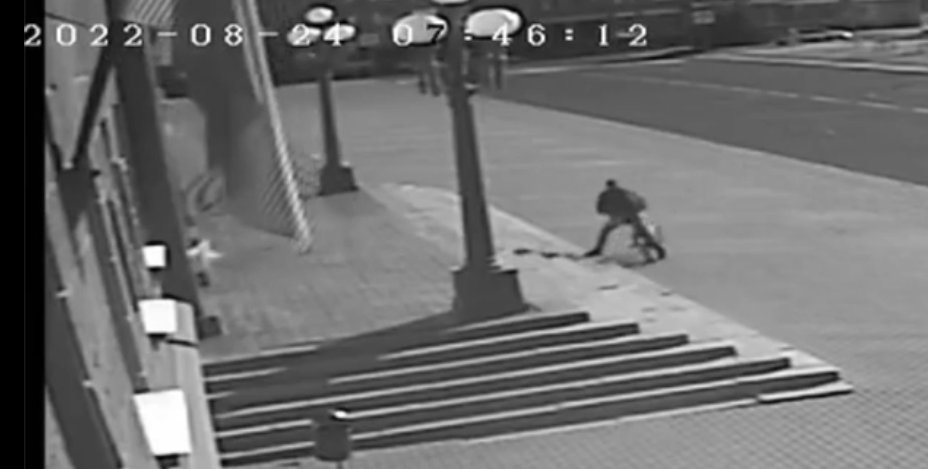
A still from CCTV footage of the attack on Oryol regional government building
Compulsory psychiatric treatment for man alleged to have thrown Molotov cocktails on Ukrainian Independence Day
On 1 August 2023, the 2nd Western District Military Court sentenced 49-year-old Mikhail Davydov to compulsory psychiatric treatment. Davydov had been charged with “terrorism” (per Article 205.1 of the Russian Federal Criminal Code) over Molotov cocktails thrown at the regional administration building in Oryol last year.
The criminal case was launched after an unknown cyclist threw two Molotov cocktails at the front doors of the Oryol regional government building on Ukrainian Independence Day (24 August) last years. The cyclist’s actions were captured by a surveillance camera.
The alleged perpetrator, Mikhail Davydov, was apprehended only a week later, on 31 August 2022. A 48-year-old resident of the region, Davydov was allegedly on the federal wanted list for “refusal to testify” (per Article 308 of the Criminal Code). According to investigators, Davydov had been hiding from the FSB since 22 April 2019. Davydov and his lawyer Larisa Melikhova denied this, however. According to them, Davydov had not been hiding from anyone, “since he had been providing for himself since 2019 and had petitioned the Federal Bailiffs Service for alimony payments, which request was denied. He was not in hiding, but had lived the entire time in the Oryol Region’s Bolkhov District, where he was detained by police officers.”
On 8 September 2022, Davydov was charged with “reckless attempted murder” (per Articles 30.3.e and 105.2 of the Criminal Code of the Russian Federation). The region’s governor, Andrei Klychkov, reported that a regional administration staffer had been wounded during the attack. However, the surveillance footage shows that the cyclist began throwing the Molotov cocktails before the doors opened (that is, they had no intention of killing anyone). In addition, the governor wrote that the employee in question was “doing fine.”
Davydov’s remand in custody at the pretrial detention center was extended several times, each time on the attempted murder charges. Davydov, however, was sent to a psychiatric hospital, apparently in February 2023. At any rate, in March 2023 the court extended his term of detention at a psychiatric hospital.
In June 2023, the case was submitted to the 2nd Western District Military Court, but now on charges of “terrorism.” On 1 August 2023, the court issued a ruling that Davydov be subjected to compulsory medical treatment. According to Kommersant newspaper, “the defendant was declared insane.”
Compulsory psychiatric treatment, unlike imprisonment, is not limited to a fixed term. It ends when a panel of physicians rules that the individual has been “cured,” and the court seconds their ruling. There have been cases in which people were subjected to compulsory psychiatric treatment for many years.
Oleg Vazhdayev has been transferred to Rostov-on-Don, where the court will begin to try his case the day after tomorrow.
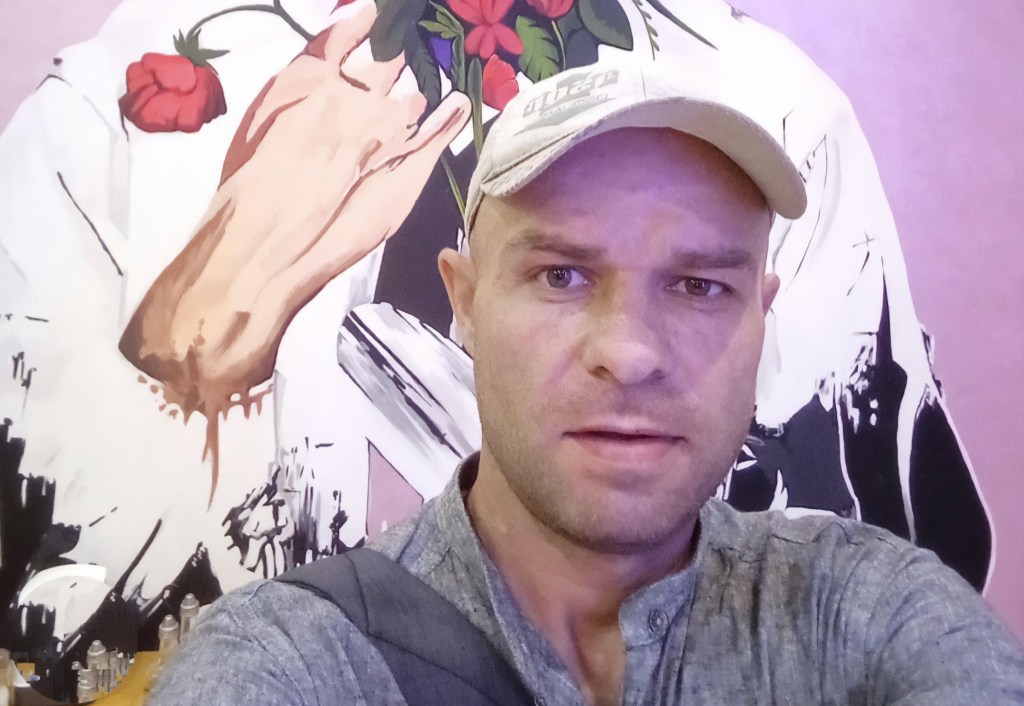
Vazhdayev, an auto mechanic, was detained in late September on charges of attempting to set fire to a military enlistment office in Krasnodar. After his arrest, the police tortured him, demanding that he confess to receiving funding from Ukraine.
The building in which the military enlistment office is housed was not damaged, but this did not stop the security forces from charging Vazhdayev with committing a “terrorist act” (per Article 205.1 of the Russian Federal Criminal Code). He faces ten to fifteen years in prison if convicted.
The criminal case against Vazhdayev has been submitted to the Southern District Military Court, and he was recently transferred from the Krasnodar pretrial detention center to Rostov-on-Don.
The trial of the case on the merits should begin the day after tomorrow. Come to the trial!
2:00 p.m., 31 May 2023
Southern District Military Court (Judge Maxim Mikhailovich Nikitin), 75B Mechnikov Street, Rostov-on-Don
If you are going to the trial, don’t forget to bring your internal passport with you and leave all blades and means of self-defense at home.
You can also write to Oleg or send him a package.
Address for letters and parcels:
Vazhdayev Oleg Igorevich (born 1988)
219 ul. Maksima Gor'kogo, SIZO-1
Rostov-on-Don 344022 Russian Federation
(It is possible to send emails via the service Zonatelecom.)
Solidarity Zone is supporting Oleg Vazhdayev and his family.
Source: Solidarity Zone (Facebook), 29 May 2023. Translated by the Russian Reader. People living outside Russia will find it impossible to use the Zonatelecom service. It is also probably impossible to send parcels to Russian detention facilities from abroad. But you can ask me (avvakum@pm.me) for assistance and advice in sending messages to Russian political prisoners.
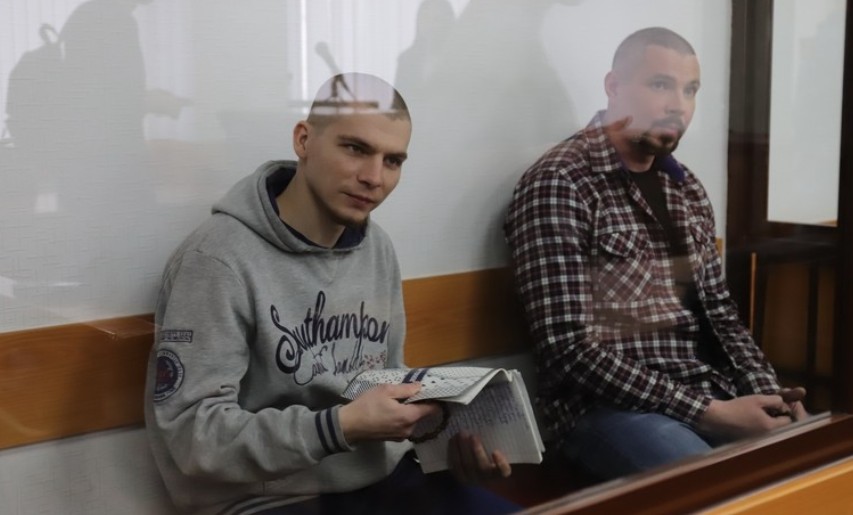
The Central District Military Court at Yekaterinburg, in Russia, yesterday (10 April) handed down 19-year prison sentences to Roman Nasryev and Aleksei Nuriev, for firebombing an administrative office building where a military registration office is based.
Roman Nasryev (left) and Aleksei Nuriev in court. Photo from The Insider
Roman and Aleksei will have to spend the first four years in prison, and the rest in a maximum-security penal colony.
This is the most severe sentence handed down so far for anti-war arson.
Roman and Aleksei received this long term of imprisonment because their actions were defined as a “terrorist act” (Article 205.2 of the criminal code of the Russian Federation) and “undergoing training for the purpose of undertaking terrorist activity” (Article 205.3). The latter Article carries a minimum term of 15 years.
The arson attack that Roman and Aleksei carried out – in reaction to the mlitary mobilisation, and to express their opposition to the invasion of Ukraine – was no more than symbolic. A female security guard was able to put out the fire, with a blanket and a few litres of water. There was damage to a window and some linoleum.
In court Roman Nasryev said:
I decided to carry out this action, because I did not agree with the [military] mobilisation, the “Special Military Operation” and the war as a whole. I simply wanted to show, by my actions, that in our city there is opposition to mobilisation and the “Special Military Operation”. I wanted in this way to make clear my opposition; I wanted my voice to be heard.
Solidarity Zone believes that this type of anti-war arson is not terrorism. That definition is politically motivated, and directly linked to the fact that the Russian government has unleashed a war of aggression against Ukraine.
□ Translated from Solidarity Zone’s Telegram feed. The original asks people to send letters and parcels to Roman and Aleksei in prison. If you are not a Russian speaker and you want to send them a message, there is no point in sending it directly. You can send messages to peoplenature@protonmail.com and I hope to be able to pass them.
The case of Pavel Korshunov, accused of “terrorism” over anti-war arson, sent to trial
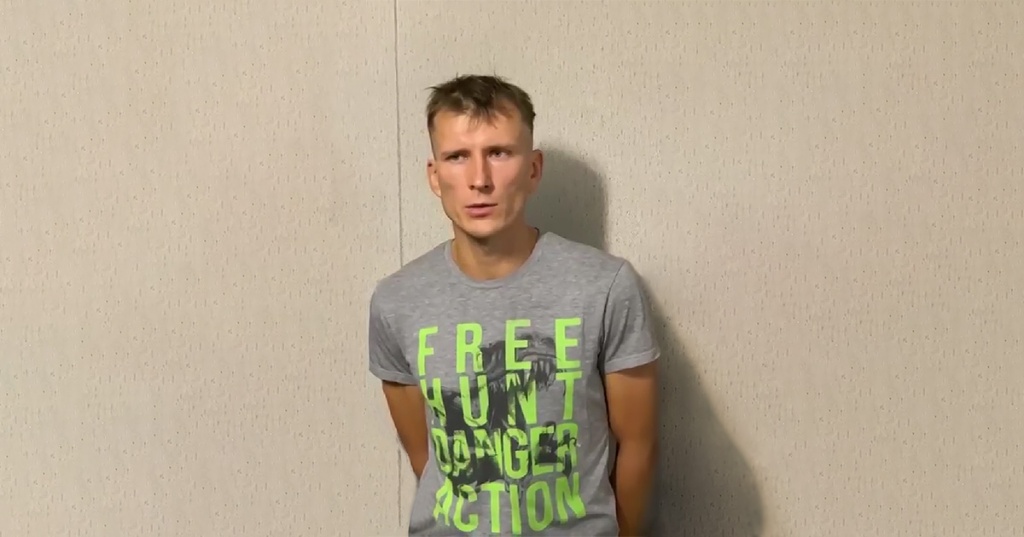
Pavel Korshunov was detained in the city of Togliatti, Samara Region, as if he were a particularly dangerous criminal — a large number of Interior Ministry special forces soldiers were involved in his capture. But, according to investigators, all that Pavel did was set try and set fire to the Togliatti city administration building the day after the mobilization was announced. In a video posted online by the security forces, Korshunov states that he wanted to impede the mobilization.
Before his arrest, Pavel worked at a boathouse. Citing sources in the security forces, the media also write that Korshunov had previously taken part in protests.
Pavel has been charged with “committing a terrorist act” (per Article 205.2.b of the Russian Federal Criminal Code) and “vandalism” (per Article 214.2 of the Russian Federal Criminal Code). He faces from twelve to twenty years in prison if convicted.
On April 7, his case was submitted to the Central District Military Court in Samara. It will be tried by a three-judge panel chaired by Igor Belkin. There is not yet any information about exact trial dates on the court’s website.
✊ Help a teacher from Krasnodar accused of terrorism!
On the night of October 6, persons unknown set fire to the military enlistment office in the city of Goryachy Klyuch, Krasnodar Territory. The next day, the security forces detained two suspects — Bogdan Abdurakhmanov, a 27-year-old native of Minsk, and Boris Goncharenko, a 34-year-old man from Krasnodar.
Abdurakhmanov and Goncharenko were initially charged with “attempted destruction of property” (per Article 30.3 and Article 167.3 of the Russian Federal Criminal Code) and thus faced no more than three years and nine months of imprisonment if convicted. The FSB intervened in the case, however, and the charge was changed to “committing a terrorist act” (per Article 205.2 of the Russian Federal Criminal Code). Bogdan and Boris now face from twelve to twenty years in prison.
Goncharenko graduated from Kuban State University. After graduating, he taught history, social studies, and philosophy at various educational institutions. At one time he worked as a manager for the Garant and Konsultant Plus legal information portals.
Boris does not support Russia’s aggression in Ukraine, and after the outbreak of the full-scale war, he was very worried about the fate of the conscripts, including his former and current students.
Goncharenko does not consider himself guilty of “committing a terrorist act.”
Solidarity Zone has found a lawyer to defend Boris Goncharenko and made a down payment on their fee so that they may begin working. On March 29, we announced a campaign to raise the 250 thousand rubles necessary to pay the lawyer’s fees in full during the investigation phase of the case. To date, less than one fifth of the amount of money needed has been raised.
We urge you to support our fundraiser with donations and reposts!
💳 Sberbank card: 2202 2025 4750 6521 (Vasily)
🪙 PayPal: solidarity_zone@riseup.net (mark it “for Goncharenko” and designate the payment in euros if possible)
🥷 Cryptocurrency (be sure to email us at solidarity_zone@riseup.net if you transfer cryptocurrency to support Boris Goncharenko):
You are not violating any Russian laws by participating in the fundraiser. We have not been deemed “foreign agents” or an “extremist” or “terrorist” organization by the authorities, and raising money to pay a lawyer’s fees is not prohibited in Russia yet. ☺️
Does it make sense to torch military enlistment offices? The short answer is no. And here’s why not.
From the outset of the mobilization in Russia, military enlistment offices have been targeted by arson attacks. We realized that this appears striking and effective and may seem like a good way to voice your protest. But is this really the case? Let’s unpack it.
1. It is ineffective. Most often, arson does not damage individual records in any way — the fire is either put out in time, or there is no fire at all. There are no exact statistics here, but an analysis of news reports about the arson attacks confirms that in most cases they didn’t accomplish anything.
Moreover, the authorities have now started digitizing conscript databases, which will soon render the destruction of paper files meaningless.
2. It involves very (!) high risks. Statistics show that arsonists are very often tracked down by the police: 48% of activists involved in arson attacks have been detained.
If you are caught, a criminal case and a hefty prison sentence are virtually inevitable. Moreover, these arson attacks are most often charged as “terrorism” — and the people charged face up to fifteen years in prison if convicted.
3. It endangers others. Military enlistment offices are often guarded, which means that the watchmen may suffer. In addition, military enlistment offices are sometimes located in or near residential buildings, and the fire can spread to them.
4. There are other ways to resist that are safer and more effective. Considering all of the above, simply talking to friends and relatives (and writing on social media) about how to avoid mobilization seems to be a much more effective and safer means of resistance.
We have compiled a complete list of methods of online and offline resistance here.
What protest methods you choose is your decision alone, of course. But we urge you to be aware and prudent in this matter and not to give in to emotions. Much more good comes from activists who aren’t in jail.
“Russian Army: A Time of Heroes Has Chosen Us.” Source: Igor Stomakhin, Facebook, 5 January 2023
On January 11, Vesna surprised me more than ever. Have you already read the post [translated, above] with (almost) the same name?
I’ll admit that I didn’t even know about this movement until February 24. But after the start of they full-scale invasion, they proved their mettle, unlike other public movements. From the earliest days of the war, they spoke out against the invasion and urged people to protest. Vesna announced mass protests while other liberal democratic organizations took no decisive action. Neither [Alexei Navalny’s] Anti-Corruption Foundation nor [opposition liberal party] Yabloko, for example, supported the call for mass street protests then. Vesna called for and was involved in the protests themselves, for which its members were persecuted and the movement was designated “extremist” by the authorities.
I try not to criticize methods and approaches to anti-war protests: everyone has the right to protest and resist as they are able and see fit. Today, however I want to speak critically about Vesna and respond to the piece, entitled “Does it make sense to torch military enlistment offices? The short answer is no. And here’s why not.”
Let’s analyze the arguments made in the post.
1. Ineffectiveness. Vesna claims that torching military enlistment offices makes no sense, since military enlistment records are not destroyed as a result of these actions. Indeed, many arson attacks on military enlistment offices have caused quite superficial damage: the flames did not spread into the offices where the paper files of conscripts might have been stored. However, this has not always been the case. For example, as a result of the actions taken by Ilya Farber (a village schoolteacher), the room in a military enlistment office where official documents were stored was destroyed by fire, as was a room at a recruiting office containing the personal belongings of employees. Moreover, we should bear in mind that the authorities and propagandists have a stake in downplaying the damage from such attacks.
When analyzing direct actions, it is also important to take into account what the guerrillas themselves say, and not to talk about the abstract results of possible actions. Did they want to destroy records at all? Moreover, it is not only military enlistment offices that are set on fire. For example, Bogdan Ziza, who threw a Molotov cocktail into a municipal administration building in Crimea, explained his motives as follows: “[I did it] so that those who are against this war, who are sitting at home and are afraid to voice their opinion, see that they are not alone.” And Alexei Rozhkov, who torched a military enlistment office on March 11, argues that the actions of guerrillas forced the authorities to withdraw conscripts from the combat zone.
If we talk about effectiveness in terms of direct action, then Vesna’s criticism is patently ridiculous: the movement has never proposed direct action tactics. If the railway saboteurs, for example, argued that torching military enlistment offices was “ineffective,” that would be a different conversation.
As for the digitization of draftee records, at the moment there is no information that it has been successfully implemented, except for claims by the authorities about staring the process. On the basis of the first wave of mobilization, the Moscow Times explained why rapid digitization of the Russian draft registration system is impossible under present conditions.
2. High risks. Indeed, people are persecuted for torching military enlistment offices. But anything else you do to counteract the Russian military machine is also fraught with high risks. You can now get a long stint in prison for the things you say. Not only Moscow municipal district councilor Alexei Gorinov (7 years) and politician Ilya Yashin (8.5 years) but also Vologda engineer [sic] Vladimir Rumyantsev (3 years) have already been handed harsh prison sentences for, allegedly, disseminating “fake news” about the army. To date, these sentences have been even harsher than those already handed down for anti-war arson. It is impossible to assess in which case it would be easier for the state to track you down and persecute you — after you torched a military enlistment office, or after you publicly posted the truth about the war. It all depends, primarily, on the security precautions you take.
3. Endangering lives. Vesna’s arguments on this score completely echo the wording of pro-government media and prosecutors’ speeches: allegedly, when a military enlistment office is torched, people could get hurt. Attention! Since the beginning of the full-scale invasion, guerrillas have carried out more than eighty anti-war arson attacks and not a single living being has been harmed! The guerrillas carry out their actions at night and plan attacks so that people do not get hurt. This is how they are discussed on the direct action Telegram channels, and the guerrillas themselves say the same thing.
4, Unsafe and ineffective. As an alternative to arson, Vesna suggests educating friends and relatives about how to avoid mobilization. Educating is, of course, an important and necessary thing to do. However, it alone is not enough to stop the war. They mention no other effective methods of resistance in their post.
I would suggest that you draw your own conclusions.
Finally, I have a few wishes. If you are planning any action that the state may regard as a criminal offense — a guerrilla action or an anti-war statement — please assess the risks and take all possible security precautions. To do this, use the guides that have been compiled online and study the know-how of forerunners. Keep in mind that even this may not be enough. Recommendations on physical security from the Combat Organization of Anarcho-Communists (BOAK) can be found in this article published DOXA. And to learn the basics of digital security, take a look the website Security in a Box.
You can find even more guides to security on the internet: don’t neglect perusing them and follow the rules they establish daily. The time you spend working through questions of security will in any case be less than the time spent in police custody in the event of your arrest after a protest action or a careless statement on the internet.
Study the safety guides mentioned in the introduction, if you thought it was not so important or had put it off for later.
How сan you take your minds off things?
Listen to the 10th edition of the podcast Zhenskii srok (“Women’s Prison Stint”) about how women revolutionaries fought the good fight and how they did time in Tsarist Russia. Among other things, the podcast explains what was mean by the term “oranges” back then and why officials and security forces were afraid of “oranges.”
For many years the Russian opposition propagandised a particular manner of protest: clean, peaceful protest of the urban class, not dirtied with violence or even any pretension to violence. I was politicised at that time. I am 25, and I first went to a street demonstration when I was 17, in the second year of study at university. And I learned the lessons conscientiously: when somebody urges people to free a demonstrator who is being detained – that’s a provocation. If someone proposes to stay put on a square and not leave, or to occupy a government building – that’s a provocateur, and that person should be paid no heed.
We are better than them, because we do not use violence, and they do. Let everyone see us and our principles as unarmed, peaceful protesters, who are beaten by cosmonauts [Russian riot police] in full combat gear. Then they will understand what is going on. Why go on a demonstration? To express our opinion, to show that we are here. And if there are enough of us, that will produce a split in the elite.
Evidently, this strategy didn’t work. Whether it worked at one time is probably not so important now. I am convinced, by my own life experience, that it has failed. A year and a half ago, I recorded an inoffensive video to support student protests – and for that got a year’s house arrest. [Reported here, SP.] And in that year, the Russian authorities succeeded in destroying the remains of the electoral system, and invading Ukraine. No peaceful protest could stop them.
During that time, as the anti-Putin opposition de-escalated protests and adapted to new prohibitions — you need to give advance notice about a demo? OK. You need to set up metal detectors on site? Very good — the authorities, by contrast, escalated the conflict with society. They pursued ever-more-contrived legal cases — for actions ranging from throwing a plastic cup at a cop, to liking stuff or joking on Twitter.
We have been retreating tactically for a long time, and finally wound up on the edge of a precipice —in a situation where not to protest would be immoral, but where, at the same time, the most inoffensive action could result in the most serious sanctions. The neurosis in which a large part of Russian society now finds itself — all those arguments about who is more ethically immaculate: those who have left, those who have stayed, those who have half-left or one-quarter-stayed; who has the moral right to speak about something and who doesn’t — all this is a result of living in a paradox.
For the first few weeks after the invasion, this logic of conflict — that the opposition de-escalates and the state escalates — reached its limits. Peaceful protests came to an end. Resistance didn’t stop: several hundred people, at a minimum, set fire to military recruitment offices or dismantled railways on which the Russian army was sending arms, and soldiers, to the front.
And when this started to happen, a big part of the opposition had nothing to say. Our editorial group was one of the first to try to report on these actions, despite the shortage of information. We were even able to speak to some of the railway partisans in Russia. But much of the independent media and opposition politicians were silent.
The silence ended on 4 October, when [Alexei] Navalny’s team announced that it would again open branches across the whole country, and support different methods of protest, including setting fire to recruitment centres. A month before that, in an interview with Ilya Azara [of Novaya Gazeta, SP], Leonid Volkov [a leading member of Navalny’s team, SP] answered a question about radical actions in this way:
I am ready to congratulate everyone who goes to set fire to a recruitment office or derail a train. But I don’t understand where these people have come from, where to find them, or whether it’s possible to organise them.
Evidently, in the course of a month, something changed. In October, the branches began to collect forms from potential supporters, and on 23 December a platform was set up on the dark web, which could only be accessed via a TOR browser. Navalny’s team stated that the platform will not retain any details of its supporters. [In an interview with DOXA, Navalny’s team clarified that the branches would be clandestine online “networks”, SP.]
For some mysterious reason, news of the reopening of the branches, and of the setting-up of the platform, went practically unnoticed in the Russian media. In October, we were apparently the only (!) publication that talked with members of the Navalny team about the reopening of the branches. Organised antiwar resistance did not make it to the top of the news agenda.
It seems to me that, notwithstanding the mass of questions that political activists want to ask Navaly’s team about this, organised resistance is the only way left to us, out of the war and out of Putinism.
I have had many discussions with antiwar activists and journalists lately, about how they assess their work, nearly a year after the start of full-scale war. The majority of them (of us) are burned out: they don’t see any point in what we are doing. I think part of the problem is that a big part of our activity concerns not resistance, but help and treatment of the symptoms — evacuation and support for refugees. Our activities don’t bring the end of the war nearer, they just alleviate its consequences.
You can count the initiatives focused on resistance on the fingers of two hands. And alas, they are not very effective. A comrade of mine, with whom at the start we put together guides about how to talk to your family members about the war, joked, bitterly:
The Russian army killed another hundred people while we were thinking about how to change the minds of one-and-a-half grandmas.
To get out of this dead end, we must together think of the future that we can achieve by our collective efforts. It’s time to reject fatalism: stop waiting for everything to be decided on the field of battle and putting all our hopes in the Ukrainian armed forces (although much will of course be decided there); stop relying on the prospect that Putin will die soon, that the elite will split and that out of this split shoots of democracy will somehow magically grow. We will not take back for ourselves freedom and the right to shape our own future, unless we ourselves take power away from this elite. The only way that we can do this, under conditions of military dictatorship, is organised resistance.
Such resistance must be based on cooperation between those who have remained in Russia and those who have left. And also those who continue to come and go (and there are many of them). Such resistance can not be coordinated by some allegedly authoritative organisation. It has to be built, by developing cooperation with other antiwar initiatives —especially the feminists and decolonising initiatives, that is, with organisations that have done a huge amount of activity since the all-out invasion and who bring together many thousands of committed supporters.
Most important of all, resistance must expand the boundaries of what we understand by non-violent protest and the permissibility of political violence. We can not allow the dictatorship to impose a language that describes setting fire to a military recruitment office, with no human victims, as “terrorism” and “extremism”.
Political struggle has always required a wide range of instruments, and if we want to defeat a dictatorship we have to learn how to use them; we need to understand clearly what each of them is good for. For many years we have paid no attention to methods of resistance that, although they are not violent, require much more decisiveness and organisation. It is to these methods that we need now to return.
There is no other way of building democracy in Russia (any democracy — liberal or socialist) without a grassroots resistance movement that can win widespread support. If the majority of opposition politicians in the pre-war period hoped that democracy could fall into their laps as a gift from the elite (as a so-called gesture of goodwill), then this year it has become completely clear: we will never have any power, if we can not ourselves take it in to our own hands.
Ulrike Meinhof [a leader of the Red Army Faction in Germany, 1970–72, SP] once quoted the words of a Black Panther activist [probablyFred Hampton, SP], spoken at a conference in February 1968 against the war in Vietnam:
Protest is when I say I don’t like this. Resistance is when I put an end to what I don’t like. Protest is when I say I refuse to go along with this anymore. Resistance is when I make sure everybody else stops going along too.
This comment was published by DOXA, an independent Russian web site that has grown out of a student magazine to become a prominent voice against the war. Translation by Simon Pirani
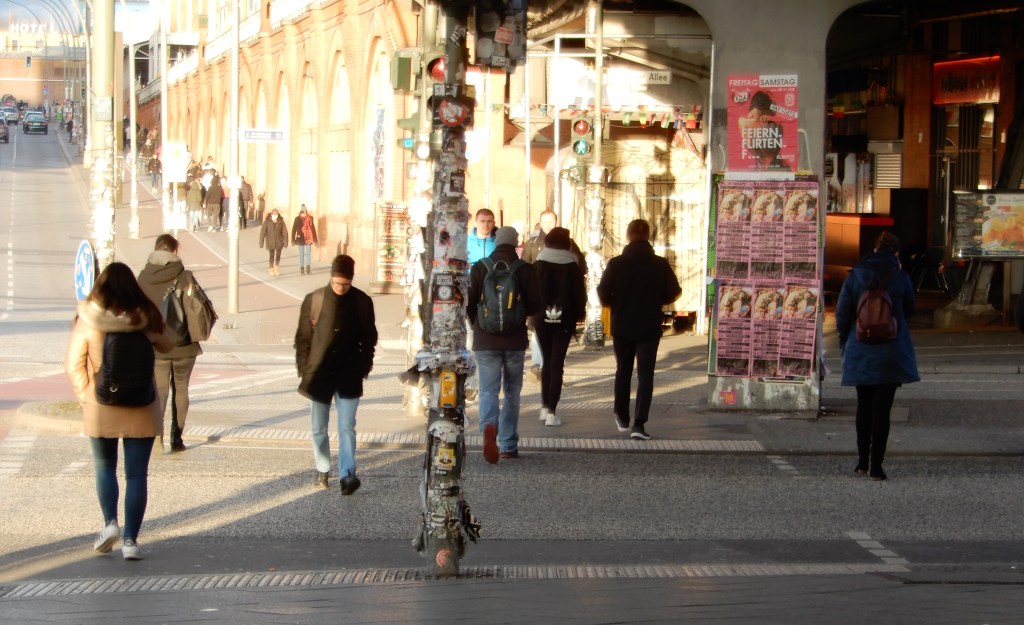
Berlin-Friedrichshain, January 2019. Photo by the Russian Reader
There is an interesting controversy on Twitter between DOXA (a left-wing media outlet) and the Vesna Movement (liberals) about violence.
Vesna wheeled out a text arguing that torching military enlistment offices is bad, and DOXA and other leftists responded by explaining why there is no way to do without such tactics now.
In response, the liberals and the publication Kotyol (“Boiler”), which took their side, have deployed a super argument: so why don’t you go to Russia and torch these places yourself, instead of advising others to do it? They also claimed that DOXA embraces Putin’s way of thinking by sending others to get killed instead of themselves.
I’ll join in the fray and answer for myself. First, it’s none of your damn business where I go or don’t go and why.
Second, waging an armed struggle requires financing, training, experience, support bases, and much more. Now of this exists now.
Third, if you liberal assholes had not consistently advocated against every form of illegal resistance for all Putin’s years and decades in power, if you had not demonized “radicals,” just as you are doing now, if you had not readily dubbed “terrorists” all those at whom the authorities pointed a finger, the situation in paragraph 2 would have been different.
Yes, it was you who shat your pants, soiling not only us, but everyone, including the Ukrainians.
The leftists are “talking shit” about violence, but are not traveling to Russia to torch things? Well, at least we’re talking shit!
Look at yourself. The bravest of you, and there are relatively few of those, raise money for the Armed Forces of Ukraine so that Ukrainians will fight and die on your behalf. But you yourselves advocate nonviolence, my ass. Which of us are the hypocrites? Who has embraced Putin’s way of thinking?
If you have at least a drop of conscience, you’ll recall what the liberals wrote in the late nineteenth century about the Decembrists and Narodniks and at least shut your traps on the question of violence.
Source: George Losev (Facebook), 17 January 2023. Translated by Thomas Campbell
Inflated rubber duckie at June 12, 2017, anti-corruption protest rally in Petersburg. The duckie was later detained by police. Photo courtesy of The Poke
Sergey Yermakov Protest Duckies and the Actionism of Fact
The final performances by Voina’s so-called Petersburg faction could be termed “actionism of fact” by analogy with “literature of fact,” a project the LEF mob tried and failed to realize in the 1920s.
Voina took ordinary actions from the repertoire of protest and resistance, actions requiring no special skills—turning over a police car, torching a paddy wagon, dousing policemen with urine—and simply did them in their performances.
What happened to the performances due to their actions?
First, the performances simply were carried out, like ordinary actions, bereft of aesthetic and symbolic depth. (We will bracket the question of Alexei Plutser-Sarno’s defamiliarizing press releases.) “They really did it.”
Second, the actions were glorified by the very fact they were performed by the actionists. They were bathed in an aura of glory, but note that this aura was totally colorless. It had no density whatsoever, and it produced no distortions in the albedo. This was because the actions were as commonplace as could be, actions available to everyone, actions to which nothing was added except their execution. (Well, yes, and the group’s signature.)
The actionist readymade (or “readydone”) and actionism of fact, unlike the classic artistic readymade, have no need of a special aesthetic space, such as a museum. Unlike literature of fact (if this literary project had actually been implemented in the twenties), actionism may well avoid the traps of language and representation.
Voina thus directly took on the issue of politically effective action. There is a certain actionist Platonism to it, but if we bypass Plato (no matter how we regard the violence of his gesture) we cannot ask ourselves about art’s attitude and access to politics.
In the Republic, Plato does not suggest banishing all poets for fobbing off the phantom of excellence (εἰδώλων ἀρετῆς) on citizens instead of virtue (i.e., the thought of action). He would let the non-mimetic poets, who glorify the gods and sing the praises of good men (ἐγκώμια τοῖς ἀγαθοῖς), stay in the city. Voina’s Petersburg faction non-mimetically sang the praises not of citizens themselves, but certain actions as such, simply by performing them. Their implicit message was something like: Look, this is up for grabs for everyone, and yet if you carry out this glorious deed, you will not be unoriginal and overshadowed by us, because this is basically something anyone could do. This is a kind of democratic and non-hierarchical political Platonism.
Voina did these performances before the May 6, 2012, clashes between protesters and police on Bolotnaya Square in Moscow. They seemingly had offered the demos who took to the streets a possible repertoire of elementary actions. (Of course, the total number of such actions is much greater, and not all of them are either criminal or so primitive. What matters in this case is only the dimension itself.) But the demos did not heed their call, preferring to play at making witty posters, from the December 2011 rally on Sakharov Avenue to this day, and exchanging anti-regime memes in the social networks. (That is, the circumstances are in some way symmetrical to the exile of the poets. In this case, however, the demos itself has turned its back on genuinely political artists, immersing itself in the carnivalesque mimesis of the meme.) By rejecting the dimension of the glorious deed, however, the demos has refused to be itself, because it is eventful, rather than substantial, in contrast to the phantasm of the ethnos.
It took Pyotr Pavlensky half a dozen performances to get close to the place where Voina had arrived in the spring of 2011, that is, in order to torch the front door at FSB headquarters in Moscow. In many ways, the performance was a step backwards, for example, when it came to the question of withdrawal. The guerillas of Voina insisted on retreating in a well-conceived way and unexpectedly returning to strike again. (This is the only worthwhile “We’ll be back!” It is a far cry from Navalny and Co.) But Pavlensky, in many respects by way of accommodating an aesthetic impulse, stood his ground to the bitter end. He has thus proven to be a more direct follower of the National Bolsheviks than Voina when it comes to this issue.
So Voina is still waiting for its demos and valiant citizens back in the spring of 2011, scornfully gazing at rubber duckies, meme politics, and witty anti-Kremlin t-shirts.
Translated by the Russian Reader. Sergey Yermakov is a professional translator who was involved in several of Pyotr Pavlensky’s performances. My thanks to Mr. Yermakov for his kind permission to publish this essay here.
Bloody Performance by Moscow LGBT Activists outside Presidential Administration Building
2 July 2013
On July 2, the LGBT community staged a bloody performance near the entrance to the Presidential Administration Building in Moscow.
Moscow activists Reida Linn, Niks Nemeni, and Roman Petrishchev were discovered in a pool of blood near the entrance to the Administration Building. Another activist, Alexei Davydov, accompanied the action with a placard. Photographs of recent real victims of homophobia were placed on the activists’ backs.
Passersby whispered in horror and recorded the event on cameras and telephones. However, within several minutes, police officers recognized it was a staged performance, confiscated Alexei Davydov’s placard (inscribed “Mizulina‘s Law in Action”), and took the activists to Kitai Gorod police precinct.
“This protest aims to demonstrate the danger of the new anti-LGBT laws, because of which any person, whatever their orientation, can end up in a pool of blood,” the picketers stated by way of explaining their actions.


 Address for letters and parcels:
 2:00 p.m., 31 May 2023
 Southern District Military Court (Judge Maxim Mikhailovich Nikitin), 75B Mechnikov Street, Rostov-on-Don
 If you are going to the trial, don’t forget to bring your internal passport with you and leave all blades and means of self-defense at home.