This December, premium SUV brand TANK celebrates its second anniversary in Russia and the New Year, inviting everyone to be a part of the celebration.
Get into the festive mood on the TANK.RU website by creating commemorative cards and beginning your own journey towards the new.
TANK. Drive your own progress.
Source: Unsolicited email from Vedomosti, 10 December 2024
The fall of the Baath state in Syria is a serious defeat for Russia (and a disaster for Iran). It would however be a grave mistake to assume that this by necessity makes it a success for the United States.
Moscow and Washington may indeed now face similar challenges in Syria.
Three issues led Russia to intervene in the Syrian civil war to save the Assad regime. First was a general desire to preserve a partner state — one of the very few remaining to Russia after the U.S. overthrow of the regimes in Iraq and Libya, which helped to prop up Moscow’s international influence. Second was a desire to retain Russia’s only naval and air bases in the Mediterranean.
Third was a deep Russian fear that an Islamist victory would lead to Syria becoming a base for terrorism against Russia and its partners in Central Asia. That anxiety was increased by the presence of numerous fighters from Chechnya and other Muslim regions of Russia in the ranks of the Islamist forces in Syria and Iraq.
[…]
Thanks to our readers and supporters, Responsible Statecraft has had a tremendous year. A complete website overhaul made possible in part by generous contributions to RS, along with amazing writing by staff and outside contributors, has helped to increase our monthly page views by 133%! In continuing to provide independent and sharp analysis on the major conflicts in Ukraine and the Middle East, as well as the tumult of Washington politics, RS has become a go-to for readers looking for alternatives and change in the foreign policy conversation.
We hope you will consider a tax-exempt donation to RS for your end-of-the-year giving, as we plan for new ways to expand our coverage and reach in 2025. Please enjoy your holidays, and here is to a dynamic year ahead!
On Sunday, something extraordinary happened: the Syrian people overthrew the Assad regime. For years we have been waiting to share this news with you. We wanted to make sure you didn’t miss our message below.
Dear Thomas,
This is the message we have been waiting so long to write. Assad is gone. The Syrian people have toppled the Assad regime. Our hearts burst with hope today. A war criminal of the worst kind no longer has the power to torture, starve, bomb and detain people in Syria.
The regime that has caused indescribable suffering and trauma for decades no longer has the power to commit war crimes. Syrians in Syria and all over the world are singing, “Syria is for the people, it does not belong to the Assad family”. We are chanting along with them. Ragheed al-Tatari, Syria’s longest-held political prisoner, has been freed alongside many others.
We write these words thinking of so many of our friends and loved ones who we lost in the past years. Our hearts break that they’re not witnessing these moments with us.
There is much that is unknown. We have lost so much. Our dream for freedom and democracy declared almost 14 years ago was for a peaceful transition of power out of authoritarian hands into those of the Syrian people – all of us diverse and different but together in our vision for a new Syria.
At the Syria Campaign we commit to continuing to work with all those who stand with human rights, with you all, to ensure our vision for a free and democratic Syria is made real.
The hope we feel today feels something like those first weeks when we took to the streets and dared to call for freedom and dignity. We believed the world would join us to protect humanity and champion the values they claimed to hold dear.
As our committed and courageous supporters you all know the journey we have been on since then. You have been with us as we rallied loudly against the bombings of hospitals, whole communities massacred by chemical weapons, the systematic use of detention and disappearance, meant to crush our spirits. You, and hundreds of thousands of people around the world, have stood with us and made our demands for protection of civilians and justice for war crimes more powerful.
Our movement, alongside the heroes on the ground in Syria – the White Helmets, medics, women’s rights activists, journalists – and the vibrant Syrian civil society in refuge around the world – the lawyers, investigators, artists, campaigners, survivor groups and family associations, has kept the demands of the revolution loud and clear.
Today, those demands are all the more urgent. It is time for Syrians to lead a peaceful Syria. Free and democratic, vibrant and diverse.
Now is the moment for Syria and the international community to restart Syria’s stalled UN-led political process, with a clear timeline for political transition that leads to free elections, as outlined in UN Resolution 2254.
There is so much to be done. We are impatient for accountability and justice. So many people remain detained or disappeared and families across the world are now hoping to go back to their homes and cities and be reunited with their loved ones. Almost every Syrian carries pain and trauma into this new moment. It is a moment that holds such promise. It is the chance to create a new beautiful Syria.
P.S. The weeks ahead will be critical. Please consider donating to support our work towards our vision for a free, just and democratic Syria.
The Syria Campaign is a human rights organisation that supports Syria’s heroes in their struggle for freedom, justice and democracy. Read more about our work here.
Online donations by credit card are processed by Voices Project USA and are tax deductible in the United States to the full extent allowable under the law. Online donations by PayPal are processed by The Voices Project (UK) and are not currently tax deductible in the US or available for gift aid in the UK. Voices Project USA Federal Identification Number is 82-3505967.
Source: A very welcome email from the Syria Campaign, 10 December 2024
“GREETING THE NEW”: the “commemorative postcard” generated for me by TANK.RU, based on my answers to six leading questions and a photo of myself I uploaded to the website.
Since the beginning of 2023, Russians have bought more than 600 Chinese Tank SUVs. According to Autostat, from January to April, Tank dealers sold 632 cars, and the more affordable model with the 300 index is more popular than the Tank 500 — during the reporting period, the first sold 479 copies, and the second — 153 copies. Thus, the Tank 300 accounts for 76 percent of total sales, and the “five hundredth” — 24 percent. Tanks are in the greatest demand in Moscow — every fourth car of this brand (166 units) is registered in the capital. In second place in terms of sales is St. Petersburg with an indicator of 125 Chinese SUVs sold (every fifth), followed by the Moscow region – every 10th SUV is registered there. The top 5 regions also include Nizhny Novgorod and Kemerovo regions (45 and 37 copies, respectively).
Tanks are in the greatest demand in Moscow — every fourth car of this brand (166 units) is registered in the capital. In second place in terms of sales is St. Petersburg with an indicator of 125 Chinese SUVs sold (every fifth), followed by the Moscow region – every 10th SUV is registered there. The top 5 regions also include Nizhny Novgorod and Kemerovo regions (45 and 37 copies, respectively).
Official sales of the Tank 300 began only in the early spring of this year. The “younger” Tank is supposed to have a two-liter “turbocharger” with a capacity of 220 horsepower in conjunction with an eight-band automatic, the drive is only full. The larger Tank 500 model appeared a month after the “three hundredth” — it is offered with a 3.0-liter V6 engine that develops 299 horsepower and works with a nine-band automatic. The drive is also full.
The town’s coroner and mortician, Dr. Ivan Malinin, a Russian immigrant who barely spoke English, performed the autopsy on Williams at the Tyree Funeral House. Malinin found hemorrhages in the heart and neck and pronounced the cause of death as “insufficiency of [the] right ventricle of [the] heart.” Malinin also found that, apparently unrelated to his death, Williams had also been severely kicked in the groin during a fight in a Montgomery bar a few days earlier in which he had also injured his left arm, which had been subsequently bandaged. That evening, when the announcer at Canton announced Williams’s death to the gathered crowd, they started laughing, thinking that it was just another excuse. After Hawkshaw Hawkins and other performers started singing “I Saw the Light” as a tribute to Williams, the crowd, now realizing that he was indeed dead, followed them.
This can be translated as “Goodbye, Finland,” or it can be translated as “Adieu, Finland.” The correct translation will depend on our neighbors.
Source: “News Roundup” email newsletter (Delovoi Peterburg), 24 November 2023. Translated by the Russian Reader
Finland has temporarily closed all but one of its eight passenger crossings to Russia in response to an unusually high inflow of migrants for which the Nordic country accuses Moscow.More than 700 migrants from nations such as Yemen, Afghanistan, Kenya, Morocco, Pakistan, Somalia and Syria, have in the past couple of weeks entered Finland via Russia. Helsinki says Russia is funneling migrants to the border, a charge the Kremlin has denied.
Having last week closed four border stations, Finland overnight closed all remaining passenger crossings except its northernmost one, Raja-Jooseppi located high north in the Arctic region, for a month.
Raja-Jooseppi opened its gates for traffic this morning and will continue to accept asylum applications during its four daily opening hours, the Finnish Border Guard said.
No migrants arrived overnight outside opening hours, it added.
The Border Guard is stepping up patrolling along the length of its 833-mile frontier with Russia.
It will get additional resources for the task from the European Union’s border agency Frontex, which said on Thursday it would deploy 50 border guard officers and other staff to Finland along with equipment such as patrol cars to bolster control activities.
HS: Russia wants to create an image of a hostile West that is of benefit to the Russian leadership. Finland has not fit this image in the past, but now they are trying to build it. Relations between Finland and Russia are at a turning point. The Russians have realised that they do not know Finland after all. They want to see who Finland cooperates with and at the same time try to stir up discord within Finnish society. Building a new relationship will be a long-term process.
JS: Russia can create a fortress mindset due to a perceived ‘threat’ from the West. Finland’s eastern border is becoming a useful confrontational narrative for the Kremlin. When the same narrative is repeated, a kind of protection mechanism kicks in and even sceptics will start to believe it.
Civic Council named “undesirable organization” in the Russian Federation
The Prosecutor General’s Office added us to this list on November 3, exactly one year after we announced the creation of our Mobilization Center. We have openly stated that we are working to ensure that the Russian Federation in its current form, with its current government and all that this government calls the state, ceases to exist.
Today it is the Russian state that is criminal, and armed struggle against it is legitimate and necessary. So the Prosecutor’s Office and the Justice Ministry are formally correct: we are their enemies.
In fact, our status as an undesirable organization has not changed anything. Supporting the Civic Council within Russia was also a criminal offense before we were give this status, just like all other independent political and civic activities. The Russian authorities hand down approximately the same prison sentences for making [anti-war] comments on social media and engaging in armed resistance. So, we propose fighting effectively, rather than commenting in vain.
We have to resist intelligently, so we suggest that our supporters inside Russia observe the rules of information security and be vigilant.
We do not accept donations payable to Russian bank cards and do not have accounts in Russian banks.
We are not urging you to attend protest rallies right now. The time to go to the public squares will come later.
We invite those who are ready to take up arms to fight, fully aware of the consequences.
For those who do not want to stay on the sidelines but cannot fight for various reasons, there are other ways to support our cause:
donating money, including anonymously through crypto wallets (including Monero)
providing information to our OSINT service
disseminating information about the opportunity to volunteer
To volunteer for the Siberian Battalion, fill out this form.
Anyone who wants to make a donation should go here. All options are a help to us.
Anyone who wants to help with information or other work inside the Russian Federation should write to us at civic_council@proton.me.
Sincerely yours,
Civic Council, an undesirable organization in the Russian Federation
Foreign luxury brands are closing their flagship stores on Nevsky Prospect, but they could be replaced by Russian fashion retailers, say market participants.
Analysts expect a reduction in rental rates on Nevsky Prospect.
According to sources cited by Kommersant-SPb and NF Group, Breitling, Fendi, Omega, Rolex, and Salvatore Ferragamo have already vacated their spaces in downtown Petersburg. Louis Vuitton has the same plans. Market participants ascribed the mass exodus of luxury sellers to political pressure in the brands’ home countries and logistical and supply chain challenges.
“Luxury retailers initially took a wait-and-see attitude, but now it has become clear that there are no prospects for stabilizing the economic situation in the medium term,” said a source who spoke to Kommersant-SPb.
KNRU development director Polina Fiofilova noted that western brands that have been operating in the fashionable part of Nevsky Prospect for years have driven rents “sky-high” and inflated the expectations of landlords.
In the first half of 2023, the rates per square meter in this locale ranged from 2,600 to 6,700 rubles per month (VAT included), while in the adjacent Telezhny Lane they amounted to 2,500 to 5,200 rubles per square meter per month. Local fashion retailers simply would not be able to afford such rents, analysts said.
Nevsky Prospect is still empty. Despite a reduction in vacancies compared to the peak period, their level remains quite high, thus generating pressure on rental costs, added Mikhail Burmistrov, CEO of the agency Infoline Analytics.
As Delovoi Peterburgwrote earlier, despite the departure of a number of foreign brands, fashion retail sales increased by nine percent, a nineteen percent increase compared to the same period last year. But the average receipt remained at the level of last year or even decreased.
In period from July to September, ten international brand stores opened in Petersburg shopping centers. Most of the new boutiques belong to the fashion segment.
Three new Turkish clothing brand stores opened in Petersburg, along with Quiksilver (Australia), Mark Formelle (Belorussia), Woolrich (USA), Yamaguchi (Japan), Liu Jo (Italy) and two Stockmann’s stores (Finland).
We reported in October that the Italian clothing brand OVS would return to Petersburg after a ten-year hiatus.
Rosstat reports that the retail price of bananas increased to 143 rubles per kilo for the first time since it has been tracking their price. Compared to October last year, the cost of bananas increased by 47 percent, which was the biggest single-month increase since 2000. Oranges led the price growth among fruits: in October, they rose in price to 209 rubles per kilo, or by almost 80% year on year. Fruit prices were affected by the weakening of the ruble, which led to an increase in suppliers’ purchase prices and a rise in the cost of logistics, according to market participants. Albina Koryagina, a partner at NEO, a consulting company, says that last year the Russian authorities controlled the growth of retail prices for socially significant products, including bananas (aka “the poor people’s fruit”), as much as they were able, but this year retailers can no longer afford to hold down prices “even when pressured.”
4,121 criminal absence without leave [AWOL] cases have been delivered to Russia’s military courts since the start of the military mobilization in September 2022, as reported on Friday, November 24, by Mediazona, which studied information available on the websites of the military courts.
The courts have already made rulings in 3,470 of the cases. “Most AWOL cases result in suspended sentences. The percentage of such rulings is sixty-three for volunteer soldiers, while for mobilized [conscripted] soldiers, it is slightly lower—fifty-six percent,” the article says. A suspended sentence, it notes, makes it possible to return a serviceman to the front.
In addition to criminal AWOL cases, Mediazona found 317 cases of disobeying orders, 96 cases of desertion, 54 cases of assaulting a commanding officer, and 42 cases for other offenses on which the authorities have doubled down during the mobilization.
According to the infographic published by Mediazona, the most cases were launched in the Moscow Region (309), the Rostov Region (224), and the Maritime Territory (181). 123 cases were launched in Moscow, and 116 in St. Petersburg.
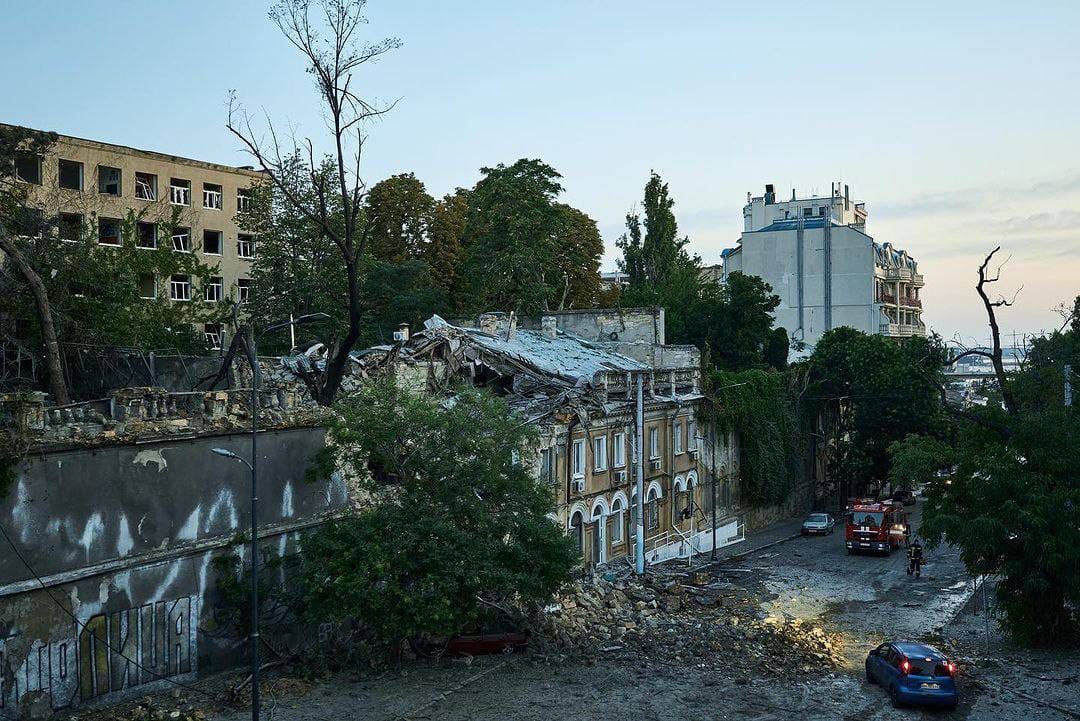
This is Odessa today. It is useless to appeal to the conscience of Russians. They don’t have one. None of them, practically none of them. Accordingly, one can only wish them one thing: may you all go to the devil, bastards! And so it will be, I believe, and fairly.
Punters outside Chronicle Bar Nekrasov Street in Petersburg, 27 June 2021 Photo: vladislavkharchev (Instagram), via Bumaga
Consulting company NF Group analyzed the trends for the openings of cafes, bars and restaurants in downtown Petersburg in the first six moths of 2023. Their analysts came to the conclusion that the city’s principal bar street is Nekrasov Street, the NF Group’s press service informed Bumaga.
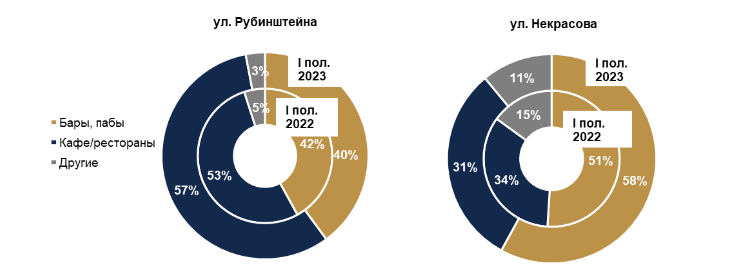
This claim is based on statistics on the distribution among different types of establishments on Nekrasov and Rubinstein streets. By mid-2023, bars and pubs accounted for 58% of all public dining projects on Nekrasov. On Rubinstein Street, this figure was lower: only 40% of all establishments there are bars or pubs.
In the first six months of last year, Rubinstein was also inferior to Nekrasov in terms of the percentage of bars and pubs: 42% on Rubinstein and 51% on Nekrasov, respectively.
Percentages of bars/pubs (goldenrod), cafes/restaurants (navy blue), and other business that opened on Rubinstein (left) and Nekrasov streets in central Petersburg in the first six months of 2022 (inner circles) and 2023 (outer circles). Pie charts courtesy of NF Group
What other conclusions did the analysts draw?
In the first six months of 2023, fifty bars, restaurants, and cafes were opened in Petersburg. This is comparable to the figures that were observed in the city before the coronavirus pandemic.
On Nevsky Prospekt, restaurateurs are increasingly opening affordable establishments, including chain outlets.
Public dining establishments have room to grow on Nekrasov Street: there they occupy 51% of all commercial space. This figure is much higher—78%—on Rubinstein Street.
The Context. Rubinstein was long considered Petersburg’s primary bar street, but the recent Bar Affair and other scandals have spoiled this location’s image. Recently, the security forces have been organizing raids on Nekrasov Street: police visited local bars several times in July alone.
“Underwear and swimsuits from 900 rubles.” An image from a circular I got this morning from Russian online retailer Ozon
We are not ashamed
I’ve been doing my favorite thing for almost the whole month—hanging out with ordinary Russians, not only in Moscow, but also in the regions—in my capacity as a sociologist, via focus groups. Ten random people are brought together, and we sit and simply talk “about life,” and I’m among them with a dictaphone. It’s the best format, and ordinary folk like it too.
Naturally, I was curious about people’s opinions about what was happening: their reactions were very different, expressing a whole range of emotions. In most cases, people sense the crisis, and they complain especially about prices… Although then they cheer up and say that “life is livable.” Some even argue that this is not a crisis, but that there are “certain crisis phenomena.” However, after thinking about it, they usually said that it would get worse; this is the easy part now, they said.
I won’t describe everything they said, because I want to get to the main point, the horrible point.
People voiced a variety of emotions (and I carefully monitor them: focus groups are not so much about information as about feelings, about which events excite people more): despair, apathy, depression, anger, patriotic enthusiasm, complacency, and braggadocio… Some still “believe in victory,” some already have doubts, but most are unable to articulate what “victory” would look like… But one emotion—and I conducted more than a dozen focus groups both in Moscow and in the back of beyond—was practically absent, manifested by no one.
I’m talking about shame. There was “we’ve been betrayed,” or “we can still win,” or even “we shouldn’t have started it at all,” but there was no shame. And this, in my opinion, is a very bad symptom, showing that society has not even started down the road to recovery yet. And it may well happen that they will lose and fall face first in the mud, but will still not understand a thing.
This is sad. I’m not trying to show off my own “moral rectitude.” I don’t claim to have it, of course: I’m just as much a bastard as my dear compatriots. My claim is purely pragmatic: if we are still not ashamed, it means that for the time being we are a long ways away from the only emotion that gives us a chance at rebirth—horror towards ourselves. While everyone continues to justify themselves (even if by citing their own weakness: “What can I do?”), the cart won’t budge an inch.
We know that no one ever feels sorry for anyone in Russia. We have always known this, and we didn’t need Sergey Shnurov to tell us that. But the complete absence of shame, and in its place, again, this incredibly vulgar self-pity, pity for us poor unfortunates, “the whole world is against us,” is still quite eye-opening. You listen to how enthusiastically folks pity the “Russian people,” and all you can do is feel gobsmacked. They screwed up completely, betrayed everyone, they are up to their elbows in blood, they can’t do anything, they don’t know how to do anything – but no, they don’t feel even a smidgen of shame.
Nothing’s going to change their minds. Indeed, this, apparently, is the Russian people’s principal tragedy.
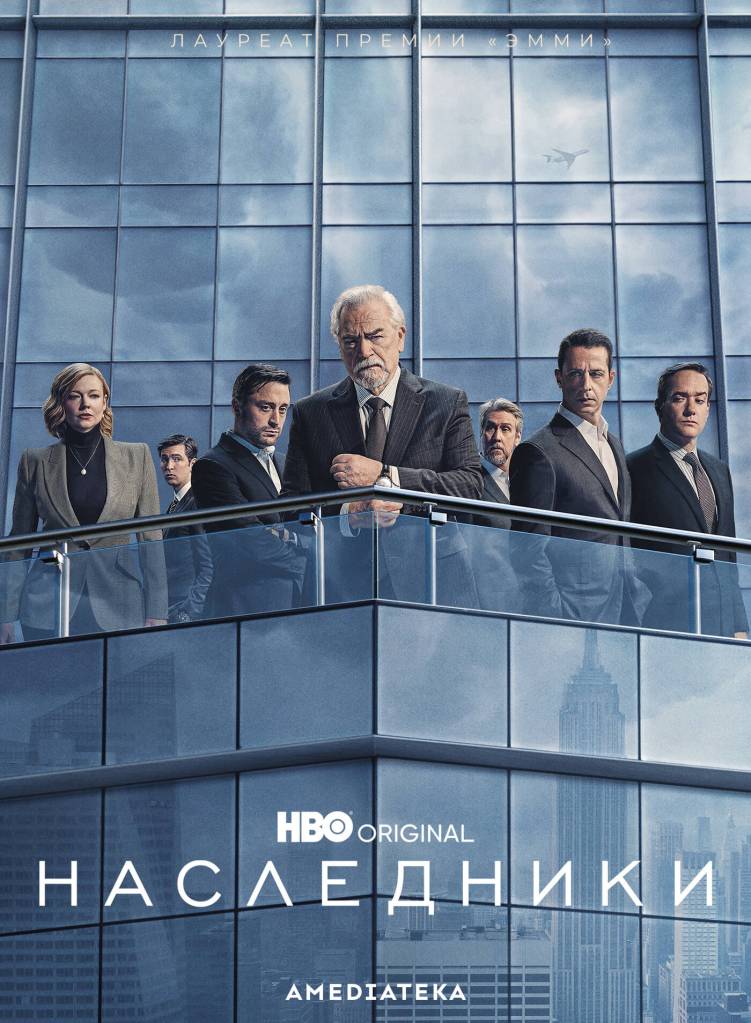
HBO and Russian streaming service Amediateka have made sure that wartime Russians are au courant when it comes to prestige television, as illustrated by this image from a circular I found in my mailbox the other day.
[…]
After witnessing the country’s crackdown on opposition activists and independent journalism — and the prosecution of hundreds of people who do not support the war or President Vladimir Putin — many emigres expect to encounter a dystopia when they arrive in Russia.
The reality is more banal.
“It’s corny, but the first thing that caught my eye after returning was that Twitter and Instagram don’t work without a VPN,” said Yulia, referring to Russia’s wartime ban on several foreign social media sites.
“Moscow bars were packed with visitors even on Monday evenings,” added the 25-year-old screenwriter who returned in April after fleeing to Georgia last year.
“Recently, my friend and I went out for a glass of wine. All the tables were occupied.”
The New Year’s spread on the tables of Petersburgers will be more modest this year than it was in 2021. They won’t have to skimp on ordinary goods yet, but delicacies such as caviar or red fish, as well as premium alcohol, will cost considerably more. Scammers and poachers who offer goods that aren’t readily available on the cheap may try to take advantage of this.
According to the Central Bank, annual inflation, as of November, was 11.98%. During the month, consumer prices increased by 0.37%; fruit and vegetables were among the items that rose most noticeably. Given that they are among the main ingredients in traditional dishes, we should expect that New Year’s Eve purchases will cost more.
Racing against inflation
As Svetlana Kazantseva, associate professor in the Basic Department of Trade Policy at Plekhanov Russian University of Economics, told DP, the annual growth rate of food prices in Petersburg was about 10%, according to research data.
“Prices for dairy and meat products are growing more slowly, which is explained by cheaper animal feed. Taking into account the inflationary component and the desire to save money, we can assume that the amount of the average bill [for New Year’s supper], if it does increase, will be an order of magnitude smaller than the rate of annual inflation, that is, about 5–7%,” the expert notes.
Marina Petrova, CEO of Petrova Five Consulting, is partial to other estimates, according to which the New Year’s meal will cost an average of four thousand rubles, which exceeds last year’s level by 12%. The simplest traditional dishes are taken into account: Olivier salad, herring under a fur coat, jellied meat, chicken with potatoes, sausage slices, champagne, and vodka. If the menu is expanded to include roast pork, fish aspic, red caviar, red fish, cheese, and cognac, then the cost will double. But it should be borne in mind that the percentage of consumers who themselves cook the food for their holiday meal has been decreasing every year. Many people have long preferred to buy readymade dishes at the store or order them delivered to their homes. However, this year they are likely to purchase more budget-conscious options. The desire to save money will primarily impact delicacies, seafood, salmon fish, beef, and caviar. The annual growth rate in prices for fish delicacies and caviar is already higher than the inflation rate.
“Traditional New Year’s menu for residents of Petersburg [clockwise, from far left]: Olivier salad, herring under a fur coat, roast chicken, caviar sandwiches, hard alcohol, sliced cheese, sausage and fish, juices, champagne, mineral water, candy, cake, tangerines.”
Beware of fakes!
According to market participants, a decrease in the total volume of red caviar is expected due to a lower salmon catch in the Far East. It will be bring a higher price than in previous years, however. During the pre-New Year sales period, it is possible that we will see an increase in prices of 35–40% compared to last year. On average, pink salmon has risen in price by 25%, chum salmon, by 5%, sockeye salmon, by 15%, and trout, by 10%. According to the Fishing Union, this year the percentage of Pacific salmon red caviar on the Russian market is close to 100%. Prices for grainy caviar from Far Eastern salmon caught in 2022 increased by an average of 10–15%. However, last year’s caviar is also on the market at a more affordable price. According to Nikita Ostrovsky, a purchasing manager at Lakifish LLC, imported red caviar appears only sporadically on the Russian and Petersburg markets.
“We can talk about insignificant amounts imported from neighboring countries, such as Armenia and, to a lesser extent, Kyrgyzstan (red trout caviar is imported from there). This category of goods is in a lower price and quality segment by comparison with trout caviar, for example, from Karelia,” he says. Another factor are the Russian government’s measures to restrict the import of red caviar to stimulate domestic production.
Ostrovsky also warns that, since caviar is considered a mandatory part of New Year’s feasts, it is likely that buyers will look hard for cheaper offers — for example, at illegal points of sale, where it is offered at a price 50% lower than the average market price.
“This can be imitation caviar, which is sold disguised as the real thing. Caviar diluted with sunflower oil. Or obtained by poaching, without the necessary paperwork. In pursuit of profit, people are willing to purchase such products,” he points out.
In fact, imitation caviar is sold legally in many stores.
Participants of the delivery market expect an increase in orders of readymade meals for the New Year’s meal, despite everything. Many of them note that they usually experience an increase in customer activity on December 21.
“We don’t take orders all day, only until 8 p.m., and then we deliver them to customers’ homes. This time round, we expect the number of orders to double compared to normal days. We regularly observes this pattern on holidays. The average bill for orders in Petersburg should grow this year. In any case, last year it grew by about 25–30%,” Vera Pradchenko, CEO of VIP Fish [a service that prepares and delivers Japanese food], told our correspondent.
[From top to bottom of tree] Cost of Olivier salad: 408 rubles (2021) vs. 455 rubles (2022); cost of herring under a fur coat: 269 rubles (2021) vs. 292 rubles (2022); cost of a no-frills New Year’s meal: 5909 rubles (2021) vs. 6737 rubles (2022); cost of a more expensive New Year’s meal: 8391 rubles (2021) vs. 10,909 rubles (2022). 40% increase in the per bottle price of imported alcohol in the more expensive meal. 20% increase in the price of premium cheese in the more expensive meal. 2.4% increase in the price of domestic salmon caviar in Russia as of October. Consumer price index for groceries in Petersburg in November: 2021 – 111.3%, 2022 – 108.9%; consumer price index for alcoholic beverages in Petersburg in November: 2021 – 102.8%, 2022 – 106.3%; increase in the price of red caviar in Moscow and Petersburg since the beginning of 2022: Moscow – 13.3%, Petersburg – 13.66%
We won’t be left without champagne
Alcoholic beverages are an equally important part of the New Year’s feast. This year, the patterns of purchases in terms of category is almost identical to previous years. Sparkling wines and vodka are still the primary drinks. But there have been changes within the categories. They have been caused primarily by the aftermath of the departure of global brands, explains Dmitry Isachenkov, director of development at Ladoga. “It is safe to say that Russian vodka will be on 90% of Russian New Year’s tables — here consumers prefer domestic products with festive designs,” he says.
After the brands that made up about 50% of the champagne market in Russia left the country, producers less dependent on the political conjuncture began filling the vacant niches. For example, Ladoga signed contracts with three new suppliers and imported 80 thousand bottles in 2022 by year’s end, which is four times more than by the end of last year. So, Russian consumers can easily find real champagne wines in Russia if they wish.
It is worth noting that the share of imports of wines from Champagne [sic] did not exceed 2.8% of the total volume of sparkling wine imports. The choice of the mass consumer will be distributed one way or another among the major Russian producers: Kuban-Vino, Derbent-Vino, Novy Svet, and Inkerman. Affordable imported sparkling wines — Italian proseccos, Spanish cavas, French cremants, and Austrian sekts — will invariably remain popular.
Isachenkov notes that the structure of purchases in the whiskey category has changed significantly — it is this category that has undergone the most powerful changes after the refusal of major brands to do business in Russia. Most consumers were ready to look for a replacement within the category, including among domestic manufacturers. Thus, sales of entirely Russian-made Fowler’s brand whiskey had by year’s end increased four and a half times compared to 2021. Other consumers have shifted to other categories and are choosing rum, tinctures, brandy or vodka. Sales of still wines increased in proportion to the other categories. At the same time, the product range of both importers and Russian wineries has been growing.
“We should not talk about the growth of the average bill, but about the increase in the cost of each item in the bill. For many, this is a long-awaited holiday after the emotional turmoil experienced during the year, and the consumer selects special drinks for celebrations above the usual cost,” the expert argues.
Different things matter
On average, the prices of the ingredients for Olivier salad have increased by 10% in Petersburg. Potatoes and onions have fallen in price, while he price of carrots has not changed. Green peas and mayonnaise have risen the most, by 20% and 17%, respectively. Herring under a fur coat has risen in price by 7%, primarily due to the main ingredient, herring (which has gone up by 20%), while beets have fallen in price by 32% and potatoes by 25%. However, the so-called Olivier index should be treated with caution.
The various indexes are more of a marketing tool to draw attention to the researcher’s brand. There is the lipstick index (launched by Estee Lauder), which is a litmus test showing how women react to changes in the economy. The American manufacturer argues that, when incomes fall, sales of expensive clothes and shoes decline, while sales of luxury cosmetics, on the contrary, grow. There is Deutsche Bank’s cheap date index (based on the costs of taxi rides, lunches at restaurants, and hotel rooms [sic]). There is the latte index (based on the price of a cup at Starbucks, now Stars Coffee in the Russian Federation) and the Big Mac index (based on the price of a hamburger at McDonald’s, now Tasty, Period). The iPod index has become an atavism.
In Russia, the Telegram channel Sugar. Portion. Collect maintains a cup of tea index by charting weekly changes in the average retail price3s of the ingredients in the Russian Federation. Other researchers use the statistics issued by Rosstat as their benchmark when calculating the cost of preparing borscht, Olivier, or herring under a fur coat.
“Any index is an indicator of rising or falling prices. You can use it to calculate how the cost of goods changes from year to year,” says Daria Zhigalina, a business automation services systems analyst at Kontur.Market. “It is important to understand that all indices are real economic indicators, albeit served up in a humorous package. Every year we see how official agencies publish data on the basket of consumer goods. Everyone has been accustomed to this indicator for a long time and knows that it can be used to assess the quality of life in the country and the purchasing power of the populace.”
According to the expert, by assessing the fluctuations in the cost of ingredients, we can analyze the economic situation separately in each region and in Russia as a whole.
For retailers, the New Year’s Eve period is a time when they can increase their revenue. Judging by the foot traffic in stores, the current situation will most likely not affect retail chains negatively since their turnover is growing. At the same time, the structure of sales will be redistributed towards traditional and inexpensive goods. In my opinion, retail has already begun to change the structure of its offerings, reducing the number of goods above the average price. In this regard, premium retail chains may be in a less advantageous position.
Caviar has not been imported [to Russia] since 2014, after government restrictions on the import of certain types of food were enacted. Prior to this, Russia imported frozen red caviar from the USA and Canada. Here it was processed and sold in salted form. The salmon catch this year amounted to 300 thousand tons, and 13–14 thousand tons of caviar were produced. Last year, the catch was over 500 thousand tons, while more than 20 thousand tons of caviar were produced. Compared to last year, the shortfall is 30%. Despite the fact that the supply of caviar is much lower than last year, the price has not increased. If there were a further rise in prices, people would simply stop buying it. It is possible that before the New Year some sellers will raise prices, but they will bring them back down after the holiday.
— Alexander Fomin, Vice–President of the Fishing Association
The growth in the price of goods that have always been considered delicacies — caviar and salted salmon— is indicative. They have doubled in price over the year, and the same dynamic is typical for most other frills. This year, salmon will be largely replaced by trout, which is cheaper, and eggplant caviar will be preferred. Real incomes fell in Petersburg by 2.7%, according to official statistics. By my calculations, for a business person, the celebration of the New Year will be about one and half times more expensive than a year ago. The selection has become somewhat smaller, but if you want them, you can find all the goods you need. We should especially not envy pensioners living on their own. The subsistence minimum doesn’t take factor in the cost of such events.
—Anatoly Golov, Co-Chairman of the Consumers Union of Russia
Russians have no reason to skimp on their New Year’s meal. On the contrary, consumer spending on the New Year’s meal may increase due to both inflation and the fact that some Russians will not be able to celebrate the New Year outside the Russian Federation and will spend money at home. Recently, statistics were published that about 15% of the population have experienced an increase in income, while 20% have experienced a decrease. Consequently, some consumers will still increase spending for the New Year and their average spending will grow at a level slightly higher than inflation.
—Artyom Tuzov, Executive Director of the Capital Markets Department at IVA Partners Investment Company
The morning begins with me looking at the light on the computer monitor. If it is on, it means there is still electricity. When I see that the light is on, I immediately get up and go put on the kettle to refill the thermoses. We got hold of the simplest gas stove, and you can of course heat water on it. But first of all, there is not an endless supply of gas and we skimp on it. Secondly, I am afraid of these stoves: over the past month they have exploded four times in our district alone. I walked past the residential buildings where these stoves exploded and saw the broken windows and cracks in the walls. It’s a little scary, let’s just say.
After I put the kettle on, I get on the Telegram channels. I have to find out whether there were [missile and drone] attacks at night, and if so, whether they hit infrastructure. Now this is the most terrible thing, because if it suddenly turns out they hit infrastructure, it means that soon there will be no heating and water. So then I start rushing between washing and drying my hair, charging the power banks and flashlights, getting the laundry going, and cooking food. You never know when the lights will go out and that’s why you do everything quickly, all at once. You feel like a trained circus animal.
When I’m going somewhere, I always put a few flashlights in my backpack. It’s strange to imagine that not so long ago a flashlight was not a mandatory item. Now it is a “must have” (my phone suggests writing “must heh” — heh!), like a medical mask during the time of covid. It’s even more important! When I go outside and travel somewhere, I never know if there will be light where I’m going. Most often there is no light — or cellphone connection for that matter. I hate this feeling of being in a vacuum: there is no mobile internet, no telephone connection, no light, and no matter what happens to you, you won’t even be able to call an ambulance. You’re living “in the moment,” damn it. Where there is no light, the elevators don’t work. I usually walk slowly up to the sixteenth floor by an isolated dark staircase. Somewhere on the eighth floor there is usually an old, peeling stool on which I can sit in the dark and take a break. I usually don’t need such a rest, but sometimes I turn off the flashlight and sit on this stool in the dark and listen to the wind blowing in the stairwell.
Last week I got stuck in the elevator: while I was going up, the lights turned off and the elevator stopped and went dead. There was a chair inside and a box containing water and medicines. I sat down, but quickly froze. Immediately, before the phone connection disappeared, I had telephoned my husband and asked him to call the help hotline so that they would get me out of there. Otherwise, it was possible to get stuck there and sit for four to seven hours. My husband got through to the hotline in half an hour — he was the twentieth in the queue. Half of the city sits in frozen elevators every day. They pulled me out of there.
When I’m returning home in the evening, I make a wish: please let there be light at home. I ride in a minibus and nothing is visible through its windows since neither the streetlights nor the traffic lights are working. I have developed a “sense” of a way that I cannot see, but I know and understand where I’m going and when I need to get out. After walking up and down all these stairs and unlit streets, I really want to find the light on at home for at least half an hour. If, when approaching our building, I see that there is no light, I slow down. There’s nowhere else for me to hurry — it’s dark and pointless everywhere. Life in general has become quite hectic. Although I have hated hurrying and scurrying my whole life, now I have to hurry and scurry.
Sometimes I manage to find a store where the lights haven’t been turned off yet. It’s like going into a church: it’s light and warm there and your mood improves a little just because you’re in a store and it’s bright inside. The prices have been shooting up monstrously and I wander the aisles for a long time figuring out what I can buy to fit my modest daily budget. But basically, since the light began to leave us, I have got used to eating rusks and croutons in different flavors. I’d never bought them before — they’re not my kind of food — but now they are quite handy. First, they are relatively cheap, and second, they come in different flavors. It’s the illusion of variety. Third, they don’t need to be cooked.
I went to see my mom yesterday. We discussed all these common everyday problems of ours. And then Mom decided to make a joke and asked:
“What are you all doing for the New Year?”
Neither she nor I laughed.
Source: Sergey Abashin, Facebook, 15 December 2022. Professor Abashin is quoting a letter he received from a Ukrainian friend or colleague, but he does not identify her by name or mention where exactly she lives. Translated by the Russian Reader
Russian President Vladimir Putin, speaking at a session of the Valdai Discussion Club, acknowledged a decline in the real incomes of our compatriots.
He noted that the issue was being resolved in cooperation with the trade unions, RIA Novosti reports.
This dialogue continues. We see that people’s nominal incomes are growing, but real incomes have become slightly lower. Bearing in mind the state of the Russian economy, we can solve these problems and should do so in accordance with the existing plans of the Russian government.
Vladimir Putin, President of the Russian Federation
The head of state also said that it was necessary to fight for wage increases. At the same time, he addressed his appeal to both Russians and “ordinary citizens” of the United States and Europe.
Since the start of the special operation by Russian troops in Ukraine, people have experienced a loss of income and savings. Putin also noted earlier that many Russians were at risk of layoffs.
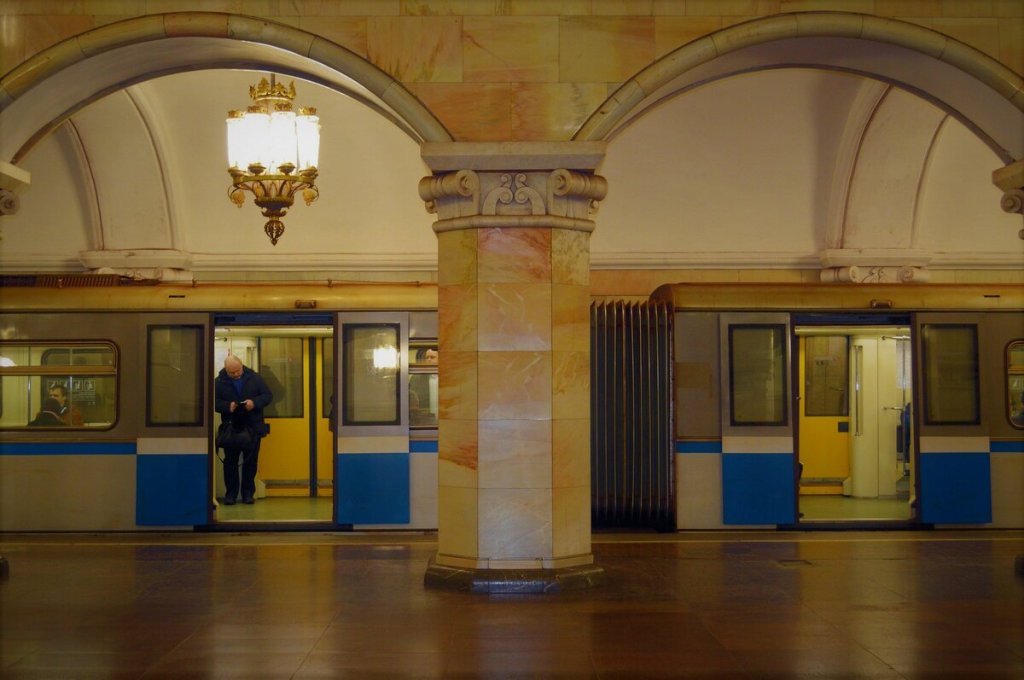
“There are more than 485 air fresheners in operation: they were installed in the air ducts of the climate control system. They spread the fragrance around the car every ten minutes. The fragrance is called ‘Moscow Metro,'” explain the metro’s press service , stressing that all the aromas were safe, hypoallergenic, and complied with regulations.
In 2019, during a vote on the project’s implementation, ninety percent of passengers surveyed said they would prefer an air-freshened carriage to a regular one. Muscovites especially wanted the smell of cherry blossoms in the subway.
What attracts people [to the shot bar Fedya, the Wildfowl!]? The irony and the simplicity, but at the same time the pleasant crowd. Here you can meet people who, the day before, dined on sets [sic] of scallops and dill sauce at designer restaurants, but they are glad to eat belyash and kvass at Fedya’s. Every other table orders kebabs (from 325 rubles) and drinks tinctures and macerations. Security guards monitor everything: if you swear loudly, they will politely ask you to leave.
Despite its declared war on “satanic” western values, Putinist Russia continues to slavishly imitate all the worst the mythical west has to offer, including “Black Friday,” as exemplified by this image from an email flyer sent to me earlier today by the major online retailer Ozon, featuring the pop singer Dmitry Malikov. Nor has Putin’s “proxy war” with the west stopped the pidginization of the Russian language, as seen in the second-to-last piece in this grim holiday collage. ||| TRR
The expected tourist flow from Iran may amount to approximately two thousand people a week starting in the spring of 2023, director of the municipal tourist information bureau Yuri Bogdanov said on November 24. According to him, relevant negotiations are underway with air carriers.
“We are negotiating with airlines that want to provide direct flights between Iranian cities and St. Petersburg. We hope that there will be six flights per week with an average number of around 300 seats on board. This is already about two thousand people a week. We expect that, beginning in the spring, these airlines will supply their airplanes,” TASS quoted Bogdanov as saying.
The expert clarified that there were more flights before the pandemic and six thousand tourists used to arrive from Iran every week.
According to Bogdanov, the flow of tourists may return to its pre-covid levels in St. Petersburg by about 2026, but at the same time primarily due to guests from Russia, and not from foreign countries. According to the figures he cited, in 2019, about five million Russians and 5.5 million foreigners visited the Northern Capital, while 6.4 million Russians and 150–200 thousand foreigners visited the city in the first nine months of 2022.
“We have reformatted the priorities for domestic tourism — we want to reach the same 10.5 million tourists a year. There is every ground for this to happen,” Bogdanov opined.
Earlier, the State Duma Budget and Taxes Committee recommended that St. Petersburg be included in the list of regions that charge tourists a resort fee.
At least 58 children, some reportedly as young as eight, have been killed in Iran since anti-regime protests broke out in the country two months ago.
According to Human Rights Activists in Iran (HRA), 46 boys and 12 girls under 18 have been killed since the protests began on 16 September, sparked by the death of the 22-year-old Mahsa Amini while in police custody.
In the past week alone, five children were reportedly killed by security forces as violence continued across the country.
Speaking at Kian’s funeral on Friday, his family said security services had opened fire on the family car, where Kian was sitting next to his father. Iranian security services have denied responsibility for his death, blaming the shooting on “terrorists”.
Iran’s mounting child death toll comes amid escalating violence in cities across the country, with protests showing no sign of abating.
[…]
Young people have been at the forefront of anti-regime protests, which started after Mahsa Amini died in the custody of Iran’s morality police. She had been arrested for not wearing her hijab correctly.
The deaths of two teenage girls, Nika Shakamari and Sarina Esmailzadeh, both allegedly beaten to death by security forces for protesting, provoked further outrage.
Videos of schoolgirls across the country protesting against their killing by removing their hijabs and taking down pictures of Iran’s supreme leaders went viral on social media, leading to raids on schools where children were beaten and detained. According to Iran’s teachers union, another 16-year-old girl, Asra Panahi, died after she was attacked by security forces in her classroom in the north-western town of Ardabil on 18 October.
The attacks on children in schools is continuing, according to Hengaw, which said a 16-year-old girl from Kurdistan is on life support after throwing herself from a school van, having been arrested at her school last week.
HRA says more than 380 protesters have been killed since the protests began and more than 16,000 people have been detained, including children. The figure is disputed by the authorities.
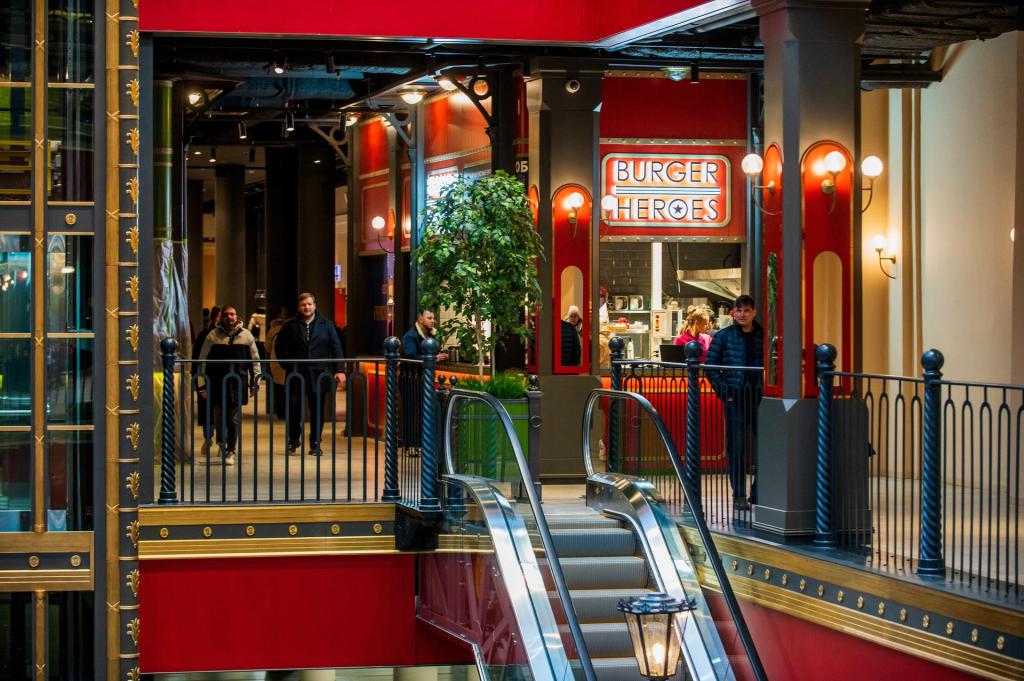
A view of Vokzal 1853 on opening day. Photo: Sergei Yermokhin/Delovoi Peterburg
On November 21, the opening of the food hall [fud-kholl] Vokzal 1853 took place in the building of the former Warsaw railway station.
It is the largest gastronomic space in St. Petersburg and, so its creators claim, in Europe.
So far, not all the establishments in the eater have opened — the launch . The event zone [event-zona] is designed for to accommodate 2.5 thousand guests and have 4 thousand seats, while the entrance to the second floor is still closed.
The cost of renovating the former railway station exceeded 1.5 billion rubles. The Vokzal 1853 food hall [fud-kholl] is a project of the Adamant holding company and restaurateur Alexei Vasilchuk. In total, as stated earlier, more than 90 restaurant concepts [restorannykh konseptsii] will await visitors, and the total area of the food hall will be about 34 thousand square meter.
The company plans to open a concert venue, craft [kraftovye] shops, and a coworking [kovorking — sic] in the space.
Earlier, DP reported that its creators had conceived the decoration of the premises to suggest the atmosphere of nineteenth-century railways stations, and visitors would find themselves in the “epicenter of a bustling creative life.”
Ukraine continued to reckon with the fallout from Russia’s air strikes on its energy infrastructure, with much of the country still struggling with blackouts. Residents in Kyiv, the capital, were told to prepare for more attacks. Russian missiles damaged a hospital on the outskirts of Zaporizhia, a Ukrainian-held city not far from Europe’s largest nuclear power plant, controlled by Russia. Meanwhile, Ukraine’s president, Volodymyr Zelensky, said Russia was heavily shelling Kherson, the southern city recaptured by Ukrainian forces in early November. Local officials said that strikes killed seven people in the city on Thursday.
Source: The Economist, “The World in Brief” email newsletter, 25 November 2022
This is a wildly disappointing exercise in sophism and self-deception by the usually much more lucid Maxim Katz. Russia has arrived at its present murderous and self-destructive bad end not through rigorous and ruthless totalitarian indoctrination and psychological manipulation, as suggested by Katz’s invocation of Ron Jones’s 1967 Third Wave experiment in a California high school, but through a chaotic, consistent indulgence of opportunism, consumerism, escapism, ressentiment, hipsterism, “westernism,” capitalism, cynicism, nihilism, and thuggery by the elites and the much of the so-called intelligentsia, thus almost completely overwhelming the decent, democratic, and egalitarian impulses and undertakings of differently minded and empowered “other Russians” from all walks of life and all parts of the country. It has been one of the missions of this website to bear witness to both these tendencies in their extreme and trite manifestations. You’ll find vanishingly little of what Katz describes in my chronicles of the last fifteen years here and on The Russian Reader‘s sister blog Chtodelat News. You will find, however, plenty of stories of brave grassroots resistance and movement building blunted and, ultimately, murdered by a police state whose PR wing has urged Russians to trade their freedom for food courts. ||| TRR
“Our everything: a huge selection of goods from Russia! Even more goods from Russia – look! [1.] Zarina hoodie, 1,689 rubles [approx. 21 euros]. [2.] Vasilisa Botanika bedding set, 1,571 rubles. [3.] Tech Team Comfort urban scooter, 3,990 rubles.” Source: Ozon email advertising circular, 2 May 2022. Ozon is a major Russian online retailer and is sometimes referred to as “the Amazon of Russia.” When I still lived in Russia, I regularly ordered books from them. In the first weeks of the war, they were pushing the imported western goods they still had in stock. ||| TRR
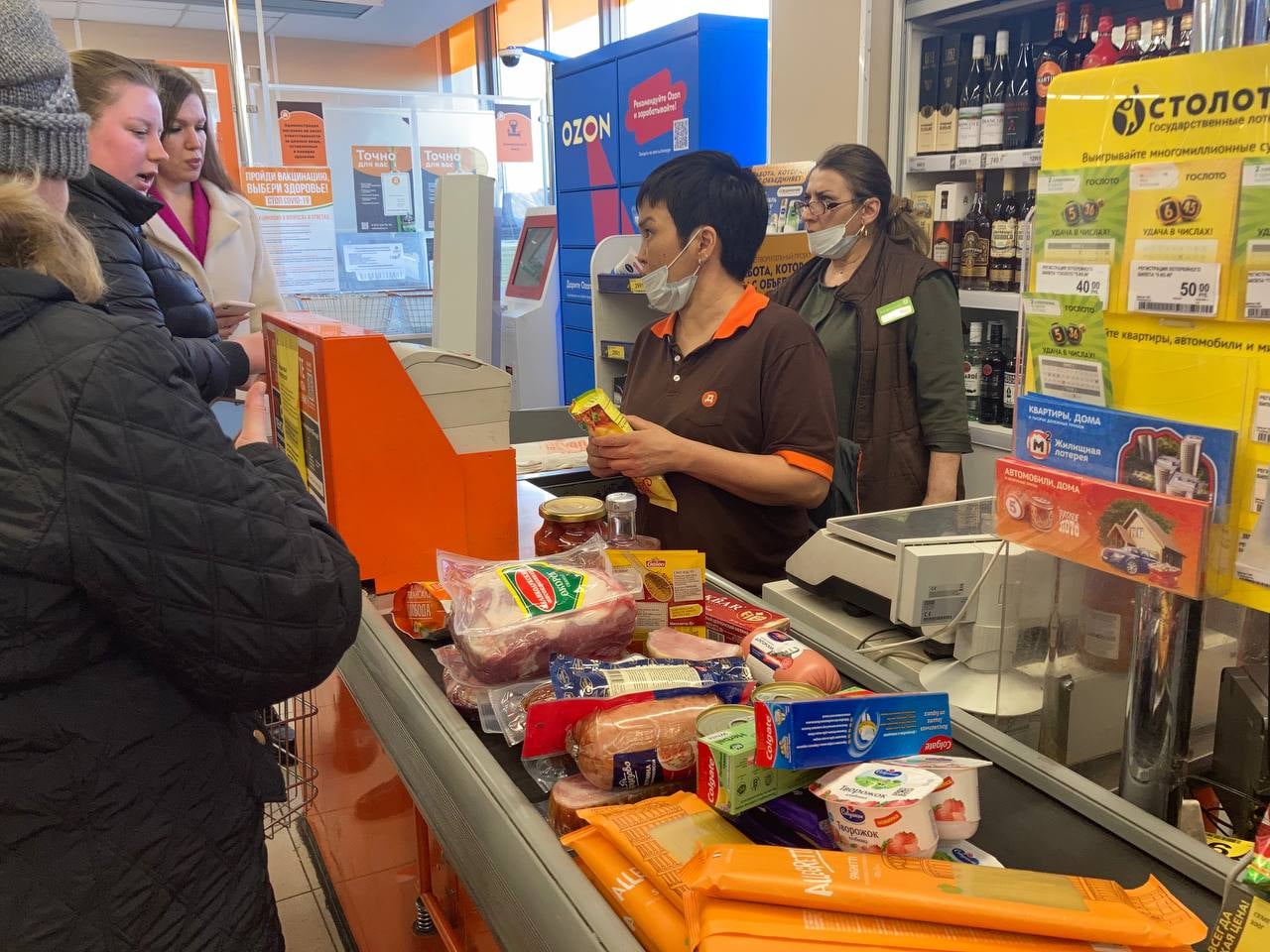
Spoiled by grocery delivery services, I am rarely in supermarkets these days and don’t see all of life’s nitty-gritty.
Today I went into the Dixie [a Russian discount supermarket chain] near my house. Everything seemed pretty normal. I went along the shelves, but I really like buckwheat groats [a staple cereal grain in Russia] and wanted to buy some, and there was no buckwheat. I didn’t need sugar but when I saw there was no buckwheat I looked at the sugar shelf — no sugar. Also there were no Always pads, and I needed some. Probably there was lots of other stuff missing too, but I didn’t have time to make a thorough study. I put some of what was there into my basket and got into line for the register. I never remember prices, alas, so I didn’t particularly notice whether anything had gotten more expensive over the last month. But this would be cleared up shortly.
A woman and her friend come running into the store, right up to the register, and she starts complaining loudly that she bought ketchup for 146 rubles [$1.33 today (3/15/22) — trans.] as per the shelf tag, but at the register they charged her 194 rubles [$1.77], which she only noticed when she got home and checked the receipt.
“Why would I want ketchup for 194 rubles! You have to sell it for the price that’s written on the tag. Give me my 48 rubles back!”
“We’re not giving you anything back: our prices don’t match the shelf tags. You can return the ketchup and we’ll give you your money back.”
“What do you mean, the prices don’t match? You are obliged to show them!”
“On your website it still says that ketchup costs 146 rubles,” the woman’s friend interjects.
“The prices are changing every other day here, you think we’re going to go around pasting up the new ones all the time?! Don’t you know what’s going on?” screams the cash register lady.
“We’re not the ones setting the prices. They change by themselves in the system. They don’t even send us shelf tags: we just scan everything here at the register!” adds another cashier supportively.
“Why is the store management suddenly changing the prices?” I ask.
The line, the cashiers, and the woman with her friend all look at me with stern incomprehension and even an element of disapproval.
“What, you don’t know,” someone mutters angrily, and everyone again looks away, down at the floor or at the checkout conveyer belt.
Everyone knits their brows in silence. The older cashier quietly tells the younger one how to do a return, take cash and calculate the correct change, because many people’s bank cards aren’t working.
No one says out loud that President Putin is waging war in Ukraine or that “NATO-the Americans-who knows who” is to blame. No one discusses why the prices are higher and why there’s no buckwheat. No one says anything at all and everyone looks at the floor.
Only the man who was standing behind me went back to the shelves and grabbed a third bottle of vodka.
Source: Alexandra Polivanova, Facebook, 14 March 2022. Translated by the Fabulous AM with the author’s permission. Photo by the author
The Dendy Junior with a cartridge and detachable controllers
Toys for everyone
On the eve of Defender of the Fatherland Day [February 23], the demand for electronics (game consoles, laptops, tablets) has grown — they are among the most coveted gifts. Ozon said that in mid-February, unit sales of consoles and accessories had increased 2.2 times year-on-year. “Retro consoles have been an unexpected trend in the video game consoles category — they have been the best-selling products. Dendy Junior and Sega Genesis will be nostalgic February 23rd gifts for Petersburg residents,” the retailer’s press service added.
Wildberries has also seen a run on electronics. But electric razors (demand for them increased by 153% in the first half of February) and hair and beard clippers (up by 48%) have been their most popular items.
M.Video-Eldorado told us that headphones and portable acoustics have been trending. In addition, the new digital reality dictates its own rules: gifts that cannot be touched with your hands are becoming more and more desirable. High demand this year has been shown by digital content such as subscriptions to services (videos, books, etc.). Sales of digital codes for games had more than doubled by February 2021 [sic].
Sales on Avito of laptops and smartphones have also increased by 15% and 9%, respectively. You can buy devices for an average of 22,380 rubles and 17,920 rubles [approx. 249 and 199 euros]. Some female Petersburgers decided to make their task as easy as possible and present men not with a specific gift, but with a gift certificate. The Avito press service said that users spend an average of 4,700 rubles [approx. 52 euros] on them.
Retailers can also make money in February on sales of children’s goods. Radio-controlled toys have become more than twice as popular on Ozon. Wildberries noted that parents purchase toy weapons, cars, airplanes and helicopters, as well as various prefabricated models for their little defenders.
Whether he’s going to the army or on a fishing trip
Goods for hunting and fishing — that’s what female customers have paid attention to this holiday. However, even this involves electronic gadgets. “The list of [our] popular items includes an echo sounder and a case for it, a monocular telescope, powerful binoculars, and a set of walkie-talkies,” Ozon’s press service says.
“In the household and garden goods category, sauna accessories (for example, a hat embroidered with the phrase ‘February 23’) and goods for cooking kebabs and barbecue (a set of skewers with lacquered beech handles in a tight protective cover has been among the top sellers) have been purchased the most,” [reports Ozon]. It’s funny that in St. Petersburg and the Leningrad region this year one of the most popular February 23rd gifts will be a set for making homemade liqueurs.
Wildberries’ female shoppers have been no less creative in choosing gifts. They decided that army dry rations are an inexpensive and original option, orders of which have increased by 344% year-on-year. These are gift sets designed to look like a real soldier’s rations. Jumbo-sized dry rations featuring canned food and snacks cost about 1,5000 to 2,000 rubles [approx. 17 to 22 euros].
Traditional values
And yet the popularity of socks and men’s skin care products remains unshakable. In the first half of February, Wildberries saws the number of orders for socks in St. Petersburg increase by 113%, and shaving kits by 150%, while orders for cosmetic care kits rose by 750%, deodorants, by 46%, and colognes, by 157%. The demand for men’s lotions has increased by 100%, while the popularity of shower gels has soared almost ninefold compared to January. Ties (up 95%), belts (up 153%), and wallets (up 144%) are also among popular traditional gifts.
Corporate customers of online stores this year bought sweets for the holidays. According to SberMarket’s b2b department, companies have most often ordered gift sets of Merci candy, coffee and tea in gift packages, and Old Spice, Palmolive, and Gillette skin care sets for employees for Defender of the Fatherland Day this year.
Source: Darya Dmitrieva, Delovoi Peterburg, 22 February 2022. Image courtesy of Wikipedia. Translated by the Russian Reader