Extremists (The Serial) Grani.Ru
December 29, 2017
Extremists
Hundreds of people throughout Russia are being prosecuted or have already been convicted for voicing their own thoughts, which the current regime does not like. The campaign against dissent has been masked as a campaign against “extremism.” Our video project’s goal is to acquaint you more closely with several so-called extremists. The FSB and the Interor Ministry have spared neither time nor effort in combating them.
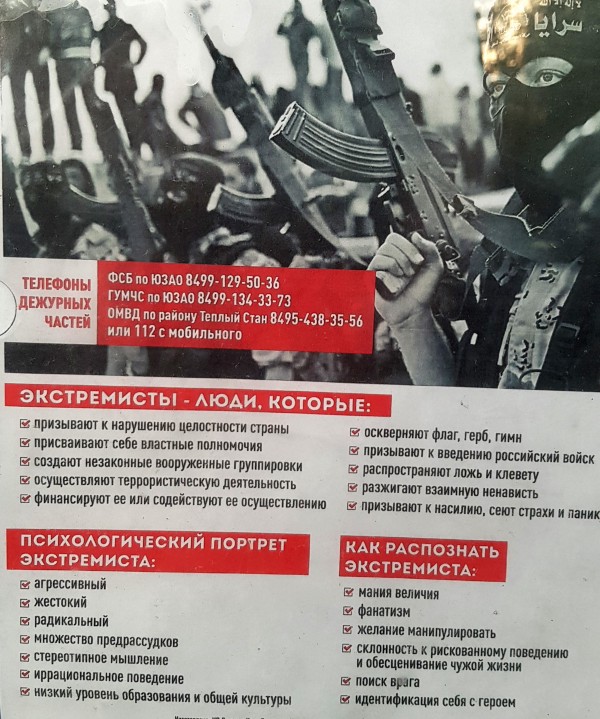
Propaganda represents extremists as dangerous people, ready at the drop of a hat to segue to terrorism. Posters hung on billboards in Moscow call on citizens to identify “extremists” on grounds such as the desire to manipulate, megalomania, identification with a hero, a low level of education and culture, and a tendency to risky behavior and devaluing the lives of others.
“Extremists are people ¶ who call for destruction of the country’s integrity, ¶ try and seize power, ¶ organize illegal armed bands, ¶ engaged in terrorist activity, ¶ finance or facilitate terrorist activity, ¶ besmirch the flag, seal, and anthem; ¶ call for the introduction of Russian troops [sic], ¶ spread lies and slander, ¶ incite mutual hatred, ¶ call for violent, sow fear and panic. Psychological portrait of an extremist: aggressive, cruel, radical, many prejudices, stereotypical thinking, irration behavior; low level of education and culture. How to identify an extremist: megalomania, fanaticism, desire to manipulate, tendency to risky behavior and devaluing the lives of others, the search for enemies, self-identification with a hero.” The poster also includes local telephone numbers for the FSB, police, and Emergency Situations Ministry.
Do the subjects of our video project fit the propaganda portrait?
Krasnoyarsk resident Semyon Negretskulov really likes Scandinavia. His blog on the social network VK mainly dealt with Finnish history and modern life in Finland. When he posted a few texts about the Greater Finland project and historical photographs of Vybog (Viipuri) that was enough for the FSB to charge him with promoting Finnish greatness. His call to help political prisoners was also deemed extremism.
Danila Buzanov had to spend a year and a half in prison for an ordinary brawl at the VDNKh in Moscow. “Anti-extremism” police officers from Center “E” turned a fight with a vendor selling Donetsk People’s Republic paraphernalia into charges under Article 282 of the Russian Criminal Code: inciting hatred and enmity towards the social group “ethnic Russians/Russian citizens who support the Donetsk People’s Republic and Lugansk People’s Republic.”
Boris Yakovlev, a musician from the town of Dno, believes that sooner or later a revolution will happen in Russia. People are poor, the authorities are thieves. When Prime Minister Dmitry Medvedev said Russia had exhausted its limit of revolutions, Yakovlev reacted like this, “Hey, Medevedev, who exhausted it? You, the Rotenbergs, the Putins, the Chaykas? We haven’t exhausted our limit, Medvedev. He doesn’t want revolutions. Kiss my ass, Medvedev! He doesn’t want revolutions. But we want them to get rid of you Medvedevs and all the rest. What part of his body does this guy think with, huh?”
The FSB regarded this and similar posts as calls to extremism. Yakovlev would have been sentenced to five years in prison, but he did not wait around to hear the verdict and requested asylum in Finland.
Darya Polyudova decided to troll the authorities, who in 2014 demanded the federalization of Ukraine. Polyudova organized a March for the Federalization of the Krasnodar Region. As a result, she was the first person in the Russian Federation to be convicted of calling for federalism.
Alexander Byvshev, a teacher of German in the village of Kroma in Oryol Region has gone to court to face a third set of charges for poems he wrote in support of Ukraine, and a fourth criminal case is in the works. More frightening than the revenge of law enforcement agencies has been the reaction of his fellow villagers.
These are just a few of the many hundreds of cases of Russians who have been prosecuted for words, opinions, and reposts. You can find a collection of banned “extremist” content at zapretno.info.
Frightened Passengers Do Not Let Ilyas Nikitin Board Plane in Vnukovo IslamNews
April 4, 2017
On Tuesday afternoon, passengers did not let Russian citizen Andrei (Ilyas) Nikitin, identified by the media as the alleged organizer of the terrorist attack in the Petersburg subway, on board a plan. The victim himself told IslamNews about the incident.
According to Nikilin, he had passed through passport control, but could not board the Rossiya Airlines plane due to protests from frightened passengers.
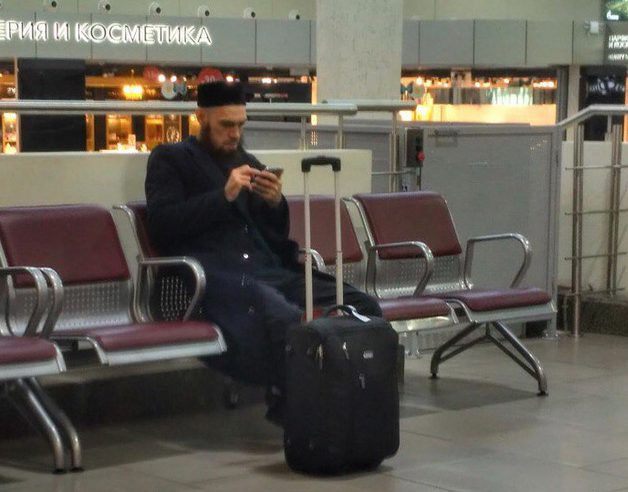
Ilyas Nikitin at Moscow’s Vnukovo Airport. Photo courtesy of IslamNews
Even airport security personnel could not resolve the situation. Ultimately, Nikitin was forced to miss the flight.
Nikitin said the reaction of the passengers was a surprise to him, because on Tuesday morning he had flown from St. Petersburg to Moscow witn no problems.
He noted that law enforcement officials helped him get a refund for his ticket.
“The airline said it would not be able to put me on this plane. I hope to fly out on another plane tomorrow morning,” said Nikitin.
In connection with the incident, IslamNews appeals to its colleagues to comply with journalistic ethics. In particular, you should not publish unconfirmed information that could damage people’s reputations and cause panic in society.
Nikitin gave St. Petersburg law enforcement agencies high marks for their work after the terrorist attack in the city’s subway.
As previously reported, on the day of the terrorist attack, Nikita himself went to the police and said he was not complicit in the tragedy. Before this, video and photos of Nikitin, shot by a CCTV camera, went viral in the media. Because of his outward appearance (the clothes and beard typical of Muslims), the man was christened [sic] the alleged bomber.
____________________
The Search for Jihad in St. Petersburg*
Denis Korotkov Fontanka.ru
April 3, 2017
The guise of the suspect in the explosion in the Petersburg subway, whose photo has been distributed to police, is unambiguous. If the assumptions are correct, this is a public show. The man in a skullcap with a typical Muslim beard stepped right out of a poster for Islamic State, an organization banned in Russia.
Until April 3, 2017, terrorists did not try and blow Petersburg up [sic].** Homegrown skinheads, who assembled small DIY bombs, do not count in the bigger scheme of things. The first explosion in the subway has been marked with a clear trace. If the man wanted by the Chekists [sic] and police is guilty, he has issued a challenge. He wore no disguise, was emphatically Muslim in appearance, and was calm.
The explosion in the fourth car of the train that had departed from Sennaya Ploshchad subway station was heard around 2:30 p.m., when the train approached Tekhnologichesky Institut station. The dead and wounded are being counted. At the moment, officials agree that “about ten” people have been killed, and the number of wounded is around fifty. According to our information, the number of dead is fourteen. Another explosive device has been discovered and disarmed at Ploshchad Vosstaniya station.
Ambulance crews, Emergency Ministry teams, and police units, sirens blazing. The subway closed, endless traffic jams. Petersburg has never seen the likes of this.***
The prosecutor’s office initially declared the incident a terrorist act, then changed its mind. By 6:40 p.m., the Investigative Committee of Russia had decided the case would be investigated as a terrorist attack, with the proviso that the “investigation intends to look into all other possible explanations of this incident.”Meanwhile, Petersburg police had already received the photo of the man who, presumably, could have placed the explosive device in the fourth car.
A tall, black skullcap, straight-cut black clothing, a typical beard with no mustache: for a considerable number of Petersburgers [sic], this is what a classic Wahhabi looks like [sic], the kind of person from whom the subway is closed by metal detectors and police units.
Subway explosions have been the “privilege” of the capital until now. On June 11, 1996, a blast between Tulskaya and Nagatinskaya stations in Moscow killed four people and injured sixteen. On January 1, 1998, an explosive device was discovered at Tretyakovskaya station; three subway workers were injured when it exploded. On August 8, 2000, a blast in the underground passage on Pushkin Square killed thirteen and injured sixty-one people. In 2004, an explosion in a train traveling between Avtozavodskaya and Paveletskaya stations killed forty-one and injured two hundred and fifty people. On August 31, 2004, a female suicide bomber blew herself up at Rizhskaya station, leaving nine dead and injuring fifty. On March 29, 2010, two female suicide bombers blew themselves up at Lubyanka and Park Kultury stations, killing forty-one people and injuring more than a hundred.
The outcome of the investigations of the 2014 [sic] and 2010 explosions is well known: the female suicide bombers were radical Islamists who blew themselves up at the behest of their religious mentors.
It was calm in Petersburg until then.**** The bell sounded in August 2016, when an FSB Grad special forces team stormed a rented flat on the tenth floor of a sixteen-storey building on Leninsky Prospekt by breaking through the ceiling [sic]. The details of the operation are unknown even now. According to official reports, four Islamist militants shot back and were destroyed by return fire. Judging by the fact that the liquidated militants were part of an Islamic State-affiliated terrorist group, led by Timur Likhov, who had been killed several days earlier, they had not come to Petersburg for a holiday.***** The FSB’s press service did not say what exactly was contained in the canisters and bags that were taken from the ransacked flat and loaded into an official van.
In November 2016, FSB special forces again stormed a flat, this time on the first floor of a five-storey building on Sofia Kovalevskaya Street. The “peaceful taxi drivers” from Uzbekistan and Kirghizia [sic] who lived there had automatic weapons and explosives in their possession, which did not stop them from asking to go home with an infantile naïveté, right after embarrassed confessions of plans to set off bombs in the Galeriya shopping mall on Ligovsky Prospect or in the subway.
Given that immediately after the explosion on the approach to Tekhnologichesky Institut an explosive device was discovered on Ploshchad Vosstaniia, the Investigative Commission’s proviso about “other explanations,” except a terrorist attack, looks more like overcautiousness. Real explosives were discovered were almost simultaneously as the first explosion in the Petersburg subway happened. You can discuss how typical it is for Islamic terrorists to use a fire extinguisher as a casing for an explosive device or place a bomb under a seat in the subway instead of using suicide bombers, but the list of possible explanations is very short [sic].
Surveillance cameras recorded the man in black allegedly leaving a briefcase containing explosives in the fourth car, strolling across Sennaya Ploshchad without the briefcase, talking with someone on the phone, and then leaving [sic]. ****** He could not help but understand he was doing this in the crosshairs [sic] of video cameras. Then his skullcap and beard are not just a typical image, but a signal.
The signal has been received.
The Petersburg subway reopened at 8:40 p.m. For the time being, Petersburgers prefer not go to under ground.
*********
* This incendiary, Islamophobic article, which shows every sign of violating Russian Criminal Code Article 282 (stipulating incitement of racial, ethnic, and religious hatred as a criminal offense) was posted on Fontanka.ru‘s website on April 3 at 9:35 p.m. Since that time, the “terrorist” in the CCTV camera still photograph, above, has voluntarily visited the police, been identified as Ilyas Nikitin, and has told the police he had nothing to do with the bombing in the Petersburg subway on April 3. Apparently, the police believed his testimony, because they immediately released him. And yet, as of 9:30 a.m. on April 5, this article is still posted on Fontanka.ru without the slightest indication that there have been any developments in the case since then. Is this the way ethical journalists work?
** This claim is false, both in terms of Petersburg’s recent history and certainly in terms of its history more generally. What were the Nazi trying to do during the 900-day siege of the city, during WWII, if not “trying to blow [it] up”?
*** A city that went through three revolutions, a civil war, and a 900-day siege by the Nazis from 1905 to 1944 “has not seen the likes of this”?
**** Petersburg in the mid noughties was anything but “calm.” There were hundreds of assaults, perpretated by neo-Nazi skinheads, on Central Asian migrant workers, students and visitors from Africa and Asia, people from the North and South Caucasus, foreigners in general, and local anti-fascists, many of them fatal.
***** The reporter’s only sources here are articles previously published on Fontanka.ru. Given the website’s well-known connections with local law enforcement agencies, I see no reason to treat these stories as necessarily or wholly true. The Russian security forces would not be the first to exaggerate the terrorist threat by fabricating or embellishing the particulars of its counter-terrorist operations.
****** Where are these images? Where have they been published?
Everything that happened on April 3 was awful, sad, and alarming. Today, at the entrance to the Vladimirskaya subway station, I was asked to step aside for an inspection. My backpack was checked, and I was asked to take everything out of my pockets. A man of “Slavic” appearance had been walking right in front of me, carrying a big backpack. No one stopped him. On the way back, at Narvskaya subway station, me and another comrade were asked to show our IDs. There was a young woman with us who, sensing the injustice, asked whether she also had to show her ID, but she was told no, she didn’t have to. Racism in action. Everyone has it hard right now, I realize, but some people have it harder. Everyone is scared to go into the subway, but the fear and humiliation is double for some. Skin color, the shape of one’s eyes, and place of birth do not make anyone second-class human beings. We must always remember this. We must remember it everyday.
Translated by the Russian Reader. Thanks to Mr. Shtorn for his kind permission to translate and reproduce his remarks here.
Poet Alexander Byvshev. Photo courtesy of OVD Info
New Criminal Charges Filed against Ex-Schoolteacher Alexander Byvshev OVD Info
January 17, 2017
On January 17, 2017, police searched the house of ex-schoolteacher Alexander Byvshev in the village of Kromy, Oryol Region. During the search, law enforcement officers confiscated a computer and other information storage devices. After the search, the suspect was interrogated at the local office of the Russian Investigative Committee.
As Alexander Podrabinekwrote on his Facebook page, Byvshev has again been charged under Criminal Code Article 282 (inciting enmity or hostility, as well as humiliation of human dignity). The charges were filed in connection with Byvshev’s poem “On the Independence of Ukraine,” which was published in February 2015 in several Ukrainian periodicals. As Byvshev himself noted, the poem is a “polemical response” to Joseph Brodsky’s eponymous poem.
On July 13, 2015, the Kromy District Court found Byvshev guilty of inciting ethnic hatred (Criminal Code Article 282.1) and sentenced him to 300 hours of compulsory labor for writing poems supporting Ukraine. He was also forbidden to work as a schoolteacher for two years. In autumn 2014, after one of Byvshev’s poems was declared extremist, Rosfinmonitoring placed Byvshev on its list of terrorists and extremists, and his bank accounts were blocked.
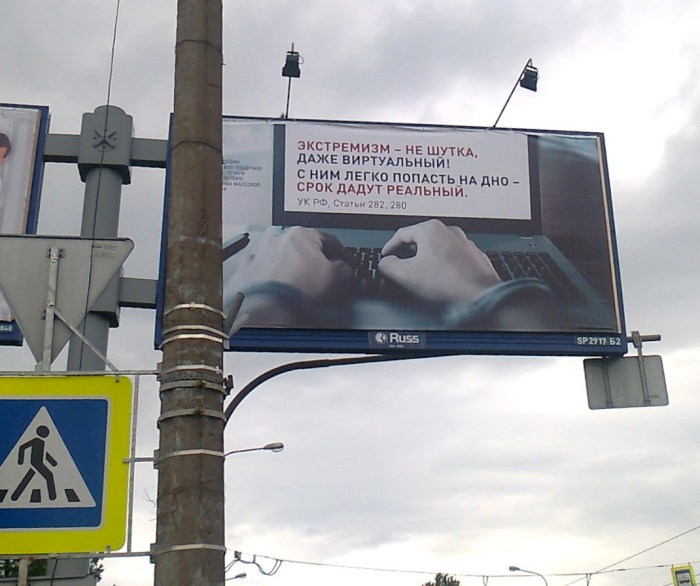
“Extremism is no joke, even virtual extremism. You can easily go down for it, and get a harsh sentece. Russian Federal Criminal Code, Articles 282 and 280.” Public service billboard, Lesnoy Prospekt, Petersburg, August 7, 2016. Photo by the Russian Reader
Kaluga Resident Faces Criminal Charges for Two-Year-Old Repost OVD Info
December 19, 2016
On November 17, FSB officers came to Kaluga resident’s Roman Grishin workplace and took him away to an investigator. After being interrogated on camera, Grishin was informed he stood accused of inciting enmity and hatred (Criminal Code Article 282.1) for reposting a video in 2014. Grishin wrote about the incident on Facebook on December 18. He was released on his own recognizance as a suspect in a criminal case.
“A group of FSB officers in balaclavas and special kit showed up in the morning at my work, plunging my coworkers into a considerable stupor,” writes Grishin.
The video is entitled “New Hit from Kharkov! This Is Russism, Baby.” Acccording to Grishin, it is freely accessible on YouTube.
As Grishin told OVD Info by telephone, the main topic of his interrogation by FSB officers was his regular trips to Ukraine. They asked why he had his picture taken on the Maidan. Grishin visits the country as a tourist, stays with friends, and stresses that he does not collaborate with any organizations in Ukraine.
Grishin lives in Kaluga. Educated as a philologist, he works as a proofreader. The FSB’s scrutiny has been a real shock to him.
“I never voiced any appeals [for enmity or hatred]. You could say I’m a couch activist,” he said.
This is not the first case of persecution for publishing the video to Boris Sevastyanov’s song “This Is Russism, Baby.” Previously, however, its posting was the occasion for filing misdemeanor charges of disseminating extremism matter (Administrative Offenses Code Article 20.29). In April 2016, Krasnodar LGBT activist Nina Solovyova was convicted of commmitting a misdemeanor for posting the video and sentenced to ten days in jail. Solovyova told her story to OVD Info in April of this year.
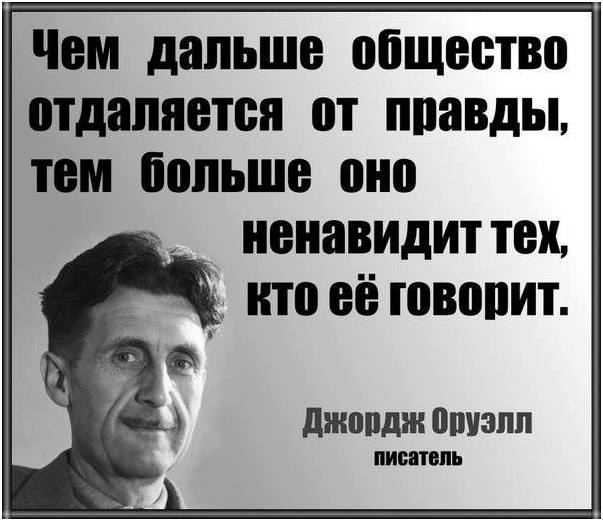
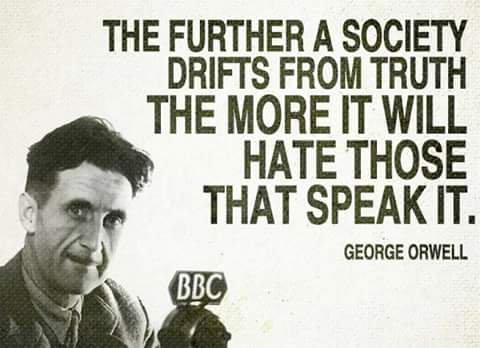
“George Orwell, writer: ‘The further a society drifts from the truth the more it will hate those who speak it.'” Image from Valery Brinikh’s Facebook page
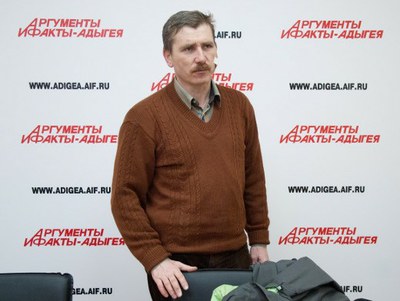
The latest hearing in my criminal trial took place on June 24, but it was no run-of-the-mill hearing. When, last week, the court turned down defense attorney Andrei Sabinin’s motion to examine a linguistics expert from the beautiful beyond via videoconferencing (although, literally right before this, two prosecution witnesses from Krasnodar had been examined in this manner), neither the prosecutors nor the judge suspected that soon they would have the honor of gazing at this linguistics expert in person. We provided them with this pleasure.
The linguistics expert smashed the so-called findings of official state expert Sergei Fedyayev to smithereens. She immediately pointed out that Fedyayev had violated the fundamental methodological principles of forensic examinations for identifying signs of extremism. First, such forensic examinations should be comprehensive, involving not only a linguist but also a psychologist and, better yet, a sociologist or political scientist (if social groups are at issue). By definition, a linguist cannot cope with all these tasks alone. Nor did linguistic expert Fedyayev cope with his task. His analysis of the article “The Silence of the Lambs” skids on the sharp turns like a Volga car. Hence the large number of mistakes and simple linguistic blunders he made, producing findings that were not only at odds with the principles of linguistics but also with common sense.
During her testimony, our expert pointed to a number of instances where Fedyayev clearly went beyond his competence as a linguist by giving legal evaluations of individual passages in “The Silence of the Lambs” and thus infringing on the court’s realm of responsibility. In addition, his findings contain a definition of the concept of a “group,” something only a sociologist or political scientist is competent to define. The Russian Supreme Court has directly ruled it is inadmissible to define the authorities (state officials) as a “social group.” But what does the Russian Supreme Court mean to Fedyayev when the Adygea Supreme Court is dealing the cards? Fedyayev’s analysis also contains probabilistic conclusions (i.e., dealing with the realm of possibility), which are inadmissible in a linguistic forensic examination.
Apologizing to the judge for infringing on legal issues, our expert noted that the article does not oppose one group to another, one nation to another, and that there is no evidence of incitement to enmity and hatred on ethnic and other grounds in the text.
Our expert also testified that lexical-semantic and lexical-stylistic methods should be used in analyzing the text, while the huge number of other methods listed by Fedyayev either were not employed or were superfluous. In particular, by not using conceptual analysis, Fedyayev was led to erroneous conclusions.
The overall conclusion of the linguistics expert we called to the stand in Maykop City Court yesterday was that the article “The Silence of the Lambs” was highly critical and chockablock with negative assessments of the authorities and the hog breeding business, but there was nothing in the article that could interpreted as inciting enmity and hatred. In particular, she pointed out to the court that the words “Adyghe” and “Adygean” are encountered in different contexts in the article, testifying to the fact that the author distinguishes between the notions, using them in the article to denote different things. While the word “Adyghe” clearly refers to an ethnicity, “Adygean” has several meanings, one of them being a resident of Adygea, without reference to his or her ethnicity, as in krasnodarets, sochinets, stavropolets, and so on. [That is, the Russian terms for residents of Krasnodar, Sochi, and Stavropol, respectively.—TRR.]
What mattered to me was our expert’s answer to the question of whether it was possible, having received an unfamiliar text in the morning, to carry out a forensic examination of it by the evening of the same day and discover grounds for suspecting the text of extremism by using linguistic methods. My question was prompted by the fact that on September 15, 2014, Fedyayev, at the request of the FSB’s regional office in the Republic of Adygea, conducted a linguistic examination of the article “The Silence of the Lambs” in ten hours, and his memorandum to this effect (not even an expert opinion) was the grounds for the Maykop City Court (Judge Irina Ramazanova, presiding) ruling that the article was extremist. Later, on the basis of the very same memorandum, whipped up in a single workday, the very same Fedyayev wrote up the expert findings that served as the basis for my indictment on criminal charges.
The conclusion of the expert we called to the stand was unequivocal: it would be impossible. Sometimes, explained the expert, who is a past master at linguistic and comprehensive forensic examinations, analysis of a single sentence might take three hours. So, personally, she takes two weeks to perform such examinations.
In general, the testimony or, rather, the lecture by the linguistics expert we called to the stand was so thorough that neither the judge nor the prosecutors could think of anything substantive to ask her. Thus, by presenting critical reviews of Fedyayev’s forensic examination, we have drawn a thick line under it, making it completely impossible for it to be used as evidence for the prosecution in the criminal case against me.
The next hearing has been scheduled for 2:15 p.m. on July 4. Most likely, we will file a motion to have the forensic examination redone, asking this time for a comprehensive, rather than linguistic, examination.
The latest hearing in my criminal case took place in Maykop from 11 a.m. to 4 p.m. on June 17 of this year. This time, the prosecution’s last two witnesses were finally questioned, albeit by a videoconference link with the Soviet District Court in Krasnodar. Vyacheslav Potapov and Vitaly Isayenko were supposed to answer questions about the operations of the website For Krasnodar, on which the article “The Silence of the Lambs” was posted.
It seemed to me that Sergei Shvetsov, senior deputy prosecutor of the Republic of Adygea, was not prepared to examine the witnesses today and the questions he asked them sounded like childish prattle. Even the judge noted this and advised the public prosecutor to concentrate. Ultimately, however, the second public prosecutor, Inessa Orlova from the Maykop City Prosecutor’s Office, took the microphone from Shvetsov and asked the witnesses specific questions.
I was personally interested in Isayenko’s responses to two sets of questions, first, about the circumstances of his interrogation on December 12, 2014. On that day, after the search [at his house], he was brought from Krasnodar to Maykop and interrogated until evening. It was night when they sent him back home to Krasnodar. As Isayenko, who suffers from Type 1 Diabetes, explained, he spent almost half a day at the Republic of Adygea Investigation Department with no food and, much more dangerously, with no insulin. They gave him only water. And yet they interrogated him intensively, trying to squeeze testimony against me and Vyacheslav Potapov, editor of the website For Krasnodar, from him. I was being interrogated in the next room, and I could hear Senior Investigator Kirill Kustov screaming at him. The stress he underwent and the long period he endured without food and insulin landed Vitaly Isayenko in the hospital the day after his return from Maykop. His diabetes flared up and he suffered from other ailments.
I was also interested in Isayenko’s comments, as a computer specialist, on certain statements in the inspection report on the computers seized at Isayenko’s house, an inspection carried out by Senior Investigator Kustov on the night of December 12, 2014. In particular, the report states that three processors were discovered in one of the computers. Isayenko explained there had been only one processor in the computer. He did not know nothing about any other processors.
In general, the witnesses said nothing new. They only confirmed what was already contained in the minutes of their interrogations.
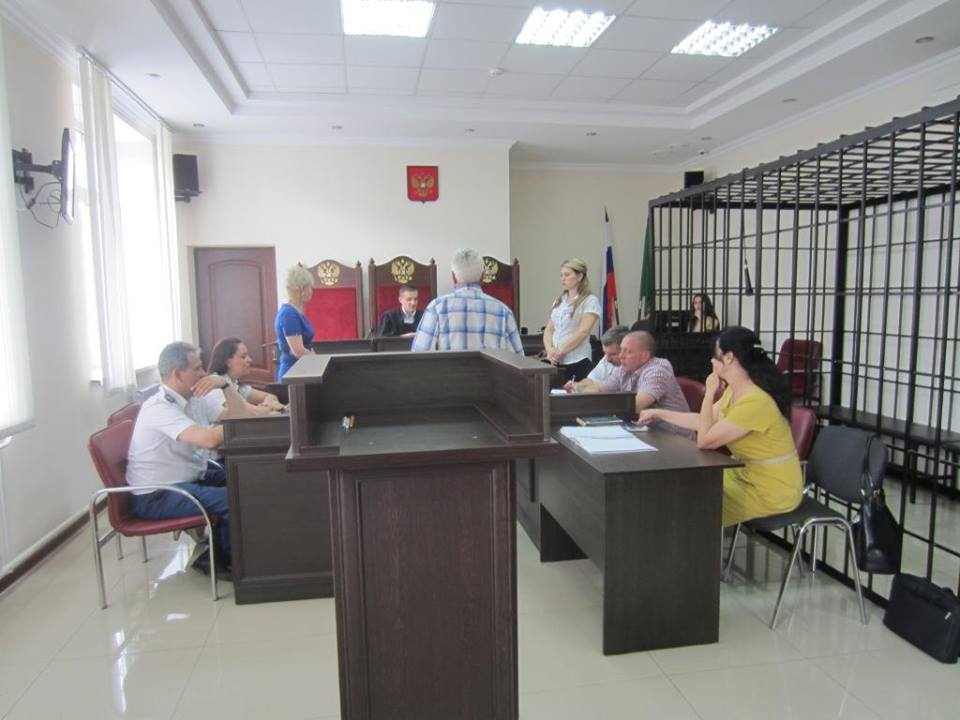
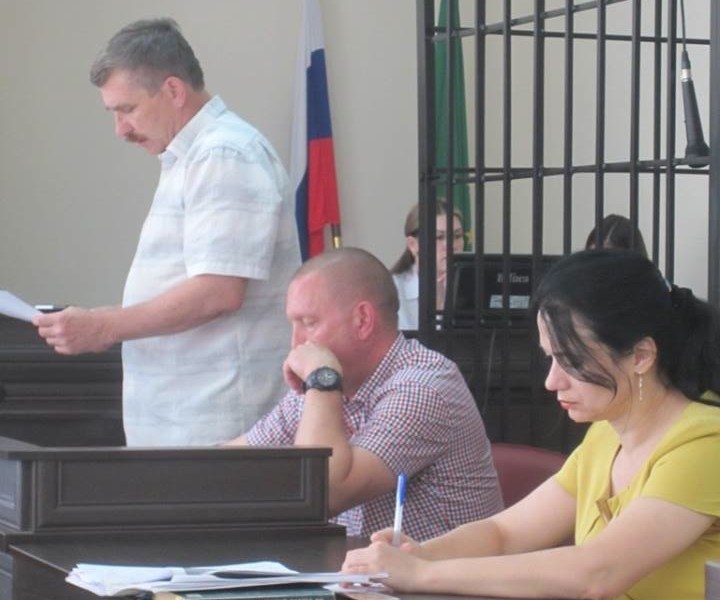
Valery Brinink (left) and his attorney, Andrei Sabinin. Maykop City Court, June 17, 2016
After the witnesses were examined, my attorney, Andrei Sabinin, attempted to request that Elizaveta Koltunova, a linguist from Nizhny Novgorod, be examined via videoconference, but the prosecutors objected, and Judge Vitaly Galagan did their bidding. Our request to examine the linguist by videoconferencing was rejected. According to the defense, this stance on the part of the prosecution and the court contradicts the adversarial nature of judicial proceedings and the principle of the equality of arms.
Much more unexpected and even amusing was the procedural action, which took place after lunch, of obtaining handwriting samples and a signature from prosecution witness Mugdin Mossovich Guchetl, a resident of the village of Gabukay. Everything would have been alright if the witness had simply produced his signature in silence, but instead he recalled another circumstance that I think gave the prosecutors a slight shock. Guchetl recalled that in February of last year, when Investigator A.S. Rudenko of the Investigative Department of the Republican Investigative Committee’s Teuchezsky District office took Guchetl’s written testimony, he asked him to sign blank sheets of paper, because, as Rudenko explained, allegedly, he would later type out Guchetl’s handwritten testimony on the computer, but he needed the signatures right away so he would not have to make a return trip to Adygeisk.
The investigator thus clearly violated the procedure for processing interrogation reports, a procedure strictly regulated by criminal procedural laws. At the same time, the investigator committed forgery by inserting things Guchetl did not say into the report. Today, after reading the interrogation report, which is part of the criminal case file, Guchetl categorically stated he did not say to the investigator what was written in the penultimate paragraph of his printed testimony, which reads as follows: “I want to clarify that I strongly disagree with the contents of the article entitled ‘The Silence of the Lambs,’ because I think the article has defamed my honor and dignity as an Adyghe, as well as insulting all Muslims. The article compares us to pigs and cowards, and claims we have no sense of self-esteem.”
Basically, it was for the sake of this passage that the investigator obtained Guchetl’s testimony. In fact, the investigator could have written something even rougher on Guchetl’s behalf, because he already his signatures on blank interrogation report forms.
Finally, I made a motion to rule the Teuchezhsky District Council an illegitimate injured party in my case, since it did not satisfy the grounds set out in Article 42 of the Russian Federal Criminal Procedure Code. When the prosecutors objected as usual, spouting platitudes about the proper recognition of the local authorities as an injured party, we demanded the prosecution present legal grounds for its stance. We were quite curious to find out how exactly the district council had been injured, if, as they themselves have said, the article had caused moral injury to the residents of the Teuchezhsky District.
The prosecutors drew a blank and requested a time-out until the next hearing, at which they promised to provide a written justification for their objection. That suited us just fine, as it did the judge, who postponed consideration of our motion until next time.
The next court hearing is scheduled for June 24.
Translated by the Russian Reader. Photos courtesy of Valery Brinikh. Please read my previous posts on his case.
Prosecution Witness in Brinikh Case Recants Grani.ru
March 24, 2016
77-year-old Mugdin Guchetl, a witness for the prosecution in the extremist case against environmentalist Valery Brinikh, recanted from the testimony identified as his in the case file during a court hearing in Maykop City Court in Adygea, as reported by the international human rights group Agora, who cited Brinikh’s defense attorney Alexander Popkov.
In testimony signed “Guchetl,” given during the investigation, it states that Brinikh has insulted not only the witness but the entire Adyghe people with his article “The Silence of the Lambs.” During the trial, however, the witness said he had not read the article, that he had not been in Adygeisk for around five years (although according to the interrogation report he was questioned in Adygeisk), that he had not given testimony to a police investigator, and that he had not signed the interrogation report.
Presiding Judge Vitaly Galagan pressed Guchetl, telling him that if he did not acknowledge his own signature, he would be summoned to court again. The defense protested the judge’s actions and filed a motion for a handwriting analysis to be performed.
The article “The Silence of the Lambs” was published on the website For Krasnodar! in September 2014. It recounts the environmental problems caused by Kievo-Zhuraki Agribusiness JSC, a large pig-breeding facility in Adygea’s Teuchezhsk District. The company was founded by Vyacheslav Derev, Karachay-Cherkessia’s representative in the Federation Council.
The article contains the following passage: “But who or what has forced the Adyghe to breathe manure-polluted air and swim in ponds poisoned by sewage? Nothing but cowardice and a lack of self-esteem.”
On December 17, 2014, Maykop City Court ruled that “The Silence of the Lambs” was extremist. On March 20, 2015, the Adygea Supreme Court reaffirmed the lower court’s decision. In their rulings, the courts claimed the author of the article had insulted ethnic Adyghe, accusing them of cowardice. On January 12, 2016, Brinikh submitted a written petition to Maykop City Court asking it to reexamine its ruling in the light of new circumstances, but on January 21, Judge Irina Ramazanov refused to consider the petition.
The environmentalist had been charged under Articles 33.5 and 282.1 of the Criminal Code (complicity in inciting hatred and enmity) as he was accused of having help to disseminate the article. Subsequently, Major Konstantin Kustov, senior major case investigator at the regional headquarters of the Russian Federal Investigative Committee, recharged the environmentalist, removing Article 33.5 from the charges and accusing the biologist of having authored “The Silence of the Lambs.”
Defense attorney Popkov has noted that over the past year the Investigative Committee has ordered five forensic examinations in the case. However, the lawyer stressed that data from a wiretap of Brinikh’s telephone, conducted by the Federal Security Service (FSB) a few months before “The Silence of the Lambs” was published, has been subjected to a phonological forensic analysis.
Hearing of the case on the merits began on January 26, 2016. Popkov had insisted on sending the case back to the prosecutor’s office, pointing out that a number of pieces of evidence had been falsified, but Judge Galagan rejected his appeal.
During the February 9 hearing of the case, one of the ethnic Adyghes who was questioned refuted the charges against the defendant.
“The environmentalist’s article caused no enmity,” he said. “On the contrary, Brinikh has help the Adyghes fight for the environment.”
Translated by the Russian Reader. Photo courtesy of8772.ru. See my previous posts on Valery Brinikh and the case against him.
Court Sentences Yekaterinburg Resident to Community Service for Posts on Social Networks and Order Her Laptop Destroyed Mediazona
February 20, 2016
Yekaterinburg’s Zheleznodorozhnyi District Court has found single mother Ekaterina Vologzheninova guilty of inciting social hatred and enmity (Russian Criminal Code Article 282), reports Grani.ru.
Ekaterina Vologzheninova
The court has sentenced the woman to 320 hours of compulsory community service and ordered her laptop, which served as physical evidence in the case, destroyed.
As Grani.ru explains, the court based its verdict on the conclusion reached by a forensic linguist that Vologzheninova had incited “ethnic [sic] hatred and enmity towards volunteers from Russia” who were involved in the armed conflict in eastern Ukraine, as well as towards public officials.
Criminal charges were filed against Vologzheninova after she [re]posted Anatoly Marushkevich’s poem “Katsaps,” along with an image of a young Ukrainian woman and the caption “Death to the Moscow Occupiers,” and a caricature featuring a man resembling Vladimir Putin leaning over the Donbass holding a knife. The last post was later excluded from the evidence.
Judge Refuses to Return Case of Environmentalist Accused of Extremism to Prosecutor OVDInfo.org
January 26, 2016
Maykop City Court has refused to return the case of environmentalist Valery Brinikh, accused of inciting hatred against the Adyghe people, to the prosecutor’s office for further investigation. This happened on January 26 at the first hearing in Brinikh’s trial. Lawyer Alexander Popkov, Brinikh’s defense attorney, told OVD Info that the reason for the motion to return the case to the prosecutor were the violations of criminal procedural law that have surfaced during the case. According to Popkov, the case files which the police investigator allowed them to examine did not match the case files submitted to the court.
Valery Brinikh
“The dates of the inspection protocols of the items seized during the search [of Brinikh’s home] have been changed,” Popkov explained.
According to him, during the investigation, he and his client discovered that the inspection protocolshad been drawn up before the items were confiscated. After they pointed this out, protocols that were formally drawn up later than Brinikh and Popkov reviewed them were submitted to the court.
Brinikh told OVD Info that the court had refused to admit two defenders to the case: retired judge Oleg Alexeev and Zaurbiya Chundyshko (an ethnic Adyghe), chair of the Maykop grassroots organization Adhyge Khase. The presiding judge has refused to call to the stand the witnesses and experts whom Brinikh and his attorney had asked to testify, including the people who performed the computer and linguistic forensic examinations during the investigation. The defense has a number of questions for them.
According to police investigators, in the fall of 2014, Valery Brinikh produced a piece of extremist matter: the article “The Silence of the Lambs,” which dealt with the environmental problems cause by a hog farming facility in Adygea’s Teuchezhsky District. It was founded by Vyacheslav Derev, the Federation Council member for Karachaevo-Cherkessia.
Translated by the Russian Reader. Photo courtesy ofCogita.ru
Please read my previous posts on the Brinikh case:
It’s Dangerous to Quote Voltaire ovdinfo.org
January 10, 2015
Adygean Environmentalist Valery Brinikh
In Adygea, Valery Brinikh, chair of the regional branch of the All-Russian Society for Nature Conversation (VOOP), has been charged with aiding and abetting extremist activity and subjected to travel restrictions. According to investigators, Brinikh “aided unidentified persons in disseminating information aimed at abasing the dignity of a person or group of persons on the basis of ethnicity and origin by creating extremist material.” Abasement of dignity charges (Russian Federal Criminal Code Article 282.1) were filed in December 2014. They were occasioned by publication of the article “The Silence of the Lambs” on the website For Krasnodar! The article details the environmental damaged caused to Adygea’s Teuchezhsky District by pollution from an industrial pig-breeding facility. The company that runs the facility, Kiev0-Zhuraki Agrobusiness JSC, was founded by Vyacheslav Derev, who represents Karachay-Cherkessia in the Federation Council, Russia’s upper house of parliament.
Several days after the charges were filed, the article was deemed extremist. According to Brinikh’s defense attorney, Alexander Popkov, the [next-to-last] sentence in the article, which quotes Voltaire’s argument that God helps those battalions that shoot best, could have been the main reason it was deemed extremist.
“The word ‘shoot’ is forbidden; it is an awful word. ‘Battalions’ is also an awful word. And Voltaire was a freethinker,” Popkov says ironically.
Brinikh was for a long time officially regarded as a suspect in the case. According to Popkov, investigators have no proof that it was his client who wrote the article, but they claim he aided “persons unknown” in disseminating it.
The indictment does not make clear exactly whose dignity was abased by the article. Popkov recounts that, initially, investigators said that Brinikh “had offended public officials.” Ethnic motives were also discussed.
In the written petition, filed by the Adygea Prosecutor’s Office, asking the court to deem the article extremist, it says that “according to the findings of the linguistic analysis carried out by the Main Directorate of Internal Affairs in Krasnodar Krai (No. 17/7-119i, dated September 15, 2014), the text of the article ‘The Silence of the Lambs’ contains statements negatively evaluating a group of persons, united on the basis of ethnicity, the Adyghe (identified in the text as ‘cowards,’ ‘persons who lack self-esteem,’ and ‘lambs’).”
The article’s authors complains about the passivity of the local populace, who refuse to defend their own interests.
Popkov notes Brinikh would not have wanted to humiliate the Adyghe.
“On the contrary,” says Popkov, “he advocated for them and visited them.”
The prosecutor’s petition also claims the article contains “statements that could be understood to incite ethnic Adyghe to take actions, probably involving violence, against a group of persons, i.e., the local authorities.”
According to Popkov, Brinikh’s aiding and abetting persons unknown “is supposedly confirmed by a phonoscopic examination: he allegedly spoke by telephone about posting the article on the Web.”
However, since the article was posted on the Web before criminal charges were filed and before it was declared extremist, it follows that Brinikh’s telephone was bugged before these events took place.
“The question arises: on what basis were they bugging him?” asks Popkov.
Translated by the Russian Reader
Editor’s Note. The following day, January 11, ovdinfo.orgreported that Valery Brinikh’s trial on the above-mentioned charges would begin in Maykop City Court on January 19.
Please read my previous posts on the Brinikh case:

 Extremists