Alexander Kolchenko: The “Terrorist” from Simferopol

The “Terrorist” from Simferopol
On April 9, Moscow City Court Ordered Alexander Kolchenko’s Arrest Extended for a Month, until May 16
Dmitry Okrest
April 13, 2015
The New Times

According to the FSB, Alexander Kolchenko is a member of the anti-Russian underground in Crimea. Along with three other arrested residents of the peninsula, he has been accused of terrorism. The New Times has tried to find out what the charges are based on (it took nearly a year to gather the evidence), how the Russian security services took over Crimea, and what residents of Simferopol think about the relatives of the arrestees.

kolchenko3_1

Alexander Kolchenko

“Sasha is now accused of terrorism, but he is not a terrorist, and I am not the mother of a terrorist,” says Larisa Kolchenko. “My son literally grew up in front of my coworkers, and after his arrest they have continued to treat me well.”

Larisa Kolchenko works in a grocery store near the Simferopol railway station. She speaks softly and quickly.

“In fact, the arson of which they are accused basically, you could say, left no trace on the city. It popped up in the news once, and that was it. There was no discussion, no publicity.”

The arson at the Russian Community of Crimea building, on the night of April 14, 2014, damaged the front door, the stoop, and an awning above the door. A few days later, a Molotov cocktail flew through the window of the United Russian party’s local office. The fire damage caused to a five-meter-square kitchen in the office was estimated at 200,000 rubles. Doesn’t that sound more like disorderly conduct?

On March 31, 2015, however, Kolchenko was accused of involvement in a terrorist network and committing a terrorist attack. It was then that solidarity actions in support of Kolchenko were held, under the slogan “Send Tundra Back to Crimea,” in Berlin, Bremen, Kyiv, Minsk, Paris, Strasbourg, and Tunis. “Tundra” is Kolchenko’s nickname within the peninsula’s activist scene.

“Only those who cooperate are allowed visits”

According to the FSB, the leader of the Bandera underground in Crimea is filmmaker Oleg Sentsov, who along with Alexei Chirniy, a lecturer in the military history department at the Crimean University of Culture, has been charged with violating Article 205 Part 2 of the Russian Federal Criminal Code (“Terrorist attacks”) and Article 205.4 Part 2 (“Organizing a terrorist network”). In early February, Sentsov was additionally charged under Article 222 Part 3 (“Arms trafficking”).

Before his arrest, Chirniy pursued the hobby of reconstructing medieval armor, considered himself a pagan, and posted Nazi propaganda posters on social networks. A court-appointed attorney is now defending him, and his case will be heard in the military district court in Rostov-on-Don by special procedure. [Translator’s Note: On April 21, 2014, after this article went to press, Chirniy was sentenced to seven years in a maximum-security facility.]

Besides damaging the two offices, the “Sentsov gang” has been accused of planning to blow up the Eternal Flame and a Lenin monument on May 9, 2014. According to the security services, the suspects were also planning to “destroy a number of vital infrastructure sites, railway bridges, and power lines.”

On May 8, 2014, Gennady Afanasiev, an employee of the Zheleznodorozhny District prosecutor’s office in Simferopol, made a deal with the investigation. Afanasiev was tried by special procedure—meaning, without court proceedings, which entitles the defendant to mitigation of punishment. On December 25, 2014, Afanasiev was sentenced to seven years in a maximum-security facility.

Sentsov has denied the charges against him. Kolchenko has admitted he was near the office but was not involved in the attack. He has refused to testify against the others. If Sentsov and Kolchenko are found guilty, they could be sent away for twenty years. Afanasiev and Chirniy will be main witnesses for the prosecution at their trial.

The prosecution alleges that Kolchenko met with Sentsov “at mass events of supporters of Crimea’s being a part of Ukraine,” at which the filmmaker allegedly suggested organizing a gang “for performing attacks in keeping with the Right Sector ideology.” According to the FSB, this gang was to destabilize the work of the newly created authorities “in order to encourage them to decide to withdraw the Republic of Crimea from the Russian Federation.”

Despite the gravity of the charges, nearly all of Kolchenko’s letters begin with the words, “I am still doing well.” He labels the arson a symbolic gesture of protest, rather than an attempt to “intimidate the population of Crimea,” and stresses that at midnight the building was empty.

“I was against the war, against violence. My actions were directed against the United Russia party, which voted for sending in troops,” Kolchenko writes.

In his letters, Kolchenko relates that he has been following the Bolotnaya Square case.

“Doing three and half years in prison for something like that is not really great. In that light, it is frightening to think about the sentence I can expect. I guess my prospects aren’t very bright.”

Larisa Kolchenko is worried that she has not been allowed to visit Alexander.

“They explain that since he refuses to cooperate, there is no reason for his family to talk with him. Visits are allowed to those who cooperate.”

“People in Simferopol won’t understand”

“At school, my son was a justice seeker,” says Larisa. “His heart bled for all of Crimea, and he was involved literally in everything.”

Kolchenko ended up in the radical left crowd because of hardcore music, which he became interested in while still at school. He went on archaeological digs, and marched under the red-and-black banners of the anarchists during demonstrations. He organized a protest campaign against construction of a transport terminal on the Black Sea, and was among the founders of the union Student Action, which fought against the monetization of education in Ukraine. (The nationwide rallies against monetization kicked off in Simferopol.) Later, he advised striking employees at Crimea Trolleybus.

“We literally supported him in everything,” says Kolchenko’s mother. “But when he was planning to go to Euromaidan, and was literally standing in the door with his backpack on, I rushed to him and tried to discourage him from going. I told him that people were being killed in the square [in Kyiv], and that people in Simferopol won’t understand.”

According to Kolchenko’s defense attorney, Svetlana Sidorkina, as an activist, Kolchenko had long been in the works among the security services.

“He has never been afraid of voicing his dissatisfaction. He has always openly advertised his position,” says Larisa Kolchenko.

When the so-called Russian Spring began, Kolchenko opposed the annexation. His mother agreed with him: she refused to vote in the referendum. Not all of Larisa’s kith and kin abided by her stance. Several relatives have ceased communicating with Kolchenko’s family.

“Russia has come: we’re going to act tougher”

“Sasha is a committed antifascist. Every year, he would organize a picket in memory of the murdered lawyer Stanislav Markelov and murdered journalist Anastasia Baburova. She was a local girl, after all, from Sevastopol,” says Larisa Kolchenko. “But now my son has been accused of being a member of Right Sector.”

“The activists were not and are not members of the Right Sector political party,” the press service of the organization, which is banned in Russia, has said in response. “However, we demand their immediate release and an end to political terror in the occupied territory.”

Later, Kolchenko’s defense sent a formal request directly to Right Sector, and got the same answer.

“But it is doubtful whether this is enough for a Russian court,” says Larisa Kolchenko. “Thank God, this absurd accusation played no role for people in Crimea. When we were collecting character references for the court, the attitude to him at the university was still good. At the printing plant where he worked as a freight handler, which did not move to the mainland until after the referendum, his colleagues said the accusation was unfair.”

It is difficult to suspect Kolchenko of being sympathetic to nationalists. In 2012, thirty rightwing radicals assaulted Tundra and three comrades after a screening of a film about Baburova.

Since Kolchenko has been arrested, no Ukrainian officials have attempted to contact him. This worries his mother.

“They seemed to have forgotten about the detainees,” Larisa Kolchenko says.

The Ukrainian Consul in Moscow has not visited the suspects. Russia has declared the men its citizens, but on February 4, 2015, the Russian Prosecutor General suddenly determined that Sentsov had dual citizenship. However, a judge rejected Kolchenko’s lawsuit against the Russian Federal Migration Service after an FMS employee provided the court with a passport request form containing Kolchenko’s information and his alleged signature. The defense now plans to a have a handwriting analysis of the document performed.

“He was forcibly made the citizen of another country,” says Kolchenko’s mother. “He did not fill out any forms.”

In turn, the State Migration Service of Ukraine confirmed Kolchenko’s Ukrainian citizenship in February, and on March 27, 2015, the Kyiv Prosecutor’s Office finally opened a case in the abduction of Ukrainian citizen Alexander Kolchenko. Svetlana Sidorkina said her client has sent a complaint to the European Court of Human Rights against Russian citizenship forcibly having been conferred on him.

When the new academic year began, many Crimean universities were missing students, who had left to complete their studies in Ukraine.

“Some people with whom I was friendly on the civic activism front have shoved off,” says Anton Trofimov, a lecturer in philosophy at the College of Taurida National University. “I even wondered: have all the problems ended? Is the environment no longer a matter of concern?”

Trofimov is an organizer of the carnivalesque Monstration marches, and he cofounded the student union with Kolchenko.

“In the end, a lot of friends have left, and for good reason,” says Trofimov. “FSB officers—former Ukrainian SBU security officers—have paid me a visit as well. They warned me, ‘Russia has come, and we’re going act differently, we’re going act tougher—in accordance with Russian laws.’”

“Sasha also wanted to leave,” says his mother. “But we tried to dissuade him. I didn’t want to let him go far away. We were all afraid—but of the wrong thing!”

A geography major, Kolchenko was deciding between Uzhgorod University and Lviv University, but on May 23, 2014, he was transferred to the Lefortovo remand prison in Moscow.

A friend of Kolchenko, who introduced himself as Roman, explains the cause of the crackdown.

“Throughout the spring, [pro-Russian forces] frightened the people with talk about the militants from Maidan. Except for the Tatars, no one stood up for themselves, and the authorities needed to show that the threat was still real.”

“After the arrest of the first four guys from the pro-Ukrainian movement, the FSB began conducting ‘preventive’ conversations with everyone else,” says Maxim Osadchuk, a history lecturer and buddy of Kolchenko from the leftist movement. “Almost all my friends who had anything to do with public life have left. The question of whether to emigrate or go underground and risk arrest became critical.”

Osadchuk himself left Crimea several days before the referendum and is now fighting as part of the Aydar Battalion.

Osadchuk believes the arrest of the four men was a warning to the remaining activists on the peninsula to curb their enthusiasm.

“Through threats and exhortations we were strongly advised either to leave Crimea or curtail all activism.”

“Luxury items like bouillon cubes and ketchup”

Kolchenko does not complain and is extremely laconic.

In a letter from the remand prison, he writes, “My cellmate and I have amassed so many goodies they will last us for a month. But the goodies are not as tasty as they would seem on the outside.”

In another letter, he writes, “My appetite has slumped here: the cafeteria food is quite enough for me.”

But he dreams of getting his hands on popular science magazines, and “luxury items like bouillon cubes and ketchup.”

Kolchenko has been studying Lenin, Marx, Fromm, and Ivan Franko, the last of whom he read in Ukrainian. He regrets that his familiarization with Russia has begun at a remand prison, and in one of his letters, he shares his impressions of Leo Tolstoy’s current affairs writings: “A typical extremist. Nowadays, they would probably charge him under Article 280.”*

In the letter, he quotes Tolstoy’s essay “The End of the Age”: “What will happen to Russia? Russia? Where is its beginning or its end? […] The Caucasus with all its nationalities? The Kazan Tatars? Ferghana Province? The Amur? […] The circumstance that all these nationalities are regarded as parts of Russia is an accidental and temporary one. […] whilst in the present this combination is maintained only by the power which spreads over these nationalities.”

* Article 280.1 of the Russian Federal Criminal Code, “Public calls for action aimed at violating the territorial integrity of the Russian Federation.”

__________

Editor’s Note. For more information about Alexander Kolchenko’s plight and how you can support him, see the Ukraine Solidarity Campaign’s page on the case (in English) and Autonomous Action’s compilation of articles about the case (in Russian). You can also follow events in the case via the Free Aleksandr Kolchenko Facebook page (mostly in Russian) and read this article (in English) about the political context of the case. Image, above, courtesy of Libcom.org.

Translated by The Russian Reader. Anyone has permission to republish this and any other of the translations or original texts found on this blog, but please acknowledge the blog explicitly in your reposts, and provide a clearly indicated URL link back to the original publication.

Maxim Kantor: Colorful Ribbons

Maxim Kantor
Colorful Ribbons
April 22, 2015
Facebook

Tell me, what you are proud of?
You didn’t fight, not even your fathers fought.
You basically did nothing at all.
That was seventy years ago, in another country.
And it was completely different people who fought, and they fought for something else.
Ukrainians, Russians, Americans, British, Jews, French, Belarusians, and Tajiks fought shoulder to shoulder then against an empire that wanted to devour the world.

pobeda
And now you are fighting for an empire against the Ukrainians. You are killing your neighbors.
You want to destroy their country.
And you want a decoration for this?
What do decorations from someone else’s victory have to do with this? What does someone else’s war have to do with it?
You are looters. You are bandits. You are imperialists.
Colorful ribbons are pinned to bandits. You think it looks nice?
Take the ribbons off now, don’t disgrace yourselves.

Maxim Kantor is a well-known Russian painter, writer, and essayist.

Photo by The Russian Reader

Russia vs. Russia: Political Art and Censorship

Victoria Lomasko
April 14, 2015
Facebook

During the last discussion at the Russland vs. Russland. Kulturkonflikte forum, the event’s title finally paid off.

Kristina Leko, an artist and teacher at the Berlin Institute of Art, opened the discussion. The organizers had invited her to comment on the forum and the exhibition of Russian “critical art.”

She wondered how much the objets d’art for Marat Guelman’s Perm project (documented at the forum) had cost, whether the money had come from the city’s budget, and if it had, whether the citizens for whose sake this monumental street art had allegedly been made had agreed with this. Leko noted that she had found it unpleasant to listen to the presentation of the project, during which it was stated that the residents of Perm were “insufficiently educated to understand art.” She also said that after carefully viewing the video documentation for MediaImpact, she could not understand where the audience for this sociopolitical art was. Did Russian “critical” artists even want to communicate with the general public? Leko asked whether it was possible to make “critical art” now without taking Russia’s aggression in Ukraine into account, and whether one could be a “critical artist” while ignoring gender and racial discrimination.

Her talk was suddenly interrupted by artist Alexander Brener, who burst into the circle of panelists and yelled, “All of this is shit! We must talk about what matters most!” Brener was not a forum participant. He had come every day to listen to the speakers and several times had expressed his dissatisfaction, but in much more acceptable form.

Brener had interrupted Leko’s talk and continued to shout about shit, but the panelists interpreted his stunt variously. One group sided with Brener, calling him a great Russian artist. This was a performance, a compliment to the forum’s organizer. The talk had been boring: let Brener have his say, they said. The moderator, sociologist Alexander Bikbov, demanded that Leko be allowed to finish her talk. He was backed up by cultural studies scholar Olga Reznikova, who told Brener that there had been many boring and offensive presentations over the past three days and asked him why he had not felt the urge to shout down a high-profile male who had been talking “shit.” The only Ukrainian participant in the forum, Vasily Cherepanin, director of the Visual Culture Research Center in Kyiv and editor of the Ukrainian edition of the journal Krytyka Polityczna, said he felt sorry for us, since we were accustomed to rudeness and could not tell the difference between it and art. As a manager of an institution, he himself kicks out such “performance artists,” no questions asked.

While this was happening, Leko’s hands were shaking. The German audience was shocked. One of the German participants asked perplexedly, “Why is there no solidarity among Russian artists?”

I am certain that the majority of men in Russia who identify themselves as “leftists” are incapable of uniting with women on an equal footing and dealing with our professional work appropriately, without loutishness. Personally, I have no desire to identify with those “leftists” or liberals who try talking down to me or do the same thing with other women. I had had enough of that at the Feminist Pencil show at MediaImpact.

I said that sexism was one of the causes that prevented people from uniting.

Hearing the word sexism, some of the Russian participants began laughing and making faces. They then pointedly left the room altogether when the topic of gender was picked up by Olga Reznikova, Heinrich Böll Foundation coordinator Nuria Fatykhova, and the German audience.

Vasily Cherepanin raised the next topic. He spoke about the war in Ukraine, stressing it was a war of aggression on Russia’s part. At the same time, many Russian socially and politically engaged artists have preferred to remain apolitical on this matter and not make anti-war statements. One of the Germans asked why the Russians were trying to depoliticize the discussion of sexism and the war in Ukraine. After this question, another third of the Russians dashed from the room, while the artist Brener, who had been sitting quietly in the corner, again broke into the circle of panelists, screaming at Cherepanin, “Fuck off!”

Moderator Alexander Bikbov summarized the discussion by noting that too few “critical” artists had stayed for its final part. As soon as the conversation had turned to the things that mattered most—politics within the art scene and the war in Ukraine—many were not prepared to discuss them.

But then at the farewell dinner, the participants who had left the discussion early continued giggling among themselves about gender and feminism.

____________________

Russia vs. Russia: From Censorship to Self-Censorship
New Russian laws—from a ban on swearing to protections for the feelings of religious believers—have made life difficult for artists. But the main obstacle to freedom of creativity has become self-censorship.
Yekaterina Kryzhanovskaya | Berlin
April 13, 2015
Deutsche Welle

lomasko-courtVictoria Lomasko, Prisoners of May 6, from the Drawing Trials project

For several years, Victoria Lomasko has been doing socially engaged graphic art, producing graphic reportages from court hearings and political rallies, and drawing the real stories of juvenile prisoners, migrant workers, rural teachers, and Orthodox activists. But the Russian woman can now longer speak openly about what concerns her through her drawings: now her black-and-white “comics” could be subject to the articles of the Russian Federal Criminal Code.

“My work Cannibal State, in support of political prisoners, today could be regarded as insulting state symbols. Liberate Russia from Putin clearly rocks the boat; it’s a call for rebellion, for revolution, and this is ‘extremism.’ A work from the Pussy Riot trial, Free the Prisoners! Shame on the Russian Orthodox Church!, featuring Patriarch Kirill, no doubt insults the feelings of believers,” the artist recounts.

Could she now, as she did earlier, freely post her political posters in social networks or show them at exhibitions?

“Hardly. But just two years ago several of them were even published in magazines,” notes Lomasko.

From censorship…

At the forum Russia vs. Russia: Cultural Conflicts, held April 10–12 in Berlin, Lomasko was not the only one bewildered about the prospects of protest art.

“In Russia nowadays you cannot do anything,” states Artyom Loskutov, an artist and organizer of the annual May Day Monstration marches in Novosibirsk.

In 2014, the Monstrators took to the streets of Novosibirsk holding a banner that read, “Hell is ours.” When the Russian media were excitedly talking about the virtues of federalizing Ukraine, Loskutov and his allies announced they would be holding a March for the Federalization of Siberia.

“If people in Russia hear every day that separatism in Ukraine turns out to be a good thing, that cannot slip through the cracks. We have simply hastened the next stage, when separatism will be seen as good for our country as well,” Loskutov emphasizes.

Russian federal media watchdog Roskomnadzor responded by sending fourteen letters to various media, including Ukrainian publications and even the BBC, demanding that they delete even mentions of this protest.

…to self-censorship

According to many forum participants, however, censorship was not the worst that was happening to them today.

“The worst thing that infiltrates our heads is self-censorship. It is impossible to know about the new laws and not to think about the consequences if you make a work about something that really concerns you,” argues Lomasko.

A congress of ultra-rightist nationalists was held in March in Petersburg, completely legally. And yet the media could not publish photographs of congress participants in clothes featuring swastikas because they would be fined for extremism.

“I really want to speak out on this subject. But if I were to draw something, I could be accused of spreading fascist ideas. And if I put it on the Web, everyone who reposts the picture automatically becomes my accomplice,” explains Lomasko.

Consequently, she said, there have been almost no artworks openly criticizing the annexation of Crimea or the war in Ukraine. Doubts about the legitimacy of Moscow’s actions are now also subject to the Criminal Code.  A rare exception is the graffiti piece Broads Will Give Birth to New Ones, in which a pregnant woman holding a Molotov cocktail is depicted with an infant soldier in her belly. But it was produced anonymously by members of the Petersburg group Gandhi.

Monumental propaganda

On the other hand, you can express your joy over the actions of Russian politicians without the sanction of officials. Thus, on the eve of the referendum in Crimea, a monumental graffiti proclaiming “Crimea and Russia: Together Forever” suddenly appeared on the wall of a house in Moscow’s Taganka Square where an officially authorized map of the Tagansky District was supposed have been painted.

“The contractor himself decided that the Crimean agenda was more topical and interesting, and he willfully painted what he did, not the map he had been commissioned to paint,” explains Anna Nistratova, an independent curator, researcher, and artist.

0,,18377432_401,00Victoria Lomasko

Later, such monumental propaganda began to appear all over the country, both as commissioned by the authorities, and at the behest of the population, including activist artists, many of whom also believe, according to Lomasko, “Crimea is ours, Donbass is ours, and Ukraine basically doesn’t exist.”

“In matters of propaganda, orders from the top are not obligatory. Our citizens themselves are capable to taking the initiative,” notes Nistratova.

__________

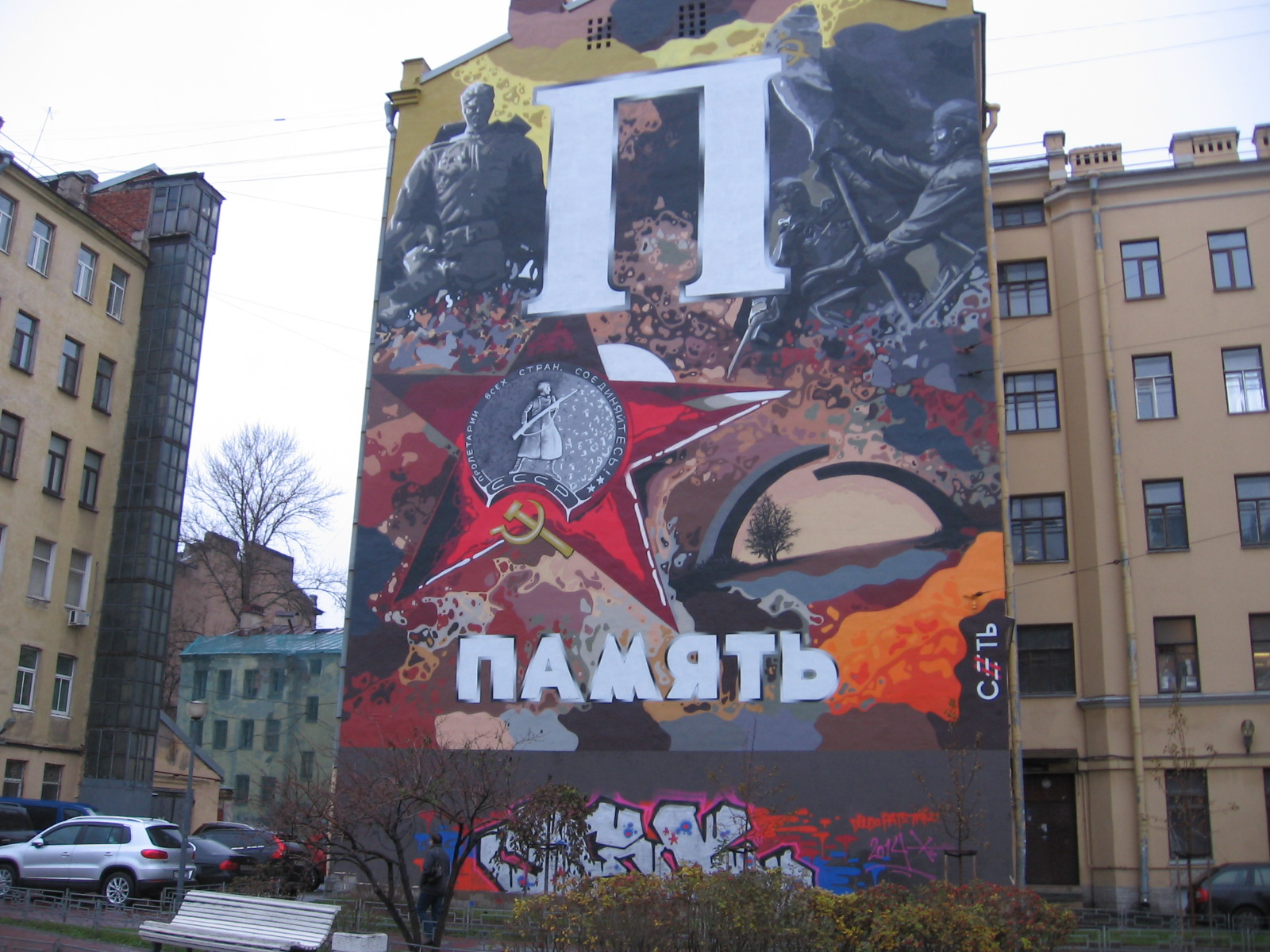
IMG_5964“Memory” (P = Pamiat’), one of a series of “graffiti” murals produced by the pro-Kremlin youth group Set (“Network”) to celebrate Vladimir Putin’s birthday in October 2014. The five murals, which appeared in different cities, each featured a different letter from the president’s surname; each letter was associated, children’s primer-style, with a different “patriotic” virtue (e.g., such as “memory” of the war). This mural was painted on an apartment block on Petersburg’s Obvodny Canal. Photograph by The Russian Reader

__________

Lost status

Nistratov points out that there are very few artists involved in political art in Russia. Besides, neither exhibitions nor the very best artworks nor inscriptions on the streets have any effect on society, in her opinion.

“The artist in Russia today is a strange, marginal subject. His status as an intellectual, as a moral exemplar, which existed earlier, has been completely forfeited,” says Nistratova.

Confusion is, perhaps, the feeling that is prevalent throughout the talks given by the participants of the forum Russia vs. Russia: Cultural Conflicts. By and large, the activist artists have no clear strategies for operating under new conditions.

“The only thing that seems to me worthwhile is maintaining one’s own little environment, a bubble inside the shit. Because if this nightmare ever ends, we have to make sure we are not faced with a scorched, absolutely bare field, bereft of political and social art, activism, and civic consciousness,” argues Lomasko.

♦♦♦♦♦♦♦♦♦♦♦♦♦♦♦♦♦♦♦

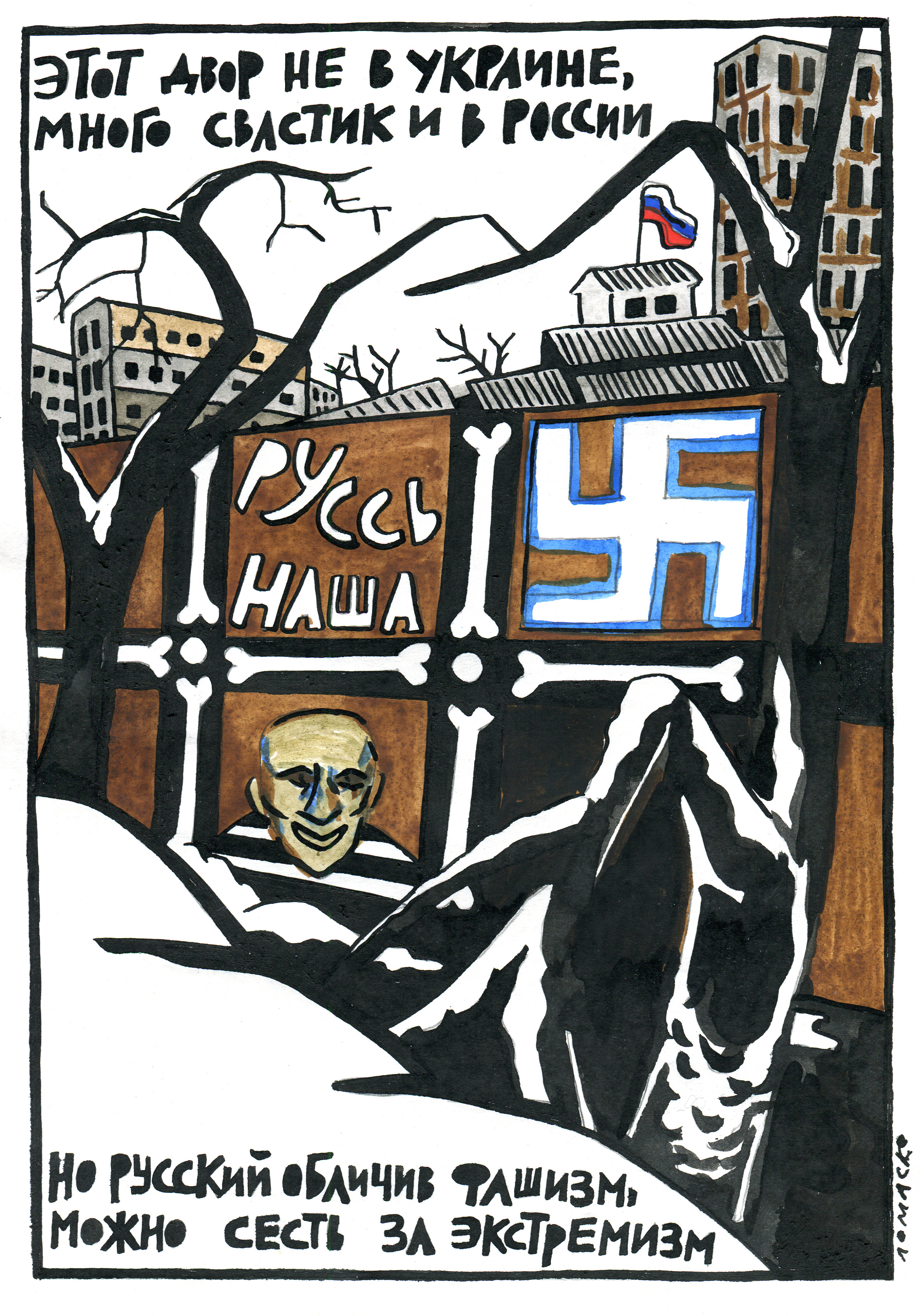
This is a real courtyard in my neighborhood, near a playground. Parents stroll around the yard with their children, discussing the news from “fascist” Ukraine.

Do I have the right to draw and show you this landscape featuring a swastika, a landscape that is fairly typical in Russia? During the recent trial of the Combat Organization of Russian Nationalists (BORN), their lawyer argued that the anti-fascists are just another street gang like the fascists. So why not label any denunciation of fascism “propaganda” of fascism itself?

Nationalists freely held an international congress in Petersburg in March. The only people the police arrested were the anti-fascists who protested the congress. Nationalists can walk around sporting neo-fascist symbols, but the authorities will prosecute publications that dare to publish photos of them. Juvenile prisons are filled with skinheads, but nationalist ideas are fomented on television.

Attn: Center “E”. I am opposed to fascism.

fashizm_colourThis yard is not in Ukraine. There are many swastikas in Russia, too. But if Russian citizens try to expose fascism, they can be charged with “extremism.” Inscription on wall: “Russ [sic] is ours!”

Ayder Muzhdabaev: To the Fourteen Percent

To the Fourteen Percent
Ayder Muzhdabaev
April 4, 2015
echo.msk.ru
facebook.com

Governments, international organization, and concerned citizens in different countries have been protesting against the increasing discrimination against the Crimean Tatars. They have demanded an end to the crackdown. Only in one country have no such protests been heard.

384662233

Guess what country?

For more than a year, its citizens have pretended not to notice that their government has been behaving towards the Crimean Tatars along the lines of the Third Reich, having cast this people in the role of collective outcast. Moreover, it is not only officials and supporters of the regime who have behaved this way, but its opponents as well.

“Opposition,” “intelligentsia”: it is no longer possible to write these words in Russian without quotation marks. In this entire country of 140 million people you will hardly find ten people who have spoken out publicly in defense of the Crimean Tatars. Almost all my Moscow “friends” have been silent as well. When I appealed specifically to them here on Facebook, telling them in detail about the plight of the Crimean Tatars in Crimea, I got zero likes and zero reposts from those whom I had imagined as my addressees.

It is worth pondering this situation and evaluating it on its merits.

An entire people have been made second-class citizens in their country. People have been deprived of the chance to listen to the radio and watch TV in their own language, and children cannot even watch cartoons in this language! People are intimidated. Some of them have disappeared without a trace, others are in prison. The rest simply sit at home crying from fear, a sense of injustice, and despair. No one can be punished (at least not yet) for expressing sympathy with the Crimean Tatars. So why has the cat got your tongue, citizens?

It is just that no one really cares at all.

I think that even if the Crimean Tatars are shipped from Crimea in cattle wagons, as they were in 1944, I will read two or three posts about it in Russian on Facebook, amidst an account of sluts at a bar and snapshots of beloved doggies.

It is because of this, and not for some other reason, that I do not believe this country can essentially change for the better.

The damned eighty-six percent are to blame for everything? Is that right?

Look who is talking, fourteen percent.

Ayder Muzhdabaev is deputy chief editor of Moskovsky Komsomolets newspaper. Image courtesy of Ukraine Today

Release Oleg Sentsov!

Oleg Sentsov first came to the attention of the international film world when he triumphed with his film Gaamer (Gamer) at the 2012 Rotterdam Film Festival. With the cruelty only hindsight can bring, Gaamer screened in the ‘Bright Future’ section of the festival, which aims to draw attention to idiosyncratic and talented newcomers.

The ‘bright future’ that Sentsov is looking at now involves a 20-year stretch in a Russian prison, condemned as traitor and terrorist. Sentsov was arrested by the Russian security services at home in Simferopol on 11 May 2014, and brought to Moscow where he is detained and awaiting trial on charges of terrorism. Though Ukrainian, of Crimean origin, the investigating authorities of the Russian Federation do not recognise Sentsov’s Ukrainian citizenship. In line with the March 2014 law on the assimilation of Crimea, Russia required any permanent resident of Crimea who held Ukrainian citizenship to declare their intentions of maintaining Ukrainian citizenship. The deadline for this process was April 18, after which all Ukrainian passport holders who resided in Crimea were deemed Russian citizens.

So Oleg not only languishes in a Russian jail, he languishes there deprived of his rights as a Ukrainian citizen, deprived of visits from diplomats of his country, and categorised as a Russian national who has betrayed his own country.

Mike Downey, “The ‘bright future’ of Oleg Sentsov,” openDemocracy, February 17, 2015

Sign the petition demanding the release of Oleg Sentsov.

Fish Fingers All in a Line

fishstick8

To all the Crimea-is-oursians out there and their fellow travelers in the “we won’t give back Crimea even after Putin goes” camp (e.g., Navalny and other members of the opposition) and their apologists in “the West,” just read the article I have linked to, below, as an April Fool’s joke.

It couldn’t be real, could it? I mean, because after the “return to home port” was accomplished, everything in Crimea has been just PEACHY! Hasn’t it?

And entre nous, the “Crimean Tatars,” who are they anyway? They sound like something you would slather on your fish fingers, not a real people with real rights.

Sorry for the interruption: you can go back to feeling smug about being real white people.

____________________

____________________

Anton Shekhovtsov
March 29, 2015

Speaking about the motives of the Russian-Ukrainian war, the author [of the article “Why did we ‘surrender’ Crimea?”; here, in Russian] makes a common mistake: she deems the Putin regime ideological, as indicated by the fact she mentions ideas of the “Russian world” as a motivation for annexing Crimea and the subsequent aggression.

In reality, however, the Putin regime is a right-wing authoritarian kleptocracy. By default, its kleptocratic essence already presumes the absence of any underlying ideology. This is not to say that the regime’s elite does not espouse any ideas. It does. These ideas include anti-Americanism, anti-Westernism, and anti-liberalism. However, all these ideas are negative (anti-), and even in their totality they do not produce anything that could be called an ideology, i.e., a positive system of beliefs.

However, the authoritarian nature of the Putin regime already highlights the fact that the regime may utilize discrete ideological elements in those cases when it is necessary to consolidate power. The regime instrumetnalizes elements of conservatism and Russian nationalism (the “Russian world”) and antagonistic imperialisms and plants them in Russian society to mobilize it and consolidate the kleptocracy. But these elements of real ideologies are not directly related to the nature of the regime. In other words, “Russian worlds,” “traditional values,” and “our grandfathers fought fascism” are fairy tales for the poor.

1209
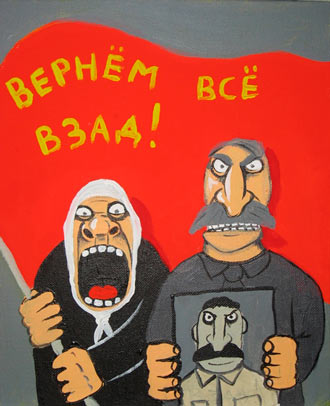
Vasya Lozhkin, “We’ll Bring It All Back!”

However many Ukrainophobes there are in Russia and among the Putinist elite, the destruction of Ukraine as a state is not an end in itself for the Putin regime. The Russian kleptocracy needs the Russian-Ukrainian war only to maintain its hold on power in Russia.

Source: Facebook. Translated by the Russian Reader. Cartoon courtesy of Vasya Lozhkin’s LiveJournal blog

An Apology for Fascism

Editor’s Note. Confused readers might imagine that the following (excerpted) screed from the hilariously named website The Saker (for the ornithologically challenged, the saker is a falcon used in falconry) is an apology for fascism. Actually, they’d be right.

* * * * *

“There are no separate Russia or Ukraine, but one Holy Rus” – Elder Iona of Odessa

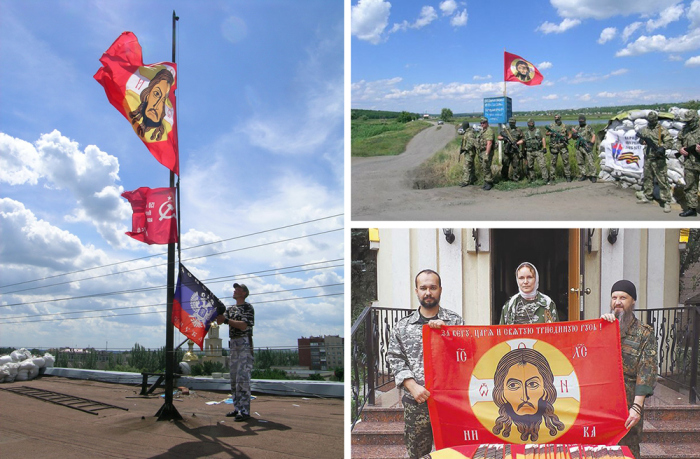
The year 2014 saw an unprecedented surge of patriotism in contemporary Russia, which resulted in popularizing the notion of the Russian World. One reason for increased patriotic sentiment was Crimea’s return to the home port after the overwhelmingly positive vote by its majority-Russian residents in a referendum one year ago. The onset of the liberation war in Donbass from the West-backed Kiev regime was the other. This war truly delineated the stakes for the existence of the Russian World. The latter is not an ethnic, but a civilizational concept that encompasses shared culture, history, and language in the Eurasian space within a traditionalist framework. To a certain extent and despite the obvious ideological differences, the Russian Empire and the USSR embodied the same geopolitical entity. A particularly noteworthy aspect of the ongoing crisis in Donbass is the symbolism—religious and historic—that surpasses the commonly used, but outdated Left-Right political spectrum. In the Russian context, this also means overcoming the Red-White divide of the Communist Revolution. That this war pushed Russians to examine their country’s raison d’être is somewhat remarkable: for two decades its citizens did not have an official ideology, prohibited by the Constitution that is based on Western models. The emergence of a new way of thinking in Russia will become clearer once we refer to the meaning of religious insignia, wars—Russian Civil and Great Patriotic, as well as the question of ideology in the Postmodern world.

mandylion-combined

[…]

In fact, post-Liberal ideology is one of the factors that blinds many Westerners to the realities of the liberation war in Donbass. The current Western model of citizenship is an abstract one: it centers around a set of principles in which individuals are interchangeable—as long as they adopt “European values” or the “American way of life”—instead of the more traditional notions of rootedness in the landscape, cultural and linguistic ties, and ancestral bonds. Thus, those who subscribe to this abstraction have difficulties understanding how belonging to the same people (narod) overrides living in two different states—contemporary Russia and Ukraine—haphazardly formed at the time of the Soviet collapse, and why they seem so attached to their language, culture, religion, history, and land that they are willing to die for them. But even for those Russians that lean toward more traditionalist thought, it took this war—the war that was meant to separate—to ideologically and spiritually unite them with others like them across the border, to begin questioning who they really are, uncertain, but hopeful, forging the idea of the Russian World. Beyond Left and Right, Beyond Red and White.

—Nina Kouprianova, “Beyond Left and Right, Beyond Red and White: Framing the Liberation War in Donbass,” The Saker, March 18, 2015

You would be right in asking, Who the heck is Nina Kouprianova? What does it matter what she thinks? But what this guy thinks does matter and he seems quite on message with Ms. Kouprianova:

Putin also addressed Ukraine’s struggles, saying “extreme nationalism is always harmful and dangerous,” and implied that Ukrainian voters would hold the parliament and the Poroshenko Administration responsible the country’s current mess. “I, for one, have always thought of Russians and Ukrainians as a single people,” he added.

His intentions could not be plainer.

Thanks to Comrade NT for the heads-up on this depressing new website.

“Return to Home Port”

KRYMFASH
Ayder Muzhdabaev
March 12, 2015

The other day, colleagues from several foreign media asked me to help them find ordinary people in Crimea willing to talk on camera about what their lives were like a year after Krymnash [Russia’s annexation of the peninsula].

Just about their lives, not about politics.

With Muscovite ease, I promised to help them out. And…

…it was not just that none of my many relatives and friends (except journalists) were willing to appear on TV, NO ONE even wanted to meet off the record with foreigners.

Their first argument was that foreigners would be followed, and at best a person who met with them would be dragged into the FSB for questioning, and at worst … You never know what.

Given that, over the past year, nine Crimean Tatars have disappeared without a trace, one was brutally murdered after being abducted, several people have been deported, several have been placed under arrest, and hundreds have been sentenced to hefty fines, I did not even bother trying to change their minds.

Such is the brownness that Russia has installed in Crimea.

Be proud if you like.

Source: Facebook

Ayder Muzhdabaev is deputy chief editor at Moskovsky Komsomolets newspaper.

__________________

natalya kokorinJournalist Natalya Kokorin

Dmytro Gnap
March 13, 2015

Two hours ago, the FSB detained our colleague Natalya Kokorin, a journalist for Slіdstvo.Іnfo and the Center for Journalistic Investigations. Intelligent and beautiful, Natasha has written many investigative reports about the redistribution of Crimean property, corruption, gangsters in power, and the Russian occupation. She and her colleagues have had to do many of their articles almost clandestinely. Today, the authorities began a search at her parents’ house when Natalya arrived there, and four FSB officers took her to their headquarters. The “Russian World” has quickly achieved victory in Crimea. A journalist who exposes the regime is a real threat to the federal and local ghouls. We are waiting for news from her lawyer and ask that you repost this.

Source: Facebook

__________________

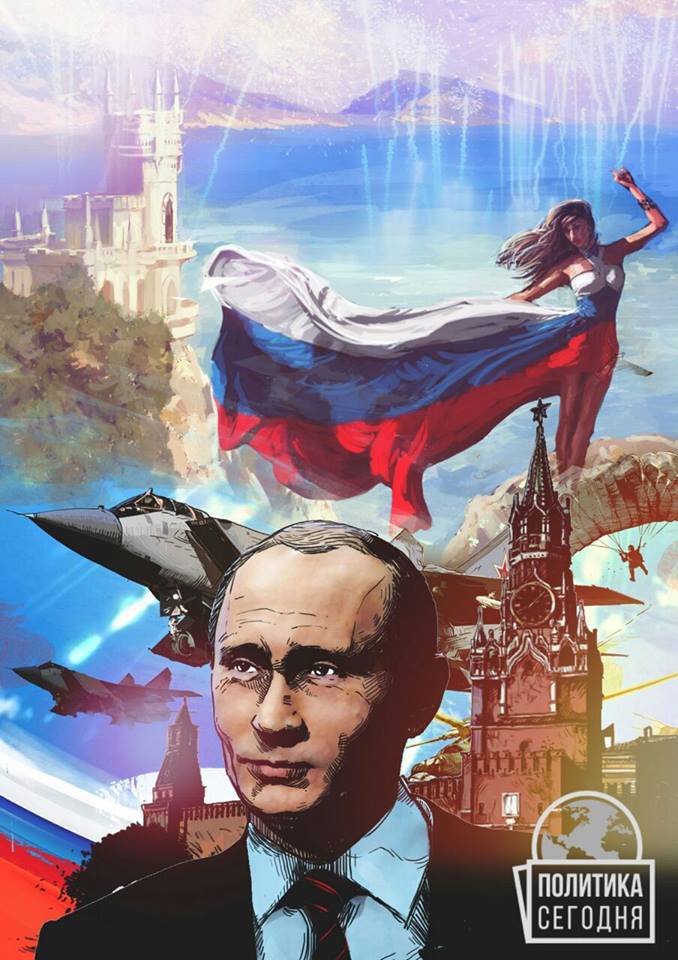
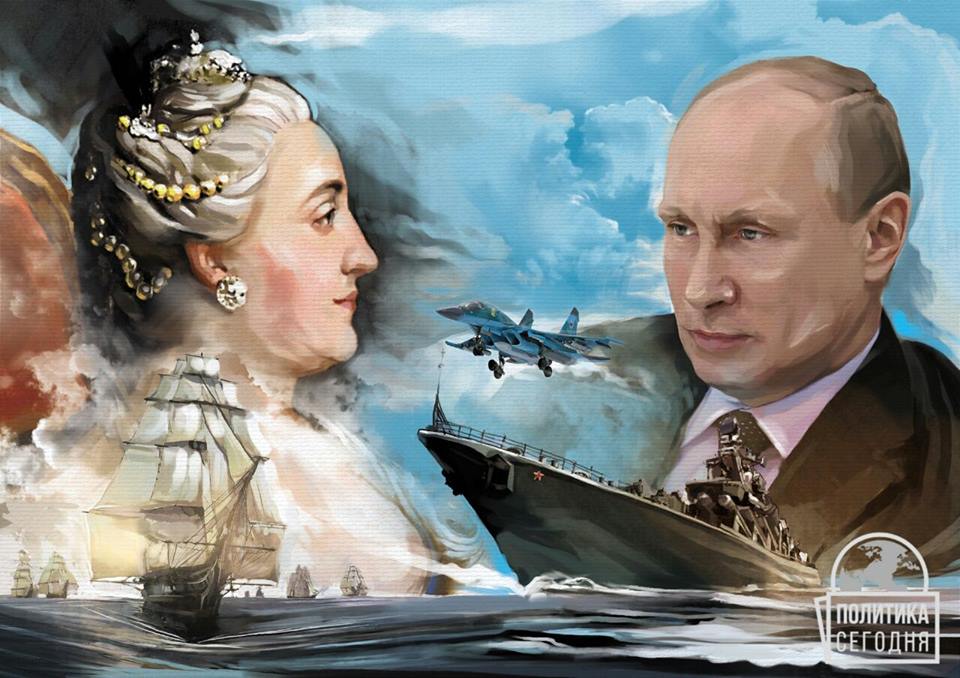
Anti-Maidan presents the exhibition Crimea: Return to Home Port

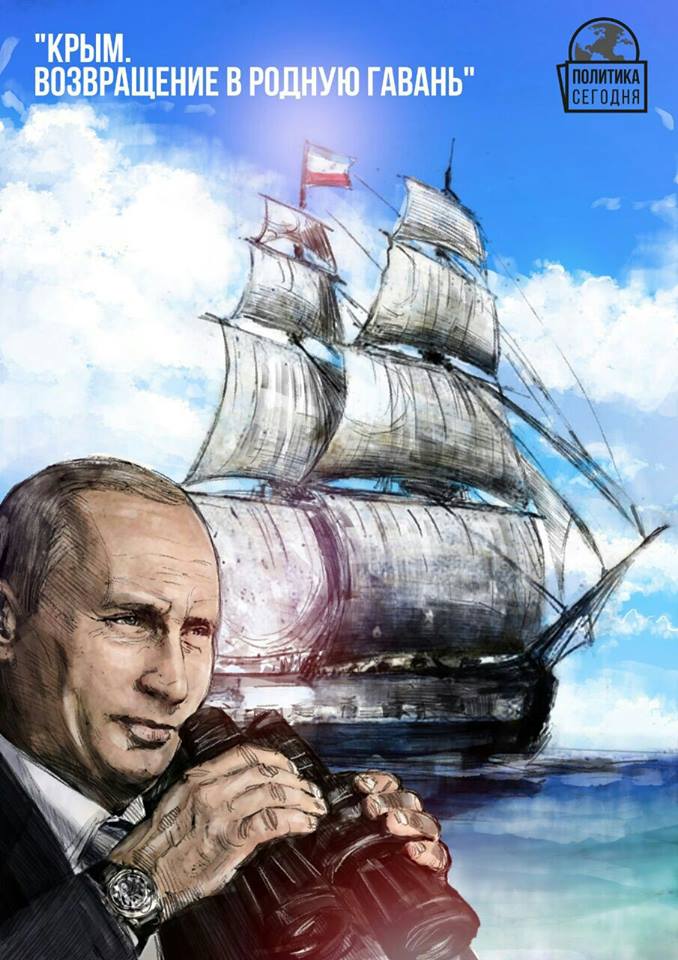
crimea-putinOn March 16 at 1:00 p.m. in Moscow, an exhibition of graphic art, Crimea: Return to Home Part, will open with support from the Anti-Maidan Movement and the Russian Bear Movement. The exhibition is dedicated to the anniversary of the referendum in which the residents of Crimea voted to join the Russian Federation.

crimea-putin-2The exposition in Novopushkinsky Square will feature about fifty works by patriotic cartoonists and graphic designers from the group Politics Today. The exhibition will send visitors back to the memorable events of the Russian Spring in Crimea. The work that will be presented at the exhibition are produced in the graphic design style [sic].

Members of the Night Wolves national motorcycle club and Julia Berezikova, co-chair of the Anti-Maidan Movement, will attend the event.

crimea-putin-3The exhibition will be held March 16 from 1 to 6 p.m. Admission is free.

Location and time: 1:00 p.m., Novopushkinsky Square, Moscow

Contacts: +7 926 430 2454 (Grigory)

Source: Emailed press release (courtesy of Comrade SC)

Solidarity with Alexander Kolchenko!

JOIN THE INTERNATIONAL SOLIDARITY CAMPAIGN FOR
ALEXANDER KOLCHENKO!

kolchenko0
Alexander Kolchenko is a Crimean anarchist, social activist, and antifascist who is being held by the Russian authorities. Along with other Crimean activists, he was kidnapped by the Russian FSB (ex-KGB) and is now detained as a political hostage in Lefortovo Prison in Moscow. He has been charged with committing “acts of terrorism” and “belonging to a terrorist community.”

Why is Alexander Kolchenko in jail?

Alexander, who has proven his antifascist stance over many years, is facing preposterous accusations of belonging to Right Sector, the radical Ukrainian right-wing organization, whose real role in Ukrainian events has been blown out of proportion by Russian official propaganda.

In modern Russia, any activist — left wing, anarchist or liberal — can be slandered as a member or sympathizer of Right Sector. This situation is comparable to the hunt for nonexistent Trotskyists under Stalin, or the McCarthy witch hunt for communists in the US. Putin’s authoritarian and nationalist regime, which uses everything from religious prejudices and conspiracy theories to outright racism in its propaganda, shamelessly steals antifascist rhetoric. And yet anyone who is considered bothersome is called a fascist, even if he/she stands on the opposite side of the political spectrum.

The case against antifascist Alexander Kolchenko and civil activist and film director Oleg Sentsov (investigators enrolled them in the same “terrorist” group) is political. It is meant to intimidate the inhabitants of Crimea and prevent any resistance on the peninsula. The most authoritarian of methods are now used in annexed Crimea to repress all dissent. Many people have been forced to leave Crimea because their life and freedom were threatened: lawyers, left wing activists, student and trade union activists, anarchists, antifascists, and Crimean Tatar activists who have fallen victims of ethnic discrimination.

What does Alexander Kolchenko face?

Alexander Kolchenko is threatened with a terrible prison sentence of up to 20 years for a non-existent “terrorist attack” in which he was not involved. Kolchenko and other Ukrainian political prisoners have been detained only to demoralize the opposition through show trials. Their freedom is directly linked to the stability of the Putin regime. If we can shake Putin’s confidence in his impunity, the prisoners will be set free. There is no hope that Kolchenko, Sentsov, and others will be given fair trials. Their arrests were unlawful, and the charges against them are far-fetched. It was not a mistake: the regime knows what it is doing.

How can you help Alexander Kolchenko?

We are asking international left wing and libertarian forces for help. You can organize and lead actions of protest and solidarity, write letters to Kolchenko, and send donations to pay for lawyers, food parcels, and support for his family. It is also important to spread information about his case. Most of all, we need to dissociate ourselves from any forces that support the aggressive expansion of Russian nationalism, even if they cover it up with leftist and anti-imperialist rhetoric. Putin’s regime is doing just fine without your sympathy. You had better save it for those who are its victims.

When should you start?

You can start right now by helping us spread this appeal, translating it into other languages, and sending it to comrades. We also strongly encourage you to organize demonstrations from April 1 to 7, 2015, in support of Alexander Kolchenko and other political prisoners jailed in Russia. Sentsov’s and Kolchenko’s current terms in pretrial police custody end on April 11 and 16, respectively. In the first half of April, Lefortovo District Court in Moscow will decide whether they should await trial in jail, be placed under house arrest or be released on their own recognizance, Only strong, massive pressure on the Putin regime and protests around the world will make it possible to set our comrades free. We demand their immediate release and the dropping of charges against them.

kolchenko6

You can find more information below.


Contact us at freekolchenko@gmail.com