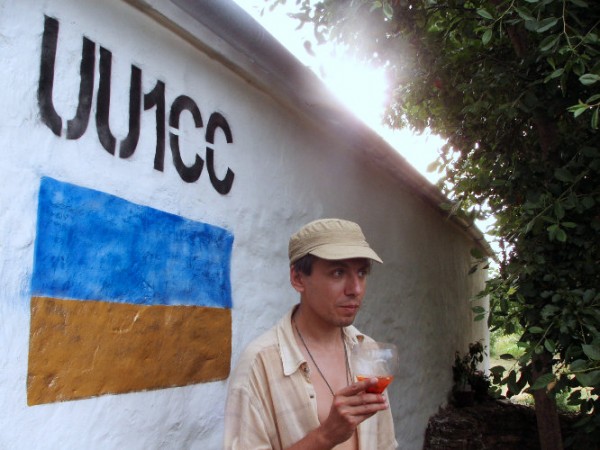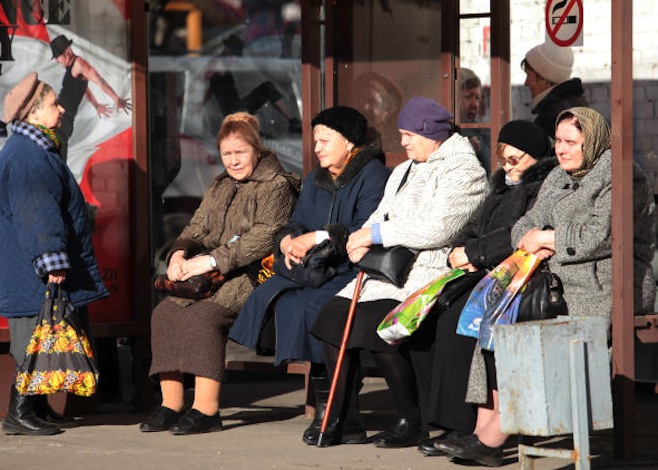
Base?

pensions
Russia’s old-age pensioners: menace to Russian liberal democracy?

Slava Rabinovich
October 2, 2015
Facebook
#‎ConcreteWall‬

Inflation: 14-17% in rubles.

Consumer basket inflation: 25-70% in rubles (depending on the specific consumer basket).

Currency devaluation:  50%. The value of foreign currency has risen 100%.

The government has decided to index pensions for inflation only by 4% in 2016.

Pensioners vote for Putin.

Putin has stoked and burnt their money in Crimea, Donbass, and Syria, and on an insane military and security services budget, and has stolen trillions right from the same budget.

Pensioners vote for Putin.

Putin has lucked out with pensioners.

________

And yet a little over ten years ago, it was the old-age pensioners (rather than portfolio investors like Mr. Rabinovich or the “rising middle class”) who mounted the first serious, massive grassroots challenge to Putin’s policies and his rule. 

Maybe the old-age pensioners have gone silent now and no longer want to mount such challenges to Putin’s rule. But it is quite amazing to observe so many able-bodied and mentally competent folks in the prime of their life engaged in casting around for whole (mostly imaginary, mostly disempowered, mostly lower) classes of people to blame for Russia’s slide into totalitarianism lite. What sense does it make to say that any whole class of people “votes” for Putin and constitutes his “base,” when we know that elections in Russia are rigged six  ways to Sunday? 

This is not say that Russia’s old-age pensioners shouldn’t be distressed by their deteriorating economic fortunes, as reflected in the distressing and real figures cited by Mr. Rabinovich, above, but the search for the “rubes” who have buttressed Putin’s rise to minor godhood should start with the classes of Russians who have really benefited from his rule. It has most signally not been the mass of old-age pensioners who have made out like bandits, although they may be more vulnerable, in some instances, to Putin’s propaganda machine and, at the local level, to the blandishments offered by the United Russia electoral machine.

If anything, my own (albeit limited) experience of grassroots protest campaigns in Petrograd has shown me that, more often than not, retirees and oldsters do more than their fair share of shouting, tussling, and scrapping with the powers that be.

But it must be nice for Russia’s worldly and well-heeled urban hipsters, thirty- and fortysomethings, and go-getters (whose brains, again in my limited experience, are no less addled by the popular prejudices of the Putin era, and whose bodies are no less averse to putting themselves in harm’s way) to imagine that Putin’s “base” is made up of old-age pensioners, the chronically poor, blue-collar workers, and residents of the Russian hinterlands.

__________

Putin Reforms Greeted by Street Protests
Steven Lee Meyers
January 16, 2005
New York Times

KHIMKI, Russia, Jan. 15 – Mikhail I. Yermakov, a retired engineer, has never before taken to the streets to protest — not when the Soviet Union collapsed, the wars in Chechnya began, the ruble plummeted in 1998 or President Vladimir V. Putin last year ended his right to choose his governor.

On Saturday, however, he joined hundreds of others in the central square of this gritty industrial city on the edge of Moscow in the latest of a weeklong wave of protests across Russia against a new law abolishing a wide range of social benefits for the country’s 32 million pensioners, veterans and people with disabilities.

Demonstrations were held in at least three other cities in the Moscow region, in the capital of Tatarstan and, for the fourth straight day, in Samara in central Russia. In St. Petersburg, several thousand demonstrators blocked the city’s main boulevard, with some calling for Mr. Putin’s resignation.

Taken together, the protests are the largest and most passionate since Mr. Putin came to power in 2000. They appear to have tapped into latent discontent with Mr. Putin’s government and the party that dominates Parliament, United Russia.

“It is spontaneous, and this is the most dangerous thing for the authorities,” said Mr. Yermakov, 67, as speakers denounced the government from a step beneath a hulking bust of Lenin. “It is a tsunami, and United Russia does not understand that it is going to hit them.”

The law, which took effect on Jan. 1, replaced benefits like free public transportation and subsidies for housing, prescriptions, telephones and other basic services with monthly cash payments starting at a little more than $7.

In a sign of bureaucratic inefficiency, some of those eligible have yet to receive any payments.

Mr. Putin and United Russia’s leaders have defended the law as an important reform ending a vestige of the old Soviet Communist system, but they clearly failed to anticipate the depth of opposition from those who relied most on the subsidies: millions of Russians living on pensions of less than $100 a month.

The protesters have denounced the payments as insufficient to cover the cost of the benefits and as miserly for a country that recently reported a budget surplus of nearly $25 billion.

As the protests unfolded in city after city across Russia, the Patriarch of the Russian Orthodox Church, Aleksei II, who typically allies himself with what is known here as “the party of power,” questioned the law and the government’s handling of it.

“What counts is that this policy should be fair and effective,” he said in a statement on Thursday. “It should be met with understanding by the people. The latest events show that these principles are not observed in full.”

Aleksei P. Kondaurov, a Communist member of the lower house of Parliament, said the law and the protests underscored the shortcomings of the political system that had evolved under Mr. Putin, one dominated by United Russia, which has refused to debate with opposition parties, let alone compromise with them.

“It was clear that it was not carefully calculated,” Mr. Kondaurov said of the new law in an interview.

Mr. Kondaurov predicted the protests would grow and spread to other pressing social issues, which he said Mr. Putin’s government and United Russia were ignoring.

At a minimum, the protests have raised doubts about Mr. Putin’s other proposed reforms, including those in banking, housing and electricity, which were supposed to be the centerpieces of his second term.

“It’s not going to be like Ukraine,” Mr. Kondaurov said, drawing a parallel, as some have here, to the far larger demonstrations that overturned the election there for president in November. “But it is clear to me that a political and economic crisis is taking shape in Russia.”

After first brushing off the protests, United Russia’s leaders have begun scrambling to respond. They have accused the Communists and other parties of inflaming tensions and have tried to deflect blame to regional governments, which they say are responsible for implementing the benefit changes.

Some local governments, most prominently the Moscow city administration, have vowed to reinstate the benefits stripped at the federal level, but few other regions are wealthy enough to afford to do so.

On Friday, the chairman of Parliament’s social and labor committee, Andrei N. Isayev, said that next week, lawmakers would consider raising pensions by 15 percent in February, rather than 5 percent in April, as now planned.

Others in United Russia have also tried to distance themselves from Mr. Putin’s new government, which has been in place for only 10 months. The deputy speaker of Parliament, Lyubov K. Sliska, said Friday that she did not rule out the dismissal of Prime Minister Mikhail Y. Fradkov and his cabinet.

But the protests have continued to grow. They began quietly, with a rally organized by the Communist Party in Solnechnogorsk, near Moscow, on Jan. 9, the 100th anniversary of the 1905 uprising.

A day later, here in Khimki, several hundred people briefly blocked the main highway to St. Petersburg in what several of those involved called a spontaneous uprising. After a scuffle with the police, 12 elderly protesters were arrested, but initial threats to prosecute them were quickly dropped.

Since then the protests have erupted in at least a dozen other cities, drawing thousands. In Tula, 110 miles south of Moscow, aging protesters clashed with bus conductors who refused to allow them to board city transport without paying, prompting the city to post police officers on the buses.

In Novosibirsk, in Siberia, a dozen pensioners mailed their cash payments for transit — the equivalent of a little more than $3 — to Boris V. Gryzlov, the leader of United Russia and parliamentary speaker, according to the Regnum news agency.

The protesters here in Khimki’s central square on Saturday represented those who have fared the worst in Russia’s post-Soviet transition.

Mr. Yermakov’s monthly pension equals roughly $85 a month. As a resident of the Moscow region, a separate administration from that of the city government, he qualified for a supplement of $7 to replace the subsidies lost under the new law. The bus fare for three trips to the small tract of land he is allowed for planting a vegetable garden, four miles away, will take nearly half that amount.

Vladilena T. Berova, whose given name is an homage to Vladimir Lenin, served at the end of World War II as a corporal in Soviet intelligence and went on to work as a psychotherapist for five decades in Moscow. Now 78 and widowed, she survives on 2,000 rubles a month, about $71.

“The fascists took my youth,” she said, referring to the war. “And now these people are taking away my old age.”

The protests have included something still rare in today’s Russia: personal criticism of Mr. Putin, who has remained popular by projecting an image of stability, one carefully protected by officials and state television.

“Instead of listening to us, he is listening to an organ,” Mr. Yermakov said, referring bitingly to Mr. Putin’s participation in the unveiling of a newly restored organ in St. Petersburg on Friday with Germany’s president, Horst Köhler.

The benefits law has already been credited, at least in part, with a slip in Mr. Putin’s ratings, as well as a general decline in the public’s mood.

A poll by the Levada Center, released on Saturday, said that only 39 percent of Russians considered Mr. Putin the most trusted politician. That is still higher than anyone else, but a drop from 58 percent a year ago.

Sergei Y. Glazyev, a member of Parliament who challenged Mr. Putin during the election for president last year, said in an interview that “the people’s struggle for social rights” should be decided in a national referendum, rather than imposed by the Kremlin and its governing party. Voters, he said, had been fooled.

“A majority of those who voted for Putin,” he said, “had a quiet different expectation of what they would get.”

Mr. Rabinovich’s Facebook post translated by the Russian Reader. Image, above, courtesy of the Moscow Times
Oleg Shevkun: “I Don’t Know How to Trim My Sails to the Wind”

“I Don’t Know How to Trim My Sails to the Wind”: The Head Editor of Radio Station for the Blind on His Dismissal for Speaking Out on Crimea
Darina Shevchenko
October 6, 2015
Yod

36812
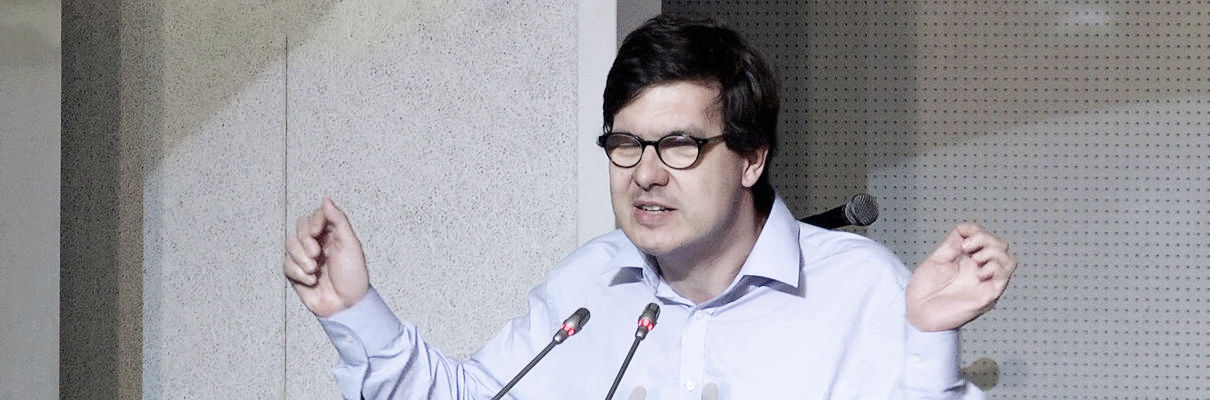
Oleg Shevkun. Courtesy of his Facebook page

Oleg Shevkun, head editor of the online radio station of the All-Russia Society for the Blind (VOS), was fired after making comments on the air about the unlawfulness of incorporating Crimea.

“I think that, from the viewpoint of international law, the incorporation of Crimea was unlawful. And the countries that responded to it with sanctions are right. We got Crimea along with isolation from the rest of the world,” Shevkun said on the air.

The VOS confirmed to Yod that Shevkun had not worked since late September: he had resigned voluntarily. Shevkun, who is wholly visually impaired, told Yod about his firing and what he planned to do next.

Why did you start talking about the incorporation of Crimea on Radio VOS, which, according to its website, is engaged in “covering all aspects of the life, work, and adaptation of people with visual impairments”?

We have tried to stay away from politics on our radio station, but it turns out to be impossible. From September 14 to September 20, the VOS held a big festival entitled “Crimean Autumn.” The point of the festival was to gather the visually impaired people of Crimea and pass on the VOS’s know-how to them. Radio VOS was involved in the festival, and on the eve of the festival we got a question from a listener in Ukraine while we were on air: “Are you going to Crimea for reasons of conscience or because your job requires it?” I could have left the question unanswered, but I am used to speaking sincerely with people. I said that my conscience did not bother me, but that I considered the incorporation [prisoedinenie] unlawful from the viewpoint of international law, and was surprised how Crimea had become part of Russia. And that I was even more surprised that this idea had been supported by the residents of Crimea. Then I added that we were going to visit people who had supported this business, and we had something to offer them.

So you did not use the word annexation” [anneksiia]?

No, I think I answered the listener’s question politically correctly. The head editor had to voice his own position on Crimea. And this was what I did. I should note that no one who called into the studio during this program disputed the unlawfulness of Crimea’s incorporation into Russia. Listeners said, Well, what of it? America breaks the law, too. If it is going to be “Well, what of it?” then we will be living by the laws of the jungle. Mom taught me not to steal, the Bible says, “Thou shalt not steal,” and in contentious situations you have to negotiate.

What happened after this broadcast?

At the festival in Crimea, one of the participants asked Alexander Neumyvakin, the president of the VOS, why management was not monitoring the content of programs on Radio VOS. Neumyvakin said there are different opinions, but the program was soon deleted from the archive. Vladimir Bazhenov, director general of the VOS cultural and sports rehabilitation complex, told me I would be fired after the festival.

How did he explain this decision?

The radio station survives on subsidies from the state. If the higher-ups find out we have been criticizing Crimea’s incorporation, blind people will end up out of work and without rehabilitation.

Do you think he was expressing his own fears or did he get a signal from higher up?

Bazhenov told me the Ministry of Foreign Affairs knew about what I had said about Crimea. But I think he was playing it safe. During the following program [at the festival], the blind people of Crimea said they had been shocked by what the head editor of Radio VOS had said, and had welcomed the “little green men” like family. In the evening, at the banquet celebrating the end of the festival, after one of the toasts it was announced that among us there was a certain person . . . Basically, he no longer worked at Radio VOS. And they called my name. I was asked to publicly renounce my beliefs; then, maybe, I could keep my job. I refused to refute my personal opinion. Bazhenov  replied that, if that was the case, I should either resign voluntarily or they would fire me for cause and I would never be able to get a job again. I was not allowed to host my programs, for example, a talk show about new technologies for visually impaired people. We took second place with this talk show at a competition for radio programs in the Central Federal District.  I used to think that such situations happened only in Alexander Solzhenitsyn’s books.

How did your colleagues react to your dismissal? Did they try and defend you?

My colleagues were told I had said on air that Crimea had been annexed, although this was not the case. There was a co-presenter with her own position and two listeners on the program in which we discussed Crimea. Everyone voiced different opinions, as should be the case when an important topic is discussed. The management objected: what had been acceptable two years was now impossible, and I should have sensed which way the wind was blowing.

36817
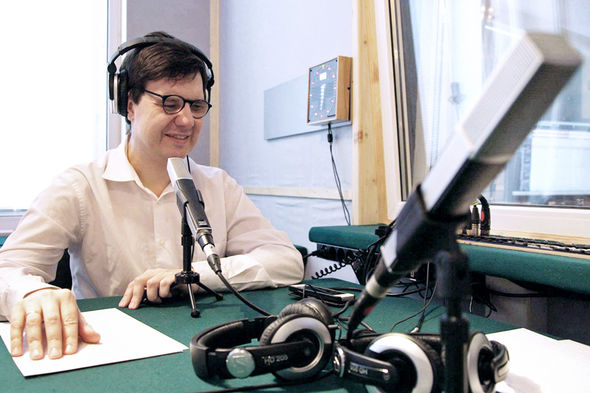
Oleg Shevkun on the air at Radio VOS. Courtesy of his Facebook page

What did you say?

I don’t know how to trim my sails to the wind. If I follow the wind all the time, what will be left of me?

Had you made any political statements on the air earlier?

When Russia’s isolation from the world began, we did the program “Navigator,” about the lives of blind people around the world, and we established a partnership with a radio station for blind people in Great Britain. We did a big interview with Seva Novgorodsev and Dina Rubina. We have tried to remain open despite the trends in society. We did programs with blind Ukrainian people, and they talked about what had changed for the better for them after the change of regime. “Crimea is ours” [Krymnash] was also in our programs. For example, I did an interview with Sergei Aksyonov, the head of Crimea.

Have you found a job yet?

I am still looking, but I am confident there will be work, despite all the complications. After my firing, a nasty text about me, entitled “Anatomy of Freedom” (by analogy, apparently, with “Anatomy of a Protest”), was leaked onto forums and social media.  It explains to our listeners that I am an “American sectarian” and that I have “American curators.”

Why was it necessary to write and distribute a text like that?

After my firing, listeners were outraged and asked questions. The text explained to them who I was.

The text also says that “under your leadership, Radio VOS really became a ‘ray of light’ for many blind people.” Tell us how you got the job of head editor at Radio VOS and what you accomplished during your time in the post.

I was a pastor in the Evangelical Church, taught, and always dreamed of working on the radio. In 2011, VOS Radio was founded, and I began doing a show there on technologies for the blind. The ratings went up. In 2013, I was offered the job of head editor.  Under my leadership, the team managed to increase our listenership by several times. We have a great team consisting of ten professionals, both sighted and visually impaired people. I am certain they will go on working at a high level. We have won prizes at different festivals where such famous radio stations as Echo of Moscow and Radio Russia were involved.  Many new programs have come on the air, for example, a program about how blind people can solve everyday problems. On the show “Student Council,” students talked about how blind people should behave in a university cafeteria and adapt to life in a dormitory. We broadcast music by visually impaired musicians. It was very important to us to establish a dialogue with our listeners. For example, blind people sit at home and need to break out of this isolation.

The presenters give them the opportunity to call on the air; they guide them through the discussion, support them, and inspire them. For example, a man calls on the air and says he hesitates to use a white cane. The presenter asks him which is more shameful, to go out carrying a white cane or stay put at home. The man finally agrees  he should get out of the house.

Or, for example, we had a blind man from Yekaterinburg, Oleg Kolpashchikov, who sails, on the air. He and his crew of blind people have traveled nearly around the world. Kolpashchikov talked about what it had been like when he lost his sight. He is even glad to be blind now, because it is disgusting to have to look at some people’s faces. He said all this in a pleasant bass voice, calmly, easily, positively. Maybe he said it crudely, but such words give confidence to people who have recently gone blind.

So you almost never discussed sociopolitical topics on the air?

Very rarely.

Do you regret you expressed your opinion about the incorporation of Crimea and lost your beloved job?

The director general said he had not been happy with my political position for a long time. I did not hide my political views. For example, I came to work wearing a “I am praying for Ukraine” ribbon. My dismissal was a matter of time. I grew up on Radio Svoboda and Echo of Moscow, and cannot quickly cave in to a fickle world.

Alexander Kolchenko and Oleg Sentsov Are Hostages
On Kolchenko and Sentsov’s Sentences
August 26, 2015
www.shiitman.ninja

179003Alexander Kolchenko and Oleg Sentsov
It is important to realize that the sentences that Kolchenko and Sentsov received are a fiction.

No one actually takes the charges against them seriously.

Even the most loyal Putinists do not take the charges seriously. What terrorism? What does the Right Sector have to do with any of this?

Kolchenko and Sentsov are hostages. Their being held in a Russian prison is an act of intimidation directed at the Crimeans who stayed home but could have fought back. Their being held in prison is an act of intimidation directed against all the people of Ukraine and those Russian citizens who could have supported them.

The trial was a fiction. The verdict is a fiction. That is why I reacted without emotion to the sentences, although I understand the shock felt by many comrades, among whom there are close friends of both Kolchenko and Sentsov. Twenty years and ten years in prison? The Russian judges could have give them sentences of forty years and twenty-five years. Or given both of them life sentences. Or given them each six months in prison, then retried the case. Or they could have not announced the verdict at all, but just laughed and made faces. Or mannequins dressed in judicial robes could have replaced the judges. Nobody would have noticed the difference.

Kolchenko and Sentsov are in prison as long as the Russian Federation is ruled by Putin’s repressive, aggressive authoritarian regime. They cannot be freed using lawyer’s tricks. They cannot be freed via “diplomatic channels.” They can be freed only by defeating Putinist Russia. Or if it “defeats” itself by choking on its own rage and madness.

And when that happens, it will not matter a whit what numbers have been written in Kolchenko and Sentsov’s sentences. It doesn’t matter what the judges whip up in Savchenko’s sentence. The release of the hostages does not depend on the actions of lawyers. It depends on politicans and military men. And, in part, on the price of petroleum.

As soon as the “Russian bear,” who has turned out to be a rabid rat, finally kicks the bucket, all the regime’s hostages will be freed.

Translated by The Russian Reader. As is nearly always the case, my opinions might not coincide entirely with those expressed by the authors whose texts I translate and post here. But it has been strange to read the angry reactions of leftist progressive Russian comrades to this particular text given the almost total lack of any visible, public solidarity with Sentsov and Kolchenko on their part.

I won’t even go into the haziness they and many other “ordinary” “apolitical” Russian citizens experience when figuring out who to blame for the whole mess in Ukraine. But this is the privilege all imperialist, metropolitan peoples enjoy: pretending not to know or understand what is being done in their name somewhere else in the world.

_________

Russia’s Sentsov–Kolchenko case “an absolutely Stalinist trial”
Halya Coynash
August 21, 2015
khpg.org

The prosecutor has demanded 23 years for Ukrainian film director Oleg Sentsov, and 12 years for civic activist Oleksandr Kolchenko in a case with no crime and where all evidence was obtained through torture. Russian human rights activist Zoya Svetova likens this to Stalinist repression, not a court trial.

Svetova has seen a huge number of trials over the last 15 years, but nothing like the “absolutely insane hearing” on Aug 19. She can’t remember a case where, with no elements of a crime, or criminal (terrorist) acts, the prosecutor should be seriously demanding 23-year and 12-year sentences. This, the fact that everybody expects the court on August 25 to convict two innocent men, and much more, she says, is reminiscent of Stalinist repressions where people were arrested for nothing.

Sentsov is charged with leading a ‘terrorist organization,’ Kolchenko of taking part in it and involvement in one specific firebomb attack on a pro-Russian organization active in helping Russia seize control of Crimea in 2014.  There is no evidence that an organization even existed, and the only specific charge against Kolchenko is one that has not previously been classified by any Russian court as ‘terrorism.’

“The prosecutor is demanding 23 and 12 years for people accused of crimes they didn’t commit. Today Sentsov and Kolchenko’s lawyers clearly demonstrated that there are no elements of a crime in this case, nor any criminal act. On August 19, 2015, I saw a totally Stalinist trial. Three judges were sitting there, a real ‘troika,’ with cold, virtually dead eyes who were listening to the prosecutor and the lawyers,” Svetova writes here.

Another of the disturbingly Stalinist features of this case has been the fixation on some demonized organization, in this case the far-right and nationalist Right Sector. Russia has constantly exaggerated this organization’s role in both Euromaidan and subsequent events in Ukraine.  There was even a Russian media attempt on the night of the Ukrainian presidential elections on May 25, 2014, to claim distortion of the election result after the Right Sector candidate gained a pitiful 0.9% of the votes. It was therefore no surprise that five days after those elections, the FSB should have claimed that it had uncovered a supposed Right Sector ‘terrorist plot.’  It has never produced any evidence at all, nor did any of the witnesses for the prosecution even demonstrate a clear understanding of what the Right Sector is, although they were all convinced it was dangerous, etc.  There is nothing to link Sentsov, the left-wing and anarchist Kolchenko or Gennady Afanasyev with the far-right organization. In court on Wednesday, the prosecutor Oleg Tkachenko changed their story, saying that Sentsov and Kolchenko are not accused of membership in Right Sector, but of having “taken on the ideology of this organization as a guide for action.” What this means remains a mystery since the court has not demonstrated any interest in seeking clarification on this subject or with respect to the numerous other discrepancies in the prosecution’s case.

At the final hearing on Wednesday, the defence demolished all of the charges against the two men, then Dmitry Dinze, Sentsov’s lawyer, read out the account given by Gennady Afanasyev of how he had been tortured to get him to testify against Sentsov.

As reported, Afanasyev and Oleksy Chirniy were arrested at the same time as Sentsov and Kolchenko.  Their ‘confessions’ and testimony are literally all that the charges against Sentsov are based on. It is therefore of critical importance that Afanasyev retracted his testimony on July 31, stating that it had been given under duress.  He then spoke for the first time to a lawyer not provided by the investigators and gave a detailed account of the torture applied immediately after his arrest, and also the pressure placed on him to repeat this testimony in court. As well as threats against him, a FSB officer who appeared at the prison warned him that his mother “could have an accident” if he didn’t cooperate.

All of this information was read to the court. The judges simply looked down and did not react in any way, and the prosecutor continued to demand 23 and 12 years.  It should be stressed that the details in Afanasyev’s account fully coincide with those given by Sentsov, and Chirniy is also known to have told the Ukrainian consul that he had been forced to ‘confess.’

Unlike the players in this modern-day show trial, the renowned Memorial Human Rights Centre has taken Afanasyev’s account seriously.  On August 19, it issued a statement recognizing Afanasyev as a political prisoner and warning of the danger he is now in. This follows a similar statement and damning assessment of the ‘trial’ of Sentsov and Kolchenko.

Sentsov’s final statement was, as all previous statements, courageous and moving. So too was Kolchenko’s, who spoke of the fact that the court had heard about the use of threats and torture by the FSB against Sentsov and Afanasyev.

“It’s interesting that people using such methods to obtain testimony have no qualms about accusing us of terrorism.”

He called the charges against them fabricated and politically motivated, and said that this trial, like those against Nadiya Savchenko, the Bolotnaya Square protester, and others are aimed at extending the life of the current regime.

“Yet throwing us in prison, this regime speeds up its end, and those people who still yesterday believed in law and order, today, watching such trials, have lost that faith. And tomorrow or the day after tomorrow, those people who are part of the 86 percent [supposedly supporting President Vladimir Putin – HC] will overturn this authoritarian regime.”

Kolchenko noted that, in the letter read out to the court, Afanasyev said that the FSB officer had told him that the day he gave testimony in court would be the most important day in his life.

“Seemingly, Afanasyev took those words to heart and interpreted them in his own way. I was very taken with this great and powerful act of his.”

Gennady Afanasyev is in danger; Oleg Sentsov and Oleksandr Kolchenko are facing long sentences on preposterous charges.  And Russia is descending into a frightening Soviet tradition in which people are tortured for ‘confessions’ with neither the prosecutor nor the judges even batting an eyelid when this is demonstrated to the world.

Please write to all three men!

The website of the Solidarity Committee with the Crimean Hostages will try to get messages to them.

solidarityua.info

In the first box, write one of the following names one at a time:

Олег Сенцов (Oleg Sentsov)

Олександр Кольченко (Oleksandr Kolchenko)

Геннадий Афанасьев  (Gennady Afanasyev)

Then in the next box, write your name.

The next box asks for a telephone number if you wish to give it. An email address is, however, needed (the fourth box).

Finally, in the fifth box, write your message.

The key aim is to ensure that all three men know that they are not forgotten. The following would be quite sufficient (if you do write in Russian, please avoid anything controversial or overly political).

Мы восхищаемся Вашим мужеством и надеемся на Ваше скорое освобождение.

Спасибо, что нашли в себе силы остаться честным с самим собой.

Держитесь!

(We admire your courage and hope for your speedy release. Thank you for finding the strength to remain true to yourself. The last word is a word of support, like “take care!”)

The question under the last box asks whether you are on social networks: yes, no, in that order (or leave it blank)

Then hit SEND.

Thanks to Comrade SP for the heads-up. I have lightly edited the text to make it more readable.

Tolokonnikova and Alyokhina on the Sentsov-Kolchenko Verdict

Masha Alyokhina
August 25, 2015
Facebook

“I don’t know what is worth doing if you cannot die for it,” said Sentsov.

“We are discussing narrow questions,” said the judge, interrupting him.

Our “twofer” was piddly shit compared with this. Just imagine being locked up in a prison colony not for two autumns, but twenty, and for just as many winters. Sentsov is a single father who has been sentenced to twenty years in a maximum security prison by Russia.

His sister says, “We fear Oleg will be forgotten.”

If convicts in Russia can be forgotten by those on the outside, inside they can be killed. I hate this system under which it is so easy to kill.

The anarchist Kolchenko was sentenced by Russia to ten years hard time.

We must not forget them. They laugh at the verdict of a country that took them hostage.

Ten and twenty years in prison.

Hang in there, please, we are with you.

11889477_1182943075054229_5283665799208464809_nAlexander Kolchenko and Oleg Sentsov
__________

Nadya Tolokonnikova
August 25, 2015
Facebook

“Well, what did you need to go and do that for? You’re a young, pretty girl, and what have you got yourself into? When you get out, who’s going to remember you? Who’s going to want you, silly goose? Why are you so stuck on politics?”

Coppers and screws always talk this way, because they don’t understand how someone could not break down and admit their guilt. After all, if you confess, they promise to reduce your sentence.

Oleg, you will get out earlier, of course. And whatever they say to you in there, we will not forget you.

Translated by the Russian Reader. Photo courtesy of Masha Alyokhina

Askold Kurov: The Importance of Solidarity

Askold Kurov, filmmaker:

I have been shooting the film Release Oleg Sentsov for over a year, since Oleg was brought to Lefortovo Remand Prison in Moscow, and the first hearings in his case were held. The case is an unbelievable absurdity, an absolutely Kafkaesque story. I hope that the film will draw attention to these terrible events. Unfortunately, however, hopes for a favorable outcome, for Sentsov and Kolchenko’s acquittal, are nil.

But this does not mean we should all keep quiet and give up on attempts to do something. It is clear that the lives of Sentsov, Kolchenko, and Afanasiev hinge on people who ignore appeals from cultural figures and people’s public expressions of support for the arrested men. Maybe the appeals and protests even anger and irritate them. But sooner or latter they will have an effect. The time will come when the regime will no longer be able to hold the men hostage. Due to the fact that directors, filmmakers, and the public showed their solidarity and constantly brought up the case, the men might be freed from prison.

Source: snob.ru

_________

Alexander Kolchenko: Closing Statement in Court

“By throwing us in prison, the regime is hastening its end”
Closing statement by anarchist Alexander Kolchenko, accused of terrorism
August 19, 2015
kasparov.ru

I deny the charges of terrorism. This criminal case was fabricated and politically motivated. This is borne out by the fact that a criminal arson case was filed only ten days after the arson itself under [Russian Federal Criminal Code] Article 167 (“Intentional damage and destruction of property by means of arson”) and was changed to a terrorism case only on May 13, after [Gennady] Afanasiev and [Alexei] Chirniy were detained, and the necessary testimony had been obtained from them.

1438171138-7230-sentsov-i-kolchenkoOleg Sentsov and Alexander Kolchenko

As regards the wording used by the investigation and the prosecution [in their formal charges against Kolchenko], it is really remarkable: “[The accused] committed accessory to arson in order to destabilize the authorities of the Republic of Crimea with the aim of influencing the decisions of Russian Federation authorities on the withdrawal of the Republic of Crimea from [the Russian Federation].”

In keeping with the prosecution’s line of thinking, if you use contraceptives, your objective is destabilizing the demographic situation in the country and the country’s defensive capabilities as a whole. If you criticize an official, you do this in order to undermine your country’s image in the international arena.

The list of such assertions is potentially endless.

During the trial itself, we had the chance to hear about the use of threats and torture against [Oleg] Sentsov and Afanasiev by FSB officers.

Interestingly enough, the people who use such methods to obtain testimony do not hesitate to accuse us of terrorism.

The Bolotnaya Square trial in several acts, the trial of Alexei Sutuga, the trial of Ilya Romanov, our trial, and the trial of [Nadiya] Savchenko all have the aim of extending this regime’s time in power. But, by throwing us in prison, this regime hastens its end, and people who only yesterday believed in law and order, are today losing this faith as they observe such trials. And tomorrow or the day after tomorrow, these people, who are part of that selfsame eighty-six percent [of Russians, who, allegedly, according to Russian pollsters, support Putin] will demolish this authoritarian regime.

I also want to note that in Afanasiev’s affidavit [a letter that he wrote from Remand Prison No. 4 in Rostov-on-Don and which defense attorney Dmitry Dinze read aloud during closing arguments—Kasparov.ru], it says that an FSB officer told Afanasiev that the day when he testified in court would be the most important day of his life. Apparently, Afanasiev took these words to heart, and in his own way. I was amazed by this gutsy, strong deed of his.

I would also like to thank those who have supported Oleg and me.

I agree with the arguments of our attorney. I consider them reasonable and fair, and I will not ask the court for anything.

____________

On August 19, 2015, the Russian prosecutor asked a military court to sentence Alexander Kolchenko to twelve years in prison, and his co-defendant, filmmaker Oleg Sentsov, to twenty-three years in prison. The verdict is scheduled to be read out in Rostov-on-Don, where the trial has been taking place, on August 25.

Read more about the Sentsov-Kolchenko case:

Translated by The Russian Reader. Photo courtesy of Unian.net

Andrei Nechayevsky: Why I Left Crimea

juliawinston-nechaevsky pic
Andrei Nechayevsky

I am from Donetsk myself. My wife and I moved to Crimea ten years ago. We built a house outside of Kerch, in the backcountry. There isn’t a soul there in winter.

Suddenly, in February 2014, Russian choppers were flying over us every night. Then troops marched through Kerch. I saw it with my own eyes.

There was this fabulous thing: Russian religious pilgrims, columns of buses filled with people who were supposedly traveling en masse to worship Crimea’s Orthodox relics. I watched them change into army uniforms in a church yard.

Kerch was inundated with completely atypical characters: there were a huge number of Cossacks. I was getting hassled in town on the street, something that had never happened before. Drunken, fairly strong men would come up to me and ask, “Where you from, lad?” And this “lad”  is fucking forty-five years old!

I got the feeling that everyone had lost their minds. There were rumors all over Crimea that the Right Sector was coming to kill ethnic Russians. Everyone was nervous they would knock down the statue to Lenin, erect a monument to Stepan Bandera, and force everyone to pray to it. People were completely worked up.

An old friend friend rushed into my arms and cried, “Andryukha! Our boys shot down three Banderite planes today, cheers!”

“You mean, three of our boys were shot down?”

“What, are you on the side of the Banderites?!”

“Well, yes.”

“I’ve long known you somehow weren’t Russian.”

Then all the money I had to live on, forty thousand dollars, was confiscated: my bank account was blocked. When everything went totally south, Dinka (my wife) and I wrote a statement renouncing compulsory Russian citizenship, packed one bag each, and left. I am not sure we locked the door as we left the house.

We certainly did not want to leave. It was our whole life. We were very sad as we walked around the garden we had tended for ten years. Dinka took care of the plants, and I fixed things and pottered about, and even was into amateur radio. I left all my things there. I took two English radio tubes and one capacitor, more for the memories than for anything other reason, really. Maybe we will even try to sneak back there and get everything out.

It was a terrible pity, and it still is a pity. But there are things I cannot tolerate under any circumstances. It is like you wake up in the middle of the night and you are being raped. The guy keeps raping you all night, but in the morning he tells you that now you and he are going to the registrar to get married.

There was nothing good in store for us there. The propaganda phase lasts until the invasion, and after the invasion the mopping up and assimilation phase starts. I have read textbooks on how to invade countries. My grandfather was in SMERSH, he was a colonel in the KGB. He had all these amazing textbooks on integrating occupied territories. When I saw this shit was happening where I lived . . .

Good Lord, I would like to live in a province near the sea, but not in a place where “unreliable elements” are purged. All of these special operations are the same. They are taught the same way they were taught before. It is an old scheme, but it works.

We have now moved to Lvov. We are not exactly thrilled: there is no sea here. But life in the new Crimea was incompatible with my idea of a normal life.  If it hadn’t been Russia [that invaded Crimea], but an aggressive Finland, then I probably would have stayed. But Russia now heads the list of countries where I would not want to be.

I think something went wrong in Russia. and quite a long time ago, but I don’t know how to treat it. Dinka has sister whose husband is a priest. Both of them are very Orthodox, very observant. When the first Maidan happened in 2004,  they left their home and fled to the Volga region, because they had been told that the Ukrainians would now come and kill all the Orthodox believers. The Ukrainians didn’t show up, and they went back. You could have shot a sitcom about it.

For me the whole of human history is divided into two parts: the part that makes me ashamed to be a human being, and the other part, which doesn’t make me ashamed. You read the Malleus Maleficarum (“The Hammer of the Witches”), and you feel very ashamed. But then you read Faust,  for example, and you are not ashamed. What is happening in Russia is right out of “Hammer of the Witches.”

I realize the situation has to be resolved somehow, but I have no idea where to find such a number of psychoanalysts and couches. Dinka and I  imagined it in the form of a Martian landing, which drops the couches in on the first wave of parachutes, and the psychoanalysts on the second wave.

But then we realized it wouldn’t work. An individual approach is needed.  You cannot cure this thing with another propaganda campaign and another brainwashing: by the time it was over no one would have any brains left. In this case you have got to take each person by the hand, serve them tea, put a plaid throw over them and say, “That’s it. This shit is fucked. It’s all over. We’re going to kill you now. Everything is fine.”

If you asked me whom I pitied more, the Ukrainians or the Russians, I would say the Russians. Because the Ukrainians have a chance of getting out of this dreary shit in which they are sitting. But the Russians, on the contrary, are sinking ever deeper into it.

Do I find any Ukrainian  politicians likable? I like the fact they exist and they are at each other’s throats. As long as there is a real political struggle, adversarial decision-making, there is a chance things will develop. Imagine: people shit every day. Do I find the rectum likable because it does this? No, but I’m really glad it exists.

I would be happy if there were parliamentary elections once a month in Ukraine, and presidential elections every two months. Because the degree to which the body [politic] is intoxicated is such that it needs constant transfusions of blood and lymph.

It’s a shitty place, in fact, the corpse of the Soviet Union, where we live. Not a single country has emerged here yet. In my opinion, Ukraine has only been parasitizing this corpse all these years. But Russia tries with all its might to pretend this corpse is the best place on earth.

Mr. Nechayevsky’s testimonial is one of several such stories by Crimeans opposed to Russia’s annexation of the peninsula, published on the website Julia & Winston under the title “It’s All Captivity: Life in Occupied Crimea,” on July 23, 2015. Before leaving for Lvov, Nechayevsky and his wife lived in the village of Osoviny, in the far eastern region of the peninsula. Nechayevsky is forty-five years old. Photo courtesy of Julia & Winston.

UPDATE. Since I posted this in late July, the website Julia & Winston seems to have gone defunct for lack of cash. It wouldn’t be the first time.

Vacation in Crimea and Make a Baby!

We interrupt our regularly scheduled blog for these public service messages.

IMAG5606
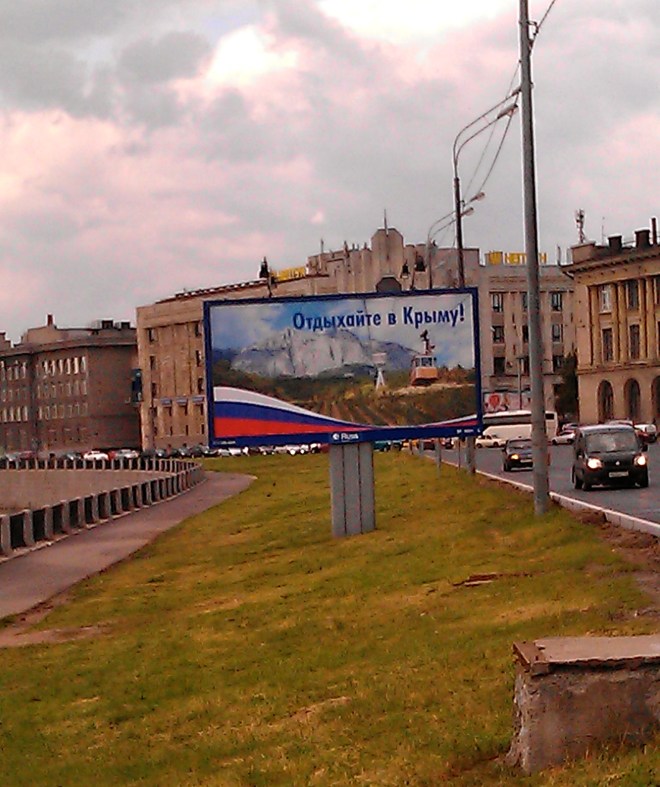
“Vacation in Crimea!” Billboard on the quay of the Obvodny Canal, 9 July 2015. Photograph by the Russian Reader


IMAG5607
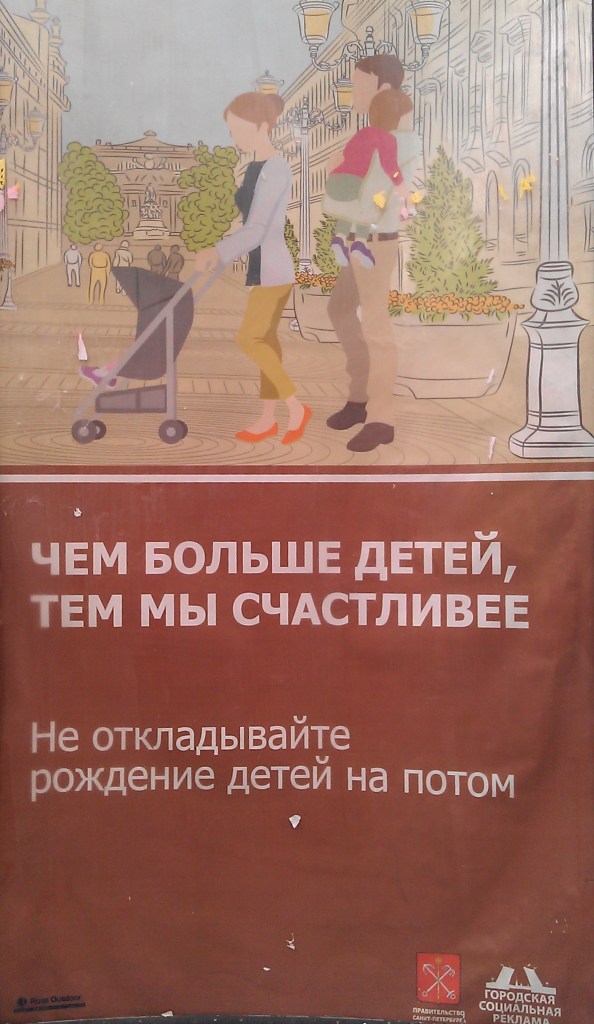
“The more children there are, the happier we are. Don’t postpone having children.” Public service billboard in central Petrograd. Photograph by the Russian Reader, 9 July 2015

____________

[…]

Indeed, Russia’s window for further population growth is rapidly closing. Within a decade, according to RANEPA’s estimates, the population of Russian women aged 20 to 29 will shrink by nearly 50 percent. The corresponding decrease in birth rates, particularly when combined with the country’s mortality rates—the 22nd highest in the world, according to the study—makes it clear that Russia is still in for long-term decline.

In fact, without remedial action, Russia’s population could shrink to 113 million by 2050, a decrease of more than 20 percent from today’s population of 144 million. And in a worst-case scenario, RANEPA argues, Russia’s population could fall by nearly a third, to 100 million, before midcentury. The economic effects of such a shift would be dramatic; Russia’s working-age population would decrease by more than 26 million, making the country less competitive and less prosperous. But there is still some hope: if Moscow takes measures to reduce mortality and boost the birthrate, RANEPA estimates that the Russian population could rise modestly, to 155 million, by 2040.

In other words, Russia has a choice to make—one with deep social and economic consequences. If implemented in the near term, improvements in health care, tax benefits for families, and steps to discourage emigration could offset and even reverse Russia’s long-term population decline. The opportunity to do so, however, will be lost over the next decade, and the social and economic consequences of governmental inattention could be catastrophic.

[…]

Unfortunately, there’s little chance that the Kremlin will seize the moment. In recent years, preoccupied with regaining its place on the world stage, Moscow has only peripherally addressed the long-term sources of national decline. Instead, it has prioritized spending on programs that reinforce its reputation as a great power. Even before the outbreak of the conflict in Ukraine, it was estimated that Russia planned to spend upward of $600 billion on upgrading its military capabilities by 2020. The increased expenditures have funded, among other projects, the creation of new intercontinental ballistic missiles, the deployment of additional long-range strike capabilities, and serious work on electromagnetic pulse weapons.

[…]

—Ilan Berman, “Moscow’s Baby Bust?” Foreign Affairs, July 8, 2015

_________

Crimean officials estimate that over 4 million tourists will visit the recently annexed peninsula’s beaches this year, boosting the region’s economy by up to 125 billion rubles ($2 billion), news agency RIA Novosti reported Thursday.

“We expect to welcome 4.3 million people to Crimea in 2015, most of them from Russia,” Crimean Tourism Minster Yelena Yurchenko was quoted as saying.

Russia seized Crimea from Ukraine in March last year in a move widely applauded at home but condemned by the West, which imposed sanctions on investment in Crimea.

Before the annexation, 6 million tourists visited Crimea annually, according to Russia’s tourism watchdog, Rostourism. Most of these were Ukrainians.

Russia is trying to stimulate travel to Crimea to help the region’s tourism-dependent economy, but the land route through mainland Ukraine has seen a steep drop in use since Russian and Ukrainian guard posts were placed on the Crimean border.

Over half of tourists this year will come to Crimea by plane and 45 percent will come by the Kerch Strait ferry, according to Yurchenko.

Russia plans to build a multibillion-dollar bridge between Russia and Crimea, but construction will not be complete until 2018.

— “Crimea Plans to Make $2 Billion on Summer Tourism This Year,” The Moscow Times, March 19, 2015The emphasis, above, is mine.

Happy Russia Day!

At three-thirty this afternoon I was awoken from a well-deserved nap by an incoming SMS on my cellphone, which read:

Уважаемый Клиент, поздравляем Вас с Днём России – праздником свободы, мира, равноправия и справедливости! Искренне желаем Вам и Вашим близким душевного тепла, достатка, счастливой, долгой и благополучной жизни! С праздником, Ваш “Билайн”

I.e.,

Dear Customer, we congratulate you on Russia Day, a holiday of freedom, peace, equality, and justice! We sincerely wish you and your family warmth, prosperity, and a long, happy, safe life! Congratulations, Your Beeline

Aside from irritating the drowsy me to no end, the SMS inadvertently reminded me of an article I had read earlier in the day on the topic of equality in Russia.

One in six Russians lives below the poverty line
June 11, 2015
ru.euronews.com

The numbers of Russians whose income is below the subsistence level increased by 3.1 million people in the first quarter of this year, up to 22.9 million. These figures have been published by Rosstat. The poverty rate rose to 15.9%, meaning that every sixth Russian falls into this category.

From January to March, the average subsistence level reached 9,662 rubles [approx. 155 euros] per person per month (a year ago it was 7,688 rubles). But inflation has also surged, which has been an especially painful blow to the poor.

The embargo on food imports from Europe and the United States, [introduced] in August 2014, fueled an inflation of food prices, and the 200% drop in the ruble’s value at year’s end drove up the prices of imported goods. As a result, by the end of the first quarter, the annual inflation rate in Russia had reached a thirteen-year maximum, 16.9%, according to Rosstat. By May, the figure had dropped slightly to 15.8%.

The statistics agency blames the increase in poverty on inflation. Average per capita monthly income, now at 25,210 rubles [approx. 400 euros per month], seems to have increased compared with the first quarter of 2015 by 11%, but fell by a quarter compared with the fourth quarter of last year.

Do you wonder how many Russians 15.9% is? The hipsters at The Village told their readers the answer yesterday evening as the latter were gearing up for the long holiday weekend: 22,900,000.

But how many people live in Russia?

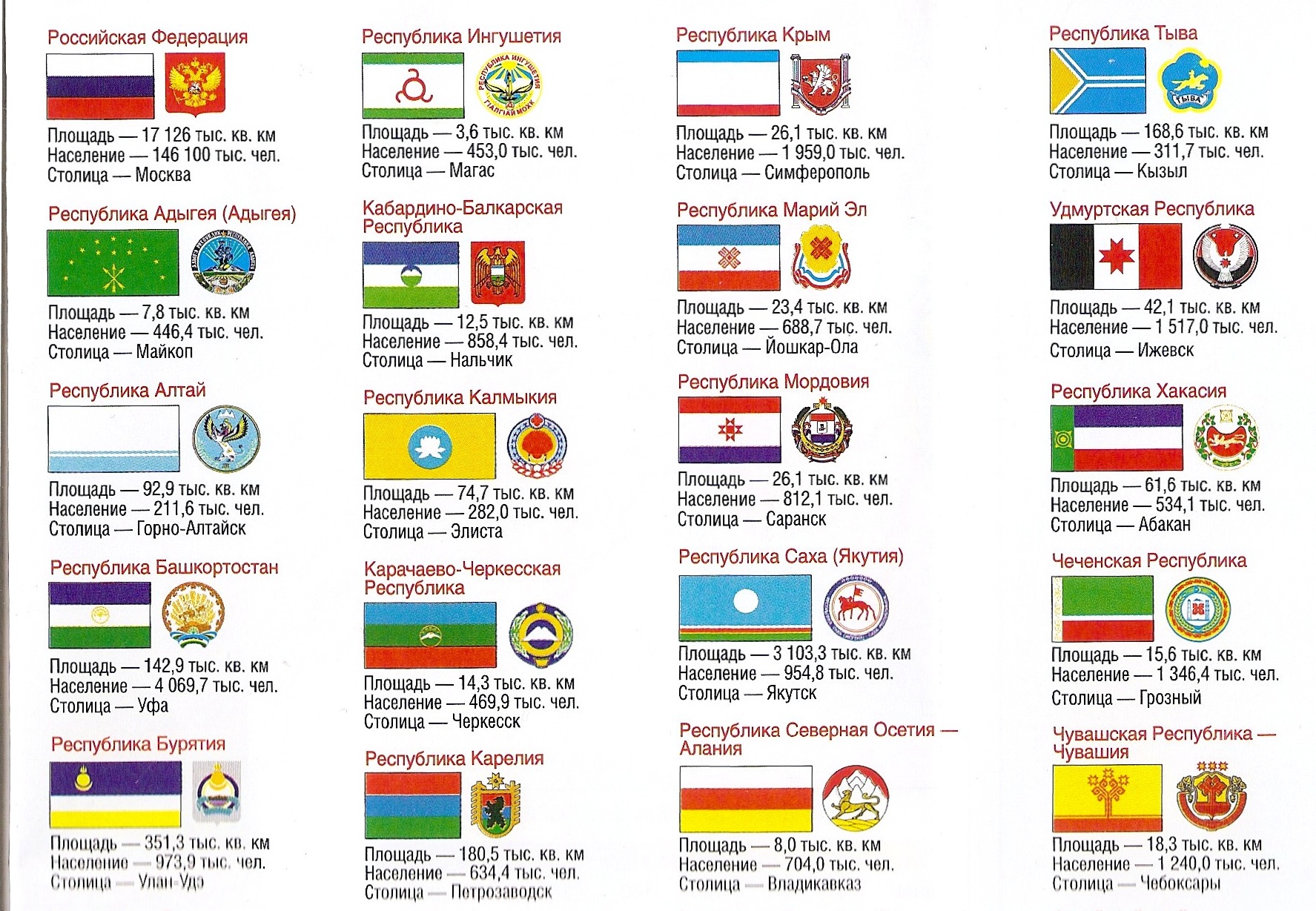
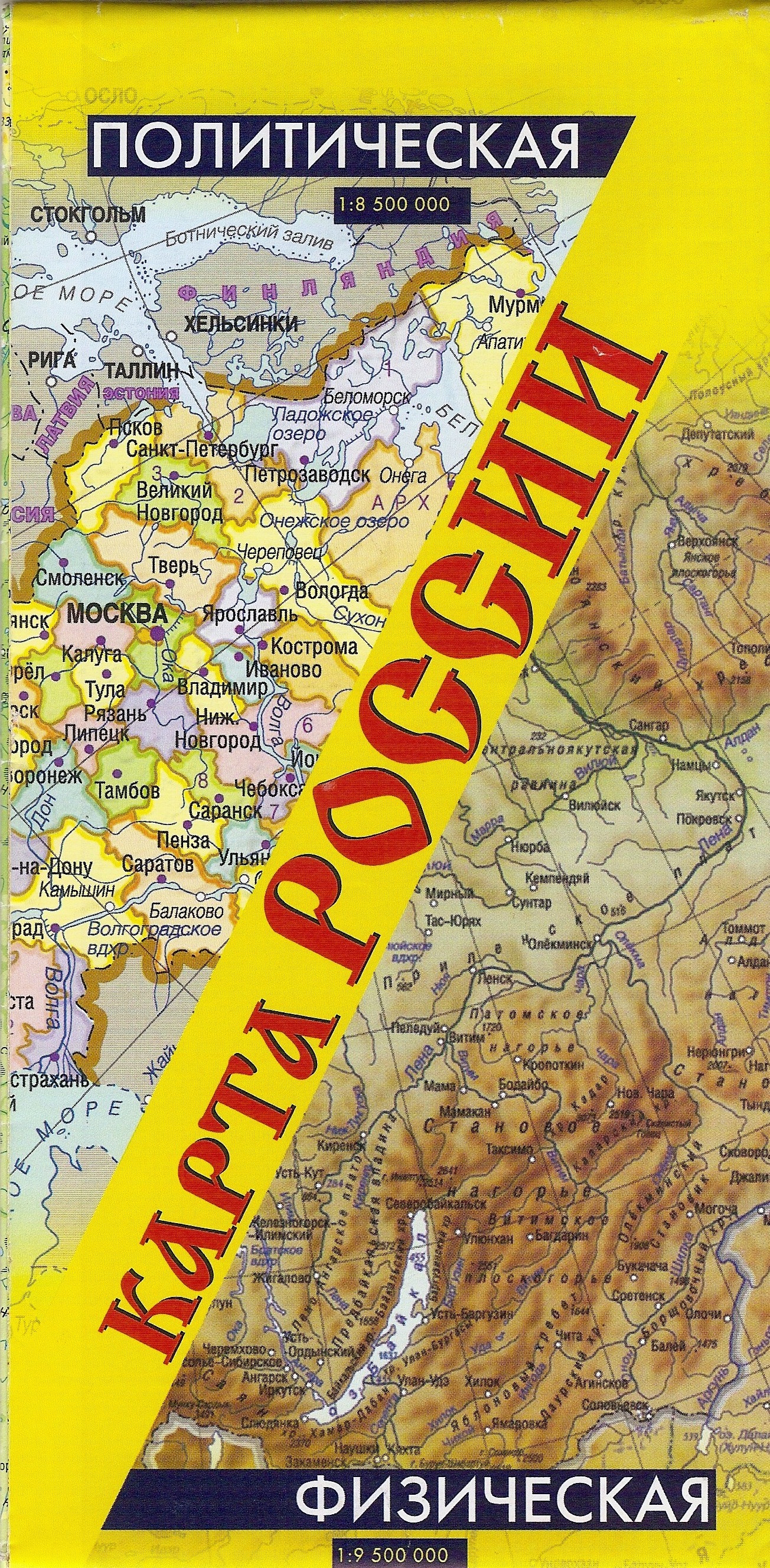
According to the handy Political and Physical Map of Russia, published by AST Publishers in February 2015, which I recently picked up at my local French-owned hypermarket, the Russian Federation’s population stands at a healthy 146,100,000, now, apparently, that is, that the Republic of Crimea’s nearly two million former wayfarers have returned to home port.

map 1

map 3map 5

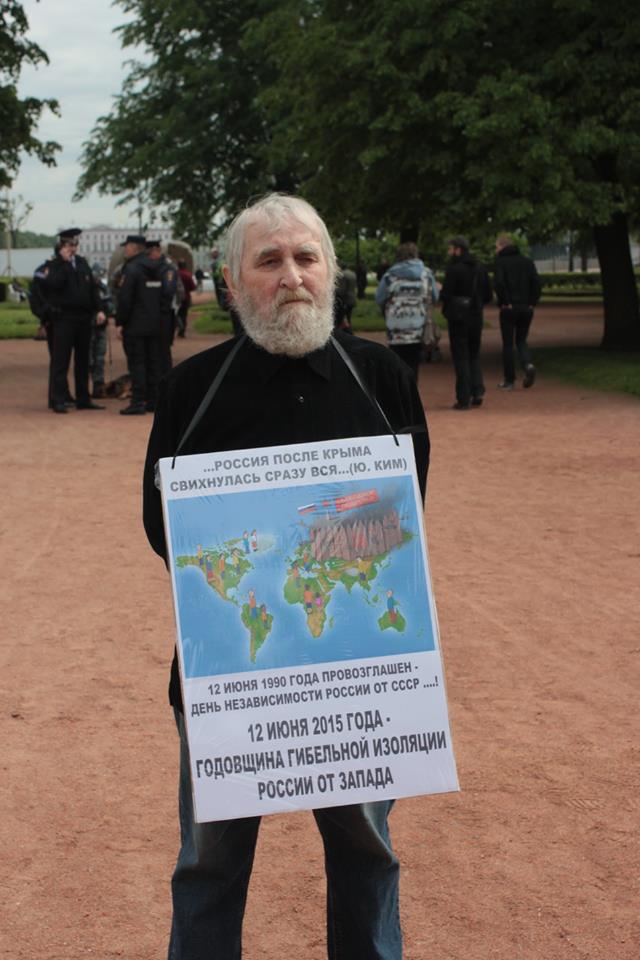
But there are a handful of malcontents who bristle at this new method of fighting poverty by annexing the territory and populations of other countries. One of them is  a stalwart of the Petersburg protest scene, Igor “Stepanych” Andreyev, who showed up to a “prayer for deliverance of the Fatherland from the oppression of lawless men in power” this afternoon, at the city’s Solovetsky Stone, sporting a provocative but veritable downer of a placard.

stepanych-2

Russia immediately went mad after [the annexation of] Crimea (Yuly Kim). On June 12, 1990, Russia’s day of independence from the USSR was proclaimed! June 12, 2015, is the anniversary of Russia’s destructive isolation from the West.

Source: Facebook (Vadim F. Lurie)

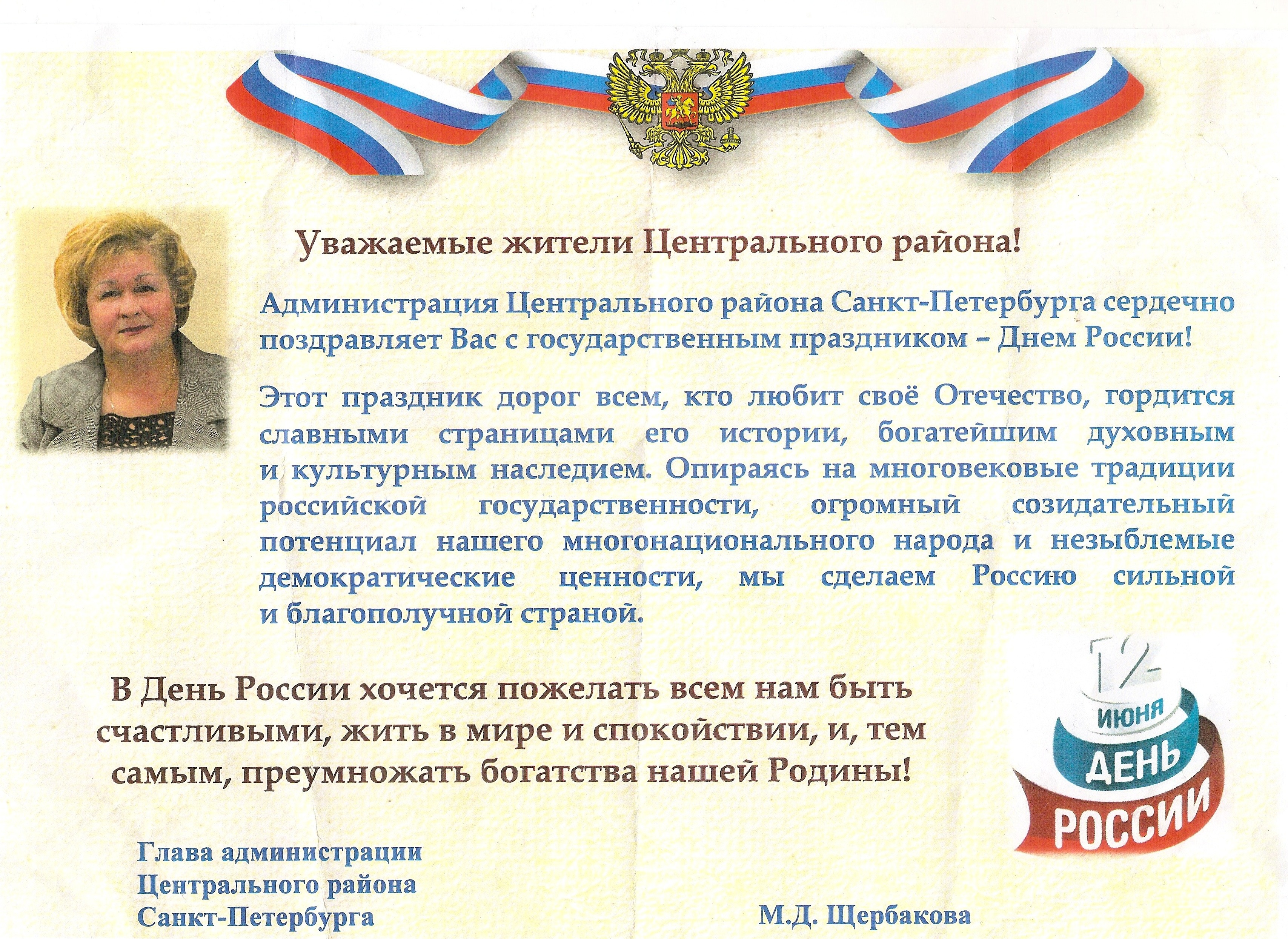
Fortunately, the Russian authorities are not as down in the mouth as the sour old multiple arrestee Stepanych. For example, Maria Shcherbakova, the seemingly perpetual head of the city’s Central District, had these uplifting holiday congratulatory printouts pasted on every front door in our neighborhood the other day.

shcherbakov kongrats

Dear Central District Residents!

The Administration of Saint Petersburg’s Central District warmly congratulates you on the national holiday, Russia Day.

This holiday is dear to everyone who loves their Fatherland and takes pride in the glorious pages of its history and its extremely rich spiritual and cultural legacy. Based on the centuries-old traditions of Russian statehood, the huge creative potential of our multi-ethnic people, and unshakeable democratic values, we will make Russia a strong and successful country.

On Russia Day, I would like to wish all of us to be happy, to live in peace and tranquillity, and to thereby multiply the riches of our Motherland!

M.D. Shcherbakova
Chief Executive, Central District of Saint Petersburg

Earlier today, President Putin expressed similarly upbeat patriotic sentiments while handing out state prizes for achievements in science, technology, literature, and the arts:

“These ideals of patriotism are so deep and strong that no one has ever been able and will ever be able to recode Russia, to convert it to fit their formats. We cannot be separated, torn, and isolated from our native roots and origins.”

Who would want to “recode” and “reformat” Russia anyway? Grumpy old Stepanych? The nearly twenty-three million Russians now living on less than 155 euros a month?

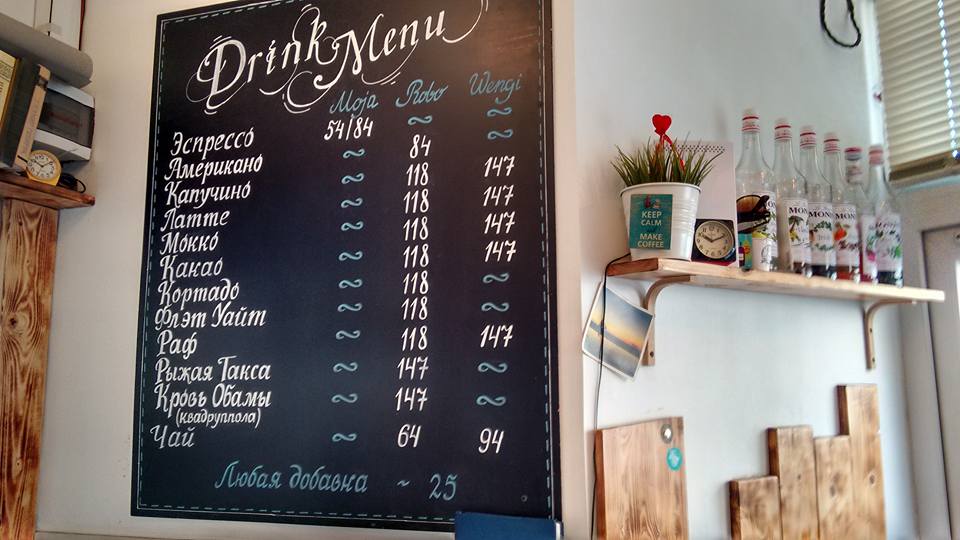
Of course not, you sillies. It is that wicked, black-as-tar, uppity Negro from across the seas, Barack Obama, as the hipster baristas in the coffee hut on the corner of Liteiny Prospekt and ulitsa Belinskogo have pointed out in their own droll way.

obama's blood

We continue our trek around Petersburg’s fashionable spots:

“What is Obama’s Blood?”

“A quadruple espresso.”

“And why did you call it that?”

“That’s just what we came up with.”

Source: Facebook (Alexander Nazarov)

At 147 rubles a cup, Obama’s Blood is the most expensive item on the menu, as a friend has pointed out to me, but when you convert it to euros (€2.36) or dollars ($2.66), it is practically a steal.

And it will get in you in the mood for a fun albeit nerve-wracking Russia Day.

* * * * * *

Russia Day (Russian: День России, Den’ Rossii) is the national holiday of the Russian Federation, celebrated on June 12. It has been celebrated every year since 1992. The First Congress of People’s Deputies of the Russian Federation adopted the Declaration of State Sovereignty of the Russian Soviet Federative Socialist Republic on June 12, 1990.

Vlad Kolesnikov: A Real Russian Hero for Russia Day

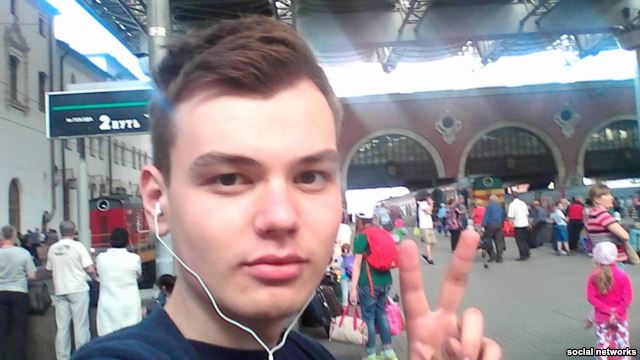
“At the military enlistment office, I turned on the Ukrainian national anthem”: 17-year-old Vlad Kolesnikov talks about his decision to combat Putin’s propaganda
Dmitry Volchek
June 10, 2015
svoboda.org

Vlad Kolesnikov

Hundreds of people have been writing to Vlad Kolesnikov, a 17-year-old technical college student from Podolsk. They have been writing with offers of assistance and shelter, and to thank him and advise him to be more careful.

“I cannot express in words the emotions I feel reading Facebook,” says Vlad, his voice trembling with emotion. “There has been so much support from strangers, it is simply incredible.”

Vlad has acquired a lot of friends on the Internet, but his own grandfather, a former KGB officer, has condemned him. At the technical college where he studied he was assaulted. (Vlad asked not to write that he had been beaten up: “It was only a split lip, a couple of bruises, a couple of blows to the head, and three drops of blood.”) And now the police have taken an interest in him.

And all because Vlad Kolesnikov not only does not hide his political views but has also decided to declare them openly.

​​Vlad Kolesnikov: Putin sits with his pack of criminals and runs the country with the aid of powerful propaganda. This is my subjective opinion. Maybe I am wrong, but I believe it is true. You know the Russian media have been vigorously promoting the image of khokhly [a Russian term of abuse for Ukrainians] and pindosy [a Russian term of abuse for Americans] as enemies. I also supported this until I watched a video on YouTube. It was 2014, and I will probably never forget it, because the video changed my life. The content of the video was completely banal. It was just an American family. The wife is Russian, the husband, American. He gives her a gift, they go to a shooting range. And instead of the propaganda we get—that it is a fascist regime where everyone is obsessed with sex and money, and everyone betrays each other—I saw people like myself. The only difference was that they smiled more. Since then I have been digging more, looking for different kinds of information, and reading the western press. I have realized the Russian media makes lots of mistakes, exaggerates, and in most cases just blatantly lies.

Radio Svoboda: And your relations with your relatives have been complicated because of the fact they do not share your views?

Vlad Kolesnikov: Yes. And not only my relations with relatives, but with everyone, you could say. I know only two people who more or less share my views: my friend Nikolai Podgornov and one other person whom I won’t name. But all the people I know—my whole college, all my relatives—they are all against me. It is just Nikolai and me,

Radio Svoboda: You and Nikolai decided to hang up a banner in Podolsk that read, “Fuck the war”?

Vlad Kolesnikov: Yes, it all started when I was at the military enlistment commission and told them I did not want to serve in the army and did not want to fight against my brethren. Maybe that sounds sentimental, but that is the way it is. We decided we could not tolerate it anymore and would voice it openly. First, we wanted to hang a banner in Moscow, but then we thought it would be torn down quickly, and so we looked for a good place in Podolsk. We walked around for a long time and found a building with an accessible rooftop in the middle of town and decided to hang the banner there. We went to a fabrics shop. We bought a five-meter-long piece of cloth. We spent a long time picking out cloth that would be sturdier. We bought paint. This is expensive for a college student, but it was worth it. We spent all night making the banner and sitting on the rooftop. We fastened the banner to iron cables so that it would hang longer, and we locked the door [to the rooftop] so that it would take the police longer to get in. They had to summon the Emergency Situations Ministry guys. I think we gained two or three hours more time on them that way.kolesnikov-2

Radio Svoboda: You told the military enlistment commission straight out that you did not want to fight?

Vlad Kolesnikov: I don’t have very good eyesight, so I am not fit for military service. I went through the medical examination, and there was I before the draft board. There were tables shaped like the letter П set up there, and the people who did the assessments were seated at these tables. I had the Ukrainian national anthem recorded on my telephone. I don’t like the Russian national anthem, because I consider it mendacious. Everything it says about freedom and so on is just pure rubbish. Before entering the room I decided to turn on the Ukrainian anthem, because I do not support the Russian army at all and consider serving in it disgraceful. So I turned on the Ukrainian anthem and said, “Guys, I’m not going to fight in the Russian army.”

Radio Svoboda: Vlad, you would agree that you are a very unusual young man. You are immune to propaganda, and are fearless to boot.

Vlad Kolesnikov:  In fact, I was just lucky. I just did not have a TV for a certain time, and I did not watch the news. And when I got a TV, I turned it on and saw the nonsense that was going on there. I turned right to that program where [TV journalist Dmitry] Kiselyov fiercely argued that the hearts of gays should be burned. I was sitting there and thinking, Is this a comedy show? Then I realized that a new kind of news had emerged in Russia. It is hardcore, and produced in keeping with all of Goebbels’s principles of propaganda: enemies surround us, the country has been occupied. Total drivel.

Radio Svoboda: So, you turned on the Ukrainian national anthem at the military enlistment commission. The members of the draft board were probably stunned when they heard it, no?

Vlad Kolesnikov:  It was something incredible. Some people were dumfounded. Others jumped up and shouted, “What are you doing? Do you know where you are?” After a while, a man came running in. He took me to a separate room and laid two certificates in front of me. One said that I had problems with my eyesight, which is true. The other said that I had a personality disorder and something else. In short, the military enlistment commission had assigned me to the loonies, because I had gone in there playing the Ukrainian anthem and expressed my opinion. That was a turning point. When that certificate was put in front of me, I realized I would not put up with this anymore. I had simply gone in there, and I was immediately classified as a loony.

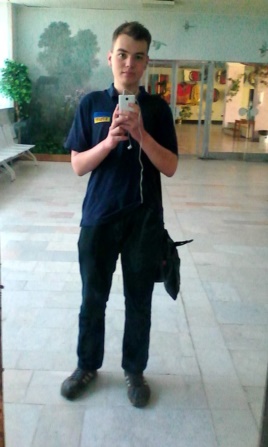
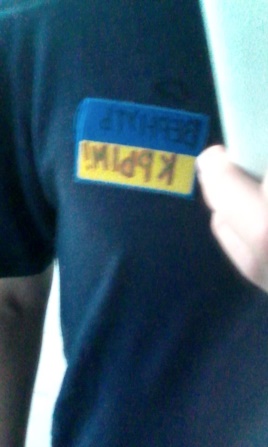
Radio Svoboda: And there is your latest feat. You came to school in a t-shirt with the Ukrainian flag on it.

Kolesnikov arrived at school with an Ukrainian flag on his chest

​​

Vlad Kolesnikov: Yes. I had voiced my political views earlier at the college, and had often argued with the teachers on this score. As you can imagine, nothing good had come of this, but neither did anything super bad, except lowered marks and other trifles. But then it got fun. Near the college, I immediately met the class teacher. At our college, they are called professional masters. I will never forget that look. At first, he looked at me like a normal, decent person. Then he saw what I had on my t-shirt. He looked up at me, and I saw this hatred! Then I went upstairs and walked into the classroom. Within five minutes, the people sitting in front of me turned around (I was sitting in the back row) and said, “Kolesnikov, should we smash your face in now or later?” Well, just you try, I said. As you know, they kept their promises, not that day, however, but a few days later, after I had published my posts, when they had heard a lot of interesting things about themselves. I can argue my position, why I think Crimea was annexed, why Donbas was occupied. I have arguments, I have facts, and I know people who served there. On TV, they say there are no Russian troops there. In reality, of course, it is the other way round. They could not come up with convincing arguments. It all came down to my being a disgrace to the country, and I should tear the flag from my shirt. It is an interesting policy, actually. It turns out if you express your opinion you are disgrace to the country.

The inscription on the flag reads, “Give Crimea Back!”

Vlad Kolesnikov was forced to leave college (he was immediately expelled) and leave Podolsk. His grandfather, with whom he lived, also did not share his political views and sent his grandson to his father in Zhigulyovsk. It was just in time. Kolesnikov called his grandfather to say he had arrived safely and heard the disturbing news that two police officers had come and asked where he had got the Ukrainian flag and where his t-shirt was now.

“All democrats in Russia were sent into exile, and that is how I feel now, as if I am in exile. Many people are now advising me to go to Kiev. But that is the most extreme option. If someone thinks I will sit this out, get a foreign travel passport, leave for Ukraine, and that will be the end of it, they are mistaken. For now, I am planning after Zhigulyovsk to return to Moscow and do a couple of protest pickets,” promises fearless Vlad Kolesnikov.

Translated by the Russian Reader

UPDATE. Vlad Kolesnikov was found dead on December 25, apparently from an overdose of prescription drugs.

* * * * * *

Russia Day (Russian: День России, Den’ Rossii) is the national holiday of the Russian Federation, celebrated on June 12. It has been celebrated every year since 1992. The First Congress of People’s Deputies of the Russian Federation adopted the Declaration of State Sovereignty of the Russian Soviet Federative Socialist Republic on June 12, 1990.