I’ll Show You the Life of the Mind

An image from Boris Akunin’s One Eight Eight One, as staged by Valery Fokin at the Alexandrinsky Theater in Petersburg.
Image courtesy of alexandrinsky.ru via Delovoi Peterburg

Every Wednesday we tell you about an article that has proved the most interesting to one of our staffers.

Yulia Holtobina, manager of the Subscribers’ News project, has shared an article with us today.

Does modern society need cultural goods? In my opinion, they are simply necessary for people to grow spiritually and achieve inner harmony. Culture is the environment in which the life of the individual and the life of society take place. Culture makes a person a personality.

In our difficult time, people increasingly want to distract themselves, to get away from fatigue and the problems that have piled up. Theaters, cinemas, and museums are the cultural spaces where they can relax, feel joy, find positive energy and inspiration, and return to a stable life.

Delovoi Peterburg thus writes that the preferences of Petersburgers have not changed. People still enjoy going to theaters, museums, exhibitions, and St. Petersburg’s other cultural spaces.

Source: Delovoi Peterburg email newsletter, 16 November 2022. Translated by the Russian Reader


Theatergoers south of Moscow were held “hostage” and shot at by actors playing Ukrainian soldiers during an immersive play that glorifies Russia’s invasion of its neighbor, local media reported Tuesday.

Opening scenes from the production titled “Polite People” showed actors dressed in Ukrainian military uniforms violently capturing audience members and shooting them with what appeared to be prop assault rifles. 

One female captive can be heard screaming “it hurts” and “let go” as the actors drag her onstage.

“Polite People” is a euphemism for the Russian soldiers without insignia who occupied Crimea before Moscow annexed the Ukrainian peninsula in 2014.

“The creators wanted to immerse the audience into the atmosphere of what Donbas residents had experienced for eight years,” the Kaluga region’s Nika TV broadcaster said, using the term for eastern Ukraine’s separatist-controlled Donetsk and Luhansk regions.

Actor Vilen Babichev, who portrays one of the Ukrainian troops, told Nika TV the play aims to show Russian audiences “the nature of the enemy that invaded our territories eight and a half years ago.”

President Vladimir Putin has justified Russia’s deadly invasion of Ukraine with unbacked claims that Kyiv is committing “genocide” against Russian-speaking residents of the Donbas.

“Polite People” is funded through a 10.1-million ruble ($165,000) Russian presidential grant.

Its author, Luhansk-based musician and film studio director Roman Razum, said the project aims to “create positive content to counteract negative content that carries an immoral ideology and counters the Russian cultural code.”

“We show that these aren’t just Ukrainian [soldiers], but fighters fully trained by NATO and supplied with weapons for many years,” Razum told Nika TV.

The play premiered in Kaluga on Monday following dates in occupied Luhansk and four Russian cities in late October and early November. It is expected to go on tour across a handful of other Russian cities until late November.

Source: “Russian Audiences Held ‘Hostage’ By Mock Ukrainian Soldiers in Pro-War Play,” Moscow Times, 9 November 2022


Is there room left in life for celebrating and if so, for what kind of celebrating? DP found out how the preferences of consumers of culture have changed this year.

The Social and Artistic Theater (SHT) told DP that its new season had got off to a good start. “I would say that audiences are going to the theater more, but the decision to go is made at the last moment. Our productions of Anne Frank, The Émigrés, and Cynics are now quite popular. Our classic production is still WITHOUT [An idiot], based on F.M. Dostoevsky’s novel The Idiot,” SHT director Alina Korol said.

No scarier than covid

The Bolshoi Puppet Theater (BTK) said that its audiences did not have any particular new preferences. There are traditionally sold-out performances at the theater, and less popular ones, but they have not noticed any new trends.

“After the start of the SMO, there was a drop-off in attendance that lasted a couple of months, maybe one and a half. If anything has changed post mobilization, it has been insignificant. But when a new wave of covid started in mid-September, many people began to get sick and the flow decreased,” the BTK’s sales department emphasized.

“People want to return to a stable life for at least a few hours, so they go to the theater. We almost always have full houses, and preferences have not changed,” commented Tatiana Troyanskaya, a public relations specialist at the Studio Theater. Among the favorites at the Studio are productions by the theater’s artistic director Grigory Kozlov (The Elder Son, Tartuffe, The Days of the Turbins, Quiet Flows the Don, as well as comedies (Our Avlabar; Dreams of Love, or the Marriage of Balzaminov), and productions for children.

Vladimir Kantor, the editor-in-chief of the magazine Petersburg Theatergoer and the head of the literary department at Saturday Theater, did not notice any new trends in the theater.

“I am familiar with the repertoire of other theaters, but I haven’t noticed any serious changes in audiences. Autumn and winter are the times when people traditionally go to the theater. I cannot mention any changes in the repertoire that can be described as trends. There were enough productions about war before the start of the SMO, as well as dystopias. I can’t name any productions about the new emigration at all,” he commented.

DP also sent requests for comment to several state theaters, including the Young People’s Theater (TYUZ) and the Alexandrinsky Theater, but did not receive responses. Meanwhile, the Alexandrinsky has removed Boris Akunin‘s name from the announcement of the premiere of One Eight Eight One. Akunin wrote the play specifically for the Alexandrinsky, but his name disappeared from playbills at the behest of the Ministry of Culture. Back in August, the audience received an email with a reminder about the upcoming premiere of One Eight Eight One — as “staged by Valery Fokin, with music by Vyacheslav Butusov, to the text by Boris Akunin.” A similar situation occurred in Moscow, at the Russian Youth Academic Theater (RAMT), where there are four productions of plays penned by the writer.

Akunin himself is aware of what has happened and does not condemn the theaters. “I sympathize with the heads of theaters… If a person has decided that the cause you serve is more important than damage to your reputation — this is a difficult choice from which you yourself suffer, but not your team and not your audience,” he wrote on his Telegram channel.

According to the writer, he has not demanded that uncredited productions be removed from the repertoire. On the contrary, they can go on until they are finally banned and even with no compensation to him. As Akunin noted, the Alexandrinsky Theater cannot pay him royalties due to sanctions.

Among private institutions, Beyond the Black River Theater and the City Theater declined to comment. On October 20, a performance of 1984 was canceled at the City Theater — as noted on its social media accounts, “for reasons beyond the theater’s control.” On October 31, the same production was presented to the audience in a new way: in a video format and featuring an encounter with the director and the actors. The theater’s management clarified that “this is probably the last time it would be possible to see 1984.” The theater also said goodbye to the anti-war production A Red Flower, based on the stories of Vsevolod Garshin.

Perennial classics

Petersburg museums did not respond to DP‘s questions about the changing preferences of its visitors. Official requests were sent to the Hermitage, the Russian Museum, and the Erarta Museum of Modern Art. The bookstores Subscription Editions and At the Top of the Voice and the bookstore chain Bookworm also declined to comment on the situation.

Alexander Prokopovich, editor–in-chief at the publishing house Astrel SPb, says that readers’ preferences had begun to change even before early February, during the pandemic, but the trends have persisted. According to him, classics and so-called longreads [longridy] — that is, literature that is demand at all times — have remained relevant, while speculative texts and fashionable literature [sic] have been losing ground.

“Readers reared their heads, rather, by remaining true to their interests in new titles; perhaps for obvious reasons, interest in new titles from the translated literature segment has increased. I have not encountered any restrictions. Writing is a strategic activity: it can take years to create a book, so it is not worth waiting for a sudden change in the subject matter of the fiction we publish. It is another matter that the events [of this year] are so emotionally charged that many authors have simply stopped writing. It is not our publishing housing that is in demand, but the books which we publish. Nothing has changed here: demand for them is determined by the quality of the texts. This has been the case in the past, and it will be the case in the future,” Prokopovich said.

Some authors claim that their works have disappeared from bookstores — for example, collections of poems by the poet Vera Polozkova. She left Russia in March. Over her fifteen-year career, Polozkova has written five books, published in a total of 280 thousand copies. On her social media accounts, the poet noted, “It would be strange to expect them [the authorities] not to touch the books after everything I’ve said and done.” She believes that she will be able to publish abroad either through crowdfunding or self-publishing [samizdat].

On the other side of the cultural barricades is RT editor-in-chief Margarita Simonyan. A month ago, the TV channel presented a collection of front-line poems, Poetry of the Russian Summer, but a few weeks later it transpired that Russian publishers were not willing to publish a book with the letter Z on the cover. Simonyan, on her Telegram channel, called it “a verdict on us all.”

Cinema depends on the weather

Cinemas were reluctant to comment on the situation. Aurora and Rodina did not answer DP’s questions, but Lenfilm did give an assessment of attendance factors. The cinema center’s management said that Lenfilm is difficult to compare with mass multiplex cinemas. “We show festival films, auteur cinema, and retrospectives. Therefore, aside from a general decrease in the number of viewers, the situation has not affected us so much, since our repertoire has stayed the same, and our audience has remained our audience. We are more dependent on the weather. After big news days, the attendance drops at first, but then it more or less levels off,” the studio commented.

Lenfilm also noted that its cinema center has been showing many Russian films. This year’s Lenfilm Film Club events have already featured screenings of Vladimir Kott’s Disobedient, Tatiana Kolganova’s Delayed Happiness Syndrome, and Ruslan Bratov’s Express.

Source: Alina Kizyakova, “Petersburgers looking for stability in theaters and books,” Delovoi Peterburg, 15 November 2022. Translated by the Russian Reader
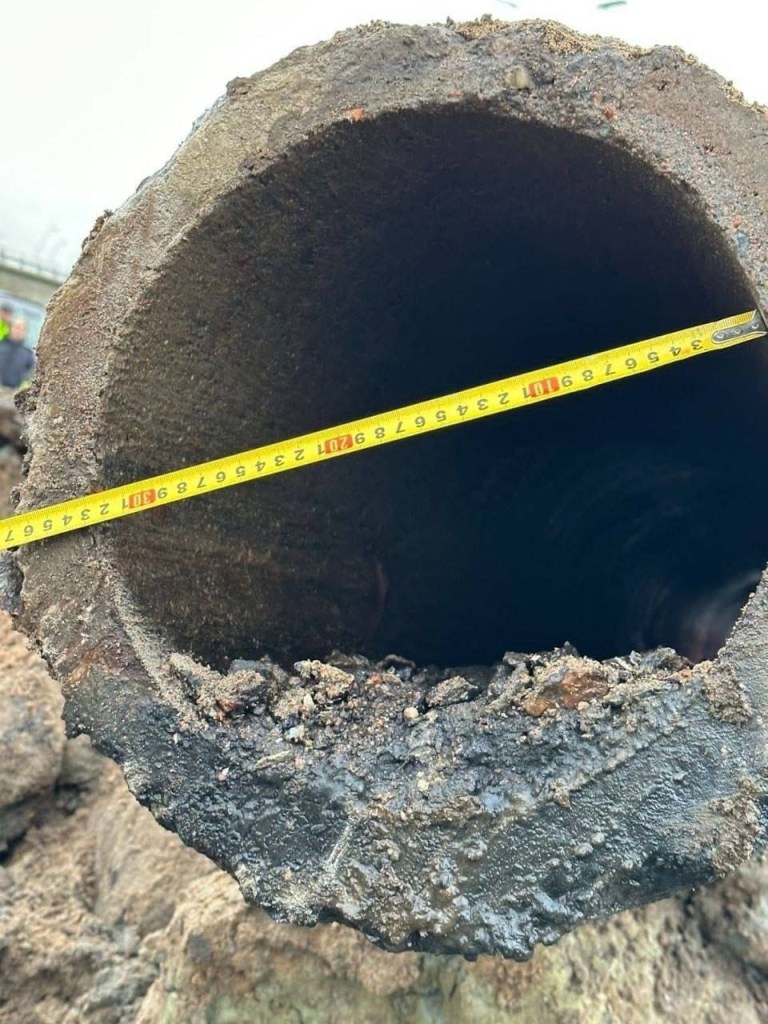
Going Underground (The Pulkovo Variations)

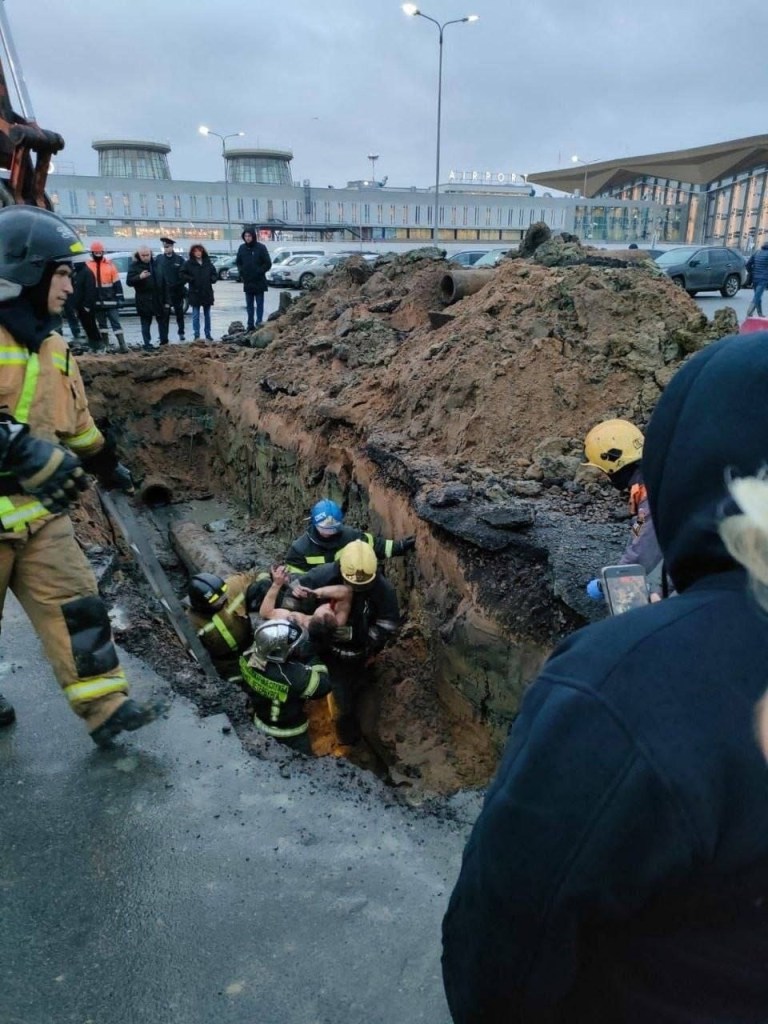
The river of eclipses is over, but not everyone’s psyche has recovered yet. For example, in the parking lot of Pulkovo Airport, a man decided to attempt an escape.

He stripped to the waist and climbed into a sewer pipe. He managed to crawl twelves meters before getting stuck.

Municipal services had to pull the man out using an excavator.

According to Fontanka.ru, the man is a 21-year-old resident of the city of Zhigulyovsk, in the Samara region.

On November 6, he left home and never returned. He had presumably gone to St. Petersburg to visit friends. It was known that the young man had a return ticket for November 9, but he did not use it.

The entire time his relatives back home and Liza Alert activists had been looking for him, but he was found in the sewer outside Pulkovo Airport, under circumstances already known to us.

Source: St. Petersburg Photo Diary (Natalya Yuda), Facebook, 12 November 2022. Translated by the Russian Reader
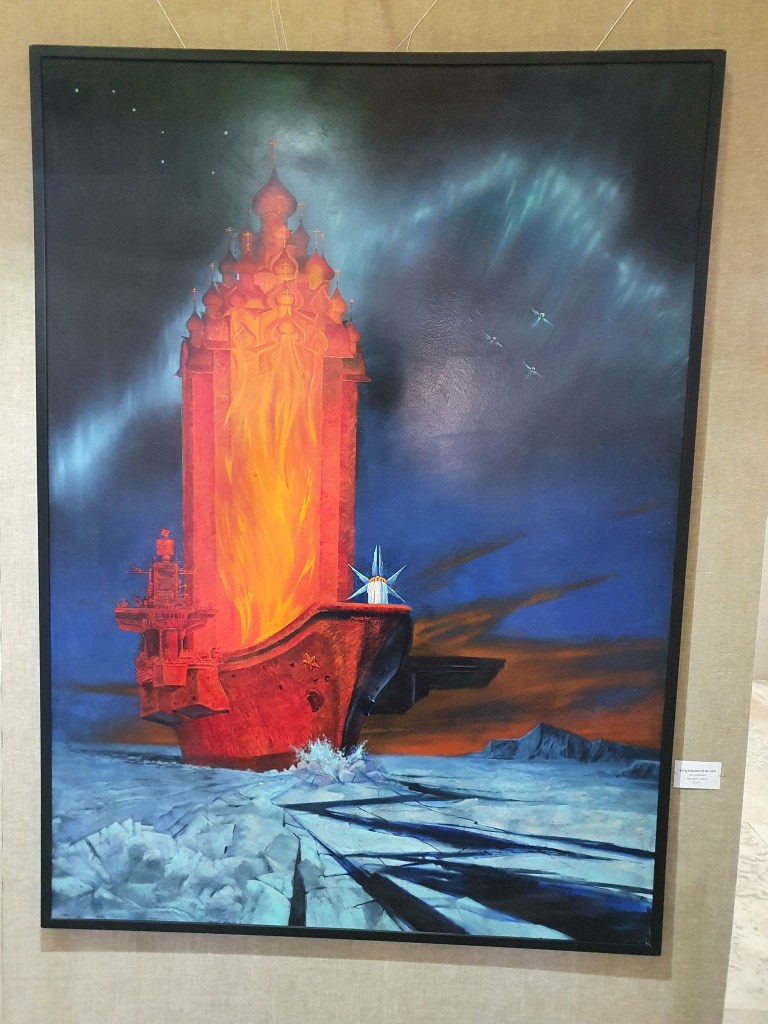
It Does Hurt to Dream

“Russian angel carrier, Artillery Museum, Saint Petersburg.” Source: Pavel Pryanikov, Facebook, 6 November 2022

Alexander Kharichev, head of the Presidential Department for Supporting the Work of the State Council, and three other experts have published a scholarly article entitled “Perception of basic values, factors, and structures of Russia’s socio-historical development, as based on research and testing.” As part of the study, seventy people from the student bodies of Moscow State University and the Higher School of Economics and the teaching staff of a conference in Sevastopol [sic] were interviewed. Among the metaphors of the future they proposed was the burnt second volume of Dead Souls; among the concepts of the modern state, “the Motherland with a laser sword”; among the concepts of the future, “Russia as the world’s ‘guardian of good” and “Pasty” [sic: “Pirozhok”]. The authors concluded that the dominant value for the Russian family is the people of Russia, which itself is a “family of families.”

Mr. Kharichev’s co-authors were Andrei Shutov, dean of the faculty of political science at Moscow State University; Andrei Polosin, doctor of political science and head of Rosatom’s regional interaction department; and Ekaterina Sokolova, deputy executive director for strategy and forecasting at the Expert Institute for Social Research. The article was published in October in the Journal of Political Studies.

The study was conducted by means of group discussions from March to May. The seventy participants answered questions about what Russian statehood is, what would happen to the country in ten years, what our future is, and a number of others.

Based on the discussions, the researchers formed a five-level “pentabasis”: person—family—society—state—country. Dominant values were formed for each level. For the country, [this dominant value] is patriotism; for the state, it is trust in the institutions of power; for the family, it is the people of Russia; for society, it is harmony; for the person, it is creativity. “The thesis was voiced that European society is individualistic, whereas our main value is family + family with friends, which leads to the emergence of the thesis ‘family as a level.’ The dominant value: the people of the Russian Federation as a family of families. Stimulating the birth rate and the concept of a ‘big family,’ the article says [just as incoherently in the original as in this translation].

  • Metaphors of Russia’s future. “The state as a novel” (written collectively by citizens, it has alternative endings); “the Russian future as the second part of Dead Souls, burned by Gogol,” “the state as the Firebird.”
  • Concepts of the modern state.[The] Motherland with a laser sword” (a source of pride for the Russian spirit and a guide to the future), “the friendly service state.”
  • Messianic concepts of the future state. “Russia as a ‘prophet country’ (opposed to the Grand Inquisitor), “Russia as the world guardian, the ‘guardian of good.'”
  • Idealistic concepts of the future state. “Wondrous City” ([i.e., promoting] inclusivity, coexistence, acceptance of others as equals; “in no case to be confused with the term ‘tolerance'”), “Pasty” (harmoniously combines different things).
  • Mechanistic concepts of the future state. “Kaleidoscope” (a multifaceted future), “a medium-sized magnet state” (generates a field for a particular community).

The study participants concluded that the person in the “Russia of the Future” is “proud of his country, influential and highly employable, financially secure, [and] free within certain community rules.” According to the authors of the article, the ideas of self-realization in the Russian Federation are very different from those common in the Western world.

“In the Russian case, self-realization or mission means that an individual contributes to the country’s development. Capitalizing [on one’s] mission is an optional stage,” the authors write.

Source: Leonid Uvarchev, “Alexander Kharichev from the presidential administration wrote an article about imagining Russia’s future,” Kommersant, 7 November 2022. Translated by the Russian Reader
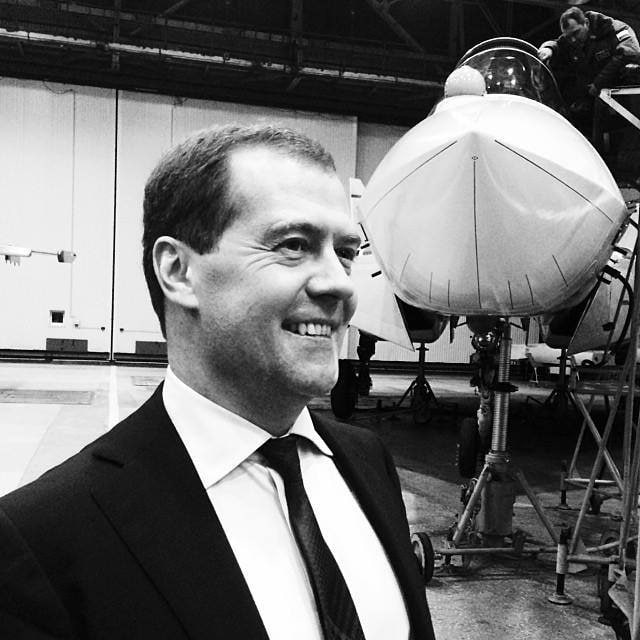
“Why Our Cause Is Just”: Medvedev’s National Unity Day Telegram

Dmitry Medvedev. Photo courtesy of his Telegram channel

WHY OUR CAUSE IS JUST
Answers to simple questions on National Unity Day

What are we fighting for? Russia is a huge, rich country. We don’t need foreign territories; we have plenty of everything. But there is our land, which is sacred to us, on which our ancestors lived and on which our people live today. And which we will not surrender to anyone. We are defending our people. We are fighting for all of our own people, for our land, for our thousand-year history.

Who is fighting against us? We are fighting against those who hate us, who ban our language, our values, and even our faith, who spread hatred towards the history of our Fatherland.

A part of the dying world is against us today. It consists of a bunch of crazy Nazi drug addicts, the common people they have drugged and intimidated, and a large pack of barking dogs from the western kennel. They are joined by motley pack of grunting piggies and narrow-minded philistines from the disintegrated western empire with saliva running down their chins due to degeneration. They have no faith and ideals, except for the harmful vices they have contrived and the standards of doublethink they impose, which deny the morality bestowed on normal people. Therefore, by rising up against them, we have gained sacred power.

Where are our former friends? We have been abandoned by some frightened partners — and I could not give a flying crap about them. That means they were not our friends, but just random fellow travelers, clingers, and hangers-on.

Cowardly traitors and greedy defectors have bugged out for the back of beyond — may their bones rot in a foreign land. They are not among us, but we have become stronger and purer.

Why were we silent for a long time? We were weak and devastated by hard times. And now we have shaken off the sticky sleep and dreary gloom of the last decades, into which the death of the former Fatherland had plunged us. Other countries have been waiting for our awakening, countries raped by the lords of darkness, slaveholders and oppressors who dream of their monstrous colonial past and long to preserve their power over the world. Many countries have long disbelieved their nonsense but are still afraid of them. Soon they will wake up once and for all. And when the rotten world order collapses, it will bury all its arrogant priests, bloodthirsty adepts, mocking henchmen, and tongue-tied mankurts under the multi-ton pile of its own debris.

What is our weapon? There are various weapons. We have the capacity to dispatch all our enemies to a fiery hell, but that is not our mission. We listen to the Creator’s words in our hearts and obey them. These words give us a sacred purpose. The goal is to stop the supreme ruler of hell, no matter what name he uses – Satan, Lucifer, or Iblis. For his goal is destruction. Our goal is life.

His weapon is an elaborate lie.

But our weapon is the Truth.

That is why our cause is just.

That is why the victory will be ours!

Happy Holidays!

Source: Dmitry Medvedev, Telegram, 4 November 2022. Mr. Medvedev, the former Russian president, has 910,612 subscribers on Telegram. For reactions to his National Unity Day post, see Asya Rudina, “‘Iblis crept up unnoticed’: Bloggers on Dmitry Medvedev’s creative work,” Radio Svoboda, 7 November 2022 (in Russian). Translated by Your Answer Needs Demented Examples Xavier, with a little assistance from the Russian Reader. For an alternative vision of Russian patriotism, also prompted by the November 4 National Unity Day holiday, see Kirill Medvedev (no relation), “‘If There Is No People, There Is No Left Either’: Progressive History and Patriotism from Below,” Posle, 2 November 2022. I can endorse neither of these visions, alas. ||| TRR

Shorthand for Fascism (The 9th Moscow Biennale of Contemporary Art)

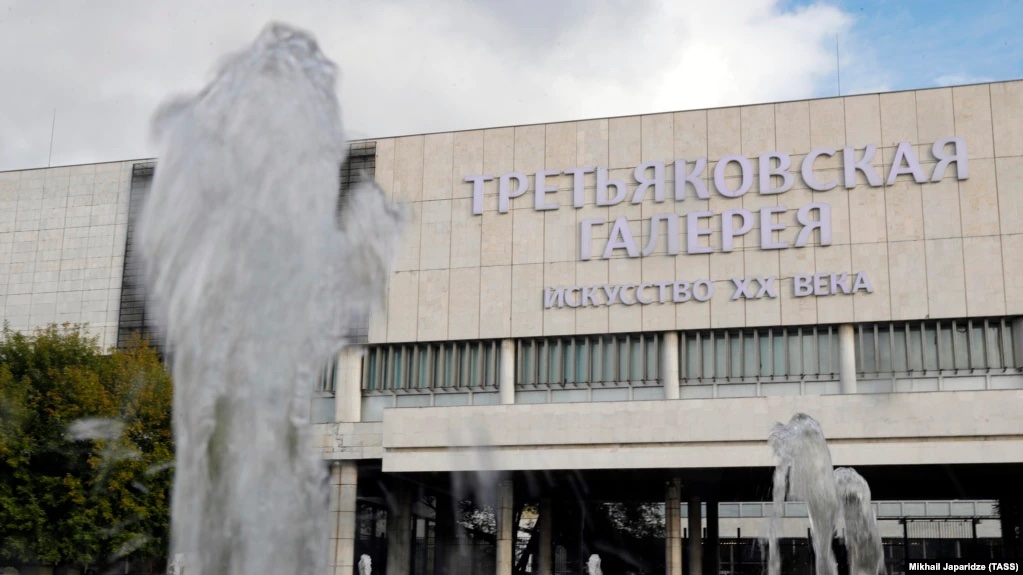
A view of the New Tretyakov Gallery in Moscow. Photo: Mikhail Japaridze (TASS). Courtesy of Radio Svoboda

Russian authorities have canceled the 9th Moscow International Biennale of Contemporary Art, which was supposed to take place at the New Tretyakov Gallery.

In a press release, the Russian Ministry of Culture said the reason was “the absolute discrepancy between the caliber of a number of the exhibits and the venue’s status […] The Tretyakov Gallery is a treasure trove of Russian art. The desire to hold the project [t]here, and not at a private or corporate venue, should go hand in hand with responsibility for the exhibition’s artistic and ethical context.”

In addition, with reference to the Tretyakov Gallery, the Ministry of Culture noted that the management of the Moscow Biennale of Contemporary Art Foundation had not fulfilled its obligations under the contract. Among other things, they had failed to meet the deadlines for installing the exhibition and not provided the necessary paperwork, which, in turn, led to a violation of fire safety rules.

The biennale was to begin on November 7. In connection with the news that the exhibition had been canceled, a statement by the organizers and a video from the exposition, now closed and sealed off, appeared on the biennale’s website.

The event’s organizers and participating artists say they do not dispute the decision to close it, but do not agree with the “terrifying wording” of the explanation for its closure.

The exhibition’s spokespeople note that they were going to show, in particular, Sergei Bugaev’s project on the demolition of Soviet war monuments in Europe, the works of Anastasia Deineka and Adelina Shabanova, who are artists from Donetsk and Lugansk, and other projects on timely topics.

“Contemporary art is considered to be outcasts [sic]. We are suspected of hooliganism and nihilism in advance, of giving people the finger with our hand stuffed in our pocket. But we did no such thing. We decided in march 2022 that we were working for our viewers. We are all going through perhaps the most difficult test for our country and in each of our lives, and we need to at least try to go through it with dignity. We tried,” the organizers said in their statement.

Source: “Biennale of contemporary art canceled in Moscow,” Radio Svoboda, 4 November 2022. Translated by the Russian Reader

A video survey of 9th Moscow Biennale of Contemporary Art at the New Tretyakov Gallery, closed by order of the Russian Ministry of Culture before its scheduled opening date of November 7, 2022.

DEAR COLLEAGUES!

LAST NIGHT, WE, THE TEAM AND THE ARTISTS OF THE 9TH MOSCOW BIENNALE LEARNED FROM THE NEWS THAT THE MINISTRY OF CULTURE OF THE RUSSIAN FEDERATION HAD DECIDED TO CLOSE THE EXHIBITION. ONE DOES NOT ARGUE WITH THE MINISTRY, BUT WE CANNOT HELP BUT OBJECT TO THE HORRIFYING WORDING “THE DISCREPANCY BETWEEN THE CALIBER OF A NUMBER OF THE EXHIBITS AND THE CHOSEN VENUE’S STATUS.”

BY DECISION OF THE MOSCOW BIENNALE’S ADVISORY BOARD, ONLY RUSSIAN ARTISTS — 27 CREATORS — ARE PARTICIPATING IN THE 9TH MOSCOW BIENNALE. FOR SOME, THIS IS THEIR FIRST SERIOUS EXHIBITION, WHILE FOR OTHERS IT IS JUST ANOTHER IN A LONG LIST OF EXHIBITIONS AT LEADING VENUES AROUND THE WORLD. THEY HAVE ONE THING IN COMMON: EACH IS A TALENTED ARTIST:

TATIANA BADANINA,
MARINA BELOVA AND ALEXEI POLITOV,
YEVGENIA BURAVLEVA,
SERGEI BUGAEV,
DMITRY VOLODIN,
THUNDER GROUP:
ALEXEI LOGINOV
ARTYOM LOGINOV
OLGA MICHI
ANASTASIA DEINEKA,
VASILY ELSHIN,
PLATON INFANTE,
ANDREI KARTASHEV,
DARIA KONOVALOVA-INFANTE,

THE EXHIBITION IS CALLED “SHORTHAND FOR FEELINGS”. THE VIEWER WAS TO MOVE FROM “TENSION” THROUGH “RESPECT,” “NOSTALGIA,” “SURPRISE,” “INFINITY,” “FAITH,” “HOPE,” “TRANQUILITY,” HISTORICAL “MEMORY,” “REVERENCE,” “GRATITUDE,” “BITTERNESS OVER WHAT MIGHT HAVE BEEN,” “LOVE” AND “BELONGING” TO “LIGHT” AND “PEACE.”

CONTEMPORARY ART IS CONSIDERED TO BE OUTCASTS. WE ARE SUSPECTED OF HOOLIGANISM AND NIHILISM IN ADVANCE, OF GIVING PEOPLE THE FINGER WITH OUR HAND STUFFED IN OUR POCKET. BUT WE DID NO SUCH THING. WE DECIDED IN MARCH 2022 THAT WE WERE WORKING FOR OUR VIEWERS. WE ARE ALL GOING THROUGH PERHAPS THE MOST DIFFICULT TEST FOR OUR COUNTRY AND IN EACH OF OUR LIVES, AND WE NEED TO AT LEAST TRY TO GO THROUGH IT WITH DIGNITY. WE TRIED:

HOPE BY TATIANA BADANINA. PART OF THE PROJECT IS A SERIES OF WHITE SHIRTS, SIMILAR TO CHRISTENING SHIRTS, BUT IT IS CLEAR THAT SOME OF THEM HAVE SOMETHING IN THEIR POCKETS. IT IS DEDICATED TO THE NOTES CONTAINING PRAYERS THAT WIVES AND MOTHERS SEW INTO THE CLOTHING OF SOLDIERS AS THEY SEE THEM OFF TO THE FRONT, HOPING THAT HER LOVE AND HOPE FOR A REUNION WILL HELP HER HUSBAND OR SON STAY ALIVE. AND ON THE WALL NEXT TO IT IS A LETTER FROM THE FRONTLINE OF THE GREAT PATRIOTIC WAR, FROM THE AUTHOR’S FAMILY ARCHIVE.

MEMORY BY SERGEI BUGAEV IS A PROJECT ABOUT THE DEMOLITION OF OUR MONUMENTS IN EUROPE. MOST OF THEM ARE MEMORIALS TO THE LIBERATING SOLDIERS, ERECTED AFTER THE GREAT PATRIOTIC WAR IN COUNTRIES LIBERATED FROM FASCISM: ESTONIA, LATVIA, LITHUANIA, UKRAINE, POLAND, CZECH REPUBLIC. BUT THE BUSTS OF ALEXANDER SERGEYEVICH PUSHKIN AND THE PLAQUE ON THE HOUSE WHERE MIKHAIL BULGAKOV WAS BORN HAVE ALSO SUFFERED. WE HAVE COLLECTED 102 IMAGES OF DEMOLISHED AND DESECRATED MONUMENTS: FROM MEMORIAL CEMETERIES TO BUSTS OF THE POET AND BROUGHT THEM TOGETHER IN ONE VIDEO, AND IN THE FINALE THERE IS FOOTAGE OF THE SAUR-MOGILA MEMORIAL COMPLEX IN DONETSK, RESTORED IN 2022 AFTER SIMILAR DAMAGE.

THE WALL TEXT WITH THE FULL LIST OF TITLES TOOK UP 4 METERS.

ANASTASIA DEINEKA’S PEOPLE ARE PORTRAITS OF PEOPLE LIVING IN DONETSK, PEOPLE WHO DID NOT LEAVE THE CITY EITHER IN 2014 OR NOW. THE ARTIST’S STORY ABOUT THE PERSON IN THE PORTRAIT SUPPLEMENTS EACH PORTRAIT. “THERE ARE HUNDREDS OF HEROES IN THE WORLD, ABOUT WHOM THOUSANDS OF BOOKS AND STORIES HAVE BEEN WRITTEN. NO ONE TALKS ABOUT THE PEOPLE YOU WILL SEE DEPICTED ON MY CANVASES, BUT YOU CAN UNDERSTAND THEM WITHOUT WORDS.”

THE CREATOR OF THE STORY OF THE BLUE HARES, ADELINA SHABANOVA, WAS BORN IN LUGANSK IN 1998. WHAT SEEMS AT FIRST GLANCE TO BE A CHEERFUL STORYBOARD FOR A CARTOON PROVES TO BE A SCARY FAIRY TALE WHEN EXAMINED CAREFULLY. THE BLUE HARES ARE LIVING THEIR NORMAL LIVES, BUT ARE IN CONSTANT TENSION. AT ANY MOMENT A BIRD OF PREY CAN BLOW UP A QUIET FAMILY DINNER, A MATH LESSON, SITTING ON THE COUCH IN FRONT OF THE TV, AND THERE IS NOWHERE TO HIDE.

PART OF THE PROJECT “LIGHT” IS ANTHONY VAN DYCK’S “PORTRAIT OF THE APOSTLE PETER,” 1618, AS A SYMBOL OF THE ETERNAL LIGHT OF GREAT ART.

PEACE — TWO ARTISTS: SASHA KUPALYAN FROM MOSCOW AND NASTYA DEINEKA FROM DONETSK, FOR TWO WEEKS COLLABORATED ON PAINTING A PEACEFUL SKY AS OUR COMMON PRAYER FOR PEACE AND CALM.

THE 9TH MOSCOW BIENNALE IS READY. WE NEEDED 1 MORE DAY TO FINISH 3 INSTALLATIONS, TAKE OUT THE GARBAGE, SET UP THE VIDEO, HANG THE CURTAINS AND SOLEMNLY MOUNT THE VAN DYCK.

MIKHAIL BORISOVICH PIOTROVSKY, A MEMBER OF THE MOSCOW BIENNALE’S ADVISORY BOARD, WAS DIRECTLY INVOLVED IN SELECTING THE CREATORS FOR THE PROJECT AND GAVE THIS QUOTE FOR THE OPENING DAY PRESS RELEASE: “RUSSIA PLAYED A HUGE ROLE IN SHAPING THE ART OF THE TWENTIETH CENTURY. THE MOSCOW BIENNALE IS A CHANCE FOR THE 21ST CENTURY.”

WE WEREN’T GIVEN A CHANCE. IT IS ESPECIALLY A PITY THAT MOSCOW WILL NOT SEE THE WORKS OF ARTISTS FROM DONETSK AND LUGANSK. NASTYA DEINEKA, IN ADDITION TO WORKING WITH SASHA KUPALYAN, REPPRODUCED IN HER ROOM “THE ANGEL OF DONBASS, WHICH SHE PAINTED FOR THE FIRST TIME ON THE WALL OF A KINDERGARTEN BOMBED ON JUNE 1, 2022. AND WE HUNG A VIDEO OF HER WORKS ON THE WALLS OF DONETSK NEARBY.

WE MANAGED LAST NIGHT, BEFORE THE ROOMS WERE SEALED, TO FILM THE EXHIBITION AND ARE POSTING THE VIDEO. PLEASE TAKE A LOOK.

Source: 9th Moscow International Biennale of Contemporary Art. The original text was printed in all caps. The punctuation of the original text has also been preserved where possible. Translated by the Russian Reader
You Don’t Speak for Us

A Statement by the Free Nations League

Regarding the Convocation of a Congress of People’s Deputies of the Russian Federation in Poland

From open sources, we have learned about an undertaking to convene a Congress of People’s Deputies in the town of Jabłonna, Poland (November 4–7, 2022). The delegates to the Congress are parliamentary deputies of different years and different levels who were elected in internationally recognized elections. Rejection of the war between Russia and Ukraine that began in 2014 and a willingness to change the socio-political system established in the Russian Federation are their common platform. The event’s organizers have announced that they will adopt a “Declaration on the Constitutional Principles of a Free Russia after the Putin regime’s overthrow,” a “list of priority decisions by the post-Putin Russian government,” etc.

In the light of this news:

🔹 We cannot but note the fact that [free and fair] elections in the Russian Federation disappeared long before 2014. Ethno-national political parties were banned thirteen years before Ukrainian region of Crimea was annexed. Thus, despite the fact that the Russian Federation, according to its own constitution, is a federation, and most of the ethno-national republics within the Russian Federation are nation-states with their own constitutions, parliaments, and governments, we have been deprived of the opportunity to represent and defend our interests in representative bodies for decades.

🔹 We acknowledge that the Russian Federation as a state has gone too far both in its ethno-national policy (extolling the Russian nation as chosen and endowing it with a special status in the Russian Federal Constitution) and in its foreign policy, thus completely destroying the legal space of the federation. The Russian Federation currently has no clear and legitimate borders, nor does it have legitimate representative bodies, since there are “deputies” and “senators” seated in the Federal Assembly who were, allegedly, delegated by illegally annexed foreign territories.

In light of the above considerations, we, representatives of the ethno-national and regionalist movements united in the Free Nations League, declare the following:

1. We do not recognize any political forces and hubs that would justify maintaining the Russian Federation in its current form. We have no need of arbitrators from Moscow, neither from the authorities nor from the opposition. We are open to dialogue and contact only with those who publicly support the right of enslaved peoples to establish independent States.

2. The Russian Federation cannot be re-established by cutting off what was seized by force and holding new elections. It is not elections that are at issue, but the very nature of Russian statehood: it is imperialist and exudes aggression towards its neighbors. This means that we, representatives of ethno-national republics and regions, have the right to shape our own destiny. If there is a discussion of independence for certain lands, let the people themselves hold this discussion, let them decide which confederations or unions to join, free from the intervention of federal forces, be they the government or the opposition. Any attempts at “peacekeeping,” attempts to teach us how to exercise our right to self-determination, will be rejected by us, and if they are intrusive, they will be met with a forceful response.

3. The process of forming a new Russian state should be voluntary and undertaken exclusively by those federal subjects whose legislative bodies vote to join a new federation. All federal parties currently represented among the federal authorities should be banned since they profess a misanthropic ideology that has produced thousands of victims and millions of refugees. The legislative bodies of the former federal subjects must be re-elected democratically, by open and secret ballot, with the involvement of ethno-national and regional political parties. There can be no automatic entry into the “renewed” Russia, no joining it “by inheritance.”

This appeal has been signed by representatives of the following national movements:

Bashkir

Ruslan Gabbasov, head of the Bashkir National Political Center (BNPC)

Ilshat Kinzyabayev, member of the BNPC

Buryat

Radjana Dugar-DePonte, representative of the Erhatan Buryat Democratic Movement in the USA

Cossack

Vyacheslav Demin, elder of the Cossack National Liberation Movement

Oirat-Kalmyk

Arslang Sanjiyev, chair of the Oirat-Kalmyk People’s Congress

Erentsen Dolyayev, deputy chair of the Oirat-Kalmyk People’s Congress

Batyr Boromannayev, deputy chair of the Oirat-Kalmyk People’s Congress

Vladimir Dovdanov, deputy chair of the Oirat-Kalmyk People’s Congress

Albert Sharapov

Tatar

Rafis Kashapov, deputy prime minister of the Government of Independent Tatarstan in Exile, co-founder of the Free Idel-Ural Movement

Farit Zakiyev, chair of the Tatar Public Center

Nafis Kashapov, deputy prime minister of the Government of Independent Tatarstan in Exile

Irshat Khabi

Chechen

Khamzat Grozny, a political exile in France from the Chechen Republic of Ichkeria

Erzya

Bolyayen Syres

Vitaly Romashkin

Ozhomason Kirdya

Source: Free Nations League, Facebook, 31 October 2022. Thanks to Sergey Ogurtsov for the heads-up. Translated by the Russian Reader


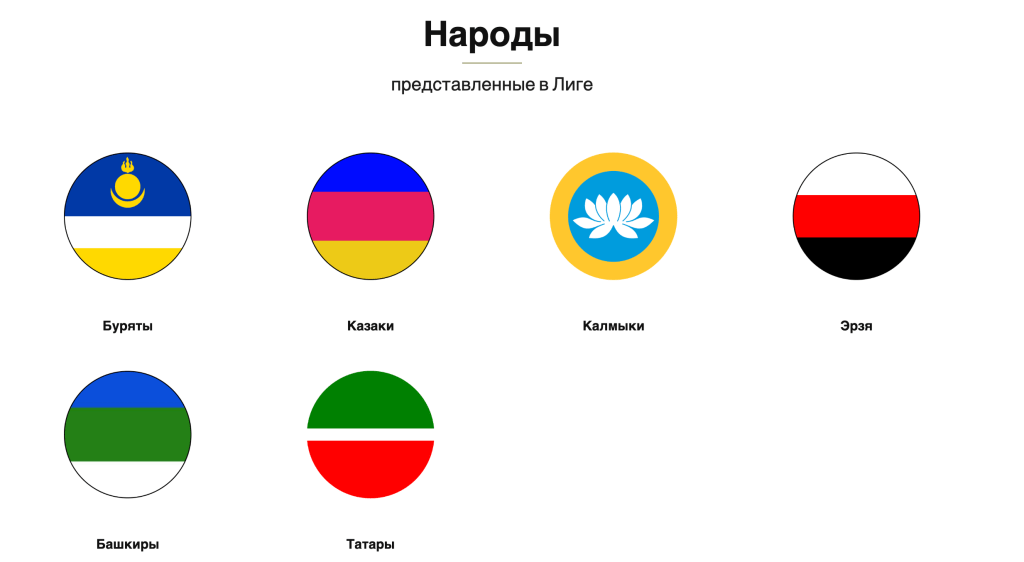
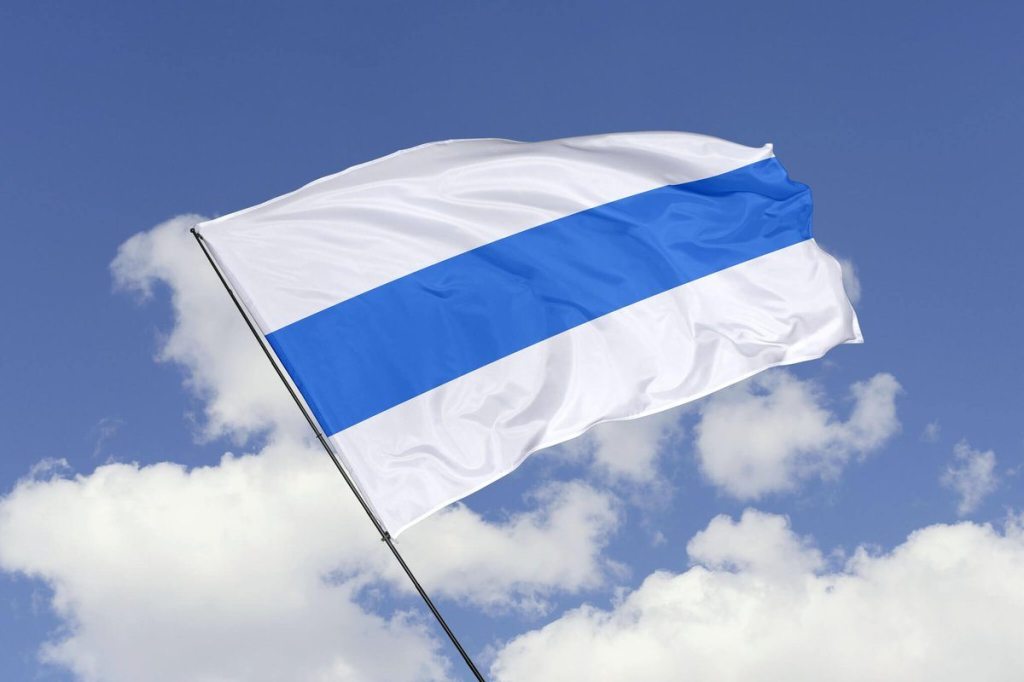
“Nations represented in the League: Buryats, Cossacks, Kalmyks, Erzya, Bashkirs, Tatars”

The FNL’s Principles

1

The Russian Federation is an empire that keeps its colonies in servitude by force. It is impossible to liberate them by holding a referendum, just as a referendum on the observance of human rights is impossible under conditions of state terror.

2

The peoples of the Russian Federation should be able to exercise their right to self-determination. Further federations or confederations can be established only a voluntary basis, not by diktat of the former federal center.

3

We declare the principle of the presumption of identity and agency [sub’ektnost’]. Accordingly, with the collapse of the current political regime in the Russian Federation, the regions have no need to appeal to anything to endow themselves with sovereignty. By definition, all regions acquire complete sovereignty and full independence from Moscow, and only then, as free territories, do they decide their future: whether they want to maintain independence, unite with other regions and republics, or create a confederation of states.

4

All subjects of the Russian Federation have the right to independently determine their future.

Source: “About Us,” Free Nations League. Translated by the Russian Reader

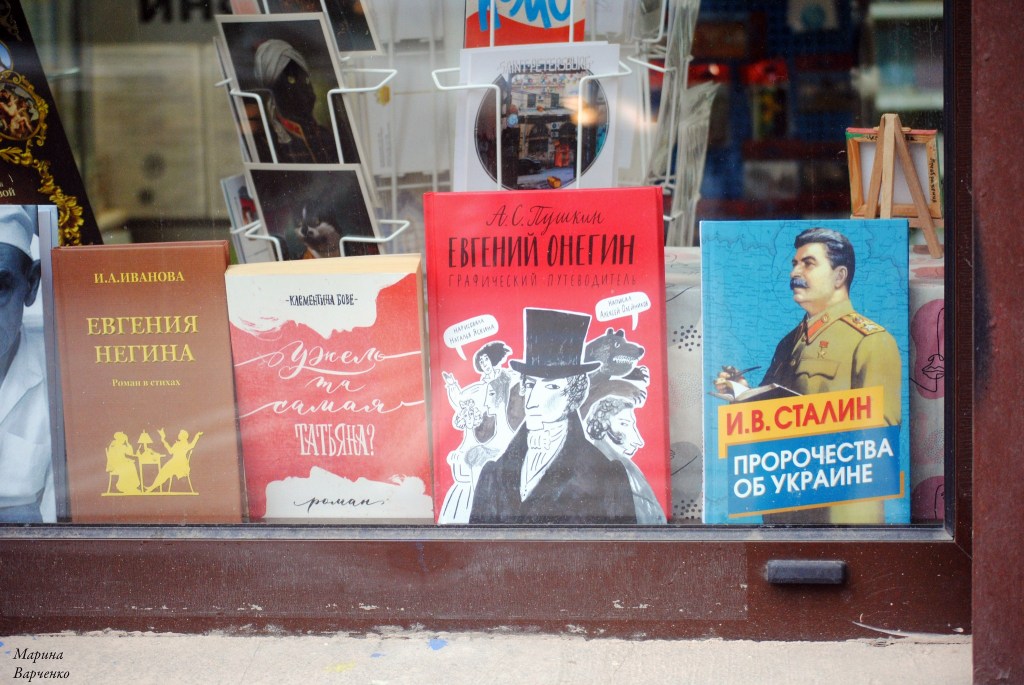
“Prophecies about Ukraine”

The books on display, from left to right, are: I.A. Ivanova, “Yevgenia Negina: A Novel in Verse”; Klementina Bove, “Is That Really the Same Tatiana? (A Novel)”; A.S. Pushkin, “Yevgeny Onegin: A Graphic Guide”; I.V. Stalin, “Prophecies about Ukraine”

A textbook and resource guide store for school teachers, Lomonosov Street, Petersburg, today.

Source: Marina Varchenko, Facebook, 21 October 2022. Remarking on this post, “Marina Marina” wrote: “I got into a fight with a history teacher from Russia in the comments [to another social media post]. She doesn’t see any historical parallels at all. And she says that it was the Americans who made up the history of Ukraine. And that what she teaches there at home is the only truth in the world.” Translated by the Russian Reader

Russian Soul Music

Since Masha Gessen quite literally believes that the Russian “liberal” intelligentsia is God’s gift to humankind, she writes the following nationalist nonsense with a completely straight face:

In the seven and a half months since Russia launched its full-scale invasion, hundreds of thousands of Russians have left their country. Many of them are journalists, writers, poets, or artists, and they, along with some who are still in Russia, have been producing essays, poems, Facebook posts, and podcasts trying to grapple with the condition of being citizens of a country waging a genocidal colonial war. Some of their Ukrainian counterparts have scoffed at their soul-searching. Ukrainians, indeed, have bigger and more immediate problems. But they also have certainty—they know who they are in the world, while for Russians nothing is as it once seemed to be.

[…]

The last time people were writing in Russian so urgently was in the late nineteen-eighties. Soviet citizens back then had been confronted with their past—the Stalinist terror. That moment gave Russia, among other things, Memorial, the human-rights organization that, along with Ukrainian and Belarusian activists, won the Nobel Peace Prize last week. Now Russian citizens are being confronted with their present. The writers in exile have physically fled their country (as has much of Memorial’s leadership) and are trying to write their way to a new Russia. Their imagination extends far beyond the Russian constitution to a world that’s radically different, and better than not only Putin’s revanchist Russian World but the world we currently inhabit.

Source: Masha Gessen, “The War in Ukraine Launches a New Battle for the Russian Soul,” The New Yorker, 9 October 2022. The emphasis is mine.


“Yoga for your health.” Central Petersburg, 6 July 2017. Photo by the Russian Reader

The queue for the ferry. There are Russian tourists behind me. (If you thought there were none of them [in Europe anymore], think again.) The boat arrives, but there’s not room enough for everyone and the guard closes the barrier just in front of us. Everyone stands there meekly, except my compatriots. As soon as the guard turns around, they dive under the barrier and run onto the crowded ship. They look like Moscow hipsters.

When did these people decide that everything is permitted them and that there are no prohibitions and rules? I missed this moment because the Soviet Untermenschen among whom I grew up considered themselves worse than everyone and were afraid of making a peep. Who instilled this hubris in them? How did they get it into their heads that they could go to war with the whole world and win?

(A spare boat was brought in five minutes later, of course, and it took us all away without any fuss or crush.)

Source: Dmitry Volchek, Facebook, 15 October 2022. Translated by the Russian Reader

We Do Not Have to Be This Way

I read the following two passages just now in quick succession, quite by chance, while eating lunch:

1) “I would try to kill anyone who harmed or spoke ill of you. You would try to kill anyone who harmed or spoke ill of me. But neither of us would ever, under any circumstance, be honest about yesterday. This is how we are taught to love in America. Our dishonesty, cowardice, and misplaced self-righteousness, far more than how much, or how little we weigh is part of why we are suffering. In this way, and far too many others, we are studious children of this nation. We do not have to be this way.”

2) “In 2014, a U.S.-driven Maidan coup in Ukraine overthrew the elected government and burned down the trade union headquarters building in Odessa, killing 48 people. In opposition to the coup two Russian-speaking provinces of Eastern Ukraine, Donetsk and Luhansk, seceded. The democratic right to self-determination from the nationalist Kiev government which banned the Russian language must be recognized for the Eastern and Southern provinces. The neo-fascist Azov Brigade opened fire on the two newly-founded republics of the Donbas region, killing over 15,000 civilians. African immigrants in Ukraine attempting to flee the war were subjected to racial discrimination by the Zelensky government.”

Yesterday morning, while drinking coffee, I read the following two passages hard on each other’s heels:

3) “As a child, one of my grandmothers wandered Siberia with her mother (in the thirties). She told me many times about a crazy old woman they met. The old woman went around pointing her finger at passersby and saying, ‘The blood of the murdered innocents will fall on everyone. On everyone! On everyone! On everyone!’ I remembered this today. She was right.”

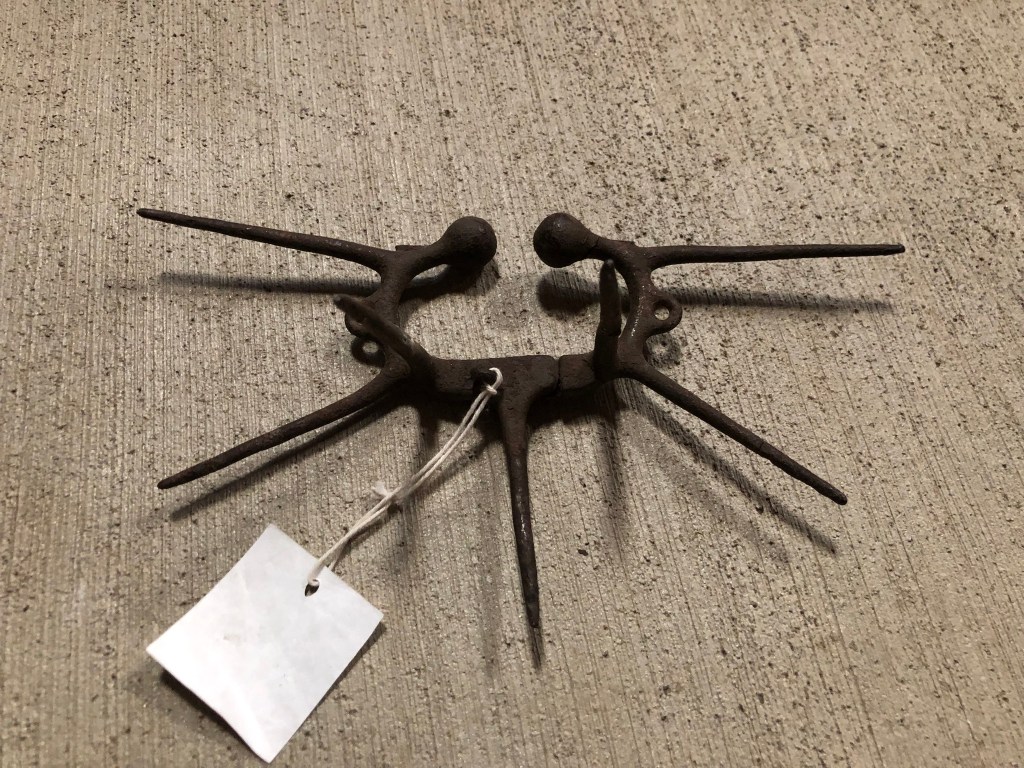
4) “This spiky looking object is an anti-suckling device. The artifact is made up of a nose ring with seven long (and sharp) spikes welded onto it. When the farmer decided that it was time for a calf to be weaned from its mother, they would use this item. The ring would be placed in the nose of a young calf—when the calf would try to nurse from its mother, the spikes would poke the mother causing her pain. The mother would then kick the calf away or avoid the calf to escape the discomfort of being poked.”

Sources: 1) Kiese Laymon, Heavy; 2) Various alleged ILWU members (including Angela Davis), “Stop the Ukraine War—refuse to handle military cargo,” MR Online (thanks to Marxmail for the heads-up); 3) Natalia Vvedenskya, Facebook, 11 October 2022 (translated by the Russian Reader); 4) Murray County Historical Museum, Facebook, 11 October 22. Photo, above, also courtesy of the Murray County Historical Museum.

Mobilization Dragnet Blues

Maxim Sokolov, but not the one the “housing authority” is looking for.

I’ve now had two visits “from the housing authority.” Both times it was middle-aged dames who visited me. The first one was wearing a headscarf, while the one today had a short haircut. The most amazing thing is that they were looking for an apartment with the same number as mine, but in the building next door. But they couldn’t find it, so they came to my apartment.

This is a rough recreation of today’s conversation:

— I need Maxim Sokolov . . .

— Meep! Someone came here asking for him two days ago. Like I said then, you have the wrong building.

— Yes, I know . . . But just in case . . .

— “Just in case” what?

— Well, just in case you’re hiding him under the sofa.

— He lives in another building! I don’t even know him.

— But I can’t find the apartment.

— You do realize that even if you come here ten times, the building number won’t change, and he won’t be here.

— But they send me looking for him so I can serve him a [mobilization] summons.

— Then tell them to buzz off!

She hesitates at the door.

— But there’s another one I can’t find.

And she shows me another summons.

— But there’s a different building number written here, too!

— Yes! But I can’t find it. In the building next door, the numbering starts with apartment no. 23, but here it says apartment no. 1 and apartment no. 3.

— What can I do? Should I write to you that he is not at this address because it’s a different address?

She sighs bitterly and stalks off.

Maxim Sokolov and Comrade Branov (whoever you are) — run, hide under the sofa, don’t live at your official addresses, save yourselves!

Source: Friends-only post on Facebook by a trusted source and occasional contributor to this website, identified here as “VA” for future reference. Photo of the odious Russian nationalist journalist Maxim Sokolov (who is the first Maxim Sokolov who pops up when you Google the name in Russian) courtesy of the equally odious RT. Translated by the Russian Reader