In the wake of Alexei Navalny’s murder by the Russian fascist state, his message to the Russian people, at the end of the award-winning documentary film Navalny, has been quoted ten thousand times and turned into a meme on social media, to wit:
“If they decide to kill me, we are incredibly strong,” he said, addressing Russian citizens. “The only thing necessary for the triumph of evil, is for good people to do nothing. So don’t be inactive.”
[…]
“You’re not allowed to give up,” Navalny said in the Daniel Rohr film, adding that “we need to utilize this power to not give up, to remember we are a huge power that is being oppressed by these bad dudes.”
Based on what I’ve witnessed firsthand and secondhand over the past twenty-five years, Navalny’s assessment of Russian society’s incredible strength was wishful thinking on his part. Or, to put it more charitably, it was an incredibly hopeful political project.
To my mind, this Facebook post by longtime TRR contributor Sergey Abashin gets closer to truth about the state of affairs in Russian society, although it’s emphatically not a political project. Nor will it be righteously memed to death by Russia and the world’s well-meaning liberal masses.
Today is the day when [Boris] Nemtsov, a politician who united everyone, was despicably murdered for dissenting. And today is the day when Oleg Orlov, a man of impeccable integrity, was “awarded” two and a half years in prison for dissenting. I hate myself for being powerless. I hate society for being submissive. I hate the authorities for their fascism.
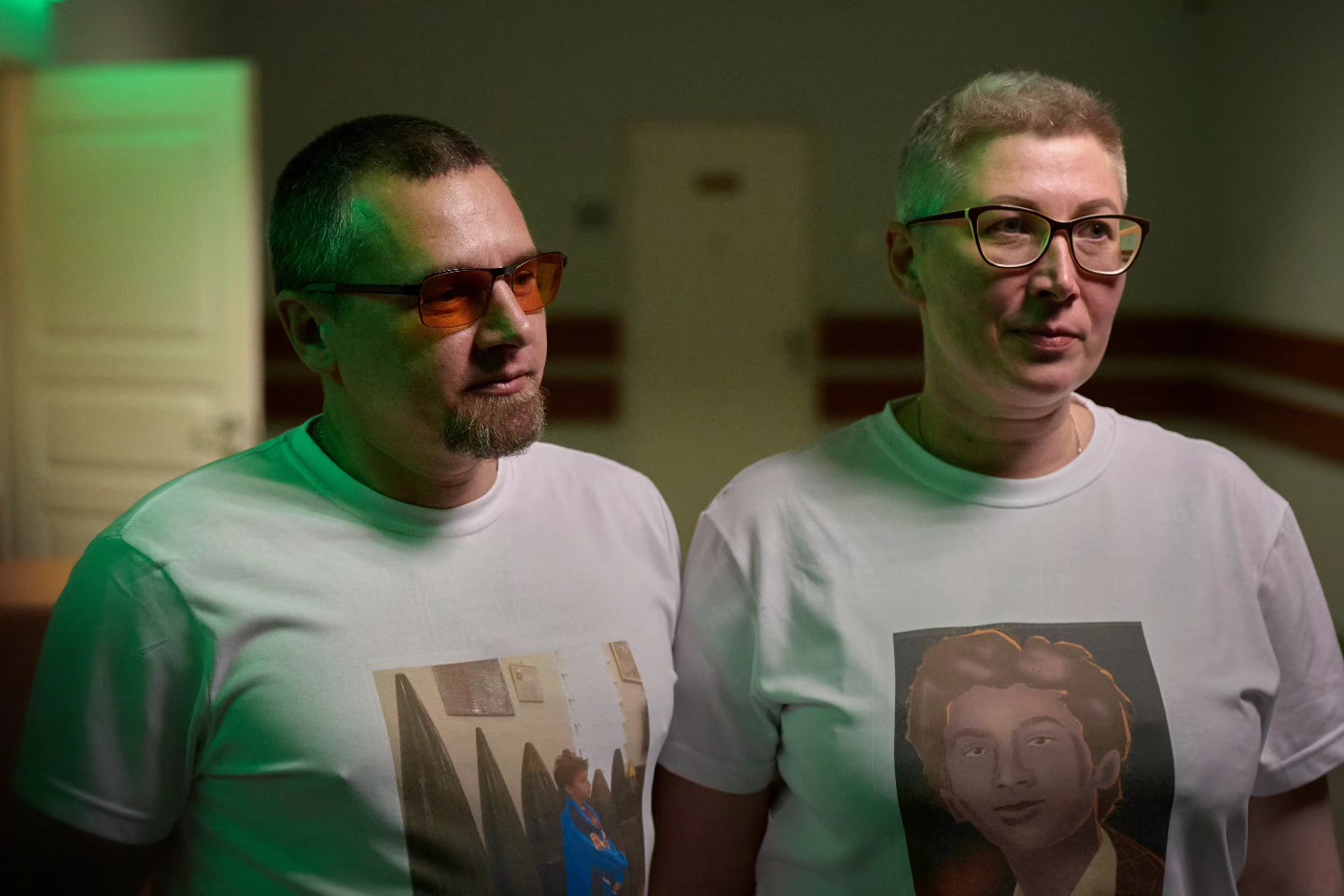
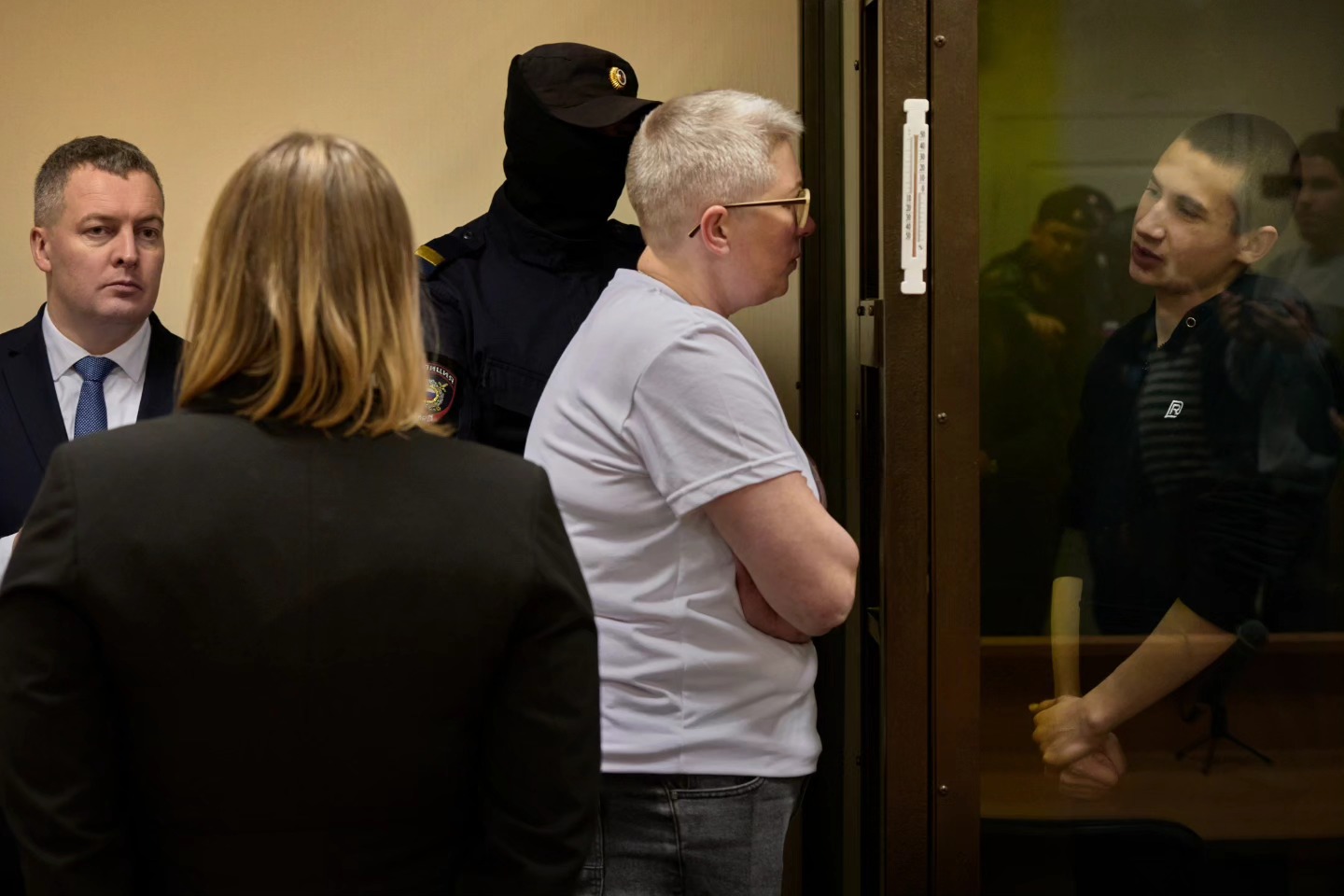
On Wednesday, November 22, 17-year-old Yegor Balazeikin was sentenced by a St. Petersburg military court to a harsh six-year prison term. The high school student, profiled by Le Monde in September, was found guilty of “attempting a terrorist act with the aim of destabilizing state institutions.”
He was arrested in February, at the age of 16, when he threw a Molotov cocktail at the gates of the military recruitment office in Kirov, near his village in the St. Petersburg region. According to the prosecution, he had committed a similar act a few weeks earlier in St. Petersburg.
Yegor Balazeikin has never denied responsibility for the first of these two acts. He explained that it was because of his opposition to the war in Ukraine. Since his arrest, he has not relented in the face of the investigators’ attempts to coax him, nor in the face of threats. In a letter to his mother, his sole ambition was to “remain a man,” both in Russia at war and in prison.
The prosecutor had requested a six-year prison sentence, relatively lenient in view of the verdicts handed down by the Russian justice system in recent months. On November 14, for example, a resident of Tolyatti received the same sentence for defacing posters showing “heroes” of the “special military operation” in Ukraine. Three days later, Alexandra Skochilenko, an artist from St. Petersburg, was sentenced to seven years in prison for pasting anti-war tags in a supermarket.
The court considered Yegor Balazeikin’s health status as a mitigating circumstance. The young man, who is passionate about history and karate, has been suffering since the age of eight from autoimmune hepatitis. It is an incurable and serious disease that has worsened since his detention in February.
Another mitigating circumstance is that he has always acknowledged the facts. On Wednesday, he once again explained his actions at the hearing. “I came to the conclusion that I could never approve of the presence of Russian armed forces on Ukrainian territory. I tried to talk about it to those around me, to help people realize this. But I realized that discussions were useless and I wanted to act differently.”
‘I don’t expect to be understood or acquitted here’
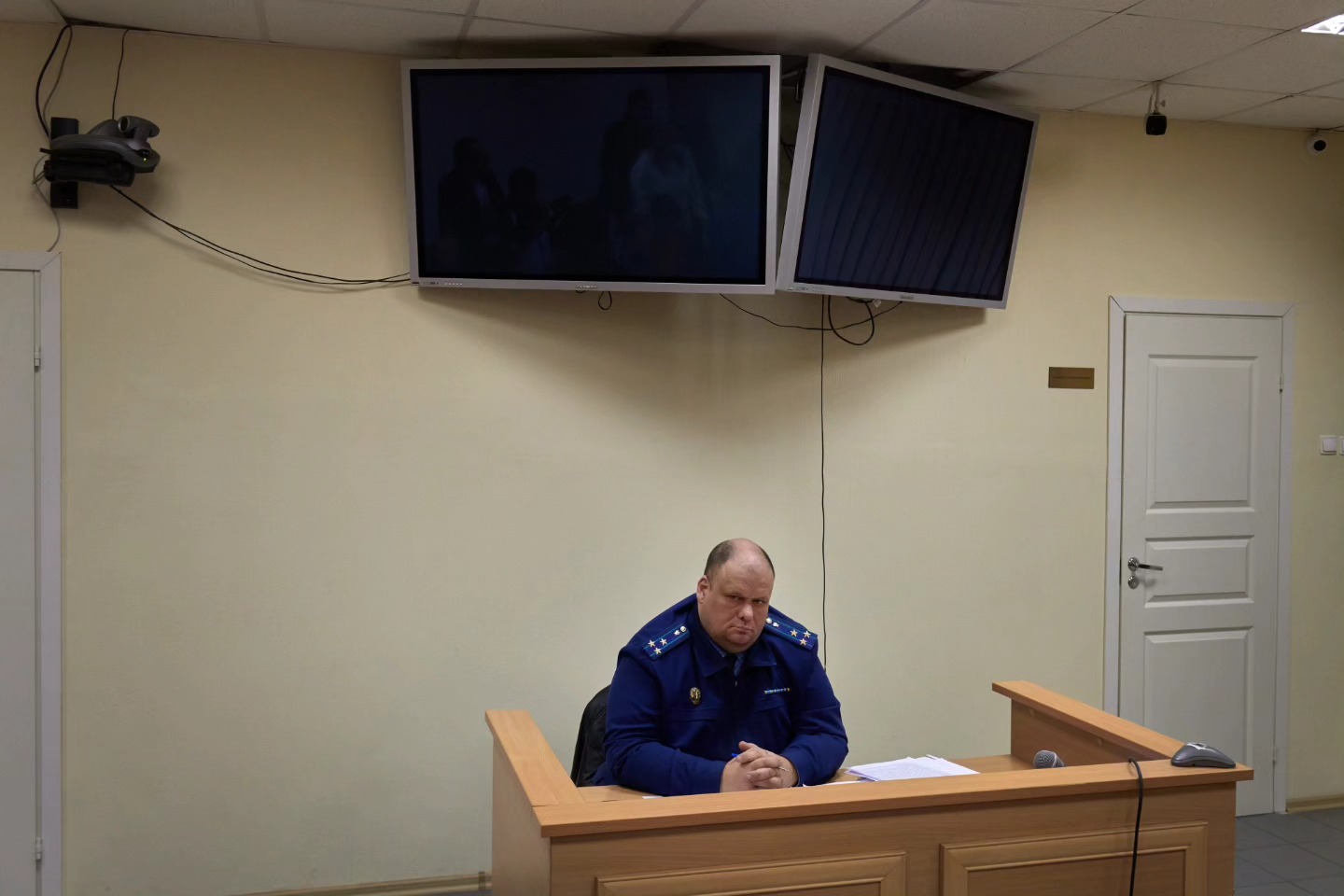
In the defiant posture that he has taken throughout the hearings, standing with clenched fists, he pronounced his last words to the court in front of a prosecutor who had fallen asleep, the press reported. “The person closest to me, my mother, would like me to be acquitted,” he said. But I’m not asking for acquittal – my conscience will judge me. Six years, eight years, it doesn’t matter… We’ll settle scores in the after world. […] I’m told to be patient and that everything will be alright in our country. But is that really the case? Two years have gone by and I still don’t see the link between bombed Mariupol and what’s happening in my little house [Egor’s family live in a wooden house that’s close to insalubrity]. And even if all this were to enable us to renovate our towns and open sports halls, would the price be acceptable? Lives… The date of February 24 [2022, the start of the war] has become more important to me than my birthday. I know I’m going to jail, but if I’m guilty of anything, it’s of being indifferent… At first, I didn’t care about any of this, which is the same as supporting [the war].”
Although he never denied his actions, the young man stressed that he had never meant to harm anyone, waiting until evening to throw his projectile against a metal door. It did not catch fire. The public prosecutor, for his part, felt that an agent from the recruitment office could have died.
His parents supported their son from the moment of his arrest. They respected his willingness to take responsibility for his actions and they acted as his spokespeople. His mother took an active part in the trial, doing her utmost to make it as transparent as possible, with publications on a support group on social media. At the hearing, she also pointed out that her son had been affected by the death of his uncle in June 2022. The uncle had been a volunteer on the Ukrainian front. “He betrayed him,” said the prosecutor.
Yegor Balazeikin, who was expecting a long sentence, wants to continue his studies in prison. His mother hopes he will be able to receive treatment there.
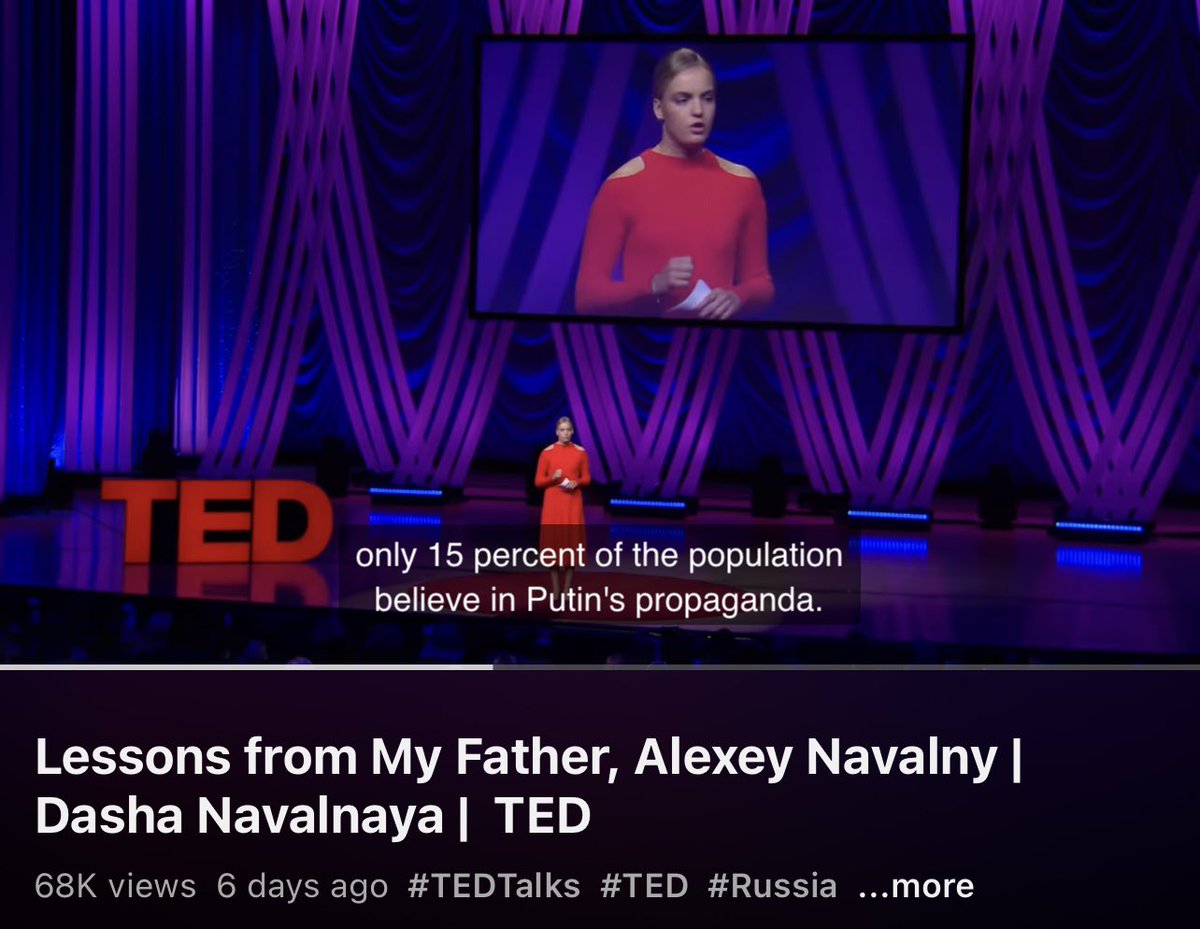
Dasha Navalnaya is the daughter of Alexey Navalny, the politician and leader of the Russian opposition to Vladimir Putin. Sharing the story of her father’s poisoning, persecution and current imprisonment, she details what it was like growing up under the watchful eye of government surveillance as her father led a decade-long investigation into the corruption of Putin’s regime — and shows why paying attention to what happens in Russia matters to everyone, everywhere.
There’s been some discussion lately on what proportion of russians actually believe russian propaganda. The presumption is that a low number gives hope for the end of the regime. There’s a lot of problems with that logic. Firstly, domestic russian propaganda is very often very open about the crimes russia is committing as an imperial aggressor. So it’s nonsensical to talk only about whether russians recognise lies. What matters is the extent to which they share this imperialist mindset and chauvinistic attitudes. It doesn’t matter whether you can recognise lies if you still think of Ukrainians as your little brother speaking a funny dialect of russian who needs to be pulled back into line. The key question is what proportion understand Ukraine is an independent nation – all the way to Crimea – and has a right to exist and do sovereign things like choose its own security alliances. It’s definitely not 85%. Not even close. When it comes to russia’s lies – like the lie it’s fighting nazis – I’d estimate the proportion of russians who understand this to be a lie at roughly 100%. On some level, to some extent, literally everyone knows this is a lie. Consider this. Have you ever heard anyone ever express any confusion as to why wagner, founded by a neo-nazi, had a leading role in ‘denazification’. It was never hidden. And it does not make any sense if you believe the lie. But no one really believes russia is fighting nazis. This would be a very, very long thread if I went through all the examples of where no one ever expresses confusion when russia openly does and says things that are completely contradictory to much of its own propaganda. No one is confused because everyone knows russia lies. But that does not translate to not supporting the regime. Lying is an endemic feature of russian society. People accept lying as easily as they lie themselves because, in this case, they know the lies are necessary to advance the imperial agenda. When Navalny’s people speak to Western audiences, they play on the assumption that western values are universal in russia and that russians are yearning for a liberal democracy yet only being held back by lies told to them. This is nonsense. Think of russia like a sports team. When diehard fans see their players fake an injury to get a free kick, the fans will shout outrage to the referee in favour of their team’s free kick with no care whether that is fair or not. Would you wade into that crowd of diehard fans to tell them “actually your side cheated” and think this would end their support for their favourite team? On some level, those fans know their side cheated, but what matters is that they just don’t care about the truth despite their feigned indignation. Similarly, convincing russians their country is an imperial aggressor committing genocide does not mean they’ll suddenly want to become a rules-based democracy that stays within its borders. They already know what they are. They support it. Note that russia’s key lies, like the denazification narrative, are used far more prominently towards international audiences in just the same way as fans shouting at a referee. In both cases, the lies are part of the game to them. But this is why international attitudes to Navalny are more positive the further away from russia you get. From afar, it’s easy to convince yourself that exposing russia’s lies will lead to the end of the regime and the start of some happy liberal era led by whoever rules next, even though so much of the russian opposition reflects these same imperial attitudes. What really matters is the end of the russian imperial mindset and its ability to conduct aggression with impunity. For that, the world must support a victory to Ukraine and a Special Tribunal for russia. Give us a TED Talk about that. More importantly, do it.
Since the all-out invasion of Ukraine, political repression in Russia has intensified, targeted in the first place at anti-war protest. But this is the outcome of a 20-year slide towards dictatorship. Russia’s antifascist movement has been a prime target for both armed nationalists and the state: it culminated in 2017–19 with the torture and imprisonment of the “Network” case defendants. In July this year, one of them, Ilya Shakursky, sent this letter from prison, looking back at the antifascist movement’s history. It was published on Avtonom, the anarchist web site. Translation and notes in brackets by People & Nature.
Ilya Shakursky in court in 2020. Photo: Penza News / Free Russia House
Ilya Shakursky: letter to a friend
It went like this. My friend shared his thoughts with me: he had arrived at this discomforting realisation that after my arrest, everything was finished – as if our world was sharply divided into “before” and “after”. It seemed that that life, in which we were immersed for many years – the atmosphere of the dvizha [slang: roughly, movement/ milieu], the concerts, demos, discussions, journeys, street fights, performances – had disappeared, had dissolved into fear and into the constraints that shroud so many of us. It seemed that that life had mutated into nostalgic reflections on those times when just to be yourself in Russia had not yet become so dangerous.
Of course, the root cause of my friend’s predicament is the reality: in the regions, the movement comprises fairly small circles of people, and all the activity depends on their enthusiasm. So it is not surprising that in a small town, after high-profile arrests, everything goes quiet. But now – when there’s a widespread tendency to analyse the history of the almost-destroyed antifascist and anarchist movements in present-day Russia – I have read in several articles the opinion that this latest defeat of the movement began precisely with the “Network” case. My own impression is that the movement at that time, although it suffered from a lack of coordination, exactly in 2016-17 began to aspire to, and head towards, unity and amalgamation.
We all know well about the devastating defeat of the young, audacious movement of the early 2000s and its consequences. It was then that the state power recognised the strength of the antifa, the subcultures, the anarchists and ecologists that it could not control. That all came to an end with the deaths of Fyodor Filatov [antifascist, founder of the Moscow Trojan Skinheads, killed on 8 October 2008 by the Militant Organisation of Russian Nationalists (BORN)], Ilya Dzhaparidze [antifascist killed by BORN on 27 July 2009], Ivan Khutorskoy [antifascist killed by BORN on 16 November 2009], [Stanislav] Markelov and [Anastasiia] Baburova [antifascist lawyer and journalist, killed in broad daylight in central Moscow by BORN on 19 January 2009], the “Khimki case” [showtrial of activists after the big Khimki forest protests] and emigration. The 2000s ended with Exodus (Iskhod) by Pyotr Silayev [author and antifascist activist]. Among us – young antifascist and anarchist men and women – that book was a big hit.
Time passed by. 2011: a vendetta in response to the break-up of the movement and the radicalisation of new people. 2012: Bolotnaya Square [a big anti-government rally, followed by mass arrests]. 2014: Maidan and the start of military action in Ukraine. We, young people whose outlook was shaped by these events, tried to re-awaken and breathe life into the flickering flame of the dvizha. Concerts, squats, days out, fist fights, graffiti, lectures, FNB [Food Not Bombs, Moscow] and free markets. We lived by all this: it was our culture, our self-expression and our inner inspiration. We got to know each other, we were inspired by the experience of our older comrades. We took the road of struggle, we cultivated an atmosphere, we kept the movement going – or at least we tried. And we reached the point where the spirit of the age put in front of us the need for militarisation. The stakes were raised. We realised we were getting closer to the point at which we would have to defend ourselves, to fight to survive. The times changed. …
Autumn of 2017. Arrests. Tortures. Exile from the country. New repressive laws. “The Network”. Sentences. Zhlobitsky [the 17 year old who suicide-bombed the FSB office in Arkhangelsk]. Attempts to protest and resist. People’s Self-Defence [anarchist network]. Kansk [a case brought under terror laws against teenagers who put up protest posters]. And again, tortures and repression. The 2010s came to their end, and now it was our “Exodus”. But not all of us could get across the desert. Some stayed right where they were. And here was the bleak emptiness that my friend told me about, that has reigned since 2017. Time has passed, and there is nothing left of that life that swirled around us. Fear infuses everything. Some were just tired out, some escaped, some – so it seems – went out of their minds and became completely different people. The desert swallowed people in endless emptiness. It’s as if previously optimistic, active people were shackled hand and foot by depression, apathy and disillusionment. Very few lights were left burning.
The new reality: crowds of roughnecks, saluting Nazi-style; billboards calling on people to sign contracts with the army; arrests and sentencing of dissidents daily; [Zakhar] Prilepin [leader of armed Russian nationalists in eastern Ukraine] in the state Duma [parliament]; anarchists and antifa outside the law; Stalinism; quotations from [Ivan] Ilyin [by Putin]; imperial flags and red banners.
When we were arrested, with every interrogation I realised more clearly that the chekists [security police officers] didn’t want simply to combat allegedly criminal activity or to strike fear into us. No, their aim was destruction – destruction of the ideological enemy that we represented. Destruction of those whose ideas of freedom and equality are absolutely alien to them, who hate “chinks” and “faggots” and love busty women and hunting parties. Portraits of those who executed the anarchists of the last century hang on their office walls, and, as if returning to the past, they are doing that Bolshevik work again. They started with the anarchists, and the Nazis they could not control, and ended up with the liberals and pacifists. The desert melts into the burning heat of repression. There’s no water and no life.
And why am I writing all this? This letter is to my friend, whose heart is full of sadness and mourning – but by writing to him, I am writing to all of you: to all with whom I met in the woods outside Moscow at concerts by Volodya Ukrop and Natasha Chetverio [antifascist singers]; all, who listened to “MDB” [Moscow Death Brigade, a punk and hip-hop band] on earphones, when taking a train to a stand-off with the “boneheads” [a “white power”/ racist subculture close to skinheads]; all who stood in defence of the Mosshelk dormitory [where activists supporting residents resisting eviction were arrested]; all who raised our flags at the demonstrations in central Moscow in 2017; all who spoke openly about problems of discrimination, and who wrote letters to Lyosha Sutuga [anantifascist activist] when he was in prison; all who wore “Will Power” (“Sila voli”) T-shirts; all who read “Avtonom”; and all who threw away those papers summoning us to chats at the Centre “E” [the state Centre to Counter Extremism]. We lived through all this together, and now we are again living through hard times that plant the darkest thoughts in our minds. But, friends, there’s no point in throwing up our hands, there’s no reason to convince ourselves that our community is dead, or that our spirit has been extinguished.
When the chekists fastened on to the term “Network”, they actually misunderstood something. They thought that we would hand over our party membership cards and renounce our responsibilities to an alleged organisation. But the anarchist movement’s networks exist without any clearly-defined structure. The network of the anarchist and antifascist movements is the smiles of two people who don’t know each other, but who catch each other’s eye in the metro with some characteristic attribute; it’s when you are in a city that’s not your own, but then someone sends you the number of a place to stay and it becomes your own; it’s when we get to know each other by a single handshake, more than likely without knowing each other’s real names; it’s when we can travel hundreds of kilometres to support our guys in a big street fight, support musicians we know or join an environmentalist sit-in. Neither the investigators nor the prosecutors and judges understand this. And for that reason they are unable to destroy us.
The European dictatorships of the 20th century annihilated those whose experiences, and heroism, is a source of inspiration for many of us today. Franco thought that he had wiped out the Spanish anarchists; Hitler thought that he had taken out all the German antifascists. But today we see how big the antifascist festivals in Berlin are, how substantial are the areas of European cities occupied by the anarchists.
It seems that we – rebels, idealists and dreamers – were always alien, marginal and incomprehensible for this country. But anyway, we are at home here. And after this next round of destruction and repression, we will rise again among new generations of young people, right here in this place. Yes, we lived through that last phase; yes, right now it’s that time when it seems that every day is more fearful and more difficult than the last. But we need to preserve in ourselves, at all costs, the honesty that has been awakened in our hearts, that spirit of freedom and the struggle for it that brings us together.
The recent blows struck at the movement have hurled some of us over the world, but they have not broken the links of solidarity and friendship. So let’s not bury ourselves in the darkness of these times, let’s continue to be ourselves, and to do all that we can to clear the darkness away.
Ilya Shakursky, July 2023. The letter was passed on by Ilya’s mum, Elena.
To support Ilya:
Russia,
431161 Mordovian republic,
Zubovo-Polynasky district, Ozernyi,
ulitsa Lesnaya 3,
FKU IK-17 UFSIN Russia (Republic of Moldova),
Shakursky Ilya Aleksandrovich (d.o.b. 1996)
2202 2005 6759 6000 (Sber, Nina Ivanovna Sh.)
PayPal: abc-msk@riseup.net (in euros, marked “for Shakursky”)
More in English on Russian antifascism
A letter from Ilya Shakursky sent in 2021 is here. People & Nature reported on the “Network” case verdicts here, and on other aspects of the case here, here, here and here. For The Russian Reader’s much more comprehensive coverage, start here. A recent comment on the security police’s attempts to link Azat Miftakhov, the jailed Moscow anarchist, with their invented “Network” is on OpenDemocracy here. The Rupression site has more information.
An overview of the antifascist movement’s history was recently posted on the Avtonom site here. On the campaign of killings of antifascists by armed nationalist groups at the end of the 00s, see here. Reports of the trial of the BORN killers here and here, and more on the fascists’ links with the Kremlin here. A memoir of Ivan Khutorskoy is here.
An article explaining why Russian and other antifascists began to mark 19 January – the anniversary of the killing of Stanislav Markelov and Anastasiia Baburova – is here, and an interview with Anastasiia’s parents here. A report of a demonstration in London on the 10th anniversary is here.
There’s a report on the 2010 battle for Khimki forest, which was threatened by road construction, here, a retrospective written in 2017 here, and a focus on the antifascists’ involvement here.
Source: “‘After this round of repression, we will rise again’ – Russian political prisoner Ilya Shakursky,” People and Nature, 2 October 2023. Thanks to Simon Pirani for the translation and publication, and for his kind permission to repost it here. People living outside of Russia will find it difficult or impossible to send letters to Russian prisons via regular mail. In many cases, however, you can send letters (which must be written in Russian or translated into Russian) to Ilya Shakursky, his co-defendants in the Network Case, and many other Russian political prisoners via the free, volunteer-run service RosUznik. You can also write to me (avvakum@pm.me) for assistance and advice in sending such letters.||| TRR
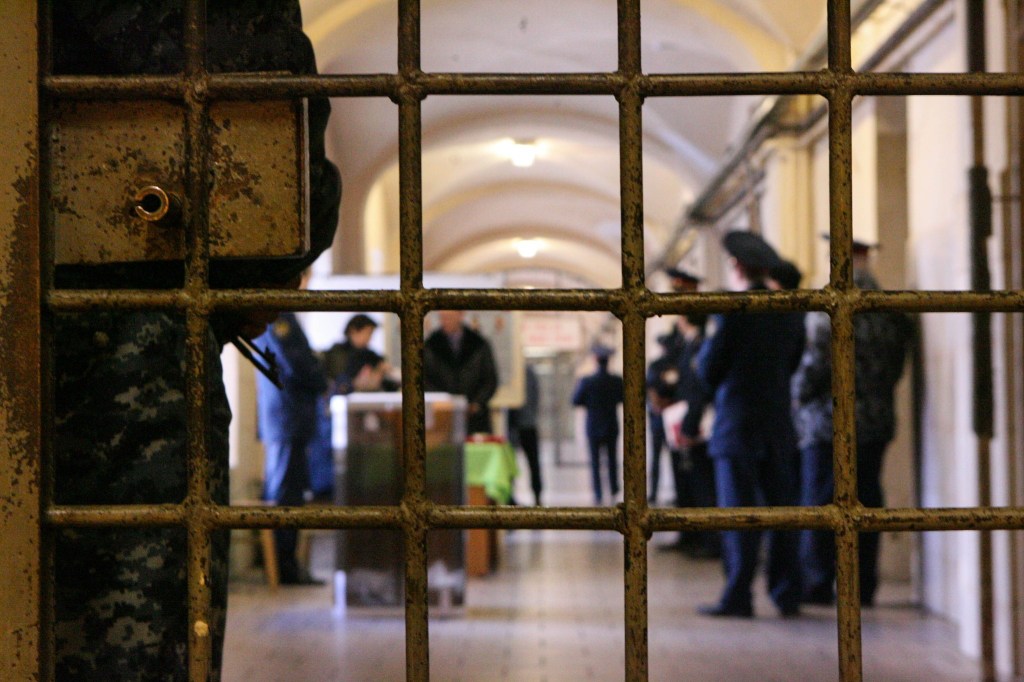
Voting in prison is not a bad form of entertainment. Dozens of prisoners are escorted to the ballot boxes simultaneously, providing a rare opportunity to chat and exchange news with your neighbors.
We were assembled in the “gully” and launched in pairs into a room equipped for a polling station. The convicts had fun arguing who to vote for. Mostly, of course, there were juicy quotes from Leningrad’s song about elections….
“Elections! Elections! The Candidates Are Buggers!” The song, written by Alexei Kortnev for the theater production Election Day (2003), was performed in the eponymous film (2007) by Sergei Shnurov and Leningrad
With a clear conscience, I wrote “FOR RUSSIA WITHOUT PUTIN” on my ballot paper. After that, I conducted a spontaneous exit poll at the prison polling station, thanks to which it transpired that most of the inmates had voted for anyone, just not for [ruling party] United Russia. Only one of them admitted that he had ticked the box for [incumbent Moscow mayor Sergei] Sobyanin. The guy, however, is a United Russia activist himself: he embezzled a factory and is now serving a sentence for fraud. So it all makes sense.
And I also saw and hugged Sergei Klokov (Vedel) for the first time in several months. For a year and a half, the man has been doing time for a telephone conversation with relatives, bugged by the security services, during which the murders in Bucha were discussed. He looks tired and misses his family, including his two young children. But he is slightly encouraged by the news that Ukraine is willing to exchange its collaborators for Russian political prisoners. I hope Sergei will be released soon. He’s a good guy.
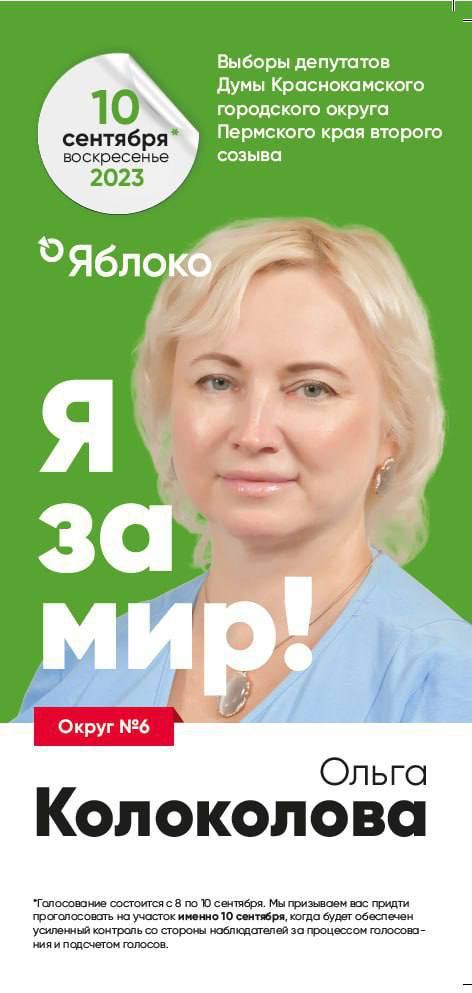
Olga Kolokolova’s campaign poster in the 10 September 2023 elections in Krasnokamensk (Perm Territory): “I’m for peace!” Image courtesy of Igor Averkiev
Olga Kolokolova, the head of the Perm regional branch of the Yabloko Party for many years, won the elections to the City Duma in Krasnokamsk (a satellite city of Perm). Moreover, she won running on the slogan “I’m for peace!”
Having received 55.2% of the votes cast, Olga Arkadyevna was returned to the Krasnokamsk City Duma, of which she was a deputy from 2005 to 2018.
Kolokolova is a veteran of the Perm loyal democratic opposition. (I say this without the slightest hint of judgment: the loyal opposition has its own positive mission, especially during periods when the regime relaxes the rules.) She is one of the most well-known politicians in Krasnokamsk, and the most consistent and most well-known Yabloko Party activist in the region.
Despite her status as a member of the loyal opposition, the election of Olga Kolokolova as a deputy in our time, and running on such a slogan, is really an unusual event, a kind of relic or vestige of the Putin regime’s bygone hybridity. In any case, it is impossible not to be happy for Olga Arkadyevna.
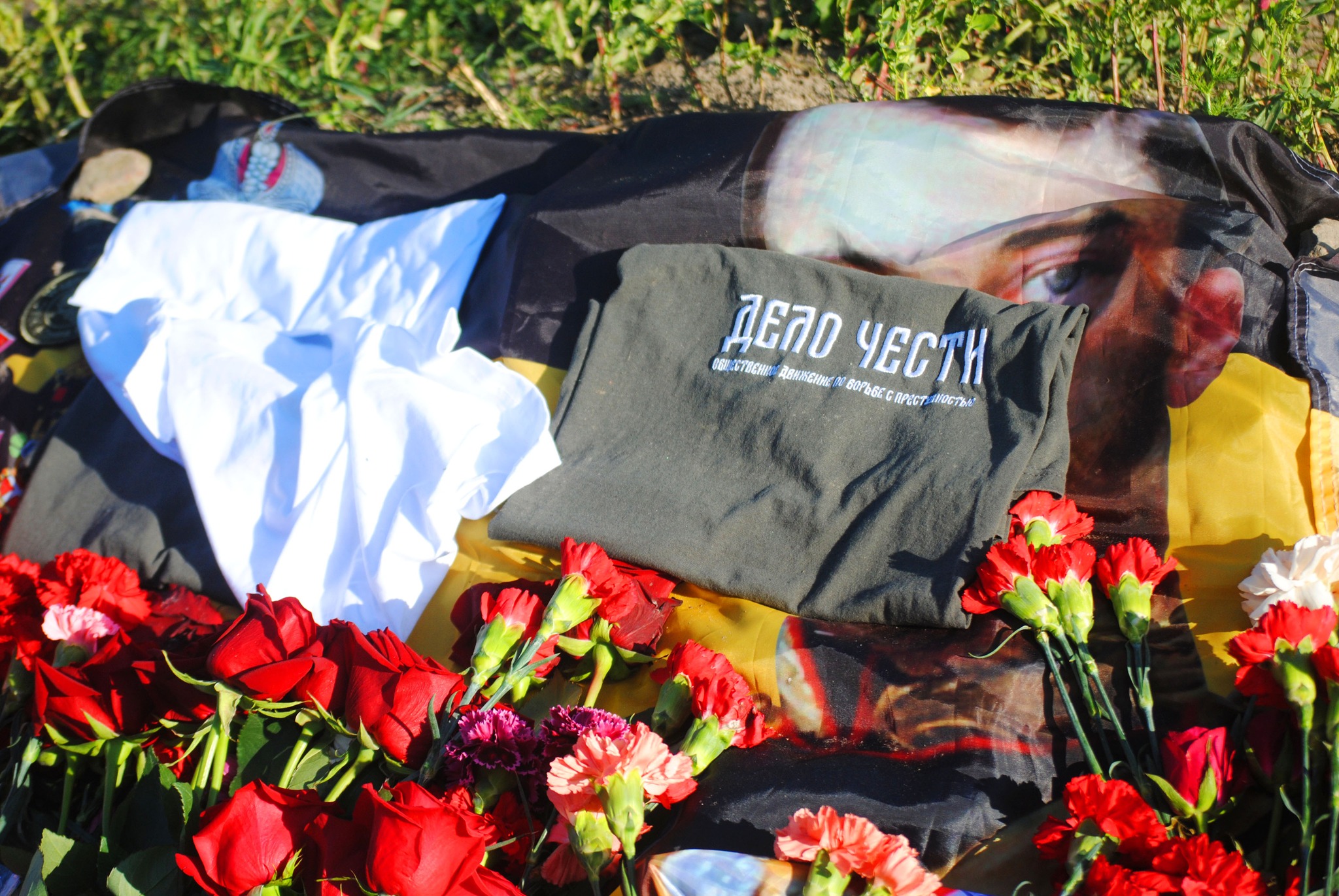
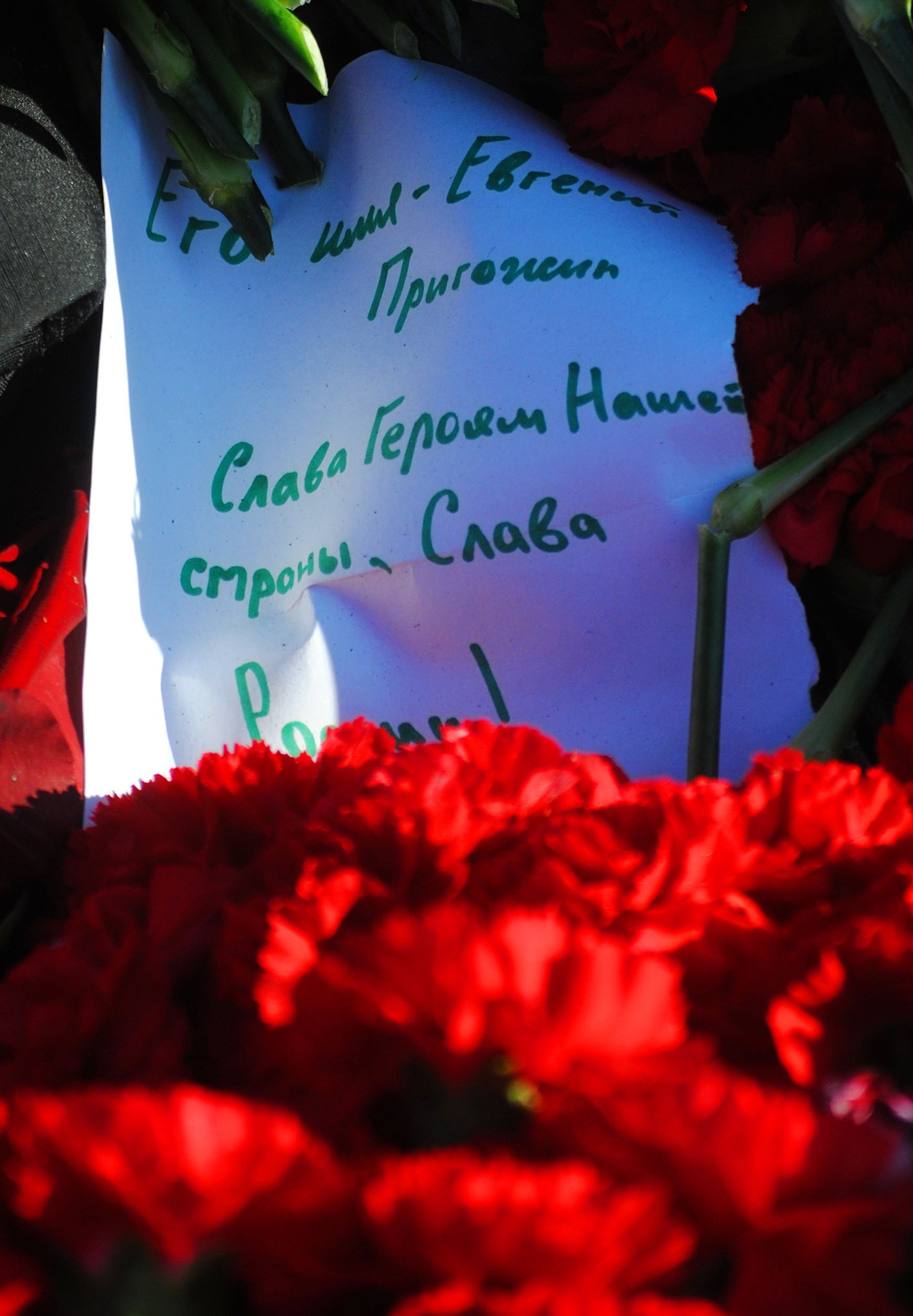
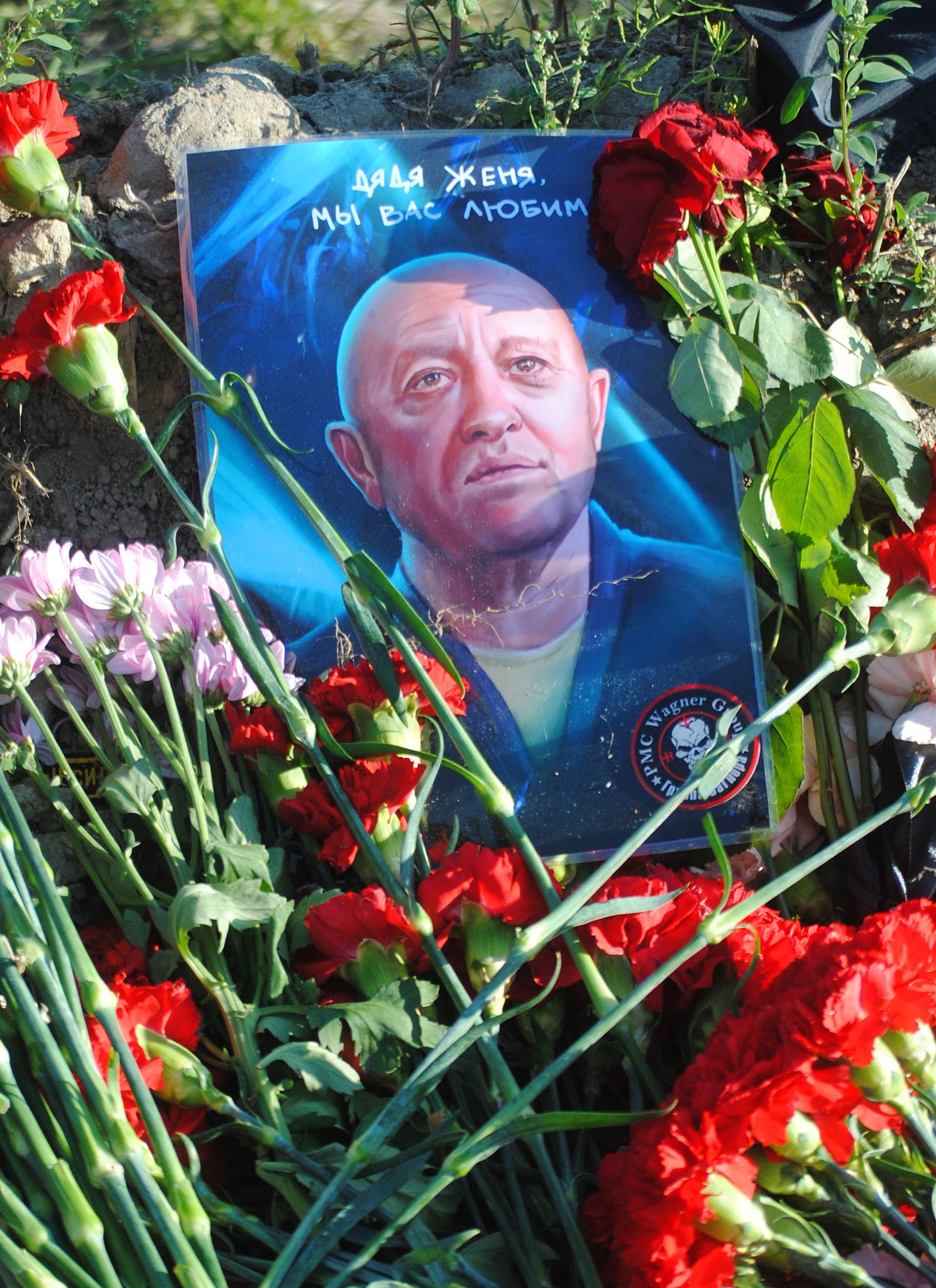
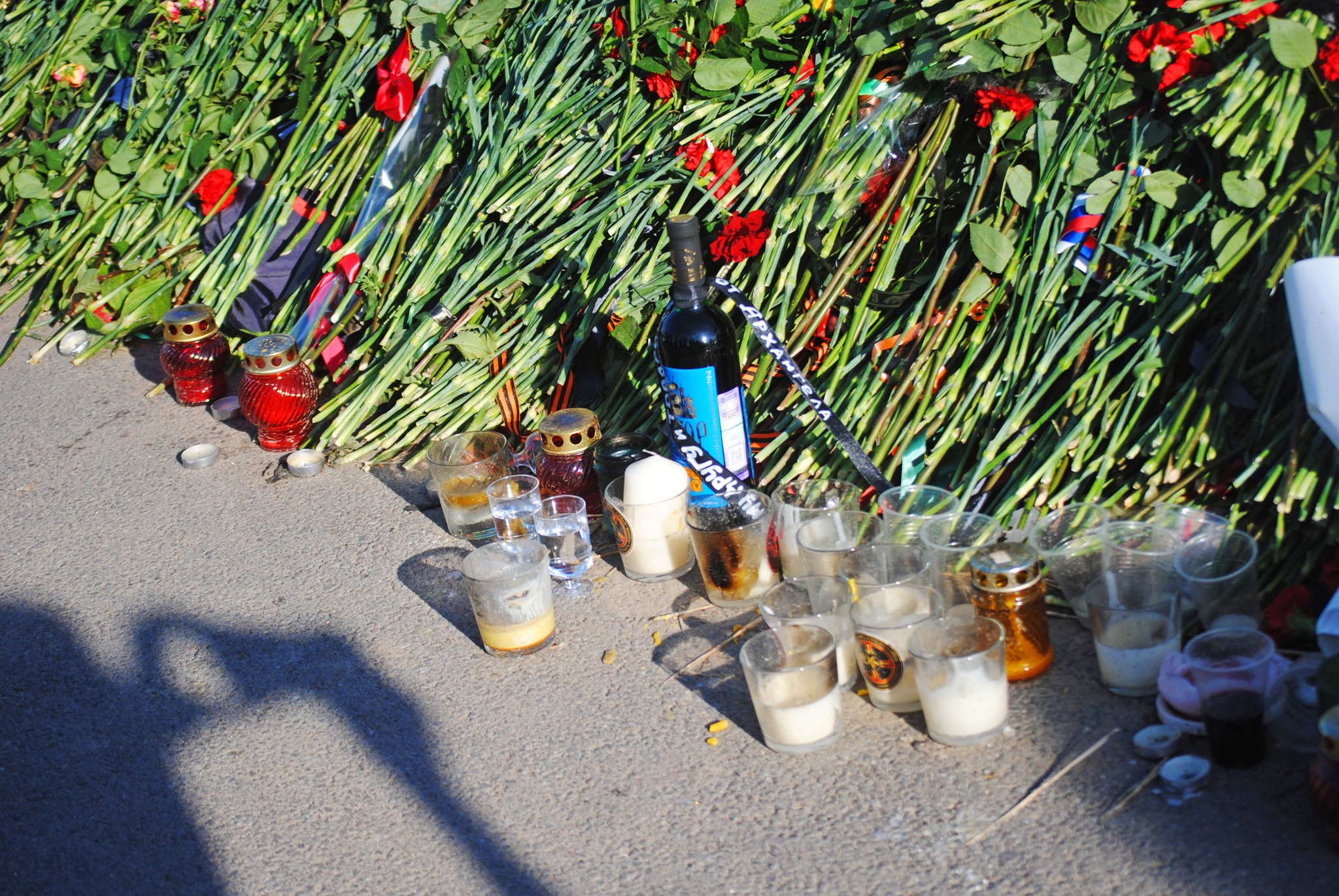
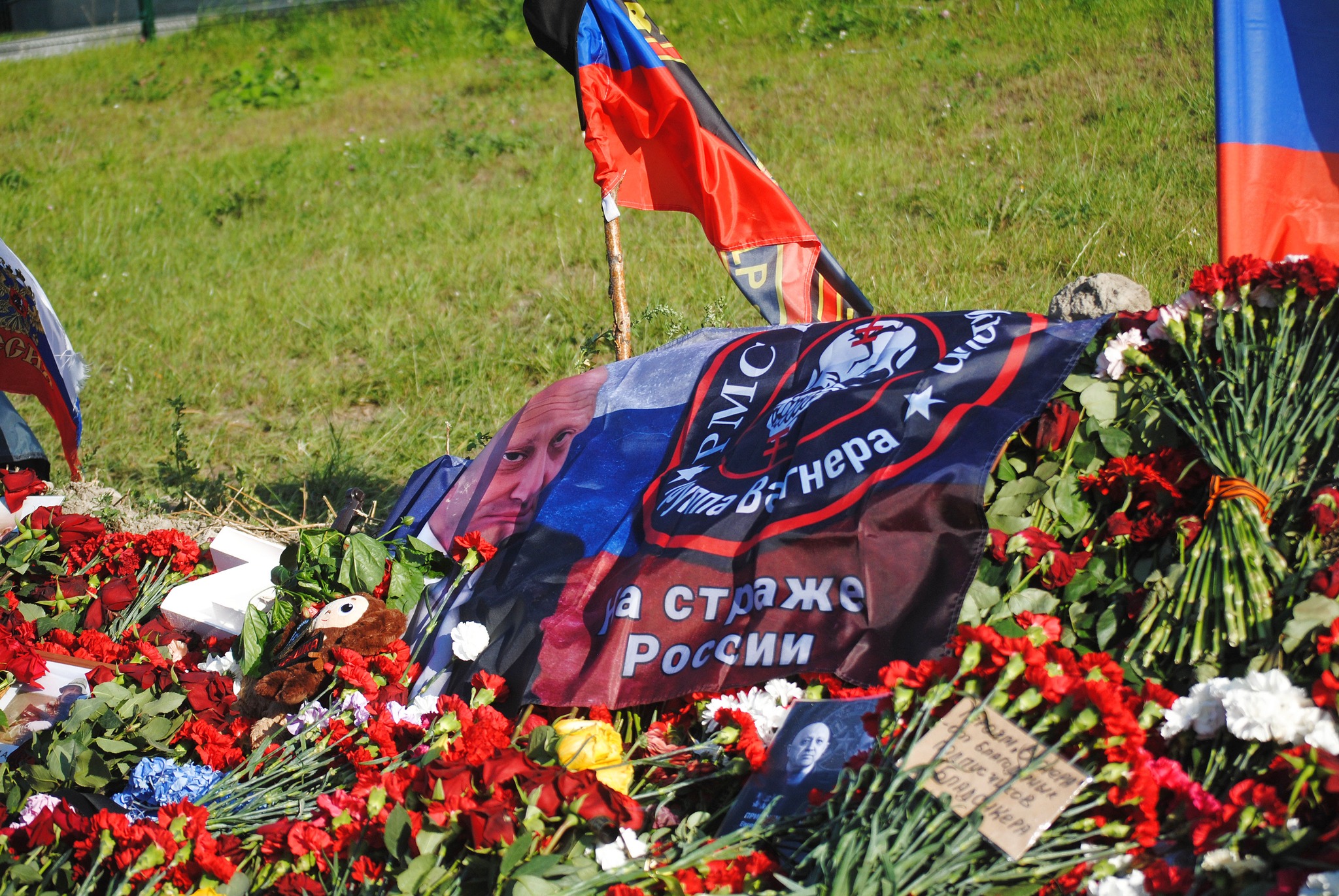
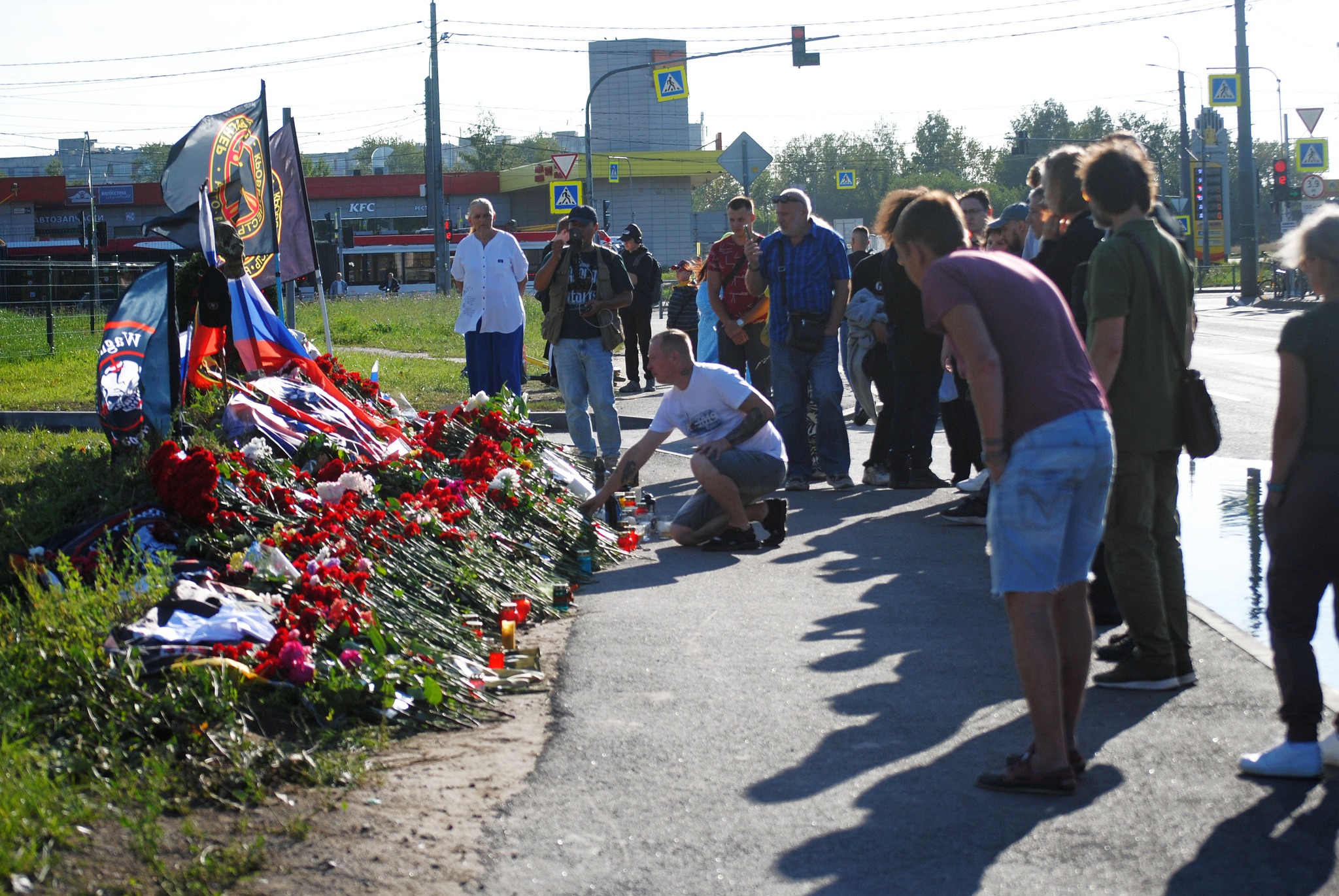
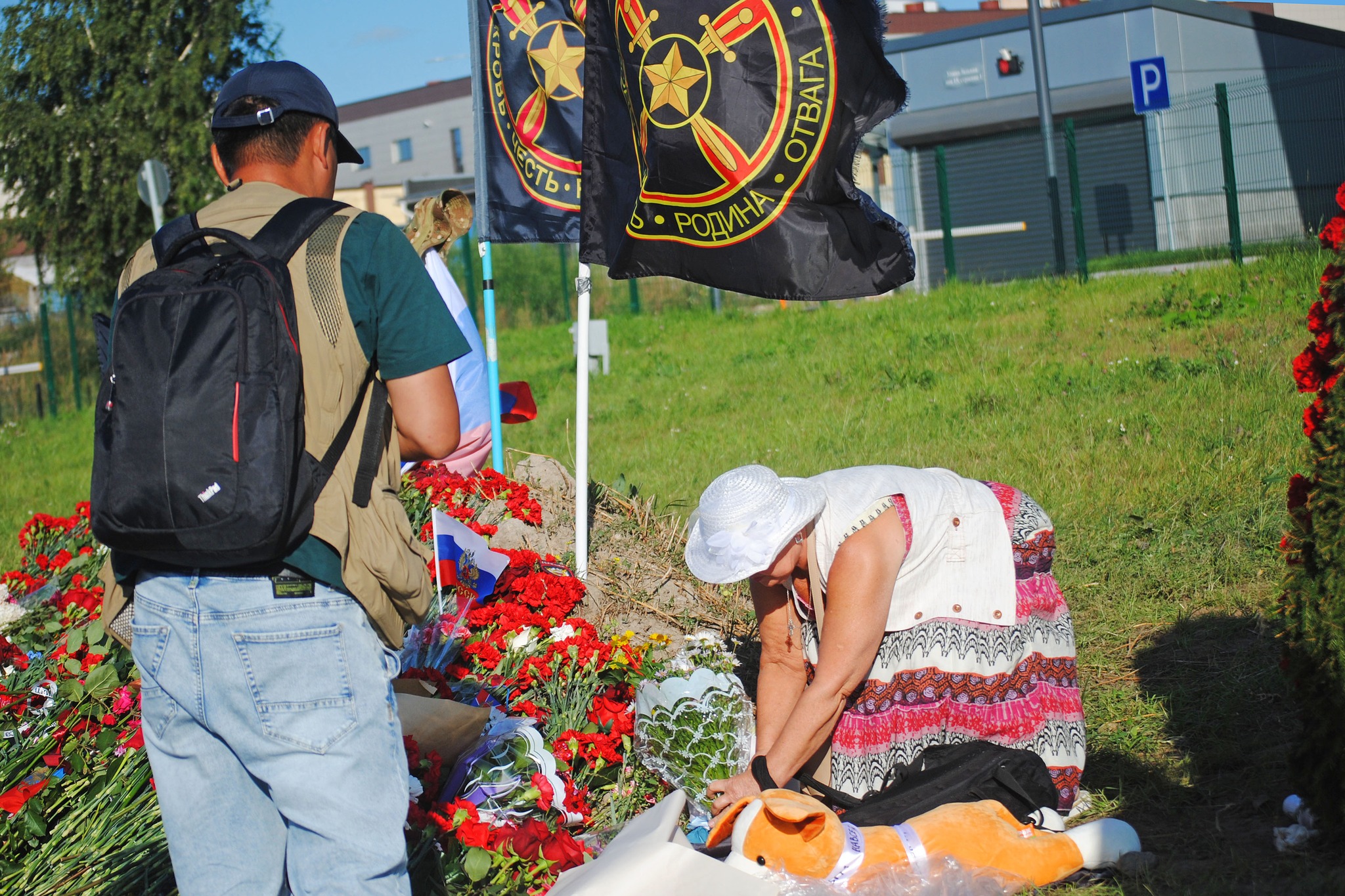
I went to see the spontaneous memorial to Prigozhin on Zolnaya [“Ashes”] Street [near the former (?) Wagner Center office building in St. Petersburg]. I have to say that what I saw impressed me. People kept coming and coming—young dudes and girls, men who were slightly older, and some people even had their kids with them. They brought flowers. They stood and looked for a long while. Some got down on their knees, and this one young dude crossed himself and genuflected. A Chinese guy was videotaping the whole scene and talking in Chinese, but it troubled no one. That’s him sporting a rucksack and filming point-blank the woman in the hat who is putting what looks like a whole bush of roses in a vase.
Hello, dear Moscow Times readers! This is your weekly newsletter, and we’re kicking off with the (near-certain) death of Yevgeny Prigozhin, the man dubbed Vladimir Putin’s “chef.”
However, Prigozhin gained notoriety not for his culinary talents, but for his business ventures. He set up several enterprises that were extremely vital to the Russian authorities. The most well known were the private military company Wagner and the “troll factory” in Olgino, a suburb of Petersburg, which was used as a tool for influencing the information space in the Russian Federation and the world.
Trolls are fantastic creatures, and they vanished of their own accord, you might say, but apparently it was Vladimir Putin who put the kibosh on Wagner. The rowdy band of freewheeling mercenaries, who took their orders from god knows whom, has come to end.
We should recall, of course, that Prigozhin took a long time admitting that Wagner and the Olgino trolls worked for him. He acknowledged this obvious fact only in the midst of the war, and this was the first step toward the mutiny of 23 June and his (near-certain) death on 23 August. The public owner of an effective resource can either use it or give it up. Prigozhin didn’t feel like giving Wagner away—that is, transferring it to the command of the Defense Ministry (and take an oath, as Vladimir Putin has now ordered)—and so the strange mutiny that had such supremely serious political consequences happened, and, later, the Embraer jet plane crashed in the Tver Region. (It was the first time this type of plane had an accident involving fatalities.)
We interviewed people in the know about the moods among Russia’s elites to find out how they were taking the “chef’s” demise. We went further, though, asking several people who kept a close eye on Prigozhin’s rise and (alas, literal) fall to explain the meaning of the story that has unfolded before our eyes.
The first explanation comes from an observer in civil society who claims that the plane crash was caused by underlings going farther than they had been ordered to go. In fact, this observer argues, Putin did not want Prigozhin dead. Without his trolls and without Wagner, which had ceased to operate in the RF and had begun to be transferred to Defense Ministry-controlled outfits in Africa, Prigozhin was no threat to Putin. However, there were people (in the GRU, most likely) who believed that Putin would be pleased if they brought him the mutineer’s head on a plate.
The risks are the same as in the case of the late [Boris] Nemtsov [assassinated near the Kremlin in 2015]. After his untimely death, Prigozhin’s significance as a symbolic figure could increase and thus serve as a consolidating factor. We cannot rule out the possibility that Prigozhin’s memory will lead to the creation of something bigger than what emerged around the man during his lifetime.
The second explanation comes from an observer in the defense sector, who argues that we’re seeing a repeat not of Nemtsov’s murder, but of the death of Polish president Lech Kaczyński in 2010. (The official Polish Tu-154 plane carrying him and other Polish officials crashed while attempting to land in Smolensk, Russia. Many Poles believe that the plane was brought down by a bomb planted onboard by the Russian secret services.)
The hit squad didn’t go too far. On the contrary, [Prigozhin’s plane crash] was a carefully planned operation that was brought off nearly flawlessly. Although we can claim that such things don’t get done without Putin’s consent, there is no way to prove it.
The third explanation comes from a political spin doctor and frequent guest on YouTube channels. He wonders why everyone has decided that the passenger manifest and the presence of his personal effects [at the crash site] is sufficient to prove that Prigozhin was killed. We cannot rule out the possibility that Prigozhin and Putin made a deal and that Yevgeny Viktorovich will be the Kremlin’s secret weapon. I’m joking on this point, of course. But Russian realities are such that a man dies he shakes off all the bad stuff that happened in his life, and people focus on his admirable qualities. Look at Stalin: his bloodthirstiness and lack of principle have been forgotten, and no one remembers the terrible mistakes he made while running the country. He’s a winner, a victor. Stalin and Prigozhin cannot be compared, but nor can we deny that Prigozhin has been the most auspicious commander in the Ukraine war.
The fourth explanation comes from an opinion journalist and writer who asks us to the recall the Russian fairytale about the vixen and the thrush. The vixen terrorizes the thrush by threatening to kill its fledglings. First the vixen asks the thrush to give it something to drink, and then it asks the thrush to feed it, so the thrush helps it to steal food and beer. (The analogy here with the “chef” is obvious.) The sated and drunken predator then orders the thrush to make it laugh, and so the thrush alights on the heads of two peasants, father and son, who cripple (and even kill) each other whilst trying to beat the thrush. (Thus recalling the Olgino trolls and their work on the US elections, for example.) After the vixen has laughed its fill, it says to the thrush, Now scare me! The thrush raises a mutiny against the fox—oh, sorry, it gets hunting dogs to attack the vixen. Depending on which version of the fairytale you find, the vixen either gets killed or escapes the attack, but it is genuinely frightened.
Vladimir Putin wanted to have an alternative both to his own generals and to the supremely dangerous Kadyrovites. He came to count on Prigozhin to carry out sensitive missions both in Africa and the RF, but failed to take into account the man’s ambitions and got carried away. When Putin was faced with Prigozhin as an actual threat, he had to defend himself in earnest.
Russian Media Monitor, “Propagandist blames US, Ukraine and NATO for Prigozhin’s crash,” 24 August 2023 Thanks to Monique Camarra (EuroFile) for the heads-up)
Mykola Honchar lives in a crumbling stone house in what is left of a tiny hamlet of eastern Ukraine. The town was attacked by Russian forces in June of last year, as the Wagner mercenary forces were spearheading a renewed offensive.
Even before the Kremlin set Wagner loose to wreak havoc in Ukraine, the Russian campaign was notable for its brutality. But from the moment Wagner forces entered the war in April 2022, they earned a special reputation for bloodlust from civilians and soldiers alike.
To Mr. Honchar, the death this week of Wagner’s leader, Yevgeny V. Prigozhin, responsible for so much carnage in the war, would be fitting — a violent end to a violent life.
“He has blood on his hands,” said Mr. Honchar, 58. “If there is a god, god will figure out what to do with him.”
Even in a war in which civilians were shot dead in the Kyiv suburb of Bucha, and the town of Mariupol was bombed into oblivion, Wagner and Mr. Prigozhin cultivated an image of brutality.
A video was promoted across Wagner-affiliated social media of the execution of one of Mr. Prigozhin’s own soldiers with a sledgehammer after he was captured and then released by the Ukrainians in a prisoner swap. While in custody, the prisoner had taped an interview saying he did not believe in Russia’s war.
“A dog receives a dog’s death,” Mr. Prigozhin said in the video.
By the time Ukraine regained Mr. Honchar’s village of Bohorodychne, Mr. Honchar was one of only two people left living in the village, once home to around 800 people.
The other person was Nina Honchar, his 92-year-old mother. He had stayed there despite the danger to take care of her. She died earlier this month.
He does not know if Wagner fighters were among the occupiers. “I did not ask for their documents,” he said. But he recalls seeing Russian fighters, who appeared to be on drugs, wandering around town in their underwear, their bodies covered with prison tattoos.
Wagner amplified its force by recruiting prisoners. After Wagner left the battlefield in June of this year, the Russian military continued the use of convicts as part of newly formed “Storm Z” units along the most dangerous front line positions.
To Mr. Honchar, it hardly matters under what banner the soldiers fought. The legacy of Wagner and Russian forces, he said, are one and the same: death, destruction and ruin.
“My brother and his wife were torn apart by shells,” Mr. Honchar said. Before he could bury them, he had to collect their body parts. “There was no skull, his hands were scattered,” he said of his brother.
Once he collected what he could find, he wanted to bury them in the local cemetery but it was under constant attack and too dangerous. He laid their remains in a trench and covered them with dirt.
When his 80-year-old neighbor died, he buried her in the crater of the shell that killed her.
Looming over the village is the Church of the Holy Mother of God, ‘Joy of All Who Sorrow.’ With its sky blue walls visible for miles around and majestic golden domes, it was once a draw for tourists and pilgrims.
Now its walls are blasted apart, one dome has tumbled to the ground and the gold leafing blasted away from another.
On June 28, Valeria Zotova, a 19-year-old woman from Yaroslavl, was found guilty of “plotting to commit a terrorist act” (per Article 30.1 and Article 205.1 of the Russian Federal Criminal Code). Zotova will spend six years in prison because of the “experiments” that the FSB (the Russian Federal Security Service) conducts on people.
According to police investigators, Zotova wanted to set fire to a warehouse where “aid” was collected for Russian servicemen fighting in the war against Ukraine.
In the video footage of her arrest, Zotova is pulled from the passenger seat of a car by masked men. However, the other people in the car were apparently not touched.
Prior to this, a certain “Andrei” had for a long time been writing to Valeria, claiming that he lived in Ukraine. In the letters, he asked Valeria to perform “missions” for him. She refused and showed the exchanges with “Andrei” to her mother. After some time, Andrei’s “girlfriend” “Karina” started writing to Valeria in VKontakte. According to Valeria’s mother, “Karina” harassed her daughter, constantly writing and calling her, and urging her to commit arson. When Valeria was detained, “Karina” was in the vehicle with her, but “Karina” was not charged in the case.
It transpired that “Andrei’s girlfriend” was an FSB officer and a secret witness. At one of the hearings in Valeria’s trial, “Karina” openly stated that it was all a “crime re-enactment” [sledstvennyi eksperiment, which translates literally as “investigative experiment”—TRR] Although the FSB chose not to conceal its actions, this had no effect on the verdict.
The defense provided the court with obvious evidence of Valeria’s innocence, namely, her correspondence with Karina, in which Valeria repeatedly refuses to commit arson.
Despite the fact that the court did admit this evidence into the case file and “weighed” it, Valeria was found guilty on the charges. Instead of the eight years of imprisonment requested by the prosecutor, the court sentenced Valeria to six years.
Valeria’s lawyer has appealed the verdict, so we can look forward to an appeals hearing in the future.
On the outside, Valeria worked very hard, almost seven days a week. In her spare time, she drew and beaded. In winter, she skated whenever possible. She adores doing crosswords and other such puzzles. She is an extraordinarily upbeat and resilient young woman who always succeeded at whatever she undertook.
A drawing that Valeria Zotova sent from the pretrial detention center in Yaroslavl Courtesy of Solidarity Zone
Valeria is currently in custody at the Yaroslavl pretrial detention center. You can show your solidarity and support by sending her a letter. She is always glad to get them and expresses her gratitude for all the support.
Address for letters and parcels:
Zotova Valeria Igorevna (born 2003)
10 ul. Portovaya nab., SIZO-1
Yaroslavl 150001 Russian Federation
You can also send her letters via FSIN-Pismo and Zonatelecom.
Solidarity Zone is supporting Valeria Zotova.
#wewriteletters
Source: Solidarity Zone (Telegram), 14 August 2023.Thanks to Simon Pirani for the heads-up.Translated by the Russian Reader.People living outside of Russia will find it difficult or impossible to send letters to Russian prisons via the FSIN-Pismo and Zonatelecom services or regular mail. In many cases, however, you can send letters (which must be written in Russian or translated into Russian) via the free, volunteer-run service RosUznik. Ms. Zotova has not yet appeared on their list of supported addressees, however. You can write to me (avvakum@pm.me) for assistance and advice in sending letters to her and other Russian political prisoners.
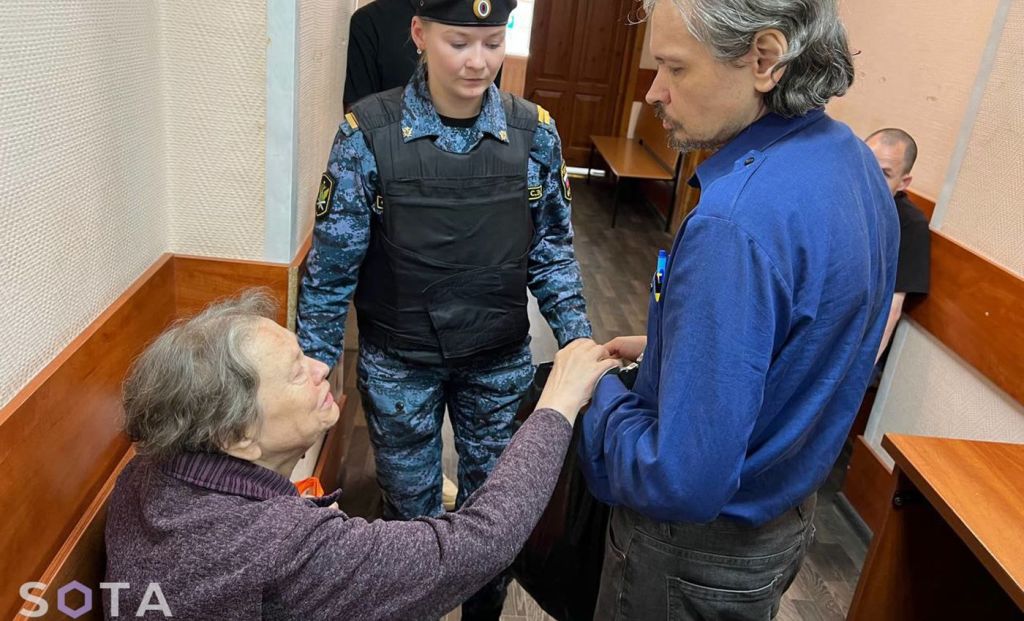
Alexander Bakhtin (right) says farewell to his mother after his trial. Photo: SOTA via Mediazona
Today, the Mytishchi City Court sentenced 51-year-old animal rights activist Alexander Bakhtin to six years in a penal colony. He was charged with disseminating “fake news” about the Russian army over three VKontakte (VK) posts written in the spring of 2022—about the possible blockade of Kyiv, about the murders of civilians in Bucha, and about Ukrainian volunteers who risked their lives saving homeless animals during the war. In addition to the time in the penal colony, the court ordered Bakhtin to undergo compulsory outpatient treatment supervised by a psychiatrist. The prosecution’s expert witness claimed that Bakhtin “could not have been fully cognizant of the actual nature and social danger of his actions and control them.” Mediazona publishes excerpts from Bakhtin’s rebuttal of the charges, which he asked to be entered into the case file before the verdict was announced. After reading these notes, readers will be able to assess for themselves the clarity and consistency of the convicted man’s thoughts.
In keeping with the principle of the presumption of innocence, it is not for me to prove that the materials I published are true, but for the prosecution to prove that these materials are “knowingly false.” But it was not proved who exactly committed the [war] crimes, which means it was not ascertained whether my actions constituted a crime.
Censorship is prohibited by the Constitution of the Russian Federation, and this Constitution is directly applicable [to my case]. Human rights can be restricted in the Russian Federation only when a nationwide state of emergency and martial law have been declared. But they have not been declared, which means that publishing materials that challenge the stance of the Defense Ministry is not a punishable offense.
I committed the actions that I am charged with in order to inform and familiarize my readers with an alternative point of view to the one that was then disseminated in the Russian media. At the same time, realizing that Ukraine’s official media are also an interested party in this conflict, I tried mainly to find information on the internet not in the official Ukrainian media, but as directly reported by local residents of Ukraine on their pages in social networks and online forums. My ultimate goal was to make what contribution I could to stopping this war, because, for example, the First Chechen War in 1996 was, as I believe, halted largely due to Russian society’s negative attitude towards it.
If we speak of “hatred and enmity” (as encountered in my posts in the form of harsh epithets directed at the Armed Forces of the Russian Federation), then these epithets do not apply to all [members of] the Armed Forces, but only to those [members] who employed various kinds of violence against civilians in Ukraine, or to those individuals who unleashed this war or called for unleashing it—that is, to war criminals. Perhaps, in terms of “generally accepted” definitions, those negative epithets of mine do apply to all their members, but I do not agree with this interpretation because, as follows from the findings of the forensic psychiatric commission, I am also generally partial to subjectivism, including when employing various definitions. So when I was asked by a psychologist to symbolically depict the concept of “justice,” I drew Putin behind bars. And when the psychologist asked me what that had to with justice, I replied that this was what justice looked liked to me right at that moment.
The severity [of a crime] should be defined by its effects. But can the prosecution prove that my publishing these posts produced any specific effects? For example, that they caused someone to lose their faith in the Armed Forces of the Russian Federation and commit an illegal action? At the time of my arrest, I had a little more than sixty friends on VK, and each criminal episode had about 100 views. There are no victims in the case. I myself stopped publishing these posts around the summer of 2022 precisely because they had no effect. By that time, the overwhelming majority of Russian citizens had already made up their minds about this war. Some of them sincerely supported the Russian authorities, while others supported them for opportunistic reasons (in order not to lose their jobs, etc.). Huge numbers of people were intimidated (including by disproportionate punishments meted out for anti-war stances) and kept quiet. Quite a large number of people emigrated from the Russian Federation altogether, while a huge number of Russians decided that this war did not concern them at all. Thus, not only my posts but also anti-war publications in general were unable to change anything, unfortunately. It was only on the battlefield that matters were decided.
If my posts are so socially dangerous, then why was my VK page not blocked for such a long time?
You can write a letter to Alexander Bakhtin through the Zonatelecom or FSIN-Pismo, or by regular mail to:
Bakhtin Alexander Sergeyevich (born 1971)219 ul. Gorval, SIZO-2Volokalamsk, Moscow Region 143600 Russian Federation
Mediazona thanks Nikita Spivak, a lawyer with OVD Info, for the opportunity to read his client’s manuscript.
Hello, Moscow Times readers! This is your weekly newsletter, which will shed light on:
a time of rapid price growth in Russia
how Africa feels about free Russian cheese grain
why Vladimir Putin remained standing.
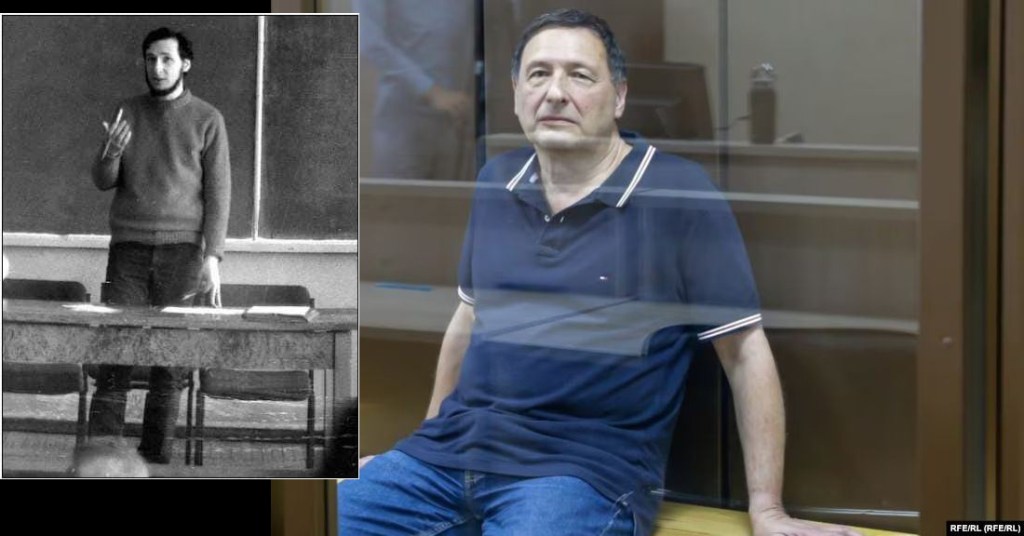
But first we will discuss a seemingly not too high-profile event—the arrest of the Soviet dissident and prominent Russian leftist Boris Kagarlitsky.
Boris Kagarlitsky was jailed by the Soviet regime, and now he’s been jailed by the Putin regime too.
On the face of it, it looks like yet another trumped-up “condoning terrorism” case! Zhenya Berkovich and Svetlana Petriichuk were also arrested under this article and are currently in pretrial detention.
But Boris Kagarlitsky is not a great theater director chockablock with interesting creative ideas. He is a veteran anti–American and anti-globalist. Few people remember how vigorously Kagarlitsky supported Russia’s invasion of Georgia, how he spoke as critically as possible about the Ukrainian Maidan of 2013, and how later he consistently criticized what he saw as Volodymyr Zelensky’s “puppet” government. And he lent his support to the “separatists” in the Donetsk and Luhansk regions.
In other words, Kagarlitsky has generally been an ideological ally of the Russian regime, and his criticism of the Kremlin is based on the argument that the regime has been insufficiently consistent in its anti-Americanism and anti-globalism, in its fight against the global financial monster and its ubiquitous outstretched tentacles.
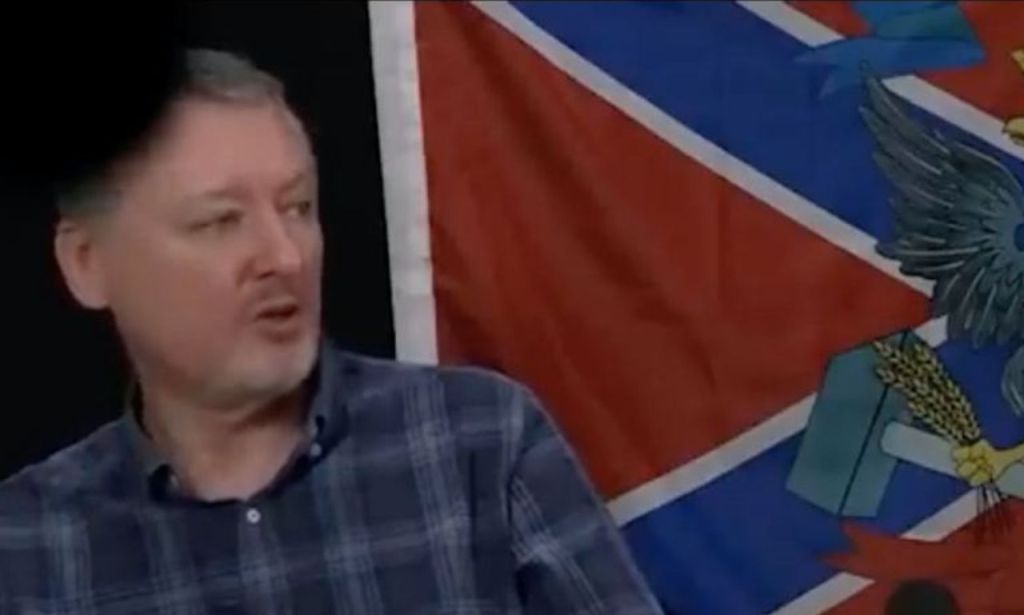
Does that remind you of anyone? That’s right: Igor Girkin-Strelkov. The arrested leader of the so-called Russian World likewise did not just support the Kremlin’s plans for conquering Ukraine. He onstantly stressed the insufficient efforts and inconsistency evinced by the Russian authorities in its “final solution” of the “Ukrainian question.”
Igor Girkin accused Putin of indecisiveness.
Thus, in the wake of Yevgeny Prigozhin’s rebellion (but not necessarily because of it, although this could be the case), the authorities, realizing that liberals no longer pose any danger, have gone after political opponents of a different stripe—after fellow travelers who rabidly dared to tell them what to do. Prigozhin did something similar, but he bit his tongue after his pseudo-mutiny. Unlike Kagarlitsky and Girkin, he stands for no ideology other than self-enrichment, and this stance is is something the Kremlin can comprehend and even adore.
What matters is that Kagarlitsky’s arrest, hard on the heels of Girkin’s arrest, shows that the regime is at a total ideological impasse. Its amorphous anti–western rhetoric has no clear conceptual basis, and hence anyone who espouses something resembling a real concept is an indubitable threat.
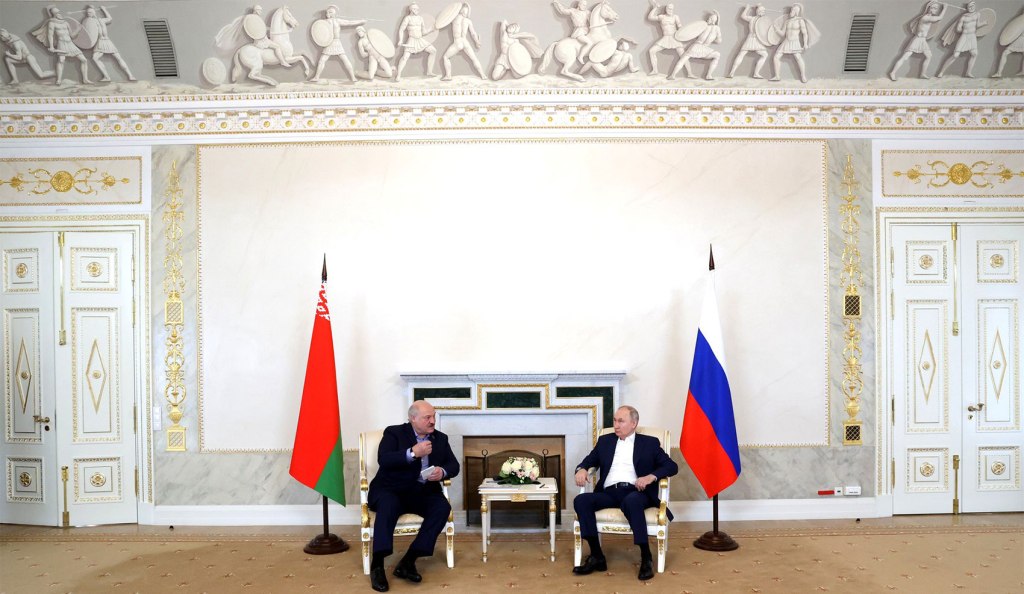
Putin’s only real ideological ally remains Alexander Lukashenko, a politician who has an immense arsenal of ridiculous arguments for explaining away the actions of his aggressive Moscow meal ticket.
The Belarusian pretender always points out where the attack is coming from.
[…]
Alexei Navalny also made a very unexpected public statement. He stood up for Girkin-Strelkov and even counted him among his fellow political prisoners. Note that from a formal point of view, the herald of the Russian World, who has the blood of many people on his hands, cannot be classified as a political prisoner.
Игорь Гиркин осужден за сбитый Boeing Гаагским судом
Vladyslav Starodubtsev, historian – contribution to debate on Boris Kagarlitsky, antiwar activism in Russia and more:
“Its just very hard to agitate for person, who called for occupation of your land and promoted and helped, including monetarly, people who kill your friends. Calling this “a difference of opinions” doesn’t seem a right thing. In 2014 he took huge effort to align far-right and far-left in support of Russian war against Ukraine, and got Presidential grant for it. Had strong connections with both Putinist elite and Russian neo-nazi criminals in Donbass. And before — justifying need to invade Georgia https://rabkor.ru/columns/debates/2008/09/09/debate-53/…
“It is not surprising that the Western left, having no illusions about the order prevailing in our country, unanimously supported Russia. The blow inflicted on the United States has global implications and opens up new perspectives for their struggle. It would be naive, to say the least, to maintain power. This is not our government, and it will never be ours. But you need to take advantage of the situation. And if the government nevertheless did something that meets our own requirements, this should be treated as a success, and this success should be developed.
We have always been against NATO, against orientation towards the United States. We have always opposed the WTO. These are our fundamental positions.
It would not only be foolish to miss the chances that history offers us today. That would be criminal!” – Boris Kagarlitsky in times of Russian invasion in Georgia
The person who not only called, but participated in promoting violence and occupation, using millions given directly by Putin’s office, then helping monetarly to occupational forces and using any possible platform to promote campism and pro-Russian views amongst the Western left. He justified terrorism. And he become the architector of his own fate. The power that he critically supported in his nationalist crusade against “The West”, against Georgians and Ukrainians, now consumed him. It seems that he relied that connections with Putinist elite will save him. But after Wagner coup, Russia represses everyone. It doesn’t make these people political prisoners. I won’t agitate for any morally compromised
He by definition is not a political prisoner, so agitate for his release doesn’t make much sense. In the biggest – agitate to his extradiction to Ukrainian court. Organize media campaigns for any of it would be pretty absurd.
“3.3. A person is not to be regarded as a political prisoner, if, under the above circumstances, the person has committed:
a violent offence against persons, except in cases of self-defence or necessity;
a hate crime against a person or property; or the person has called for violent action on national, ethnic, racial, religious or other grounds.”
That is why I never called for release of any nazi in Russia, even if they had the change of heart, either because of elite reshuffle in Putin’s office, and their allies falling down, or because they understood what horrible monstrosity they helped to build and in what they participated, under tens of thousand people were killed by Russia’s full-scale invasion. Why nobody thinks from perspective who Kagarlitsky agitated to roll over on tanks? And yes, it is a part of bigger problem, that all the left is crazy when Russian left-nationalist Kagarlitsky is arrested, after a year of being allowed to criticize Russia, but the genuine activists, who aren’t xenophobic – ignored.”
Stand with all antiwar protest -stop Russia – tell the whole story Ukraine Socialist Solidarity Campaign: “Many people on this FB page are familiar with Russian leftist commentator and intellectual Boris Kagarlitsky. He has been a controversial figure for good reason. He supported the annexation of Crimea and the war in Donbass in 2014. He is a friend of Girkiin, the committed war criminal.
For reasons unknown he chose to stay in Russia while many of his colleagues fled. And this week he was detained by the FSB in Moscow, taken to a pre trial detention center where he will stay until the end of September when he will face charges on “justifying terrorism” for his criticisms of Russia’s invasion of Ukraine. A petition is being circulated calling for his freedom, along with other anti war Russians. Supporting Kagarlitsky as a political prisoner does not in any way imply an endorsement of his extremely objectional views. As Ilya Budraitsis writes in the statement below, Kagarlitsky’s arrest is part of a new wave of repression against any critics of the war.
The following statement was released by Russian socialist and anti war dissident Ilya Budraitskis and other comrades. Please see the petition below and sign/share if you support it.
Two days ago in Moscow, FSB officers detained well-known leftist theorist, activist and commentator Boris Kagarlitsky. At present, Boris has been transferred to the pre-trial detention center in Syktyvkar, where he will stay at least until the end of September. Kagarlitsky was charged with “justifying terrorism”, for which he could face up to 7 years in prison. At the same time, in Moscow, Yekaterinburg and Penza, searches were carried out at the homes of Kagarlitsky’s associates on the YouTube channel Rabkor. It is obvious to us that the arrest of Kagarlitsky is part of a new large-scale repressive campaign by the authorities aimed at completely clearing the political space of any critics of the war. Since February 2022, Boris has taken a pronounced anti-war stance, and we are sure that this was the only real reason for his arrest.
Boris’s personal political trajectory began more than 40 years ago and has not always been flawless. In the early 1980s, Kagarlitsky was a member of the underground group of “young socialists” and was subjected to repression by the KGB, and since the early 1990s he played a prominent role in the left opposition, first to the Yeltsin and then to the Putin regime. His numerous books and public speeches had a great influence on several generations of the Russian left, and that is why his responsibility for certain assessments remained exceptionally high. In 2014, Kagarlitsky actively supported the annexation of Crimea and the creation of the so-called. “People’s Republics” in eastern Ukraine. And this support, unfortunately, played a role in disorienting part of the Russian left. These, like many other moments in Kagarlitsky’s activities, are completely unacceptable for the members of the “After” team. And now our fundamental differences have not gone away, and we will certainly discuss them with Boris – but only after his release.
It must also be acknowledged that after the start of the full-scale invasion, Kagarlitsky was one of the few Russian leftists who, while remaining in the country, continued to publicly condemn the war on the part of Russia. It can be assumed that only the wide popularity of Kagarlitsky has kept the authorities from arresting him until now. Now that this has happened, it has become clear that repression is reaching a new level and the number of activists in the immediate risk zone has increased significantly. That is why we call for an international campaign in support of Kagarlitsky and all political prisoners in the Russian Federation”.
Asilomar State Beach, 21 July 2023. Photo by the Russian Reader
Who is Girkin?
Igor Girkin (Strelkov) is an ethno-fascist FSB officer and the warlord who prepared the ground and then launched the war in Donbas in 2014. He stated that without him, “there wouldn’t be any war”. He is also responsible for ordering the execution of numerous civilians, for which he still face justice. He was sentenced to life imprisonment in absentia by the International Criminal Court on November 17, 2022 as perpetrator of the downing of Malaysian Airlines 17 and the murder of 298 people—a war criminal.
Stunning drone footage has revealed details of the Batagaika crater, a one-kilometer-long gash in Russia’s Far East that forms the world’s biggest permafrost crater.
In the video two explorers clamber across uneven terrain at the base of the depression, marked by irregular surfaces and small hummocks, which began to form after the surrounding forest was cleared in the 1960s and the permafrost underground began to melt, causing the land to sink.
“We locals call it ‘the cave-in,'” local resident and crater explorer Erel Struchkov told Reuters as he stood on the crater’s rim. “It developed in the 1970s, first as a ravine. Then by thawing in the heat of sunny days, it started to expand.”
Scientists say Russia is warming at least 2.5 times faster than the rest of the world, melting the long-frozen tundra that covers about 65% of the country’s landmass and releasing greenhouse gases stored in the thawed soil.
After the court hearing [in his criminal case], Oleg Orlov read out a long list of names of people convicted of “disseminating fake news” or “discrediting the army.” He mentioned Alexei Gorinov, Dmitry Ivanov, Samiel Vedel (aka Sergei Klokov), Vladimir Kara-Murza, Ilya Yashin, Maxim Lypkan, and many others.
“I am not imprisoned, and I can say what I deem necessary. I can answer your questions. But how many of my and your kindred spirits are deprived of this opportunity,” Orlov reminded. “I consider it my duty to read out the list. These are only some of the people who have been imprisoned for their anti-war stance.”
After reading out the names, Orlov cited data from OVD Info. “634 people from 78 regions [of Russia] have faced criminal charges for anti-war protests, for words and statements,” the human rights activist said. “And 200 of them have already been incarcerated. Let’s remember these people.”
Orlov stressed that he was fighting not only for his own sake. “Both my lawyer Katerina Tertukhina and my public defender Dmitry Muratov — we are fighting like this and trying to prove the nullity of the charges [against him], the nullity of the [prosecution’s] expert witness analysis, because we are trying to fight for all people.”
Crimean Tatar-led underground movement is already active behind Russian lines and hundreds of young Tatar men are ready to take up arms to liberate the occupied peninsula, a veteran community leader has said.
Mustafa Dzemilev, widely seen as the godfather of the Crimean Tatar rights movement, pointed to operations by the Atesh guerrilla group, comprising Crimean Tatars, Ukrainians and Russians, in Crimea and other occupied Ukrainian regions.
Atesh, which means “fire” in Crimean Tatar, was created in September last year, primarily to carry out acts of sabotage from within the ranks of the Russian army. It claims more than 4,000 Russian soldiers have already enrolled in an online course on how to “survive the war” by wrecking their own equipment.
There is no evidence linking the group to the latest attack on the Kerch Bridge, early on Monday morning, but the group has claimed a string of smaller-scale attacks, blowing up Russian checkpoints, assassinating Russian officers, setting fire to barracks and feeding sensitive information to Ukrainian intelligence. It recently accused Russian sappers of laying mines in the Krymskyi Titan chemical works in Armiansk, northern Crimea. An explosion there could spread an ammonia cloud across the land bridge between the peninsula and mainland Ukraine.
“Atesh is very deep underground,” Dzhemilev, 79, told the Guardian in an interview in Kyiv. “There was not a single arrest among Atesh members, but they are working inside Crimea territory blowing up targets.”
Hello! This is Alexandra Prokopenko with your weekly guide to the Russian economy — brought to you by The Bell. In this newsletter we focus on the Kremlin’s decision to seize the Russian assets of two major foreign companies and what it means for the business climate and the other Western businesses who cannot — or will not — leave Russia. We also look at Friday’s interest rate hike and new Western sanctions on Russia.
Nationalization of Western assets heralds broader property redistribution
Finland’s Fortum and Germany’s Uniper saw their Russian assets seized by the Kremlin earlier this year. This week was the turn of France’s Danone and Denmark’s Carlsberg. It feels like we are witnessing the final chapter in the history of Western business in post-Soviet Russia. If the transfer of Fortum and Uniper’s energy assets to external management was explained as a response to the European Union’s treatment of Russian energy companies, there is no such obvious reason for the behavior toward Carlsberg and Danone and it likely reveals the Kremlin’s real intentions. This is direct nationalization — and opens the door to a new distribution of property in Russia.
The Arkhangelsk Region has allocated 800 million rubles to the occupied Ukrainian city of Melitopol, which will be used to repair the city, which has suffered from Russia’s invasion. However, the region itself does not have enough money to repair its own housing. Arkhangelsk is considered the capital of the Russian North, but has been informally dubbed the “capital of dilapidated housing.” Many people live in substandard housing: the city is chockablock with barracks and crumbling wooden houses. Watch Valeria Ratnikova’s report on how the region copes with a budget deficit while its money is spent on the war.
00:00 Opening 02:15 Ruins, barracks, and crumbling houses 06:00 Brevennik Island: expensive prices and derelict housing 10:56 Natalia Zubarevich about the lack of money in the region 12:04 The campaign against waste haulage to the region 16:18 The authorities are taking revenge on opposition activists opposed to landfills 31:35 Denunciations and criminal cases for statements about the war 33:22 One of the protesters went to the war 36:15 What residents say about the war 38:26 Getting fired for criticizing the war 39:40 A female student fled to Lithuania — the authorities wanted to jail her for talking about the war 46:25 The region’s environmental problems 49:10 Journalists detained during Putin’s visit 51:11 How the war has affected life in the region











 Address for letters and parcels: