Image on the website of the Happiness pastry shop chain. The text reads, “OUR PRINCIPLES: Love, Quality, Care, Interest, Communication.”
Happiness Coffee and Pastry Shop Chain Introduces Surcharge for Foreigners Paperpaper.ru
August 23, 2016
There is an additional fee for groups of foreigners at the Happiness (Schastie) coffee and pastry shop on St. Isaac’s Square in Petersburg. A Paperpaper.ru editor discovered this while visiting the establishment. A surcharge of ten percent is added to the final bill.
The reasons for the surcharge are not spelled out either in the menu or on the bill. As the establishment’s manager explained to Paperpaper.ru, the surcharged was introduced at the “director’s personal orders.” Besides, the manager assured us that a line explaining the practice would soon appear in the menu.
The surcharge was confirmed by phone calls to the Happiness outlets on St. Isaac’s Square and Rubinstein Street.
The chain’s management informed Paperpaper.ru that the surcharge was indeed enforced in all of its outlets, but only vis-a-vis groups consisting wholly of foreigners. The rule has been in effect since November 2015. According to the chain’s rules, waiters warn customers that a ten-percent service charge will appear on their bill. Management also confirmed to Paperpaper.ru that the rule would be spelled out in the menu.
Article 62.3 of the Russian Federal Constitution states, “Foreign nationals and stateless persons shall enjoy in the Russian Federation the rights and bear the obligations of citizens of the Russian Federation, except for cases envisaged by federal law or international agreement of the Russian Federation.”
In addition, Article 19 of the Constitution guarantees “equality of rights and freedoms of human and citizen, regardless of sex, race, nationality, language, origin, property and official status, place of residence, religion, convictions, membership of public associations, and also of other circumstances.”
_________
Message on the home page of the Central Barbershop website: “The services in our barbershops are provided in strict keeping with in-house standards of service [sic], operating procedures, and service [sic]. You can be refused a service if it does not according with the company in-house standards. It is prohibited in the barbershop to bring or imbibe alcoholic beverages, for the female sex to be present, [and] for member of a non-traditional orientation [sic[ to be on the premises.” Curiously, all this discrimination is absent from the English-language version of the same page, which only blandly states, “Men’s barber services are performed in accordance with European and American requirements.”
Petersburg Barbershop Refuses to Serve Homosexuals Paperpaper.ru
September 6, 2016
The Petersburg barbershop chain Central Barbershop has refused to serve homosexuals, according to its website. Women are also forbidden from being in its barbershops.
“The issue concerns me, since there are lots of gays and lesbians around. I had a bad experience of interacting with this group of people, and I would not like to see them in my salons. It is terrible they are everywere. But this is not homophobia, because homosexualists [sic] have their own places, and they can go there,” said Mikhail Korets, founder of the barbershop chain.
According to Korets, his employees will politely refuse to serve gays, citing a lack of time or available barbers. He compared this kind of refusal with the work of security guards at nightclubs, which do not let people into their establishments by saying there is no room.
According to Yuri Gavrikov, head of local LGBT organization Equality (Ravnopravie), the Petersburg barbershop chain is involved in discriminating against people. He compared the chain’s decision with racial discrimination in the US during the 20th century.
Translated by the Russian Reader. Thanks to Comrade VZ for the heads-up on the English-language website of the fascist barbers.
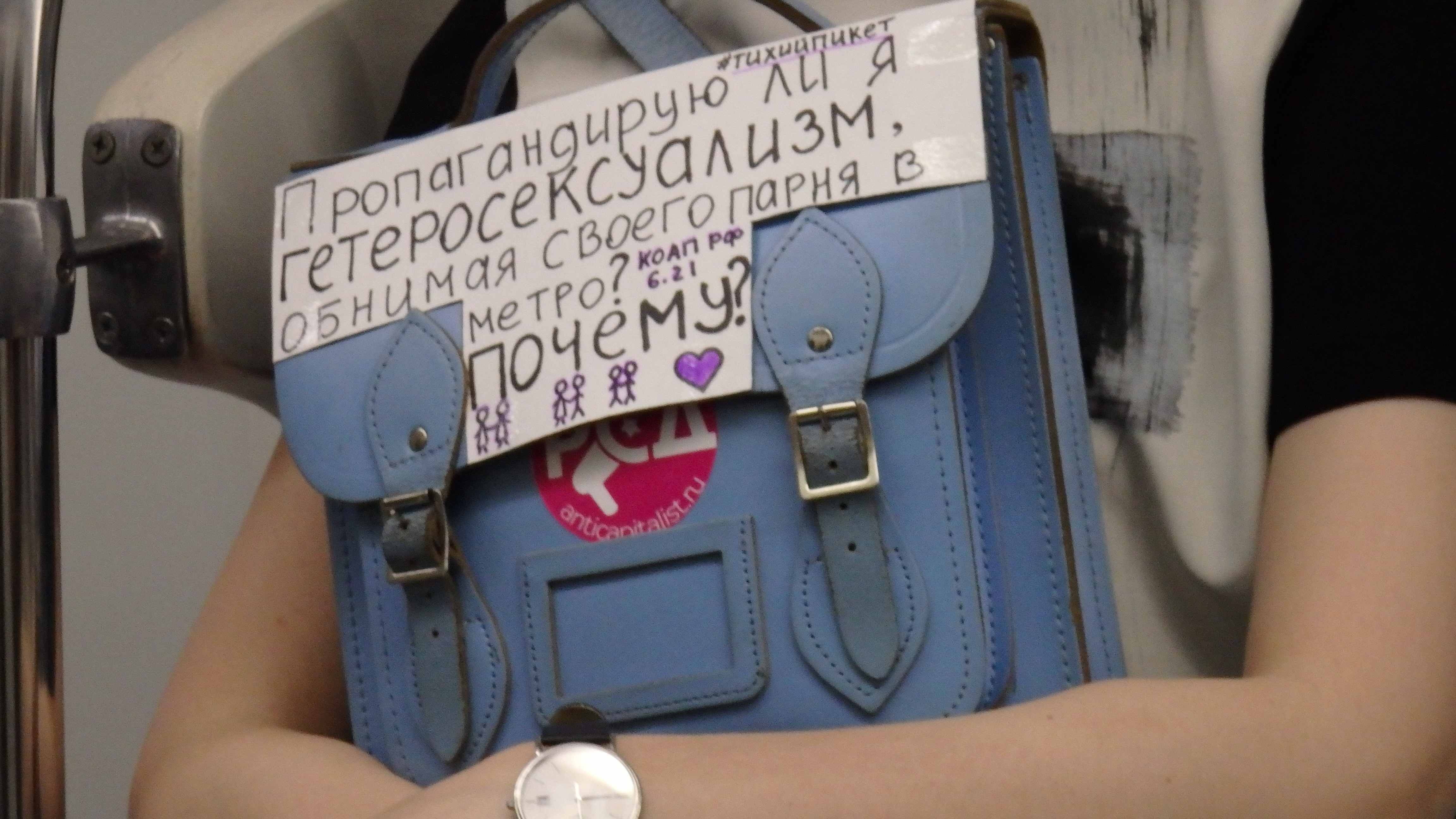
“#quietpicket Am I promoting heterosexuality when I hug my guy in the subway? Russian Federal Misdemeanors Code Article 6.21 [Promoting Non-Traditional Sexual Relations among Minors]. Why not?” Placard, Petersburg Subway, July 24, 2016. Photo by the Russian Reader
This past May, I published a translation of Marina Simakova’s fascinating interview with Darja Serenko, a Moscow artist who had launched a long-term silent protest action and research project in the subway that she had dubbed Quiet Picket.
While riding the subway earlier today in Russia’s Northern Capital, I was glad to see a young woman sit down opposite me with a shoulder bag pasted over with a tiny placard hash-tagged #quietpicket.
Since she seemed a bit tense, as did the passengers around her, I went up and asked her whether it would be alright to photograph her placard. She smiled and said it would be. After that, the mood in the car seemed to lighten up a bit.
“Islamo-, homo-, xeno- phobia kill. #Orlando.” Spontaneous memorial to the victims of the Orlando shooting outside the US Consulate in St. Petersburg, Russia, June 13, 2016. Photo by Vadim F. Lurie
I have received lots of comments assessing my worth as a woman and a daughter, and a lot of the usual fare, such as “I wish you were dead” and “You’re not human beings.” But there is one more thing I would like to discuss.
When you write that “terrorists only need an excuse,” “the sexual orientation of the victims doesn’t matter,” and “I am mourning too, so how am I different from you?” you are closing your eyes to the cause of the murders.
Homophobia is the cause.
I don’t like the word. It is abstract, but it does a fair job of explaining how, in the last two years, nineteen of my acquaintances have been assaulted, two have been raped, and two have been murdered, and how over twenty people I know have been forced to leave the country. These have been people from my circle of friends, which is not so huge. Laws have been passed against us. We are unequal and officially deemed unequal according to Article 6.21 of the Russian Administrative Offenses Code. We do not have the right to marry and have joint custody of children. We do not have the right to visit each other in prison or hospitals. For the past three years, in the Russian hinterlands, there have been neo-Nazi groups operating who prey exclusively on LGBT. Television has vigorously inflamed the atmosphere of hatred and fear. There was a break, which lasted a year, for the Ukrainian war, but now we are the number one public enemies. Just watch the news.
I am glad you can live without noticing this, that it doesn’t concern you. I would also be glad not to know all the particulars, for example, how a bullet from a trauma pistol penetrates the eye, and the sound it makes, or what it is like to file a complaint against a guy your father brought over to “fix” you, or how to dial 911, because someone is trying to open your door, but the cops refuse to show up. And you sit there till morning with a little knife in your hand listening to someone trying to pick your lock. And then, in the morning, when the fuss has died down, you close the door, leave the house, and never go back there again. These are the things people close to me have gone through. Maybe your colleagues and friends have gone through some of these things. I am even certain they have.
I know how long a broken nose takes to heal (I can even compare, because noses get broken often), what it is like to get hit by a stone, a bottle, and a chunk of pavement, what it is like when your girlfriend is found strangled in a car, what it is like when the doctors say you can expect to go deaf, because the auditory nerves die off after a blow to the temple (I can tell you about that in detail: I went through it myself), what it is like when you are doused with urine and videotaped, what it is like when you are called into the director’s office and fired, forced to switch schools, universities, the place you work. I even know what it is like when your classmates rape you behind a garage. I know what it is like when a cop spits in your face while his buddies are suffocating your friend, and you cannot do a thing, because your arms are pinned behind your back, and all this is accompanied by jubilant cries of “faggots!” I know what it is like to dream of buying a plot of land, surrounding it with a fence three meters high, and raising your children in this cage, because it is the only way you can guarantee their safety.
Any conversation on the topic ends with the advice to “not stick your neck out.” When mass murders occur, the same attitude leads to comments that “it doesn’t matter what your orientation is.”
No, you really don’t know how my mom felt when she heard about the shooting at the gay club, or what I feel when I realize I have no way of reassuring her. “Everything will be okay.” Are you kidding?
The orientation of the people who were killed matters.
If it doesn’t matter to you, then you could give a fuck about the cause of the murders and why these murders happen again and again and again.
Elena Kostyuchenko is a journalist with Novaya Gazeta newspaper and a Russian LGBT rights activist. Translated by the Russian Reader. Thanks to Comrade AS for the heads-up
Nothing Russian about AIDS Moscow City Duma Proposes Fighting HIV Epidemic with Heterosexual Monogamous Family
Alexander Chernykh Kommersant
May 31, 2016
Yesterday [May 30, 2016], the Moscow City Duma discussed the spread of HIV in Moscow. Virtually no physicians spoke at the hearing. Instead, the deputies chatted with experts from the Russian Institute for Strategic Research (RISS), who told the MPs that HIV was part of the west’s information war against Russia and that, rather than preventing HIV, condoms were, on the contrary, an indirect cause of the epidemic. The deputies were thus led to conclude it was not HIV that needed to be combated, but the populace’s moral laxity.
Lyudmila Stebenkova, chair of the Moscow City Duma’s health care committee, opened the hearing. She reminded the MPs that, a year ago, they had discussed HIV “because there had been all sorts of insinuations in the press that we, allegedly, had a huge number of HIV-infected people.”
It was then Moscow MPs asked to verify the data and ordered a “well-grounded report on HIV infections.” To prepare the report, Moscow authorities turned not to doctors but to RISS, a government think thank founded by presidential decree in 1992. According to RISS’s website, the institute deals with “issues of national security provision” and “prevents the falsification of history.”
As Stebenkova explained, “Previously, they produced a stunning report on various NGOs funded by the west.”
RISS took nearly a year to produce the report. Yesterday, the institute’s deputy director, [Tamara] Guzenkova, presented it to Moscow MPs. According to RISS’s website, Ms. Guzenkova has nothing to do with medicine. She has a doctoral degree in history. In her publications, she has criticized the new Ukrainian authorities and spoken out on the “EU’s decline.”
She approached HIV from a familiar angle, arguing that “the problem of HIV/AIDS has been employed as part of the information war against Russia.”
In its report, RISS claims there are two models for fighting HIV. The western model includes “neoliberal ideological content, insensitivity to national idiosyncrasies, and the total priority given to high-risk groups such as drug addicts and LGBT.”
In turn, the Moscow model “takes into account the cultural, historical, and psychological idiosyncrasies of the Russian populace, and is based on a conservative ideology and traditional values.”
According to Ms. Guzenkova, when the international community proposes that Russia should employ western approaches to fighting the disease, it turns the epidemic into a “political issue” by “opposing Russia as country that permits itself to pursue an independent foreign and domestic policy.”
RISS’s deputy head Oksana Petrovskaya, who also has a doctoral degree in history and is a specialist on the history of the southern and western Slavs, continued comparing the two concepts. The institute’s website features her articles on the “fate of Russian cemeteries abroad” and the “identity crisis in Poland.”
Ms. Petrovskaya explained that Moscow was doing a better job of fighting HIV than Saint Petersburg, and then offered her own explanation why this was the case.
“The reasons are not only geographical and regional but also have to do with a focus on traditional values,” she said. “We can regard Moscow as a symbol of native Russian values, and Saint Petersburg as a symbol of Western European cultural values.”
RISS’s report is even more specific on this point.
“The earthy primordiality of the spontaneously emergent holy lands of Moscow is opposed to artificially and rationally organized Petersburg, the main component of whose myth has been the apocalyptics of the doomed city. Formed in the wake of perestroika, the counterculture of Petersburgers is based on a conception of personal freedom as freedom from contradiction.”
The report’s third co-author, Igor Beloborodov, a Ph.D. in sociology, heads RISS’s department of demographics, migration, and ethnic and religious issues. He listed the sources of HIV transmission.
“It is the contraceptive industry, which has a stake in pushing their products and, thus, in getting as many juveniles as possible to engage in early sex. The pornography industry: despite all our laws, you can get all the stuff you want in two clicks.”
Mr. Beloborodov also roundly criticized the sex products industry, dubbing them “lobbyists who have a direct stake in perverting the populace.”
He even argued the idea of sexual education for children had been imposed by the west in order to “demographically deter countries regarded as geopolitical competitors.”
But Mr. Beloborodov nevertheless believes condoms are the main enemy. He recounted his conversation with Spanish [epidemiologist] Jokin de Irala.
“He argues that contraceptives eliminate the self-preserving role of personal behavior. And that five [sexual] contacts involving a condom during adolescence are the equivalent of one unprotected contact.”
“Either way, no one has come up with a better means of preventing sexually transmitted diseases and, in particular, AIDs, than the monogamous family—the heterosexual monogamous family, I should underscore—who are faithful to one another,” said Mr. Beloborodov. “And I hope no one will ever come up with anything better.”
It is worth noting that Mr. Beloborodov rather loosely recounted the stance taken by Professor de Irala. In interviews and articles, the epidemiologist has said that abstinence alone does not help, and he promotes the concept of “abstinence and condoms.”
MP Stebenkova stressed she was not opposed to condoms as a means of preventing pregnancy, but did not believe in their efficacy against HIV. She recounted how she had recently been told the story of a young woman who had protected sex and yet had still tested positive for HIV.
“The risk is still reduced,” Alexei Mazus, head of the Moscow AIDS Center, who attended the hearing, suddenly noted.
“But condoms do not provide total protection,” the MP snapped back.
Mazus did not bother to object.
In summary, Stebenkova told the audience that “this report will play a very large role in further action.”
“In the long run, it is not AIDS we must fight, but drugs and promiscuity,” she said.
Translated by the Russian Reader. Photo courtesy ofVivarium Works
P.S. This horrorshow reminds me of a completely anonymous TV “documentary” I saw on one of the then-new and possibly now-defunct local channels in the mid nineties while channel surfing late at night. The documentary claimed in no uncertain terms, but without producing a shred of real evidence, that Russia’s rampant drug addiction problem was a plot by the CIA. Since back in those halcyon days you could not find “documentaries” of this sort on the main channels and broadcast in prime time, it occurred to me that the “documentary,” consisting only of a montage of any vaguely relevant or suggestive footage the filmmakers could get their hands on, backed by an ominous voiceover narrative, was the handiwork of a group of disgruntled veterans from some recently disbanded KGB sub-directorate. Now all of those disbanded sub-directorates have reformed with names like the Russian Institute for Strategic Research and the Kremlin. They are literally on the verge of running the country into the dirt, alas. TRR
Manmade Savagery
Tatiana Kosinova
April 7, 2016 Cogita.ru
Tonight, police detectives in Petersburg arrested student Sergei Kosyrev, who confessed to the murder of journalist Dmitry Tsilikin. Kosyrev has dubbed himself the Cleaner and claims his motive for committing the murder was hatred.
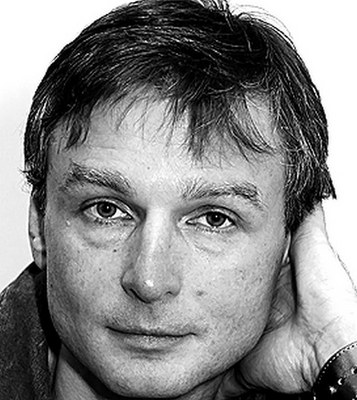
Slain Petersburg journalist Dmitry Tsilikin. Photo courtesy of Cogita.ru
On the morning of April 7, 2016, the website of the Russian Federal Investigative Committee’s Petersburg office reported that the office had detained a suspect in the murder of journalist Dmitry Tsilikin.
Tsilikin’s death was discovered on March 31, 2016. Relatives founded his body, covered with multiple stab wounds, in his own apartment. Investigators opened a case under Article 105.1 (murder) of the Russian Federal Criminal Code.
Fontanka.ru’s Yevgeny Vyshenkov chronicled the search for Sergei Kosyrev in the early hours of April 7, 2017. Vyshenkov writes that after studying billing recordings of the journalist’s mobile telephone, investigators intercepted the 21-year-old Kosyrev, who had called Tsilikin on the morning of March 27. Investigators had established that the journalist bled to death at five p.m. on March 27, 2016.
According to an article published today by Fontanka.ru, the murder suspect “called himself the Cleaner during questioning, and his life a crusade. Sergei Kosyrev, a 21-year-old student at the Hydrometeorological University, explained that the crime was a mission […] a crusade against a particular social group, […] and the feeling he had when he, allegedly, killed Tsilikin, was not dislike, as written in the arrest report, but hatred.”
Investigators have informed the media that Kosyrev holds right-wing views and is a fan of the Norwegian black metal band Emperor, whose “drummer stabbed a man to death in Lillehammer in for ideological reasons” in 1992.* Komsomolskaya Pravda writes that Kosyrev might turn out to be a “serial killer of gays.”
The gloomy stories involving the unsolved deaths and injuries of gays in recent years cry out to be seen as symptomatic.
As Masha Gessen wrote in The New York Times yesterday, “What no one has written in response to any of these deaths is that the Kremlin’s antigay campaign, which simultaneously pushes people underground and communicates to the public that homophobic violence will go unpunished, ensures that these shameful killings continue.”
Like the rest of the country, Sergei Kosyrev, a student at the Hydrometeorological University, has lived for the last four years in an atmosphere of increasing hatred for LGBT, “fifth columns,” “foreign agents,” and a whole list of official aliens and others compiled by official propagandists and state media. The security services do not see their actions as incitement of hatred and enmity, because they are busy searching for “extremists” among opposition-minded journalists, politicians, and lone picketers. However, the atmosphere of hatred and savagery is manmade, and sooner or later culpability will catch up with the people who have generated it in the shape of a war of all against all.
Translated by the Russian Reader
Correction. When this post was originally published, it contained a link to a different article on Fontanka.ru, not the article containing the passage cited by Tatyana Kosinova, in which it is alleged that suspected killer Sergei Kosyrev referred to himself as “the Cleaner,” etc., during question by police. I apologize for my error. May 18, 2016. TRR
* On 21 August 1992,[Bård “Faust” Eithun] stabbed Magne Andreassen, a gay man, to death in a forest just outside Lillehammer. Eithun was visiting his family there. He went to a pub and had a drink, but “the atmosphere didn’t suit him, so he decided to head home.”According to Eithun, while walking in the Olympic park, “this man approached me – he was obviously drunk and obviously a faggot […] it was obvious that he wanted to have some contact. Then he asked me if we could […] go up to the woods. So I agreed, because already then I had decided that I wanted to kill him, which was very weird because I’m not like this.” Eithun carried a knife because, as he explained: “It’s better to have a knife you don’t need than to not have one when you need it.” Once in the woods, Eithun stabbed Andreassen 37 times and then kicked him in the head repeatedly as he lay on the ground.
Eithun claimed that he felt no remorse at the time. In the late 1990s, he said of the murder: “I was outside, just waiting to get out some aggression. It’s not easy to describe why it happened. It was meant to happen, and if it was this man or another man, that’s not really important.”Ihsahn, his bandmate in Emperor, said that Eithun “had been very fascinated by serial killers for a long time, and I guess he wanted to know what it’s like to kill a person.”
The media has linked the murder to black metal and speculated that Eithun was motivated by Satanism or fascism, but in a 2008 interview he explained: “I was never a Satanist or fascist in any way, but I put behind me the hatred and negativity. Those feelings just eat you up from inside.” In a 1993 interview he had said “I am not a Satanist, but I praise the evil.” In an interview for the book Lords of Chaos he explained he had been “interested in Satanism but there are other things as well. Basically, I don’t give a shit.”Jørn Tunsberg of the band Hades Almighty said that the murder was “an impulse killing” and that “it had nothing to do with black metal.”
Putin Proclaims National Idea Fontanka.ru
February 3, 2016
In Russia, there can be no other unifying idea than patriotism, argues President Vladimir Putin, as reported by TASS.
“This is, in fact, the national idea,” the head of state announced during a meeting with the Leaders Club, which brings together entrepreneurs from forty of the country’s regions.
According to Putin, this idea is not ideologized and is not linked to the work of a particular party, reports RIA Novosti.
“It is a common rallying point. If we want to live better, the country has to be more attractive to all citizens and more effective,” the president stressed.
_________
Who Killed a Transsexual in Ufa and Why? Ufa1.ru
February 2, 2016
On Monday, February 1, Angela Likina was stabbed in the chest and killed in Ufa. The Ufa resident had gained notoriety in 2014, when a video recorded on a traffic police dashcam entitled “Ufa Traffic Cops Stop a Transvestite” [sic] went viral on the Web. Ufa1.ru found out who killed Oleg Vorobyov, who had changed his sex and become Angela Likina, and why.
Angela Likina. Photo courtesy of Ufa1.ru
The controversial video from the traffic police car dashcam recorded an inspector checking the papers of a female motorist. It transpired, however, that the motorist’s name, according to his internal passport, was Oleg Vorobyov. The inspector was very surprised by this. The motorist was a transsexual who had been preparing for a sex change operation for several years, becoming Angela Likina. The restricted video was leaked to the Web.
Later, the State Auto Inspectorate conducted a review of the incident, because the restricted footage should have not ended up on the Web. Angela Likina also commented on the video herself. She was surprised the incident had provoked so much interest among Web users.
“People die in accidents, children get hurt, cars are stolen, blood is needed to save someone’s life. Gentlemen, why are you setting records for likes and reposts about me? I honestly don’t understand,” said Likina, adding, “I don’t care how you live, what you do, and so on, so long as you are alive, healthy, and happy. But my life does not concern you in absolutely any way.”
How Did Oleg Live?
Ufa1.ru spoke with friends and acquaintances of Angela Likina, who talked about the life of the murdered woman. We found out this sad ending had emerged from a number of factors. Before becoming Angela Likina, Oleg Vorobyov had been married. Acquaintances confess that, outwardly, the couple were seemingly happy. They were raising two daughters, now aged fourteen and nine. The family lived in a private house, which also housed Oleg’s auto repair garage. Many of the people with whom we spoke said automobile owners were satisfied with Oleg’s work, that he had a magic touch.
Over five years ago, Oleg realized he was living in someone else’s body. He understood he wanted to change his sex and become the person he thought he was. Oleg began calling himself Angela Likina and started the complicated process of preparing to change his sex. He took hormone pills and began dressing like a woman. According to his internal passport, however, he remained Oleg Vorobyov. He could only change his name after finally changing his sex.
Five years ago, the Vorobyovs divorced, but the former husband and wife and their two children kept living under the same roof. The house was the wife’s property, and her former husband had an established business there. Several of the family’s acquaintances believe that Angela did not want to lose her income from the auto repair garage and spend money on renting a place to live. After all, she had to save up a large sum of money for the operation, and the medicines she took to prepare for the procedure were expensive. Close friends emphasize that Angela worked a lot, sometimes seven days a week.
At the same time, Ufa1.ru’s sources noted the Ufa resident simply had no choice.
“He once tried to rent a flat, but was kicked out. A neighbor had said, ‘I don’t want my children to see this!’ Consequently, he was evicted and didn’t even get his money back,” said one of our sources.
Friends of the family noted that those who have lived under the same roof with ex-spouses can imagine the atmosphere that prevailed in the Vorobyov house. Some say that the rows over living arrangements caused the Vorobyovs to come to blows. Things were aggravated by the fact that the head of the family had become a woman. Their children also became the targets of reproaches and ridicule at school.
“They would come home in tears, and sometimes refuse to go to school, but Angela loved her daughters and gave them a lot of time,” acquaintances noted.
Who Killed Angela?
According to friends, a boyfriend came to visit Oleg’s ex-wife on the ill-fated evening. The criminal investigation will shed more light on what exactly happened in the house. For now, the family’s acquaintances have their own hypotheses. Perhaps the man intervened in yet another family row. Maybe he stood up for his girlfriend and wanted to intimidate Angela by demanding she pack her things and leave. The row, however, escalated into something bigger.
“She was stabbed in the chest near the heart. She did not die immediately. She made it to a neighbor’s house, told him what had happened and who had done it, and an ambulance was summoned. Then Angela died in the neighbor’s arms. It was apparently too late to help her. I don’t know what was happening in the family. Angela was a good person, but strangers often beat her up. Her neighbors respected her choice. It is a bad thing when a person steals, kills or rapes, but everything else is a private matter,” said an acquaintance of Angela’s.
“The best human qualities—kindness, fairness, compassion, and unselfishness—were powerfully manifested in her. Unfortunately, that is a rarity nowadays. And she really never held a grudge against anyone, although there were a fairly large number of people who wished her ill. Most of them, it is true, were people who did not know her at all. They insulted and mocked her. You could say she was understanding about it: far from everyone in our city, or even our country, is ready to comprehend the decision to have a sex change. And that is another reason I have endless respect for her: the determination to go her own way to the end, to change her life fundamentally, the willingness to take one and overcome all the difficulties,” another girlfriend of Angela’s confided to Ufa1.ru.
“Apparently, Angela sensed her impending death. Not long before this she had asked forgiveness from her wife for all the rows that had happened between them,” said another family acquaintance.
__________
Fire at Moscow workshop kills 12 people, including 3 children Boston Globe
January 31, 2016
ASSOCIATED PRESS, JANUARY 31, 2016, MOSCOW — A fire at a textile workshop in Moscow has killed 12 people, including three children, officials said.
The victims were not identified but were reportedly immigrants.
The Investigative Committee, the top state investigative agency, said the fire broke out late Saturday in northeastern Moscow, damaging more than 32,000 square feet of the structure.
Investigators said they are looking at negligence or arson as possible causes.
Russia’s children’s rights ombudsman, Pavel Astakhov, said Sunday on his Twitter account that three children were among those who died, including a baby. He said the victims were migrant workers who lived next to their workplace.
Several dozen fire engines responded to the blaze, and it took firefighters about five hours to extinguish the blaze.
Investigators continued to sift through the rubble Sunday for evidence.
Many immigrants work in Russian factories, some of which have been investigated for hazardous working conditions. In April, a blaze on the outskirts of Moscow killed 17 migrant workers.
__________
The death toll of Kyrgyz citizens (according to the Embassy of the Kyrgyz Republic in the Russian Federation):
1. Sajida Masaliyeva, born 1988. Home address: Village of Kyzyl-Bel, Batken District, Batken Region.
2. Toktokan Saliyeva, born 1983. Home address: Village of Tayan, Batken District, Batken Region.
3. Uulkan Saliyeva, born 1997, sister of Toktokan Saliyeva.
4. Isa kizi Aizat, born 1995. According to available information, Isa was a native of the Village of Kaiyndy, Batken Region.
5. Milikajdar uulu Koshonbay, born 1990.
6. Tologon Kozuyev, born 1991.
7. Manas, born 1995; brother of Tologon Kozuyev; no other details.
8. Daniel, 4-5 years old, son of Ergeshbay Japarov, a Russian national who perished in the fire; born in the village of Rout, Batken District, Batken Region; according to the victims, Daniel was a citizen of the Kyrgyz Republic.
[Elena Bobrova:] You are something of a patriot yourself?
[Nikolai Kolyada:] How else should I relate to Russia? I love her whatever she be like. Like Gogol I can tell the whole unvarnished truth about her. And Nikolai Vasilyevich said such awful things about Russia. He sobbed bloody tears when thinking about the country. But not because he hated it. On the contrary, because he loved it. When foreigners start speaking badly about Russia, I begin to boil: “Shut up, it is none of your business. I have the right to say anything about her, but you do not.” Well, it is okay when Europeans or Americans sling mud at us: they have a hard time coping with the fact we are different, unpredictable, and freer than they are. But when our own people hate their own country, that is terrible. This morning, I was reading Facebook and I thought, “Why do you live here if you hate Russia so much?”
[Bobrova:] But you just said yourself we have a right to chew out Russia because we live here.
[Kolyada:] Chew out but not hate. But Facebook is just seething with hatred.
—Excerpted from “20% of the Petersburg audience are loonies,” Gorod 812 (print edition), February 1, 2016, page 34
Items one, two, four, and six translated by the Russian Reader
Drawing to Go on Living
Yuri Ivashchenko
November 3, 2015 Mediazona
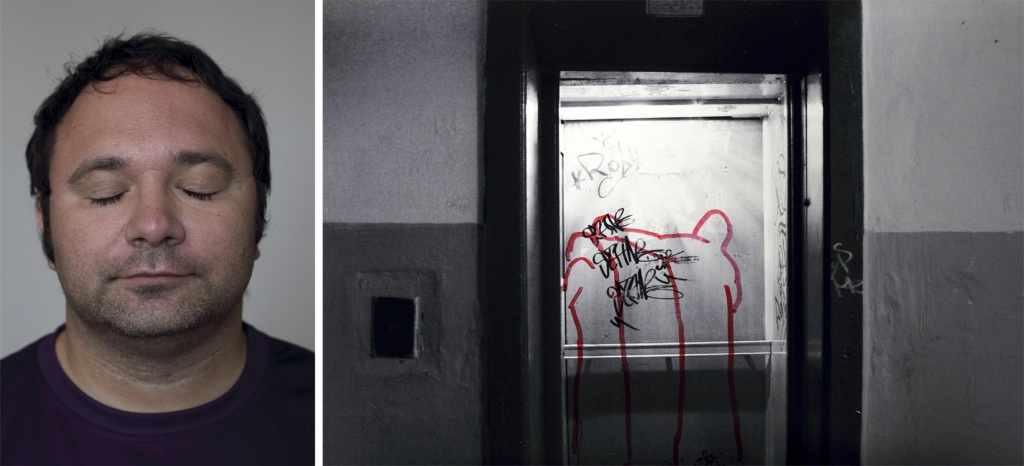
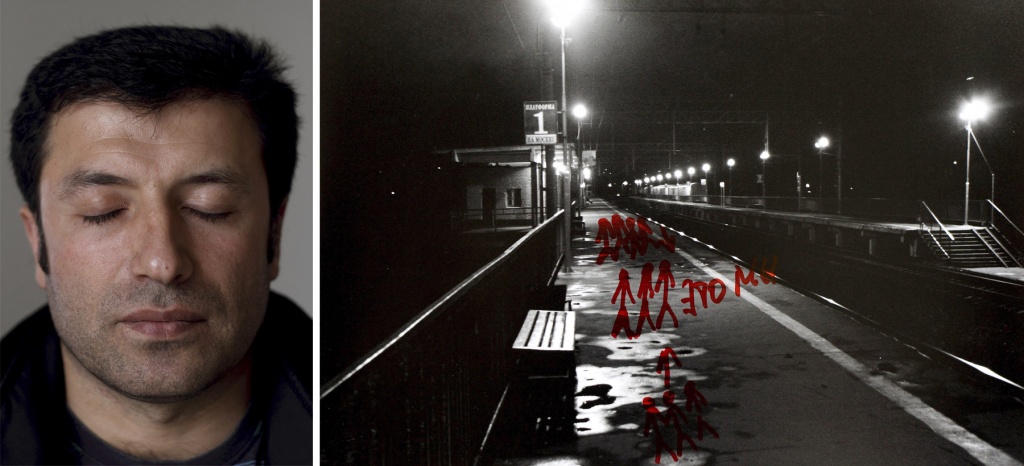
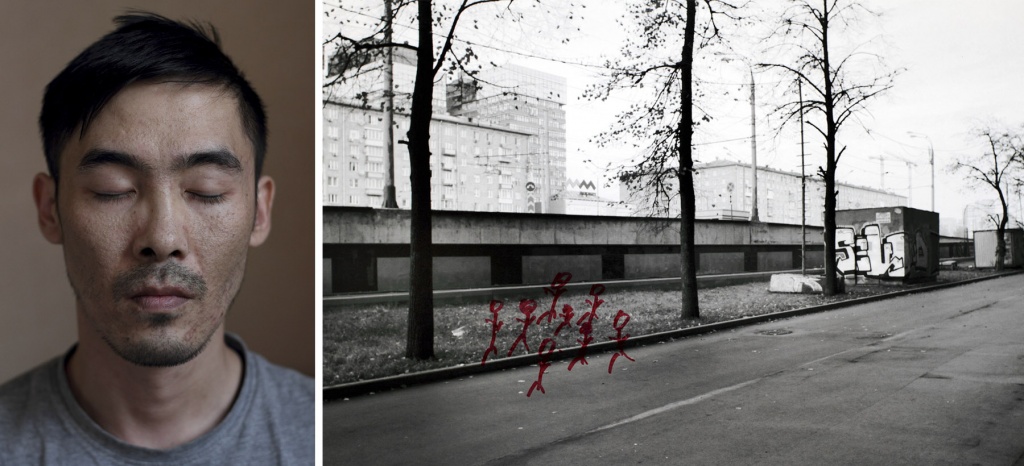
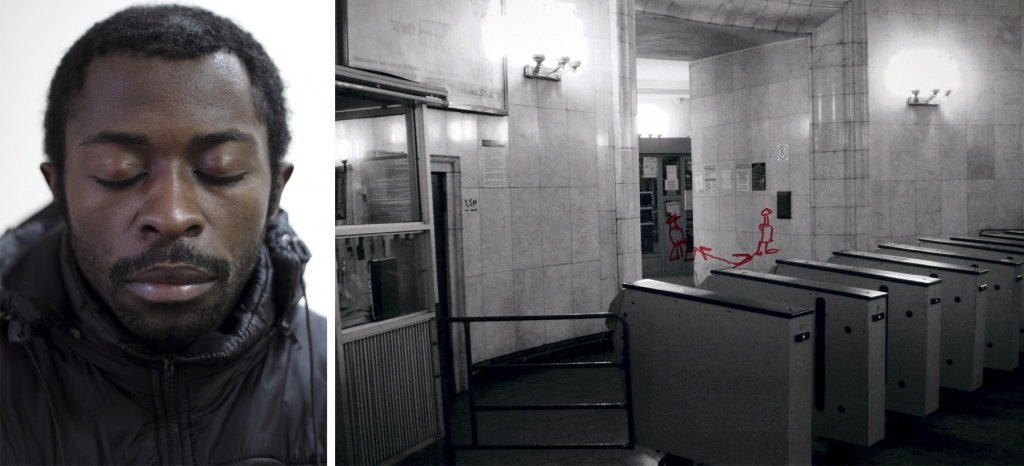
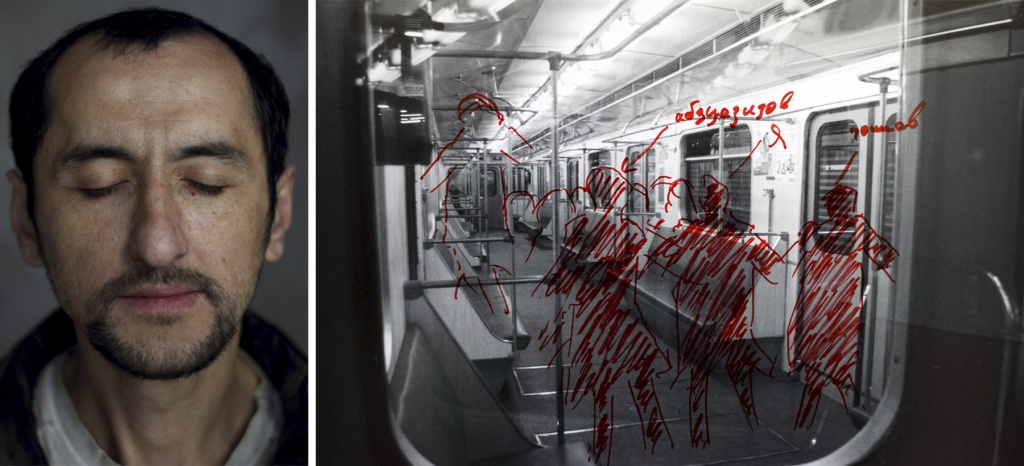
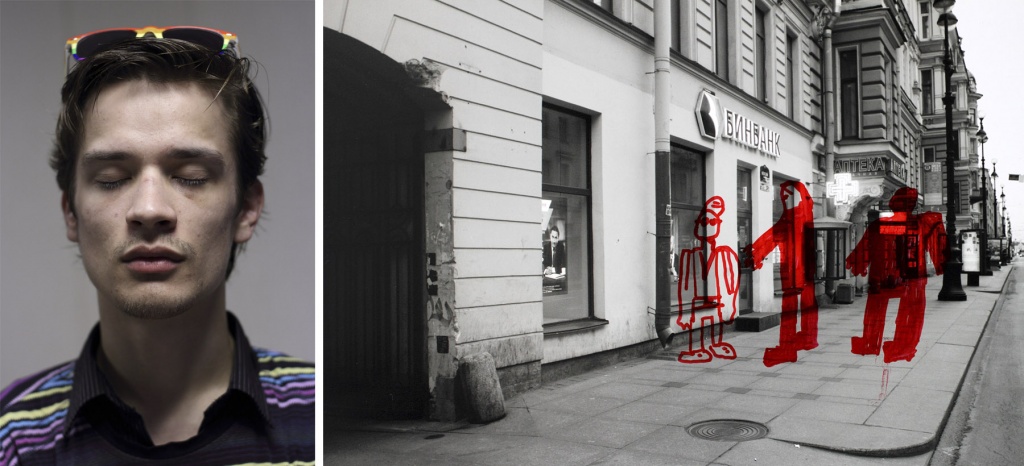
Photographer Yuri Ivashchenko looks for people who have been assaulted by racists and homophobes in Russia. He asks them to make a schematic drawing of what happened to them on a snapshot of the crime scene.
Mikhail Tumasov, Russia. Assaulted April 2012 in Samara
Mikhail came out to a new friend, who violently assaulted him. Mikhail spent a week in the hospital. A magistrate judge rejected Mikhail’s lawsuit, since Mikhail had not listed the assailant’s birthplace, registered address, and other personal data.
Ibrahim Yunusov, Uzbekistan. Assaulted on October 3, 2008, at Sokolovskaya railway platform in the Moscow Region
Ibrahim and his brother, immigrants from Central Asia, were assaulted at the railway platform, where they had gone to see off a Belarusian friend. When eyewitnesses of the assault called the police, the officers who arrived on the scene suspected the brothers had been involved in a recent rash of telephone thefts on commuter trains. Despite eyewitness testimony corroborating the Yunusovs’ alibi, a court found them guilty of stealing other people’s property and sentenced Ibrahim to a year of probation. His brother Rustam was sentenced to six months of probation. The six months they had spent in a pretrial detention facility was deducted from their sentences.
Alexander Lee, Uzbekistan. Assaulted June 17, 2014, on Leningrad Highway in Moscow
Alexander was standing at a tram stop when several men attacked him. Fighting them off, he ran towards the Sokol subway station. Screaming, “Kill him!” ten to fifteen young men chased Alexander. They caught up with him and surrounded him on a lawn. One of the assailants hit Alexander in the back. He fell to the ground and was beaten up by the mob. The assailants took Alexander’s telephone and wallet, which contained around 10,000 rubles. Later, passersby called an ambulance. Alexander was taken to hospital, where he spent over a month. Doctors have diagnosed Alexander with a bruised spinal cord. A criminal investigation of the assault is underway, and there are suspects in the case.
Mele, Cameroon. Assaulted November 30, 2013, at the Novoslobodskya subway station in Moscow
Mele was attacked in the late evening at the turnstile to the subway by a man shouting racist slogans.
The assailant was arrested. He confessed his guilt in court and was released after reaching a settlement with Mele that involved paying him compensation and apologizing.
Anvar Yusupov, Tajikistan. Assaulted January 16, 20112, in the Moscow subway
A group of drunken young men, their faces covered in scarves, attacked Anvar and two of his friends when they were returning home from work. Noticing the young men were wielding knives, Anvar decided to defend himself with a beer bottle and managed to wound one of the assailants. Subsequently, the wounded young man was arrested in Saint Petersburg for stealing tennis shoes and testified about the incident in the subway. The court, however, found Yusupov guilty and sentenced him to six months’ imprisonment in a penal colony, which was later commuted to a fine.
John, Russia. Assaulted April 18, 2015, near Nevsky Prospect, 184, in Saint Petersburg
John was walking down the street in rainbow-colored glasses when he drew even with two young men. One of them bumped John hard with his shoulder. John asked the passerby why he had done this. The man replied that he hated “fags” and head-butted John. John responded by pepper-spraying the assailant, who fled the scene with his companion. The police refused to open a criminal investigation into the incident.
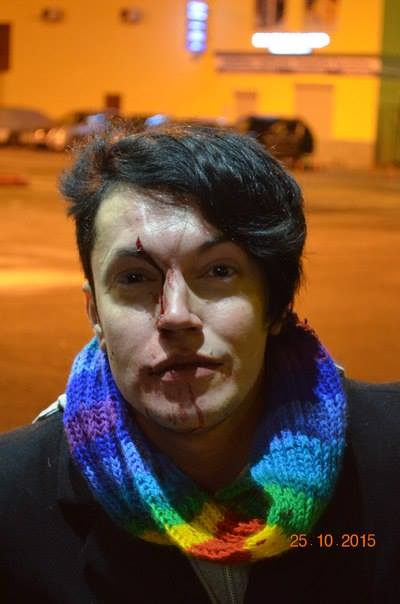
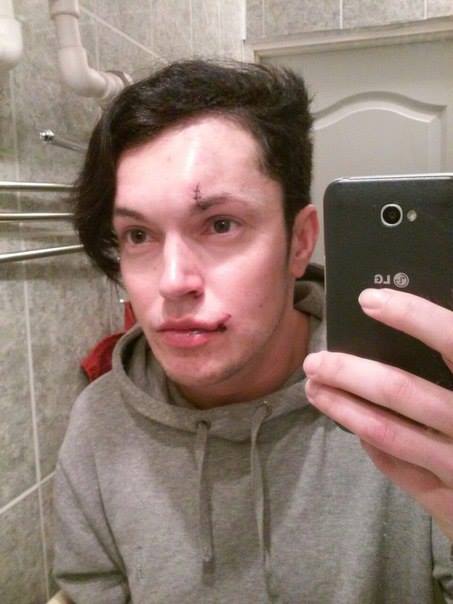
This is the story of how Dante got punched in the kisser and now bears all the hallmarks of an alleged real man.
Petersburg LGBT activist Dante Teodori
I was going to the Rainbow Coffee Klatch on the subway today. I looked and saw this one guy eyeing me quite maliciously. The fellow was well built and dressed in sport clothes but dressed decently. After a while, he came up and leaned over me. (I was sitting down.) He told me either I could take off my scarf and scram from the car or he would kick my ass. (I have omitted the obscenities.) I refused. He smacked me in the face and split my lip. I took the second blow on the head and it split my eyebrow. Then some dude pushed him away.
I got out at a station and looked for the cops or some other official service, but there was no one. I got back on the train and pushed the hotline button to connect me to the driver, but it didn’t work. Well, okay, I thought, I will just go as I am. I asked people for napkins and telephoned the guys to come meet me in the subway, since I thought my nose was broken and I wouldn’t be able to see anything because of the blood. When I got there, the guys suggested calling an ambulance, since we didn’t know where the first-aid station was.
They took me to the hospital, since they didn’t like the look of the epic lump on my forehead. At the hospital, I was examined, stitched up, and sent home to heal.
Second, the scarf was not in the LGBT colors. It was knitted and given to me by a very nice woman with whom I was detained for waving the Ukrainian flag. What does this mean? That technically anyone wearing colorful clothes can get the crap beat of them.
And the most important thing. I think the only chance we have of getting closer to the future we want is to live as if it has already arrived.
Translated by the Russian Reader. Thanks to Gabriel Levy for the suggestion. Photos courtesy of Dante Teodori’s Facebook page. This story has been covered widely in the local media. See, for example, “LGBT activist beaten over colorful scarf,” Paperpaper.ru, October 26, 2015 (in Russian).
The Closing Statement of Andrei Marchenko Industrial District Court, Khabarovsk, September 30, 2015 Grani.Ru
Exactly one year and two months ago, I had a knock on the door around this time of day. The people knocking identified themselves as election campaigners, but then a huge crowd of people with a video camera turned on burst in as soon as I opened the door. Because of one sentence on the social network Facebook, the FSB had come in connection with the criminal investigation opened against me.
Andrei Marchenko. Photo by Alla Viktorova. Courtesy of Grani.Ru
It was my first search and a lesson for the rest of my life. You should never be afraid of anything, and must know and defend your rights.
Let us start with the fact that I was shown the search warrant in passing, as well as IDs. Apparently that is why I still do not know the first names or surnames of the men who came to search my place. Next, I was denied a telephone call and not allowed to ask neighbors to act as official witnesses during the search. (The official witnesses were soldiers brought by the FSB themselves.)
Naturally, pressure was put on me during the search. But it lasted only until they had checked everything and realized that what they had come for was not in my house (nor could it have been there). There was no money from foreign sponsors, no extremist literature, nothing.
The only thing that gladdened my visitors was the business card of Elizabeth Macdonald, a US consul in Vladivostok, although I do not understand why it is forbidden to communicate with foreigners. In a daze, I signed the search record (which was also a mistake), and they left. They departed, leaving me with a summons to an interrogation.
May it please the court to know that from the outset I considered this criminal case political, and I still do. The charges were filed only to silence me and force me not to voice my personal opinion about the current political situation in the country and the world.
May it please the court to learn that when they were conducting their investigation before criminal charges were filed, the investigators from the FSB Khabarovsk regional office during their so-called private chat with me were intensely and primarily interested in my role in organizing a flash mob in Khabarovsk six years in a row to protest the homophobic policies of the Russian leadership. They asked about my friends from the Khabarovsk LGBT community (both generally and about specific people). They asked about my meetings with a representative of the US Consulate in Vladivostok during her visit to Khabarovsk. I stress it was this aspect of my life that primarily concerned the investigators.
The investigators were also interested in my political views and my personal opinion about the anti-terrorist operation in the east of Ukraine.
I venture to guess that the FSB was investigating me as a “gay foreign agent.”
But after searching my home and questioning witnesses, the investigators at the FSB’s Khabarovsk regional office decided, nevertheless, to charge me with extremism under Article 280, Part 1 [of the Russian Federal Criminal Code].
May it please the court to hear that the forensic examinations made it clear I am not a terrorist and extremist but a simple Russian citizen who takes to heart all the news happening both to Russian citizens and other peoples.
Your honor, when rendering the verdict, I ask you to take into account the propagandistic hysteria that the Russian state media fanned during the summer of 2014.
It was in May and June 2014 that round-the-clock hysteria about “Ukrofascists,” “Banderites,” “crucified boys,” and so on wafted from every TV set. Russians were really being zombified. But I had and have the opportunity to get accurate information from different sources, including Ukrainian, European and American news and analysis channels, and programs on the independent Russian TV station Rain and the radio stations Echo of Moscow and Radio Svoboda.
It was then that my freedom-loving mind (my whole life has been a struggle for justice, for compliance with human rights and freedoms) revolted against all this, and I decided I could freely express my value judgment among like-minded people and friends on the American social network Facebook, which is not subject to Russian laws.
But it turned out (this is in the case file) that my behavior and statements had been monitored for a long while. Although, as a popular blogger, I had heard about total surveillance, it was a shock to me when I learned I was on the list of those being monitored.
Your honor, when I posted the statement for which I have been charged, I was not inciting anyone to carry out acts of violence. It was my impulsive and, perhaps, overly emotional response to the rubbish broadcast that night (Far Eastern Time) by Russian state television.
And, as follows from the results of the forensic examination (volume 2, pages 9–15), the post was my way of expressing my negative attitude towards a specific group of people in Russia who are supporters of fascism and terrorism, and who forcibly seized the territory of another country, Ukraine. I think that, just like me, every honest Russian citizen has a negative attitude towards this group of so-called volunteers. I should emphasize that, according to legal experts at the SOVA Center for Information and Analysis, the current prosecution under Article 280 is unlawful. “Citizens of Russia [who are] supporters of fascism and terrorism and forcibly seized Ukrainian territory” are not a group protected by anti-extremist legislation and, therefore, the use of violence against this group cannot constitute foul play as stipulated by Article 280.
Your honor, I would also like to emphasize that publication of the post mentioned in the charges was nothing more than an expression of my personal point of view. I just wanted to draw attention to the news, to the lies of the propagandists on state television (using their own way of putting things), and to my [Facebook] page.
Your honor, as I have said, this case is purely political and was initiated not because of extremism, but because I, being openly gay and a media figure, have been very civically active and express my opinion, which differs from the general ideological line in Putin-era Russia.
Translated by the Russian Reader
Editor’s Note.According to Grani.Ru, Judge Galina Nikolayeva adjourned the trial until ten o’clock tomorrow morning, Thursday, October 1. It is expected she will announce a verdict in the trial then.
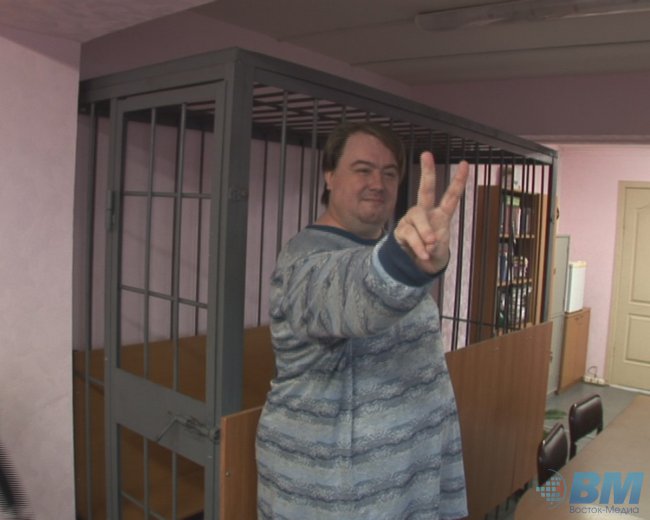
Update. According to an article on the news website Vostok-Media, on October 1, 2015, the Industrial District Court in Khabarovsk found Andrei Marchenko guilty as charged and sentenced him to a fine of 100,000 rubles, but immediately amnestied him as part of a general amnesty celebrating the seventieth anniversary of victory in the Second World War.
Andrei Marchenko celebrating his virtual victory in court. Photo courtesy of Vostok-Media
Prosecutor Requests Two Years in Open Penal Settlement for Khabarovsk Blogger Marchenko
September 28, 2015 Grani.Ru
Prosecutor Olesya Demina has asked Khabarovsk’s Industrial District Court to sentence blogger and LGBT activist Andrei Marchenko to two years in an open penal settlement, as reported by Grani.Ru’s correspondent from the courtroom. Marchenko has been accused of extremism for posts he made on Facebook.
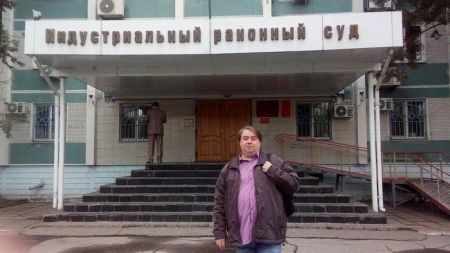
Andrei Marchenko outside of Industrial District Court in Khabarovsk. Photo by Alla Viktorova. Courtesy of Grani.Ru
During closing arguments, defense attorney Natalya Gladych drew the court’s attention to Marchenko’s positive character references, as well as the findings of a psychologist, who concluded that the defendant’s only purpose had been to draw attention to himself and to his position on the war in the east of Ukraine.
“Two years in an open penal settlement is an excessively severe punishment given that the evidence presented by the prosecution is insufficient. The prosecutor speaks of Marchenko as an out-and-out extremist, although the man was simply expressing his opinion. The harsh form in which he delivered it was due only to heightened emotionality,” said Gladych.
On Monday, the defendant was to make his closing statement, but Judge Galina Nikolayeva unexpectedly adjourned until Wednesday, September 30, when Marchenko will deliver his closing statement and the judge will return a verdict.
“I did not expect that the prosecution would request real prison time. There is not a single injured party in the case. There is only the one sentence on Facebook, which did not lead to any real consequences. And for this the representative of the state machine asks the court to sentence me to real prison time,” Marchenko commented to Grani.ru after the hearing.
Marchenko has pleaded not guilty and hopes for an acquittal.
On June 8, 2014, Trinity Sunday, Marchenko published a post on Facebook dealing with the events in the east of Ukraine.
“Impale all the terrorists!!!!!!!!” he wrote. “Kill all of them!! Blood Sunday! Free Ukraine from the fascist Russian terrorists on Trinity Sunday!”
The post was made visible only to Marchenko’s friends in the social network. Nevertheless, it was this publication that led to the blogger’s prosecution.
On August 28, 2014, FSB officers carried out a search at Marchenko’s home during which they seized all his office equipment and mobile phones. The following day, the blogger was charged at regional FSB headquarters under Article 280, Part 1 of the Criminal Code (public incitement to extremism)
Andrei Marchenko. Photo courtesy of amurburg.ru
A week before the raid, the blogger had also been summoned to regional FSB headquarters. There he was shown screenshots of a certain site according to which Marchenko and another Khabarovsk LGBT activist, Alexander Yermoshkin, were the founders and masterminds of a “gay terrorist underground” that were pursuing the goal of organizing an “orange revolution” in Khabarovsk. As Marchenko noted, the FSB investigator was “utterly serious.” Marchenko was then asked why he did not like “Novorossiya.” He was told that his numerous posts in support of Ukraine and criticizing the Kremlin were the reason for the FSB’s concern.
On September 11, 2014, another five phrases from Marchenko’s summertime posts were sent off for forensic examination.
“Including phrases in support of Poroshenko and phrases about the fact that prices are higher but Crimea is ours,” wrote the blogger.
Two weeks later, it transpired that Rosfinmonitoring had placed Marchenko on its list of terrorists and extremists. However, the blogger kept his bank accounts only for withdrawing money he earned through official freelance bureaus from the WebMoney system. For many years, these earnings had been Marchenko’s only source of income. Thus, Rosfinmonitoring’s decision left the activist penniless.
“Now I don’t even have money for groceries,” wrote Marchenko.
The blogger expressed bewilderment at his inclusion in the list, noting that the court had not yet deemed him either a terrorist or an extremist.
NB. Grani.Ru, the opposition news and commentary website that published this article about Andrei Marchenko’s plight is itself banned in Russia as “extremist” and can only be viewed there through VPNs, anonymizers, and mirror sites.
Update. According to an article on the news website Vostok-Media, on October 1, 2015, the Industrial District Court in Khabarovsk found Andrei Marchenko guilty as charged and sentenced him to a fine of 100,000 rubles, but immediately amnestied him as part of a general amnesty celebrating the seventieth anniversary of victory in the Second World War.
Andrei Marchenko celebrating his virtual victory in court. Photo courtesy of Vostok-Media