A court in St. Petersburg has put sixty-year-old accountant Irina Tsybaneva under house arrest for leaving a note that read “Death to Putin” on the grave of the Russian president’s parents. The woman was able to steal up to the gravestone, which is guarded, but she was unable to leave the cemetery unnoticed. The police and the prosecutor’s office asked the court to send Tsybaneva to a pretrial detention center, calling the crime “audacious,” but the court found that this was too harsh a pretrial restraint. Mediazona has delved into the details of the case and found out what role the news played in the Petersburg woman’s spontaneous actions.
“I just saw a [TV] program, at that time very serious, there was some news, and something just…,” said Tsybaneva, trying to explain her actions, while standing in the defendant’s cage at the Primorsky District Court in Petersburg.
Tsybaneva has been charged with desecrating the burial place of deceased persons due to political or ideological enmity. It is alleged that she went to the grave of the parents of Russian President Vladimir Putin and left a note there that included the following phrase: “You raised a freak and a murderer.”
“And how often do you go and write notes to everyone [sic] while watching the news?” the prosecutor asked her.
“Never. I watched the news and realized that everything is quite scary, everything is very sad, a lot of people have been killed.”
“We had the coronavirus, everyone was depressed. Did you also write something to someone then?”
“What for? No, of course not,” said Tsybanev, smiling.
“Well, I don’t know. You watched the news and decided to write.”
“Yes, under the influence of the news.”
“Are the media to blame for your actions?”
“That’s the upshot.”
Irina Tsybaneva. Photo courtesy of Mediazona
Before the war in Ukraine, Tsybaneva, who is employed as an accountant in Petersburg, was not particularly interested in politics. Even after the Russian invasion, she practically never raised the topic of war raised in conversations with relatives, her son Maxim told Mediazona.
“She went to concerts, festivals, theaters, and museums. She traveled a lot both in Russia and abroad,” the man added. “At one time, she was a big fan of bard music. I don’t know how it is now, but it’s probably still the case. She went to the Grushinsky Festival many times. She was a prominent figure in Trofim‘s fan club.”
Tsybaneva spent a lot of time with her six grandchildren. (Her daughter and her son each have three children.) She moved to St. Petersburg in the 1980s from the Tver Region, working as an engineer and then as an accountant in various companies.
On October 6, the eve of the Russian president’s birthday, Tsybaneva went to the Serafimovskoe Cemetery, where Mr. Putin’s parents are buried.
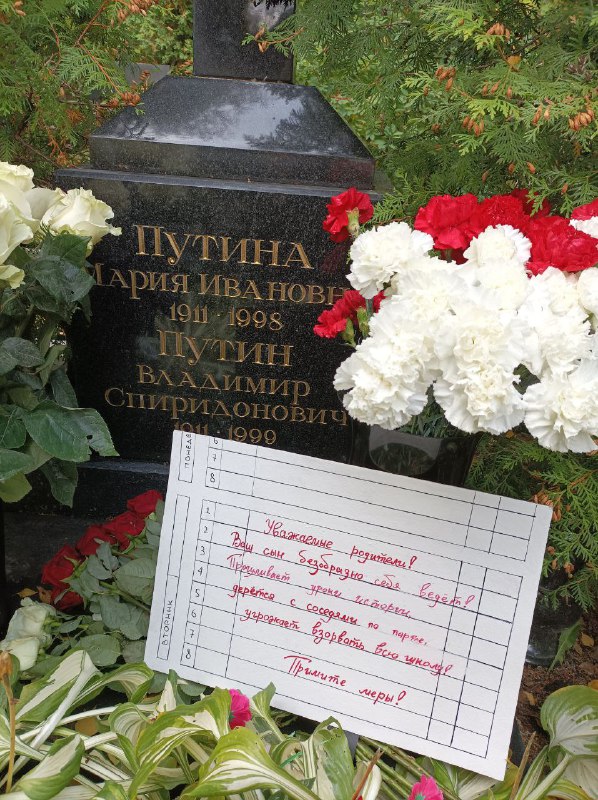
Security had already been beefed up at the cemetery and specifically at the graves of Vladimir and Maria Putin, probably due to the fact that, in late September, a small poster in the guise of a school pupil’s class journal appeared on their headstone. It read as follows: “Dear parents! Your son has been behaving disgracefully! Skipping history lessons, fighting with his desk mates, and threatening to blow up the whole school! Take action!”
“Dear parents! Your son has been behaving disgracefully! Skipping history lessons, fighting with his desk mates, and threatening to blow up the whole school! Take action!” Photo courtesy of Feminist Anti-War Resistance
A week later, a court in Petersburg jailed the activist Anastasia Filippova for ten days on charges of disobeying a policeman. As reported by Bumaga, Filippova’s relatives linked her arrest with the poster. Yesterday, a court overturned her arrest, and she was released from the special detention center.
Despite the beefed-up security and the police officers on duty at the cemetery, Tsybaneva was able to walk up to the grave of the Putins.
“They got distracted there, and she somehow left the note. It transpired that there are a lot of cameras there,” Maxim Tsybanev said, adding that his mother was able to photograph the note on her phone, which was later seized, however.
The contents of the note were made public today during Tsybaneva’s pretrial restraints hearing. “Parents of the maniac, move him in with you. He has caused so much pain and trouble, the whole world is begging for his death [illegible]. Death to Putin, you raised a freak and a murderer,” Tsybaneva’s message read.
In a linguistic analysis, a copy of which was submitted as part of the written request for pretrial restraints in court today, experts concluded that the note contains a “negative assessment of Russian President Vladimir Putin” addressed to his parents. But how exactly the police identified the person who left the note is unknown. In court, the prosecutor cited an “ongoing investigation.”
The leaflet containing the appeal to Putin’s late parents was found the same day by a cemetery guard, who immediately informed the police. On Monday, October 10, they were already knocking on Tsybaneva’s door.
“She wouldn’t open it for a long time, but eventually a policeman promised to pry it open, and she opened it. At three p.m. yesterday she was taken to the 35th police precinct. For some reason, they kept her waiting there for a long time. Finally, around nightfall, she telephoned and said that there would be a search. We immediately went to her house, but she wasn’t there,” Maxim Tsybanev told Mediazona.
The accountant was placed in the temporary detention center and a criminal case was opened against her for abusing the burial place of deceased persons due to political or ideological enmity. If she is convicted, Tsybaneva could face up to five years in prison.
During the couple of days that Tsybaneva was in custody, the police were able to conduct a DNA examination, which confirmed that the traces of skin found on the note were hers. Handwriting analysis also indicated that it was Tsybaneva who wrote it. In addition, a picture of the note was found on her phone.
“I immediately admitted that I had written [the note], and that there was no need to do these analyses,” Tsybaneva said in court.
Police investigators and the prosecutor’s office asked that Tsybaneva be sent to a pretrial detention center.
“She is suspected of a crime whose danger to public consists in insulting the memory of the dead, the deceased, and the feelings of the living towards the dead,” the prosecutor argued.
She called the crime committed by the accountant “audacious” and, given Tsybaneva’s impressionability and the impact the news has on her, she argued that it was better for the woman to be in custody.
The defense lawyers were able to convince the court that the restraint measure requested by the state was too harsh. Consequently Judge Dmitry Lozovoy put Tsybaneva under house arrest for twenty-eight days, forbidding her to use the internet, telephone and mail.
“Given the actions committed, this is too harsh, but given current situation in the country, it is quite good,” said her son Maxim, commenting on the judge’s decision.
I read the following two passages just now in quick succession, quite by chance, while eating lunch:
1) “I would try to kill anyone who harmed or spoke ill of you. You would try to kill anyone who harmed or spoke ill of me. But neither of us would ever, under any circumstance, be honest about yesterday. This is how we are taught to love in America. Our dishonesty, cowardice, and misplaced self-righteousness, far more than how much, or how little we weigh is part of why we are suffering. In this way, and far too many others, we are studious children of this nation. We do not have to be this way.”
2) “In 2014, a U.S.-driven Maidan coup in Ukraine overthrew the elected government and burned down the trade union headquarters building in Odessa, killing 48 people. In opposition to the coup two Russian-speaking provinces of Eastern Ukraine, Donetsk and Luhansk, seceded. The democratic right to self-determination from the nationalist Kiev government which banned the Russian language must be recognized for the Eastern and Southern provinces. The neo-fascist Azov Brigade opened fire on the two newly-founded republics of the Donbas region, killing over 15,000 civilians. African immigrants in Ukraine attempting to flee the war were subjected to racial discrimination by the Zelensky government.”
Yesterday morning, while drinking coffee, I read the following two passages hard on each other’s heels:
3) “As a child, one of my grandmothers wandered Siberia with her mother (in the thirties). She told me many times about a crazy old woman they met. The old woman went around pointing her finger at passersby and saying, ‘The blood of the murdered innocents will fall on everyone. On everyone! On everyone! On everyone!’ I remembered this today. She was right.”
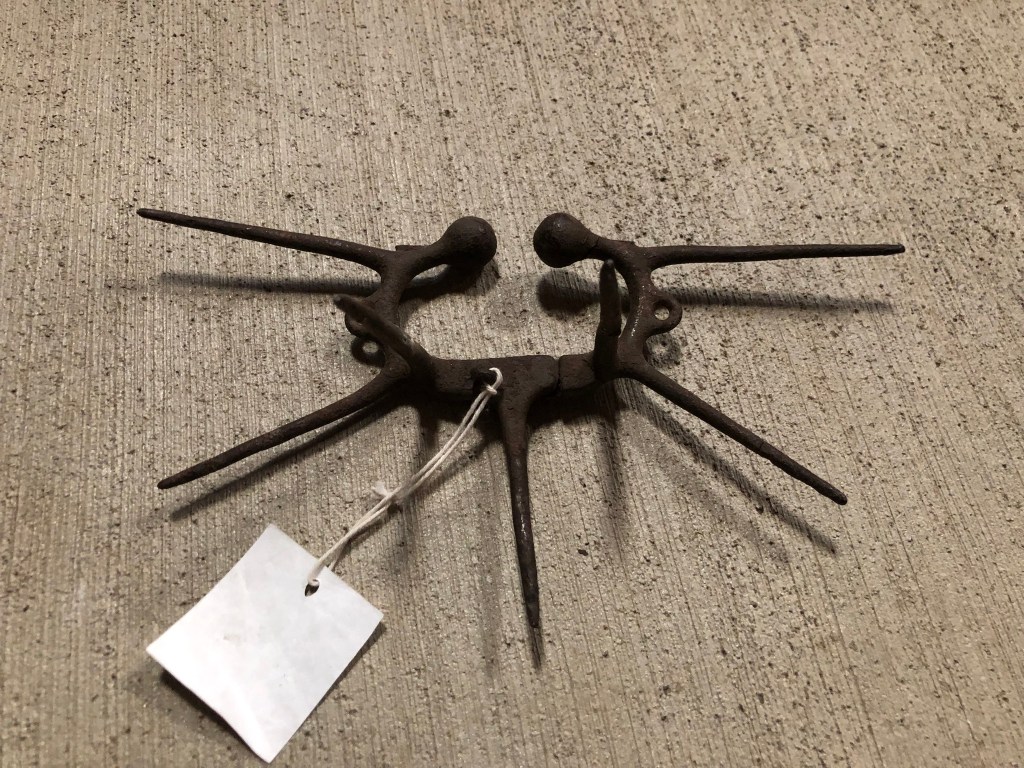
4) “This spiky looking object is an anti-suckling device. The artifact is made up of a nose ring with seven long (and sharp) spikes welded onto it. When the farmer decided that it was time for a calf to be weaned from its mother, they would use this item. The ring would be placed in the nose of a young calf—when the calf would try to nurse from its mother, the spikes would poke the mother causing her pain. The mother would then kick the calf away or avoid the calf to escape the discomfort of being poked.”
Sources: 1) Kiese Laymon, Heavy; 2) Various alleged ILWU members (including Angela Davis), “Stop the Ukraine War—refuse to handle military cargo,” MR Online (thanks to Marxmail for the heads-up); 3) Natalia Vvedenskya, Facebook, 11 October 2022 (translated by the Russian Reader); 4) Murray County Historical Museum, Facebook, 11 October 22. Photo, above, also courtesy of the Murray County Historical Museum.
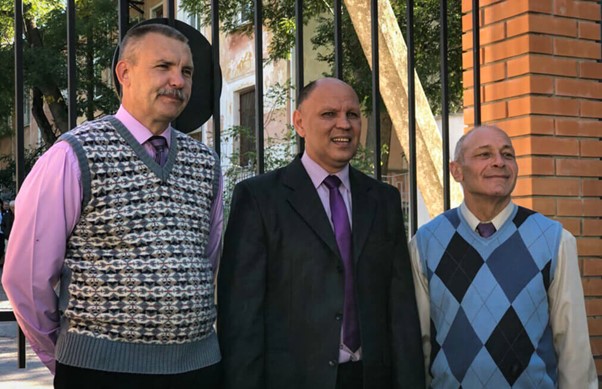
Volodymyr Sakada, Yevhen Zhukov, and Volodymyr Maladyka have been sentenced to six years in prison by a Russian occupation in Sevastopol for being Jehovah’s Witnesses. Photo: Lutfiye Zudiyeva, Graty. Courtesy of Kharkiv Human Rights Protection Group
This bulletin is put together by labour movement activists in solidarity with Ukrainian resistance. More information at https://ukraine-solidarity.org/. We are also on Twitter. Our aim is to circulate information in English that to the best of our knowledge is reliable. If you have something you think we should include, please send it to 2022ukrainesolidarity@gmail.com.
To receive the bulletin regularly, send your email to 2022ukrainesolidarity@gmail.com. To stop it, please reply with the word “STOP” in the subject field.
Source: Dimitri Ozerkov, Instagram, 2 October 2022
— I imagine that the calls to boycott (or not participate in) Manifesta by a number of artists in connection with the events in the Crimea must have been nerve-wracking for you.
— The calls for a boycott were addressed not to the Hermitage, but to the Manifesta Foundation. They came mostly from artists who had not been invited to participate. But [Manifesta 10 chief curator Kasper] König’s project involves a number of important international artists, whom neither the left nor the right can suspect of collaborationism. Manifesta is an event that is free from censorship, but that operates according to Russian laws. Everyone is free to decide independently what is important to them: being involved in an art project or voicing their political stance in another way.
— Is it possible to be an artist and not be a citizen?
— “A poet you may not be / But be a citizen you must.” [Ozerkov here quotes an oft-quoted line from “Poet and Citizen,” a poem by the 19th-century Russian poet Nikolai Nekrasov.] I believe that you can be a professional in your field and have a civic stance. But they are completely different things. If an artist is leftwing, it doesn’t alway mean they’re a good professional. If you oppose the authorities and their individual decisions, this does not instantly make you a good artist. Exceptions are rare. Those who try to combine these concepts, in my opinion, are trying to compare apples and oranges. If, for example, you perform music and stop playing because there are lies and war in the world, then your civic stance prevents you from continuing to be an artist. But it’s always your choice. It seems to me that in a modern liberal capitalist society, some people have the right to make art, and others have the right to look at it, regardless of what is going on in their heads regarding politics.
Source: “Dimitri Ozerkov on Manifesta,” DW, undated, although presumably published in the spring or summer of 2014. Translated by the Russian Reader
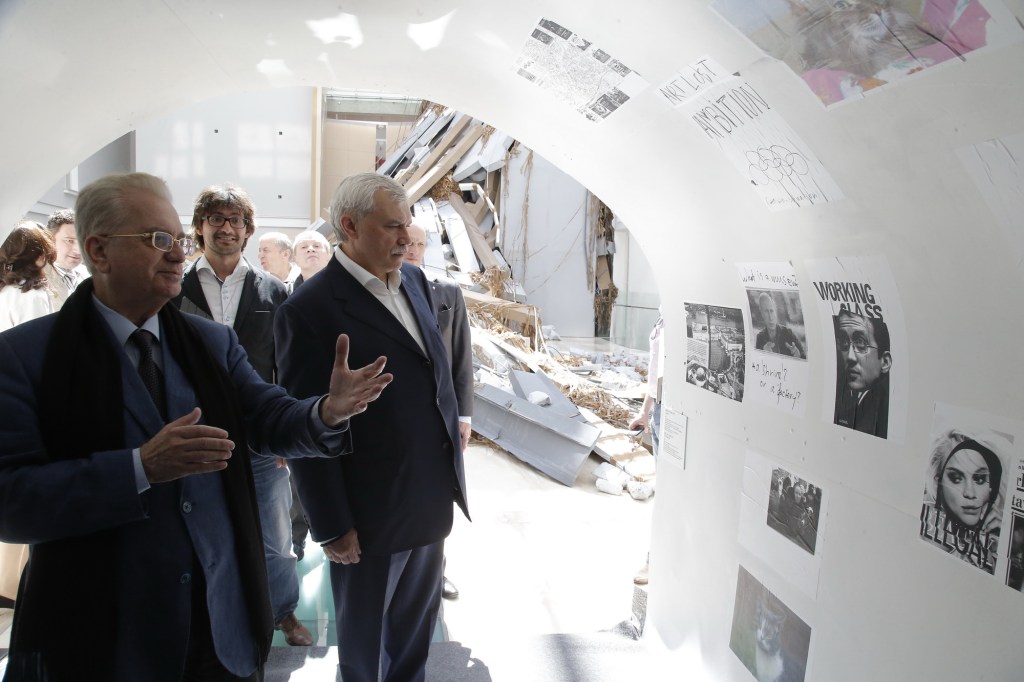
Hermitage director Mikhail Piotrovsky shows then-Petersburg Governor Georgy Poltavchenko the main exhibition at Manifesta 10, General Staff Building, State Hermitage Museum, St. Petersburg, 6 July 2014. Dimitri Ozerkov, who now suddenly wants nothing to do with Russia and its bad ways, is the younger chap standing behind the two Putinist satraps beaming like a kid in a candy shop. Manifesta 10 took place hard on the heels of Russia’s illegal annexation of Crimea and its “proxy” invasion of Eastern Ukraine in the spring of 2014. I found this photo in my archives the other day. Unfortunately, I have no idea who took it or where it was originally published. Governor Poltavchenko’s visit to Manifesta 10 was well documented in the local and Russian press at the time, although, curiously, most of the photos in those press accounts have gone missing. ||| TRR
The show must go on and will go on.
At a press conference in London this morning, Kasper König, curator of the controversial Manifesta 10, and professor Mikhail Piotrovsky, director of the State Hermitage Museum in St. Petersburg—where the biennial will be held this summer—restated they won’t allow current events in Russia and the Ukraine to interfere with the show.
“We operate in the territory of art, which has its own rules,” Piotrovsky said at the press conference. “We have to show that there are things that are more important than politics.”
Fifty-seven artists, including eight Russians, are to be exhibited at the main show, which will unfold between the Winter Palace and the newly opened General Staff Building.
Since the passing of the federal law last June forbidding “gay propaganda”, the 10th anniversary edition of the self-labeled “roving European biennial of contemporary art” has been under fire for what is seen as a tacit endorsement of the Russian government. A first petition launched by Irish artist Noel Kelly asked the Manifesta Foundation to reconsider its choice of St. Petersburg—a potentially dramatic decision for Manifesta, as €3,000,000 of its €4,500,000 total budget comes directly from the host.
Criticism intensified with the events in Crimea. Another petition asked König to suspend the event until the departure of Russian troops from the Ukraine. The St. Petersburg–based artists collective Chto Delat publicly withdrew in March, following Manifesta’s public statement that the biennial would stay in the former Russian capital. “Neither curator nor institution are capable of rising to the challenge of a dramatically evolving political situation,” the group wrote on its blog, “and we cannot be held hostage by its corporate policies.” The Polish artist Pawel Althamer and his collaborator also withdrew.
The Ukraine [sic] was little discussed at this morning’s press conference. König described Manifesta’s relationship with Chto Delat as “friendly, productive, and a continuous discussion” and the exhibition as a “birthday present to the Hermitage,” which celebrates its 250th anniversary this year.
Both König and Piotrovsky insisted on how unpopular contemporary art is in Russia, arguing that exhibiting artists rarely shown in the country was in itself a strong act. “It’s political in a larger context,” said König, who is stringing together heavy hitters such as Joseph Beuys, Bruce Nauman, Gerhard Richter, the Ukrainian photographer Boris Mikhailov, as well as Karla Black and Susan Philipsz.
LGBT politics are entering the show with the work of the American-French painter Nicole Eisenman, whose work will be shown alongside that of Maria Lassnig and Marlène Dumas in the world-famous “Matisse Rooms” at the Winter Palace.
But König is avoiding everything that could be interpreted as overt. To Dumas, who wanted to make a series of portraits of famous gay men, he said: “OK, but this a bit simplistic.” The series, which features the likes of Oscar Wilde and Tchaikovsky, is now presented as being “of famous men.”
As if to justify what could be described as a rather tame approach given the political situation, Piotrovsky concluded: “There is a very strong trend to isolation in Russia, and all boycotts only make Russia more isolated, and closed. At the Hermitage our historical mission is to keep the doors open.”
Maxim Sokolov, but not the one the “housing authority” is looking for.
I’ve now had two visits “from the housing authority.” Both times it was middle-aged dames who visited me. The first one was wearing a headscarf, while the one today had a short haircut. The most amazing thing is that they were looking for an apartment with the same number as mine, but in the building next door. But they couldn’t find it, so they came to my apartment.
This is a rough recreation of today’s conversation:
— I need Maxim Sokolov . . .
— Meep! Someone came here asking for him two days ago. Like I said then, you have the wrong building.
— Yes, I know . . . But just in case . . .
— “Just in case” what?
— Well, just in case you’re hiding him under the sofa.
— He lives in another building! I don’t even know him.
— But I can’t find the apartment.
— You do realize that even if you come here ten times, the building number won’t change, and he won’t be here.
— But they send me looking for him so I can serve him a [mobilization] summons.
— Then tell them to buzz off!
She hesitates at the door.
— But there’s another one I can’t find.
And she shows me another summons.
— But there’s a different building number written here, too!
— Yes! But I can’t find it. In the building next door, the numbering starts with apartment no. 23, but here it says apartment no. 1 and apartment no. 3.
— What can I do? Should I write to you that he is not at this address because it’s a different address?
She sighs bitterly and stalks off.
Maxim Sokolov and Comrade Branov (whoever you are) — run, hide under the sofa, don’t live at your official addresses, save yourselves!
Source: Friends-only post on Facebook by a trusted source and occasional contributor to this website, identified here as “VA” for future reference. Photo of the odious Russian nationalist journalist Maxim Sokolov (who is the first Maxim Sokolov who pops up when you Google the name in Russian) courtesy of the equally odious RT. Translated by the Russian Reader
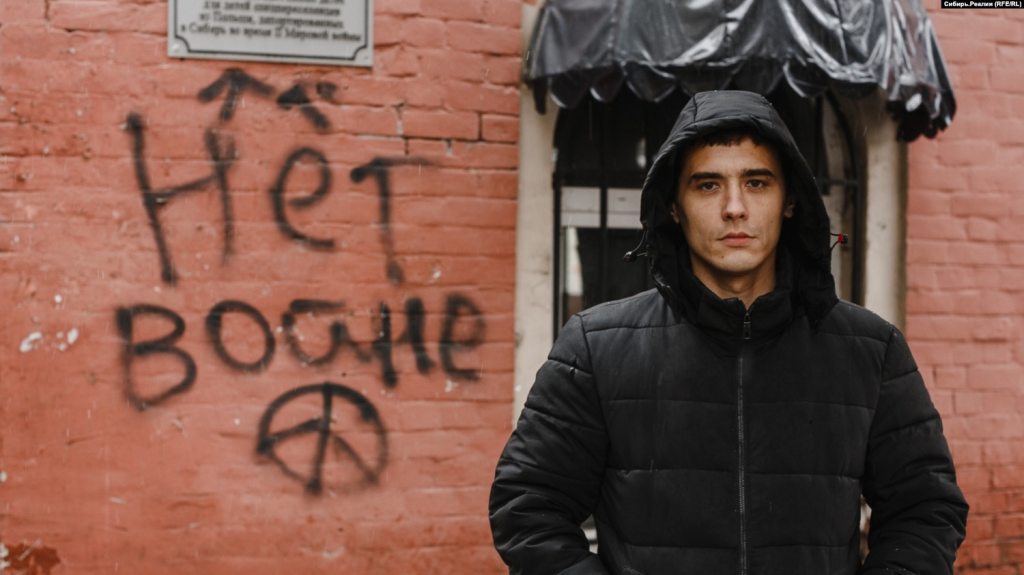
On September 24, the day Putin announced a military mobilization, Timur Saifulmulyukov walked into traffic on Tomsk’s main street, maneuvering between the streams of moving cars and waving an anti-war poster. A couple of minutes later he was detained. The police confiscated the poster and drew up an arrest report, charging him with violating traffic rules and discrediting the Russian army. He talked about what prompted him to take the action, his attitude to the mobilization, and how he sees his future in Russia in an interview with Siber.Realii.
Timur Saifulmulyukov is thirty-five years old, married, with one child, and works as a fire safety and video surveillance systems installer. He had not been involved in protests before September 24.
Timur Saifulmulyukov, shouting “No war!” in downtown Tomsk on 24 September 2022
– What were you doing February 24 and how did you feel when you learned that war had broken out?
– On February 24, I didn’t know that the war had started. I overlooked it. I found out only the next day. There was nothing devious about it. I had followed the news before the war, and I saw that Russia was amassing troops. Other countries asked what was going on, and our officials dismissed their concerns. It’s always like this in Russia: you file any complaint and it gets dismissed everywhere. And just as Russia spat on the rights of its own citizens, so it spat on the rights of the citizens of Ukraine.
It wasn’t a depression that afflicted me, but a kind of apathy. A feeling of hopelessness. You feel incapable of doing anything, you don’t feel what your role is in all of this. I knew about those who disagreed with the Putin regime, I knew that criminal cases were being launched against them and that they were being imprisoned. It was an ambivalent, you know, feeling. On the one hand, you think that nothing can be done, and on the other, that something has to be done.
– And that’s why you decided to go protest using the slogans “No war!” and “Give our children a free and peaceful life”?
– I had never been involved in political protests before. But I now realized that something had to be done to support people who were more proactive than me and the people around me. I made myself a poster and chose an anti-war slogan to attract attention, but at the same time there were as few reasons [for the police] to find fault as possible. Of course I want a peaceful life to children and people in general.
– And what did you do next?
– I went to Novosobornaya Square, but I saw that the police weren’t even letting the people (who had came out to protest against the mobilization — SR) just stand there. The point of the protest was to voice our stance, but we couldn’t even stand there for two minutes. There was no effect, but there was punishment. I started looking for protesters — I thought that journalists would definitely be photographing and filming some of them. The police stopped me immediately and checked my documents. I decided that I would definitely not do anything in such circumstances. I thought about what to do and shook a little: I felt completely vulnerable.
I thought that I had to take a little break, to gather my wits about me. I walked around and looked at what was happening. It was clear that some people had already been detained. I thought it was time for me to go home, but also that I had to do something, ultimately. To overcome my fear, I went to a store to buy water and chocolates — in case I was detained. And cigarettes: I don’t smoke myself, but I thought they would come in handy in a paddy wagon or a jail cell. And then the idea occurred to me to block traffic. I wrote to my wife that I’d made up my mind and off I went.
– So your wife supported your action?
– No, she’s afraid. It’s psychologically difficult for her. We used to talk about personal responsibility for what was happening in our country. And we came to different positions: that I felt responsible, and she, maybe, felt a little responsible, but thought that nothing could be done. That she had no levers of influence, and didn’t want to risk her life. I don’t want to either, but I’ve read and watched so much about people who do things, and then are railroaded for the rest of their lives. Pressure is put on them, but they still go out and protest.
– And how do the people around you generally feel about the war?
– I think they mostly passively support it. It’s not that they hated anyone very much or believed the propaganda. But it is convenient for them to adopt the position taken by the “strongman”: it seems to them that our state now has a strong position. And whoever is stronger is right. If it occurred to them that this was abnormal, they would have to explain these contradictions to themselves. And they don’t want to take risks. If [protesters] hadn’t been at obvious risk now, more people would have come out. Many people think this way: that the effect [of protests] is zilch, but the risks are numerous.
– What were the minutes before you were detained, during which you walked in traffic, like? How did others react?
– I didn’t see any negative reactions. People were looking at me, and some of them tried to film or take pictures of me on their phone. But I was trying not to get hit by a car and attract as much attention to myself as possible.
Timur Saifulmulyukov, standing in front of a wall painted with a “No war!” slogan. Courtesy of RFE/RL
– How did the police treat you?
– I was lucky that I was detained by a traffic police patrol. That’s why I didn’t sit in a paddy wagon for several hours like the other detainees. They didn’t put my hands behind my back. They put me in a car and took me to the police department. As we were driving, they were honking at everyone [to get out of the way], so I took advantage of this and showed my poster through the window. When we arrived, they confiscated my phone and started writing me up. They charged me with traffic violations, and I thought they would let me go. But then they took me to the fifth floor and made me give a statement. One person interrogated me, but two others were constantly in the room. None of them introduced themselves. When I asked for their names, they said we’d meet again and I’d find out then. They never did introduce themselves. And they constantly interrupted me.
– What they did ask you about?
– Did I make the poster myself? What time did I leave the house? Did I know about the Vesna Movement and the [local Tomsk opposition] Telegram channel Velvet Street? I had recently changed my [internal] passport, so I was also asked why I had a new passport. They asked me if I knew where the troops were, and what my attitude to the war was. I replied that this was my personal opinion, and I would not say it out loud. It’s clear what they wanted, but I tried not to talk about it.
Then I was taken to another office and given a charge sheet, this time for “discrediting.” I looked at it, but I overlooked one paragraph, which I noticed later. In this paragraph, written by a third person, it stated that I had violated Article 20.3.3 of the Administrative Offenses Code (“discrediting the Armed Forces of the Russian Federation”) and that I agreed with the charge.
– Were you scared?
– When I stepped into traffic holding the poster, it was no longer scary. When you start doing something, there is no fear anymore — there is a confidence, a willingness to do whatever it takes. It’s like they’re torturing you and torturing you, and then it doesn’t matter anymore what they do.
– You have no desire to leave Russia?
– I don’t want to go anywhere. My wife and I have already discussed this. War or no war, we’re not going anywhere.
– And if you get a [mobilization] summons?
– I’m not going to the war. I don’t want to be involved in this massacre, I don’t see the point in it. And it doesn’t matter to me if I just pushed papers instead of being directly involved in combat. Nor do I think that the majority supports the mobilization. It’s just that people don’t want to go to jail. They think that maybe it will pass. Or they hope for the best. Or a friend or a brother has been killed [in combat], so they think, What, am I going to try and dodge the draft? I’ll go get killed too.
– Wars end sooner or later. What do you think will happen then between Ukraine and Russia?
– I think that the relationship will be very difficult, because relations between countries are based on some kind of background, and the background is terrible. Something like 150 years will have to pass for a semblance of tolerance to emerge. Such things don’t fade away just like that.
– And how do you see your own future?
– I think that after holding the referendums and annexing [the occupied Ukrainian territories], they will introduce martial law. Otherwise, why all this fuss? Ukraine will not retreat and will win back its territories. And a complete mess will ensue. But I am relatively prepared for it.
This is my 3,000th dispatch on this beat, as filed on this website, which I launched fifteen years ago, in October 2007, and its shorter-lived sister blog, Chtodelat News, which was my main venue for broadcasting news and views from the other Russias and other Russians between 2008 and 2013.
Timur Saifulmulyukov’s story, above, is a perfect example of the kind of stories about Russia and Russians that definitely weren’t getting told anywhere else in English fifteen years ago. They are told only marginally better nowadays, despite everything (mostly bad, but occasionally good) that has happened in and around Russia since then.
In one measurable way, this project has been a success. As of today, I’ve had a combined total of 1,115,195 views since October 2007, including over 180,000 this year alone so far! Would that I had a penny or two for each of those views.
If you find these stories valuable, you can support my work by sharing them on social media with friends and colleagues. You can also donate money via PayPal or Ko-Fi to help me pay overhead costs (such as internet fees, hosting charges, and online magazine subscriptions) and somehow compensate me and my guest translators for our considerable work.
This labor of love takes as much time as my paying jobs, which have become less dependable recently. I would rather continue filing dispatches on the Russian Reader as frequently as I have in the past fifteen years, but for that to happen I need much more serious financial support than I’ve enjoyed in the past. If you have solid tips about where I could seek such support, I would appreciate hearing them as well. ||| Thomas Campbell, publisher, editor, writer, researcher, and lead translator of the Russian Reader since October 23, 2007
A group of labour movement activists has launched a unique service to English language readers: up to date information about Ukraine, based primarily on independent Ukrainian voices from the front line and first-hand testimony from Russian-held territory.
The Ukraine Information Group produces a weekly Bulletin, highlighting material translated by Ukrainian civil society organisations who wish to get their message about, particularly about the areas occupied by Russia.
To receive the Bulletin by e-mail, let us know at 2022ukrainesolidarity[at]gmail.com. The Bulletin is also put out on Twitter and stored online here.
The Group aims, working in the labour movement and civil society organisations, to strengthen solidarity with the Ukrainian people resisting Russian military aggression.
Its aims state: “Conscious of the ‘propaganda war’ waged on all sides, we aim to make accessible reporting and analysis by voices independent of the state.” The Group focuses on the Russian-occupied areas because (1) the situation there throws light on Russia’s imperialist war aims and methods of rule, and (2) there are limited sources of reliable information from those areas.”
The Group started in March, with calls by elected local government representatives to support their counterparts in Ukraine who were being intimidated with kidnappings and other violence in areas occupied by the Russian army. Appeals were organised in the UK and in Switzerland.
In July 2022 the Group held two online discussions with Ukrainian civil society activists about the situation in the Russian-occupied areas, attended by supporters from across Europe. Links to recordings are here.
The Ukraine Information Group is hostile, as a matter of principle, to Russia’s imperialist assault on Ukraine. But, on the other hand, it does not automatically give unconditional or unquestioning support to the Kyiv government. The UIG stands in the tradition of socialist internationalism and seeks to work in particular with like-minded progressive organisations throughout Europe.
Convenor Simon Pirani, honorary professor at the University of Durham, said: “With the Russian announcement of annexations we have gone past another dangerous turning point. To do anything here in the UK to support Ukrainian resistance, reliable information and informed analysis is a prerequisite.”
Supporter John Palmer, former Political Director of the European Policy Centre and Europe editor at the Guardian, said: “We are committed to supporting Ukraine’s demands on the United Kingdom and the European Union for greater and continuing military, economic and social support, but we will judge NATO’s military support specifically on whether it is designed to strengthen Ukraine’s struggle against the occupiers rather than pursuing a wider NATO/Russia geo-political military confrontation which could risk the use of nuclear weapons.”
Supporter Mike Phipps, who writes for the Labour Hub website, said: “We’re not in competition with other organisations that are doing excellent work in solidarity with the people of Ukraine. Our aim is to play a specific role – bringing to a wider audience news and analysis from Ukrainian sources that can help people in the UK understand the dynamics of the situation.”
To get in touch with the Group, e-mail 2022ukrainesolidarity[at]gmail.com. Follow on Twitter @UkraineIG
Pacific Grove, California, 17 June 2022. Photo by the Russian Reader
This bulletin is put together by labour movement activists in solidarity with Ukrainian resistance. More information at https://ukraine-solidarity.org/. We are also on Twitter. Our aim is to circulate information in English that to the best of our knowledge is reliable. If you have something you think we should include, please send it to 2022ukrainesolidarity@gmail.com.
To receive the bulletin regularly, send your email to 2022ukrainesolidarity@gmail.com. To stop it, please reply with the word “STOP” in the subject field.
I gave a talk at an online event on the war in Ukraine, arranged by the Future of the Left group on Monday. The meeting was shorter than planned, due to technical problems. Only two of the advertised speakers made it: Richard Sakwa, emeritus professor of Russian and European politics at Kent university, and me. Sakwa focused on the western powers’ failure to uphold principles of sovereign internationalism in the post-cold-war period, and concluded by opposing military aid to Ukraine. Against that, I put the case for supporting Ukrainian resistance as a matter of internationalist principle. I said that I think such discussions should continue. Here’s a recording of the session. Simon Pirani.
Here is a text, based on my talk. It is aimed mainly at the bogus “anti imperialism” widespread in the left, and among Future of the Left’s supporters, rather than at anything Sakwa said.
Thanks for inviting me to join the panel. It’s worth reflecting on what good panels like this, or gatherings like this, can possibly do. As a socialist, I believe that effective change is caused by the labour movement and social movements acting independently of the state. So I will say what I think the labour movement could or should do, and what people here could or should do, rather than declaiming principles with no reference to implementation.
My main point is that we should build solidarity with Ukrainian resistance to Russian aggression. That is rejected by some people in the labour movement, and I think we have to find ways of discussing these differences on life and death issues.
Character of the Russian war
Russia is a weakened empire desperately trying to restore its imperial status. It emerged from the break-up of the Soviet Union as an economically subordinate power, supplying the world capitalist economy with raw materials and pumping oligarchs’ wealth into the world financial system. Under Putin, since 2000, it has sought to make up for economic weakness by military means.
In the second Chechen war, Russia pulverised Chechnya and its population, rather than allow aspirations for national autonomy or independence to take root. Russia invaded Georgia in 2008, and intervened in Syria in 2015, to support a dictator who drowned citizens in blood rather than allow them any democratic freedoms.
The strongest imperialist powers tolerated all of this. Despite all their denials, they essentially had Russia act as the gendarme of capital in its sphere of influence.
Russia’s pretensions to imperial status have been most evident in its interventions in Ukraine. Ukraine is one of Russia’s oldest colonies; denying Ukrainian national rights was always integral to Russian imperial thinking; and of course before the invasion in February Putin made a speech claiming that historically Ukraine is not a nation.
The imperialist character of Russia’s war on Ukraine is evident from the military methods used. This is an imperialist force seeking to subjugate an enemy population.
Putin said Russian soldiers would be greeted with flowers, and there is not a single recorded case of that. There are plenty of examples of Ukrainians trying to resist the Russian army with their bare hands.
There have been massacres of civilians; rape used as a weapon; torture; forcible conscription; forcible deportation – all methods perfected by the British empire in the 18th and 19th centuries. As was the method of forcing into the army men from the poorest regions, disproportionately from ethnic minorities.
The targeting of politicians, journalists and activists in occupied areas seems more like the US empire in the 20th century.
I recommend the two reports on violations of international human rights law by the Organisation for Security and Cooperation in Europe (here and here). They spare no detail on alleged war crimes by Ukrainian soldiers, particularly against Ukrainians accused of collaborating with Russia. But they also conclude that the vast majority of war crimes have been committed by the Russian side. The vast majority.
An investigation team set up by the UN last week gave an initial report to the Human Rights Council that reached similar conclusions.
All this makes nonsense of the claims made by some people in the labour movement, that it is a war between two equal sides.
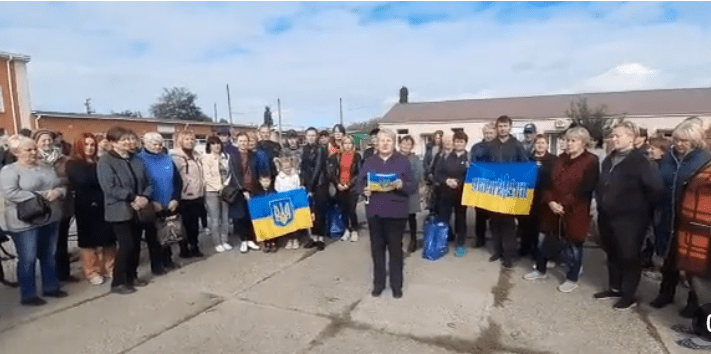
A rally on Friday in Snihurivka, which is occupied by Russian forces. See “About the photos” below
Why in February did Ukrainians, whatever their dissatisfaction with their own government – and I can assure you, there was plenty of that – volunteer in huge numbers? Why the contrast between that, and the situation in Russia, where last week’s mobilisation announcement is ripping at the social fabric?
Ukrainians are resisting an imperialist assault, and so the labour movement should provide practical, material solidarity to the working class communities bearing the brunt of this invasion.
Trade unionists from the UK, from France and from Austria, have organised convoys of aid to workers in the front line areas. My question to people here is: do you support such initiatives?
Do you agree that Ukrainians have the right to defend themselves with arms? I do, in the same way as I believe that Palestinians faced with the apartheid Israeli occupation have that right.
Role of NATO
Obviously, NATO has supplied Ukraine with substantial quantities of weapons in the last six months and this will surely continue. In their view, their gendarme has gone rogue and needs to be brought back under control.
But these arms supplies, like the applications by Sweden and Finland to join NATO, are more results of the invasion of Ukraine than causes.
To conclude from this that NATO expansion was the cause of the invasion is one-sided, false logic.
An honest assessment of Russia’s relationship with the NATO powers would show that NATO expansion into eastern Europe belongs to the 1990s. Russia was weak, and was being economically integrated into the world capitalist economy. The last big group of eastern European countries applied to join NATO in 1999 and actually joined in 2004.
What has happened since then? The Russian state, buoyed by the oil boom of the 2000s, has sought to control its sphere of influence with little interference by the NATO powers.
Just look at their limited reaction to Russia’s intervention in Ukraine in 2014. There were economic sanctions, which were very painful for Russian businesses. But these were linked only to the annexation of Crimea, not to Russian support for the separatists in the Donbas.
Clearly Germany and France, which both had substantial investments in, and trade with, Russia, were anxious to find a compromise. NATO continued after 2014, as it had before, to refuse to start a membership action plan for Ukraine. Germany only changed its Russia policy in February, a day before the invasion, with the cancellation of the Nord Stream 2 gas pipeline.
Analytically, I would define Putin’s Russia as a creature of those powers, a creature of world capitalism, not an opposite to them.
“Proxy war”
The false claim that NATO expansion caused Russia to invade Ukraine is linked to the false political proposition that Ukrainians are fighting a “proxy war” for NATO, and that the labour movement can not therefore support Ukrainian resistance.
The Future of the Left web site says: “Putin is no friend of the working class – but neither are Zelensky or NATO. […] Although the direct fighting in Ukraine is between the Russian and Ukrainian states, [no mention here of Ukrainian people, only the state, SP …] many see this war, in effect, as a proxy war between Putin and the US.”
This false logic could be applied to any number of situations.
Spain in 1936. Here’s how the argument looks: “Franco is no friend of the working class – but neither are the Republican government or the Allied powers. […] Although the direct fighting is between nationalists and Republicans, many see this war as one between the Axis and the Allies.” No room for the International Brigades there.
Vietnam in 1972. Here’s how the argument looks: “The US is no friend of the working class – but neither are the Soviet and Chinese leaders. […] Although the direct fighting is by the Vietnamese people, many see this as a proxy war between Moscow and Washington.” Not much room there for supporting Vietnamese resistance. (Both quotes are invented by me, to make my point.)
In my view, many wars – all these included – have combined elements of resistance to imperialism or fascism, and clashes between imperialist powers. The only difference in Ukraine in 2022 is that we are dealing with Russian imperialism, not German, American or British imperialism.
And in the labour movement we now see a bogus, western-centred form of “anti imperialism”: people who believe, crudely, that the main enemy is US imperialism and my enemy’s enemy is my friend.
This thinking just serves the Kremlin. It is ruinous to international solidarity, just as ruinous as the support given by elements in the labour movement to Tony Blair’s imperialist adventure in Iraq.
The so-called “republics” in the Donbass
A key claim of Kremlin propaganda is that the invasion in February was motivated by a desire to defend Russian-speaking Ukrainians from Ukrainian nationalism.
Just how sincere the Kremlin is about this can be judged by the number of Russian-speaking Ukrainians who the Russian army have killed, raped and driven from their homes.
Nevertheless, the claim is still made, and we hear echoes of it in the labour movement.
We need to look back at least to 2014. The Maidan uprising, a truly mass movement, was politically confused and complex but was directed above all against the government of Viktor Yanukovich, and the Party of Regions that represented eastern Ukrainian capital – the owners of mines, steelworks and other industries.
That party spared no effort to sow division between Ukrainians on the basis of language.
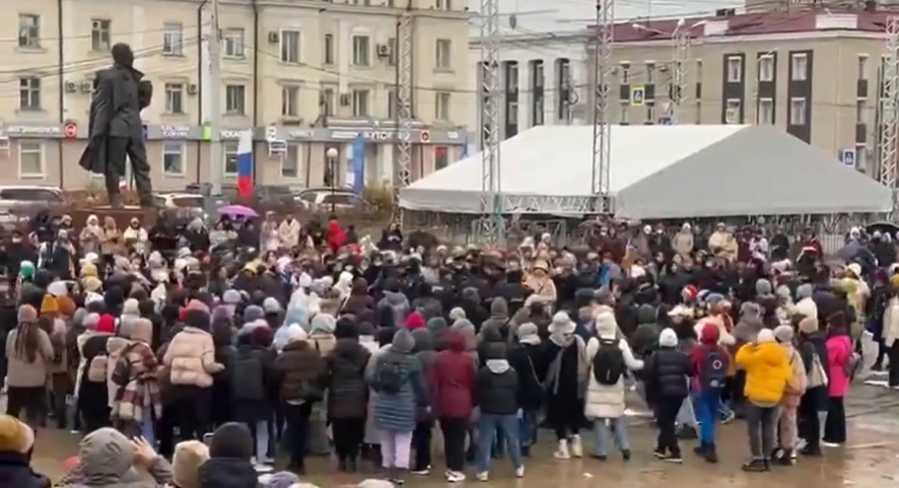
An anti-mobilisation rally in Yakutia, Russia. See “about the photos”, below
In response to the Maidan uprising, that party encouraged the anti-Maidan movement that sought autonomy for eastern regions, and that had support from substantial numbers of working class people. Note that at that time, when sociologists could still make reasonable guesses about what people in Donbas wanted, it was autonomy, not separation, that was supported by a significant minority.
Right-wing Ukrainian nationalism stoked up these divisions from the other side.
But these tensions were turned into military conflict by the Russian army, fighting alongside extreme Russian nationalist and fascist volunteers. They put in place the two “republics”, under which the economy of those areas was trashed and half the population left. Tinpot dictatorships were established without the most elementary observance of civil, democratic or labour rights.
To select from this complexity the fact that working-class people supported the anti-Maidan movement, and offer this as a reason to deny Ukrainians the right to resist aggression, is beyond absurd.
There is an analogy with Ireland. Working-class Protestants long formed the support base not only for Orange political parties but for armed loyalist paramilitaries. Traditionally, socialists understood that the power underpinning all this was British imperialism. We did not parrot calls for a Unionist six-county state, or pretend that working-class attitudes to that state weakened the case for a united Ireland. We called for the withdrawal of British troops.
Conclusion
As things stand, in the labour movement, bogus “anti imperialism” is undermining the internationalist principles on which the Chartists supported Irish liberation in the 1840s and which many of us here supported Vietnamese liberation in the 1970s. These principles should guide our actions now with regard to Ukraine.
More about Ukraine
□ The Ukraine Information Group, set up by a small group of labour movement activists in the UK (including me), is now distributing a weekly email bulletin, with links to sources of reliable information and informed comment on Ukraine in English. Please subscribe!
The first photo is of a rally at the weekend in Snihurivka, Mykolaiv region, that was occupied by Russian forces in March. A declaration was read out condemning the occupation. It stated that those present would not take part in the fake “referendum”, did not want to accede to the Russian Federation, and considered themselves Ukrainians. This is a still from a short film broadcast on the Telegram channel of Denis Kazansky, a journalist based in the area. He commented: “That’s the real position of residents of the occupied areas of Ukraine. Just compare that video with the disgraceful methods used by the occupiers to try to get people to vote.”
The second photo is of a demonstration in Yakutia, in Siberia, against the Kremlin’s mobilisation order. Women performed a traditional round dance, the Osuohai, surrounding a group of policemen and shouting “no to genocide!” and “no to war”. The police were repeatedly obstructed but in the end left and made several arrests. The Public Chamber of Yakutia, in a 1984-style revision of reality, stated that there had been no anti-war protest, only a “blessing by mothers for the return of their husbands and sons alive”. This is a still from a film shared by Feminist Antiwar Resistance.