Silhouette figures trying to keep a ten-ruble coin in the air next to a stenciled inscription (left) that reads, “Not everything is in our hands.” Petersburg, May 23, 2016. Photo by the Russian Reader
Russia Level with Kazakhstan in Wages
Maria Leiva RBC
May 24, 2016
In 2015, the average Russian salary, in terms of US dollars, was equal to the level of wages in Kazahkstan, according to data from the Higher School of Economics (HSE). Compared to 2014, the salaries of Russians dropped by almost a third last year.
The observed decline in wages in Russia has led to their drawing level, late last year, with average wages in Belarus and Kazakhstan in previous years, experts at the HSE have calculated in their May monitoring of the populace’s socio-economic status and social well-being. Computed on the basis of exchange rates, the average wage in Russia last year was $558 a month, which is lower than the 2014 level by 34% or more than a third. By way of comparison, in Kazakhstan and Belarus, the average monthly wage, calculated using the same method, was $549 and $415, respectively.
From 2011 to 2015, Russia had the highest level of wages in the CIS, but in 2014, compared with 2013, it dropped by nearly 10%, from $936 to $847. The experts at the HSE note that the gap in economic performance indicators between Russia and certain CIS countries has been constantly contracting. For example, the average salary in Armenia in 2008 was around 52% of the 2015 Russian wage, but by the end of the period in question, it had grown to 60%. During the same period, Belarus has gone from 61% to 75%, and Tajikistan, from 17% to 26%. However, over the same period, the relative positions of Azerbaijan, Moldova, Ukraine, and Kazakhstan have declined.
If we compare the average wage in Russia and Central and Eastern Europe, the wage in those countries has exceeded the average in Russia for the past five years. Thus, last year, the average Russian wage came to 60% of the average wage in Hungary, and 50% of the average wage in the Czech Republic. However, in 2015, Russia came close to the level of wages in Bulgaria during 2013–2014.
Trends in the average monthly wage in Russia, Brazil, and China over the past five years show that wages in Brazil were higher than in Russia last year. Despite the fact that data on wages in China for 2015 have not yet been published, the figures for Russia in 2015 were lower than for China in 2012, 2013, and 2014, indicating the gradual reduction of the gap between the two countries in terms of this indicator.
Last week, Sberbank also reported a fall in the average monthly Russian wage below China’s average wage. The bank’s principal analyst, Mikhail Matovnikov, cited data that the average monthly wage of Russians had fallen below $450 a month, lower than that in China, Poland, Serbia, and Romania.
Translated by the Russian Reader. Thanks to Valentin Urusov for the heads-up.
Kazakhstan: Land Protesters Face Police Rampage People and Nature
May 25, 2016
Street protests against plans to step up land privatization were broken up by police in many of Kazakhstan’s largest cities on Saturday, May 21. The demonstrations were organized by informal online networks rather than by any of the recognized opposition groups. Here are the key points from a report by Andrei Grishin, published in Russian on the website of the Fergana News Agency.
Special rapid-reaction police detachments attacked small groups [of demonstrators] wherever they gathered. They grabbed everyone, regardless of gender, age and nationality. Dozens of journalists were arrested.
Kazakhstan had waited for the events of May 21 with bated breath. [Protesters had named that as a day of action after a previous wave of demonstrations had forced the government to pull back from planned land reforms. See an earlier report here.] The official media had railed against the protests. And it all ended, as it has so many times before, with the “slaughter of the innocents,” but this time more brutal than usual. The detention of dozens of journalists, including foreigners, was proof of that.
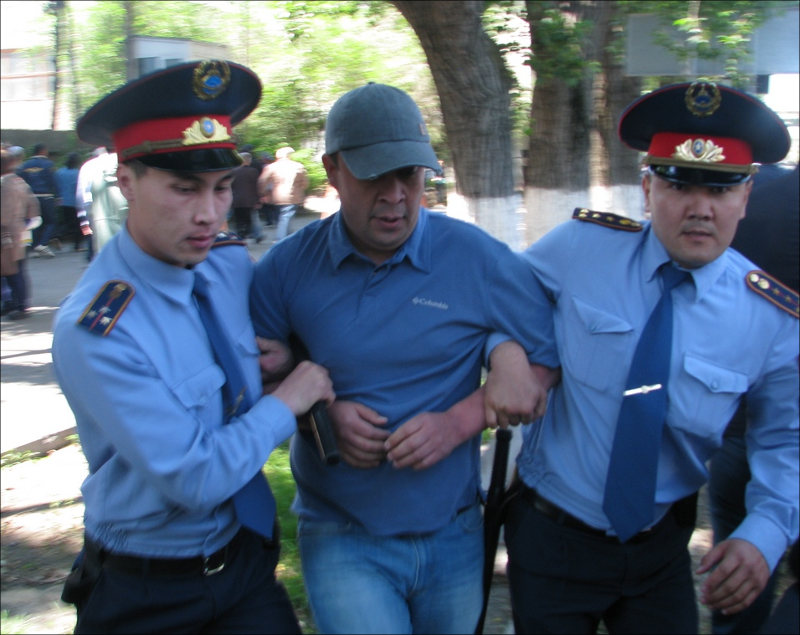
Police detain protester in Almaty, May 21, 2016
However, for the first time, people came out to protest all at once, in a number of cities and towns, without any leaders, because these leaders had either been arrested in advance, or had agreed to the authorities’ demands [after the previous demonstrations] and joined the [government’s] land commission.
[In Almaty in the southeast, the largest city in Kazakhstan and former capital, the authorities used every possible method of disrupting people’s plans to demonstrate. They created a “terrorism” scare, announcing the discovery of a stash of molotov cocktails, sticks, money and explosives; blocked social media; and issued orders forbidding public sector employees, students and workers in large enterprises from demonstrating, and in many cases, called people into work. Nevertheless, people gathered in small groups at Astana Square and by 11.30 am there were about a thousand of them. The police then went on the rampage, arresting and dispersing people.]
In other towns where activists made attempts to gather in squares or parks, the authorities acted similarly, although the numbers of both demonstrators and police were much smaller than those in Almaty. [There were arrests in Astana, the new capital, whereas things went compariatively peacefully in Kustanai and Pavlodar.]
In any case, no revolution took place! The president of the administrative policing committee at the ministry of internal affairs, Igor Lepekha, announced on Saturday that there had been “no unsanctioned gatherings or conflicts with the police. No breaches of order were permitted.” But at the same time he confirmed the detention of a number of people, including journalists; there had been a “misunderstanding” with the latter, he said.
Nevertheless, even this small number of demonstrations was a new phenomenon in Kazakhstan, in the sense that they started simultaneously in different regions. And all the experts noted in chorus that the land question was just the pretext, that in fact people have all sorts of other issues with the government. And that is really worrying parliament, above all, the fact that people are openly, and quite legally, calling for the resignation of the president.
And so it was clear that the government once again would deal with the problem [of protest] with repression. Evidence of this was the series of criminal cases opened even before May 21 against civil society activists, and the announcement by the internal affairs department of Western Kazakhstan about “preventing mass disorder.”And it is still possible, of course, that the Almaty police will “find” the owners of the molotov cocktails and sticks [i.e. use frame-up tactics against militants].
Police detaining protesters in Almaty on Saturday, May 21, 2016
However at the same time the authorities have treated the land question with great caution, thus the one-year moratorium [announced by President Nazarbayev on 6 May] on the amendments [to the land code], and the establishment of the land commission, and inclusion in it of several “disloyal” civil society activists, and the hints that have been dropped about the possibility that each citizen of the country could be granted by law 1,000 square meters of free land.
Riot police loading protesters onto a bus, Almaty, May 21, 2016
Just a few days ago, when the government feared the spread of mass action, President Nazarbayev appealed to Kazakhs “not to shame ourselves before the world, but to solve our complicated problems by means of constructive dialogue.”
I don’t like environmentalists. Most of them are insane fanatics who have been victimized by terrorist organizations like Greenpeace. The sole purpose of such organizations is to troll big corporations and c0untries.
—Ilya Varlamov, popular Russian blogger, May 22, 2016
It Is Too Late to Put Out the Fires in the Far East and Eastern Siberia Greenpeace Russia
May 23, 2016
Greenpeace Russia and the federal fire detection system have discovered catastrophic fires in Amur Region, Transbaikal Territory, and Buryatia that cannot be extinguished, because the country simply lacks the manpower and resources to do it.
Here are the data from the Russian Federal Forestry Agency’s Distant Monitoring Information System (IDSM) for a single major fire underway in the Shimanovsk, Svobodny, and Blagoveshchensk Districts of Amur Region. According to ISDM, the fire covered an area of 248,000 hectares as of this morning.
“If current trends continue, 2016 could be the worst year for forest fires since the beginning of the twenty-first century, surpassing the figures for 2003 and 2012 in terms of the size of the forest fires,” says Alexei Yaroshenko, head of Greenpeace Russia’s forestry department.
The area of just one fire in Amur Region is thirteen times larger than the size of the fires listed in the official report for the region and four times larger than all fires reported by officials nationwide.
The size of the remaining fires is difficult to calculate. Smoke prevents satellites from recording hotspots, and experts from viewing burnt black forest. However, according to preliminary estimates, it is also already close to three million hectares. Amur Region accounts for approximately a third of this area, while the rest is roughly evenly divided between Buryatia and Transbaikal Territory.
“We have had problems with divergence [among reported figures] on the sizes [of the fires in] Amur Region, Buryatia, and Chelyabinsk Region, and there have been problems with Irkutsk Region” acknowledged Nikolai Krotov, deputy head of the Federal Forestry Agency. “We do not rule out the fact that political and subjective factors might exist, and information in one format or another is transmitted to the outside world in a different way.”
We should recall that Avialesokhrana’s reports are based on data sent to it by regional authorities.
Can nothing really be done?
Our country has been burning from year to year. Foresters do not have the resources and manpower to put out the fires, while officials do not have the resources and manpower to acknowledge the fires.
“The authority over forest management and firefighting that was transferred to the regions is at best subsidized by the federal budget at ten to twenty percent,” explains Yaroshenko.
Greenpeace Russia demands that foresters be allocated decent financing and released from unnecessary bureaucracy, and that lies about the fires be ended.
How do we calculate the size of fires?
To assess the size of current forest fires, Greenpeace uses MODIS and VIIRS satellite imagery and the FIRMS system for detecting hotspots throughout the entire life cycle of major forest fires. At the same time, Greenpeace follows State Standard (GOST) 17.6.1.01-83, according to which the area of a forest fire is defined as “the area within the contour of the forest fire where there is evidence of fire’s impact on vegetation,” and Paragraph 67 of the Rules for Fighting Forest Fires, which stipulates that “in cases when burning has resumed within five days in the extinguished sectors of a neutralized forest fire, the fire is deemed to have resumed.”
Translated by the Russian Reader. Thanks to Comrade AM for the heads-up. The paragraph highlighted in red, above, has been heavily altered to reflect the actual quotation from Kommersant newspaper article on which it was, allegedly, based.
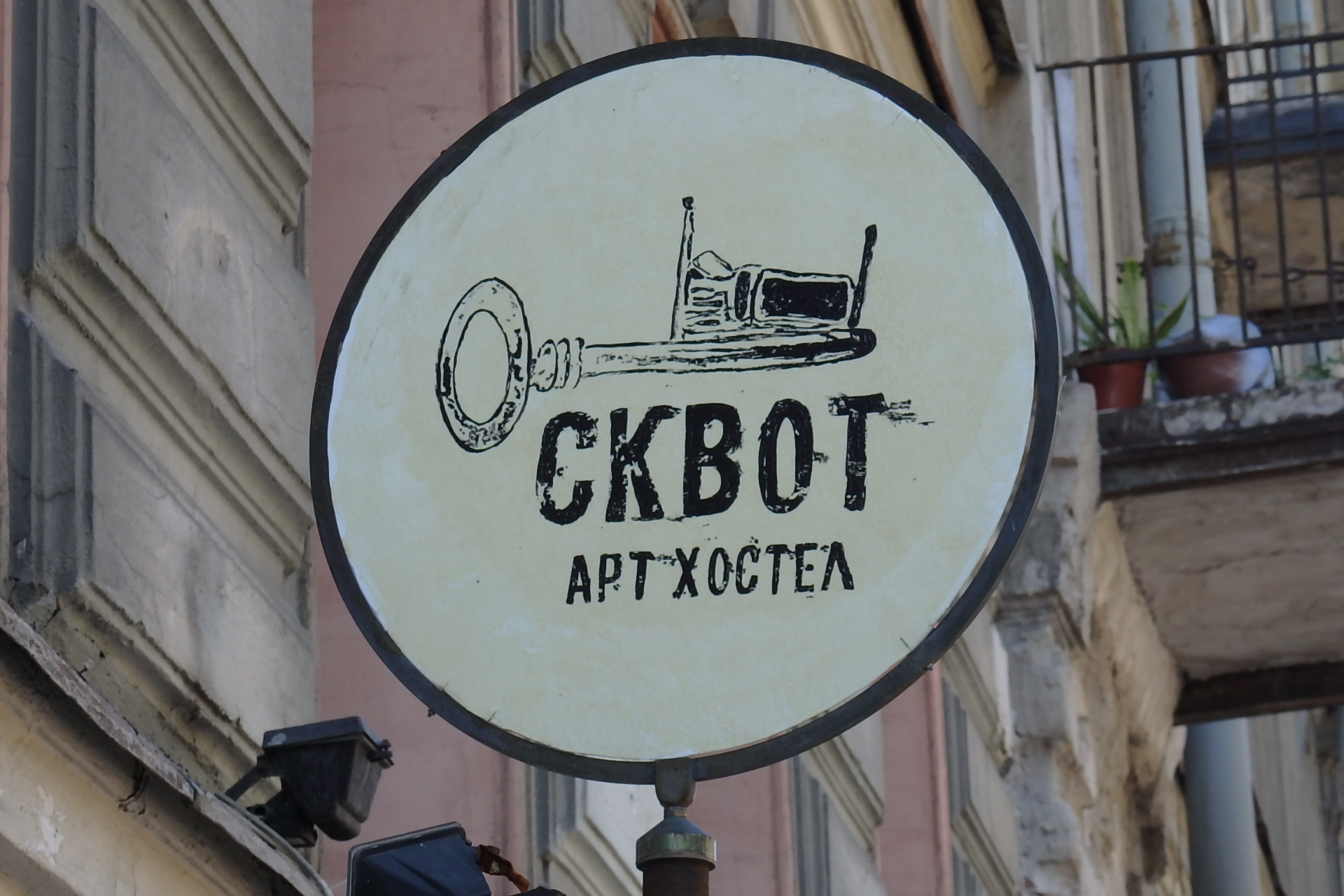
Sign for the Squat Art Hostel in central Petersburg. According to an article in the March 2, 2015, issue of Ekspert Severo-Zapad magazine, the city had between 1,250 and 1,270 budget accommodations, including 270 hostels. As of today’s writing, Airbnb listed over 300 rentals in the city. Photo by the Russian Reader
MPs Plan to Evict Hostels from Apartments But entrepreneurs don’t intend to pull up stakes yet
Elena Gorelova Vedomosti
May 12, 2016
At its Friday session [Friday, May 13, 2016], the State Duma will consider a bill that could ban Russian hoteliers from housing hostels in apartment buildings. Galina Khovanskaya, chair of the Duma’s committee on housing and communal services, had tabled the amendment back in September 2015. According to MPs, mini hotels violate the rights of residents in adjacent apartments. If the changes take effect, it will be possible to install hotels in residential buildings only after rezoning the spaces from residential to non-residential. Mini hotels will have to be equipped with soundproofing, fire safety equipment, and security alarms. They will have to be located on the first floor and have a separate entrance.
The ban would have a catastrophic impact on hosteliers, argues Yevgeny Nasonov, chair of the committee on budget accommodations at the Moscow branch of Opora Russia and general director of Clover, a network of hostels. A study conducted by the League of Hostels in December 2015 showed that around 80% of Moscow’s mini hotels and serviced apartments are located in the city’s residential housing stock. In Petersburg, Crimea, and Krasnodar Territory, those percentages are even higher.
From 2012 to 2014, mini hotels were most often opened in residential buildings, says Roman Sabirzhanov, who owns sixteen hostels, including the Fabrika and the Croissant. But residents dissatisfied with their new neighbors then began complaining and showered the prosecutor’s office with lawsuits. Seeing the risks of doing business in residential buildings, Sabirzhanov opened his own hostels in non-residential buildings from the very beginning. It is not always more expensive, he claims. For example, Sabirzhanov has invested 3.5 million rubles [approx. 47,000 euros—TRR] in a new, 225-square-meter hostel on Chistye Prudy. 40% of the money went for rent; 40%, on repairs; and the remaining 20% on obtaining permits and undergoing classification. As of July 1, 2016, all hotels must be classified, receiving from one to five star, while hostels will receive the the no-stars category.
Even if the bill is not passed into law, hostels in residential buildings will be banned sooner or later, Sabirzhanov believes. At the moment, big cities are in the process of being purged of dubious flophouses in the run-up to the 2018 World Football Cup, and hostels have been subjected to more frequent inspections, he says. Even normal hotels might get the axe, the hotelier is convinced. Over the past five years, the number of beds in discount hotels and serviced apartments has grown twentyfold in Moscow, and the major hotel chains that have been lobbying the ban on hostels are not pleased with this redivision of the market, Sabirzhanov claims. He advises hoteliers against making hasty decisions. For the time being, he says, they should operate as they have before, recoup their investments, clean up their premises, and settle conflicts with building residents. At the same time, however, they should think about relocating if they have the means, launching a new hostel in a non-residential space, and going through classification. In the end, you can close the hostel and put the apartment up for rent, says Pavel Gorbov, executive director of Re:Sale Expert.
Launching a small hostel in Moscow runs you approximately two million rubles, estimates Nasonov. But rezoning a space as non-residential is quite expensive for small businesses. Nasonov cites the example of an entrepreneur he knows who has been attempting to build a separate entrance for a store in a residential building near Vykhino subway station. (The procedure for obtaining permissions is the same as for hostels.) He has already spent 1.5 million rubles on construction.
Dr. Yekaterina Chatskaya, a gynecologist at Moscow Municipal Clinic No. 180 and a leader of the Moscow local of trade union Action told Novaya Gazeta what it is like to be a trade unionist when Russia health care has entered an area of turbulence.
Yekaterina Chatskaya is a gynecologist at Moscow Municipal Clinic No. 180. In April 2015, she was involved in a work-to-rule strike by Moscow physicians, meaning that doctors spent as much time with each incoming patient as was necessary and ignored newly introduced, stringent patient-intake standards. Novaya Gazeta found out what happened with the strike and personally with Dr. Chatskaya over the past year.
How did last year’s work-to-rule strike end?
I kept a diary of my patient intakes. We analyzed the standards that took shape during the course of the strike and sent them to the head physician. It turned out our figures were similar to those issued by the Health Ministry. But the problem is that the Health Ministry’s standards are recommendations. They are not obligatory, meaning that they virtually don’t function in practice.
For example, in Moscow, a gynecologist’s standard intake time varies from twelve to fifteen minutes at different hospitals, but the federally recommended initial appointment time is twenty-two minutes. That is a fundamental difference.
In the blogs and appeals written by physicians, they say they are fighting to increase appointment times by three minutes. Do these minutes add up to something in actual practice?
Of course, they do. I have a fifteen-minute limit for seeing a single patient, and I see patients for six hours in a row without a break, meaning this limit does not include a lunch break or even a simple trip to the toilet. Over this six-hour period, according to the standards, I should be able to see twenty-four patients, who have registered in the electronic data base. But it is virtually impossible to keep up with this pace. There are complicated patients, and there are urgent cases. Old women dress slowly. They require a special approach. And you must not hurry pregnant women at all, whether someone is pregnant for the first time or has had a miscarriage in the past. But when the intake period lasts longer than six hours, it is inevitable that doctors make mistakes. Your concentration is reduced, and your eyes are tired.
You really feel by the end of the intake period that you are losing concentration and can make a mistake?
That is exactly why I started thinking about how long it takes to examine a patient in reality. Before the strike, my official intake period lasted seven hours, but in fact it came to eight hours without stopping. After the strike, we succeeded in getting six-hour schedules, while everything is still the same at other clinics.
Has what happened last year changed anything about your team?
At first, a lot of people wanted to support me, but when a group letter was drafted and we took it to other doctors for them to sign it, people got scared. The head physician called me into his office and said it was extremism, that I was going against the regime, although there were no political demands at all in the letter. Certain colleagues stopped speaking to me altogether.
But the turning point came. A year ago, we organized a local of the independent trade union Action (Deistvie). Initially, there were three of us. Now there are six times as many. We managed to stop the introduction of so-called effective contracts. One of the points in the contracts was that incentive pay would be based only on the decision of the clinic or hospital director. My pay consists of 20,000 rubles base salary and roughly the same amount in incentive pay. Under the so-called effective contracts, incentive pay would have included work assignments that are not part of my job description. Theoretically, if I had refused to mop the floors on the orders of the department head, I could have been stripped of my incentive pay. We wrote to the head physician and the prosecutor’s office. The prosecutor’s office acknowledged the decree facilitated corruption and ordered it abolished. This was a victory. But many clinics have switched to the so-called effective contracts.
Your latest protest campaign has targeted the Moscow Health Clinics Standard. What don’t you like about it?
The standard has led to a collapse at work, and not only at our clinic. During the flu epidemic, GPs were working over twelve hours a day. One doctor made a house call to a patient at one-thirty in the morning, and before that she had been seeing patients since eight in the morning, and then went out on house calls. Another colleague of mine worked three weeks without a single day off.
They have begun to drive away specialists. How? For example, a GP has to refer a patient to an endocrinologist. But to do this, he or she has to write up a full justification for the referral, get the chart and referral signed by the department head, and manage all this within the twelve-minute limit for the appointment. Management have been strongly advising GPs not to refer patients to specialists but to threat them themselves. Naturally, the endocrinologist sits there without any work. After some time has passed, management decides that since such a small number of patients come to see him, the clinic has no need of his services. Our clinic fired a mammalogist, a dentist, and an endocrinologist in this way. There is very big queue to see the gastroenterologist. But our clinic immediately set up paid appointments to see him. If you have the money, you will be served right way.
Getting an ultrasound appointment has become a disaster. In late 2014, one ultrasound specialist went on maternity leave, a second was cut, and a third resigned of her own accord. For several months, a single specialist examined pregnant women in the entire district of Mitino. It even came to blows at the terminal when two women fought over an ultrasound appointment voucher. Another big minus of the reforms has been the virtual abolition of the principle of neighborhood health care.
Now you can make an appointment with any primary care physician at a clinic. Is that a bad thing?
In our conditions, it is a bad thing, because it leads to the unavailability of medical care. For example, my primary care neighborhood covers six thousand people, although according to the standards I should be serving two thousand two hundred people. When my appointment bookings for fourteen days in advance open up at 7:30 on a Monday morning, the appointment vouchers are already gone by eight in the morning. Patients can now choose a doctor themselves, and naturally they choose doctors with good reputations. Inevitably, these doctors will be overbooked. Patients assigned to these doctors as their neighborhood doctors are simply unable to get an appointment to see them, although they will be seeing many patients from other neighborhoods.
An absurd situation has developed. The municipal health department monitors the availability of specialists. On our clinic’s overall chart, there is constantly a red light next to my name, meaning that I violate the norm, because patients sign up to see me two weeks in advance. A good doctor is not profitable to a clinic because she or he skews the statistics.
How much do you earn?
My take-home pay is between twenty-five and thirty thousand rubles a month. My last paycheck was 35,000 rubles [approx. 465 euros a month per the current exchange rate—TRR]. I have been working at this salary since April of last years. I am not paid a kopeck more, only the mandatory minimum.
Does the Moscow health department know about this situation?
Yes. We regularly appeal to them. The last appeal by primary care physicians was sent to them on March 31. After that, we got paid a little more.
Doctors are pushed to the limit. Seeing the shiny pictures on the TV, our patients imagine that everything is alright with medical care, and if something is wrong, it is the doctor’s fault. A patient can come and sit outside a doctor’s door for an hour: that means he is a bad doctor. It was that way at first, though now, it is true, patients have begun to realize that if there is a queue, it means the doctor is good. I was reprimanded when an urgent care patient got wedged into my schedule, and I was unable to see another patient before my lunch break. I asked her to wait, but when I came back fifteen minutes later, she was filling out a complaint in the department head’s office. I was reprimanded, even though the patient was seen the very same day after my break.
Would it be easier if the Health Ministry issued strict regulations rather than recommendations?
It would be ideal. We have written several times to the Moscow health department asking them to establish regulations in keeping with the Labor Code and the Russian federal government decree stipulating that a doctor should see patients for no more than thirty-three hours a week. The reply we received was meaningless, as always.
Meanwhile, our head physician issues orders that violate the recommended norms. These two realities do not intersect at all.
For example, hardship pay has been abolished throughout Moscow. Even our radiologists lost additional holidays and pay. But the federal decree clearly stipulates that medical workers who come into contact with HIV and tuberculosis should receive both additional pay and additional holidays.
Photographer Umida Akhmedova: “I Cannot Abide Being Told What to Do”
Geliya Pevzner RFI
May 20, 2016
Umida Akhmedova, Tashkent: Inner Courtyard of the Kukeldash Madras, early 2000s
On May 5, 2016, it was announced that photographer and filmmaker Umida Akhmedova had been awarded the Václav Havel International Prize for Creative Dissent. In 2009, Akhmedova published the photo album Men and Women: From Dawn to Dusk and shot the documentary film The Burden of Virginity. She was subsequently charged and convicted of defaming and insulting the Uzbek people. Akhmedova answered RFI’s questions before the awards ceremony on May 25 in Oslo.
Umida Akhmedova: To be honest, [the prize] was quite a surprise to me. Such people have received it: Pussy Riot, Pyotr Pavlensky, and Iranian artist Atena Farghadani. But the press release says that I teach young people a lesson with my documentary photographs. In part, I agree with this. I do not consider myself a hero, but I have never yielded to the state’s machinations. I shoot what I see. I do not reflect on who will like it and who won’t. No, I shoot what is there. I have never once thought it was heroism.
Nevertheless, you were criminally prosecuted.
Yes, of course, and I have not yet been exonerated. Some people still shy away from me as a convicted offender. Six years ago, we appealed the conviction to the Supreme Court of Uzbekistan, but since then we have not heard a peep from them. They have not responded to our appeal. I was charged with “defaming and insulting the Uzbek people” by publishing the photo album Men and Women: From Dawn to Dusk and releasing the film The Burden of Virginity, which was produced as part of a program on gender sponsored by the Swiss Embassy.
How exactly did you slander the Uzbek people?
My lawyer also asked the question. No one responded, because only the president can decide what slander is. No one, in fact, has any intention of responding. Who personally filed a complaint against me? After all, the law says that if I have slandered you, you go and tell the court I have slandered you. But there was no such complaint. I don’t know how they cooked this up, but nor they did deign to prove anything.
Let’s return to the prize. Was it awarded to you for this album or for your whole body of work?
You know, it was not even for the album or that film. They said it was for my creative and civic stance. Because after everything that happened, I did not going into hiding. I have continued to do my art, and I have been active on the social networks. I was convicted yet again for the protest action “Uzbek Maidan,” as they exaggeratedly dubbed it. We did not expect it would be an Uzbek Maidan when we took a petition to the Ukrainian Embassy in January 2014. Yes, we were sympathetic to the Maidan, and our sympathy boiled down to the fact that the eight of us had our picture taken next to a monument to Taras Shevchenko. We were detained and tried a few days later. True, it was an administrative hearing. Maybe I got the prize for this as well, for having a civic stance. It is what it is. How can you not have a civic stance? How can you call yourself a photographer or documentary filmmaker if you don’t have a civic stance? I don’t understand this.
What are you working on now?
My husband Oleg Karpov and I continue to make films. Actually, the film Burden of Virginity was our film, because he is a director, and the ideas in the film belong to both of us. We recently made a film entitled Samarkand, and now I have a photo project called SNAP, which stands for “means of visual agitation and propaganda” (sredstva nagliadnoi agitatsii i propagandy), which was a subject in Soviet times when I was a student. It is written on every corner in our country that Uzbekistan is a country with a great future, that Uzbekistan is my pride: communist slogans like this, but updated for today’s needs. Meaning that the ideas for visual agitation and propaganda still have their source in the old life. I had myself photographed in front of these banners. You don’t have to look hard to find them. If you drive around Tashkent for half an hour you can take dozens of such photographs. “Shine bright, my native Uzbekistan,” “Independent Uzbekistan has a great future”: every year they come up with some slogan or other about our great country. It comes from the Soviet era. They haven’t invented anything new.
You will be awarded the prize on May 25. Are you working on a speech?
I will talk about the fact I am not a politician or a member of the opposition. I am not a member of a party, a sociologist or a political scientist. I am just a person who cannot abide being told what to do in her art. And I will also talk about fear. When it takes control of you, fear is a really nasty emotion.
After Apologizing for Genocide of Crimean Tatars, Vasily Gatov Attacked by Russian Channel One Employees 15 Minut
May 20, 2016
Well-known journalist and media manager Vasily Gatov, grandson of Ivan Sheredega, the NKVD Internal Troops commander who, in 1944, oversaw the deportation of the Crimean Tatars, has been targeted by his former colleagues at Russia’s Channel One after publishing a post on Facebook.
“Today is the anniversary of one of the most shameful events in the history of the Soviet Union, the deportation of the Crimean Tatar people. I don’t find it so easy to write these words: my own grandfather commanded this ‘operation.’
“In May 1944, the Soviet Army was in the midst of liberating the lands of Europe from the Nazi genocide machine, and the concept of ‘death camps’ was clear to the soldiers and officers. During these very same days, Stalin decided that another entire people, from its children to its heroes, was the ‘enemy.’
“As it is euphemistically called in the relevant documents, the ‘expulsion’ of the Chechens, Balkars, Volga Germans, Crimean Tatars, Lithuanians, Latvians, and Estonians is nothing but a form of genocide. A genocide that has never been recognized, that has never been mourned, and that has never been paid for.
“The Crimean Tatars, Chechens, and Ingush are nations that have suffered at the hands of both the USSR and Russia.
“It is not only a shame. It is not only a sin.
“It is a crime that has been committed twice, an aggravated conspiracy by a gang whose objectives completely fall under the definitions of the crime as laid down by the International Court.
“And until a trial takes place in one form or another, any reasonable and sober person will have to repeat the same words:
“Forgive me if you can.”
Gatov also published his comment on the condemnation of his actions by his former colleagues on his Facebook page.
“Towards evening, I read the [minutes of] the long-distance Party meeting held on Facebook by Channel One employees and a few invited guests in order to condemn me. My thanks to Ksenia Turkova and Arina Borodina for their efforts to defend me in circumstances in which I cannot even reply to Svetlana Kolosva (director of Channel One’s documentary films department) and her fellow Party members.
“As for the claims made there, I have the following to say. Only a complete raving lunatic whose head was chockablock with propaganda and had been made insecure by continually lying to himself and others could have read into what I wrote yesterday everything my former friends and acquaintances discovered there. Basically, that’s all I have to say.
“Actually, it’s not quite everything. I discovered several interesting likes from people I didn’t expect to see on the list of invitees to the Party meeting. However, upon reflection, I concluded that the people who left those likes also completely fit the definition written above.”
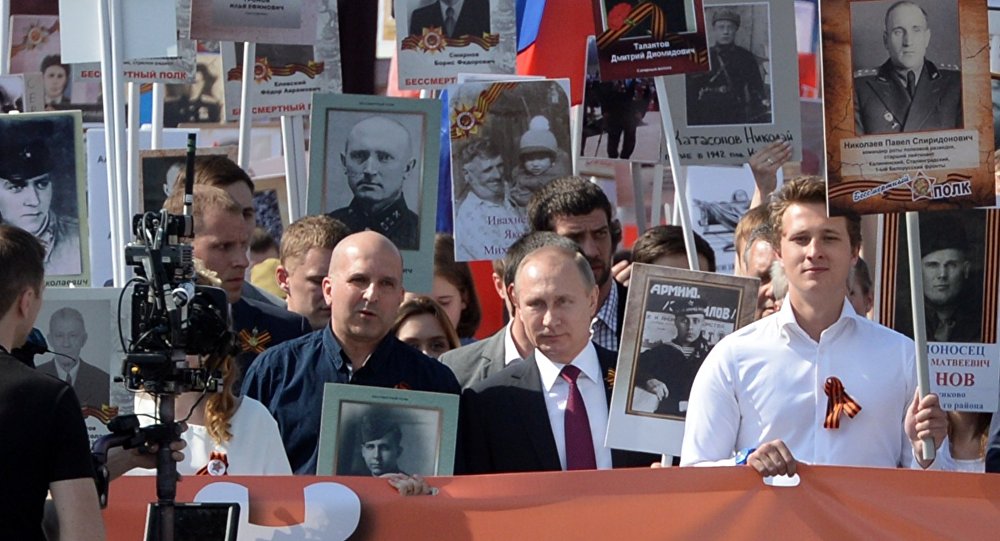
Vladimir Putin leading Immortal Regiment march in Moscow, May 9, 2016. Photo: Ilya Pitalev/Sputnik
Proposal to Give Voting Rights to Those Killed in the War Made at Conference Financed by Petersburg City Hall Fontanka.ru
May 20, 2016
The Alexander Nevsky Monastery has been hosting a conference entitled “Faith and Works: Corporate Social Responsibility in Times of Crisis.” Petersburg city hall’s department for relations with religious associations allocated part of the funds for the conference.
Andrei Ageyev, director of the Institute of Economic Strategies of the Russian Academy of Sciences spoke at the conference. Reflecting on the Great Patriotic War as a point around which society had consolidated, he proposed considering the possibility of giving the right to vote to the twenty-seven million Soviet citizens who died during the Second World War.
Explaining his idea to our correspondent, Ageyev noted that the dead could in this way have an impact on current affairs in Russia, with whose progress and salvation they were directly related. For example, their families could vote in their stead, Ageyev added.
Ageyev also argues that the right to vote may have to be given to several previous generations, and not only to those who died in the war. The reason is the same: they must be able to influence current events since these events are a continuation of their own lives.
Translated by the Russian Reader. Photo courtesy of Sputnik
Alexander Skobov Don’t Underestimate the Enemy Grani.ru
May 14, 2015
Igor Yakovenko has questioned the sanity of those MPs who supported Red Guardist Irina Yarovaya’s latest amendments to the anti-extremism laws. At issue is a ban on travel abroad for people whom the FSB has issued a warning about the inadmissibility of activities that, in the FSB’s opinion, are potentially fraught with terrorism, war, and genocide. Under the current rules for issuing warnings, no formal grounds are needed except the opinion of the agency issuing the warning. Meaning that if it wishes, the FSB can crank out warnings to anyone whose activities the authorities simply do not countenance.
Yakovenko asks, why not let the undesirables leave the country if you cannot stand them? Let them leave and thus reduce the ranks of the so-called fifth column. These measures will not stop an increase in protests, and if protests do kick off, they will only add fuel to the fire. Yakovenko’s conclusion is that the folks on the other side of politics are completely off their rockers. But I would not underestimate the enemy’s intellectual capacities. Yes, they suffer from an acute totalitarian itch to ban and restrict. But they know what they are doing.
In my opinion, Yarovaya’s notorious amendment to ban travel for “warnees” is absolutely rational and quite precisely calculated. It is targeted at the segment of Russian society that,according to Yakovenko himself, suffers from pathological anemia and dystrophia of the will. These are successful and well-off people who still believe that if they have done nothing unauthorized, they will get off scot-free for their not entirely loyalist public activism. They have become accustomed to the fact that one can be involved in not entirely loyalist but quite respectable and moderate media, cultural, and human rights projects without especially risking one’s own comfort. Our stunted civil society largely rests on such lovers of performing “small deeds” in their spare time.
And now take a guess at what percentage of these outstanding people would be willing to sacrifice travel abroad for the sake of continuing their outstanding social activism, who would be willing to sacrifice the principal attribute of the post-Soviet lifestyle, without which life would be unthinkable? Anyone like Yarovaya would realize that the majority of them will choose either to give up their activism or leave the country before receiving a warning. To predict these people’s future behavior it suffices to recall Ksenia Sobchak’s recent philosophical musings about the lives of frogs.
And where will all these popular newsmakers find themselves if they are banned from leaving the country for the piquant statements they occasionally permit themselves in public? This is not to mention the fact that many civic initiatives will simply be paralyzed if the people involved in them cannot take numerous business trips and attend various international clambakes. The current regime is quite consistently pushing for the complete suffocation of not only the independent but even the semi-independent civic organizations that have managed to stay afloat. The period when Putin’s clique had a stake in maintaining a legal oppositional ghetto on the margins of public life, thus imparting a certain seemliness to its own image, has come to an end. In recent years, this image has become so disfigured the Kremlin has lost interest in touching it up. It has realized it no longer has anything to lose.
And so there will no longer be any legal bounds vouchsafing the opposition from crackdowns. Any public organization that violates the informal ban on discussing issues the regime finds touchy will be crushed. All the Kremlin’s recent significant steps, beginning with Moskalkova’s appointment and ending with the latest round of purges of semi-independent media, have been focused on this. In this long series of steps, however, the ability to ban any undesirable from traveling abroad is a symbolic step. It finally undermines the social milieu whose entire life strategy was built on the proposition that however disgusting Putinist authoritarianism was, it was better than Soviet totalitarianism because the freedom to travel abroad existed. That meant one could live with it, adapt to it, and come to terms with it. By obeying certain rules imposed by the regime, one could maintain a minimal amount of freedom.
This slightly dissatisfied milieu has become used to living high on the hog. Our consumptive civil society must come to its natural biological end. It must be replaced by professional revolutionaries who will have no such problems since their activism conforms with the law as interpreted by people who have arrogated to themselves the exclusive right to interpret it. For them, Yarovaya’s fascist laws will be neither more nor less than a profound insult to their moral sensibilities.
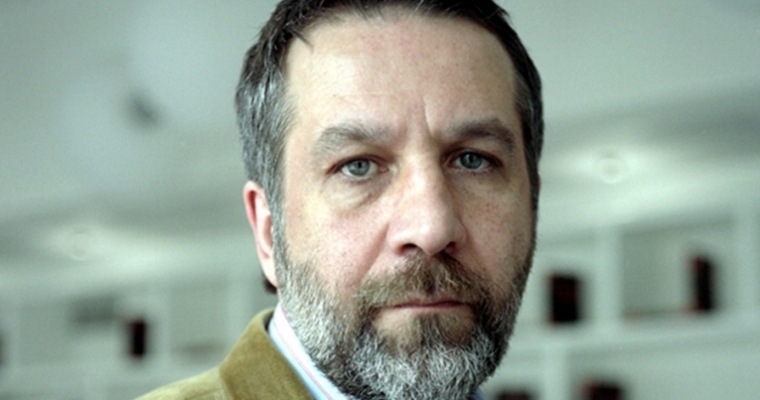
Alexander Skobov, a left-liberal writer and activist, is a former Soviet dissident and political prisoner. Translated by the Russian Reader. Thanks to Comrade AM for the heads-up. Image courtesy of Wikipedia
The Moscow Timesbuys the “Cossack” myth hook, line and sinker:
“The Cossacks are an ethnic group within Russia with a strong military tradition. They often take on roles as police or security guards to maintain peace in Russia’s streets.”
In this still from video provided by Anapa Today, “Cossacks” throw milk at opposition leader Alexei Navalny, center right, at the Anapa Airport in southern Russia, Tuesday, May 17, 2016. A group of “Cossacks” attacked Russian opposition leader Alexei Navalny and his associates outside the airport, injuring Navalny and six others, his spokeswoman said. Courtesy of Dmitry Slaboda and Anapa Today via AP. (The quotation marks are mine – TRR.)
Maybe there are real cowboys left in the US, but wearing a cowboy hat does not make a you a cowboy, even though lots of Americans do just that: put on a cowboy hat and imagine they are “cowboys.” The same thing goes for the “Cossacks” flooding and terrorizing Russian public space the past several years.
Meaning, it has recently became fashionable for violent pro-regime thugs or recovering alcoholics or just plain old security guards to dress up as “Cossacks” and behave dreadfully or just gad about looking anachronistic and as if they are in charge, although no one put them in charge of anything, and if the police had any moxie they would haul them away to the hoosegow on sight.
I’ve seen such “Cossack” security guards with my own eyes slouching around Our Lady of Vladimir Church, in my hometown of Petersburg, the achingly lovely church where Dostoevsky was a parishioner in the later years of his life.
Another thing I have been told at least three dozen times by various folk in the Motherland over the years is that lapta—an alleged Russian bat-and-ball game not played by anyone for at least two centuries and that no one (least of all, the folks telling me about it) has ever seen played by anyone—is the “Russian equivalent of baseball.” Some even claim it inspired the invention of baseball in the US.
Modern young people pretending to play lapta so there would be a photograph of modern young people playing it to put in the Wikipedia article on lapta. Courtesy of Wikipedia
I think an actual nationwide lapta fad would be a great way of diverting the aggressive energies of all the thugs, alcoholics, and security guards currently pretending to be “Cossacks.” We should see if we can make it happen.
Of course then maybe the ex-“Cossacks” would start running around whacking Navalny & Co. with their new lapta bats. It’s a risk we’ll have to take.







#/media/File:Red_Guards.jpg)