On June 28, the 2nd Western District Military Court sentenced nineteen-year-old Valeria Zotova to six years in prison in a criminal case fabricated by the FSB.
The court has not yet provided a copy of the verdict to either Valeria or her lawyer. Therefore, the lawyer could not prepare a full-fledged appeal. But he did file a brief complaint to meet the deadline: an appeal must be filed within fifteen days of the date of sentencing.
The appeals process is a very important component of legal proceedings. Until the appeals stage has been completed and the sentence comes into force, there is hope that the verdict will be reversed or changed and Valeria will not be sent to a penal colony at this time.
You can always support Valeria by writing her a letter or sending a parcel.
Address for letters and parcels:
Zotova Valeria Igorevna (born 2003)
10 ul. Portovaya nab., SIZO-1
Yaroslavl 150001 Russian Federation
Source: Solidarity Zone (Facebook), 16 July 2023. Translated by the Russian Reader. People living outside of Russia will find it difficult or impossible to send parcels to Russian prisons or to use the FSIN-Pismo and Zonatelecom services to contact Russian political prisoners. In many cases, however, you can send letters (which must be written in Russian or translated into Russian) via the free, volunteer-run service RosUznik. As of this writing, Ms. Zotova has not appeared on their list of supported addressees. You can also ask me (avvakum@pm.me) for assistance and advice in sending letters to her and other Russian political prisoners.
Valeria Zotova, 19, from Russia’s Yaroslavl has been sentenced to six years behind bars for plotting to set a military aid collection point on fire, Solidarity Zone reports.
The woman was found guilty of attempted “terrorist attack”. The state prosecution wanted eight years in prison for Zotova.
“However, the case materials, correspondence received by the lawyer and Valeria’s own words indicate that the case was a provocation staged by the FSB, whose agents actively persuaded the woman to set the aid collection point for the Russian military ablaze. Zotova may have attracted the attention of the special services due to her anti-war stance,” human rights activists said.
A criminal case against Zotova was opened in February. The woman went for a walk with her friends in mid-February. Later that night, law enforcers showed up at her place for a search without any explanation. During the search, the detainee’s mother was threatened with promises to make her a suspect in her daughter’s case for “participating in anti-war rallies”. She denies these accusations: despite her anti-war views, she did not participate in rallies against the Ukraine war. The news emerged later that Valeria was held in a detention centre in Yaroslavl.
In April, Russian authorities placed Valeria’s mother Svetlana Zotova on the extremist list. The woman had previously been charged with “calls” to commit terrorist and extremist actions. The charges stemmed from comments allegedly posted by Svetlana Zotova on Telegram channels. The woman was prohibited from leaving the country. She could face up to ten years in prison on the charges.
Igor Paskar in court. Photo courtesy of Solidarity Zone
On 31 May the Southern District Military Court in Rostov-on-Don sentenced Igor Paskar to eight-and-a-half years’ imprisonment on charges of “vandalism” and “terrorism”. He was found guilty of burning a Z-banner [a pro-war symbol] and the symbolic firebombing of the FSB [Federal Security Service] building in Krasnodar. The day before his sentencing, Igor gave his final statement in court. Here is a translation of his speech:
Almost a year has gone by since I carried out this action. During that year, I pictured this moment time and again, the moment when I would be given the opportunity to make my final statement. I agonised over the words I would say, and the motives that drove me to act as I did.
During the last sitting, your honour, you asked whether I regret my actions. I understood that the extent of my professed regret would influence the severity of the sentence. But if I renounced my beliefs, I would be acting against my conscience.
On the contrary, during the time I have been in prison, I have seen firsthand the injustices perpetrated against the people who we call our brothers: both prisoners of war who have served in the Ukrainian armed forces and ordinary Ukrainian citizens.
The war – or whatever term we use to label it – came to their homes, destroying their lives as they knew them. No matter what slogans and geopolitical interests we use to varnish this, in my eyes it cannot be justified.
Do I regret what has happened? Yes, perhaps I’d wanted my life to turn out differently – but I acted according to my conscience, and my conscience remains clear.
Rather than reflecting on who is right and who is guilty, I would like to pose this question: what did each of us do to stop this nightmare? What, ten or fifteen years from now, will we tell our children and grandchildren about these troubled times?
Unfortunately, God has not granted me the joy of fatherhood; the people who were closest to me have gone, and I am left alone with myself. It was easy for me to do what I did, even though I was well aware of the consequences. There was no-one to agonise about my fate, no-one to worry about me, or to cheer me on. But what I really did not expect was the huge number of letters and messages of support that I have received.
People have written from every corner of Russia, and not only Russia. Many were grateful for my position, so completely at odds with the notion of unanimous national support for what is being perpetrated. There were so many messages of encouragement: “stay strong”, “don’t despair”. So many warm words, so much sympathy.
But I’ll be so bold as to read just one part of a letter that I received in May, which really touched me, and pushed me to write this final statement to the court. Here it is:
“There is very little left of everyday life. It turns out that we can’t live everyday lives anymore. I am listening to the memoirs of prisoners from the 1930s, 40s and 50s. Right now, I’m on the breath-taking biography of [the actress] Tamara Petkevich [who spent seven years in a prison camp]. She was arrested in 1943 and lived until 2017. When they came for her, she was only 22 – just a girl, half the age I am now. I have not read Solzhenitsyn’s GulagArchipelago, and I never got round to Shalamov’s Kolyma Tales either. But now I’m listening to Petkevich, and it’s making me realise that this is exactly what we must listen to, what we must read at school. As a country we are obsessed with the past, but we hardly ever think about the present or the future. The Americans have their American dream: something to strive for. We have nothing but a fixation on that which happened long ago, that which cannot return. But time and again we try to bring back what has passed, and these attempts are absolutely pointless. It’s as though the whole country is stuck in the mud. As individuals we are caught in our feelings. It’s terrible that even now, for as long as we stubbornly turn our heads back, we will never live happily, never the way we want to. Let’s hope people can find happiness in the little things.”
You can support Igor Paskar by sending letters:
□ Address: Russia 344022, Rostov-on-Don, 219 Maksim Gorky Street, SIZO-1, Igor Konstantinovich Paskar (d.o.b. 1976)
□ You can send letters online via the volunteer service RosUznik.
Solidarity Zone gives full support to Igor Paskar. His legal representative is Felix Vertegel.
Note. Letters sent to Russian detention facilities that are not in Russian are unlikely to be delivered to prisoners, and RosUznik is also a Russian-language service. If you send short messages to Igor via Solidarity Zone supporters in the UK at 2022ukrainesolidarity@gmail.com, we will arrange for them to be translated and passed on.
□ More about Solidarity Zone on Facebook and Telegram. A report of the organisation’s work in May is here. Links to more information in English here. Russian original of Igor Paskar’s statement here.
Source: People and Nature, 8 June 2023. Thanks to Simon Pirani for the translation, the hard work, the heads-up, and his shining example of solidarity, which helps keep me going when times are tough.||| TRR
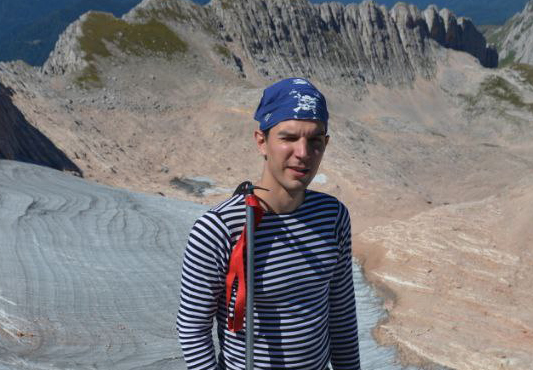
Oleg Vazhdayev has been transferred to Rostov-on-Don, where the court will begin to try his case the day after tomorrow.
Vazhdayev, an auto mechanic, was detained in late September on charges of attempting to set fire to a military enlistment office in Krasnodar. After his arrest, the police tortured him, demanding that he confess to receiving funding from Ukraine.
The building in which the military enlistment office is housed was not damaged, but this did not stop the security forces from charging Vazhdayev with committing a “terrorist act” (per Article 205.1 of the Russian Federal Criminal Code). He faces ten to fifteen years in prison if convicted.
The criminal case against Vazhdayev has been submitted to the Southern District Military Court, and he was recently transferred from the Krasnodar pretrial detention center to Rostov-on-Don.
The trial of the case on the merits should begin the day after tomorrow. Come to the trial!
2:00 p.m., 31 May 2023
Southern District Military Court (Judge Maxim Mikhailovich Nikitin), 75B Mechnikov Street, Rostov-on-Don
If you are going to the trial, don’t forget to bring your internal passport with you and leave all blades and means of self-defense at home.
You can also write to Oleg or send him a package.
Address for letters and parcels:
Vazhdayev Oleg Igorevich (born 1988)
219 ul. Maksima Gor'kogo, SIZO-1
Rostov-on-Don 344022 Russian Federation
(It is possible to send emails via the service Zonatelecom.)
Solidarity Zone is supporting Oleg Vazhdayev and his family.
Source: Solidarity Zone (Facebook), 29 May 2023. Translated by the Russian Reader. People living outside Russia will find it impossible to use the Zonatelecom service. It is also probably impossible to send parcels to Russian detention facilities from abroad. But you can ask me (avvakum@pm.me) for assistance and advice in sending messages to Russian political prisoners.
The Central District Military Court at Yekaterinburg, in Russia, yesterday (10 April) handed down 19-year prison sentences to Roman Nasryev and Aleksei Nuriev, for firebombing an administrative office building where a military registration office is based.
Roman Nasryev (left) and Aleksei Nuriev in court. Photo from The Insider
Roman and Aleksei will have to spend the first four years in prison, and the rest in a maximum-security penal colony.
This is the most severe sentence handed down so far for anti-war arson.
Roman and Aleksei received this long term of imprisonment because their actions were defined as a “terrorist act” (Article 205.2 of the criminal code of the Russian Federation) and “undergoing training for the purpose of undertaking terrorist activity” (Article 205.3). The latter Article carries a minimum term of 15 years.
The arson attack that Roman and Aleksei carried out – in reaction to the mlitary mobilisation, and to express their opposition to the invasion of Ukraine – was no more than symbolic. A female security guard was able to put out the fire, with a blanket and a few litres of water. There was damage to a window and some linoleum.
In court Roman Nasryev said:
I decided to carry out this action, because I did not agree with the [military] mobilisation, the “Special Military Operation” and the war as a whole. I simply wanted to show, by my actions, that in our city there is opposition to mobilisation and the “Special Military Operation”. I wanted in this way to make clear my opposition; I wanted my voice to be heard.
Solidarity Zone believes that this type of anti-war arson is not terrorism. That definition is politically motivated, and directly linked to the fact that the Russian government has unleashed a war of aggression against Ukraine.
□ Translated from Solidarity Zone’s Telegram feed. The original asks people to send letters and parcels to Roman and Aleksei in prison. If you are not a Russian speaker and you want to send them a message, there is no point in sending it directly. You can send messages to peoplenature@protonmail.com and I hope to be able to pass them.
The case of Pavel Korshunov, accused of “terrorism” over anti-war arson, sent to trial
Pavel Korshunov was detained in the city of Togliatti, Samara Region, as if he were a particularly dangerous criminal — a large number of Interior Ministry special forces soldiers were involved in his capture. But, according to investigators, all that Pavel did was set try and set fire to the Togliatti city administration building the day after the mobilization was announced. In a video posted online by the security forces, Korshunov states that he wanted to impede the mobilization.
Before his arrest, Pavel worked at a boathouse. Citing sources in the security forces, the media also write that Korshunov had previously taken part in protests.
Pavel has been charged with “committing a terrorist act” (per Article 205.2.b of the Russian Federal Criminal Code) and “vandalism” (per Article 214.2 of the Russian Federal Criminal Code). He faces from twelve to twenty years in prison if convicted.
On April 7, his case was submitted to the Central District Military Court in Samara. It will be tried by a three-judge panel chaired by Igor Belkin. There is not yet any information about exact trial dates on the court’s website.
✊ Help a teacher from Krasnodar accused of terrorism!
On the night of October 6, persons unknown set fire to the military enlistment office in the city of Goryachy Klyuch, Krasnodar Territory. The next day, the security forces detained two suspects — Bogdan Abdurakhmanov, a 27-year-old native of Minsk, and Boris Goncharenko, a 34-year-old man from Krasnodar.
Abdurakhmanov and Goncharenko were initially charged with “attempted destruction of property” (per Article 30.3 and Article 167.3 of the Russian Federal Criminal Code) and thus faced no more than three years and nine months of imprisonment if convicted. The FSB intervened in the case, however, and the charge was changed to “committing a terrorist act” (per Article 205.2 of the Russian Federal Criminal Code). Bogdan and Boris now face from twelve to twenty years in prison.
Goncharenko graduated from Kuban State University. After graduating, he taught history, social studies, and philosophy at various educational institutions. At one time he worked as a manager for the Garant and Konsultant Plus legal information portals.
Boris does not support Russia’s aggression in Ukraine, and after the outbreak of the full-scale war, he was very worried about the fate of the conscripts, including his former and current students.
Goncharenko does not consider himself guilty of “committing a terrorist act.”
Solidarity Zone has found a lawyer to defend Boris Goncharenko and made a down payment on their fee so that they may begin working. On March 29, we announced a campaign to raise the 250 thousand rubles necessary to pay the lawyer’s fees in full during the investigation phase of the case. To date, less than one fifth of the amount of money needed has been raised.
We urge you to support our fundraiser with donations and reposts!
💳 Sberbank card: 2202 2025 4750 6521 (Vasily)
🪙 PayPal: solidarity_zone@riseup.net (mark it “for Goncharenko” and designate the payment in euros if possible)
🥷 Cryptocurrency (be sure to email us at solidarity_zone@riseup.net if you transfer cryptocurrency to support Boris Goncharenko):
You are not violating any Russian laws by participating in the fundraiser. We have not been deemed “foreign agents” or an “extremist” or “terrorist” organization by the authorities, and raising money to pay a lawyer’s fees is not prohibited in Russia yet. ☺️
Ruslan Zinin is a real Russian hero, but you won’t find many Russians talking about his heroism or his current plight for the simple reason that they’ve convinced themselves that there is nothing more to be said or done about their country’s dreadful criminal invasion of Ukraine. It is now up to Ukrainians and the “collective West” to stop Putin, whatever the cost. The vast majority of Russians have better things to do, apparently. In the last few days alone, I’ve seen smart Russian friends of mine, people I definitely consider to be among the country’s best and brightest and even (in other circumstances) the most courageous, writing angrily about alleged government bank bailouts in the US and the supposed tendency of US “taxpayers” to vote for conservative politicians, or how they can’t talk about the things that matter to them on social media due to the war (about which they emphatically don’t want to write because enough has been said about it already), or wondering aloud why it took so long for “them” (i.e., the “international community”) to issue an arrest warrant for Putin.||| TRR
Ruslan Zinin
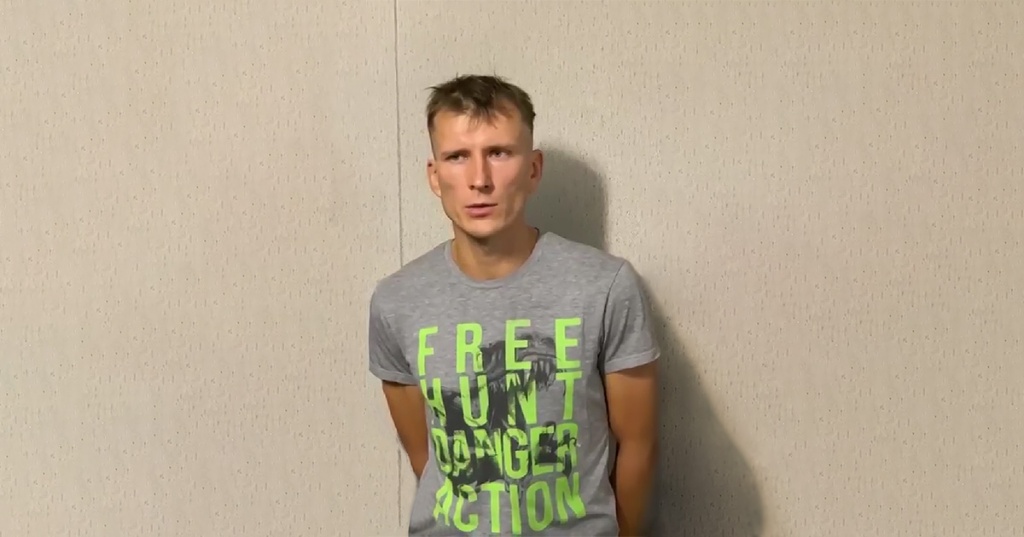
Ruslan Zinin transferred to solitary confinement
Ruslan Zinin’s mother Marina Zinina has reported that on March 21 [her son] was transferred to a solitary confinement cell without explanation.
“They came and took him away, saying, ‘Let’s go to another place.’ They put him in the basement in a solitary confinement cell. […] The conditions are terrible. It’s damp and cold and reeks of sewage, and rats are running around, and there’s nothing in the cell at all, except for a cot. There’s nowhere to store food, nowhere to get water, there’s no kettle, there’s nothing.”
Marina Zinina also said that Ruslan has not received any letters for two weeks, despite the fact that FSIN-Pismo [the Russian penitentiary system’s electronic correspondence service] has been sending people notifications that their letters had been vetted by the censor and handed over to Ruslan.
Solitary confinement is one of two forms of punishment for violating the rules in a pretrial detention center. (The second is a reprimand.) The warden of the pretrial detention center or his deputy can impose these penalties. But before imposing a penalty, the prisoner is given the opportunity to write an explanation about their alleged violation, and they must be notified of the penalty in writing.
Zinin was not charged with violating the rules of the pretrial detention center, and was not informed of any such decisions on the part of the warden.
We consider Zinin’s transfer to solitary confinement to be an escalation of pressure on the prisoner, an attempt to silence him and get him to consent to unfounded accusations of “terrorism.”
A logging truck driver from Ust-Ilimsk (Irkutsk Region), Zinin fired several shots from a sawn-off shotgun at the local military commissar in the midst of the mobilization announced in September of last year. He was incited to do this by the draft notice that had arrived for his brother. The military commissar survived the attack.
In early March, Zinin was charged with committing a “terrorist act” (per Article 205.2.b of the Russian Federal Criminal Code).
Despite the fact that letters are not being handed on to Ruslan at the moment, they remain an important support tool. A large flow of letters shows the wardens at the pretrial detention center that a lot of people are concerned about Ruslan’s plight. An even greater flow of letters and complaints in connection with their non-receipt has repeatedly been shown to be capable of breaking through the information blockade that the authorities impose on political prisoners.
Address for letters and parcels to Ruslan:
Zinin Ruslan Alexandrovich (born 1997)
63 ul. Barrikad, SIZO-1
Irkutsk 664019 Russian Federation
You can send letters electronically from anywhere in the world via the FSIN-Pismo service (subject to payment with a Russian-issued bank card) or the free, volunteer-run resource RosUznik (which allows you to remain anonymous).
❗️ If in the last two weeks FSIN-Pismo has sent you a notification of delivery, write to the service’s support team that your letter was not passed on to Ruslan. (You can say that you found about this in the media.)
You will also find sample complaints about non-receipt of letters on our Telegram channel.
Solidarity Zone has been providing comprehensive assistance to Ruslan Zinin and his family.
Source: Solidarity Zone (Facebook), 22 March 2023. Translated by the Russian Reader. People living outside Russia will find it difficult, if not impossible, to use the Russian Federal Penitentiary Service’s FSIN-Pismo service. It is also probably impossible or nearly impossible to send parcels to Russian detention facilities from abroad. But you can send letters — translated into Russian (if you don’t know a competent translator, you can use a free online translation service such as Google Translate) — to Ruslan Zinin (and many other Russian political prisoners) via RosUznik, as mentioned above. You can also ask me (avvakum@pm.me) for assistance and advice in sending letters.
Logging truck driver Ruslan Zinin grabbed a sawed-off shotgun when, in the wake of the “partial” mobilization’s annoucement, a summons arrived for his brother. On September 26, Zinin went to the military enlistment office in Ust-Ilimsk (Irkutsk Region). Military commissar Alexander Yeliseyev was giving a speech as he dispatched dozens of people to the slaughter. His disdainful attitude towards the mobilized men, as well as his remarks that they themselves were to blame, that they had “piled up loans” and “had heaps of children,” outraged Zinin to the depths of his soul. At that moment, someone in the room asked, “Where are we going?” “We’re all going home now!” Zinin shouted back and fired twice at the military commissar.
Consequently, Zinin’s brother was not mobilized (and, perhaps, the mobilization was temporarily suspended in the district), and military commissar Yeliseyev spent a month and a half in the hospital.
Zinin himself was remanded in custody and charged with “encroachment on the life of a law enforcement officer” (per Article 317 of the Russian Federal Criminal Code of the Russian Federation).
The charge was incommensurate with Zinin’s actions [and the circumstances]: the military commissar is not a law enforcement officer and was not performing tasks to protect public order.
However, police investigators went even further and reclassified the charge to “commission of a terrorist act” (per Article 205.2.b of the Criminal Code).
Formally speaking, this is a lesser charge since it does not stipulate life imprisonment, unlike the previous one. However, there cannot be a jury trial for those charged with “terrorism,” judges cannot impose sentences below the statutory minimum, and part of the sentence must be served in a closed prison [as opposed to a penal colony, in which inmates live together in open-plan barracks]. This is not to mention the mass of smaller infringements on the rights of a person convicted as a “terrorist.” Person convicted under this article must be sentenced to between twelve and twenty years in prison.
Currently, we do not know Zinin’s opinion on the matter, nor the specifics of the indictment, because the defense lawyer was forced to sign a non-disclosure agreement. However, the Solidarity Zone team in any case considers the accusation unfounded, regarding it as nothing other than lawlessness on the part of law enforcement agencies and an attempt to intimidate society. One of the main points of the criminal code article on “terrorism” is to terrorize the populace. In this case it is not Zinin’s actions that constitute “terrorism,” but, on the contrary, the actions of the authorities.
As before, you can support Ruslan by sending him a letter or parcel. If your letters are not passed by the censor or you do not receive a reply from Ruslan, let us know and file a complaint. Templates for complaints can be found on our Telegram channel.
Address for letters and parcels:
Zinin Ruslan Alexandrovich (born 1997)
63 ul. Barrikad, SIZO-1
Irkutsk 664019 Russian Federation
You can send letters electronically from anywhere in the world via the FSIN-Pismo service (subject to payment with a Russian-issued bank card) or the free, volunteer-run resource RosUznik (which allows you to remain anonymous).
Solidarity Zone is providing comprehensive assistance to Ruslan Zinin and his family.
Source: Solidarity Zone (Facebook), 9 March 2023. Translated by the Russian Reader. People living outside Russia will find it difficult, if not impossible, to use the Russian Federal Penitentiary Service’s FSIN-Pismo service. It is also probably impossible or nearly impossible to send parcels to Russian detention facilities from abroad. But you can send letters — translated into Russian (if you don’t know a competent translator, you can use a free online translation service such as Google Translate) — to Ruslan Zinin (and many other Russian political prisoners) via RosUznik, as mentioned above. You can also ask me (avvakum@pm.me) for assistance and advice in sending letters.
Yesterday, during a dinner conversation, I was asked why I’d been silent, why I hadn’t been writing anything about the war. Was it because I was afraid of going to jail, or was it something else? These questions were posed point blank albeit sympathetically.
I’ve been asking myself this question for many months. On the one hand, it’s stupid to deny that watching as my acquaintances are given devastating prison sentences does not affect me in any way. It makes an impression, of course.
On the other hand, I wonder what would I write or say now if the level of state terror had remained at least at pre-war levels. I realize that I would still write or say nothing. I can hardly squeeze this text out of myself. I’m just explaining myself because yesterday was not the first time I’ve been asked why I haven’t been writing anything about the war.
I feel that words have lost their meaning.
One of the ideologues of the war, who constantly makes allegations about the “genocide of the Russian language,” writes bezpilotnik, obezpechenie, na primer, and ne obezsud’te. [Instead of the correct spellings bespilotnik, obespechenie, naprimer, and ne obessud’te — meaning, respectively, “drone,” “provisions,” “for example,” and “don’t take it amiss.”] No one corrected him for a year. Compared to him, I’m a total expert on the Russian literary language, but I don’t have the words to stop cruise missiles or send soldiers home, while his bezpilotnik turns residential buildings into ruins in a second.
I do not know what words to find for a mother who, conversing with her POW son, regularly interjects “bitch” and “fuck.” Or for a mother who, as she sees off her son, smiles at the camera and says what actually matters is that she didn’t raise him to be a faggot, and basically, if push comes to shove, she has another child. Moreover, the supplies of such people are really endless.
Now, sadly, only the Ukrainian Armed Forces can “explain” anything. I am not trained in military affairs. So I am silent.
Separately on Friday, police briefly detained Yevgeny Levkovich, a reporter for Radio Svoboda, RFE/RL’s Russian service, at his home in Moscow, and charged him with “discrediting the army,” according to newsreports and Facebookposts by Levkovich.
[…]
In Moscow, police detained Levkovich for about five hours at the Teply Stan police station and charged him under Article 20.3.3 of the Administrative code for allegedly discrediting the army; convictions for that offense can carry a fine of up to 50,000 rubles (US$613).
Levkovich wrote on Facebook that his trial was scheduled for Monday, but he did not plan to attend because he did not “see the point” in contesting the charge.
Radio Svoboda wrote that the charge was likely related to Levkovich’s posts on social media, but did not say whether authorities had specified any posts prompting the charge. On his personal Facebook page, where he has about 36,000 followers, Levkovich recently wrote about Russia’s war on Ukraine.
These are the numbers. I want to do something so that people don’t get caught, and even more actively support those who do get caught. But in the first case, it is unclear what these people are reading, and where the safety recommendations should be published so that they are accessible to such people. And we are already working on the second case, but we lack the human resources.
Those arrested for radical anti-war protest are heroes, although sometimes the charges are completely trumped-up. In any case, all of them deserve support. Solidarity Zone regularly writes about such political prisoners, publishes addresses where you can send them letters, and raises funds to pay their lawyers. Sign up to get news of what is happening to these people and, if possible, get involved in supporting them.
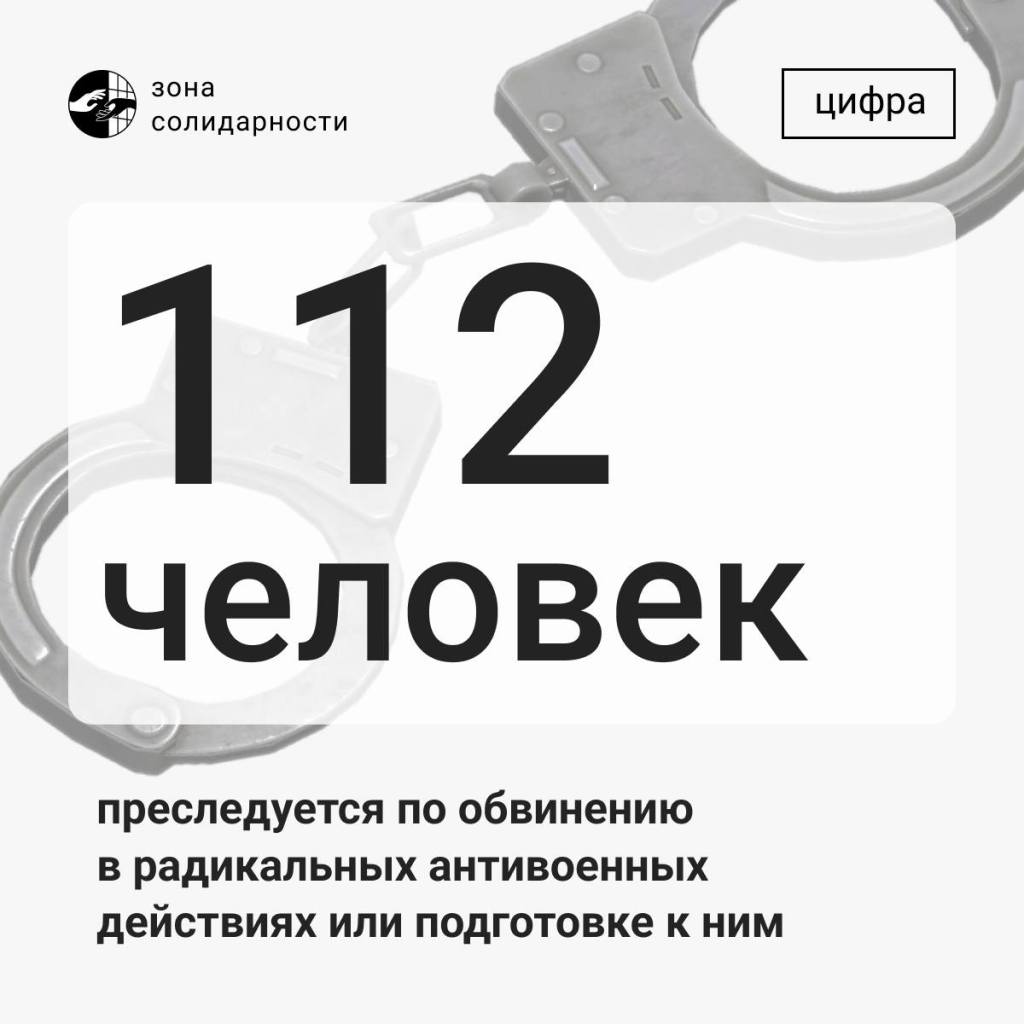
112 people are being prosecuted on charges of carrying out or planning radical anti-war acts.
Solidarity Zone counted how many people have been criminally charged with setting fire to military enlistment offices, sabotaging the railroads and other militant anti-war actions, or planning them, in the year following [Russia’s] full-scale invasion of Ukraine.
What police investigators allege these people have done to warrant criminal prosecution:
1 — “other”
7 — torched vehicles marked with the letter Z
17 — planned arsons of military enlistment or other government offices
36 — sabotaged the railways
51 — torched military enlistment or other government offices
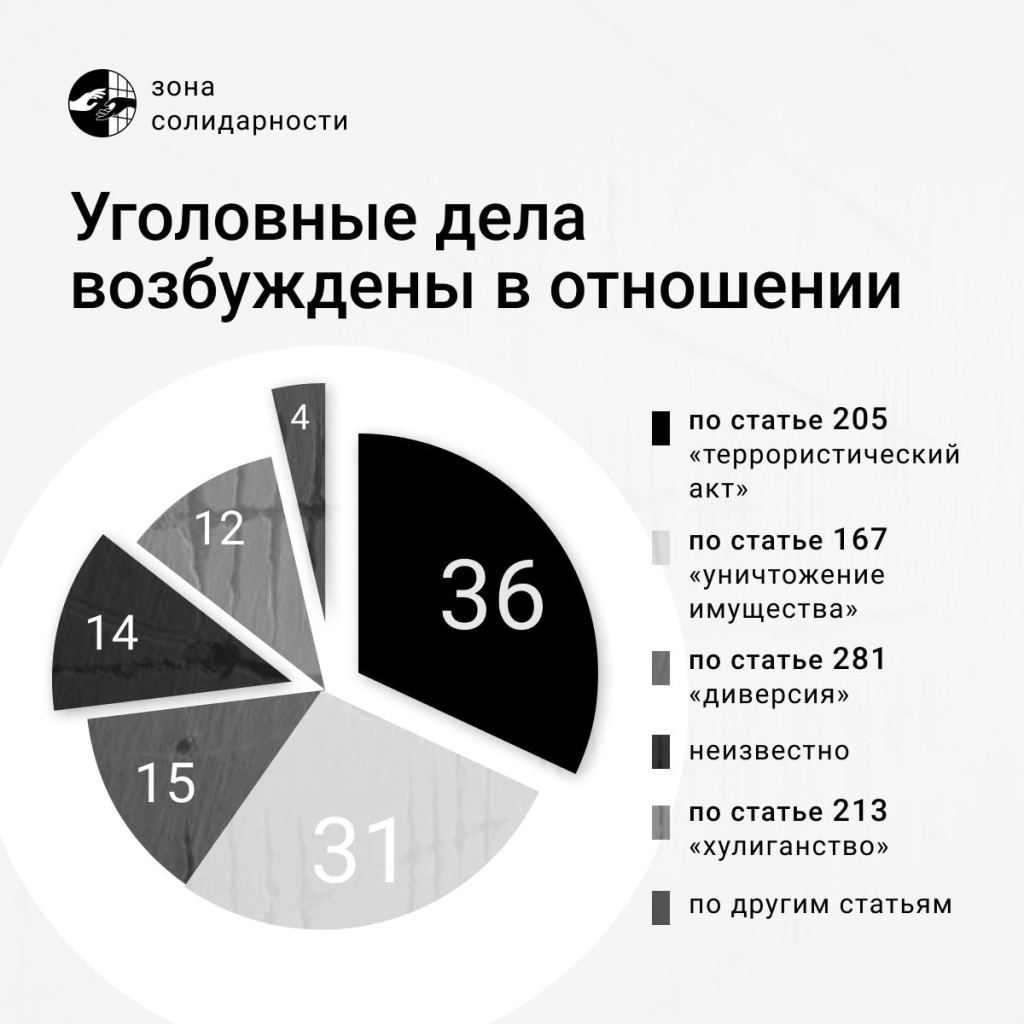
Articles of the Russian criminal code under which these people have been charged:
36 — Article 205: Terrorist Act
31 — Article 167: Destruction of Property
15 — Article 281: Sabotage
14 — Unknown
12 — Article 213: Disorderly Conduct
4 — Other Criminal Code Articles
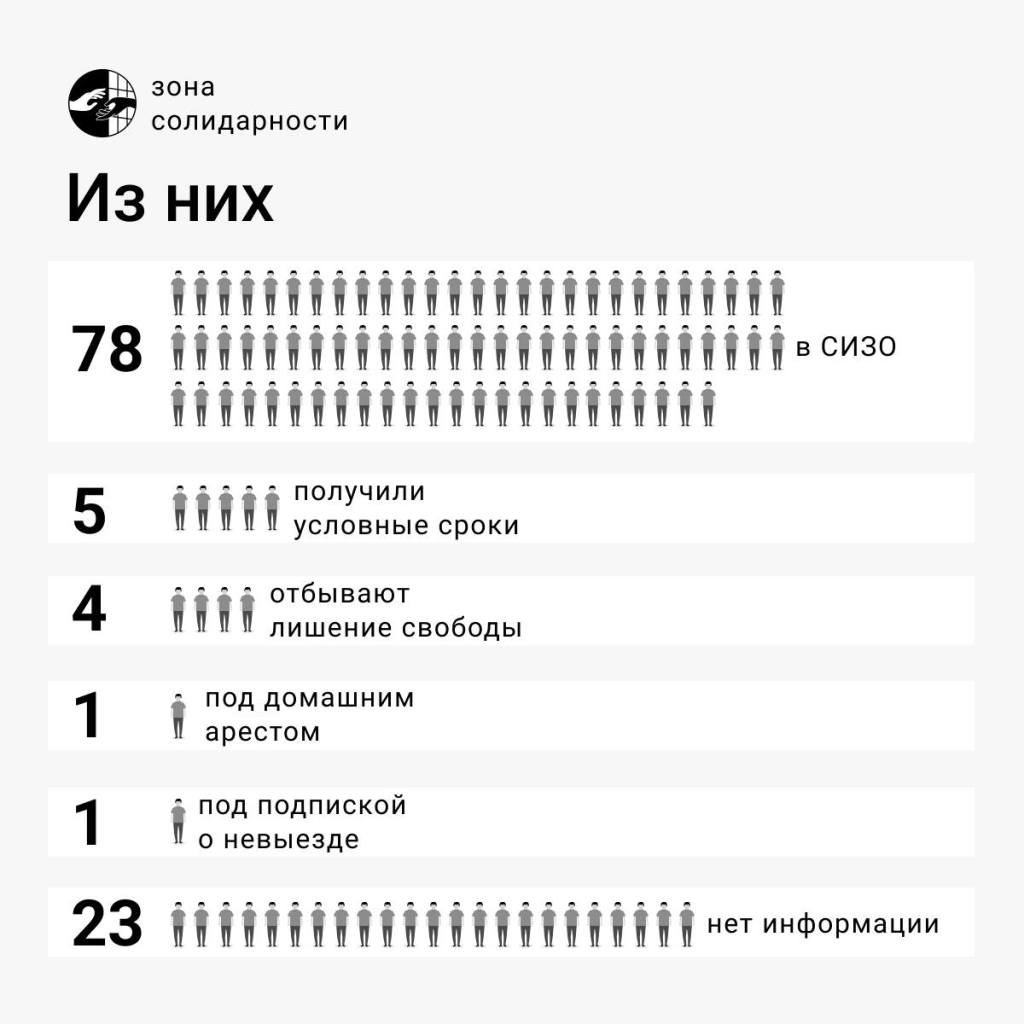
Of these people:
78 are being held pretrial detention centers (remand prisons).
5 have been sentenced to parole.
4 are serving prison sentences.
1 is under house arrest.
1 has been released on their own recognizance pending trial.
There is no information about 23 of them.
Our statistics are incomplete because the Russian authorities do not always report new criminal cases. Sometimes we only get reports that people have been detained, with no mention of their names or the charges against them, and these reports are thus extremely hard to verify.
Our statistics do not include people who were killed by the security forces during arrest or people prosecuted on administrative charges.
Source: Solidarity Zone (Facebook), 24 February 2023. Translated by the Russian Reader. Here, by way of comparison, are OVD Info’s statistics for numbers of people criminally (as opposed to administratively) prosecuted for “non-radical” anti-war actions since 24 February 2022:
Total defendants: 465 in 77 regions (we include occupied Crimea and Sevastopol in our data because we monitor activities of repressive Russian government authorities that operate there).
Women among the defendants: 90 (19%)
Minors among the defendants: 6 (1%)
(Section 3, Article 207.3 of the Criminal Code) Prosecuted for “spreading fakes about the Russian army” (ie talking about the war in an unsanctioned manner): 141 (30%)
(Section 3, Article 280.3 of the Criminal Code) Prosecuted for “discrediting the Russian army”: 54 (12%)
Convicted: 119 (26%)
Imprisoned upon conviction: 26 people
In pre-trial detention: 108 people
Under house arrest: 17 people
Convicted and given a non-custodial sentence: 62 people
It thus follows that a total of 577 Russians have faced criminal prosecution for anti-war actions of all kinds (violent and nonviolent) since the start of their country’s invasion of Ukraine. As Ivan Astashin, a former political prisoner himself, argues, above, all these people are, indeed, heroes. It’s another matter that they constitute a statistically insignificant segment of the world’s ninth most populous country. Again, by way of (invidious) comparison, at least 1,003 Americans have been charged with crimes for their alleged involvement in the 6 January 2020 riot at the US capitol.
I would argue that those who were forced to leave Russia due to Putin’s unleashing of illegal aggression against Ukraine could file a class action lawsuit against the Russian Federation or the ruling elite of the Russian Federation demanding compensation for the moral anguish and economic harm suffered as a result of these events. The Russian federal authorities must fully compensate them for expenses incurred by forced relocation, such as the cost of airplane and other tickets, accommodation in hotels and rented accommodation abroad, and other expenses. Compensation could also include the irreparable losses suffered by citizens within the country due to forced relocation — for example, the loss of a job or a business. Compensation for emotional suffering is a separate issue.
Payments could be made from the Russian federal budget, through the sale of the property of officials directly responsible for unleashing the war, or at the expense of business income from entrepreneurs who have directly supported the illegal aggression. Naturally, compensation for this damage is possible only after full payment of the reparations necessary to restore Ukraine’s economy and civil infrastructure. What do you think about this? #nowar#netvoine
[two selected comments + one response by the author]
Zmey Gurevich A difficult question. It’s true that the monstrous war forced me to leave Russia. But to my incredible surprise, I have have become happy here [in emigration]. Perhaps it’s immoral to be happy when rivers of blood overflow their banks. It’s been eating at me. But the painful departure has led me a new happiness. Some vital knots have been untied… No, I have nothing to bill [the Russian authorities] for. My friends empathize with me and ask me how things are going here. I can’t tell them the truth. I am ashamed. But my departure has turned into a happy time for me. I don’t know what will happen next.
Vlad Shipitcyn Zhenya! Did you go to at least one protest rally against Putin in Russia over [the last] 22 years? No, you didn’t. Did you ever stand on the stand on the street holding a [protest] placard? No. So no one owes you anything, not a kopeck. You too are responsible for both the regime and the war. You let them happen. So calm down.
Evgeny Krupitsky Hi! Yes, I am responsible for this war: it happened due to my connivance, indifference and cowardice. And I said it right away: https://www.youtube.com/watch?v=GsAFChc2HSI And my protest was that on March 6, exactly a year ago, I left the Russian Federation having abandoned everything, because I felt sick and ashamed. Okay, maybe it’s not such a big deal in terms of significance and courage, but I am proud of my little protest. I know you went to the rallies long before the start of the war, that you were detained, beaten and fined, and I respect and admire you for that! But someone will say that they suffered more than you did, that they did more to prevent this war, etc. We need to consolidate, rather than argue about who is more to blame!
Evgeny Krupitsky, “My take on what’s happening (2 April 2022) #nowar #netvoine”
Some people in Russia are living a normal life, but they feel the lack of real normality, and this causes them discomfort. Others live with a sense of catastrophe, but they feel the absence of a real catastrophe, and this also causes discomfort. Consequently, everyone is on edge. The sensible approach is to live normally with a sense of disaster. But this useful attitude is hard to achieve, and if you don’t have it, then I do not even advise you to start. When it takes shape, it will no longer be relevant.
The four members of this “countryside hub” are among hundreds of Russian opposition activists of various political leanings who have fled their country to Georgia throughout the past year. Some left in the months prior to Moscow’s invasion of Ukraine last February as repression grew to unprecedented levels in the Putin era. Others came after the war began, realizing that with their dissenting opinions, they could no longer live in what they deem a fascist totalitarian state.
In Tbilisi, they have created or joined new anti-war resistance organizations, which operate on Western grants and employ hundreds of volunteers. Working around the clock, these groups offer services in real time to Ukrainians refugees as well as Russian activists and military deserters fleeing their respective countries. The help comes in the form of evacuation routes, therapeutic services, legal guidance, shelters and resettlement plans.
[…]
From her volunteering as an election monitor in Russia’s 2011 elections to offering pro-bono legal support to activists arrested during protests in subsequent years, Burakova’s career followed a linear trajectory. Degrees in political science and law equipped her with the legal know-how to aid political opponents, and now exiles, over how to wrestle with and escape an authoritarian system that often invents new laws to persecute citizens. As of 2022, “discrediting the Russian army” is now an offense that has landed countless people in prison for sharing anti-war posts on social media.
[…]
“To conduct these types of congresses and host mock parliamentary votes on Russia’s future while in exile just looks a bit cringe-ova,” Burakova tells me, using the popular English word that has been appropriated into the Russian language. Her husband Egor Kuroptev shares the sentiment.
M., one of my smartest interlocutors, arrived from Moscow Time. “Well, what is your final conclusion? Why?” he asked me. I told him that now I see three points that we simply missed, that ended up in our blind spot. The first point is that of course everyone worked hard during these years, enthusiastically; everyone had an articulated mission in life, etc. But it was seemingly taken as a natural given that each of us was the client of someone a few floors above us. Now everyone looks back and discovers that their mission has been burned for a long time, and their belonging to one or another Moscow (or regional) clan shines forth in their biography. For some reason, it was automatically believed that, in the nineties, we operated in a world in which, when difficulties arose, we should turn to “the man from Kemerovo” (in the words of Grebenshchikov’s song). In the noughties, however, all this was allegedly vanquished. In reality, nothing was “vanquished”: it was simply transformed into large-scale state clans. That is why now everyone who was engaged in charity, book publishing, media development, etc., has suddenly shifted the emphasis in their reflections on life: wait a second, I worked for Abramovich (or Gusinsky, or Potanin, etc.). The system consisted entirely of a network of clients.
The second point: the language of pragmatic communication. It was a completely abusive language. The smash-mouth jargon permeated everything. Roughly speaking, the country was governed in the language of American rappers (i.e., the Solntsevo mob). All communications! Not only the special communications among those in power, but also all communications in the liberal, academic realm, in civil society. The cynical jargon of abuse reigned everywhere, and it was absolutely acceptable even in highly cultured milieux. And we did not see what consequences this would have.
The third point: “populism.” The automatic perception of the “common people” [narod], which had its origins in the late-Soviet and perestroika periods, was a colossal mistake. It was tacitly assumed, first, that there was a “common people”; second, that the “common people” would determine their own fate; and third, that the “common people” naturally triumph over evil because they themselves are good. It was this “populism” that served as the basis for the compromise with the state when it began to take institutional shape in Yeltsin’s wake.
All three of these points were “organic” in some sense. They were a part of ontology: they were taken for granted without any reflection and criticism. And all three played a fatal role in the process of “slowly boiling the frog alive.”
I had problems,
I had gone way too far.
The lower depths of the deepest hell
Didn't seem so deep to me.
I called my mom,
And Mom was right.
She said, "Straightaway you've got to call
The man from Kemerovo."

He is a man of few words, like de Niro.
Only a wacko would argue with him.
You can't pull one over on him,
He knows all the insides and outs.
The sky could crash to the ground,
The grass could stop growing,
He would come and silently fix everything,
The man from Kemerovo.

Adam became a refugee,
Abel got on a mobile connection,
Noah didn't finish what he was building,
Got drunk and fell face down in the mud.
The history of humankind
Wouldn't be so crooked,
If they had thought to get in touch
With the man from Kemerovo.

I got a call from Kyiv,
I got a call from Kathmandu,
I got a call from the opening of the plenum —
I told them I would not come.
You have to drink two liters of water at night,
To have a fresh head in the morning.
After all, today I'm going to drink
With the man from Kemerovo.
Only one conclusion follows from Stalin’s death: woe is the country where tyrants die natural deaths while still in power.
Source: Roman Osminkin (Twitter), 5 March 2023. Translated by the Russian Reader. Mr. Osminkin’s remarks were occasioned by the social media commemoration of the anniversary of Stalin’s death, yesterday, which often as not consisted of replicating the meme “That one croaked, and this one will croak too.” This means, apparently, that the entire “plan” of the “Russian anti-war movement” and the “anti-Putin opposition” consists in waiting for the current Russian tyrant to die a natural death. It’s a frank admission to be sure. ||| TRR
Valeria Zotova is a new prisoner of Putin’s regime
19-year-old Valeria Zotova was detained in the wee hours of February 17. She is accused of planning to set fire to a warehouse from which supplies are sent to military personnel involved in the war against Ukraine. According to the security forces, the young woman has been charged with committing a “terrorist act” (per Article 205 of the Russian Federal Criminal Code).
You can support Valeria Zotova right now by writing her a letter!
Address for letters:
Zotova Valeria Igorevna (born 2003) 53 ul. Portovaya nab., SIZO-1 Yaroslavl 150001 Russian Federation
(It is possible to send letters via the electronic services FSIN-Pismo and Zonatelecom.)
Source: Solidarity Zone (Facebook), 21 February 2023. Translated by the Russian Reader. Thanks to Sergey Ogurtsov for the heads-up.People living outside Russia will find it difficult or impossible to use the FSIN-Pismo and Zonatelecom services. In many cases, however, you can send letters (which must be written in Russian or translated into Russian) via the free, volunteer-run service RosUznik. As of this writing, however, Ms. Zotova has not appeared on their list of supported addressees. You can also ask me (avvakum@pm.me) for assistance and advice in sending letters to Russian political prisoners.
The Yaroslavl District Court has remanded in custody 19-year-old Valeria Zotova, accused of attempted terrorism (per Article 30.3 and Article 205.1 of the Russian Federal Criminal Code), reports TASS, citing the press service of the Yaroslavl Regional Court.
A day earlier, Zotova’s mother told OVD Info that her daughter had left the house on the evening of February 16, saying that she was going for a walk with friends, but did not return home. At about one o’clock in the morning, security forces came to search the Zotov home. The officers did not identify themselves and did not state the grounds for their investigation.
The young woman was taken to Yaroslavl’s Pretrial Detention Center No. 1. On February 20, a Telegram channel linked to the local security forces posted a video of Zotova’s arrest. The report said that she had been charged with terrorism (per Article 205.1 of the Criminal Code). If convicted on this charge, she could face between ten and fifteen years in prison.
Following the footage of the detention, a “confession” appears on the video: Valeria Zotova says that she transmitted information, coordinates and photos of a building for a monetary reward. According to her, [the people who paid her the money] “wanted to set fire to this building,” in which “parcels for the mobilized are collected and sent to Donbas.”
Svetlana Zotova said that in October of last year she herself had been fined for “discrediting” the army (per Article 20.3.3 of the Administrative Offenses Code) over a “No war” message, graffitied on a local kiosk. During the search, the security forces threatened to make her a suspect in her daughter’s case, claiming that she had been involved in anti-war rallies. The woman stated that she was not involved in anti-war protests, despite her views. Before the invasion of Ukraine, she had picketed in support of politician Alexei Navalny and the Khabarovsk protesters.
On 11 October 2022, amidst the recently announced military mobilization, Roman Nasryev and his friend Alexei Nuriyev broke a window on the first floor of the municipal administration building in the town of Bakal in the Chelyabinsk Region and threw Molotov cocktails into it. There was a military enlistment office in the building.
Local pro-government media outlets dubbed the young men “the rockers who threw Molotov cocktails at city hall.”
Initially, Nasryev and Nuriyev were charged with “destroying or damaging property” (per Article 167.2 of the Russian Federal Criminal Code). Later, however, after the FSB had homed in on the case, the charge was revised to “committing a terrorist act” (per Article 205.2 of the Criminal Code).
Roman and Alexei were also later accused of “undergoing training in order to carry out terrorist activities” (per Article 205.3 of the Criminal Code).
Law enforcement claimed that the accused “took courses on carrying out terrorist activities via the Internet and by phone.” In response to such a strange and dubious claim, a subscriber to one of the Telegram channels ironically quipped, “Apparently, they did not train well. Distance learning is still not as good as in-person instruction.”
Roman and Alexei face from fifteen to thirty years of imprisonment or life in prison if convicted as charged. To date, these are the most serious charges brought against suspects or defendants in anti-war arson cases.
On October 21, Rosfinmonitoring added Nuriyev and Nasryev to its list of “extremists and terrorists.”
27-year-old Roman Nasryev worked as a driver in the Interior Ministry’s extra-departmental security guard service (now overseen by the Russian National Guard). He and Nuriyev played in the Bakal rock band Room 32. Relatives tell us that he liked to learn to play musical instruments on his own, including guitar, mouth harp, harmonica, dombra, and flute. Roman’s other hobbies were sports, especially running and calisthenics, skiing, writing poetry, cars, and fishing.
Room 32, performing “Hug Me” at the Emergenza Festival four years ago
Both of the accused men hold anti-war views. Politically, Nasryev describes himself as a libertarian. (Earlier, we mistakenly wrote that he held left-wing views.) Roman explains that he did what he did to protest the war in Ukraine and the military mobilization.
Roman is married and has two children, a four-year-old daughter and a son, who was born in November, when Roman was already in remand prison.
On January 27, the young men’s remand in custody was extended for six months, until 4 August 2023. Both prisoners of conscience are currently being held at Pretrial Detention Center No. 1 in Chelyabinsk. Nasryev is being held in solitary confinement.
You can support Roman by sending him a letter or parcel. (There is no limit on the number of parcels inmates at the pretrial detention center can receive). Letters not only cheer up inmates and strengthen their spirits, but also show the security forces that people are paying keen attention to what happens to them, and this can prevent the security forces from engaging in lawlessness and torture.
You can also start a correspondence with Roman — his wide-ranging interests are listed above.
Address for letters and parcels:
Nasryev Roman Raifovich (born 1995)
53 ul. Rossiyskaya, SIZO-1
Chelyabinsk 456006 Russian Federation
(It is also possible to send emails to inmates via the Zonatelecom service.)
Solidarity Zone supports Roman Nasryev.
Source: Solidarity Zone (Facebook), 31 January 2023. Translated by Thomas Campbell. People living outside Russia will not be able to use the Zonatelecom service. It is also impossible or nearly impossible to send parcels to Russian detention facilities from abroad. In many cases, however, you can send letters (which must be written in Russian or translated into Russian) via the free, volunteer-run service RosUznik. As of this writing, Mr. Nasryev has not appeared on their list of supported addressees. You can also ask me (avvakum@pm.me) for assistance and advice in sending letters to Russian political prisoners.
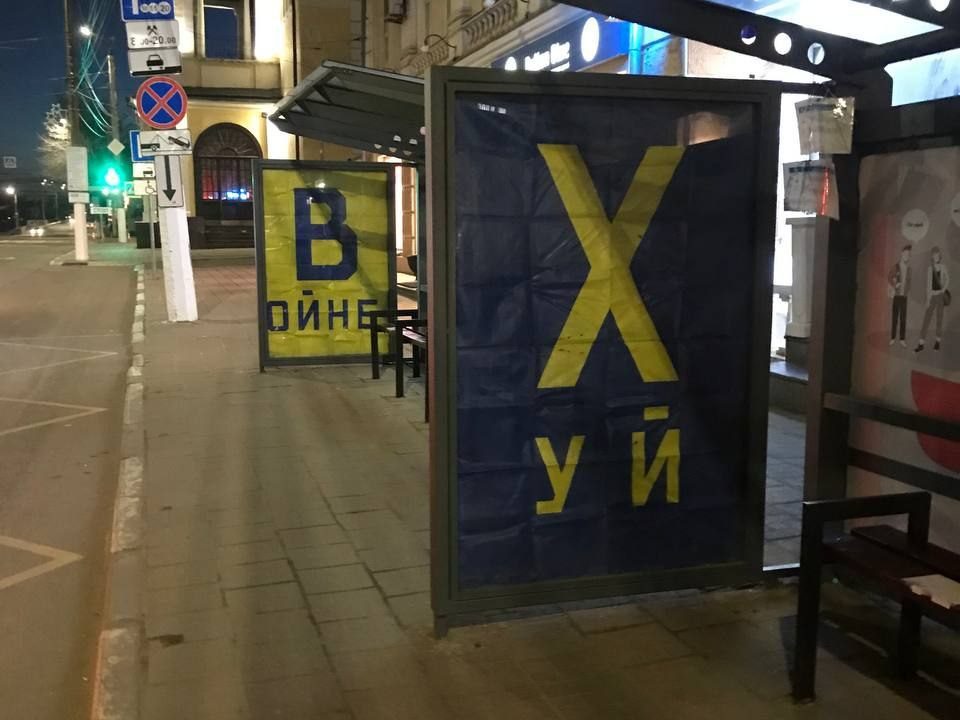
“Fuck the War”: a street art piece attributed to Ivan Kudryashov, photographed in Tver on 1 May 2022. Photo courtesy of Solidarity Zone
Ivan Kudryashov: Tver resident accused of planning arson of military enlistment office
The Telegram channel Stasia and Letters reports that Tver activist Ivan Kudryashov is in a pretrial detention center, charged with planning to set fire to a military enlistment office.
It is reported that Kudryashov repeatedly carried out anti-war protests in Tver. He was arrested on September 30 and charging with “preparing to commit a terrorist act” (per Article 30.1 and Article 205 of the Russian Federal Criminal Code). If found guilty, he faces a maximum prison sentence of eleven years and three months.
Kudryashov is, possibly, the author of the resonant “Fuck the War” street art pieces at bus stops in Tver. In any case, the VK page “Ivan Kudryashov” contains an entry about them, dated September 22.
Stasia and Lettersquotes a letter from Andrei Trofimov, accused of making anti-war statements, who was held in the same cell as Kudryashov for three weeks:
“[Ivan Kudryashov] was born in the city of Bologoye and grew up in an orphanage and, later, with a foster family in Torzhok, Tver Region. He graduated from an eleven-year school. After school, he enrolled in the economics department at Tver State University. In the second year, he dropped out of university and did his obligatory military service in the Armed Forces of the Russian Federation. After that he lived in Tver and worked as a fitter at a train carriage factory. At school, he liked mathematics and was a checkers champion. He is fond of contemporary music, and is also a fan of the British TV series Sherlock.”
It is reported that Ivan Kudryashov is now in solitary confinement, which means it is especially important to write to him.
Address for letters and parcels:
Kudryashov Ivan Valeryevich (born 1996)
141 Vagazhanov Street
Pretriel Detention Center No. 1
Tver 170010 Russian Federation
(It is possible to send letters via the FSIN-Pismo service.)
#prisoners#solidarity #nowar#writing letters
Source: Solidarity Zone, 5 December 2022. Translated by the Russian Reader. People living outside Russia will not be able to use the Russian Federal Penitentiary Service’s FSIN-Pismo service. It is also probably impossible or nearly impossible to send parcels to Russian detention facilities from abroad. In many cases, however, you can send letters (which must written in or translated into Russian) via the free, volunteer-run service RosUznik, but as of this writing Mr. Kudryashov has not appeared on their list of addressees. You can also ask me (avvakum@pm.me) for assistance and advice in sending letters.



 Address for letters and parcels: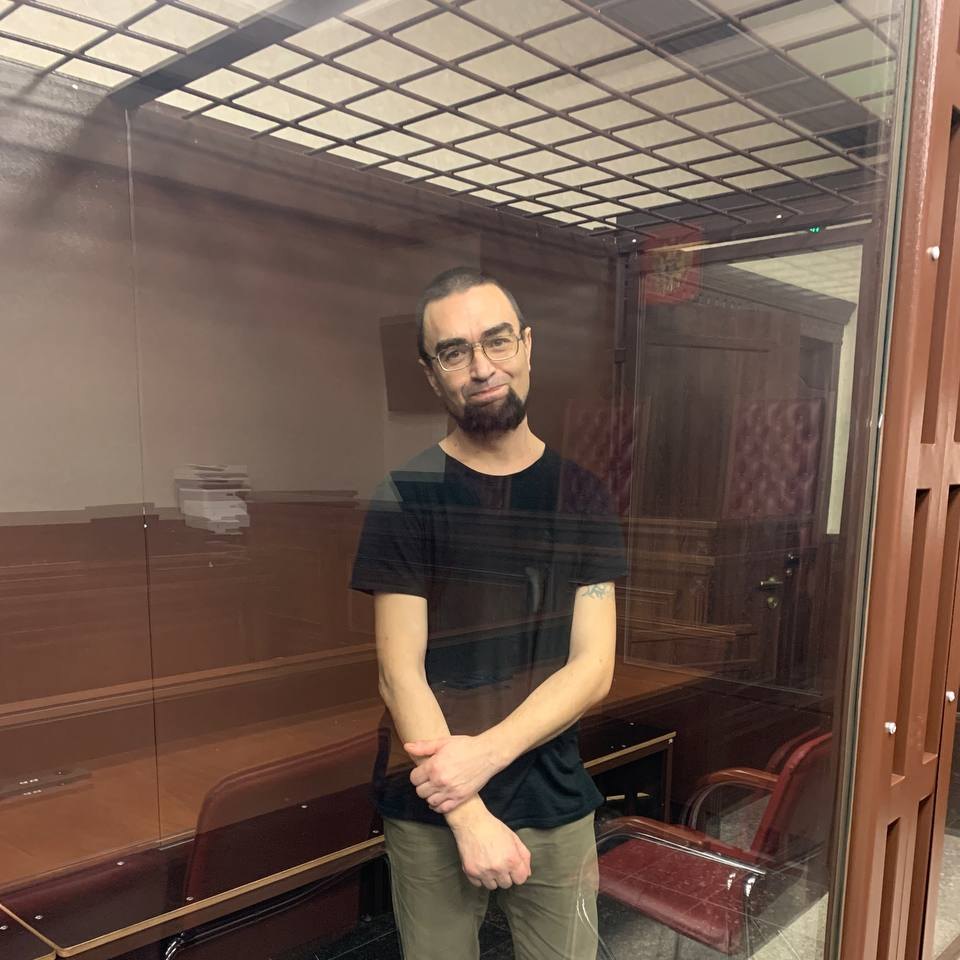
 2:00 p.m., 31 May 2023
 Southern District Military Court (Judge Maxim Mikhailovich Nikitin), 75B Mechnikov Street, Rostov-on-Don
 If you are going to the trial, don’t forget to bring your internal passport with you and leave all blades and means of self-defense at home.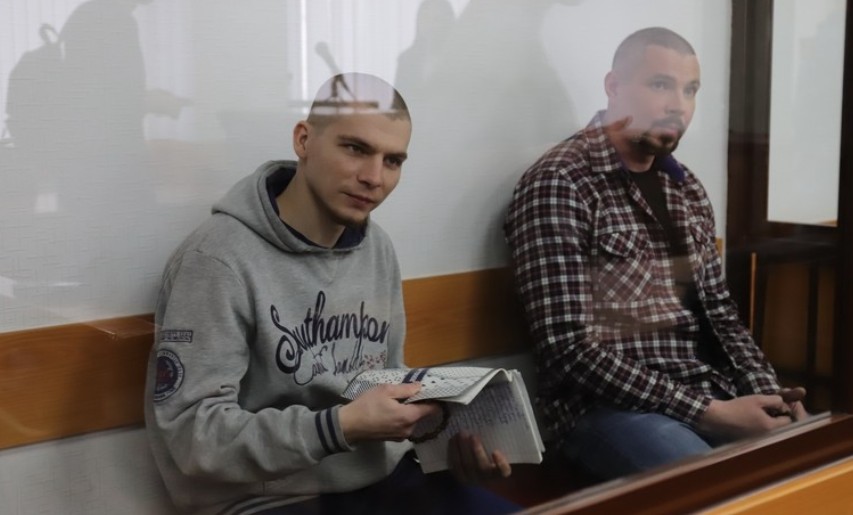


 Ruslan Zinin transferred to solitary confinement
 You can send letters electronically from anywhere in the world via the
 Ruslan Zinin charged with terrorism
 As before, you can support Ruslan by sending him a letter or parcel. If your letters are not passed by the censor or you do not receive a reply from Ruslan, let us know and file a complaint. Templates for complaints can be found on