Nationalist Historical Fantasy

08911958.cover_415

Historical Fantasy
Andrei Zakharov, A Crossroads in Time: The New Rossiyans (Alfa Kniga, 2012)

None of our contemporaries who decided to vacation on the shores of a mysterious lake in the Chernobyl Exclusion Zone expected the trip would change their future. A natural disaster and encounters with Red Army soldiers, surrounded near Kiev in 1941, and a detachment of White Guards from 1919 were not part of their plans. But man proposes and God disposes. They did not know who wanted to test them—God or someone else—by gathering and abandoning them in the mountains of South America in the sixteenth century, during the collapse of the Inca empire and its conquest by Spanish conquistadors. But the trials that befell their lot forced all of them to unite and start a new life.

Source: LitRes

Translated by the Russian Reader

_______________________

Police, Nationalists Clash As Russians Mark National Unity Day
Radio Free Europe/Radio Liberty
November 04, 2017

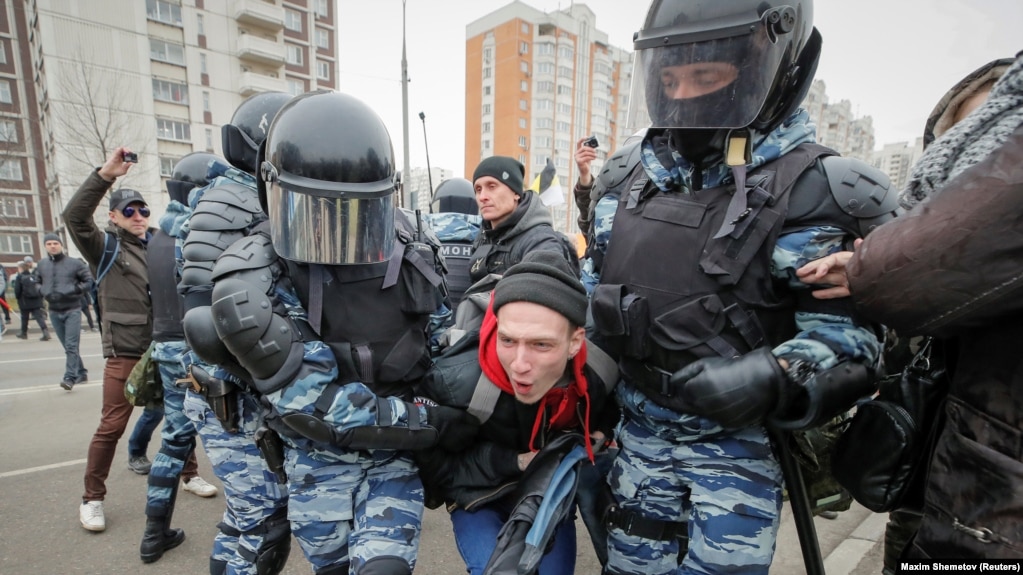
Police detain protesters at the nationalist march in Moscow. Police detain protesters at the nationalist march in Moscow. Photo courtesy of Maxim Shemetov/Reuters

Riot police and nationalist demonstrators clashed in Moscow on November 4 at an antigovernment demonstration coinciding with celebrations of Russia’s National Unity Day holiday.

Police detained several demonstrators in a crowd of nationalists who had gathered in southeastern Moscow for an annual Russian March that organizers called off almost as soon as it began after police refused to allow participants to carry banners.

Organizers said authorities had granted approval for banners at the demonstration. The city government had given official permission for the rally, and hundreds of participants had gathered for the event at the time police intervened.

Video footage showed one woman being carried off in a stretcher after what a Dozhd TV reporter at the scene described as a scuffle with riot police.

A second Russian March, meanwhile, was under way in northwestern Moscow.

The standoff between police and demonstrators came at the start of a politically charged weekend in which Russians nationwide are marking National Unity Day.

The holiday, which the Kremlin established more than a decade ago, has replaced Soviet-era celebrations of the Bolshevik Revolution anniversary.

This year’s holiday comes three days ahead of the centennial of the 1917 Bolshevik Revolution.

A day before the celebrations, Russian authorities on November 3 said they had detained several backers of a self-exiled Kremlin critic in the Moscow area, claiming they were plotting to trigger riots by attacking government buildings and police during the holiday.

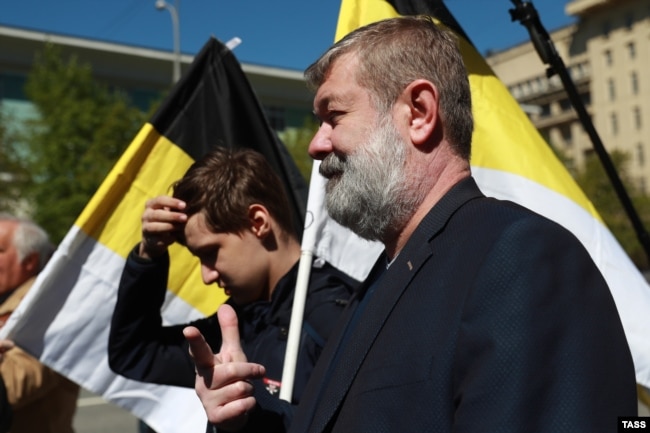
Russian opposition politician Vyacheslav Maltsev (right) at a Russian opposition rally on May 6, 2017.Russian opposition politician Vyacheslav Maltsev (right) at a Russian opposition rally on May 6, 2017. Photo courtesy of TASS

The Federal Security Service (FSB) said the suspects are members of a “conspiratorial cell” of Artpodgotovka (Artillery Bombardment), a movement established by outspoken opposition activist Vyacheslav Maltsev.

Maltsev, who has described himself as a nationalist and anarchist, has said on YouTube that Russia is up for a “revolution” this weekend.

RBC news agency cited an unidentified Interior Ministry source as saying that a spate of additional raids targeting Maltsev’s group were carried out in Moscow and the surrounding area on early on November 4.

Russia’s state TASS news agency quoted officials as saying that more than 90,000 security personnel will be on duty for some 2,000 Unity Day events across the country.

Nationalists traditionally hold rallies on November 4, while Russians nostalgic for the Soviet Union, such as the Communists, celebrate on November 7.

National Unity Day, which President Vladimir Putin established in 2005, officially honors a Russian victory over Polish forces in 1612.

In a ceremony commemorating the event, Putin on November 4 placed flowers at the Red Square monument to Kuzma Minin and Dmitry Pozharsky, who are credited with leading Russian troops against the Poles.

A Little Pepper Spray Never Hurt Anyone

33
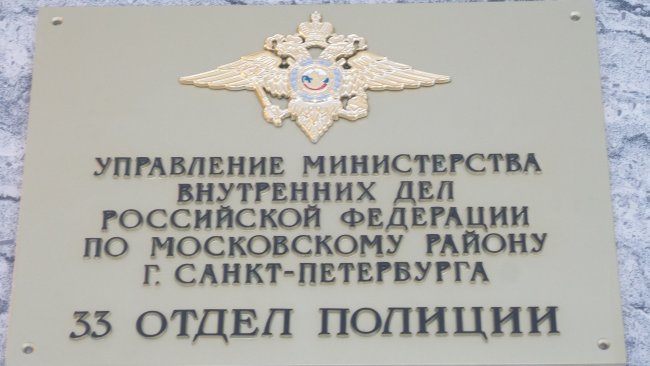
The sign outside the 33rd Police Precinct in Petersburg’s Moscow District. Courtesy of Google Maps and OVD Info

Petersburg Police Confirm Pepper Spray Used in Precinct
Radio Svoboda
June 19, 2017

The Interior Ministry Directorate for St. Petersburg has confirmed that pepper spray was employed in the 33rd Police Precinct, where detainees from the June 12 anti-corruption protest rally were being held, reports Rosbalt.

As the police’s press service reported, a man was brought to the precinct for minor misconduct. After the man attempted to harm himself, police officers doused his cell with pepper spray. The Interior Ministry claims that after the spray was deployed, the people who had been detained at the protest on the Field of Mars were taken to a meeting room.

Earlier, OVD Info reported that the protest rally detainees complained the pepper spray had spread into neighboring cells. They asked that a doctor be summoned to the precinct, since one of them suffered from bronchial asthma, but police officers did not react. One of the detainees, who had his mobile phone with him in the cell, managed to summon doctors. Subsequently, seventeen people, who had been left to spend the night at the precinct, were transferred to a basement room, where they were held until the evening of the following day. They were not given food, only one bottle of water each.

Alexander Shishlov, Petersburg’s ombudsman for human rights, said he would formally investigate the incident.

More than six hundred people were detained during an unauthorized [sic] protest rally against corruption in Petersburg. The city courts registered 546 cases against the detainees. They were charged with involvement in an unauthorized rally and disobeying the police.

Translated by the Russian Reader. Thanks to Comrade NS for the heads-up

“We Have a Surrogate Democracy”: An Interview with Ekaterina Schulman

Ekaterina Schulman. Photo courtesy of Andrei Stekachov and The Village

Political Scientist Ekaterina Schulman on Why You Should Vote
Anya Chesova and Natasha Fedorenko
The Village
September 16, 2016

This Sunday, September 18, the country will vote for a new State Duma, the seventh since the fall of the Soviet Union. The peculiarity of this vote is that it will take place under a mixed electoral system for the first time since 2003. 225 MPs will be elected to five-year tears from party lists, while the other 225 MPs will be elected from single-mandate districts. Several days before the elections, The Village met with Ekaterina Schulman, a political scientist and senior lecturer at the Russian Presidential Academy of National Economy and Public Administration (RANEPA). We talked with her about why you should vote if United Russia is going to win in any case, as well as about the changes in store for the Russian political system in the coming years.


The Upcoming Elections

The Village: On Sunday, the country will hold the first elections to the State Duma since 2011. The social climate in the city and the country as a whole has changed completely since that time. Protests erupted in 2011, and the people who protested on Bolotnaya Square and Sakharov Avenue believed they could impact the political situation. Nowadays, few people have held on to such hopes. What should we expect from the upcoming elections? And why should we bother with them?

Ekaterina Schulman: Everything happening now with the State Duma election is a consequence of the 2011–2012 protests, including changes in the laws, the introduction of the mixed system, the return of single-mandate MPs, the lowering of the threshold for parties to be seated in the Duma from seven to five percent, and the increased number of parties on the ballot. These are the political reforms outlined by then-president Dmitry Medvedev as a response to the events of December 2011. Later, we got a new head of state, but it was already impossible to take back these promises. The entire political reality we observe now has grown to one degree or another out of the 2011–2012 protest campaign, whether as rejection, reaction or consequence. It is the most important thing to happen in the Russian political arena in recent years.

The statements made by Vyacheslav Volodin, the president’s deputy chief of staff, on the need to hold honest elections, Vladimir Churov’s replacement by Ella Pamfilova as head of the Central Electoral Commission, the departure of someone more important than Churov from the CEC, deputy chair Leonid Ivlev, and the vigorous sacking of chairs of regional electoral commissions are all consequences of the protests. If they had not taken place, nothing would have changed. We would still have the same proportional voting system, the same seven-percent threshold, the same old Churov or Churov 2.0. Continue reading ““We Have a Surrogate Democracy”: An Interview with Ekaterina Schulman”

“Who Knows What a Girl with Bright-Green Shoelaces Might Have in Mind?”

We are all different, but when we ask for the Lord’s blessings, we must not forget that God created us equal.

All you need to know about the Putin regime, packed into one minute and forty-seven seconds.

Gold shoelaces, flaming red hair, a provocative text on someone’s jeans. This evening, the attention of these police officers is directed to everything unusual. Operation “Leader” is underway. Its objective is to locate and neutralize teenage subculture groups.

It is said that these groups have recently begun acting particularly aggressively. The other day, for example, two classes at a school in Kirov staged a rumble, and now police inspectors have increased their vigilance to be on the safe side. Who knows what a girl with bright-green shoelaces might have in mind?

Girl: “I like the color green.”

The color of this young man’s hair also prompted the curiosity of the police inspectors. The young man calls himself a “punk.”

Female police inspector: “Why do you look that way?”

Punk: “Why do you look the way you do? I don’t ask you that.”

Male police officer: “Her hair isn’t dyed. Your hair is dyed. You stand out.”

Punk: “So I’m not one of the crowd. Give me a cigarette.”

Now the “punk” will be meeting more often with the folks in gray. The police have decided to screen him—to find out whom he associates with and whether he is involved in anything illegal.

Olga Yergina, Inspector, Juvenile Affairs Department: “As a rule, groups in Russia have a leader. [The leader] comes up with and hatches, say, a plan and proposes it to the other members of the group. Say, let’s commit the theft of some property or other or some things. As a rule, members of the group usually agree to commit the wrongful act, and so it turns out that they are guilty of conspiracy.”

This group of young people was also unable to hide from the inspectors. The teenagers do not admit to being skinheads, although several of them are already on file with the police.

Female police officer: “That one was born in 1995.”

Skinhead: “I’m fifteen.”

They claim they are well behaved: that they don’t drink and that they go in for sports sometimes.

The inspectors have their work cut out for them with this bunch, work that goes by the code name of “prevention.” The key now is to keep them from committing a crime or attending an unauthorized political rally. Although a written promise is a mere formality, teenagers have to be kept on a leash somehow, don’t they?

Translated by the Russian Reader

Anti-Immigrant Pogrom on the Obvodny Canal

http://www.colta.ru/docs/29793
Migrants: “Come out, children, and brush your teeth”
Daniil Dugum
19 August 2013

Morning Visitors

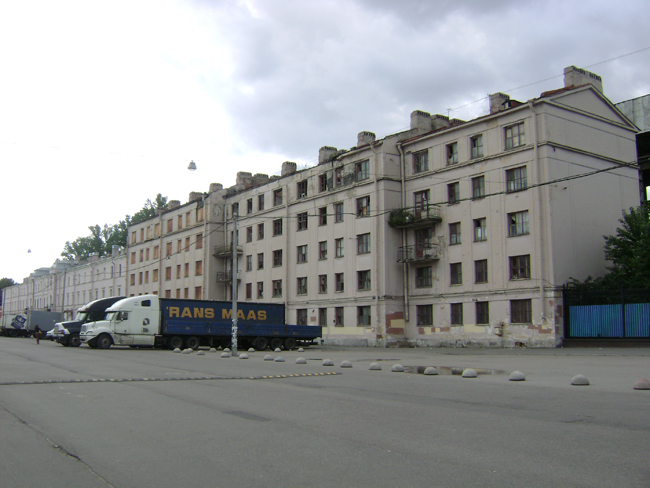
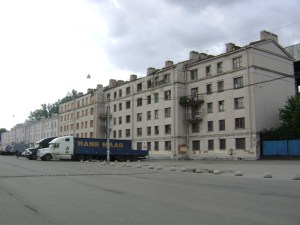
The windows of the pricey Finnish supermarket Prisma, in Saint Petersburg’s former Warsaw Station, look out onto a structure with a half-collapsed roof and scruffy walls. People live there, however. They pay rent to the mysterious “proprietor” of the resettled residential building. He probably managed to “come to terms” with local “law enforcement” for a time, but the building is slated for demolition.

Early in the morning of August 13, uniformed OMON riot police and plainclothes officers raided the homes of migrant workers in this building on the city’s Obvodny Canal.
DSC05079

Human rights activist and sociologist Andrei Yakimov, from the Memorial Anti-Discrimination Center, recounts what happened.

“At around 6:30 a.m., the ‘police’ arrived—about nineteen uniformed men and five or six plainclothes officers. After the riot policemen kicked everyone out of the building (they were not stingy in dishing out insults and shoves, nor did they give pregnant women and mothers with infants any break), they checked everyone’s papers and began ransacking the rooms where people lived, breaking down doors and searching for valuables. The migrants claim that jewelry was pilfered, money was snatched from wallets, and video cameras, tablet computers and laptops were stolen: many of the workers were preparing to leave the country and had bought presents for loved ones in Uzbekistan. Some had taken out small loans to buy tickets home. A pregnant women had the ninety thousand rubles [approx. two thousand euros] she had borrowed for medical treatment (maternity ward expenses) confiscated. The riot policemen handed all these things over to the plainclothes officers, who loaded them into cars. The total loot came to about six large plastic bags. The uniformed thieves made several trips there and back to get everything.”

Three days before the pogrom, the Federal Migration Service and regular police had done a check at the building. After looking at their papers for the umpteenth time and warning the migrants that the building would be boarded up and all tenants must vacate it by August 20, the authorities had then left. They knew that most of the workers were soon returning to their homelands. The robbery thus appears to have been carried out with a suspicious punctuality.

In the Building

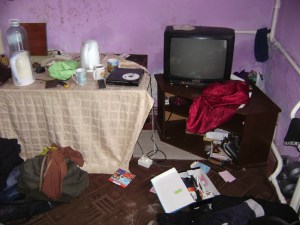
Ibrahim, an Uzbek worker, meets me at the threshold of the house on the Obvodny.  Limping, he leads me through a maze of dilapidated walls. In some places, oilcloth covers the leaks in the ceiling and the gaps in the windows. Surrounded by total poverty, people have managed to create some sort of living environment in several rooms. An elderly woman sits in one of these rooms: she is Ibrahim’s wife, Mavlyuda. Next to her is a pregnant woman, the one from whom police confiscated the money she had borrowed to give birth. Mavlyuda tells me that during the raid she lost everything she had earned. The riot policemen had told the plainclothes officers, “Go in and take what you want.” Not only did they steal rings, jewelry, money and new shoes, they even stole an unopened bottle of shampoo. (“What, they have no shampoo? And yet they stole it!”) A twelve-year-old boy had his new tracksuit confiscated. Police messed with the residents’ food supplies. They sprinkled laundry detergent into cooking pots, and tossed food out windows that they had smashed with the same pots. They poured cooking oil and flour onto rugs, clothes and beds. They took special pleasure in disposing of religious objects. Ibrahim holds a board in a broken frame—engraved verses from the Quran. Muslims hang such boards over the door. The riot policemen had trampled and spit on this board.

Ghalib, a construction worker from Uzbekistan, was beaten in the hallway of his refuge while attempting to prevent the robbery. Police confiscated his ticket home and tore it up in front of him. The women say that Ghalib is ashamed to tell where he was beaten. Police beat him in the kidneys and the groin so badly he urinated blood.

On the second floor, a girl of twelve or thirteen recounts how, first, stones were thrown at the windows, then men came and dragged the adults outside, saying to the children, “Come out, children, and brush your teeth.” Then the men began tossing televisions and household utensils out the windows.

His wife had warned Azamat, a truck driver, about the danger that day, and so he watched the pogrom from a hiding place. Later, he discovered that his money and a present (a watch) for his father, who has cancer, were missing. Azamat tells me how three of the policemen beat up a teenager whom he did not know. Non-Slavic in appearance, the boy did not live in the building (none of the residents had seen him before), he was just in the wrong place at the wrong time. “He got scared and ran, but they caught up with them and kicked him around like he was a football. When they picked him off the ground, he was limp like a rag,” Azamat says. He lifts a sweatshirt from a chair and shows me how the boy’s body fell.

After the pogrom, Pyotr Krasnov, a lawyer at the Memorial Anti-Discrimination Center, tried to help the victims.

“We filled out seven police complaint statements at the scene and left around sixty complaint forms in the resettled building in the hope that residents would submit them to the police precinct themselves. In the end, three of the seven people who filled out complaints came to the precinct with us, which I think is a huge success in itself,” says Krasnov.

Ghalib, the man who was beaten, took his complaint to the police. The first thing he was asked was, “Why do you live there?” He then sought medical attention. When the doctors found out it was the riot police who had beaten him, they refused to issue him any documents detailing his injuries.
DSC05084

“Illegals”: How Is That?

After conversing with the tenants of the abandoned building on Obvodny Canal, I got the impression they do not realize they inhabit the premises illegally, and that the “proprietor” to whom they pay rent has no real claim on this “residential space.” “My papers are in order” is the main code in a migrant’s life, and the residents of the building on the Obvodny repeat it like a mantra. Their lives are lived outside the law, and even outside any notion that somewhere it exists and functions. The migrants, especially the young people, believe that buying the necessary documents (it doesn’t matter where) is in fact the correct, legal way of doing things. Many are surprised to learn that a “work permit” that has to be purchased is a fake.

Pyotr Prinyov, from the trade union Novoprof, opens a newspaper and reads a want ad aloud.

“Look here. ‘Wanted: Uzbek nationals with work permits . . .’ But it is the employer who is required to obtain a work permit. That is, it is issued with the employer’s involvement. But if someone shows up with a readymade work permit, then it is 99% certain it has been purchased. There are tons of want ads like this. It is clear that employers are at fault, and that migrant workers are forced to play by these rules.”

But people in the house on the Obvodny do not understand this. It was only the robbery that angered the residents. Document checks and arrests are routine. Regular extortions by police on the streets, and getting ripped off at hard jobs with long hours are things to be endured for the sake of families. But where is the reward now?

We talk with another woman, whose husband is being deported. With tears in her eyes, she speaks about three children in Uzbekistan, how they will have to go back, and that her husband will be unable to re-enter the Russian Federation for five years. At one point, she says something that applies not only to herself.

“Tell the Russians we are honest workers. Tell them we aren’t criminals. My boss at the kitchen [where she works], a Russian woman, almost started crying with me when she found out I was leaving: ‘Where will I find someone like you?’ She’s satisfied with me! Why do you say on television that an Uzbek killed someone? We’re not all like that. Tell them that Uzbeks are honest workers. We’ll leave, but will a Russian woman go clean the streets and stairwells like we do?”

Contrary to the popular myth of the total criminality of migrants, according to official statistics from the Prosecutor General’s Office (a body that checks the police and thus has no interest in fudging the numbers), the majority of crimes are committed not by migrants and guest workers, but by Russian citizens (22.57% versus 77.43%). And Moscow’s judicial department informs us that, in 2012, immigrants from the Commonwealth of Independent States (i.e., the former Soviet republics) had 17% of the crimes committed in the city on their conscience, but a quarter of these involved faked migration papers and work permits.
DSC05087

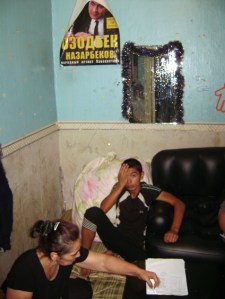
Andrei Yakimov debunks another myth.

“In fact, most of the migrants in Russia would like to forget they are migrants. They would adapt quite quickly were they allowed to. The older generation remembers the Soviet Union as a golden age, when they had it all. The younger generation of immigrants believes that dissolving into Russian society is better than going home. And that fabled Islamic solidarity is actually a fiction. Look at the mood in Tatarstan: Tatars experience the same xenophobia towards immigrants as Russians do.”

For now, though, everything goes on as before and will continue to go on this way. According to Memorial’s calculations, a so-called native Petersburg is twenty-six times less likely to fall victim to police violence than a person of “non-Slavic” appearance.

As you leave these robbed and humiliated people in their ruined shelter, you inadvertently catch myself thinking about what Alexander Herzen once said about the pacification of Poland: “I am ashamed to be Russian.”

Photos © Memorial Anti-Discrimination Center