Timur Kacharava’s Murder by Neo-Nazis Remembered Twenty Years On

Flowers laid at the site where the antifascist Timur Kacharava was murdered: a photoreportage by Bumaga

Twenty years ago, neo-Nazis assaulted Timur and his friend Maxim Zgibay outside the Bukvoyed bookstore on Vosstaniya Square. Today [13 November 2025] a spontaneous memorial arose there once more.

The murder: On 13 November 2005, Kacharava received six stab wounds to the neck and died on the spot. Zgibay was hospitalized in critical condition. Alexei Shabalin, found guilty of Timur’s murder, was sentenced to twelve years in a penal colony. Four of the assailants were sentenced to terms of imprisonment ranging from two to twelve years, while the other three were given suspended sentences.

The plaque: Nearly every year, the inscription “TIMUR, WE WILL ALWAYS REMEMBER YOU” appears on the wall of the building next to the murder site. Today, Yabloko party chair Nikolai Rybakov sent an appeal to [St. Petersburg] Governor Alexander Beglov, urging him to install a permanent memorial plaque marking the spot of Kacharava’s violent death.

The film: Leftist organization RevKomsomol – RKSM(b) has released the trailer of an upcoming film with the working title Antifascists by Calling. The film is being produced with the support of the creative association RevKino, RKP(i), and the nonprofit initiative Food Not Bombs.

Source: Bumaga (Facebook), 13 November 2025. Translated by the Russian Reader

Antifascist Timur Kacharava’s Mother Remembers Her Son 19 Years After His Murder by Neo-Nazis

It is a tradition in Petersburg to visit the improvised memorial to Timur Kacharava outside the Bukvoyed bookstore on Vosstaniya Street every year on the evening of November 13. Candles and portraits of the antifascist, who was murdered at this spot nineteen years ago, are brought there by his mother and a changing roster of first-time visitors. Last year the memorial was torn down by far-right activists.

Eight people were convicted of the knife attack on the twenty-year-old Timur and his friend Maxim Zgibay (who was wounded but survived the assault), and five of them were sentenced to prison. All of them have been released (the killer was paroled in 2016) and disappeared from the limelight.

Bumaga asked Irina Kacharava about the people she has seen at the memorials over the past nineteen years, how she feels about the release of Timur and Maxim’s assailants, and what life choices her son would have made in today’s Russia.

— How do you usually spend November thirteenth?

— The day before, I always wish it wasn’t happening. I wish it was the twelfth or the fourteenth. I wish I could just forget it, erase it, and be done with it. But I cannot. The thirteenth comes. I spend it at work or at home. Between five and six-thirty my husband and I go to the wall [at the Bukvoyed bookstore] on Vosstaniya Square. We go to the cemetery the day before, of course. We make sure to leave Timur’s favorite flowers, irises, [at his grave].

We hate this day, and we don’t want it to happen. For some reason it’s easy to go to the cemetery, but it’s very hard to go to the wall. But we gave our word that as long as we are alive, as long as we are able, we will go, no matter how hard it is.

We are always surprised that we are not the only ones there. Each year we think that this time round no one will come for sure. People come, and I’m surprised that all of them are young people. I ask them how they even heard about Timur, since they weren’t even alive when it happened. Nineteen years have passed. They say they heard [about Timur] from their moms and dads, and some from their brothers and sisters. That’s surprising.

We dislike this day very much, but we go to the wall, and then we try to start living again.

— Do you meet Timur’s friends? Do you communicate with them on other days?

— For a long time, ten years at least, we kept in very close contact with all of Timur’s friends. We would even get together. That has been winding down now, but it’s normal, I think. So many years have passed, and some have families, while others have left the country.

Mostly strangers or people who have been going for years come to the wall — for example, adults [sic] from the former Memorial.

— Over the years, it has been suggested that a memorial plaque be erected or a street be named in Timur’s honor. Do you think it is still possible?

— MP Nikolai Rybakov (who is the national leader of the Yabloko Party but not an MP — Bumaga) launched the campaign to put up a plaque. He personally approached us at the wall: he said he had made a request to the authorities, and that he was waiting for response. Time has passed, but nothing has happened.

— Would you like it to happen?

— I don’t know: I never thought about it. I don’t believe anyone will ever do it. And I don’t think it could happen at all given the current situation [in Russia].

By the way, there were fewer lads of conscription age [at the yearly memorial] when all these sad events [the war] began. At the beginning of the [military] mobilization, they were afraid to come. Law enforcement agencies are always present there to prevent mayhem.

— How did you react when one of the people involved in the attack, Alexander Zenin, who had been in hiding for twelve years, was detained in 2018?

— I laughed. He had been living in Pesochny the whole time. During that time he had managed to have two children, but the police had been unable to catch him. The trial was hard for me; my husband went to it. The police investigator called us and told us that the case would start to kick off again, that we would have to go to the court hearings again. He said that if we signed a paper that the case could proceed without our presence, then it would be wrapped up in one hearing. So we signed it. It turned out that he just wanted to tick a box and close the case quickly, and so there was no investigation as such. But it didn’t matter by and large. Whether he was caught or not, I wish him well and hope that his children grow up, for God’s sake.

— In 2007, you said about the attackers: “I have no vengeful feelings.” You haven’t had any since then?

— No, it’s not rational to seek revenge.

— Did they try to contact you, to apologize?

— What apologies could there be after I attended the court hearings?! I was alone there without my husband, and our lawyer was away at the time. I was alone against the seven defendants, their parents, and their lawyers. Twenty-one people tried to bite me (figuratively speaking), cut me, and kill me. I had started going to the court hearings to defend Timur. The parents of the defendants felt so angry with me that Timur had crossed their paths and caused their children to suffer.

Zenin sent us fifty thousand rubles in 201. He was apologizing, as it were, so that he would get a big plus [in his character testimony] in court. But I didn’t take the money. I asked the investigator how I could inform the court that I had not taken the money. He told me: “It was the good will of the defendant — he sent the money. Nobody cares whether you took it or not.” (Alexander Zenin was sentenced in 2018 to one and a half years in a medium security penal colony for inciting hatred and enmity.)

— You are employed as a teacher. Do you observe political activism among young children? Have their views been radicalized? Or are their attitudes apolitical?

— I’ll talk about their parents, because everything comes from the family. The parents are completely susceptible to propaganda. Of course, there are children who voice their opinions, but I do not get into these conversations with them due to professional ethics.

There are children who repeat what the TV says, what their parents say. Although there were some pupils whose parents were of the same opinion as me, and, accordingly, their children also think differently. I didn’t discuss things with them, but I was pleased to hear that not everyone was marching in lockstep. Although young people are chewed out, they are decent folk; there are all kinds of different people [among them], just like we were, just like you are. There are always pros and cons. It’s just that now the propaganda is so heavy that it is difficult to analyze the situation and have an opinion.

I can tell you this about the younger children. Whereas before [the war] they played cops and robbers, and no one wanted to be a cop, and everyone wanted to be a robber, now they play terrorists. And for some reason both sides are terrorists.

— What would Timur be doing in Russia in 2024?

— I think he would have left by 2022. He would have gone to Europe: he had his own people there. I would not say that he would have left for political reasons. The most important thing for him was music. He expressed his views through music. That’s where he would have gone. The politics would have been secondary.

— Is life in Russia more dangerous now than it was in 2005?

— Of course. There is no comparison. Despite what happened to our family in 2005, it’s not even up for discussion.

— Would you have been happy if he had left the country, but was safe and doing creative things?

— When children leave home or leave the country, it’s always sad, I guess. I’ve been trying to fool myself all these years (as psychologists have counseled me to do) that he’s alive but has just left the country. But it doesn’t work for me.

Would I have welcomed his leaving? I think it would have been his choice. His father and I would have had to accept that choice. It wouldn’t have mattered much whether we liked it or didn’t like it, whether we were sad or not. And who’s to say he would have been safe there? We don’t know what he would have done there. We would just have had to accept his choices, like we accepted his life choices in 2005.

I was reproached at the trial for not forbidding him from doing all those things. Doing what? Rescuing animals from the streets and feeding homeless people? (Timur Kacharava was a vegan and fed homeless people at Food Not Bombs events — Bumaga.) What were we supposed to forbid him from doing do? I just didn’t realize at the time that it would prove to be so dangerous. We would have just accepted his choice, because he would have had the right to it, as well as the right to make it a reality.

So, it is better that he lived a short, tragic life that was his own life rather than than the long, boring life which we would have dreamt up for him. Of course I would have been sad [had he left]. How could I not have been sad?

Source: “‘It is better that he lived a short, tragic life that was his own life’: The mother of anti-fascist Timur Kacharava, murdered in 2005, on who in St. Petersburg continues to remember her son,” Bumaga, 14 November 2024. Translated by the Russian Reader. As I was preparing this post, a friend of mine in Petersburg wrote me the following:

“Last night, I stood for a while next to the memorial to Timur outside the Bukvoyed store on Vosstaniya. Suddenly three antifa showed up, one of them sporting a mohawk. They told me that a bonehead [a neo-Nazi skinhead] had just shot at them with a trauma pistol. He had been going to attack one of the antifa, but when he noticed that there were three of them he ran away and fired a parting shot. That’s what they said. E. saw young boneheads at Avtovo that evening. Considering that they now often attack couriers and janitors [i.e., Central Asian migrant workers] in particular, there is partly the same disturbing feeling as before [i.e., during the intense wave of neo-Nazi attacks on ethnic minorities, immigrants, and antifascists in Petersburg in the late 2000s]. That’s on top of everything else.”

Twelve Years Ago Today

“Let’s clear the forest of the fascist occupation, 1941-2010.” 28 July 2010, Khimki. Photo courtesy of Antifa FM

It’s the 12th anniversary of the antifa protest in Khimki

Antifa.ru and other channels have recalled the historical date of 28 July 2010, when, at the height of its popularity, the antifa movement in Moscow was involved in solving social issues.

Throughout 2010, progressive Muscovites were extremely agitated about the planned construction of an alternate to the Leningrad Highway through the Khimki Forest in the nearest part of the Moscow Region. A lot of money was riding on the project, but responsibility for fighting the protesters was entrusted to the local Khimki authorities. Judging by their tactics, they were probably quite criminalized.

For antifa, the line was crossed when right-wing football hooligans — neo-Nazis, in other words — were involved in dispersing a tent camp set up in the forest by the protesters.

In late July, a secret concert by the bands Inspection Line and Moscow Death Brigade, popular among the antifa crowd, was advertised on social media. On July 28, Inspection Line vocalist and writer Petya Kosovo famously said to those who had come to the rendezvous point, “I hope there are no rubes here who think they just came to a concert? We’re going to Khimki!”

Several hundred young people exploded: they went to Khimki “to protect the Russian forest from Nazi occupation.”

Upon arriving in Khimki, right at the train station, they asked where city hall was, and the locals happily showed them the way. The protesters immediately produced masks and a banner about the Russian forest, and the crowd of about 400 people headed to the hated city hall, cheerfully chanting as they marched. On a video that circulated at the time, you can clearly see a police jeep fleeing from the determined young people.

It was the weekend, so the protesters were not able to talk with the local administration. The protesters decorated city hall with protest graffiti and shots from trauma pistols. They actually did very little damage to the building.

But this incident was followed by a shellacking. Only not the mythical shellacking of the Khimki City Hall, but the real shellacking of the antifa movement by the so-called law enforcement agencies.

Police raids took place all over central Russia — in Nizhny Novgorod, in Kostroma (where a whole punk-hardcore festival on a riverboat was arrested), not to mention Moscow and the Moscow Region. Hundreds of people were detained and beaten; hundreds fled Russia. Some left forever, while others returned after a year or two. But their spirit wasn’t the same when they came home: they hunkered down. And the movement — that big and formidable movement that had caused a stir in 2010, the movement that had protected workers and refugees from being illegally evicted from dorms and had defended the Khimki Forest — that movement no longer existed. The gloomy era of Bolotnaya Square and the constant stomping of protests, the era of crackdowns, was coming.

[…]

Source: Volja (Telegram), 28 July 2022. Translated by the Russian Reader


Vitaly Shushkevich: “Several hundred antifa and anarchists smashed [sic] the facade of Khimki city hall.
The activists demanded an end to the logging currently underway in the Khimki Forest.” Posted on 28 July 2010.

Alexei “Socrates” Sutuga, 1986-2020

Alexei “Socrates” Sutuga

Vlad Tupikin
Facebook
September 1, 2020

Alexei Sutuga, a former political prisoner and one of the most distinguished activists of the antifa movement, better known in Moscow by the pseudonym Socrates, died on the morning of September 1, 2020, at the Sklifosovsky Institute of Emergency Medicine in Moscow.

Since the Saturday before last, Alexei had been in a coma after suffering severe head injuries during a nighttime criminal assault in the vicinity of the Baumanskaya subway station in Moscow. His relatives and friends had been raising money for his treatment all this time. Now I guess we’ll have to raise money to support his mom.

You see, I started this text according to all the rules of news journalism. But actually I’m crying my eyes out.

Socrates was one of those rare people, strikingly intelligent and sensitive, who, it seems, you do not expect to encounter in the radical (anti)political and countercultural movement. Among people who need to think quickly and act quickly, as in war, how often you meet a poetic soul, a person who is ready to listen carefully, think over what others have said, respond to someone else’s pain and, more generally, to the particulars of another person’s state or condition? Socrates was that kind of person.

I will probably be updating this text, adding details, like bank account numbers, if necessary. Now I can’t even figure out exactly how old he was… Thirty-something. He was a big, strong, reliable, kindhearted guy from Siberia, an anti-fascist, an anarchist, a real hero of the working class who knew how to list, think, make decisions, and act.

He was.

Alexei Sutuga, born January 24, 1986, Irkutsk, died September 1, 2020, Moscow.

I’m sorry we didn’t save him.

Photo courtesy of Alexander Chernykh, who reminds his readers that Alexei Sutuga’s book Socrates: The Prison Dialogues (in Russian) is available for free download. If you would like to help the Sutuga family pay for his funeral and outstanding medical costs, you can send money via PayPal to his mother, Olga Nikolayevna, at https://www.paypal.me/sutugaolga. Translated by the Russian Reader

A Letter from Socrates in Prison

A Letter from Socrates

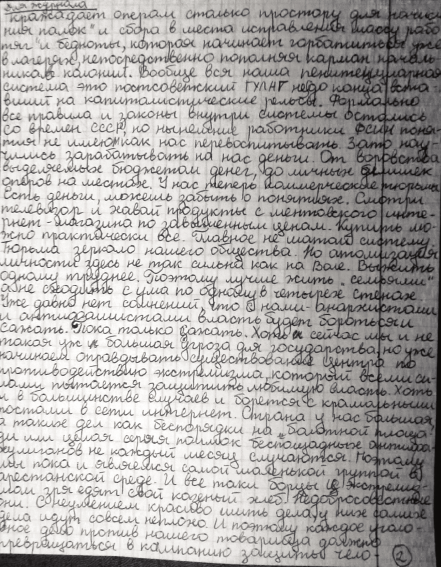
You can imprison us but you can never break us. We are not neo-Nazis who when they find themselves in prison try to slash their wrists, hang themselves, and swallow razor blades right off the bat. And who in the camps  quickly join the “goats” (kozlyatnya), the prison household work brigades. We can be part of the general prison population. We don’t have to fear that our fingers will be beaten off with a hammer or we will be whacked upside the head with a slipper, because we haven’t done anything “gross.” We don’t judge people by ethnicity, color, and creed. Here in prison we are all “wogs” and “bandits” in the eyes of the law, because we valued honor and truth  more than liberty. We are not Moscow chumps who imagined they were Aryan Vikings, but who as soon they went into the system realized they were not fascists but were like everyone else here. No, in Russia there will never be an Aryan Brotherhood like in the US. In our prisons there is a friendship of peoples.

sokrat_bwAlexei Sutuga

Moscow Babylon has seduced, hoodwinked, and punished all the poor fellows from all over the Soviet Union. Now we all hate those greasy pushers in suits flashing IDs, the stupid cops who have involuntarily become polizei, and we laugh at each other when we tell the stories of how we ended up here. Now, as in the years of the Soviet-era Great Terror, there are entire social groups getting run through the system for the same crimes. This is no fight against crime. It is a war with competitors for control of business and against their own (potential) poverty. The law enforcement agencies are doing business when they jail businessmen and officials for fraud (Article 159 of the Criminal Code). They nick their businesses from them and get rid of competitors who got caught with their hands in the till and did not cut them in on the action. Since the entire Russian business world is built on financial scams and fraudulent schemes, there is no shortage of new criminal cases.

The same is true in drugs trafficking. The terrible Criminal Code Article 228, Parts 3 and 4 (drug dealing), introduced by the president, has made it possible to populate the prisons and camps with Central Asian nationals, which has done nothing at all to disrupt the well-regulated flow of drugs, but justifies the work of the Russian Federal Drug Control Service and the entire Russian Federal Penitentiary Service. And such a time-honored crime among  prisoners as theft (Article 158) gives police investigators wide berth for padding solved cases stats and packing the penitentiaries with mobs of working stiffs and poor folk, who bust their humps in the prison colonies, thus directly lining the pockets of the wardens.

Our entire penitentiary system is a post-Soviet Gulag that has not fully embarked on the capitalist path. Formally, all the system’s rules and regulations have remained as they were in Soviet times, but the current Federal Penitentiary Service employees has no clue how to rehabilitate us. On the other hand, they have learned how to make money off us, from embezzling allocated funds to the personal deals made by criminal investigators at the local level. Russia now has commercial prisons. If you have money, you can forget about the unwritten “understandings” that once reigned. Watch TV and tuck into groceries ordered from the cops’ online store at inflated prices. Almost anything can be bought.  Just don’t rock the system.

Prison is a mirror of our society. But the atomization of the individual is not as forceful as it is on the outside. It is harder to survive alone. That is why it is better to live in “families” than to go crazy alone between four walls. For a long time there has been no doubt that the regime plans to combat and jail us anarchists and anti-fascists. For the time being they are only jailing us. Though now we are not such a big threat to the state, we justifiy the existence of the Center for Extremism Prevention (Center “E”), which does everything it can to defend its beloved regime. Although in most cases this amounts to combating seditious posts on the Internet.

sokrat_pismoManuscript of Sutuga’s letter

Our country is big, and things like the riots on Bolotnaya Square or the capture of ruthless antifa hooligan do not happen every months. So for the time we are the smallest group in the prison community. And yet the anti-extremism police eat their government-issued bread for nothing. They are unscrupulous. Although they are clumsy at fabricating cases,  they are doing quite well for themselves. And so every criminal case against a comrade of ours must be turned into a campaign to defend the individual from the state’s power over him or her. All the punitive institutions of the state should be subjected to attack. We and the people are on one side, and this leviathan with legs and dressed in a uniform is on the other.

Alexei “Socrates” Sutuga

*****

This letter was originally written as an article, entitled “Alexei Sutuga’s Letter from Behind Bars,” and published on July 19, 2015, in Avtonom 36 (2015).

Images, above, courtesy of Autonomous Action

Thanks to Vladimir Akimenkov for the heads-up. If you follow this last link you will find information, in Russian, about Sutuga’s address at the prison colony in Angarsk where he is currently serving his sentence, where and how to send letters to him, and how you can help him and his family financially.

OVDInfo.org has published the following summary of Sutuga’s case:

Alexei Sutuga is an anti-fascist and member of the Autonomous Action anarchist movement. In April 2012, he was arrested on suspicion that on December 4, 2011, he and a group of anti-fascists had assaulted a group of young nationalists, and that on December 17, 2011, he and his friend the anti-fascist Alexei Olesinov had assaulted security guards at the Vozdukh Club in Moscow. The accused and people who had been attending a concert at the club testified that the security guards had themselves provoked the fight and used weapons. In 2013, police investigators admitted that Sutuga had had nothing to do with the incident on December 4, 2011. In  the summer of 2013, he was released on bail from remand prison, and in January 2014 the case against him was closed as part of an amnesty. Afterwards, according to Sutuga, Center “E” officers threatened him with “problems.”

In April 2014, Sutuga was detained  by Center “E” operatives after an anti-fascist concert in Moscow’s Izmailovo district. According to a report by the For Human Rights Movement, ten other people were detained besides Sutuga. The pretext was a crime committed by a person unknown in the vicinity of the concert, but according to the human rights activists, there were no grounds for suspecting the anti-fascists. Sutuga was asked about a trip to Maidan as he was being detained. All the other detainees were soon released, but a disorderly conduct report was filed against Sutuga and he was kept at the police station.  He was later charged with having delivered multiple blows with a chair, his feet, and an improvised hammer to several people during a fight at a Sbarro chain restaurant outlet on January 2, 2014. Sutuga himself claimed that he had been trying to separate the people involved in the fight, which, according to him, had taken place between a group of right-wing youth and another group of young people, and that in the process of pulling them apart he had struck someone once. On October 1, 2014, Sutuga was sentenced to three years and one month in a medium-security penal colony. On December  17, 2014, an appeals court upheld the judgment.

In April of this year, Antti Rautiainen reported the following to Infoshop News (which I have summarized).

Sutuga has been transferred to the Irkutsk Region. He has refused to do household work in prison (which could reduce his sentence), unlike neo-Nazis Maxim Martsinkevich and Roman Zheleznov, as this form of collaborating with prison wardens is impossible for an anarchist.

Sutuga is twenty-nine years old. His sentence will end in May 2017.

On March 17, Sutuga went on hunger strike, demanding that his confiscated letters and books be returned to him and that he be transferred from the remand prison in Irkutsk, where he was incarcerated, to a prison colony.

On March 22, Sutuga was transferred to Prison Colony No.14 in Angarsk.

The Memorial Human Rights Center declared Sutuga a political prisoner on March 20.

Sutuga has a wife and child who live in Ukraine. His spouse is studying for a PhD and raising their child.

The cost of a two-way flight to Angarsk for his wife and son is about 60,000 rubles (approx. 1,200 euros). Only one long-term conjugal/family visit is permitted every three months. Alexei’s family needs money for sending parcels of food and other necessities to the prison colony.

Alexei Gaskarov: “The Desire for Justice Has Not Faded”

“The Desire for Justice Has Not Faded”
Alexei Gaskarov (as reported by Maria Klimova)
29 December 2014
MediaZona

On August 18, 2014, the Zamoskvoretsky District Court in Moscow sentenced four defendants—Alexei Gaskarov, Ilya Gushchin, Alexander Margolin, and Elena Kokhtareva—in the so-called second wave of the Bolotnaya Square Case. Judge Natalya Susina found each of them guilty of involvement in rioting (Article 212, Part 2 of the Russian Federal Criminal Code) and using violence against authorities (Article 318, Part 1). Gaskarov was sentenced to three and a half years in prison. On November 27, the Moscow City Court dismissed an appeal against the sentence filed by all four defendants.

Antifa: “We Were Able to Tell Good from Evil”
There are different people in prison. The majority are not the same people we are used to interacting with on the outside. There are different sorts: junkies, criminals, and outright riffraff. But I still find myself thinking I had seen a number of these characters in the yard of my building back in the day. I have flashbacks when I encounter these people. So when you ask why my friends and I became antifascists, you have to imagine the environment we come from.
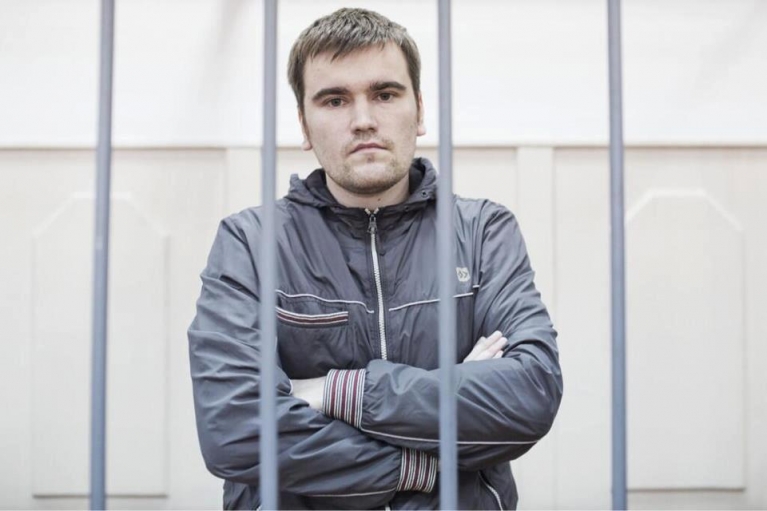
Photo_Gaskarov_behind_barsAlexei Gaskarov

I remember well what was happening on the streets in 1998–1999. The first skinheads and football hooligans had appeared, ethnically motivated killings were becoming more frequent, and rabidly fascist ideas were gaining popularity. A reality emerged that was invisible to the majority of people. With each passing year, the situation worsened, and the violence increased. We wanted to oppose it. We were able to tell good from evil. The neo-Nazi scene, on the contrary, attracted people not blessed with intellect, frankly. Most of them were up to nothing more than wasting their time on inciting racism and making fake videos of racist attacks. People like Artur Ryno and Pavel Skachevsky, the White Wolves, and other asinine teenagers bought into this.

Society has paid no mind to the killings of migrants, because it is quite xenophobic itself. Its attention has been drawn when Russians square off against Russians, when neo-Nazis murder antifascists in stairwells. But, in fact, at least one hundred ethnically motivated murders occurred in 2008–2009, and this should have been cause for concern.

BORN and Donbas: “They Have Been Hoodwinked”
I have tried as much as possible to follow the trial in the BORN case. It is complete nonsense that the accused are now pretending their actions were motivated by concern for the Russian people. This crazy fascism has nothing to do with defending ethnic Russians.

The boneheads (neo-Nazi and white power skinheads) were a product of society as it existed then. Maybe if Russia had been a democratic country, as it is on paper, the right-wingers would have had the chance to realize themselves in the political arena. In fact, all they had was street politics. The question is whether all those murders would have been committed had they been able to register their own political parties officially.

As we see from the testimony given at the trial by Nikita Tikhonov and Yevgenia Khasis, the neo-Nazis tried to get their own political party, but to create it they needed a combat organization. By creating BORN (Combat Organization of Russian Nationalists), they were hoping to force the regime’s hand, to show they were capable of violence, but that there would be no violence if they had legal means of pursuing their ends.

The antifascists never had the goal of killing anyone. It was the neo-Nazis who first embarked on the path of violence, but this was because there was a certain political will for this. It is important to realize that, despite the street battles, until the mid 2000s the ultra-rightists did not see the antifascists as people whom they needed to shoot first. However, after Maidan 2004, the regime clearly tried to find support within society, including among potentially loyal young people. The nationalists were regarded as just such young people. There were lots of them, and they could be organized around football. This was when the first Russian Marches took place, and nationalists were allowed to set up semi-militarized training camps.

The neo-Nazis were supposed to oppose the so-called threat of orange revolution, the people dissatisfied with the current regime. Antifascists and anarchists were then considered part of this threat. This was when the turning point occurred: it was now considered a priority to destroy us.

Ilya Goryachev and Nikita Tikhonov, BORN’s ideologues, were apparently able to get the message to the presidential administration that they could confront left-liberals on the streets. And they would tell rank-and-file members of their gang that, for example, Pavel Skachevsky’s sister had been attacked by antifascists. This is complete nonsense: I know for a fact that antifascists Ilya Dzhaparidze and Koba Avalishvili didn’t do it. I don’t know whether Skachevsky’s sister was actually attacked at all. At the time, the website of DPNI (Movement against Illegal Immigration) was active, and it would publish information that was untrue, and simply meant to incite people. The fact remains that Dzhaparidze, who was murdered by the neo-Nazis, had nothing to do with this business. But the morons from BORN just believed it and did not even bother to verify the information. The same goes for why Ivan Khutorskoi was killed. It is, of course, complete rubbish that he broke the arms of underage nationalists. He might have talked to them and given them a slap upside the head, but no more than that.

The people from the far-right groups are no nationalists, of course. We know that many of them have gone off to Kiev to fight with the Azov Battalion, for example. This is not the same segment of nationalists that protested on Bolotnaya Square, but the marginal part of the movement, which took advantage of the fact that young people often go into denial when they see society’s existing problems.

I have the feeling that the BORN case, the case of neo-Nazis who sincerely believed they were defending the Russian people, has not taught anyone anything. We now see how this anti-Ukrainian hysteria has been whipped up. It is largely due to this hysteria that Russian citizens have been going off to Donbas to fight. They sincerely imagine they are going there to defend the interests of the Russian people. But in fact they have been hoodwinked. Like Vyacheslav Isayev and Mikhail Volkov, two of the defendants in the BORN trial.

Ukraine and Television: “Discrediting the Very Idea of Protesting”
Many people are too susceptible to television, to what they hear said on it. We have returned to 2004, when Maidan was a threat to the Russian regime. As then, our country’s authorities are trying to discredit the very idea of protesting against an existing regime.

We all remember the invasion of Crimea by “polite people.” It is clear that Ukraine has the right to resist—not their own populace, of course, but the armed men who entered their country and occupied government buildings. They entered the country, occupied cities, cut off access to information from the outside world, and pumped people full of propaganda.

Russia has done much to ignite chauvinist attitudes in eastern Ukraine, but neither have the Ukrainian authorities used all the means they have for negotiating. They should have introduced institutions of political competition and made their arguments with words. It would have been much better if they had tried to use democratic levers.

I know what European integration is fraught with. In Ukraine, all the political forces got behind integration with Europe. And then Russia suddenly adopted an antiglobalist stance. Yet it was obvious that being in a customs union with Russia would not have brought Ukraine any benefits. It needed reforms: hence the decision to unite with Europe. I do not agree with this decision, but I understand the arguments in its favor. At any rate, the choice for European integration was democratic. It is also telling that Maidan did not go massive when integration was being discussed, but only after the police forcibly dispersed a student demonstration.

I have much less access to information than people on the outside, but I believe the referendum in Crimea was held in such a way that it is impossible to say whether it was conducted properly or not. It is not possible to determine this right now, because even the current mood is largely shaped by propaganda that is broadcast in the absence of an alternative viewpoint. I cannot imagine holding a fair referendum at the moment, unless, perhaps, Ukrainian TV channels were allowed on the air there.

The question is who, exactly, will bear responsibility for its having happened this way.

Outcomes and Know-How: Why Be Involved in Russian Politics Today?
The verdict in our case, the closure of independent media, and all the hypocrisy around events in eastern Ukraine point to the fact the Kremlin has adopted a policy of self-preservation. This entire authoritarian system has begun to rot, but there are things allowing it to remain afloat. That is why it has to nurture the oligarchic elite, cops, and FSB officers.

This year has shown that banking on a majority consolidated at Ukraine’s expense and shutting out the twenty per cent who are dissatisfied with current policies is impossible without the loss of economic prosperity. Everyone has now been talking about restructuring our country’s resource-based economy. But why was this impossible to do over the past fifteen years?

You cannot constantly tighten the screws without the public welfare’s deteriorating. I have no illusions about violent revolution: however many people take to the streets and whatever it is they might oppose, there will always be more people from the security forces. So people have two ways of making an impact now: the first is going out and voicing their concerns, while is the second is quiet sabotage—leaving the country, not investing in anything. I know there are many people in business who are leaving because they cannot breathe here. The authorities can, of course, use the same scheme as they did on Bolotnaya Square, but that will trigger another outflow of people and capital; even more money will be taken out of the country. There will be fewer and fewer resources, but the salaries of the cops will still have to be paid. This, in turn, will lead to a split within the elite.

The current power structure is similar, in some sense, to the structure of BORN: it is just as completely opaque. Because of this, complete morons can be wind up at any point in the decision-making chain.

My sense is that the authorities will soon be forced to liberalize, to back off a bit. There will be breaks for businesses. For some, this will be enough to continue developing them. We will return to the old, slow path of growth. Maybe in some ways this is better than this crackdown and gradual slide into hell. They might stop dispersing opposition rallies or not jail Alexei Navalny, for example. The regime has many ways of avoiding a deplorable sequence of events.

Ukraine has shown that this pro-government crowd, who occupy niche positions, can just up and disappear one fine day. A year ago, no one knew that there would be tours of Yanukovych’s residence. When this happens, the old system has to be replaced with something.

The difference between federal and local politics in Russia is still not very great. This was shown well by the recent elections in my hometown of Zhukovsky, where local activists ran for city council and got half the votes, but in the end only two of them won seats.* This is not a good outcome. It has been impossible for activists to have an impact on anything. It did not work out when they wanted to defend a forest. The authorities shut down all such grassroots pressure campaigns.

It is not the outcome that matters nowadays, however, but the process of being involved, because what remains is a community with experience of solving problems. That community is not going away. And if certain changes suddenly begin in the country, then it is certainly a good thing such communities will already be there at the local level and can be the basis of new institutions. Yes, many people are now demoralized, but the desire to get justice and resist thievery has not faded.

Jail, Bolotnaya Square, and Me
I am certain that nothing would have changed had I not gone to the May 6, 2012, opposition protest on Bolotnaya Square, for example. No matter what I did, strange criminal charges would have been filed against me anyway. This is evident even from the news, where everything is presented in such a way that even popular TV presenters Tatyana Lazareva and Mikhail Shats, who were on the Opposition Coordinating Council [along with Gaskarov], are depicted as criminals.

The point is not Bolotnaya specifically, but the fact that if you are involved in activism, criminal investigations will be opened against you. That rubbish with Navalny and the stolen picture is a specific story stemming from Bolotnaya Square. I did foresee that this might happen.

I have no particular hopes for another amnesty. I have the sense the authorities might go for an amnesty for people convicted of economic crimes, because there is a theory that they could help improve the current economy, that the businessmen will one way or another add a fraction of a per cent to economic growth. The authorities could decide to do this. As for us, I have huge doubts. In prison, though, people always pin great hopes on amnesties. In reality, all the prisons are overcrowded: in violation of all European standards, there are two and half meters of living space per prisoner. And when Putin said, recently, that amnesties need not happen too often, he cannot but have known that practically no one got out under the first prisoner amnesty.

You can survive in the pre-trial detention facility, of course. There are no rats running around in the cell or moldy walls in here. And they take us out for a walk every day. True, the courtyard here is bare, and you cannot even see the trees. It is hard to keep track of the seasons: time flows differently on the inside. In short, they do not let you forget you are not at a health spa.

In terms of building relationships, the experience I gained while jailed for two months in the case of the attack on the Khimki town hall has come in handy here. I am used to the fact that people come and go at the pre-trial detention facility. You come across different characters. Recently, there was a guy in here who had lived in the woods for two months. He had been working in construction when he got screwed out of his pay. He didn’t know what to do and went into the woods. He drank hawthorn berry tincture there and had become something like a vagrant. He was nicked for stealing a bike.

I really want all political prisoners released as quickly as possible. And not only released, but released into a free country. I would like the space in which we all have to live to be freed up, to be less gloomy. This is my wish. That a thaw finally comes.

* City council elections took place in Zhukovsky, a town of 105,000 residents forty kilometers southeast of Moscow, on September 14, 2014, Russian general election day. Observers reported massive vote rigging, ballot box stuffing, and tampering with vote tally reports by polling station officials. A month later, members of the Presidential Council on Civil Society and Human Rights brought the matter to the attention of Vladimir Putin. The president promised to order the prosecutor’s office to investigate the election violations in Zhukovsky, but the outcome of the election has still not been officially challenged or amended.

Editor’s Note. This translation was previously published, with an excellent introduction and afterword by Gabriel Levy, on People and Nature. Translated by The Russian Reader.