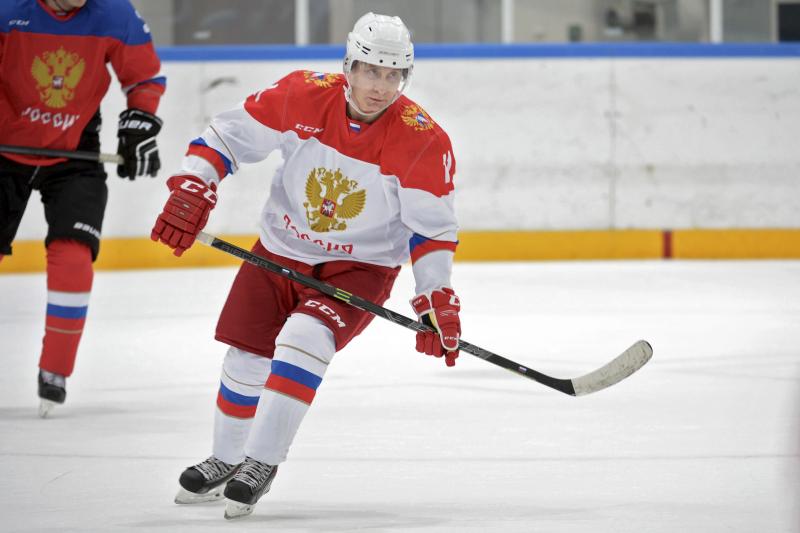
Russian President Vladimir Putin skates during a training session of participants of the Night Ice Hockey League in Krasnaya Polyana, Sochi, Russia, January 6, 2016. Photo: Aleksey Nikolskiy/Reuters
Disabled Man Not Admitted to Ice Hockey World Championship Match Because He “Walked Funny” Rosbalt
May 17, 2016
Roman Mironov, a Category I disabled man, was unable to attend a Ice Hockey World Championship match, despite the fact he had a complimentary ticket. He told his story to Rosbalt.
“I was given a complimentary ticket, because I am a volunteer and help people with disabilities. I decided to go to a hockey match at Yubileiny Arena [in Petersburg], but the police turned me away, saying I ‘walked funny.’ I asked them to substantiate their actions, but they refused to give me an explanation. I showed them my ticket, but they did not even want to look at it.”
According to Mironov, this was not the first time he had not been admitted to public events.
“There have been cases when I have not been admitted to public celebrations and football matches,” he said.
Mironov has childhood cerebral palsy, because of which, he admits, he has been the target of discrimination on more than one occasion.
The Russian Federal Interior Ministry officially announced that police do not exercise checkpoint and admission functions at sporting events.
“It should be noted the police’s job at sporting events, including the hockey championships, is solely to ensure public order,” the Interior Ministry said.
The Ice Hockey World Championship kicked off in Petersburg on May 6 and winds up on May 22.
Translated by the Russian Reader. Thanks to Mediazona for the heads-up. Photo, above, courtesy of Foreign Affairs
Court in Voronezh Rejects Forced Psychiatric Hospitalization of Opposition Activist Rosbalt
May 12, 2016
A Voronezh court has refused to involuntarily hospitalize opposition activist Dmitry Vorobyovsky in a mental hospital. As Voronezh political activist Alexander Boldyrev has informed Rosbalt, the opposition activist has been released from the hospital.
“I did not even expect this outcome, since even the hearing was declared open. But the prosecutor’s office did not support the motion to involuntarily hospitalize Vorobyovsky,” said Boldyrev.
Commenting on Vorobyovsky’s release, lawyer Olga Gnezdilova suggested that appeals by human rights organizations played a role by forcing law enforcement officials to pay attention to the letter of the law.
On Friday, May 6, Vorobyovsky was forcibly taken to the clinic from his home. People who said they were employees of the city gas company called at the door of his apartment. When Vorobyovsky opened the door, he was restrained and dragged off to an ambulance. The administration of the Voronezh Regional Psycho-Neurological Clinic filed a petition with the court to have the man forcibly hospitalized. Doctors called the hunger strike Vorobyovsky announced after his abduction “symptoms of his illness.”
Translated by the Russian Reader. Thanks to Comrade VZ for the good news. Photo courtesy of Amnesty International
Women in Petersburg Celebrated February 23 by Paving the Way to a Church with “Dead” Bodies Rosbalt
February 24, 2016
Photo courtesy of protest organizers
A protest action against discrimination and the [proposed decriminalization of] battery and homicide threats took place outside St. Nicholas Maritime Cathedral in Petersburg. Feminists thus marked Fatherland Defenders Day.
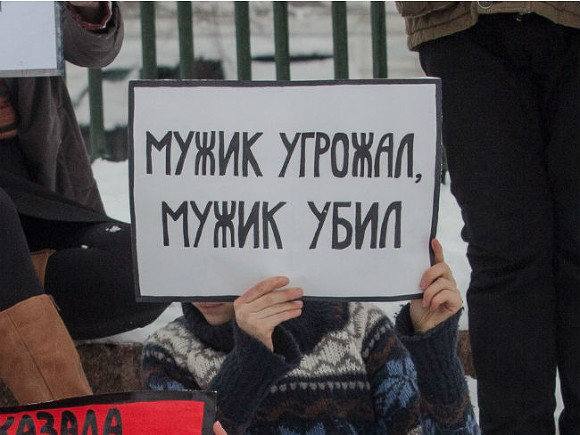
During the performance, two men laid out young women, who depicted the fatal victims of beatings, on the steps leading to the church. At the end of the protest action, the protesters raised placards bearing slogans such as “My man made threats, my man killed me,” “Who will defend us from the defenders of the fatherlands?” “I said no: he broke my arm,” “97% of abuse cases never make it to court,” and “Thank you, legislators, for our happy deaths.”
Photo courtesy of protest organizers“My man threatened me, my man killed me.” Photo courtesy of protest organizers
The organizers told Rosbalt they were protesting against the [proposed] removal of battery and homicide threats from the Russian Criminal Code.
“The decision as to whether women can find protection from law enforcement agencies or not is being made by legislators and priests who do not suffer from beatings by their partners. How is this possible? Do the lives and health of the country’s citizens not interest the government? Every fourth woman in Russia faces domestic violence,” the organizers noted.
According to them, it is extremely difficult for women to file battery complaints. And most often the perpetrator is not duly published: the charges are limited to a misdemeanor.
Whereas “women put up with violence their whole lives and often die at the hands of their partners.”
“We believe such a law is a crime,” noted the organizers.
Photo courtesy of protest organizer
The Way to the Church
Russian women marked February 23 by paving the way to a church with dead bodies.
The women were thus protesting the [proposed] exclusion of battery and homicide threats from the Criminal Code, a measure actively lobbied by the Russian Orthodox Church.
[President Putin] urged [lawmakers] not to delay passage of the law, which would decriminalize such articles of the Criminal Code as battery, homicide threats, and willful failure to pay alimony. (Kommersant, February 16, 2016)
Translated by the Russian Reader. Thanks to Comrade SJ and the Nihilist for the heads-up
__________
Russian Supreme Court proposes to decriminalize minor offences RAPSI
July 31, 2015
MOSCOW, July 31 (RAPSI) – Russia’s Supreme Court suggested decriminalizing minor offenses such as battery, the threat of homicide, failure to pay alimony or child support, RAPSI learnt in the court on Friday.
In a meeting with President Vladimir Putin, Supreme Court Chairman Vyacheslav Lebedev proposed that minor crimes such as battery and petty theft be decriminalized and classified as administrative offenses [misdemeanors]. He said this would reduce the number of cases sent to court by 300,000 annually.
A bill, which the Supreme Court has drafted, would decriminalize petty crimes such as battery, the use of forged documents, the threat of homicide and failure to pay alimony or child support. Penalties for these offenses would only include fines, correctional labor or community service.
Justice Vladimir Davydov said at the plenary meeting that this would free up half of all investigators to deal with serious crimes and would help over 300,000 people avoid criminal penalties and negative consequences for employment, education and the issuance of passports or loans.
A deputy prosecutor general said he supported the idea, adding that approval would allow investigators, who claim to be too busy with petty crimes, to investigate more serious crimes.
Petty crimes accounted for 46 percent of all cases sent to court last year.
__________
Putin suggests decriminalization of Russian Penal Code TASS
December 3, 2015
Russian President Vladimir Putin has asked Russian lawmakers to support a proposal to decriminalize a number of articles of the Russian Penal Code.
“I am asking the Russian State Duma to support the proposal of the Russian Supreme Court to decriminalize some articles of the Russian Penal Code and transfer some of the crimes that pose no great threat to the public or society to the category of administrative offenses but with one major reservation: the offense will be classified as a crime if it is committed for a second time,” Putin said in the annual state of the nation address to the Russian Federal Assembly (parliament) on Thursday.
The head of state clarified that practically every second criminal case, which is taken to court today, is linked to minor and inconsiderable offenses while people, including youth, are sent to prison.
“The confinement and the fact of criminal conviction affect their future fate and often encourage them to commit further crimes,” the president concluded.
Russian penitentiaries have around 660,000 inmates. According to the Federal Penitentiary Service, 55% of them are recidivists. Approximately 25% of the offenders serve prison sentences for minor offenses and crimes of medium gravity; 1,800 people have been convicted for terrorism and extremism.
Excessive acts of law enforcement agencies destroy business climate in Russia
Putin said excessive acts of law enforcement agencies destroy the business climate in Russia.
“That is a direct destruction of the business climate. I am asking the investigation and prosecution authorities to pay a special attention to it,” he said.
The President said that in 2014 nearly 200,000 criminal cases on economic crimes were initiated in Russia. Of this number 46,000 reached the court and 15,000 cases “collapsed” in courts.
“It turns out that only 15% of cases ended with verdicts,” Putin said.
He added that most of the defendants in these cases – about 83% – fully or partially lost their businesses.
“That means that there were bullied, robbed and released,” the head of state said.
He called on prosecutors to make a wider use of their authorities to monitor the quality of the investigation.
The president also recalled the discussions on additional powers of prosecutors.
Today, a supervisory authority has the authority to cancel decisions on initiation of criminal proceedings, to dismiss indictments or not to uphold the charges in court.
“We need to use what we have more intensively. After that we will be able to analyze what is happening in practice,” he said.
According to Putin, detention at the stage of investigation of economic crimes should be used as a last resort and preference should be given to such methods as pledge, subscription on parole and house arrest.
Striking Petesburg truckers Oleg Krutskhikh and Alexei Zhatko
“Soon the whole country will work for the Rotenbergs”
Antonida Pashinina
November 25, 2015 Rosbalt
Long-haul truckers have continued their protests against the Plato system in Russia. Truckers are outraged by new tolls on federal highways and are determined to have them abolished. In the Northern Capital, drivers got all the way to the Smolny [Petersburg city hall], but a dialogue with the authorities did not take place there. Private entrepreneurs and veteran truckers Oleg Krutskikh and Alexei Zhatko told Rosbalt about why they are willing to fight to the last, what they will do in the event of failure, and what their families think about their protest.
How did you start working as truckers?
Oleg: I began driving when I got out of the army, in 1998 or 1999. My dad was a driver, and I followed in his footsteps. You know how it is: army brats are drawn to the army. Well, sons of truckers are drawn to trucking. First, I drove a KamAZ, then a MAZ. I am from the Voronezh Region. In the 2000s, my family and I moved to Petersburg. I spent ten years behind the wheel of cargo trucks, then I became an entrepreneur, although I have kept driving myself.
Alexei: I am originally from the Stavropol Territory. I moved to Petersburg in 1999. I moved my father here. He is a trucker. At first, I worked as a dispatcher in a container company. Then I took a truck from this company to break in. I put Dad behind the wheel, and he went to work. Then I started to drive myself and I bought several trucks.
It was profitable to work in freight haulage then, right?
Oleg: Yes, in the no-holds-barred nineties and noughties, you got paid in cash in dollars. A round trip within the city cost $100, to Moscow, $850–950. Then we were forced to legalize, which was the right thing to do. We started paying taxes. We became self-employed entrepreneurs or turned our operations into limited liability companies. Until 2008, we did more or less all right. We made enough to pay for fuel and pay our drivers. The oil flowed abroad, and the government had enough money both for itself and for people, to throw them some bones. Then the dollar rose, the price of spare parts soared, and there was less work. Depreciation amounts to a lot of money in Russia, and you are left with peanuts. Basically, we cannot afford to replace our vehicle fleets.
Alexei: From 2002 to 2008, when the tax system was semi-gray and payments were made in cash, I bought trucks. I had eight of them. Subsequently, every year I would cut one truck to be able to repair the rest. Now I have one heavy transport truck left. I used to have these issues. I would drive to the service center and they would replace all the bad parts. You won’t believe me, but now I know which city and which demo yard has the cheapest spare parts. What is a demo yard? A place that sells used parts. That means we are not running 100% safe on the road anymore. Even if a part has 20% wear and tear, your safety is lower.
Oleg: The point is that incomes have fallen almost to zero. Basically, [the authorities] want to take the shirt off our backs, but we are refusing to budge. We are not earning anything nowadays. We have ground to a halt and are idling.
Have you been involved in the protests for long?
Oleg: Since November 11.
Alexei: I was out of town for two months. I left in August, and when I got back these new developments had emerged. I was forced to leave the truck in Krasnodar and fly here. It was cheaper. I have not worked since November 15.
The stance of the authorities is clear. Long-haul truckers must pay the damages the big rigs cause to federal highways.
Alexei: I really do not understand this. If the permissible weight is forty tons, how can I cause damage to roads? I pay motor vehicle tax and excise duties. I cannot cause more damage than is stipulated by the State Standards. But I am told that I cause more damage than I should anyway.
Nobody knows how the motor vehicle tax is spent. Take a look at our roads. The M10 from Petersburg to Moscow is more or less okay. The M7, to Tatarstan, is good, and the M4 is not bad. There are no other [decent] roads [in Russia]. Take, for example, the M5. The section from Syzran to Penza is a disaster. From Samara almost to Ufa there are two hundred-odd kilometers that we travel at a snail’s pace. And then they say they are closing the highway because it has drifted. In fact, they just do not plow the road, and traffic moves slowly. You cannot climb hills or get up to speed. So the authorities decide to close the whole thing. It is easier for them.
Oleg: Or take a look at how much the toll roads cost. They have now opened a road near Vishny Volochyok to Moscow. It is 920 rubles one-way, meaning nearly 2,000 rubles round trip [approx. 28 euros]. The toll on the M11 is 1,200 rubles. So a round trip has gone up by 4,000 rubles. And I have not figured in the tolls on the Western High-Speed Diameter. Plus, the Plato system costs around 2,000 rubles until March, then it will cost 5,000 rubles. The rise in expenses due to toll roads will come to around 9,000 rubles. That is a 25% increase.
Look, a 25% rise in freight haulage costs means that all the prices in the shops will go up. Old ladies and pensioners will bear the brunt. I think the authorities are keen to put tolls on absolutely all roads. For example, Leningrad Region Governor Drozdenko said that regional roads should be toll roads, too. They have gone after the truckers first, because we could be accused of damaging the roads. If they imposed this law on all drivers at once, it would not be just us who were out protesting. Others would come have out as well.
Do you think the authorities were afraid of mass protests?
Oleg: I think they wanted to get us to this point stage by stage. At first, they will work out the bugs on us, and then gradually incorporate everyone else.
It will come to the point where drivers of passenger cars will pay the duty as well. If we do not squash it and stop it, the entire country will work for the Rotenbergs. The burden will fall on everyone’s shoulder. We will be like slaves. They will legally be able to use us.
Alexei: Try and understand the trucker’s mindset. I like my job because I am as free as the wind. If I want to go Novosibirsk, I go there. Tomorrow, I might want to go to Krasnodar. It is a kind of freedom. But now they are trying to put a noose around my neck, and they can always tighten it. I find myself in Novosibirsk, for example. They tighten the noose, and I cannot make it back home. My only choice would be to abandon everything, sell the truck, and get home on some other form of transport. So I don’t want this noose. But long-haul truckers are a kind of caste who are no strangers to hardship. Our lifestyle differs little from that of a dog. We live in our rigs like a dog in a kennel. Just like a dog pisses on the wheel, so do we. So if truckers do end up moving on Moscow [in protest] that will not be a problem. Living in our rigs for a month near Moscow would be easier than pie.
You have not even tried to register on the Plato system?
Alexei: Why should I? I don’t recognize it and I am not planning to recognize it.
It would be easier for me to run my rig downtown sometime, drive it up to the Smolny ignoring all the traffic warning signs, and set fire to it.
What is the point of working under such a system? I am ashamed for the government. I used to idolize Medvedev. I used to respect him. Three or four years ago, he said that we would add a tax of seven rubles to the price of fuel and abolish the motor vehicle tax. I was really happy about this. I thought, let it be that way. I did not quite get it, but it would be simpler for me than running to the state savings bank all the time to pay the taxes and fees. But how has it all turned out?
Now they are promising to reduce the fines, but there is not a single regulatory document backing this promise up. You phone Rosavtodor (the Russian Federal Road Agency), and [they tell you] the rates on the Plato website are still in effect. How is that? My idol Dmitry Medvedev says one thing, but something else happens. This has political implications. But still, it is painful, what can I say.
I understand that you don’t want to associate your protests with politics?
Oleg: This is our life. We are fighting for it, for the lives of our families and their families.
Alexei: We don’t need revolutions and upheavals, because there are problems after all upheavals, and the economy will have to recover. There won’t be any work, and the country will suffer from poverty. We don’t want that.
And what is the difference? One group of people is now in power, then people just like them will take over. The only thing I do not understand is why a barrel of oil cost eight dollars in the 1990s, and now it costs over forty dollars, but we still do not have enough money. And why in the 1990s, if someone in the government admitted his mistakes, he offered his resignation, but nowadays an official who has goofed up big time says, “Well, that didn’t work out. Sorry, but I am going to keep working.”
Oleg: And what happened with [former Russian defense minister] Serdyukov? How could you, guys? They spit in the country’s face. If they spit in the Investigative Committee’s face, who are we truckers? I won’t be surprised if [the powers that be] do not react to us at all, if they just have the riot police crush us.
You think they could start cracking down on the protests using the riot police?
Oleg: For now we are being treated more or less decently. Time will tell.
What is the news from the field? Do you know anything about how the events have affected businesses in Russia?
Alexei: The first [city] to sound the alarm has been Tyumen. They produce their own bread and milk, but everything else is shipped in. The produce will not last long. In Volgograd, a glass factory has temporarily shut down. But here I am thinking: many factories are certainly owned by politicians, by MPs. Ordinary people would not own them. And this is a blow to the owners. So while we are not driving, there should be some movement on the part of our rulers.
According to my information, there are four ferries at a standstill in Novorossiysk, and New Year’s is around the corner. In Derbent, there are many train cars loaded with persimmons, tangerines, and pomegranates that are not going anywhere. They simply have nowhere to offload the produce there. The persimmons arrive there in ordinary heated freight cars and cannot be stored for long. I think if we continue the stoppage, then it will not just be a protest—
But a strike, rather.
Alexei: It is a strike. We cannot go back on the roads. We have been cornered. If things go on like this, it will be worse.
Approximately how much do you pay in taxes per year?
Oleg: I did the calculations for seven trucks. We burn through about 30 tons of diesel a month. Multiply that by 7 rubles, and it comes to 210,000 rubles a month, or two and half million rubles a year. Plus there is the motor vehicle tax and the taxes for individual entrepreneurships and limited liability companies. All in all, it comes to around three and a half million rubles [approx. 50,000 euros]. Meaning that if Plato goes online, we will probably bite the dust, and the treasury will come up three and a half million rubles short. If you do the math, that amounts to good pensions for twenty-eight old ladies or tiny pensions for fifty old ladies. So all those old ladies will lose their pensions. The people who work for me will end up at the unemployment office, and the state will have to cut them unemployment checks.
The truckers have shown all Russians a great example of solidarity. Basically, people from different parts of the country have united to fight for their rights.
Alexei: Despite the fact that the media have been blacking us out, all of us—our groups of drivers and our dispatchers—have been getting the message out. I have lots of dispatchers who have been explaining to customers that they are not going hand over loads to anyone, because we are all in solidarity, because each of us has his trucks out there. When I was driving from Novorossiysk to Krasnodar to store my truck in the lot there, a traffic cop stopped me. He asked where I was going. I explained I was going to a lot, then flying to Petersburg.
That was a traffic cop who asked me. What does this tell us? That the traffic police, too, probably have their own trucks out there or friends and acquaintances. They support the truckers, but they have their orders. I myself am a former military man. Everyone understands everything perfectly.
As far as I know, the police have so far not been actively hindering the protests. In Petersburg, for example, the protesters got off with small fines.
Alexei: No, their objective is to break up the convoys of trucks.
Are you not afraid of provocations?
Oleg: We got together to figure out how we would run our protests, and there was immediately news on the web that Oleg Krutskikh was an accomplice of Navalny and all. Someone started writing to truckers that there would be no protest, that it had been called off. A specific agency is working against us.
Alexei: People get SMS alerts that a protest will not take place. That so-and-so works for Navalny and is trying to start a commotion.
What do you think about United Russia MP Yevgeny Fyodorov’s statement? He said you were protesting “at the behest of the United States.”
Alexei: That is insane. Perhaps the man has some problems. Maybe he reads too much about America. There is no trace of commonsense audible or visible in what he said.
Oleg: I would like to appeal to you as a member of the media. 80% of the news is about Egypt and Syria. Guys, we have so many problems in our own country that at least 95% of the population could care less what is happening abroad. Only the 5% who have business abroad care. I have a huge request for you all: tell us, the 95%, about Russia. When things have been put to right in Russia, maybe you can tell us about life in other countries.
Alexei: I guess then it will be difficult for someone to raising his popularity rating. Showmen dominate politics in our country. More than anything they want good ratings, not to solve the major problems within the country.
I really am unconcerned about what is going down in Donetsk when I have nothing to eat at home. I have to feed my own people. I have two children, after all. I have been shut down for two weeks, and I realize that my wallet is empty.
Will your reserves last long enough to keep off the road like this?
Alexei: It doesn’t matter. We will go take out a loan then. Clearly, we won’t be able to pay it back. But we do not have much of a choice. We have to live.
So you are going hold out to the last, then?
Alexei and Oleg: We will hold out to the last. We have nothing to lose. We cannot go back out on the road: we will be fined.
How have your families reacted to your involvement in the truckers’ protests?
Alexei: My family has never been involved in politics. My spouse, although I do not share information with her, sees and understands everything perfectly well. She is a speech therapist and a teacher, who gets paid no more than fifteen thousand rubles a month [approx. 215 euros]. Yet she tells me I should quit this business. But I cannot quit my job. This is a lifestyle.
Oleg: It would be hard now to retrain to do some other job. As for the protests, my involvement has been spontaneous. They say I am an activist. I am no activist. I am just someone who generally likes the truth.
Everyone now involved in the protests are activists.
Alexei: Yeah, take any trucker. Any of us can be slapped with the charge of organizing a protest. Because all of us are on the telephone communicating.
We exchange telephone numbers at our encampments, and that has united us even more. But we have no leaders. All of us are organizers. We agree to meet by calling each other. One person passes the information on to the next person. The radio is our mass medium. All of us could be locked up as organizers.
In Dagestan, for example, it is not just Dagestanis who are attending the protests, but people from different regions. The guys at our encampment in Novorossiysk snapped and took off for Dagestan, because they knew it would be the hottest spot. That is how fast information spreads among our lot. And if the politicians think we are disorganized louts, they are wrong, although that is what many of them are saying.
Translated by the Russian Reader. Photo courtesy of Rosbalt
Female Pensioner from Leningrad Region Beats Official with Stick
November 23, 2015 Rosbalt
SAINT PETERSBURG, NOVEMBER 23. Criminal charges have been filed against a sixty-one-year-old woman who assaulted the head of a municipal district in the Lomonosov District.
As the press service of the Leningrad Regional office of the Investigative Committee informed Rosbalt, the official had gone to a village to deal with the populace’s discontent over construction of a parking lot. During the discussion, a local woman hit him with a stick.
She has been charged with the criminal offense of “inflicting violence on a public official.”
Translated by the Russian Reader. Image courtesy of www.zazzle.co.nz
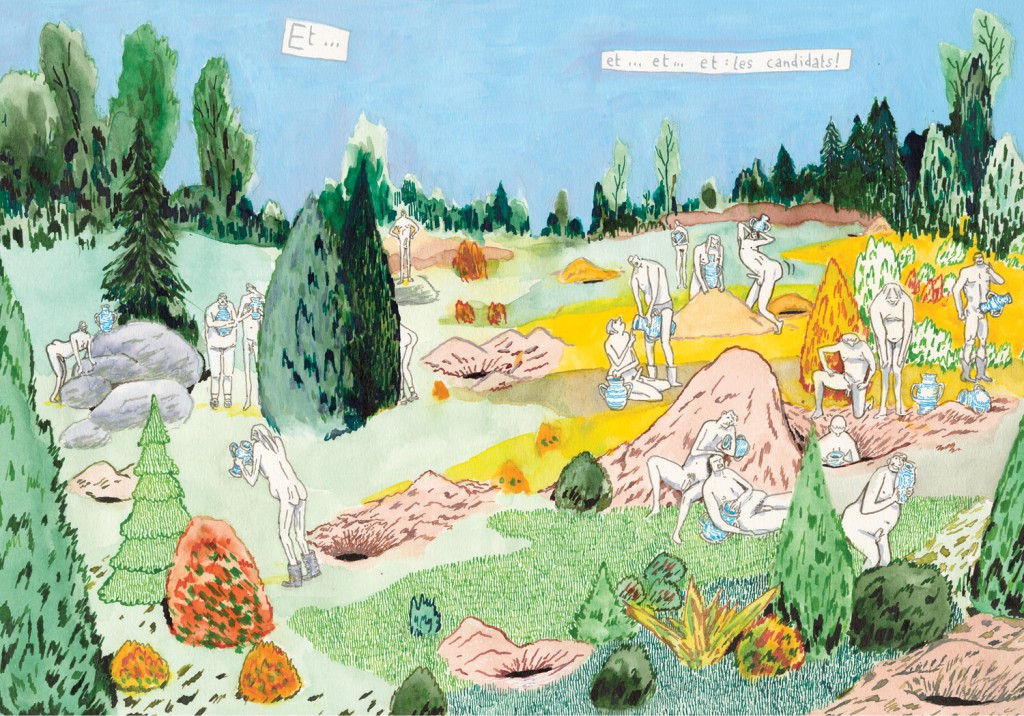
Dominique Goblet and Kai Pfeiffer, panel from Plus Si Entente
Boomfest founder Dmitry Yakovlev said to Rosbalt that museum staff had told him problems might arise with the show because of the nudity while it was still being mounted. A compromise was therefore reached. The European artists’ nude characters were dressed in paper underwear.
“We agreed to a compromise. The guests at the show’s opening even thought the underwear was supposed to be there. The artists were probably also not willing to have their show closed. But this variation with the underpants was found. Naturally, before opening the show, we discussed it with the museum. We promised there would no flagrant eroticism or pornography. Yet when you walk around the city there are naked bodies all over the place,” said Yakovlev.
The exhibition was open three days. It was dismantled personally by staff at the Nabokov Museum. Boomfest organizers have no plans to find a new venue for the show. Its layout was quite complicated, as it was embedded into the museum’s interior. The works will soon be sent back to Goblet in Brussels, and Pfeiffer in Berlin.
Dominique Goblet and Kai Pfeiffer
According to Yakovlev, this was the first time an exhibition had been shut down in Boomfest’s nearly decade-long history. However, festival organizers have experience organizing even more complex projects in terms of message and graphic content. For example, in 2011, artists Anton Nikolayev and Victoria Lomasko presented the book Forbidden Art, a graphic reportage documenting the trial of the curators of the exhibition Forbidden Art 2006.
“I am extremely saddened by what has happened, but I am especially sadden by the fact that we don’t know the exact cause of the show’s closure,” said Yakovlev.
Translated by the Russian Reader. Images courtesy of Boomfest
Baltic Pearl Migrant Construction Workers Demand 780,000 Rubles from Employer
July 20, 2015 Rosbalt
PETERSBURG, JULY 20. Workers building the Baltic Pearl residential complex have demanded back pay from their employer, Trivium Group. As one of the construction workers, foreman Khusrav Kholmirzayev, told Rosbalt, the employees calculated the company has owned thirty workers approximately 780,000 rubles [approx. 12,600 euros] since last year.
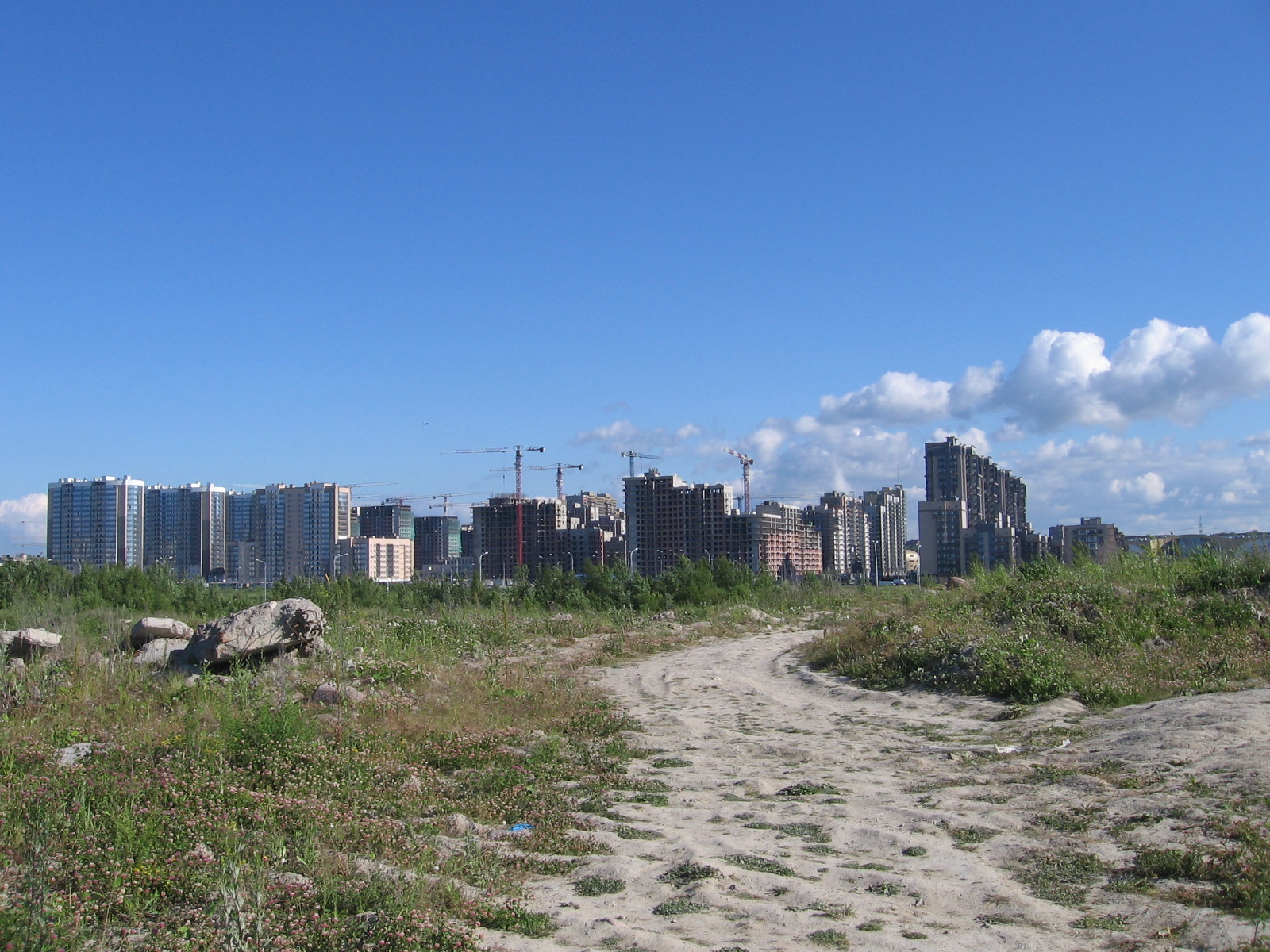
The Baltic Pearl. June 28, 2015. Photo by the Russian Reader
According to Kholmirzayev, last year, three crews were employed on the building site, and he supervised thirty men. He added that they worked without having signed labor contracts. Meanwhile, Russian authorities deported several migrants: the workers did not have enough money to pay for work licenses. Kholmirzayev noted that his crew was not paid fully from August to October 2014.
“We had only enough to survive. We stayed because we were promised the remainder would be paid,” he said.
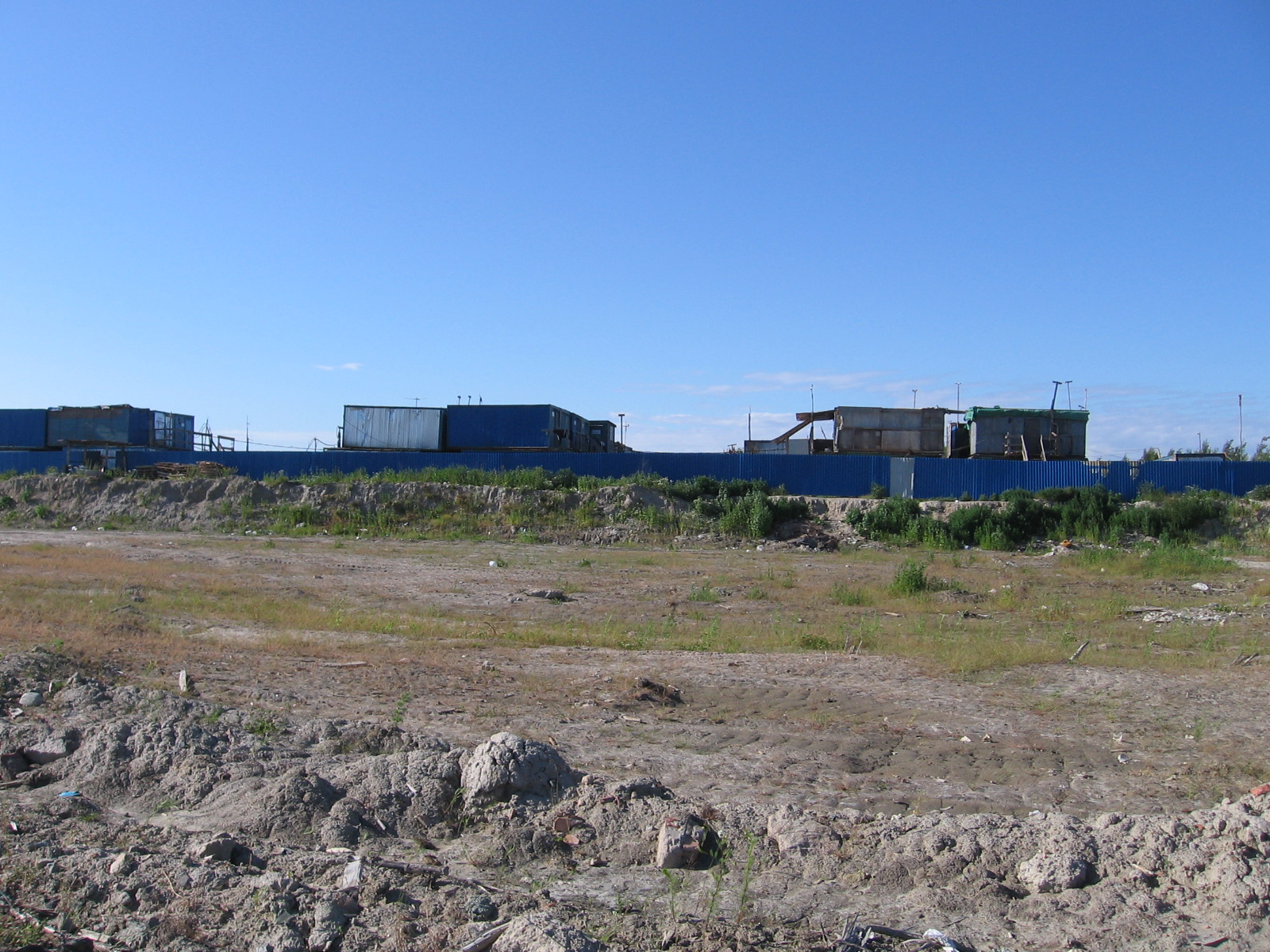
A makeshift container village, inhabited by migrant construction workers, with the Baltic Pearl in the background. Photo taken on June 28, 2015, by the Russian Reader
In 2015, the workers were not paid for March and April, after which they walked off the construction site. The workers who remained in Petersburg got jobs at other building sites, while Kholmirzayev has been trying to get the money from the previous employer.
“Relatives of the workers call me and say, ‘As foreman, you have to pay the workers.’ My parents have paid many of them,” he noted.
Today, the Trivium Group’s offices at Burtsev Street, 13, were supposed to be picketed by twelve migrant workers, but the protest did not take place. Only Kholmirzayev and Maksim Kulaev, an activist with the Interregional Trade Union Workers Association (ITUWA), showed up for the event. Moreover, the company could not be found at its registered address.
According to Kulaev, because of the crisis, “wage arrears are widespread in the housing sector and construction, especially if migrant workers are involved.”
Another view of the container village for migrant construction workers, which is situated right next to the Gulf of Finland, where residents of the Baltic Pearl and environs could be observed swimming on June 28, 2015, when this photo was taken.
Rosbalt tried and failed, over the course of the day, to make contact with Trivium Group management over the phone via its listed numbers.
The website of the Petersburg and Leningrad Region Arbritration Court currently lists nine suits which Trivium Group has lost. According to the files viewable on the website, it transpires that Trivium Group has been ordered to play over fifty million rubles [approx. 808,000 euros] to other organizations. The claims have been appealed.
Trivium Group is one of the many companies engaged in erecting the Baltic Pearl complex.
This is the third in a series of posts dealing with Central Asia, Central Asians, immigration, and migrant workers in Russia. The first post in the series, a translation of Sergei Abashin’s essay “Movements and Migrants,” can be read here. The second post, “Why Migrant Children Are Being Expelled from Russian Schools,” can be read here.Translated by the Russian Reader