“I Broke All the Laws I Could”
Juliana Lizer
October 2, 2015
Takiedela.ru
Leonid Nikolayev, the legendary activist Crazy Lyonya from the radical art group Voina, was buried this week. Juliana Lizer reports about a man who gave up the routine of office work for the life of an underground revolutionary.
We Don’t Need a Chairman
Leonid Nikolayev grew up in a bedroom district in Moscow beyond the Moscow Ring Road, a place dotted with identical, shabby blocks of flats built in the eighties and nineties, skinny trees in vast, empty yards, rows of shell-like garages scribbled with blue and black markers, kiosks offering beer and chocolate bars in the most unexpected spots, and a market, the main source of produce and clothing. The entertainment and cultural offerings were minimal. It was half an hour by bus to the two nearest cinemas, which featured standard Russian and Hollywood fare. There were two cafés in the entire neighborhood. A McDonald’s, built in the early noughties, was a universal boon and a new place to hang out besides the stairwells, yards, and the plastic-bottle-and-bag-littered woods.
According to Nikolayev’s mother Svetlana, the range of his interests was defined in the upper classes at school: the hard sciences and history. So, after graduating, he enrolled in the Moscow Institute of Fine Chemical Technology. At first, he was very passionate about his studies. He was at the top of his class, and pursued good grades.
“I majored in materials science and even worked for a year in a nanotechnology-related field, at a research institute. I was very much impressed when there was talk of allocating money for developing nanotechnologies, and researchers in all fields thought about how to squeeze the word ‘nano’ into their research, because that was the only way to get funding,” Nikolayev told journalists.
Nikolayev lost interest in his studies while doing his master’s degree. He became bored. After some thought, he went to work on a construction site, then got a job at a private holiday resort in the Moscow Region. He shoveled snow, supervised equipment repair, helped with household chores, and chatted with the holidaymakers. After a while, this “sensible” fellow was noticed and invited to try himself in a new role. Nikolayev began successfully selling sauna stoves.
In September 2008, Nikolayev went to his first protest rally, 100 Pickets in Defense of 2×2.
The Prosecutor General’s Office had found “signs of extremism” in several programs broadcast on the Russian cartoon channel 2×2. The channel had received a warning and was threatened with having its broadcasting license revoked.
“I really liked the way the people who did this chose to defend [the channel],” recalled Nikolayev.
“One hundred or so picketers lined both sides of Tverskaya holding different placards. Lyonya stood next to the monument to Yuri Dolgorukiy. He was quite self-confident. He fought off the cops ably and correctly: he had carefully listened to the instructions we gave before the rally. He had a cool placard on a wooden base he had made himself. It was obvious right off the bat he was an office worker. He was dressed like one and was carrying a briefcase,” recounted Julia Bashinova, a co-organizer of the rally.
After the rally, Nikolayev decided to join the movement We (My), which had been organized in the wake of the euphoria generated by Ukraine’s Orange Revolution. As his comrades remembered, Nikolayev found out about the movement when he saw the absurdist protest action Send the Leaders to the Mausoleum, in which activists had rallied for construction of a double mausoleum for Vladimir Putin and Dmitry Medvedev, chanting slogans such as “Riot police in every home,” “All power to the Chekists,” and “Putin lived, Putin lives, Putin will live.” They also sang the Soviet national anthem, inserting “Putin,” “Putinism,” and “Putin’s party” in the appropriate places.
“Lyonya came himself to the movement. He signed up and came to our meeting. He said, ‘When I saw a protest action happening in this way, I immediately realized this was for me.’ I thought then that here is this simple fellow who sells sauna ovens and has no idea what he has got himself into. Soon, however, he was one of the movement’s most active and productive members,” recalled We founder Roman Dobrokhotov.
Along with We, Nikolayev was actively involved in organizing the Solidarity movement, where he fought against leaderism, as well as for the movement’s compliance with its own principles.
“In 2009, when the entire We movement joined Solidarity, and the issue of a single chairman was raised, Lyonya drew a placard featuring the slogan ‘We don’t need a chairman,” and we chanted this slogan. You would think it was a lot of fuss about nothing, but Lyonya took democracy very seriously. Within the movement, he always reconciled everyone and acted as an arbiter,” said journalist and former activist Alexander Artemyev.
In the late noughties, Nikolayev probably lived the same way as the majority of those who took to the streets in 2011–2012 with white ribbons. On weekdays, he woke up at the same time, went to the office, had lunch, left the office, met with comrades, and attended rallies and pickets.
“Lyonya himself told me that the boring life of a stove salesman did not suit him, so he not only expressed his values in protesting but also was having fun to the max by being involved in the most audacious protest actions. The Voina group’s craziness attracted him,” recounted Dobrokhotov.
At that point, the art group, which included Oleg Vorotnikov (Vor), Natalia Sokol (Koza), Pyotr Verzilov, Nadezhda Tolokonnikova, and other members with the most unimaginable nicknames, was a huge success among the politicized public, primarily for the action Fuck for the Teddy Bear Heir! In an action dedicated to Putin’s designated successor Dmitry Medvedev, Voina activists had collectively copulated at the Biology Museum in Moscow.
Nikolayev met the founders of the controversial art group at a New Year’s party. It was 2010.
Our President
In 2010, the Blue Buckets movement emerged. Its members fought against the rudeness and total impunity of officials who sped through traffic with flashing lights on their roofs. Movement members wrote on their own cars that they yielded “only to 01, 02, and 03” [i.e., law enforcement and emergency vehicles], and they fastened little blue buckets, resembling flashing lights, to their roofs.
In late May 2010, a video quickly made the rounds of the media and social media showing a pedestrian in a red t-shirt and a blue bucket on his head deftly dashing atop the roof of a black car equipped with a flashing light. The scene is near the Kremlin Wall. A character in a suit jumps out of the car and tries to catch the bucket man. The bucket flies to the ground, only to reveal yet another, light blue bucket beneath it. The pedestrian in the red t-shirt runs out of the frame, followed by the suit in his car.
Voina claimed responsibility for the incident, and the name of the action’s hero was revealed: Crazy Lyonya Is Our President.
“I broke all the laws I could. I acted like a flashing light,” the newly minted president commented. It was then that Nikolayev got pinned with the obscene nickname Yobnutyi (“Crazy”).
“Certain castes have now taken shape in our society. Security officials and prosecutors have risen above other people. We see they can break the law, run people over with their cars, do whatever they want, violate traffic laws, and they are not punished for this in any way. […] I just spoke to them on an equal footing,” Nikolayev explained to journalists.
From that moment, middle manager, liberal opposition activist, and frequent attendee of the Marches of Dissenters Leonid Nikolayev ceased to exist.
“Crazy [Lyonya] is a call to all the passive crazies in the country (of whom, we know, there are millions) to reexamine their stance and finally become active crazies,” Voina explained in an interview with the website Salt.
Nikolayev decided to leave Moscow with his new artist friends and gradually dropped off the radars of his old liberal friends.
“I was at a get-together right before their departure for Petersburg, on the veranda of some café on the Arbat, right after Lyonya was arrested for the flashing lights action, then released. Vor was saying then that Lyonya had to abandon his ‘normal life.’ Vor was persuading him fairly vigorously,” recalled ex-Voina activist Gray Violet.
In his own words, in Petersburg, Nikolayev turned his own life into a political statement.
“I no longer wake up in the morning to drive through traffic jams to get to the office. I sleep until noon in order to spend the night in the company of crazy friends rehearsing audacious actions. The things that used to be in the background—a trip on public transport, an outing to the store—have now, without money, turned into an adventure, into a quest you have to go through every day,” Nikolayev told the site BesTToday in an interview. “I have traded noisy, dusty Moscow for calm and beautiful Petersburg, and I am not just saying that.”
Hello, Right Ball
On the night of June 14, 2010, a sixty-five-meter-high penis, drawn in thick white lines on the roadway of the Liteiny Bridge, rose over the Neva, exactly opposite the windows of the so-called Big House, FSB headquarters in Saint Petersburg.
“After the action Dick Captured by the FSB, when Lyonya saved one of the female participants and spent the night at a police station, he became an example for us to follow, an example of self-sacrifice. After that night, we started doing this little thing: we greeted each other by saying, “Hello, Right Ball!” and “Hello, Left Ball!” Incidentally, there was a point to how we divided the balls. Despite the half year he had spent with Voina, who were totally extreme in their political views, Lyonya continued to consider himself a liberal. Well, and I got the anarchist left ball,” recalled Lyubov Belyatskaya, who was involved in the action.
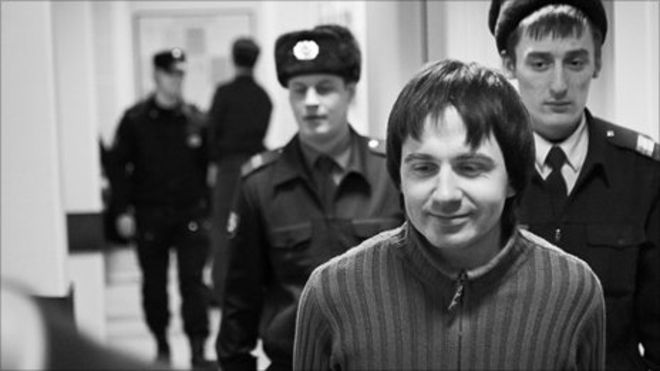
Voina’s next action was Palace Coup. The activists overturned several police cars, and this cost Vorotnikov and Nikolayev their freedom. Some time after the action, both men were detained at a safe house in Moscow, transported to Petersburg, and locked up for three months in a remand prison.
In his own words, Nikolayev was treated quite tolerably in prison. The conditions were even insultingly pleasant: his cell was not overcrowded, there were no conflicts, the floor was wooden, the windows were double-glazed, and the staff was friendly. Nikolayev was bored in prison, but he regarded it as an interesting experience. He exercised, tried to help his cellmates, and asked friends to put vegetables and herbs in care packages.
“The convicts, the underworld, turned out to be quite pleasant, interesting people to talk to,” Nikolayev recalled after his release.
Vorotnikov and Nikolayev finally got out of prison on a cold evening in February 2011. Relatives, friends, and journalists had been waiting for them all outside the remand prison in minus twenty degree weather: prison staff could not manage to draw up the necessary release documents.
“Everyone thought that now we would go to someone’s house. But instead we drove to Palace Square, and they skated there on the ice and snow. The square was absolutely deserted. It was night and twenty degrees below zero. Some cops walked up. I told them, ‘Look, they just got out of prison. You had better leave.’ And they left,” remembered activist Elena Kostylyova.
“Our goal is winding people up, convincing them they should not be afraid of anything, that they should act. If they are not yet smashing up and changing everything, I think this will happen. I am ashamed to look at these conditions, at the way we live, at the regime in power in Russia. It is just shameful to put up with it,” Nikolayev explained Voina’s actions and his own actions.
Fame had come to Voina. The days passed in endless interviews, and people recognized the group’s members on the street. According to friends, Nikolayev was not happy about this. He was mainly silent, smiled or sat with a blank expression on his face.
“Voina hung out at my place for a long time, and at some point I got fucking annoyed with their posturing and irresponsibility. But Lyonya was completely different. I never associated with him the Voina crowd at all. He was super kind, super responsive, super calm, and unbelievably sincere, and my sense was they took advantage of this,” recalled leftist activist Leonid Gegen about Voina in Petersburg.
“In November 2011, he came home thin, bearded, shaggy, and dirty. I was terrified. But I knew it was useless to forbid him to do anything. He would have left all the same; only he would have stopped communicating with the family. He was very grateful I respected his choice. He really appreciated it,” recalled Nikolayev’s mother Svetlana.
They saw each other for the last time in the summer of 2012. Not wanting to expose them to danger, Nikolayev would communicate with his loved ones by Skype.
After the incident with the torched paddy wagon on New Year’s, a kind of holiday postcard to all political prisoners, Nikolayev disappeared from the media. The art group would continue for a time to roam from one safe house to another in Russia, but in the spring of 2013, several media reported Voina’s entire lineup now lived in Europe.
Whereas news about other group members periodically appeared in the press, Nikolayev vanished, and the most unbelievable rumors about him were soon circulating. According to one story, Nikolayev had received political asylum in Europe, settled down, and was leading the boring life of an emigrant.
Vasya
“Look, Vasya, you’re an electrician. What have you seen besides your wires? You have to wise up or get the heck out of this country,” confidently said the drunken landlord who had agreed to settle the modest thirty-year-old Vasily in his flat. He would live under the same roof with Vasya for a year and a half, but would learn his real name only from an obituary.
A year in Petersburg and a year and a half in Moscow under an assumed name, physical labor, and rare encounters with friends from his past life: Crazy Lyonya was now Vasya at crash pads, at work, and among his new acquaintances.
“I met him on Nevsky, in a crowd of people, and then several months later at a friend’s house, only I was surprised his name was Vasya. Well, Vasya was as good a name as any other, and I called him Vasya. The funniest thing was that I realized who he was only a little over a year ago, when I looked at Voina’s website. I saw a photo of him and understand why he was Vasya. Well, Semyon Semyonovich [the name of a central character in the popular 1969 Soviet comedy film The Diamond Arm], I thought,” recalled a female acquaintance of Nikolayev’s from Petersburg.
“I harshly criticized certain of his ideological kinks like rejecting money, shoplifting, and that sort of thing. For starters I got him a job as a helper with builder friends of mine. He quickly learned from them and within six months he was taking on his own jobs to earn money for himself and the revolution,” said an anonymous source.
“It’s groovy when you’re chatting with people who—”
“Who don’t know you who are?”
“Who don’t know who I am,” the newly minted Vasily told journalist Marina Akhmedova in an interview.
Photographer Julia Lisnyak recalled the particulars of that interview.
“He often ate anything whatsoever, and it was unclear where he lived, so Marina and I decided to go and feed him. We told him a little fib that we were famished and ordered a bunch of sushi, which he happily wolfed down. Marina asked, ‘Lyonya, where do you live? Where do you get clothes?’ He said, ‘Look, these shoes are hand-me-downs. You see what nice shoes they are? They’re the shoes of a dead linguist! Well, and what of it? The man died, and I was given his shoes. He was a linguist.’”
In December 2013, Nikolayev took a piece of cardboard, wrote “Moscow” on it, and went hitchhiking.
On January 6, 2014, he arrived at a flat recommended by a friend and asked, “Do I understand correctly that I can sleep here for two or three days?”
The tipsy director Nikolai, landlord of the potential crash pad, asked the new tenant to bring him two bottles of cranberry liqueur. The tenant coped with the task and would ultimately stay a long time.
“Somewhere after six months, I realized I was faced with a radical phenomenon, that this was not just some dude who had come to find a place to crash, but a man with a long-established destiny. I found out he was no Vasya, that he had not been telling me his real name,” recounted Nikolai.
In the summer of 2014, Nikolayev ran into Lena, a friend since his days with We, in Kamergersky Lane in Moscow.
“He was wearing a hoodie, had a bicycle, and was listening to street musicians. He told me he had been in Moscow several months, was in hiding, worked in construction, and his housemates knew him as Vasya. He used forged documents and could not meet with relatives and friends for fear he could be arrested. He asked me to call him Homeless Vasya instead of Crazy Lyonya.”
Lyonya-Vasya would also meet another old friend accidentally. He noticed her in a café and went up to say hello, asking she not say his name out loud.
“He had hipster glasses, a red beard, and a diamond-patterned sweater. I didn’t recognize him right away,” recounted Anastasia. “Later, he shaved his head and showed up in a black leather jacket. ‘Vasya! Where are your damned glasses? Put them on now, you look like yourself,” she remembered being later exasperated at Lyonya-Vasya’s next change of image.
“I spoke to him like Don Quixote to Sancho Panza. He was like my errand boy, in the literal sense of the word. He completely humbly and calmly accepted the job, like a White Army officer’s orderly. ‘Why is my underwear not washed? Where is the bread? Have you me bought me a subway pass or not? How am I going to travel tomorrow? By the way, go and buy me a sex doll: I need it for rehearsal.’ When I found out who he was, I flipped out. I had lorded it over one of the central figures of the radical anti-Putinist left, a star of the Russian counterculture, and made him run errands,” the director Nikolai confessed.
But it was probably Nikolai who helped Nikolayev get into the character of Vasya the electrician. The director had believed in this act to the last.
The hard work exhausted Nikolayev. He could be bothered in the middle of the night to unload a truck or dig a hole. However, Vasya the electrician was optimistic, followed the political situation closely, read a lot about science and art, and attended cultural events. Despite the difficulties and poverty, he was pleased with the fact that he was thin, pumped up, and had become tougher. He tried to eat healthy food, drank kefir, and cooked lentils. There was the most protein in them, he explained to everyone. As in Petersburg, he lived very ascetically. He slept on the floor, had no relations with women, and did not drink. This surprised his acquaintances, but they did not pester him with questions.
“If I had come in and saw him sleeping on a bed of nails like Rakhmetov [a revolutionary in Chernyshevsky’s novel What Is to Be Done?], I wouldn’t have been surprised. He became my tutor on political issues. He told me everything: how democracy in Russia differed from democracy in America, who the ultra-leftists and ultra-rightists were, how French communism differed from Russian communism, what mistakes Lenin and Stalin had made, what had happened in Paris in 1968, and who the Red Army Faction in Germany were. Later, I watched all the films about the RAF and found out that Fassbinder had done work on them. It was an amazing brainwashing,” said the director Nikolai admiringly.
Once, when Vasya was strolling in downtown Moscow with a female friend, the police asked him to show his documents.
“Young man, have you washed your passport or what?”
“Yeah, I washed it. Ha-ha!”
“Oh, I’m also from the Tula Region!”
“You’re kidding? What district you from?”
Vasya named a nonexistent district in the Tula Region, but the policeman who was “also from the Tula Region” did not notice this. According to Dmitry Dinze, Nikolayev’s lawyer, his client had not been on the wanted list.
“In 2012, they had been looking for him, but the investigator worked on the case in such a way it was clear he could have cared less about Leonid Nikolayev. But the case has not been closed, the statute of limitations has not yet run out.”
“He had the idea of creating his own underground. Although he admitted himself he would be unlikely to find ‘hotheads’ willing to be involved in bold, provocative actions, since a lot had changed since they had overturned the cop cars, and the dudes in prison for the Bolotnaya Square case had literally done nothing, but had got hefty sentences. He understood that there were really few risky actionists. ‘It is unreal even to find someone to act as lookout,’ Lyonya would say sadly. But he really wanted to whip up something big, to stage a sensational performance. He worried that nobody had heard anything about Voina for over three years. He joked about stealing a tank on May 9 [Victory Day] or setting fire to an FSB building,” said Lena.
In conversation, Nikolayev described his plan as grandiose and quite absurd.
“It will be really funny, unbelievably funny. But the cops and FSB guys will be royally angry!” he assured his listeners.
However, he kept postponing implementation of his plan. Too many people whom he had asked for help had turned him down, he was unable to find a photographer and cameraman, and he lacked money for props. It was this, according to an acquaintance who wished to remain anonymous, that had forced Nikolayev to go to work for the Beryozki Noncommercial Gardening Cooperative. He lacked exactly thirty thousand rubles for implementing his venture.
On the afternoon of September 22, Nikolayev was sawing branches from a felled tree. At the same time, a workmate set to cutting down another tree. The falling trunk struck Nikolayev on the back of the head. He suffered a basal skull fracture and brain swelling, and went into a coma. The documents in Nikolayev’s pockets were made out in someone else’s name, so it was not easy to figure out who exactly had been admitted to hospital, then sent to the morgue. According to the doctor, there was no chance he could have survived.
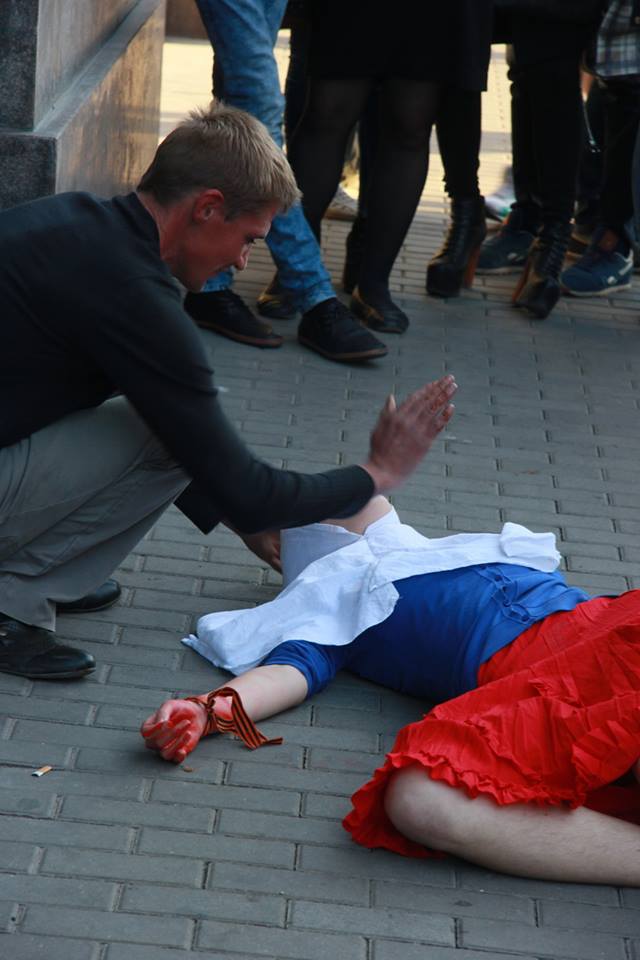
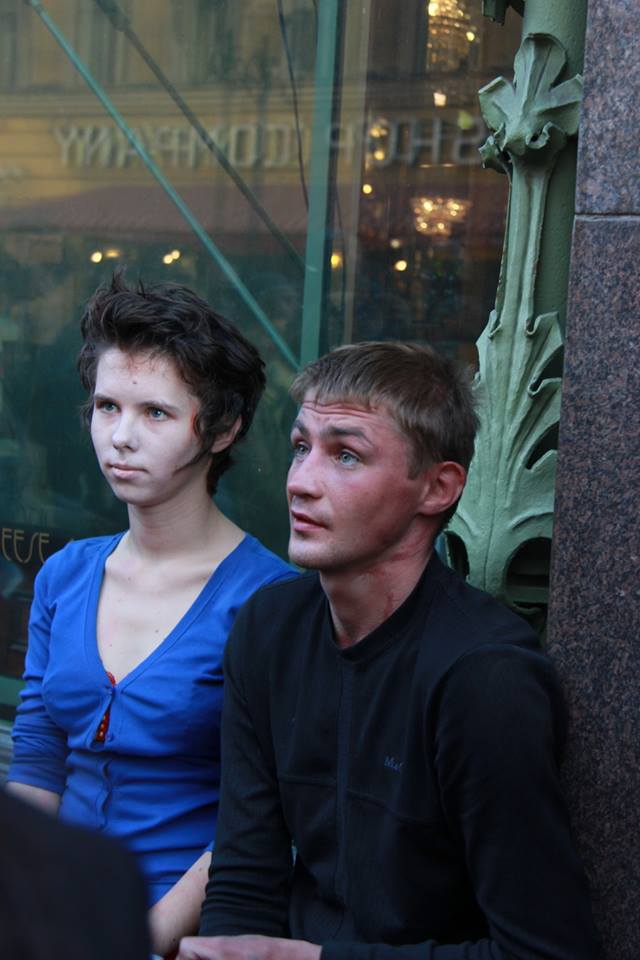
Translated by the Russian Reader. Photo courtesy of e-flux. Check out the poignant photographs of Leonid Nikolayev by Julia Lisnyak, as published in the original article, and read about the other face of Takie Dela, its work as a charity foundation (in Russian).