How bad can it get? When we strip away US president Donald Trump’s insults and temper fits, what can he actually do?
First, he can withdraw US military aid to Ukraine – which he has been talking about doing since long before the US presidential election. If the European states got their act together, which is possible, the effects of this would be constrained.
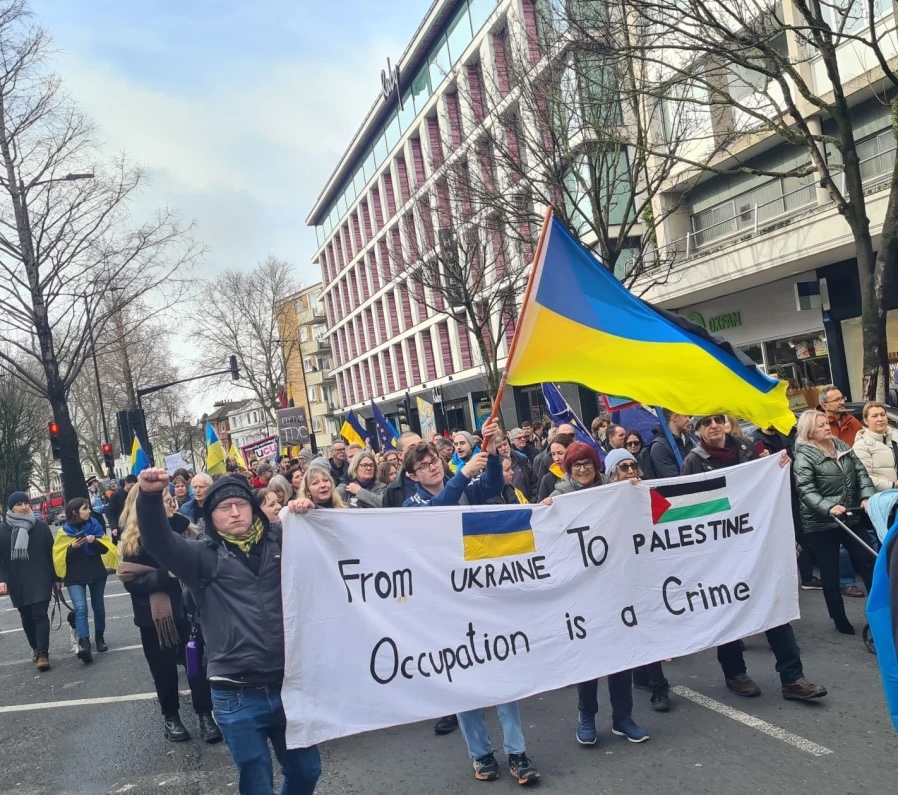
At the “Russian troops out” march in London, 22 February 2025
US diplomats have reportedly threatened to block Ukraine’s access to the Starlink communication system on which its drones rely, potentially giving asymmetrical advantage to Russia.
Second, Trump can cancel sanctions. The latter would bring him into conflict with the Countering America’s Adversaries Through Sanctions Act of 2017, which was specifically designed to compel the president to lift sanctions only with Congress approval. Of course Trump could play fast and loose with the law, which he has done and is doing in other respects, and/or Congress could go along with him.
The cancellation of sanctions would be bad. But let’s not lose sight of the fact that the sanctions were never very effective, in large part because previous US governments, under both Trump and Biden, sought to limit their effect on the oil market and the world economy.
Third, Trump can shift narratives. I broadly agree with people who say we should judge Trump and his cohorts by their actions, not by the constant stream of often incoherent words. Yes, but. Nazi salutes normalise Nazism; speculation about expelling the Palestinian population from Gaza normalises ethnic cleansing; and slandering the Ukrainian president as a “dictator” who started the war in his country reinforces Russian propaganda.
On the third anniversary of Russia’s all-out invasion – and the eleventh year of its military attack on Ukraine, and the long chains of suffering it has caused – these are real dangers. It’s not clear how they will play out.
Crimea’s Tatars: “They drive us from our homes, just as they did to our grandparents 80 years ago”
By Katya Aleksander, who interviewed activists supporting more than 100 Crimean Tatar political prisoners. First published in Russian by Important Stories (Vazhnye Istorii)on 18 May, the 80th anniversary of the deportation of the Crimean Tatars.
On 18 May 1944, eighty years ago, the Soviet government accused an entire people of “collaboration with the Nazis” and “betraying the fatherland” – and deported the Tatars from the Crimean peninsula. It took the Crimean Tatars more than forty years of constant struggle to return to Crimea. But in 2014 the peninsula was annexed by Russia. The war began, and, with it, repression by the new authorities on a massive scale.
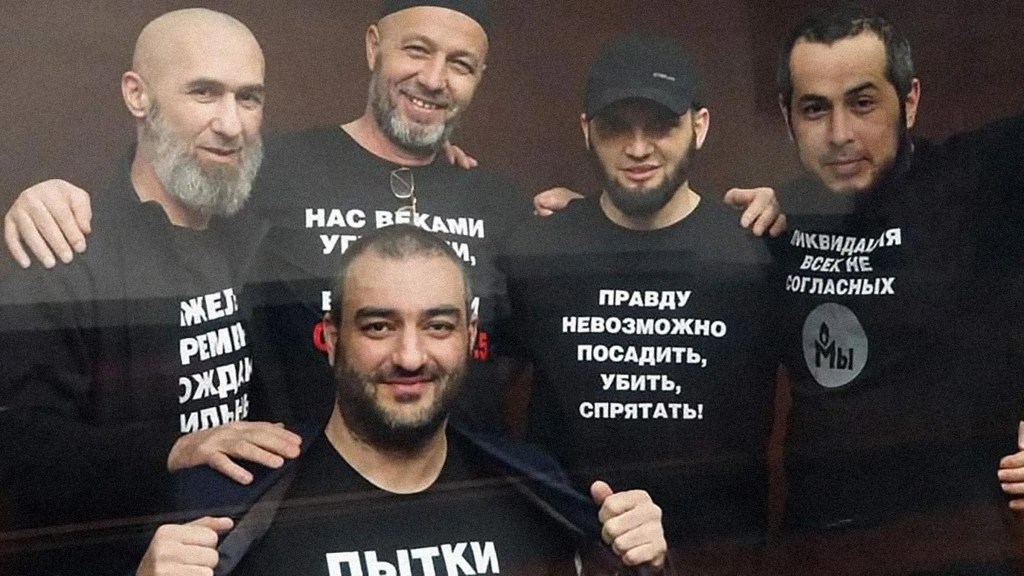
Political prisoners Tofik Abdulgaziev, Vladlen Abdelkadyrov, Izzet Abdullaev, Medzhit Abdurakhmanov and Bilial Adilov, among those falsely accused of “terrorism” and “preparation to seize state power” in 2019, and sentenced to 12-14 years’ imprisonment. Abdullaev’s T-shirt says, “the truth can not be imprisoned, killed or hidden”. Photo by Crimea Solidarity
On the anniversary of that tragedy, which Ukraine demands be categorised as genocide, Important Stories spoke with Crimean Tatars who continue the struggle to live freely in their historic homeland.
Every Crimean Tatar family has its stories of deportation. They all start in the same way. On 18 May 1944, at five o’clock in the morning, soldiers burst in to the house and gave people 5-10 minutes to collect their belongings and go to the nearest train station. No explanations. At dawn, everyone was forced into cattle wagons and taken away.
It was all over by 4:00 pm on 20 May: one of the fastest deportations in world history. All the deportees’ property passed to the Soviet state.
“Many people thought they were being taken away to be shot. The Soviet Union was an atheist regime, and many Crimean Tatars were of Islamic faith”, said Azime (her name has been changed), the wife of a present-day Crimean Tatar political prisoner. Her family were deported to Uzbekistan.
“They put everyone in cattle wagons, with no windows and locked doors. There was no sanitation. No water, no food. People died from hunger, thirst and dysentery. The soldiers just threw their bodies out at the train stations. Some people were able to hide their relatives’ bodies: those families hoped that they would soon arrive somewhere and be able to bury their loved ones like human beings.”
The transport took 2-3 weeks. About 80 per cent were taken to Uzbekistan, and the rest were sent to special places of exile in other parts of the Soviet Union.
“Part of my family was deported to Uzbekistan, part perished in those cattle wagons, and my grandfather was taken to the Urals”, said Ismail (his name has been changed), who today acts as a defence lawyer for Crimean Tatars. “Grandad said that, while he and his mother tried to find accommodation, they could not go to work for two days. And so [for breaking the labour laws] his mother was sent to prison for five years.”
Soviet propaganda prepared local people to receive the deportees. Uzbeks were advised to keep well away from the newcomers, who were “cyclops” and “cannibals”. In exile, Crimean Tatars faced hunger, dangerously unsanitary conditions and an absence of health services. Between 18 May 1944 and January 1946, about 200,000 Crimean Tatars lost their lives, according to estimates by the National movement.
The struggle to return home
People could not return to Crimea. Until 1956 the Crimean Tatars had the status of “special settlers” with limited civil rights. They had to report regularly to police commandant’s offices. They were permitted to move to a different region only by invitation from close relatives. Attempts to leave without permission were punished by up to ten years’ imprisonment.
Although their language was banned, the Crimean Tatars preserved their culture and traditions. Parents told children what their home looked like, and how to get there, so that they could find their way to it when they returned.
“Everyone lived with thoughts of going back”, Ismail said, telling his family’s story. “My uncle somehow found a way to travel to Crimea. My grandmother asked him to bring a bottle of water from home: she wanted to drink Crimean water. When my uncle got back from his trip, he realised that he had forgotten about the water. He took a bottle, filled it from the tap, and took it to Grandma [telling her it was from Crimea]. She cried. For her, that bottle was almost sacred. She kept it, and never drank a drop.”
In the 1960s, the Crimean Tatars began independently to collect information about the victims of the deportation. They demanded that the Soviet authorities revoke the slander that they were traitors, and allow them to return home. That is how the Crimean Tatar national movement was born.
On 5 September 1967, after many attempts to secure justice, came a decree of the Presidium of the Supreme Soviet of the Union of Soviet Socialist Republics (USSR), which revoked all accusations against the Crimean Tatars and allowed them to live in any part of the country. But to return to Crimea, they had to secure a residence permit, and find work. [Residence permits, linked to employment, were used to discipline labour in the Soviet Union.]
By the end of September 1967, about 2000 Crimean Tatars had already returned to the peninsula. But the majority of them could neither get a residence permit, nor any chance of work, from Crimea’s new inhabitants. Many were deported again, and brought to court for breaches of the internal passport regulations.
Azime’s family was one of the first that returned to Crimea and found a way to stay there. “My grandfather, an activist of the national movement, left behind all that he had worked for in Uzbekistan, took his four children, and went home. We are not even talking about returning to his own village, where his grandparents were buried – only returning to somewhere on the peninsula where the family would be allowed to stay. They found a place in Dzhankoi district, where several other [Crimean Tatar] families also moved in. The street was named International Street, because we, the non-Russians, lived there.”
Azime was born at the end of the 1980s, already back in Crimea. Among people of her age, that is very unusual, she said. “I know literally two other people [of her age] who were born back there [on the peninsula].”
[In the 1970s and 80s] the Crimean Tatars had to build their homes all over again. The homes from which their families had been deported now belonged to other people. The work they could find was always the hardest. The attitude of the new local population was hostile: they continued to accuse them of treachery.
“Our grandparents were often dismissed from work”, Azime remembers. “They were constantly searching for new jobs, in order not to be deported again. My mum went to school in Crimea: when the family returned, she was eleven years old. She was admitted to university only on the fourth or fifth attempt. The dean of Simferopol medical school told her father outright that he would not accept Crimean Tatar students, not for any amount of money.
“My mum was the only Crimean Tatar woman in her university. [When her fellow students and teachers learned that she was a Crimean Tatar], she was told to her face that she had no business being there. Many teachers simply marked her work down. Our people felt everywhere that Crimean Tatars were strangers in their own land.”
The Crimean Tatar national movement had already taken shape, and its activists fought for the right to live in Crimea and for the freedom of those imprisoned for breaches of the internal passport regulations. They monitored attacks on human rights, and took part in hunger strikes and other forms of protest. In 1978 the activist Musa Mamut burned himself to death as an act of protest: this became one of the symbols of Crimean Tatar resistance.
But even twenty years after the decree of 5 September 1967, the situation had hardly changed. “The mechanisms to obstruct the Crimean Tatars’ return had been so finely tuned by the Crimean authorities, that I never heard of a single instance of a new Crimean Tatar family buying a house”, the Crimean Tatar activist Bekir Umerov wrote in his memoirs. His family was also prevented from returning to Crimea: in the 1980s they moved to the Krasnodar region [of southern Russia], to be nearer to home.
After the beginning of perestroika [the reform of the Soviet system started under Mikhail Gorbachev, from 1986] in the spring of 1987, the Crimean Tatars gathered in Tashkent [in Uzbekistan] for their first All-Union Assembly. They agreed on a document that called on Mikhail Gorbachev, then the general secretary [of the Communist Party of the Soviet Union] to meet a delegation. This call went unanswered, and so on 18 May, the anniversary of the Crimean Tatars’ deportation, the activist Bekir Umerov announced a hunger strike in protest.
This met with a powerful response, and not only among Crimean Tatars. The scientist and human rights defender Andrei Sakharov mentioned the action in his call to Gorbachev to resolve the problem of Crimean Tatars being able to return home. Umerov ended his protest a month later, when the Second All-Union Assembly of Crimean Tatars elected him to a delegation that travelled to Moscow. But the Kremlin refused to meet the Crimean Tatars, as it had done before.
The activists then began protests at the Lenin mausoleum [on Red Square], at the building of the CPSU Central Committee, at the Kremlin. Each day the number of participants grew. One of the biggest rallies was held on Red Square in the middle of July 1987. The Crimean Tatars staged a peaceful sit-down protest, and the police held back from using force. A week later, on 26 July, more than 1000 Crimean Tatars took part. This time the police blocked the way to Red Square and so the demonstrators went along Vasilevsky Spusk, sat on the ground, raised their placards and shouted: “Crimea! Our homeland!” The action went on for 26 hours.
Many of the participants were arrested and deported from Moscow to the places where they lived. No official documents sanctioning a return to Crimea were issued by the authorities – but there were fewer obstructions.
The Crimean Tatar protests continued through the whole perestroika period.
Occupation of the peninsula
Many families could return to their homeland only after the collapse of the USSR. The move was difficult, even without the authorities interfering. “For more than 20 years, the Crimean Tatars had been finding their feet in the places to which they were deported. They had settled down. And now they had to leave everything again, return home empty-handed, and again start to get on their feet”, Azime explained.
“After all that had happened to our people [as a result of deportation], we stuck closer together and helped each other. My parents told me about how someone had got land in Crimea, gathered 30-40 families and built a house on it together. And then they built another. We are not just a people, we are one big family”, Ismail, the human rights defender, said.
“In general the Crimean Tatars are Muslims. This means a sense of collectivism, which means brotherhood, giving moral support to each other, good neighbourliness. These are traditions going back to the [Crimean] khanate [of the 15th-18th centuries]. The Prophet says, ‘if you laid down to sleep well-fed, and your neighbour was hungry, you will not sense the scent of paradise’. And it makes no difference whether your neighbour is Muslim or not.”
The Crimean Tatars were only able to live a relatively quiet life in their historical homeland for a little more than twenty years.
“It turned out that my generation was the only one, in the past century, who could spend their early years at home, living in peace”, Azime said. “I just recently said to my children that I could not now myself imagine how carefree those years were. We just lived, and did not think that things could be different.”
That life changed at the beginning of 2014. “I was then pregnant with my third child”, Azime recalled. “I was already preparing for the birth when I heard on the news that the Russian [armed forces] were coming. I knew that for decades Russia had imprisoned Muslims simply for professing their faith. I can not tell you how terrified I was, for my child, for my husband, for all of us. Then tanks appeared on the streets, and men in uniform, and the occupation began.”
Some Crimean Tatars decided to move to Ukrainian-controlled territory. Azime and her husband also discussed that, but decided to stay. “We both agreed that here is our home, our land, for which our parents had fought. Why should we leave? It was they who came to us, no-one asked the Russians to come here. We decided that we would not allow Russia to drive us from our homes a second time.”
Most of the Crimean Tatars were against the occupation, and boycotted the “referendum” [of March 2014, on joining the Russian Federation]. Consequently, after the annexation, the Russian authorities took repressive measures: Crimean Tatars were arrested, kidnapped, and accusations under the laws on terrorism were fabricated en masse. People were accused of membership of [the transnational Muslim organisation] Hizb ut-Tahrir, which is banned in Russia. As proof, “secret witnesses” were produced, together with the fact that the accused professed the Islamic faith.
“We did not know what to do”, Ismail remembers. “We did not know the new legal code, or what to do when three brothers by faith were falsely accused of terrorism. From the start, the new ‘authorities’ were determined to show that they would liquidate anyone who opposed Russia. They only wanted people loyal to them in Crimea.”
Ismail himself suffered intimidation and harassment. In 2015 an officer of the Federal Security Service (FSB) planted drugs on him [and he was arrested]. When being questioned, he was asked about Crimean Tatar affairs. They tried to convince him to work for the security services. Thanks to the prominent Crimean Tatar lawyer Emil Kuberdinov, the case did not go any further than the prosecutor’s office.
“At that time the Russians were still trying to work out the extent to which their hands were tied in Crimea”, Ismail said. “But I already understood what was on its way. Crimean Tatar lawyers came on the scene, not only helping people who were arrested, but also support political prisoners’ families, explaining how to send parcels to prison, what to do on prison visits and so on.”
In 2016, Crimean Tatar activists, together with lawyers, formed the Crimea Solidarity organisation.
In 2017, about one hundred Crimean Tatars across peninsula simultaneously staged one-person pickets against Russian repression. About 60 people were served with administrative summonses, for breaching the regulations on picketing (Article 20.2 Part 5 of the code on administrative offences [similar to civil law]). The hearings were all arranged on the same day, in different districts. As well as Crimea Solidarity’s lawyers, the interests of the accused were represented by civil society activists. One of these was Ismail. “People began to offer support to Crimea Solidarity. I did so myself. We had no legal education, but the lawyers helped us to prepare. So the Crimean Tatars continue to help each other.”
Repression under occupation
Criminal cases under terrorism laws have become the main instrument of repression against Crimean Tatars. Military courts deal with these cases in closed hearings that even close relatives can not attend. The sentences under these laws are 10-20 years’ imprisonment.
The Russian security forces have conducted searches at mosques, arrested clerics, cases have been put together alleging failure to inform on “terrorist groups”. Family members of political prisoners have also been subject to surveillance and harassment.
Every arrest and raid becomes a matter for the whole community. People gather at any time of day or night, often bringing children along, to support families who have been singled out for searches. Azime, along with her elder sons, has often gone to support her neighbours. She tells her children not to fear people in uniform, that those people’s fear is even greater.
Azime also prepared the family for the fact that they might be raided at home. Her husband Rinat (his name has been changed) is an activist in the national movement, has written a great deal about the repression of the Crimean Tatars, and has spoken out openly against repression and against the occupation. He had been arrested on administrative charges several times, and the family understood that sooner or later he could face criminal charges. Some time ago Azime started to sleep wearing her clothes and a hijab [expecting a raid].
The security forces came for Rinat at 6:00 in the morning, but he was not at home.
“Before sunrise every day we read prayers. My mother asked me in Tatar (in the family we use our native language) how she would be able to perform ablutions. I told her not to be afraid and to stay calm. The armed men told us that we could not speak in Tatar. That was offensive to me, as a woman and as a mother. They insulted our faith: they said that instead of ‘beating the floor’ five times a day, which should behave like normal people.”
Protesters and Russian armed forces in Crimea, 2014. Photo by Krym.Realii/RFE-RL
During the raid, Azime’s three children were much calmer than she had expected them to be. “I tried to stay confident and not to fear these men and their automatic weapons, hoping that that would also help the children to stay calm. Only my daughter was crying, at the start when she first saw the guns, she is the youngest.
“When I woke up, the room was dark, but I could see floodlights being shone from the street directly into our windows. The shadows were dancing around the courtyard. I understood that it had started. Then wild knocking at the door”, Azime recalled. “I asked my mum to dress and open the door. A big crowd of armed men in masks ran in, shouting. They turned the shelves upside down, everything from outer clothes to underwear. They paid closest attention to the books.
“My sons are still in primary school, I don’t think they understood exactly what was going on. For them it was like something out of a fairy tale, where we needed to defy evil. They did not sit in the corner like mice, but walked between these people with the automatic rifles, as though everything was OK. The men did not touch them. Just once, they tried to find out [from the children] the password for my phone, which I refused to unblock. I did not want them to see photographs of me unveiled.”
It only became clear later how stressful the children had found the raid. “For years afterward, my elder son started to fear the whole world that surrounds him. He thought that the FSB was everywhere, he saw all people as a threat. When we went into town, he would stick close by me and say, ‘I am afraid that they are going to take me away’. For a year or two, my daughter developed a nervous tic. She works with a psychotherapist, but still fears me falling asleep before her, fears being alone.
“At least the children didn’t see how their father was set upon and thrown to the ground with an automatic pointed at his temple. That’s a rare thing for a Crimean Tatar family nowadays. I have talked with the children many times, I saw to them that the Almighty is with us, and that his wisdom also oversees what is happening with their dad”, Azime said.
Wives of Crimean Tatar political prisoners
Azime’s husband was beaten, and arrested, when he travelled to Rostov to deliver parcels to other Crimean Tatar political prisoners being held there. While Rinat’s case was in court, Azime could at least see him at the hearings. But when the sentence was announced, neither Rinat’s wife nor other Crimean Tatars were admitted to court. Rinat was sentenced to nearly 20 years in a maximum security facility, under two Articles of the criminal code: “organisation of the activity of a terrorist group” and “preparation for a violent seizure of power”.
Azime said: “My husband is big, kindly man, like a bear in a cartoon. He went out to work, went to court hearings [of other arrestees], publicised the repression of our people, and always found time for our family. I lived like a princess. And now all that has finished. A new life has begun: I have to survive, and to try to understand what comes next.
“At night I cry into the pillow, so that the children can not hear. I have to learn to do things in the household that were previously done by my husband: what documents have to go where, how to pay for the electricity, how to read the meters. I have had to give up studying and my teaching work. Before all this, I had more time for the children: now I often have to leave them to look after each other.”
Azime’s health has suffered as a result of all that has happened, and she has had two operations. She is supported not only by her family but by the community. “There was a knock at the door, and a woman I don’t know was standing there, offering me eggs and cheese. She said: ‘That’s for you, my dear. You don’t know me, but your husband gave court support to my son.’ Around here there are already many women with the same, bitter experience. I turn to them for advice, about where to buy things for prison parcels, where to send documents for this and that. I am walking along a well-trodden road.”
It is now five years since Rinat’s conviction. In that time, Azime has not been able to meet her husband once. Her only contact with him is through letters, that are passed on by his lawyer. In prison, Rinat has continued to write about the repression against the Crimean Tatars. Azime receives his articles, retypes them electronically, publishes them and sends them out. “My husband constantly writes to me, thanking the Almighty for the fact that his wife is here. He says, ‘when my book comes out, that will be your doing – you are my censor, editor, proof-reader and publisher!’
“Like the wives of other Crimean Tatars, I have chosen to continue the fight taken up by my husband. Up until 2022, we used to travel, to explain what is happening to our people. We were in Kyiv, Kherson and Mariupol. We continue to campaign now, but we can not travel anywhere. Our husbands have been deprived of free speech. Who, if not us, will speak about their cases and convey their arguments? They, also, became activists not by choice. And now we stand in their place.
“In our letters to our husbands, we sound very strong, like stone, their bastion. I always write to my husband, ‘this is your challenge from the Almighty. If you meet it, you will earn yourself a place in paradise’. It’s at night-time that I cry in my pillow. I feel sorry for my husband, and it is hard for me too. I have to be both mother and father to my children; I have to support my husband; and be an activist. But you cry, and you keep going – and that’s how I earn a place in paradise too.”
The all-out war
With the Russian army’s all-out invasion of Ukraine in Feburary 2022], many Crimean Tatars were again forced to leave their homes. The biggest exodus took place when military mobilisation was announced. According to the Mejlis of the Crimean Tatar people [the national representative council, now based outside Crimea], since September 2022 between six and eight thousand Crimean Tatars have left the peninsula. Azime said that Crimean Tatar families that have sons of conscription age try to leave Crimea. “Everyone fears that their sons will be taken by force to the war.”
Ismail said: “Many people have left because they do not want to fight on Russia’s side – although the mobilisation turned out to be more a moral pressure than a physical one. Of those who have been sent to the front from Crimea, only about 5 per cent are Tatars. I reckon that, of those who did go to the front in autumn of 2022, 60-70 per cent have already returned.”
Those who have moved to territory controlled by Ukraine can not return to Crimea, due to the risk of repressive action. In 2023 the Crimean Tatar Leniye Umerova tried to get to Crimea to see her father, who was very ill. She travelled from Ukraine via Georgia. She was arrested at the border on suspicion of spying. Umerova has already spent a year behind bars in Russia. The case will be heard in secret and she is threatened with 20 years’ imprisonment.
Since 2022, repression against Crimean Tatars has been stepped up. The Russian authorities have conducted at least 71 searches, and there have been at least 110 convictions – more than in the preceding eight years. In the autumn of 2022 a second pre-trial detention centre (SIZO) was opened in Crimea: Crimean Tatars, and Ukrainians kidnapped in the occupied territories, are sent there. Since the all-out war began, there have been a much greater number of cases, compared to the previous eight years, related to the “voluntary Noman Chelebidzhikhan battalion of Crimean Tatars”, that has been fighting on the Ukrainian side since 2014.
There was also a wave of repressive measures against Crimean Tatars when parts of Kherson and Zaporizhzhya regions were occupied: about 100 people have been arrested there. Some cases have been initiated by informers who write on the Krymsky SMERSH telegram channel that was set up in 2022.
“Informing has become a big thing in Crimea”, Ismail says. “Someone says something at the market, and that’s it, you get a knock on the door. The regional authorities have acquired an extra repressive tool against the peninsula’s citizens: the Article [in the code on administrative offences] on discrediting the army. There have been many administrative cases as a result, some for people writing comments on social media.”
Azime said: “Today, deportation of Crimean Tatar people takes a hybrid form. Now it’s not in cattle wagons: people are taken away in prison transport vans. From many families they have taken all the menfolk: for example they will take the husband, son and father. I have a neighbour who is 75, they have taken both her sons. Every time I see her she says, ‘my dream is just to be able to hug them once more in this life’.”
Azime has decided to stay on the peninsula, as long as possible. “In our lives we have seen hundreds, perhaps thousands, of families that have been broken up, which fought for so long to be able to return home. I have decided for myself that I will never leave our homeland. We understand that the repression will intensify, that whatever has to happen, will happen.
“What’s the point of cowering like a mouse, of living in fear? If they succeed in shutting our mouths, that would be a betrayal of our people who have suffered so much. We must not stay silent. As long as our husbands are imprisoned, and as long as they continue to try to destroy the Crimean Tatar people, we won’t stop fighting.”
Ismail, too, has no intention of leaving the peninsula. He continues to support Crimean Tatars in court. “I have decided for myself to take this position. I see how the families of my close friends are punished and repressed, how people are imprisoned. As a Crimean Tatar and a Muslim, how should I react? Do I sit here and say, ‘it’s nothing to do with me’ – or give some help. For me, this is a test from God.
“The best example to me in this situation is the Prophet Muhammad. Yasir’s family was taken to the desert and tortured by infidels for their religion. What did the Prophet do? He did not sit at home saying a prayer; he did not stand to one side. He went there, where Yasir’s family was under attack, and gave his support. That shows how we, today, faced with this repressive machine, need to react.
“It does not depend on us, whether they imprison a person or not. But it depends on us what we do, what support we give. Can we help the defence in court? Then we’ll go to court. Can we help the family? Then we will visit their home, bring things that they need, and money, and help with the children.
“For the Crimean Tatars it is very important to preserve our spirit of unity. We have faced many trials. When a person is left to face a problem on their own, that is very hard to bear. If someone just sits down for coffee with that person, and says, ‘you are not alone, we will help you, we are right alongside you’, this helps to deal with tragedy.
“I was recently in touch with the mother, and aunt, of a Crimean Tatar who was sentenced to ten years, in a case related to the ‘voluntary Noman Chelebidzhikhan battalion of Crimean Tatars’. They kept telling me how people had come to visit them, to help and support them, how they felt the support of our people. Without this, they said, they would have been broken.
“Russia is trying to give the appearance that everything is fine in Crimea, and now they don’t lay a finger on anybody. That is a lie. We can show the world that we have already had ten years of this. We understand, of course, that the repressive machine pays little heed to laws, let alone to moral and humanitarian values. If an instruction comes down to lock someone up, they do it, no matter what defence is presented in court.
“But we continue to go to court, to record videos showing how Crimean Tatars face harassment and intimidation. We continue to fight. We don’t keep quiet or swallow all this silently. We will take a stand and say, ‘we are not guilty’. I think that if we had not done this, if we had sat quiet, then Crimea would already have been turned into another Chechnya.”
The links in the article are from the original Russian version, to sources in Ukrainian and Russian. Web sites in English include the Mejlis of the Crimean Tatar people; Crimea Platform, recently launched by the Ukrainian government; the Crimea Human Rights Group; and Crimea SOS. Reports on human rights abuses have been published this year and last by the UN and the Council of Europe. A history of the Crimean Tatars, ‘A Seditious and Sinister Tribe’: the Crimean Tatars and their Khanate, by Donald Rayfield, has just been published, and reviewed. There are more than 100 political prisoners listed (Russian only) on the Crimea Solidarity web site currently detained.
Source: People and Nature, 16 August 2024. Thanks to Simon Pirani for translating this important overview of the Crimean Tatars’ struggle and for permitting me to reprint his translation here.
Bohdan Ziza, a Ukrainian artist, poet and activist, is serving a 15-year sentence for “terrorism” after pouring blue and yellow paint – the colours of the Ukrainian flag – on to a municipal administration building in Evpatoria, Crimea, his home town. He made and circulated a video of the action – on 16 May 2022, shortly after the all-out Russian invasion of Ukraine – and for that was also charged with “incitement to terrorism”.
Bohdan Ziza. From his instagram channel
This is Bohdan’s speech from the dock, before being sentenced by a Russian military court on 5 June last year.
Do I regret what I have done?
I am sorry that I over-reached, and that my action resulted in charges under the Article [of the Russian criminal code] on terrorism. I am sorry that my grandmother is now without the care and support that she needs. Apart from me, she has nobody. And I am sorry that I can not now help others who are close to me, who need that help now.
As for the rest: I acted according to my conscience.
And also, according to my conscience, I do not deny or disavow what I did. I behaved stupidly, and could have expressed my opinion in some other way. But did I deserve, for what I did, to be deprived of my freedom for ten years or more?
I would like to appeal to the court: do not follow the regime’s script, do not participate in these awful repressions. But obviously that would have no effect. The judges and other similar political actors are just doing what they are told.
For these reasons, I will continue to protest, even in prison. And I am well aware of the sentence I may receive, and how it may affect my health and even my life.
But am I worthy of the life that I live? Is each one of us worthy of a carefree life, when we stay silent at a time when, every day, innocent people’s lives are being taken?
This was the worst night of my life. I never experienced anything like it. I thought we would die. There were three Kinzhal rockets, and loads of Kalibrs. They fell very close, they were right above our building. The building shook – several explosions, one after the other. For the first time in the war there was a white glow, the sky was white from the explosions. It was as though we were in a trench, not in our own home. At one moment I thought that it was all flying towards us. There was the very clear sound of a rocket, and then a very powerful explosion. But we have been lucky, again, and we are still alive.
That was a message from my sister, in Kyiv, who had to live through another night of bombardment of the city by the Russian armed forces.
When she went out in the morning, she learned that one of the rockets had hit the next-door building.
For many people, this war that is going on now is happening over there somewhere, far away.
One of the staff at the pre-trial detention centre said to me: “Bloody hell, I am sick of this war. Whenever you turn on the TV, it’s more of the same.” I answered that the war is not over and so you can not get away from it. And then he said: “Yeah, yeah, I know. It’s just that everything is getting more expensive. The cost of running a car now!”
And that’s the problem, here in Russia. For you, this war is an inconvenience, an irritation. You try to wait it out, living your usual life, trying to avoid bad news, and in that way simply not valuing simple things, not valuing the fact that you can wake up in a warm bed, in a warm flat, and say to someone who is dear to you, “good morning”. At a time when in the country next door, millions of people are losing their homes, losing their loved ones, when whole cities are being destroyed. Every day. That’s the everyday reality for Ukrainian citizens now.
In theory, Russian people’s failure to act could be explained, if only what is happening was not being done by Russian hands. The hands of those who bear arms, and those who don’t do anything to stop them. Every day that an ordinary Russian person carries on, reasoning that this is all politics and doesn’t concern him, and living his normal life, he adds money to the Russian Federation budget and in that way sponsors this criminal war.
Of course there are those who do not support what is happening, who take action, who are not silent participants: journalists, various activists – those who refuse to keep quiet.
My action was a cry from the heart, from my conscience, to those who were and are afraid – just as I was afraid – but who also did not want, and do not want, this war. Each of us separately are small, unnoticed people – but people whose loud actions can be heard. Yes, it is frightening. Yes, you can end up behind bars – where I, for sure, did not plan to be. Even for these words I could face a new criminal case. But it is better to be in prison with a clear conscience, than to be a wretched, dumb beast on the outside.
I am also an ordinary citizen of my country – Ukraine – who is not used to keeping quiet when confronted with lawlessness. I am not alone here today in this “goldfish bowl” [slang for the glass cage in which the accused appears in Russian courts]. There are more than 200 people with me: Ukrainian political prisoners, serving time in Russian prisons on fabricated charges. Many of them are Crimean Tatars, who are once again faced with repression by Russia. I am myself half Crimean Tatar, and angry at our people’s suffering.
Many Ukrainians are serving time in Russian prisons simply because they are Ukrainians, and were somewhere that the Russian state thought they should not be. In Russian prisons people are beaten up for speaking in Ukrainian. Or not even for speaking it, but simply for understanding it. Bastards among the guards at pre-trial detention centres or other places where people are imprisoned address prisoners in Ukrainian, to see if they get a reaction, to see if they provoke an answer or a response. If a person reacts, they beat him up.
Those who so passionately seek “Nazis” in Ukraine have not opened their eyes to the Nazism that has emerged in Russia, with its ephemeral “Russian world”, with which armed forces have come to us, to try to extirpate Ukrainian identity.
People in prison suffer in the most terrible conditions. Many of them are elderly. More than 40 people [in the pre-trial detention centre] have critical health problems, and can not access the medical treatment that they need. People die in prison. They are not criminals. Deport them from the country! Why do you keep them here?
I am no kind of terrorist. It sounds ridiculous to even say that. I am a person with morals and principles, who would rather give his own life than take the life of another person. But I am not ready to give my life to the Federal Penal Enforcement Service of the Russian Federation.
I declare a hunger strike, and demand that I be stripped of my Russian citizenship. I demand that all Ukrainian political prisoners be freed. If anything happens to me in prison, I want the world to know that it happened only because I am a Ukrainian, who took a stand against the war in his country.
And if this is my last word, let it be my last word in the Russian language. The last thing I will say publicly in Russian in this country, as long as this regime lasts. The reddish regime.
[Ziza then switched from Russian to Ukrainian, and recited this poem. Explanation of names mentioned below.]
I am not Red, I am Crimson!
I am not playing to the gallery!
These are not rhymes, they are wounds!
And I am not Melnik, I am Bandera!
The weather: it’s snowing in my summer,
From Symonenko’s motherland
I go to the end, like Teliha!
And I believe in wings, like Kostenko!
□ Note. The Ukrainian for “crimson” (“bahrianyi”), was also the pseudonym of Ivan Lozoviaha, a dissident writer and political exile from 1932 to his death in 1963. Andriy Melnik and Stepan Bandera were leaders of Ukrainian nationalist partisan military formations in the 1940s. Vasyl Symonenko was a Ukrainian poet, active in dissident circles until his death in 1963. Olena Teliha was a feminist poet, member of a nationalist underground cell in Nazi-occupied Kyiv, killed by the Nazis in 1942. Lina Kostenko is a Soviet-era dissident who has continued working as a poet and writer in post-Soviet Ukraine.
□ This is translated from the Russian text on the Graty news site, with reference to the Crimea Human Rights Group report.Thanks to M for help with translation.
□ What happened next. After Bohdan Ziza made this speech to the Southern District Military Court in Rostov, Russia, on 5 June 2023, he was sentenced by the judge, Roman Plisko, to 15 years in a high-security penal colony. Shortly after that, Ziza wrote to Zmina, the Ukrainian human rights organisation. He ended his hunger strike and then wrote to Uznik on-line, which coordinates correspondence with anti-war prisoners in Russia, to thank them and the many supporters who had written to him.
Bohdan, who marked his 29th birthday on 23 November, was moved to Vladimir prison. On 5 December, the Kharkiv Human Rights Protection Group reported that he had been visited by his lawyer and is in good spirits. He is sharing a cell with Appaz Kurtamet, another Crimean Tatar political prisoner, and was serving time in a punishment cell after stating that he is not a criminal and refusing to wear prison clothing.
□ What we can do. Advice to non-Russian speakers who wish to write to Bohdan and Appaz is included in this article on the Kharkiv Human Rights Protection Group site. The group also appeals to other countries’ diplomats to help Ukrainian citizens in Russian prisons (although this does not include Bohdan, since he was compelled, as a teenager, to take Russian citizenship after Crimea was annexed by Russia in 2014).
□ More information. Solidarity Zone (see facebook, telegram and twitter) supports anti-war activists jailed in Russia. The Kharkiv Human Rights Protection Group, Crimea SOS and Zmina are among the Ukrainian human rights organisation that publicise the fate of more than 180 Crimean political prisoners in Russian jails. SP, 17 January 2024.
Since the all-out invasion of Ukraine, political repression in Russia has intensified, targeted in the first place at anti-war protest. But this is the outcome of a 20-year slide towards dictatorship. Russia’s antifascist movement has been a prime target for both armed nationalists and the state: it culminated in 2017–19 with the torture and imprisonment of the “Network” case defendants. In July this year, one of them, Ilya Shakursky, sent this letter from prison, looking back at the antifascist movement’s history. It was published on Avtonom, the anarchist web site. Translation and notes in brackets by People & Nature.
Ilya Shakursky in court in 2020. Photo: Penza News / Free Russia House
Ilya Shakursky: letter to a friend
It went like this. My friend shared his thoughts with me: he had arrived at this discomforting realisation that after my arrest, everything was finished – as if our world was sharply divided into “before” and “after”. It seemed that that life, in which we were immersed for many years – the atmosphere of the dvizha [slang: roughly, movement/ milieu], the concerts, demos, discussions, journeys, street fights, performances – had disappeared, had dissolved into fear and into the constraints that shroud so many of us. It seemed that that life had mutated into nostalgic reflections on those times when just to be yourself in Russia had not yet become so dangerous.
Of course, the root cause of my friend’s predicament is the reality: in the regions, the movement comprises fairly small circles of people, and all the activity depends on their enthusiasm. So it is not surprising that in a small town, after high-profile arrests, everything goes quiet. But now – when there’s a widespread tendency to analyse the history of the almost-destroyed antifascist and anarchist movements in present-day Russia – I have read in several articles the opinion that this latest defeat of the movement began precisely with the “Network” case. My own impression is that the movement at that time, although it suffered from a lack of coordination, exactly in 2016-17 began to aspire to, and head towards, unity and amalgamation.
We all know well about the devastating defeat of the young, audacious movement of the early 2000s and its consequences. It was then that the state power recognised the strength of the antifa, the subcultures, the anarchists and ecologists that it could not control. That all came to an end with the deaths of Fyodor Filatov [antifascist, founder of the Moscow Trojan Skinheads, killed on 8 October 2008 by the Militant Organisation of Russian Nationalists (BORN)], Ilya Dzhaparidze [antifascist killed by BORN on 27 July 2009], Ivan Khutorskoy [antifascist killed by BORN on 16 November 2009], [Stanislav] Markelov and [Anastasiia] Baburova [antifascist lawyer and journalist, killed in broad daylight in central Moscow by BORN on 19 January 2009], the “Khimki case” [showtrial of activists after the big Khimki forest protests] and emigration. The 2000s ended with Exodus (Iskhod) by Pyotr Silayev [author and antifascist activist]. Among us – young antifascist and anarchist men and women – that book was a big hit.
Time passed by. 2011: a vendetta in response to the break-up of the movement and the radicalisation of new people. 2012: Bolotnaya Square [a big anti-government rally, followed by mass arrests]. 2014: Maidan and the start of military action in Ukraine. We, young people whose outlook was shaped by these events, tried to re-awaken and breathe life into the flickering flame of the dvizha. Concerts, squats, days out, fist fights, graffiti, lectures, FNB [Food Not Bombs, Moscow] and free markets. We lived by all this: it was our culture, our self-expression and our inner inspiration. We got to know each other, we were inspired by the experience of our older comrades. We took the road of struggle, we cultivated an atmosphere, we kept the movement going – or at least we tried. And we reached the point where the spirit of the age put in front of us the need for militarisation. The stakes were raised. We realised we were getting closer to the point at which we would have to defend ourselves, to fight to survive. The times changed. …
Autumn of 2017. Arrests. Tortures. Exile from the country. New repressive laws. “The Network”. Sentences. Zhlobitsky [the 17 year old who suicide-bombed the FSB office in Arkhangelsk]. Attempts to protest and resist. People’s Self-Defence [anarchist network]. Kansk [a case brought under terror laws against teenagers who put up protest posters]. And again, tortures and repression. The 2010s came to their end, and now it was our “Exodus”. But not all of us could get across the desert. Some stayed right where they were. And here was the bleak emptiness that my friend told me about, that has reigned since 2017. Time has passed, and there is nothing left of that life that swirled around us. Fear infuses everything. Some were just tired out, some escaped, some – so it seems – went out of their minds and became completely different people. The desert swallowed people in endless emptiness. It’s as if previously optimistic, active people were shackled hand and foot by depression, apathy and disillusionment. Very few lights were left burning.
The new reality: crowds of roughnecks, saluting Nazi-style; billboards calling on people to sign contracts with the army; arrests and sentencing of dissidents daily; [Zakhar] Prilepin [leader of armed Russian nationalists in eastern Ukraine] in the state Duma [parliament]; anarchists and antifa outside the law; Stalinism; quotations from [Ivan] Ilyin [by Putin]; imperial flags and red banners.
When we were arrested, with every interrogation I realised more clearly that the chekists [security police officers] didn’t want simply to combat allegedly criminal activity or to strike fear into us. No, their aim was destruction – destruction of the ideological enemy that we represented. Destruction of those whose ideas of freedom and equality are absolutely alien to them, who hate “chinks” and “faggots” and love busty women and hunting parties. Portraits of those who executed the anarchists of the last century hang on their office walls, and, as if returning to the past, they are doing that Bolshevik work again. They started with the anarchists, and the Nazis they could not control, and ended up with the liberals and pacifists. The desert melts into the burning heat of repression. There’s no water and no life.
And why am I writing all this? This letter is to my friend, whose heart is full of sadness and mourning – but by writing to him, I am writing to all of you: to all with whom I met in the woods outside Moscow at concerts by Volodya Ukrop and Natasha Chetverio [antifascist singers]; all, who listened to “MDB” [Moscow Death Brigade, a punk and hip-hop band] on earphones, when taking a train to a stand-off with the “boneheads” [a “white power”/ racist subculture close to skinheads]; all who stood in defence of the Mosshelk dormitory [where activists supporting residents resisting eviction were arrested]; all who raised our flags at the demonstrations in central Moscow in 2017; all who spoke openly about problems of discrimination, and who wrote letters to Lyosha Sutuga [anantifascist activist] when he was in prison; all who wore “Will Power” (“Sila voli”) T-shirts; all who read “Avtonom”; and all who threw away those papers summoning us to chats at the Centre “E” [the state Centre to Counter Extremism]. We lived through all this together, and now we are again living through hard times that plant the darkest thoughts in our minds. But, friends, there’s no point in throwing up our hands, there’s no reason to convince ourselves that our community is dead, or that our spirit has been extinguished.
When the chekists fastened on to the term “Network”, they actually misunderstood something. They thought that we would hand over our party membership cards and renounce our responsibilities to an alleged organisation. But the anarchist movement’s networks exist without any clearly-defined structure. The network of the anarchist and antifascist movements is the smiles of two people who don’t know each other, but who catch each other’s eye in the metro with some characteristic attribute; it’s when you are in a city that’s not your own, but then someone sends you the number of a place to stay and it becomes your own; it’s when we get to know each other by a single handshake, more than likely without knowing each other’s real names; it’s when we can travel hundreds of kilometres to support our guys in a big street fight, support musicians we know or join an environmentalist sit-in. Neither the investigators nor the prosecutors and judges understand this. And for that reason they are unable to destroy us.
The European dictatorships of the 20th century annihilated those whose experiences, and heroism, is a source of inspiration for many of us today. Franco thought that he had wiped out the Spanish anarchists; Hitler thought that he had taken out all the German antifascists. But today we see how big the antifascist festivals in Berlin are, how substantial are the areas of European cities occupied by the anarchists.
It seems that we – rebels, idealists and dreamers – were always alien, marginal and incomprehensible for this country. But anyway, we are at home here. And after this next round of destruction and repression, we will rise again among new generations of young people, right here in this place. Yes, we lived through that last phase; yes, right now it’s that time when it seems that every day is more fearful and more difficult than the last. But we need to preserve in ourselves, at all costs, the honesty that has been awakened in our hearts, that spirit of freedom and the struggle for it that brings us together.
The recent blows struck at the movement have hurled some of us over the world, but they have not broken the links of solidarity and friendship. So let’s not bury ourselves in the darkness of these times, let’s continue to be ourselves, and to do all that we can to clear the darkness away.
Ilya Shakursky, July 2023. The letter was passed on by Ilya’s mum, Elena.
To support Ilya:
Russia,
431161 Mordovian republic,
Zubovo-Polynasky district, Ozernyi,
ulitsa Lesnaya 3,
FKU IK-17 UFSIN Russia (Republic of Moldova),
Shakursky Ilya Aleksandrovich (d.o.b. 1996)
2202 2005 6759 6000 (Sber, Nina Ivanovna Sh.)
PayPal: abc-msk@riseup.net (in euros, marked “for Shakursky”)
More in English on Russian antifascism
A letter from Ilya Shakursky sent in 2021 is here. People & Nature reported on the “Network” case verdicts here, and on other aspects of the case here, here, here and here. For The Russian Reader’s much more comprehensive coverage, start here. A recent comment on the security police’s attempts to link Azat Miftakhov, the jailed Moscow anarchist, with their invented “Network” is on OpenDemocracy here. The Rupression site has more information.
An overview of the antifascist movement’s history was recently posted on the Avtonom site here. On the campaign of killings of antifascists by armed nationalist groups at the end of the 00s, see here. Reports of the trial of the BORN killers here and here, and more on the fascists’ links with the Kremlin here. A memoir of Ivan Khutorskoy is here.
An article explaining why Russian and other antifascists began to mark 19 January – the anniversary of the killing of Stanislav Markelov and Anastasiia Baburova – is here, and an interview with Anastasiia’s parents here. A report of a demonstration in London on the 10th anniversary is here.
There’s a report on the 2010 battle for Khimki forest, which was threatened by road construction, here, a retrospective written in 2017 here, and a focus on the antifascists’ involvement here.
Source: “‘After this round of repression, we will rise again’ – Russian political prisoner Ilya Shakursky,” People and Nature, 2 October 2023. Thanks to Simon Pirani for the translation and publication, and for his kind permission to repost it here. People living outside of Russia will find it difficult or impossible to send letters to Russian prisons via regular mail. In many cases, however, you can send letters (which must be written in Russian or translated into Russian) to Ilya Shakursky, his co-defendants in the Network Case, and many other Russian political prisoners via the free, volunteer-run service RosUznik. You can also write to me (avvakum@pm.me) for assistance and advice in sending such letters.||| TRR
Igor Paskar in court. Photo courtesy of Solidarity Zone
On 31 May the Southern District Military Court in Rostov-on-Don sentenced Igor Paskar to eight-and-a-half years’ imprisonment on charges of “vandalism” and “terrorism”. He was found guilty of burning a Z-banner [a pro-war symbol] and the symbolic firebombing of the FSB [Federal Security Service] building in Krasnodar. The day before his sentencing, Igor gave his final statement in court. Here is a translation of his speech:
Almost a year has gone by since I carried out this action. During that year, I pictured this moment time and again, the moment when I would be given the opportunity to make my final statement. I agonised over the words I would say, and the motives that drove me to act as I did.
During the last sitting, your honour, you asked whether I regret my actions. I understood that the extent of my professed regret would influence the severity of the sentence. But if I renounced my beliefs, I would be acting against my conscience.
On the contrary, during the time I have been in prison, I have seen firsthand the injustices perpetrated against the people who we call our brothers: both prisoners of war who have served in the Ukrainian armed forces and ordinary Ukrainian citizens.
The war – or whatever term we use to label it – came to their homes, destroying their lives as they knew them. No matter what slogans and geopolitical interests we use to varnish this, in my eyes it cannot be justified.
Do I regret what has happened? Yes, perhaps I’d wanted my life to turn out differently – but I acted according to my conscience, and my conscience remains clear.
Rather than reflecting on who is right and who is guilty, I would like to pose this question: what did each of us do to stop this nightmare? What, ten or fifteen years from now, will we tell our children and grandchildren about these troubled times?
Unfortunately, God has not granted me the joy of fatherhood; the people who were closest to me have gone, and I am left alone with myself. It was easy for me to do what I did, even though I was well aware of the consequences. There was no-one to agonise about my fate, no-one to worry about me, or to cheer me on. But what I really did not expect was the huge number of letters and messages of support that I have received.
People have written from every corner of Russia, and not only Russia. Many were grateful for my position, so completely at odds with the notion of unanimous national support for what is being perpetrated. There were so many messages of encouragement: “stay strong”, “don’t despair”. So many warm words, so much sympathy.
But I’ll be so bold as to read just one part of a letter that I received in May, which really touched me, and pushed me to write this final statement to the court. Here it is:
“There is very little left of everyday life. It turns out that we can’t live everyday lives anymore. I am listening to the memoirs of prisoners from the 1930s, 40s and 50s. Right now, I’m on the breath-taking biography of [the actress] Tamara Petkevich [who spent seven years in a prison camp]. She was arrested in 1943 and lived until 2017. When they came for her, she was only 22 – just a girl, half the age I am now. I have not read Solzhenitsyn’s GulagArchipelago, and I never got round to Shalamov’s Kolyma Tales either. But now I’m listening to Petkevich, and it’s making me realise that this is exactly what we must listen to, what we must read at school. As a country we are obsessed with the past, but we hardly ever think about the present or the future. The Americans have their American dream: something to strive for. We have nothing but a fixation on that which happened long ago, that which cannot return. But time and again we try to bring back what has passed, and these attempts are absolutely pointless. It’s as though the whole country is stuck in the mud. As individuals we are caught in our feelings. It’s terrible that even now, for as long as we stubbornly turn our heads back, we will never live happily, never the way we want to. Let’s hope people can find happiness in the little things.”
You can support Igor Paskar by sending letters:
□ Address: Russia 344022, Rostov-on-Don, 219 Maksim Gorky Street, SIZO-1, Igor Konstantinovich Paskar (d.o.b. 1976)
□ You can send letters online via the volunteer service RosUznik.
Solidarity Zone gives full support to Igor Paskar. His legal representative is Felix Vertegel.
Note. Letters sent to Russian detention facilities that are not in Russian are unlikely to be delivered to prisoners, and RosUznik is also a Russian-language service. If you send short messages to Igor via Solidarity Zone supporters in the UK at 2022ukrainesolidarity@gmail.com, we will arrange for them to be translated and passed on.
□ More about Solidarity Zone on Facebook and Telegram. A report of the organisation’s work in May is here. Links to more information in English here. Russian original of Igor Paskar’s statement here.
Source: People and Nature, 8 June 2023. Thanks to Simon Pirani for the translation, the hard work, the heads-up, and his shining example of solidarity, which helps keep me going when times are tough.||| TRR
The Central District Military Court at Yekaterinburg, in Russia, yesterday (10 April) handed down 19-year prison sentences to Roman Nasryev and Aleksei Nuriev, for firebombing an administrative office building where a military registration office is based.
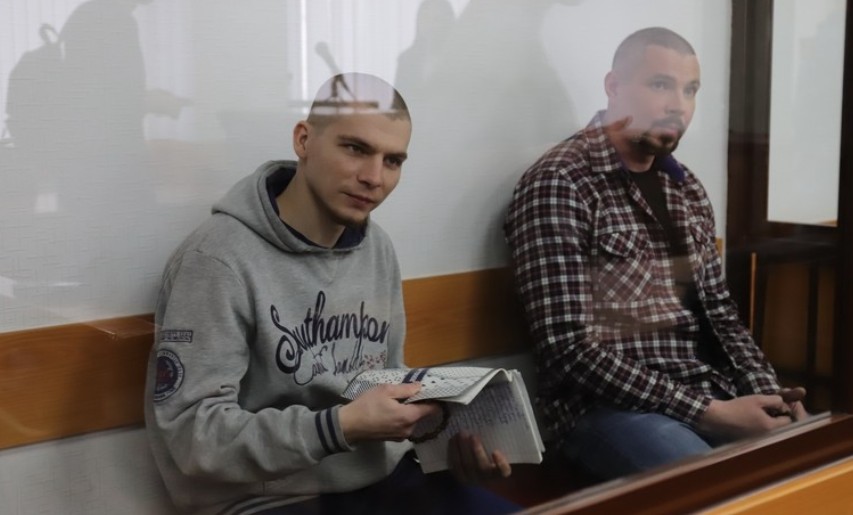
Roman Nasryev (left) and Aleksei Nuriev in court. Photo from The Insider
Roman and Aleksei will have to spend the first four years in prison, and the rest in a maximum-security penal colony.
This is the most severe sentence handed down so far for anti-war arson.
Roman and Aleksei received this long term of imprisonment because their actions were defined as a “terrorist act” (Article 205.2 of the criminal code of the Russian Federation) and “undergoing training for the purpose of undertaking terrorist activity” (Article 205.3). The latter Article carries a minimum term of 15 years.
The arson attack that Roman and Aleksei carried out – in reaction to the mlitary mobilisation, and to express their opposition to the invasion of Ukraine – was no more than symbolic. A female security guard was able to put out the fire, with a blanket and a few litres of water. There was damage to a window and some linoleum.
In court Roman Nasryev said:
I decided to carry out this action, because I did not agree with the [military] mobilisation, the “Special Military Operation” and the war as a whole. I simply wanted to show, by my actions, that in our city there is opposition to mobilisation and the “Special Military Operation”. I wanted in this way to make clear my opposition; I wanted my voice to be heard.
Solidarity Zone believes that this type of anti-war arson is not terrorism. That definition is politically motivated, and directly linked to the fact that the Russian government has unleashed a war of aggression against Ukraine.
□ Translated from Solidarity Zone’s Telegram feed. The original asks people to send letters and parcels to Roman and Aleksei in prison. If you are not a Russian speaker and you want to send them a message, there is no point in sending it directly. You can send messages to peoplenature@protonmail.com and I hope to be able to pass them.
The case of Pavel Korshunov, accused of “terrorism” over anti-war arson, sent to trial
Pavel Korshunov was detained in the city of Togliatti, Samara Region, as if he were a particularly dangerous criminal — a large number of Interior Ministry special forces soldiers were involved in his capture. But, according to investigators, all that Pavel did was set try and set fire to the Togliatti city administration building the day after the mobilization was announced. In a video posted online by the security forces, Korshunov states that he wanted to impede the mobilization.
Before his arrest, Pavel worked at a boathouse. Citing sources in the security forces, the media also write that Korshunov had previously taken part in protests.
Pavel has been charged with “committing a terrorist act” (per Article 205.2.b of the Russian Federal Criminal Code) and “vandalism” (per Article 214.2 of the Russian Federal Criminal Code). He faces from twelve to twenty years in prison if convicted.
On April 7, his case was submitted to the Central District Military Court in Samara. It will be tried by a three-judge panel chaired by Igor Belkin. There is not yet any information about exact trial dates on the court’s website.
✊ Help a teacher from Krasnodar accused of terrorism!
On the night of October 6, persons unknown set fire to the military enlistment office in the city of Goryachy Klyuch, Krasnodar Territory. The next day, the security forces detained two suspects — Bogdan Abdurakhmanov, a 27-year-old native of Minsk, and Boris Goncharenko, a 34-year-old man from Krasnodar.
Abdurakhmanov and Goncharenko were initially charged with “attempted destruction of property” (per Article 30.3 and Article 167.3 of the Russian Federal Criminal Code) and thus faced no more than three years and nine months of imprisonment if convicted. The FSB intervened in the case, however, and the charge was changed to “committing a terrorist act” (per Article 205.2 of the Russian Federal Criminal Code). Bogdan and Boris now face from twelve to twenty years in prison.
Goncharenko graduated from Kuban State University. After graduating, he taught history, social studies, and philosophy at various educational institutions. At one time he worked as a manager for the Garant and Konsultant Plus legal information portals.
Boris does not support Russia’s aggression in Ukraine, and after the outbreak of the full-scale war, he was very worried about the fate of the conscripts, including his former and current students.
Goncharenko does not consider himself guilty of “committing a terrorist act.”
Solidarity Zone has found a lawyer to defend Boris Goncharenko and made a down payment on their fee so that they may begin working. On March 29, we announced a campaign to raise the 250 thousand rubles necessary to pay the lawyer’s fees in full during the investigation phase of the case. To date, less than one fifth of the amount of money needed has been raised.
We urge you to support our fundraiser with donations and reposts!
💳 Sberbank card: 2202 2025 4750 6521 (Vasily)
🪙 PayPal: solidarity_zone@riseup.net (mark it “for Goncharenko” and designate the payment in euros if possible)
🥷 Cryptocurrency (be sure to email us at solidarity_zone@riseup.net if you transfer cryptocurrency to support Boris Goncharenko):
You are not violating any Russian laws by participating in the fundraiser. We have not been deemed “foreign agents” or an “extremist” or “terrorist” organization by the authorities, and raising money to pay a lawyer’s fees is not prohibited in Russia yet. ☺️
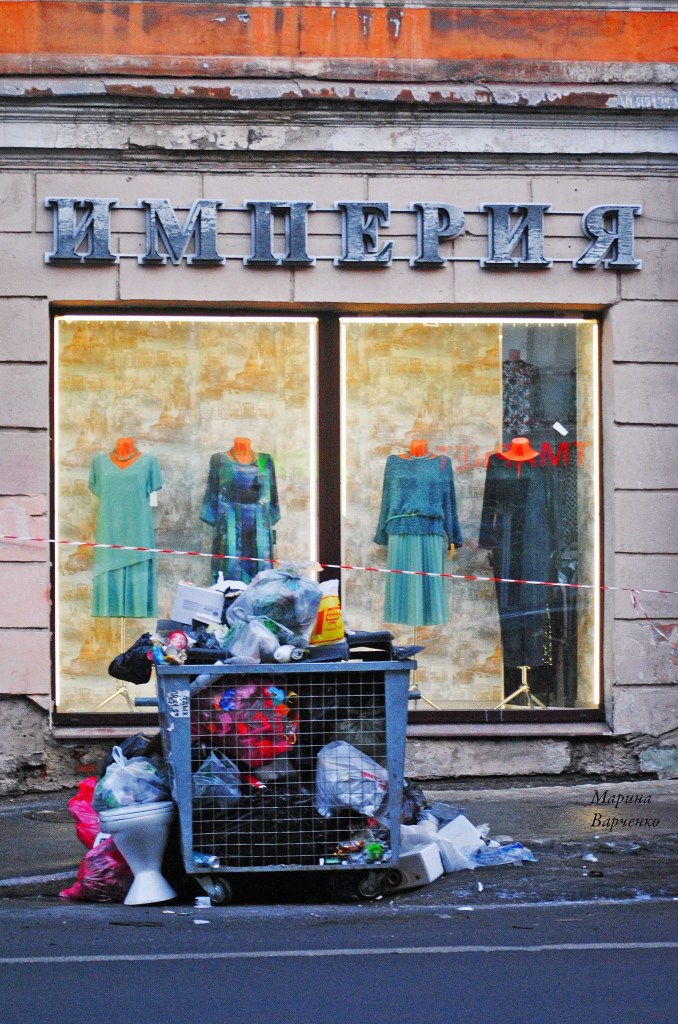
Today, on Razyezhaya, I came across a simply perfect illustration of what we’re living through.
Source: Marina Varchenko, Facebook, 25 December 2022. Razyezhaya is a street in central Petersburg that I know like the back of my hand since I lived nearby for many years. ||| TRR
These comments by Mira Tai were published by Doxa, the Russian online student magazine that has become a prominent voice against the war.
Hello! It’s Mira.
The full-scale Russian invasion of Ukraine has compelled many people, who live in Russia but are not ethnic Russians [russkie], to think about how we actually became the “small peoples of Russia” [a widely used term for the non-Russian nationalities that make up about one fifth of Russia’s population]. We saw many parallels between the way that the “Russian world” is trying to swallow up independent Ukraine, and the way that the ethnic republics “voluntarily became part of Russia” previously.
We have seen how the state, in which openly-declared nationalists hold leading posts in government bodies, justifies the massacre of citizens of a neighbouring country as “denazification”. We have seen how the propaganda machine is speaking openly about the renaissance of a gigantic centralised empire, in which there is no identity except Russian, and no other language than Russian.
These months have made all of us pose a mass of difficult questions, to ourselves and to each other. And no matter how hard the Russian propaganda machine tries to ridicule or denigrate this process, it will not be stopped and not be turned back – because we have changed. The surge of anger among non-Russian people has gone too far. The genie will not be put back in the bottle.
And the further it goes, the more astonishing it becomes that the majority of prominent Russian liberals and representatives of the “anti-Putin resistance”, continue to ignore what is happening. A great example is the new educational project, “Renaissance” [“Vozrozhdenie”], which opened today [23 December] and which has been loudly advertised on Ekaterina Schulmann’s Youtube channel over the last few months.
For the project, nine men and Ekaterina Schulmann invite people to take courses on the theory of democracy, capitalism and protest, the history of Christianity, and so on. They promise that in future this knowledge will facilitate the working-out of “a strategy for the Russian state, rebuilt and reborn as the inheritor of Russian, European and world culture”. Judging by the visual images chosen – golden-haired young women in Monomakh caps [the crown symbol of the pre-1917 Russian autocracy], gold leaf and portraits of monarchs – the school’s founders are especially inspired by the aesthetics of the Russian empire.
In a video in the section “About Us”, the word “civilisation” appears together with a picture of a young, rouged Ekaterina the Second [usually Catherine the Great in English-language history books] – the empress who first seized Crimea and began the process of genocide against the Crimean Tatars. That same Ekaterina, whose army slaughtered the population of whole towns in the name of the country’s “growth”.
And so in the tenth month of the full-scale Russian attack on Ukraine, we continue to witness how Russian liberals ignore any consideration of decolonisation. They do not even pose questions about the ideas and interests of those who have not been, and do not want to be, “inheritors of Russian culture”. They have not been troubled by doubts about the abstract liberal ideals of “democracy, freedom and peace”; they have no hesitation in proposing “Europe” as the source of progress, as opposed to the east. One of the courses offered by “Renaissance” is titled, in the best traditions of orientalism: “The East: a delicate matter”. …
People who can today link the word “civilisation” with portraits of Ekaterina the Second and festive, gold-trimmed panoramas of Moscow and St Petersburg, and who can promise the “renaissance of Russia”, must be blind and deaf to the suffering, and the hatred, of the Chechen people, who were subjected to genocide by the nearly-democratic Moscow of the 1990s. Blind and deaf to the hatred, and suffering, of the Ukrainian people, subjected to genocide by the authoritarian Moscow of 2022. Blind and deaf to the hatred, and suffering, of everyone whose first language definitely should not have to be Russian. And this lack of feeling is monstrous.
□ These comments appeared in Doxa’s Anti-War Digest on 23 December. I have translated them, because I think they offer useful starting-points for discussion about “decolonisation” of Russia that has begun not only among anti-war Russians, but also among those elsewhere who take the side of Ukrainian resistance. With Mira Tai, we witness “how Russian liberals ignore any consideration of decolonisation” – and, I would add, some self-proclaimed socialists do the same. One such is the writer and publicist Boris Kagarlitsky, who is to teach courses for “Renaissance,” and appears in its introduction video. He expressed opposition to this year’s invasion, but only after years of support for Russia’s imperial adventure in Ukraine since 2014 (for which he was criticised on this blog and elsewhere). SP.
□ To read more about Doxa in English, see an interview with Doxa activists just published by the Ukrainian socialist journal Spil’ne (Commons), and these speeches from the dock by Doxa editors Armen Aramyan, Volodya Metelkin, and Natasha Tyshkevich. They were tried on criminal charges last year, after publishing a video that discussed whether teachers should discourage students from attending demonstrations to support Alexei Navalny, the anti-corruption campaigner. (Doxa’s new website is in Russian.)
Ukrainian activists in the Eastern Human Rights Group are using social media to build up a register of people forcibly deported from Russian-occupied areas.
A bot has been launched on Telegram (@come_back_to_ukraine_bot) to contact citizens removed to Russia.
Deporting people against their will is a war crime. International and local human rights organisations, and the Ukrainian government, say there is mounting evidence that Russia is doing so on a large scale.
The Russian defence ministry said on 18 June that more than 1.9 million people, including 307,000 children, had been evacuated from Ukraine to Russia since the full-scale invasion on 24 February. Ukrainian activists deny Russian claims that all evacuees have left Ukraine voluntarily.
“If we don’t find how to help them, Russia will erase the Ukrainian identity of these children,” Oleksandra Matviichuk of the Ukrainian Centre for Civil Liberties responded.
The Kharkiv Human Rights Protection Group in April protested against a scheme to resettle residents of Mariupol in the most inhospitable and distant areas of Russia.
Halya Coynash reported that the Mariupol council had drawn attention to a leaflet distributed to Mariupol residents “inviting” them to the Russian Far East. She commented:
First, they destroy a successful and warm city on the Sea of Azov, and then they drive its residents to Siberia or Sakhalin to work as cheap labour.
Mariupol’s mayor, Vadim Boichenko, said that he has a list of 33,500 residents forcibly deported either to Russia or to the Donbass “republics,” and is coordinating rescue efforts.
Coynash also published details of the “filtration” of residents in the occupied areas by Russian forces, with those considered “unreliable” being sent to detention camps in the Donbass “republics.”
Ukraine’s human rights ombudswoman Lyudmyla Denisova said last month that 210,000 children, and more than 1 million other Ukrainians, had been deported against their will. Reuters reported these numbers, saying they could not independently verify them, and that the Kremlin had not responded to a request for comment.
Iryna Venediktova, Ukraine’s prosecutor general, said earlier this month that a war crimes case was being built up relating to the deportation of children to Russia.
The Organisation for Security and Cooperation in Europe (OSCE), in its report on human rights violations in Ukraine between 24 February and 12 April, said that its Mission had received “numerous consistent reports” on forced deportations from the occupied territories to Russia. It said that Russia had denied these accusations, but added:
If (some of) these deportations were forcible (including because Russia created a coercive environment in which those civilians had no other choice than to leave for Russia) and as they necessarily concerned civilians who had fallen into the power of Russia as an occupying power, this violates in each case International Humanitarian Law and constitutes a war crime.
Mateusz Morawiecki, prime minister of Poland, said on a visit to Kyiv this month that deportations – which recalled Poles’ experience under the Russian Empire and the Soviet Union – are “an exceptional crime, about which there is almost complete silence in western Europe.”
The Eastern Human Rights Group, set up in 2014 by labour activists in Donbass and now operating from Kyiv, decided to work on a register of deported citizens after appealing unsuccessfully for the Ukrainian government to take action.
“Our team lobbied repeatedly for setting up a state structure to deal with repatriation, but, as happens quite often, the government did not listen,” the group stated on 13 June. “We decided to take action on the issue ourselves, and at a non-government level we are working on the issue of repatriating Ukrainians.”
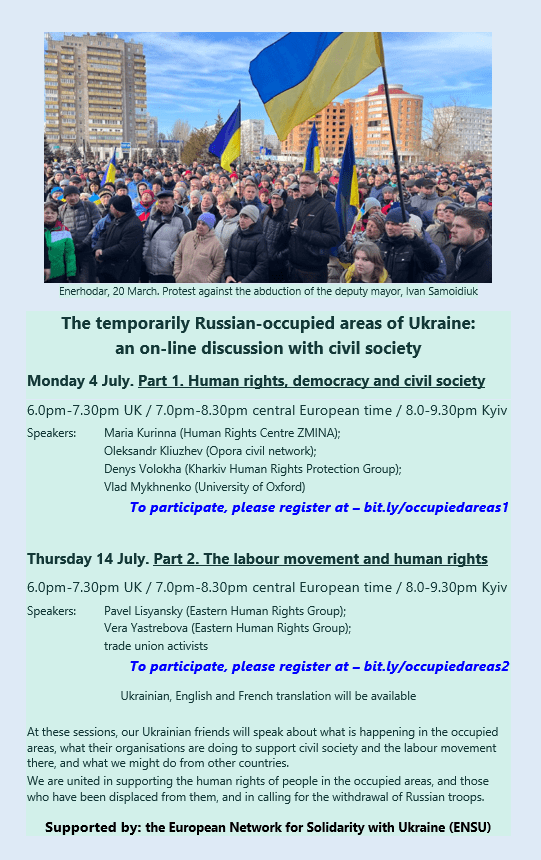
□ Two all-European public zoom calls about the Russian-occupied areas are being held on Monday 4 July and Thursday 14 July, on which Ukrainian activists will report on what can be done to support civil society there. The initiative is supported by the European Network in Solidarity with Ukraine. You need to register in advance to participate.
□ The Eastern Human Rights Group has also reported on forcible military mobilisation in the Donbass “republics,” and use of the death penalty there. Here are three recent Facebook posts. With thanks to Anna Yegorova for the translations.
For the last three weeks, forced mobilisation in the occupied territories of Luhansk and Donetsk regions has slowed down, due to active protests by mothers, sisters, and spouses of the forcibly mobilized.
However, the Ministry of National Security in the Luhansk and Donetsk “people’s republics” swiftly suppressed women’s protests, as we recorded the detention of several women in Yenakievo and Rovenky.
Since last Saturday, military patrols searching for men of conscription age in the cities of occupied Donbas have become more active with men being detained in the streets again. (The detentions are not as massive as in March, but that is understandable: there are simply not as many men as there were in March.)
This new stage of forced mobilisation is associated with the need to send new manpower to fight in Donbass.
Forced mobilisation has again affected workers at enterprises, and enterprise managers have spoken out against it. The administrations of the “Luhansk people’s republic” and “Donetsk people’s republic” said that “construction brigades” [a term dating back to the Soviet times, usually designating student groups as “volunteers” to work on farms and plants] from the Russian Federation would soon arrive to replace the workers [so that the latter could be send to the battlefield].
Over the past three weeks, the so-called “people’s militia” of the Luhansk and Donetsk “people’s republics” has increased military patrols in the temporarily occupied territory of Ukraine, due to the increasing number of defections from AK-1 and AK-2 units. Forcibly mobilised people, even after they have been dressed in uniform, seek opportunities to escape from the Russian convoy escorting them to the front line.
Frequent defections became public thanks to women in [the occupied territories of] Donetsk and Luhansk reporting to Vera Yastrebova, the head of the Eastern Human Rights group.
One woman said that her brother escaped with a group of mobilised men on the way to the front line, and now they are wanted by the local “authorities.” There are also cases when mobilised residents of the two “people’s republics” jump off trains that take them to the front line, following a brief training in the Russian Federation.
Over the past three weeks, there have been more than 100 cases of defections from the “LPR” and “DPR,” a source from the DPR told us.
By Vera Yastrebova.A working group is preparing to change the criminal “law” of the Luhansk “people’s republic” to introduce a new type of punishment – the death penalty, I have been told by sources there.
A decision was first made back in 2021, when the Kremlin decided to create unitary “legislation” for the Donetsk and Luhansk “people’s republics,” and essentially rewrite the laws in Luhansk to match those of Donetsk. But they haven’t had time to do that.
Now the principle has been agreed, and changes are being developed very quickly. The haste is due to the fact that the Luhansk “people’s republic” will be able to apply the death penalty to Ukrainian prisoners of war.
The issue of the “death penalty” will be further pushed by the Kremlin, in order to force Western countries to engage in direct negotiations with the leaders of the “LPR” and “DPR,” my sources say.
□ There will be all-European public zoom calls, on Monday 4 July and Thursday 14 July, with Ukrainian activists supporting people in the occupied areas. Details and link to registration here.
Source: Simon Pirani, “Ukrainians face forcible deportation and conscription by Russian forces,” People and Nature, 27 June 2022. Reprinted here with the author’s kind permission
Is this monstrous war of aggression really between two equal sides?
An open letter in response to the Manifesto Against the War
Dear comrades,
I write in anger and sorrow about your Manifesto Against the War, to which I turned in the hope of learning from you about how we can situate the anti-war movement in the wider struggle against capital.
Enumerating the causes of military conflict, you refer, first, to “the growing rivalry between the greatest imperialist powers”. Third is “Islamic fundamentalism”. But before that, second, comes that “the US government has positioned its military alliance system, NATO, against the Russian Federation to prevent the integration of the defunct Soviet empire’s successor into an enlarged, stable and peaceful European order with mutual security guarantees”.
Demonstrations in Ukrainian cities occupied by the Russian armed forces are part of a people’s war
You don’t explain why you think that, in this age of the deep crisis of the capitalist system – which in your words “unleashes ever more violent struggles for geostrategic zones of influence” – such a “peaceful European order” could ever have been possible.
That hope, embraced by Mikhail Gorbachev and many social democrats in the 1990s, was surely dashed as the economic crises of neoliberalism (1997-98, 2008-09, etc) multiplied, as the Russian bourgeoisie emerged in its 21st-century form on one hand, and the alliance of western powers pursued their murderous wars in Iraq, Afghanistan and elsewhere on the other.
You don’t explain why you name the US government and NATO, and Islamic fundamentalism, as causes of the current war … but not the Russian elite, which actually started it.
You turn causes into effects, and effects into causes, in order to justify this focus on the US and NATO. So, immediately following your point about the US using NATO to prevent Russia’s integration into a stable European order, you continue: “The sabotage of Nord Stream 2 shows that economic pressure is just as important here as it is in the positioning against China.”
This just doesn’t fit with the facts. Nord Stream 2 was a major point of dispute between the German ruling class and its US counterpart. For years, the US sought to sanction the pipeline, and the German government resisted. In July 2021, the Biden administration struck a deal with chancellor Merkel under which the pipeline would be completed. The German desire to integrate Russia, at least as a trading partner, prevailed.
The pipeline was finally frozen by the new German chancellor, Olaf Scholz, on 22 February, the day after Russian president Putin recognised the Donetsk and Luhansk “people’s republics” – a clear indication that the Minsk peace process was finished and that Russia was preparing for some sort of war. Russia acted; Germany reversed its long-standing policy.
The freezing of Nord Stream 2 put no discernible economic pressure on Russia, anyway. The point of the pipeline was to enable Russia to pipe gas to European destinations without taking it across Ukraine. It was designed to reduce Russian dependence on Ukraine for pipeline transit, that is, to produce a geopolitical benefit rather than any significant economic benefit. The western powers have imposed heavy economic sanctions on Russia – after it invaded Ukraine on 24 February.
The reason you mix up causes and effects is clear. Your narrative description of the post-Soviet period mentions the collapse of the Soviet empire, the loss of those (to my mind illusory) “quite favourable” chances of Russia “democratising” – and then the failure of that option due to NATO expansion. The arrogance inherent in that expansion “created the external conditions in Russia for the implementation of a strategy of imperialist revisionism” under Putin, you say.
I would dispute the prevalence of NATO expansion as an “external condition”. I think the broader crises of capital, and of its neoliberal management strategy, were far more important. But what about the internal conditions? You don’t mention those. What about the reconstruction of the Russian bourgeoisie in the post-Soviet period, and its relationship with the post-Soviet repressive apparatus represented by Putin? Where does that fit into your analysis?
Your focus on the “external condition” means that your account of Russian militarism is one-sided. The Georgian war in 2008 and the annexation of Crimea were “warning signals” that were “disregarded” by NATO, which, according to you, built “infrastructure” in Ukraine. What “infrastructure”? (NATO was always divided about admitting Ukraine as a member, and until last month’s invasion kept its military relationship with Ukraine at a low level.)
Your account of Russian militarism starts in 2008. What about the murderous assault on Chechnya in 2000-02, which first cemented Putin’s position as president, and was supported by NATO? What about the Russian assault on eastern Ukraine in 2014, which you incorrectly describe as a “civil war with indirect Russian involvement”? What was “indirect” about a war in which Russian mothers lost their sons on the front line, fighting in Russian army uniforms? What is “indirect” about the massive logistical, financial and political support given by the Russian government to the Donetsk and Luhansk “republics”?
Most telling of all, you don’t mention Syria. The drowning of the Syrian uprising in blood in 2015-16, surely the greatest defeat of a revolutionary movement in this century, was accomplished by the Assad regime with powerful Russian military support.
The NATO powers stood back and allowed this to continue (while they themselves fought their own wars in Iraq, Libya and Afghanistan) for the same reason that they acquiesced in Putin’s actions against Chechnya, Georgia and Ukraine: because for all their disavowals of “spheres of influence”, they were content that Russia should act as a gendarme for international capital in certain geographical areas. As indeed they were content to see Russian troops intervene against the Belarussian uprising in 2020, and in Kazakhstan in 2022.
You write: “this catastrophic war of aggression was also preceded by imperialist acts of aggression on the part of the West, which provoked in Putin’s Russia a geostrategic logic common to all imperialist power elites”. Sure! The Russian empire, with its rich history of suppression of its colonies and its own people, needed to be provoked by the western powers, in order to make war on the oldest of those colonies. Just like the British ever needed provoking, before making war on Ireland. (I hope my sarcasm comes through OK in a written text.)
Your policy proposals reflect your skewed view that this is a war between two equal sides. You make serious points, and I hope they are discussed. But first we have to be clear. Is this monstrous war of aggression really between two equal sides? Only one side is shelling and terrorising civilians, and arresting and murdering those who defy its occupying forces. (Remember Putin’s declaration on the first day? “We don’t intend to occupy”? Tell them that in Mariupol.)
Do you really believe this is an inter-imperialist conflict, with no element of a people’s war? Why else did you neglect to mention those thousands of Ukrainians fighting outside the state framework to defend their own communities, with arms in hand or in other ways? Because they didn’t fit your preconceived interpretation?
I write with anger because I have had such great respect for some of the signatories of the manifesto, and the contribution they have made to the development of socialist thinking. In the 1990s – when studying both the Russian revolution and modern-day Russia showed me that Trotskyism, the framework I had accepted before then, was wanting – autonomism was one of the trends that I began to study and learn from. Including what some of you have written.
Your statement looks as though you decided the conclusion – that this is fundamentally an inter-imperialist conflict, and nothing more – and worked back from there to interpret the facts. Comrades, that’s the wrong way round. The younger generation deserves better, from all of us.
In solidarity,
Simon Pirani. (21 March 2022.)
PS. I have written about my own view here, if it’s of interest.
Source: People and Nature, 21 March 2022. Reprinted here with the author’s permission. ||| TRR
Ukraine: ‘condemn Russia’s imperialist threat’ • People and Nature • 24 January 2022
Ukrainian socialists are urging international unity against the Russian government’s imperialist policies that threaten a new war.
The Social Movement, a group of mainly labour activists in Ukraine, calls in a statement for “solidarity with people who have suffered from the war that has lasted almost eight years, and who may suffer from a new one”.
The statement expresses “gratitude and solidarity to Russian left-wing activists who oppose the imperialist policies of the Kremlin and are fighting for democratic and social transformations in their country”.
“Our house was stolen by war”: one of Ukraine’s 1.5 million internally displaced people. Photo from commons.com.ua
The Social Movement denounces the “myth, popular among some Western leftists”, that the Russian-supported “people’s republics” in Donetsk and Luhansk are “the result of popular will”. Their statement says:
The heads of the “Donetsk People’s Republic” and “Luhansk People’s Republic” are integrated into the ranks of the ruling elite of the Russian Federation and have become the mouthpiece of the Kremlin’s most aggressive predatory sentiments. In the “republics” themselves, any opposition political activity, even the most loyal to the Russian government, is suppressed.
The (Ukrainian) Social Movement statement concludes with a call for “complete withdrawal of Russian troops from Donbas”. It says that “one of the best means of pressure on the leaders of the Russian Federation would be the seizure of the property and assets of Russian oligarchs and officials in London and other places”.
It calls for “revision of the socio-economic course proposed to Ukraine by the West: instead of destructive neoliberal reforms under the pressure of the IMF – the cancellation of Ukraine’s external debt”. And it urges “more inclusive and progressive humanitarian policies in Ukraine, ending impunity for the Ukrainian far right, and abolition of the ‘de-communisation’ laws”.
One thing many Ukrainians find grotesque is the sight of their country’s fate being discussed by the US and Russia, as though the Ukrainian state did not exist. This is the focus of an article, “Moscow and Washington should not determine Ukraine’s future”, by socialist activist Taras Bilous.
So is a facebook post written on 20 January by Marko Bojcun, the socialist historian of Ukraine, which I reproduce here with his permission:
Though Putin, the artful player, has several options in his hand, his ultimate objective has been to get the US to join an expanded Normandy format and the Minsk negotiations, and there to help force Ukraine to accept further limitations to its state sovereignty. Basically, that means Kyiv would accept the separatist Donetsk and Luhansk “republics” as internationally recognised autonomous state institutions within Ukraine, but in reality bodies that continue to be run by Russian state ministries – as they already are in a concealed manner. Russia would use them to lever Ukraine’s domestic and foreign policies.
Putin recognises that he can achieve his main goal only with US endorsement. He needs the US to join him in twisting the arms of the stubborn Ukrainians. That has been the point of all these Russian troop movements to Ukraine’s current borders: to get the Americans to weigh in, to keep Ukraine out of any direct talks and to conclude a deal over their heads.
Ukraine is critical to Russia’s long term project of economic, military and diplomatic recovery, its resumption as a Great Power. That means Russia will not stop its drive until it achieves much more. The present conjuncture resembles in some way another historical moment, in 1938, when Neville Chamberlain, the British prime minister, met Joachim Von Ribbentrop, Nazi Germany’s foreign minister, over the Czechoslovak crisis. Chamberlain came out of that meeting, waved a scrap of paper in his hand and declared peace in their time. I wonder what US foreign secretary Anthony Blinken and his Russian counterpart Sergei Lavrov will have to say after their meeting tomorrow?
The answer to that last question turned out to be: nothing much. Blinken offered Lavrov the carrot of a meeting between the US and Russian presidents, something Putin has long craved in his efforts to claim Russia’s “great power” status.
□ A recent comment article by the journalist James Meek is on the London Review of Books web site, on open access. Meek and Paul Mason are among the panelists appearing at an event organised by the Ukrainian Institute in London about the war danger, on Wednesday 16 February. (The Institute, run in the distant past by cold-warrior right wingers, is now managed by liberal, post-Soviet Ukrainians. Its educational and informational events are well worth looking out for.)
□ The London-based, official-labour-movement-focused Ukraine Solidarity Campaign regularly publishes information.
□ The biggest gap in English-language coverage is about what is going on in eastern Ukraine. I have occasionally translated and published stuff on this blog (see e.g. a recent post here, and, from further back, here, here and here).
□ The Kharkiv Human Rights Protection Group web site has excellent, and accurate, coverage of an appalling range of repressive state and military activities – see, e.g., their tags on Crimea and “terrorism” (which includes those “people’s republics”), but note, too, their more general reporting on human rights abuses in Ukraine and Russia.
□ It is a job of work to counter the stream of deceit and misinformation from Putin-ists in the UK labour movement. I summed up the arguments in a recent blog post here. I even wrote to the Morning Star, about one of its more grotesque lies – that “hundreds of trade union leaders” were killed by the post-2014 Ukrainian government. Accuracy about dead bodies is not their big thing, it seems. My letter is reproduced below. SP, 24 January 2022.
False reporting of “hundreds” of trades unionists’ deaths
I I sent this letter to the Morning Star newspaper, which claims its favours “peace and socialism”. It was published, in the print & pdf edition only, on 17 January
Dear Editor,
In the article “Opinion: US and NATO play with fire in their latest anti-Russia campaign”, 9 December, John Wojcik stated: “Hundreds of trade union leaders and activists were murdered by the new right-wing Ukrainian government shortly after it came to power [in 2014].”
This is incorrect. The two major Ukrainian union federations reported no such deaths of union leaders. Nor did the detailed reports by the UN High Commission for Human Rights on civil rights in Ukraine. Some activists were killed in this period, during numerous civil disturbances, but there is no evidence that the government was responsible. (Many people were killed, by Ukrainian, Russian and separatist forces, in the military conflict that began in the summer of 2014. This is not what Wojcik is referring to.)
Many of your readers will have mourned the death of friends and comrades killed for their trade union activity. It would be disrespectful to them to leave uncorrected the statement that hundreds of union leaders were killed.
The article also states that the new Ukrainian government “banned the use of the Russian language”. This is incorrect. A law making Ukrainian the single state language was adopted in 2019. It requires Ukrainian to be used – but not exclusively, i.e. it can be used together with other languages – in certain public spaces. It will be applied to educational institutions and the media, but not to private or religious life. Many Ukrainian socialists are opposed to it. But exaggerating its effect can only help to exacerbate differences between working people on grounds of nationality and language, that historically the labour movement has endeavoured to overcome.
Simon Pirani, London.
Correction. This article has been corrected on 4 February, to reflect the fact that this letter was published in the Morning Star’s print & pdf editions. It was not published in the on-line edition.