
The eve of the 2018 presidential election saw the release of Andrei Loshak’s series Age of Dissent, about young supporters of Alexei Navalny who were involved in his election campaign.
The sequel to the series, filmed on the eve of the latest presidential “election,” recounts how the lives of the activists who dreamed together with Navalny of “the wonderful Russia of the future” have changed dramatically in six years. Filming was almost completed when news came Navalny’s death. The movie’s protagonists ask themselves how to live without dreams and hope.
Source: Current Time Doc (YouTube), 3 June 2024. Annotation translated by the Russian Reader
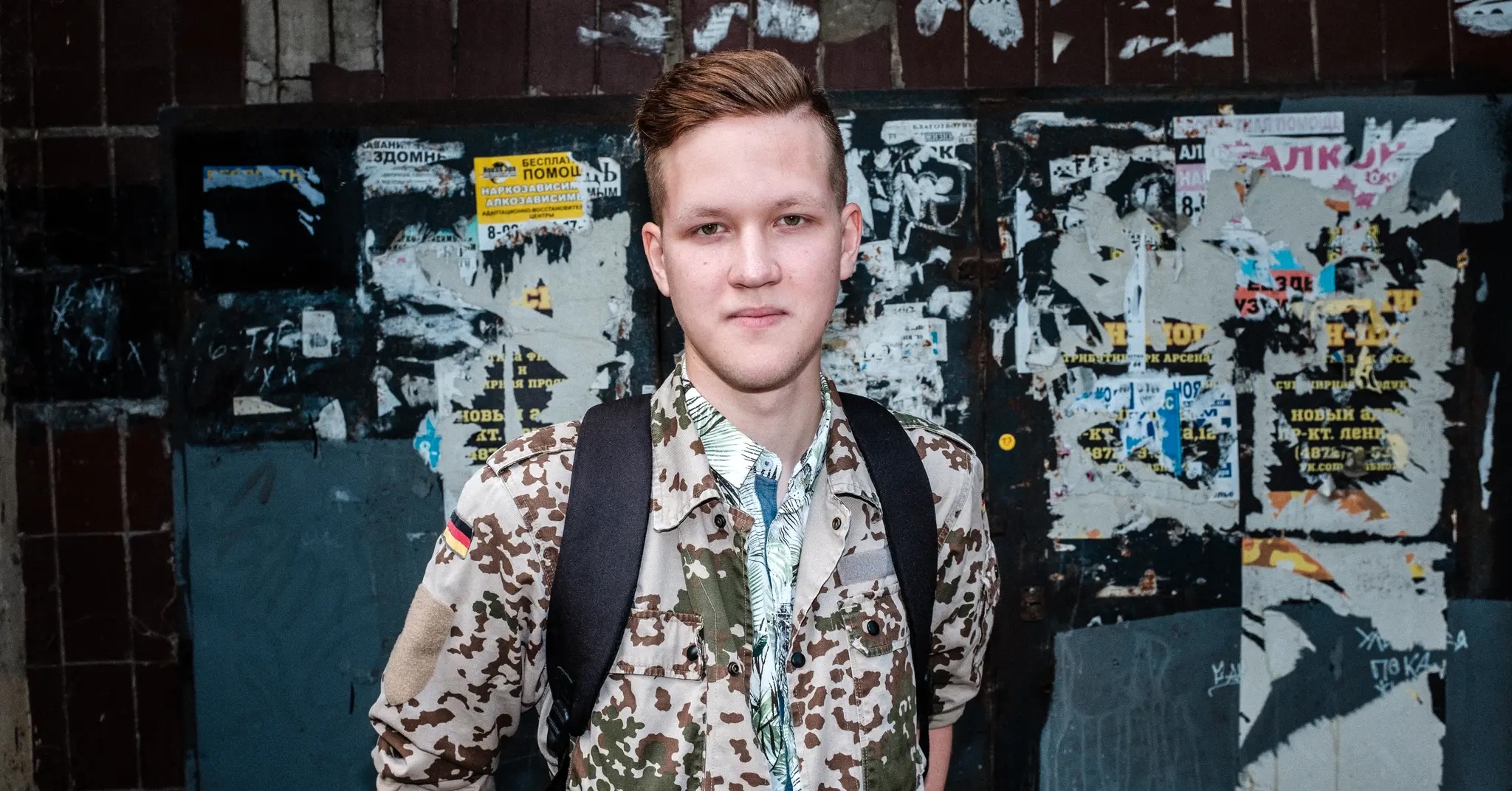
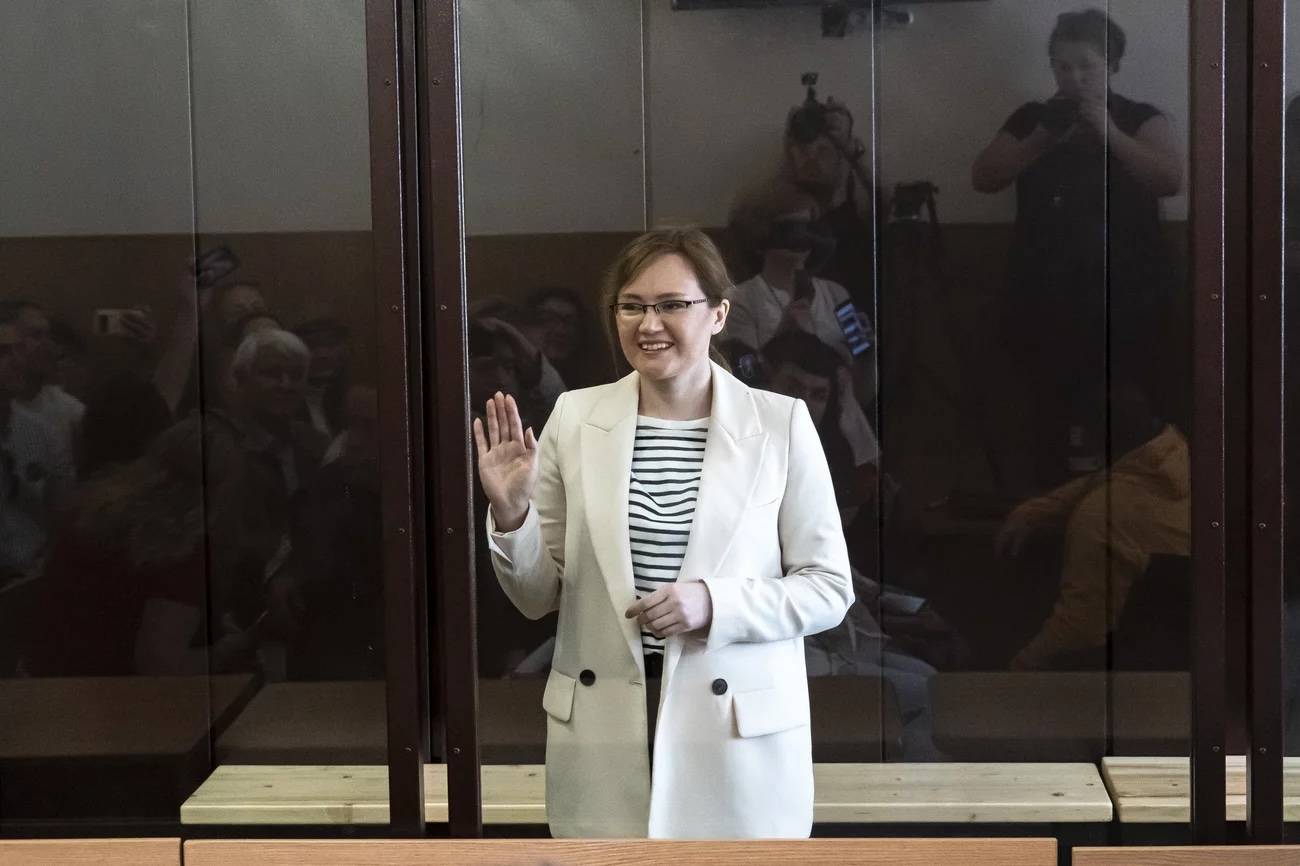
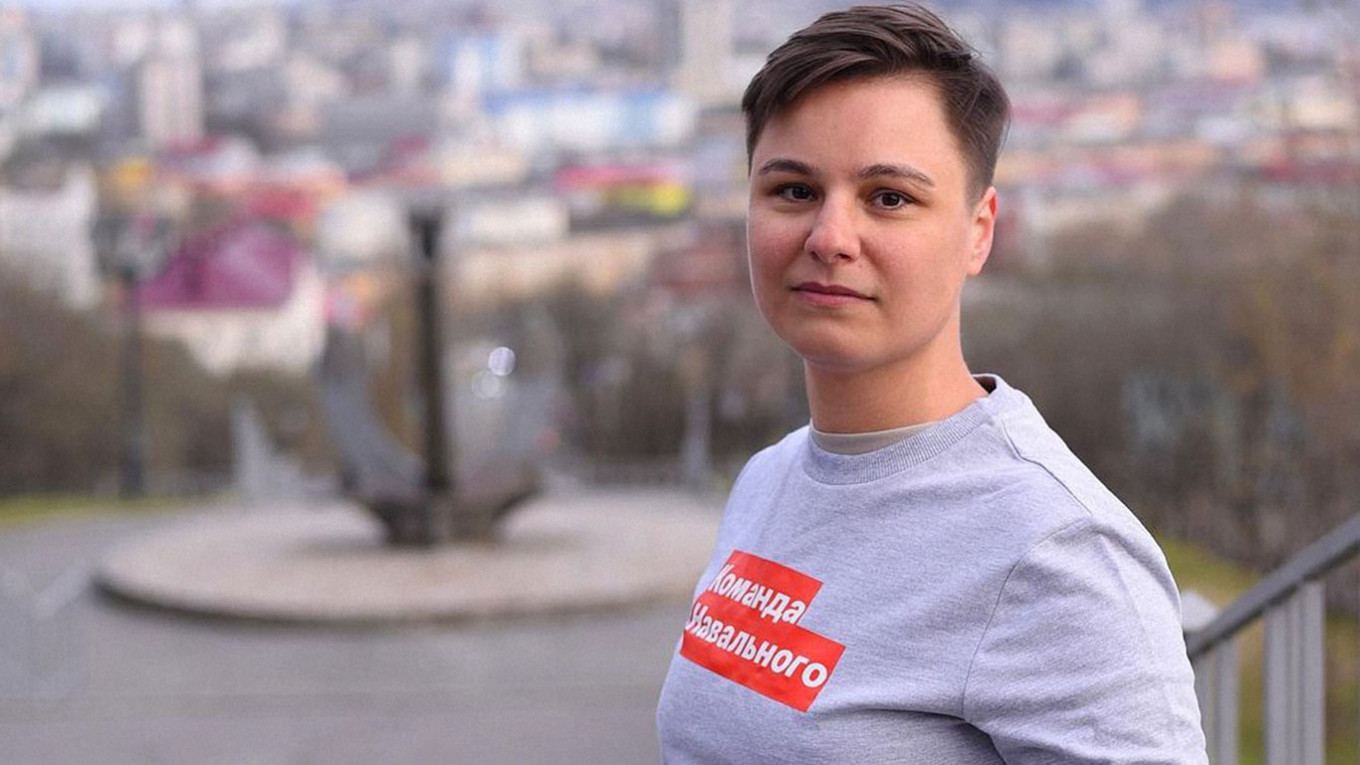
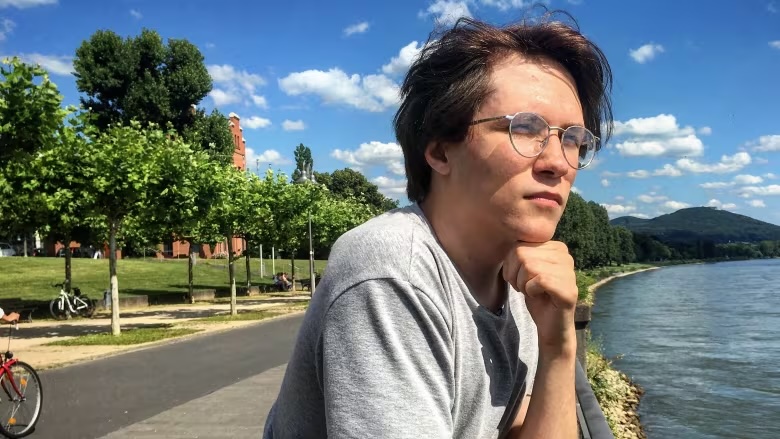
The protagonists of Andrei Loshak’s documentary film Age of Dissent 2024: (clockwise, from upper left corner) Filipp Simpkins, Lilia Chanysheva, Ksenia Fadeeva, Yegor Chernyuk, and Violetta Grudina
On June 3, Current Time hosted the premiere of Russian filmmaker Andrei Loshak’s documentary Age of Dissent 2024. It is a sequel to Age of Dissent, which was filmed on the eve of the 2018 presidential election in Russia and focused on opposition politician Aleksei Navalny and the young supporters who helped him with his unofficial campaign. He was denied registration as a candidate but campaigned as if he was on the ballot.
Fast forward six years, to 2024, and another Russian presidential election, which was held in March and won, again, by Vladimir Putin with what the state said was 87.3 percent of the vote. Loshak’s new film, commissioned by Current Time, RFE/RL’s Russian-language TV and digital network, tells how the lives of the same activists who had dreamed, together with Navalny, of a “beautiful Russia of the future” changed dramatically.
Filming was almost completed when news broke in February of Navalny’s mysterious death in a Russian Arctic prison while serving a 19-year term on charges his supporters and many Western governments considered politically motivated.
On the eve of the film’s premiere, Current Time journalist Ksenia Sokolyanskaya met with Loshak in Tel Aviv.
RFE/RL: Did you think from the very beginning that this story would have some kind of sequel? Or did something happen at a certain moment that made you want to return to these people?
Andrei Loshak: I must say that, probably, this idea was there from the very beginning. After I released the first film, I saw that it kind of took off. People began to tell me that they wondered what would happen to the subjects next. And I thought, yeah, it’s really interesting that it will be a new election cycle six years later.
I had to monitor their fates, so I asked to film some things, although I didn’t know for whom it was to be done or when. But then I realized that they had all left Russia, that their fates had changed very dramatically, and that everything that they had fought for and lived for, all of it was destroyed in these past six years.
Yes, it seemed to me that this was enough to return to them and film what had happened to them. But you have to understand that we finished filming in January and early February [of 2024]. I sat in Tbilisi and thought about what to do with all of this.
What was my idea? To draw attention to Aleksei Navalny, because for me, this was such a serious motivator. There was a moment when he was being transferred to [the Polar Wolf prison in Russia’s Arctic town of] Kharp, and he disappeared, and I was struck by how few people wrote about it. For two weeks, it was not clear whether he was alive or not.
They killed Aleksei on February 16. At that moment, I was simply lost. I didn’t understand what to do with the material.
I think it was important to record the reactions of [the film’s subjects] to the news of that day, before they had time to get used to it. Although, to be honest, I’m still not used to it. It killed me, too.
This is probably the most personal film I’ve made in a long time. Because usually you take the position of an observer and film all sorts of things, but in this film I lived with the subjects — with one dream, one hope — and Aleksei was as important a figure for me as he was for them.
RFE/RL: I read the comments under the teaser for the film, which was posted the other day. People wrote that it was painful to watch, that their hearts were broken. We live in a Russia we don’t want to live in, and Violetta in the film talks about “those traumatized by Russia.”
Loshak: Moreover, a psychotherapist gave them such a diagnosis.
RFE/RL: In the film, a separate theme is the question: How do you live when the main thing you’re living for is taken away? Do you think there is an answer?
Loshak: We are all asking this question now, and few people understand how to overcome all this. This is a recording of this moment, when our homeland rejected us. We found ourselves superfluous and unnecessary there. She needs us, but the circumstances are such that they don’t expect us there, they don’t want us there, they push us out of there.
Hope is such a straw. You still clutch at it. Of course, a few months is not enough time to understand how to live now. I am in this process, and my heroes are in this process of understanding. [In the film,] Oleg says this [phrase] from the point of view of common sense: “We need to stop this, guys.”
RFE/RL: Meaning that political activism is not a profession?
Loshak: Yes. It is possible in some historical cycles, but in others it is impossible. And when you find yourself rejected, uprooted and without a homeland, your plan must change….
That’s why I always look at this whole “opposition movement” with great skepticism. I don’t know who looks at it without skepticism. But on the other hand, I don’t deny it. It’s kind of necessary, because they’re doing the right things, but it’s virtually impossible to influence anything in Russia from [exile]. This must be understood clearly.
This feeling of helplessness with which Violetta says: “What, how, and why?” — the loss of these meanings is very painful. But we always have to say goodbye to something; everything has its own lifespan. And unfortunately, we are now at this point where we need to say goodbye to all this and start something new. The question is: What?
RFE/RL: Do you have faith? In the film people talk a lot about faith, and it ends with Aleksei’s words about the need to believe. Do you have faith that Aleksei’s story can also transform into something that people will watch, and that if they don’t know the story of Jan Palach, they will learn it from your film? (Editor’s Note: On January 16, 1969, 20-year-old university student Jan Palach set himself on fire in Prague to protest the August 1968 invasion of Czechoslovakia by Warsaw Pact troops. He died of his burns three days later.)
Loshak: I’m sure of it. I’m convinced of it. Such sacrifices, heroic deeds of such magnitude, cannot be in vain. I am absolutely sure that this is not a wasted sacrifice and that Aleksei will remain in the history of Russia forever as one of these heroic figures, which, of course, will acquire its own mythology. And in what our grandchildren and great-grandchildren will read about him, we would hardly recognize Aleksei.
There are always few such figures in history. I have never encountered anything like this in my life, such a level of self-sacrifice.
RFE/RL: The scale.
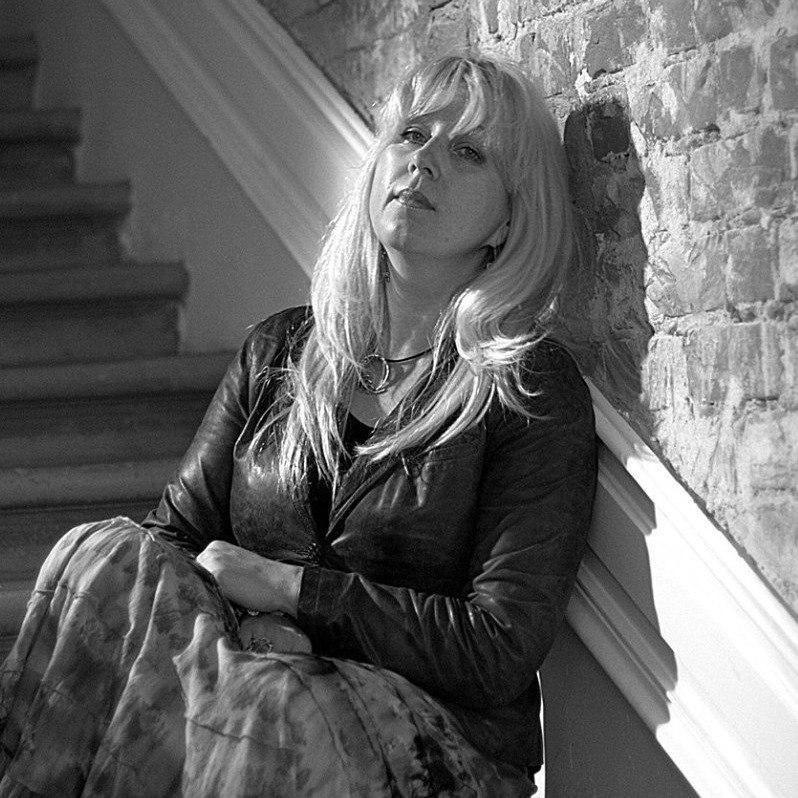
Loshak: Yes, but we also had, of course, our own Jan Palach: [Russian journalist] Irina Slavina, who set herself on fire in Nizhny Novgorod [in 2020], opposite the city police headquarters. (Editor’s Note: Before self-immolating, Slavina wrote on Facebook, “Blame the Russian Federation for my death.” A day earlier, she had written that police had searched her apartment, trying to find evidence linking her with the opposition Open Russia group and confiscated her computers and mobile phone.)
She didn’t do it in vain, either. I’m absolutely sure. Although who remembers her now? This was just a few years ago, before the war [in Ukraine]…. She will also be in this pantheon of heroic people who openly came out against evil.
Of course, Aleksei and what he did, and the way he died — all of this will later inspire people because everyone always needs bright examples, everyone needs these myths. And Aleksei has already become this myth. I can already see how people who never appreciated him during his lifetime — and, in general, I heard little good from them about Navalny — are now writing: “But Navalny would not have said that,” or, “Navalny would not have done that.”
His wings have already grown; he is already soaring over this unfortunate Russia, and he will always soar there from now on. This is actually good because you have to believe in something.
RFE/RL: After Navalny’s death, a discussion appeared in the Russian-speaking, mostly emigrant, community. It seems to me that the impetus was Shura Burtin’s manifesto on Meduza that a “beautiful Russia of the future” will not happen and that hope for some kind of good future is harmful. One of your subjects, Violetta, also talks about how she doesn’t feel joy, that she can’t say she lives, she just exists. Do you think you should actually believe such stories?
Loshak: Believe in what?
RFE/RL: You said Aleksei’s sacrifice was not in vain, but it seems to me that for a large number of people this is not true.
Loshak: That everything is in vain, that evil triumphs over good, and that this has always been the case in Russia? It has always been this way. But it seems to me that everything has its time. Even if we look at the history of Russia, evil has always defeated good, but there have also been moments when good had a chance.
There have always been thaws, rollbacks toward democratization, and liberation from the shackles with which the state always entangles people in Russia. We have always had this chance; we just never took advantage of it.
With Aleksei there was this chance; he gave us this chance throughout his political life, starting in 2017, but this liberal layer of us, so to speak, simply looked at it all with the curiosity of a TV viewer, nothing more.
Then he returned. He returned [to Russia from Germany in January 2021 after being treated for poisoning], realizing that, of course, he would most likely be imprisoned. But he gave us this chance again, and it was as if it was all staged. He returned, his documentary Putin’s Palace was released, which was watched by 100 million people. Then there was a rally, and the usual 20,000 to 40,000 people came out.
We wasted the chances that Navalny gave us.
I really believe that at some point people will understand how important it is to participate in politics, how important it is to be a citizen, and not just to be a resident of this country. One of the subjects in the first part of the documentary in 2017 said to me — I won’t say his name now, because he is in Russia, but he was on the Maidan; by accident, he ended up there — “When 10,000 people come out, it’s nothing. But when 1 million people come out, you can’t do anything about it.”
This is why I endlessly respect Navalny: for the fact that he did everything he could, and more than he could, to give us these chances. And we blew them. And I hope that someday this will become obvious. You see, what is happening to Russia now cannot last forever.
RFE/RL: Why?
Loshak: Because it’s against common sense, it’s against the passage of time. This is an attempt to turn back time, to turn it around….
In general, history is cyclical. Now there is some moment of crisis in which Western civilization finds itself. We see incredible divisions within Western countries. I don’t remember this before. This is also some kind of new sign of the times. But nevertheless, Western societies have gone through many crises, and their strength is that they are democratic, and thanks to this openness they survive them, work through them, and reach a new level.
But Russia is not doing this. Russia is simply driving us into some kind of Middle Ages with its boots. The rhetoric that is heard now is about a “holy war,” about the defense of traditional values. It all comes down to homophobia really. This is the only thing they found as a scarecrow around which they built this whole structure about the “holy war” of the Russian world with Western civilization, which is satanic, because gay people can openly hold each other’s hands and recognizes their marriages. This is complete bulls**t.
For this generation, about which I filmed in 2017, there was no issue of homophobia at all. They had already grown up in this cross-border world of the Internet. They saw that this was normal. This is how all people live, and they are happy.
I subscribe to Russian-language Iranian opposition channels. You’re amazed how much the same is there. It’s just that these grandfathers look more colorful there. Ours are in secular blue jackets, and in Iran there are bearded ones in dressing gowns. But everything is the same. People want to live freely; they want to be happy. It is impossible to be happy when everything is forbidden.
It is impossible to keep these prohibitions all your life because the reverse process is taking place all over the world. People are following the path of gaining more and more freedom, because it is more comfortable to live this way, and at the same time respect the freedom of others….
But at any moment the Russian state can invade your life and tell you how you should behave, how to dress. You have nothing. You owe them everything for some reason, but they don’t owe you anything.
This is such an old patriarchal model of the world order. If you look at all this more broadly, I see it as a rebellion against patriarchy. And what is happening in Russia is the agony of the patriarchy. In Russia, the strong are always right. To the question, “What is strength?” [I answer that] in Russia there is strength in strength. Not in any truth. This is nonsense. What is the truth? The truth was on Aleksei’s side. And where is he? I’m sure [these grandfathers] are becoming decrepit. Time will simply kill them because time is not on their side. And at some point they will simply stop being strong, and then they will be finished.
Arriving at Jan Palach’s grave [in Prague], Oleg tells the story about what happened in 1969. And in 1989, the Velvet Revolution [in Czechoslovakia] began with people coming to his grave. Yes, we had to wait 20 years for this name and this feat to become an impulse and begin to work. But now, it seems to me, time flows faster. I would like to believe that we will not have to wait another 20 years.
RFE/RL: When you invited people to the premiere in Tel Aviv on Facebook, you wrote: “I don’t wish you a pleasant viewing. That would be hypocritical on my part.” As someone who has seen the film twice, I can say it is indeed very difficult to watch. What effect do you, as an auteur, hope for?
Loshak: Due to what happened during the filming — and it was not I who wrote Navalny’s death into the script — I stopped thinking at all about who I was doing it for. It’s just a film that has a lot of my personal pain in it. I did this in order to try to part with this pain. It’s like psychotherapy: You have to work through it and live it in order to move on….
Navalny was important to so many people. This is a figure on a much larger scale than perhaps even we thought. Both importance and value. Still, his presence in Russia, even in prison, in this political landscape was completely incommensurable. We just don’t even understand yet how important. And we will understand gradually more and more. This film is probably for these people.
RFE/RL: You wrote a big post on Facebook about Aleksei and said that you miss him, and that it doesn’t go away. And in the end you say that despondency is a mortal sin, that Russia is a terrible fairy tale with a bad ending. You say that faith is an irrational thing. Do you want to return to Russia?
Loshak: Of course, I want to return to Russia now…. If Putin dies, then, of course, I will return….
Listen, this is our homeland. It’s not that we’re injured. It’s normal to want to live in your homeland with your people. They turned us into some kind of national traitors, although they are the national traitors. But we ourselves even began to get used to it, feeling that we were somehow different, which means we don’t belong there, that this is not our homeland.
But, damnit, this is our homeland, our roots are there, our everything is there. Why shouldn’t we want to go back? It’s normal to want to go back and desire to live in a different country. That is, to want changes in your country, which has simply turned into a fiend of hell, which threatens the whole world with nuclear disaster and is working to split the whole world and plunge it into some kind of abyss of chaos.
What is Western civilization? If we talk about European values, this is democracy, this is human rights, this is freedom — these are normal things. This is the norm. And they declared the norm to be evil. Who are they after that? This is some kind of madness that will end either in a nuclear apocalypse or in the fact that at some point they will simply die, as generally happens in history with villains: At some point, they simply died, and the world sighed freely until a new one was born.
RFE/RL: In an interview, you said you’d like to shoot a film in [the Ukrainian city of] Odesa, which is an important place for you. Did you have in mind a film that is less heavy than the one you have made for Current Time? Something entirely different?
Loshak: I really want to. I am very tired of politics, of Putin — of this creature, this absolutely insignificant bastard, who forces us to follow him all the time. Then we all write about it, film it, and react in horror. We are forced to because we react to abuse, to constant violence against us, because this person mocks us.
I want to film about something more metaphysical. With hope, with faith, with love. There is a lot of love missing.
Source: Ksenia Sokolyanskaya, “‘We Wasted The Chances He Gave Us’: Director Andrei Loshak Talks About His New Navalny Film,” RFE/RL, 4 June 2024. Although this isn’t a perfect translation, I refrained from editing it—except for the title of Loshak’s new film, which was translated flagrantly wrongly in the original text. ||| TRR
In February 2022, opposition politician Ilya Yashin openly spoke out against the war while declaring that he would never leave Russia. In December, he was sentenced to eight and a half years in prison on charges of “discrediting” the army. Yashin has been held in a punishment cell over a month (since 17 May 2024), a visit from his parents was canceled, and nothing is known about the state of his health. We talked to Yashin’s parents about their son, whom they are proud of.
Contents: 00:00 Why do the Yashins not keep their son’s letters at home? 2:45 “A person is jailed for 15 days and until the last minute he doesn’t know whether he’ll be released or not” 7:15 “I’ll be the first to tell you’re wrong” 10:16 “Emigrating means admitting that we lost”11:47 “Gorinov doesn’t have it better because Ilya’s in prison” 13:43 “Who will know whether you gave your consent or not?” 17:36 “I guess I’ll have to be in prison for a while. What’s a little bit?” 21:21 How the clerk at the Tushino district court fell in love with Yashin and quit her job 22:36 Does Ilya Yashin have a fiancee? 25:20 How Yashin’s ex-girlfriends attend his court hearings 27:29 “We don’t communicate with Ksenia Sobchak” 31:27 Why didn’t Yashin become an actor? 33:53 “We accidentally met Lyudmila Navalnaya at the trial” 35:31 How Lyudmila Navalnaya taught Tatyana Yashina to put together prison care packages 36:48 Why do shampoo and toothpaste have to be poured into a plastic bag? 39:08 “His sentence will end when the regime ends” 40:46 “Now nothing good will ever happen” — on Navalny’s death 42:52 “Both my friends are dead” — Yashin’s letter after Navalny’s murder 44:55 “There are people who have it worse than we do” 48:53 Yashin’s health problems 52:49 How did Yashin’s parents meet? 54:58 Who taught Ilya to box and why 56:46 “I did everything to make sure Ilya was a momma’s boy” — Valery Yashin on parenting 1:00:28 “We Spartak fans are indomitable!” 1:02:16 Yashin asked for a wash basin in prison 1:06:01 “Ilya lived in a barracks in the tenth grade” 1:11:09 “He’s serving the longest sentence in the penal colony in Smolensk” 1:13:47 How his son has changed in prison, according to his father 1:14:36 …and according to his mother 1:19:19 “It’s him doing, but I’m the one who’s ashamed” — how Yasha’s mom taught her son to be a good deputy 1:25:00 “He went to his first protest rally in the eleventh grade after school”1:28:08 “Yabloko decided to do a deal with the Kremlin”1:31:24 How did Yashin and Nemtsov become friends? 1:33:48 “Even from prison, Ilya manages to send me flowers for my birthday” 1:34:46 “Mom, I’m in a paddy wagon but I’m okay” 1:36:57 The scariest day in Tatyana Yashina’s life 1:42:52 “I don’t consider Putin my enemy” 1:47:21 “Our son really did something wrong, but your son is paying for everyone” — what relatives of other prisoners say to Yashins 1:58:20 “Absolute strangers made care packages for him” — about the prisoner transport to Izhevsk 2:01:05 How did Yashin end up in the Okrestina detention center in Belarus in 2020? 2:03:48 “If you haven’t raised a person who is smarter than you, you’ve wasted your life” 2:05:34 “This is a marathon, and I have no doubt you’ll make it to the finish line” — a three-day visit with Ilya 2:07:05 “I missed your omelettes the most” 2:08:03 Why does Ilya Yashin’s mom not want him to become president? 2:10:13 “Guys, don’t get upset!”
Source: Tell Gordeeva (YouTube), 17 June 2024. Annotation translated by the Russian Reader
Russian opposition politician Ilya Yashin is currently serving an eight-and-a-half year sentence in prison for spreading “disinformation” about the Russian army after speaking out against the mass murder of civilians in Bucha, Ukraine. Journalist Katerina Gordeeva sat down with his parents, Tatyana and Valery, who still live in Russia, to learn how they’re coping with his incarceration, how they support their son in prison, and what hopes they have for the future. Meduza shares key points from the interview.
On not persuading him to leave Russia
We never pressured him on any issue — neither small ones nor something like this. It’s his life, and he has to make these decisions; we can only help. I always told him, “Ilya, no matter what happens in life, know that you have a strong support system. That doesn’t mean you’ll always be right. And if I think you’re wrong, I’ll be the first to tell you.” The decision [not to leave Russia] came in 2012, after the Bolotnaya Square case. Leaving would mean giving up, admitting that everything was in vain.
He didn’t leave then. And then Boris Nemtsov was killed, and he said, “Now, even more so, I can’t leave. Leaving would mean admitting that we lost. As long as I’m alive, I don’t believe that I’ve lost.” We didn’t try to talk him out of it because I understood how he felt, and I can’t imagine him being abroad now. I think it would have been such an ordeal that what he’s going through now is still much easier.
On an exchange
He himself doesn’t want an exchange. His main argument is: “Even if there are any exchanges, I’m far from being the first in line, and probably I’m the last, because there are people for whom it’s a matter of life and death. Secondly, I’m not ready to be exchanged for a hired killer who will then be free. Thirdly, agreeing to an exchange means leaving the country. I could have left the country right away.” I told him, “Ilya, it’s clear which way everything is going. Maybe if the opportunity arises, you shouldn’t be stubborn and should agree? After all, who will know whether you gave consent [for the exchange] or not?” He said: “I will know. That’s enough.”
On why they themselves stay in Russia
Because our son is here. We use any possible fleeting opportunity to see [him]. If there’s an appeal hearing, and he’ll be there via teleconference, maybe he’ll see us, and we’ll wave to him. And then he’ll see and make a heart. Maybe we’ll be given five minutes to exchange a few words. Letters are one thing, but it’s another when you can see him and understand by his expression, [by the way] he shuffles papers, what state he’s in, what his mood is. That’s why we attend all the court sessions.
On their son’s sentence
I was shocked when the prosecutor requested nine years for Ilya. I thought I’d misunderstood, I had misheard, because it couldn’t be true. Then, after we’d left the courtroom but before the sentence was pronounced, there was a moment when it overwhelmed me a little. But I quickly pulled myself together, and by the time of the sentencing, we took it quite calmly, philosophically: when the regime ends, the term will end. He chose this path, and we’re walking it with him. We are beside him, we are helping, and what will be, will be.
On family life
We never had any secrets. In our family, we made all our decisions collectively, so to speak. Any decisions — important or unimportant — were discussed by the whole family, and we included Ilya in this from a very young age.
On how Ilya has changed in prison
Tatyana: He’s become kinder and less rigid, paradoxical as it may sound. When he was young, he could break off relationships abruptly. Now, he’s more understanding, he doesn’t judge. Some things make him smile wryly — but without judgment.
Valery: He used to have moments where he was very categorical in his judgments. He’d listen, understand, agree, but still stick to his opinion. Now, he’s grown more tolerant. He’s developed [an open-mindedness]; he’s matured and become more resilient.
On people’s support
We were in Smolensk; the court was hearing an appeal on an administrative case for failing to fulfill the so-called duties of a “foreign agent.” And the [train] arrives just on the dot, so we had to take a taxi and rush into the building. When we got there, a journalist who’d arrived earlier called us and said, “They changed the courtroom because there are a lot of people.” And when we walked in, we saw a full hall — Smolensk residents of all ages. […]
And then these people came up to us — there were these guys, a very young man, a student, young women, and a local lawyer. They said, “Come with us, we’ll show you where you can sit, have coffee, eat, and warm up.” It was so touching. Then a charming woman, about our age, maybe a bit younger, came up to us. She said, “I live nearby too, you can always rely on me.” I’ve met a lot of people who say things like, “Hold on, everything will be fine, this will all end.” But no one has ever called my son a traitor or whispered it behind my back.
On the future
During our last visit, which lasted three days and was the first in two years, we could hug and talk about anything. We talked a lot. He said: “What can you do? It’s a marathon.” I told him, “Ilya, I might not make it to the end.” He said: “You’ll make it. I have no doubt.”
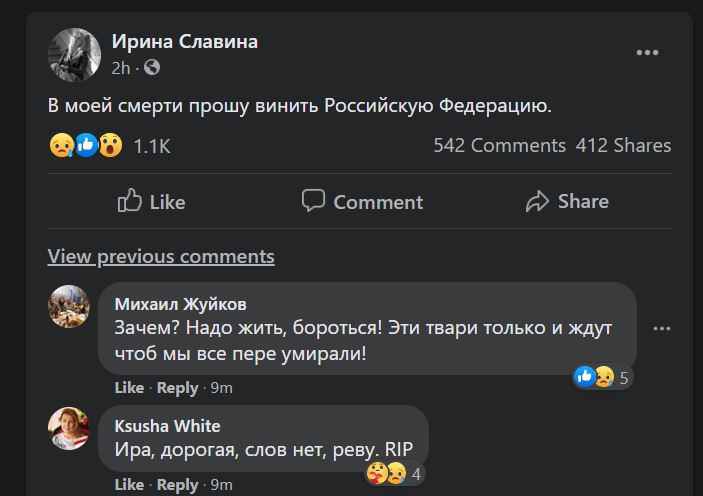 Slavina’s alleged suicide note on Facebook
 Protest rally in Abakan against plans to raise the retirement age. Photo by Alexander Kryazhev. Courtesy of RIA Novosti and Republic
 Mikhail Benyash. Courtesy of Andrey Loshak’s Facebook page