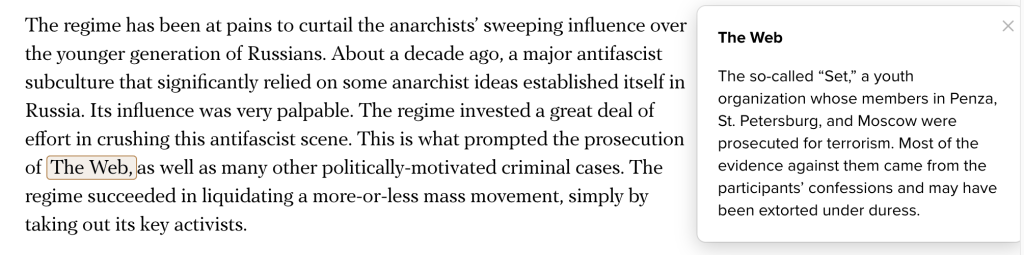
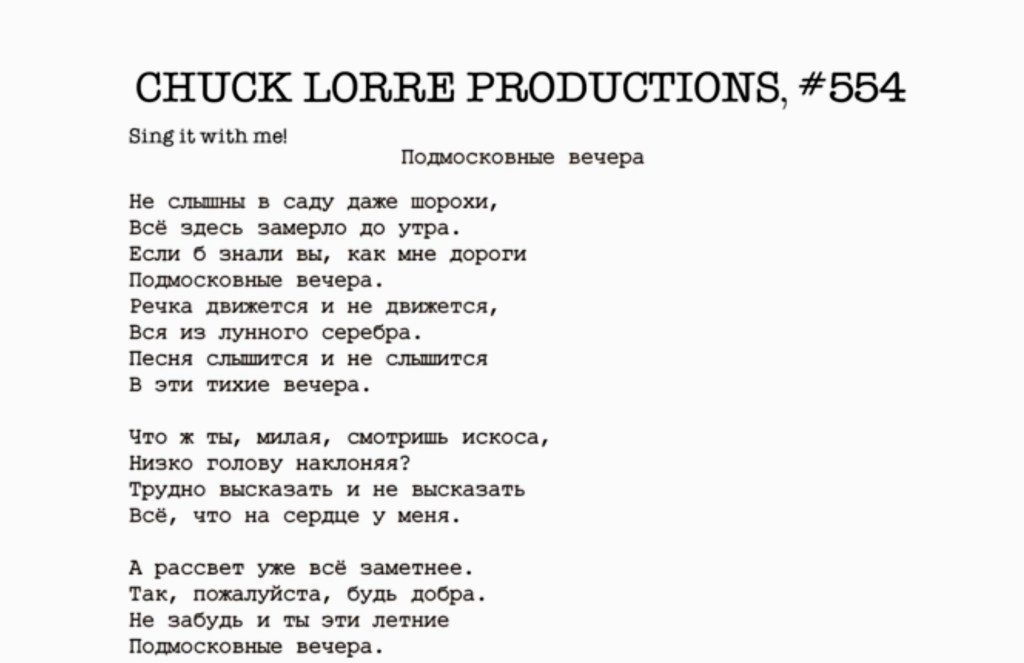
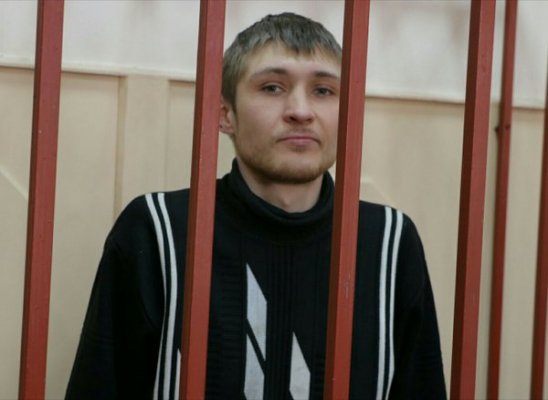
The ridiculous Meduza strikes again, now deliberately misnaming the (nonexistent) “Network” (and, by the by, passing off the FSB’s torture-“collaborated” fairytales as facts) after just as deliberately, three years ago, torpedoing the broad-based solidarity movement that had finally sprung up in support of the defendants in the so-called Network Case.*
There is unprecedented public outrage at the verdict and the prison sentences requested by the prosecutor. Hundreds of open letters and appeals—from musicians, poets, cinematographers, book publishers, artists, teachers, and municipal councilors—are published. For the first time in Russia, the practice of torture by the special services is openly and massively condemned. The verdict is called an attempt to intimidate the Russian people. The public demands a review of the Network Case and an investigation of the claims of torture. People stand in a huge queue on Moscow’s Lubyanka Square to take turns doing solo pickets.
But a week later, the wave of indignation is shot down. Meduza publishes a controversial article, “Four Went In, Only Two Returned,” in which a certain Alexei Poltavets confesses to a double murder that he committed, allegedly, with defendants in the Network Case. There had long been rumors about the so-called Ryazan Case—the murders of Artyom Dorofeyev and Ekaterina Levchenko in the woods near Ryazan—within the activist community, but the story had never surfaced, because there was no evidence. There is no evidence now, either: the Network’s involvement in the murder is not corroborated by anything other than the claims made by Poltavets. Poltavets himself is in Kiev, and no formal murder charges are made against the Network. But it is enough to discredit the solidarity campaign. Now, in the eyes of society, those who take the side of the Network Case defendants are defending murderers. Public outrage fades, and the verdict remains the same
Western “observers” of Russian politics have the strangest notions of which Russian sources can be trusted. I was told earlier today, by a subscriber to the late Louis Proyect’s Marxmail list, that if I (meaning me, the guy who lived in Russia for twenty years) wanted to know what was really happening in Russia nowadays, I should read Boris Kagarlitsky.
— Meduza, who in the halcyon pre-war days discredited themselves so many times, but especially when they destroyed the burgeoning grassroots solidarity campaign in support of the Network Case defendants by publishing a thoroughly scurrilous “investigative report” implicating some of the defendants in an unsolved double murder.
— Boris Kagarlitsky, the man who in 2014 did more than anyone else to peddle to gullible westerners the obnoxious hogwash that the Russian takeover of parts of the Donbas was really a grassroots populist uprising against the bad guys in Kyiv, a man whose flimsy “institute” and odious opinion website Rabkor were financed directly by the Kremlin back in the days when the Kremlin still regarded him as a useful idiot. (The Kremlin doesn’t see him that way anymore, clearly, but now it should be too late for him to redeem himself in the eyes of progressive humanity.” ||| TRR
Supreme Court Chief Justice Accused of Persecuting Dissidents during Soviet Times He convicted human rights activist Felix Svetov, whose daughter Zoya Svetova had her apartment searched by the FSB yesterday
Alexei Obukhov Moskovsky Komsomolets
March 1, 2017
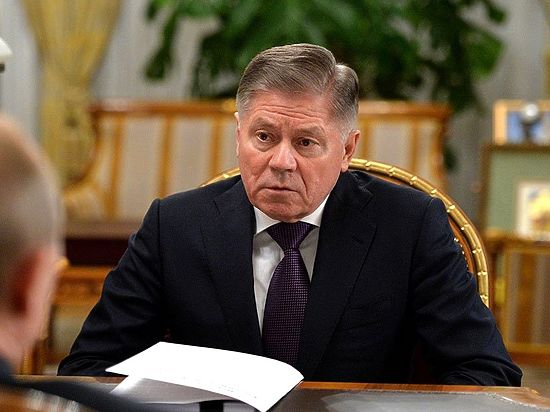
Memorial has published documents relating to the case of journalist and human rights activist Zoya Svetova’s father, Felix Svetov, who was convicted in the Soviet for his human rights works. His trial, in 1986, was presided over by Vyacheslav Lebedev, who has been chief justice of the Russian Federal Supreme Court since 1989.
Chief Justice Vyacheslav Lebedev. Photo courtesy of Kremlin.ru
According to Memorial, Svetov was found guilty because he had made “defamatory” allegations that “innocent people [were] thrown into prison” and accusations that the authorities did not observe socialist laws and violated the rules of the Criminal Procedure Code.
Ultimately, Lebedev, who was then deputy head judge of Moscow City Court, sentenced Svetov to five years of exile.
Memorial published the information in connection with the search conducted this past Tuesday in the apartment of Felix Svetov’s daughter Zoya Svetova, an employee of Open Russia, which is headed by Mikhail Khodorkovsky. A similar search had taken place before Svetov’s trial in 1986.
Yet investigators have claimed that the hours-long search, which in particular involved confiscating the computers of Svetova’s children, the well-known journalists and brothers Filipp, Tikhon and Timofei Dzyadko, was carried out as part of the case against Khodorkovsky’s company Yukos, launched back in 2003. Svetova herself has suggested the real reason for the search was her work on the Moscow Public Monitoring Commission.
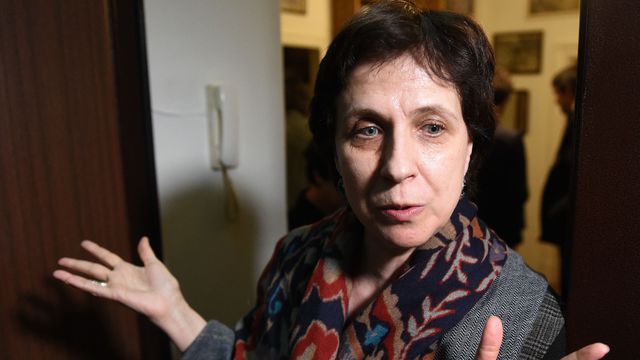
Memorial added that, in 1984, Lebedev handed down a guilty verdict to human rights activist Elena Sannikova. She was convicted of “anti-Soviet agitation and propaganda.”
_________________________
Moskovsky Komsomolets Deletes Article on Supreme Court Chief Justice’s Involvement in Persecuting Soviet Dissidents Meduza
March 1, 2017
On March 1, an article entitled “Supreme Court Chief Justice Accused of Persecuting Dissidents during Soviet Times” vanished from the website of newspaper Moskovsky Komsomolets. The article was published on Wednesday afternoon and was accessible on the site for a few hours.
No reasons have been given for its deletion. A copy of the article has been cached in Google Search results. Moskovsky Komsolets editor-in-chief Pavel Gusev told Meduza he was unaware of why the the article had been deleted and was hearing about the matter for the first time.
The article discusses Memorial’s publication of documents relating to a police search of the home of Felix Svetov and Zoya Krakhmalnikova, parents of Zoya Svetova, which took place in 1982.
Among other things, Memorial’s Facebook post points out that the presiding judge in Svetov’s case, which was heard in the mid 1980s, was Vyacheslav Lebedev, who would become chief justice of the Russian Federal Supreme Court in 1989.
FSB investigators searched journalist Zoya Svetova’s home for over ten hours on February 28, 2017, allegedly, as part of the Yukos affair. Svetova works for Mikhail Khodorkovsky’s Open Russia, but claims she knows nothing about Yukos’s business.
Translated by the Russian Reader. Thanks to Comrades AK and JM for the heads-up
Russia: ‘Deeply alarming’ raid targets human rights activist and journalist Zoya Svetova Amnesty International
28 February 2017
After Russian criminal investigators searched the flat of Zoya Svetova, a prominent journalist and human rights activist, this morning, Sergei Nikitin, Director of Amnesty International Russia, said:
“Today’s search of Zoya Svetova’s flat is deeply alarming. She is one of Russia’s most respected journalists and human rights activists – it is unclear what she might have to do with the criminal investigation against YUKOS.”
“This search seems like a blatant attempt by the authorities to interfere with her legitimate work as a journalist and perhaps a warning for her and others of the risks of human rights work and independent journalism in Russia.”
Zoya Svetova previously worked for Reporters without Borders and Soros Foundation in Russia.
The search was conducted by 12 officers from Russia’s Investigative Committee that probes serious crime. According to Svetova’s lawyer, it was linked to a case of alleged embezzlement and tax fraud by the former YUKOS oil company head Mikhail Khodorkovsky. One of the most prominent critics of the Kremlin, Khodorkovsky served 10 years in jail and in 2011, after being convicted of another offence and sentenced to a new term of imprisonment, he was declared a prisoner of conscience by Amnesty International.
In December 2016 Russian Investigative Committee officers raided the apartments of seven Open Russia activists as well as the movement’s offices in Moscow and Saint Petersburg. The Investigative Committee claimed it was seeking evidence of money laundering by former YUKOS executives with links to Khodorkovsky.
In No Mood for Songs and Dialogues OVD Info
July 2, 2016
Hello. We continue to raise money for the work of our monitoring group. Watch the following video, in which Artyom Loskutov, co-founder of the annual Monstrations, talks about what champs we are.
You can donate money to us by heading to this page.
Last week, Moscow courts left two suspects in the Bolotnaya Square case, Dmitry Buchenkov and Maxim Panfilov, in police custody, along with Petersburg architect Sergei Akhmetov, accused of tearing epaulettes from a policeman’s uniform during a gathering in support of Alexei Navalny and Pyotr Ofitserov. Curiously, police investigators have been unable to produce convincing evidence that Buchenkov and Akhmetov were actually at the scene of the crimes of which they have been accused.
Maxim Panfilov. Courtesy of OVD Info
Other Criminal Prosecutions
No less predictable was the rejection of Oleg Navalny’s petition for parole, especially considering the fact that, a week before his court hearing, he received three reprimands for poor conduct at the penal colony where he has been imprisoned.
Totally unpredictable, however, was the return to Moscow of Ildar Dadin, sentenced to two and a half years in a prison colony for “repeated violations” at public protests. Dadin had been held for over two months in a Petersburg remand prison, and it was anticipated that sooner or later he would be transferred to a penal colony. For some reason, however, this has not happened.
News came of the first criminal charges filed for “willful refusal” to obey the law on “foreign agents.” Charges were filed against Valentina Cherevatenko, chair of Women of the Don Foundation.
Shapi Biyakiyev, a Petersburg trucker involved in the recent nationwide protests by truckers against the new Plato toll system, was charged with using violence against a police officer.
In Hurzuf, Crimea, residents upset that a local beach had been transferred to the Artek Young Pioneers Camp were detained by police. Meanwhile, in Moscow, tempers flared around construction of the so-called Northeast Chord highway. First, a cyclist was detained for protesting the felling of trees in Kuskovo Park, and then people opposed to the felling of trees on Krasny Kazanets Street in Veshnyaki were detained.
“Murder of 200-Year-Old Oak in Kuskovo Park,” posted July 2, 2016, by Ecowalker First
Moscow police also detained people in a hunger strike organized by the Moscow Queue Waiters [i.e., ocheredniki, people on a waiting list for affordable housing—TRR] twice in a single day outside the constituent reception offices of the ruling United Russia party. When the detainees were released from a police station after the first detention, they went back to the reception offices and were rearrested. But Makhachkala outdid everyone: around eighty believers were detained after Friday prayers outside a Salafist mosque. Meanwhile, Dagestan public figure and parliamentary candidate Rasul Ismailov was detained in Khasavyurt.
Daniil Alexandrov, a freelance correspondent for online newspaper Meduza, was ticketed for working without accreditation in Karelia, where he gone to cover the story of the children who died on Lake Syamozero.
FSB agents raided the Mayakovsky Library in Petersburg in connection with the fact that it served as the venue for Dialogues, monthly public discussions of political topics. The project’s founder, Nikolai Solodnikov, resigned his post at the library, which will no longer host the events.
In Krasnodar, people involved in solo pickets against the policies of current Mayor Vladimir Yevlanov and in support of Communist Party MP Sergei Obukhov were assaulted, while in Kemerovo, local opposition activist Stanislav Kaliniсhenko was detained, taken to a police station, and, allegedly, beaten up by police.
Opposition activist Stanislav Kalinichenko after his alleged beating by police in Kemerovo. Courtesy of his blog
Karelian village council member Vladimir Zavarkin, sentenced to a fine for calling for a referendum to decide whether the republic should secede from Russia, was stripped of his mandate.