Skip to content

The Russian Reader

News and views of (other) Russia(n)(s)

Tag: logo

It’s Always Sunny in Saint Petersburg

create the great

The Sun of Our Ambitions: What Petersburg’s New Logo Tells Us
Mikhail Shevchuk
Republic
November 15, 2019

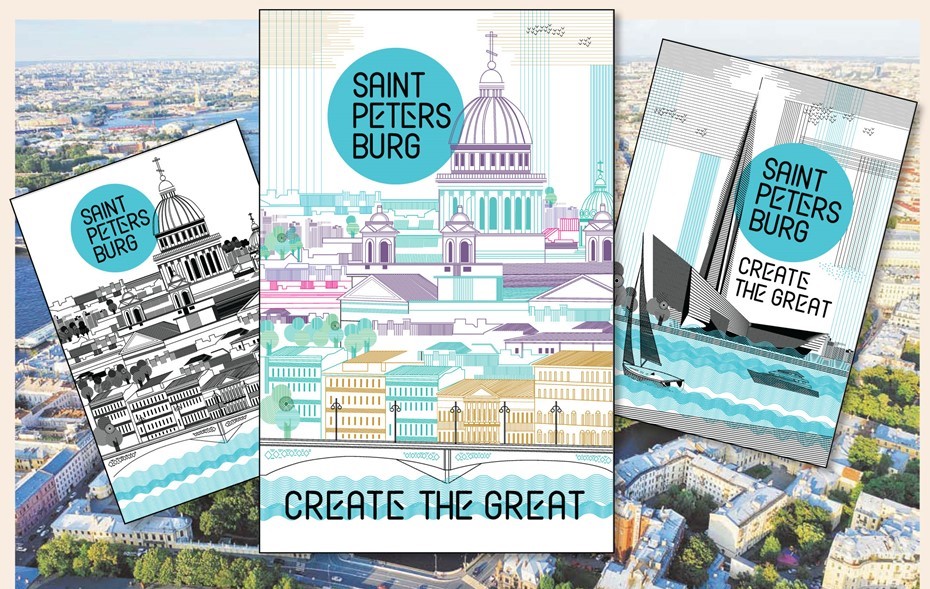
Petersburg just got a brand or, more precisely, a meta brand, a broader concept than a mere agglomeration of icons and symbols. It is, rather, a conceptual encapsulation of the region that reflects its attractive features. What has attracted the most attention, however, is the new brand’s logo: a turquoise-colored circle, inscribed with the words “Saint Petersburg,” in which the crossbars of the e’s have been raised to evoke associations with the city’s drawbridges.

“It is the cold turquoise-colored northern sun that always shines, both in winter and summer,” explained Andrei Barannikov, CEO of SPN Communications, which worked on the project. It symbolizes “faith in breakthroughs and faith in insights.”

Naturally, social networks were immediately flooded with criticism because the project was allocated 7 billion rubles [approx. 99 million euros] in municipal funds and took nearly a year to complete. Many people thought spending that kind of money on a “turquoise-colored circle” was laughable.

There is no point in arguing with them. Apparently, they are the same people who think they could have painted the Black Square as easily as Malevich, and that an aristocratic coat of arms would make the best logo. A brand’s value does not lie in a combination of lines and colors, however, but in its semantic content. This is what we should discuss.

The slogan “Create the Great,” proposed as part of the branding campaign, is obviously supposed to generate associations between Petersburg and its founder, Peter the Great. A draft version of logo, leaked on the internet before the project was completed, featured a picture of Peter the Great adorning the selfsame turquoise-colored circle. It is a good thing this was not the final version: national heroes are usually not well recognized abroad. Perhaps the Americans can permit themselves this sort of thing because their national hero, George Washington, is known by everyone due to the dollar bill, and maybe the same applies to the British and Queen Elizabeth, but hardly anyone would recognize, say, Garibaldi or Atatürk unless they were identified in a caption.

“Petersburg is a city of ideas and concepts. The city on the Neva is imagined as a place that has been created and continues to be created by outstanding people, as well as a place that creates such people, that enables individuals to realize themselves, to achieve the most ambitious goals,” Barannikov said.

“Creating the great” is, in fact, a difficult task, if only because it is not entirely clear what counts as greatness in this case. Someone’s ambitions might extend no farther than repairing roads and screwing new knobs on the doors of kindergartens. The conservative system of values that guided Soviet leaders usually situated “greatness” in the creation of massive buildings and facilities, places that could be seen and touched. Real proof of the people and state’s limitless possibilities was embodied in this materialism.

The immaterial notion of greatness mainly boiled down to great feats, achievements, exploits, and deeds, that is, to surmounting external obstacles through superhuman effort. Major things achieved at the behest of the big bosses and involving colossal work and sacrificed lives were thus regarded as truly great.

It seems this paradigm still dominates Petersburg, which is unsurprising, of course, if you know anything about the lives of its current leaders, including Petersburg Governor Alexander Beglov. On the posters, which show the things the brand can do, we see the building of the Stock Exchange, St. Isaac’s Cathedral, and Gazprom’s Lakhta Center skyscraper—that is, architectural edifices, depicted strictly and schematically, and almost in monochrome.

create the great-2

There are no people whatsoever on the new promotional posters, and no fashionable flowery frivolity or asymmetry, either. “Creating the great” must be done in a grave, business-like manner, by the book and after the fashion. There is no place here for DIY, for you cannot erect a massive stone edifice using DIY methods.

We should hardly blame the advertising agency commissioned by the city, which obviously did what it did to make its clients happy. One has the impression that the clients strictly ordered the advertising agency to wed current trends with the imperial style, which is a sine qua non in Petersburg.

Petersburg  has a particular canon of values, which are invoked by all local politicians without exception if they have any hope of attaining high office in the city. These include the city’s scientific and industrial potential, its advantageous geographical placement in terms of trade and transportation routes, its status as Russia’s maritime capital, and its cultural heritage. No one ever deviates from this canon, but it seemingly sets the framework for “creating the great”: Petersburg has wharves and factories, but it has no way of transforming itself into an IT hub or a major university town. Discrete achievements are doable, but they do not gel into a coherent picture. For the authorities, growing the city’s cultural potential means holding the annual city-sponsored cultural forum and, in the public space, organizing military parades and religious processions. This is the same old imperial style.

It would be stupid to present highways, train stations, and even skyscrapers, which are a dime a dozen in places like Kuala Lumpur, as examples of “greatness.” The current Petersburg authorities are much more inclined to focus on opening new kindergartens and procuring new buses. These are definitely good causes, but they can hardly be called “great,” unless, of course, we embrace a system of values in which launching a new commuter train is considered a great achievement.

If we give credence to Barannikov’s argument that a great city is a place that enables people to achieve ambitious goals, today the surest way to achieve such goals is as a government official, and Putin and his team are thus the ideal symbols of self-realization. In a monochrome bureaucratic state, the main ambition is to climb as high as possible on the bureaucratic career ladder.

In the outside world, a picture of Putin would probably be more recognizable than Catherine the Great’s profile. The only problem is that Putin’s achievements have mainly occurred since he left his hometown and moved to Moscow, so it would be more appropriate to adorn the city’s promotional posters with pictures of the Sapsan high-speed train that shuttles between Petersburg and Moscow.

Translated by the Russian Reader. Image courtesy of Delovoi Peterburg and Fontanka.ru
hecksinductionhour capitalism, international, petrograd, politics, urban, zeitgeist Leave a comment November 16, 2019November 16, 2019 4 Minutes

Yana Antonova: Undesirable

yana antonovaYana Antonova

Polina Nemirovsky
Facebook
April 9, 2019

This is Yana Antonova, a pediatric surgeon. Today at six in the morning, police and security services came to her home, which she shares with her eleven-year-old son, and searched it. They did not let her call a lawyer.

Yana has been charged with engaging in the work of an “undesirable organization.”

This is the third such criminal case in Russia, including the case against Anastasia Shevchenko.

It is easy to dismiss this news, to pay it no mind. We can say they knew what they were getting themselves into. They had no business joining “undesirable” organizations and so on. But while some will shrug, I would draw their attention to the fact that Russia’s law books contain laws that give the authorities the ability to bring criminal proceedings against people for their political activism, of whatever stripe, and the authorities can do this shamelessly, openly, and without standing on ceremony.

I copied down the “crimes” allegedly committed by Yana, as listed in her charge sheet. They include two pickets, three Facebook posts, a seminar, and attendance of a political rally.

There was no “extremism” whatsoever in the posts and pickets, nor any calls to illegal actions of any kind. The only thing they had in common was the logotype of a movement that has now been banned. It was banned because the prosecutor’s office decided it was British and “undesirable,” without producing a shred of evidence.

Just read what these officials write. I am not a big fan of raising a ruckus about 1937 whenever something like this happens, but the Russian law enforcement officials who ban “undesirable” organizations and arrest people like Yana nowadays are obviously the heirs of the folks who once upon a time persecuted people for “anti-Soviet” and “counterrevolutionary” actions.

What did Yana Antonova do?

  • She unfurled and displayed three yellow flags emblazoned with the words “Open Russia.”
  • She held a solo picket demanding that construction of a swimming pool be completed. (The picket was actually, the police claim, a news hook for filling the media with coverage of the local Open Russia cell.)
  • Antonova also held a seminar for opposition activists at which Yevgeniya Chirikova was the keynote speaker. Flags and clothing emblazoned with the logo of the Open Russia movement were featured at the event.
  • She published a video featuring the Open Russia logo. [The video was actually about the lack of schools in Krasnodar.]
  • With criminal intent, as the police put it, she published information about Open Russia in open access that featured appeals to an unlimited number of people to attend a political rally. [It was a rally in memory of Boris Nemtsov.]
  • With criminal intent, she held a solo picket in memory of opposition politician B.E. Nemtsov [sic] and covered the event on the internet.
  • She published an Open Russia news item. [This was actually a picture featuring a quotation by slain Russian journalist Vladislav Listyev.]

This is a simple story about how quoting Vladislav Listyev and picketing in memory of Boris Nemtsov can end up with your facing six years in prison.

Thanks to Yevgenia Litvinova for the heads-up. Translated by the Russian Reader

____________________________________________________

Natalya Trubachova
Ekho Moskvy
April 9, 2019

This is the third criminal case against Open Russia, this time brought to us by the famous rough justice system in Krasnodar Territory. You heard me right: the very same place where crime boss Aydin Shirinov kicked up his heels at a meeting with Putin. It is the same place where the Tsapkov Gang, who murdered twelve people, and previous to that terrorized the village of Kushchevskaya for years, had personal connections with high-ranking officials in the Russian Federal Prosecutor’s Office. It is the very same part of the country where police officers tortured detainees, and the Committee Against Torture made the documentary film Extreme South about these goings-on in Anapa. It is the very same place where the murderer Vyacheslav Tsepovyaz used his connections thousands of kilometers from home and dined on delicacies in a penal colony in the Far East. It is the home of the notorious Judge Yelena Khakhaleva. It is also the place where grown men dress up as Cossacks and attack political activists, blogger, journalists, and even Baptists with whips. (It was reported just today that in Novorossiysk, men dressed as Cossacks, police officers, and officials from city hall broke up a private worship service, accusing the Baptists of causing a schism in the otherwise homogeneous spiritual world of Russians.)

In this gigantic criminal cesspool, a tumor of lawlessness on the country’s body, law enforcement has finally figured who the really dangerous criminal is. Her name is Yana Antonova, and she has been accused of doing the work of Open Russia. Despite the fact Yana lives in Russia, she has been linked to the Open Russian Movement in Britain. An Englishwoman, basically, is making trouble in Krasnodar Territory. The region has such a great future ahead of it, and not as a hotbed of crime and lawlessness on a nationwide scale, but the bloody English have screwed that up.

Joking aside, the last misdemeanor case against Yana, which opened the way to her criminal prosecution, was for reposting a video on Facebook dealing with the lack of schools in Krasnodar Territory. Law enforcement justified their concocted case against Yana by pointing to the tiny yellow logo in the video, Open Russia’s logo.

In this case, yet another ridiculous concoction and a completely absurd reason (just imagine: she reposted a video on Facebook!) were grounds for filing criminal charges against Yana.

The criminal charges against Yana Antonova are a flagrant attempt to force Russian society to keep its mouth shut and swallow its outrage. The takeaway message is: bear it in silence and don’t complain, otherwise you’ll have real problems.

One more thing. Yesterday, the entire Runet laughed openly at a video in which former riot police (OMON), men who had served in “hot spots, as well as Manege Square and Bolotnaya Square” (how shameful to compare special forces troops who risked their lives in battles and special operations with those who dispersed legal political rallies by their fellow Russians), complained they were being evicted from their government-subsidized apartments.

I have the feeling that, five or ten years from now, we will see a similarly amazing appeal for help from law enforcers in Krasnodar Territory.

“We smashed up art shows, assaulted reporters, chased the Baptists away, and sent Open Russia supporters to jail, but now we have nothing to live on,” they will say.

Since there are so many slackers and fellows with hefty foreheads, dressed up as Cossacks or wearing real uniforms, armed with whips or sporting epaulettes, it is bound to happen. But the government’s coffers are not bottomless.

Natalya Trubachova is a Russian civil rights activist. Translated by the Russian Reader

hecksinductionhour putinism, regime, regions, religion, rights, solidarity, zeitgeist April 10, 2019 5 Minutes
  • Blogging Russia (Why and How I Do This)

Topics

Recent Posts

  • Sasha Razor: Who Burns the Lavra? June 16, 2026
  • A Monterey Story: The Answer June 14, 2026
  • Postscript to Russian Reader No. 2829: “Somalis Who Work” June 10, 2026
  • The Podcast June 9, 2026
  • A Mind of Winter June 8, 2026
  • Kyrgyzstan: Pro-Russian Outpost in Central Asia and Cannabis Heaven? June 7, 2026
  • You’re Getting Discombobulated (and You’re Getting Ebola) June 6, 2026

Most Popular Posts

  • Sasha Razor: Who Burns the Lavra?
  • Who Is Valeria Zotova?
  • Yesterday in Soviet History (Susanna Pechuro, Maya Ulanovskaya, and the SDR)
  • Russia's Musical Blacklist
  • Vasily Gatov: Forgive Me If You Can

Archives

You can support this free resource by donating today through PayPal!

Donate Button

Send your feedback to: editor@therussianreader.com

Blog Stats

  • 1,064,216 Views

Follow The Russian Reader via e-mail

Enter your email address to follow this blog and receive notifications of new posts by email.

Join 1,604 other subscribers
WordPress.com.

Loading Comments...