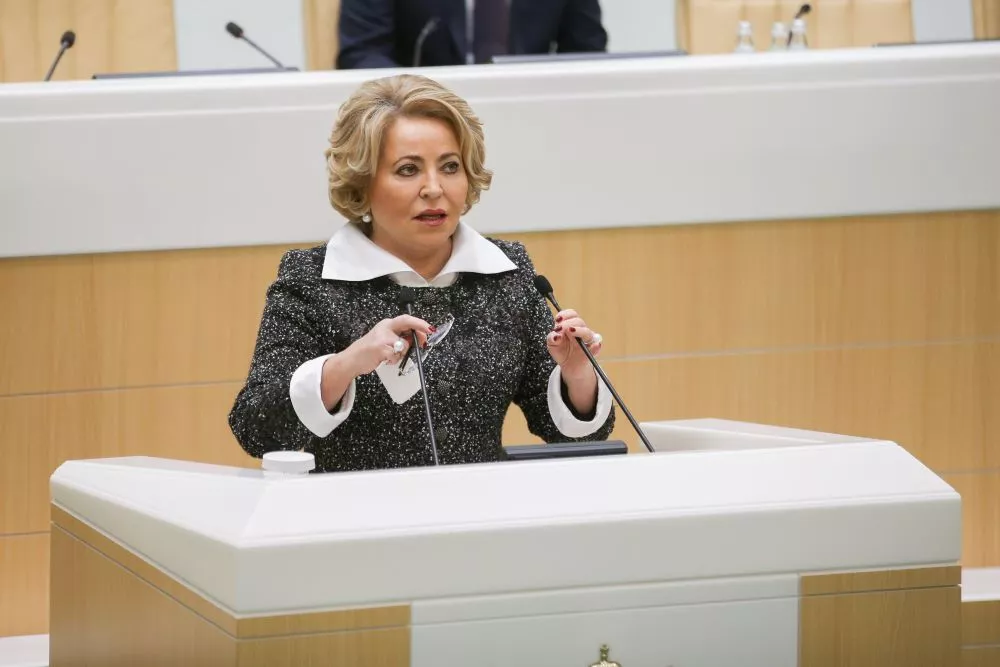
Federation Council Speaker Valentina Matviyenko has promised that the Soviet-era law criminalizing “social parasitism” would not be revived.
And yet, the politician argues that certain categories of unemployed people should at least make contributions to the compulsory medical insurance system. The Federation Council speaker spoke about this in an interview with Moskovsky Komsomolets:
I am talking about those unemployed people who drive Mercedes, have considerable hidden incomes, and yet do not pay taxes or make contributions to the compulsory medical insurance system. Or those, for example, who let their flats in downtown Moscow for 200,000 rubles a month [approx. 2,200 euros], but “on paper” claim that they rent it out for 10,000 rubles a month [approx. 110 euros]…. The tax service should identify such unscrupulous citizens and flush them out of the shadow economy and shadow incomes…. Workers, teachers, and doctors should not have to pay for young, healthy people who are under no obligation to society.
According to Matviyenko, forcing such citizens to be involved in the compulsory medical insurance system is fair because it is impossible to live in society and be free from it. She noted that teachers, doctors, workers, and others should not have to pay for healthy citizens without fixed employment.
This is not the first time Matviyenko has voiced the idea of collecting health insurance contributions from the unemployed: she has said that paying 45,000 rubles a year [approx. 500 euros] is quite affordable.
Surveys show that most Russians oppose a tax on social parasitism.
“Social parasitism” was a criminal offense in the USSR from 1961 to 1991. People who were unemployed without a valid reason could be sentenced to corrective labor, exile, or imprisonment. Citizens engaged in shadow private business were often prosecuted on this charge. The poet Joseph Brodsky was also convicted of “social parasitism.”
In 1964, when Joseph Brodsky was 24, he was brought to trial for “social parasitism.” In the view of the state, the young poet was a freeloader. His employment history was spotty at best: he was out of work for six months after losing his first factory job, and then for another four months after returning from a geological expedition. (Being a writer didn’t count as a job, and certainly not if you’d hardly published anything.) In response to the charge, Brodsky leveled a straightforward defense: he’d been thinking about stuff, and writing. But there was a new order to build, and if you weren’t actively contributing to society you were screwing it up.
Over the course of the trial he stated his case repeatedly, insistently, with a guilelessness that annoyed the officials:
BRODSKY: I did work during the intervals. I did just what I am doing now. I wrote poems. JUDGE: That is, you wrote your so-called poems? What was the purpose of your changing your place of work so often? BRODSKY: I began working when I was fifteen. I found it all interesting. I changed work because I wanted to learn as much as possible about life and about people. JUDGE: How were you useful to the motherland? BRODSKY: I wrote poems. That’s my work. I’m convinced … I believe that what I’ve written will be of use to people not only now, but also to future generations. A VOICE FROM THE PUBLIC: Listen to that! What an imagination! ANOTHER VOICE: He’s a poet. He has to think like that. JUDGE: That is, you think that your so-called poems are of use to people? BRODSKY: Why do you say my poems are “so-called” poems? JUDGE: We refer to your poems as “so-called” because we have no other impression of them.
Brodsky and the judge were (to put it mildly) talking past one another: Brodsky felt his calling had a value beyond political expediency, while the judge was tasked with reminding him that the state needn’t subsidize his hobby if he wasn’t going to say anything useful. But the incommensurability of these points of view runs much deeper than this one case.
Performers: MONTSERRAT MARTÍ CABALLE (soprano), OSCAR ENCINAS (tenor), LUCÍA GARCÍA (soprano), CARLOS COSÍAS (tenor), OLGA PUDOVA
A Russian premiere!
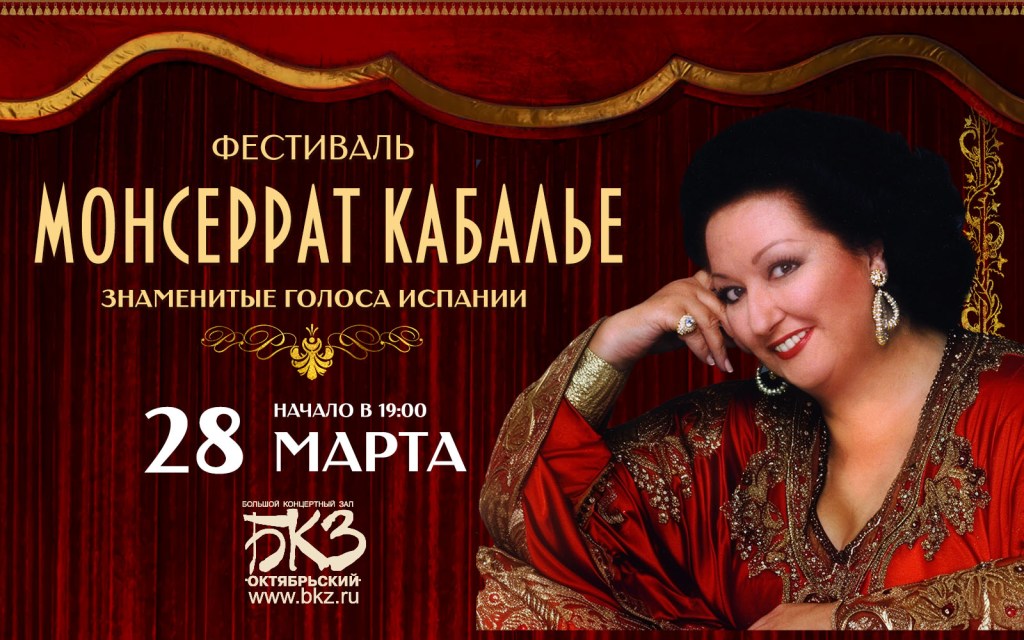
THE MONSERRAT CABALLÉ FESTIVAL
On 28 March 2025, the Oktyabrsky Concert Hall will host a magnificent musical celebration, the first Monserrat Caballé Festival, dedicated to the great Spanish opera singer.
Specially for this event, renowned artists from Spain — relatives, friends, and students of the legendary opera diva — will come to Russia for one evening only! For their one and only performance they have chosen the beautiful St. Petersburg, our country’s musical capital, and the Oktyabrsky Concert Hall, where a distinct atmosphere always reigns.
Monserrat Caballé, whose name has come to symbolize impeccable vocals and subtle artistry, has left an indelible mark on world culture. Having performed over 100 opera roles and almost 1,000 different musical works, she has forever remained in the hearts of not only connoisseurs of exquisite classical music but also fans of musicals and fans of pop rock for performances like the title song from the album Barcelona, the international mega hit she recorded with Queen lead signer Freddie Mercury. Monserrat adored Russia and often visited our country to give concerts. The Caballé family thus decided to hold the first music festival named after her in our country.
The Monserrat Caballé Festival is meant to preserve the superstar’s historical legacy and introduce the public to today’s talents, the most popular performers continuing the Spanish school of opera’s rich traditions.
Among the performers are the great singer’s daughter, MONTSERRAT MARTÍ CABALLÉ (soprano), and the famous Spanish voices OSCAR ENCINAS (tenor), LUCÍA GARCÍA (soprano), and CARLOS COSÍAS (tenor). OLGA PUDOVA, a guest soloist at the Bolshoi and Mariinsky theaters, a phenomenal coloratura soprano who has already conquered Europe’s principal opera stages, is a special guest from Russia.
The artists will be accompanied by OLGA PUDOVA, well known to Russian and international audiences, and the famous conductor MIKHAIL GOLIKOV, People’s Artist of Kabardino-Balkaria. Creative teams from St. Petersburg and Moscow will also be involved in the concert.
The Monserrat Caballe Festival is not only a tribute to the legendary singer but also a grand exuberant celebration, aimed at a wide range of spectators and embracing all generations and the most varied musical tastes.
Don’t miss the opportunity to gift yourself an unforgettable evening full of vivid emotions, beautiful melodies and Spanish passion!
Source: Bileter.ru. Translated by the Russian Reader
On 20 October 2012, during her tour in Russia, Caballé suffered a stroke in Yekaterinburg and was quickly transferred to the Hospital de Sant Pau in Barcelona.
In his Literary Life, [Joseph] Brodsky’s friend Lev Loseff explained the background of “A Halt in the Desert,” a poem about the destruction of a beautiful old building: “One night Brodsky watched the first stages in the razing of the Greek Orthodox church from the apartment of his friends, two sisters from a Tatar family,” and called the poem “a meditation on the symbolic significance of what has just happened: Russia has broken with its Christian and Hellenistic cultural heritage.” Brodsky writes:
So few Greeks live in Leningrad today that we have razed a Greek church, to make space for a new concert hall, built in today’s grim and unhappy style. . . . it is sad that from this distance now we see, not the familiar onion domes, but a grotesquely flattened silhouette.
The deliberately created “fresh ruins” and “open altar wounds” recall the recent wartime devastations. The biblical allusion in “Thou who doest sow” suggests the threat of retribution in Hosea 8:7, “they have sown the wind and they shall reap the whirlwind.” Brodsky concludes by hopelessly asking:
What lies ahead? Does a new epoch wait for us? And if it does, what duty do we owe?– What sacrifices must we make for it?
Loseff claimed that Brodsky condemns “the collective guilt of a nation that produced this regime, that refused to accept the historical alternative, the heritage of Greece and Greek democracy.” But the Russians did not refuse to accept the heritage of Greece. They were not consulted and had no choice. An atheistic Communist system had been imposed on them by deadly force after the Revolution of 1917 and brutally maintained by all successive regimes. It was now the poet’s responsibility to preserve this culture.
Kirill Medvedev,* a poet, publisher, and member of the band Arkady Kots, left Russia in 2023 and returned in late 2024. At Republic Weekly’s request, he explains his winding road, what Moscow looks like when one hasn’t seen it from the inside for a long time, and what remainers have to say about leavers.
After a year and a half of living in other countries for personal (but, of course, political) reasons, I have been living in Moscow for several months now. Despite certain risks, I really don’t want to leave, and I am terrified of everything having to do with living in exile. I’m willing to speak in allegories or even to keep silent altogether just to be able to live in my hometown. Although what could be more important than waking up in the morning and smacking the Putin regime in the face without pulling your punches?
Everything in Moscow is still familiar and homely. I am indifferent to Sobyanin’s renovations. Things have improved in some places, while in other places it’s the reverse. Half-abandoned spots have suddenly emerged even in the most expensive neighborhoods, as if the money had suddenly been hoovered out of them. I’m certain that’s literally what happened.
I don’t see any particular feasting amid a plague, but I guess I’m just not hitting the right spots. Moscow has become more desolate and wild on the whole. When the capital is finally moved to Siberia, the Moscow I know and love will look even better. But for now, it is still what it is: a crazy quilt fashioned from Eurasian chaos, absorbing a million shades of the glitz and poverty of the entire country and its neighbors, and tempting us with new revolutions somewhere in its squares and back alleys.
All of Russia can be found in Moscow, and yet, as everyone knows, Moscow is not Russia. Thanks to this fun fact, it is easier for Muscovites than for anyone else to love the entire country, albeit an imaginary and unfathomable country, shaped from different scraps. “I stand as before an eternal riddle, / Before a great and fabulous land,” sang one remarkable Muscovite. I repeat another poet’s line about another city, thinking that love for one’s capital city and one’s country is an enormous, complicated privilege: “May it not be my lot / To die far away from you.”
Online public communication habits have actually changed a lot because of the risks involved. It no longer feels like your event didn’t happen if it wasn’t written up online and if you didn’t post a photo of yourself with a crowd of happy spectators.
There are [now] more personal channels of communication within communities and more word of mouth. Reactions are more reserved in public and more emotional among friends. Pardon my sentimentality, but there is little to compare with physical hugs with friends and family in a city charged with your own and other people’s memories.
Of course, there are a lot of new problems, and I’d rather deal with some variety of internet addiction than the nightmare in which everyone has found themselves. And yet there is the perception that the war has ushered in the degradation of all ways of living in Russia. This is not true. Humans are ultra-creative and crafty creatures. Violent shocks do not neutralize life but propel it into new forms. A caveat: no new ways of living and creating can justify the mass murder of people who will never wake up to life again. But cultural, activist, educational, and other communities who persist and change, albeit semi-clandestinely, albeit at the cost of compromise or risk, increase our chances of transitioning to a different way of living in this country in the future. The more allies we have here at home now, the more likely they are to be in the right place at the right time—that is, if the first flights our friends who have been shoved out of the country plan to take are delayed a bit.
Irony or irritation towards the people who have left [Russia] for one reason or another is evident among almost all those who have stayed, except for those who are definitely planning to leave. One of the frequent complaints is “They left to live in safety, and they did the right thing—they just shouldn’t pass it off as a political act.”
That is true, though with many caveats. Bravo, of course, to the activists who have been helping people who have to leave to get out of the country and to adapt to life abroad. Bravo to the journalists who have moved to relatively safe places and continue to fulfill their professional obligation to their fellow citizens. Regular albeit serious news, reported with respect for themselves and the audience, without unnecessary harshness (“so that you can send it to your grandmother”) is needed desperately: almost everyone talks about it. But pessimism and aggression about life inside the country on the part of fellow citizens who have left the country is completely out of place. It is clearly old-fashioned exile self-therapy and should be practiced in private.
While the demand for alternative information is great (many people in the USSR who were not necessarily anti-Soviet also listened to Voice of America), one can see skepticism or simply a lack of interest in émigré politics. Why is this the case? There seem to be many examples in history when political émigrés came back home, were involved in great transformations, or even spearheaded them. Escaping from prison in Russia, making one’s way abroad, drinking to a successful adventure with comrades in Geneva, discussing future strategies in a relaxed atmosphere, and soon returning home to work underground was a typical trajectory for Russia’s radical democrats in the early twentieth century.
Things have changed since then, although today many also travel back and forth. You can talk at length to those who have stayed in Russia about the hardships of emigration, and they will agree and sympathize with you, especially if you were actually in danger here at home.
For the most part, though, people still see someone else’s moving abroad as their means of upgrading their private existence.
By renouncing your past life, it is as if you automatically renounce your past community. The propaganda, of course, does its best to inflate the resentment, but it’s not just propaganda at work. Emigration is indeed an experience of constant self-denial. Especially today, when Russian emigrants are so evidently prodded (gently and not so gently) to cancel themselves in terms of of their citizenship, background, language, identity, or even flag. Moreover, the reanimated ethical-religious discourse of the Cold War, with its confrontation between good and evil on a global scale, has played a considerable role in this.
The field where dialogue should have taken place between leavers and remainers, as well as between moderate oppositionists and hesitant loyalists, has been overrun by moralizers in proverbial white coats and rabid patriots. They are the dividers and conquerors.
The leavers more often argue in terms of negative freedom—freedom from censorship, political crackdowns, and military mobilization, from having to indirectly finance the war or live among its supporters. The remainers stay because they do not see how they can realize themselves abroad, at least not without the sort of superhuman effort and self-denial that many of them find more frightening than living under the threat of arrest or self-censorship. They often speak of duty—to elderly relatives, students, patients, voters, political prisoners, the graves of relatives, the homeland, etc. And they often hear in response that it is immoral to be involved in the normalized life in today’s Russia. The ethical conflict is evident.
I wander the Pokrovkas and the Ordynkas, thinking about where I can get money to pay the bills and pay off my debts. There are posters calling for men to sign up for the army. Somehow I don’t feel more upstanding than the guys who go off to kill for money. I would definitely not go to do that, but this certainty does not raise my moral self-esteem. I think of an old comrade who perished in the “special military operation.” His debts, low social status, and leftist anti-western ressentiment had blossomed into imperialist obfuscation.
I sit in a cafe, thinking about my plans. The people around me talk about different things, while people in a neighboring country are bombed in our name.
I’m good at displacing unpleasant things. We all are good at it.
Being here, dissolving into this life, it is difficult to feel like a member of an ethics committee. It’s easier to realize that all people are basically the same, that there are no insuperable differences between them. All our actions (whether ordinary, shameful, or magnificent), all the passivity of the masses, all the revolts of nations, are manifestations of the same human principle in different historical circumstances. The way humanness manifests itself in our present circumstances, the way my own humanness manifests itself in them, is the most interesting thing to observe. Okay, we’ve established that.
No, of course, there is a huge difference between opposition to evil, passive non-participation, and complicity in it. Putin’s propagandists have been blurring the distinction between the first, second and third to depoliticize and morally degrade society. We know this, and you can’t fool us. In both the secular and Christian systems, a person always has a choice and a responsibility for it. We should not see the individual as a unwilling victim of want and propaganda. But something else is also true: even if you believe that you have made your own super-correct moral choice once and for all, endlessly judging your neighbor, or believing they are made of some qualitatively different stuff than you, or finding them complicit in collective guilt without trial is also a quite devilish temptation, akin to the temptations proffered today in our country by various spiritual and political leaders.
Political evil is countered not by personal virtue, and even less by moralistic posturing. It is countered by political or civic ethics, but our country has a huge problem with that.
All the debates between the leavers and the remainers, all the debates over the slogans “peace now” vs. “war until the dictatorship’s defeat,” all the debates about whether Navalny should have returned to Russia, revolve around the missing answer to the ethical (aka political) question: for what are we willing to risk our private lives, for what collective ideals?
I certainly don’t have a clear answer. Russia is long past the heroic times of liberalism and socialism, when people believed that civic heroism was not weak-mindedness or recklessness, but a deliberate, mature step toward a better future. Popular willingness to take to the streets against war and dictatorship is impossible without the conviction that we are on the right side of history, that we are in a movement that both overlaps with and transcends our private interests.
The Bolsheviks believed in communism’s inevitable advent on a global scale, and were able to convince many people this would happen, which was why they won. In 1991, Russians believed that by defending the [Russian] White House and confronting the coup plotters’ tanks, they were leading Russia onto the road of progress which all democratic nations were already rolling down. Whether we like it or not, Russia is not ready to follow any well-trodden path. There is no single road anymore: the road is just going to have to be paved anew. (I’m reckoning on this.)
Today we see a faint glimmer of hope in republicanism, with its idea that community spirit is not a consolation prize for people who lack professional fulfillment and personal happiness. It is not reducible to a professional or personal virtue and is not a profession itself.
Anyone willing to stand with others to oppose tyranny and then work every day to prevent it from happening again is capable of demonstrating civic valor. And the brighter, bolder and more constructively a person commits to this work, the more they make use of their professional, creative and other kinds of potential, the greater their authority in the community will be and the more likely they will remain in the community’s memory. This sounds good as a motivation, but if the republican ethic is realizable, then it is realizable in the small and medium-size spaces of campaigns around residential buildings, courtyards, neighborhoods, and (at most) cities, where it is possible to find analogues of the ancient Greek square for people to hold meetings.
A national community is imaginary, no matter how you look at it, and it is based on a rather sketchy common historical plight and collective memory. If we do not want it to be the memory of how “everyone was afraid of us,” it should be the memory of how we survived together and resisted—secretly and explicitly, passively and actively—the extermination of others and self-extermination, of how we built ties, engaged in “culture,” taught children, supported political prisoners, and helped the bombing victims and the homeless.
This is the ground of community, a ground not nourished by moral superiority, by denying oneself and one’s roots, or by essentializing differences. It is nourished by responsibility for the people who stand or have stood next to you in the same squares and the same queues, for the people who walk the same streets, who went to the same schools, who share the same hopes for the future.
If we indeed stand on this ground, then it makes sense for us to challenge and set our hearts on something together.
* Medvedev has been placed on the Russian Justice Ministry’s registry of “foreign agents.”
Yesterday was a rare sunny, warm day, so my boon companion and I traveled to the city’s far southeast to walk through Bruno Taut’s Falkenberg Garden City in Berlin-Bohnsdorf. It was like a tiny vision of heaven.
As it happened, it was also a short walk from Max Bel, Franz Clement, and Hermann Muthesius’s Prussian Street Estate, which was also quite handsome and built to a properly human scale.
I’ve noticed Berlin’s modernist housing estates seem to have had a beneficent effect on their neighborhoods, so that even current architects designing new houses and developments there try to get into the Tautian spirit, as it were. The overwhelming impression, however, is that you’re looking at a future we have lost forever.
The Russian Reader, Berlin-Friedrichshain, 30 March 2019
And now we come to this verb “see.” Within fifteen lines it’s been used six times. Every experienced poet knows how risky it is to use the same word several times within a short space. The risk is that of tautology. So what is it that Frost is after here? I think he is after precisely that tautology. More accurately, non-semantic utterance. Which you get, for instance, in “’Oh,’ and again, ‘Oh.’” Frost had a theory about what he called “sentence-sounds.” It had to do with his observation that the sound, the tonality, of human locution is as semantic as actual words. For instance, you overhear two people conversing behind a closed door, in a room. You don’t hear the words, yet you know the general drift of their dialogue; in fact, you may pretty accurately figure out its substance. In other words, the tune matters more than the lyrics, which are, so to speak, replaceable or redundant. Anyway, the repetition of this or that word liberates the tune, makes it more audible. By the same token, such repetition liberates the mind—rids you of the notion presented by the word. (This is the old Zen technique, of course, but, come to think of it, finding it in an American poem makes you wonder whether philosophical principles don’t spring from texts rather than the other way around.)
All modern entertainment that “undermines” traditional values should be banned in Russia, conservative philosopher and “Russian World” ideologue Alexander Dugin has said.
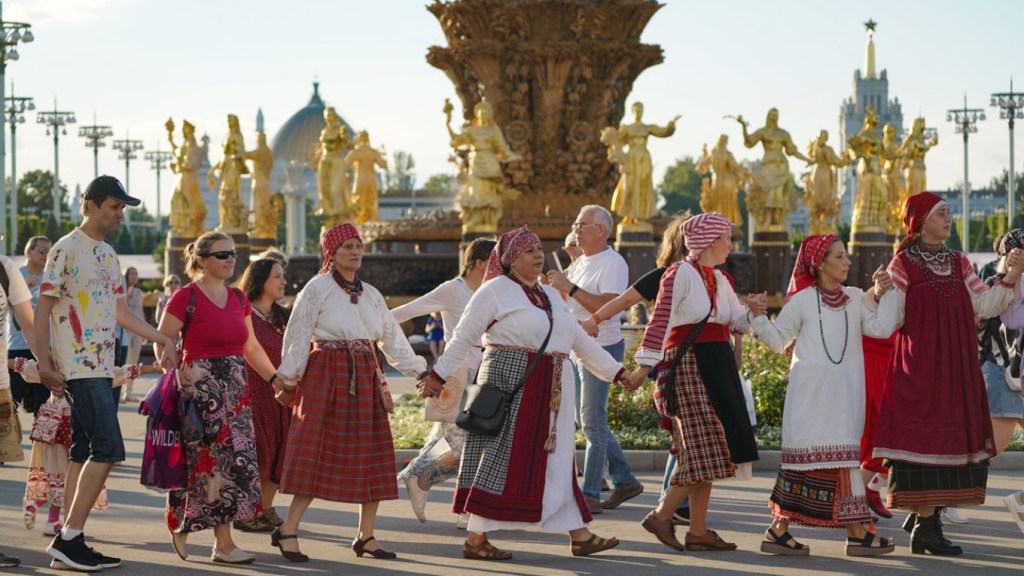
“Only morally healthy entertainment should be allowed — first of all, round dances and traveling around one’s native land, and even better, pilgrimages to holy places. Everything else should be banned,” Dugin wrote on his Telegram channel.
According to Dugin, a healthy nation should have wholesome leisure activities, “and not all of that stuff.” As a negative example of entertainment, he cited KVN, which has become, he claims, “a poisonous matrix of degeneration.”
“The sinister nature of this pernicious phenomenon is now clearly visible. [Ukrainian President Volodymyr] Zelensky, [comedian Maxim] Galkin, and all the rest,” Dugin said.*
Earlier, the philosopher claimed that the West regards Russia as its principal foe because Russian President Vladimir Putin has been reviving traditional values and liberating the country from global influence. This, in his opinion, is what provoked the disgust of Western “progressive elites” with Putin.
Dugin has also argued that Russia has neither a parliament nor democracy, but a de facto monarchy headed by Putin, who can do whatever he wants. The philosopher noted the irrelevance of certain laws in Russia, as well as the people who propose or support them. In his opinion, all of this is “boyars dancing for the time being,” that is, until the sovereign pays attention to the antics of these “selfish and thieving bastards.”
Dugin has argued that Russia itself is the Katechon — the last bulwark against the Antichrist, who today reigns in a West “totally perverted” by LGBT+, postmodernism, relativism, and transhumanism.
The philosopher has dubbed the war in Ukraine “the most important event in history.” In his opinion, it is being waged on behalf of a multipolar world, with many superpowers. Consequently, according to Dugin, Russia will free other countries of the world from Western liberal imperialism, in whose grip they are trapped. And yet, Dugin acknowledged that Russia would lose a great many people in the course of the war.
* Zelensky was captain of the Kryvyi Rih KVN team Kvartal 95 from 1998 to 2003.
Enter Thoughts of Days to Come, dressed to the nines in khaki blouses. They are lugging atom bombs, ICBMs, a launching pad. O, how they reel, dance, and caper: “We are warriors and carousers! Russians and Germans will fall together; for example, at Stalingrad.” And like old widow Matryona, cyclotrons are dumbly howling. In the Ministry of Defense a nest of crows is loudly cawing. Look at the pillow. What do you know! Shiny medals all in a row.
“Where there’s a will, there’s a way.” “A pint of vodka, they say, Soon’ll be a ruble a pop.” “Mom, I really don’t love Pop.”
Enter a certain Orthodox, saying: “These days I’m number one. I’m pining for the sovereign, and in my soul the Firebird flares. Soon Igor will reunite with Yaroslavna and have his fun. Let me make the benediction or else I’ll box you on the ears. Worse than evil eye or herpes is the plague of Western thinking. Sing, accordion, and drown out the saxophone, jazz’s vile offspring.” On the icons they plant a kiss, Sobbing victims of circumcis—
Impact of Discrimination on Integration of Emigrants From the Aggressor Country (with Ivetta Sergeeva)
Following the full-scale invasion of Ukraine in 2022, up to one million Russians fled their homeland, marking the most significant brain drain since the Soviet Union’s collapse. While some host countries view the highly educated and politically active migrants as an asset, integrating nationals of the aggressor state has presented challenges. Many migrants face institutional restrictions aimed at sanctioning Russia, alongside varied experiences of discrimination from local populations. This study delves into the effect of discrimination on the assimilation intentions of Russian migrants, focusing on language learning as a key indicator. Laitin’s model of identity building suggests that migrants’ willingness to assimilate depends on the perceived benefits, including acceptance by the host society. Following the model, Sergeeva assumes that discrimination signals to migrants that the host country’s society does not accept them, making learning the local language a less rational choice.
Utilizing a cross-sectional panel survey, the study establishes a link between discrimination and integration, differentiating between the effects of discrimination experienced from local citizens and local institutions on language acquisition. Findings reveal that societal discrimination significantly dampens migrants’ willingness to learn local languages and diminishes their trust in and attachment to host societies, unlike institutional discrimination, which shows no such effect on language learning. These insights contribute to an understanding of the impact of nationality-based discrimination, highlighting the role of societal acceptance in the successful integration of political migrants.
This event will be hosted in person and virtually on Zoom. Register for the Zoom meeting here. Non-NYU affiliates must RSVP for in-person campus access.
Ivetta Sergeeva is a PhD candidate at the European University Institute in Florence. She specializes in political behavior, civil society, and Russian emigration. She is a co-founder and co-principal investigator of OutRush and ViolenceMonitor (a series of surveys on intimate partner violence in Russia). She also has eight years of experience supervising projects in civil society and human rights organizations in Russia. Website: www.ivettasergeeva.com. Email: ivetta.sergeeva@eui.eu.
Date: 29 April 2024 4:00 PM – 5:30 PM
Speaker: Ivetta Sergeeva
Location: Jordan Center, 19 University Place, New York
Professoressa on the Pole* is the result of Polina Kanis’ investigation into the perceptual transformation of the female body in Russia following the onset of the full-scale invasion of Ukraine and subsequent ideological shift within Russian society. As part of this investigation the artist trained as a pole dancer and worked at a strip club.
The exhibit includes photographs documenting Kanis’ three-month stint at a strip club, the club’s rules of conduct for strippers, and a video re-enactment of the artist’s stage performance. The project marks the latest chapter in Kanis’ ongoing research into the changing role of a female teacher in Soviet and post-Soviet Russia, where limitations imposed by the state can only be counter-balanced by imagination.
*Professoressa (Italian: female teacher) refers to the 1967 manifesto Letter to a Teacher (Letters a una Professoressa), which harshly criticizes the power structure and classism of the educational system in 1960s Italy.
location: Expo
price: €5, tickets for a performance of the CARTA ’24 festival give free admission
duration: 5h
extra info: wed – sun: 14:00 – 19:00, evening performances until 22:00
Nadya Tolokonnikova, an artist who is founder of the feminist collective Pussy Riot, has long been persecuted in Russia for her conceptual performances and artistic protest against the Putin regime. Her performance Punk Prayer in the Christ the Savior Cathedral in Moscow, recognized by The Guardian as one of the most important artworks of the twenty-first century, ended for her and her colleagues with imprisonment for “hooliganism motivated by religious hatred.”
OK LINZ is bringing Nadya Tolokonnikova’s art to the museum, presenting her haunting works dealing with resistance, repression, and patriarchy for the first time to the European public.
Tolokonnikova’s oeuvre encompasses objects, installations, and performative works in which she processes her traumatic experiences during her life under Putin. Out of a state of repression, she has developed a visual language that rebels against aesthetical and political realities: anarchic and radical, yet also moving and witty.
“Being from Russia brings me pain. Most of my life, even after 2 years imprisonment following my art protest, I chose to stay in Russia, even though I had plenty of opportunities to immigrate, I tried to change Russia, make it a country that I would be proud of—peaceful, prosperous, friendly, democratic, loving, a country that values human life, art and happiness. First with Voina Group, later with Pussy Riot, I’ve been in performance art since 2007, for 17 long years—years filled with joy of protest and comradery, harassment, arrests. I watched my friends being murdered and revolutions suffocating under Putin’s boot.“ —Nadya Tolokonnikova
An oversized blade hangs like a sword of Damocles over visitors to the OK. “Shiv” is the title, American prison slang for an improvised knife. It stands for the precarious situation of artists and activists in Russia who, like Tolokonnikova herself, live in constant fear of persecution by the Russian judiciary. The exhibition will spotlight a selection of Situatioinist actions by Pussy Riot. At the center is Tolokonnikova’s 2022 performance Putin’s Ashes in which she joined forces with twelve women from Ukraine, Belarus, and Russia who experienced repression and aggression at the hands of the Russian president to burn a portrait of Vladimir Putin in a desert, collecting the ashes in small bottles.
“This art is a weapon,” says Tolokonnikova of her works, analyzing and exploring in this way the role that her art and she herself can play in the context of international power structures.
Curators: Michaela Seiser / Julia Staudach
Source: e-flux mailing list, 22 April 2024
Akhmatova’s Orphans International conference Princeton University 3-5 May 2024
May 3
4:00 pm–5:00 pm. Location: Firestone Library
The Anatoly Naiman Papers. Visit to the Special Collections
Presentation by Thomas Keenan-Dormany, Slavic Librarian
5:00 pm–6:30 pm. Location: McCosh 50
Rock. Paper. Scissors (2023)
Documentary film screening
Q&A with the co-author Anna Narinskaya
7:00 pm
Reception at the Levings’ residence (Shuttle provided)
May 4
Location for all talks: 245 East Pyne
9:30 am
Breakfast at East Pyne
Session 1
10:00 am–12:00 pm
Veniamin Gushchin, Columbia University
Late Akhmatova and Philology: Intertextuality, Interpretive Communities, and Effective History
Evgeny Soshkin, Free University / Brīvā Universitāte (Latvia)
Akhmatova’s Dead Orphans: Toward the History of a Paradox
Gleb Morev, Independent researcher
Akhmatova and Brodsky
12:00 pm–1:00 pm
Lunch
1:00 pm–1:40 pm
Keynote speech
Roman Timenchik, The Hebrew University of Jerusalem / PrincetonUniversity
Akhmatova’s Orphans and the Literary Orbit of the 1960s
Session 2
2:00 pm–4:00 pm
Dmitry Bobyshev, University of Illinois Urbana-Champaign [via Zoom]
On the so-called ‘Akhmatova’s Orphans’
Emily Lygo, University of Exeter
Dmitry Bobyshev’s Poetry of the Turn of the Century
Marco Sabbatini, University of Pisa
“Out of the Magic Choir”: Viktor Krivulin and the Leningrad Underground Poetry on Akhmatova and her Orphans
4:00 pm–4:30 pm
Coffee break
4:30–5:50 pm
Sofia Guerra, Princeton University
Anatoly Naiman’s Translations from Giacomo Leopardi
Benjamin Musachio, Princeton University
Estrada as a Fault Line: Akhmatova and Company vs. Evtushenko
6:00 pm–7:30 pm
Location: East Pyne 010
Akhmatova’s Orphans. Disassembly (2024)
Documentary film screening
Q&A with the director Yuri Leving
7:30 pm
Dinner
May 5
Location for all talks: 245 East Pyne
9:30 am
Breakfast at East Pyne
Session 1
10:00 am–12:00 pm
Maya Kucherskaya, Jordan Center, New York
Solo in a ‘Magic Choir’: The Case of Joseph Brodsky
Michael Meylac, StrasbourgUniversity [via Zoom]
An Enchanting (!) Chorus (?): Different Poets of Dissimilar Fortunes
Alexander Dolinin, University of Wisconsin-Madison
Brodsky’s Poem “Darling, I left the house today…” in the Context of Poetic Tradition
12–1 pm
Lunch
1:00 pm–1:40 pm
Leningrad Poetic Circles of the 1960s Through the Camera Viewfinder
Roundtable devoted to photography of Boris Shwartzman, Mikhail Lemkhin and Lev Poliakov
Session 2
2:00 pm–4:00 pm
Polina Barskova, Berkeley University [sic!]
Depiction of Links and Ruptures of Time in Evgeny Rein’s Poetry
Oleg Lekmanov, Princeton University
On Evgeny Rein’s Poem “In the Pavlovsky Park”
Anna Narinskaya, Independent researcher, Berlin
The Orphans and Jews
4:00 pm–4:30 pm
Coffee break
Session 3
4:30 pm–6:45 pm
Translating Poetry of “Akhmatova’s Orphans” into English
An Open Workshop: Kathleen Mitchell-Fox, Emma George and Ilya Kaminsky, Princeton University
Lev Oborin, Berkeley University
Anatoly Naiman’s “Vegetation”: Towards Poetology of Branching
Maria Rubins, University College London
Is Brodsky a Poet for Our Time?
6:45 pm
Dinner
Organizing Committee:
Yuri Leving, Chair
Ekaterina Pravilova, Ilya Vinitsky and Michael Wachtel
Sponsored by REEES, PIIRS, and Department of Slavic Languages and Literatures, Princeton University
Dmitry Kuzmin in 2019. Photo courtesy of Wikipedia
“It is probably too late for the world, but for the individual man there always remains a chance.” This formulation from Joseph Brodsky’s Nobel Prize speech grew out of the two-hundred-year Russian liberal tradition of tiny, good deeds accomplished in the maw of Leviathan, and over the past two years it has inspired many. Each refugee rescued from the occupied Ukrainian territories via the Rubikus volunteer network is the best evidence of this inspiration. But we of course know that this is not true. There is not always a chance to save the individual. And the death of Alexei Navalny has reminded us of this with irrefutable clarity. Although with no greater clarity than the death a few days earlier of three children, burned alive with their parents at their home in Kharkiv as a result of a Russian rocket strike.
But empathy is only ever individual: in your head you may be on the side of all the Ukrainians and all the political prisoners, but your heart responds to concrete stories, names, and faces. And the media reality of today brings them to us. By following a couple of links, you can look into the eyes of every victim of a rocket attack. You can read the last text messages sent by Ukrainian women to their loved ones killed in this war. You can see the frontline dugout where the phenomenal poet Maksym Kryvtsov, the hope of Ukraine’s rising literary generation, slept alongside his tabby cat—just a few days before they were both killed there.
It’s a little more complicated with the victims on the other side of the frontlines, the ones whom the Kremlin regime is trying to exterminate on its own soil. Navalny’s singularity and even exceptionalism lies in the fact that even in a prison camp literally at the ends of the earth he was still able to turn his story into a gripping, if agonizing, show. Others do not have this opportunity. Where is Nikita Uvarov, the teenager sentenced to five years for talking with his friends about anarchism and for constructing an FSB building in Minecraft and planning to blow it up? Where are Salekh Magamadov and Ismail Isayev, the Chechen youths who dared to start a chat group for atheists and received eight- and six-year prison sentences, respectively? Or this thing that didn’t even get picked up in the news: where is the “transgender LGBT activist and OVD Info volunteer” who sent money to the Ukrainian army? Their name is unknown but their prison sentence, they say, is twelve years. And this is not to mention Belarus, which has practically disappeared from the Russian news, and where one of the main opposition figures, Maria Kolesnikova, is in prison and has not been heard from for over a year. Navalny, who even from the Yamal Peninsula was able to maintain Russian society’s focus and interest, was also doing this for all the above-named individuals and many more unnamed ones, even if it didn’t actually help them at all. Along with Navalny’s murder, the topic of internal crackdowns, the domestic frontline in the Putinist walking dead’s war against all the living, will inevitably exit the field of daily scrutiny. It is entirely likely that this was indeed the motivation for finishing off a reprisal that had lasted for years, and now we can expect an abrupt post-election uptick in those selfsame crackdowns.
In theory, there are people working on the other side. But they are, in typical fashion, incapable of drawing attention to themselves—and they intentionally avoid it. The prosecutors advocating for the prosecution, the judges issuing the sentences, the prison wardens carrying out their dirty work (even if we don’t take straight-up murder into account)—they all have names and faces, but no one worries about them: it seems that only the extremely scrupulous Gabriel Superfin remembered today who is nominally responsible for the tragedy on the Yamal Peninsula. After all, every rocket dropped onto Ukrainian targets was designed by someone, assembled, shipped by someone, and someone pressed the button. You can fantasize about how each of these people will eventually pay for their involvement, but we know from historical experience that at best their grandchildren and great-grandchildren will feel ashamed of them. In the stand-off between individuals and the system it is immaterial who personally represents the system. In the recent story of the rock group Bi-2’s lucky liberation from imprisonment in Thailand it was openly discussed how the Russian consul was pulling the strings in the devilish machinations—but where is this consul, who has seen him? He is probably an inventive paper-pusher—a “first-rate pupil,” in Yevgeny Schwartz’s words—but he is not meant to have any personal qualities.
Safe to say we won’t get anything out of Thailand: this country, so beloved by Russian tourists, where the king can kick his former wife out to a dilapidated shack, having first ordered his minions to destroy the shack’s toilet and to hang a sign over the waste pit saying, “I hope you are as comfortable here as in the palace,” should easily find common cause with a country where the president’s main opponent had his underpants smeared with poison. Yet a month earlier, for example, Russian national Yevgeny Gerasimenko was arrested at Russia’s request in Prague, at Vaclav Havel Airport (you can imagine what Havel would have said about this). It seems that no one had to lobby for this arrest, the system worked on its own: some Russian agency put in a request to Interpol, some international bureaucratic authority received the request, some Czech law enforcement officials carried out their routine duty. What does it matter that Gerasimenko’s application for political asylum was already being reviewed by the authorities of a different EU country: they were looking for him, the former manager of a computer school in Norilsk, a city built on the bones of political prisoners, allegedly for dangerous financial crimes… Wait, and of what crimes had Alexei Navalny been convicted, sent to a village built on the bones of political prisoners, and murdered there? Does no one remember anymore?
A long time ago there was a Soviet film about a group of teenagers who got lost in caves: they ran out of food and water, they lost their sense of time, all the underground passages led them again and again to a bunker built by the Germans in WWII, with the word Tod (“death”) written in huge letters on the wall. When they’re on their last legs one of the boys has the thought that Death, in fact, is fascist, that everything that’s bad for the Nazis has to be good, everything that the Nazis prohibit should be allowed—and he pulls the lever below the word. The wall collapses and they’re set free. And that’s what the story by Magsud Ibrahimbeyov, on which the film is based, is called: “Death to All That’s Good.”
You might think that something which was clear to Soviet teens has become unclear to many people in today’s democratic world: when you are up against an inhuman system, the whole system is inhumane. Its criminal sentences for discrediting the army and its legitimation of Nazism are legal to the same extent as its fines for traffic violations. Its special services aim to root out good and inculcate evil to exactly the same extent as its therapists who have developed “acceptance and responsibility” therapy for Russian LGBT people, or its preschool teachers who dress the little ones in camouflage and line them up to make the letter “Z.” There are no such scales that could determine which of the system’s nodes and mechanisms are more harmful or more guilty: the rabid steamroller that has decided to crush you moves all the more efficiently because its rollers, hydraulics, and electric starter are working in perfect unison.
This unison starts to fall apart when one single individual drops out of the system.
Among the various individual people scattered across the icy wasteland of Russia, for the past six months I’ve been steadily observing two perfectly ordinary schoolchildren (albeit in snatches since it’s not entirely up to me). They have no father, their wingnut mother unfailingly supports the authorities, and every week at their very average school on the outskirts of Moscow they get to listen to the “Important Conversations” lesson—a repulsive propagandist mishmash that make the Brezhnev-era political-information sessions of my youth look like ambrosia. You might think that the fate of these kids in the foreseeable future is predetermined. But here we have an interesting result. The older brother is studying Ukrainian on his own. The young one, who isn’t yet up to that task, is diligently drawing Ukrainian flags in all of his school notebooks. It seems that they haven’t even discussed this with each other.
I don’t know how to convey to these kids that they’re playing with fire. I am not sure it will be possible to save them if it comes to that. But I see in them what Daniil Kharms once promised: “Life has defeated death by means unknown to me.” And if Brodsky was wrong about the possibility of saving the individual person, then maybe he was wrong about the world as well. Although from today’s perspective how the world can be saved is entirely unclear.
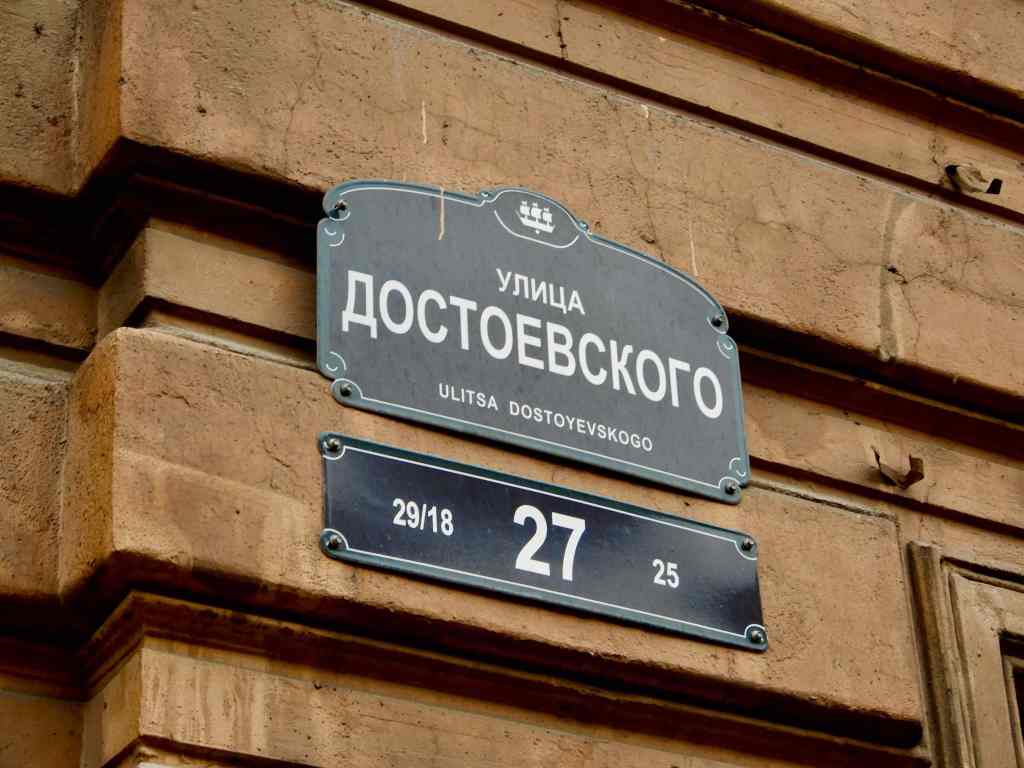
A house sign on Dostoyevsky Street in Petersburg, 10 October 2018. Photo by the Russian Reader
1
Since the second phase of Russia’s war of aggression against Ukraine began on 24 February 2022, there have been heated debates in the press and social media about the extent to which Russian culture—not Soviet culture, but precisely classic Russian culture, starting with the nineteenth century (if not earlier)—is culpable for what has been happening. The accusers say, for example, that all of Russian culture and its leading figures have invariably been infected by the imperialist spirit and the oppression of other countries and cultures. The objections raised against this view can be grouped into several lines of argument. Some opponents say that we shouldn’t ascribe today’s problems to classic writers, while others argue that an entire culture cannot be blamed for this aggression, even if it is supported by the political elite and a considerable portion of society. A third group claims that the Russian officers hurling missiles at civilian settlements or the Russian soldiers looting occupied villages have hardly been immediately influenced by any books whatsoever, so the question of culture’s culpability is entirely irrelevant. Some of the people who object to the notion of a “single and unified” Russian culture hold that those who allege its unity are unwittingly playing into the hands of Kremlin propaganda, which also asserts that Russian culture in its entirety is founded on a “code” and immutable “values,” which the state is supposedly taking great care to uphold by bombing neighboring countries and arresting all dissenters.
I would argue that these debates about culture’s culpability are a psychological trap that takes us back to the early twentieth century, when the humanities were dominated by essentialism—that is, a view of society founded on the absolute certainty that, for example, women and men, or sexual minorities (see Vasily Rozanov’s People of the Moonlight, 1911), or different nations and religions have an immutable essence that predetermines the behavior of individual members of these groups. In the early twentieth century, essentialism was used as an argument in favor of inequality: the “innate characteristics” of women were supposedly such that women should not be allowed to vote, and the “innate characteristics” of colonized peoples were such that they did not deserve the right to self-governance. It is no accident that the twentieth century witnessed the unfolding of two deeply interlinked processes: one social—the fight for the civil and political rights of marginalized groups (feminism, anti-colonialism, queer emancipation), and one in the humanities and sciences that sought to overcome essentialism and affirm the view that the self-consciousness of men and women, the self-consciousness of large cultural or racialized groups, etc., is internally variable and always the result of a long process of historical evolution. Today, we seem to be plunging back down the ladder onto an older rung. As cultural studies scholar Jan Levchenko has astutely noted, Putin’s hostility toward modernity and his rejection of the idea of the future has unleashed an archaization of consciousness in several countries. It is important to resist this process.
A distressing example of the new essentialism can be found in a column published in the Frankfurter Allgemeine Zeitung on 8 September 2023 by the Berlin journalist Nikolai Klimeniouk, titled “Sie wollen, dass wir sie ‘lieben’” (“They want us to ‘love’ them”).[1] Klimeniouk claims that contemporary Russian culture (or all Russian culture? his article does not make this clear) is supposedly founded on the idea of a non-consensual love that does not respect personal boundaries and demands reciprocal “consent” from those nations who were subjected first to Soviet and now to Russian aggression. This belief in the unimportance of other people’s boundaries, Klimeniouk argues, is shared by the intellectuals of Russian descent who defended Andrei Desnitsky, the biblical scholar who was recently fired from Vilnius University following a heated public campaign in the Lithuanian media. The organizers of that campaign took Desnitsky to task for publishing an article in 2012 about the 1940s Soviet occupation of Baltic countries in which he made statements that, in spite of all his caveats at the time, have been read in today’s context as an expression of sympathy for the occupiers.
In his discussion of Desnitsky, Klimeniouk makes an unexpected logical leap. First, he rehashes the viewpoint of the scholar’s supporters:
“The journalist [who wrote about Desnitsky – I.K.] was [not a journalist but] a denouncer. The decision was undemocratic. Desnitsky is an important scholar who brought renown to the university. This would never happen in a civilized country. In Lithuania, they punish you for expressing your opinion, and Russians are hated everywhere.
“This framing is frighteningly similar to a discussion of significance to contemporary Russian culture, which began in 1985 on the pages of the New York Times Book Review, and, it appears, was never concluded.”
Klimeniouk then summarizes two essays which appeared in The New York Times Book Review at that time: “An Introduction to a Variation,” by Milan Kundera, and “Why Milan Kundera is Wrong about Dostoyevsky,” a response by Joseph Brodsky. The turn to this older polemic is symptomatic: Klimeniouk believes that it is possible nowadays to make arguments of the same sort that these two writers exchanged almost forty years ago—although, truth be told, these arguments already sounded quite outmoded even at the time. That’s why it is worth going over these essays in more detail than Klimeniouk provides, since his column revives a debate that already proved unfruitful once.
Milan Kundera’s essay begins with the tale of how, in 1968, a Soviet military patrol stopped him—expelled from all Czechoslovak institutions, his books banned—as he was driving from Prague to Budějovice. The officer in charge tells Kundera, “It’s all a big misunderstanding, but it will straighten itself out. You must realize we love the Czechs. We love you!” This strange declaration of love by an officer of the occupying army makes Kundera recall Dostoyevsky, with his irrationalism and fetishization of strong emotions, as well as Solzhenitsyn, whose Harvard commencement speech criticized the spirit of the European Renaissance. In his essay, Kundera positions himself as a defender of the European cultural values that emerged during the Renaissance: self-consciousness, rationalism, irony, and playfulness.
Joseph Brodsky, already famous in the States but not yet а Nobel Prize winner (that would happen a year after the events described here), took it upon himself to defend Dostoevsky against Kundera on the pages of the New York Times Book Review. However, he also resorted to the same kind of essentialist rhetoric—perhaps to an even greater degree—as his opponent, and to top it off, he also tried to humiliate Kundera, possibly out of sheer irascibility. “[Kundera’s] fear and disgust [toward the occupiers] are understandable, but soldiers never represent culture, let alone a literature – they carry guns, not books. […] Mr. Kundera is a Continental, a European man. These people are seldom capable of seeing themselves from the outside.”
These are more or less the kind of thoughts, according to Klimeniouk, that can be found in the minds of today’s Russian émigré intellectuals, which is why they defend Desnitsky and refuse to entertain the idea of a connection between Russian culture and Russian aggression—they don’t see a link between “guns” and “books” either.
Klimeniouk devotes the rest of his column to a discussion of statements made by Russian writer Maria Golovanivskaya on the topic of love (in an interview with Lev Oborin on the website Polka) and a now-deleted Facebook post by Tatyana Tolstaya (rather unconscionable musings about the rapes of German women by Soviet soldiers). Finally, he quotes a new history textbook for the eleventh grade, written by [former Russian culture minister] Vladimir Medinsky and Moscow State Institute of International Relations (MGIMO) rector Anatoly Torkunov, before concluding, “[In contemporary Russia,] high culture has once again lost the battle with state repression.”
This conclusion seems to me both illogical and, perhaps, formulaic: it seems to follow from a different argument than the entire preceding column. In order for culture to “once again [lose] the battle” with the state, there must be a conflict between the two, and Klimeniouk had so far tried to show that there was no conflict whatsoever between Russian culture and the Russian government. What is more, Klimeniouk ascribes to Russian culture “perennial” motifs that can be expressed with equal success using quotes from Brodsky, Golovanivskaya, or Tolstaya. These same “perennial” motifs underlie, in his view, the connection between Russian culture and today’s war of aggression.
I think that we should analyze the psychological stance underlying Klimeniouk’s article. These days, this approach threatens to spread much farther than a single newspaper article, and not just in the media, but also in scholarship. This is precisely why I think that what matters now is not whether Klimeniouk is interpreting Brodsky correctly, or even what all this has to do with Andrei Desnitsky getting fired. What matters is methodology. How can we contextualize and explain this rhetoric of “love” that Klimeniouk apparently considers something akin to an incurable (or, at any rate, intractable) disease of Russian culture?
2
A newspaper column certainly has its own generic rules: it is meant to quickly convince readers that the author is right. Nevertheless, even taking these rules into account, it is surprising that Klimeniouk does not bring in several rather obvious nineteenth-century texts in which the “love” rhetoric he describes is most effectively expressed. Looking at these texts, however, makes it clear that this rhetoric is an expression of a specific historical-evolutionary line that can be traced to the mid-nineteenth century, rather than reflecting universally shared qualities of Russian culture. This line could be called expansionist universalism. The texts created within its framework became a crucial intellectual resource that facilitated the emergence of the Russian state’s current rhetoric of war—but not as texts per se, but because this rhetoric was later substantially reworked by late-Soviet Russian nationalists.[2]
The first example is Fyodor Tyutchev’s poem “Two Unities” [“Dva edinstva,” September 1870). Addressed to the “Slavic world” (the same sort of ideological construct as the “Russian world” is in our time), with its famous second stanza pointing to Otto von Bismarck as the “oracle of our day”:
«Единство, — возвестил оракул наших дней, — Быть может спаяно железом лишь и кровью…» Но мы попробуем спаять его любовью, — А там увидим, что прочней…
“Unity,” declared the oracle of our day, “Can be forged solely through iron and blood.” But we shall bond our unity through love, And then we shall see which of the bonds gives way.
Tyutchev called for the creation of a Slavic federation led by Russia, which was to be founded on “love.” The famous Czech poet and journalist Karel Havlíček Borovský (1821–1856) once wrote about this “love”: “Russians call everything Russian Slavic in order to later call everything Slavic Russian.” But Havlíček did not mean all Russians when he said “Russians”; he meant the Slavophiles, who were unwittingly playing along with their government. And, while Havlíček criticized the Slavophiles and the Russian state’s autocracy, he also translated Gogol and Lermontov into Czech.
The second example is Dostoyevsky’s “Pushkin Speech,” delivered in 1880. It declares love as the basis of the Russian people’s “world-scale kind-heartedness”:
«…Мы [русские] разом устремились <…> к самому жизненному воссоединению, к единению всечеловеческому! Мы не враждебно (как, казалось, должно бы было случиться), а дружественно, с полною любовию приняли в душу нашу гении чужих наций, всех вместе, не делая преимущественных племенных различий, умея инстинктом, почти с самого первого шагу различать, снимать противоречия, извинять и примирять различия, и тем уже выказали готовность и наклонность нашу, нам самим только что объявившуюся и сказавшуюся, ко всеобщему общечеловеческому воссоединению со всеми племенами великого арийского рода…»
“Indeed, we [Russians] then impetuously applied ourselves to the most vital universal pan-humanist fellowship! Not in a spirit of enmity (as one might have expected) but in friendliness and perfect love, we received into our soul the genius of foreign nations, all equally, without preference of race, able by instinct from almost the very first step to discern, to discount distinctions, to excuse and reconcile them. Therein we already showed what had only just become manifest to us—our readiness and inclination for a common and universal union with all the races of the great Aryan family.”
The third example is Alexander Blok’s poem “The Scythians” (1918), which literary scholars have noted was directly influenced by the “Pushkin Speech”:
Да, так любить, как любит наша кровь, Никто из вас давно не любит! Забыли вы, что в мире есть любовь, Которая и жжет, и губит!
Мы любим все — и жар холодных числ, И дар божественных видений, Нам внятно все — и острый галльский смысл, И сумрачный германский гений…
Yes, to love the way that our blood loves, None of you has loved in countless years! You have forgotten that there is a love That burns and wrecks and wakens fears!
We love it all—the sear of ice-cold numbers, The gift of divine illuminations, We grasp it all—the sharp-edged Gallic wit, The gloomy genius of the Germans.
The version of universalism on which Tyutchev, Dostoyevsky, and Blok insisted assumed that practitioners of Russian culture, who had arrived late to the dialogue of European culture(s), could occupy a central place in that dialogue because they (speaking as it were on behalf of “Russians”) could allegedly understand everything, and this ability to understand was underpinned by the unique Russian capacity for “love.” Mastering a foreign culture, as based on this universal “love,” becomes a form of self-affirmation for the “lover.” This rhetoric was a means of alleviating and masking the constant tension between two images of Russia produced in the press and in government publications, a tension felt ever more strongly over the course of the nineteenth century: Russia as the nation-state of Russians and Russia as a multi-ethnic empire. But this task of “all-conquering love” was not declared on behalf of the government, but rather on behalf of society. While the “we” in Tyutchev’s poem could still encompass the and society, in Dostoyevsky’s speech and Blok’s poem the “we” points first and foremost to a society that was ready, in their opinion, to bring about cultural expansion in place of the state.
Some of their contemporaries sharply criticized this rhetoric. For example, the well-known critic Nikolai Mikhailovsky noted very soon after the publication of the “Pushkin Speech” that Dostoyevsky’s calls for a “united Aryan tribe” had anti-Semitic undertones.
If we examine the examples given by Klimeniouk with a view to older history, it becomes clear that the Russian intelligentsia’s universalism has not always and across the board had an expansionist character. There have been at least two variations. The first is westernizing, which assumes that Russian culture is too archaic and that it can and must be renewed with the help of transfers of Western European culture into Russia. This thinking was, for instance, foundational for the translation strategy of the Russian Symbolists, who were able in the 1900s and 1910s to “catch up” to French poetry, which was developing rapidly at the time. This westernizing conception influenced the program of the World Literature publishing house, founded by Maxim Gorky in 1919. At a different historical stage, westernizing universalism manifested itself in a passion for Polish culture (jazz, poetry, fashion magazines) among the nonconformist intelligentsia in the 1950s-1960s; Brodsky himself was a Polonophile in his youth. Of course, Thaw-era Soviet Polonomania was rarely marked by a deep interest in the other; it was often just the urge to imagine an alternative, better life for oneself, but cultural transfers often occur in exactly this fashion.
The second, rarer variation is philanthropic, whereby the popularization of different cultures in Russia served to express sympathy and moral support for the bearers of said culture(s). In 1916, immediately following the Armenian (and Assyrian) genocide in the Ottoman Empire, an enormous book of translations entitled The Poetry of Armenia from Ancient Times to the Present Day was published under the editorship of the prominent poet and critic Valery Briusov. The translators included other well-known poets such as Jurgis Baltrušaitis, Konstantin Balmont, Ivan Bunin, Vyacheslav Ivanov, Vladislav Khodasevich—and even Alexander Blok, author of “The Scythians.” The anthology did not have colonial or expansionist intentions, however; instead, it voiced Russian civil society’s solidarity with a people subjected to genocide (even though that word didn’t even exist yet). Briusov took on direction of the project only after he gave himself a crash course in basic Armenian and read several books about the history of Armenian literature.
The anthology was the first in a series of translated compendiums of ethnic minority literatures of the Russian Empire, for whom the catastrophes of the First World War were particularly hard. These anthologies were of major philanthropic significance and were edited by Briusov, Maxim Gorky, and several other Russian writers. They included An Anthology of Armenian Literature (Sbornik armianskoi literatury, Petrograd: Parus, 1916, edited by Gorky); An Anthology of Latvian Literature (Sbornik latyshskoi literatury, Petrograd: Parus, 1916, edited by Briusov and Gorky); and An Anthology of Finnish Literature (Sbornik finliandskoi literatury, Petrograd: Parus, 1917, edited by Briusov and Gorky). Adjoining them is an anthology of translations from then-contemporary Hebrew poetry, The Jewish Anthology, published in 1918 by the Moscow publishing house Safrut, and edited by Khodasevich and Leib Yaffe.
In the Soviet context, beginning in the mid-1930s when Stalin veered into isolationism and “Russocentrism” (David Brandenberger’s term), universalism became a stealth-oppositional attitude. It expressed—to use Osip Mandelstam’s coinage—a longing for the world culture beyond the “iron curtain,” and was a way of resisting the notion of Russian culture as something absolute, self-important, and completely adapted to Soviet conditions. There was a reason why in late Stalinism any attempts to study the influence of Western literary traditions on Russian literature were subject to persecution. Research of this sort was stigmatized as “cosmopolitanism” and “kowtowing to the West.”
In the late Soviet period, there was an official universalism in which the rhetoric of “love” à la Tyutchev or Dostoyevsky was invoked only rarely, but which reproduced a construction typical of their texts: “the primacy of the one who loves.” The Russian people were to be understood as an “elder brother” implicitly united with the Soviet state (“The unbreakable Union of free republics / was bound all together by Great Rus,” as the first line of the Soviet national anthem declared).[3] This Soviet official universalism appears to be exactly what the officer whom Kundera encountered was relaying: “we” love “you,” the Czech people, and this is exactly why we saved you from the Prague Spring, from the “pernicious” desire to live as you wish. And this paternalistic, protective, colonialist universalism, ramped up into a sort of cargo cult (“we will repeat what was said then—and it will be as it was then”)is replicated by Margarita Simonyan in one of her tweets (13 July 2023), in which she writes:
“What did you not like about living with us? What was so bad about it? Most of you have us to thank for statehood, you got culture thanks to us. Who was oppressing you? Who messed with you?”
This Soviet version of universalism is exactly what today’s stylistics of “re-enactment” has been replicating, and it is one of the intellectual resources driving Russia’s war against Ukraine. The people who have written and write in this tradition can certainly be held responsible for what is happening today. But there are other forms of universalism that have been preserved and survive in Russian culture. Understanding universalism as a complex, evolving discursive system containing many variations makes it possible to look at Russian culture not as a single, unified, and timeless whole invested with a unified, singular culpability, but as a space open to polemics in which different ideas grapple with each other.
3
Let me move on from the discussion of the varieties of universalism to more general thoughts on the methodology of the contemporary humanities and social sciences. They might seem trivial to my colleagues in history, but over the last year and a half these basic tenets of the profession have seemingly been overshadowed, and it would behoove us to recall them.
A historian is not required to forgive or rehabilitate the figures they write about, but it is important to understand these figures within the context of their own time—what they could or could not think about, what concepts they used, what kind of knowledge or resources were available to their characters, or to whose questions they were responding. This paradigm of historical knowledge was established by the French historians of the Annales school and further developed by the intellectual historians of the Cambridge school—e.g., John Pocock and Quentin Skinner.
Proponents of historicism are sometimes accused of enabling relativism: general rules do not exist; each era has its own norms. Still, the example of late-Soviet humanities scholars—of figures such as Sergei Averintsev, Aron Gurevich, and Mikhail Gasparov—shows that they did not think of historicism as a branch of relativism but as a tool for understanding people from different eras and cultures, and this work of understanding (especially for Gasparov) enabled them to grasp the limitations of the cultural conventions of their own time. They developed their concepts of historicizing interpretation as a tool for understanding over the course of the 1970s and 1980s, and this approach was one of the most significant advances in the late-Soviet humanities and social sciences in terms of both its scholarly and existential utility.
This interpretative sequence—understanding the other so as to better understand one’s own situation and, by reflecting on one’s own situation, gaining an even more accurate understanding of the other—was laid out by proponents of the philosophical school of hermeneutics. Yet neither the hermeneutic philosophers (Paul Ricœur and Hans-Georg Gadamеr) nor the unofficial Soviet humanities scholars directly inquired into the consciousness of an interpreter belonging to a repressed or silenced societal group (even though unofficial humanities scholars in the USSR certainly belonged to such a group), or to one identifying their own sense of self with those in an unprivileged position. (Yuri Lotman’s persistent discussion of the history of the Russian intelligentsia as a stigmatized and marginal group shows that he understood the position from which he was speaking quite well.) In hermeneutics, the interpreter of the world appears as a kind of “default subject” (implicitly, a white European man), so it may seem as if hermeneutics were at odds with critical theory and its closely affiliated approaches—feminism, postcolonial and decolonial theory, queer studies. But the current intellectual state of affairs shows that these approaches can be synthesized.
Critical theory teaches researchers to ask themselves questions—and not just about their own privilege (“check your privilege”), but also about the conceptual tools they are using. For example, I myself should consider whether my mind retains the traces, the discursive debris, of the expansionist universalism which I discussed earlier.
Today, when we talk about history as the result of human efforts with specific social, discursive, and conceptual parameters, feminist, queer, postcolonial and decolonial theory all help to focus our gaze more sharply. But these methods could also benefit from the acuity afforded by historicism, because the human conflicts and interactions they study have differed in different eras and took on a particular shape in each specific instance. Now, let’s turn to why this kind of synthesis is necessary.
In 2011, Stanislav Lvovsky wrote that, sooner or later, Russian culture would have to be reconstituted on new foundations. It is now obvious that he was right. When undertaking this project, it will be important to take stock of the resources available to сultural professionals in their fight against the tendencies that Russia’s leaders have let proliferate and become dominant—no matter how many states emerge out of the ruins of today’s regime at the end of the current political cycle. I think that if we examine the different versions of Russian universalism historically, using the methods developed by the Annales school, we will find that, alongside the passive-aggressive tradition observed by Kundera, Russian culture also has resources for resisting the state’s rhetoric of “paternalistic love.” These resources are primarily found in works of unofficial literature and unofficial scholarship.
I dearly hope that Ukraine wins this war, but a mere military victory would not be enough for me. At the end of the Second World War, scholars in different countries set to thinking up ways to undermine the intellectual foundations that gave rise to Nazism. (Many years after the war, Michel Foucault’s foreword to Gilles Deleuze and Felix Guattari’s Anti-Oedipus called the book “an introduction to non-fascist life.”) Today, people in many different countries also have reason to think about how they can subvert the intellectual foundations which are producing an aggressive right-wing populism that stigmatizes minorities. When right-wing populism is implemented by former security-service officers gripped by ressentiment, you get the nightmare that is playing out in Russia today.
I think that the future of humanity lies not in national but post-national states—societies organized as federations of different minorities. The methodology of the contemporary humanities and social sciences can function both as a common language that different minority groups can use for collective action, and as a crucial tool for understanding the other, and others.
[1] The excerpts from Klimeniouk’s article quoted here were first translated from the original German into Russian by the author himself, and then rendered in English by the translators.
[2] See, for instance, the uncensored version of Stanislav Kunyaev’s poem “Okinu vzgliadom Severo-Vostok,” [“I will cast a gaze at the North-East”], which was first published in 1986: “Let the Mansy salute Yermak, / And it is meet for the Uzbek to praise Skobelev, / for the fact that we now have gas and timber and cotton, / and have room for lots of missiles.”
[3] Text by Sergei Mikhalkov and Gabriel El-Registan.
A puzzling poem discovered at the tombstone of the late Yevgeny Prigozhin, the Russian Wagner mercenary leader, has emerged, intensifying the speculation that he may still be alive.
Once recognized as “Putin’s chef,” Prigozhin met his demise alongside nine others when his Embraer Legacy 600 aircraft crashed to the earth during a recent flight connecting St Petersburg and Moscow.
Reports of a possible explosion on the plane have surfaced subsequently. Confirming the 62-year-old’s demise required genetic analysis of the fire-engulfed aircraft wreckage. An ongoing inquiry into the crash is also underway.
Despite the official verification of his passing, numerous conspiracy theorists and supposed Russian “specialists” persistently assert that he remains living in an undisclosed location abroad.
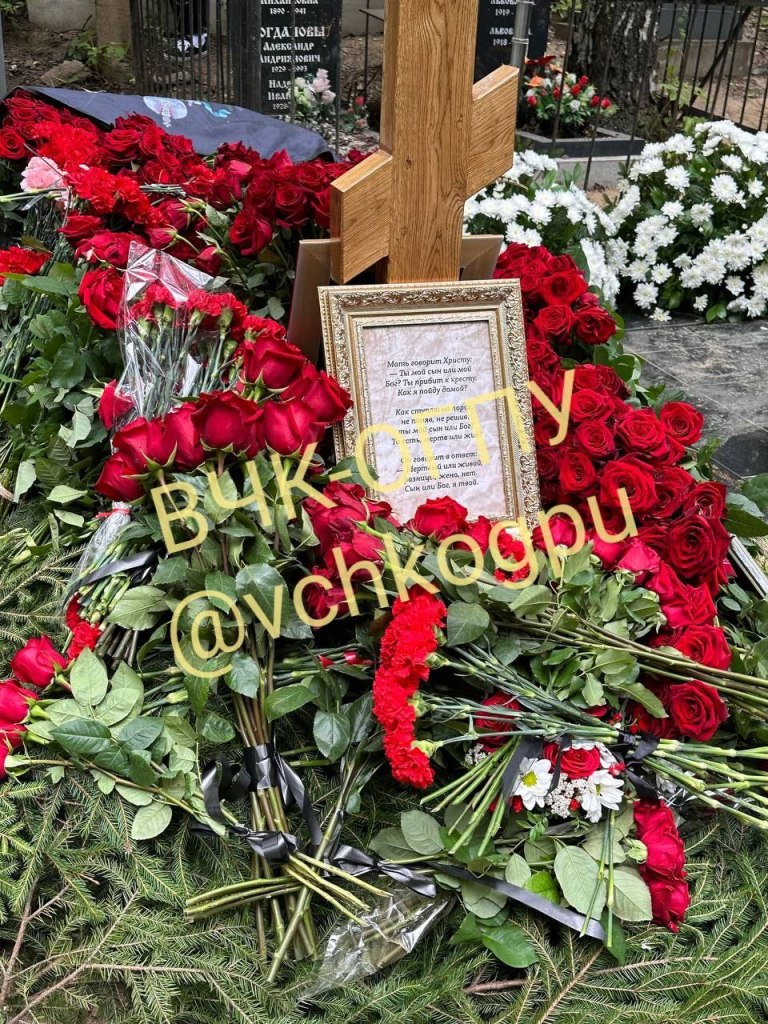
Presently, photographs from his restricted funeral—purportedly arranged by his mother, Violetta Prigozhin—exhibit armed guards, scent-tracking canines, and a peculiar poem framed and positioned on the grave marker.
Source: VChK-OGPU (Telegram), 30 August 2023
As per the state-endorsed Russian media outlet Moskovskij Komsomolets and the Telegram channels Rotunda and VChK-OGPU, the framed poem, observed during the funeral attended [by] Lyubov Prigozhina, 52, and the Wagner mercenary supremo’s elder daughter Polina, 31, comprises these verses:
‘Mother says to Christ: Are you my son or my God? You’re nailed to the cross, how will I go home?’ it read.
‘How will I step on the threshold, not understanding, not deciding: Are you my son or God? That is, dead or alive.
‘He says in response: Dead or alive, no difference, woman. Son or God, I am yours,’
The excerpt is borrowed from a composition by the Russian/Soviet Union poet Joseph Brodsky, entitled Still Life.
Earlier that day, a hearse was spotted traversing St Petersburg en route to the Porokhovskoye Cemetery.
As per Rotunda’s assertion, the Russian Ministry of Internal Affairs remained unaware of the funeral’s precise location. The ultimate lines of the poem supplement the intrigue, echoing assertions made by Russian authority Valery Solovey the previous day.
He commented, “Prigozhin himself was not aboard. His doppelgänger had taken flight in his stead—Vladimir Putin is keenly cognizant of this fact. If you… place your faith in the official declarations of the Russian administration, then what more can I add…?”
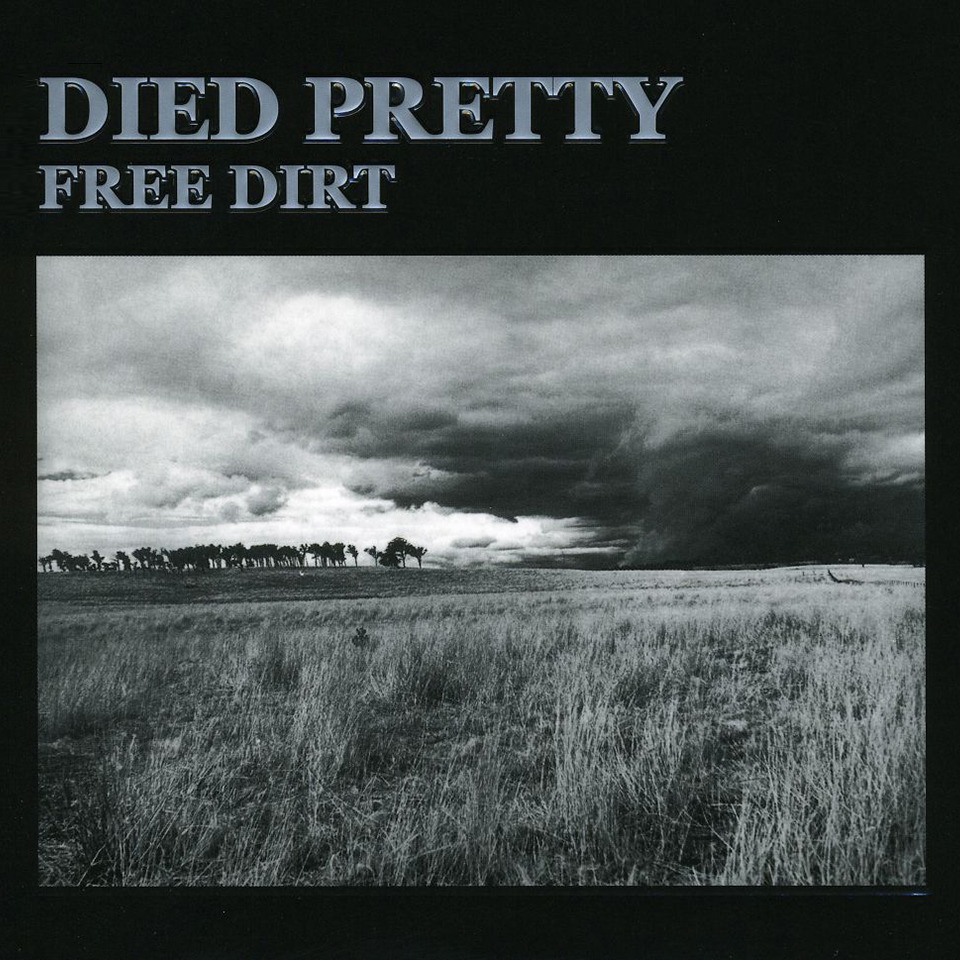
I just noticed that the Australian band Died Pretty released their gorgeous first album, Free Dirt, on 8 August 1986, two days before my nineteenth birthday. Sadly, the band’s unforgettable lead singer Ron S. Peno died on 11 August this year, a day after my birthday. Happily, my equally unforgettable friend Jenya Kulakova celebrates her thirty-fifth birthday today. She was not yet around to enjoy Free Dirt when it hit the record stores thirty-seven years ago, but maybe she’ll enjoy it today—along with my translation of a poem written by one of the most famous writers from her adopted hometown. ||| TRR
The cover of Died Pretty’s 1986 debut LP Free Dirt Image courtesy of Jittery White Guy Music
August

Provincial towns, where you’ll never get a straight answer.
What’s it to you? It was yesterday however you cut it.
Outside the elms murmur, nodding to a landscape
Only the train ever sees. Somewhere a bee buzzes.

The knight made a career of crossroads, but these days
Is himself a stoplight. Plus there’s a river in the distance.
And between the mirror into which you gaze
And those who can’t recall you there’s also little difference.

Closed fast in the heat, the shutters are entwined in gossip,
Or merely ivy, to avoid making a blunder.
Bounding through the front door, a sunburnt stripling
Clad in only his swim trunks has come to collect your future.

So twilight’s a long time in descending. Evening’s usually cast
In the shape of a train station square, with a statue, etc.,
Where the glance in which you read “You bastard!”
Is in direct proportion to the crowd that’s not present.
Source: VK. Translated (many moons ago too) by the Russian Reader