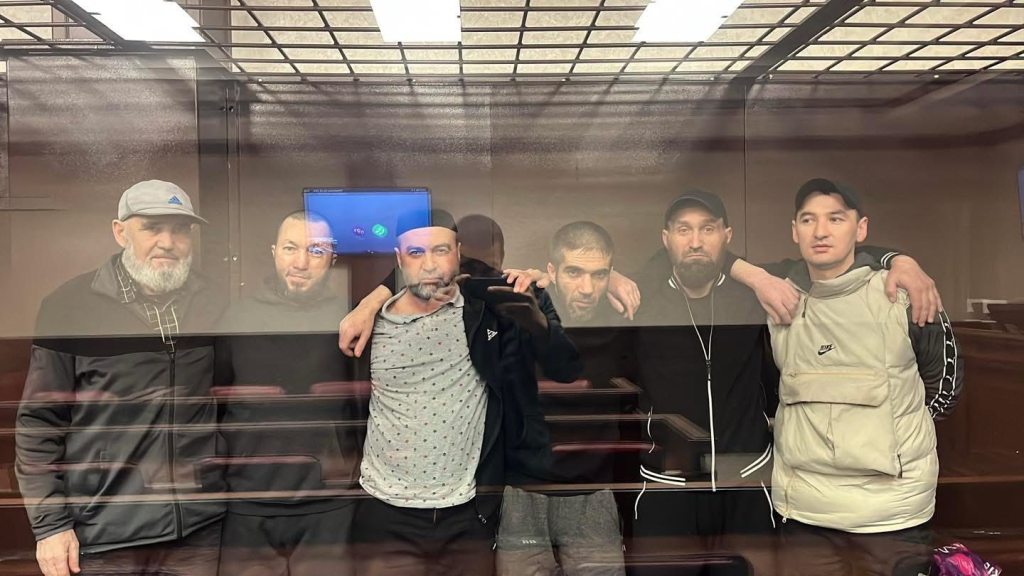
Today, a Russian military court sentenced six Crimean Tatars from the Dzhankoi District to terms in prison ranging from 11 to 14 years.
On the firing range of persecution, this is yet another sentence for Muslims in Crimea. For us, it means yet more broken lives, families separated for many years, and children who have also been sentenced to a life without their fathers. It is a river of grief.
I look at the grey-haired old man on the left of the photo, 69-year-old Khalil Mambetov, and in my mind’s eye I see the political prisoners Azamat Eyupov and Servet Gaziyev, who have already been sent into exile thousands of kilometers away from Crimea to serve their sentences. I look at Mambetov and think about his wife, Tata Lila, who is battling cancer. “We don’t know how to tell her that Agha Khalil has been sentenced to 14 years in prison,” say the wives of the other defendants.
Refat Seidametov, Leman Zekeryaev, Ekrem Krosh, and Osman Abdurazakov were also sentenced to 14 years’ imprisonment, with the first four years to be served in a closed prison and the remainder in a maximum security penal colony.
The court sentenced Aider Asanov to 11 years’ imprisonment, with the first three years to be served in a closed prison and the remainder in a maximum security penal colony, followed by one year’s custodial supervison.
Aider’s mother has a severe form of bronchial asthma. After her son’s arrest, her condition deteriorated further. Leman Zekeryaev’s mother has trouble walking. Ekrem Krosh’s brother Enver is also in the pretrial detention center in Rostov-on-Don, and the Almighty only knows how much pain their mothers are in.
When they will embrace their relatives on the outside, like hundreds of other women in Crimea, is also known to the Almighty alone. But we will continue to do everything in our power. And no matter how difficult it is, no matter how overcome we are by chronic fatigue, we continue to peacefully defend the supreme values of our people’s integrity. Because we cannot become inured to persecution.
Russia’s worst conveyor belt of repression in occupied Crimea has sunk to a new low with six recognized Crimean Tatar political prisoners from Dzhankoi facing sentences of 17 and 17.5 years. Not only are none of the men accused of any recognizable crime, but even the charges are those virtually copy-pasted from ‘trial’ to ‘trial’ since 2015, with the sole difference lying in the huge sentences demanded in this case against all the men. As well as in the fact that Khalil Mambetov is already 69, making this a near certain death sentence.
The ’trial’ of the six Crimean Tatars is coming to an end at the Southern District Military Court in Rostov-on-Don, with the prosecutor claiming, on 7 April 2025, that the men’s ‘guilt’ had been proven. He demanded 17.5-year sentences against Khalil Mamebetov (b. 1955) and Refat Seidametov (b. 1969) and 17-year sentences against Osman Abdurazakov (b. 1984); Aider Asanov (b. 1963); Ekrem Krosh (b. 1985); and Leman Zekeryaev (b. 1973). In each case, the sentence would be for maximum-security (or ‘harsh-regime’) imprisonment, with the prosecutor also seeking a one-year term of (seriously) restricted liberty should they survive the sentence in the appalling conditions of Russian penal institutions.
Lawyer Emil Kurbedinov told Crimean Solidarity that ‘each sentence in these cases is proof of political persecution. And with each sentence, the lawlessness takes on increasingly sophisticated and perverted forms.”
(From left) Leman Zekeryaev, Ekrem Krosh, Aider Asanov, Khalil Mambetov, Refat Seidametov, and Osman Abdurazakov. Photo: Crimean Solidarity
Although the sentences demanded are not necessarily those handed down, the fact that such horrifically long terms are demanded in all cases is unprecedented. It is especially worrying given that all of the men are accused of the lesser of two charges used in these conveyor belt trials.
Russia’s use of its legislation against any Ukrainian citizens on occupied territory is illegal, however these trials are especially cynical since the men are accused solely of unproven involvement in an organization which is legal in Ukraine. The pretext for bulk ‘trials’ of Crimean Tatar and other Ukrainian Muslims is a flawed and suspiciously secretive Russian Supreme Court ruling from 2003 declaring the peaceful, transnational Muslim organization Hizb ut-Tahrir ‘terrorist’. Since 2017, Russia has largely used such ‘trials’ as a means of trying to crush the Crimean Tatar human rights movement with civic journalists and activists, especially from Crimean Solidarity, increasingly targeted.
This was the second wave of such arrests in the Dzhankoi region of Crimea, with the first wave in August 2022 coming the day after a humiliating attack on a Russian military base in Crimea which Russia could not admit, but doubtless wanted to avenge. The link between these two ‘operations’ seemed clear given that the arrests on 24 January 2023 targeted the brothers of two of the men arrested in August 2022, with Ekrem Krosh the brother of civic activist Enver Krosh, seized in 2022, and Osman Abdurazakov the brother of Edem Bekirov. It also seemed likely because of the charges. In almost all such ‘trials’, one or more of the defendants is accused of ‘organizing’ a Hizb ut-Tahrir group under Article 205.5 § 1 of Russia’s criminal code. The others are accused of ‘involvement’ in such a ‘group’ (Article 205.5 § 2). Why one charge is laid, not the other, often seems arbitrary or about reprisals, but the difference in length of sentence has, up till now, been significant. All six defendants in the second Dzhankoi group are accused only of ‘involvement’, while the sentences demanded are those normally used against purported ‘organizers’. In occupied Crimea, it has become standard for all defendants to face the equally absurd charge of ‘planning to violently seize power’, under Article 278.
These ‘trials’ are not just a travesty because of the flawed charges. Essentially no evidence of actual involvement in Hizb ut-Tahrir is required. FSB-loyal ‘experts’ are used to provide ‘assessments’ of illicitly taped conversations about religion, politics, bringing up children, etc., with the supposed ‘experts’ providing the ‘conclusions’ demanded of them. The ‘trials’ also hinge on the so-called ‘testimony’ of anonymous witnesses who may well have never met the defendant. As reported, there have been absolutely glaring infringements in this case, with the FSB, for example, not even bothering to explain which part of a long conversation which they illicitly taped, proves the men’s ‘guilt’. The description given by one of the ‘secret witnesses’ did not match the photos used for the alleged identification parade.
Tragically none of this, nor the age of one of the defendants, will make a scrap of difference. The ‘case’ was passed to the court in Rostov in August 2023, and is being heard by a panel of judges, under presiding judge Viacheslav Alekseevich Korsakov, who has already demonstrated his willingness to provide the sentences demanded of him, however unwarranted.
The next hearing is scheduled for 15 April, with the defence beginning the final debate.
Crimea’s Tatars: “They drive us from our homes, just as they did to our grandparents 80 years ago”
By Katya Aleksander, who interviewed activists supporting more than 100 Crimean Tatar political prisoners. First published in Russian by Important Stories (Vazhnye Istorii)on 18 May, the 80th anniversary of the deportation of the Crimean Tatars.
On 18 May 1944, eighty years ago, the Soviet government accused an entire people of “collaboration with the Nazis” and “betraying the fatherland” – and deported the Tatars from the Crimean peninsula. It took the Crimean Tatars more than forty years of constant struggle to return to Crimea. But in 2014 the peninsula was annexed by Russia. The war began, and, with it, repression by the new authorities on a massive scale.
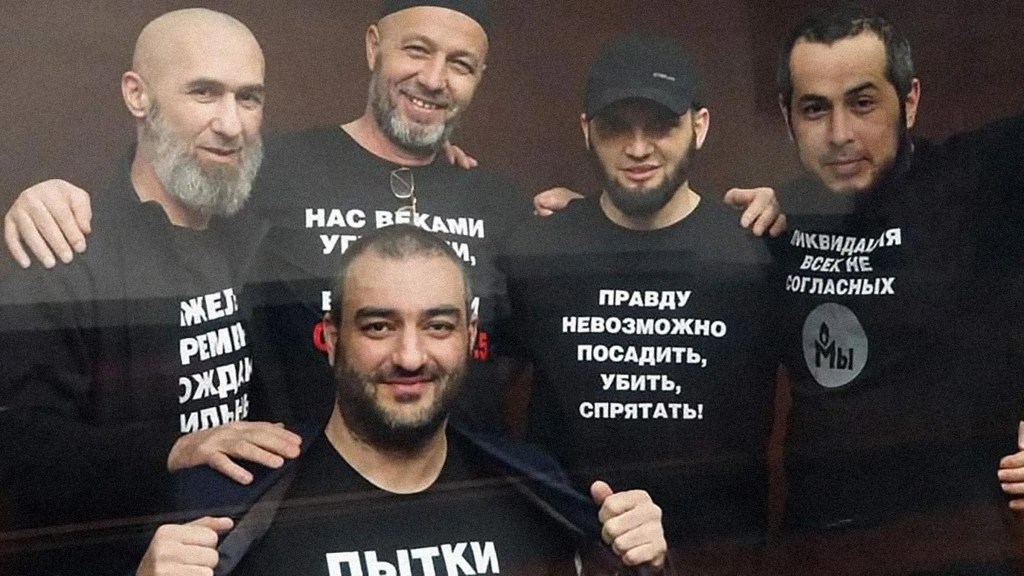
Political prisoners Tofik Abdulgaziev, Vladlen Abdelkadyrov, Izzet Abdullaev, Medzhit Abdurakhmanov and Bilial Adilov, among those falsely accused of “terrorism” and “preparation to seize state power” in 2019, and sentenced to 12-14 years’ imprisonment. Abdullaev’s T-shirt says, “the truth can not be imprisoned, killed or hidden”. Photo by Crimea Solidarity
On the anniversary of that tragedy, which Ukraine demands be categorised as genocide, Important Stories spoke with Crimean Tatars who continue the struggle to live freely in their historic homeland.
Every Crimean Tatar family has its stories of deportation. They all start in the same way. On 18 May 1944, at five o’clock in the morning, soldiers burst in to the house and gave people 5-10 minutes to collect their belongings and go to the nearest train station. No explanations. At dawn, everyone was forced into cattle wagons and taken away.
It was all over by 4:00 pm on 20 May: one of the fastest deportations in world history. All the deportees’ property passed to the Soviet state.
“Many people thought they were being taken away to be shot. The Soviet Union was an atheist regime, and many Crimean Tatars were of Islamic faith”, said Azime (her name has been changed), the wife of a present-day Crimean Tatar political prisoner. Her family were deported to Uzbekistan.
“They put everyone in cattle wagons, with no windows and locked doors. There was no sanitation. No water, no food. People died from hunger, thirst and dysentery. The soldiers just threw their bodies out at the train stations. Some people were able to hide their relatives’ bodies: those families hoped that they would soon arrive somewhere and be able to bury their loved ones like human beings.”
The transport took 2-3 weeks. About 80 per cent were taken to Uzbekistan, and the rest were sent to special places of exile in other parts of the Soviet Union.
“Part of my family was deported to Uzbekistan, part perished in those cattle wagons, and my grandfather was taken to the Urals”, said Ismail (his name has been changed), who today acts as a defence lawyer for Crimean Tatars. “Grandad said that, while he and his mother tried to find accommodation, they could not go to work for two days. And so [for breaking the labour laws] his mother was sent to prison for five years.”
Soviet propaganda prepared local people to receive the deportees. Uzbeks were advised to keep well away from the newcomers, who were “cyclops” and “cannibals”. In exile, Crimean Tatars faced hunger, dangerously unsanitary conditions and an absence of health services. Between 18 May 1944 and January 1946, about 200,000 Crimean Tatars lost their lives, according to estimates by the National movement.
The struggle to return home
People could not return to Crimea. Until 1956 the Crimean Tatars had the status of “special settlers” with limited civil rights. They had to report regularly to police commandant’s offices. They were permitted to move to a different region only by invitation from close relatives. Attempts to leave without permission were punished by up to ten years’ imprisonment.
Although their language was banned, the Crimean Tatars preserved their culture and traditions. Parents told children what their home looked like, and how to get there, so that they could find their way to it when they returned.
“Everyone lived with thoughts of going back”, Ismail said, telling his family’s story. “My uncle somehow found a way to travel to Crimea. My grandmother asked him to bring a bottle of water from home: she wanted to drink Crimean water. When my uncle got back from his trip, he realised that he had forgotten about the water. He took a bottle, filled it from the tap, and took it to Grandma [telling her it was from Crimea]. She cried. For her, that bottle was almost sacred. She kept it, and never drank a drop.”
In the 1960s, the Crimean Tatars began independently to collect information about the victims of the deportation. They demanded that the Soviet authorities revoke the slander that they were traitors, and allow them to return home. That is how the Crimean Tatar national movement was born.
On 5 September 1967, after many attempts to secure justice, came a decree of the Presidium of the Supreme Soviet of the Union of Soviet Socialist Republics (USSR), which revoked all accusations against the Crimean Tatars and allowed them to live in any part of the country. But to return to Crimea, they had to secure a residence permit, and find work. [Residence permits, linked to employment, were used to discipline labour in the Soviet Union.]
By the end of September 1967, about 2000 Crimean Tatars had already returned to the peninsula. But the majority of them could neither get a residence permit, nor any chance of work, from Crimea’s new inhabitants. Many were deported again, and brought to court for breaches of the internal passport regulations.
Azime’s family was one of the first that returned to Crimea and found a way to stay there. “My grandfather, an activist of the national movement, left behind all that he had worked for in Uzbekistan, took his four children, and went home. We are not even talking about returning to his own village, where his grandparents were buried – only returning to somewhere on the peninsula where the family would be allowed to stay. They found a place in Dzhankoi district, where several other [Crimean Tatar] families also moved in. The street was named International Street, because we, the non-Russians, lived there.”
Azime was born at the end of the 1980s, already back in Crimea. Among people of her age, that is very unusual, she said. “I know literally two other people [of her age] who were born back there [on the peninsula].”
[In the 1970s and 80s] the Crimean Tatars had to build their homes all over again. The homes from which their families had been deported now belonged to other people. The work they could find was always the hardest. The attitude of the new local population was hostile: they continued to accuse them of treachery.
“Our grandparents were often dismissed from work”, Azime remembers. “They were constantly searching for new jobs, in order not to be deported again. My mum went to school in Crimea: when the family returned, she was eleven years old. She was admitted to university only on the fourth or fifth attempt. The dean of Simferopol medical school told her father outright that he would not accept Crimean Tatar students, not for any amount of money.
“My mum was the only Crimean Tatar woman in her university. [When her fellow students and teachers learned that she was a Crimean Tatar], she was told to her face that she had no business being there. Many teachers simply marked her work down. Our people felt everywhere that Crimean Tatars were strangers in their own land.”
The Crimean Tatar national movement had already taken shape, and its activists fought for the right to live in Crimea and for the freedom of those imprisoned for breaches of the internal passport regulations. They monitored attacks on human rights, and took part in hunger strikes and other forms of protest. In 1978 the activist Musa Mamut burned himself to death as an act of protest: this became one of the symbols of Crimean Tatar resistance.
But even twenty years after the decree of 5 September 1967, the situation had hardly changed. “The mechanisms to obstruct the Crimean Tatars’ return had been so finely tuned by the Crimean authorities, that I never heard of a single instance of a new Crimean Tatar family buying a house”, the Crimean Tatar activist Bekir Umerov wrote in his memoirs. His family was also prevented from returning to Crimea: in the 1980s they moved to the Krasnodar region [of southern Russia], to be nearer to home.
After the beginning of perestroika [the reform of the Soviet system started under Mikhail Gorbachev, from 1986] in the spring of 1987, the Crimean Tatars gathered in Tashkent [in Uzbekistan] for their first All-Union Assembly. They agreed on a document that called on Mikhail Gorbachev, then the general secretary [of the Communist Party of the Soviet Union] to meet a delegation. This call went unanswered, and so on 18 May, the anniversary of the Crimean Tatars’ deportation, the activist Bekir Umerov announced a hunger strike in protest.
This met with a powerful response, and not only among Crimean Tatars. The scientist and human rights defender Andrei Sakharov mentioned the action in his call to Gorbachev to resolve the problem of Crimean Tatars being able to return home. Umerov ended his protest a month later, when the Second All-Union Assembly of Crimean Tatars elected him to a delegation that travelled to Moscow. But the Kremlin refused to meet the Crimean Tatars, as it had done before.
The activists then began protests at the Lenin mausoleum [on Red Square], at the building of the CPSU Central Committee, at the Kremlin. Each day the number of participants grew. One of the biggest rallies was held on Red Square in the middle of July 1987. The Crimean Tatars staged a peaceful sit-down protest, and the police held back from using force. A week later, on 26 July, more than 1000 Crimean Tatars took part. This time the police blocked the way to Red Square and so the demonstrators went along Vasilevsky Spusk, sat on the ground, raised their placards and shouted: “Crimea! Our homeland!” The action went on for 26 hours.
Many of the participants were arrested and deported from Moscow to the places where they lived. No official documents sanctioning a return to Crimea were issued by the authorities – but there were fewer obstructions.
The Crimean Tatar protests continued through the whole perestroika period.
Occupation of the peninsula
Many families could return to their homeland only after the collapse of the USSR. The move was difficult, even without the authorities interfering. “For more than 20 years, the Crimean Tatars had been finding their feet in the places to which they were deported. They had settled down. And now they had to leave everything again, return home empty-handed, and again start to get on their feet”, Azime explained.
“After all that had happened to our people [as a result of deportation], we stuck closer together and helped each other. My parents told me about how someone had got land in Crimea, gathered 30-40 families and built a house on it together. And then they built another. We are not just a people, we are one big family”, Ismail, the human rights defender, said.
“In general the Crimean Tatars are Muslims. This means a sense of collectivism, which means brotherhood, giving moral support to each other, good neighbourliness. These are traditions going back to the [Crimean] khanate [of the 15th-18th centuries]. The Prophet says, ‘if you laid down to sleep well-fed, and your neighbour was hungry, you will not sense the scent of paradise’. And it makes no difference whether your neighbour is Muslim or not.”
The Crimean Tatars were only able to live a relatively quiet life in their historical homeland for a little more than twenty years.
“It turned out that my generation was the only one, in the past century, who could spend their early years at home, living in peace”, Azime said. “I just recently said to my children that I could not now myself imagine how carefree those years were. We just lived, and did not think that things could be different.”
That life changed at the beginning of 2014. “I was then pregnant with my third child”, Azime recalled. “I was already preparing for the birth when I heard on the news that the Russian [armed forces] were coming. I knew that for decades Russia had imprisoned Muslims simply for professing their faith. I can not tell you how terrified I was, for my child, for my husband, for all of us. Then tanks appeared on the streets, and men in uniform, and the occupation began.”
Some Crimean Tatars decided to move to Ukrainian-controlled territory. Azime and her husband also discussed that, but decided to stay. “We both agreed that here is our home, our land, for which our parents had fought. Why should we leave? It was they who came to us, no-one asked the Russians to come here. We decided that we would not allow Russia to drive us from our homes a second time.”
Most of the Crimean Tatars were against the occupation, and boycotted the “referendum” [of March 2014, on joining the Russian Federation]. Consequently, after the annexation, the Russian authorities took repressive measures: Crimean Tatars were arrested, kidnapped, and accusations under the laws on terrorism were fabricated en masse. People were accused of membership of [the transnational Muslim organisation] Hizb ut-Tahrir, which is banned in Russia. As proof, “secret witnesses” were produced, together with the fact that the accused professed the Islamic faith.
“We did not know what to do”, Ismail remembers. “We did not know the new legal code, or what to do when three brothers by faith were falsely accused of terrorism. From the start, the new ‘authorities’ were determined to show that they would liquidate anyone who opposed Russia. They only wanted people loyal to them in Crimea.”
Ismail himself suffered intimidation and harassment. In 2015 an officer of the Federal Security Service (FSB) planted drugs on him [and he was arrested]. When being questioned, he was asked about Crimean Tatar affairs. They tried to convince him to work for the security services. Thanks to the prominent Crimean Tatar lawyer Emil Kuberdinov, the case did not go any further than the prosecutor’s office.
“At that time the Russians were still trying to work out the extent to which their hands were tied in Crimea”, Ismail said. “But I already understood what was on its way. Crimean Tatar lawyers came on the scene, not only helping people who were arrested, but also support political prisoners’ families, explaining how to send parcels to prison, what to do on prison visits and so on.”
In 2016, Crimean Tatar activists, together with lawyers, formed the Crimea Solidarity organisation.
In 2017, about one hundred Crimean Tatars across peninsula simultaneously staged one-person pickets against Russian repression. About 60 people were served with administrative summonses, for breaching the regulations on picketing (Article 20.2 Part 5 of the code on administrative offences [similar to civil law]). The hearings were all arranged on the same day, in different districts. As well as Crimea Solidarity’s lawyers, the interests of the accused were represented by civil society activists. One of these was Ismail. “People began to offer support to Crimea Solidarity. I did so myself. We had no legal education, but the lawyers helped us to prepare. So the Crimean Tatars continue to help each other.”
Repression under occupation
Criminal cases under terrorism laws have become the main instrument of repression against Crimean Tatars. Military courts deal with these cases in closed hearings that even close relatives can not attend. The sentences under these laws are 10-20 years’ imprisonment.
The Russian security forces have conducted searches at mosques, arrested clerics, cases have been put together alleging failure to inform on “terrorist groups”. Family members of political prisoners have also been subject to surveillance and harassment.
Every arrest and raid becomes a matter for the whole community. People gather at any time of day or night, often bringing children along, to support families who have been singled out for searches. Azime, along with her elder sons, has often gone to support her neighbours. She tells her children not to fear people in uniform, that those people’s fear is even greater.
Azime also prepared the family for the fact that they might be raided at home. Her husband Rinat (his name has been changed) is an activist in the national movement, has written a great deal about the repression of the Crimean Tatars, and has spoken out openly against repression and against the occupation. He had been arrested on administrative charges several times, and the family understood that sooner or later he could face criminal charges. Some time ago Azime started to sleep wearing her clothes and a hijab [expecting a raid].
The security forces came for Rinat at 6:00 in the morning, but he was not at home.
“Before sunrise every day we read prayers. My mother asked me in Tatar (in the family we use our native language) how she would be able to perform ablutions. I told her not to be afraid and to stay calm. The armed men told us that we could not speak in Tatar. That was offensive to me, as a woman and as a mother. They insulted our faith: they said that instead of ‘beating the floor’ five times a day, which should behave like normal people.”
Protesters and Russian armed forces in Crimea, 2014. Photo by Krym.Realii/RFE-RL
During the raid, Azime’s three children were much calmer than she had expected them to be. “I tried to stay confident and not to fear these men and their automatic weapons, hoping that that would also help the children to stay calm. Only my daughter was crying, at the start when she first saw the guns, she is the youngest.
“When I woke up, the room was dark, but I could see floodlights being shone from the street directly into our windows. The shadows were dancing around the courtyard. I understood that it had started. Then wild knocking at the door”, Azime recalled. “I asked my mum to dress and open the door. A big crowd of armed men in masks ran in, shouting. They turned the shelves upside down, everything from outer clothes to underwear. They paid closest attention to the books.
“My sons are still in primary school, I don’t think they understood exactly what was going on. For them it was like something out of a fairy tale, where we needed to defy evil. They did not sit in the corner like mice, but walked between these people with the automatic rifles, as though everything was OK. The men did not touch them. Just once, they tried to find out [from the children] the password for my phone, which I refused to unblock. I did not want them to see photographs of me unveiled.”
It only became clear later how stressful the children had found the raid. “For years afterward, my elder son started to fear the whole world that surrounds him. He thought that the FSB was everywhere, he saw all people as a threat. When we went into town, he would stick close by me and say, ‘I am afraid that they are going to take me away’. For a year or two, my daughter developed a nervous tic. She works with a psychotherapist, but still fears me falling asleep before her, fears being alone.
“At least the children didn’t see how their father was set upon and thrown to the ground with an automatic pointed at his temple. That’s a rare thing for a Crimean Tatar family nowadays. I have talked with the children many times, I saw to them that the Almighty is with us, and that his wisdom also oversees what is happening with their dad”, Azime said.
Wives of Crimean Tatar political prisoners
Azime’s husband was beaten, and arrested, when he travelled to Rostov to deliver parcels to other Crimean Tatar political prisoners being held there. While Rinat’s case was in court, Azime could at least see him at the hearings. But when the sentence was announced, neither Rinat’s wife nor other Crimean Tatars were admitted to court. Rinat was sentenced to nearly 20 years in a maximum security facility, under two Articles of the criminal code: “organisation of the activity of a terrorist group” and “preparation for a violent seizure of power”.
Azime said: “My husband is big, kindly man, like a bear in a cartoon. He went out to work, went to court hearings [of other arrestees], publicised the repression of our people, and always found time for our family. I lived like a princess. And now all that has finished. A new life has begun: I have to survive, and to try to understand what comes next.
“At night I cry into the pillow, so that the children can not hear. I have to learn to do things in the household that were previously done by my husband: what documents have to go where, how to pay for the electricity, how to read the meters. I have had to give up studying and my teaching work. Before all this, I had more time for the children: now I often have to leave them to look after each other.”
Azime’s health has suffered as a result of all that has happened, and she has had two operations. She is supported not only by her family but by the community. “There was a knock at the door, and a woman I don’t know was standing there, offering me eggs and cheese. She said: ‘That’s for you, my dear. You don’t know me, but your husband gave court support to my son.’ Around here there are already many women with the same, bitter experience. I turn to them for advice, about where to buy things for prison parcels, where to send documents for this and that. I am walking along a well-trodden road.”
It is now five years since Rinat’s conviction. In that time, Azime has not been able to meet her husband once. Her only contact with him is through letters, that are passed on by his lawyer. In prison, Rinat has continued to write about the repression against the Crimean Tatars. Azime receives his articles, retypes them electronically, publishes them and sends them out. “My husband constantly writes to me, thanking the Almighty for the fact that his wife is here. He says, ‘when my book comes out, that will be your doing – you are my censor, editor, proof-reader and publisher!’
“Like the wives of other Crimean Tatars, I have chosen to continue the fight taken up by my husband. Up until 2022, we used to travel, to explain what is happening to our people. We were in Kyiv, Kherson and Mariupol. We continue to campaign now, but we can not travel anywhere. Our husbands have been deprived of free speech. Who, if not us, will speak about their cases and convey their arguments? They, also, became activists not by choice. And now we stand in their place.
“In our letters to our husbands, we sound very strong, like stone, their bastion. I always write to my husband, ‘this is your challenge from the Almighty. If you meet it, you will earn yourself a place in paradise’. It’s at night-time that I cry in my pillow. I feel sorry for my husband, and it is hard for me too. I have to be both mother and father to my children; I have to support my husband; and be an activist. But you cry, and you keep going – and that’s how I earn a place in paradise too.”
The all-out war
With the Russian army’s all-out invasion of Ukraine in Feburary 2022], many Crimean Tatars were again forced to leave their homes. The biggest exodus took place when military mobilisation was announced. According to the Mejlis of the Crimean Tatar people [the national representative council, now based outside Crimea], since September 2022 between six and eight thousand Crimean Tatars have left the peninsula. Azime said that Crimean Tatar families that have sons of conscription age try to leave Crimea. “Everyone fears that their sons will be taken by force to the war.”
Ismail said: “Many people have left because they do not want to fight on Russia’s side – although the mobilisation turned out to be more a moral pressure than a physical one. Of those who have been sent to the front from Crimea, only about 5 per cent are Tatars. I reckon that, of those who did go to the front in autumn of 2022, 60-70 per cent have already returned.”
Those who have moved to territory controlled by Ukraine can not return to Crimea, due to the risk of repressive action. In 2023 the Crimean Tatar Leniye Umerova tried to get to Crimea to see her father, who was very ill. She travelled from Ukraine via Georgia. She was arrested at the border on suspicion of spying. Umerova has already spent a year behind bars in Russia. The case will be heard in secret and she is threatened with 20 years’ imprisonment.
Since 2022, repression against Crimean Tatars has been stepped up. The Russian authorities have conducted at least 71 searches, and there have been at least 110 convictions – more than in the preceding eight years. In the autumn of 2022 a second pre-trial detention centre (SIZO) was opened in Crimea: Crimean Tatars, and Ukrainians kidnapped in the occupied territories, are sent there. Since the all-out war began, there have been a much greater number of cases, compared to the previous eight years, related to the “voluntary Noman Chelebidzhikhan battalion of Crimean Tatars”, that has been fighting on the Ukrainian side since 2014.
There was also a wave of repressive measures against Crimean Tatars when parts of Kherson and Zaporizhzhya regions were occupied: about 100 people have been arrested there. Some cases have been initiated by informers who write on the Krymsky SMERSH telegram channel that was set up in 2022.
“Informing has become a big thing in Crimea”, Ismail says. “Someone says something at the market, and that’s it, you get a knock on the door. The regional authorities have acquired an extra repressive tool against the peninsula’s citizens: the Article [in the code on administrative offences] on discrediting the army. There have been many administrative cases as a result, some for people writing comments on social media.”
Azime said: “Today, deportation of Crimean Tatar people takes a hybrid form. Now it’s not in cattle wagons: people are taken away in prison transport vans. From many families they have taken all the menfolk: for example they will take the husband, son and father. I have a neighbour who is 75, they have taken both her sons. Every time I see her she says, ‘my dream is just to be able to hug them once more in this life’.”
Azime has decided to stay on the peninsula, as long as possible. “In our lives we have seen hundreds, perhaps thousands, of families that have been broken up, which fought for so long to be able to return home. I have decided for myself that I will never leave our homeland. We understand that the repression will intensify, that whatever has to happen, will happen.
“What’s the point of cowering like a mouse, of living in fear? If they succeed in shutting our mouths, that would be a betrayal of our people who have suffered so much. We must not stay silent. As long as our husbands are imprisoned, and as long as they continue to try to destroy the Crimean Tatar people, we won’t stop fighting.”
Ismail, too, has no intention of leaving the peninsula. He continues to support Crimean Tatars in court. “I have decided for myself to take this position. I see how the families of my close friends are punished and repressed, how people are imprisoned. As a Crimean Tatar and a Muslim, how should I react? Do I sit here and say, ‘it’s nothing to do with me’ – or give some help. For me, this is a test from God.
“The best example to me in this situation is the Prophet Muhammad. Yasir’s family was taken to the desert and tortured by infidels for their religion. What did the Prophet do? He did not sit at home saying a prayer; he did not stand to one side. He went there, where Yasir’s family was under attack, and gave his support. That shows how we, today, faced with this repressive machine, need to react.
“It does not depend on us, whether they imprison a person or not. But it depends on us what we do, what support we give. Can we help the defence in court? Then we’ll go to court. Can we help the family? Then we will visit their home, bring things that they need, and money, and help with the children.
“For the Crimean Tatars it is very important to preserve our spirit of unity. We have faced many trials. When a person is left to face a problem on their own, that is very hard to bear. If someone just sits down for coffee with that person, and says, ‘you are not alone, we will help you, we are right alongside you’, this helps to deal with tragedy.
“I was recently in touch with the mother, and aunt, of a Crimean Tatar who was sentenced to ten years, in a case related to the ‘voluntary Noman Chelebidzhikhan battalion of Crimean Tatars’. They kept telling me how people had come to visit them, to help and support them, how they felt the support of our people. Without this, they said, they would have been broken.
“Russia is trying to give the appearance that everything is fine in Crimea, and now they don’t lay a finger on anybody. That is a lie. We can show the world that we have already had ten years of this. We understand, of course, that the repressive machine pays little heed to laws, let alone to moral and humanitarian values. If an instruction comes down to lock someone up, they do it, no matter what defence is presented in court.
“But we continue to go to court, to record videos showing how Crimean Tatars face harassment and intimidation. We continue to fight. We don’t keep quiet or swallow all this silently. We will take a stand and say, ‘we are not guilty’. I think that if we had not done this, if we had sat quiet, then Crimea would already have been turned into another Chechnya.”
The links in the article are from the original Russian version, to sources in Ukrainian and Russian. Web sites in English include the Mejlis of the Crimean Tatar people; Crimea Platform, recently launched by the Ukrainian government; the Crimea Human Rights Group; and Crimea SOS. Reports on human rights abuses have been published this year and last by the UN and the Council of Europe. A history of the Crimean Tatars, ‘A Seditious and Sinister Tribe’: the Crimean Tatars and their Khanate, by Donald Rayfield, has just been published, and reviewed. There are more than 100 political prisoners listed (Russian only) on the Crimea Solidarity web site currently detained.
Source: People and Nature, 16 August 2024. Thanks to Simon Pirani for translating this important overview of the Crimean Tatars’ struggle and for permitting me to reprint his translation here.
⚡️ Another sentence: 11 years in a maximum security penal colony for a 52-year-old cook from Crimea
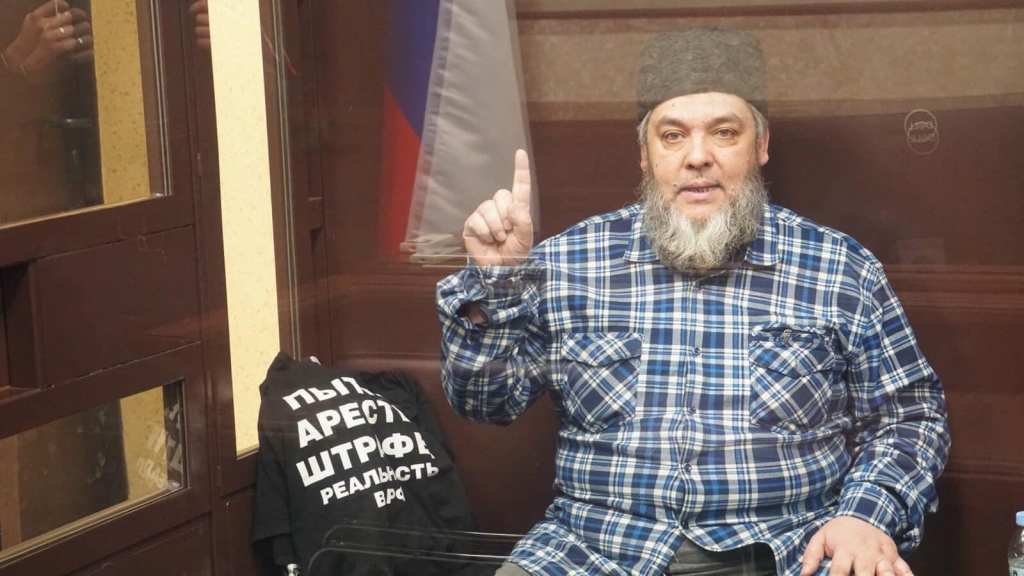
Today, the Southern District Military Court [of Russia] announced the verdict in the trial of Yashar Shikhametov, a Crimean Tatar, a cook from Sevastopol, and a political prisoner. He was charged with membership of the Islamist political party Hizb ut-Tahrir, which has been banned in Russia since 2003. In Ukraine and most countries of the world, however, the organization operates without any restrictions in terms of national legislation.
According to the case file, the accused had no weapons, explosives, or ammunition, did not plan to commit a terrorist act and did not call on others to carry out terrorist acts. There is no evidence that he was planning to overthrow the constitutional order of the Russian Federation and seize power. The case materials contain audio recordings on which religion and politics are discussed. In fact, this was the only evidence presented by investigators, along with the testimony of secret witnesses, which cannot be corroborated.
Shikhametov was was arrested on 17 February 2021, and then spent over a year and a half in a pre-trial detention center, where he suffered from many ailments. In July of the same year, his case was submitted to the military court of Rostov-on-Don. The trial of the case on the merits took place over the course of twenty-four hearings.
On August 14, 2022, Prosecutor Sergei Aidinov asked the court to sentence Shikhametov to eleven years of imprisonment in a maximum security penal colony, with the first four years of the sentence to be served in a closed prison.
The verdict issued by the Russian court today gave the prosecutor exactly what he had asked.
At yesterday’s court hearing, the political prisoner complained of feeling unwell. When the court suggested that he take part in the closing arguments, Shikhametov insisted on the need for a recess.
The court turned down the defense’s request to declare a recess.
Judge Alexei Magomadov deemed Shekhametov’s inability to take part in the closing arguments as a voluntary refusal to testify, despite the fact that the defendant had written a twenty-one-page-long closing statement for the hearing. He also turned down [defense] lawyer Alexei Larin’s request to postpone the hearing.
“Did we have a choice in 2014? I will tell you that it’s all true. Ethnically, we are Crimean Tatars; we are Muslim in terms of religion and culture, and we are citizens of Ukraine. Is this proof of my guilt? We do not hide, we do not hide it, but we declare it directly and everywhere. Is that a crime? But the FSB investigator cooks up this whole [case] with remarks made around the kitchen table, and by tormenting people and intimidating them with searches,” Shikhametov wrote in the [closing statement], which he was unable to deliver in court.
Source: Mumine Saliyeva, Facebook, 9 September. Photo courtesy of Crimean Solidarity. Thanks to Natalia Sivohina for the link. Translated by the Russian Reader
Shikhametov is from Orlinoye on the outskirts of occupied Sevastopol. He earlier appeared as a defence witness in the political trial of Enver Seitosmanov, which may have been the reason that the Russian FSB turned their attention to him. They added him, six years after the earlier arrests in 2015, to Russia’s first conveyor belt ‘trial’ of Crimean Muslims on charges of involvement in Hizb ut-Tahrir. The latter is a peaceful, transnational Muslim organization which is legal in Ukraine, and which is not known to have committed any acts of terrorism anywhere in the world. Russia’s prosecutions, under ‘terrorism’ legislation, are based solely on an extremely secretive Russian Supreme Court ruling from February 2003, which declared the organization ‘terrorist’ without providing any grounds or explanation. Russia is increasingly using these charges as a weapon against Crimean Tatar civic activists and journalists, with men who have committed no recognizable crime being sentenced to up to 20 years’ imprisonment. The charges are a favourite with the FSB and their decision to arrest any particular person is a near 100% guarantee that their victim will be imprisoned and receive a huge sentence.
Shikhametov was charged under Article 205.5 § 2 of Russia’s criminal code with ‘involvement’ in a Hizb ut-Tahrir group. This was seemingly the same fictitious ‘group’ which the FSB claimed that Ruslan Zeytullaev had ‘organized’ (a more serious charge) and that Ferat Saifullaev, Yury Primov and Rustem Vaitov were supposed to have been members of. Russia was still ‘testing the ground’ (and international reaction) in that case and all of the men initially received much lower sentences than required by legislation. The prosecution (or, more likely, the FSB) challenged the sentence against Zeytullaev until they got a 15-year sentence but did not appeal against the other three sentences (more details here). One difference now is that the prosecution almost invariably adds the charge (under Article 278) of trying to overthrow the Russian state. This charge is even more nonsensical, as not one of the men has ever been found to have any weapons, but does enable them to increase the sentence.
Both the earlier ‘trials’ and that against Shikhametov were, as the latter said, based on ‘conversations in the kitchen’ on religious and political subjects. These were sent to FSB-loyal ‘experts’ (from the Kazan Inter-Regional Centre for Analysis and Assessments) who provide the opinion demanded of them.
Russia’s FSB have, however, discovered that such prosecutions do not go to plan, primarily because of committed lawyers who insist on demonstrating the flawed nature of both the charges and the alleged ‘evidence’. Although the convictions remain essentially predetermined, the men’s lawyers, as well as the important Crimean Solidarity human rights initiative, provide important publicity about the shocking methods used to fabricate huge sentences.
Armed and masked enforcement officers burst into Shikhametov’s home on 17 February 2021 and carried out ‘a search’, before taking the father of three away and imprisoning him. As in all such cases, lawyers were illegally prevented from being present. The officers claimed to have found three ‘prohibited religious books’. The books, which did not have any fingerprints on them, were in a cupboard holding coats and shoes which was a place, as Shikhametov himself told the court, that no practising Muslim would hold religious literature.
During one of the hearings, Shikhametov stated that he considered the real criminals to be those who planted ‘prohibited books’ in his home. Typically, the only outcome of this was that Shikhametov himself was removed from the courtroom. Shikhametov has been open in calling those involved in this prosecution and others “accomplices and criminals” and this was not the only time he was removed from the courtroom.
In July 2021, the FSB carried out an armed search and interrogation of Ferat Saifullayev (who had been released after serving his sentence).They threatened “to come back and find prohibited literature” if he did not give false testimony against Yashar Shikhametov. During this interrogation, he was neither informed of his rights, nor told what his status (suspect, witness, etc.) was. Saifullayev signed the document thrust in front of him, but later stated publicly that he had only done so because of the pressure and threats against him. He insisted that this supposed ‘testimony’ should be excluded as having been obtained with infringements of the law and issued a formal complaint to the FSB in Sevastopol, naming senior ‘investigator’ Yury Andreyev.
Prosecutor Sergei Aidinov was never able to explain how Shikhametov, working as a café chef was supposed to have ‘carried out ideological work’ or what such ‘work’ was.
All of this was ignored by presiding judge Alexei Magamadov, together with Kirill Krivtsov and V.Y. Tsybulik who actively took the side of the prosecution. Such bias was seen here, as in all other political trials of Crimean Tatars and other Ukrainians, in the use of ‘secret witnesses’. The only real ‘evidence’ in this ‘trial’ came from people whose identity was not known, and whose supposed testimony could not be verified. In all these trials, the judges invariably disallow questions aimed at demonstrating that the person is lying and that he does not in fact even know the defendant.
Please write to Yashar Shikhametov!
He will almost certainly remain imprisoned in Rostov until his appeal hearing. Letters tell him that he is not forgotten and send an important message to Moscow that their persecution of Crimean Tatars and other Ukrainian political prisoners is under scrutiny.
Letters need to be in Russian, and on ‘safe’ subjects. If that is a problem, use the sample letter below (copying it by hand), perhaps adding a picture or photo. Do add a return address so that the men can answer.
The addresses below can be written in either Russian or in English transcription. The particular addressee’s name and year of birth need to be given.
Sample letter
Привет,
Желаю Вам здоровья, мужества и терпения, надеюсь на скорое освобождение. Простите, что мало пишу – мне трудно писать по-русски, но мы все о Вас помним.
[Hi. I wish you good health, courage and patience and hope that you will soon be released. I’m sorry that this letter is short – it’s hard for me to write in Russian., but you are not forgotten.]
Address
344022, Россия, Ростов-на-Дону, ул. Максима Горького, 219 СИЗО-1
Шихаметову, Яшару Рустемовичу, г.р. 1970
[In English: 344022 Russian Federation, Rostov on the Don, 219 Maxim Gorky St, SIZO-1
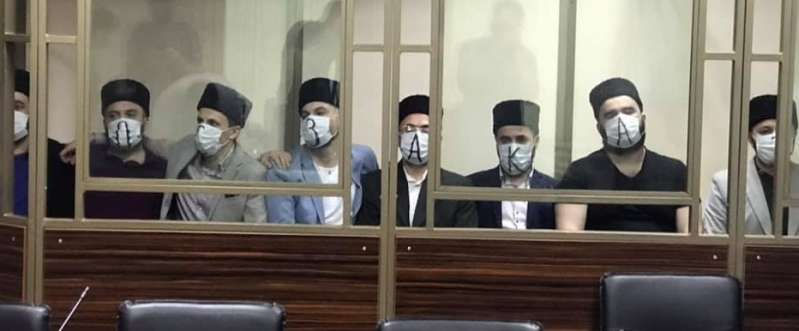
Reading of the sentence on 16.09.2020. The men are each wearing one letter each of the word ГОСЗАКАЗ (“commissioned by the state”). Photo by Crimean Solidarity. Courtesy of khpg.org
Acquittal and monstrous sentences in Russia’s offensive against Crimean Tatar civic journalists & activists Kharkiv Human Rights Protection Group
Halya Coynash
September 17, 2020
In the last decades of the Soviet regime, dissidents received 7-10-year sentences for so-called ‘anti-Soviet agitation and propaganda’. Modern Russia, persecuting Ukrainian citizens on illegally occupied territory for their religious beliefs and political views, is doubling such sentences. Seven Crimean Tatar civic journalists and activists have received sentences of up to 19 years, without any crime. Justice had not been expected from a Russian court, however absurd the charges and flawed the ‘trial’, so the only – wonderful – surprise was the acquittal of Crimean Solidarity civic journalist and photographer Ernes Ametov. If Russia was hoping, in this way, to prove that these are real ‘trials’ before independent courts, there is no chance. All eight men have long been recognized as political prisoners, and all should have been acquitted.
The sentences passed on 16 September by judges Rizvan Zubairov (presiding); Roman Saprunov; and Maxim Nikitin from the Southern District Military Court in Rostov (Russia) were all lower than those demanded by the prosecutor Yevgeny Kolpikov, but still shocking.
Crimean Solidarity civic journalist Marlen (Suleyman) Asanov: 19 years
Crimean Solidarity activist Memet Belyalov: 18 years and 18 months restriction of liberty
Crimean Solidarity civic journalist Timur Ibragimov: 17 years and 18 months restriction of liberty
Crimean Solidarity Coordinator and journalist Server Mustafayev: 14 years and 1 year restriction of liberty
Crimean Solidarity civic journalist Seiran Saliyev: 16 years and 1 year restriction of liberty
Edem Smailov (the leader of a religious community): 13 years and 1 year restriction of liberty
Crimean Solidarity volunteer Server Zekiryaev: 13 years
In Soviet times, dissidents received a term of imprisonment, then one of exile. Now they add ‘restriction of liberty’ (ban on going outside Crimea and attending events, as well as having to register with the police). In all of the above cases, the sentences are for maximum security prison colonies, although not one of the men was even accused of an actual crime. They are also sentences that Russia, as occupying state, is prohibited by international law from imposing.
The armed searches and arrests of the men in October 2017 and May 2018 were the first major offensive against Crimean Solidarity. This important civic organization arose in April 2016 in response to the mounting persecution of Crimean Tatars and other Ukrainians in occupied Crimea. The initiative not only helped political prisoners and their families, but also ensured that information was streamed onto the Internet and in other ways circulated about armed searches, arrests, disappearances and other forms of repression. Given Russia’s crushing of independent media in occupied Crimea, the work that Crimean Solidarity activists and journalists do is absolutely invaluable. It has, however, subjected them to constant harassment, including administrative prosecutions, and, when that has not stopped them, to trumped-up criminal charges.
The charges
The men were essentially accused only of ‘involvement’ in Hizb ut-Tahrir, a peaceful Muslim organization which is legal in Ukraine. In declaring all Ukrainian Muslims arrested on such charges to be political prisoners, the renowned Memorial Human Rights Centre has repeatedly pointed out that Russia is in breach of international law by applying its own legislation on occupied territory. It has, however, also noted that Russia is the only country in the world to have called Hizb ut-Tahrir ‘terrorist’ and the Russian Supreme Court did so in 2003 at a hearing which was deliberately kept secret until it was too late to lodge an appeal.
In occupied Crimea, the Russian FSB are increasingly using such prosecutions as a weapon against civic activists and journalists, particularly from Crimean Solidarity.
Initially, the FSB designated only Asanov as ‘organizer of a Hizb ut-Tahrir group’ under Article 205.5 § 1 of Russia’s criminal code. The other men were all charged with ‘involvement in such an alleged ‘group’ (Article 205.5 § 2). Then suddenly in February 2019 it was announced that Belyalov and Ibragimov were now also facing the ‘organizer’ charge. The essentially meaningless distinction is reflected in the sentences passed on 16 September, with the difference in sentence between Timur Ibragimov as supposed ‘organizer’ only one year longer than that passed on fellow civic journalist, Seiran Saliyev (accused of being a member of the so-called Hizb ut-Tahrir cell).
All eight men were also charged (under Article 278) with ‘planning to violently seize power’. This new charge also appeared only in February 2019, with no attempt ever made to explain how the men were planning such a ‘violent seizure’. The charge only highlights the shocking cynicism of any such ‘terrorism’ charges when the only things ‘found’ when armed searches were carried out of the men’s homes were books (not even Hizb ut-Tahrir books), no weapons, no evidence of plans to commit violence. Russian prosecutors simply claim that this follows from Hizb ut-Tahrir ideology. Memorial HRC notes that the extra charge is often laid where political prisoners refuse to ‘cooperate with the investigators’. Since all the Crimean Muslims prosecuted in these cases have stated that they are political prisoners and have refused to ‘cooperate’, the extra charge is becoming standard.
‘Evidence’
The prosecution’s case was based on the testimony of Nikolai Artykbayev, a Ukrainian turncoat, now working for the Russian FSB; two secret witnesses whose identity and motives for testifying are known, and the ‘expert assessments’ of three people with no expert knowledge of the subject.
Russia is now using so-called ‘secret witnesses’ in all politically-motivated trials of Crimeans and other Ukrainians. No good reason is ever provided for concealing the alleged witnesses’ identity, and the bad reason can easily be seen in this case where their identity was understood. Konstantin Tumarevich (who used the pseudonym ‘Remzi Ismailov’) is a Latvian citizen and fugitive from justice who could not risk being sent back to Latvia after his passport expired. It is likely that the FSB realized this back in May 2016 and have used his vulnerable position as blackmail, getting him to testify both in the earlier trial of four Crimean Tatars from Bakhchysarai, and now in this case.
There is a similar situation with Narzulayev Salakhutdin (whose testimony was under the name ‘Ivan Bekirov’). He is from Uzbekistan and does not have legal documents.
These men gave testimony that in many places was demonstrably false, yet ‘Judge’ Zubairov constantly blocked attempts by the defendants and their lawyers to ask questions demonstrating that the men were telling lies.
As mentioned, the main ‘material evidence’ was in the form of three illicitly taped conversations in a Crimean mosque. These were supposedly understood to be ‘incriminating’ by Artykbayev, although the latter does not know Crimean Tatar (or Arabic) [or] who transcribed them. That transcript, of highly questionable accuracy, was then sent to three supposed ‘experts’: Yulia Fomina and Yelena Khazimulina, and Timur Zakhirovich Urazumetov. Without any professional competence to back their assessments, all of the three ‘found’ what the FSB was looking for.
While the judges also lack such professional competence, they did hear the testimony of Dr Yelena Novozhilova, an independent and experienced forensic linguist, who gave an absolutely damning assessment of the linguistic analysis produced by Fomina and Khazimulina.
This was only one of the many pieces of testimony that the court ignored. Zubairov actually refused to allow a number of defence witnesses to appear and used punitive measures against the defendants and their lawyers.
All such infringements of the men’s rights will be raised at appeal level, although this will also be before a Russian court, with the charges of justice being minimal.
PLEASE WRITE TO THE MEN!
They are likely to be imprisoned at the addresses below until the appeal hearing and letters tell them they are not forgotten, and show Moscow that the ‘trial’ now underway is being followed.
Letters need to be in Russian, and on ‘safe’ subjects. If that is a problem, use the sample letter below (copying it by hand), perhaps adding a picture or photo. Do add a return address so that the men can answer.
Sample letter
Привет,
Желаю Вам здоровья, мужества и терпения, надеюсь на скорое освобождение. Простите, что мало пишу – мне трудно писать по-русски, но мы все о Вас помним.
[Hi. I wish you good health, courage and patience and hope that you will soon be released. I’m sorry that this letter is short – it’s hard for me to write in Russian., but you are not forgotten.]
Addresses
Marlen Asanov
344010, Россия, Ростов-на-Дону, ул. Максима Горького, 219 СИЗО-1.
Асанову, Марлену Рифатовичу, 1977 г. р
[In English: 344010 Russian Federation, Rostov on the Don, 219 Maxim Gorky St, SIZO-1
Asanov, Marlen Rifatovich, b. 1977]
Memet Belyalov
344010, Россия, Ростов-на-Дону, ул. Максима Горького, 219 СИЗО-1.
Белялову, Мемету Решатовичу, 1989 г.р.
[In English: 344010 Russian Federation, Rostov on the Don, 219 Maxim Gorky St, SIZO-1
Belyalov, Memet Reshatovich, b. 1989]
Timur Ibragimov
344010, Россия, Ростов-на-Дону, ул. Максима Горького, 219 СИЗО-1.
Ибрагимову, Тимуру Изетовичу, 1985 г.р.
[In English: 344010 Russian Federation, Rostov on the Don, 219 Maxim Gorky St, SIZO-1
Ibragimov, Timur Izetovich, b. 1985]
Server Mustafayev
344010, Россия, Ростов-на-Дону, ул. Максима Горького, 219 СИЗО-1.
Мустафаеву, Серверу Рустемовичу, 1986 г.р.
[In English: 344010 Russian Federation, Rostov on the Don, 219 Maxim Gorky St, SIZO-1
Mustafayev, Server Rustemovich, b. 1986]
Seiran Saliyev
344010, Россия, Ростов-на-Дону, ул. Максима Горького, 219 СИЗО-1.
Салиеву, Сейрану Алимовичу, 1985 г.р.
[In English: 344010 Russian Federation, Rostov on the Don, 219 Maxim Gorky St, SIZO-1
Saliyev, Seiran Alimovich, b. 1985]
Edem Smailov
344010, Россия, Ростов-на-Дону, ул. Максима Горького, 219 СИЗО-1.
Смаилову, Эдему Назимовичу, 1968 г.р.
[In English: 344010 Russian Federation, Rostov on the Don, 219 Maxim Gorky St, SIZO-1
Smailov, Edem Nazimovich, b. 1968]
Server Zekiryaev
344010, Россия, Ростов-на-Дону, ул. Максима Горького, 219 СИЗО-1.
Зекирьяеву, Серверу Зекиевичу, 1973 г.р.
[In English: 344010 Russian Federation, Rostov on the Don, 219 Maxim Gorky St, SIZO-1
Zekiryaev, Server Zekievich, b. 1973]
Thanks to Comrades SP and RA for the heads-up. The text has been very lightly edited for readability. || TRR
It is known that four people have been detained. Eldar Kantimirov was taken from the village of Zarechnoye in an unknown direction. According to activists, he was charged with organizing a terrorist organization or involvement in one (Russian Criminal Code Article 205.2). The particulars of the case, like Kantimirov’s whereabouts and his official status in the case, are still unknown. They may have to do with the religious organization Hizb ut-Tahrir, which has been declared a terrorist organization in Russia.
Riza Omerov, who lives in Belogorsk, was taken to FSB headquarters. His sister is married to Rustem Ismailov, a defendant in the Simferopol Hizb ut-Tahrir trial. Omerov has three children. His wife, who is seven months pregnant, has now gone into premature labor.
Ayder Jepparov was detained in the village of Zuya in the Belogorsk District. He was also taken to FSB headquarters.
Eskender Suleymanov was detained in Stroganovka, a village in the Simferopol District. He is the brother of Ruslan Suleymanov, a defendant in the Hizb ut-Tahrir trial. The activist was taken to FSB headquarters in Simferopol.
The homes of Ruslan Mesutov, in the village of Maly Mayak, and Lenur Halilov, chair of the religious community in the village of Izobilnoye, both located in the Alushta District, were also searched.
UPDATE. Ruslan Mesutov has been detained. Like Eldar Kantimirov, he has been accused of involvement in a terrorist organization (Russian Criminal Code Article 205.5 Part 2).
Lenur Halilov has been accused of organizing terrorist activities (Russian Criminal Code 205.5 Part 1).
Ayder Jepparov, Riza Omerov, and Eskender Suleymanov remain in police custody. It is still not known whether they have been charged as part of the criminal case.
A search has also been underway in the home of Enver Omerov, Riza Omerov’s father. FSB officers stopped his car and detained him during the night. OVD Info has been unable to ascertain whether the security forces have released him.
FSB investigator Sergei Makhnev, who has been involved in the case of the second Simferopol Hizb ut-Tahrir group, led the search. Makhnev has already stated Suleymanov’s case would be incorporated into this case.
UPDATE 2. Crimean Solidarity has reported that Riza Omerov, Enver Omerov, Ayder Jepparov, and Eskender Suleymanov were remanded in custody until August 5.
Russia has declared Hizb ut-Tahrir a terrorist organization. Its members have been charged and sentenced to long terms in prison only for gathering at people’s homes, reading religious books, and recruiting new members.
According to numerous experts, Hizb ut-Tahrir was wrongly declared a terrorist organization since its members in Russia have never advocated violence or been involved in terrorist attacks.
_________________________________________________
Rostov: Prosecutors Ask Court to Sentence Simferopol Hizb ut-Tahrir Trial Defendants to 17 Years in Prison Krym.Realii
June 10, 2019
Our correspondent reports the prosecution in the first Simferopol Hizb Ut-Tahrir trial has asked the North Caucasus Military District Court in Rostov-on-Don to sentence the defendants to long terms in prison camps.
The prosecutor asked that Teimur Abdullayev be sentenced to 17 years, Rustem Ismailov, to 13 years, Uzeir Abdullayev and Ayder Saledinov, to 12 years, and Emil Jemadenov, to 12 years.
On October 12, 2016, five homes in Crimea were searched by police and security services. Consequently, the five men currently on trial in Rostov-on-Don were detained and charged with involvement in Hizb ut-Tahrir, an organization that was banned in Russia and Crimea, which Russia occupied in 2014.
On December 6, 2018, it transpired the five men had been transferred to a remand prison in the Russian city of Rostov-on-Don.
On February 19, 2019, a secret witness was interrogated during a hearing of the Simferopol Hizb ut-Tahrir case by the North Caucasus Military Court in Rostov-on-Don.
Hizb ut-Tahrir, an international Islamic political organization, says its mission is to unite all Muslim countries in an Islamic caliphate, but it rejects terrorism as a means of attaining their goal. They claim they have been unjustly persecuted in Russia and Crimea, which was occupied by Russia in 2014.
The Russian Supreme Court banned Hizb ut-Tahrir in 2003, placing it on a list of organizations deemed “terrorist.”
Defenders of the Crimeans convicted and arrested in the Hizb ut-Tahrir case argue they have been persecuted on religious grounds. Lawyers note that, while it has mainly been Crimean Tatars who have been persecuted by Russian law enforcement as part of the case, Ukrainian, Russians, Tajiks, Azeris, and non-Tatar Crimeans who practice Islam have also been persecuted.
International law forbids an occupying power from enforcing its own laws in occupied territory.




 The defendants in the Simferopol Hizb ut-Tahrir trial in Rostov-on-Don. Photo courtesy of Crimean Solidarity and Krym.Realii