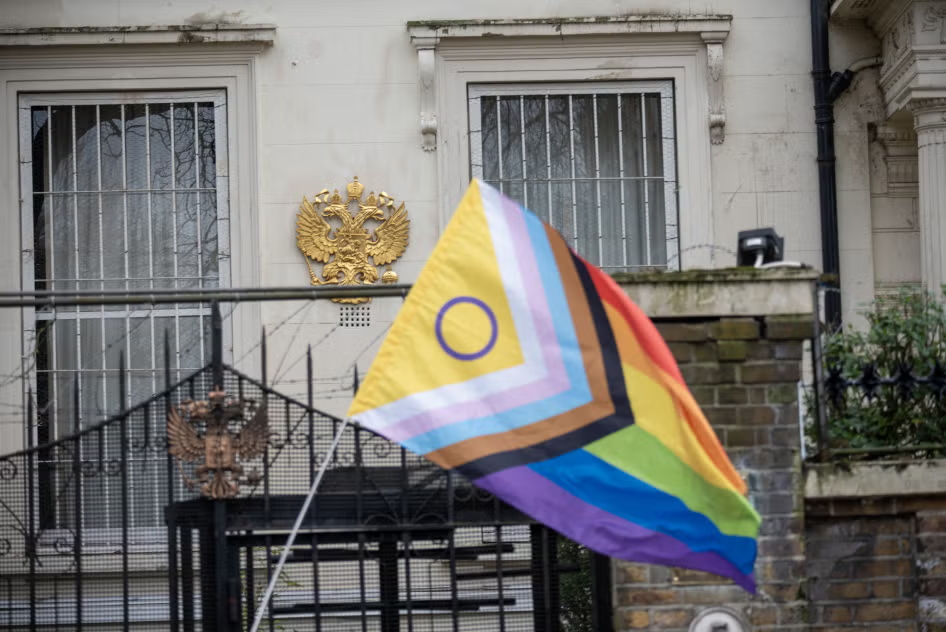
Russian authorities have banned nine groups that provide support to lesbian, gay, bisexual, and transgender (LGBT) people as “extremist,” Human Rights Watch said today. The apparent aim is to further suppress, stigmatize, and criminalize those who document abuses, share information, and provide legal, medical, and other assistance to Russia’s LGBT population.
Following the 2023 Russian Supreme Court decision to outlaw as “extremist” the “International LGBT Movement”—a legal and factual mischaracterization of a diverse, decentralized global human rights cause—the authorities have targeted numerous civil society organizations. Between March and May 2026, courts banned nine LGBT groups in seven Russian regions as “extremist,” namely Coming Out, LGBT Resource Centre, Parni Plus, Moscow Community Center for LGBT+ Initiatives, Irida, Russian LGBT Network, Kallisto movement, T9 NSK, and Centre T. A lawsuit against Alliance of Straights and LGBT for Equality is pending.
“Russian authorities are intensifying their criminalization of those who provide critical support to the very LGBT people they have systematically persecuted,” said Hugh Williamson, Europe and Central Asia director at Human Rights Watch. “Authorities should vacate all court decisions and criminal convictions based on these spurious ‘extremism’ charges.”
On April 22, a court in Orel banned Parni Plus, an LGBT media outlet. The court based its decision largely on an “expert assessment” by the Nizhny Novgorod Academy of the Internal Affairs Ministry, effectively a law enforcement university. It found that Parni Plus “belittled Russian spiritual values and showed contempt for Russian President Vladimir Putin,” criticized Russian laws, and attempted to create “an alternative, anti-state hierarchy of values.” Parni Plus said the authorities were “trying to label the visibility, voice and experiences of the LGBTQ community as ‘extremism’” and said it would continue its work.
A similar report formed the basis for the Moscow city court ruling banning the Moscow Community Center for LGBT+ Initiatives on April 23. The center said it “cannot ignore the fact that queer people have not ceased to exist and require support.” The group also said it would continue its advocacy and providing psychological, legal, and other support.
Centre T called the May 4 decision by the Moscow city court to ban the organization “unfounded and repressive.” The group pledged to continue its work to provide support and information for transgender and nonbinary people.
On March 3, the Saint Petersburg city court banned Coming Out, a prominent LGBT support group, as “extremist.” The group said the authorities have been expanding the definition of extremism to criminalize “virtually any independent activity, any dissent, or any act of solidarity to isolate, intimidate, and silence those who speak about issues and support vulnerable people.” Coming Out said it would continue its work to resist the state’s efforts “to make LGBT+ people unseen and unheard.”
Russian LGBT Network, which the Saint Petersburg city court on April 27 also banned as “extremist,” said the court’s judgment had “nothing to do with justice,” and that its activities essentially consisted of supporting the LGBT community, documenting discrimination, protecting rights, and discussing the situation of queer people in Russia. It also said it would continue its work.
On April 7, the Sverdlovsk Region court outlawed the LGBT Resource Centre. The court said the center engaged in “propaganda” and that its activities contradicted Russia’s state policy. On April 29, the Yaroslavl Region court banned Kallisto as “extremist,” claiming the movement aimed to “reshape and effectively destroy Russia’s fundamental spiritual and moral values, in particular traditional family values.”
On May 19, a court in Novosibirsk used the same reasoning to ban T9 NSK, an initiative that supported transgender people and their friends and family. The group shut down its website and social media accounts. In May, the Saint Petersburg city court registered the Justice Ministry’s lawsuit to ban the Alliance of Straights and LGBT for Equality as “extremist.” The group said it would continue working to provide support, security, overcome isolation and censorship, and focus on education and outreach. This was the last known case to be tried, in closed proceedings.
Under article 282.2 of Russia’s criminal code, participation in organizations banned as “extremist” carries penalties of up to 6 years in prison, while leading such an organization carries up to 12 years. Donations to such organizations are punishable with up to 8 years in prison under article 282.3, and repeated displays of “extremist” symbols, such as the rainbow flag or banned organizations’ logos, up to 4 years under article 282.4.
On March 6, a court in Samara convicted Artyom Fokin, the leader of Irida, a local LGBT community organization, on charges of leading an “extremist” organization and repeated violation of the country’s repressive “foreign agents” legislation and fined him 450,000 rubles (US$6,000). A Samara court subsequently banned the group on April 24.
Human Rights Watch monitoring has found that at least nine people had been convicted on criminal charges based on the “extremist” designation of the “International LGBT Movement,” including for allegedly leading organizations supposedly belonging to this movement, sharing content, organizing drag shows, conducting activism, or supporting same-sex dating. At least 25 others are facing criminal charges.
In 2023, the United Nations high commissioner for human rights, Volker Türk, condemned the Russian Supreme Court’s “LGBT-extremism” ruling. Independent UN human rights experts warned that the designation enables arbitrary and abusive application of the law and jeopardizes a wide range of activities protected under international human rights law.
“The Russian government’s banning of LGBT rights organizations is absurd, harmful, and discriminatory,” Williamson said. “Rights-respecting governments should support Russian LGBT groups and activists, including by enabling them to continue their work from abroad.”
Source: “Russia: LGBT Rights Groups Further Criminalized,” Human Rights Watch, 28 May 2026
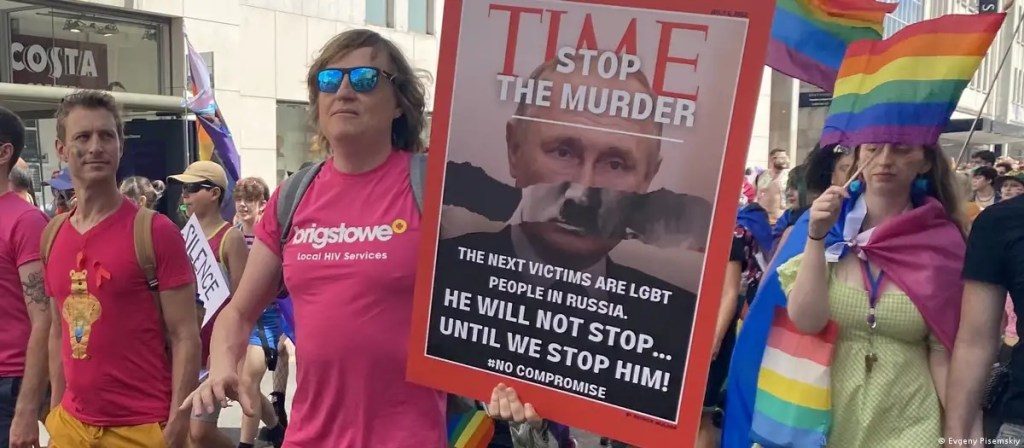
It has been nearly three years since the nonexistent “International LGBT Movement” was declared an “extremist” organization by the Russian Supreme Court, per its 30 November 2023 ruling. The decision unleashed a crackdown resulting in over one hundred convictions on charges of “LGBT propaganda.” Russian police have detained people at clubs and private parties, and queers have been remanded in custody and fined several thousands of rubles. Numerous LGBTQ+ organizations have been targeted, and many of them have been declared “extremist” as well, although they provided medical and legal assistance, hosted cultural events, and reported on the queer community via social media. Deutsche Welle spoke with members of these organizations about how they continue to operate in Russia and render assistance to people despite all the obstacles.
“The greater the pressure has been, the more attention we’ve paid to the LGBT movement”
Parni Plus, which has been around for eighteen years, is the principal Russian-language queer news website, and it has been closely linked to Phoenix Plus, an NGO that was founded two years earlier. Phoenix Plus focused on raising awareness, promoting free testing, and supporting HIV-positive people. Phoenix Plus’s chair, the cisgender male Evgeny Pisemsky, had also worked as a volunteer at the public awareness center Info Plus. Since Info Plus provided little specific information for HIV-positive gays, the idea arose to launch the site Parni Plus.
“Originally, running the site was my hobby, but at one point I realized it was a great way of reaching a bigger audience,” Pisemky, who became the website’s editor-in-chief, told DW.
Parni Plus has transformed along with the changing political climate in Russia. After the Russian State Duma passed a law banning “promoting LGBT to minors,” the site started publishing articles about the LGBTQ+ movement’s fight for its rights.
“The greater the pressure has been, the more attention we’ve paid to the LGBT movement,” Pisemsky explained to DW.
At one time, the media project tried to “navigate” the legal obstacles while also publishing articles criticizing the authorities for ignoring HIV prevention. This resulted in numerous instances when the authorities blocked the website.
“Our lawyer and I would send off complaints to Roskomnadzor [the Russian media watchdog] along the lines of ‘Where did you find that?’ and they would unblock us every time,” said Pisemsky.
When Phoenix Plus was declared a “foreign agent,” in 2020, Pisemsky had to shut it down in order to safeguard Parni Plus. But its consciousness-raising and activism continued, as Pisemsky consistently helped people get online HIV consultations from anywhere in Russia. The covid-19 lockdowns and Russia’s subsequent full-scale invasion of Ukraine did not put a stop to the organization’s work either: its team was ready to assist anyone and everyone remotely.
The team made the decision to reject the “18+” warning label it had been obliged to post on the website. In June 2023, they wrote that information about sexuality and sexually transmitted diseases were particularly vital to children and adolescents.
“[W]e are sick and tired of turning our back on queer children and teenagers. They are the most vulnerable segment of our communities, which are in particular need of support nowadays. We are not only freeing them from the need to lie when accessing the site. We [also] plan to publish many more articles just for minors,” they wrote.
After the LGBTQ movement was declared “extremist” in Russia, the Parni Plus team was forced to flee the country.
“We became ‘foreign agents’ twice: first as Phoenix Plus, and then as Parni Plus. Practically all our reporters were also declared ‘foreign agents’, and we racked up over twenty fines, totaling two million rubles,” Pisemsky recounted.
He argues that remaining open matters most of all.
“The ‘extremist’ label makes you worry about family members, and the authorities have been trying to erase us, but we have been surviving against the odds. It is vital to LGBTQ+ people that [our] organizations remain visible,” said Pisemsky.
80% of transgender people in Russia want to leave
Centre T is an organization specializing in assistance to trans people. It emerged in 2020 from a therapy group run by Yan Dvorkin, who is non-binary, and his colleague.
“We didn’t plan on founding a special organization. We were just psychologists who did sessions for trans people. But we quickly realized that our clients had a huge number of unmet needs in different areas, and that there was nowhere in Moscow for them to turn. There was nowhere to refer people for medical care or for meeting people and relaxing,” Yan explained.
That was how Centre T came into being. Its first project was called “Plush Toy Cat”—monthly tea parties featuring board games and dancing. These events took place for several years and, according to Dvorkin, would draw as many as 150 people.
“People from the regions would even come to hang out with other transgender people. It was an unbelievably positive experience: the participants found friends, partners, and future roommates at the get-togethers.”
Centre T gradually expanded. Its staff began providing consultations on emigration and means of obtaining medical care. They engaged in public education and community building, opened a shelter in Moscow, and set up regional associations.
After Russia’s full-scale invasion of Ukraine, the Centre T team immediately sensed that negative changes were afoot in Russian society. According to Dvorkin, the active persecution of trans people in Russia kicked off precisely after February 2022, culminating in the 2023 law banning “sex change” (the correct term is “gender transition”).
“We worked with a medical board based at a clinic, and its physicians treated transgender people with respect. They issued diagnoses of ‘transsexualism’—a classification that enabled individuals to start redoing their identification papers and getting ready for surgeries. The passage of the law banning gender transition changed everything. We had fought against its adoption, and it was largely for this reason that our organization was designated a ‘foreign agent’ in 2023,” he said.
Dvorkin has no regrets that Centre T put up such a fierce fight. The team received many words of support in return.
Centre T staff members attended court hearings of cases involving LGBT individuals. Members of ultra-right gangs would occasionally attack them at the entrance to the courthouse.
Dvorkin described how the Centre T team coped with tough times.
“One time they attacked us with pepper spray and a child passing by got caught in the crossfire. His mother came to our defense and went with us to the police station. But our arguments about dangerous radicalization or the literal example of who was actually harming children fell on deaf ears in court. After losing such cases we would go to my place to ‘celebrate’ by eating a cake baked in advance and singing along to a guitar,” he recounted.
After the “LGBT movement” was ruled “extremist,” it became much harder for Centre T to operate, as many organizations voided their cooperation agreements with them, and they had to cancel in-person events. The situation in Russia changed drastically, and Centre T began moving its staff members abroad; many of them had been charged with violating the anti-LGBT “propaganda” law. Centre T also made the decision to close its Moscow shelter, which had attracted unwanted attention.
“This dude tried to kick down the door. We called the police. Our people saw through the window that he went outside, shook the policeman’s hand, and they went their separate ways,” recounted Dvorkin.
Currently, Centre T continues to operate online: it helps people access medical care and responds to crisis calls, providing support not only to trans people and their families but also to professionals at various levels. Centre T has also been providing more robust counseling on emigration matters.
“It has become clear that transgender people can no longer live a normal life in Russia. Eighty percent of transgender people in Russia want to leave and are looking for a way to do so,” concluded Dvorkin.
Although he sees Centre T’s new status as an “extremist organization” as dangerous, he has no plans to go into hiding.
“If I’m detained and extradited, then that’s life,” he said.
The MCC has gone underground
Unlike the majority of LGBTQ+ organizations, the Moscow Community Center for LGBT+ Initiatives (MCC) is still engaged in offline work in Russia and make it their emphasis. The MCC was formed in 2015 and conceived as a place where people could drop in, feel safe, and have a good time by reading books, drinking coffee, attending themed events, and meeting new eople. In 2019 it was transformed into a co-working café.
“We wanted casual passersby to be able to walk into our café, see the special ‘signs,’ and immediately realize they were in an LGBT space,” notes Olga Baranova, the MCC’s non-binary president.
Another of the MCC’s big projects is the queer festival OpenArt. Launched in 2017, it still takes place, under wraps, in Russia. Although it is hard to imagine now, the festival’s first edition was even guarded by police officers.
“An FSB officer arrived and asked what was going on. I told him to come in and have a look. He was afraid of possible riots and that skinheads would go after the festival attendees on the dark streets and beat them up. So we were assigned a police patrol. The provocateurs showed up at the doors, of course, but our guards kept everyone safe. No one inside noticed a thing,” Baranova recounts.
Despite the law against “gay propaganda” among children, the MCC managed to navigate the obstacles and and engage with a young audience: in 2022, for example, the festival was held in a two-story venue, with a 16+ area on the first floor. Nevertheless, it wasn’t without its challenges.
“Center ‘E’ officers [the Russian Interior Ministry’s anti-“extremism” police] came and talked with me. They asked me to shut everything down. Ultimately, though, the festival was a huge success,” Baranova recalls.
When the “International LGBT Movement” was declared “extremist” by the Russian authorities, the MCC went underground. The organization is now focused on emergency assistance, whether that means moving people abroad or getting them into a shelter.
“It’s important to remember that we cannot help everyone because we simply don’t have the resources,” Baranova points out. “If the police are pounding on your door, if you’re up against a tough situation in life, then you definitely should write to us and submit a request.”
Otherwise, the MCC continues to hold events on important topics, and their goal is to ensure that people do not end up being isolated.
“We see what are our beneficiaries need and every three to six months we change the focus of our meetings,” notes Baranova. “For example, right now many of them are looking for jobs.”
The community center wanders among various venues, and Baranova regrets the constant need to move from place to place. “In your own home you can put your favorite pillow on the bed and your favorite glass on the table. These are the things that create a sense of home, not bare walls,” she complains.
Members of the Russian LGBTQ community are persecuted for their identity
Eighteen years ago, a small community center called Coming Out opened in St. Petersburg. Since then, it has grown into one of Russia’s leading LGBTQ+ rights organizations. Coming Out also provided free psychological counseling and ran in-person solidarity groups, but its primary activities were legal support and consultations.
Thanks to Coming Out, there is an archive of accounts of discrimination against queer people in Russia.
“Long before 2022, we gatherd accounts of discrimination against queer people by law enforcement, of workplace and domestic discrimination, and of discrimination at medical and educational institutions. We analyzed the messages transmitted by the state propaganda machine and corroborated the existence of worrying trends with the numbers. We annually presented the outcomes of our work to Russian and international officials,” Denis Oleinik, a cisgender man and Coming Out’s executive director, explained to DW.
Coming Out was designated a “foreign agent” by the Russian authorities in December 2021. A few months later, realizing they could no longer work in Russia because they could not guarantee their own safety, the organization’s staff gradually fled Russia and moved its entire operations online. When Coming Out was declared an “extremist” organization, in March 2026, all of its staff members were ready for this turn of events, according to Oleinik.
“Over the past four years, we’ve learned to do everything remotely, put together a secure volunteer system, and set up systems for gathering and storing information that are as anonymous as possible. It’s really important to us that the beneficiaries of our assistance are safe and that the help we provide doesn’t harm them. To date, there have been no cases of people being persecuted for receiving support or assistance,” he explained.
Oleinik wants anti-queer discrimination to disappear in the future, but Coming Out’s research paints a completely different picture.
“In 2025, members of Russia’s LGBTQ community were subjected to persecution and discrimination not only for things they said or wrote but also for their very identity. Thus, in 2025, posting personal photos featuring kissing, publishing a blog about the lives of a same-sex couple, and organizing meetings in one’s own home were classified as ‘propaganda’ and ‘extremism,'” its report says.
This means that Oleinik and his colleagues have their work cut out for them.
Source: Dima Yelagin, “How ‘the boys’ became a threat to Russia,” Deutsche Welle Russian Service, 16 June 2026. Translated by the Russian Reader
Kolya* says they would not dare to go to a state health-care facility for the therapy they are receiving for a mental health condition. The 19-year-old from a city in Russia’s far-east, who identifies as non-binary and gay, tells The Lancet they fear that information about their sexuality could be passed on to other state institutions and used against them in some way. “I wouldn’t have told the mental health specialist treating me about my sexuality if they weren’t a private doctor. I wouldn’t tell the municipal clinic, I wouldn’t want them to have that kind of information about me in case they passed it on somewhere”, they say.
Kolya chose a private clinic because, like many in the LGBTQ+ community, they perceive them to be less likely to divulge their gender identity or sexuality to others, and less likely to be discriminatory. Kolya’s distrust of the Russian health-care system, and their avoidance of it, is becoming increasingly common among the heavily marginalised LGBTQ+ community, according to one of the largest surveys of how LGBTQ+ people are living in Russia, released in May.
The survey of more than 6000 people in Russia by the Coming Out and Sphere Foundation organisations showed a significant rise in the number of LGBTQ+ people avoiding seeing a doctor for fear of discrimination or biased treatment last year, reaching 35%.
Many of the respondents who reported discrimination said they had faced inappropriate comments, jokes, or offensive remarks from medical professionals, as well as experiencing reproductive coercion. Others specifically mentioned issues that arose when seeking help from psychologists and psychotherapists. In such cases, respondents reported instances of outing and breaches of confidentiality, including the disclosure of information about sexuality or gender identity without their consent.
The report’s authors say LGBTQ+ people, and especially transgender people, are losing access to medical services due to this distrust. “In our latest survey we saw a 6 percentage point year-on-year rise in people avoiding seeing a doctor. Historically, annual increases for this indicator have been in the range of 1–2 percentage points. A 6-point rise represents a marked departure from that trend—that’s why it is significant”, Denis Oleinik, Executive Director of Coming Out, told The Lancet.
“If this rate of increase were to continue at the same pace annually, within 5 years a substantially larger proportion of LGBTQ+ people would be avoiding medical care, with serious consequences for both individual health outcomes and broader public health. The 6-point rise may not sound dramatic in isolation, but viewed against the historical baseline and the potential trajectory it represents a genuinely concerning shift”, he added.
Over the past decade, a series of repressive anti-LGBTQ+ laws have been passed in Russia, including bans on any public information or activities supporting LGBTQ+ rights or displaying non-heterosexual orientation, on same-sex marriage, and on transgender people officially or medically changing their gender. A 2023 ruling by the Supreme Court also banned the international LGBT movement, declaring it extremist, allowing people to be fined or prosecuted for anything that could be construed as promoting “non-traditional sexual relations”.
In previous years, authorities have used these tools to crack down on groups and activists taking action to support LGBTQ+ rights, but now they are increasingly being used against individuals, with prosecutions even for displaying or wearing rainbow-coloured materials. “The persecution has moved to people being targeted not for something they have done, but just for being LGBTQ+,” said Oleinik. This in turn has made many in the community concerned about going anywhere, including health-care facilities, where their gender identity or sexual orientation could be identified and possibly disclosed.
Vitaly Djuma, Executive Director at the Eurasian Coalition on Health, Rights, Gender and Sexual Diversity told The Lancet that, in many cases, an LGBTQ+ person with a particular complaint that could be linked to non-heterosexual sexual behaviour would “not give up that kind of intimate information unless they really trusted the doctor, especially if they thought it could lead to disclosure [of their sexual orientation]”. Instead, he said, they would be forced to go to a private clinic, if they could afford it, or risk seeking treatment within state health care. “They would have to just try and deny the complaint is any indication of their sexuality”, he added.
Groups providing harm reduction services in Russia say that LGBTQ+ people are accessing their services, which they can legally provide to other key populations, to resolve health issues. “The LGBTQ+ community is increasingly reaching out to us in a more discreet way, sometimes through third parties. People are afraid to disclose that they are LGBTQ+”, a worker at a non-governmental organisation in a major Russian city, speaking on condition of anonymity, told The Lancet.
The situation is especially difficult for transgender people, who, the survey shows, are more likely to face discrimination in health care, and more likely to avoid going to a doctor, than other members of the LGBTQ+ community. Oleinik said there were “few cases where doctors or clinics outright rejected providing services to someone just because they were gay or lesbian, but for trans people, it’s much worse”.
He added that there had also been cases of transgender people who, with medical changing of gender banned, turned to the black market to get the medicines they needed to transition, administered them unsupervised, and subsequently became ill.
Lucy Shtein of the North Caucasus SOS crisis group, which evacuates persecuted LGBTQ+ people from Russia, pointed out that following the ban, transgender people had become even more vulnerable as a group. “After the ban on gender transition, access to medical care became even more restricted for them”, she told The Lancet.
Furthermore, anti-LGBTQ+ legislation has forced groups which provided health services for members of the community, such as harm reduction, prevention of sexually transmitted infections, or psychosocial help, to either close down or leave the country, cutting off another line of access to health care for people who do not trust state medical services. Experts say it is difficult to determine what effect this avoidance of, and inability to access, health care, is having on health among the LGBTQ+ community in Russia.
Data for some common health indicators in the community, such as numbers of HIV/AIDS cases and other sexually transmitted infections, as well as depression and other mental health conditions, are not always available or lack relevant detail. Although there are official figures for the number of people currently living with HIV and new infections, specific data on epidemiological trends among key populations is either not publicly available or, according to experts, not reliable.
Routes of transmission—according to some reports most new infections are now transmitted through heterosexual contact—are determined through self-reporting, while historical data have shown the proportion of overall HIV testing carried out among key populations is decreasing year on year.
This makes it very difficult to get an accurate picture of the epidemiological situation for the disease among the community, which could indicate potential wider consequences of individuals avoiding health care.
“Data for transmission routes is unreliable with the use of self-reporting and a large amount of unidentified transmissions. The HIV epidemic is absolutely still ongoing among men who have sex with men and other members of the LGBTQ+ community, especially in big cities where the practice of chemsex is burgeoning”, Djuma said.
Oleinik added that systematic research on LGBTQ+ people has become essentially impossible as researchers, non-governmental organisations, and public health professionals cannot gather such data without risking being associated with extremist activity. “If anything does exist in official sources, it tends to appear exclusively in negative framing—for example, linking same-sex behaviour to HIV transmission in ways that stigmatize the community rather than support it. Such studies or statistics cannot be trusted as objective public health data”, he said.
Additionally, apart from physical health, there are serious concerns of a deterioration of mental wellbeing among the community, with studies having previously established links between discrimination and mental health among LGBTQ+ people.
There are no specific data available on mental health in the community— statistics for relevant indicators, such as suicide, are not up to date—but there is some anecdotal evidence of worsening mental health in the general population, and all those who spoke to The Lancet said mental health among the community was inevitably being impacted by the government’s repressive legislation and an increasing normalisation of homophobic discourse among politicians and society.
Kolya says that “aggressive government anti-LGBTQ+ narratives” were one of the key reasons they were in psychotherapy and taking anti-depressants. “It’s stressful as hell sometimes. Every queer person I know feels that same stress [caused by these narratives]”.
Groups working with LGBTQ+ people in Russia said they had seen a rise in demand for their mental health services. “We have received significantly more requests for psychological support, especially from young LGBTQ+ people. Many have become more willing to seek support, are less afraid of psychotherapy, and are more open to working with psychologists and psychiatrists. This is likely connected both to the deterioration of mental health due to repression and to a broader understanding of the importance of mental health in general”, said Shtein.
“The number of people who come to us seeking psychological support is higher than last year and it’s growing every month”, added Oleinik. “The number of people thinking about suicide or who [harmed] themselves is also growing every year”, he said.
Kolya, and others who spoke to The Lancet, said that suicidal ideation and attempts were common among the community, again especially among transgender people. However, Oleinik said that despite the grim situation facing the community, groups like his would continue to help LGBTQ+ people access health care. “Our role in the current situation is increasingly important. We understand that people in the community need us—a lot of organisations have closed, stopped offering some programmes, but we can still reach the community. It might look like there is little hope at the moment, but we won’t stop”, he said.
Source: Ed Holt, “LGBTQ+ Russians increasingly avoiding doctors,” The Lancet, 25 June 2026
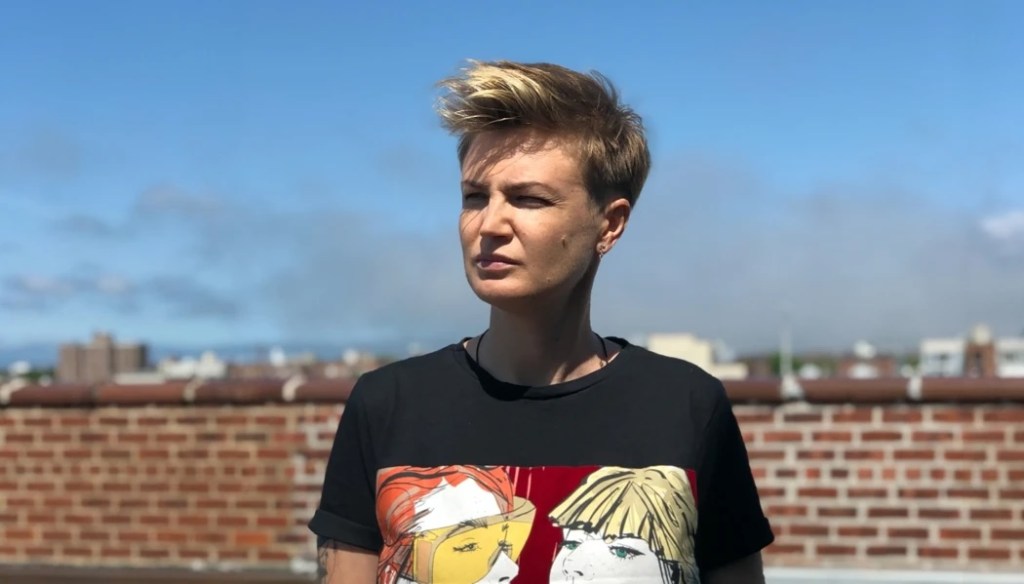
A magistrate in Moscow has been delivered a complaint of “LGBT propaganda” (as defined by Article 6.21.3 of the Russian Federal Code of Administrative Offenses) filed against Olga Baranova, program director of the Moscow Community Center for LGBT+ Initiatives. Apparently, this is her first fine—coming after the MCC was designated an “extremist” organization.
The hearing will take place on July 8, according to the court’s website. The court has not disclosed which agency drafted the report. Cases involving “LGBT propaganda” can be launched by various agencies: the Interior Ministry, the Prosecutor’s Office, or Roskomnadzor. However, in politically motivated cases, the instigator is most often Center “E”—the Interior Ministry’s department for “combating extremism.”
In late April, a court ruled in favor of the Justice Ministry and designated the MCC an “extremist” organization. It is one of ten LGBT groups that were given this designation in 2026. The Center is currently appealing the decision, so it is not yet listed in the registry of extremist organizations.
Source: “MCC director Olga Baranova gets her first ‘propaganda’ citation,” Parni Plus, 27 June 2026. Translated by the Russian Reader
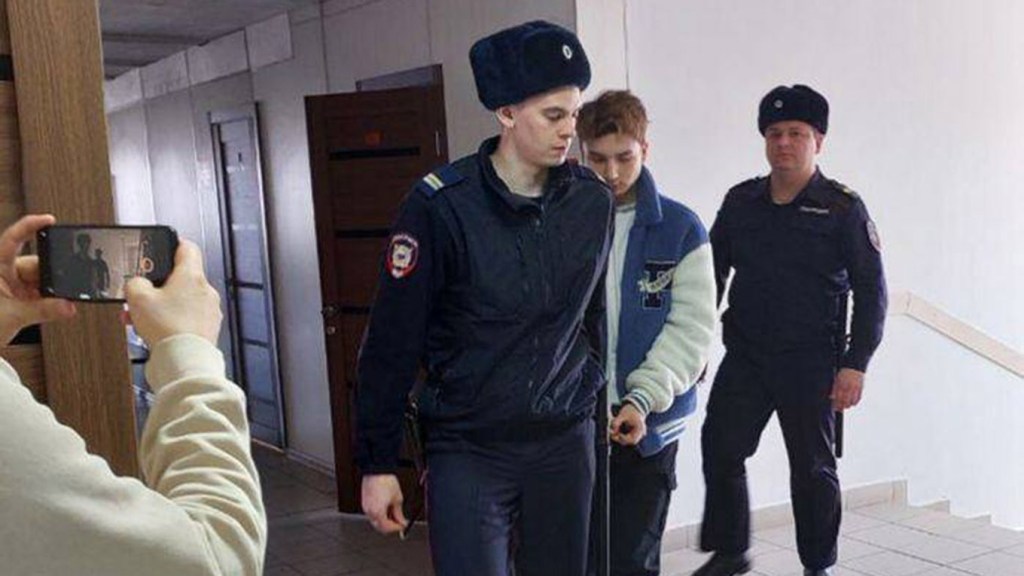
A court in the Orenburg region on Monday handed down prison sentences to a bar owner and two of his employees in Russia’s first criminal case targeting people accused of belonging to what authorities call the “International LGBT Movement.”
The trio was arrested on LGBTQ+ “extremism” charges in March 2024, representing the first instance of criminal charges being pressed in connection with the Russian Supreme Court’s designation of the non-existent “LGBT movement” as “extremist” the year before.
Bar owner Vyacheslav Khasanov received a seven-year sentence, according to Ostorozhno Novosti. Manager Diana Kamilyanova was sentenced to six years and three months, while art director Alexander Klimov received two years and three months.
All three were accused of organizing events that demonstrated “affiliation with individuals of unconventional sexual orientation under the guise of running a nightlife venue.” According to the exiled news outlet Mediazona, the bar hosted drag shows.
The trio denied the charges during the court proceedings, which were held behind closed doors.
While the case represents the first instance of criminal charges being brought under the LGBTQ+ “extremism” designation, Russia’s first actual prison sentence under the ban was issued separately in January 2025 in the Kemerovo region.
The Orenburg court said Monday that its verdict has not yet taken effect and remains subject to appeal.
In addition to the prison terms, the court seized 1 million rubles ($12,800) in revenue from Khasanov. It also barred all three defendants from working in the entertainment and hospitality industries for two to three years following their release.
Source: “Orenburg Court Jails 3 Bar Employees for LGBTQ+ ‘Extremism,’” Moscow Times, 29 June 2026