ICE Goes After Russian Asylum Seekers: The Cases of Alexander Bolokhoev and “Dimitry”

ICE agents in the U.S. have detained Alexander (“Sasha”) Bolokhoev, a cofounder of the movement Tusgaar Buryad-Mongolia, which advocates for Buryatia’s independence [from the Russian Federation].

Sasha left Russia in 2021—that is, before Russia’s full-scale invasion of Ukraine. In April 2022, he arrived in the U.S. and claimed political asylum. Unlike many of our compatriots, however, Sasha did not lie low and do nothing, pointing to the fact that he had been persecuted on ethnic grounds in Russia. He immediately joined the fight. He and Marina Khankhalaeva founded the Tusgaar movement, which has already been added to Russia’s official list of “extremists and terrorists.” He also spearheaded a congress of Buryat political organizations in New York.

Sasha’s detention by ICE was in no wise connected to his activism. He was detained in the state of Oklahoma during one of the anti-immigrant dragnets which have become a daily fact of life under Trump. Sasha was stopped on the highway and taken directly from his vehicle, which was left standing there.

Sasha is in the US completely legally. He has all the necessary papers, including a work permit. In the current reality, though, this may not matter much. Even green card holders and U.S. citizens have been detained and deported from the country.

Sasha is currently in custody in a deportation detention center in Oklahoma. He is held there along with a Chechen man who was also detained during a similar raid. The worst possible outcome for both of them would be deportation to Russia. I agree with Marina that torture and death would await Sasha in a Russian prison.

The Trump administration has instituted the systematic deportation of Russians on standalone flights to Moscow. As of October, at least three known charter flights have deported over a hundred people from the U.S. back to Russia. Upon landing in Moscow, all of these people are screened by the FSB (Federal Security Service) and they are often sent straight to a detention center.

Source: Julia Khazagaeva (Facebook), 21 October 2025. Translated by the Russian Reader. A special thanks to Ms. Khazagaeva for sending me the subtitled video interview with Sasha Bolokhoev, above.


The full interview with Buryat activist in exile Alexander Bolokhoev (in Russian and Buryat, with no subtitles)

Alexander Bolokhoev is a Buryat Mongol who immigrated to the United States and is a nationalist. He graduated from school with straight A’s, but soon left to work in Korea and then in the United States, where he currently is employed as a truck driver. In his featured spot “Saashyn Zam” (“Sasha’s Path”), Bolokhoev will talk about everyday life in the United States and his journey in life. You can join the discussion and ask questions every Wednesday at 8:30 p.m. (Ulaanbaatar time) on the channel @MiniiMongolGer.

Source: Buryadmongol (YouTube), 12 June 2024. You can watch a subtitled six-minute excerpt from this same interview in my translation of Ms. Khazagaeva’s Facebook post, above.


Buryat Emigrant Detained in US: Faces Deportation and Criminal Prosecution in Russia US

Immigration and Customs Enforcement (ICE) has detained Alexander Bolokhoev, an activist for the Buryat independence movement who has been living in the country since 2022 and seeking political asylum. The news was reported by Lyudi Baikala (People of Baikal).

According to the publication, Bolokhoev moved to the US in the spring of 2022, where he worked as a truck driver and participated in anti-war protests. He is an activist for the movement “Tusgaar Buryaad–Mongolia,” which is recognized as “terrorist and extremist” in Russia. In 2023, Bolokhoev participated in a congress of Buryat political organizations in New York, signed a declaration of Buryat independence, and joined the Buryat Independence Committee.

The movement’s leader, Marina Khankhalaeva, stated that if Bolokhoev is deported to Russia, he could face imprisonment or death due to his outspoken position and participation in the activities of the banned organization. The activist is currently being held in a detention center, and his status and a possible court decision on deportation are not yet known.

The movement “Tusgaar Buryaad–Mongolia” (“Independent Buryat-Mongolia”) was founded in the US by former opera singer and current homemaker Marina Khankhalaeva, and historian and professor Vladimir Khamutaev. The initiative advocates for “the self-determination of the Buryat people and the creation of an independent national state.”

Both founders have lived in the US for over ten years. Khankhalaeva was not previously involved in politics and stated she turned to activism after the start of the war in Ukraine. Khamutaev is known for his research on the annexation of Buryat lands to Russia and has been a proponent of Buryat autonomy since the 1980s.

The movement gained notoriety after Khankhalaeva spoke at the European Parliament during the Forum of Free Peoples of Russia, where decolonization issues were discussed. In 2023, the organization “Tusgaar Buryaad–Mongolia” was designated as terrorist and extremist in Russia.

According to Sota sources, the movement actively sought Buryat emigrants, suggesting they build their asylum cases through anti-war and “decolonization” speeches. However, after Trump came to power and mass migration acceptance was halted, such actions ceased to be beneficial for the emigrants but created a threat for them in Russia.

Source: Sota News (X), 21 October 2025


On a rainy evening in March, a Russian man named Dimitry stumbled through the dark, looking for a hole in a fence. In a former life, Dimitry worked as a fitness trainer for cops and bureaucrats in St. Petersburg, so he figured he could jump the barrier — “Honestly, with the shape I’m in, it wouldn’t be a problem.” But he was less confident about landing cleanly on the jungle terrain on the other side. Better, he thought, to look for a break in the chain-link.

The fence enclosed CATEM, a de facto immigrant detention center in Costa Rica where Dimitry, his wife, and their 6-year-old son were sent in February, along with 200 other asylum-seekers from Armenia, Afghanistan, Iran, Turkey, and Russia, among others. They were part of the first wave of migrants and asylum-seekers to be deported by the Trump administration to third countries — places other than their country of origin where, generally, the migrants had never been.

Dimitry’s plan, quickly formed a year earlier in an attempt to evade Russian authorities, had seemed straightforward. The family would fly to Tijuana, where they would download the U.S. Customs and Border Protection’s app, file a claim for political asylum, and wait to be given an appointment. But on January 20, 2025, after eight months of waiting, their appointment was canceled. They drove to the Tecate border crossing and restated their political-asylum claim. After being handcuffed and fingerprinted, the family was placed in a holding facility at the Otay Mesa border crossing. They spent a month there, separated, before they were put on a military plane to Arizona. In Arizona, they were led to a bus. One of the migrants asked the driver where they were being taken next.

“Costa Rica,” the driver replied.

Costa Rica, Dimitry thought. Is that a city or a country?

Continue reading “ICE Goes After Russian Asylum Seekers: The Cases of Alexander Bolokhoev and “Dimitry””

Dankhaiaa Khovalyg: Russia’s Asian Republics Speak

Dankhaiaa Khovalyg. Photo: Rinchinaaa/Baikal People

‘I was made from Russian anyway,’ 28-year-old Dankhaiaa Khovalyg writes in her story ‘Ayalga,’ published in early 2022. Its female protagonist tells a psychologist how she feels like a stranger in her own country. When Dankhaiaa was a teenager, she deliberately detached herself from her native culture. She was proud to speak Russian without an accent, and dreamt of leaving Kyzyl ‘to be with her own people’ in Moscow.

During her eight years in Moscow, Dankhaiaa was involved in decolonial activism, researched her own painful background, and launched a project about indigenous people from Russia’s six ethnic Asian regions —the podcast re.public_speaking.

Alina Golovina, a Baikal People correspondent based in Buryatia, spoke with Khovalyg about why it is important to talk about trauma, where decolonization begins, and whether Russia’s ethnic republics can unite for their own benefit. At Danhkaiaa’s suggestion, they spoke to each other using the informal second-person pronoun ty.

As soon as I would lеave home, the world would crash down on me with all its xenophobia

— Tell me about yourself, Dankhaiaa.

— I was born and raised in Kyzyl. After graduating from school, I went to study in Moscow and lived there for eight years. I worked as a client manager in an IT company and was involved in feminist activism. In 2021, I quit my job and realized my childhood dream: I enrolled in literature classes and took up writing. Since March 2022, I have been living in Berlin and doing podcasts and anti-war activism.

— You told me that up to ninety percent of the indigenous people in Tuva speak Tuvan and consider it their native tongue. Why have you prioritized Russian? Is it a problem?

— I’m a city girl: I grew up in Kyzyl. I was sent to a Russian-language kindergarten and, later, to a Russian-language class at school. That was how my mother showed that she cared about me: Russian-speaking classes were considered tonier. I was a bookworm and was engrossed in Russian literature. Unfortunately, I didn’t have access to a large amount of foreign literature at school, and at that moment, eighty percent of me certainly consisted of this great and beautiful Russian literature by the so-called Tolstoyevskys. I read all of that stuff and would dream of going to Moscow. I was a little proud that I spoke such beautiful Russian. Basically, I went through all that internalized colonial chauvinist crap that life was better there, that I was going to get out because I was more like them.

— Did it save you from ethnic discrimination? If not, when did you first encounter it?

— My experience of discrimination actually began long before I moved to Moscow. My mother found opportunities using travel vouchers to send me to summer camps in Krasnodar Territory, Khakassia, and other regions. I was eleven and twelve years old at the time. It didn’t matter whether I traveled five hundred kilometers from home or several thousand, because everywhere I went I encountered phenomenal bullying. I was labeled ‘China girl’ and ‘black.’ No one asked me to dance at dance parties. I was either totally ignored or talked to condescendingly and peppered with passive-aggressive insults. I had lived in my native Tuva in a groovy, comfortable bubble: most people spoke Tuvan, and we didn’t encounter any racism there. But as soon as I would leave home, the world would crash down on me with all its xenophobia. Whereas in Tuva I was considered pretty, smart, and cool, everything and everyone at those camps made it clear to me that I was second-rate.

— How did this affect you?

— These contrasts generated very unhealthy takeaways in my head: that Tuva’s overall level [of development] was much lower than the rest of Russia’s. This absolutely perverted assumption made me, as a teenager, condescend to Tuvan culture and my Tuvan side. It is quite painful for me to remember the instances when relatives addressed me in Tuvan, but I would reply in Russian, saying that I didn’t understand them, although that was a lie. Those memories now make me feel bitter. I feel sorry for that teenage girl.

— What happened later in life? How did Moscow welcome you?

— I often encountered micro-aggressions in public places. For example, I would be standing in the queue at a store, and a huge Russian guy would push me aside and go in front of me. There was no explicit verbal indication that this was because I was non-Russian, but I think this wouldn’t hae happened if I had been of Slavic appearance. I repeatedly had big problems finding a place to live because of my name and my appearance. Or, for example, I would be climbing the stairs to my floor, and neighbors descending the stairs would say, ‘The churkas have come and taken over the place’ when they would see me. They would not say it to my face, but under their breath as it were, and when they were already a flight below me, so I couldn’t even shout back at them as it happened. I would just stand there for a while, frozen on the steps. You always deal with this alone because when you are with your husband or a group of people, those very same neighbors keep their mouths shut. Every such episode of chauvinism really demoralized me, although I didn’t express it outwardly. Because no matter who I would tell, they would say, ‘Oh, don’t pay attention! Rise above it! We don’t stoop to their level.’ I swear that there has never been an instance when someone just shared my indignation for a second.

— Have you experienced physical violence? Have you been attacked?

— I didn’t encounter any actual boneheads (far-right skinheads): I moved to Moscow in 2013, by which time the most ardent supporters of that ideology had been jailed. The cases of physical violence that happened to me are difficult to categorize. The first time it happened was when I was in my first year at university. I was traveling from my part-time job in an empty train carriage to my dormitory. I had leaned my head against the window and fallen asleep with my legs stretched out. I woke up to an old man kicking me and saying, ‘Move your damn feet.’ I did and asked him what was the matter, and he said he wanted to sit down. I suggested he sit down in one of the other free seats, upon which he started kicking me again, saying that I was a churka and if I gave him any guff, he would beat the shit out of me. It was so horrible, because the old man spoke softly and looked like a harmless creature. I didn’t leave because I didn’t want to look weak. He stared at me point-blank the whole way and commented that I behaved very freely in Russia. It was forty minutes of violence.

The second incident happened on Leninsky Prospekt near the Oktyabrskaya subway station. It was summer, I was walking with headphones on in a crowd of people, listening to music. I noticed out of the corner of my eye that a man was walking in my direction and looking at me intently. Over the years, you develop something like a muscle that reacts to unwanted attention and makes you tense up and pull yourself together as if you’re getting ready to react. When the man walked by, he hit me over the head with a bottle. I fell down. He walked on. So there I was, lying propped up on my elbows, looking at the man walking away, and all the other people just passed me by. I thought at the time that it could have been a scene from a film, because only in a film can you get hit and nobody comes up and asks how you’re doing or tries to help you. And there were a lot of little situations — elbowing, pushing, kicking. Several times when I was putting away my dirty tray at a food court, I was told, ‘Hey, clean this up.’

Continue reading “Dankhaiaa Khovalyg: Russia’s Asian Republics Speak”

The Case Against Mikhail Babintsev, Photographer and “Terrorist”

Military court of appeal to consider the case of photographer Mikhail Babintsev

In October, Mikhail Babintsev, a resident of Buryatia, was sentenced to thirteen years in prison: the investigation argued and the court ruled that his attempt to set fire to the military recruitment center in the village of Mukhorshibir was a a “terrorist act.” Mikhail disagrees with this ruling and has appealed the verdict. With support from you, we aided the prisoner’s family in paying the defense lawyer’s fees during the appeals phase.

Mikhail Babintsev

On 17 January, the Military Court of Appeal in Vlasikha (Moscow Region) will hear the defence’s appeal of the verdict.

Solidarity Zone argues that treating arsons of military recruitment centres as violations of Article 205 of the Russian Federal Criminal Code (“Terrorist Act”) is unreasonable and politically motivated. The same conclusion has been reached by Memorial’s Political Prisoners Support Project, for example, in the case of Roman Nasryev and Alexei Nuriyev.

The Military Court of Appeal is located in a closed military town in the Moscow Region. The headquarters of the Strategic Missile Forces is also located there. Therefore, no one is allowed to enter the court or the town itself, but a live broadcast of the court hearings will be arranged at the security checkpoint on the edge of the town.

Come follow the trial and support Mikhail with your presence!

🕙 10:00 a.m., 17 January 2024

📍 Military Court of Appeal, 25 Solnechnaya Street, Vlasikha, Odintsovo District, Moscow Region, Security Checkpoint 1

To travel by public transport from Moscow, you can use one of the following options:

  • from the Kievsky railway station by bus No. 477 to the Vlasikha security checkpoint;
  • from the Belorussky railway station (or from Fili or Kuntsevskaya metro stations) by train to Odintsovo station, then by minibus No. 46 to the Vlasikha security checkpoint.

☎️ We recommend that you call the court in advance at 8(495)598-74-29 and tell them that you wish to attend the court hearing so that the broadcast is definitely organised.

#political prisoners #crackdowns #no war #solidarity #arson attack #buryatia #court

Source: Solidarity Zone (Facebook), 12 January 2024. Translated by the Russian Reader

Terribly Far

This is the premiere of Terribly Far, a new program by Lyudmila Savitskaya.

We will talk about what is happening to people who are terribly far from Moscow and St. Petersburg. Who are terribly far from the congresses, conferences and conflicts of opposition leaders. Who are terribly far even from popular YouTube channels and shows. Who are also terribly far even from Telegram.

Why does this matter? It matters because otherwise we won’t understand how the country got to this point and why some Russians volunteer to fight in the war.

In this episode, you’ll learn what worries Russians more than Prigozhin’s rebellion, why the Baltic Sea in Kaliningrad is becoming bloody, in which city it is easiest to encounter wild bears on the streets, and the job you have to land to make a dream salary of 8,000 rubles [approx. 80 euros] a month.

00:10  Why this program is needed

02:05 “We support the president, but where is the water?!” On Prigozhin and the water in Kostroma

06:06 There is no money to pay mail carriers in Buryatia

09:26 People in Kaliningrad are trying to save the Baltic Sea from pig’s blood

12:44 People in Tomsk are fleeing from bears on the streets

15:20 Taxis in Penza risk sinking underwater even after a normal rain shower

16:18 Why all this matters even in wartime

Subscribe to our channel, where we talk about the problems of ordinary people. And if you live beyond the Moscow Ring Road and are facing trouble right now, write to us at:

strashnodaleki@gmail.com

We will definitely tell our viewers about it. Because we do care.

Source: “Terribly Far No. 1: Pigs vs. People | Prigozhin and Hot Water | Bears on the Streets,” Open Media (YouTube), 7 July 2023. In Russian, with Russian captions. Annotation translated by the Russian Reader

__________________

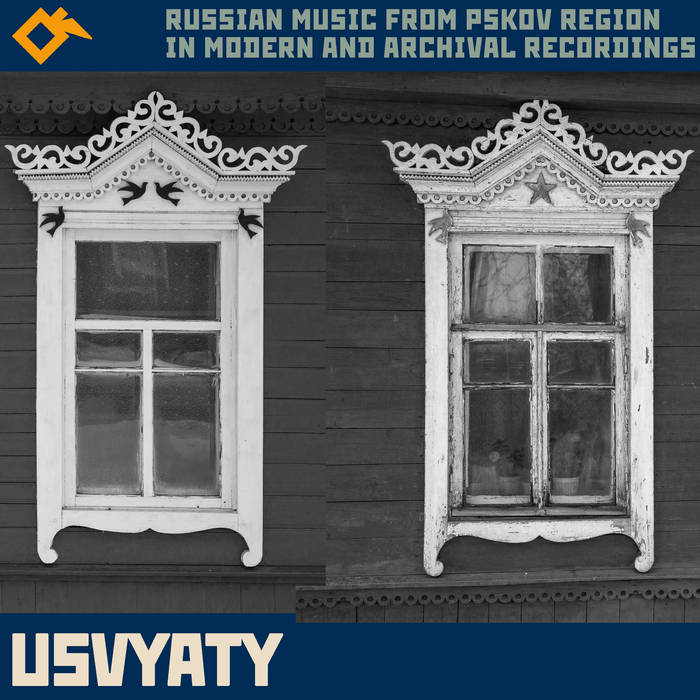
The Usvyaty District of the Pskov Region belongs to the ethnographic area known as Poozerye (Lakeland). There used to be many folk musicians there, the most famous of whom was the singer Olga Sergeeva (1922-2002).

Ekaterina Trusova (maiden name Kozintseva, tracks 1-7) is a garmon (Russian button accordeon) player living in Usvyaty. She was recorded at the Usvyaty House of Culture on December 12, 2021.

The other two musicians featured on this album belong to a previous generation and were recorded by Ekaterina herself in the 1990s on a home cassette tape recorder. The cassettes were digitized by Alexander Yuminov (KAMA Records) in 2022.

Sofya Rubisova (tracks 8-13) is a folk singer from the village of Sterevnevo, Usvyaty District.

Dmitry Kozintsev (tracks 14-17) is Ekaterina’s father, a garmon player from the village of Pysi. Unfortunately, the recordings of him are of poor quality, as the tape in the cassette turned upside down. But we still decided to include them in the album.

Another album from the area, from the village of Tserkovishchi, can be found here.

Source: Antonovka Records (Bandcamp), 8 July 2023. I’ve lightly edited the original annotation to make it more readable. ||| TRR

__________________

Branded “foreign agent,” Yaroslavl media outlet announces closure

YARNOVOSTI announced it was suspending its work on July 7. The publication had been running for over ten years. It covered the inhabitants of Yaroslavl, corruption, problems with public amenities, and politics.

In June, the Justice Ministry had declared YARNOVOSTI a “foreign agent.” None of its employees agreed to work under this label. The editors said that during its entire existence it had not received “a kopeck” of foreign funding.

“Of course, we expected to continue working, but, as Vladimir Putin said, nothing lasts forever. We are still getting to the bottom of what happened on June 2: we have made all possible and even impossible inquiries, and have drawn up the paperwork for the court,” the media outlet’s editorial team wrote.

Source: 7 x 7 (Telegram), 7 July 2023. Translated by the Russian Reader. As of this writing, YARNOVOSTI seems to have shut down its website, but its page on VKontakte is still functioning. In its latest post there, published on 7 July 2023, it informed readers of the decision to suspend its work.

Russian Buddhists and the War

Telo Tulku Rinpoche, the now-former Supreme Lama of Kalmykia

On Friday, January 27, 2023, the Russian Justice Ministry placed Telo Tulku Rinpoche (Erdni-Basan Ombadykov) on its registry of “foreign agents.” Rinpoche is еру president of the Association of Buddhists of Kalmykia and the 14th Dalai Lama’s official representative in Russia, Mongolia and the CIS countries. The ministry’s press service said that the Buddhist leader had been placed on the list because he had “spoken out against the special military operation in Ukraine and openly spoken in support of Ukraine,” and also because he “is a US citizen and lives outside the Russian Federation.”

In addition to Rinpoche, the list of newly minted “foreign agents” that day included Little Big soloist Ilya Prusikin, journalist Fidel Agumava, Free Idel-Ural Movement co-founder Rafis Kashapov, and Feminist Anti-War Resistance coordinator Darja Serenko.

The following day, January 28, Telo Tulku Rinpoche announced that he had resigned his post as the Supreme Lama of Kalmykia.

“In the last two days, many people have expressed concern and sympathy over my inclusion in the registry of foreign agents. I am sincerely grateful to them for their involvement in and appreciation of my work. In these difficult times, I would like the people of Kalmykia and all followers of Buddhism to maintain courage, steadfastness and commitment to the ideals of compassion, love and nonviolence that form the basis of the Teaching of the Buddha that we profess. […] In my thoughts, deeds and prayers, I remain entirely with the Kalmyk people and Buddhists all over Russia, to whose service I have devoted my life,” the monk said.

Who Is Telo Tulku Rinpoche?

Telo Tulku Rinpoche (Erdni-Basan Ombadykov) was born in the United States in 1972 to a family of Kalmyk immigrants, according to the lama’s biography on the Kalmykian Buddhist community’s website.

In 1991, Rinpoche visited Kalmykia for the first time as part of a delegation led by the 14th Dalai Lama. Shortly after the visit, which the website refers to as “the starting point for the restoration of Buddhism in the republic,” Rinpoche was chosen as the supreme lama of the region, the Shajin Lama.

“While serving as the Shajin Lama, Telo Tulku Rinpoche has made great efforts to strengthen the religious and cultural ties that have existed for centuries between the traditionally Buddhist regions of Russia and the Tibetan community, led by His Holiness the 14th Dalai Lama XIV,” the website notes.

Another highlight of Rinpoche’s tenure as the Shajin Lama has been, according to the website, “comprehensive support for peaceful coexistence and cooperation among members of Kalmykia’s traditional confessions — Buddhism, Christianity and Islam.” In addition, under the lama’s leadership, more than thirty temples and prayer houses were erected in Kalmykia.

Rinpoche is a US citizen. He was applying for Russian citizenship, and was scheduled for an interview on February 24, 2022, but it was canceled due to the beginning of Russia’s invasion of Ukraine.

Russian Buddhists and the War

In an interview posted on the YouTube channel Alchemy of Soul on September 30, 2022, Rinpoche openly opposed the “special operation.”

“I think it’s wrong,” he said. “This war is needless. […] I think that the Ukrainian side is in the right. It is defending its country, its land, its rights, its Constitution, its people.”

The lama explained that he had not spoken out against the war earlier because he had been worried about the safety of Buddhists in Russia and their families.

“I didn’t want to spoil the relationship between the authorities and our Buddhists. I didn’t say anything, but nevertheless, every morning I always prayed for everyone, both Buddhists and non-Buddhists,” Rinpoche explained.

The monk said that he had left Kalmykia and was in Mongolia, where he was helping Russians fleeing the military mobilization. Rinpoche was negotiating an extension of the visa-free regime for Russian nationals and helping with their accommodation and the purchase of sleeping bags.


“American born Telo Tulku Rinpoche is a Buddhist leader in Russia. In this video Anzhela and Rinpoche discuss Buddhism’s philosophy on war, Russian mobilization of citizens to support the invasion of Ukraine, and steps Russian men are taking to avoid mobilization.” (In Russian, with English subtitles)

However, not all Buddhists share Rinpoche’s opinion about the “special operation.” Damba (Vasily) Ayusheev, head of the Buddhist Traditional Sangha of Russia, explained that the lama’s anti-war stance had to do with the fact that he is a US national.

Ayusheev himself voiced his own support for the war in Ukraine on February 28.

“We live in a single Russian state and defend the interests of our country, against which a dirty information war is being waged. […] We must have a strong and reliable home front. Our sahyusan [dharmapala] are on our side, our Great Khambo Lamas are on our side, and Buddha is on our side,” Ayusheev said on Buryad FM Radio on February 28, according to Infpol.

“It is a sacred duty. We Buddhists must defend our homeland. […] In our system, in Buddhism, the man must defend [the homeland, and] if necessary, go to war, be victorious, and return to his family, to his homeland,” Ayusheev said on September 30 in a conversation with Izvestia. The Buddhist added that he was proud of his co-religionists’ involvement in the war, and called the annexation of the Ukrainian regions to Russia a “historic moment” and a “great event.”

Jampa Donied (Buda Badmayev), the deputy head of the Buddhist Traditional Sangha for Russia’s Northwestern Federal District, also argues that Buddhists are involved in the “special operation” to defend their spiritual values.

On March 16, 2022, an “initiative group of Buddhists and sympathizers of Buddhism” published an open letter in support of [the Russian government’s] military actions in Ukraine on a VK group page.

“Buddhism — which is undoubtedly a peaceful doctrine — teaches us to calm the mind, maintain internal balance and find peace in all worlds. But Buddhism is not a doctrine of non-resistance to evil, if evil is ready to destroy everything its midst. […] In response to evil, we must not trigger negative emotions of anger and malice in ourselves, but we should be able to resist aggressive attacks from external forces in a calm state of mind. We must defend ourselves without letting evil into our hearts.”

The activists called upon people to sign the letter to “express solidarity with the President of Russia’s decision to pacify Ukraine, making it possible to establish peaceful and neighborly relations with this country.”

As of March 26, 2022, forty-two people from different regions of Russia had signed the letter. Three more people have signed it since then.

According to Alchemy of Soul presenter Anzhela Kalsynova, Rinpoche is the only [Russian] Buddhist leader who has publicly condemned Russia’s invasion of Ukraine. And yet, the lama himself suggests that his co-religionists do not support the war, but are not openly opposing it due to concerns for their own safety.

The law on “foreign agents” in Russia is discriminatory and is used to combat those who have fallen out of favor with the authorities. All “foreign agents” are required to report their activities, income and expenses to the Russia Justice Ministry. They are restricted in their ability to disseminate information and find sources of funding. They face increased official oversight and lose their working partnerships. Like Rinpoche, they are deprived of the opportunity to continue their life’s work.

Source: “Buddhism and the war: Supreme Lama of Kalmykia declared ‘foreign agent,'” OVD Info (Medium), 1 February 2023. Translated by the Russian Reader. For a brief overview of Buddhism in Russia, see Rustam Sabirov, “Buddhism in Russia: History and Modernity,” Buddhistdoor Global, November 4, 2019.

Erkhuu Khoto: Songs of Buryats from Irkutsk

83rd release from Antonovka Records

Erkhuu Khoto is the Buryat name for the city of Irkutsk, in which khoto means “city.” Buryats are the indigenous people of this area.

The Ayanga Ensemble (ayanga means “melody” in Buryat) was founded in 1998, the leader is Tsybigmit Damdinzhapova.

The band performs mainly songs of the Irkutsk Buryats, some of which were directly inherited from their ancestors. For example, Evgenia Baldynova learned song 4 from her grandfather. And song 5 was passed on to Petr Saganov from his grandmother Lilia Zhebadaeva, who, in turn, learned it from her grandfather Danchi Nikolaev, born in 1875. And Evgenia and Peter are the oldest (86 years old) and the youngest (27 years old) members of Ayanga respectively.

Some of the ensemble participants moved to Irkutsk from Buryatia and Transbaikal, so particular songs come from there. For example, Onon is a river in Transbaikal Territory.

Ayanga Ensemble (from left to right on the album cover photo):
1. Oyuna Chimitova — vocals
2. Khanda Bazarova — vocals
3. Valentina Bardakhanova — vocals
4. Petr Saganov — vocals, solo vocals (5, 13)
5. Rinchin-Khanda Lubsanova — vocals, solo vocals (12, 16), vocals in duo (9)
6. Olga Radnaeva — vocals, solo vocals (10)
7. Tatyana Turmakova — vocals, solo vocals (7)
8. Eduard Khalzanov — vocals, vocals in duo (6)
9. Tsybigmit Mitupovna Damdinzhapova — vocals, solo vocals (11, 14, 17), vocals in duo (9)
10. Evgenia Baldynova — vocals, solo vocals (15)
11. Zinaida Egnaeva — vocals, vocals in duo (6)
12. Alla Dmitrieva – vocals
13. Svetlana Inchizhinova – vocals

The calligraphic inscription on the cover is the name of the ensemble written in Old Mongolian script by Rinchin-Khanda Lubsanova.

The Buryat song titles are written as given by the performers and may differ slightly from the literary version.

Recorded in Irkutsk on July 3, 2022.

Thanks to Tsybigmit and the ensemble, Sergey Shotkinov, Lyudmila Gerda, Natalya Dmitrieva.

Source: Antonovka Records, Facebook, 11 December 2022

Buryats and the “Russian World”

Radjana Dugar-DePonte. Photo courtesy of After Empire

As soon as the march “The Slavic Woman’s Farewell” began to play, my mother would cry. She was eleven years old when the Great Patriotic War began. In the small Buryat village of Khandagai, in the Irkutsk Region, all men between the ages of eighteen and fifty-five went to the front. They were sent off to the strains of “The Slavic Woman’s Farewell.” Few of them came back alive from the war.

Siberian divisions played a key role in the great turning point of 1941, when the enemy was halted outside Moscow. Pride in the deeds of our forebears is a significant part of the Siberian identity, but until recently this pride was suffused with the bitterness of loss. My mother always remembered the price of that victory: she saw them in her mind’s eye, the young handsome lads and men who left forever to the sound of trumpets and timpani. I was told how, in the early 2000s, members of the Buryat diaspora in Moscow were invited to a meeting of battlefield searchers in the Moscow Region to receive a list of dead soldiers whose remains had finally been found, identified, and properly buried. One of the searchers came up to the delegation and said with undisguised respect, “So this is what you are like, Buryats!” It turned out that all the fields near Podolsk, where his search party had worked, were simply littered with the remains of my countrymen.

Someone witty once very aptly called Putin a reverse Midas. The Phrygian king Midas turned everything into gold with a single touch. Putin turns everything he touches into a foul-smelling brown substance. The regime’s appropriation of the May 9th Victory Day is just one example. The celebration of Victory Day in Russia for me is now associated exclusively with pobedobesie [“victory frenzy”], with vulgarity, and with the slogan “We can do it again!”, whose true meaning dawns on us only today, after the invasion of Ukraine and the horrors of Bucha.

The irony of the current situation, in which members of my nation, the Buryats, are involved in this shameful war for Russia, is that images of Russian occupiers with Asian faces are now being injected into the public’s mind, while in the Great Patriotic War the role of the warrior-liberator was reserved exclusively for ethnic Russian soldiers.

Soon after Bucha, fake reportsw spread online that it was Buryats who committed the atrocities there, and these posts were illustrated by photos of Yakut soldiers holding the flag of the Sakha Republic, taken in 2018 in the military garrison in the Russian Far East where they served. Why would anyone want to shift the blame for the massacres to Buryats? My Ukrainian Facebook friend Dmytro Kanibolotskyy answered this question best of all: “Russia’s attempts to declare ‘Ukrainian nationalists’ guilty or to pass off the footage from the Bucha district as ‘staged’ have failed. Satellite images clearly showed that the bodies of the dead were lying in the same places when Russian troops were still in Bucha. The involvement of ethnic Russians in the mass murders is also evidenced by their intercepted conversations and the testimony of local residents. But now Russian propaganda is trying to tell a different story, to Ukrainian readers at least: the Russian Federation’s ethnic minorities, who got drunk and disobeyed orders, are allegedly to blame for the whole thing. It is convenient to encourage Ukrainians to think that their enemies are not ethnic Russians, but Buryats (as well as Yakuts, Chechens, Dagestanis, and other peoples of the Russian Federation), that they must fight not against Russia or ethnic Russians, but against the nations that Russian has colonized.”

The investigation of the war crimes in Bucha and other towns and villages is already underway. Ukrainian presidential advisor Oleksiy Arestovych has spoken unequivocally about the preliminary results: the atrocities in Bucha were committed by “burly Slavic guys,” and not by Buryats, “as they like to say.” I am sure there will be a new Nuremberg trial after the war, and if it transpires that there were Buryats among the war criminals, they will have to be punished. But I hope that there will also be room in the dock for warmongering propagandists, and for the Kremlin’s disinformation agents in Ukraine.

Recently, I have often been asked why so many Buryats are fighting in the “special operation.” There are really a lot of Buryat soldiers fighting in this war. The Telegram channel Mongolian Knot reported that “according to various estimates, there are about ten thousand Buryats at the front.” Other sources report that there are five or six thousand Buryats in combat. Most likely, as a percentage per capita among all the peoples of Russia, the Buryats fighting in Ukraine are in the lead.

I have been told that there is not a single Buryat village that does not have at least a dozen or two dozen contract soldiers at the front. The situation is particularly difficult in the Agin-Buryat District of the Transbaikal Territory. The absence of young Buryat men in public places is striking. There are places where Buryat families go in full force — the so-called countryside and the datsan. There are generally few Buryat men between the age of twenty and forty years in the datsans. According to my relatives, none of the ten Buryat families who came to services at the temple had fathers. In the countryside vacation spots, there were at best two men among every three or four families with children.

Buryats make up only 0.3% of Russia’s population, but they make up 2.8% of the official war dead. In terms of numbers of war dead, Dagestan is ahead of Buryatia, but Dagestan’s population is three times larger. The moderators of the Telegram channel Demography by Raksha looked at the stats for Buryats whose age was known at the time of their deaths in the war, and calculated how many men in Buryatia died on average over the same (fifty-three-day) period during “peacetime” (in 2019-2020). On top of this, they sorted those who have perished in the war in Ukraine into the appropriate age groups.

Thus, only the confirmed cases of combat deaths of men from Buryatia in the war in Ukraine increased the mortality of Buryat men aged 18-45 years by 70%, and the mortality of young men under the age of thirty by 270%. Think about those numbers! There are approximately 462 thousand Buryats in the Russian Federation. What will happen to this nation if it loses so many young healthy men of reproductive age all at once — a tenth of the strong young men who could have raised twenty to thirty thousand children?

The causes of this catastrophic situation can be discussed endlessly. The Buryat territories, consisting of the Republic of Buryatia proper, as well as parts of the Irkutsk Region, the Ust-Orda Buryat District, the Transbaikal Territory, and the Agin-Buryat District, are a large economically depressed region. High unemployment, meager salaries, and the indebtedness of the population have led to the fact that almost the only choice a young man faces in finding a way out of economic impasse is either illegal migration or contract military service.

The traditional upbringing in Buryat families also plays a big role in the conscious choice of a military career. Boys are taught from an early age to be independent, work hard, stand up for themselves, and protect loved ones. Traditional sports are very popular in Buryatia, especially the national form of wrestling, buhe barildaan.

A young guy from a small Buryat village, accustomed to harsh living conditions, hard work, getting up early, and discipline, adapts easily to military life, and after signing a contract, receives a preferential military mortgage (which is almost the most important factor for young families) and a guaranteed salary that is decent by the region’s standards.

Buryat tank crewmen were involved in battles on Ukrainian territory long before February 24 of this year. One of them, Dorzhi Batomunkuyev, who suffered severe burns in the Battle of Debaltseve in 2015, gave an interview to Novaya Gazeta’s Elena Kostyuchenko in which he called Putin “cunning” and admitted that he and his comrades had painted over the numbers of their tanks and removed the chevrons and stripes from their uniforms to “disguise” them before being sent to Donbas.

Dmitry Sapozhnikov, a Russian national and the commander of the DPR’s special forces, told the BBC Russian Service that the role of Buryat tank crews in the battle for the Debaltseve bridgehead had been decisive. Even then, the Buryats were the most combat-ready segment of the Russian army. It was not for nothing that a Buryat crew won the international tank biathlon shortly before our contractor soldiers were deployed to Donbas.

Thus, their professionalism, a respect for elders laid down by their upbringing, their strict adherence to orders, and the way they perform in combat, including their willingness to sacrifice themselves, all make the Buryats excellent soldiers. In 2010, news came of the heroic deed of Aldar Tsydenzhapov, a 19-year-old sailor from the Agin-Buryat District. On September 24, 2010, the crew of the destroyer Bystry was on board and preparing to sail on a combat mission to Kamchatka. Aldar and four of his mates took over the watch. When a fire broke out in the destroyer’s engine room, Aldar rushed to its epicenter and shut a red-hot valve with his bare hands.

The ship and more than 300 crew members were saved, but Aldar was fatally burned and died in a military hospital. The then President of Russia Dmitry Medvedev considered Aldar unworthy of the title of Hero of Russia. Initially, the authorities planned to award him only the Order of Courage. Only after public outrage, a petition campaign on Change.org, and appeals from parliamentarians and party officials, was he posthumously awarded the title of Hero of Russia.

I understand perfectly well that many readers will now accuse me of trying to whitewash my own people. There is most likely some truth to this. I will repeat once again that if it transpires that there are war criminals among Buryats, I will be the first to demand that they be punished. In the meantime, I will give some first-hand evidence of the behavior of Buryat soldiers in occupied Ukrainian territory.

In the first days of the war, in the comments under a post in the Facebook group Buryatia Is Our Home, someone mentioned that the Buryat tank crews were not marauding, but instead were going house to house and trying to buy food from local residents. They said that they were going on maneuvers and had not known about HQ’s plans to cross the border with Ukraine. One Buryat contract soldier said the same thing in a telephone conversation with his family on the eve of the invasion: he had been looking forward to coming home soon, but instead he ended up at war.

A woman from Ukraine, whose brother and niece had spoken with the tank crews, wrote on the Buryat group page that they were hungry since they had been issued dry rations for only one day; they were not aggressive, and wanted to go home. Many of them were conscripts, eighteen- and nineteen-year-old lads who had urgently been “made” contract soldiers. A resident of Chernihiv region wrote about an incident in Mykhailo-Kotsiubynske: “Belarusians, who are stationed there as occupiers along with Buryats and Muscovites, took a horse from a villager, slaughtered it, and ate it. Like in the First World War… And what to do if the Muscovites simply confiscate food? Buryats are the most cultured among the occupiers, they buy [food] for money, while the Belarusians say they are ‘peaceful people.'” (My translation.) There was the testimony from a resident of Bucha that Buryats had tried to warn her to be careful when “they” (probably Pskov paratroopers or Wagner Group mercenaries) came. And in Borodyanka, people said, “The Buryats did not shoot.”

Subsequently, videos with blaring titles like “The Buryats are worse than the Kadyrovites,” etc., were dumped on the web. When you watch the videos, however, it transpires that the most terrible crime of the alleged Buryats (soldiers of Asian appearance, whom the interviewee called “flat–faced”) was shattering a door with an axe, which is not a good thing, of course, but not remotely as bad as torture, rape, and summary execution.

Outright fakes and “crucified boys” have now come into play, like the video featuring a volunteer who allegedly survived Bucha, which was thoroughly and expertly demolished by Dmitro Kanibolotskyy. Such sleaze is manufactured in an attempt to “save face” for ethnic Russian soldiers. This is the point of the image of the savage Buryat, who allegedly slices flesh from live dogs in order to “chow down.” A post containing such outlandish content actually has been making the rounds on social media.

Unfortunately, involvement in an unjust war of conquest eventually hardens and corrupts even the most steadfast and moral people. In such a war, there are no soldiers in clean white jackets, if HQ encourages looting and violence against civilians. The Russian army and the people of Russia are guilty of the aggression unleashed by Putin. The blood of thousands of Ukrainians will remain on our conscience forever. The war has brought shame on Russia. But this inglorious coin has another side. The Russian leadership is responsible not only for criminal aggression against the people of Ukraine, but also for the death of thousands of its own soldiers, especially non-ethnic Russian soldiers whom the Kremlin obviously feels less sorry for, regarding them as cannon fodder that can be dumped on the front line.

It is possible to understand on a personal level the Ukrainians who believe that the majority of war crimes have been committed by Buryats. They are under stress, they are distraught and grief-stricken, they are not up to rational arguments now. Some Russians comport themselves much worse in this situation, and I’m not talking about Putinists and my completely brainwashed fellow citizens. I mean the so-called “cultured” liberal crowd.

Many people today are wondering why so many Buryats are fighting in Ukraine. Video blogger Karen Shainyan even bothered to go to Ulan-Ude to get an answer, where he shot a video that has racked up almost 300 thousand views on YouTube. Shainyan sought out a wide spectrum of experts, only Buryats themselves were not invited to his intellectual symposium. However, we Buryats were still shown in the form of visual aids, as illustrations to the expert opinions of the sahibs. It is simply impossible to imagine a whole ethnic group, outside of Russia, being so unabashedly deprived of its subjectivity.

A few days ago, the Buryat political exile Dorjo Dugarov and I had a chance to speak on the same topic – “Why are Buryats going off to fight for the Russian army?” – on the Ukrainian TV channel FreeDom. I saw Shainyan’s show literally the next day after our broadcast, and I couldn’t help but notice a parallel: Shainyan denies the subjectivity of Buryats in about the same fashion as Putin denies the subjectivity of Ukraine! That is why it is not surprising that Ukrainian TV journalists bothered to invite Buryats to talk about Buryatia, while a Moscow blogger could not or did not want to find a single Buryat in Ulan-Ude! It is the same imperial rationale, the same disrespect for “inferior” nations as Putin’s. And until Russians rid themselves of imperial thinking, Russia will keep stepping on the same bloody rake over and over again.

Alexander Nevzorov, Russian imperialist and erstwhile champion of Russian armed force in Chechnya, but now an idol of the Russian opposition crowd, has since the beginning of the war repeatedly allowed himself statements suggesting that “the Buryats don’t care who they rape.” The views of the flip-flopping hybrid democrat are especially congenial to those who, wrapped in the redesigned flag of “the other Russia, the good Russia,” want to shift the collective blame for all crimes onto the country’s minorities. But no, the shame of this war will have to be shared equally by our whole country, which has gone off the rails.

Source: Radjana Dugar-DePonte, “Buryats and the ‘Russian world’: ‘The shame of this war will have to be shared equally,'” Sibir.Realii (Radio Svoboda), 12 May 2022, and the slightly different version of this article published on the Radio Svoboda website on 17 May 2022. Radjana Dugar-DePonte is a historian and exiled Buryat political activist. Thanks to Comrade Koganzon for the heads-up. Translated by the Russian Reader

Coach Yakovlev’s War with the Zwastika

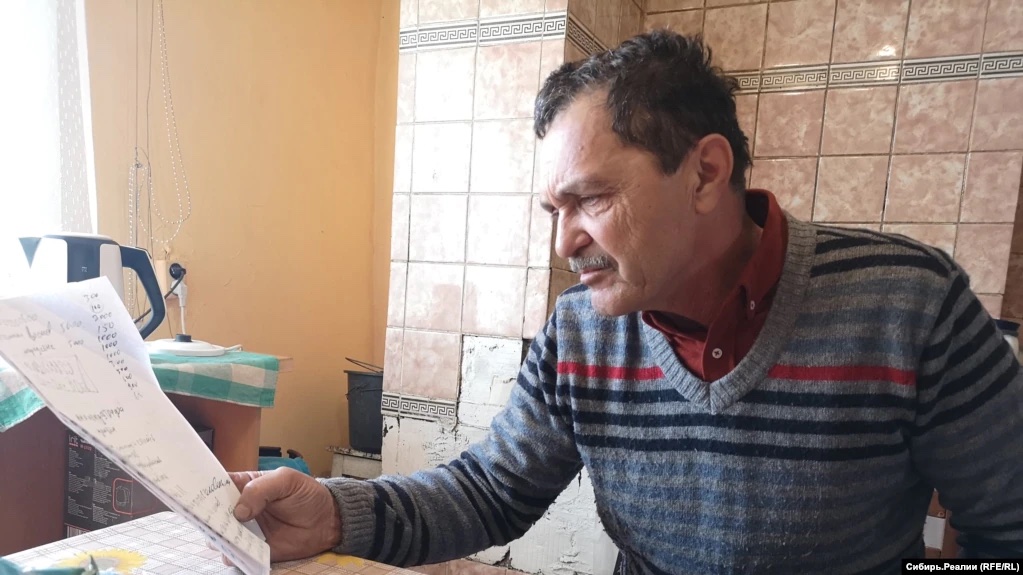
Valery Yakovlev copied out some of the supportive text messages he received after the media wrote about his case.
Photo courtesy of Sibir.Realii (RFE/RL)

Valery Yakovlev, a 64-year-old children’s sports coach in the village of Onokhoy, in the Republic of Buryatia, spoke out against the special operation in Ukraine and twice tore down a “Z” sign from the entrance of the village’s sports school. His explanation for why he did this was recorded by the school’s doorkeeper on a dictaphone, and the recording was later handed over to the police. For publicly discrediting the armed forces of the Russian Federation, the court fined the Coach Yakovlev 90 thousand rubles [approx. 1,030 euros].

Valery Yakovlev is a USSR master of sports in classical archery. He has been a winner of individual events and an overall champion at republic-wide archery competitions. Having worked as a coach for twenty-two years, he has trained numerous champions, masters of sports, and candidates for master of sports.

For many years he was a successful businessman: he had his own store in the village. Later, he bought twenty hectares of land and became a successful farmer.

In adulthood, he fulfilled a childhood dream by building a glider and flying it. He is fond of sailing, paints pictures, and studies Spanish. He plays the synthesizer. He has four adult children, as well as grandchildren.

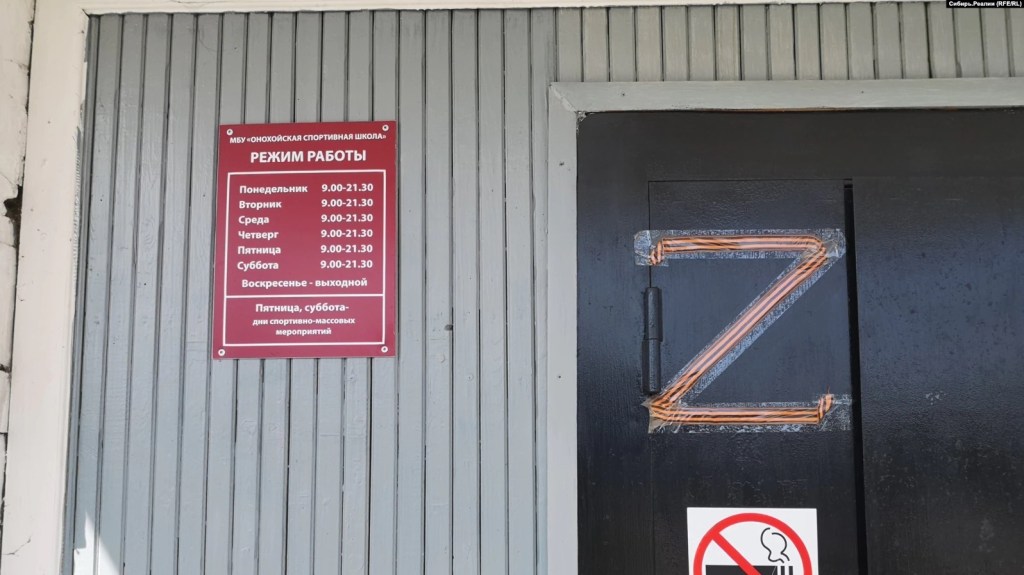
On March 23, a flash mob entitled “Za nashikh” [“For our lads”] was held in Onokhoy. In its wake, a Latin letter Z was pasted on the entrance to the children’s sports school. When Coach Yakovlev saw the sign, he tore it down. But the next day the letter appeared on the door again.


So I tore it off again [says Valery Yakovlev]. On the third day, when I came to practice, the doorkeeper didn’t want to give me the keys to my room. She said she’d been forbidden to give them to me. I think that was their way of provoking me. I snapped. I yelled, “Is this because I tore down the letter?! Did anyone ask you, me, or the children whether we wanted this letter on the door? Who gave you the right to hang it up there on my behalf?! Do you want bombs falling on your heads? Or your children’s heads? Why are you acting like sheep? So, now if I’m against the war, I can’t be given the keys?!” I don’t remember it verbatim anymore, but I said something like that. The whole thing was recorded on a dictaphone and turned over to the police.

I was later summoned to the police station. They kept me there until half past eleven. And the next day they interrogated me for another four hours. Some police boss showed up who started scanning me, checking me out. They asked me what ethnicity I was. The next day, a lieutenant colonel arrived and started scanning me too. It was unpleasant, frankly speaking. I had the feeling that they were digging hard for one specific word, figuring out what my associations were with the Z, so that later they could they tie it in with the army. I felt that they wanted to pin me with this fifteen-year article [i.e., the new article in the Russian criminal code that makes “discrediting” the Russian army punishable by a maximum of fifteen years in prison]. But I argued that there was nothing political about what I did. I just didn’t want the children to get mixed up with that sign. It gives off dangerous vibes.

I told the police that I don’t like the armed forces, I don’t like marching, I don’t like military uniforms. There are people who have this point of view. There is no such sign on the art center. There is no such sign on the comprehensive and music school, there is no such sign on the recreation center or the kindergarten. There’s not even one on the village administration building! But there is a sign like that on the children’s sports school! Why? I run the archery section. I teach kids to shoot. It’s shooting! But I don’t want them to apply their knowledge. What’s not clear about that? I don’t like that letter. And yes, it reminds me of something.

What is the total amount of the fine that the Zaigrayevo District Court imposed on you?

I was tried on three charges at once. The first two were for tearing off the sticker [with the letter Z]. The third was for what I said on tape. On April 5, the Zaigrayevo District Court of Buryatia found me guilty of violating Part 1 of Administrative Offenses Code Article 20.3.3, “Public actions aimed at discrediting the deployment of the Russian Federal Armed Forces.” I was ordered to pay 30 thousand rubles for each of the violations. The total amount of the fine was 90 thousand rubles. I was given two months to pay the fines.

After the verdict was announced, I only said, “But at least I won’t be ashamed in front of the children!”

Could you afford, on your salary, to pay off this amount so quickly?

My salary at the school is 18 thousand rubles a month [approx. 205 euros], and I have a pension of 9 thousand rubles a month as a working pensioner. Of course, it was unpleasant. I thought that I would have to sell my outboard motorboat. Or that I would have to give up my entire salary every month and live for the time being on my pension alone. Since I have a lot of potatoes in the basement, I would have survived.

But my children took pictures of the charge sheet and announced a fundraiser on the internet. Apparently, they circulated it on some messenger services. The donations came to me, along with the messages. I can’t read them without crying, I immediately get a lump in my throat. Some of the messages are brief: “For the fine,” “For the fine to the ghouls,” “For justice,” “Hang in there, bro!” Others are longer: “Accept this donation with my respect and gratitude,” “You are not alone, thank you for your courage and honor,” “All the best to you, normal people are on your side!”, “You are right, thank you,” “Valery, you are a hero of our time,” “Conscience is your main thing,” “Thank you, you are a role model,” “Thank you for peace — no war.”

There was not a single negative comment. People sent messages from different cities around the country. That is the most important thing.

As my children tell me, the comments about the doorkeeper were by no means unsparing in all cases. But I haven’t seen them myself, I’m not on social media.

We ended up raising 200 thousand rubles [approx. 2,300 euros] in two days instead of 90 thousand. I gave the surplus to charity and asked people to stop sending money.

The letter Z taped on the Onokhoy sports school’s front door. Photo courtesy of Sibir.Realii (RFE/RL)

Has the village’s attitude towards you changed?

Some people say “Hello, Valery Anatolyevich” when they meet me, as usual. But others walk by me like they don’t know me. But, apparently, these people were not close to me before. I see surprise in some people’s eyes, like they didn’t know I was that kind of person.

A lot of soldiers from Buryatia have been dying in this war. Is this discussed in your village?

Do you think that people even know this? They don’t know. There is no such information in the public domain. I once went up to a father of two sons of draft age. They are about to be summoned to the military enlistment office. I said to him, “Listen, your sons may be taken away from you, they may be killed. What do you think of that as a father?” He replied, “Well, that means it was fate.” I almost fell over. Another father had a different reaction. He said, “I’d rather go with [my son] and rob a store so that we could go to prison together. He will always be my son, whether he’s a criminal or anything else.” Those are the opinions people have.

I saw on the internet the [internal] passport of a man whose body had been found on the battlefield. He had the same last name as people I knew from a neighboring village. I wanted to call them and ask whether he was their relative. But I couldn’t bring myself to do it. Later, I found out that yes, it was their relative.

I don’t know what to think about this… I can’t talk. Everything inside me hurts! (He cries – Siber.Realii.)

Sometimes you start talking to people, and the person responds by talking at you like the TV. Everything is immediately clear. I ask whether they’ve been watching TV. There’s no one to talk to anymore except old acquaintances. I’m irritated by human stupidity and people’s unwillingness to try and understand anything, their inability to be independent in their judgments.

Where do you get your information from?

I used to listen to Echo of Moscow, but now it’s gone. There are twenty channels on the TV in Onokhoy, but there is nothing to watch. I rarely turn it on. I even have my own personal rating of channels in terms of mendaciousness: Zvezda, TV Centre, and so on. I also have my own ratings for TV presenters. I regard them as frontline soldiers. They do tremendous work, trying to condemn millions of people to death.

I’m not involved in politics, and I don’t trust anyone. First I compare and analyze the information. I use the internet and YouTube. I look for the experts, in both politics and economics. By the way, judging by the forecasts of the latter, we are in for rough times. I have land, several hectares, that I’ve been working for many years. I bought more seeds and potatoes just in case. I have to at least cover my costs as a farmer — diesel fuel, tractor repairs, and dog food.

Can we say that the story with the stickers and the audio recording has come to an end?

Now I am being asked to make a statement in the media saying that I made a mistake, and that the western media blew things out of proportion. They even gave me a sample text written in advance. I don’t know what to do yet. After all, I don’t want to lose my job working with children. I love my job.

Onokhoy, Republic of Buryatia. Photo courtesy of Sibir.Realii (RFE/RL)

Why do you think what has happened to Russia happened?

There should be turnover in the country’s leadership. Eight years and two terms should be the maximum in office, no matter how good a president is. This should be the case in any country to prevent dictatorship and corruption.

Now, after some time has passed, do you not regret that you tore down that letter Z and got into so much trouble for it?

When I saw that sign, I thought for only half a second. Later, I pondered why I did it. I thought for a long time and this is what I discovered: when I was in grades four, five and six, I hated Solzhenitsyn and Sakharov. At the time, I didn’t know why I hated them. [They were] “enemies of the people” and “traitors.” But many years later, after I had read almost all of Solzhenitsyn’s works, when I found out who Sakharov was… My God, how they hammered that stupidity and rubbish into our heads! I don’t want it to happen again. That’s all.

Source: Sibir.Realii (RFE/RL), 18 April 2022. Thanks to Comrade Koganzon for the link. Translated by the Russian Reader. Earlier today, Reuters published a revealing portrait of another brave Russian teacher who resisted his country’s wartime plunge into fascism and also paid the price.

Scapegoats

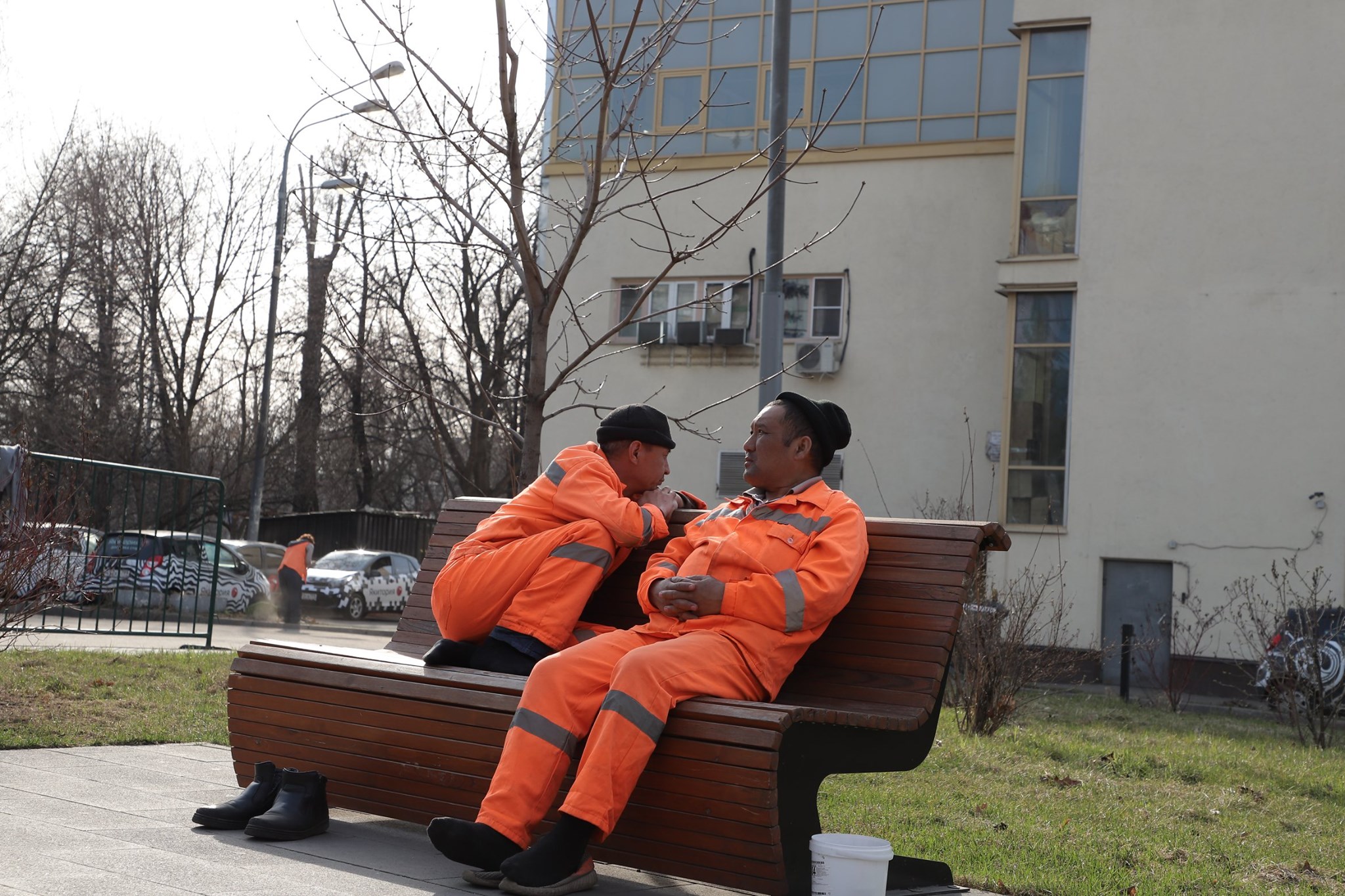
anatrrra-dvornikiCentral Asian yardmen in Moscow taking a break from their work. Photo by and courtesy of Anatrrra

‘People shout “Coronavirus!” at me as if it were my middle name’
Lenta.ru
March 29, 2020

The coronavirus pandemic has led to an increase in xenophobic attitudes towards people of Asian background around the world, even though the US has already overtaken China in the number of infected people, as have European countries, if you add up all the cases. However, according to an international survey of several thousand people, it is Russians who are most likely to avoid contact with people of Asian appearance, although one in five residents of Russia is not an ethnic Russian. Our compatriots of Asian appearance have been subjected to increasing attacks, harassment, and discrimination. Lenta.ru recorded their monologues.

“Being Asian now means being a plague rat”
Lisa, Buryat, 27 years old

Sometimes I am mistaken for a Korean, and this is the best option in Russia, when you are mistaken for Chinese, Koreans or Japanese. The disdainful attitude is better than when you are mistaken for a migrant worker from Central Asia, because the attitude towards them is clearly aggressive. At least it was before the coronavirus.

Now, basically, being Asian means being a plague rat.

A couple of days ago, a young woman approached me at work—I’m a university lecturer. The lecture was on fashion, and naturally I had talked about the epidemic’s consequences for the fashion industry. The young woman works in a Chanel boutique. She said right to my face that “only the Chinese have the coronavirus,” and she tries not wait on them at her store, but “everything’s cool” with Europeans.

My mother has to listen to more racist nonsense because she has a more pronounced Asian appearance than I do, because my father is Russian. For example, there are three women named Sveta at her work. Two are called by their last names, but she is called “the non-Russian Sveta,” although she has lived in Petersburg since the nineteen-seventies. And when I enrolled in school, the headmaster asked my father to translate what he said for my mother, although five minutes earlier my mother had been speaking Russian.

In the subway, she can be told that immigrants are not welcome here and asked to stand up. A couple of times, men approached her on the street and asked whether she wasn’t ashamed, as a Muslim woman, to wear tight jeans. She is learning English, and when she watches instructional videos, people in the subway, for example, say, “Oh, can these monkeys speak Russian at all? They’re learning English!” Police are constantly checking her papers to see whether she’s a Russian citizen. When I was little, we were even taken to a police station because the policemen decided she had abducted an ethnic Russian child—I had very light hair as a child.

Recently, she was traveling by train to Arkhangelsk, and children from two different cars came to look at her. At such moments, you feel like a monkey. (By the way, “monkey from a mountain village” is a common insult.)

Everyone used to be afraid of skinheads. Everyone in the noughties had a friend who had been attacked by skinheads. Everyone [in Buryatia] was afraid to send their children to study in Moscow. But being a Russian Asian, you could pretend to be a tourist: my Buryat friend, who knows Japanese, helped us a couple of times make groups of people who had decided we were migrant workers from Central Asia leave us alone. Another time, the son of my mother’s friend, who was studying at Moscow State University, was returning home late at night and ran into a crowd of skinheads. They asked where he was from, and when he said he was from Buryatia, one of them said, “I served in Buryatia! Buryats are our guys, they’re from Russia,” and they let him go.

Now all Asians are objects of fear. People shout “Coronavirus!” at me on the street as if it were my middle name. They get up and move away from me on public transport, and they give me wide berth in queues. A man in a store once asked me not to sneeze on him as soon as I walked in. I constantly hear about people getting beat up, and I’m very worried. My Buryat girlfriends, especially in Moscow, are afraid to travel alone in the evening. People also move away from them on transport and behave aggressively.

You can put it down to human ignorance, but you get tired of living like this. When you talk about everyday racism with someone, they say they worked with an Asian and everything was fine. This constant downplaying is even more annoying. You haven’t insulted Asians—wow, here’s your medal! It doesn’t mean there is no problem with grassroots racism in multi-ethnic Russia.

“When are you all going to die?!”
Zhansaya, Kazakh, 27 years old

On Sunday morning, my boyfriend, who is an ethnic Kazakh like me, and I got on a half-empty car on the subway. We sat down at the end of the car. At the next station, an elderly woman, who was around sixty-five, got on. When she saw us, she walked up to my boyfriend, abruptly poked him with her hand, and said through clenched teeth, “Why are you sitting down? Get up! We didn’t fight in the war for people like you.”

I am a pharmacist by education, and I have seven years of experience working in a pharmacy. The pharmacy is next to a Pyatyorochka discount grocery store. Recently, I was standing at the register when a woman of Slavic appearance, looking a little over fifty, came in. She came over with a smile that quickly faded from her face when she saw me. I only had time to say hello when suddenly she screamed, “When are you all going to die?! We are tired of you all! You all sit in Pyatyorochkas, stealing our money, and then act as if nothing has happened!”

I didn’t hold my tongue, replying abruptly, “Excuse me! Who do you mean by you all?” The woman was taken aback as if something had gone wrong. Then she said something about “CISniks” [people from the Commonwealth of Independent States], ran out of the pharmacy, and never came back.

I had always dreamed about driving a car since I was a kid. At the age of eighteen, I found a driving school, where I successfully passed the classroom training, and after three months of practice I had to pass exams at the traffic police. I got 100% on the written test the first time. But during the behind-the-wheel exam, the examiner began talking crap the minute I got into the car. When I introduced myself by first name, middle name, and last name, he said something I missed since I was nervous. Then he, a rather obese man, hit me on the thighs and screamed, “Do you want me to say that in Uzbek?”

I immediately unbuckled my seat belt and got out of the car. I gave up for good the idea of taking the driving test.
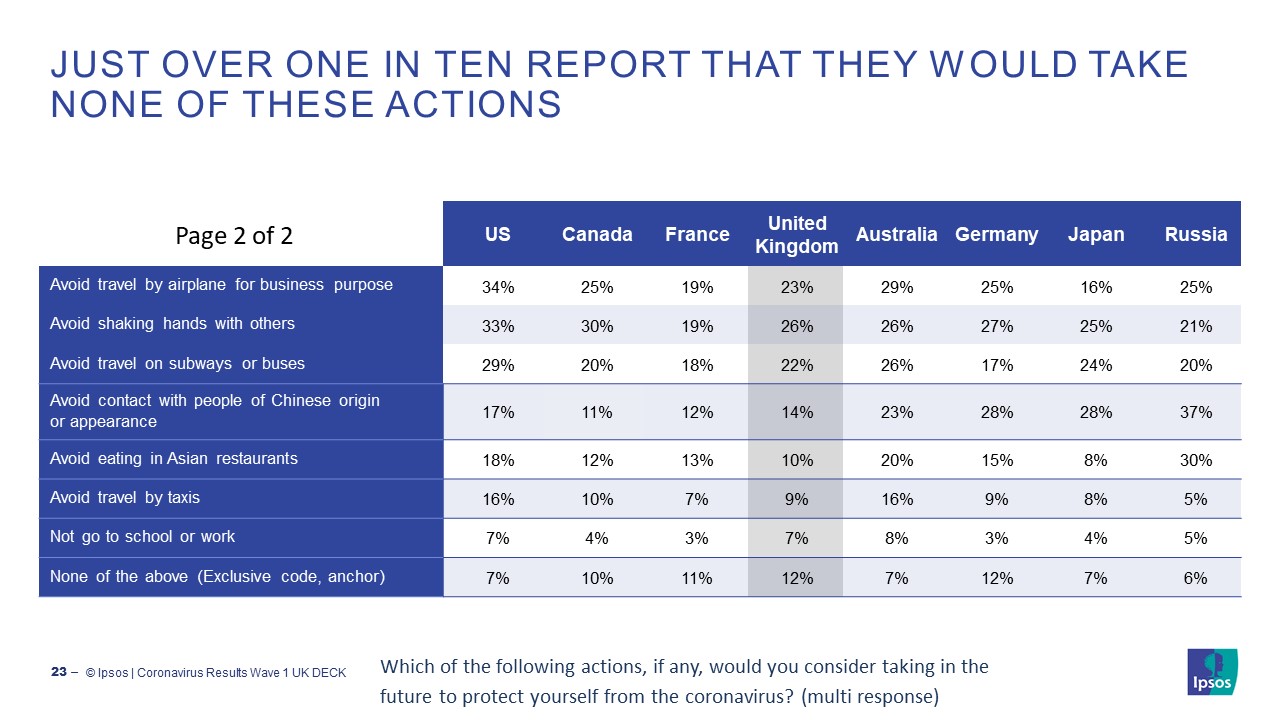
covid-19-coronavirus-actions-ipsos-moriResults of an Ipsos MORI poll published on February 14, 2020

“The chinks piled into our country and brought this plague”
Anna, Buryat, 27 years old

We live in a multi-ethnic country that supposedly defeated fascism, but now every time I go into the subway, the police check my papers as if I were a terrorist. People really have begun to move away from me, give me a wide berth, and throw me contemptuous glances, as if to say “There goes the neighborhood!”

I live near University subway station [in Moscow], and there really are lots of Chinese students there. I feel quite sorry for them: they are constantly stopped by the police in the subway, and people look at them with disgust and demonstratively steer clear of them. If there are Chinese people who have stayed here, they probably didn’t go home for the Chinese New Year. Where would they bring the virus from? If they had gone home for the holidays, they would not have returned to Russia, since the border was already closed by the end of the holidays. Accordingly, the Chinese who are here are not carrying the virus.

Recently, I was going down an escalator. My nose was stuffy from the cold, and so I blew my noise softly. I thought I was going to be murdered right on the escalator: some people bolted straight away from me, while others shouted that I was spreading the contagion.

Recently, in a grocery store, a woman and her teenage daughter were standing behind me. The woman said something to the effect that all sorts of chinks have come to our country and brought the plague. She said it out loud and without any bashfulness, aiming her words at me. She and her daughter were less than a meter away from me, as if I didn’t understand them. My level of indignation was off the charts, but I didn’t say anything.

Another time, I went into my building and approached the elevator. A woman and her children literally recoiled and almost ran out—they didn’t want to ride in the elevator with me! I said I’d wait for the next one. They were not at all perplexed by the fact that I spoke Russian without an accent.

“I will always be second class here”
Malika, Uzbek, 21 years old

Recently, a mother and daughter passed by my house. Tajik yardmen were cleaning the yard. The girl asked the mother why she was rolling her eyes, and the mother explained that the yardmen were probably illegal aliens and terrorists. I walked next to them all the way to the bus stop—it was unpleasant.

During three years of living in Moscow, I very rarely felt like an outsider: the people around me were always sensible, and I was almost never stopped by police in the subway to check my papers. But when I decided to leave the student dorm, I realized that I would always be a second-class person here. It took four months to find an apartment. A girlfriend and I were looking for a two-room flat for the two of us for a reasonable amount of money, but every other ad had phrases like “only for Slavs.” There were jollier phrases like “white Europe” or “Asia need not apply.” But even in cases where there were no such restrictions, we would still be turned down when we went to look at flats.

After a while, I started saying on the phone that I was from Uzbekistan. Some people would hang up, while others would make up ridiculous excuses. In the end, we found a place through friends, but the process was quite unpleasant.

I’m no longer bothered by such everyday questions as “Why is your Russian so good?” I like talking about my own culture if the curiosity is not mean-spirited. But I am terribly disgusted to see how my countrymen are treated on the streets and realize that I’m left alone only because I’m a couple of shades lighter. Because of this, people take me for a Russian and complain about “those wogs” to my face.

“He shouted that I was a yakuza and had come here to kill people”
Vika, Korean, 22 years old

I’m an ethnic Korean. I was born and raised in North Ossetia, and graduated from high school in Rostov-on-Don. I have lived in Moscow since 2015, and I encounter more everyday racism here.

One day a woman on the street started yelling at me to get the hell out of Moscow and go back to my “homeland.” Another time, a madman in the subway sat down next to me and shouted that I was a yakuza and had come here to kill people.

When I was getting a new internal passport at My Documents, the woman clerk asked several times why I was getting a new passport and not applying for citizenship, although I had brought a Russian birth certificate and other papers.

Once my mother was attempting to rent an apartment for us and humiliated herself by persuading the landlords that Koreans were a very good and decent people. I wanted to cry when she said that.

There is a stereotype that Asians are quite smart and study hard, that they have complicated, unemotional parents, and so on. As a teenager, I tried to distance myself as much as possible from stereotypical ideas about Koreans. Now I can afford to listen to K-pop and not feel guilty about being stereotypical.

Generally, we are not beaten or humiliated much, but I don’t feel equal to the dominant ethnic group [i.e., ethnic Russians], especially now, when everyone is so excited about Korean pop culture, generalize everything they see in it to all Koreans and can come up to you out of the blue and say they love doramas. That happened to me once. It is very unpleasant—you feel like a pet of a fashionable breed.

In questionnaires on dating sites you can often find preferences based on ethnicity, and they can take the form of refusals to date people of a certain race, as well as the opposite, the desire to date such people. It is not a sign of tolerance, however, but the flip side of racism—fetishization. It still reduces a person to her ethnic group, suggesting she should be perceived not as an individual, but as a walking stereotype.

“Several times it ended in attempted rape”
Madina, from a mixed family (Tatar/Tajik/Kazakh/Russian), 25 years old

I was born in Moscow. My Russian teacher from the fifth grade on liked to repeat loudly to the entire class, “Can you imagine? Madina is the best Russian and literature student in my class!” By the end of the sixth grade, my classmates were sick and tired of this, but instead of boning up on Russian, they decided to throw me a blanket party. They got together, backed me into a corner, and kicked the hell out of me.

I recently returned from doing a master’s degree abroad and was looking for an apartment to rent in Moscow. Several times, landlords offered to rent an apartment without a contract, explaining that I undoubtedly needed a residence permit. When I showed them my internal passport and Moscow residence permit, they turned me down anyway.

Before moving to the United States, I had to forget about romantic relationships for several years because several times it all ended with attempted rape under the pretext “You’re an Asian woman, and I’ve always dreamed of fucking a woman like you  in the ass.”

Nor was it strangers I’d met on Tinder who told me this, but guys from my circle of friends at school and university. There were three such incidents, and all of them combined racism, objectification, and a lack of understanding of the rules of consent.

“She looked at me like I was death, shoved me, and ran out of the car”
Aisulu, Kazakh, 22 years old

Recently, I was a little ill: I had a runny nose and sneezed once in a while. I wouldn’t even say it was the flu, just the common cold. I decided to attend lectures and put on a mask for decency’s sake.

I went into the subway, where people got up and moved away from me twice. I wasn’t particularly offended, but it was unpleasant when I stood next to a women after moving to another car and sneezed. She looked at like I was death, shoved me, and ran out of the car. That was quite odd.

I told a classmate about the incident, and she asked why I was wearing a mask, because it attracts more attention. I felt even worse, and took it off.

Translated by the Russian Reader

Spooky Knowledge and the Russian Police State

gabyshevOpposition shaman Alexander Gabyshev was detained while walking to Moscow to exorcise Vladimir Putin. Photo courtesy of yakutia.info

Superstitious Democracy
Pavel Aptekar
Vedomosti
September 20, 2019

The arrest and possible criminal prosecution of self-declared shaman Alexander Gabyshev, who was en route to Moscow to exorcise Vladimir Putin, whom the shaman had dubbed a demon, is less a consequence of Gabyshev’s involvement in protest rallies and more the outcome of a serious attitude toward superstitions and occult practices on the part of high government officials and the security forces.

On Thursday, Gabyshev’s traveling companions reported that security services officers, armed with machine guns and billy clubs, had raided their tent camp on the border between Buryatia and Irkutsk region, where the shaman was spending the night. The siloviki detained Gabyshev and spirited him away on a police bus that took off towards Ulan-Ude.

In the afternoon, the Buryatia Interior Ministry reported, without naming a name [sic], that Gabyshev had been detained by order of a police investigator on suspicion of his having committed a crime in Yakutia, and he would be extradited to Yakutsk. According to sources cited by news agencies and TV Rain, Gabyshev could be charged with extremism.

Gabyshev’s trek to Moscow had already been marred by the arrest of his traveling companions, which partly sparked the unrest in Ulan-Ude that led to a protest rally at which protesters demanded a recount of the recent mayoral election in the city and generated a tactical alliance between shamanists and the Communists.

In our age of smartphones and supercomputers, the attempt to exorcise demons from the Kremlin seems like a joke, just like the possible charge of extremism against Gabyshev: it transpires that occult rituals are regarded as real threats to the Russian state.

We should not be surprised by this, however. Many of our fellow Russians have lost faith in the rational foundations of the world order and the state system. The paucity of scientific explanations in Russian society has been compensated by superstitions and conspiracy theories, which are broadcast by national TV channels, among others.

But that is only half the problem. Such explanations of reality and occult methods are widespread among the highest ranks of the security services, that is, among people who have the ear of the country’s leaders. Cheka officers were intensely interested in occultism in the 1920s and 1930s, an interest shared, later, by the NKVD and the Nazi secret services.

In post-Soviet Russia, arcane practices were promoted by the late General Georgy Rogozin, who served as deputy chief of the president’s security service.

“There are powerful techniques that reveal psychotronics. This is the science of controlling the brain. […] In order to see the trajectory of a person’s life, their ups and downs, it is enough to know when they were born,” Rogozin told Komsomolskaya Pravda in an interview.

In December 2006, General Boris Ratnikov of the Federal Protective Service (FSO) told Rossiiskaya Gazeta that the secret services had tapped into the subconscious of US Secretary of State Madeleine Albright and detected a “pathological hatred of Slavs” and dreams of controlling Russia. In 2015, Security Council Secretary Nikolai Patrushev reproduced this as Albright’s “statement” that Siberia and the Far East did not belong to Russia.

We can only guess what threats the current security forces were able to “scan” (concoct, that is) in Gabyshev’s subconscious.

Translated by the Russian Reader