Russian Police Tortured Jehovah’s Witnesses in Surgut with Stun Guns

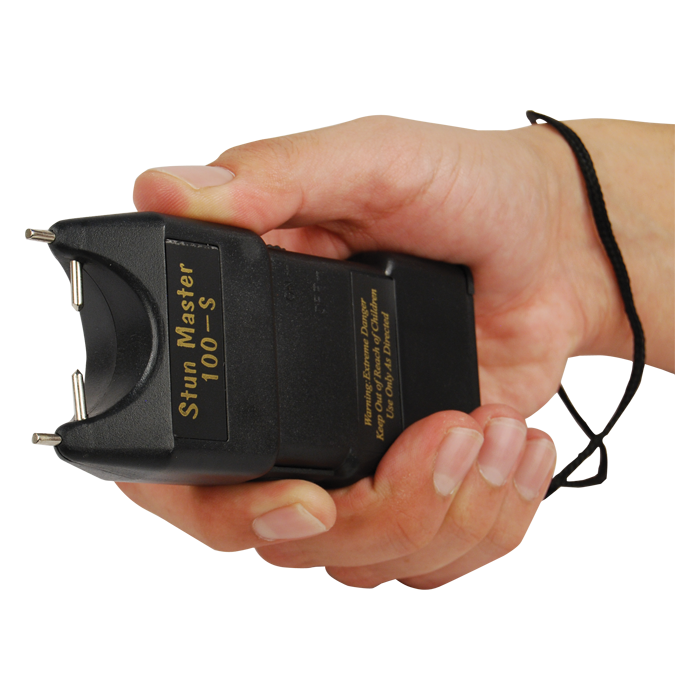
stun master 100-sA stun gun like the Stun Master S-100 could have been used by Russian police on recalcitrant Jehovah’s Witnesses in Surgut. The Stun Master delivers an electric shock of 100,000 volts and sells for a mere $22 at diyhomeprotection.com.

Forensic Examination Confirms Surgut Jehovah’s Witnesses Tortured with Stun Gun
OVD Info
March 28, 2019

Defense lawyers commissioned an independent forensic examination of the wounds on the bodies of six Jehovah’s Witnesses in Surgut. The Stealth Forensic Research Institute concluded five of the men could have been tortured with stun guns. OVD Info has a copy of the institute’s findings.

Burns from stun guns were found on Vyacheslav Boronos, Yevgeny Kairyak, Kirill Severinchik, Alexei Plekhov, and Artyom Kim.

The forensic examiners concluded the wounds on the bodies of the arrested men were consistent with wounds they could have received if they had been shocked with stun guns. The examiners arrived at the findings after analyzing medical files and considering the opinions of experts on the wounds and the photographic and video documentation of the wounds.

In mid February, numerous police raids and searches were carried out in the homes of Jehovah’s Witnesses in Surgut. At least seven of the men detained during the raids complained they were beaten, humiliated, and tortured with stun guns. OVD Info published an account of these events, as provided by the victims’ lawyer.

On March 27, the Russian Investigative Committee reported the Jehovah’s Witnesses detained during the raids in Surgut had not been tortured with stun guns. But they had been subjected to physical force due to the fact that they, allegedly, had resisted arrest. The Investigative Committee thus explained why there had been bruises and abrasions of the legs of the Jehovah’s Witnesses.

In April 2017, the Russian Supreme Court ruled that the Administrative Center of Jehovah’s Witnesses in Russia was an extremist group and banned its work nationwide. In August 2017, all Jehovah’s Witness congregations in Russia were placed on the list of officially banned “extremist” groups.

Translated by the Russian Reader

Here is a list of the articles I have previously published about the new campaign of persecution of Russian Jehovah’s Witnesses:

_________________________________________

SM-100S-bFeatures:

  • 100,000 Volts
  • 4.5″ Tall
  • Safety Switch
  • Wrist Strap
  • Lifetime Warranty
  • Uses One 9V Energizer Eveready Alkaline Battery (not included)

How To Use:

  • A short blast of 1/4 second will startle an attacker, cause minor muscle contractions and have a repelling effect.
  • A moderate length blast of 1 to 4 seconds can cause an attacker to fall to the ground and result in mental confusion.  It may make an assailant unwilling to continue an attack, but will be able to get up almost immediately.
  • A full charge of 5 seconds can immobilize an attacker, cause disorientation, loss of balance, falling to the ground and leave them week and dazed for several minutes afterward.

Note: This Stun Master stun gun will have an effect anywhere on the body, but the maximum effect is in the following areas:

  • Upper Shoulder
  • Below Rib Cage
  • Upper Hip

How Stun Guns Work:

The stun gun does not rely on pain for results. The energy stored in the gun is dumped into the attacker’s muscles causing them to do a great deal of work rapidly.

This rapid work cycle instantly depletes the attacker’s blood sugar by converting it to lactic acid. In short, he is unable to produce energy for his muscles, and his body is unable to function properly. The stun gun also interrupts the tiny neurological impulses that control and direct voluntary muscle movement. When the attacker’s neuromuscular system is overwhelmed and controlled by the stun gun he loses his balance.

Should the attacker be touching you, the current will NOT pass to your body! Stun Master has been a leading brand in the stun gun industry since 1994 making it a true icon in the world of self-defense. This type of success for so many years in a competitive field is the finest recommendation any product could be given.

Source: DIY Home Protection

_________________________________________

Article 3 of the European Convention on Human Rights prohibits torture, and “inhuman or degrading treatment or punishment”. There are no exceptions or limitations on this right.

Article 9 – Freedom of thought, conscience and religion

1. Everyone has the right to freedom of thought, conscience and religion; this right includes freedom to change his religion or belief and freedom, either alone or in community with others and in public or private, to manifest his religion or belief, in worship, teaching, practice and observance.

2. Freedom to manifest one’s religion or beliefs shall be subject only to such limitations as are prescribed by law and are necessary in a democratic society in the interests of public safety, for the protection of public order, health or morals, or for the protection of the rights and freedoms of others.

The Russian Federation signed the European Convention on Human Rights on February 28, 1996, and ratified it on May 5, 1998.

Alexander Verkhovsky: Russia’s Campaign Against “Religious Extremism”

yaltinskoe_delo_hizb_ut_tahrir_1.jpgRussia has used its official ban on the Muslim movement Hizb ut-Tahrir to go after Crimean Tatars in occupied Crimea, such as these six men, charged in the so-called Yalta Case. The fact that the defendants are neither terrorists nor members of Hizb ut-Tahrir has not stopped Russian authorities from prosecuting them for these imaginary crimes. Courtesy of Crimean Tatar Resource Center

Russia’s Campaign Against “Religious Extremism” Has Been Expanding: It Should Be Reined In
Alexander Verkhovsky
Nezavisimaya Gazeta
March 5, 2019

The dramatic events of recent weeks surrounding the Jehovah’s Witnesses, including the harsh prison sentence handed down to Dennis Christensen, and the torture of detained believers in Surgut, make us wonder how unique what has been happening to them has been.

First, we should recall the bare facts. The Russian authorities have banned numerous texts published by the Jehovah’s Witnesses, including their translation of the Bible into Russian. All their local branches have been banned and their property confiscated. More than forty criminal cases are underway, cases in which 120 people, aged 23 to 84, have been charged. Twenty-five of those charged have been remanded in custody. All of them have been charged with going on with the work of a banned “extremist” organization (punishable under Article 282.2 of the Russian Federal Criminal Code), although this amounted only to holding prayer meetings and group discussions

The Russian Supreme Court decided to ban the Jehovah’s Witnesses completely on April 20, 2017. Criminal cases based on the ban were launched a year later, that is, over a hundred suspects were charged in a matter of ten months, and yet not a single case has gone to court yet.

In fact, Christensen was convicted on the basis of an earlier ban of a local Jehovah’s Witness branch. There were eight such bans of local branches. Unlike his co-religionists, convicted earlier under the same ban, Christensen was sentenced to actual prison time. After the so-called Yarovaya package was adopted by the Russian parliament, he had to be sentenced to no less than six years in prison, and this was what happened. It should make us extremely concerned about what will happen to current and future suspects, especially the ones now jailed in remand prisons.

But what has happened to the Jehovah’s Witnesses in Russia is not unique. In exactly the same way, the peaceable followers of the fundamentalist movement Tablighi Jamaat and the peaceable followers of the quite moderate Turkish theologian Said Nursi have been banned in Russia and persecuted under the same law in the Russian Criminal Code.

The pattern was the same. First, the texts published by the groups were banned because, allegedly, they claimed the superiority of their religious doctrines to others and contained hostile descriptions of non-believers. Then, the organizations themselves were banned for the same reasons, including using the banned texts in their worship services. Finally, the Russian authorities prosecuted believers for “going on with the work” of their now-banned organizations. Moreover, the courts usually gave defendants probation sentences at first. Subsequently, however, people convicted on the same charges were sent to prison and the sentences handed down were harsher.

The Muslim activists were also tortured by Russian law enforcement. The current shock over events in Surgut can be put down to the fact that Russian society is in some sense inured to the torture of Muslims suspected of “radicalism.”

The Russian Supreme Court banned all three groups: the Jehovah’s Witnesses, the followers of Said Nusri, and Tablighi Jamaat. For some reason, it paid no mind to the fuzzy definition of “extremism” to which it resorted in all three rulings. It is true that all three religious doctrines claim only their way is the true way and that all other ways are false, and their texts occasionally contain rather harsh descriptions of non-believers. The current Russian legal definition of “extremism” is such that these things can be considered evidence of “extremism,” but you could find more or less the same things in nearly all religious doctrines. Such claims are typical of confessions of faith, and, as such, they are protected by the Russian Constitution.

With regard to criminal cases of incitement to hatred, including religious hatred, in 2011, the Supreme Court ruled that criticism of religious convictions, religious rituals, and religious groups is not a criminal offense. For some reason, however, this ruling has not been applied in civil cases banning religious literature and organizations, although the conflict between the procedure for banning religious “extremism” and Russia’s constitutionally enshrined freedom of conscience is striking. Perhaps unraveling this conflict is a job for the Russian Constitutional Court?

Returning to the Jehovah’s Witnesses, we should again pay attention to the scale of their persecution. The number of accused Jehovah’s Witnesses in terms of one calendar year has been much greater than the numbers of the two Muslim groups mentioned. It is more comparable to the persecution of the radical movement Hizb ut-Tahrir al-Islaami.

Hizb ut-Tahrir was banned in 2003 as a terrorist group, although it has not been implicated in terrorism. The Russian authorities were clearly in a hurry to ban it, so the actual danger it posed or did not pose to the constitution was not even at issue. Members of the movement have been charged under the anti-terrorist laws in the criminal code, and so their prison sentences have been even harsher. But there are similarities with the other religious groups we have been discussing: participating in group gatherings and reading the same texts were offered as evidence of their criminal deeds.

Another serious conflict emerges in this case between the Russian Constitution and the articles in the Russian Criminal Code dealing with “extremist” (Article 282.2) and “terrorist” (Article 205.5) groups. Let us assume for simplicity’s sake that a group has been banned altogether legitimately. When this happens, the group’s formal and informal members are obliged to honor the court’s ban. But they have not changed their views, and they still associate with the same group of people. It is likely they would want to discuss what to do in the circumstances: perhaps, for example, establishing a new group based on slightly different principles. If we are dealing with a dangerous group that has been rightfully outlawed, such discussions and meetings could not help but interest the police and security services, but they are hardly criminal in their own right, for these people have not been deprived of their basic civic rights, including the right to assemble. Besides, not only active members could take part in these meetings but also outsiders, and yet law enforcement does not especially distinguish between the two groups of people in practice.

These problems are more apparent when we speak of religious communities. The Russian Constitution enshrines the right to practice one’s religion both alone and in the company of others. The work of any religious organization mainly consists in praying together and other joint activities, such as confessing and preaching as part of religious services. If a religious association has been banned, its members are in effect barred from exercising their constitutional right. If Russia’s current anti-“extremist” laws are meant to enact such severe restrictions of a fundamental human right, this have never been explicitly stated. So, again, one would like the Russian Constitutional Court to issue a clarification. It is, after all, a matter of tens of thousands of Russian nationals potentially facing criminal charges.

Since there have not been any clarifications, and the current crackdown has only been picking up steam, many have wondered how it happened. There is hardly a single, simple answer to this question. We might say that in their campaign against potentially dangerous movements, the Russian authorities have gone much too far and made a considerable number of mistakes. One of the reasons is that they listened to politically and religiously biased “experts,” and they continue to heed their advice, judging by the way the anti-“extremist” campaign has progressed in the religious realm. Our many years of experience with these cases have shown that counterarguments by religious studies scholars and legal experts rarely reverse the current tendency. They prove useful only when the authorities are willing to listen to them for reasons of their own.

The growing campaign against the Jehovah’s Witnesses has been horrifying, but there is also the chance that this time someone in the elite will finally come to their senses and change their mind. The Jehovah’s Witnesses clearly pose no threat whatsoever to Russian national security. Moreover, it is clearly just as impossible to eradicate their religion in Russia, since it would be wrong to jail or force over 100,000 people to emigrate, especially since Russia’s Jehovah’s Witnesses did not give up their faith in the worst of times.

The problem, however, is whether the officials who make key decisions about large-scale crackdowns could find acceptable means for reconsidering their earlier decisions. If this does happen, it matters, given the constitutional conflicts described above, whether anti-“extremist” policies will be reconsidered, if only in the religious realm.

Alexander Verkhovsky is director of the SOVA Information and Analysis Center. Thanks to Nikolay Mitrokhin for the heads-up. Translated by the Russian Reader

An Islamophobic Witch Trial in Moscow Ends with Hefty Sentences for Swarthy Men Who Read Banned Books

KMO_169609_00017_1_t218_222045Defendants in the trial holding up a homemade placard that reads, “Oh people! Wake up. We’re not tourists.” Photo courtesy of Kristina Kormilitsyna and Kommersant. Thanks to Sergey Abashin for the heads-up

In Moscow, Hizb ut-Tahrir Defendants Sentenced to 11 to 16 Years in Prison
OVD Info
February 15, 2019

The Moscow District Military Court has sentenced defendants in the so-called Hizb ut-Tahrir case to eleven to sixteen years in medium security penal colonies, reports Moscow News Agency.

The men were found guilty of violating either Russian Federal Criminal Code Article 205.5 Part 1 or Part 2, which criminalizes involvement in the work of an organization deemed a terrorist organization. According to investigators, the accused men read “banned literature, including religious and ideological texts” in a rented apartment in Moscow from October 7, 2016.

The prosecutor had originally asked the court to sentence the accused men to thirteen to seventeen years in prison.

Interfax reports that Zafar Nodirov, the cell’s alleged leader, Farhod Nodirov, and Hamid Igamberdyev received the maximum sentences.

Sobirjon Burhoniddini, Alijon Odinayev, Muradjon Sattorov, Otabek Isomadinov, and Aziz Hidirbayev were sentenced to eleven to twelve years in maximum security penal colonies.

Four of them did not deny their involvement in Hizb ut-Tahrir. They claimed the organization was a political party whose members did not engage in prohibited activities.

The twelve natives [sic] of Central Asia were arrested in December 2016. Three defendants in the case pleaded guilty and were sentenced to ten to twelve years in maximum security penal colonies.

Hizb ut-Tahrir is an international pan-Islamist political organization. It is banned in a number of Muslim countries and Russia. It is also banned in Germany for not recognizing the state of Israel. The SOVA Center for Information and Analysis has argued the party has been wrongfully deemed a “terrorist” organization in Russia.

Thanks to Elena Zaharova for the heads-up and for caring. Translated by the Russian Reader

___________________________________________________

Why Ban Hizb Ut-Tahrir? They’re Not Isis—They’re Isis’s Whipping Boys
William Scates Frances
The Guardian
February 12, 2015

Another day, another Islamic State (Isis) meme. This one is a rather well done mimicry of the pamphlet style of Hizb ut-Tahrir. Its title reads “Hizb ut-Ta’khir”—translated roughly as the “party of delay”—and its bold headline reads, “Establishing the Khilafah since 1953.”

Beneath, the disclaimer reads: “I know, we have got nowhere so far, but we have lots of conferences and heaps of flags and are really good at sitting in cafes.”

This is not the first meme about Hizb ut-Tahrir to be spread around the oft deleted and resurrected pro-Isis Twitter handles. The Dawlah twittersphere (Dawlah meaning “state,” shorthand for Islamic State) is full of them, all of a similar theme, all targeting Hizb ut-Tahrir.

Reading much of the commentary in recent months, you would not expect Hizb ut-Tahrir to be the target of Isis supporters’ mockery. However, contrary to the common equivalency made between the two groups, the gap between Isis and the Hizb has never been wider. They are not only very different, but for some time have been in active opposition.

Hizb ut-Tahrir is a nonviolent political group that imagines itself as speaking truth to power from within the belly of the beast. Isis is a violent utopian movement that views staying in the west as inherently suspect. Hizb ut-Tahrir’s membership are generally inclined towards the classical Islamic sciences, while Isis affiliates are “Salafi-Jihadi” in approach.

Hizb ut-Tahrir has a party structure, with defined roles and official party lines. Isis is scattered, with isolated spokespeople of varied authority and rhetorical skill. The primary similarity between the two is their religion, but when their membership, approach, rhetoric and demographics are so utterly distinct, the comparison stops there.

In Australia, Hizb ut-Tahrir is something like the Muslim equivalent of a socialist student movement. Its prominent members are mostly tertiary-educated and imagine themselves as a sort of Muslim consulate to the west. They are avowedly nonviolent in their approach, but do not shy away from supporting specific “mujahedeen” groups in current conflicts, though this support has rarely been found to go beyond the rhetorical and is confined to wars within the Muslim world.

Like the aforementioned socialist student groups, their main form of communication comes through pamphlets and fiery speeches delivered by a small cadre of speakers from within their party structure.

Isis, on the other hand, is nothing like this. While in Raqqa and Mosul the group has something approaching a governance structure, in Australia the supporters of the group have no coherent hierarchy. Rather, “Dawlah fanboys,” as they are known to some, are scattered individuals confined to hidden Facebook groups, anonymous Twitter accounts and the occasional coy “spokesperson.”

They imagine the Islamic State as a sort of Muslim utopia, a land “free of humiliation.” They view themselves as destined to fight the good fight against the tyranny and disbelief which defines a postcolonial Muslim world. That they use memes is telling; they are a wholly different demographic from Hizb ut-Tahrir. Much of their membership seems to be both less educated and of a lower socioeconomic status. They deride the Hizb as all talk, and say as much often and publicly.

On the other side, Hizb ut-Tahrir has, in the few media releases in which they address Baghdadi directly, invoked verses of the Qur’an regarding the curse of God upon tyrants and their servants. This rhetoric has only increased since a senior member of the group was reportedly executed in Aleppo for “questioning Baghdadi’s self-proclaimed Caliphate.” Hizb ut-Tahrir called dibs on the Caliphate, and they view Baghdadi’s group and his title as wholly illegitimate.

Much was made of Wassim Dourehi’s refusal to denounce Isis during his Dateline interview with Emma Albarici. This was no show of support; Dourehi’s refusal was Hizb ut-Tahrir exposing the media’s ignorance of their movement. Further, it only takes a cursory look at Hizb ut-Tahrir’s website to see that they are embroiled in a bitter and ongoing feud with Isis.

While Tony Abbott has not confirmed whether the federal government will attempt to ban Hizb ut-Tahrir, it would be foolish to do so. Hizb ut-Tahrir thrives on bans. It is banned in a large number of the regimes of “taghout”—tyrants, as their language describes it—and they wear these bans as a mark of honor, as a sign of their legitimacy and the fear their truths inspire. Indeed, the lack of a ban is used by some Isis supporters to prop up a persistent rumor that Hizb ut-Tahrir is a government front.

As it stands, Hizb ut-Tahrir is a whipping boy. Whenever Isis does something bad, they are dragged out in public to get a flogging. The idea that banning the Hizb will somehow reign in Isis or stop the spread of their rhetoric shows just how much this ignorance pervades discussions of public policy.

A Russian Religious Revival?

churchMany Russian Orthodox churches are stunningly beautiful both inside and out, but the number of Russians who attend church services regularly and make an effort to observe the tenets of the faith is actually quite tiny. Photo of St. Demetrios of Thessaloniki Church in Kolomäki, St. Petersburg, by the Russian Reader

There Are No More than One to Five Percent Genuine Russian Orthodox Believers in Rostov Region
The Heads of Most So-Called Believers Are Filled with a Mishmash of Christianity, Superstition and Paganism  
Sergei Derkachov
donnews.ru
January 11, 2019

Despite the robust building of churches in Rostov Region and the Russian Orthodox Church’s growing role in civic life, the number of practicing Russian Orthodox Christians in the region is still quite small, according to police statistics. Moreover, genuine Orthodoxy has a worse time of things in Rostov Region than in Russia as a whole.

There are no official statistics of how many people in Rostov Region identify themselves as Russian Orthodox. However, we can make a rough estimate based on other statistics. Thus, a couple of years ago, Merkury, Metropolitan of Rostov and Novocherkassk, said that, during the 2014–2015 school year, 72% of pupils in Rostov-on-Don schools elected to study “Foundations of Orthodox Culture.” In 2015–2016, the corresponding figures were 74.4%; in 2016–2017, they were 80.8%.

Recently, donnews.ru wrote about a public opinion poll conducted among Rostov-on-Don residents in 2017. 65.6% of those surveyed identified themselves as Orthodox, 29.2% as atheists, and 2.8% as Muslims.

In other words, the vast majority of people in Rostov consider themselves Russian Orthodox Christians. However, practicing believers, meaning people who go to churches and attend church services, at least during major church holidays, is considerably  smaller.

Police tallies of the numbers of people who go to church on Christmas and Easter are basically the only way to estimate the real numbers of practicing Orthodox believers in the regions and Russia as a whole, since those who identify themselves as Orthodox but do not attend church regularly usually think it necessary to go to church on the main Christian holidays.

According to the Rostov Regional Office of the Russian Interior Ministry, approximately 42,000 people attended Christmas services in 2019, meaning a mere one percent of the region’s population. A similar figure was reported by the police in 2018. In 2017, approximately 50,000 people attended Christmas services in Rostov Region. The highest number of attendees, 80,000 people, was recorded in 2015.

2.6 million people went to Christmas services nationwide. Based on the current estimated population of Russia, this leaves us with less than two percent of the total population. In Rostov Region, however, with one percent of the population attending church services, this difference is more arresting. Curiously, according to a poll by VTsIOM, 72% of Russians observed Orthodox Christmas. Clearly, what this meant in the vast majority of instances was just another big holiday feast.

According to Russian sociologist Nikolay Mitrokhin, author of The Russian Orthodox Church: Its Current State and Challenges, although the number of churches has increased, the number of believers in Russia has basically remained the same.

“People who attend Christmas services in various regions account for around two percent of the entire population. This gives you a sense of the size of the Russian Orthodox Church’s current impact. In recent years, seventy to seventy-five percent and, in some cases, eighty percent of those polled have identified themselves as Russian Orthodox. And yet the number of people capable of dragging themselves to church on the most important holiday next to Easter is within the margin of statistical error,” says Mitrokhin.

The figures are much better for Easter. According to police statistics, 4 million to 4.3 million people on average go to church on Easter. The Interior Ministry did not supply figures for 2017 and 2018 in Rostov Region. In 2014, 135,000 people attended Easter services; in 2015, over 260,000 people; and in 2016, 326,000 people. In this case, however, we should take two important factors into account. First, the difference in weather conditions: Easter usually falls on a Sunday in late April or early May, whereas Orthodox Christmas is fixed on the calendar: the night of January 6 and the wee hours of January 7. Second, in the case of Easter, the police count not only people who attend church services but also people who stop by church only to have their Easter dinner delicacies blessed.

Generally, the number of people who go to church once a year on Christmas and Easter is many times lower than those who identify themselves as Russian Orthodox in opinion polls. It is also worth noting that a considerable segment of the populace persists in visiting cemeteries on Easter, deeming it almost an obligation or an Orthodox tradition, although the Church has designated a different holiday for the purpose, Radonitsa, observed during the second week after Easter.

This points to Russian Orthodoxy’s other major probem: the populace’s spiritual illiteracy. In 2012, Boris Dubin, head of sociopolitical research at the Levada Center, claimed that, according to their surveys, only forty percent of Russian Orthodox believers in Russia believed God existed. Thirty percent of the faithful were sure, on the contrary, that God did not exist. Only twenty-five percent of Russians observe the Lenten fast, according to annual polls by the Levada Center. In recent years, however, the Great Fast has been treated by some people as a diet that has no ideological and religious implications. People also often equate giving up one or two food items with keeping the fast.

The minds of most Orthodox Russians are filled with a mishmash of Christianity, superstition, and paganism. Even Metropolitan Merkury recently said Russians are “complete spiritual illiterates and devoid of religious education.”

“Our people do not have a clue about Holy Scripture, sacred history, and the deeds of Russian saints. They do not link these things together into a single whole,” he said.

The well-known Russian priest and writer Andrei Lorgus commented on these circumstances a year ago on his Facebook page.

“Every year, during Easter and Christmas, I look at the Interior Ministry’s tallies. Of course, they do not match our own estimates, which are based on records of parishioners. You could say that the holiday pool [sic] of Orthodox in Russia is less than 3.5%. We have even had people who were not baptized attend holiday night vigil services. So, the Church in Russia is numerically no more than three percent. There are three percent of us! Are there too few of us? Considering our tragic history, it is hard to say. But when perestroika kicked off, and the Church was restored to its rights, we expected more. As someone who was a neophyte in the 1980s, I am disappointed. Or, rather, I was disappointed, but I am not disappointed anymore. Indeed, there was no way there could have been more, despite the huge efforts and sacrifices that were made.”

Finally, Patriarch Kirill himself recognizes the small number of true Orthodox Christians in Russia. During a sermon delivered on November 24, 2018, at Christ the Savior Cathedral in Kaliningrad, he drew the flock’s attention to the difference between statistics and reality.

“Although statistically the majority of Russians now say they belong to the Orthodox faith, statistical belonging and actual strict observance are different things. We must work to make our people practicing Russian Orthodox Christians, to make people feel with their minds and hearts how vital it is to be with God, to make them feel the power of prayer, to make them feel how prayer closes the chain through which communication between them and God is effected.”

According to the patriarch, the Russian people are still only at the very start of their spiritual rebirth.

Thanks a billion to Nikolay Mitrokhin for the heads-up. Translated by the Russian Reader

Church and State

vladimir sunset

Nearly Fifty Russian Orthodox Church Affiliates Awarded Presidential Grants
Vedomosti
Yelena Mukhametshina
October 31, 2018

At least 47 organizations affiliated with the Russian Orthodox Church (ROC) have been awarded presidential grants totalling 55.3 million rubles [approx. 734,000 euros] in the latest NGO grants competition, according to the Presidential Grants for Civil Society Development Foundation website. They include lay religious organizations, monasteries, parishes, and dioceses.

Thus, the parish of the Church of the New Russian Martyrs and Confessors in Smolensk has been awarded 2.2 million rubles for a project entitled “The Pearl Necklace of Holy Russia,” meant to encourage youth tourism and cooperation with the Belarusian Orthodox Church. The ROC’s Yakutia Diocese has been awarded 2.5 million rubles for a project entitled “Yakutia’s Churches Are Russia’s Historic Legacy.” The grant winners plan to produce three documentary films, ten videos in a series entitled “Reading the Gospel Together,” and one video about Easter. The largest grant awarded to these NGOS was 10 million rubles. Mercy, an ROC organization that helps homeless people, won this grant.

According to Ilya Chukalin, executive director of the Presidential Grants for Civil Society Development Foundation, it is easy to explain why organizations associated with the ROC have won grants. The Orthodox Initiative Grant Competition has been held in Russia since 2005, so these NGOs have know-how in writing grants and also submit numerous grant applications. As Chukalin explains, the more applications submitted, the better the chances of winning.

“Besides, the grant applications are mainly submitted by church parishes, often in villages. Grants have to be submitted by legal entities, and there are only two types of legal entities in small villages: local governments and church parishes. Usually, they apply for small grants—for example, to build a park or sports facilities in the village,” Chukalin said.

Chukalin, however, underscored the fact that Muslim and Jewish projects have also been awarded grants.

Grants totalling 41 million rubles [appox. 554,000 euros] were awarded to eleven branches of the Combat Brotherhood, headed by Boris Gromov, former governor of Moscow Region, and Russian MP Dmitry Sablin. The Combat Brotherhood’s head office won the largest grant, worth approximately 20 million rubles, for a project entitled “Memory Is Stronger than Time,” dedicated to the thirtieth anniversary of the withdrawal of Soviet troops from Afghanistan. The Russian Union of Youth (RSM) has been awarded 63.5 million rubles [approx. 843,000 euros] to involve young people in developing small towns and settlements.

The largest grant in the competition overall was awarded to the Concerts, Festivals, and Master Classes Agency, which will spend nearly 112 million rubles on a project entitled “Yuri Bashmet to Russia’s Young Talents.”

A total of 19,000 applications was submitted to two competitions in 2018. 3,573 projects were awarded grants. The total amount awarded was 7.8 billion rubles [approx. 103.6 million euros].

fullscreen-1rf7

The largest presidential grants awarded to NGOs. 1) Concerts, Festivals, and Master Classes Agency, “Yuri Bashmet to Russia’s Young Talents,” 111.97 million rubles; 2) Association of Art and Culture Schools, “Second Tertiary Degrees for Creative Professionals,” 80.64 million rubles; 3) New Names Foundation, “Russia’s New Names,” 68.96 million rubles; 4) Russian Union of Youth, “The Space of Development,” 63.51 million rubles; 5) Golden Mask Festival, National Theatrical Prize, 50 million rubles; 6) Northern Capital Foundation, “A Road through War,” 40.97 million rubles; 7) Elena Obraztsova Foundation, International Competition for Young Opera Singers, 40.72 million rubles; 8) Butterfly Children Foundation, Compiling a Registry of Epidermolysis Bullosa Patients, 35 million rubles; 9) Tyumen Development Foundation, Local Community Development Centers, 27.04 million rubles; Peace Avenue Foundation, “The Country’s Main Law,” 24.92 million rubles; Urals Musicians Association, Urals Music Night International Festival, 23.86 milliion rubles. Source: Presidential Grants for Civil Society Development Foundation, October 2018

Alexei Makarkin argues that this way of awarding grants has its own rational. The ROC has long been an ally of the government, which can help it implement small projects, for example, to encourage an energetic priest.

The Combat Brotherhood has also been working with the government a long time, and this year marks the anniversary of the withdrawal of troops from Afghanistan.

The large grant awarded to the RSM, however, may have been triggered by the protest votes cast in many small towns during the recent local and regional elections, argues Makarkin.

“The hinterland is also vital, because in many small towns there is the sense of having reached the edge. There are no more budget cuts that can be made, and reforms will hit them hard. Therefore, the idea is to support local activists, whose projects do not require a lot of money,” Makarkin said.

Photo and translation by the Russian Reader

It Was a Joke

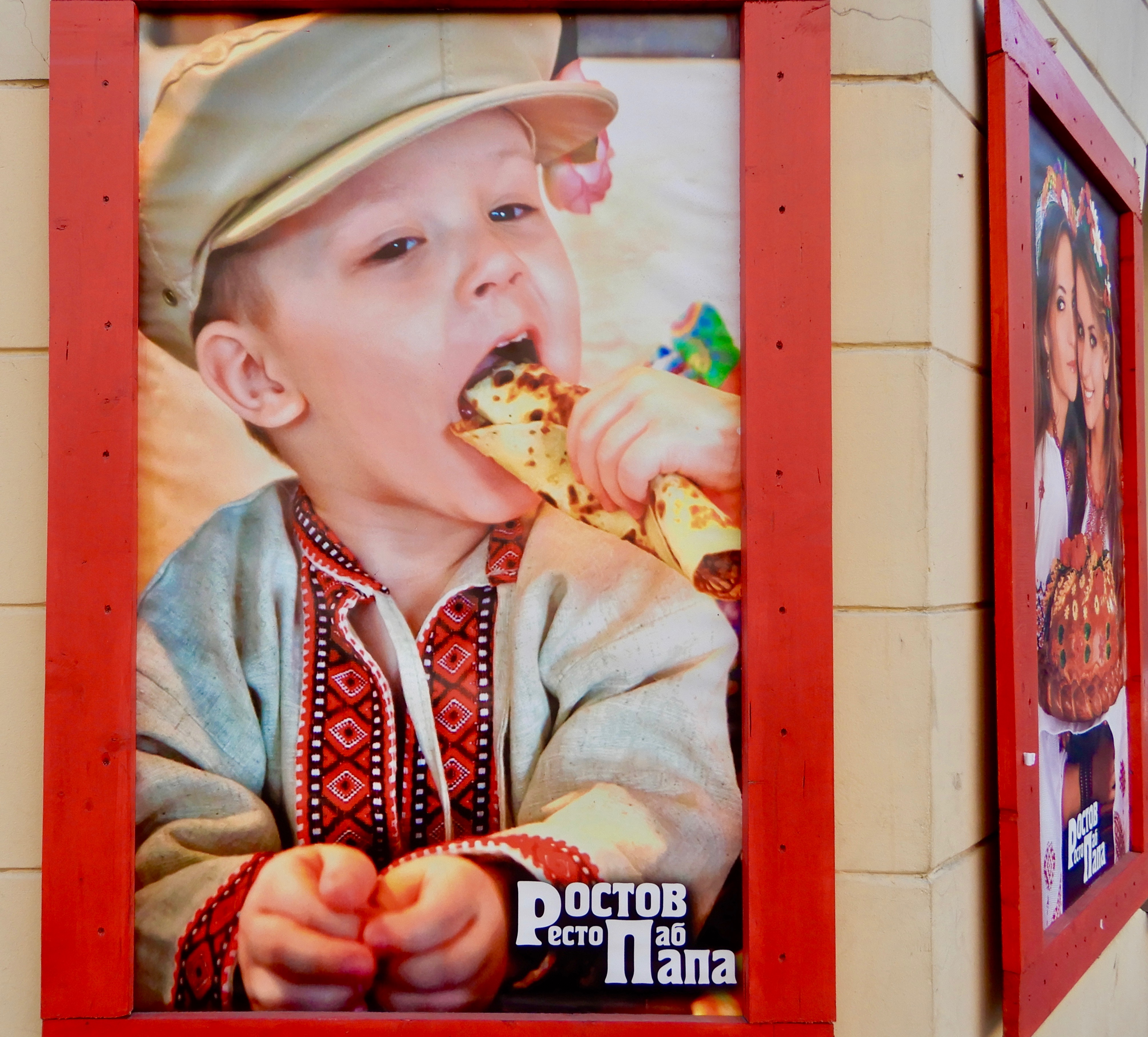
rostovpapaRussians do not swallow the regime’s propaganda hook, line and sinker, argues Ivan Mikirtumov, but use it to guide their public behavior. Photo by the Russian Reader

Why the Russian President Made Fun of Russian Propaganda
Ivan Mikirtumov
Vedomosti
October 22, 2018

Speaking at the Valdai Discussion Club on October 18, Vladimir Putin told his audience the punchline of what would later emerge as a “funny” joke about nuclear war.

“As martyrs, we will go to heaven, and they will simply croak, because they won’t even have time to repent,” said Putin.

Judging by the overall reaction, the joke has been a success.

The genre of the humorous anecdote, including the political anecdote, was typical of the Soviet period, that is, of a communist dictatorship in the midst of the Cold War. Unlike texts and drawings, anecdotes were an oral genre and, therefore, were relatively harmless to disseminate. The technical difficulties of proving someone had told a joke made it a less than reliable tool for snitching on other people. This sometimes had to do with the content. If you wanted to inform on someone who had told you a joke about Stalin, Khrushchev, Brezhnev, the KGB, the Politburo, etc., then likely as not you would have had to quote in writing what you had heard or, at any rate, admit you knew the joke. Under certain circumstances, however, this knowledge could be used against you.

In post-Stalinist times, people were rarely punished for telling jokes. Jokes were widespread in Soviet culture, achieving exceptional heights of wit and observation. Jokes could be used to track public opinion, since they reflected society’s critical self-consciousness. Jokes were a form of feedback, but by virtue of its unique incompetence the Soviet regime ignored them, too.

Everything dangerous, hostile, evil, harmful, stupid, and meaningless is made into a figure of fun when it fails and falls through. People do not laugh at things that are huge and horrible until they are rendered pitiful, proven weak, and shown to be a sham. Stalin gave people little occasion to laugh, because he rarely failed, but the leaders of the late-Soviet period and the entire Soviet system were perfect targets for jokes and other species of ridicule. It is said Brezhnev was smart enough to laugh at jokes about himself, but it was not something he did publicly.

Putin told his audience the punchline of a joke whose opening line we can imagine as an oral exam question at the General Staff Academy, a question asked by the examiner in a room adorned with framed photographs of the commander-in-chief and the Russian Orthodox patriarch.

“Tell me, how will the outcome of a nuclear war differ for Russians and people in western countries?

Why is it that Putin’s answer to this imaginary question might seem funny? What was he ridiculing?

Mentioning heaven, martyrdom, and repentance in a military context in Russia, a country in which cynicism has reigned supreme, is tantamount to a direct attack on official religiosity, as instilled by the regime, a religiosity that has become dreadfully tiresome to everyone. The notion Russians will go to heaven wholesale, whether they believe in God or not, whether they are religious believers of any denomination at all, and whether they are vicious or virtuous, is tantamount to a scathing parody of religious beliefs.

Nuclear war is the business of the military. It thus transpires souls are saved and people canonized as martyrs at the behest of the Russian army’s top brass. With Putin in charge of it, heaven promises to be something like an army barracks, so the entire satire on martyrdom and salvation was performed as a “humorous shtick” of the sort favored by Russia’s siloviki.

What do generals have to say about the soul’s salvation? They say what they are supposed to say, as they gaze at the patriarch’s framed photograph on the wall.

Recently, General Zolotov and the two heroic Russian tourists who took a trip to Salisbury this past March found themselves in the limelight nearly at the same time. We can easily imagine these men holding forth on heaven, martyrdom, and repentance. Putin’s joke was clearly a sendup of the symbiosis between state-imposed religiosity and militarism, a crucial concept in current Russian agitprop.

It is short step from a joke like this to jokes about Orthodox secret policemen, monarchist communists, sovereign democracy, the Kiev “junta,” the US State Department’s vials and cookies, and ritual murders, performed by Jews, of course, on Orthodox babies (and the tsar’s entire family in the bargain), and so on. During the years of Putin’s rule, a whole Mont Blanc of drivel has sprung up, and whole hosts of freaks have come out of the woodwork. It is simply amazing there are still so few jokes about Putin and Putinism in circulation, but now, I imagine, things will kick off, since the main character in these jokes has taken the bull by the horns.

This does not mean, of course, that, by artfully telling his joke, Putin meant to take the piss out of himself and his regime. We are dealing here with the long-familiar militarist bravado summed up by the saying “Broads will give birth to new soldiers,” with the teenage frivolity typical of the siloviki, a frivolity they enjoy acting out.

“We’ll wipe the floor with them,” as they would say.

If, however, Putin was publicly ridiculing the concept behind current state propaganda, we are confronted with a bad joke, a bad joke told to the selfsame ordinary Russians who are targets of the propaganda so ridiculed, while the guy who made the cute joke is the same guy who presides over production of this propaganda and benefits from it.

The rules of the genre have been violated, for now it is the audience, the public that has been ridiculed. Clearly, Russia’s ruling elite despises the people it attempts to manipulate, and the propagandists sometimes laugh themselves silly backstage after they have concocted a particularly nimble con.

I don’t think Russians are gulled by the Kremlin’s propaganda. Rather, they register the messages transmitted to them by the regime as signals telling them what to say and do in certain circumstances. This lovely consensus is destroyed when the concept underpinning the propaganda has been publicly turned into a laughingstock, because people who have been pretending in recent years that they take it seriously find themselves in an awkward situation. They have lost face, having themselves been made ludicrous.

How, then, do they answer the question as to why they played along with the regime in its efforts to gull them? The only plausible explanation for this behavior is shameful thoughtlessness, fear, and impotence, things to which no one wants to admit.

Ivan Mikirtumov is a visiting lecturer at the European University in St. Petersburg. Translated by the Russian Reader

This Monkey’s Gone to Heaven

“The aggressor must be aware that retaliation is inevitable, that they will be destroyed. And we, the victims of aggression, as martyrs, will go to heaven, while they will just die, because they will not even have time to repent,” Putin said.

DSCN2643.jpg

While there was obviously nothing to like about Vladimir Putin in his earlier incarnations as KGB officer, deputy mayor of Petersburg, FSB head, interim prime minister who relaunched the Chechen War, and Russia’s newly minted, apparently sober second president, it is clear that twenty years in office have now made him a stark raving lunatic.

I wish that Russians in their millions, frightened into action by what their nominal national leader said the other day, would rise to save the world from this menace. In reality, too many Russians have either bought the new party line hook, line, and sinker or disappeared into various modes of actual and internal emigration.

The much smaller groups of Russians who bravely try and combat Putinism and its cancers are badly outnumbered and increasingly embattled. Just read this website from time to time to find out what I mean.

Maybe I am exaggerating a little, but not as much as even I would like to think.

I apologize for this outburst, because mine is supposed to be a website about other Russias and other Russians. It would be sheer escapism, however, to claim that even the freest, boldest hearts in the world’s largest country are not affected by the regime’s downward spiral into a fascist, militarist, police-state abyss. {TRR}

Judgement Day: Russia’s Rabid Crackdown on Jehovah’s Witnesses

yuri zalipayevIs Russian Jehovah’s Witness Yuri Zalipayev an “extremist”? Should he be imprisoned for five years for exercising his right to freedom of conscience, as guaranteed by the Russian Constitution? Photo courtesy of jw-russia.org

Not Everyone Shall Be Guaranteed the Freedom of Conscience: How Russia Has Been Persecuting Jehovah’s Witnesses
Marina Muratova
OVD Info
August 23, 2018

Believe what you will, but do not do it openly is how the freedom of religion should now be interpreted in Russia. The authorities have sent over fifty people to court for praying and reading the Bible together. Jehovah’s Witnesses have had their homes searched and been arrested like people suspected of grave offenses. The grounds for these actions is the argument that the practice of their faith is a “continuation of the activities of an extremist organization.” OVD Info investigated the charges.

Everyone shall be guaranteed the freedom of conscience, the freedom of religion, including the right to profess individually or together with others any religion or to profess no religion at all, to freely choose, possess and disseminate religious and other views, and act according to them.
—Article 28, Constitution of the Russian Federation

Russia vs. the Jehovah’s Witnesses
23 criminal cases in 18 regions of Russia, 53 people charged, 13 suspects. 31 people released on their own recognizance, 9 people under house arrest, 26 people in remand prisons. Several people assaulted by police during searches of their homes, the doors of those homes kicked down in nearly all cases. Nighttime interrogations, confiscated electronic devices, papers, and money, blocked bank accounts.

On April 20, 2017,  the Russian Supreme Court shut down the Administrative Center of Jehovah’s Witnesses in Russia for violating the law against “extremism.” All 395 official chapters of the Jehovah’s Witnesses in Russia were banned. The EU’s mission to Russia said the ruling could lead to arrests. That is what has happened.

The Charges
Believers gather to pray and read the Bible, meaning they continue the work of a banned organization, according to Russian police investigators. There are few exceptions: nearly all the Jehovah’s Witness who have been detained have been charged with violating Russian Criminal Code Article 282.2 (“organization of and involvement in the work of an extremist organization”).

Danish national and Jehovah’s Witness Dennis Christensen was, among other things, charged with financing extremist activities. The prosecutor submitted to the court records,  allegedly showing that money was transferred from the account of the Jehovah’s Witnesses after the church was shut down. It transpired the transactions in question had been executed by the bank itself after the Jehovah’s Witnesses had been dissolved as a legal entity. Another Jehovah’s Witness, Yuri Zalipayev, stands accused of inciting assaults on Russian Orthodox Christians and Muslims. Zalipayev’s defense attorney is sure police investigators cooked up their evidence and then tried to conceal the frame-up.  Arkadya Akopyan, a 70-year-old tailor, has also been charged with insulting Muslims and |Russian Orthodox Christians. There is no audio or video evidence, only a witness’s testimony.

arkadya akopyanIs Russian Jehovah’s Witness Arkady Akopyan an extremist? Photo by Diana Khachatryan. Courtesy of Takie Dela

Police Searches of Homes
Russian law enforcement authorities usually conduct searches simultaneously in the flats of several Jehovah’s Witnesses early in the morning. Jehovah’s Witness have often reported violations on the part of police during these searches. In the case of the Polyakov family in Omsk, the security services busted down the door to their flat, prevented the Polyakovs from telephoning relatives, and smashed Mr. Polyakov’s face. (Doctors recorded his injuries only two days later.) When the Polyakovs attempted to voice their disagreement with the actions of police  in the official search report, police wrested the form from their grasp.  During searches and interrogations in Penza, a police investigator forced six female Jehovah’s Witness detainees to strip naked.  In Saratov Region, the security forces mistakenly sawed off the door of the wrong flat. In another flat the same day, the police discovered banned literature in the sleeve of a child’s overcoat. Jehovah’s Witnesses believe the police planted it there.

In the city of Shuya, Ivanovo Region, police interrogated a 10-year-old girl, and the list of items confiscated during the police search of her family’s flat included sheet music and a pupil’s grade book from a music school. In Kabardino-Balkaria, one group of security officers stormed a flat through the balcony, although the flat’s female occupant had opened the front door to another group of security officers. In Birobidzhan, 150 law enforcement officers took part in numerous searches carried out on the same day: the operation was codenamed “Judgement Day.” Police have seized digital gear, books, Bibles, diaries, photographs, and bank cards during the raids. The raids and subsequent interrogations have lasted several hours.

Jehovah’s Witnesses have not only been detained in their homes. Police caught up with Andrei Stupnikov of Krasnoyarsk at an airport at four in the morning as he and his wife were checking into a flight to Germany. A court later jailed Stupnikov, since he could have received political asylum, as the judge put it. Alexander Solovyov was detained when he stepped off a train after returning to Perm from holiday.

Custodial Measures
Most of the Jehovah’s Witnesses who have been charged with criminal offenses have been incarcerated in remand prisons.  The defense attorney representing Sergei Klimov of Tomsk told OVD Info that Klimov spent two months in a solitary confinement cell measuring 1.7 meters by 2.8 meters, allegedly, because it was impossible to find room for him in an ordinary cell. On August 8, at an appeals hearing, Klimov was left in police custody, but he was transferred out of solitary into gen pop.

After time spent in remand prisons, several Jehovah’s Witnesses have been released and placed under house arrest. Konstantin Petrov of Magadan spent 64 days in jail, while several Jehovah’s Witnesses in Orenburg spent 78 days in jail each.

Vitaly Arsenyuk, a resident of the town of Dzhankoy in northern Crimea, was charged with engaging in illegal missionary work, a violation of Article 5.25 Part 4 of the Russian Federal Administrative Offenses Code. After the first hearing in his case, in June 2017, Arsenyuk died of a heart attack.

Some Jehovah’s Witnesses have spent months in pretrial custody. Danish national Dennis Christensen has spent over a year in a remand prison. No one has yet been sentenced to hard prison time, but the courts have been indulgent to Jehovah’s Witnesses only on rare occassions. In 2017, a court acquitted Vyacheslav Stepanov and Andrei Sivak of Sergiev Posad, who had been charged with inciting hatred or enmity on the strength of a video recording of worship services. In May, an appellate court freed 55-year-old Alam Aliyev. On August 9 and 10, a court in Kamchatka overturned earlier decisions remanding Mikhail Popov in custody and placing his wife Yelena under house arrest.

Community Property
In all regions of Russia, buildings constructed or purchased by Jehovah’s Witnesses have generally been seized and turned over to the state. In Petersburg’s Resort District, the state took possession of a complex valued at around two billion rubles [approx. 25 million euros], a complex from which the authorities had received hefty tax payments for many years. Over the course of seventeen years, state inspectors never found a single violation at the complex, but now the local courts refuse to recognize the rights of Jehovah’s Witnesses to the property or the official deeds to the complex.

Reactions
The EU delegation to the OSCE, the Parliamentary Assembly of the Council of Europe (PACE), the Russian Presidential Human Rights Council, and human rights activists have spoken out against Russia’s persecution of Jehovah’s Witnesses.

Dennis Christensen’s arrest led to the initiation of legal proceedings at the European Court of Human Rights (ECHR) in Strasbourg. On May 15, 2015, the Kingdom of Denmark was admitted as a third party to the case of Christensen v. Russian Federation.

In response to the complaint filed with the ECHR, Russian envoys at the ECHR and UN claimed Jehovah’s Witnesses still had the right to practice their religion despite the dissolution of their congregations. It was at this same time, in the spring of this year, that the number of arrests of Jehovah’s Witnesses in Russia went through the roof.

The International Memorial Society has already recognized 29 Russian Jehovah’s Witnesses as political prisoners. A total of fifty Jehovah’s Witnesses have been subjected to persecution by the authorities.

  • Oryol: Dennis Christensen, Sergei Skrynnikov
  • Omsk: Sergei and Anastasia Polyakov
  • Penza: Vladimir Alushkin, Vladimir Kulyasov, Denis Timoshin, Andrei Magliv, and four more unnamed people
  • Tomsk: Sergei Klimov
  • Saratov: Konstantin Bazhenov, Felix Makhammadiyev
  • Village of Shirokoye, Saratov Region: Alexei Budenchuk
  • Magadan: Sergei Yerkin, Yevgeny Zyablov, Konstantin Petrov
  • Khabarovsk: Ivan Puyda, Vladimir Moskalenko
  • Naberezhnye Chelny: Ilkham Karimov, Konstantin Matrashov, Vladimir Myakushin, Aidar Yulmetiev
  • Orenburg: Vladimir Kochnev, Alexander Suvorov, Vyacheslav Kolbanov
  • Polyarny, Murmansk Region: Roman Markin, Viktor Trofimov
  • Shuya, Ivanovo Region, Dmitry and Yelena Mikhaylov, Svetlana Shishina, Alexei A., Svetlana P.
  • Vladivostok: Valentin Osadchuk
  • Nakhodka: Dmitry and Yelena Barmakin
  • Krasnoyarsk: Andrei Stupnikov
  • Perm: Alexander Solovyov
  • Sol-Iletsk, Orenburg Region: Boris Andreyev
  • Village of Perevolotsky, Orenburg Region: Anatoly Vichkitov
  • Kostroma: Sergei and Valeria Rayman
  • Vilyuchinsk, Kamchatka Territory: Mikhail and Yelena Popov
  • Beryozovsky, Keremovo Region: Sergei Britvin, Vadim Levchuk
  • Maysky, Kabardina-Balkaria: Arkadya Akopyan
  • Lensk, Yakutia: Igor  Ivashin
  • Pskov: Gennady Shpakovsky
  • Birobidzhan: Alam Aliyev
  • Yelizovo, Kamchatka Territory: Konstantin Bazhenov
  • Belgorod: Anatoly Shalyapin, Sergei Voykov

This list was supplied to us by the European Association of Jehovah’s Christian Witnesses and defense attorney Artur Leontiev.

Freedom of Conscience
OVD Info asked attorney Artur Leontiev, who has been handling the defense of Sergei Klimov and Andrei Stupnikov, as well as the case of the property owned by the Jehovah’s Witnesses in St. Petersburg, to comment on the persecution of the Jehovah’s Witnesses.

“Law enforcement agencies have been criminally prosecuting believers for ordinary, peaceful professions of faith, as when they gather in small groups to read and discuss the Bible, watch videos on biblical topics, and so forth. The security forces got it into their heads that this constituted a continuation of the activities of an organization dissolved by the court. However, the believers who have been charged with these crimes had nothing to do with the legal entities that were dissolved and were not parties to the proceedings in the Russian Supreme Court.

“Believers’ phones were tapped, their letters were vetted, and they were followed. The security service thus amassed a fair amount of operational material. I think the heads of the various agencies decided to use it to improve their conviction rates, all the more so since the peaceable Jehovah’s Witnesses were easy targets. They have always tried to be law-abiding. Even now they do not regard themselves as criminals. They evince no aggression, imagining the injustice that has befallen them is a misunderstanding that will soon be cleared up. Actually, they are faced with a choice: refuse to practice their religion or be prepared to endure all the delights of criminal prosecution. However, the law enforcers doing the dirty work in the locales often understand what is really going on, but they are guided by the principle of ‘I have my orders, and I have a family to feed.’

“The complaint (Administrative Center of Jehovah’s Witnesses in Russia and Kalin v. Russian Federation, Case No. 10188/17) has been filed with the ECHR and accepted for review, the parties have exchanged comments, and the case has been expedited. Complaints have also been filed with the ECHR for each particular instance of criminal prosecution of Jehovah’s Witnesses.

“It is vital, however, the Russian legal system kicked into gear and operated not on the basis of expediency, but according to the law. Whatever you feel about the Jehovah’s Witnesses, they have the same right to their beliefs and the same right to a fair trial as other Russians.”

Translated by the Russian Reader
Smile! You’re on Hidden Camera

sure we can

Center “E” Surveilled Belgorod Family or Nine Months via Camera Hidden in Flat
OVD Info
August 24, 2018

In Belgorod, officers of the Center for Extremism Prevention (aka Center “E”) watched a married couple for nine months using a camera hidden in their flat, reports TV Rain, citing defense attorney Anton Omelchenko.

The couple was suspected of involvement with the Jehovah’s Witnesses. A court gave Center “E” permission to use the camera for three months on three occasions.

“Law enforcement agencies put hidden cameras in homes to record people playing. Criminal charges were filed as a result. One of the cases in Belgorod simply slayed me: a married coupled in a one-room flat who were under surveillance for nine months round the clock. Everything was really noted in the case files. The couple would watch TV and say something negative about the regime, and the field officers would immediately write down, ‘Criticized regime.’ There was a complete transcript of the entire surveillance. I also found this shocking,” Omelchenko told the TV channel.

Since their case has not yet been heard in court, Omelchenko did not name the couple who were under surveillance. It is known they have left Russia.

Photo and translation by the Russian Reader

It’s All Free for the ROC

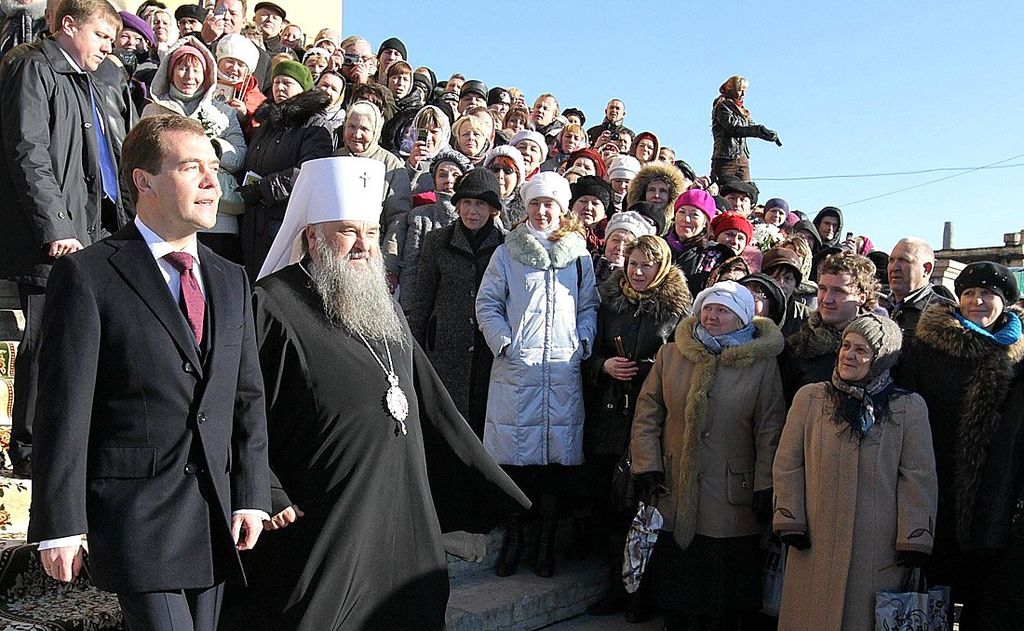
Dmitry_Medvedev_and_metropolitan_Varsonofius.jpegDmitry Medvedev, then President of Russia, and Varsonofius, then Metropolitan of Saransk, during National Unity Day in 2011. Photo courtesy of Wikimedia Commons

Free for the ROC: Petersburg City Hall Allocates Two Land Plots for Church Construction
Alexei Kumachev
Delovoi Peterburg
July 31,2018

Petersburg city hall [aka the Smolny] has allocated two land plots for church construction in the Primorsky and Petrograd distrists. According to documents published on the Smolny’s website, the land will be provided free of charge. It was reported previously that the Russian Orthodox Church (ROC) had announced plans to build a Sunday school on Heroes Avenue and a church on Konstantinovsky Avenue.

The St. Petersburg Diocese of the Moscow Patriarchate will receive a land plot on Krestovsky Island. The total area is 2,000 square meters. A ten-year lease will be signed within a month.

Earlier, it was reported the ROC’s plans for the lot on Konstantinovsky Avenue involved construction of 254 square meter church, a 400 square meter school building, a 32 square meter belfy area, and a 28 square meter baptistery.

The proposal to transfer the land to the ROC was made by Petersburg Deputy Governor Igor Albin at a meeting of the city government.

The estimated cadastral value of the land is ₽15 million. According to Anna Sigalova, deputy director for investments at Colliers International in Petersburg, the plot could be sold for around ₽300 million [approx. €4 million]. The analyst added the price could change if the plot were rezoned for residentialhousing construction.

In addition, the ROC will receive a land plot in the Krasnoye Selo District for free. This is the previously mentioned plot on Heroes Avenue. The total area of the site is 2,200 square meters.

The ROC plans to build a two-storey Orthodox school with its own church on the site. The work will be done by the congregation of the All Saints Church in southwest Petersburg. The term of the free lease is ten years. Petersburg Governor Georgy Poltavchenko signed the documents ceding the land to the ROC.

On July 18, we reported the Petersburg and Leningrad Region Arbitrage Court had agreed to hear a lawsuit filed by the city’s Property Relations Committee (KIO) against the congregration of the Intercession of the Blessed Virgin Church (St. Petersburg Diocese, ROC) concerning the ownership rights to the church, which was built on the former grounds of South Primorsky Park, opposite the house at 24 Valor Street.

16 сентябрь 2015 (12)Intercession of the Blessed Virgin Church while still under construction in September 2015. Photo courtesy of the church’s website

The 16,600 square meter plot had earlier been rezoned for construction of religious buildings and handed over to the ROC. The church building itself, however, was constructed. without the necessary permits. The first hearing of the lawsuit, which claims the city’s right of ownership to the church in the park, has been scheduled for September.

In July 2017, the Smolny transfered a nearly 5,000 square meter plot of land in the elite [sic] village of Komarovo to the ROC. The media wrote at the time the summer cottage of Varsonofius, Metropolitan of St. Petersburg and Ladoga, could be built on the site. At the same time, Petersburg Legislative Assembly member Boris Vishnevsky drew attention to the fact that a nearly half-hectare land plot was transferred to the Petersburg Diocese only due to the house on it.

In 2013, the ROC leased the land until 2062. The plot’s value was estimated at ₽30 million. Later, officials explained why they had decided to transfer it to the ROC.

“The plot contains a piece of real estate, a house whose cadastral number is 78:38:0022359:29, and whose rightful owner is a religious organization [i.e., the ROC],” said Petersburg Deputy Governor Mikhail Mokretsov.

According to Mokretsov, an inspection established the plot was used for religious purposes. The Smolny leased the plot to the St. Petersburg Diocese on July 25, 2017.

Translated by the Russian Reader