This bulletin is put together by labour movement activists in solidarity with Ukrainian resistance. More information at https://ukraine-solidarity.org/. We are also on Twitter. Our aim is to circulate information in English that to the best of our knowledge is reliable. If you have something you think we should include, please send it to 2022ukrainesolidarity@gmail.com.
To receive the bulletin regularly, send your email to 2022ukrainesolidarity@gmail.com. To stop it, please reply with the word “STOP” in the subject field.
My name’s Tom and I run openDemocracy’s coverage of Russia and Ukraine.
Do you remember where you were when Putin’s invasion started? I do: I remember texting friends and colleagues in Ukraine, who were in the middle of packing their bags. In the space of a few hours in February, I tore up my plans for the year. I knew our incredible team would face a challenge like no other.
It’s a nightmare that has taken all their skills and contacts to cover for you.
I’m not going to lie, it’s been a very difficult year. But our coverage has been so effective that it’s got our website blocked in Russia. (Don’t worry, we’ve found other ways to get our news to readers there.)
Will you please set up a regular donation to help our team in Ukraine keep covering the war? We’re a small, independent, non-profit news site and we rely on the generosity of readers to keep going.
One of our long-standing journalists in Kyiv somehow wrote an article on that first day of the Russian invasion – a day, she said, that felt like a week.
While some Ukrainian journalists took up arms to defend their country, others braved bombs, bullets and capture to tell the world about the Russian invasion.
To support journalists in the Ukrainian media, we asked readers to help them through some of the most difficult months of their lives. We raised £40,000 – money from openDemocracy readers to support journalists from other organisations as they were forced to relocate, cover new costs and advertising dried up. Those funds went to media outlets and journalists who don’t usually get grants or international support.
Now, we need your support for our work. Could I ask you to set up a regular donation to support our team as they face another difficult year, please? The hard truth is that without reader donations we will have to scale back our reporting of the war. But with your help we can keep telling the truth about Putin’s aggression. Every donation will make a real difference to our work.
This bulletin is put together by labour movement activists in solidarity with Ukrainian resistance. More information at https://ukraine-solidarity.org/. We are also on Twitter. Our aim is to circulate information in English that to the best of our knowledge is reliable. If you have something you think we should include, please send it to 2022ukrainesolidarity@gmail.com. To receive the bulletin regularly, send your email to 2022ukrainesolidarity@gmail.com.
A view of the entrance to Open Space Moscow. Photo courtesy of Mediazona
On the evening of November 24, masked security forces officers broke into Open Space in Moscow, where fifty people had gathered to support the anarchists arrested in the Tyumen Case and write postcards to political prisoners. The security forces, who were probably commanded by a colonel from Center “E”, made the visitors lie down on the floor or stood them facing the wall and held them for several hours, beating some of them. They didn’t let a lawyer inside.
On November 24, an evening of solidarity for the defendants in the Tyumen Case took place in Open Space, a co-working space for activists in Moscow’s Basmanny District. Six anarchists from Tyumen, Surgut and Yekaterinburg have been arrested and charged with organizing a “terrorist community,” and all of them have said they were tortured.
The event was open to the public and had been advertised, for example, by the online magazine DOXA. (Recently, State Duma deputies demanded that the magazine be designated an “extremist organization.”)
The event started around six o’clock, and about forty to fifty people were in attendance, says one of the participants. Some eyewitnesses say that before the security forces arrived, they signed postcards in support of political prisoners, while others said that they recited or listened to poetry. In any case, when an intermission was announced, the guests went outside to smoke — and at that moment a paddy wagon drove up to the building, and masked security forces officers stormed the venue.
Video footage of the beginning of the raid, which the SOTAvision journalist Ksenia Tamurka managed to shoot before she was detained, shows that the masked security forces officers behaved in a demonstratively rough manner. They shouted, kicked over furniture, and knocked the phone out of the correspondent’s hands. After the phone falls, the sounds of blows and shouts are audible in the footage: “Hands behind your head!”, “Legs wider!”, “Face the wall, don’t look down!”
The security forces officers forced some of the young people to lie down on the floor, while they made the rest of them, including the young women, stand facing the wall, forbidding them to move. A young woman who had left the event during the break and unhappily returned to retrieve a tote bag she had forgotten toldSOTA that she stood facing the wall for about an hour.
“When I turned my head, I was told to keep facing the wall. An hour later, they apparently took out my passport from my tote bag and summoned me to another room, where most everyone was lying face down on the floor. I sat down and we waited further. Then after, I don’t know, thirty minutes, I was summoned by other Russian National Guard officers. They asked me where my phone was, and I showed them. They asked me to unlock it, but I said no, citing Article 23 [of the Russian Constitution, which enshrines the right to privacy]. They were like no, you’re going to unlock it. And when I had already sat down, there was already a young female journalist after me, and she refused to show them her phone. They dragged her by the hair and she screamed,” the young woman said.
After what she saw, the young woman agreed to unlock the phone, and the security forces wrote down its IMEI. Another woman, who attended event with a child, said that the security forces officers demanded that she show them her Telegram chats and latest bank transfers to find out “whether she sponsored terrorism.”
The young woman who was screaming was SOTA journalist Ksenia Tamurka. The media outlet has not yet published the commentary of the journalist herself. One of the detainees recounted the assault on Tamurka as told by another eyewitness; another young man heard the journalist screaming, although he was in another room.
He said that the security forces treated the young men in various ways: in his opinion, it largely depended on the length of their hair. The young man pointed out that the security forces also detained members of Narcotics Anonymous, whose meeting was going on in the next room. “And when they were asked what they were doing there, they said, We are drug addicts, we don’t know anyone here! Then they were taken away from where we were, and [the police] talked to them separately,” he recalled.
At some point, the security forces perhaps began to behave a little less harshly. In video footage recorded a few hours after the start of the search, it is clear that the detainees were no longer pressed against the wall, but were simply looking at it. The security forces did not detain the journalists who shot the video, but, according to a Sota correspondent, they did drag a passerby inside the building after he looked in the window.
The detainees were loaded into the paddy wagon only a few hours later, and the minors among them were released along the way. The rest were brought to the Basmanny police department.
One of them said that she and four young men were beaten at the station. According to the young woman, the security forces officers “struck her when she was lying on the floor.” One detainee was “beaten with a baton and a book,” and another young man was “thrown on a chair and kicked.” According to her, the police found a balaclava, an emergency hammer from a bus, and a traumatic pistol, which he had a permit to carry, on one of the men who was beaten.
Another young woman could not recall beatings and said only that the detainees wrote statements at the police department “about what they actually did.” Alexei Melnikov, a member of the Public Monitoring Commission who was recently appointed to the Presidential Human Rights Council, went inside the department and saw the detainees while they were making their statements, but also made no mention of possible violence.
The detainees were released from the department around two o’clock in the morning. None of them reported that they were forced to sign any documents other than their statements. Tamurka left the department last, around four in the morning.
Golos coordinator Vladimir Yegorov identified the colonel from Center “E” in video footage of the security forces escorting the detainees to the paddy wagon. According to Yegorov, he was beaten during a search of the Golos office on October 5 on the colonel’s orders. Yegorov does not know the policeman’s name, because it was not listed in the search report. According to SOTA, the masked security officers accompanying the colonel at Open Space serve in the second field regiment of the Interior Ministry’s Moscow Main Directorate.
Correction (7 p.m., November 25): The article originally stated that the journalist Ksenia Tamurka left the police department along with the other detainees around two o’clock in the morning. SOTAvision later clarified that she came out last, around four o’clock in the morning.
Shops are full of food, but no Nespresso capsules (I still have some for a couple of months).
Stores are still selling printers, but not ink cartridges (I had to re-fill the used one last week).
There is clothes in shopping centers, but stores I used to go to are closed.
European countries still formally issue visas, but not really, although they might, but probably not, and getting there by air costs the same as becoming a space tourist.
Some countries are still open, but flights abroad are few and expensive and airbnb doesn’t accept payments from Russia, so I have to ask my son living in Germany to pay for our Summer trip.
Speaking of my son, I still can transfer money to him, but sometimes it takes weeks and sometimes they never get through, though sometimes they do, and you never know.
Speaking of the money, I still get my salary, but sometimes it is delayed because transferring money to the right bank account in the right currency in time makes our financial team prematurely gray-haired.
Speaking of the salary, our high-tech company is still working, but neither electronic components, nor equipment, nor people can cross borders, although sometimes they can, and then they don’t, and you never know when and why, and nobody knows it.
I keep reading and watching Youtube videos about the war every day, although it has all become a routine, and I hate myself for that, and I did protest but stopped because it’s all pointless and dangerous, though it isn’t, but it is, and we are all cowards, but it doesn’t matter, though it does.
I want Ukraine to win this war, and I don’t feel as if I am betraying my country but rather that my country is betraying me and itself, and this is probably the only crystal-clear thing in my life.
Yes, life is still normal in Russia.
91.7K views • 6,390 upvotes • 32 shares • Answer requested by Emirey Jackson
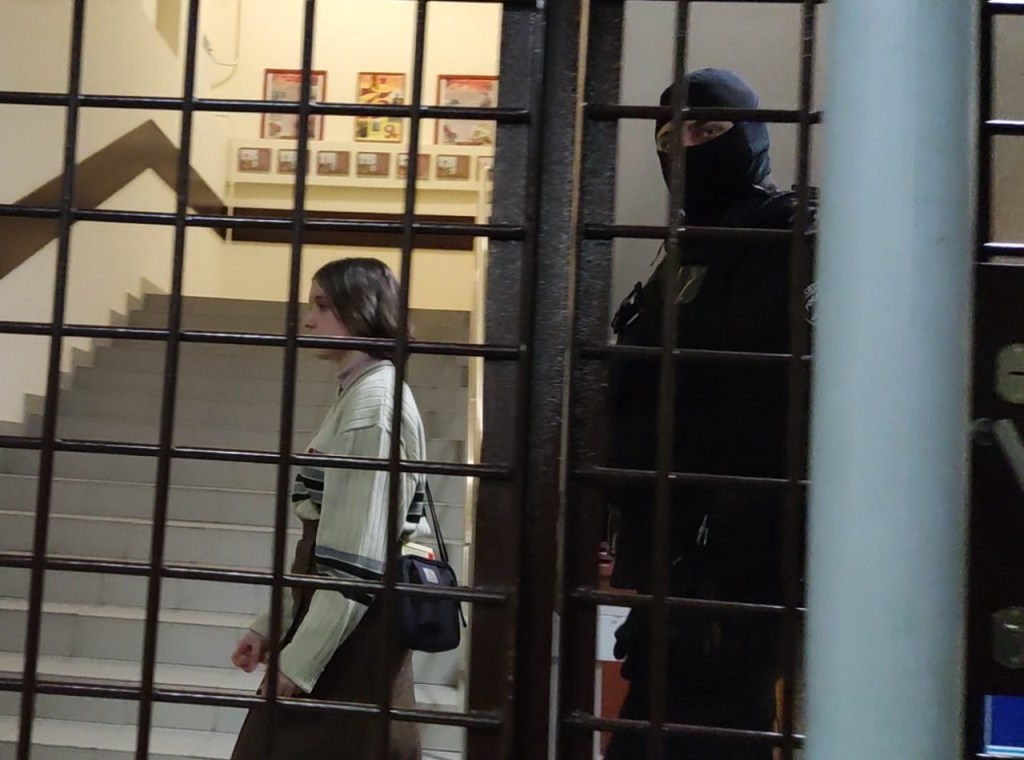
“Blue Eyes,” who physically assaulted Ksenia Tamurka, escorts her around the police station. Photo courtesy of SOTA
SOTA correspondent Ksenia Tamurka was detained along with the other attendees of a solidarity event for the defendants in the so-called Tyumen Case. The event was held at Open Space, an activist co-working space in Moscow The journalist was beaten when she refused to show her phone to men who had their faces covered. Despite this, Tamurka did not succumb to pressure and for several hours defended her rights to police officers. We publish this monologue by our correspondent, from which you can learn how to talk to the security forces and what you must do for your own safety.
Masked security forces officers [siloviki] burst into Open Space, and I started filming. I was either knocked down with a chair, or I tripped over it when I was pushed. I dropped my phone, and they put me face to the wall — they told me to stand like that. People around me were knocked down and thrown on the floor. They were not allowed to turn their heads; they could only look at the floor or at the wall. A Narcotics Anonymous meeting was being held in the basement of the premises, and one of the [recovering drug addicts] was asked what he used and how long he had been going there. They found some kind of book on LGBT topics in his possession and the siloviki read it aloud. In the process, they made nasty jokes about the guy. They said that there was no such thing as a former drug addict, and reproached him for being so young and already hooked. They collected everyone’s phone and papers, including mine and my press pass.
One guy begged them to let him call his mom. When these masked me with no insignia on their black uniforms had broken in, he thought it was a terrorist attack and had written to his family about it. The boy was very afraid that his mother would be worried, but the siloviki laughed, saying, Come on, how could you confuse us with terrorists? Why are you scaring your mother?
Then one of the Center “E” officers [eshnik] — the nastiest, most weaselly one — called me over because he thought I was hiding something when I was tucking in my sweater. He asked me to be a good girl and give him what I had allegedly hid; otherwise they would search me and stick their hands in my underpants. I said that I hadn’t hidden anything, that I was a journalist and had come there on assignment. He asked me strange questions, but I answered reluctantly. I said that I would only answer an investigator’s questions. For this, I was “punished” — I was made to stand with my face to the wall, although the others were sitting. When the siloviki nearby suggested that I sit down too, this eshnik said, “No, she’s being punished. She will stand.”
A couple of hours later I was summoned again. “Point your finger at your phone. Come on, unlock it,” they said. I refused because the request was illegal. Those men in uniform saw that I had Face ID, and they brought my phone close to my face, but I closed my eyes and looked away. The eshnik said all sorts of nasty things to me, getting angry and shouting. One of the masked siloviki, a man with blue eyes, grabbed me by the hair. Someone else hit me in the face and tried to open my eyes with his fingers. I was surrounded by five masked men. I screamed and cried and screwed up my face. I was very afraid to glance lest my phone be unlocked, god forbid. They dragged me back and forth by the hair. They shouted, “A drama queen! Ah, what a drama queen!” The police officers threatened to take me to the Moscow Region and talk to me in a basement.
At Open Space there is a mailbox for postcards designed to look like the bars in a jail. They punished me again by forcing me to stand looking at this box, like I was serving a prison sentence. Every police offer who walked by me thought I was backing away from it and pushed me closer. When one policeman passed by, he snapped his fingers before my eyes. When he was passing by, another policeman inserted a postcard with a beautiful picture in the box and said, “Let’s change the view — gaze at this.” Almost everyone passing by noted the pulled out hair on my clothes. Then that eshnik came up to me and tried to persuade me to unlock my phone. He asked whether I was tired, offered to deal with me “the normal way,” and said that I was delaying everything and would be the last to leave. “Just say the password, just enter it,” he said, but I wouldn’t enter it. They offered to give me a chair, to which I replied, “I’m not going to bargain with you. And bring a high chair.” They brought it. I sat down: I was comfortable, it was great, I looked at the wall. The blue-eyed man who had pulled my hair came up to me. I told him, “You beat me,” and pointed out that it was illegal, but he was like, “I don’t care.” The siloviki also tried to scare me by saying that my mobile phone would be entered into evidence and returned a year later, at the earliest, if we didn’t resolve everything on the spot.
The men in uniform constantly asked the organizers and participants why they supported terrorists and wrote postcards to them, and why the slogans on their walls were so filthy.
The siloviki asked everyone to tell them the PINs to their phones first, and then, if the person refused, they put the device in their hands and told them to enter it personally. They asked them to show their Telegram chats and film rolls and enter some other commands, like they were checking whether the mobile phone was stolen. When I asked what it all meant and why they needed my phone, they replied that they suspected me of theft, that there was a criminal complaint and even an APB out on me. I asked them to show them me and asked whether all those lying and sitting at Open Space had APBs out on them too. The siloviki replied that they would not show me anything because it was official information, and they stopped talking to me.
Everyone was photographed and searched, and their documents were photographed too — illegally, of course. They also took a picture of my father’s library card and public transport pass, although I didn’t consent to this. I was told that I was not in a position to forbid them to do anything. All the time I heard the same conversation: “We are checking your phone for theft, we are checking your phone for theft, enter the IMEI.” And almost everyone agreed to do it! Very few refused — and they were beaten, in my opinion. In any case, they were not treated very pleasantly. The eshnik asked me who I worked with at SOTA, who gave me the assignment, who I knew. He asked me about books and suggested that I read 1984. I told him to read Zamyatin’s We.
Th eshnik tried to make friends with me. He kept asking how I was feeling and complimented me, calling me a “persistent lady.” He even took my number and suggested that we discuss books later. He was constantly trying to get me to talk about “opposition” literature, bragging about his knowledge and telling me about Orwell. This man then invited me to take a stroll with him, but when he saw my face, he wimped out himself. “Well, you don’t want to walk with such scum, do you?” he said.
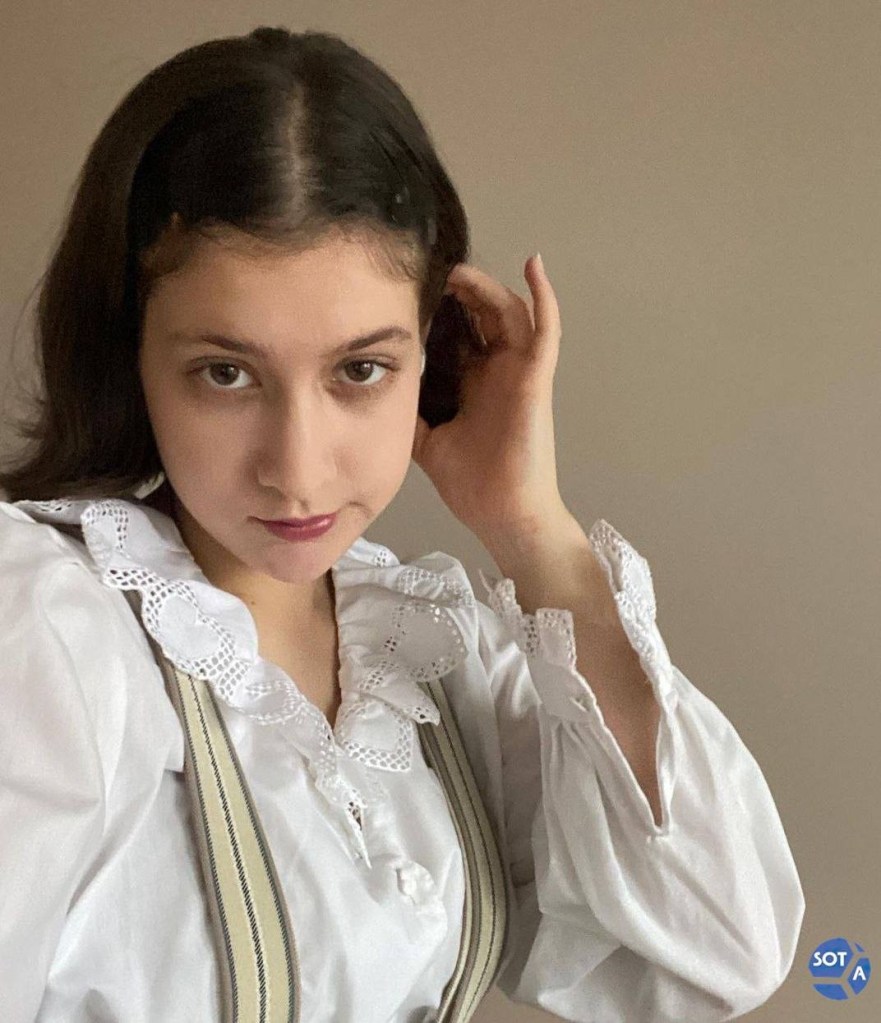
Ksenia Tamurka. Photo courtesy of SOTA
When I had already lost track of time, the intercessions on my behalf were conveyed to me. I was so glad when I found out that journalists had already gathered [outside], that my colleagues were there too! I was relieved because I had been very worried that I couldn’t contact anyone.
A man who did not agree to unblock his phone was beaten quite hard, judging by the sounds. We were forbidden to turn and look. One boy was whipped on his legs — the police officer made him spread his legs wider and thrashed him with all his might. It was so loud and scary.
They also promised that they would talk to me separately — I was afraid that they would just start torturing me, because I asked the policemen about it, and they either jokingly or seriously answered that yes, they would. There was a moment when everyone was really led away, and I thought, Well, that’s it — it’s about to start. But no, I was just sent to a paddy wagon.
At the station, I realized that everyone was pretty sick of me, judging by the comments that came my way. They called me a dumb broad and a pest. They said that I should be beaten with a rod. Later, in the department, they suggested that I should be “whipped with an officer’s belt in a dark room.” It also transpired that I was a dumb broad because no one was fucking me. They said disgusting things about me. I wrote down everything they said and all sorts of atmospheric details in the blank spaces in the book I had with me, [Vladimir] Sorokin’s Sugar Kremlin. The police saw it and tried to take a peek. Then the blue-eyed duded just stole it from me. They read all my notes in front of me and laughed in my face: “What? Who beat you? No one touched you. Why are you making things up?” But one of them added that I could still be beaten, because there was no other way to make me understand.
I was held separately and constantly harassed. And yet, when I asked to make a phone call, they said that it was specifically forbidden to me. When I asked to let a lawyer in to see me, that was also forbidden to me. I wanted to go to the toilet, but that too was specifically forbidden to me, while everyone else was allowed to go. They lied to me that there was no one waiting for me outside, that no one had any use for me and no one was waiting for me, although I knew that a crowd had already gathered at the station. The policemen discussed my breasts in front of me. Then they asked me my size — I cited Article 51 [of the Russian Constitution] and refused to testify.
When everyone else had already been released, they continued to drag their feet with me. The policemen kept their promise. I had to prove to them that the phone was mine for some reason. But if they had confiscated it from me, they should have known whose phone it was! It was their problem that they didn’t follow the legal procedures and forced me to deal with the consequences of their negligence! Moreover, my phone was the last one. The cunning eshnik and the blue-eyed devil finally decided to punish me too for my perseverance and entered the wrong password many times so that my phone would be blocked.
While we were waiting for the on-duty officer, the fool who dragged me by the hair ran out through another exit. Today I will file a complaint regarding the theft of my book and the actions of those police officers. I also went to the emergency room — I feel that it hurts me to touch it [sic]. I had the assault and battery documented there. The trauma specialist told me that it was an “industrial” injury because I had been on the job.
By the way, the slogan “The people’s trust is the police’s strength” was written on the wall of the police department.
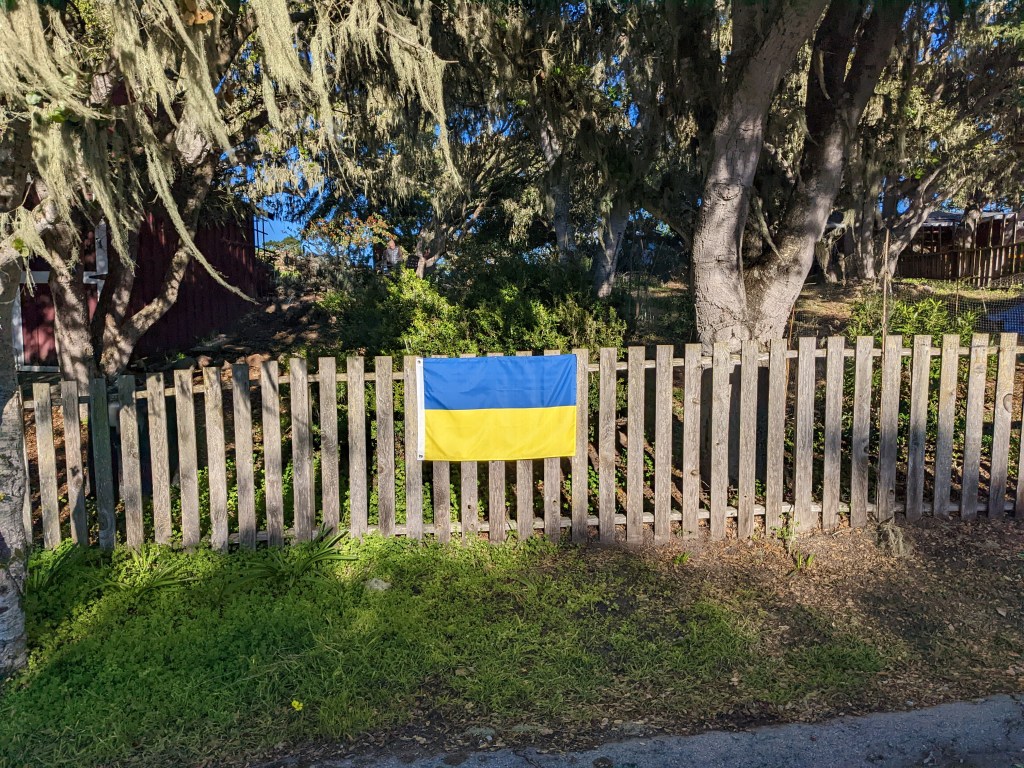
A Ukrainian flag flying from the balcony of the La Granja apartment building in Pacific Grove, California, 6 November 2022. Photo by the Russian Reader
This bulletin is put together by labour movement activists in solidarity with Ukrainian resistance. More information at https://ukraine-solidarity.org/. We are also on Twitter. Our aim is to circulate information in English that to the best of our knowledge is reliable. If you have something you think we should include, please send it to 2022ukrainesolidarity@gmail.com.
To receive the bulletin regularly, send your email to 2022ukrainesolidarity@gmail.com. To stop it, please reply with the word “STOP” in the subject field.
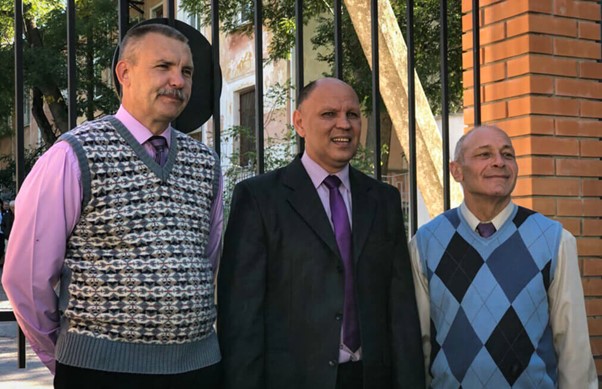
Volodymyr Sakada, Yevhen Zhukov, and Volodymyr Maladyka have been sentenced to six years in prison by a Russian occupation in Sevastopol for being Jehovah’s Witnesses. Photo: Lutfiye Zudiyeva, Graty. Courtesy of Kharkiv Human Rights Protection Group
This bulletin is put together by labour movement activists in solidarity with Ukrainian resistance. More information at https://ukraine-solidarity.org/. We are also on Twitter. Our aim is to circulate information in English that to the best of our knowledge is reliable. If you have something you think we should include, please send it to 2022ukrainesolidarity@gmail.com.
To receive the bulletin regularly, send your email to 2022ukrainesolidarity@gmail.com. To stop it, please reply with the word “STOP” in the subject field.
A group of labour movement activists has launched a unique service to English language readers: up to date information about Ukraine, based primarily on independent Ukrainian voices from the front line and first-hand testimony from Russian-held territory.
The Ukraine Information Group produces a weekly Bulletin, highlighting material translated by Ukrainian civil society organisations who wish to get their message about, particularly about the areas occupied by Russia.
To receive the Bulletin by e-mail, let us know at 2022ukrainesolidarity[at]gmail.com. The Bulletin is also put out on Twitter and stored online here.
The Group aims, working in the labour movement and civil society organisations, to strengthen solidarity with the Ukrainian people resisting Russian military aggression.
Its aims state: “Conscious of the ‘propaganda war’ waged on all sides, we aim to make accessible reporting and analysis by voices independent of the state.” The Group focuses on the Russian-occupied areas because (1) the situation there throws light on Russia’s imperialist war aims and methods of rule, and (2) there are limited sources of reliable information from those areas.”
The Group started in March, with calls by elected local government representatives to support their counterparts in Ukraine who were being intimidated with kidnappings and other violence in areas occupied by the Russian army. Appeals were organised in the UK and in Switzerland.
In July 2022 the Group held two online discussions with Ukrainian civil society activists about the situation in the Russian-occupied areas, attended by supporters from across Europe. Links to recordings are here.
The Ukraine Information Group is hostile, as a matter of principle, to Russia’s imperialist assault on Ukraine. But, on the other hand, it does not automatically give unconditional or unquestioning support to the Kyiv government. The UIG stands in the tradition of socialist internationalism and seeks to work in particular with like-minded progressive organisations throughout Europe.
Convenor Simon Pirani, honorary professor at the University of Durham, said: “With the Russian announcement of annexations we have gone past another dangerous turning point. To do anything here in the UK to support Ukrainian resistance, reliable information and informed analysis is a prerequisite.”
Supporter John Palmer, former Political Director of the European Policy Centre and Europe editor at the Guardian, said: “We are committed to supporting Ukraine’s demands on the United Kingdom and the European Union for greater and continuing military, economic and social support, but we will judge NATO’s military support specifically on whether it is designed to strengthen Ukraine’s struggle against the occupiers rather than pursuing a wider NATO/Russia geo-political military confrontation which could risk the use of nuclear weapons.”
Supporter Mike Phipps, who writes for the Labour Hub website, said: “We’re not in competition with other organisations that are doing excellent work in solidarity with the people of Ukraine. Our aim is to play a specific role – bringing to a wider audience news and analysis from Ukrainian sources that can help people in the UK understand the dynamics of the situation.”
To get in touch with the Group, e-mail 2022ukrainesolidarity[at]gmail.com. Follow on Twitter @UkraineIG
Pacific Grove, California, 17 June 2022. Photo by the Russian Reader
This bulletin is put together by labour movement activists in solidarity with Ukrainian resistance. More information at https://ukraine-solidarity.org/. We are also on Twitter. Our aim is to circulate information in English that to the best of our knowledge is reliable. If you have something you think we should include, please send it to 2022ukrainesolidarity@gmail.com.
To receive the bulletin regularly, send your email to 2022ukrainesolidarity@gmail.com. To stop it, please reply with the word “STOP” in the subject field.
Alexander Petrosyan, “Today on Sennaya Square [in Petersburg],” Facebook, 24 September 2022
In Petersburg, police have searched the homes of activists, as well as the home of Sota journalist Victoria Arefieva. The security forces broke down the door to Arefieva’s apartment, seized electronic devices belonging to the journalist and her sister, and detained her for forty-eight hours on suspicion of making a phoney bomb threat to the St. Petersburg City Court, Sotawrote on Saturday, September 24.
In addition, searches were conducted at the homes of persons implicated in the case of the Vesna Movement activists Yevgeny Fateyev and Valentin Khoroshenin, whom a court has banned from “engaging in certain activities.” The security forces also visited the home of activist Pallada Bashurova, against whom two “telephone terrorism” investigations have been launched, OVD Info reports. Yevgenia Litvinova, a member of the Petersburg Human Rights Council, was also detained in connection with a “telephone terrorism” case.
New protests against mobilization scheduled for September 24
According to Sota, the searches are connected with protests, scheduled for September 24, against the “partial mobilization”; law enforcement agencies thereby are attempting to prevent their coverage in the press. Vesna, a democratic youth movement, called on Russians to engage in a new round of protests in the wake of the first wave that occurred on the day Russian President Vladimir Putin made the announcement. “Mogilization [“grave-ization”] is actively going on all over the country. Soon thousands of our men could go to the front. We can and must oppose it!” Vesna said in a statement issued on September 22.
According to the online human rights project OVD Info, on September 21, the police detained more than 1,300 protesters in thirty-nine cities across Russia. Most of the arrests occurred in Moscow and Petersburg. In some police departments, the detainees were handed summonses to the military enlistment office right on the spot.
Source: Irod Uralskii (“Herod of the Urals” or “Monster of the Urals”), Telegram, 19 September 2022. Translated by the Russian Reader
KVN Trix
“Maybe we should go straight to prison after university?”: a team of journalism students sang a song about “foreign agents” at a KVN competition
In the quarterfinals of the Baltika KVN League, members of the Petersburg university student team Trix sang a song about the plight of Russian journalism, listing the names of the media outlets and journalists labeled “foreign agents,” to the tune of Alla Pugacheva’s song “Nado zhe” (“Well, I Never”).
During the performance, three members of the team took the stage. The team’s captain, Anastasia Kostina, listed the names of “foreign agents” and asked in the song, “Do we need, do we need, do we need to keep studying? Maybe we should go straight to prison after university?” As she sang these lines, a young man in a police uniform ran onto the stage, twisted the soloist’s hands behind her back, and escorted her backstage.
Kostina said that the jury took the joke warmly and that there had been no censorship prior to the performance. “There was no internal censorship. Thanks to the editors for that — they allowed this song. The jury warmly welcomed such humor. They gave a critique at the end of the contest: they said it was bold, satirical, and so topical that it’s a sin to condemn us for it.”
The young woman was also asked what she thinks about continuing her studies in journalism school. “Indeed, I’m having a crisis right now, because I don’t understand whether to put more emphasis on my studies and the profession, or go into humor. But for now I continue to study, because who knows what will come in handy in life,” Anastasia replied.
Source: Mel (“Chalk”) Magazine: On Raising and Educating Children, Facebook, 19 September 2022. Translated by the Russian Reader
KVN (Russian: КВН, an abbreviation of Клуб весёлых и находчивых, Klub Vesyólykh i Nakhódchivykh or Ka-Ve-En, “Club of the Funny and Inventive”) is a Russian (and formerly Soviet) humour TV show and an international competition where teams (usually composed of college students) compete by giving funny answers to questions and showing prepared sketches. The Club originated in the Soviet Union, building on the popularity of an earlier program, An Evening of Funny Questions (Russian: Вечер весёлых вопросов, romanized: Vecher vesyolykh voprosov); the television programme first aired on the First Soviet Channel on November 8, 1961. Eleven years later, in 1972, when few programmes were being broadcast live, Soviet censors, finding the students’ impromptu jokes offensive and anti-Soviet, banned KVN. The show was revived fourteen years later during the perestroika era in 1986, with Alexander Maslyakov as its host. It is one of the longest-running TV programmes on Russian television. It has its own holiday on November 8, the birthday of the game — celebrated by KVN players every year since it was announced and widely celebrated for the first time in 2001.