The Vitamin Pharmacy

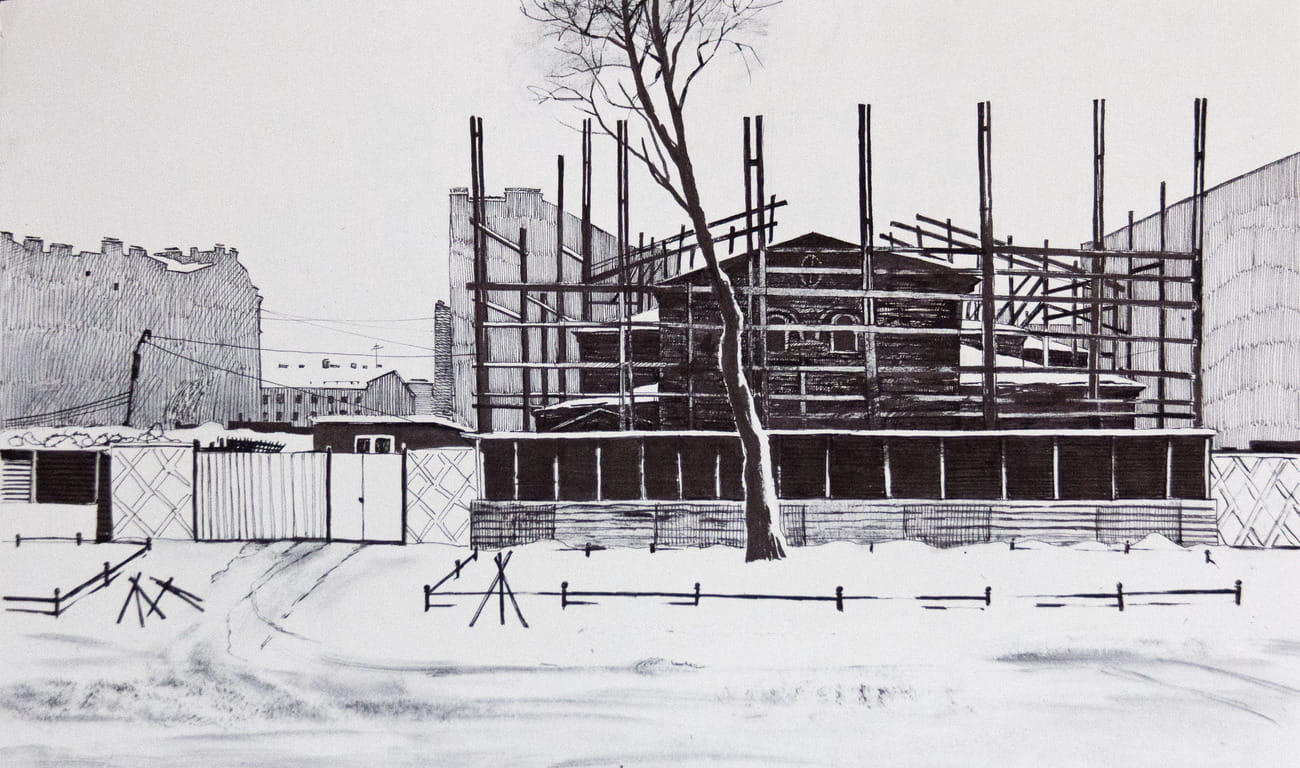
Olga Vasilieva, The Vitamin Pharmacy: Temporary Structures, 2021. Ink on paper, 52 х 32 cm. Courtesy of the Facebook public groups Petersburg in the Year Twenty-One: Line Art and St. Petersburger Ansichten in allen Variationen der Kunst
* * * * *

The E.E. Brömme Mansion is a historic mansion in St. Petersburg. It is located in the Vasilyevsky Island District, at 41 12th Line, Building 1-Zh. An official regional cultural landmark, it is one of the few surviving wooden mansions in the city’s historic center. It is also known as one of the “Siege addresses”: the so-called Vitamin Pharmacy operated in the mansion during the Siege of Leningrad.

[…]

In 1893, the lot was purchased by the brothers Eduard, Robert and Wilhelm Brömme. They were the sons of the German architect Eduard Georg Christian Brömme, who had settled in St. Petersburg in the early nineteenth century. The Brömme brothers were related to the famous Poehle family of Petersburg pharmacists Pele: their father was married to Wilhelm Poehle’s sister Wilhelmina Maria, and one of the brothers, Eduard, to his daughter Emilia.

In the mid-1890s, the trading company Brömme Brothers founded a factory for the production of essential oils and chemicals. In 1897-1898, additional factory buildings, designed by the architect A.P. Soskov, were constructed in brick on the lot where the mansion was located. The Brömme factory produced essential oils for perfumes and pharmaceuticals, fruit essences used in the manufacture of soda pop and confectionery, and aniline dyes.

The wooden one-story mansion with a mezzanine floor, which at that time belonged to Eduard Brömme and also served as the factory’s office building, was redesigned in 1906 by the architect V.S. Karpovich. The building was adorned with carved neoclassical decor, as well as two majolica panels and a majolica figured medallion featuring floral motifs, in a wooden frame containing the figures of griffins. All three ornaments were made at the Geldwein-Vaulin ceramic workshop by Pyotr Vaulin. The mansion and its fence faced the building setback line on the 12th Line, while the garden surrounding it served as a buffer zone between the house and the factory.

After the Revolution, the factory was nationalized. In the 1920s, it was known as the Fruit Aroma factory. In 1931-1935, the chemical plant of Politkatorzhanin, an industrial firm run by the Leningrad regional branch of the Society of Former Political Prisoners and Exiled Settlers, operated in the same facilities. The plant produced essences and oils for the food industry. After the society was liquidated, the plant was transferred to the People’s Commissariat of the Food Industry and converted into a vitamin-manufacturing plant (Leningrad Vitamin Plant No. 1). The wooden mansion was repurposed as cafeteria for workers and a kitchen, and was also used as an administrative building.

“The Vitamin Pharmacy”
At the outset of the Siege, Leningrad’s chemists and doctors said that, in addition to hunger, the inhabitants of the besieged city were threatened by diseases caused by a lack of vitamins in the diet — in particular, by scurvy. A research group was organized that included chemists, biochemists and engineers. Alexei Bezzubov, the director of the chemical engineering department at the Vitamin Industry Research Institute and a consultant for the Leningrad Front board of health, was appointed head of the research group. On October 15, 1941, it released draft regulations for the production of conifer infusions — a remedy for vitamin C deficiency. On November 18, 1941, the Leningrad Executive Committee issued a decree entitled “On measures to prevent vitamin deficiency.” Pine and spruce needles for the production of infusions were harvested on the outskirts of the city by teams of women. Carotene was also obtained from the needles. Later, the production of yeast from wood rich in B vitamins and the processing of saltbush, hogweed, cow parsley, sorrel, nettle, and dandelions were established. Infusions from these plants saved the servicemen defending the city from night blindness caused by a lack of vitamin A. Tobacco dust, found in Leningrad’s tobacco factories, was used to produce nicotinic acid for treating pellagra.

All these drugs were produced at specialized enterprises in the city, including the Mikoyan confectionery factory and Leningrad Vitamin Plant No. 1. The plant’s administrative building — the Brömme mansion — also functioned as the outlet where city dweller received their vitamin rations and was popularly known as the “vitamin pharmacy.” Vitamin plant employees warmed up and partially lived in the mansion, since it was easier to heat than the factory workshops.

Leningrad Vitamin Plant No. 1 on the 12th Line continued to operate after the war. From 1977 to 1987, it was one of the production facilities of the Farmakon chemical pharmaceutical company.

[…]

People’s Memorial
Despite the fact that there has never been a memorial plaque on the building, Petersburgers remember the Brömme mansion as the “vitamin pharmacy,” a “Siege address.” There is a tradition of laying flowers outside the building on the commemorative dates of September 8 (the day the Siege of Leningrad began) and January 27 (the day the Siege was lifted). In 2021, residents of Vasilyevsky Island who are members of the Facebook group From the Spit to the Harbor organized a commemorative action that lasted from January 18 (the day the Siege was broken) to January 27.

“On January 18, we will bring photos of our relatives who went through the Siege on Vasilyevsky. We are not planning any big meetings or gatherings, but we hope that between the two Siege anniversaries, everyone who wants to join the action will bring photos of their relatives: those who stayed on the Island during the Siege; those who left the Island to defend Leningrad; and Siege survivors and veterans who themselves had nothing to do with the Island, but whose descendants now live on Vasilievsky Island. You can bring your photos on any day of the action and at any time. On January 27, we will collect all the photos (the memorial is intended as a temporary one) and keep them until next January.”

Consequently, flowers and wreaths were laid outside the Brömme mansion, and photographs of Leningraders who survived the Siege were posted on the mansion’s fence. A homemade plaque memorializing the Siege chemists and the “vitamin pharmacy” was also mounted on the mansion’s wall.

Source: “E.E. Brömme Mansion,” ru.wikipedia.org. Translated by the Russian Reader
“Whitewashing Nazism”

Center “E” sifts through Petersburger’s social network posts: they’ve already found one that merited a criminal charge
Fontanka.ru
December 10, 2021

Center “E” field officers have detained a 40-year-old Petersburg man on suspicion of whitewashing Nazism. A post that the man published a year ago on the social network VKontakte (VK) triggered the criminal investigation.

As Fontanka.ru learned on December 10, the text denied the crimes of the Nazis and also contained lies about what the USSR did during the Second World War.

In late November 2021, the investigative department for the city’s Krasnoe Selo district launched a criminal case under Article 354.1 of the Russian Criminal Code. On December 8, the author of the post was detained. Investigators are currently trying to establish whether there were other violations by scrutinizing the social media posts of the Petersburger, who, judging by his VK page, is an ordinary working stiff [rabotyaga].

COMMENTS (19)

dimon’s iphone
Dec 10, 2021 at 5:36 p.m.
When will people realize that “Kontakt” [VKontakte] and “Telega” [Telegram] are the Okhrana’s mousetraps? They can fill a lot of quotas this way. What matters is that it’s all safe: it doesn’t involve chasing down armed bearded men.

wow
Dec 10, 2021 at 1:32 p.m.
History is going in circles. We’ve gone back to telling political jokes in the kitchen. But soon we’ll have to think about whether even that is safe…

At a local Communist Party meeting in 1937 a parrot suddenly flies in the window and shouts, “Down with the Communists, down with the Soviet government!” before flying away.

The local NKVD freaks out. They go on an apartment-by-apartment hunt for the talking parrot.

Entering yet another apartment, they ask the man who lives there whether he has a parrot.

“Yes!” he says.

“Does it talk?”

“Yes,” the man answers.

“Show us!”

The man opens the refrigerator, whence they hear a parrot shout, “Long live Comrade Stalin! Long live the Communist Party!”

The NKVD officers see they have the wrong parrot and leave.

The man opens the refrigerator door again and says, “Well, bitch, do you understand now what Siberia is like?!”

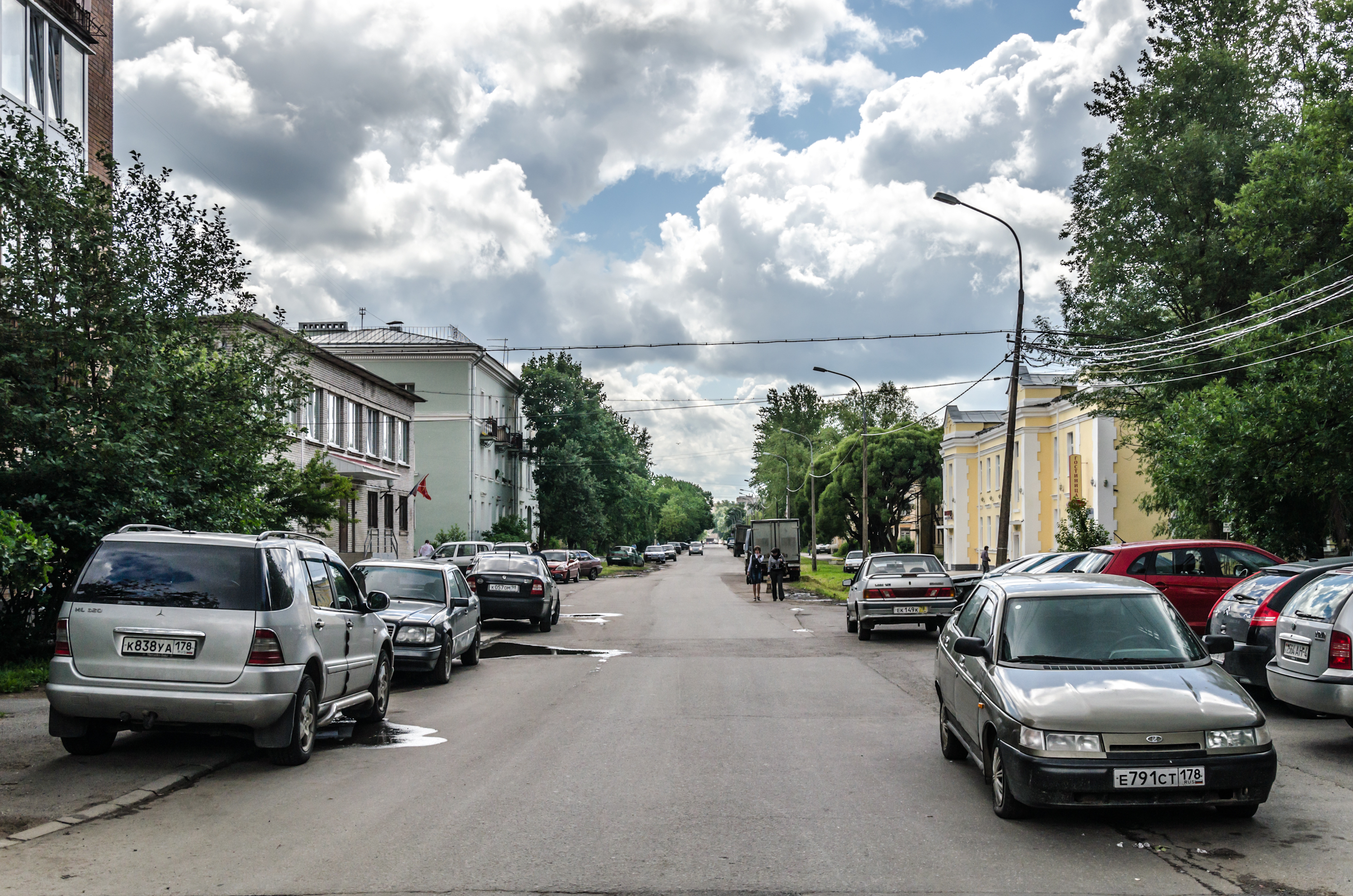
2nd Komsomol Street in Petersburg. Photo courtesy of Wikipedia

PETERSBURG MAN DETAINED FOR SOCIAL NETWORK POST
He was released on his own recognizance
Darya Medvedeva
78.ru
December 9, 2021

A Petersburg man was detained for a post on the social network VKontakte, a source in law enforcement has told 78.ru.

As the police found out, no later than May of this year the man posted in the public domain a text denying the criminal wrongdoing of the Nazis and misinformation about what the USSR did during the Second World War.

The 50-year-old “blogger” was detained on 2nd Komsomol Street on December 8. A criminal case has been launched against him on suspicion that he tried to rehabilitate Nazism. The police assume that he was involved in other crimes. He has been released on his own recognizance.

[…]

The emphasis is mine. Translated by the Russian Reader

Yuri Leiderman: The Black General

Yuri Leiderman
Facebook
September 29, 2021

“The Black General”
I arrived in the city of Heraklion and checked into the hotel. I turned on the TV while I got settled in. On TV5Monde, a group of intellectuals in well-chosen nonchalant jackets was discussing Rimbaud, Kafka and Gallimard’s new releases.

I should have been like them, I thought enviously.

I could have become like them, I thought, horrified.

There is no Pinochet to reign them in,
No Black Colonel,
No Black General,
I thought with a grin.

So I am the very last Black General, overgrown and useless and grassy, I thought without much emotion, after appending hands, palms, and wrists, like claws, like threads, to the seams.

Translated and reproduced here with the artist’s kind permission by the Russian Reader

Bad List Updates

Marta Hillers’s Book A Woman in Berlin Placed on List of Extremist Materials
Wonderzine
November 23, 2021

Sota reports that the Russian Justice Ministry has placed A Woman in Berlin, a book by Marta Hillers, on its list of extremist materials. In the book, the writer recounts the end of World War II and the mass rapes of German women by Soviet soldiers. The Abakan City Court in the Republic of Khakassia had petitioned to have the book placed on the register.

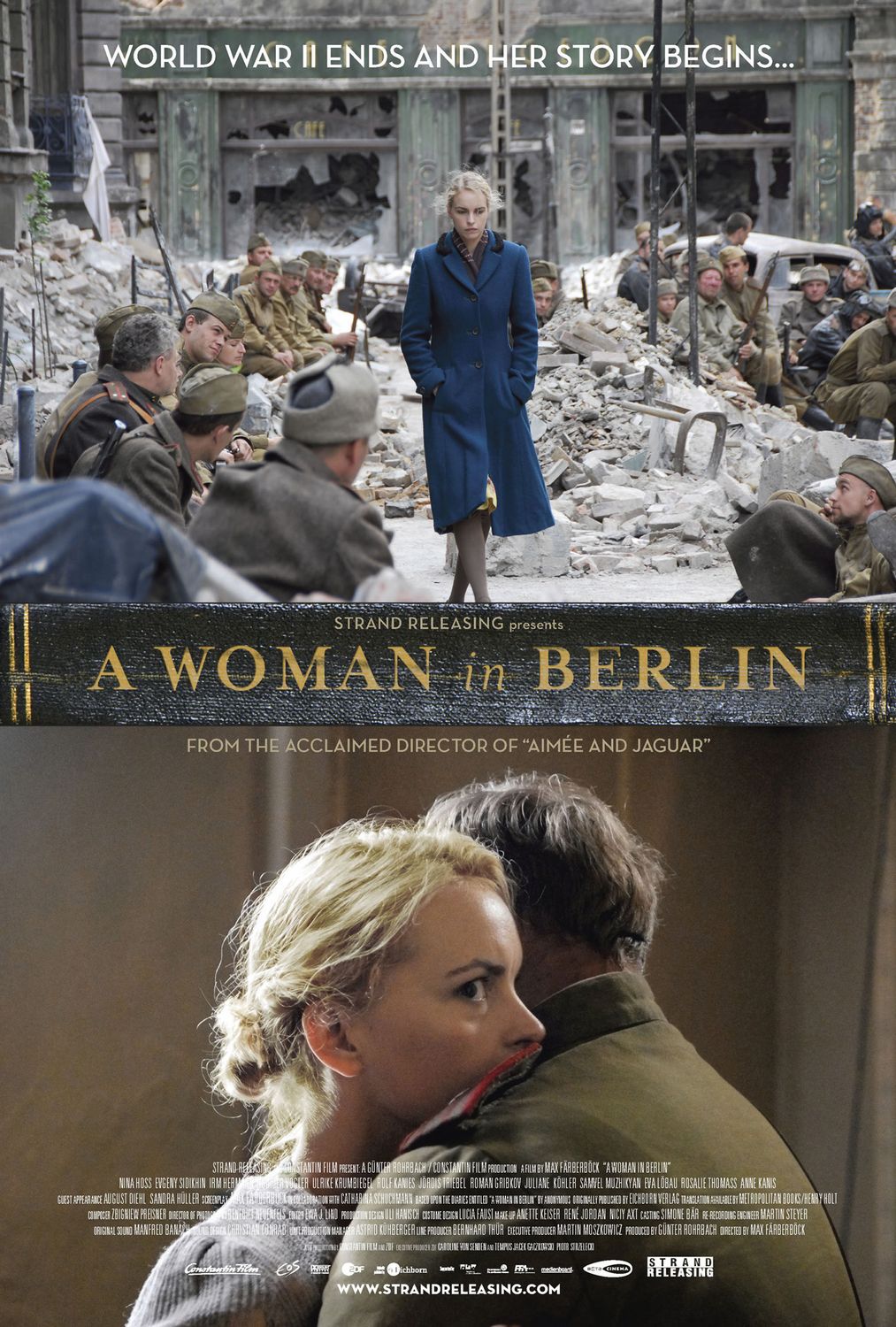
Sota also draws attention to the fact that in 2008 the book was adapted for the screen. The film is not mentioned in the list of extremist materials.

“Kill the Beggars,” a song by the group Pornofilmy, and eight other materials were also placed on the register. The list was published by a Telegram channel about updates to the list of extremist materials [and “extremists” and “terrorists”], maintained by the programmer Ivan Shukshin.

Thanks to Anna Romashchenko for the heads-up. Image courtesy of Kinopoisk. Translated by the Russian Reader
“Kill the Beggars!”

Come on!

Progress and efficiency have triumphed. And how!
Today we have a neutron bomb
We’ll destroy our surplus enemies quickly
Without touching their property, we’ll do everything cleanly

Well, it didn’t come in handy in the war
It will come in handy at home — both for you and for me

Kill the poor!
Exterminate, destroy them!
Chew them up, crush them! Come on!
They’re not afraid to die
The beggars will be only too glad
Every beggar goes to heaven
Kill the beggars!

Come on!

The sun laughs in gasoline puddles
We don’t need a war tax anymore
The slums are on fire, burning perfectly
And a million unemployed people have just disappeared

Well, look: the country is rising from its knees
Unemployment is defeated

Kill the poor!
Exterminate, destroy them!
Chew them up, crush them! Come on!
They’re not afraid to die
The beggars will be only too glad
Every beggar goes to heaven
Kill the beggars!

Come on!
Fucking do it!

Champagne splashes, joy and pride
Crime is falling. Breathe freely!
Smiles frozen on the faces of the fortunate
And Putin said that we have won

Let’s get dressed up! Shout “Hurrah!”
We’ll dance until morning

Kill the poor!
Exterminate, destroy them!
Chew them up, crush them! Come on!
They’re not afraid to die
The beggars will be only too glad
Every beggar goes to heaven
Kill the beggars!

Come on!
Come on!
Come on!
Kill the beggars!

Source: AZ. Translated by the Russian Reader
Subtle Forms of Utter Hogwash

Dostoevsky and the Russian Soul

Rowan Williams’ fascination with Russia began when, as a boy, he watched Sergei Eisenstein’s Ivan the Terrible on television. After that he became a born again Russophile, learned the language, and even completed a doctorate on Russian Christianity. But no Russian figure has held his fascination more than Fyodor Dostoevsky.

Dostoevsky is still considered among the greatest novelists the world has ever produced. But his talent for writing complex, often contradictory characters is rooted in a single traumatic moment when, as a young man, he found himself before a firing squad. The event changed his life, his writing, and his views on Russia’s place in the world.

Now that tensions between Russia and the West are once again running high, Rowan considers what the author’s life and thought can tell us about the country today.

Ultimately, Rowan finds, what makes Dostoevsky such a wonderful novelist is his humanity. At a time of deep divides, this is a writer with something to offer us all.

Source: BBC Radio 4

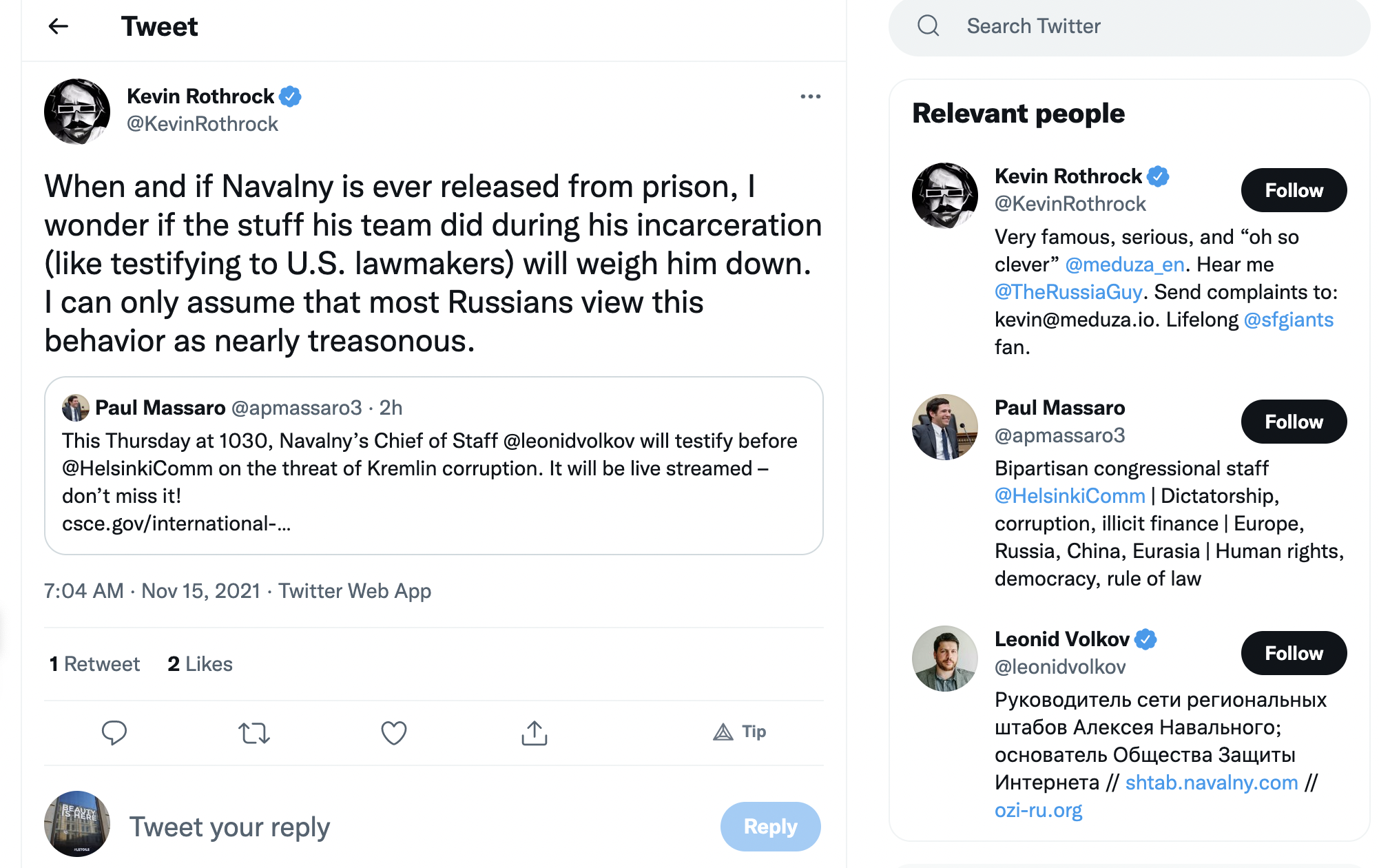
Source: Twitter.com

“They were right to shoot people”

Natalia Vvedenskaya
Facebook
November 12, 2021

In the early 2000s, our computer broke down. There were few computer repairmen back then, and a passing acquaintance suggested her husband for the job. The young man came over and quickly fixed everything. Over tea it transpired that he worked at the FSB.

This was still amazing then, so we naively asked him how he could work in such a place, for the heirs of criminals and all that. And this twenty-five-year-old man literally said, “They were right to shoot people. They just should have done it more quietly.”

Now the whole country from top to bottom is run by people from the FSB. Of course, they want to ban Memorial. What need is there to remember if it was “right” to shoot people? What need is there to defend human rights if it is “right” to imprison people now?

The liquidation of Memorial is just the final whistle: the boat is leaving the dock. We’ll still put up a bit of a fight, of course. What else can we do?  But all the same.

___________

The acquaintance soon divorced the man because he had begun beating their child.

____________

The document, above, is from the family archive. Roman Troshchenko, a priest, worked as a physician’s assistant in an orphanage after serving time in the camps. He was shot, allegedly, for “spreading rumors among the children and the populace that the Soviet regime would fall and the fascists would come to power.”

Translated by the Russian Reader

The History Lesson

Natalya Pavlishcheva, Forbidden Rus’, 9th Edition: 10,000 Years of Our History from the Flood to Rurik 

THE NINTH EDITION of the super-bestseller that has sold record numbers of copies! A sensational book that has overturned over all the usual ideas about the history of Russia, which is not 1,200 to 1,500 years old, as the textbooks lie, but ten times longer!

This “prehistoric” Russia is actually under a complete ban in “scholarly circles.” “Professional historians” do not believe in it. Its existence is denied by “serious academics.” Its traces are diligently ignored by Ph.D.’s and academicians who are accustomed to hush up inconvenient facts that do not fit into the Procrustean bed of scholarly officialdom, although there are more and more such facts with every passing year.

Flying in the teeth of implicit censorship and “professional” taboos, and based not on the retelling of hoary “scholarly” myths, but on the latest data from archaeology, climatology and even genetics, this book offers a new, revolutionary look at the origins of Ancient Rus’ and the deepest roots of the Russian people. It unravels the principal secrets of our past, breaks through the conspiracy of silence and exposes the poverty of historical officialdom!

The book was previously published under the title 10,000 Years of Russian History: From the Flood to the Christianization of Rus’.

Source: Litres. Translated by the Russian Reader

Brighten the Corners

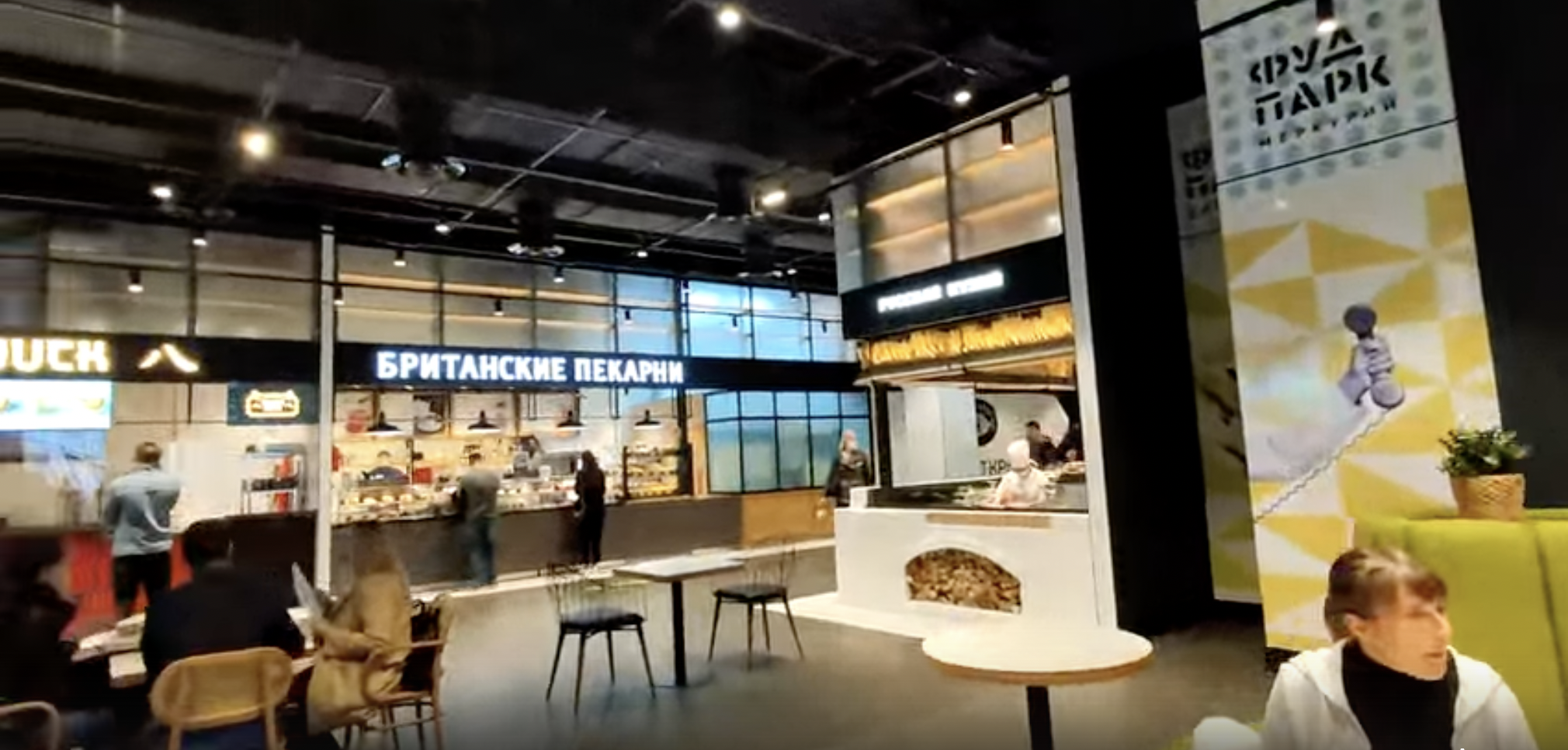
Ginza Project opens food park with more than 20 corners at Mercury Shopping Mall near Begovaya subway station 🍲🥤
Bumaga
September 26, 2021

Ginza Project restaurant group has launched its first food hall in Petersburg. This week, a food park was opened in the Mercury shopping and entertainment complex near the Begovaya subway station. It is a joint project of Ginza Project and Adamant, according to the restaurant group’s website.

The gastronomic space occupies 3,000 square meters. In addition to restaurant concepts [sic], there is a grocery market and a children’s entertainment center.

There are more than 20 corners with food and drinks in the food park. Among the residents are Koreana Light, Bo and Bao Mochi, Easy Hummus, Pa Pa Power, British Bakeries, Buro and Salad Bar. You can try the French grill at The Vixen Has Come, smoothies at Simple Blend and French baked potatoes at Potato Papa.

In addition, Ginza Project has opened three of its own corners in the food park: I Want Kharcho and Khachapuri, featuring Georgian cuisine; Ginza Small, featuring Japanese food; and Pancake and Dumpling, feature Russian fare.

The food park is located on the third floor of the Mercury Shopping Mall. You can learn more about it on the project’s website and its group page on VKontakte.

The image, above, is a screenshot of Ginza Project’s promo video for Food Park Mercury on VKontakte. All underlined words are in Rusglish or Latin characters in the original. Translated by the Russian Reader

_____________

At 12 p.m. on Sunday, October 3, a Last Address plaque in memory of the schoolboy Boris Bumagin, who died in exile, will be installed at 20 English Embankment in  Petersburg.

Boris Grigoryevich Bumagin was born in 1935, the son of the Leningrad Communist Party leader Grigory Kharitonovich Bumagin, who led guerrilla forces in the occupied areas of the Leningrad Region during the Second World War. In October 1949, Grigory Kharitonovich was arrested as part of the Leningrad Affair and sentenced to 25 years in prison.

Fifteen-year-old eighth-grader Boris Bumagin was arrested on 14 March 1951 as the “son of a convicted member of the G.Kh. Bumagin anti-Soviet wreckers group.” Boris and his sister were exiled for five years to Krasnoyarsk Territory, where their mother was already in exile. In August 1952, Boris tragically drowned in the Taseyeva River. His father, who was in prison, learned about his son’s death a year later in a letter from his wife.

Two years after his death, Boris Bumagin was exonerated for lack of evidence of a crime. His father was released at the same time, in 1954, and exonerated in 1956.  A plaque in memory of Grigory Bumagin was installed at 20 English Embankment in 1985. Now a memorial plaque for his son Boris will be installed at the same house. Boris’s great-niece Alina Tukkalo has arranged for the installation.

We invite you to attend the installation ceremony and remind you of the need to practice social distancing and to wear masks when socializing. Stay healthy!

Source: Last Address Petersburg email newsletter, 27 September 2021. Translated by the Russian Reader

Last Address (Moscow): Natalia Totskaya

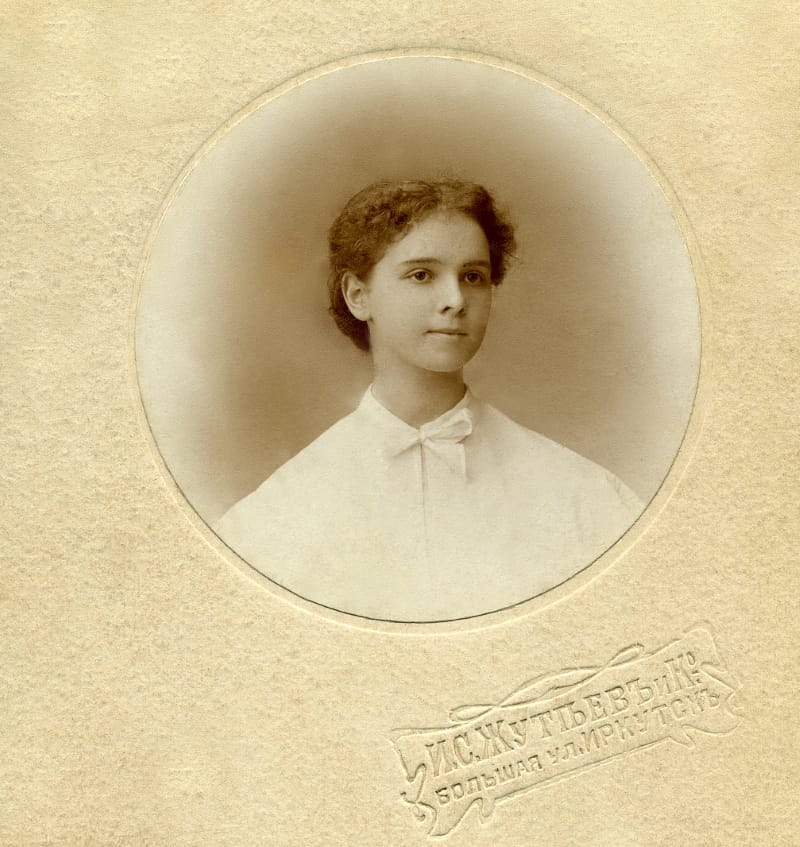
A photograph of the young Natalia Totskaya, taken at a photo studio in Irkutsk. On January 2, 1938, Totskaya was executed for “counterrevolutionary terrorist propaganda” and “espionage.” Courtesy of Oksana Matiyevskaya

Oksana Matiyevskaya
Facebook
August 28, 2021

Here’s what’s new.

I was just writing an announcement for tomorrow’s Last Address ceremony for a neighborhood group.

Suddenly, I realized that five years ago, when I started doing this, the charges of espionage and terrorist propaganda [made against many victims of the Great Terror] seemed to be the distant past, a clear marker of Stalin’s hysterical spy mania. It seemed, well, unreal, hard to believe. What must have it been like to live in such darkness, huh?

The years have gone by, but, people have asked, does it still seem unreal?

This is Natalia Totskaya, a graduate of an Institute for Noble Maidens. She was a teacher of foreign languages and translator. She corresponded with her sister, who had emigrated.

A plaque bearing her name and four dates — of her birth, arrest, execution and exoneration — will be installed and dedicated tomorrow, Sunday, 3:00 p.m, at 1/2 Solyanka Street, bldg. 1 [in Moscow].

Please come and join us!

Thanks to Marina Bobrik for the link. Translated by the Russian Reader

The Real Rusha

The success of Putin’s Russia has been determined by a correct-minded approach to solving problems of the development of Russia. Putin’s domestic, socio-economic and international policy ensured great support for him from the majority of Russian citizens. He was supported by the nation not only as a politician, but first of all as a national statesman, responsible for the country and its development.

—Ivan S. Kuznetsov, Elena V. Katyshevtseva (Nikulina), and James Douglas Stuber, Modern Russian History: A Textbook, trans. Liudmila I. Katyshevtseva (Gwangju: Chonnam National University Press, 2012), p. 188

Since the beginning of the year, the number of political prisoners in Russia has increased from 349 to 410. According to the Memorial Human Rights Center (included in the register of foreign agents), the vast majority of them were deprived of their liberty due to their religious affiliation. The list also includes people who were deprived of their liberty after participating in protests in support of Alexey Navalny in January of this year.

—Alina Pinchuk, “‘The growing repressiveness of the regime’: there are more political prisoners,” Radio Svoboda, August 17, 2021

Photo and translation of second quotation by the Russian Reader