Farewell to Matyora

imag2621

Experts Predict the Closure of All Rural Hospitals by 2023 
Ilya Nemchenko
RBC
December 9, 2016

If the number of social welfare institutions continues to decrease at the same pace, there will be no hospitals in rural areas within seven years. Experts argue that all rural schools and medical clinics could be closed within seventeen to twenty years.

Due to “optimization” processes, over the past twenty years, rural areas have lost much of their social infrastucture, experts at the Center for Economic and Political Reform (CEPR) have concluded. In report entitled “Russia, Land of Dying Villages,” they note the numbers of hospitals, schools, and clinics in rural areas will continue to decline in the coming years. RCB has a copy of the report.

Based on Rosstat’s data, the CEPR has calculated that, over the past fifteen to twenty years, the number of rural schools had shrunk by nearly 1.7 times (from 45,100 in 2000 to 25,900 in 2014), the number of rural hospitals by four times (from 4,300 to 1,060), and the number of rural clinics by 2.7 times (from 8,400 to 3,060).

The upshot is that all rural hospitals could close in seven years, while all rural schools and clinics could close in seventeen to twenty years, claims the report.

“It is clear that this is not possible and that all ‘optimizations’ have their limits. However, there are fears that social welfare institutions will continue to close in the countryside in the coming years, albeit at a much less impressive pace,” write the report’s authors.

The optimization of schools and hospitals is often justified by decreases in population, although it is socio-economic problems that facilitate flight to the cities. The experts argue the government has deliberately pursued a policy of depopulating rural areas and has deprived the countryside of its “last hope for the future.” They call the current circumstances a vicious circle. Optimization of social welfare facilities has proceeded at a much faster rate than rural depopulation and the abandonment of villages.

According to the report, the rural population has been in constant decline over the past twenty years. This has happened due both to migration outflows and the fact that the death rate has exceeded the birth rate. The number of deserted villages increased by more than six thousand from 2002 to 2010, to 19,500. Moreover, less than one hundred people live in more than half of all rural settlements.

The experts note that while the number of depopulated villages has continued to grow in Central Russia and the north, rural areas have been developing vigorously in the south. In 2016, the North Caucasus Federal District had the largest population in terms of percentages (50.9%), while the Northwest Federal District had the lowest (15.8%).

The study underscores that the main causes of depopulation in the countryside are social and economic problems. The standard of living is low in rural areas, while unemployment is relatively high, and this has spurred a growth in the crime rate. The experts note that prices in rural areas are high, so country dwellers spend more money on food than city dwellers do.

Population outflow has also been due to the poor quality of utilities and housing. According to the CEPR, only 57% of rural housing stock is supplied with running water, while only 33% of houses have hot water. The condition of the water mains in the countrsyide has constantly grown worse: only 54.7% of residents are supplied with safe drinking water. The experts note that only 5% of villagers have sewers. (This figure has not changed since 1995.) However, the provision of natural gas is relatively better. According to Rosstat, approximately 75% of the rural housing stock is supplied with pipeline or liquefied gas.

The CEPR’s researchers write that the government policy has concentrated capital, jobs, and people in the large cities, while attempts to maintain the rural population have failed, because there are no conditions for developing the villages. The experts believe that comprehensive socio-economic reforms are needed to solve the problem. Otherwise, the number of deserted villages will have increased by the time of the next census.

Translation and photo by the Russian Reader

See some of my previous posts on life in the Russian countryside:

Yekaterina Chatskaya: Saving Mental Healthcare in Moscow

Campaign Opposing Closures of Moscow Psychiatric Hospitals Kicks Off
Yekaterina Chatskaya
Action Trade Union
December 6, 2016

Psychiatric Hospital No. 15, Moscow. Photo courtesy of Action Trade Union

Moscow has been witnessing another round of “optimization” of public healthcare. This time, officials have targeted the mental healthcare system. At present, Psychiatric Hospital No. 12 (Kannabikh Hospital), Psychiatric Hospital No. 14, and Psychiatric Hospital No. 15 are endangered. Experts and relatives of patients have been sounding the alarm. The actions of the “optimizers” will harm patients and generate a new threat to society. In addition, hundreds of qualified specialists will lose their jobs. Yekaterina Chatskaya, a Moscow physician and co-chair of the Action Interregional Healthcare Workers Trade Union, has summarized the information the trade union has collected on the “optimization” of the psychiatric clinics.

The authorities have dubbed the virtual closure of three hospitals “reorganization measures.” In particular, the Moscow City Government has already issued a decree on the reorganization of Psychiatric Hospital No. 12 (Kannabikh Hospital). It will be merged with the Solovyov Neuropsychiatric Research and Treatment Center. The reorganization of the hospital, staffed, until recently, by approximately 300 people, has come amidst psychological pressure on employees and their “voluntary” resignations or, at best, their resignation by mutual agreement and payment of two months’ worth of salary. Management has been concealing from staff the fact that severance pay in the amount of two months’ average salary is owed to employees in the event of dismissal on grounds of redudancy. Moreover, employees retain their old jobs for at least two months from the date they were officially notified of layoffs.

Psychiatric Hospital No. 15, which employs more than a thousand people, has also been threatened with mass layoffs as part of reorganization. The Moscow Health Department plans to convert it into a neuropsychiatric residential care facility. G.P. Kostyuk, Moscow’s chief psychiatrist and deputy head of the municipal health department, announced these plans at a meeting with hospital employees. However, 16 doctors and 102 nurses will remain on staff at the residential care facility. The health department could provide no written guarantees that salary levels would be maintained or other staff members would be provided with jobs.

We already know there are plans to convert Psychiatric Hospital No. 14 into a hospital for patients with chronic mental illnesses. The Moscow City Government, however, has yet to pass decrees on the reorganization of Hospital No. 14 and Hospital No. 15.

At the meeting with the employees of Hospital No. 15, officials said the decision to close the hospital had been taken personally by Deputy Mayor Alexei Khripun. However, officials provided no other weighty arguments for the decisions, and the arguments they made were patently absurd. In particular, the officials claimed that the hospital, located near Kashirskaya subway station, is unable to serve patients from the city’s Northwest Administrative District, although the hospital has in fact been serving patients from northern and northwestern Moscow for fifty years. The officials were unable to provide specific calculations showing why this had suddenly become unfeasible. Nor did they respond to doctors who argued that a residential care facility would be unable to replace the shuttered hospital. By the way, residential care facilities, unlike hospitals, are part of the social welfare system, not the healthcare system.

It is telling that reforms of such a socially significant area of medical care in Moscow as psychiatry should be launched without broad public discussion. The only document on the topic I could find in the public domain was “The Development Concept of the Moscow Municipal Psychiatric Service: Expert Comments by the Moscow Health Department’s Research Institute for Healthcare Organization and Medical Management.” It was published on November 29, that is, after people had begun to be fired and information about the reorganization had gone public.

Fifteen years ago, the Russian Federal Health Ministry announced a policy of “decentralizing inpatient psychiatric care, strengthening its outpatient component, and employing inpatient-substitution techniques” (Russian Federal Health Ministry Decree No. 98, dated March 27, 2002, “On s Sector-Wide Program for Reorganizing the Psychiatric Care Network in the Russian Federation, 2003–2008”). Most experts agree that shifting some of the burden from inpatient facilities to the outpatient component is warranted. However, even supporters of the policy recognize that Russia’s outpatient and day patient facilities can hardly offset a reduction in the number of beds at psychiatric hospitals and hospital closures. In particular, in November 2010, Valery Krasnov, director of the Moscow Psychiatric Research Institute, told the 15th Russian Psychiatric Congress that “2010 was marked by a decrease in the number of neuropsychiatric treatment centers and a deficit of social workers.” The resolution of the 16th Russian Psychiatric Congress, which took place in 2015, stated, “During the period between 2005 and 2014, a significant decrease in the number and capacity of psychiatric institutions, both outpatient and inpatient, occurred.” In other words, there has been no shift of institutional capacity towards the outpatient component, but a reduction of all components of mental healthcare.

The Action Interregional Healthcare Workers Trade Union believes that in order to decide the future of these hospitals a working group involving members of the Moscow City Government and employees of the affected hospitals should be organized. Public hearings on the matter where all interested parties could speak their minds should be held. In addition, there is no doubt that healthcare workers who are being laid off should have written guarantees they will be given new jobs at the same pay grade.

The union warns that attempts to make employees resign “voluntarily” are unlawful. Under current labor laws, reorganization cannot be grounds for terminating someone’s employment. Employees may refuse to sign letters of resignation without fear of the legal consequences. Even when employees are promised transfers to other institutions, they should not sign letters of resignation. Transfers are effected through a supplementary agreement to existing work contracts. Otherwise, employers are freed from the obligation to maintain the same working conditions and wages at the new workplace.

Furthermore, even if an employer claims dismissal is due to downsizing, we must remember that downsizing of this sort is legally possible only after the reorganization (the merger of hospitals) has been completed. After the reorganization, the employer must notify employees of possible dismissal at least two months before layoffs and offer them all available vacant positions. After dismissal, employees are entitled to payment in the amount of the average monthly salary for two months, or three months, if they have registered with the employment bureau.

The plans to close the hospitals have sparked outrage. The first petitions against the closures of Hospital No. 12 and Hospital No. 15 were posted on the web in mid November.

On December 1, a pressure group of healthcare workers from the three “optimized” hospitals, relatives of patients, and leaders of the Action Interregional Healthcare Workers Trade Union held a joint meeting. They founded a temporary Committee for the Defense of Healthcare in Moscow and decided to launch a campaign. Today, December 6, relatives of patients will kick off a series of solo pickets outside the Moscow Health Department. A full-fledged picket outside the department has been announced for November 9 at noon. A protest rally has been scheduled for December 18 on Suvorov Square from one to four p.m. City authorities are now reviewing applications for the rally as part of the approval procedure.

Translated by the Russian Reader. Thanks to the Confederation of Labor of Russia (KTR) for the heads-up

Sorry, We Have No Medicine

Unlike life-saving prescription drugs, hashish and other narcotics are easy to come by in Russia. Photo by the Russian Reader

Sorry, We Have No Medicine
Alfia Maksutova
Takie Dela
November 24, 2016

What doctors and officials do to avoid giving patients the free drugs they have coming to them

“You’re not ill.”

“You don’t have that.”

“You don’t need that drug.”

“You need that drug, but a cheaper substitute will also do.”

“You need the drug, but we’re out of it, so you’ll have to wait.”

This is how doctors and officials respond to thousands of people who, by law, are supposed to receive subsidized medicines. They trick them. They know these people are ill, and they know what drugs they need. According to rough estimates, however, the state now lacks 45 billion rubles for providing drugs to the populace. In certain regions, only 10% of applicants can be supplied with subsidized medicines. Officials and doctors turn down patients in such a way that it is as difficult as possible to prove they have broken the law. The Health Ministry and the health care regulator Rosdravnadzor regularly report that things are stable when it comes to preferential drug provision in Russia. The figures underpinning the reports bear no relation to reality. The true scale and brutality of the war between patients and the state is striking.

***

“Every time, they say, ‘Sorry, we have no medicine. There is nothing we can do about it.’ But by law I am supposed to get them. If they are out of them today, the state should purchase them tomorrow. Isn’t that right?”

Veronika has repeated the question over and over, but her voice still sounds surprised. When she speaks, her hands, with their long, elegant fingers, tremble slightly, as if they too are incapable of coping with the surprise. She has used hormonal inhalers for fifteen years. Without them, she cannot breathe. She has asthma, a host of related ailments, and official status as a disabled person. She is entitled to get the necessary dose at the pharmacy for free, but the medicine has not been issued for a year and a half now.

“It was always given out intermittently,” says Veronika. “You had to find out ahead of time the day when the drug would show up and run to the clinic when it opened to be in time to get it. If you were late, they would tell you they had run out, and it was your problem. But it was only last year I had to deal with the medicine not being available for months at a time.”

Then, after waiting six months, Veronika first turned to the Moscow Health Department for help. It was enough to file an application and the inhaler, which the pharmacy did not have in stock in the morning, turned up in the evening. But the magical effect of phoning the health department did not last long. A couple of months later, the drug was once again no longer available. When Veronika called the health department this time, she was told the situation was complicated. She could file an application, but no one knew when the drugs would arrive. The same day, the pharmacy called her and said her request was pointless: the drugs would not be available. Currently, relatives have been paying for her inhalers to the tune of several thousand rubles a month. According to Veronika, many of the people queued up to see the pulmonologist could not afford to pay this amount. The phrase “we are out of drugs” is tantamount a death sentence to them.

Veronika’s case is one of thousands. It suffices to peruse the regional press for the past month to read a dozen such stories. In Mordovia, the pharmacies not only have no prednisolone for patients entitled to the free drugs benefits, but no iodine or bandages, either. In Oryol Region, a woman suffering from lymphoma managed to get medicine only after local media wrote about her case. In Khakassia, the Audit Chamber will be investigating the problems with subsidized medicines due to the large numbers of complaints by patients. Organizations involved in protecting patients’ rights talk constantly about the growing number of pleas for help. The Movement against Cancer, for example, has noted an uptick. In September of this year, there had been so many cases of cancer patients turned down for subsidized drugs that the Prosecutor General’s Office investigated legal violations in a number of regions. According to online monitoring data for September 2016, done by Alexander Saversky, head of the League of Patients, over 80% of those surveyed had trouble obtaining subsidized drugs. Only 35% of those people had managed to get a prescription for the drugs in question without problems. Similar figures were adduced in a survey done last year by the Russian People’s Front: half of the patients surveyed were not issued the medicines they requested on time.

A 2016 government report stated the subsidized drugs provision program was suffering a shortfall of 45 billion rubles [approx. 660 million euros]. This was no surprise. The standard cost per person receiving free drugs has dropped from 849 rubles a month, in 2011, to 758 rubles, in 2016. According to Rosstat, however, the price of drugs has increased this year by 24%. In 2015, the government allocated an additional 16 billion rubles to alleviate the situation, but, unexpectedly, they were not used. The Health Ministry has said that all necessary drugs have been purchased. Roszdravnadzor regularly monitors the supply of drugs nationwide and has remained satisfied with its results. According to the reports issued by these agencies, around 98% of beneficiaries in Moscow Region, for example, receive their drugs, and the situation in other regions is stable. The Health Ministry’s ability to force public health officials to bend reality for reporting purposes has amazed even the president. Continue reading “Sorry, We Have No Medicine”

The Hit-and-Miss Approach to HIV Prevention in Russia

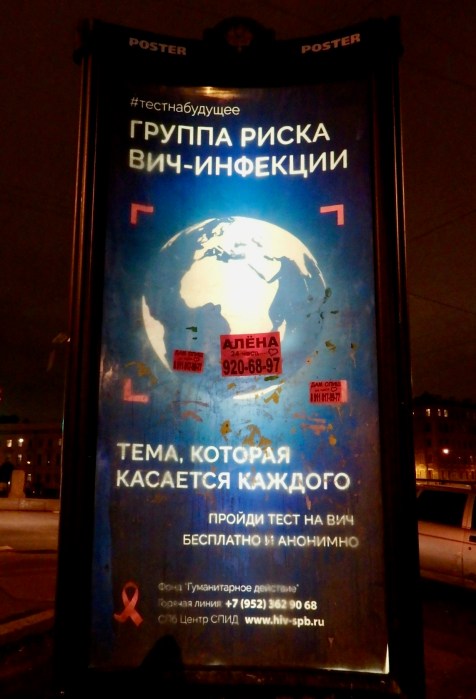
“#testforthefuture. HIV-infection risk group. A topic that affects everyone. Take an HIV test free and anonymously. Humanitarian Action Foundation.” Public service ad in central Petersburg, October 29, 2016. Photo by the Russian Reader. Typically, the ad is plastered with flyers offering the services of prostitutes.

Health Ministry Did Not Include HIV Test in Compulsory Medical Exam
Polina Zvezdina
RBC
November 21, 2016

Optional and Anonymous

The Health Ministry has changed its annual medical exam program for adults, judging by the amendments posted on the Federal Website for Draft Regulations. Free HIV testing was not included in the document. In September 2016, Health Minister Veronika Skvortsova had promised testing would be included in the annual wellness examination program beginning in 2017.

If the amendments are adopted, beginning next year, general practitioners will be obliged to inform everyone between the ages of 21 and 49 who is undergoing a physical exam that they can take an anonymous HIV test at specialized medical clinics. Physicians should provide patients with a list of the clinics where the test is performed.

The Health Ministry had planned to receive funds to expand the program by eliminating ineffective research. Our sources at the ministry did not explain to us why the HIV test had been turned down for inclusion in the compulsory program.

MPs Fedot Tumusov and Alexandrev Petrov, who sit on the State Duma’s Healthcare Committee, believe the ministry rejected the HIV test as part of its physical exam program due to a lack of funds. Andrei Skvortsov, coordinator of the Patient Monitoring movement, agrees with them.

This is not the first time the government has been unable to find funds in the federal budget to fight HIV. Thus, on November 15, due to a lack of financing, a special interdepartmental commission decided not to add new drugs for suppressing HIV to the list of essential drugs. Elena Maximkina, director of the Health Ministry’s Department for Drug Provision, said that 20.8 billion rubles had been spent in 2016 on purchasing anti-HIV drugs. Yet in the three-year federal draft budget, 17.8 billion rubles have been slated for prevention and treatment of HIV and hepatitis B and C in 2017, 17.5 billion rubles in 2018, and 17.1 billion rubles in 2019.


Mandatory and Unethical

Another reason the free test could not be included in the medical exam program is legal. At present, the test is only administered voluntarily, explained Tumusov. Testing as part of the standard medical examination should be obligatory, believes Tumusov, A Just Russia party MP, but first you must explain to the public why it is necessary. We can already observe positive outcomes in Yekaterinburg, where reports of an unofficial [sic] HIV epidemic sparked widespread testing for the infection, said Tumusov.

Skvortsov argues that testing could be included in the medical check-up program if doctors in district clinics and non-specialized hospitals were better informed about the specifics of HIV and the means of its dissemination.

“Medical personnel often refuse to give HIV-infected patients necessary medical treatment, and such patients face other forms of discrimination,” he noted.

Doctors at ordinary clinics are also often not able to carry out the pre-test and post-test consultations that would be required if obligatory testing were included in the medical examination program, said Skvortsov.

Another factor is that patients are now often reluctant to be tested under the voluntary health insurance program, argues Igor Pchelin, chair of the Steps Regional Public Charity Foundation to Fight AIDs. This is due to the fact that physicians may not comply with medical confidentiality and reveal test results to colleagues, neighbors, and friends of infected patients.

Provided there is sufficient financing in 2020, the government plans to test 35% of the public for HIV annually, according to the strategic plan for combating the spread of the infection. From the draft of the plan, which RBC has seen, it follows that financing should amount to an additional 3.2 billion rubles per year. This amount is needed to test an additional 20 million people at a cost of 150 rubles per test. It is currently not known whether the funds will be allocated or not. In 2015, HIV testing covered around 30 million people or 19.3% of the population.

Translated by the Russian Reader. If you found this article fascinating and depressing, you should definitely read Daria Litvinova, “Russia Wishes Away Its HIV Epidemic,” The Moscow Times, November 18, 2018.