New Trumped-Up Criminal Charges Against Soviet Dissident and Russian Opposition Activist Alexander Skobov

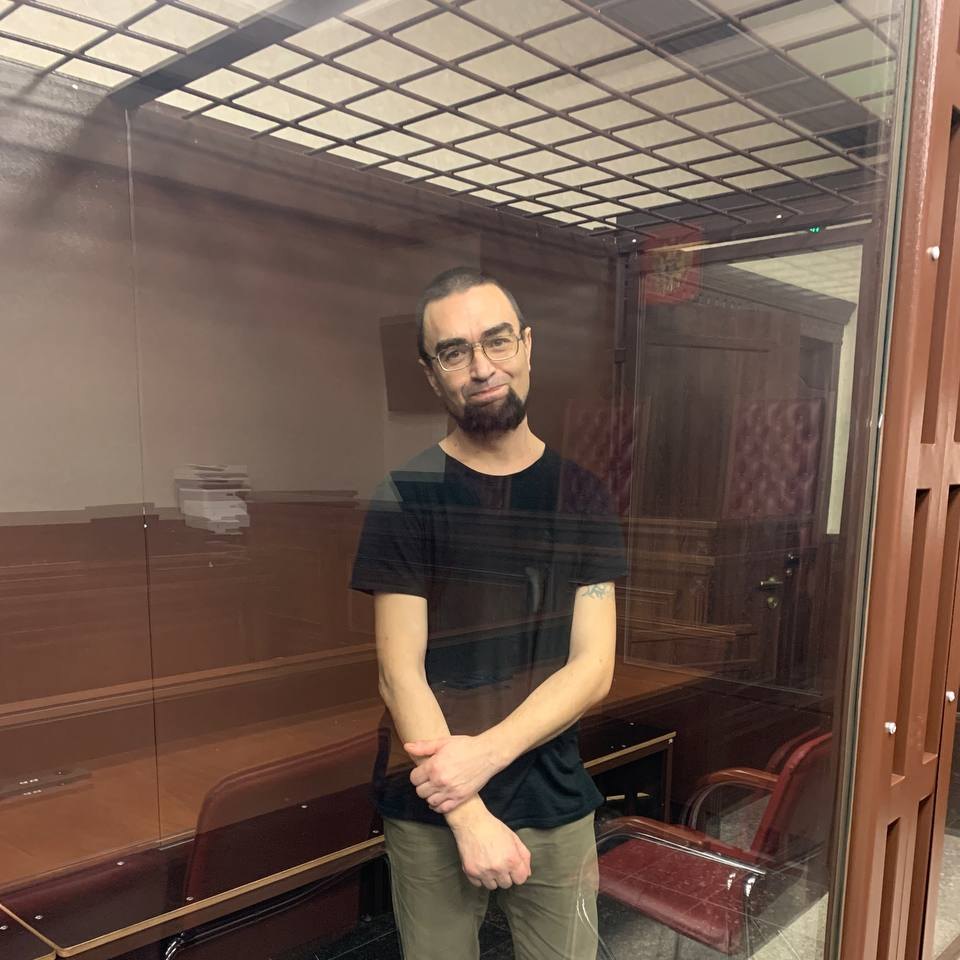
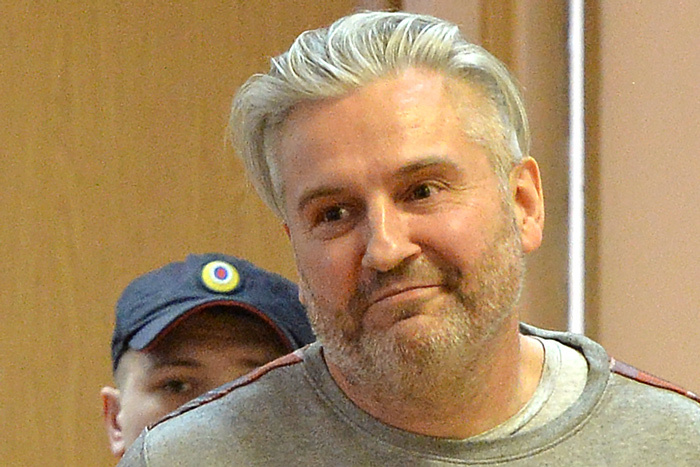
Alexander Skobov. Photo courtesy of V. Izotov/Deutsche Welle

A new criminal case, on charges of “involvement in a terrorist community,” has been opened against former Soviet dissident and Russian political journalist Alexander Skobov, who has been detained for over a month on charges of “condoning terrorism.” This news was reported on Saturday, 18 May, on Skobov’s official Facebook account by his wife, Olga Shcheglova.

Shcheglova said that she visited her husband on 14 May in the pretrial detention center in Syktyvkar, where he had been transferred from St. Petersburg. During a conversation with him, his lawyer and local police investigators, she learned that Skobov has also been charged with “condoning terrorism” and “involvement in a terrorist community.” The dissident’s wife is convinced that these two charges stem from her husband’s affiliation with the Free Russia Forum.

According to Shcheglova, on 21 May, Skobov will be sent to the regional psychiatric hospital in Komi for a forensic psychiatric examination. Skobov himself has stated that he would not participate in the investigation and forensic expertise, and he would appear in court only if his mother were present at the hearings. Skobov’s defense has filed an appeal, which will be heard by the court on 22 May.

Skobov’s Persecution in the USSR and Russia

On 22 March 2024, Russian authorities designated Skobov a “foreign agent.” According to the Justice Ministry, he had “disseminated unreliable information” about the decisions of public officials, opposed the war, “identified the Russian Federation with a terrorist organization,” been involved in the work of an “undesirable organization,” and produced and distributed “foreign agent materials” [sic], the human rights project OVD Info reports.

In 1978, Skobov was arrested over his active involvement in the Left Opposition group and the samizdat publication of an anti-government magazine. He was later sentenced by the court to undergo treatment at a psychiatric hospital, from which he was released in the summer of 1987.

This time around, the political journalist was arrested on charges of “condoning terrorism.” Skobov was detained in St. Petersburg on 2 April 2024. In protest, the dissident refused to take with him to jail his diabetes medication and his glasses, despite his poor eyesight. According to the Telegram channel Memorial Support for Political Prisoners, the real reason for his arrest was “a [social media] post condoning the bombing of the Crimean Bridge.”

Source: Asya Miller, “New criminal case opened against dissident Skobov,” Deutsche Welle Russian Service, 18 May 2024. Translated by the Russian Reader


In early April, 66-year-old dissident Alexander Skobov was arrested for allegedly “justifying terrorism” in his posts online. For his friends and family members, the arrest came as no surprise.

Skobov, a long-time dissident who was made to spend seven years in a psychiatric ward after taking part in protests against the Soviet authorities in the 1970s, had published multiple posts condemning Russia’s actions in Ukraine since 2014. In March he was named a “foreign agent”, and since then people close to him said his arrest had seemed inevitable.

“He and I talked a hundred times about the fact that he would be arrested — if not today then tomorrow,” said Skobov’s friend Yuly Rybakov, a human rights activist and former deputy in the State Duma, Russia’s lower house of parliament. “People have been imprisoned for much less.”

Skobov’s 90-year-old mother, whom he lives with and cares for, said she had been having nightmares about his arrest for months before it happened, and Rybakov recalled that Skobov himself said he “didn’t understand” why the authorities hadn’t come for him yet.

Skobov’s children, who moved abroad long before Russia’s invasion of Ukraine, urged their father to flee the country when they saw him in Istanbul in early March. Other friends have also tried to convince him to leave and avoid arrest, citing his many health issues, including severe diabetes, hepatitis C, chronic obstructive pulmonary disease and near blindness.

But, Rybakov said, Skobov was resolute, telling him that he “wanted to be part of his own judicial process” when he was inevitably arrested.

Rybakov said that Skobov had been “driven to despair” by what had been happening in Russia in recent years and “felt that someone had to be radical”.

Another friend, Mikhail Sedunov, said that trying to convince Skobov to change his course of action was like “grabbing the wing of a plane that was already accelerating down the runway”.

On 2 April, masked policemen arrived at Rybakov’s flat, where Skobov had been staying. When Rybakov left to take the dog for a walk, the police reportedly entered the property, threw Skobov to the ground, twisted his arms and handcuffed him. According to Rybakov, Skobov “defiantly” refused to take either warm clothing, his diabetes medication, or his glasses with him, intending these gestures as an “act of protest”.

Skobov’s wife, Olga Shcheglova, managed to buy him replacement medication and glasses, which she brought to him ahead of his interrogation by Russia’s Investigative Committee. But Skobov refused to accept them — a reaction Shcheglova said she had “expected” from her husband.

Resistance to the authorities and a fight for justice had defined Skobov’s life for more than four decades. His first foray into political activism was in 1976, when he and other university students in St. Petersburg scattered leaflets calling for the “establishment of true humane socialism” and the “overthrow of the tyranny of officials” ahead of a meeting of the Communist Party of the Soviet Union. The students were expelled from university and brought before a court, and some, like Skobov, were then sentenced to compulsory treatment in psychiatric hospitals because, according to Rybakov, it was believed that “only crazy people could dislike the Soviet regime”.

Skobov’s radical spirit remained unquelled when he was finally released from hospital in 1981, however, and he immediately joined the Free Inter-Professional Association of Workers, a dissident group that led the first attempt to create an independent trade union in the USSR. In 1982 he was arrested for his involvement with the group and sent back to hospital, where he spent another three years.

In the early 1990s Skobov taught history at a secondary school for gifted students, writing and publishing his own award-winning textbooks. But later in the decade political activism again became the focal point of his life as he took part in protests against the Chechen wars.

When Russia annexed Ukraine in 2014, Skobov took to social media to rail against the regime, openly supporting Ukraine and condemning Russia’s military action. The same year, two unidentified men armed with knives attacked him outside his home in what his friends and family members say they are sure was retribution for his criticism of the regime.

Even this did not deter him, however, and his friends said his statements opposing Putin’s rule became “even sharper, more unrestrained, and more radical”. Speaking last year at the Free Russia Forum, an opposition conference held biannually in the Lithuanian capital Vilnius, Skobov condemned the regime more harshly than any of the other attendees, despite being one of the only participants still living in Russia.

Another friend of Skobov, Nikita Yeliseyev, said he doubted Skobov would survive the 7.5-year sentence that he is almost certain to receive.

“He is an old man,” Yeliseyev said. “And he has a number of very serious illnesses.”

Sedunov said all of Skobov’s actions stemmed from a desire to “struggle, as vigorously as possible, against the obvious evil represented by the current Russian government”.

“This is the way he was brought up: he wanted to fight evil any way he could. And this was the only way left,” Sedunov said.

Source: Dmitry Tsyganov, “‘Someone has to be radical’: Former Soviet dissident Alexander Skobov is determined to defend his beliefs — even if it means dying in prison,” Novaya Gazeta Europe, 8 May 2024


Aleksandr Skobov has been a thorn in the side of authoritarian governments for more than four decades, from the Soviet era to President Vladimir Putin’s long rule. And now, in pretrial detention in St. Petersburg and facing prison, he is in no mood for compromise.

“On principle I refuse to comply with fascist laws,” he told RFE/RL late last month, shortly after the Russian government designated him a “foreign agent” on March 22. “I don’t intend to get into debates with the government. I will not try to prove my innocence. I will not label my writings, and I will not write any financial reports for them.”

“A criminal case could be launched at any moment,” he concluded.

He was right: On April 3, the 66-year-old was arrested and charged with “justifying terrorism” for a social-media post about the Ukrainian attacks that damaged the Crimea Bridge that links Russia with the Ukrainian region of Crimea, which Moscow occupied in 2014. The following day, a St. Petersburg court ordered Skobov held in pretrial detention for at least two months.

“If you take any of my articles or YouTube videos, you can find a whole bouquet of possible charges,” Skobov said in the March 31 interview. “Discrediting the army. Inciting hatred and enmity. Justifying terrorism. The rehabilitation of Nazism. I directly equate the actions of the Stalin regime with those of Hitler’s during World War II.”

Another reason for Skobov’s prosecution, his supporters believe, is his leadership role in the Free Russia Forum, a group of mostly exiled opposition figures founded by former world chess champion Garry Kasparov and activist Ivan Tyutrin in 2016 that has been declared “undesirable” in Russia. If he is charged with participation in an “undesirable” organization, he could face up to six years in prison.

“I am a member of the forum’s council, and I regularly participate in its broadcasts,” Skobov told RFE/RL. “I help write its statements and official pronouncements. Several of them I have written myself. I am actively involved, and I do not intend to stop.”

Skobov said he was drawn to the group because “it was the only opposition organization that categorically rejected the idea of the peaceful transformation of Putin’s dictatorship toward democracy using the procedure established by that dictatorship.”

“It was the only organization that, beginning with the annexation of Crimea, unambiguously stood by Ukraine as a victim of aggression,” he added. “We try to help the Ukrainian Army and the Russian volunteer formations that are fighting with them.”

Writing on Facebook after Skobov’s arrest, writer and critic Mikhail Berg said Skobov suffered from “an unbearable fear of being afraid.”

“And that is why he chooses the most painful forms of criticizing the authorities,” he wrote. “He shouts even though the authorities have long been destroying people for whispering or even for just opening their mouths.”

Parallel Lives

Born in Leningrad, as St. Petersburg was called then, in 1957, Skobov participated in his first anti-government protest when he was 19. He and other members of an underground organization threw about 100 flyers calling for “humanistic socialism” from the roof of a downtown building on the eve of the 25th congress of the Soviet Communist Party. Several of the protesters were kicked out of their universities, but Skobov — a first-year history student at Leningrad State University — got off with a disciplinary meeting of the Komsomol youth group.

In October 1978, he was arrested for publishing an underground, anti-government magazine called Perspectives. He spent half a year in a KGB prison before being sentenced to forced psychiatric treatment.

“In the late 1970s and early 1980s, political prisoners in Soviet psychiatric hospitals were rarely forcibly medicated, although there were such cases, of course,” Skobov said. “But I was treated more or less OK. Most of the doctors that I encountered tried to avoid playing the role of executioners or stranglers.”

He spent three years in confinement.

In 1982, he was again sentenced to psychiatric treatment, this time for a samizdat article he wrote defending Chile’s former socialist president, Salvador Allende, who died in unclear circumstances in 1973, and criticizing the rightist dictator General Augusto Pinochet. That article was deemed “anti-Soviet propaganda.”

This time, Skobov spent five years in the hospital before being released in the summer of 1987 during the initial phase of Soviet leader Mikhail Gorbachev’s liberalization campaign.

In many ways, Skobov and Putin led parallel lives during this period. Putin was born in Leningrad almost exactly five years before Skobov and studied at Leningrad State University just before him. But as Skobov became drawn into a life of opposition to authoritarianism, Putin joined the KGB secret police.

The president’s official biography insists that Putin always worked for the KGB’s First Directorate, which carried out counterintelligence operations. However, rumors have persisted for years that he worked for some time in the Fifth Directorate, which was responsible for suppressing internal dissent and prosecuting political dissidents. At the time, a senior figure in that department was Viktor Cherkesov, a longtime member of Putin’s inner circle who served as his deputy when he headed the Federal Security Service — the KGB successor organization — in the 1990s and who died in 2022.

In 2022, journalist and researcher Konstantin Sholmov published a photograph of a KGB archival document from 1976 that he said was on display at the Political History Museum in St. Petersburg. The document, a protocol of a search of the residence of Leningrad artist and dissident Oleg Volkov, named “Lieutenant Putin” as one of the officers carrying out the search.

In 2013, a series of photographs emerged showing a 1989 Leningrad protest during which KGB operatives roughly detained dissident Valery Terekhov. One of the men in the photograph resembles Putin. The Kremlin later denied that the man was Putin, saying the future president had already been sent to East Germany by 1989.

Prominent human rights activist Aleksandr Cherkasov of the banned rights group Memorial told the news outlet Agentstvo earlier this month that he believes Putin was involved in the investigation of Skobov. He said Skobov had told him Putin staked out his Leningrad apartment in November 1982 when prominent dissidents gathered to celebrate Skobov’s birthday.

Despite the danger growing around him after he was designated a “foreign agent,” Skobov refused to consider emigration.

“I’m not going to quit,” he said.

“Today anyone in Russia who disagrees with Putin’s Nazi regime is taking a risk,” he added, “even if he doesn’t really stick out or act publicly. Since the regime has already made the transformation from ‘hybrid totalitarian’ to totalitarian, it demands not just silence from its loyal subjects, but active participation. And even avoidance can be dangerous.”

Opposition leader Aleksei Navalny’s suspicious death in prison on February 16 was “to be expected,” Skobov said.

“Navalny constantly laughed in [Putin’s] face, and a dictator cannot stand that,” he added. “Unfortunately, I don’t think it will be the last death of a political prisoner in Putin’s Russia.”

Source: Robert Coalson & RFE/RL’s North.Realities, “‘I’m Not Going To Quit’: Facing Prison, Soviet-Era Dissident Skobov Speaks Out Against War, Repression,” RFE/RL, 10 April 2024

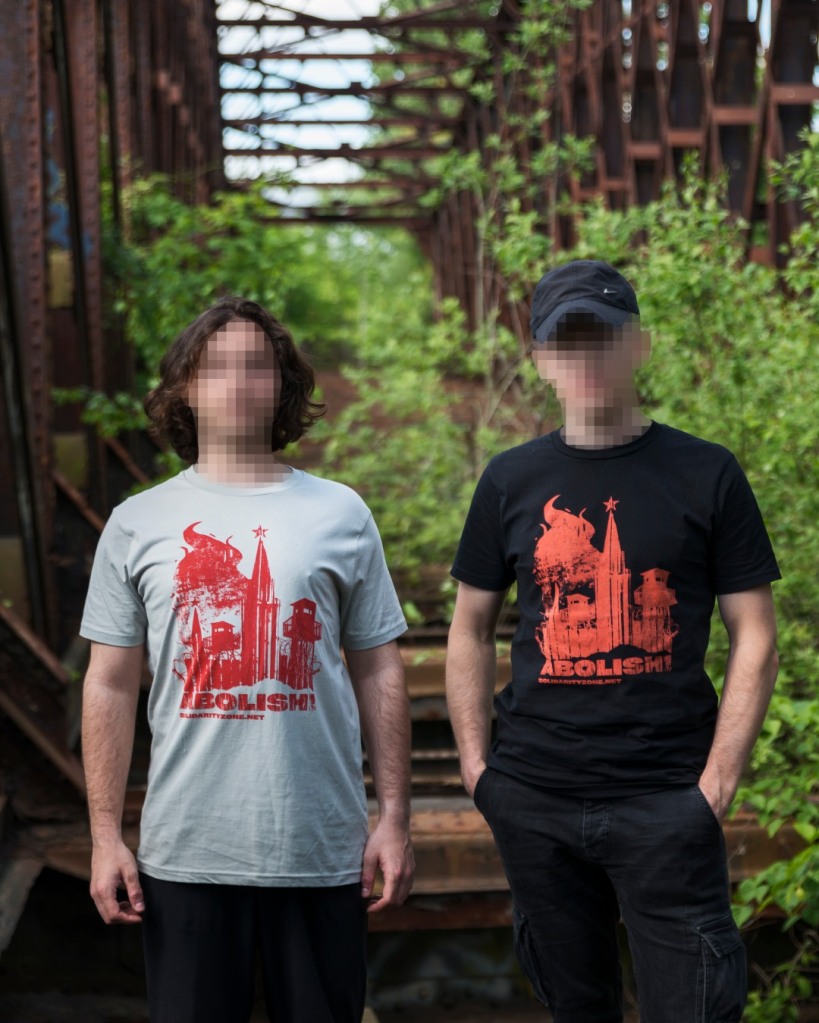
Buy a Radical T-Shirt and Support Solidarity Zone!

It’s May already! Are there enough T-shirts with radical slogans in your cupboard? Maybe Abolish and Derail the Empire work for you. By buying these T-shirts from us, you support Solidarity Zone, a human rights initiative that defends imprisoned members of the Russian anti-war resistance.

👕 Sizes:

— Abolish! print from XS to 2XL

— Derail the Empire print from S to 2XL

If you need another size, get in touch — we will see about arranging that the next time we print up the T-shirts.

💶 Price: €20 + delivery

✍️ To order, fill in this form.

The T-shirts are delivered by post from within the EU. For security reasons we do not send merch to the Russian Federation or the republic of Belarus. We also can not guarantee delivery to Georgia, due to the way the postal system there works.

✊ Funds raised from the sale of this merch go to support Solidarity Zone—a horizontal initiative providing support to those arrested in Russia for anti-war actions.

#merchandise #tshirt #solidarity #support #merch

Source: Solidarity Zone (Facebook), 12 May 2024. The original text has been edited slightly for sense.

Bohdan Ziza: “A Cry from the Heart”

Bohdan Ziza, a Ukrainian artist, poet and activist, is serving a 15-year sentence for “terrorism” after pouring blue and yellow paint – the colours of the Ukrainian flag – on to a municipal administration building in Evpatoria, Crimea, his home town. He made and circulated a video of the action – on 16 May 2022, shortly after the all-out Russian invasion of Ukraine – and for that was also charged with “incitement to terrorism”.

Bohdan Ziza. From his instagram channel

This is Bohdan’s speech from the dock, before being sentenced by a Russian military court on 5 June last year.

Do I regret what I have done?

I am sorry that I over-reached, and that my action resulted in charges under the Article [of the Russian criminal code] on terrorism. I am sorry that my grandmother is now without the care and support that she needs. Apart from me, she has nobody. And I am sorry that I can not now help others who are close to me, who need that help now.

As for the rest: I acted according to my conscience.

And also, according to my conscience, I do not deny or disavow what I did. I behaved stupidly, and could have expressed my opinion in some other way. But did I deserve, for what I did, to be deprived of my freedom for ten years or more?

I would like to appeal to the court: do not follow the regime’s script, do not participate in these awful repressions. But obviously that would have no effect. The judges and other similar political actors are just doing what they are told.

For these reasons, I will continue to protest, even in prison. And I am well aware of the sentence I may receive, and how it may affect my health and even my life.

But am I worthy of the life that I live? Is each one of us worthy of a carefree life, when we stay silent at a time when, every day, innocent people’s lives are being taken?

This was the worst night of my life. I never experienced anything like it. I thought we would die. There were three Kinzhal rockets, and loads of Kalibrs. They fell very close, they were right above our building. The building shook – several explosions, one after the other. For the first time in the war there was a white glow, the sky was white from the explosions. It was as though we were in a trench, not in our own home. At one moment I thought that it was all flying towards us. There was the very clear sound of a rocket, and then a very powerful explosion. But we have been lucky, again, and we are still alive.

That was a message from my sister, in Kyiv, who had to live through another night of bombardment of the city by the Russian armed forces.

When she went out in the morning, she learned that one of the rockets had hit the next-door building.

For many people, this war that is going on now is happening over there somewhere, far away.

One of the staff at the pre-trial detention centre said to me: “Bloody hell, I am sick of this war. Whenever you turn on the TV, it’s more of the same.” I answered that the war is not over and so you can not get away from it. And then he said: “Yeah, yeah, I know. It’s just that everything is getting more expensive. The cost of running a car now!”

And that’s the problem, here in Russia. For you, this war is an inconvenience, an irritation. You try to wait it out, living your usual life, trying to avoid bad news, and in that way simply not valuing simple things, not valuing the fact that you can wake up in a warm bed, in a warm flat, and say to someone who is dear to you, “good morning”. At a time when in the country next door, millions of people are losing their homes, losing their loved ones, when whole cities are being destroyed. Every day. That’s the everyday reality for Ukrainian citizens now.

In theory, Russian people’s failure to act could be explained, if only what is happening was not being done by Russian hands. The hands of those who bear arms, and those who don’t do anything to stop them. Every day that an ordinary Russian person carries on, reasoning that this is all politics and doesn’t concern him, and living his normal life, he adds money to the Russian Federation budget and in that way sponsors this criminal war.

Of course there are those who do not support what is happening, who take action, who are not silent participants: journalists, various activists – those who refuse to keep quiet.

My action was a cry from the heart, from my conscience, to those who were and are afraid – just as I was afraid – but who also did not want, and do not want, this war. Each of us separately are small, unnoticed people – but people whose loud actions can be heard. Yes, it is frightening. Yes, you can end up behind bars – where I, for sure, did not plan to be. Even for these words I could face a new criminal case. But it is better to be in prison with a clear conscience, than to be a wretched, dumb beast on the outside.

I am also an ordinary citizen of my country – Ukraine – who is not used to keeping quiet when confronted with lawlessness. I am not alone here today in this “goldfish bowl” [slang for the glass cage in which the accused appears in Russian courts]. There are more than 200 people with me: Ukrainian political prisoners, serving time in Russian prisons on fabricated charges. Many of them are Crimean Tatars, who are once again faced with repression by Russia. I am myself half Crimean Tatar, and angry at our people’s suffering.

Many Ukrainians are serving time in Russian prisons simply because they are Ukrainians, and were somewhere that the Russian state thought they should not be. In Russian prisons people are beaten up for speaking in Ukrainian. Or not even for speaking it, but simply for understanding it. Bastards among the guards at pre-trial detention centres or other places where people are imprisoned address prisoners in Ukrainian, to see if they get a reaction, to see if they provoke an answer or a response. If a person reacts, they beat him up.

Those who so passionately seek “Nazis” in Ukraine have not opened their eyes to the Nazism that has emerged in Russia, with its ephemeral “Russian world”, with which armed forces have come to us, to try to extirpate Ukrainian identity.

People in prison suffer in the most terrible conditions. Many of them are elderly. More than 40 people [in the pre-trial detention centre] have critical health problems, and can not access the medical treatment that they need. People die in prison. They are not criminals. Deport them from the country! Why do you keep them here?

I am no kind of terrorist. It sounds ridiculous to even say that. I am a person with morals and principles, who would rather give his own life than take the life of another person. But I am not ready to give my life to the Federal Penal Enforcement Service of the Russian Federation.

I declare a hunger strike, and demand that I be stripped of my Russian citizenship. I demand that all Ukrainian political prisoners be freed. If anything happens to me in prison, I want the world to know that it happened only because I am a Ukrainian, who took a stand against the war in his country.

And if this is my last word, let it be my last word in the Russian language. The last thing I will say publicly in Russian in this country, as long as this regime lasts. The reddish regime.

[Ziza then switched from Russian to Ukrainian, and recited this poem. Explanation of names mentioned below.]

I am not Red, I am Crimson!

I am not playing to the gallery!

These are not rhymes, they are wounds!

And I am not Melnik, I am Bandera!

The weather: it’s snowing in my summer,

From Symonenko’s motherland

I go to the end, like Teliha!

And I believe in wings, like Kostenko!

□ Note. The Ukrainian for “crimson” (“bahrianyi”), was also the pseudonym of Ivan Lozoviaha, a dissident writer and political exile from 1932 to his death in 1963. Andriy Melnik and Stepan Bandera were leaders of Ukrainian nationalist partisan military formations in the 1940s. Vasyl Symonenko was a Ukrainian poet, active in dissident circles until his death in 1963. Olena Teliha was a feminist poet, member of a nationalist underground cell in Nazi-occupied Kyiv, killed by the Nazis in 1942. Lina Kostenko is a Soviet-era dissident who has continued working as a poet and writer in post-Soviet Ukraine.

□ This is translated from the Russian text on the Graty news site, with reference to the Crimea Human Rights Group report. Thanks to M for help with translation.

□ What happened next. After Bohdan Ziza made this speech to the Southern District Military Court in Rostov, Russia, on 5 June 2023, he was sentenced by the judge, Roman Plisko, to 15 years in a high-security penal colony. Shortly after that, Ziza wrote to Zmina, the Ukrainian human rights organisation. He ended his hunger strike and then wrote to Uznik on-line, which coordinates correspondence with anti-war prisoners in Russia, to thank them and the many supporters who had written to him.

On 27 September 2023 Bohdan Ziza’s appeal against his sentence was rejected by Maksym Panin at the military court of appeal in Vlasikha, near Moscow.

Bohdan, who marked his 29th birthday on 23 November, was moved to Vladimir prison. On 5 December, the Kharkiv Human Rights Protection Group reported that he had been visited by his lawyer and is in good spirits. He is sharing a cell with Appaz Kurtamet, another Crimean Tatar political prisoner, and was serving time in a punishment cell after stating that he is not a criminal and refusing to wear prison clothing.

□ What we can do. Advice to non-Russian speakers who wish to write to Bohdan and Appaz is included in this article on the Kharkiv Human Rights Protection Group site. The group also appeals to other countries’ diplomats to help Ukrainian citizens in Russian prisons (although this does not include Bohdan, since he was compelled, as a teenager, to take Russian citizenship after Crimea was annexed by Russia in 2014).

□ More information. Solidarity Zone (see facebook, telegram and twitter) supports anti-war activists jailed in Russia. The Kharkiv Human Rights Protection Group, Crimea SOS and Zmina are among the Ukrainian human rights organisation that publicise the fate of more than 180 Crimean political prisoners in Russian jails. SP, 17 January 2024.  

□ Bohdan Ziza’s own art and poetry is on instagram and youtube.

Source: “Crimean political prisoner Bohdan Ziza: ‘My anti-war action was a cry from the heart’,” People and Nature, 17 January 2024. Thanks to my friend and comrade Simon Pirani for his outstanding work here and elsewhere, and for his kind encouragement to repost this important document of Ukrainian resistance to Russian fascism.

Timur Kacharava Was Murdered in Petersburg by Russian Neo-Nazis 18 Years Ago Today

“Timur, we will always remember you”: a memorial to the Russian anarchist, anti-fascist, punk rock musician and university philosophy major Timur Kacharava at the site of his murder by Russian neo-Nazis in downtown Petersburg

Eighteen years ago today the anarchist Timur Kacharava was murdered outside the Bukvoyed bookstore on Vosstania. I haven’t seen any announcements anywhere, but I’m sure that today, as every year, people will come there to remember him. It seems that Timur’s parents usually arrive early, around five o’clock, and everyone else makes their way there during the evening. I’m planning to be there at six o’clock.

Source: Jenya Kulakova (Facebook), 13 November 2023. Translated by Thomas Campbell


“Timur Kacharava was murdered by nationalists on 13 November 2005”

A recent philosophy major at St. Petersburg State University, where Timur studied, came to Bukvoyed. She said that not so long ago in class she drew the lecturer’s attention to a logical error (it had something to do with Descartes), for which he praised her and said that previously his student Timur Kacharava had noticed the same error—and he told her about him. That’s how she found out about him. Timur was murdered eighteen years ago. And today this young woman was scrolling through her news feed and saw something on Bumaga about the event in memory of Timur. She was able to come, find Timur’s mother here, and tell her this story about the logical error. Timur’s mom was smiling.

Irina (Timur’s mother) says that every year she goes to Bukvoyed thinking that no one will come this year for sure. And she is mistaken: the photos, flowers, and candles are already there. She said, “Today, boys came who are not even eighteen. They were born after the murder, and yet they still come!”

Source: Jenya Kulakova (Facebook), 13 November 2023. Translated by Thomas Campbell

Ilya Shakursky: Letter to a Friend

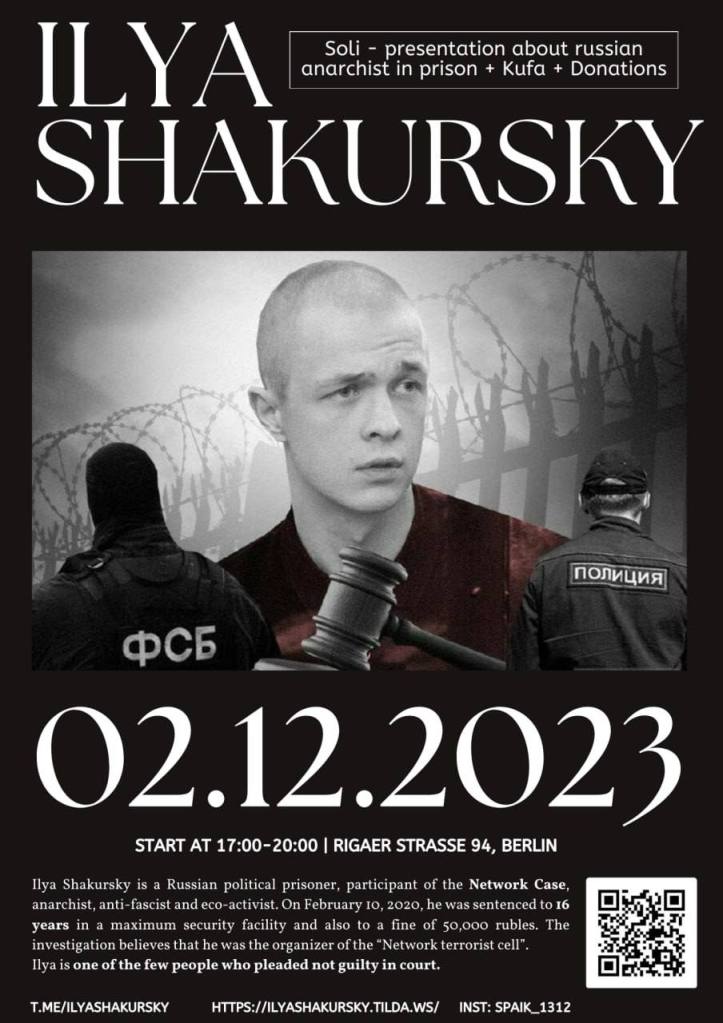
Since the all-out invasion of Ukraine, political repression in Russia has intensified, targeted in the first place at anti-war protest. But this is the outcome of a 20-year slide towards dictatorship. Russia’s antifascist movement has been a prime target for both armed nationalists and the state: it culminated in 2017–19 with the torture and imprisonment of the “Network” case defendants. In July this year, one of them, Ilya Shakursky, sent this letter from prison, looking back at the antifascist movement’s history. It was published on Avtonom, the anarchist web site. Translation and notes in brackets by People & Nature.


Ilya Shakursky in court in 2020. Photo: Penza News / Free Russia House

Ilya Shakursky: letter to a friend

It went like this. My friend shared his thoughts with me: he had arrived at this discomforting realisation that after my arrest, everything was finished – as if our world was sharply divided into “before” and “after”. It seemed that that life, in which we were immersed for many years – the atmosphere of the dvizha [slang: roughly, movement/ milieu], the concerts, demos, discussions, journeys, street fights, performances – had disappeared, had dissolved into fear and into the constraints that shroud so many of us. It seemed that that life had mutated into nostalgic reflections on those times when just to be yourself in Russia had not yet become so dangerous.

Of course, the root cause of my friend’s predicament is the reality: in the regions, the movement comprises fairly small circles of people, and all the activity depends on their enthusiasm. So it is not surprising that in a small town, after high-profile arrests, everything goes quiet. But now – when there’s a widespread tendency to analyse the history of the almost-destroyed antifascist and anarchist movements in present-day Russia – I have read in several articles the opinion that this latest defeat of the movement began precisely with the “Network” case. My own impression is that the movement at that time, although it suffered from a lack of coordination, exactly in 2016-17 began to aspire to, and head towards, unity and amalgamation.

We all know well about the devastating defeat of the young, audacious movement of the early 2000s and its consequences. It was then that the state power recognised the strength of the antifa, the subcultures, the anarchists and ecologists that it could not control. That all came to an end with the deaths of Fyodor Filatov [antifascist, founder of the Moscow Trojan Skinheads, killed on 8 October 2008 by the Militant Organisation of Russian Nationalists (BORN)], Ilya Dzhaparidze [antifascist killed by BORN on 27 July 2009], Ivan Khutorskoy [antifascist killed by BORN on 16 November 2009], [Stanislav] Markelov and [Anastasiia] Baburova [antifascist lawyer and journalist, killed in broad daylight in central Moscow by BORN on 19 January 2009], the “Khimki case” [showtrial of activists after the big Khimki forest protests] and emigration. The 2000s ended with Exodus (Iskhod) by Pyotr Silayev [author and antifascist activist]. Among us – young antifascist and anarchist men and women – that book was a big hit.

Time passed by. 2011: a vendetta in response to the break-up of the movement and the radicalisation of new people. 2012: Bolotnaya Square [a big anti-government rally, followed by mass arrests]. 2014: Maidan and the start of military action in Ukraine. We, young people whose outlook was shaped by these events, tried to re-awaken and breathe life into the flickering flame of the dvizha. Concerts, squats, days out, fist fights, graffiti, lectures, FNB [Food Not Bombs, Moscow] and free markets. We lived by all this: it was our culture, our self-expression and our inner inspiration. We got to know each other, we were inspired by the experience of our older comrades. We took the road of struggle, we cultivated an atmosphere, we kept the movement going – or at least we tried. And we reached the point where the spirit of the age put in front of us the need for militarisation. The stakes were raised. We realised we were getting closer to the point at which we would have to defend ourselves, to fight to survive. The times changed. …

Autumn of 2017. Arrests. Tortures. Exile from the country. New repressive laws. “The Network”. Sentences. Zhlobitsky [the 17 year old who suicide-bombed the FSB office in Arkhangelsk]. Attempts to protest and resist. People’s Self-Defence [anarchist network]. Kansk [a case brought under terror laws against teenagers who put up protest posters]. And again, tortures and repression. The 2010s came to their end, and now it was our “Exodus”. But not all of us could get across the desert. Some stayed right where they were. And here was the bleak emptiness that my friend told me about, that has reigned since 2017. Time has passed, and there is nothing left of that life that swirled around us. Fear infuses everything. Some were just tired out, some escaped, some – so it seems – went out of their minds and became completely different people. The desert swallowed people in endless emptiness. It’s as if previously optimistic, active people were shackled hand and foot by depression, apathy and disillusionment. Very few lights were left burning.

The new reality: crowds of roughnecks, saluting Nazi-style; billboards calling on people to sign contracts with the army; arrests and sentencing of dissidents daily; [Zakhar] Prilepin [leader of armed Russian nationalists in eastern Ukraine] in the state Duma [parliament]; anarchists and antifa outside the law; Stalinism; quotations from [Ivan] Ilyin [by Putin]; imperial flags and red banners.

When we were arrested, with every interrogation I realised more clearly that the chekists [security police officers] didn’t want simply to combat allegedly criminal activity or to strike fear into us. No, their aim was destruction – destruction of the ideological enemy that we represented. Destruction of those whose ideas of freedom and equality are absolutely alien to them, who hate “chinks” and “faggots” and love busty women and hunting parties. Portraits of those who executed the anarchists of the last century hang on their office walls, and, as if returning to the past, they are doing that Bolshevik work again. They started with the anarchists, and the Nazis they could not control, and ended up with the liberals and pacifists. The desert melts into the burning heat of repression. There’s no water and no life.

And why am I writing all this? This letter is to my friend, whose heart is full of sadness and mourning – but by writing to him, I am writing to all of you: to all with whom I met in the woods outside Moscow at concerts by Volodya Ukrop and Natasha Chetverio [antifascist singers]; all, who listened to “MDB” [Moscow Death Brigade, a punk and hip-hop band] on earphones, when taking a train to a stand-off with the “boneheads” [a “white power”/ racist subculture close to skinheads]; all who stood in defence of the Mosshelk dormitory [where activists supporting residents resisting eviction were arrested]; all who raised our flags at the demonstrations in central Moscow in 2017; all who spoke openly about problems of discrimination, and who wrote letters to Lyosha Sutuga [an antifascist activist] when he was in prison; all who wore “Will Power” (“Sila voli”) T-shirts; all who read “Avtonom”; and all who threw away those papers summoning us to chats at the Centre “E” [the state Centre to Counter Extremism]. We lived through all this together, and now we are again living through hard times that plant the darkest thoughts in our minds. But, friends, there’s no point in throwing up our hands, there’s no reason to convince ourselves that our community is dead, or that our spirit has been extinguished.

When the chekists fastened on to the term “Network”, they actually misunderstood something. They thought that we would hand over our party membership cards and renounce our responsibilities to an alleged organisation. But the anarchist movement’s networks exist without any clearly-defined structure. The network of the anarchist and antifascist movements is the smiles of two people who don’t know each other, but who catch each other’s eye in the metro with some characteristic attribute; it’s when you are in a city that’s not your own, but then someone sends you the number of a place to stay and it becomes your own; it’s when we get to know each other by a single handshake, more than likely without knowing each other’s real names; it’s when we can travel hundreds of kilometres to support our guys in a big street fight, support musicians we know or join an environmentalist sit-in. Neither the investigators nor the prosecutors and judges understand this. And for that reason they are unable to destroy us.

The European dictatorships of the 20th century annihilated those whose experiences, and heroism, is a source of inspiration for many of us today. Franco thought that he had wiped out the Spanish anarchists; Hitler thought that he had taken out all the German antifascists. But today we see how big the antifascist festivals in Berlin are, how substantial are the areas of European cities occupied by the anarchists.

It seems that we – rebels, idealists and dreamers – were always alien, marginal and incomprehensible for this country. But anyway, we are at home here. And after this next round of destruction and repression, we will rise again among new generations of young people, right here in this place. Yes, we lived through that last phase; yes, right now it’s that time when it seems that every day is more fearful and more difficult than the last. But we need to preserve in ourselves, at all costs, the honesty that has been awakened in our hearts, that spirit of freedom and the struggle for it that brings us together.

The recent blows struck at the movement have hurled some of us over the world, but they have not broken the links of solidarity and friendship. So let’s not bury ourselves in the darkness of these times, let’s continue to be ourselves, and to do all that we can to clear the darkness away.

Ilya Shakursky, July 2023. The letter was passed on by Ilya’s mum, Elena.

To support Ilya:

Russia,

431161 Mordovian republic,

Zubovo-Polynasky district, Ozernyi,

ulitsa Lesnaya 3,

FKU IK-17 UFSIN Russia (Republic of Moldova),

Shakursky Ilya Aleksandrovich (d.o.b. 1996)

2202 2005 6759 6000 (Sber, Nina Ivanovna Sh.)

PayPal: abc-msk@riseup.net (in euros, marked “for Shakursky”)


More in English on Russian antifascism

A letter from Ilya Shakursky sent in 2021 is here. People & Nature reported on the “Network” case verdicts here, and on other aspects of the case here, here, here and here. For The Russian Reader’s much more comprehensive coverage, start here. A recent comment on the security police’s attempts to link Azat Miftakhov, the jailed Moscow anarchist, with their invented “Network” is on OpenDemocracy here. The Rupression site has more information.

An overview of the antifascist movement’s history was recently posted on the Avtonom site here. On the campaign of killings of antifascists by armed nationalist groups at the end of the 00s, see here. Reports of the trial of the BORN killers here and here, and more on the fascists’ links with the Kremlin here. A memoir of Ivan Khutorskoy is here.

An article explaining why Russian and other antifascists began to mark 19 January – the anniversary of the killing of Stanislav Markelov and Anastasiia Baburova – is here, and an interview with Anastasiia’s parents here. A report of a demonstration in London on the 10th anniversary is here.

There’s a report on the 2010 battle for Khimki forest, which was threatened by road construction, here, a retrospective written in 2017 here, and a focus on the antifascists’ involvement here.

□ In Russian, a blog by Ilya Shakursky  


Source: “‘After this round of repression, we will rise again’ – Russian political prisoner Ilya Shakursky,” People and Nature, 2 October 2023. Thanks to Simon Pirani for the translation and publication, and for his kind permission to repost it here. People living outside of Russia will find it difficult or impossible to send letters to Russian prisons via regular mail. In many cases, however, you can send letters (which must be written in Russian or translated into Russian) to Ilya Shakursky, his co-defendants in the Network Case, and many other Russian political prisoners via the free, volunteer-run service RosUznik. You can also write to me (avvakum@pm.me) for assistance and advice in sending such letters.||| TRR

Pickleball, Octopus, Political Prisoner, Putin, Prigozhin, Pretty Girls


The Hustle, “The Economics of Pickleball and the Sport’s Sound Problems”

MBARI, “Scientists solve mystery of why thousands of octopus migrate to deep-sea thermal springs”

Sergei Okrushko

Solidarity Zone has begun supporting Sergei Okrushko

On July 28, an explosion occurred at the Kuibyshev Oil Refinery in Samara. The same day, 42-year-old Sergei Okrushko, who was born in Ukraine and worked as an electrician at the refinery, was detained at the border with Kazakhstan whilst trying to leave Russia. The FSB charged him with “sabotage” (per Article 281 of the Russian Federal Criminal Code of the Russian Federation “Sabotage”, and a court in Samara remanded him in custody to a pretrial detention center.

Okrushko confessed, and at his bail hearing he said that he held anti-war views and committed the action for political reasons.

It also transpired that Okrushko had earlier tried to enter Ukraine, but he was not admitted because of his Russian passport. During his stay in Moldova, he had repeatedly participated in anti-war protests.

No one was injured during the explosion at the refinery. According to the investigation, more than 30 million rubles in physical damage was caused, however.

The Kuibyshev Oil Refinery is the largest enterprise in the Samara Region, processing about seven million tons of oil per year. The plant specializes in the production of fuel for all types of transport from automobiles to ships.

On August 3, Okrushko refused the services of Solidarity Zone-affiliated lawyer Zakhar Lebedev, whom he had agreed to let defend him two days earlier. While Okrushko was writing the waiver of counsel, the lawyer noticed fresh injuries on Okrushko’s body: “I noticed that his left arm, namely most of his shoulder and forearm, was purple. It was clear that these were hematomas, which hadn’t been there on August 1 when I visited him at the pretrial detention center. When I asked Sergei where he had got such bruises, he said, without hesitating, “When they arrested me.” When I asked why they had not been there when I’d visited him at the pretrial detention center, Sergei hesitantly said that they’d shown up only now.”

We believe that the fresh bruises and his sudden and unmotivated waiver of counsel testify to the fact that Sergei Okrushko was tortured between August 1 and August 3.

Subsequently, the authorities stopped admitting any lawyers into the pretrial detention center, except for the court-appointed lawyer Vyacheslav Pavelkin. Later, it transpired that Okrushko was taken to the FSB several times without a lawyer.

Unfortunately, at this stage we have been unable to provide Sergei with defense counsel. But at the very outset of his ordeal, we sent him a care package and books, placed an order at the online Federal Penitentiary Service store, and transferred money to his personal account at the pretrial detention center. We recently learned that Sergei received all these things, which means that we were able to provide him with at least minimal humanitarian support. In the coming days, we will put together another care package for Sergei and continue to support him as much as possible.

Solidarity Zone’s mission is to support people imprisoned for anti-war direct-action protests and not let them face the system alone. We cannot always provide full-fledged support due to interference from the security forces, but we consider any reduction in the harm caused by the actions of the Russian state to be a decent outcome.

If you want to support us, you can find our details here.

💌📦 Address for letters and parcels:

Okrushko Sergei Aleksandrovich (born 01.03.1981)
22 Sadovyi proyezd, SIZO-1
Samara 443021 Russian Federation

You can also send letters via Zonatelecom.

#politicalprisoners #ukrainians #crackdown #torture #fsb #fsblawlessness #solidarity #nowar #wewriteletters #samara

Source: Solidarity Zone (Facebook), 24 August 2023. Translated by the Russian Reader. People living outside of Russia will find it difficult or impossible to send letters to Russian prisons via Zonatelecom or regular mail. In many cases, however, you can send letters (which must be written in Russian or translated into Russian) via the free, volunteer-run service RosUznik. Mr. Okrushko has not yet appeared on their list of supported addressees, however. You can write to me (avvakum@pm.me) for assistance and advice in sending letters to her and other Russian political prisoners.


Putin


Prigozhin


Recommended for ages 16 and up. This production contains sexually suggestive language, references to suicide, and depictions of drug use, extreme physical violence towards humans and animals, and self harm. This production also contains the use of herbal cigarettes, haze, and a brief flash of light.

Alexander Bakhtin: Justice Is Putin Behind Bars

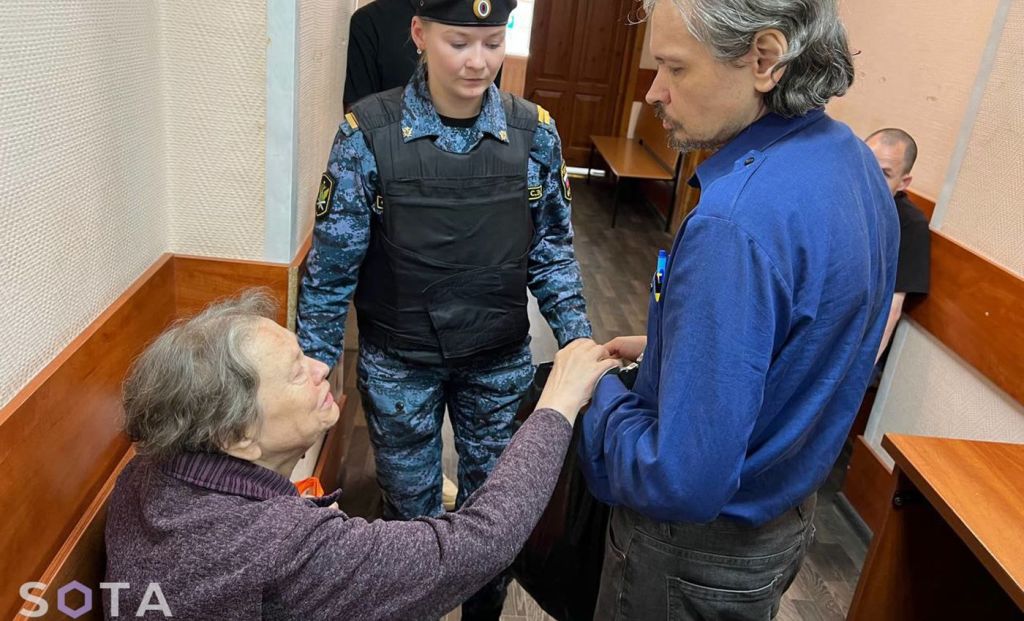
Alexander Bakhtin (right) says farewell to his mother after his trial. Photo: SOTA via Mediazona

Today, the Mytishchi City Court sentenced 51-year-old animal rights activist Alexander Bakhtin to six years in a penal colony. He was charged with disseminating “fake news” about the Russian army over three VKontakte (VK) posts written in the spring of 2022—about the possible blockade of Kyiv, about the murders of civilians in Bucha, and about Ukrainian volunteers who risked their lives saving homeless animals during the war. In addition to the time in the penal colony, the court ordered Bakhtin to undergo compulsory outpatient treatment supervised by a psychiatrist. The prosecution’s expert witness claimed that Bakhtin “could not have been fully cognizant of the actual nature and social danger of his actions and control them.” Mediazona publishes excerpts from Bakhtin’s rebuttal of the charges, which he asked to be entered into the case file before the verdict was announced. After reading these notes, readers will be able to assess for themselves the clarity and consistency of the convicted man’s thoughts.


  • In keeping with the principle of the presumption of innocence, it is not for me to prove that the materials I published are true, but for the prosecution to prove that these materials are “knowingly false.” But it was not proved who exactly committed the [war] crimes, which means it was not ascertained whether my actions constituted a crime.
  • Censorship is prohibited by the Constitution of the Russian Federation, and this Constitution is directly applicable [to my case]. Human rights can be restricted in the Russian Federation only when a nationwide state of emergency and martial law have been declared. But they have not been declared, which means that publishing materials that challenge the stance of the Defense Ministry is not a punishable offense.
  • I committed the actions that I am charged with in order to inform and familiarize my readers with an alternative point of view to the one that was then disseminated in the Russian media. At the same time, realizing that Ukraine’s official media are also an interested party in this conflict, I tried mainly to find information on the internet not in the official Ukrainian media, but as directly reported by local residents of Ukraine on their pages in social networks and online forums. My ultimate goal was to make what contribution I could to stopping this war, because, for example, the First Chechen War in 1996 was, as I believe, halted largely due to Russian society’s negative attitude towards it.
  • If we speak of “hatred and enmity” (as encountered in my posts in the form of harsh epithets directed at the Armed Forces of the Russian Federation), then these epithets do not apply to all [members of] the Armed Forces, but only to those [members] who employed various kinds of violence against civilians in Ukraine, or to those individuals who unleashed this war or called for unleashing it—that is, to war criminals. Perhaps, in terms of “generally accepted” definitions, those negative epithets of mine do apply to all their members, but I do not agree with this interpretation because, as follows from the findings of the forensic psychiatric commission, I am also generally partial to subjectivism, including when employing various definitions. So when I was asked by a psychologist to symbolically depict the concept of “justice,” I drew Putin behind bars. And when the psychologist asked me what that had to with justice, I replied that this was what justice looked liked to me right at that moment.
  • The severity [of a crime] should be defined by its effects. But can the prosecution prove that my publishing these posts produced any specific effects? For example, that they caused someone to lose their faith in the Armed Forces of the Russian Federation and commit an illegal action? At the time of my arrest, I had a little more than sixty friends on VK, and each criminal episode had about 100 views. There are no victims in the case. I myself stopped publishing these posts around the summer of 2022 precisely because they had no effect. By that time, the overwhelming majority of Russian citizens had already made up their minds about this war. Some of them sincerely supported the Russian authorities, while others supported them for opportunistic reasons (in order not to lose their jobs, etc.). Huge numbers of people were intimidated (including by disproportionate punishments meted out for anti-war stances) and kept quiet. Quite a large number of people emigrated from the Russian Federation altogether, while a huge number of Russians decided that this war did not concern them at all. Thus, not only my posts but also anti-war publications in general were unable to change anything, unfortunately. It was only on the battlefield that matters were decided.
  • If my posts are so socially dangerous, then why was my VK page not blocked for such a long time?

You can write a letter to Alexander Bakhtin through the Zonatelecom or FSIN-Pismo, or by regular mail to:

Bakhtin Alexander Sergeyevich (born 1971)
219 ul. Gorval, SIZO-2
Volokalamsk, Moscow Region 143600 Russian Federation

Mediazona thanks Nikita Spivak, a lawyer with OVD Info, for the opportunity to read his client’s manuscript.

Source: Nikita Sologub, “Justice is Putin behind bars: what Alexander Bakhtin, sentenced to six years for three posts about the war, said in court,” Mediazona, 11 August 2023. Translated by the Russian Reader. People living outside of Russia will find it difficult or impossible to send letters to Russian prisons via the FSIN-Pismo and Zonatelecom services or regular mail. In many cases, however, you can send letters (which must be written in Russian or translated into Russian) via the free, volunteer-run service RosUznik. Mr. Bakhtin has not yet appeared on their list of supported addressees, however. You can ask me (avvakum@pm.me) for assistance and advice in sending letters to him and other Russian political prisoners.

Igor Paskar: “What Did Each of Us Do to Stop This Nightmare?”

Igor Paskar in court. Photo courtesy of Solidarity Zone

On 31 May the Southern District Military Court in Rostov-on-Don sentenced Igor Paskar to eight-and-a-half years’ imprisonment on charges of “vandalism” and “terrorism”. He was found guilty of burning a Z-banner [a pro-war symbol] and the symbolic firebombing of the FSB [Federal Security Service] building in Krasnodar. The day before his sentencing, Igor gave his final statement in court. Here is a translation of his speech:

Almost a year has gone by since I carried out this action. During that year, I pictured this moment time and again, the moment when I would be given the opportunity to make my final statement. I agonised over the words I would say, and the motives that drove me to act as I did.

During the last sitting, your honour, you asked whether I regret my actions. I understood that the extent of my professed regret would influence the severity of the sentence. But if I renounced my beliefs, I would be acting against my conscience.

On the contrary, during the time I have been in prison, I have seen firsthand the injustices perpetrated against the people who we call our brothers: both prisoners of war who have served in the Ukrainian armed forces and ordinary Ukrainian citizens.

The war – or whatever term we use to label it – came to their homes, destroying their lives as they knew them. No matter what slogans and geopolitical interests we use to varnish this, in my eyes it cannot be justified.

Do I regret what has happened? Yes, perhaps I’d wanted my life to turn out differently – but I acted according to my conscience, and my conscience remains clear.

Rather than reflecting on who is right and who is guilty, I would like to pose this question: what did each of us do to stop this nightmare? What, ten or fifteen years from now, will we tell our children and grandchildren about these troubled times?

Unfortunately, God has not granted me the joy of fatherhood; the people who were closest to me have gone, and I am left alone with myself. It was easy for me to do what I did, even though I was well aware of the consequences. There was no-one to agonise about my fate, no-one to worry about me, or to cheer me on. But what I really did not expect was the huge number of letters and messages of support that I have received.

People have written from every corner of Russia, and not only Russia. Many were grateful for my position, so completely at odds with the notion of unanimous national support for what is being perpetrated. There were so many messages of encouragement: “stay strong”, “don’t despair”. So many warm words, so much sympathy.

But I’ll be so bold as to read just one part of a letter that I received in May, which really touched me, and pushed me to write this final statement to the court. Here it is:

“There is very little left of everyday life. It turns out that we can’t live everyday lives anymore. I am listening to the memoirs of prisoners from the 1930s, 40s and 50s. Right now, I’m on the breath-taking biography of [the actress] Tamara Petkevich [who spent seven years in a prison camp]. She was arrested in 1943 and lived until 2017. When they came for her, she was only 22 – just a girl, half the age I am now. I have not read Solzhenitsyn’s Gulag Archipelago, and I never got round to Shalamov’s Kolyma Tales either. But now I’m listening to Petkevich, and it’s making me realise that this is exactly what we must listen to, what we must read at school. As a country we are obsessed with the past, but we hardly ever think about the present or the future. The Americans have their American dream: something to strive for. We have nothing but a fixation on that which happened long ago, that which cannot return. But time and again we try to bring back what has passed, and these attempts are absolutely pointless. It’s as though the whole country is stuck in the mud. As individuals we are caught in our feelings. It’s terrible that even now, for as long as we stubbornly turn our heads back, we will never live happily, never the way we want to. Let’s hope people can find happiness in the little things.”

You can support Igor Paskar by sending letters:

□ Address: Russia 344022, Rostov-on-Don, 219 Maksim Gorky Street, SIZO-1, Igor Konstantinovich Paskar (d.o.b. 1976)

□ You can send letters online via the volunteer service RosUznik.

Solidarity Zone gives full support to Igor Paskar. His legal representative is Felix Vertegel. 

Note. Letters sent to Russian detention facilities that are not in Russian are unlikely to be delivered to prisoners, and RosUznik is also a Russian-language service. If you send short messages to Igor via Solidarity Zone supporters in the UK at 2022ukrainesolidarity@gmail.com, we will arrange for them to be translated and passed on.

□ More about Solidarity Zone on Facebook and Telegram. A report of the organisation’s work in May is here. Links to more information in English here. Russian original of Igor Paskar’s statement here.

Source: People and Nature, 8 June 2023. Thanks to Simon Pirani for the translation, the hard work, the heads-up, and his shining example of solidarity, which helps keep me going when times are tough. ||| TRR

A Letter from Oleg Belousov

On March 29, Oleg Belousov was the first person in St. Petersburg to be convicted on charges of disseminating “fake news” about the Russian army. Judge Eva Gunter sentenced him to five and a half years in a medium-security penal colony.

Formally, Belousov was charged for comments he made on the community social media page “St. Petersburg Diggers.” The case was launched after Belousov was denounced to the authorities by Sergei Chmyhun, another person involved in the community page. The court handed down a guilty verdict despite the fact that Belousov has a third-class disability and a disabled son as a dependent.

Bumaga wrote to Oleg. We have published his slightly abridged reply below. Oleg writes about his health problems, his love for his son, and his gratitude to the people who supported him.

Oleg Belousov, amateur archaeologist, member of the MIA searchers movement, and political prisoner.
Photo by Andrei Bok for Bumaga

Thank you so much for informing readers and following my case as it unfolded. As many people as possible should find out about this regime’s mendaciousness, about phrases taken out of context, and the trumped-up case. Before my arrest, I still had some doubts about whether I had been mistaken about something, whether I was wrong. But after seeing all the dirt and lies, my doubts were dispelled!

For health reasons. I received ointment for dermatitis of the eyelids: my sister looked for one [kind?], and a young woman from the support group (unfortunately, I don’t know her name) looked for the other one. The medical worker muttered [my] last name and asked, “Who sent it?” I replied that I was a political prisoner and anyone could have sent it, not only relatives. I get letters from all over Russia, and not only from Russia.

Would that I [had received the ointment] right away, but I had to suffer for three months—you won’t get medical help in here. My sister also sent two bottles of [eye]drops, but to get them, you have to go through a whole quest. To begin with, you get an appointment with a doctor, then the doctor has to make a note in your medical record and file an application to be allowed to send it, and then there’s the sending and receiving…

Due to numbness in my right arm and left leg, I do exercises for the cervical spine and the joints. It’s all based on the body’s internal forces, there is no osteopath in her.

Everything is alright, I can’t be broken. I’m more worried about my son. There were a lot of things that I hadn’t done for him yet, that I didn’t teach him to do. He is a disabled child: he suffers from a residual organic lesion of the central nervous system. He certainly lacks my help. He has problems with work too: it’s no so easy for him to find a job. My sister, my niece, and her husband also have health problems. So I’m more worried about them. But me, I’ll get stronger, I’ll toughen up. I’m not afraid of challenges. They won’t shut my mouth, I have a right to my own opinion.

Since I’ve been behind bars, I’ve seen my son only at the court hearings. He worries, of course. When I was arrested, he hugged me and said, “How am I going to live without you?” I will never leave him, of course, and when I get out, I will help him as long as I live.

I now see how many good, honest, decent people there are in Russia who are not afraid to express their opinions. I feel their support, and it gives me strength.

As for the verdict, it was expected, so I took it calmly. How else [could the case have ended]? You can’t expect anything else from liars. It would be smarter for them not to instigate such cases, not to disgrace themselves before the whole world, but they think with a different part of their bodies.

About the provocateur/informer. I had thought earlier that he was a fool, a narrow-minded man. After his denunciation — well, the bastard turned out to be a repeat of 1937. But for every scoundrel, there are thousands of people in Russia who are responsive and ready to help. So what can I say about my feelings for this [person]? It’s like stepping in shit. It’s better not to meet such “people.”

Thanks so much to everyone who writes letters, sends food parcels, and worries about me, my son, and my loved ones! Don’t be afraid to speak the truth, to voice your stance publicly! What kind of freedom is it if you are forced to remain silent? All my cellmates and all the prison employees see and understand the whole situation and what is happening.

Nothing’s gone to change me. I have been an honest, decent person, and I will come out one too! Be kind! May the skies above your head be peaceful!

Source: “‘I have been an honest, decent person, and I will come out one too’: a letter from Petersburger Oleg Belousov, sentenced to five and half years in a penal colony for ‘fake news about the army,'” Bumaga, 27 April 2023. The emphasis (in bold) was in the original article. Translated by the Russian Reader