(Anti)Fascism Tuesday

Federal immigration agents detained three people and deployed chemical agents at multiple locations around E. 34th Street and Park Avenue in Minneapolis’ Powderhorn neighborhood Tuesday morning. At least two were observers and not the target of immigration enforcement operations.

Around 9:40 a.m., community response networks began sending alerts about Immigration and Customs Enforcement (ICE) door-knocking at E. 34th Street and Park Avenue. By 10 a.m., a crowd of over 100 observers had gathered, confronting agents at multiple intersections. 

Among the detainees was a woman who was forcibly removed from her vehicle after agents smashed her passenger-side window. 

In a video taken by Sahan Journal, the woman can be seen arguing with agents prior to being grabbed by multiple agents and carried to agents’ vehicle. The woman can be heard shouting that she is disabled and on her way to a doctor’s appointment that ICE was obstructing. Prior to the detention agents had instructed her to drive away.

After being pulled out of a car, a women screams as she’s being arrested by immigrations agents at 34th and Park in Minneapolis on Jan 13, 2026. Credit: Chris Juhn for Sahan Journal

Shortly after, another observer on site was tackled and forcibly put in agents’ vehicle as well. According to state Rep. Aisha Gomez, DFL-Minneapolis, who was present at the scene, agents pushed the man’s head into the concrete prior to carrying him away. Gomez also said that agents were physical with her as well. 

“These officers have obviously not had the basic law enforcement training,” Gomez said. “I was shoved with no verbal communication whatsoever.” 

Andy Larson, a south Minneapolis resident who was out observing ICE activity Tuesday, told Sahan Journal that one protester kicked out the taillight of an ICE vehicle and was tackled to the ground up the road on Park Avenue and E. 36th Street.

“It was a really good kick,” Larson said.

The protester managed to escape ICE agents, Larson said. ICE deployed chemical irritants and shot pepper balls into the crowd and fled the scene.

According to Sahan Journal photojournalist Chris Juhn, a Hispanic man was also visible in the back of one vehicle. It is unclear whether the man was an observer or target of federal operations. ICE did not respond to Sahan’s request for comment on the operations. 

At multiple points during the operation, agents deployed chemical agents at observers. Agents fired pepper balls at observers’ feet and threw canisters of tear gas at the corner of 34th Street and both Park and Oakland avenues prior to leaving the scene. Eyewitness Moses Wolf said there was no singular precipitating event that led to tear gas being deployed on Park Avenue.

“There was a crowd confronting each other telling ICE to get out,” Wolf said. “I didn’t really see any physical altercation happening.” He said it appeared to be a tactic by ICE agents to exit the scene.

Wolf said the confrontation prior to the deployment of tear gas had not escalated beyond what had already been happening. 

“It wasn’t anything crazy,” Wolf said. “I turned around for one second and there was this whole entire cloud of it, and pepper spray came with that.” 

Eyewitness Neph Sudduth said at Oakland Avenue agents used tear gas as they were leaving.

“They were finally leaving, it was the last car of the convoy,” Sudduth said. “They just threw two or three canisters out at us as they left.”

Both Sudduth and Wolf said they witnessed agents using pepper spray out of the windows of their vehicles as they drove off.

“They just wanted to hurt us cause we told them how we felt, and they didn’t like it,” Sudduth said.

The operation in Powderhorn is part of a flood of federal immigration activity in Minnesota. As many as 2,000 federal agents are present in the state according to reporting from the New York Times, with an additional 1,000 set to be deployed. 

For Gomez, the clash with ICE is the new reality of life in the Twin Cities with federal agents present. 

“This is what our streets are like,” Gomez said. “We have these masked, unaccountable unknown to us federal agents, and it’s like they’re the secret police.”

Despite the difficulties, Gomez believes observers should and will continue to show up to meet federal agents in the streets. 

“Our community is undeterred,” she said. “We’re not going to just lay down. You can gas us and mace us all you want, we’re not going to just lay down.”

Sahan Journal reporter Andrew Hazzard contributed to this story.

Source: Nicolas Scibelli, “Crowd of 100 confronts immigration agents door-knocking in south Minneapolis,” Sahan Journal, 13 January 2024


1. Numbers

During the 2024 campaign, Donald Trump promised to deport every illegal immigrant who was a rapist, murderer, or thief. He also promised to deport 20 million immigrants. Some voters believed the first promise; other voters believed the second.

Because people are stupid, that first group of voters believed that there were 20 million undocumented immigrants who have committed felonies. This is not possible. The total number of people in jail in America today—this includes federal, state, local, and tribal land prisons—is just under 2 million. The number of undocumented immigrants who have committed serious crimes cannot be 10x the entire prison population of the United States. If it were, then daily life in America would look like Escape from New York.

So some Trump voters were duped owing to their general ignorance and/or innumeracy.

But others were not. Others signed up for Trump because of his second promise (the 20 million deportations) and viewed the first promise (about deporting only criminals) as the pap necessary to get the suckers onboard.

There are two crucial questions about these two groups. The first is:

What is their relative size? What percentage of Republican voters were tricked into voting for Trump’s immigration policies versus what percentage are getting exactly what they wanted?

Would you like to guess? Go ahead. I promise that whatever you’re thinking, it isn’t dark enough.

Here’s a survey tracking Republican approval of Trump’s immigration policies (the top line, in red) over most of 2025:
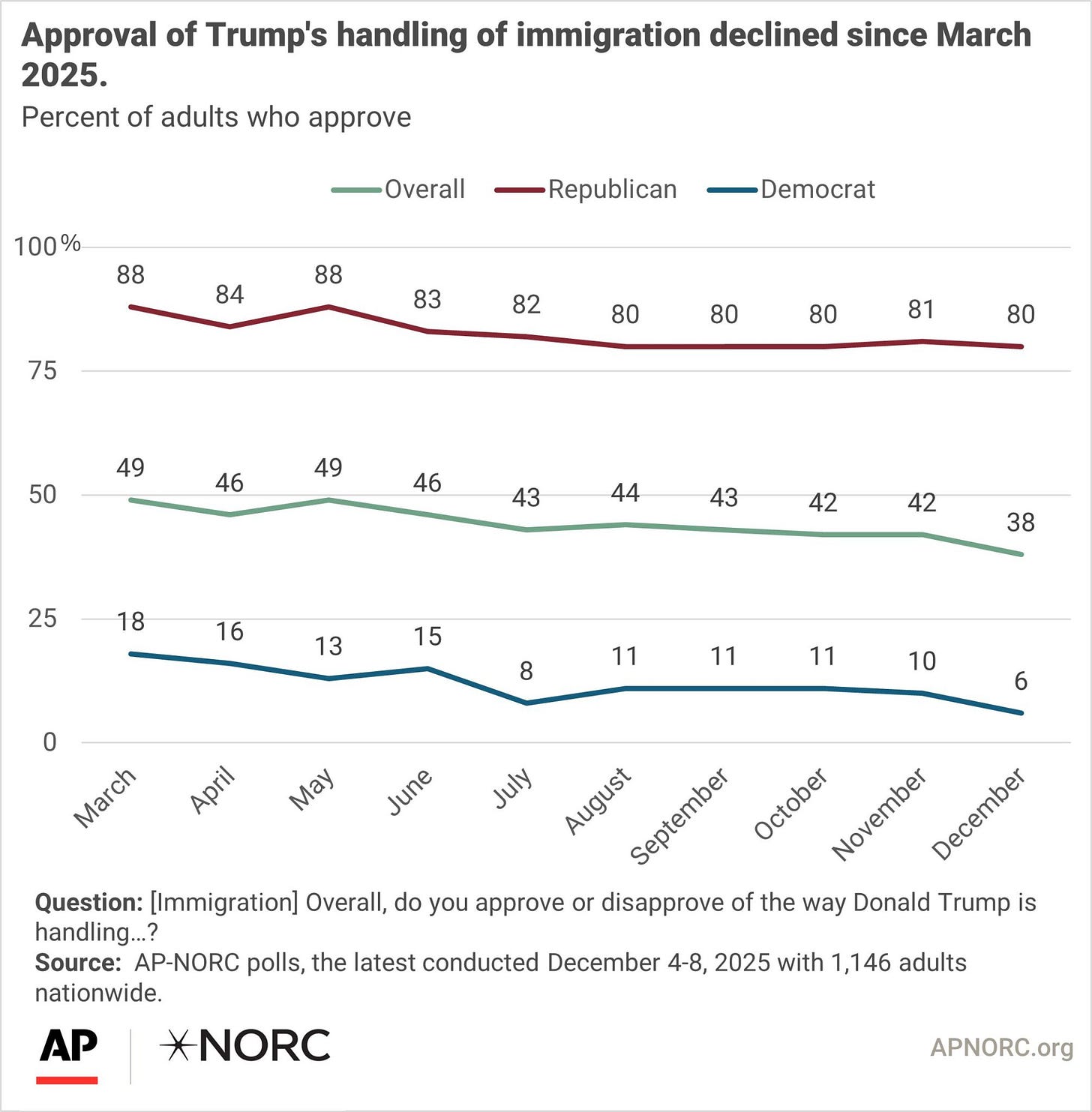
That’s a consistent level of support around 80 percent. Now here is the first poll conducted after the killing of Renee Good:
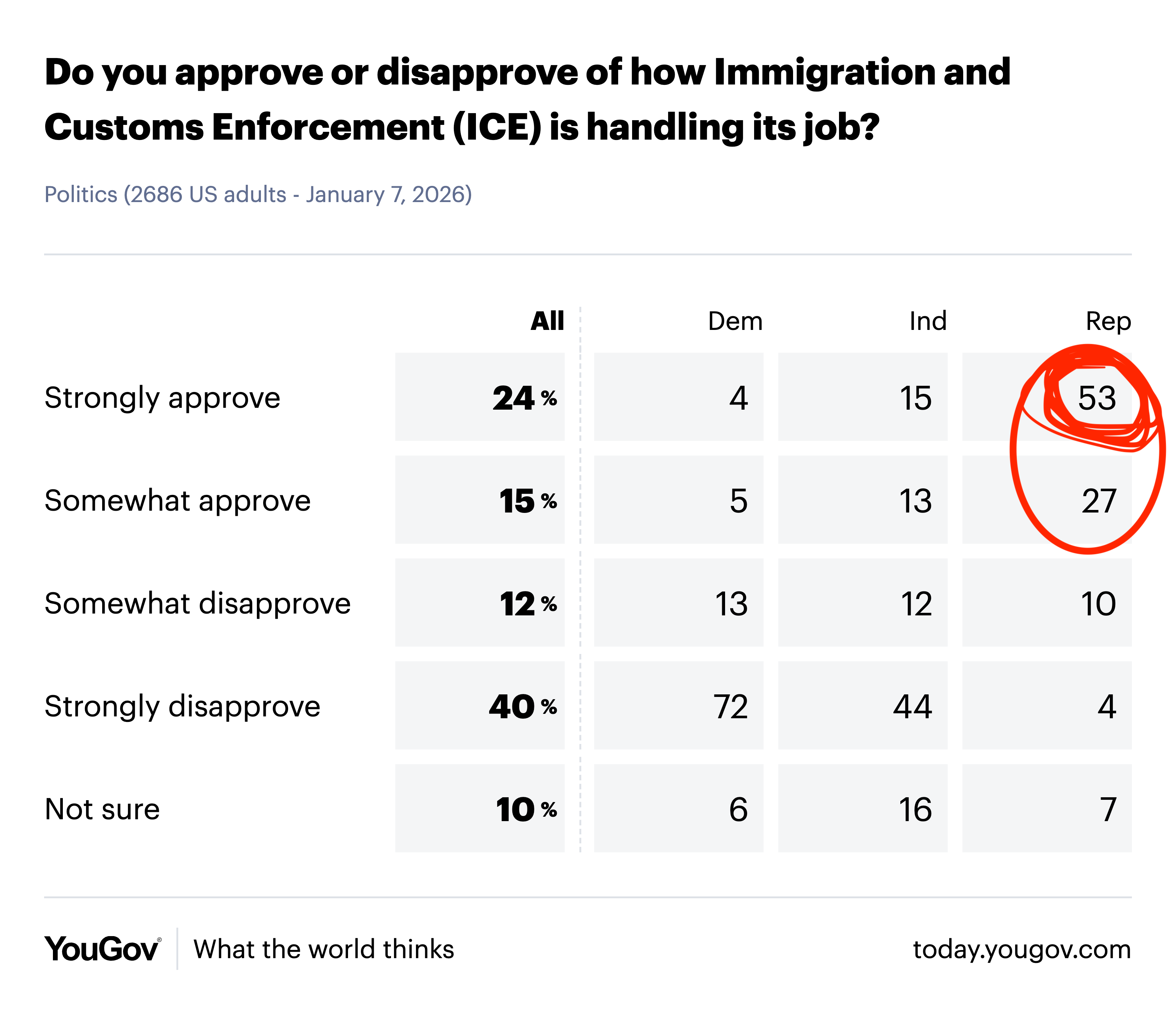
Even after the killing of an unarmed American citizen, a total of 80 percent of Republicans approve of what ICE is doing and 53 percent of Republicans strongly approve.

It seems pretty clear that, at best, one in five Trump voters were duped. The majority of them are getting exactly what they wanted.

Now if Trump were to lose the support of 20 percent of Republicans voters—or even 14 percent—it would be meaningful for Republican electoral prospects. Which is nice.

The problem is that having 80 percent of Republican voters actively supporting a fascist race war is meaningful for our societal prospects.


Which brings us to the second question: How are these groups distributed through the elite positions of power in government? And here it seems that many of the Republicans most invested in a race war have a great deal of power. Like, for instance, Vice President JD Vance, Deputy Chief of Staff Stephen Miller, and Secretary of Homeland Security Kristi Noem.

At the elite levels, even the idea of 20 million deportations is too little. Here’s a tweet from the Department of Homeland Security on New Year’s Eve:
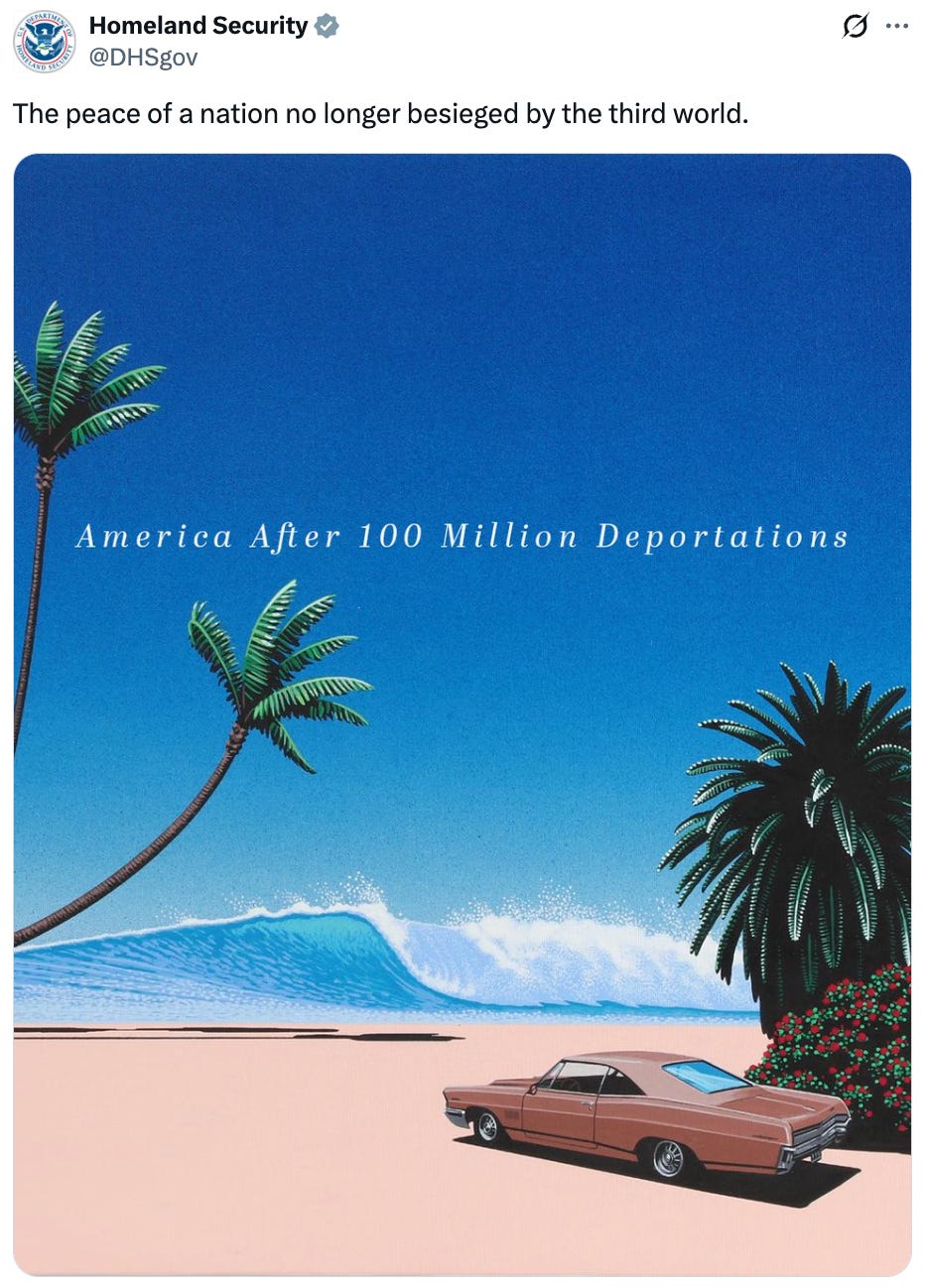
100 million deportations?

There are 43 million foreign-born Americans. Most of them are legal immigrants. In order to perform 100 million deportations, DHS would have to round up every immigrant of any status—even naturalized citizens—and then also snatch 57 million American who are citizens by birth and deport them, too.

Want to guess who those other 57 million Americans might be?

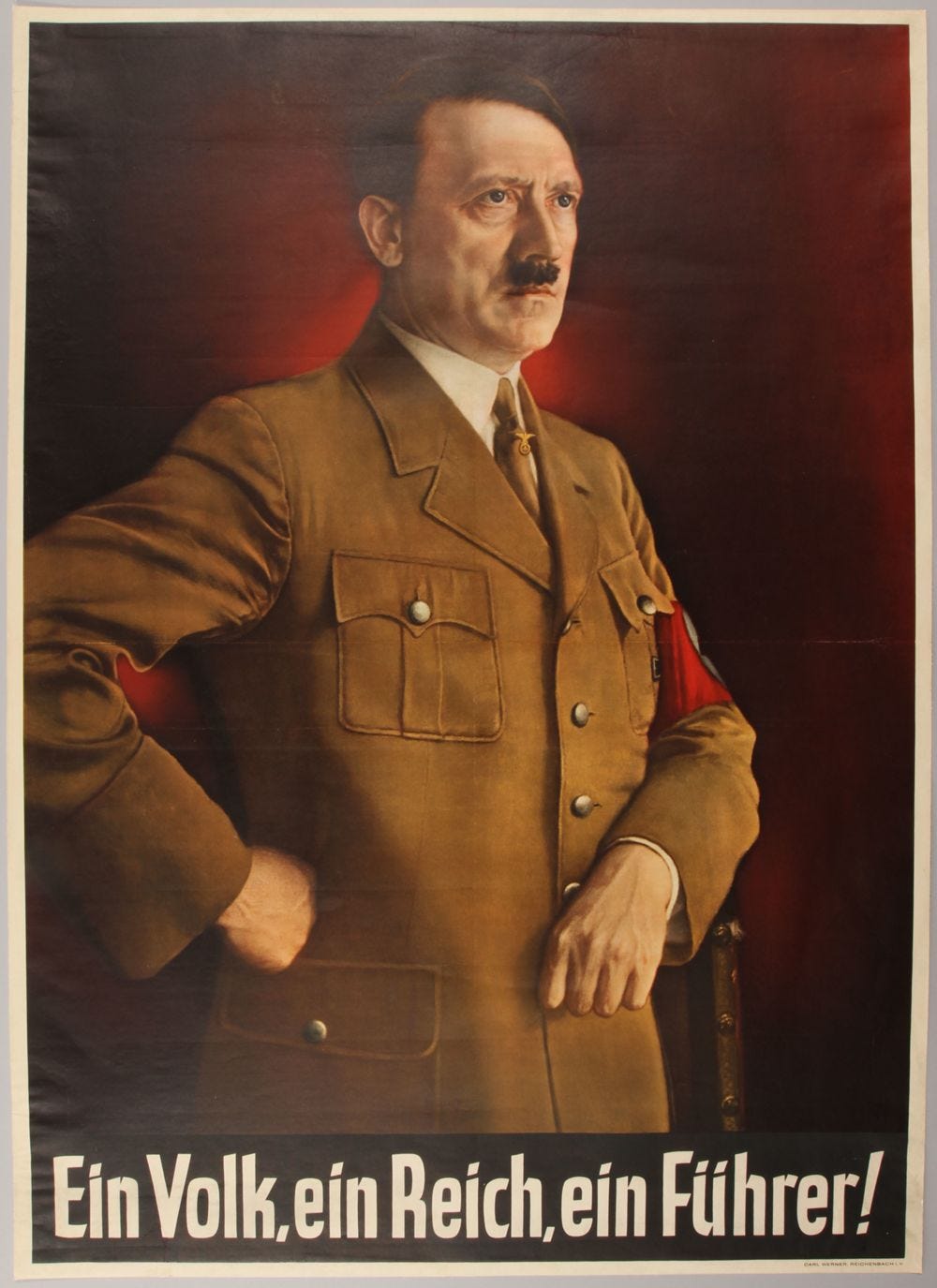
This week the Department of Labor published this:
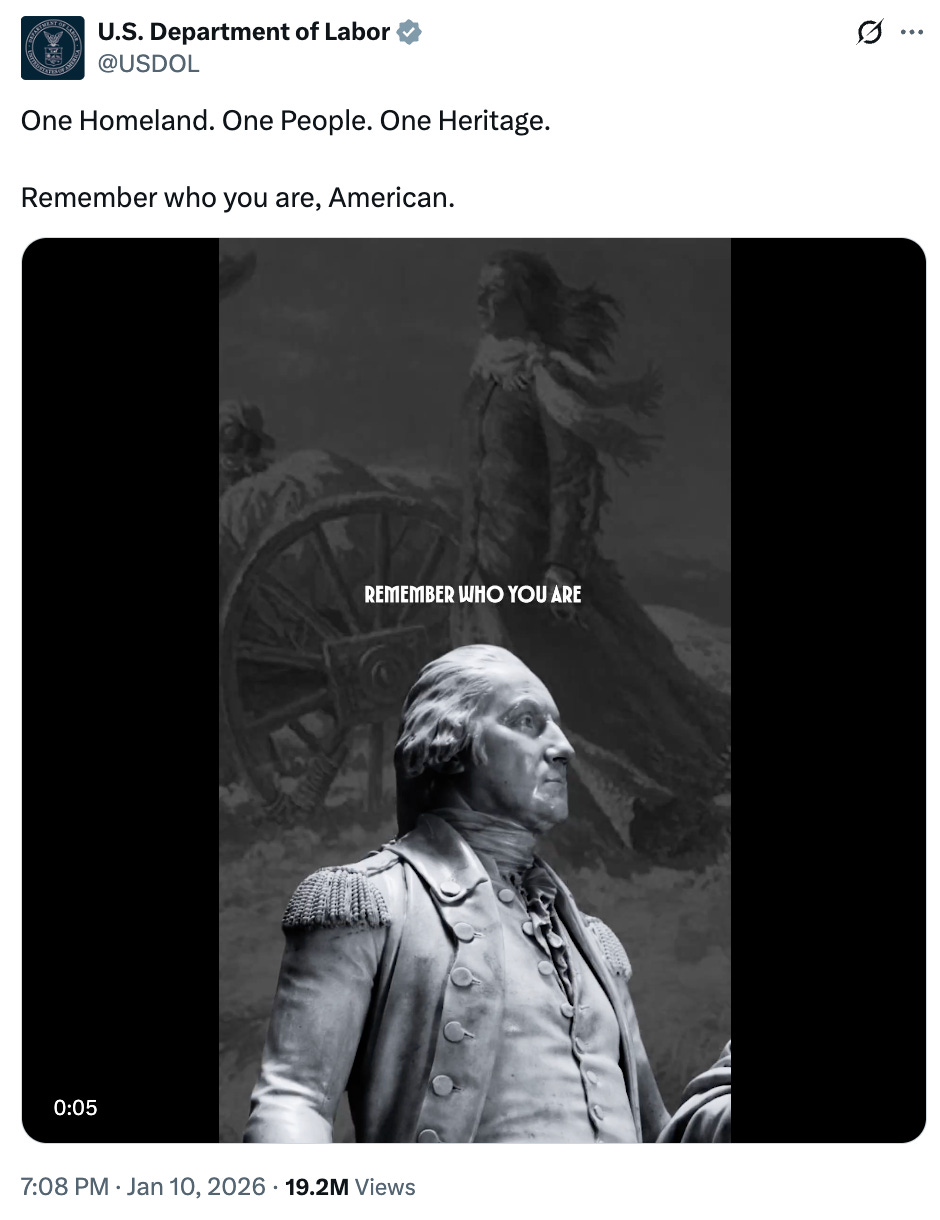
Of course, the slogan sounds better in the original German.
Oh, and don’t forget the Department of Labor’s heroic propaganda posters depicting the American worker in a very specific way.
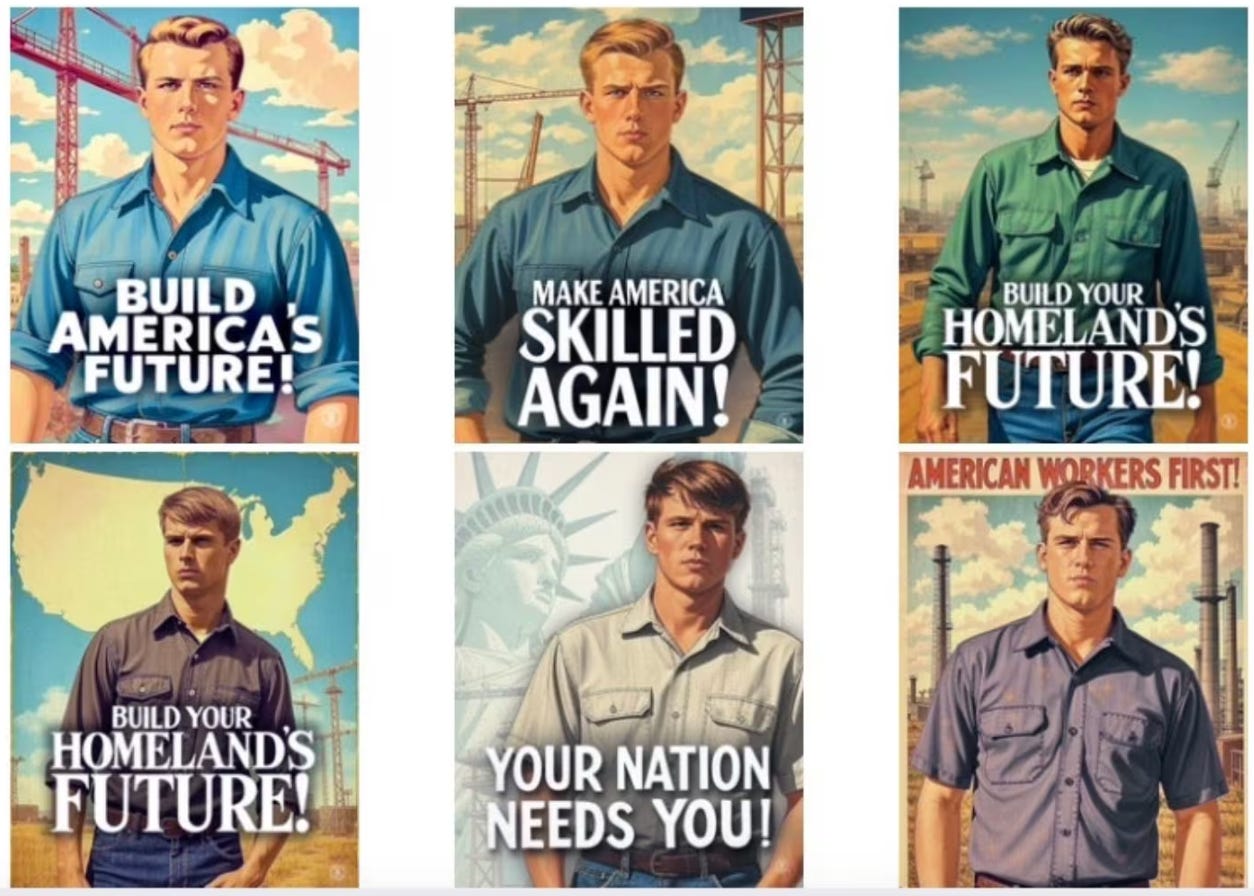
On the one hand, it feels weird to say that the U.S. government is attempting some low-key ethnic cleansing.

On the other hand, the reality is that we have a masked secret police force going door-to-door attempting to kidnap brown people; one government agency publicly daydreaming about deporting 100 million people; and another government agency saying that the ideal worker is a 20-year-old white guy.

2. Demographics

Another tell: This administration is obsessed with America’s falling fertility rate. From the NYT:

Vice President JD Vance last week called falling marriage rates “a big problem.” The deputy secretary of Health and Human Services in December urged his agency to “make America fertile again.” And at a recent conference for young conservatives, Sean Duffy, the transportation secretary, doubled down on the importance of marriage and children, holding out his nine kids as a model for others to follow.

Full disclosure: I am also obsessed with America’s falling fertility rate. Enough that I wrote a book about it.

The problem here is that nearly all of the declines in total fertility rate (TFR) over the last decade have been the result of declining Hispanic fertility.

Here’s the deal: The TFR—the total number of kids the average woman has over the course of her life—has been below the replacement level, but relatively stable, among white and black Americans for the last generation or so. But America’s TFR kept declining anyway. Why?

Because Hispanic Americans—many of whom were recent immigrants—had TFR’s higher than the U.S. average. And their baby-making propped up the nationwide number. The problem is that, as recent immigrants spent time in America, their reproductive behavior began regressing to the mean. The shift has been dramatic:
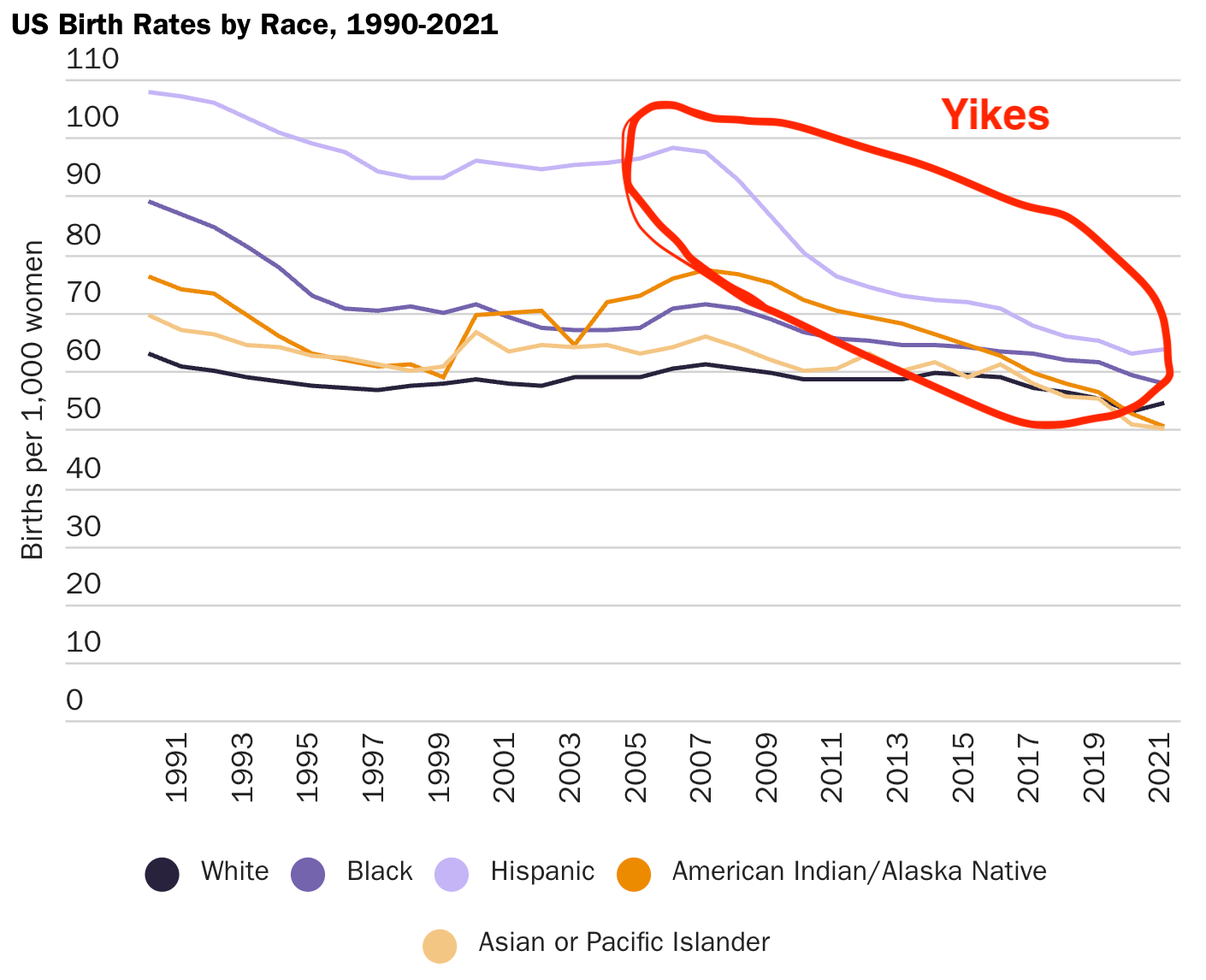
If you were concerned about the fertility rate in America, would you be trying to (a) halt all immigration—since immigrants usually bring with them fertility rates higher than native-born Americans—and (b) deport 100 million people from the ethnic group that has the highest fertility rate?

No.

The only reasonable conclusion is that the concern of people in the Trump administration isn’t about the total fertility rate. It’s about the white fertility rate.

I don’t know how much clearer the regime could be.

So tell me: What does the pie chart look like on Republican voters and race war? What is the percentage of Trump voters in each of these categories:

  • Group A: Sees and understands the administration’s intent and supports it.
  • Group B: Sees and understands, but oppose it.
  • Group C: Do not understand that the regime views its program as part of a race war and thinks it’s all business as usual?

And follow-up question: How big can Group A be for us to retain a functional, liberal society?

I look forward to your discussion.

Source: Jonathan V. Last, “The Nazi Slogans Are Not an Accident,” The Bulwark, 13 January 2026. I subscribe to the Bulwark, and so I have shared this article here as a service to my own readers. ||||| TRR


Forbes Breaking News, “BREAKING NEWS: Robin Kelly Introduces Articles Of Impeachment Against Kristi Noem,” 13 Jan. 2026

[. . .]

“Mr. Speaker, I rise today to announce I will be impeaching Homeland Security Secretary Kristi Noem,” announced Rep. Robin Kelly of Illinois.

“Secretary Noem has violated the Constitution and she needs to be held accountable for terrorizing our communities. Operation Midway Blitz has torn apart the Chicagoland area. President Trump declared war on Chicago and then he brought violence and destruction to our city and our suburbs in the form of immigration enforcement.”

Rep. Kelly then broke down some of the outrageous violence that ICE has visited upon her district.

“In my district, federal agents repelled down from Black Hawk helicopters and burst into an apartment building in the South Shore area. They dragged US citizens and non-citizens alike out of their beds in the middle of the night. They claimed the apartment was infiltrated by members of a Venezuelan gang. I don’t understand this president’s obsession with Venezuela, but they did not arrest a single member from that gang.”

“I visited that apartment building and saw firsthand the destruction those agents left. Doors to people’s homes or apartments were kicked down. Belongings, including little kids’ toys, were strewn about in the hallway. That raid and so many others shook our community, not just immigrants, but everyone. Now, Secretary Noem has brought her reign of terror to Minneapolis after she left Charlotte and Raleigh. We have all seen what happened.”

“ICE officers shot and killed Renee Nicole Good in cold blood. Without knowing any of the facts or an investigation, Secretary Noem lied about what happened. She called [a] beloved 37-year-old mom a domestic terrorist. Secretary Noem and her rogue agents are the ones terrorizing our communities, and she is breaking the law to do so. I will hold her accountable.”

“I’m filing three articles of impeachment against Secretary Noem. Number one, obstruction of Congress. Secretary Noem has denied me and other members of Congress oversight of ICE detention facilities. It is our constitutional duty to find out what’s happening in these centers where people are reportedly being treated like less than animals. Two, violation of public trust.”

“Secretary Noem directed ICE agents to arrest people without warrants, use tear gas against citizens, and ignore due process. She claims she’s taken murderers and rapists off our streets, but none of the 614 people arrested during Operation Midway Blitz has been charged or convicted of murder or rape.”

“Three, self-dealing. Secretary Noem has abused her power for personal benefit. She steered a federal contract to a new firm run by a friend, her friend. Her propaganda campaign to recruit ICE agents cost taxpayers $200 million. She made a video that turned the South Shore raid into something that looked more like a movie trailer. But make no mistake, this is not a movie. This is real life and real people are being hurt and killed. I really have to wonder who are the people behind the mask. These DHS agents have no identifying factor.”

“From all their botched raids and officer-involved shootings, I have to ask, what is their training like? What is the vetting? Is Secretary Noem recruiting January 6th insurrectionists? I was one of the last members of Congress to escape the House Gallery on January 6th. I remember hiding on my hands and knees and running through the hallways to a safe room. Insurrectionists are not fit to serve as law enforcement. I realize that impeachment of Secretary Noem does not bring Renee back.”

“True justice would be Renee alive today at home with her family. Impeachment doesn’t bring back the four other people killed by immigration officers this year, including a man in Chicago. We could not bring them back to their loved ones. What we can do, though, is impeach Secretary Noem. Hold her accountable. Let her know the public is watching. In this country, we do not kill people in cold blood without consequences. These are not policy disagreements.”

“These are violations of her oath of office and she must answer for her impeachable actions.”

[. . .]

Source: Occupy Democrats (Facebook), 13 January 2026


Audience members at the all-ages Minneapolis rock venue Pilllar Forum tussled with ICE agents on the street outside the club on Sunday — prompting that night’s show to be canceled.

The owner of Pilllar Forum, Corey Bracken, said several of his customers and musicians were pepper-sprayed by ICE agents and at least two were hit with batons on the street outside the venue, at 2300 Central Av. NE., where other ICE detainments and community protests have happened in recent days.

“My staff doesn’t feel safe after this, and our artists and customers don’t feel safe,” said Bracken, a dad who expanded his skateboarding store into a music venue and coffee shop in 2023 to bring more live music and art to underage fans.

He is leaving it up to his staff and the bands themselves to decide whether to proceed with upcoming concerts, including several more scheduled this week.

The ruckus started shortly after the 6:30 p.m. showtime for a four-band bill headlined by Pilllar Forum regular Anita Velveeta, a popular trans/queer punk act. Audience members saw ICE agents pull up and detain two individuals outside the neighboring Supermercado Latino market, prompting the club’s young music fans to quickly exit onto the street and protest the agents’ actions.

The Department of Homeland Security didn’t respond to a Star Tribune request for comment. An employee at Supermercado Latino also declined to comment on the incident.

Antonio Carvale, singer/guitarist in one of Sunday’s opening bands, BlueDriver, said he was one of five people at the venue who had to be treated with water and saline solution after being hit with pepper spray. He said agents fired the spray after they pushed a protester who pushed back.

“Honestly, the pain felt brutal, but fortunately the community was prepared and helped treat our eyes,” Carvale said, but he commiserated with a bandmate who was also struck by a baton and “banged up pretty bad.”

The band was disappointed Sunday’s gig then was canceled, but he added, “It would’ve been hard to play when I couldn’t even see the frets.”

One of the audience members who was pepper-sprayed, Jess Roberts of Minneapolis, said she had to go to an urgent care clinic because she was sprayed in the ear, which led to an infection.

The run-in with ICE followed a viral Instagram post by Pilllar Forum that went up Friday and landed 25,000 likes. It showed a peaceful but loud crowd of protesters shouting down ICE agents on Central Avenue, with the message, “And that is how you get it done.”

Minneapolis City Council President Elliott Payne and the new Minnesota state senator representing northeast Minneapolis, Doron Clark, joined Bracken in another social media video posted late Sunday denouncing the incident. Clark called Pilllar Forum “an institution here on Central.”

Payne urged residents, “Stay safe and stay vigilant.”

Twin Cities musicians and music fans offered online support for Pilllar Forum after Sunday’s mayhem.

“Thank you for supporting the community!” veteran rocker Tim Ritter of the band Muun Bato wrote on the venue’s Facebook page.

Bracken did offer refunds to paid attendees of Sunday’s canceled show, proceeds of which were to be donated to families affected by ICE detainments, per headliner Anita Velveeta’s request.

“So far, I haven’t heard from anyone who wants their money back,” Bracken said.

Source: Chris Riemenschneider, “Music fans scuffle with ICE outside all-ages Minneapolis rock venue,” Minnesota Star Tribune, 12 January 2026. I subscribe to the online edition of this newspaper (which I grew up reading as a kid), and so I am just as happy to share its contents here when appropriate. ||||| TRR
(Anti)Fascism Today

Brandon Siguenza (center) and his wife, Julia Rose (left) in happier times. Source: Facebook

Good morning,

My name is Brandon Siguenza, and I am a US citizen from Minneapolis. Yesterday, while doing legal observation, ICE stopped their cars to harass my friend and me. They sprayed pepper spray into the vent of our vehicle. We held our hands in the air and told them we were not obstructing, that the car was in park and they were free to drive forward and away. There was no active immigration raid. They returned to their cars, and drove forward a bit, then decided to stop again. They surrounded us, smashed the windows of our car, opened the doors (they were unlocked), ripped my friend and I out of the car and arrested us on charges of obstruction.

I was put in an unmarked SUV, separated from my friend. As I was put in the back seat an ICE agent tore the whistle off my neck and said “I’ll be taking this, I might need it later.” My phone was knocked out of my hand while being arrested. As we drove away I asked the driver and the passenger if they wouldn’t mind buckling my seatbelt, as they were driving erratically. I was ignored. I asked them if I could have the handcuffs loosened, as I was losing circulation, and was told no. At one point the passenger realized his own driver’s license was in the backseat next to mine, and tried to surreptitiously grab it without me seeing it.

We were taken to the Whipple federal building, where I saw dozens of brown people being processed in an unheated garage. I was frisked, told of my charges, and saw buses and vans being prepped. I later learned that these were being filled with detainees and driven to the airport for deportation. As we were led in, I noticed that the building was very busy. I got the impression that one of the 2 agents bringing me around was being trained. At multiple points throughout my stay, government agents were unable to open doors, not sure where they were meant to be going, and overall confused and overwhelmed. They couldn’t figure out how to use the building phones, or complained about a lack of cell service preventing them from checking the internet or making calls.

The people in the cells were extremely scared. We heard people screaming “let me out!”, crying, wailing and terrified screams. There were cells with as many as 8 people. I have no way of knowing how long they have been there, if they were allowed any contact with the outside world, or if they were being brought food or water. Most people were staring at the ground with almost no energy. I was not allowed to talk to anyone imprisoned. I distinctly remember seeing a desperate woman. She was staring at the ground with her head in her hands crying, hopeless, while her friend or family member sat on a bathroom seat observed by 3 men.

My friend and I were put in an area for “USCs,” which we eventually learned meant US citizens, separated by gender. We were imprisoned for 8 hours, during which my friend was never allowed a phone call. I was allowed to call my wife and tell her where I was. During my interview with Special Agent William and Special Agent Garcia, they asked me to empty my pockets. When I pulled out gloves, Agent William said those were meant to be taken when I was processed, and complained about having to fill out the form again. He frisked me once more, where he found glass in my pocket from when our car window was shattered. He filled out the form listing my personal items again, but put the wrong date. I was read my rights, I pleaded the fifth and was led back to my cell.

Food, water, and bathroom breaks were extremely difficult to acquire. I would ask over the intercom provided in the cell for a bathroom break, be told someone was on their way, then ask again 20 minutes later, be told someone was on their way, wait another 20 minutes, etc. Eventually they either turned off the intercom or it stopped working, because no one would respond. I could get water and bathroom breaks by pounding on the glass when someone happened to walk by and beg them directly. Hours would go by without anyone checking on us. I am vegan and the only food they offered were turkey sandwiches, fruit snacks with gelatin, and granola bars with honey. I eventually ate a granola bar out of hunger.

I was in the cell alone for between 1 and 2 hours, then another man was put into my cell, whose shirt was ripped open from his arrest, and an injured toe, who was carried aggressively into an unmarked car during his arrest. After about 4-5 hours, another man was brought in who had a cut on his head from his arrest. He told me he was tackled by 4 or 5 agents during his arrest. At no point was he offered medical assistance.

Later I was told that a lawyer was here to see me, and I was able to speak with him in a visitation room. The special agent told me that the door could not be closed all the way, so it was cracked during my interaction with my lawyer. I got the impression that they were not used to having lawyers present, and were trying to follow procedure as best they could. I asked an agent if the other detainees were allowed lawyers and was not answered.

At one point, 3 men from the department of Homeland Security Investigations brought me into a cell. They insinuated that they could help me out. After inquiring several times what exactly they meant they finally told me that they could offer undocumented family members of mine legal protection if I have any (I don’t), or money, in exchange for giving them the names of protest organizers, or undocumented persons. I was shocked, and told them no.

Finally, after hours of detention, I was told to follow an agent. At no point was I told whether or not I was being charged, or where I was going, but I was led out of the building. I asked if I could use a phone to call my wife to pick me up, and was told I could not. After pleading for several minutes eventually Special Agent William let me use his phone to call my wife. As I was escorted off the property by government agents, I was told to turn right. I was escorted to the protest area, where 5 minutes later, tear gas was deployed and I was struck by a paint ball gun. I was not protesting, I was simply being released without charges after an 8 hour detention. I was on the other side of the street, as instructed by the agents that released me and the agents shouting orders over a bullhorn. A passerby who was tear gassed was panicking and having an asthma attack, so I helped her find a medic to get her an inhaler. I used a stranger’s phone to co-ordinate pickup, and was picked up by my wife.

During my detention I knew that I was being released. I knew that as a citizen of the United States I have legal protection. The hundred or so other people being detained had no such protection. At this time I don’t need your help, it is the families that are being separated, abused, terrorized, harassed and killed that need your help. If this is happening to me, an American citizen born in the United States, then what is happening to the people in here that have no one calling lawyers on their behalf? That have no constitutional rights to due process? What is happening to the people that they will never be released to see their families, go to their jobs, or walk through their city ever again?

Please take care of yourselves, your family, and your community. I am safe and healthy, if you feel compelled to help, please offer your help to the Immigrant Defense Network at https://immigrantdefensenetwork.org/. If you know someone detained by ICE, call or text CAIR-MN at 612-206-3360 for 24/7 legal intake.

Source: Brandon Siguenza (Facebook), 12 January 2025. Thanks to KFK for the heads-up.


KARE 11, “Taken by ICE & Detained | Breaking the News Plus”

What is it like in the Minneapolis ICE Detention Center? Patty O’Keefe & Brandon Siguenza join Jana to discuss their experience being detained for over 9 hours.

Source: KARE 11 (YouTube), 12 January 2026


In this week’s bulletin: Trade Union Confederation statement after January 9th Russian attacks; statement by Ukraine Social Movement on Venezuela; captivity and oppression in the Russian-occupied territories; problems  of the Russian economy; anti-war messages in Russian cities.

News from the territories occupied by Russia:  

Ukrainian, abducted as a teenager from occupied Donbas in 2019, sentenced by Russian court to 22 years (Kharkiv Human Rights Protection Group, January 9th)

Ex-military and Ukrainian: No more needed for Russian ‘treason trials’ and massive sentences (Kharkiv Human Rights Protection Group, January 9th)

The Face of Resistance: The Story of Crimean Tatar Political Prisoner Ismet Ibrahimov (Crimea Platform, January 9th)

‘Russian world’ in occupied Luhansk oblast: no heating and deliberately cut off from mobile telephones and Internet (Kharkiv Human Rights Protection Group, January 8th)

Desperate plea from Russian prison: Ukrainian political prisoners need to be freed now, not after ‘peace deal’ (Kharkiv Human Rights Protection Group, January 7th)

Crimean Political Prisoner Tofik Abdulgaziev in Critical Condition (Crimea Platform, January 7th)

The Woman Who Didn’t Break. Part Two (Kharkiv Human Rights Protection Group, January 6th)

Monstrous 27-year sentence against Ukrainian civilian abducted from Russian-occupied Melitopol (Kharkiv Human Rights Protection Group, January 6th)

Weekly update on the situation in occupied Crimea on January 6,  2026 (Crimea Platform, January 6th)

Even Putin supporter debunks Russia’s lies about a ‘Ukrainian drone attack on civilians’ in occupied Khorly (Kharkiv Human Rights Protection Group, January 5th)

No answers & questions to Red Cross after Russia holds 64-year-old Melitopol journalist prisoner for third year (Kharkiv Human Rights Protection Group, January 5th)

“You must not show that you are afraid”: Tales of captivity in the Kremlin-controlled “People’s Republics” (The Insider, January 5th)

News from Ukraine:

Fire Point’s large missiles and contracts: the story of Ukraine’s most enigmatic defence company (Ukrainska Pravda, January 9th)

More artists killed in Ukraine (The Artist, January 9th)

Statement of the KVPU on the critical situation in Ukraine after January 9 Russian attacks  (Ukraine Solidarity EU, January 9th)

‘Bro-wolfieʼ: The story of a soldier who survived in Mariupol and rebuilt his life (Kharkiv Human Rights Protection Group, January 8th)

All change: why Zelensky needs to reshuffle Budanov, Fedorov, Shmyhal, Maliuk and other top officials (Ukrainska Pravda, January 5th)

Engineers, missile strikes and high technology: can Ukraine produce more weapons in 2026? (Ukrainska Pravda, January 4th)

Denys, a unionised railway worker on the front line (International Labour Network of Solidarity and Struggle, January 1st)  

War-related news from Russia:

Alexander Krichevsky of Izhevsk: Six Years in Prison for a Comment (Russian Reader, January 8th)

The rise and fall of the “Heroes of the Surgut Land”. How the Russian state works with memory of soldiers who died in the war with Ukraine (Mediazona, January 7th)

The streets speak. Anti-war messages in Russian cities (Mediazona, January 6th)

Timofey Anufriev Dies Fighting for Ukraine (Russian Reader, January 6th)

On thinning ice: After almost four years of war, Russia’s central bankers are running out of tricks to keep the economy afloat (The Insider, January 6th)

The Story of Gordey Nikitin: 17 Years for “High Treason”  (Russian Reader, December 31st)

Analysis and comment:

Cedos held a discussion on the impact of research on policy change (Cedos, January 9th)

Behind the Contact Line: How would the 20-point peace plan impact the millions of Ukrainians living under Russian occupation? (Meduza, January 9th)

When Information Starts Working on Its Own (Kharkiv Human Rights Protection Group, January 8th)

From master spy to lead negotiator: what does Zelensky’s new chief of staff, Kyrylo Budanov, bring to the peace talks? (Meduza, January 8th)

Women’s Careers in STEM: Barriers and Motivations  (Cedos, January 7th)

The Non-Peaceful Atom (Posle Media, January 7th)

Key challenges related to possible holding of an all-Ukrainian referendum on changes to Ukraine’s territory (Opora, January 5th)

Social Movement: What’s wrong with US aggression against Venezuela? (Ukraine Solidarity EU, January 3rd)

International solidarity:

Ukrainian leaders in UK call for Kemi Badenoch to sack David Wolfson, Russian assets to be used to aid Ukraine (USC, January 8th)

Upcoming events:

Thursday 15th January, at 7pm, Russia’s War On Ukraine, Us Strategy Review – Stopping The Authoritarians, organised by Ukraine Solidarity Campaign Scotland, register here.

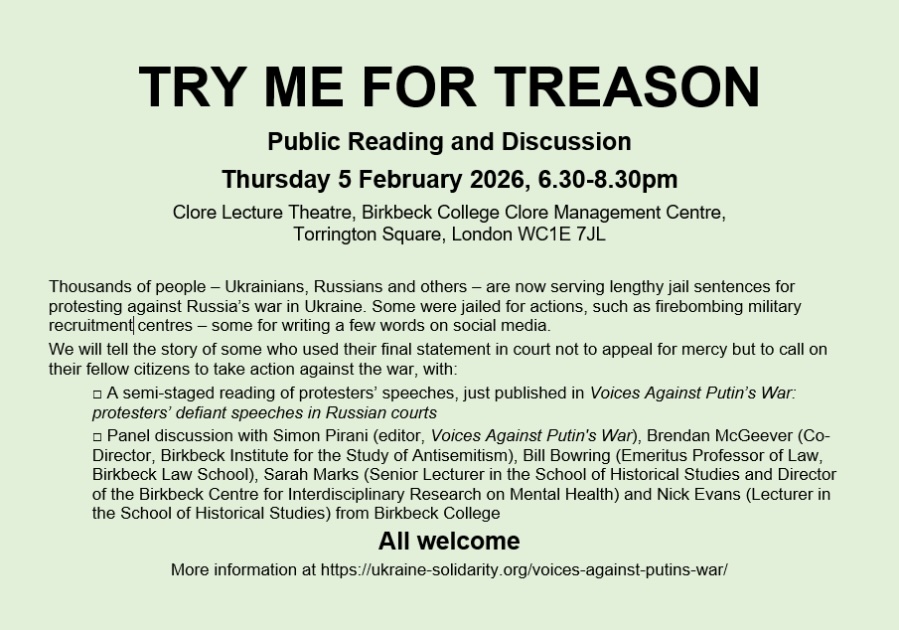
Thursday 5th February, at 6.30pm. Try Me For Treason reading and discussion event at Clore Lecture Theatre, Birkbeck College Clore Management Centre, Torrington Square, London WC1E 7JL. Details here.

This bulletin is put together by labour movement activists in solidarity with Ukrainian resistance. To receive it by email each Monday, email us at 2022ukrainesolidarity@gmail.com.

Source: News from Ukraine Bulletin no. 178, 11 January 2026


Beginning in 1943, the War Department published a series of pamphlets for U.S. Army personnel in the European theater of World War II. Titled Army Talks, the series was designed “to help [the personnel] become better-informed men and women and therefore better soldiers.”

On March 24, 1945, the topic for the week was “FASCISM!”

“You are away from home, separated from your families, no longer at a civilian job or at school and many of you are risking your very lives,” the pamphlet explained, “because of a thing called fascism.” But, the publication asked, what is fascism? “Fascism is not the easiest thing to identify and analyze,” it said, “nor, once in power, is it easy to destroy. It is important for our future and that of the world that as many of us as possible understand the causes and practices of fascism, in order to combat it.”

Fascism, the U.S. government document explained, “is government by the few and for the few. The objective is seizure and control of the economic, political, social, and cultural life of the state.” “The people run democratic governments, but fascist governments run the people.”

“The basic principles of democracy stand in the way of their desires; hence—democracy must go! Anyone who is not a member of their inner gang has to do what he’s told. They permit no civil liberties, no equality before the law.” “Fascism treats women as mere breeders. ‘Children, kitchen, and the church,’ was the Nazi slogan for women,” the pamphlet said.

Fascists “make their own rules and change them when they choose…. They maintain themselves in power by use of force combined with propaganda based on primitive ideas of ‘blood’ and ‘race,’ by skillful manipulation of fear and hate, and by false promise of security. The propaganda glorifies war and insists it is smart and ‘realistic’ to be pitiless and violent.”

Fascists understood that “the fundamental principle of democracy—faith in the common sense of the common people—was the direct opposite of the fascist principle of rule by the elite few,” it explained, “[s]o they fought democracy…. They played political, religious, social, and economic groups against each other and seized power while these groups struggled.”

Americans should not be fooled into thinking that fascism could not come to America, the pamphlet warned; after all, “[w]e once laughed Hitler off as a harmless little clown with a funny mustache.” And indeed, the U.S. had experienced “sorry instances of mob sadism, lynchings, vigilantism, terror, and suppression of civil liberties. We have had our hooded gangs, Black Legions, Silver Shirts, and racial and religious bigots. All of them, in the name of Americanism, have used undemocratic methods and doctrines which…can be properly identified as ‘fascist.’”

The War Department thought it was important for Americans to understand the tactics fascists would use to take power in the United States. They would try to gain power “under the guise of ‘super-patriotism’ and ‘super-Americanism.’” And they would use three techniques:

First, they would pit religious, racial, and economic groups against one another to break down national unity. Part of that effort to divide and conquer would be a “well-planned ‘hate campaign’ against minority races, religions, and other groups.”

Second, they would deny any need for international cooperation, because that would fly in the face of their insistence that their supporters were better than everyone else. “In place of international cooperation, the fascists seek to substitute a perverted sort of ultra-nationalism which tells their people that they are the only people in the world who count. With this goes hatred and suspicion toward the people of all other nations.”

Third, fascists would insist that “the world has but two choices—either fascism or communism, and they label as ‘communists’ everyone who refuses to support them.”

It is “vitally important” to learn to spot native fascists, the government said, “even though they adopt names and slogans with popular appeal, drape themselves with the American flag, and attempt to carry out their program in the name of the democracy they are trying to destroy.”

The only way to stop the rise of fascism in the United States, the document said, “is by making our democracy work and by actively cooperating to preserve world peace and security.” In the midst of the insecurity of the modern world, the hatred at the root of fascism “fulfills a triple mission.” By dividing people, it weakens democracy. “By getting men to hate rather than to think,” it prevents them “from seeking the real cause and a democratic solution to the problem.” By falsely promising prosperity, it lures people to embrace its security.

“Fascism thrives on indifference and ignorance,” it warned. Freedom requires “being alert and on guard against the infringement not only of our own freedom but the freedom of every American. If we permit discrimination, prejudice, or hate to rob anyone of his democratic rights, our own freedom and all democracy is threatened.”

Notes:

https://onlinebooks.library.upenn.edu/webbin/serial?id=armytalks

War Department, “Army Talk 64: FASCISM!” March 24, 1945, at https://archive.org/details/ArmyTalkOrientationFactSheet64-Fascism/mode/2up

Source: Heather Cox Richardson, Letters from an American, 9 January 2026

Alexander Krichevsky of Izhevsk: Six Years in Prison for a Comment

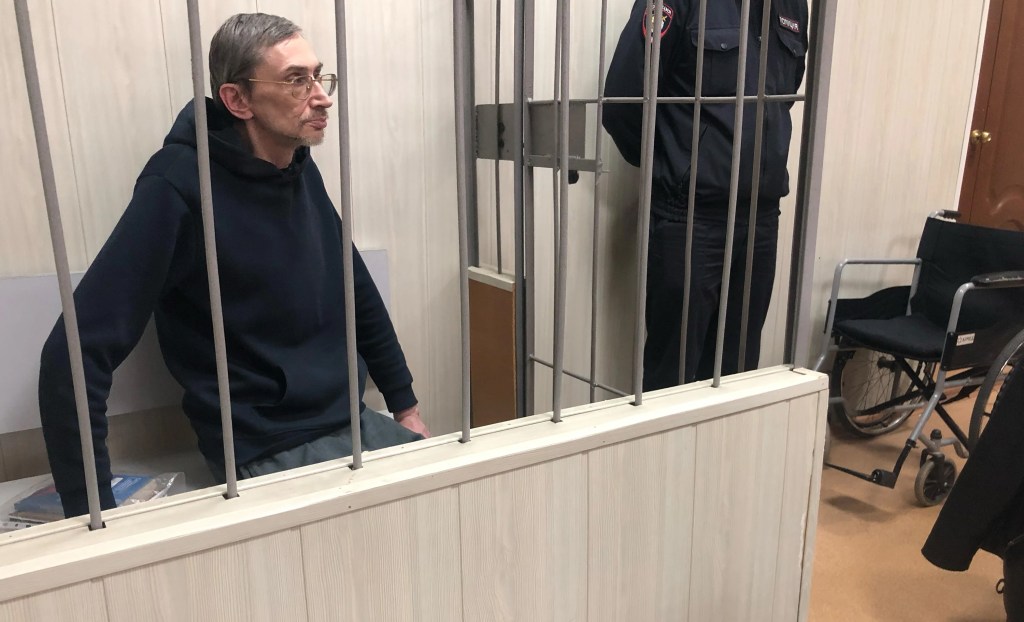
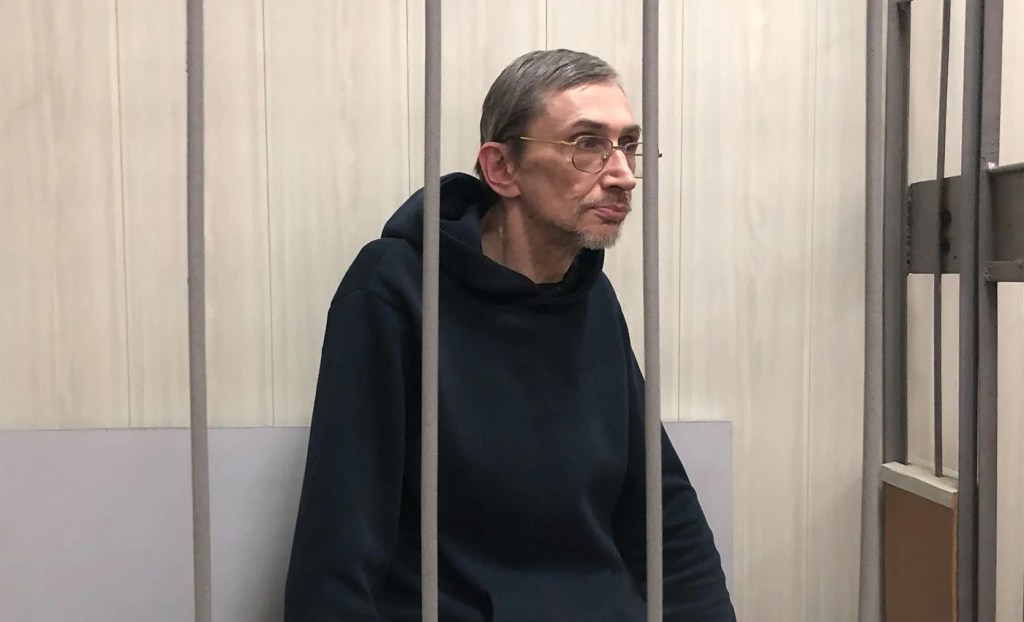
Alexander Krichevsky. Photo: Mediazona

In September 2024, Alexander Krichevsky, a 58-year-old resident of Izhevsk, posted a lengthy comment on a Chechen opposition blogger’s Telegram channel. In the comment, Krichevsky compared Putin and the “FSB clique” to a “darkness” which must be destroyed. The security forces deemed this statement incitement to murder the president and FSB officers. They monitored the man and intercepted his internet traffic. Last December, Krichevsky was detained and remanded in custody to a pretrial detention center despite his ailments and the fact that he is confined to a wheelchair. His ailing mother was placed in a care home, where she died a month later. Today, at the Central District Military Court in Yekaterinburg, where Krichevsky’s case is being heard, the prosecutor requested that he be given the maximum sentence of six years in prison.

“That is why we listen to him, because he is not afraid—he’s a ray of freedom in a kingdom of darkness! And only together will we destroy this darkness, only when we understand that we have only one enemy—Putin and his FSB clique. . . . Both you and we must destroy this enemy to continue living as peaceful neighbors,” 58-year-old Izhevsk resident Alexander Krichevsky wrote in a chat on the channel of opposition Chechen blogger Tumso Abdurakhmanov aka Abu Saddam Shishani, on 11 September 2024.

This was Krichevsky’s response to a user who had asked Abdurakhmanov himself in a chat: “Tumso, aren’t you afraid that Kadyrov’s people might find you?”

When questioned in court, Krichevsky said that he was sure he was responding to the user personally, not writing in a public chat. He repeated many times that he had only figurative “destruction” in mind and had been trying to “reconcile” Abdurakhmanov’s readership by pointing out that they had only one enemy.

“Of course, I wasn’t even thinking about physically destroying such a large number of people and didn’t understand how [what I wrote] would even look. Apparently, my love for pretty words—all those rays of light and other nonsense—let me down. I was thinking in terms of games: when a person plays checkers or chess, they destroy their opponent’s pieces. Roughly speaking, that was the image I had in my head,” Krichevsky said in court.

The FSB operative who discovered Krichevsky’s comment saw it not as criticism alone, but also as a “public call to murder the president of the Russian Federation and officers of the Federal Security Service.”

The same conclusion was reached by Polina Komova, a philologist and expert at the Ministry of Internal Affairs Forensic Center in Udmurtia. She acknowledged in court that the word “destroy” could have other meanings “depending on the context,” but in her opinion it could be understood only in its literal meaning—that is, “to end [someone’s] existence, to exterminate”—in Krichevsky’s comment.

“He was planning a terrorist attack involving self-detonation”: wiretapping and arrest

The security forces began monitoring Krichevsky in early December 2024. It emerged in court that the FSB had requested data on his calls and connections from Rostelecom and learned that on 11 September, when he wrote the comment, he had accessed Telegram from home. Megafon provided the security forces with information about the base stations in the area where Krichevsky’s phone number pinged that day.

On 5 December 2024, the Supreme Court of Udmurtia gave the FSB permission to tap Krichevsky’s phones, and a few days later it approved “gathering information from technical communication channels and acquiring computer information.” A few days before Krichevsky’s arrest, operatives monitored his apartment to “document illegal activities.” The report states that Krichevsky did not leave his home.

On 19 December 2024, Krichevsky was detained and sent to a pretrial detention center. He described his arrest to journalists.

“There was a knock on the door at seven in the morning, and seven people came into [our] small flat: five FSB officers and two eyewitnesses. I opened the door myself. They immediately sat me down on a chair in the hallway. My ailing mother was lying there, barely alive. They said, ‘Can you hand over [your phone]?’ They tried to intimidate me once: ‘If you refuse, we’ll take you away and charge you with additional offenses.’ I realized that resistance was futile. I gave them the phone, and they looked at it and took what they needed.”

The social media comment charges against Krichevsky were accompanied by an FSB report containing much more serious, but in effect unproven, allegations. The document states that, according to “intelligence,” Krichevsky, who opposes the “state’s political course” and the conduct of the “special military operation,” supported radical Islamists fighting for Ukraine and was planning to convert to Islam and carry out a terrorist attack in Udmurtia “by blowing himself up with cooking gas.” The court never did hear what this report was based on.

Photo: Mediazona

“None of my comments or my own thoughts bear this out. When I heard this business about blowing myself up . . . In this case, everything that the prosecutor has just read aloud is pure speculation on the part of the investigators. None of my quotes corroborates it,” Krichevsky said in court.

Judge Alexander Raitsky simply reminded Krichevsky that the case centered on a single [social media] comment, which the defendant himself did not disput, and that the court would evaluate the evidence in the deliberation room.

The case file also contains another comment by Krichevsky from the same written exchange: “Many empires have collapsed in this world. I myself foresee the end of the Russkies [rusnya]. I don’t feel sorry for them: let them collapse with a bang. That’s where they belong. I myself hate these FSBniks, pigs [cops], and other scum who suck the blood of our homeland and shit on our neighbors.”

The security forces deemed this “a statement containing a negative assessment of the group of persons sharing the profession of Federal Security Service officers and police officers,” but it was not included in the indictment.

Responding to the judge’s question about this comment, Krichevsky said that he sometimes tried to “adapt” to the rude tone of the conversation [on the Telegram channel’s chat].

“My mother died four weeks after my arrest”: wheelchair-bound in a detention center

Krichevsky had worked as a systems administrator in Izhevsk before his arrest.

As a child, Krichevsky had moved with his family from Udmurtia to Rostov-on-Don. After high school, he enrolled in medical school, but in 1989 he broke his spine and had to drop out because his left leg was paralyzed and he had lost feeling in his right leg. After a long period of rehabilitation, he was able to walk again, but was unable to recover fully: he had a severe limp and had difficulty going up stairs.

Krichevsky said in court that his father had committed suicide on 11 September 2008.

“He had terminal cancer. He was in serious pain and turned to me because I was in medical school. He wanted me to tell him what poison he could use to commit suicide. I refused to do it. Then, two days before his death, I noticed he was sharpening a knife in an odd way. He died in a rather original way, if that word is appropriate in this situation—he stabbed himself in the heart with a knife,” Krichevsky told the court.

In early 2010, during a trip to Thailand, Krichevsky broke his left leg, which had been paralyzed since his [accident in 1989]. He underwent surgery at a local hospital, but he could not stay in hospital for long because his visa had expired. Krichevsky returned to his hometown of Izhevsk, where he underwent a second operation, but his condition only worsened.

“My knee wouldn’t straighten. They tried to do something about it, but because I had spinal injuries, my knee spasmed, and it remained crooked and they couldn’t do anything about it. And my hip didn’t recover either; I also had a fractured hip,” Krichevsky told the court.

Since then, Krichevsky has been confined to a wheelchair. Other ailments have also emerged: kidney problems, emphysema, and head tremors.

“I don’t know whether it’s early Parkinson’s combined with Alzheimer’s, or something else,” Krichevsky said.

Krichevsky had been living with his elderly mother and caring for her since 2016. Last year, she was hospitalized with a complex fracture. After she was discharged, she was unable to walk, and Krichevsky would help her to sit up and do breathing exercises in order to prevent pulmonary edema and bedsores. After Krichevsky was arrested, the woman was sent to a care home. She died of a pulmonary edema a month later.

“They apparently left her lying in bed at the care home. When a person lies in a horizontal position for a long time, they develop a pulmonary edema. That’s what my mother died of,” he said in court.

Photo: Mediazona

While in pretrial detention, Krichevsky formally lost his Group I disability status, which he had prior to his arrest, and so he was unable to obtain a medical examination.

According to Krichevsky, a neurologist at the Izhevsk detention center promised to send him to a hospital, but instead Krichevsky was transferred to another pretrial detention center. “I thought they were taking me to a hospital, but they took me first to Perm and then to Yekaterinburg. They basically lied to me when they said they were taking me to a hospital,” he said on the stand.

Krichevskny never did get any medical attention: “We’ll only help you if you’re dying, [they said.] Otherwise, just sit there and suffer.”

“Radical views and hostility toward the current government”: trial and pleadings

Krichevsky’s trial was postponed five times in a row: it took a long time to bring him in his wheelchair, first to Detention Center No. 1 in Yekaterinburg, and then to the court. He was brought to the hearings late, and had to spend four to five hours in the police van, where, according to Krichevsky, the temperature was the same as outside.

At the beginning of the trial, Krichevsky filed a motion requesting that he be assigned an inpatient forensic examination and treatment. He said that he had never been examined by a neurologist at the Yekaterinburg detention center, only by a GP. He was taken for examination to the local medical unit, which was not equipped for people with disabilities: there was a “big step” in front of the toilet and sink which he could not get over. As a result, the doctors only checked his reflexes and sent him back.

In their medical report, the doctors at the detention center stated that Krichevsky had no disability and that his overall health was satisfactory, meaning that he was able to take part in the court hearings.

Before the proceedings, Krichevsky again requested to be sent for treatment, “in accordance with the neurologist’s recommendation” in Izhevsk, but Judge Raitsky denied the request, seeing no need for it. Prosecutor Artem Terentyev also asked that the request be denied, as it went “beyond the scope of the criminal case under consideration.”

During the trial, the prosecutor asked that Krichevsky be imprisoned for six years in a medium-security penal colony. The prosecutor stressed that the defendant had “radical views” and was “hostile toward the current government of the Russian Federation and its officials,” and that he had written the offending comment at a time when the mobilization had not yet been completed. The prosecutor considered these to be aggravating circumstances.

The prosecutor cited Krichevsky’s “poor health” as a mitigating circumstance.

You can support Alexander by writing him a letter.

Address:
Russian Federation 620019 FKU SIZO-1, GUFSIN of Russia for the Sverdlovsk Region • Sverdlovsk Region, Yekaterinburg, Repin Street, 4 • Alexander Anatolyevich Krichevsky, born 1967

You can also send letters through the online service Zonatelecom.

Source: Vasily Besspalyi, “Wheelchair user from Izhevsk sentenced to six years in prison for comment about Putin; his mother, sent to nursing home after his arrest, dies a month later,” Mediazona, 22 December 2025. Translated by the Russian Reader. Since letters to Russian prisoners are vetted by prison censors, they must be written in Russian or translated into Russian, something that can done more or less handily using an online machine translator like Google Translate. Please write to me if you need help or advice. ||||| TRR

“Try Me for Treason”: Londoners Stand in Solidarity with Imprisoned Opponents of Russia’s War in Ukraine

“Try me for treason. I betrayed your deranged state”, the Russian anti-war protester Andrei Trofimov told the Second Western District Military Court in May.

In 2023, Trofimov was sentenced to ten years’ imprisonment, for opposing Russia’s war in Ukraine in social media posts, and trying to join the Free Russia Legion that fights on Ukraine’s side. At that hearing, Trofimov said he hoped for Ukraine’s victory, and called president Putin “a dickhead”.

On the basis of that statement alone, he was further accused of “justifying terrorism” and defaming the Russian army. For those “crimes”, the judge at the hearing in May this year, Vadim Krasnov, added three years to Trofimov’s sentence.

Before sentencing, Trofimov told the court that he had not justified terrorism, but supported the Ukrainian armed forces’ legitimate military actions against aggression, and had not defamed the Russian army whose actions were unconstitutional and illegal. He told the court that he considered himself guilty of a much more serious crime: treason – taking the enemy’s side in war.

Excerpts from the speeches by Trofimov and three other anti-war protesters were read out in London last month, at a launch event for the book Voices Against Putin’s War: Protesters’ Defiant Speeches in Russian Courts. I said a few words about the book, which I edited.

Here’s a film of the event.

Ukraine Information Group, “Try Me For Treason (readings from anti-war protesters’ speeches in Russian courts),” 7 December 2025

And there will be another chance to hear these powerful readings in London – on Thursday 5 February 2026, 6:30 p.m., at Birkbeck College. Here are the details.

You can order copies of Voices Against Putin’s War, or download a free pdf, here.

We published the book against the background of repeated claims that a peace agreement is about to be signed between Russia and Ukraine. These are louder than ever after this week’s talks in Berlin. At the time of writing this, it is not clear to me that the Kremlin is really interested in stopping the war, or what the “security guarantees” being offered to Ukraine actually mean.

I would recommend following the excellent arguments made about the peace process by Oleksandr Kyselov (most recently here, also here and here), Hanna Perekhoda (who writes on Facebook here), and other Ukrainian socialist writers.

If you want to know why the 20% of Donbas that Ukraine still controls matters so much, this comment by the Institute for the Study of War is worth reading. This speech by Valery Zaluzhny helps us understand what the Ukrainian political elite thinks.

Whatever the outcome of the talks now in progress, if any, the defence of victims of Russia’s military occupation of Ukrainian territory, and domestic political repression, will remain a central issue for our movement, right across Europe.

Source: Simon Pirani, “Try Me for Treason,” People and Nature, 21 December 2025

A Documentary Film about Pavel Kushnir

Kushnir (2025), a film about the late pianist and antiwar protester Pavel Kushnir (in Russian and English, with subtitles)

Pavel Kushnir was a virtuoso pianist, a writer, and a courageous man whom the world discovered only too late. He died on July 27, 2024, in a Birobidzhan detention center following a dry hunger strike. The formal pretext for his arrest was a series of anti-war videos posted on a YouTube channel that had only 5 subscribers.

This film is an attempt to understand the man who played Rachmaninoff until his fingers bled, who dreamed of flying to Mars, who idolized Kurt Cobain, and who called the war by its true name while living in complete isolation.

We have gathered archival footage, previously unknown recordings of Pavel, fragments of his poignant cut-up novel, and memories from close friends and colleagues, including Clean Bandit soloist Grace Chatto, music expert Mikhail Kazinik, and publisher Dmitry Volchek. This is a story not just about a death in prison, but about an extraordinary life that became an act of art and resistance.

In this video:

Unique footage of Kushnir’s performances and artistic actions.

The story of an unmade avant-garde film and friendships with global stars.

The Birobidzhan Diary: a chronicle of loneliness and the fight against fascism.

Why a brilliant musician went unnoticed by the cultural establishment, but not by the prison system.

Source: VotVot (YouTube), 12 December 2025


Our film about the pianist Pavel Kushnir has dropped. […] Honestly, the film was ready to go in late April, but we spent a long while navigating the legal maze around the music, copyrights, and permissions. That was not even the main reason for the delay, though. I wanted to wait until the media hype had subsided and we could take a look at Pavel’s legacy from a certain historical distance, to talk about him not as a victim (although that viewpoint is legitimate, of course) but as a rebel whose choice was deliberate. Similarly, if you will, there are different takes on Christ: some view him as a needless victim who arouses pity, and the more maudlin that pity, paradoxically, the stronger their hatred for his crucifiers; while others see him as a rebel whose heroism was deliberate.

In my opinion, seeing Pavel as a pure “victim” robs him of agency, turning him into an extra in someone else’s play, in which the crucifiers have all the starring roles.

The film is based on Pavel’s own diaries. In terms of composition, I reprised the structure of his screenplay for the unmade film The Six Weary Ones. Three states of madness—prophetic madness, creative madness, and the madness of protest—figure as the three aspects of his personality. As in Joyce, each of Kushnir’s chapters has its own color and symbol. We have added music to these chapters. The music for the red chapter, “Prophet,” is by Rachmaninoff. Bach supplies the music for the blue chapter, “Creator”: blue stands for the heavens and the cosmos, and fugues are cosmic in nature. The third, black-and-white chapter, dealing with rebellion and Birobidzhan, is set to Scriabin’s Prometheus, a [tone] poem about the first rebel in history. Camus writes, in The Rebel, that rebellion confers agency on us, turning us from beasts into human beings. Again, it’s all in the eye of the beholder: some feel pity for Prometheus, chained and tortured by the eagle, while others see in him the power of the unbroken human spirit. And Scriabin’s idea of transforming all of humanity meshes perfectly with the cosmic utopia begun in the previous chapter. Prometheus: The Poem of Fire is a mystery play; as [Russian poet Konstantin] Balmont put it, it is “a vision of singing, falling moons, of musical stardoms, arabesques, hieroglyphs, and stones sculpted from sound.”

The film is chockablock with musical, literary and philosophical allusions which I won’t burden you with now. But if you’re interested, I’ll set up a cozy stream on my tiny Telegram channel where we’ll discuss the film and unpack its hidden layers, and I’ll answer your questions. You can write in the comments about whether this idea seems viable, and I’ll decide what to do based on your feedback.

Once again I want to thank everyone who did their part and helped commemorate a major artist. Thanks to you, we raised 1,185 euros and 533,954.51 rubles [approx. 5,800 euros], which is not just a large sum but a phenomenally large sum, considering that the major media practically ignored our fundraising campaign. That being said, many friends and former colleagues supported us by reposting [our fundraising appealing], which is eloquent testimony to the fact that a person and his reputation are more vital than any institution, and for this I am endlessly grateful to them.

The money we raised was enough for several full-fledged scouting trips and location shoots. Considering the geographical scope of our shoots, which included traveling to Birobidzhan itself, our grassroots war chest was emptied at some point. It became clear that without outside help we wouldn’t be able to complete the project properly, avoid devolving into a Skype interview format, and pay all the courageous artists, editors, and cameramen who had agreed to shoot a film in Russia at their own peril. I understood that asking folks for money again was not a good plan. So, after consulting with our small team, I accepted an offer from the online platform Votvot. They covered our remaining expenses and, most importantly, agreed to our condition that the film would be freely available. Our promises to our donors have not been broken: this grassroots film is being released in a way that is accessible to the grassroots—on YouTube.

I want to thank my friend and colleague Alexander Urzhanov from the bottom of my heart: he was quite emotionally invested in this film and provided us with his fabulous production resources. I would also like to thank all the folks at Narra: they have asked me not to name them, but you know who you are. Misha, Dasha, Ira, and Nastya, I couldn’t have done it without you and by myself! Particular thanks go to Boris Barabanov and Darina Lukutina from Votvot, without whom this film would scarcely have been possible.

I would like to thank Pavel’s relatives for permitting us to use his voice to read his diaries. Getting ahead of myself, I should say that this is the only digitally generated thing in the film. Everything else was filmed or recorded using analog methods: the diaries, the posters, and the drawings of a certain incomparable artists were all done without synthetics or computer glitz. All you see is life’s pleasant graininess.

I thank Pavel’s friends for sharing their archives and letters, as well as everyone who appears in this film.

I have one final request to you. Watch this film tomorrow. More to the point, share this film. I’m afraid that the film will get lost in the ruthless algorithmic desert without your reposts. May this film find everyone who needs it.

Source: Sergey Erzhenkov (Facebook), 12 December 2025. Thanks to Giuliano Vivaldi for the heads-up. Translated by the Russian Reader


Pavel Kushnir was a classical pianist. But according to Russian authorities, he was also a dangerous dissident. In July 2024, he died on hunger strike in a remote prison in Far East Russia. Who was Pavel Kushnir, and why did he end up in jail? Liza Fokht from BBC Russian has been trying to piece together Pavel Kushnir’s story.

Source: Spotify

“We Wanted to Show the Whole Range of Anti-War Resistance in Russia”

Thursday 20 November, 7:00 p.m. UK time: TRY ME FOR TREASON – Readings from anti-war protesters’ speeches in Russian courts, and book launch for Voices Against Putin’s War.

You are welcome to attend in person at Pelican House, 144 Cambridge Heath Road, London E1. Or watch the livestream here on Facebook, or on Youtube.

Source: Ukraine Information Group (Facebook), 18 November 2025


What can courtroom speeches by imprisoned protesters tell us about the breadth of anti-war resistance in Russia? British historian Simon Pirani discusses his new book Voices Against Putin’s War with independent Russian journalist Ivan Rechnoy.

Simon Pirani is a British researcher and author who has written about energy and ecology, the history of the Russian Revolution, the labor movement, and post-Soviet Russia. His recent book Voices Against Putin’s War: Protesters’ Defiant Speeches in Russian Courts compiles and analyzes the courtroom speeches of twelve prisoners who were sentenced for resisting Russian aggression in Ukraine. 

— Today in Russia, hundreds of people are serving prison sentences for criticizing the invasion of Ukraine. Twelve of those people are the subjects of your book. How did you select them?

— We wanted to show that opposition to Putin’s war is widespread. What is striking about these people is their diversity. They come from different generations, have different life experiences, and hold different political views. This diversity demonstrates that, despite the absence of public demonstrations and the lack of any real possibility of organizing an open anti-war movement in Russia, an anti-war movement does exist there. It encompasses a very broad spectrum of Russian society as well as people from the occupied territories. For example, the book features the courtroom speech of Bohdan Ziza from Crimea.

We decided not to include some of the most well-known opponents of the war in the book — people who made brave and principled speeches in court, like Ilya Yashin, for example. Their statements had already been widely publicized in the media here. Instead our goal was to draw the attention of English-speaking readers to lesser-known figures. 

On the one hand, there are those who simply said something or posted statements on social media. For example, Darya Kozyreva, the youngest person featured in the book, was arrested for laying flowers at the Taras Shevchenko monument in Saint Petersburg. On the other hand, these are those who did something, such as throwing firebombs — not with the intention of hurting anyone, but to draw attention to the injustice of the war. Igor Paskar and Alexei Rozhkov are among them. These are people who live in smaller towns far from Moscow or Saint Petersburg, where young men are much more likely to receive draft notices from the conscription service. 

We also included the statement by Ruslan Siddiqi, who sabotaged a railway line to stop munitions from reaching Ukraine. 

The texts for the book were put together by a group of friends who, since the February 2022 invasion, had been translating the courtroom statements and some of the posts from the media or social networks. When we were already well into that process, a lot of new material appeared on the website Poslednee Slovo [author’s note: the project’s name translates as “the final statement”]. It’s a terrific project that does an excellent job of collecting and publishing a much broader range of cases than we could cover. 

We limited ourselves to people who have made explicit anti-war statements about the war in Ukraine. However, as you know, there are many other political prisoners who have appeared in court since the 2022 invasion, as well as many more from before that, especially among the Crimean Tatar political prisoners. They are all represented on the Poslednee Slovo website. Another remarkable thing about the website is that it goes back all the way to the Soviet period. They’ve included the 1966 speeches by Andrei Sinyavsky and Yulii Daniel, perhaps the first examples since Stalin’s time of people using the right for a final statement in court as a form of propaganda. 

Our book includes a chapter that lists seventeen additional cases of people who delivered anti-war speeches, beyond the twelve protagonists whose complete statements we published. We hope that either I or my colleagues will eventually translate all of those speeches as well. 

Unfortunately, the final courtroom speech has become something like a literary genre in its own right. This tells us a lot about the difficult and fearful times we are living through.

— How do you envision the audience for this book? Are they people in the West and elsewhere who already have some understanding of the situation in Russia and want to learn more? Or are they readers to whom you want to convey a political message — perhaps even to persuade them of something?

— The book is in English and is therefore intended for English-speaking readers rather than Russian-speaking readers. Only a small percentage of people in the UK, the US, and Europe can read Russian. Since 2022, many of us have been aware of the fate of the anti-war movement in Russia. As you know, it began with large demonstrations, but protesting soon became difficult and then almost impossible. Next came the firebomb attacks on military recruitment centers — actions not meant to harm people, but to draw attention to the anti-war cause. We then started reading, in Russia’s opposition media, the final statements of opposition figures — the courtroom having become, in effect, the last public forum in Russia where protest is still possible. 

However, I think that many people in English-speaking countries remain unaware of all this. 

So, to answer your question, our aim is to reach a wider audience in Western societies: not only those who have closely followed Russia’s attack on Ukraine and its consequences, but also those whose understanding of it comes only from what they have picked up incidentally through the media.

— One of the central figures in your book is Alexander Skobov. One might say he bridges two eras. He was a dissident in the Soviet Union and is once again among the persecuted today. There is another similar example that is not included in the book: Boris Kagarlitsky. How do people in the West perceive the difference between current repressions and the dissident movement during the Cold War? Also, how do they see the difference between the Russian and Western situations now?

— First, I would like to say a few words about Skobov. As someone who regularly travelled to Russia between 1990 and 2019, I was deeply affected by these courtroom speeches. The first one I came across was by Igor Paskar. I thought, “My God, these are such young people — not the youngest, but still much younger than me — who have entered this fight.” Alexander Skobov’s speech also affected me emotionally, perhaps because he is about my age — a year or two younger — and, as you said, he bridges two eras. 

I was particularly touched by the letter that he wrote to his partner, Olga Shcheglova. It was published in Novaya Gazeta Europe, and we also included it in the book. In the letter, Skobov explains that some of his friends and comrades urged him to leave Russia, but he refused. This made it inevitable that he would eventually face trial and imprisonment. In the letter, he explains that he wanted to communicate to the younger generation that the small group of dissidents he once belonged to — the socialist wing of the Soviet dissident movement — stands in solidarity with them in these difficult times. He wanted this message to be recorded in history. 

I think that is a very important statement, and we all owe Alexander Skobov gratitude for linking these two historical periods through his sacrifice. I hope that including his statements in our book will help people in the West understand this continuity more clearly. 

I will try to answer your question about how these movements are perceived. During the Soviet era, people in the West generally considered the dissident movement to be very small and marginal. Given how communication worked back then, it was very difficult for information to break through. Of course, there were large revolts against Soviet power, beginning with the Novocherkassk uprising in the 1960s and other violent revolts in the 1970s and 1980s. I have a friend in Ukraine who studied the major revolt that took place in Dniprodzerzhynsk. These movements were very short-lived, and we hardly knew about them in the West, even those of us who were interested in what was going on in the Soviet Union. 

Today, Russians — and Ukrainians, of course — have a much greater opportunity to have real conversations with people in Western Europe. I think the powers of that time really succeeded in dividing Europe; there really was an iron curtain. But that’s gone now. Millions of Ukrainians and Russians live in Western Europe, the UK, and the US. People are learning to communicate with each other and work together in new ways. 

We can already see examples of this in Germany, in the UK, and elsewhere. I think this conversation must continue — and our book, I think, is part of that ongoing dialogue. 

Of course, it’s not easy to communicate with someone who is literally in a Russian prison. However, through the friends, comrades, and families of the central figures in our book, I hope this conversation will begin and continue over a long period of time. 

— I wanted to ask specifically about the possibility of connecting the Russian-Ukrainian and Israeli-Palestinian agendas. We are, of course, impressed by the huge mobilization in support of Palestine. At the same time, many on the left are frustrated that active support for Ukraine — a country in a situation in some ways similar to that of Palestine — is far less widespread in Europe and the West. Have there been any positive developments in this regard recently? 

— Since October 2023, we have all watched with horror as Israel’s assault on Gaza has unfolded. It has been widely recognized as a genocide, and we now see a larger and more enduring anti-war movement in Western countries than we have seen in decades — comparable perhaps only to the protests against the US-UK invasion of Iraq in 2003, or even the movement against the Vietnam War in the 1970s. 

One of the reasons I felt it was important to translate these texts into English was to show Western audiences how much the Russian anti-war movement has in common with movements here. Of course, their enemies are different, standing on opposite sides of the geopolitical divide, and there are many other differences as well. Yet the similarities are striking — and deeply significant. The motivations of some of those who gave these courtroom speeches — whose statements we have translated — are very similar to those of activists in the UK who have been arrested for supporting Palestine Action, or of those who joined the flotilla recently stopped by Israeli forces as it attempted to reach Gaza. 

I spent much of last year attending the large British demonstrations against Israel’s assault on Gaza and calling for a ceasefire. Together with friends, we carried a banner stating: “From Ukraine to Palestine, occupation is a crime.” Our group wanted to show our fellow demonstrators that Ukraine’s struggle for national self-determination and the Palestinians’ struggle for freedom from Israeli occupation share something essential — the right to decide their futures, free from foreign interference and military threats. 

We received a very interesting response from other marchers. Those familiar with the politics of the so-called left and socialist movements will recognize the reaction we encountered from a small minority, mostly older people, who said things like: “Why are you siding with Ukraine? Ukraine is just a plaything of the Western powers, a puppet of NATO. Why even talk about this issue?” Yet the overwhelming majority — more than ninety percent — of those who approached us said, “Ah, yes, we hadn’t thought about it that way before, but there really is something in common between these struggles.”

Another major obstacle to unity comes not only from the “campism” of certain leftists — those who focus exclusively on American and British imperialism while downplaying or excusing Russian imperialism — but also from the state, the mainstream press, and government propaganda. The official narrative is consistently supportive of Ukraine and entirely condemnatory of Palestinian resistance. Ordinary people sense this imbalance — the racism and discrimination directed at the Palestinian cause, alongside the establishment’s favoritism toward Ukraine. There is some truth in that: the propaganda machinery of our ruling class here is largely sympathetic to Ukraine. Working-class people in the UK and across Europe notice this and grow suspicious. However, I believe that is a suspicion we can overcome — and that has been our experience. 

All of this is my personal opinion. The purpose of the book, however, is to bring to English-speaking readers the voices of our friends and comrades in Russia — those brave people who have found themselves in court and who, in some cases at the risk of additional years in prison, have chosen to exercise their constitutional right (though not always respected by judges) to deliver a final statement before the court. It is a remarkably courageous and difficult decision. 

— I wanted to thank you for the book, and I also wanted to ask you, since you have been interested in this topic for a long time: how did your interest in it arise, and why has Russia become so important to you?

— My connection with Russia began through the labour movement. I first went to Russia in 1990 — to Prokopyevsk, in western Siberia, where the miners’ strikes of 1989 had first broken out. At that time, I was working as a journalist for the mineworkers’ trade union here in the UK. We saw an opportunity to develop links of solidarity between Soviet miners and British miners. And we had some success. Our friends in the British miners’ union established a very close relationship with the Independent Miners’ Union of Western Donbas, based in Pavlograd. This friendship continues even today.

In those days, I was a member of a Trotskyist organisation, and in August 1990, we organised a meeting in Moscow to mark the 40th anniversary of Trotsky’s assassination. This, too, was part of a conversation between Western socialists and people in Russia and Ukraine that had been practically impossible during the “Cold War.”

I continued to follow what’s going on in Russia and Ukraine, and to write about it, and between 2007 and 2021, I worked at a research institute, writing about the energy sectors of those countries. 

Since the pandemic, I haven’t been back to Russia. On February 24th, 2022, when the invasion began, I was at home and was shocked. We were all shocked. The invasion has changed everything, both in Ukraine and Russia, for many years to come. Together with friends, we began translating these courtroom speeches and posting them online. Gradually, that work grew into the idea of making a book.

I hope your readers will read it. Later this year, we’re going to make the book freely available as a PDF, so that everyone can access it. 

If we do make any money — and I should say it is a very cheap book — all proceeds will go to Memorial and political prisoners. Nobody is making a profit from this project. The whole point is to share these voices with a much wider audience.

Source: Ivan Rechnoy, “We Wanted to Show the Whole Range of Anti-War Resistance in Russia,” Posle, 22 October 2025


 Sale! £15.00 £12.00

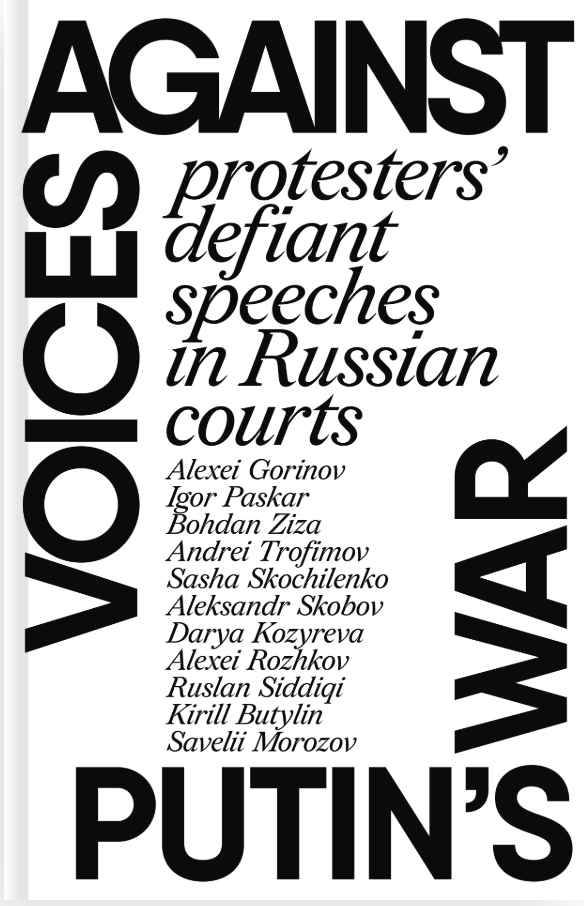
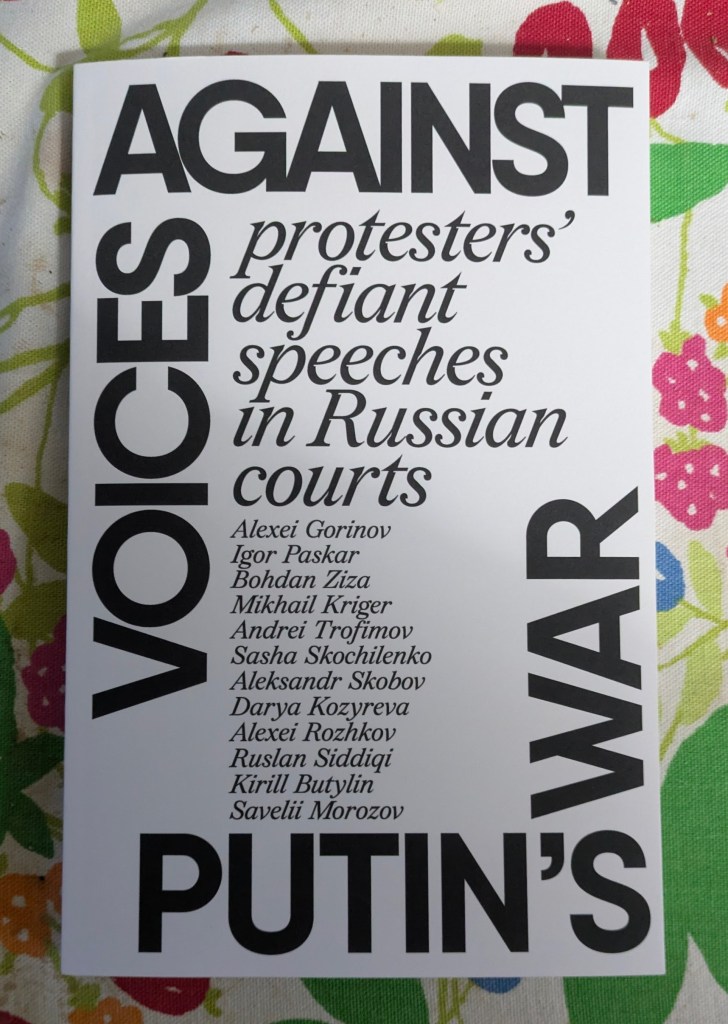
VOICES AGAINST PUTIN’S WAR
Protesters’ defiant speeches in Russian courts

Speeches by Alexei Gorinov, Igor Paskar, Bohdan Ziza, Mikhail Kriger, Andrei Trofimov, Sasha Skochilenko, Aleksandr Skobov, Darya Kozyreva, Alexei Rozhkov, Ruslan Siddiqi, Kirill Butylin and Savelii Morozov.

Foreword by John McDonnell, Member of UK Parliament

Edited by Simon Pirani

ISBN: 978-1-872242-45-3 (paperback)
e-ISBN: 978-1-872242-47-7 (e-book)
RRP: £15 (pbk)
e-RRP: £7 (Ebook)
196 pages; 140x216mm.
Publication date: September 2025

The E-book can be purchased at the usual online retailers
Any profits will be donated to Memorial: Support for Political Prisoners https://memohrc.org/en

Source: Resistance Books

The Courtroom Rebels Standing Up to Warmonger Putin

Voices Against Putin’s War: protesters’ defiant speeches in Russian courts is published this month by Resistance Books. Here is the Introduction to the book, by Simon Pirani, first published online by the European Network for Solidarity with Ukraine.

At the heart of Voices Against Putin’s War are ten speeches made in court by people who opposed Russia’s war of aggression in Ukraine, and were arrested and tried for doing so. Most of them are now serving long jail sentences, for “crimes” fabricated by Vladimir Putin’s repressive machine.

Along with the speeches, we include other public declarations – social media posts, letters and interviews – in which the protagonists made their case; statements by two more persecuted activists, made outside court; and a summary of 17 other anti-war speeches in court. We hope that, by publishing these translations in English, these resisters’ motivations will become known to a wider audience.

Chapters 1-10 are each devoted to one protester, arranged chronologically by the date of the protester’s first conviction. United in their opposition to the Kremlin’s war, they divide roughly into four groups.

First is Bohdan Ziza (chapter 3), who lived not in Russia but in Ukraine – in Crimea, which has been occupied by Russian forces since 2014. In 2022 Ziza filmed himself splashing paint in the colours of the Ukrainian flag on to a municipal administration building. He was tried in a Russian military court and is serving a 15-year sentence.

Second are two young women from St Petersburg, Sasha Skochilenko (chapter 6) and Darya Kozyreva (chapter 8), prosecuted for the most peaceful imaginable protests against the war. Skochilenko, who posted anti-war messages on labels in a supermarket, was freed after more than two years behind bars, in August 2024, as part of a prisoner swap between Russia, Belarus and several Western countries. Kozyreva is serving a two-and-a-half year sentence, essentially for quoting Taras Shevchenko, Ukraine’s national poet, in public.

Third are three young men who deliberately damaged property, but not persons, to draw their fellow Russians’ attention to the anti-war cause. Igor Paskar (chapter 2) firebombed an office of the Federal Security Service (FSB). Alexei Rozhkov (chapter 9) firebombed a military recruitment centre – a form of protest used dozens of times across Russia in 2022. He fled to Kyrgyzstan, was kidnapped, presumably by the Russian security forces, and returned to Russia for trial. Ruslan Siddiqi (chapter 10), a Russian and Italian citizen, derailed a train carrying munitions to the Ukrainian front. He has been sentenced to 29 years, and has said that he can be seen as a “partisan”, and “classified as a prisoner of war”, rather than a political prisoner.

The fourth group of protagonists, jailed for what they said rather than anything they did, have records of activism for social justice and democratic rights stretching back decades: Alexei Gorinov (chapter 1), a municipal councillor in Moscow who dared to refer to Russia’s war as a “war” in public; Mikhail Kriger, an outspoken opponent of Russia’s war on Ukraine since 2014 (chapter 4); Andrei Trofimov (chapter 5); and Aleksandr Skobov (chapter 7), who was first jailed for political dissent in 1978, in the Soviet Union, and who 47 years later in 2025 told the court: “Death to the Russian fascist invaders! Glory to Ukraine!”

Two activists prosecuted for anti-war action, who made their statements outside court, are featured in chapters 11 and 12. Kirill Butylin (chapter 11) was the first person arrested for firebombing a military recruitment office, in March 2022. No record of his court appearance is available, but his defiant message on social media is: “I will not go to kill my brothers!” Savelii Morozov (chapter 12) was fined for denouncing the war to a military recruitment commission in Stavropol, when applying to do alternative (non-military) service.

The ten anti-war speeches in court recorded in this book are by no means the only ones. Another 17 are summarised in chapter 13. These speeches, along with others by defendants who railed against the annihilation of free speech, or protested against grotesque frame-ups, have been collected and published by the “Poslednee Slovo” (“Last Word”) website.

High-profile Russian politicians jailed for standing up to the Kremlin also made anti-war speeches in court, including Ilya Yashin of the People’s Freedom Party, sentenced to eight-and-a-half years in December 2022 for denouncing the massacres of Ukrainian civilians at Bucha and Irpin, and Vladimir Kara-Murza, sentenced in April 2023 to 25 years for treason. Both of them were freed, along with Sasha Skochilenko, in the prisoner exchange of August 2024. Other prominent political figures remain in detention for opposing the war, including Boris Kagarlitsky, a sociologist and Marxist writer, sentenced in February 2024 to five years for “justifying terrorism”, and Grigory Melkonyants, co-chair of the Golos election monitoring group, sentenced in May 2025 to five years for working with an “undesirable organisation”. Dozens of journalists and bloggers are behind bars too.

These better-known, politically motivated people are only a fraction of the thousands persecuted by the Kremlin.

The cases recorded by human rights organisations include thousands of Ukrainians detained in the occupied territories. In many cases their fate, and whereabouts, is unknown: they may be dead or imprisoned.

Thousands more Russians who have spoken out against the war, or been caught in the merciless dragnet by accident, are behind bars. So are “railway partisans” who sabotaged military supply trains, and others who denounced their regime’s support for Putin’s war, in Belarus.

In Chapter 14, we outline the resistance to the Kremlin’s war, the repression mobilised in response to it, and the scale of the twenty-first-century gulag that has been brought into being. Notes, giving sources for all the material in the book, are at the end.

People resisting injustice have for centuries, in many countries, made use of the courts as a public platform. Irish rebels against British colonial violence began doing so at the end of the eighteenth century. In Russia, the tradition goes back at least to the 1870s, when Narodniki (Populists), speaking to judges trying them for violent protests, denounced the autocratic dictatorship. The workers’ movements that culminated in the 1917 revolutions used courtroom propaganda widely. When Stalinist repression reached its peak in the 1930s, the major purge trials were designed to eliminate it: their format was prearranged, with abject, false confessions. The practice reappeared after the post-Stalinist “thaw”, in the 1965 trial of the dissident writers Andrei Siniavsky and Yulii Daniel.[1]

Courtroom speeches have again become a powerful weapon under Putin – and the Kremlin dictatorship is finding ways to get its revenge.[2] It added three years to Andrei Trofimov’s sentence (chapter 5) – for the fantastical, false “offences” of disseminating false information about the army and “condoning terrorism” – based solely on what he said at his first trial. Other anti-war prisoners, including Alexei Gorinov (chapter 1) have had years added on to their sentences, on the basis of false “evidence” provided by prison officers, or prisoners terrorised by those officers.

Why did they do it? Why did our protagonists make protests that carried the risk of many years in the hell of the Russian prison system? Why, when brought to court, did they choose to make these statements that carried further risk? They have weighed their words and spoken for themselves; no attempt will be made here to summarise. However it is noteworthy that all of them addressed their speeches to their fellow citizens, not to the government.

Andrei Trofimov told the court in his second trial that “Ukraine is my audience”, because “Russian society is dead and it is useless to try to talk to it” – but nevertheless went to extraordinary lengths to make sure that his short, sharp message from his first trial, ending “Putin is a dickhead”, was widely circulated in Russian media.

The others had greater hopes in Russian society, including the Ukrainian Bohdan Ziza, who, in the video for which he was jailed, underlined that: “I address myself, above all, to Crimeans and Russians.” In court he said his action was “a cry from the heart” to “those who were and are afraid – just as I was afraid” to speak out, but who did not want the war.

Alexei Rozhkov had no doubt that “millions of my fellow citizens, women and men, young and old, take an anti-war position”, but were deprived of any means to express it. Kirill Butylin appealed to others to make similar protests so that “Ukrainians will know, that people in Russia are fighting for them – that not everyone is scared and not everyone is indifferent.” As for the government, “let those fuckers know that their own people hate them”.

Aleksandr Skobov, now 67 and in failing health, explicitly addressed younger generations. In an open letter from jail, he recalled how as a socialist he had been a “black sheep” among Soviet-era dissidents, most of whom had now passed away. “The blows are falling on other people, most of them much younger.” While “sceptical about ‘pompous declarations about the passing-on of traditions and experience’”, nevertheless, “I want the young people who are taking the blows now to know: those few remaining Soviet dissidents stood side-by-side with them, have stayed with them and shared their journey.”

Given this unity of purpose, of seeking however unsuccessfully to connect with the population at large, we might see the protagonists as practising the “propaganda of the deed” – not in the sense that phrase was given in the early twentieth century by politicians and policemen, as acts of violence, but in its original, broader sense: as any action, violent or not, that stirred one’s fellow citizens to a just cause. For, while some of those whose words are in this book used violence against property, and some specifically justified Ukrainian military violence against Russian aggression, none used violence against people.

Here are two further observations. First: while all the anti-war resisters shared a common purpose, they started with a diverse range of world views. A profound moral sense of duty runs through some of their statements. “Do I regret what has happened?” Igor Paskar asked his judges. “Yes, perhaps I’d wanted my life to turn out differently – but I acted according to my conscience, and my conscience remains clear.” Or, as Alexei Rozhkov put it: “I have a conscience, and I preferred to hold on to it.”

Andrei Trofimov, in a similar vein, said at his second trial that “writ large, it is a matter of self-preservation” – not “the preservation of the body per se, of its physical health” but the preservation of conscience in this difficult situation, “my ability to tell black from white, and lies from truth, and, quite importantly, my ability to say out loud what I believe to be true”.

Ruslan Siddiqi voiced his motivation differently, in terms of political ideas about changing society. In letters to Mediazona, an opposition media outlet, he described his path towards anarchism. Expressing dislike for the “rigidity” of some anarchists and communists, he nevertheless envisaged a transition “from a totalitarian state to other forms of government with greater freedoms and further evolution into communities with self-government”.

The invasion of Ukraine changed things: anyone who opposed it was declared a traitor by the government. “In such a situation, it is not surprising that some would prefer to leave the country, whereas others would take up explosives. Realising that the war was going to be a long one, at the end of 2022 I decided to act militarily.”

By contrast, Alexei Gorinov founded his defence on pacifist principles, and quoted Lev Tolstoy on the “madness and criminality of war”. Being tried “for my opinion that we need to seek an end to the war”, he could “only say that violence and aggression breed nothing but reciprocal violence. This is the true cause of our troubles, our suffering, our senseless sacrifices, the destruction of civilian and industrial infrastructure and our homes.”

Sasha Skochilenko was still more explicit: “Yes, I am a pacifist” she told the court. Pacifists “believe life to be the highest value of all”; they “believe that every conflict can be resolved by peaceful means. I can’t kill even a spider – I am scared to imagine that it is possible to take someone’s life. […] Wars don’t end thanks to warriors – they end thanks to pacifists. And when you imprison pacifists, you move the long-awaited day of the peace further away.”

Savelii Morozov told the military recruitment commission that he would not refuse to fight in all wars, but in this particular, unjust war. A war in defence of one’s homeland could be justified, but not the “crime” being perpetrated in Ukraine.

For Darya Kozyreva, the central issue is Ukraine’s right to self-determination, asserted by force of arms. The war is a “criminal intrusion on Ukraine’s sovereignty”, she told the court. While identifying herself in an interview as a Russian patriot – “a patriot in the real sense, not in the sense that the propagandists give that word” – Kozyreva justified Ukrainian military resistance. Ukraine does not need a “big brother”; it will fight anyone who tries to invade, she said. In Russia, even some of Putin’s political opponents “do not always realise that Ukraine, having paid for its sovereignty in blood, will determine its own future”. She wants to believe in “a beautiful future where Russia lets go of all imperial ambition”.

Aleksandr Skobov expressed the hope that Russia will be defeated militarily in still more categorical terms. He spelled out in court three principles of his political organisation, the Free Russia Forum: the “unconditional return to Ukraine of all its internationally recognised territories occupied by Russia, including Crimea”; support for all those fighting for this goal, including Russian citizens who joined the Ukrainian armed forces; and support for “any form of war against Putin’s tyranny inside Russia, including armed resistance”, but excluding “disgusting” terrorist attacks on civilians. 

Second: these anti-war speeches have much to tell us not only about Russia and Ukraine, but about the increasingly dangerous world we live in, in which Putin’s slide to authoritarianism has been succeeded by right-wing, authoritarian turns in the USA and some European countries. Russia’s imperial war of aggression has been followed by Israel’s genocidal offensive in Gaza, in which multiple war crimes – mass murder of civilians, the use of starvation as a weapon, deliberate blocking of aid, and the targeting of journalists, aid workers and international agencies – have been facilitated by the same Western powers that offer lip service to Ukraine’s national rights.

The two aggressor nations, Israel and Russia, aligned with different geopolitical camps, are subject to analogous driving forces. Nationalist ideology supercedes rational economic management; expansionist violence supercedes democracy; the decline of Western neoliberal hegemony paves the way for militarist thuggery. Capital’s need for social control underpins near-fascist methods of rule. Readers may recognise, in the Russian state’s dystopian efforts of 2022-23 to punish its dissenting citizens as “terrorists” and “traitors”, patterns that are retraced in the unhinged witch-hunts of 2024-25 in the USA and western Europe, against opponents of the Gaza slaughter.

The powers on both sides of the geopolitical divide are frightened of similar things: the defiance and resilience of the opponents of Putin’s war, and the anger that has brought millions of people on to the streets of north American and European cities, in protest at the Gaza genocide. They are frightened of beliefs that are taking shape, in varying forms, that humanity can and should strive for a better, richer life than that offered by the warmongers and dictators. Some of these beliefs are expressed in the chapters of this book.

□ You can buy Voices Against Putin’s War from the Resistance Books website.  

□ Thursday 20 November 2025, 7:00 pm. TRY ME FOR TREASON. Readings from anti-war protesters’ speeches in Russian courts, and book launch for Voices Against Putin’s War. Pelican House, 144 Cambridge Heath Road, Bethnal Green London E1 5QJ. Register free on Eventbrite here. Flyer attached.

□ More about the book here: How protesters use Russia’s courts to denounce the war on Ukraine 

□ There are English-languages pages on the websites of Memorial: Support for Political PrisonersSolidarity ZoneMediazona and The Last Word.


[1] T.D. Sullivan, Speeches from the dock, or, Protests of Irish patriotism (P.J. Kennedy, New York, 1904); Franco Venturi, Roots of Revolution: a history of the populist and socialist movements in 19th century Russia (Phoenix Press, 2001), Marshall Shatz, Soviet Dissent in Historical Perspective (Cambridge University Press, 1980).

[2] “Vykhoda net: kak v Rossii massovo fabrikuiut novye ugolovnye dela”, The Insider, 19 June 2025

Source: Simon Pirani, “The courtroom rebels standing up to warmonger Putin,” People and Nature, 9 October 2025

Timur Kacharava’s Murder by Neo-Nazis Remembered Twenty Years On

Flowers laid at the site where the antifascist Timur Kacharava was murdered: a photoreportage by Bumaga

Twenty years ago, neo-Nazis assaulted Timur and his friend Maxim Zgibay outside the Bukvoyed bookstore on Vosstaniya Square. Today [13 November 2025] a spontaneous memorial arose there once more.

The murder: On 13 November 2005, Kacharava received six stab wounds to the neck and died on the spot. Zgibay was hospitalized in critical condition. Alexei Shabalin, found guilty of Timur’s murder, was sentenced to twelve years in a penal colony. Four of the assailants were sentenced to terms of imprisonment ranging from two to twelve years, while the other three were given suspended sentences.

The plaque: Nearly every year, the inscription “TIMUR, WE WILL ALWAYS REMEMBER YOU” appears on the wall of the building next to the murder site. Today, Yabloko party chair Nikolai Rybakov sent an appeal to [St. Petersburg] Governor Alexander Beglov, urging him to install a permanent memorial plaque marking the spot of Kacharava’s violent death.

The film: Leftist organization RevKomsomol – RKSM(b) has released the trailer of an upcoming film with the working title Antifascists by Calling. The film is being produced with the support of the creative association RevKino, RKP(i), and the nonprofit initiative Food Not Bombs.

Source: Bumaga (Facebook), 13 November 2025. Translated by the Russian Reader

Voices Against Putin’s War

On May 16, 2022, the Ukrainian artist Bohdan Ziza poured blue and yellow paint – the colours of his country’s flag – on to a municipal administration building in his home town, Yevpatoria, in Crimea.

Ziza posted a video of the action online, with a call to “adherents of graffiti culture, all the vandals of Crimea, Russia and Belarus” to protest against “the most horrific war” unleashed by “[Vladimir] Putin and the machine of state.” He was soon arrested and charged with “committing a terrorist act” and “incitement to terrorism”.

In June 2023, Ziza used his final statement to the Russian military court that sentenced him to fifteen years’ imprisonment to denounce the war again: “My action was a cry from the heart, from my conscience, to those who were and are afraid — just as I was afraid — but who also did not want this war.”

Ziza is one of ten anti-war protesters whose speeches are published this month, in English translation, in Voices Against Putin’s War: protesters’ defiant speeches in Russian courts. The collection also includes two statements made outside court, related interviews and letters, a summary of seventeen other anti-war speeches in court, and a survey of the anti-war protest movement and the repression against it.

In Russia, dissenters since the Populist rebels of the 1870s have used their final statement in court to urge resistance to power. The tradition flourished in the workers’ movements that preceded the 1917 revolution, was broken by the 1930s Stalinist show trials with their formulaic confessions, and reborn after the 1950s “thaw”, with dissidents such as the writers Andrei Sinyavsky and Yulii Daniel.

In 2022, Russia’s all-out invasion of Ukraine was followed by a brutal crackdown on civil society in occupied territory, Crimea included, as well as repression of domestic dissent. Protest was driven off the streets. Individual non-violent direct actions like Ziza’s, or writing or speaking against the war, were punished with long jail sentences, such as those now being served by most of the protagonists in Voices Against Putin’s War

Ruslan Siddiqi, the Russian-Italian anarchist, went further: he is serving twenty-nine years’ imprisonment for derailing a train that was carrying munitions to Russian army units in Ukraine.

In court, he declared himself a prisoner of war, rather than a political prisoner: “My targets were Russian military equipment and the logistical chains used to transport military hardware and fuel. I wanted to impede military operations against Ukraine.”

Acting according to one’s conscience, in a dystopian world of militarism and big lies, was a central consideration for many of the protagonists.

Alexei Rozhkov, who firebombed a military recruitment centre in Sverdlovsk region, fled to Kyrgyzstan while on bail, before he was kidnapped by Russian special forces and returned to be put on trial.

He told the court that sentenced him to sixteen years: “Although I have never been a politician or a statesman, I could not remain indifferent when the war began. I have a conscience, and I preferred to hold on to it.”

The book’s protagonists oppose the war from a wide range of political viewpoints. On one hand, there are pacifists such as Sasha Skochilenko, the artist jailed for seven years for replacing labels in a supermarket with handwritten anti-war messages (and later freed in a prisoner swap between Russia and Western countries), who told the court: “Wars don’t end thanks to warriors — they end thanks to pacifists.”

On the other hand, there are political activists who spoke of Ukraine’s right to resist Russia militarily. Aleksandr Skobov, 67, the oldest protagonist, first jailed for activity in the socialist wing of the Soviet dissident movement in 1978, refused to stand when the judge came into court.

Skobov wished death on the “murderer, tyrant and scoundrel Putin.” He said he would never stop calling on honest Russians to join the Ukrainian armed forces, and for air strikes on Russia’s military facilities.

No less adamant in support of Ukraine was the youngest protagonist, Darya Kozyreva, 19, sentenced to two years and eight months’ imprisonment for laying flowers and a poem at the statue of Ukraine’s national poet, Taras Shevchenko, in St Petersburg.

In court, Bohdan Ziza denounced not only the 2022 invasion but also the frenzied assault on Crimean Tatar organisations that preceded it in Crimea, which Russia annexed in 2014. “Those who so passionately seek ‘Nazis’ in Ukraine have not opened their eyes to the Nazism in Russia, with its ephemeral ‘Russian world’,” with which the armed forces have “tried to extirpate Ukrainian identity”.

(Last month Ziza, on his own demand, had the Russian citizenship that was imposed on him along with all Crimean residents revoked. He is today in Vladimir Central jail, where “politicals” have been incarcerated since the 19th century.)

Voices Against Putin’s War results from the work of a small volunteer group of translators supporting Russian anti-war organisations, of which I was part, and is supported by the European Network for Solidarity With Ukraine. On top of the speeches published, we have summarised seventeen more from the wonderful “Poslednee Slovo” (“last word”) website.

The trials highlighted in the book also provide a snapshot of Russia’s wartime lurch towards a form of fascism. Against those who take non-violent direct action, charges under terrorism laws were standardised in 2022, with jail sentences of between ten and twenty years. Torture of detainees is routine.

Long sentences are designed to terrorise people into silence: Andrei Trofimov got ten years for social media posts justifying Ukrainian military actions against Russia.

For his two-minute speech in the military court, which ended “Glory to Ukraine! Putin is a dickhead” he was charged with “condoning terrorism” and “defaming the army”: a further three years were added to his sentence.

The monstrosity of Russia’s domestic repression may properly be understood in the context of the bloodbath it has visited on Ukraine, and especially on the occupied territories.

Hundreds of thousands of Russian and Ukrainian soldiers have been killed and wounded in action, and millions of Ukrainian civilians have been uprooted from their homes by bombing. Added to that, people in the occupied areas have faced enforced imposition of Russian citizenship, mass deportations including of children (the basis of a case against Putin in the International Criminal Court), legal nihilism, and an economic slump.

The primary instrument of social discipline in the occupied areas is enforced disappearances, including imprisonment. In September 2024, Ukraine’s register of persons “missing under special circumstances” counted some 48,324 names, of which 4,700 were confirmed by the Ukrainian government to be in captivity, although the true number may be far higher.

The Organisation for Security and Cooperation in Europe estimated that 16,000 people on the register were adult civilians. The Kharkiv Human Rights Protection Group identified 5,000 victims of enforced disappearances while preparing material for the International Criminal Court, and the Ukrainian ombudsman is working on 1,700 such cases. (All these numbers relate to civilians detained or missing, as distinct from Ukrainian prisoners of war, of which there are some 8,000–10,000.)

In short, Russia has taken many thousands of civilian prisoners in the occupied territories, whose fates often remain unknown. Many are political prisoners: 585 journalists, community leaders and activists from newly-occupied territories identified by human-rights organizations, 265 counted by the Crimean Human Rights Group, and others.

Furthermore, there are the thousands of civilian prisoners jailed by the so-called “People’s Republics” in Donetsk and Luhansk between 2014 and 2022, including for political offences, who have been transferred to prisons in Russia.

Alongside this orgy of violence, Russia’s machine of domestic repression has gone into overdrive.

A swathe of new censorious laws, for instance penalizing “disseminating knowingly false information about the Russian military” (which includes calling the war a war) have been added to the pre-existing laws on “foreign agents”, “undesirable organizations” and “extremism” from the last decade. Deranged police sweeps of people whose critical comments are harvested from social media have intensified.

The leading human-rights organisation Memorial: Political Prisoners Support, now based abroad, lists over 3,000 political detainees today, compared to just 50 in 2015 and 420 in 2021. After the post-Stalin “thaw”, historians reckon the number of political detainees in the Soviet Union fell to 5,000-10,000 in the 1970s (in the fifteen-republic union, with a population nearly twice that of Russia alone).

The trend reflected in these numbers justifies the term we have used in Voices Against Putin’s War: a “21st-century gulag.”

Amidst an international tide of rising right-wing authoritarianism and militarism, culminating in the genocide in Gaza, the speeches in the book are significant far beyond Russia. In his foreword, John McDonnell, a left-wing Labour MP in the UK, calls them “an inspiration to all those across the globe who see an injustice, and who refuse to passively comply”, from Israeli draft refuseniks and Palestine Action supporters in Britain to women demonstrating for life and liberty in Iran. That is where hope lies in our dark times.

□ You can buy Voices Against Putin’s War from the Resistance Books website.  

□ Thursday 20 November, 7:00 p.m. TRY ME FOR TREASON. Readings from anti-war protesters’ speeches in Russian courts, and book launch for Voices Against Putin’s War. Pelican House, 144 Cambridge Heath Road, Bethnal Green London E1 5QJ. Register free on Eventbrite here.  

□ There are English-languages pages on the websites of Memorial: Political Prisoners Support, Solidarity ZoneMediazona and The Last Word.

Source: Simon Pirani, “Raging against Putin’s war machine,” People and Nature, 20 October 2025. Originally published in Jacobin

Toxicity

School of Rock performs System of a Down’s “Toxicity” (2022)

Actors Martin and Janet Sheen, John Cusack and Slovenian philosopher Slavoj Žižek have signed an open letter urging Russian prison officials to end the solitary confinement of jailed activist Mikhail Kriger, who has been on a dry hunger strike for more than a week.

They join Garbage frontwoman Shirley Manson, who earlier this week called on the local prison chief to end Kriger’s isolation.

Kriger, 65, first launched a hunger strike in late September. He started a dry hunger strike — meaning abstention from both food and water — last Friday after a planned visit with his daughter was canceled.

Kriger has accused prison authorities of deliberately trying to isolate him to prevent contact with other inmates. 

The latest signatories of the letter to the head of Correctional Colony No. 5 in Russia’s Oryol region claimed Kriger’s condition “has now become critical,” according to the letter published by the exiled news website Mediazona.

“[Kriger’s] speech has slowed, his gaze is unfocused and he is extremely weak. Dry hunger strikes cause organ failure and quickly lead to shock and death,” the Sheens, Cusack and Žižek wrote.

Kriger was in 2023 sentenced to seven years in prison for “justifying terrorism” and “inciting hatred” over anti-Kremlin social media posts. The activist said during trial that he was being persecuted for his anti-war views and open pro-Ukrainian position.

The Nobel Peace Prize-winning human rights group Memorial designated Kriger a political prisoner.

The anti-Kremlin activist group Pussy Riot raised alarm over Kriger’s hunger strike earlier this week, calling on followers to write letters to him and the prison administration. 

It was not immediately clear whether authorities in the Oryol region prison colony intended to respond to the international appeals.

It was also not clear when Kriger was expected to be moved out of solitary confinement and whether his medical condition was being properly monitored.

Kriger’s support group said the activist was taken to a regional hospital on Wednesday for tests, the results of which have not been shared.

Kriger’s lawyer said he was “cheerful, wrote poems and even offered to hop on one leg to show his strength,” the support group said in an update Thursday.

“Forced feeding will only begin if he loses consciousness or doctors deem his condition critical,” Kriger’s support group wrote on Telegram.

Source: “Hollywood Stars Back Jailed Russian Activist on Hunger Strike,” Moscow Times, 17 October 2025


Yegor Shramko holding a placard that reads “No to the war with Ukraine” in Petersburg’s Palace Square

Our correspondent reports that activist Yegor Shramko did an anti-war picket in Palace Square and was detained.

The Petersburg man held a blue-and-yellow placard bearing the slogan “No to the war in Ukraine” and stood this way for around an hour. Shramko told our correspondent that although passersby supported him, the police were summoned by animateurs dressed as Russian emperors and empresses who offer to take photos with them for money on the square.

“I cannot keep silent. A life in which you have to fear everything, keep quiet, and be afraid of every little noise has no value for me,” Shramko explained to Bumaga.

He told RusNews that he had been wanting to stage the protest for four months but only worked up the nerve today.

This past summer, Shramko was jailed for twenty-four hours on charges of “displaying extremist symbols.” The “extremist symbol” in this case was the portrait of Alexei Navalny which Shramko brought to the Solovetsky Stone on the murdered politician’s birthday. At the time, Shramko told Bumaga that Navalny’s own words—”I’m not afraid, and you shouldn’t be afraid either”—had encouraged him to take the plunge and risk arrest by carrying out the proteest.

Source: Bumaga (Facebook), 17 October 2025. Thanks to Hanna Perekhoda for the heads-up.


The activist held a solo picket for about an hour. St. Petersburg residents approached him—some offered words of support, while others began arguing with him. More than 50 minutes after the picket began, security forces in full uniform arrived and detained Yegor.

Source: “Security forces detained activist Yegor Shramko, who was holding a pacifist picket | St. Petersburg,” RusNews (YouTube), 18 October 2025


As you have probably heard, recently, on a Swiss train, a Russian man (with Latvian citizenship) attacked a family. The family was speaking Ukrainian among themselves. He started threatening to kill them and their baby.

It’s easy to dismiss this as just another “fait divers” (which, in a sense, it is), but I think it says something larger. To understand his actions, you have to understand where it comes from.

For centuries, the inhabitants of the Russian state lived in a situation where order depended on fear and extreme forms of violence. This was true in much of the world, but while many countries began to change over the last century (let’s put aside the reasons behind the change), in the Russian/Soviet empire the situation actually became worse. Much worse.

The rules were never something people agreed to follow together (after all, you need to feel a part of a society and thus to share common imaginary to do it, and it is impossible to do it if you live in the empire, however much some contemporary researchers might wish it). It is something they were imposed from above, by the state, or by whoever had power over you at the moment. People learned that laws only mattered when someone strong was watching. So when a person raised in that kind of world finds themselves in a place like Switzerland, where rules work because the majority respects them voluntarily, they see the absence of fear and coercion as a sign that anything goes.

The man in that train was in a setting where no one was looking as capable to physically stop him and he took that as permission to dominate others, those people that he hates for the mere fact of their existence.

This same pattern plays out on a global scale. The Russian state elites see Europe much like that man saw the train: as a place without explicit “real” (military) force. It looks fake, easy to break, like a house of cards, because it relies on trust, and thus, in their view, on NOTHING.

People and societies shaped by fear and domination can’t imagine relationships built on any agreements (that require trust). They assume that if no one is dominating explicitly, it’s an invitation to act.

The man on the train and Putin’s crew are two versions of the same story. Both come from a social setting that sees respect as submission, peace as weakness, agreements as empty shells and absence of explicit force as an invitation to unlimited violence.

Source: Hanna Perekhoda (Facebook), 18 October 2025


Donald Trump told Ukrainian President Volodymyr Zelensky on Friday to make a deal with Russia, pouring cold water on Kyiv’s push for Tomahawk missiles as the U.S. leader pursues a diplomatic solution to the war.

Trump said as recently as last month that he believed Ukraine could take back all its territory — but a day after agreeing to meet Russian President Vladimir Putin for a new summit the American had changed his tune.

After meeting with Zelensky at the White House, Trump said on social media that their talks were “very interesting, and cordial, but I told him, as I likewise strongly suggested to President Putin, that it is time to stop the killing, and make a DEAL!”

Trump also appeared to suggest both sides should accept their current front lines. “They should stop where they are. Let both claim Victory, let History decide!” he said.

Zelensky said after the meeting that Russia was “afraid” of the U.S.-made long-range Tomahawk cruise missiles, but that he was “realistic” about receiving the weapons from Washington.

He told reporters that while he and Trump talked about long-range weapons they “decided that we don’t speak about it because… the United States doesn’t want escalation.”

‘Get the war over’

Zelensky came to Washington after weeks of calls for Tomahawks, hoping to capitalize on Trump’s growing frustration with Putin after a summit in Alaska failed to produce a breakthrough.

But the Ukrainian left empty-handed as Trump eyes a fresh diplomatic breakthrough on the back of last week’s Gaza peace deal.

Trump has appeared far more upbeat about the prospects of a deal since his two-and-a-half hour call with Putin on Thursday, in which they agreed to meet in Budapest.

“Hopefully we’ll be able to get the war over with without thinking about Tomahawks,” Trump told journalists including an AFP reporter as he hosted Zelensky at the White House.

Trump added that he believed Putin “wants to end the war.”

Zelensky, who came to the White House to push for the long-range U.S.-made weapons, said however that he would be ready to swap “thousands” of Ukrainian drones in exchange for Tomahawks.

Zelensky congratulated Trump on his recent Middle East peace deal in Gaza and said he hoped he would do the same for Ukraine. “I hope that President Trump can manage it,” he said.

‘Many questions’

Diplomatic talks on ending Russia’s invasion have stalled since the Alaska summit.

The Kremlin said Friday that “many questions” needed resolving before Putin and Trump could meet, including who would be on each negotiating team.

But it brushed off suggestions Putin would have difficulty flying over European airspace.

Hungary said it would ensure Putin could enter and “hold successful talks” with the United States despite an International Criminal Court arrest warrant against him for alleged war crimes.

Since the start of his second term, Trump’s position on the Ukraine war has shifted dramatically back and forth.

Initially Trump and Putin reached out to each other as the U.S. leader derided Zelensky as a “dictator without elections.”

Tensions came to a head in February, when Trump accused his Ukrainian counterpart of “not having the cards” in a rancorous televised meeting at the Oval Office.

Relations between the two have since warmed as Trump has expressed growing frustration with Putin.

But Trump has kept a channel of dialogue open with Putin, saying that they “get along.”

The U.S. leader has repeatedly changed his position on sanctions and other steps against Moscow following calls with the Russian president.

Putin ordered a full-scale invasion of Ukraine in February 2022, describing it as a “special military operation” to demilitarize the country and prevent the expansion of NATO.

Russia now occupies around a fifth of Ukrainian territory — much of it ravaged by fighting.

On Friday the Russian Defense Ministry announced it had captured three villages in Ukraine’s Dnipropetrovsk and Kharkiv regions.

Source: Danny Kemp (AFP), “Trump Tells Zelensky to ‘Make a Deal’ as Tomahawk Plea Misfires,” Moscow Times, 18 October 2025


All last week, Republican leaders tried to portray the No Kings protests scheduled for Saturday, October 18, as “Hate America” rallies. G. Elliott Morris of Strength in Numbers partnered with Atlanta-based science newsroom The Xylom to estimate that as many as 8.2 million people turned out yesterday to oppose the Trump administration. The mood at the protests was joyful and peaceful, with protesters holding signs that championed American principles of democracy, free speech, equality, and the rule of law. As the Grand Junction, Colorado, Daily Sentinel put it in a front-page headline: “‘This is America’ ‘No Kings’ protests against Trump bring a street party vibe to cities nationwide.”

Then last night, after the protests, the president’s social media account posted an AI-generated video showing Trump in a fighter jet with “KING TRUMP” painted on the side. The president sits in the airplane in front of something round that could be seen as a halo. He is wearing a gold crown; weirdly, the oxygen mask is over his mouth and chin, rather than mouth and nose.

Once in the air, the plane drops excrement on American cities, including what seems to be New York City. The excrement drenches protesters, one of whom is 23-year-old liberal political commentator and influencer Harry Sisson. Journalist Aaron Rupar of Public Notice, who shares media clips that reflect politics, commented: “Trump posts AI video showing him literally dumping sh*t on America.” Historian Larry Glickman noted that media outlets make much of alleged Democratic disdain for ordinary Americans, but have had little to say about the disdain for Americans embodied by Trump’s video.

Several administration videos and images have responded to Americans saying “No Kings” by taking the position “Yes, We Want Kings,” an open embrace of the end of democracy. But they are more than simple trolling. Led by Trump, MAGA Republicans have abandoned the idea of politics, which is the process of engaging in debate and negotiation to attract support and win power. What is left when a system loses the give and take of politics is force.

The idea that leaders must attract voters with reasoned arguments to win power and must concede power when their opponents win has been the central premise of American government since 1800. In that year, after a charged election in which each side accused the other of trying to destroy the country, Federalist John Adams turned the reins of government over to the leader of the opposition, Thomas Jefferson. That peaceful transfer of power not only protected the people, it protected leaders who had lost the support of voters, giving them a way to leave office safely and either retire or regroup to make another run at power.

The peaceful transfer of power symbolized the nation’s political system and became the hallmark of the United States of America. It lasted until January 6, 2021, when sitting president Trump refused to accept the voters’ election of Democrat Joe Biden, the leader of the opposition.

Now back in power, Trump and his loyalists are continuing to undermine the idea of politics, policies, and debate, trying instead to delegitimize the Democratic opposition altogether. Yesterday, during the protests, President Donald Trump, Vice President J.D Vance, and the official White House social media account posted a video of Trump placing a royal crown on his head, draping a royal robe around his shoulders, and unsheathing and brandishing a sword (an image that raises questions about why Trump wanted one of General Dwight D. Eisenhower’s swords so badly that he had the museum director who refused to hand it over fired). In the video, Democratic leaders including former House speaker Nancy Pelosi (D-CA) and what appears to be Senate minority leader Chuck Schumer (D-NY) first kneel and then bow to Trump.

Administration imagery doesn’t simply insult opposition leaders; it undermines the idea of politics by suggesting that Democrats are un-American. Last night the White House continued its racist crusade against Democratic leaders by posted an AI-generated image of Trump and Vance wearing jewel-encrusted crowns positioned above an image of House minority leader Hakeem Jeffries (D-NY) and Senate minority leader Chuck Schumer (D-NY) wearing Mexican sombreros. The caption reads: “We’re built different.”

The administration’s hostility to loyal opposition is translating into direct assaults on our government. House speaker Mike Johnson is refusing to seat a member of the opposition. Voters chose representative-elect Adelita Grijalva (D-AZ) on September 23 to fill a vacant House seat, but Johnson has come up with one reason after another not to seat her. Until she is sworn in, she has no access to government resources and cannot represent her constituents. She also cannot be the 218th signature on a discharge petition that would force a vote on whether to demand the release of the Epstein files, the final signature needed.

Grijalva recorded a video reinforcing the political system, saying: “We need to get to work, get on the floor, and negotiate so we can reopen the government.”

But Republican congressional leaders are refusing even to talk with Democrats to reopen the government, let alone to negotiate with them. They are trying to force Democrats simply to do as they say, despite the fact that 78% of Americans, including 59% of Republicans, support the Democrats’ demand for an extension of the tax credit that lowers the cost of healthcare premiums on the Affordable Care Act markets. Lindsay Wise, Anna Wilde Mathews, and Katy Stech Ferek of the Wall Street Journal reported today that more than three quarters of those who are insured through the ACA markets live in states that voted for Trump.

A video of Trump in a bomber attacking American cities carries an implied threat that the disdain of throwing excrement doesn’t erase. This morning, Trump reinforced that threat when he reminded Fox News Channel host Maria Bartiromo: “Don’t forget I can use the Insurrection Act. Fifty percent of the presidents almost have used that. And that’s unquestioned power. I choose not to, I’d rather do this, but I’m met constantly by fake politicians, politicians that think that, that you know they it’s not like a part of the radical left movement to have safety. These cities have to be safe.”

That “safety” apparently involves detaining U.S. citizens without due process. On Thursday, Nicole Foy of ProPublica reported that more than 170 U.S. citizens have been detained by immigration agents. She reports they “have been dragged, tackled, beaten, tased and shot by immigration agents. They’ve had their necks kneeled on. They’ve been held outside in the rain while in their underwear. At least three citizens were pregnant when agents detained them. One of those women had already had the door of her home blown off while Department of Homeland Security Secretary Kristi Noem watched.”

On Friday, the Trump administration pushed its attempt to use the military in Democratic-led cities, asking the Supreme Court to let it deploy troops in Chicago immediately. Chris Geidner of Law Dork notes that four judges, two appointed by Democrats and two appointed by Republicans, have rejected the administration’s arguments for why they must send in troops. Now the Department of Justice has appealed to the Supreme Court, asking for a decision on the so-called shadow docket, which would provide a fast response, but one without any hearings or explanation.

The administration’s appeal to the Supreme Court warned that there was “pressing risk of violence” in Chicago—a premise the judges rejected—and said preventing Trump from going into the city “improperly impinges on the President’s authority.”

How much difference will the No Kings Day protests, even as big as they were, make in the face of the administration’s attempt to get rid of our democratic political system and replace it with authoritarianism? What good is an inflatable frog against federal agents?

Scholar of social movements Lisa Corrigan noted that large, fun marches full of art and music expand connections and make people more willing to take risks against growing state power. They build larger communities by creating new images that bring together recognizable images from the past in new ways, helping more people see themselves in such an opposition. The community and good feelings those gatherings develop help carry opposition through hard moments. Corrigan notes, too, that yesterday “every single rally (including in the small towns) was bigger than the surrounding police force available. That kind of image event is VERY IMPORTANT if you’re…demonstrating social coherence AGAINST a fascist government and its makeshift gestapo.”

Such rallies “bring together multigenerational groups and the playfulness can help create enthusiasm for big tent politics against the monoculture of fascism,” Corrigan writes. “The frogs (and unicorns and dinosaurs) will be defining ideographs of this period of struggle.”

Source: Heather Cox Richardson, Letters from an American, 19 October 2025


System of a Down, “Toxicity” (2001)