Each Wednesday we tell you what material has been the most interesting for one of the residents [sic] of the Delovoi Peterburg Experts Club, a reader, or one of our employees.
Today, Zurab Pliyev, first deputy director general of Northern Capital LLC, shared an article with us.
“Putin’s final result in the presidential election was 87.28%”
During the recent Russian presidential election, we were honored to be part of the team that ensured the smooth operation of 248 polling stations in St. Petersburg. Our company was responsible for their catering for all three days.
We catered hot meals for all polling station employees, election commission members, observers, and representatives of law enforcement agencies free of charge.
And we read this article in Delovoi Peterburg with a sense of pride that we had also made a contribution to the way those three days came off.
Article of the week:
Putin’s final result in the presidential election was 87.28%
Source: Delovoi Peterburg “Article of the Week” email newsletter, 27 March 2024. Translated by the Russian Reader
Vladimir Putin won the Russian presidential election with 87.28% of the vote. The final vote count was announced by the head of the Central Election Commission, Ella Pamfilova.
76,277,708 people voted for Putin.
After all the votes were tabulated, the candidate from the Communist Party Nikolai Kharitonov garnered 4.31%, the leader of the LDPR Leonid Slutsky received 3.2%, and the candidate from New People, Vladislav Davankov, got 3.85%, Pamfilova said.
Earlier, the CEC had announced a record-high turnout in the history of presidential elections in [post-Soviet] Russia.
The 2024 presidential election also was the first multi-day campaign in the history of [post-Soviet] Russia. It was possible to vote for the new [sic] head of state on March 15, 16 and 17.
The regions of the Northwestern Federal District were among the worst in terms of turnout in the Russian Federation. The lowest turnout for the presidential election was in the Komi Republic, at 58.52%. Karelia, where 60.08% voted in the election, was also among the five regions with the lowest turnout.
Northern Capital LLC’s cabbage pasties are only 75 rubles a pop. Photo courtesy of Delovoi Peterburg
The presidential election was held, a decisive event not only for the future of the country, but also for every Russian citizen. Over the course of three days, Russian citizens chose a worthy candidate for the post of the head of state, and, according to experts, the turnout at polling stations was the highest in the history of [post-Soviet] Russia.
The catering service Northern Capital LLC also compiled its own statistics for the three days of elections. The snack bars at the 248 polling stations were supplied with the most relevant and necessary items. Current and future voters enjoyed pancakes, pastries, pies, and drinks. For the Central District alone, Northern Capital produced 23,679 baked goods. Polling station workers, election commissioners, law enforcers, and election observers did not go hungry either. At the behest of Zurab Pliyev, first deputy director general of Northern Capital LLC, they were provided with free hot lunches and beverages.
“We consider it our duty to continue and support the tradition of snack bars at polling stations, which has passed from generation to generation. We want to maintain that special election atmosphere that makes the celebration a family affair. The snack bar is the second largest component of the process. That is why we made sure that there was a wide variety of high-quality and tasty food not only for voters, but also for those who directly implement the electoral process,” said Zurab Izrailovich Pliyev, first deputy director general of Northern Capital LLC.
This security footage of apparent ballot stuffing at a polling station in Petersburg was released by the Petersburg [Elections] Observers movement on their Telegram channel on 20 March. The polling station was later identified as No. 5, housed in School No. 260 in the city’s Admiralty District. The women shown doing their patriotic duty to prolong Russia’s current fascist regime were identified by another source as school teachers.
Vladimir Putin was re-elected as Russian president. Officially it’s his fifth term in the Kremlin — although in practice it’s six if we include his stint pulling the strings as prime minister. The official results have Putin polling even higher than predicted, taking 87% of the vote. That figure looks utterly implausible and places Putin among the likes of Asian, Middle Eastern and Central Asian autocrats. The election itself went ahead against a tense background, with Ukrainian shelling and attempted incursions into Russia’s border regions along with on-going drone attacks on Russian oil refineries.
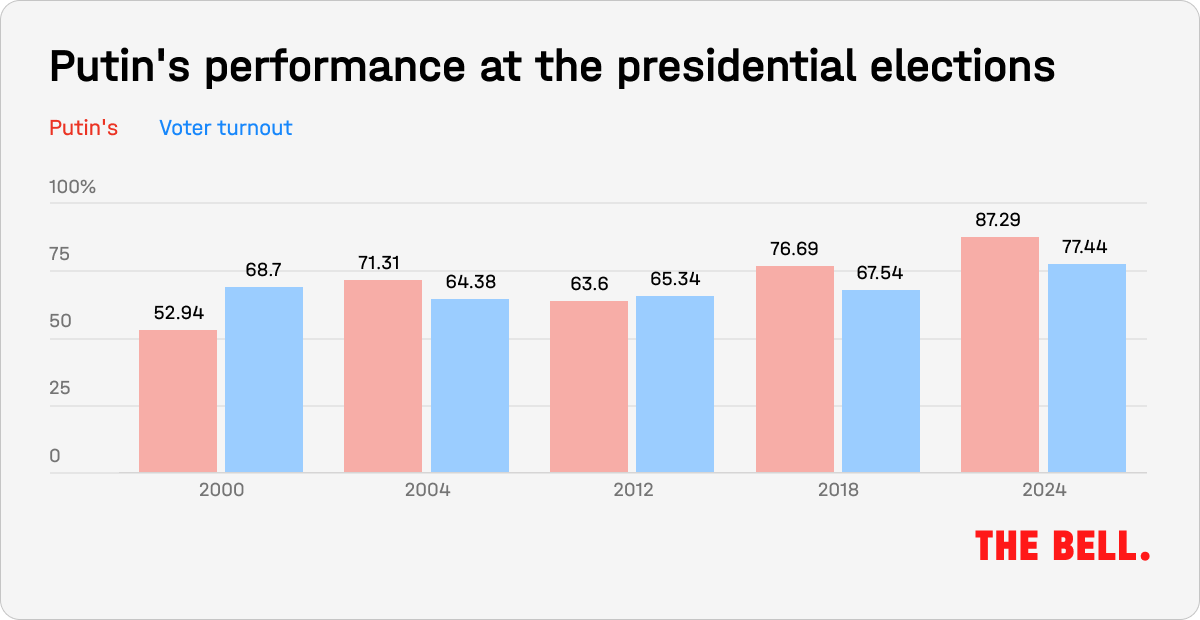
The official election result is already out — Vladimir Putin secured 87.28% on a turnout of 77.44%. Both those numbers are record highs since the collapse of the Soviet Union. And both are about 10 percentage points up on 2018 (when Putin polled 76.8% on a 67% turnout). This suggests that the Kremlin’s political managers were tasked with delivering a significant increase in Putin’s popularity. That in itself is not surprising: in the current circumstances an autocrat needs to demonstrate how his people have rallied around the flag.
Initial research by journalists and independent experts suggests the vote could have been the most heavily falsified in the history of post-Soviet Russia. Analysis by IStories and Ivan Shukshin, a researcher and activist with the Golos vote monitoring NGO, estimated that around 22 million of the 76.3 million votes cast for Putin were “anomalous.” In other words, almost a third of Putin’s official tally could have been false.
Their methodology is based on analyzing the turnout and vote shares at individual polling stations, using the central election commission’s official data. Districts with higher turnouts also have larger vote shares for Putin — a fact which suggests ballot-stuffing since the two shouldn’t be strongly correlated. IStories and Shukshin didn’t include results in Moscow, where online voting makes the analysis trickier. A third report by Novaya Gazeta Europe said as many as 31.6 million votes — almost half of Putin’s total — could have been fake.
Many experienced observers of Russian politics (1,2) believe that election organizers in provincial Russia “overdid it” this time round. Most pre-election leaks of the Kremlin’s vote strategy featured more modest targets. In spring 2023, for instance, RBC wrote that the Kremlin wanted to secure 75% of the vote on a 70% turnout. A few months later, Meduza wrote that regional authorities were advised that they should secure at least 80% of the vote for Putin. The final pre-election opinion polls conducted by state pollster VTsIOM (which also represent indirect instructions to regional election officials for polling day) showed Putin’s result was at the initial target level of 75%.
The record result places Putin firmly among his fellow autocrats. In free democratic elections, it’s a rare anomaly for a candidate to poll even at 60-70%. Only once, in extreme circumstances, have we seen more than 80% in a democratic country — a huge protest vote that gave France’s Jacques Chirac 82% in a presidential run-off against Jean-Marie le Pen in 2002, the BBC reported. In Russian history, Putin still has something to aim for if we look back to Soviet times. The turnout in 2024 was slightly higher than when Boris Yeltsin was voted president of the Russian Soviet Federative Socialist Republic in 1991, but there is still some way to go to match the Stalin era of 100% turnout in votes to appoint new deputies.
Since Putin was re-elected in 2018, voting in Russia has become even less transparent, and offered greater opportunities for fraud. Remote electronic voting was conducted in 29 Russian regions. Some 70% of the 4.7 million voters registered to vote online apparently cast their votes on the first of the three-day poll. Monitoring violations at physical polling stations is an almost impossible task. The Central Electoral Commission stopped broadcasting live footage from monitoring cameras in polling stations after the pictures from 2018 had depicted numerous violations and led observers to conclude that the scale of ballot stuffing was so great that the real result could not be determined in at least 11 regions.
The 2024 poll also differed from Putin’s two most recent victories in the selection of candidates who ran against the Kremlin leader. In 2012, political strategists allowed businessman Mikhail Prokhorov to stand, proposing that Russia’s marginal liberal opposition would consolidate around him. And in 2018, that same role went to TV presenter Ksenia Sobchak. But this time round there was no acceptable liberal candidate. Even the little-known politician Boris Nadezhdin, who timidly spoke out against the war in Ukraine, was denied registration. On the ballot were only Putin’s “rivals” from the systemic opposition parties. All of them have been equally supportive of Russia’s repressive turn, backing various crackdown measures that have come before the State Duma in recent years.
The extras in the 2024 race — Communist Nikolai Kharitonov, Vladislav Davankov of New People, and Leonid Slutsky of the LDPR — polled less than 12% combined. That’s slightly less than communist candidate Pavel Grudinin managed on his own in 2018. The 75-year-old Kharitonov’s 4.3% was better than the youthful Davankov’s 3.8%, while Slutsky, the unsuccessful heir to charismatic populist Vladimir Zhirinovsky, trailed in last with 3.2%.
Despite intimidation by the authorities, many Russians went to polling stations across the country and abroad at noon on 17 March as part of the Noon Against Putin protest, which was conceived as one of the few safe ways for Russians to voice their dissent. After all, it is hard to punish people for going to a polling station on election day and queueing.
The protest was the brainchild of Maxim Reznik, a former member of St. Petersburg’s legislative assembly, and it was endorsed by Alexei Navalny. After the opposition politician was murdered in a Russian penal colony, his supporters and other Kremlin opponents urged Russians to take part in Midday Against Putin.
This time round the last day of the election fell on the end of Shrovetide, and the powers that be tried to take advantage of it. For example, in Tomsk, they organized Shrovetide festivities at one of the polling stations to generate “hustle and bustle.” In Arkhangelsk, local restaurants were forced to cook pancakes for free distribution at the polling stations. Festivities were also organized, for example, in Moscow Region, Perm, Chuvashia, Murmansk Region, and Kamchatka.
Investigative journalist Andrei Zakharov quoted an anonymous agitator who, along with his colleagues, was tasked with “inviting people to a Shrovetide party in a park while also suggesting they take their [internal] passports with them in order to vote. It’s not far to the polling station.”
Those who decided to take part in the noonday protest were intimidated by fake mailings. As early as 13 March, some users in Russia received messages purporting to be from Navalny supporters postponing the Noon Against Putin protest to late Sunday. On Saturday, some Muscovites got messages accusing them of supporting “extremist ideas” and demands to vote “without waiting in line.”
There was also intimidation from actual law enforcers. The Moscow Prosecutor’s Office issued three warnings about the danger of the protest and possible criminal chargers against the protesters.
In spite of this, people in Russia and around the world came to the polling stations at noon on 17 March.
The huge queues abroad attracted a lot of media attention. Just look at the number of people at [Russia’s] diplomatic missions in Almaty and Bishkek. In European countries, people stood in line for many hours.
The long waits at polling stations abroad were sometimes caused by the deliberately slow work of the election commissions. For example, in Riga, voters were let in two at a time, although there were six voting booths and four polling station officials available. Voting was also delayed because many embassies and consulates banned cell phones, searched voters as they entered, and made them temporarily surrender their belongings.
In Russia, people were also searched in many polling places after dozens of incidents of attempted arson and spoiling ballot boxes with paint (the handiwork of phone scammers) took place. “First, two policemen search the bags [of voters] very thoroughly outside. I even had to show them my deodorant stick,” a reader of Dmitry Kolezev’s Telegram channel from Moscow wrote.
Due to the [long] queues in Riga, Vienna and Yerevan, for example, the polls were kept open for at least another hour [after they were to have been closed]. But in Berlin, the embassy was immediately closed, prompting the people gathered there to stage an impromptu protest. One of the staffers at the diplomatic mission danced a little jig as they shouted “Shame!”
The queues were de facto protest rallies. People lined up outside polling stations in Moscow, St. Petersburg, Arkhangelsk, and Sochi. Officials tried to persuade them to cast their votes on electronic terminals — it is easier to rig the vote that way — but people took paper ballots and either voted for someone other than Putin or defaced them by writing on them such things as “Love is stronger than hate,” or “You have the blood of Ukrainians on your hands, scumbag” (the latter remark was addressed to Vladimir Putin).
As it turned out, nobody interfered with the queues; the police were not violent and did not detain anyone. Most of the detentions that did occur were of independent observers and members of elections commissions who had tried to prevent violations. According to OVD Info, 17 March was “relatively calm.”
The election’s outcome surprised no one in a country where wartime censorship has virtually been introduced. Vladimir Putin took more than 87% of the vote according to the official count — a result almost like that of Central Asian dictators, and greater than that of [Belarusian dictator Alexander] Lukashenko.
The main outcome was that many Russians took advantage of the procedure as one of the few remaining opportunities to safely speak out against Putin and his policies. And they saw that they were not alone.
In a third video, another man detained by law enforcement agents identified himself as Rajab Alizadeh.
A man off camera asked him: “When you fled from Moscow, you had weapons. Where did you throw them? There or here?”
Alizadeh, whose face and shirt were covered in blood and whose head was wrapped in medical gauze, said “somewhere along the road,” but could not recall exactly where he and his accomplices left their weapons.
An unverified graphic video shared online showed what was said to be Alizadeh lying face down on the ground as Russian law enforcement agents cut off his ear, which, if confirmed, could explain why the man’s head was wrapped in bandages in the interrogation video.
Alexandra Karaseva. Photo from social media account via Bumaga
During the three days of the [presidential] election in Russia, the Interior Ministry reports, twenty-one criminal cases were launched over attempts to set fires at polling stations or spoil ballots with brilliant green dye solution. Twenty-one-year-old student Alexandra Karaseva was remanded in custody to a pretrial detention centre after being arraigned on just such charges.
According to police investigators, on 15 March, Karaseva threw a Molotov cocktail at a polling station poster on the porch of School No. 358. No one was injured.
Bumaga explored what we know about Alexandra Karaseva, why she might have committed the arson attack, and what defendants charged with obstructing the work of polling places face.
In St. Petersburg, 21-year-old Alexandra Karaseva was remanded in custody to a pretrial detention centre. Investigators allege that she threw a Molotov cocktail at a polling station
Around three p.m. on the first day of voting, 15 March, a young woman ran up to the porch of School No. 358, in Petersburg’s Moscow District, and threw a Molotov cocktail at the wall, as seen in surveillance footage.
The school housed two election precincts—No. 1395 and No. 1396. The attempted arson only left traces of soot on the upper part of the information sign bearing the elections logo and on the wall of the school. No one was injured and the operation of the polling station was unaffected.
The aftermath of the 15 March arson attempt on the porch of School No. 358 in Petersburg. Photo courtesy of Bumaga
The young woman tried to run away but was immediately detained by one of the witnesses. After the incident, the media and the municipalcourts press service revealed the suspect’s identity: 21-year-old Alexandra Karaseva. According to the media, the young woman told the police that she had been promised payment for the arson, and that she had received the assignment from a certain “Ukrainian Telegram channel.”
Karaseva was charged with “obstructing the exercise of voting rights” and faces up to five years in prison if convicted. According to police investigators, unidentified persons had inveigled Karaseva “into a criminal plan” over the telephone. The arson attack’s goal was to disrupt the work of polling stations, the investigators claim.
The next day, 16 March, Petersburg’s Moscow District Court remanded Karaseva in custody to a pretrial detention centre. The young woman had pleaded guilty, but asked to be placed under house arrest.
She danced, wasn’t interested in politics, and had financial troubles: how Alexandra Karaseva is described by her acquaintances
Karaseva had been dancing from the age of five, and at the university she was actively involved in extracurricular activities, her acquaintances told Bumaga. In the autumn of 2023, [the university’s website]mentioned her as a fourth-year student who was a choreographer for the university’s dance team. She worked on a performance celebrating the fifth anniversary of the National Guard department at the Military Institute’s Logistics Academy.
“We worked together on a student talent show. She was responsible for staging the team’s dance numbers. She led a very active lifestyle and was involved in extracurricular activities. She cared about people who needed help. She used to work as a choreographer for children’s dance groups,” said Alisa, a female university acquaintance of Karaseva’s.
While studying at the University of Economics, Karaseva lived at the Inter-University Student Campus (ISC) near the Park Pobedy metro station and competed in the 2023 Miss and Mister ISC contest. According to another university acquaintance of Karaseva’s (who wished to remain anonymous), Karaseva was often short of money, so she took various part-time jobs.
“Frankly, this situation has been a huge shock to me,” said the acquaintance. “Never in my life would I have believed that Sasha could do such a thing. As long as I have known her, she never raised the topic of politics. I’m pretty sure she didn’t do it out of choice. It was probably out of desperation. She was either conned or had money problems.
A few months ago, Karaseva had transferred to the Herzen Russian State Pedagogical University, according to Channel 78. One of Karaseva’s acquaintances also told Bumaga that Karaseva was no longer enrolled at the University of Economics. Officials at the Herzen toldFontanka.ru that a young woman with the same name had recently been expelled from the pedagogical university for skipping classes.
Karaseva’s immediate family members ignored our requests to comment on the story.
Over three day, twenty-one criminal cases were launched in Russia for arson attempts and the pouring of brilliant green dye solution on ballots at polling stations. Some suspects report they were promised payment
Sixty-one criminal cases relating to the presidential election were launched in Russia over the three days of voting, First Deputy Interior Minister Alexander Gorovoy reported on the evening of 17 March. Twenty-one of these cases involved arson attempts at polling stations and attempts to spoil ballot boxes with brilliant green dye solution: they were charged as “obstruction of voting rights.”
In addition to Karaseva, people in other regions of Russia also brought Molotov cocktails and brilliant green dye solution to polling stations. Most cases were recorded on the first day of voting. Here are just a few of them:
A criminal case was launched against a 58-year-old resident of Kogalym who set fire to her ballot and ballot box at a polling station.
Charges were filed against a resident of Volzhsky, in the Volgograd Region, who poured brilliant green dye solution on a ballot box and the ballots in it. The woman herself said that she had been offered a “monetary reward of thirty [thousand rubles]” for spoiling the ballot box.
20-year-old Alina Nevmyanova, who poured green paint into a ballot box at a polling station in Moscow on 15 March 15, was remanded in custody to a pretrial detention centre. According to Baza, the young woman “had received instructions from someone over the phone.”
A Moscow pensioner by the name of Petrukhina, who suffers from cancer and who, according to Mediazona, set fire to voting booths, was placed under house arrest.
In most cases, the suspects in these criminal cases have repented and admitted their guilt. In some cases, they reported that they did it for the money, while eyewitnesses claim that the defendants were allegedly instructed by phone before attempting arson or spoiling ballots with brilliant green dye solution. The details in many of the incidents are still emerging, however.
No Ukrainian organizations have claimed responsibility for the incidents that took place during the Russian elections.
Since the beginning of the full-scale war in Ukraine, acts of sabotage in Russia have been widespread, and they are often committed for payment or after conversations with phone scammers. In Petersburg, they most often have involved arson attacks on military infrastructures, such as military enlistment offices and railroad relay boxes. According to police investigators, the relay box arsonists have usually been hired by persons unknown through Telegram channels for job seekers. For example, the first person convicted of sabotage in Petersburg, Vyacheslav Zaitsev, who was eighteen at the time of his arrest, agreed to destroy a relay box on the railroad in return for ten thousand rubles [approx. 100 euros]. He was sentenced to eight years in prison.
Zhumagul Kurbanova, a 66-year-old employee of a Pyaterochka convenience store in Petersburg, told police officers that she had received a phone call from a certain “Alexander Fyodorovich,” who convinced her to set fire to the door of the military enlistment office on English Avenue, as there were allegedly fraudsters operating there. Kurbanova was sentenced to ten years in prison.
The State Duma has proposed increasing the punishment for attempts to disrupt elections to eight years in prison. Currently, people who torch and vandalize ballot boxes face a maximum of five years in prison
Shortly after a dozen cases of inept “sabotage” at polling stations were recored in Russia on the first day of the election, State Duma deputies proposed toughening the punishment for attempting to disrupt elections by “generally dangerous means” by up to eight years’ imprisonment. Yana Lantratova (A Just Russia–For Truth), a member of the Duma committee investigating foreign interference in Russia’s internal affairs, reported that a bill to this effect was being drafted.
Currently, Article 141.2 of the Russian Federal Criminal Code—”obstructing the exercise of voting rights or the work of election commissions by conspiring to influence the outcome of the vote”—carries a maximum sentence of five years’ imprisonment. Attempts to set fire to polling stations or pour brilliant green dye solution on ballot boxes most often triggered charges of violating this particular article.
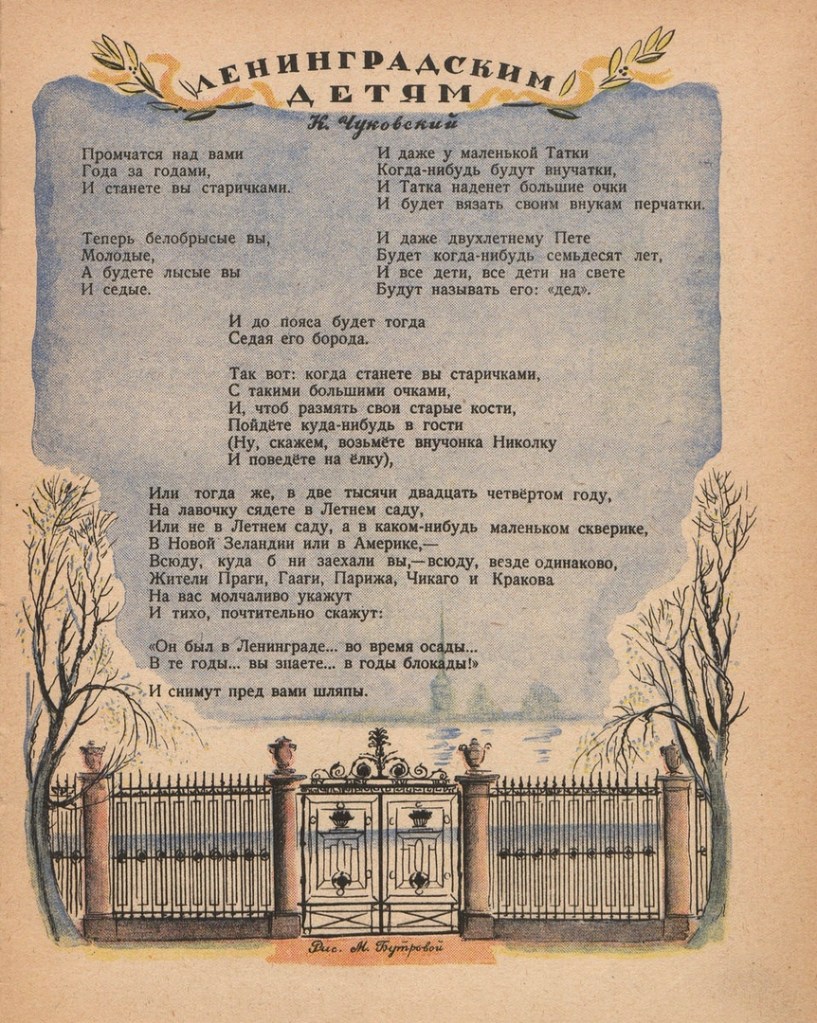
Kornei Chukovsky’s poem “To the Children of Leningrad” (1944), as published in the children’s magazine Murzilka in 1945. Source: dinasovkova (LiveJournal)
The years will speed past you, Year after year after year, And you’ll become old women and men.
Now you are towheaded, Now you are young, But then you shall be bald And grey.
And even little Tatka Shall someday have grandkids, And Tatka will put on big glasses And knit mittens for her grandchildren.
And even two-year-old Petya Will someday be seventy years old, And all the children, all the children in the world Will call him “old man.”
And his grey beard will Hang down to his waist.
Now, when you’re old women and men, Wearing those big glasses, To stretch your old bones You’ll go on an outing. (You’ll pick up your grandson Nikolka, say, And take him to a New Year’s party.)
Or, in that very same year, two thousand twenty-four, You’ll sit on a bench in the Summer Garden. Or not in the Summer Garden, but in some little square In New Zealand or America. It will be the same everywhere, wherever you go — Prague, The Hague, Paris, Chicago, Krakow. The residents will silently point at you And quietly, respectfully say:
“They were in Leningrad during the Blockade, Back in those days, you know, in the years of the Siege.”
And they’ll doff their hats to you.
1944
Translated by the Russian Reader. Thanks to Alexander Voitsekhovsky and Svetlana Voskoboinikova for the heads-up.
Actor Alexander Sushchik recites Kornei Chukovsky’s “To the Children of Leningrad”
Few people in Russia see the March 2024 presidential election as a real opportunity to change the country’s leadership. Voting in Russian elections has not been free and fair in recent times, and since the invasion Ukraine, the Russian regime has tightened the screws dramatically. There is no freedom of speech, people are persecuted for making anti-war statements, many opposition leaders and activists are in prison, and hundreds of thousands of people have fled Russia.
In January [2024], however, thousands of people unexpectedly showed up to sign petitions supporting the presidential candidacy of Boris Nadezhdin, a former State Duma deputy who entered politics in the 1990s. Nadezhdin is running under the slogan “End the special military operation.” Many people view endorsing Nadezhdin as a legal opportunity to voice their anti-war sentiments. Standing in long queues at signature collection points, people said they had come to see other people who thought like they did and voiced hope for change.
Their conversations are featured in Nadezhdin’s Queue, a film in Radio Svoboda’s documentary project “Signs of Life.”
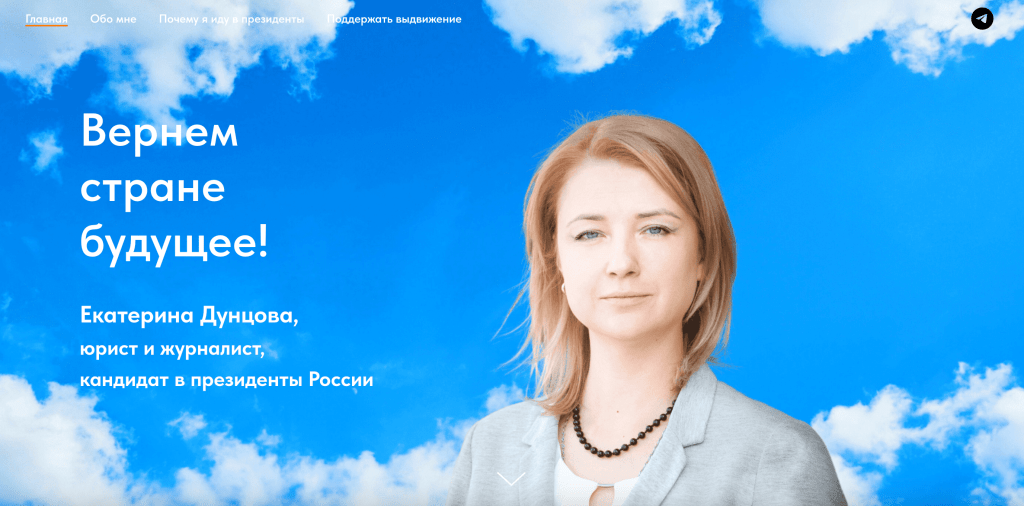
Journalist and politician Yekaterina Duntsova, whose candidacy in the upcoming presidential election was rejected by the Russian Central Election Commission (the Russian Supreme Court later upheld this decision), released a New Year’s address on Instagram.
“I promise you that I will do everything that depends on me to return our country’s life to a normal direction without special operations and political crackdowns, with a government accountable to us that will work to grow the economy and improve the well-being of ordinary families,” she said, wishing that 2024 would bring Russians “self-confidence, long-awaited peace, and more basic human happiness.”
Duntsova said that the New Year is “when we live in peace with ourselves and our neighbors,” and people who are dear to us are with us, and not “somewhere far away, risking their lives performing missions whose purpose cannot be explained to us.”
Duntzova also promised that the new political party she announced earlier would be “an association of people who just want to live peacefully.”
Source: Deutsche Welle Russian Service. Translated by the Russian Reader. This post was made possible by a generous donation from Sumanth Gopinath.
On 27 December 2023, the Supreme Court of the Russian Federation dismissed the suit filed by Yekaterina Duntsova, a journalist from Rzhev, against the Russian Central Election Commission (CEC), which had refused to register Duntsova’s initiative group for collecting signatures in support of her run as an independent candidate for the Russian presidency.
Duntsova was thus practically left with no chance to run in next year’s presidential elections as an independent. DW has compiled all the most important facts we know about her.
Ekaterina Duntsova is forty years old. She was born in Krasnoyarsk. She graduated from high school in Rzhev, Tver Region. She has two university degrees, in law and journalism. Duntsova studied law at Tver State University and also studied directing at the St. Petersburg State Institute of Cinema and Television. Russian state media note that she studied at both universities by correspondence.
Duntsova works as a journalist and is the coordinator of the Sova (“Owl”) volunteer search and rescue team in Rzhev. On the Web, many people refer to her as “radio operator Kat” — that’s Duntzova’s call sign on the team. Many liberal internet users have compared her with ex-Belarusian presidential candidate Svetlana Tikhanovskaya. State media have dubbed Duntsova “the fugitive oligarch Mikhail Khodorkovsky’s pet project.”
In 2003, Duntsova worked for about a year at the Rzhev municipal television company, then for many years headed the school television studio Friday the 13th and was editor-in-chief at RIT Independent Studio, a television company founded in 2003 by Duntsova’s husband Roman Nagoryansky. RIT closed in 2022. Duntsova has three children: two daughters and a son. The eldest daughter is studying in Tokyo. Duntsova and her husband separated in 2021.
In 2014, Duntsova ran as an independent for a seat in the sixth Rzhev City Duma but failed to win. Duntsova served in the seventh Rzhev City Duma, which sat between 2019 and 2022.
How Duntsova announced her run for the Russian presidency
On 16 November 2023, Duntsova announced on VKontakte that she would run as a candidate in the Russian presidential election and unveiled her campaign website, duntsova2024.ru. At the time of her nomination, she was the only woman to declare her desire to compete for the Russian presidency.
Duntsova’s candidacy was supported by Our Headquarters, a project created by the staff of Ark, a support group for Russians who have left the country over the war with Ukraine (in cooperation with the Russian Anti-War Committee). Posts about Duntsova’s nomination went out on many Telegram channels.
Duntsova explained her decision to run for president by arguing that “for the last ten years the country has been moving in the wrong direction: we have been pursuing a policy not of growth but of self-destruction.” Duntsova said she favors an end to the war in Ukraine, democratic reforms, and the release of political prisoners, particularly Alexei Navalny. “We have to abolish all inhumane laws and restore relations with the outside world. We have to change budget priorities by spending money on improving the lives of citizens, not on new tanks,” she noted.
“Why Yekaterina Duntsova was not allowed to run in the election,” Deutsche Welle Russian Service, 23 December 2023
At the same time, the journalist was cautious in her comments about Russia’s invasion of Ukraine. “Unfortunately, I cannot afford to delve deeply into this topic while I am in Russia,” she said. In order to remain on the right side of the law, she said that she would refer to the fighting in Ukraine as the “special military operation.” For the same reason, Duntsova declined to comment on the fate of the annexed territories in a future possible peace deal between Russia and Ukraine.
And yet, Duntsova argued that Russians should shed their “collective guilt complex.” She also avoided direct criticism of Vladimir Putin, stressing that she did not want to get personal, adding, however, that “it is possible to criticize the policies of the current government, it is possible to criticize certain laws and decisions made.”
Duntsova’s nomination campaign
On November 20, Duntsova was summoned to the prosecutor’s office in Rzhev to discuss the social media post about her intentions to run for the Russian presidency. “They asked what I thought about the [special military operation]. I invoked Article 51 of the Russian Constitution [which stipulates that no one is obliged to give evidence against themselves]. Apparently, they also wanted to find whether my intentions were real,” the journalist said at the time in a conversation with DW. In early December, Duntsova reported that VTB Bank had blocked transfers to her account after she appealed to supporters to back her campaign financially.
On December 20, Duntsova submitted the paperwork to the CEC to register her initiative group, which had to have at least 500 people. As an independent candidate, she also needed to gather 300,000 signatures in at least forty regions of the Russian Federation. The Central Election Commission had to review the package of documents and make a decision within five days. There were no grounds for refusing to register the initiative group, Duntsova argued.
However, on December 23, the CEC did not register the group, claiming that it had uncovered more than one hundred errors in Duntsova’s paperwork. As an example, it cited a document in which the patronymic “Valeryevna” had been written “Valerievna.” In addition, the CEC claimed that the notary who certified the documents, in particular, erroneously reported the [internal] passport number of the organizer of the initiative group’s meeting. Earlier, inspectors from Russian Justice Ministry paid this notary a visit.
On December 25, Duntsova appealed the CEC’s refusal to allow her to collect signatures in support of her campaign for the Russian presidency by filing suit with the Supreme Court. According to Duntsova, the CEC supported its arguments “solely with an internal memo. The law does not stipulate the use of such a document in principle, so it cannot be used as the basis for the decision.”
On December 27, the Russian Supreme Court dismissed the journalist’s lawsuit against the CEC, thus making it practically impossible for Duntsova to register as a candidate for the presidential election. Theoretically, she could ran as some party’s candidate. Duntsova has already called on the Yabloko Party to hold a congress and nominate her as their presidential candidate. The party responded that they do not nominate “random individuals about whom nothing is known.”
Duntsova said she intends to consider nominations from other parties as well. She also declared her plans to create her own political party: “The party I propose to create is not the Yekaterina Duntsova party. It will be the party of all those who are in favor of peace, freedom and democracy. My goal is to launch our self-organization [sic], which will be built around many new faces, around people who share our views. In the near future we will publish a program and work on it together.” Earlier, the journalist also spoke about her willingness to join forces with presidential contender Boris Nadezhdin.
Whose candidates have been nominated to run in the presidential election
The presidential election in Russia will be held 15–17 March 2024. The incumbent head of state Vladimir Putin is running as an independent. The Liberal Democratic Party of Russia (LDPR) nominated its leader Leonid Slutsky as a candidate for the highest state office. The Communist Party of the Russian Federation (CPRF) nominated Nikolai Kharitonov, while Civic Initiative nominated Moscow Region MP Boris Nadezhdin, and New People nominated State Duma deputy speaker Vladislav Davankov.
DW News [in Russian], 23 December 2023. The anchor interviews Yekaterina Duntsova live on air, starting at 15:44
The conservative Russian All-People’s Union decided to nominate its leader Sergei Baburin as a candidate in the upcoming presidential election. In addition, a meeting was held in Moscow to nominate Igor Strelkov (Girkin), a reserve FSB colonel and former “defense minister” of the Donetsk separatists, who has been in pretrial detention since July 2023 on charges of calling for extremist activity. Strelkov’s initiative group gathered 566 signatures from nomination meeting attendees, but the notaries did not arrive to certify them.
Independent Russian presidential candidate Yekaterina Duntsova will not be permitted to appear on the ballot in the March 2024 vote after the Central Election Commission (CEC) rejected her nomination documents.
Duntsova, 40, a journalist and local politician from the Tver region northwest of Moscow, announced her bid for the presidency in November on a pro-peace, pro-democracy platform.
This week, she secured the endorsement of an initiative group of more than 500 supporters as is required for candidates not running as part of a political party.
At a meeting Saturday, the Central Election Commission (CEC) rejected her documents, saying it found over 100 typos and other errors, the Ostorozhno Novosti Telegram news channel reported.
“We have carefully studied the documents, and we have the impression that they were filled out in haste without complying with legal standards,” the BBC’s Russian service quoted CEC member Yevgeny Shevchenko as saying at the commission’s meeting.
If the CEC had accepted her documents, she would have then needed to collect 300,000 unique voter signatures from at least 40 regions of Russia to be able to appear on the ballot.
Following the meeting, Duntsova said she plans to appeal the commission’s decision in court and intends to ask the liberal Yabloko party to nominate her as a candidate.
“I want us all to believe that we will be able to take another chance. Don’t lose faith, don’t lose hope,” she said.
Duntsova’s campaign has reported several instances of pressure since she announced her bid for the presidency.
She was summoned to the prosecutor’s office to discuss her campaign and attitude toward Russia’s actions in Ukraine shortly after announcing her campaign.
One of Duntsova’s supporters was detained in the Siberian city of Krasnoyarsk after returning from the nomination meeting, according to women’s activist group Myagkaya Sila (Soft Power). The supporter, who is also a member of Myagkaya Sila, was reportedly accused of falsely filing a complaint against a police officer.
She has also faced speculation that she could be a Kremlin-endorsed spoiler candidate.
The state-run RIA Novosti news agency claimed this week without evidence that Duntsova had the financial backing of Mikhail Khodorkovsky, a former oligarch turned exiled Kremlin critic.
President Vladimir Putin, 71, is expected to handily win re-election to a fifth term — keeping him in power until at least 2030 — in the March 2024 vote after the elimination of virtually all opposition.
“Yekaterina Sergeyevna, you are a young woman, you still have everything ahead of you. Any minus can always be turned into a plus. Any experience is still experience,” CEC chief Ella Pamfilova told Duntsova at the end of Saturday’s meeting.
Despicable but predictable. My heartfelt thanks to Mr. Shuvalov for finally having the guts to admit what has been obvious for years: that the Russian elites and mostly nonexistent Russian middle class are sick off their asses on catching up with and overtaking the specter of “America.” So, which side never stopped fighting the Cold War? The greedy mid-level KGB officers who have been running Russia for the last eighteen years. If you didn’t know that already, it means you’ve been looking in the wrong direction all this time. And to think this is what the “struggle against imperialism” has come to. Oh, and the VTsIOM “polling data” about “happiness,” cited at the end of this article, is total bullshit, yet another smelly burp from the well-funded belly of Russia’s rampant pollocracy. TRR
Screenshot of the alleged slogan of the 19th World Festival of Youth and Students, currently underway in Sochi. Courtesy of the festival
Shuvalov: Russia’s Goal Is For Russians to Be Happier than Americans Fontanka.ru
October 18, 2017
By 2024, industrious Russians with higher educations will be able to catch up with and overtake abstract [sic] Americans in terms of happiness. Such were the horizons painted by First Deputy Prime Minister Igor Shuvalov at the 19th World Festival of Youth and Students on October 18 in Sochi.
“Goal number one is that, when the next political cycle [sic] is completed, in 2024, anyone who has a basic [sic] higher education and the ability to work would feel happier than in the United States,” said Shuvalov, according to Lenta.ru, as cited by RIA Novosti.
A presidential election is scheduled for 2024.
According to the Monitoring Center at RANEPA’s Institute of Social Sciences, nearly 45% of working Russians do not understand the purpose and meaning of the government’s economic policies. Only 47% of Russians have a sense of the government’s actions vis-à–vis the economy.
In August, the All-Russian Center for the Study of Public Opinion (VTsIOM) published the results of a poll, according to which approximately 84% of Russians consider themselves happy.
Earlier, in April, according to VTsIOM, the percentage of Russians who felt happy reached its highest level since 1990, amounting to 85%.
Translated by the Russian Reader. Thanks to Comrade Koganzon for the heads-up
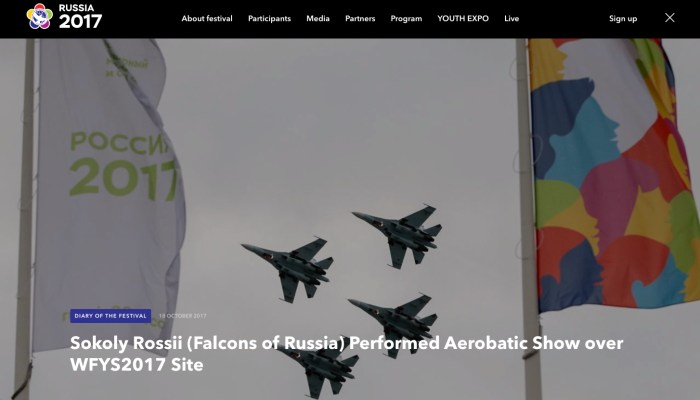
Screenshot of the homepage of the 19th World Festival of Youth and Students, currently underway in Sochi, Russia.