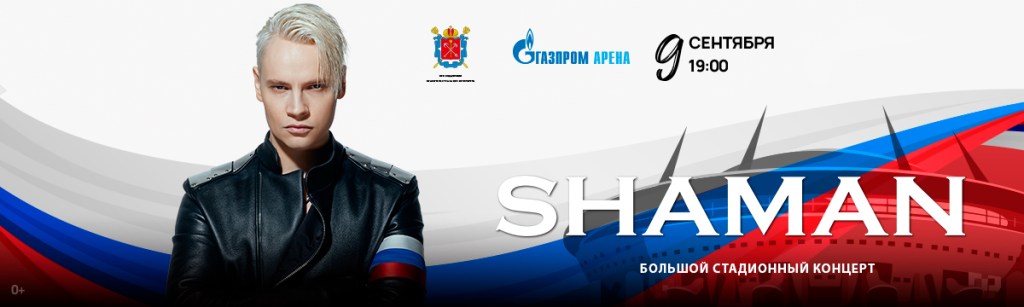
This ad for a “big stadium concert” by the Russian nationalist pop singer Shaman, scheduled for 7 p.m., September 9, at Petersburg’s Gazprom Arena, showed up this morning (for the second or third time in the last mont) in the weekly email newsletter I get from Bileter.ru, a Russian online retail ticket vendor. The aesthetic here is both strikingly fascistic/nationalistic and pointedly un-Russian. I would say it’s almost American in its inspiration, if I didn’t know better. ||| TRR
This showed up in my mailbox today too:
За последние две недели в редакции произошли изменения. У нас теперь новый руководитель редакции, а потому скоро вы ощутите изменения, которые make Inc. great again.
Here’s my translation:
There have been changes to [our] editorial board over the past two weeks. We have a new editorial director now, and so you will soon feel the changes that [will?] make Inc. great again.
These days, all “progressive” Russians are fluent in English, supposedly, and this is often how they signal their “progressive” values to each other: by shouting out their true reactionary colors in Rusglish.
In this case, the progressive reactionaries hale from Inc. Russia, “a magazine for entrepreneurs [that] focuses on small and medium-sized businesses, advanced technologies, and the people behind it all.” Founded in the US in 1979, the Russian edition has been in existence since 2016.
The passage that I quoted and translated, above, led off Inc. Russia‘s weekly email newsletter.
Immediately after Russia’s brutal, unprovoked invasion of Ukraine, the Russian Inc.ers were openly dismayed by the sudden turn of events in their otherwise entrepreneurially progressive country—without, however, ever going so far as to oppose the war explicitly. This dismay and confusion gradually and visibly diminished as the war continued. Now, apparently, Inc. Russia has come full circle: they are determined to show that they and their readers live in nearly the best of all possible entrepreneurial worlds. They’ve definitively stopped paying any mind to their country’s breakneck plunge into fascism, much less to the war itself.
And yet the new realities occasionally puncture Russian Inc.‘s otherwise now-placid surface, as in this news item published on their website earlier today:
English to become optional in the subway
It may become option to duplicate information in subways in English. The Transport Ministry has published a law bill addressing the matter. The Moscow subway stopped duplicating [station] names back in 2021, while Nizhny Novgorod and Kazan do not plan to give up English until instructions are received.
As reported by Kommersant, the Transport Ministry has published a draft law on amendments to the orders regulating the “standard rules” for the use of subways, monorails, funiculars, and suspended cable cars.
Carriers are currently required to duplicate all information on diagrams, signs, inscriptions, and station announcements in English. The Transport Ministry proposes doing away with this obligation, leaving the decision to the regions.
The proposal was prompted by “numerous appeals from citizens and [regional governments], due to the considerable informational burden on passengers and taking into account the socio-political situation.”
Moscow’s Metro, Central Circle, and Monorail stopped announcing stations in English back in 2021, after a drop in the number of tourists due to the pandemic and “passenger complaints about additional information.”
Oleg Yaushev, director of the Nizhny Novgorod Metro, said that none of the city’s residents had complained about the English dubbing in the city’s subway, so the company does not plan to remove it.
“We installed this information system relatively recently and spent a lot of money on it. Why remove it now? Tourists who are native English speakers travel to the city. The language is widely spoken, and we welcome them. Of course, if there is a directive to remove everything and leave it only in Russian, we will comply. But it’s not worth freaking out about it,” he said.
Kazan’s Metroelectrotrans also expressed its willingness to execute the order, “if it is issued.” However, local residents there have also not petitioned the company to cancel the dubbing of station names in English.
Source: Inc. (Russia), 14 August 2023. Translated by the Russian Reader
Russian streaming service Amediateka (thanks to the good offices of sanctions busters HBO) keeps its viewers comfortably ensconced in an alternate reality dominated by the Great Satan’s pop culture:

The second season of the sports series “Winning Time: The Rise of the Lakers Dynasty” recounts the period between 1980 and 1984. It deals with the rivalry with the Boston Celtics, as well as with the personal lives of the players, which prove no less emotional and striking than their play on the court. Jerry Buss wants to get his sons involved in working with the Lakers, Magic Johnson learns to be a good father, and Larry Bird plunges into family squabbles. Won’t this prevent the lads from becoming NBA champions?
Source: Amediateka email newsletter, 14 August 2023. Translated by the Russian Reader
Finally, here is yet another reflection of the Russian petite bourgeoisie’s (and, hence, Russian officialdom’s) peculiar love-hate, cargo-cultish relationship with the “collective west” (i.e., the United States) and the English language.
This past weekend, reports Bumaga, local sporting enthusiasts took part in the Bubble Baba Challenge — 2023 [sic, in English], “an event held in the rapids of [the] Vuoksi River whereby contestants race in the water using sex dolls as flotation devices.” The event took place in Kiviniemi, aka Losevo, in the occupied Karelian Isthmus, approximately 60 miles north of Petersburg.
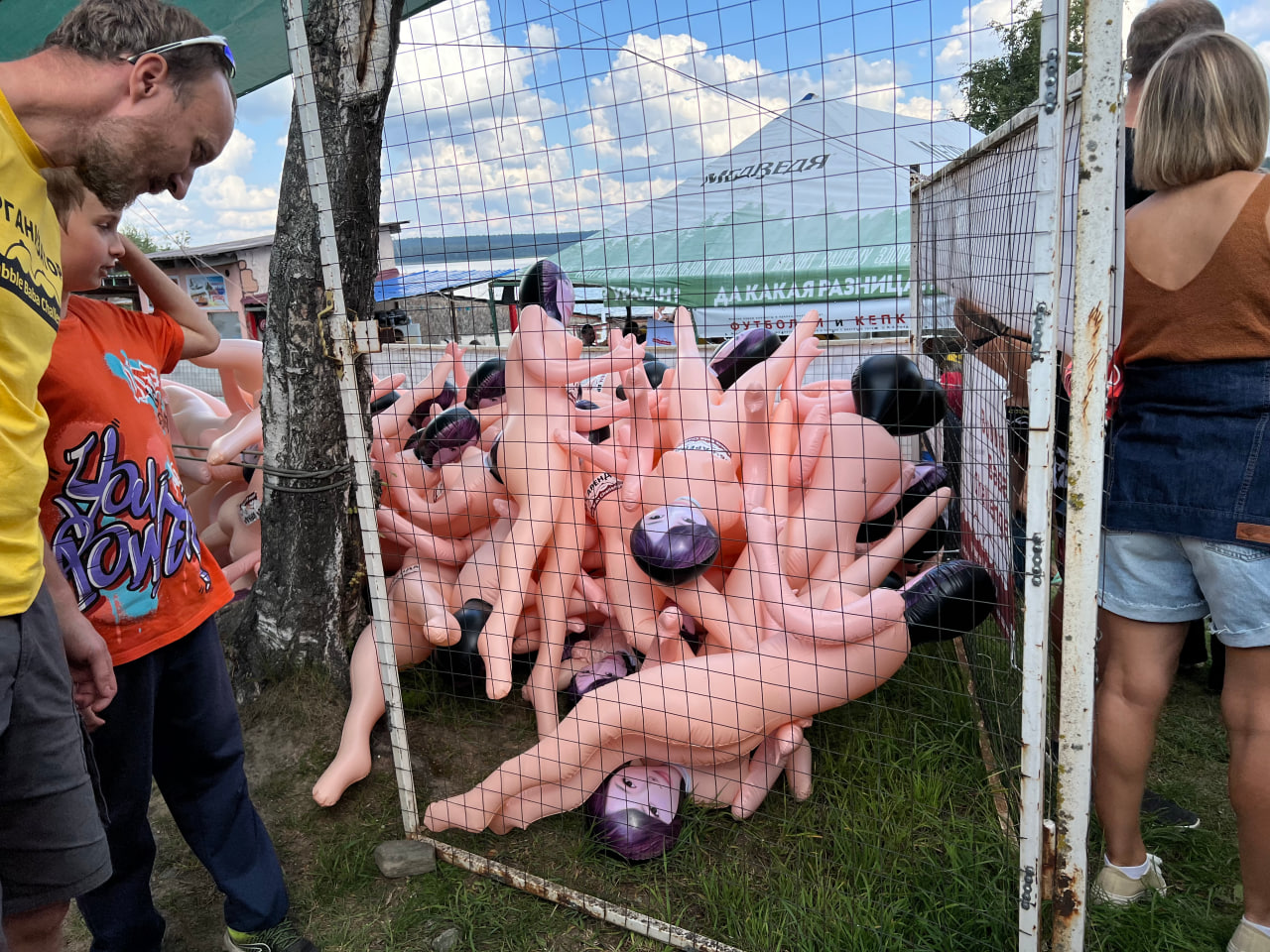
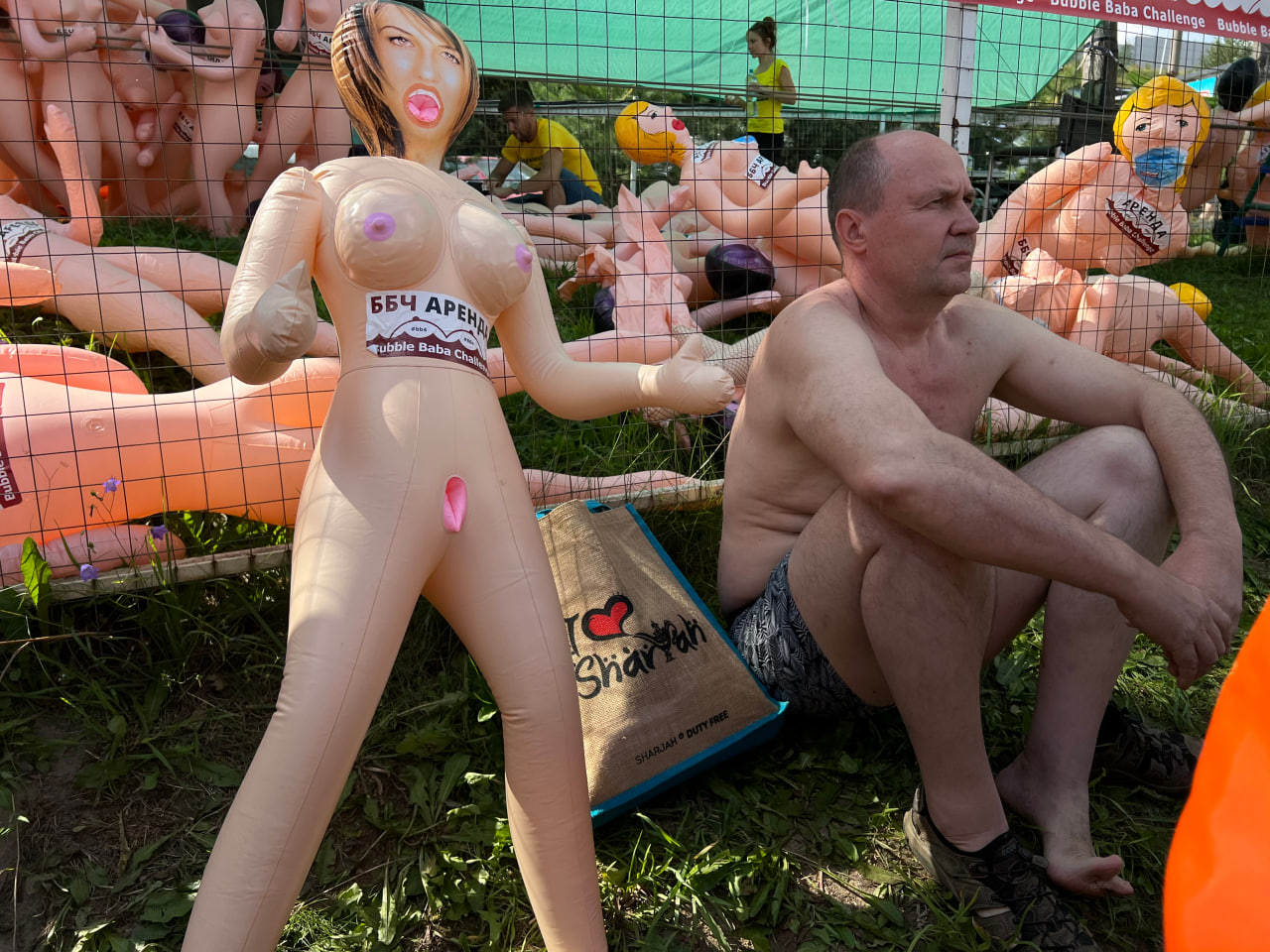



Photos by Pavel Daisi for Bumaga (@paperpaper_ru)
