Spinoff of the Legendary Zombie Franchise

Spinoff of the legendary zombie franchise

The world’s end kicks off not with explosions but with alarming news and eerie silence on the streets of Los Angeles. The world is going mad slowly, and Madison Clark (played by Kim Dickens of Gone Girl, House of Cards, and Treme), a school psychologist and mother raising two children, is the first to sense it.

Madison’s new husband, Travis Manawa (played by Cliff Curtis of Training Day, Avatar: The Way of Water, and Invincible), is a teacher trying to build a new life from the ruins of his old one, while also raising his son from a previous marriage. Their mundane problems fade into insignificance when the world order collapses and fear becomes commonplace.

Source: Amediateka email newsletter, 23 February 2026. Translated by the Russian Reader


“Victory will be ours” reads the banner on the Russian Embassy in Seoul. Source: Jintak Han/ZUMA/Picture Alliance

On Sunday, 22 February, a fifteen-meter-high banner in the colors of the Russian flag sporting the slogan “Victory will be ours” in Russian appeared on the Russian Embassy’s building in Seoul. The banner was unfurled ahead of the fourth anniversary of Russia’s full-scale war against Ukraine.

The South Korean Foreign Ministry “expressed concerns […] over the large banner,” according to the Yonhap News Agency. The ministry stressed that it could create “unnecessary tensions with South Korean citizens and other countries,” as it is regarded as an allusion to Russia’s war against Ukraine.

Russian Embassy refuses to take down banner

Despite the concerns raised by South Korea’s Foreign Ministry, the Russian Embassy has refused to remove the banner from its building. The banner was hung on the occasion of Diplomatic Workers Day and Defender of the Fatherland Day, according to the Foreign Ministry’s Telegram channel.

“The popular expression on the banner is familiar to all Russians. It is associated with our history, including the mobilization of the Soviet people for victory over Nazi Germany and other glorious chapters of Russian history,” embassy spokespeople underscored. They also claimed that the banner “promotes patriotic consolidation among Russians, and the historical connotations mentioned should not hurt anyone’s feelings.”

Source: Boris Frank, “Russian Embassy in Seoul unfurls ‘Victory will be ours’ banner,” Deutsche Welle Russian Service, 23 February 2026. Translated by the Russian Reader

Make (Blank) Great Again

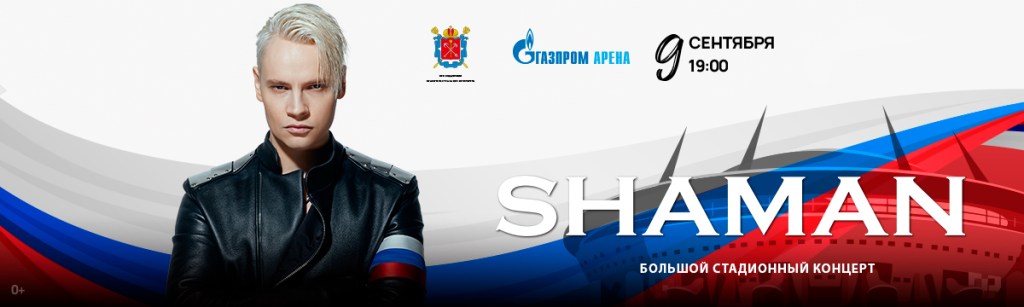
This ad for a “big stadium concert” by the Russian nationalist pop singer Shaman, scheduled for 7 p.m., September 9, at Petersburg’s Gazprom Arena, showed up this morning (for the second or third time in the last mont) in the weekly email newsletter I get from Bileter.ru, a Russian online retail ticket vendor. The aesthetic here is both strikingly fascistic/nationalistic and pointedly un-Russian. I would say it’s almost American in its inspiration, if I didn’t know better. ||| TRR


This showed up in my mailbox today too:

За последние две недели в редакции произошли изменения. У нас теперь новый руководитель редакции, а потому скоро вы ощутите изменения, которые make Inc. great again.

Here’s my translation:

There have been changes to [our] editorial board over the past two weeks. We have a new editorial director now, and so you will soon feel the changes that [will?] make Inc. great again.

These days, all “progressive” Russians are fluent in English, supposedly, and this is often how they signal their “progressive” values to each other: by shouting out their true reactionary colors in Rusglish.

In this case, the progressive reactionaries hale from Inc. Russia, “a magazine for entrepreneurs [that] focuses on small and medium-sized businesses, advanced technologies, and the people behind it all.” Founded in the US in 1979, the Russian edition has been in existence since 2016.

The passage that I quoted and translated, above, led off Inc. Russia‘s weekly email newsletter.

Immediately after Russia’s brutal, unprovoked invasion of Ukraine, the Russian Inc.ers were openly dismayed by the sudden turn of events in their otherwise entrepreneurially progressive country—without, however, ever going so far as to oppose the war explicitly. This dismay and confusion gradually and visibly diminished as the war continued. Now, apparently, Inc. Russia has come full circle: they are determined to show that they and their readers live in nearly the best of all possible entrepreneurial worlds. They’ve definitively stopped paying any mind to their country’s breakneck plunge into fascism, much less to the war itself.

And yet the new realities occasionally puncture Russian Inc.‘s otherwise now-placid surface, as in this news item published on their website earlier today:

English to become optional in the subway

It may become option to duplicate information in subways in English. The Transport Ministry has published a law bill addressing the matter. The Moscow subway stopped duplicating [station] names back in 2021, while Nizhny Novgorod and Kazan do not plan to give up English until instructions are received.

As reported by Kommersant, the Transport Ministry has published a draft law on amendments to the orders regulating the “standard rules” for the use of subways, monorails, funiculars, and suspended cable cars.

Carriers are currently required to duplicate all information on diagrams, signs, inscriptions, and station announcements in English. The Transport Ministry proposes doing away with this obligation, leaving the decision to the regions.

The proposal was prompted by “numerous appeals from citizens and [regional governments], due to the considerable informational burden on passengers and taking into account the socio-political situation.”

Moscow’s Metro, Central Circle, and Monorail stopped announcing stations in English back in 2021, after a drop in the number of tourists due to the pandemic and “passenger complaints about additional information.”

Oleg Yaushev, director of the Nizhny Novgorod Metro, said that none of the city’s residents had complained about the English dubbing in the city’s subway, so the company does not plan to remove it.

“We installed this information system relatively recently and spent a lot of money on it. Why remove it now? Tourists who are native English speakers travel to the city. The language is widely spoken, and we welcome them. Of course, if there is a directive to remove everything and leave it only in Russian, we will comply. But it’s not worth freaking out about it,” he said.

Kazan’s Metroelectrotrans also expressed its willingness to execute the order, “if it is issued.” However, local residents there have also not petitioned the company to cancel the dubbing of station names in English.

Source: Inc. (Russia), 14 August 2023. Translated by the Russian Reader


Russian streaming service Amediateka (thanks to the good offices of sanctions busters HBO) keeps its viewers comfortably ensconced in an alternate reality dominated by the Great Satan’s pop culture:

The second season of the sports series “Winning Time: The Rise of the Lakers Dynasty” recounts the period between 1980 and 1984. It deals with the rivalry with the Boston Celtics, as well as with the personal lives of the players, which prove no less emotional and striking than their play on the court. Jerry Buss wants to get his sons involved in working with the Lakers, Magic Johnson learns to be a good father, and Larry Bird plunges into family squabbles. Won’t this prevent the lads from becoming NBA champions?

Source: Amediateka email newsletter, 14 August 2023. Translated by the Russian Reader


Finally, here is yet another reflection of the Russian petite bourgeoisie’s (and, hence, Russian officialdom’s) peculiar love-hate, cargo-cultish relationship with the “collective west” (i.e., the United States) and the English language.

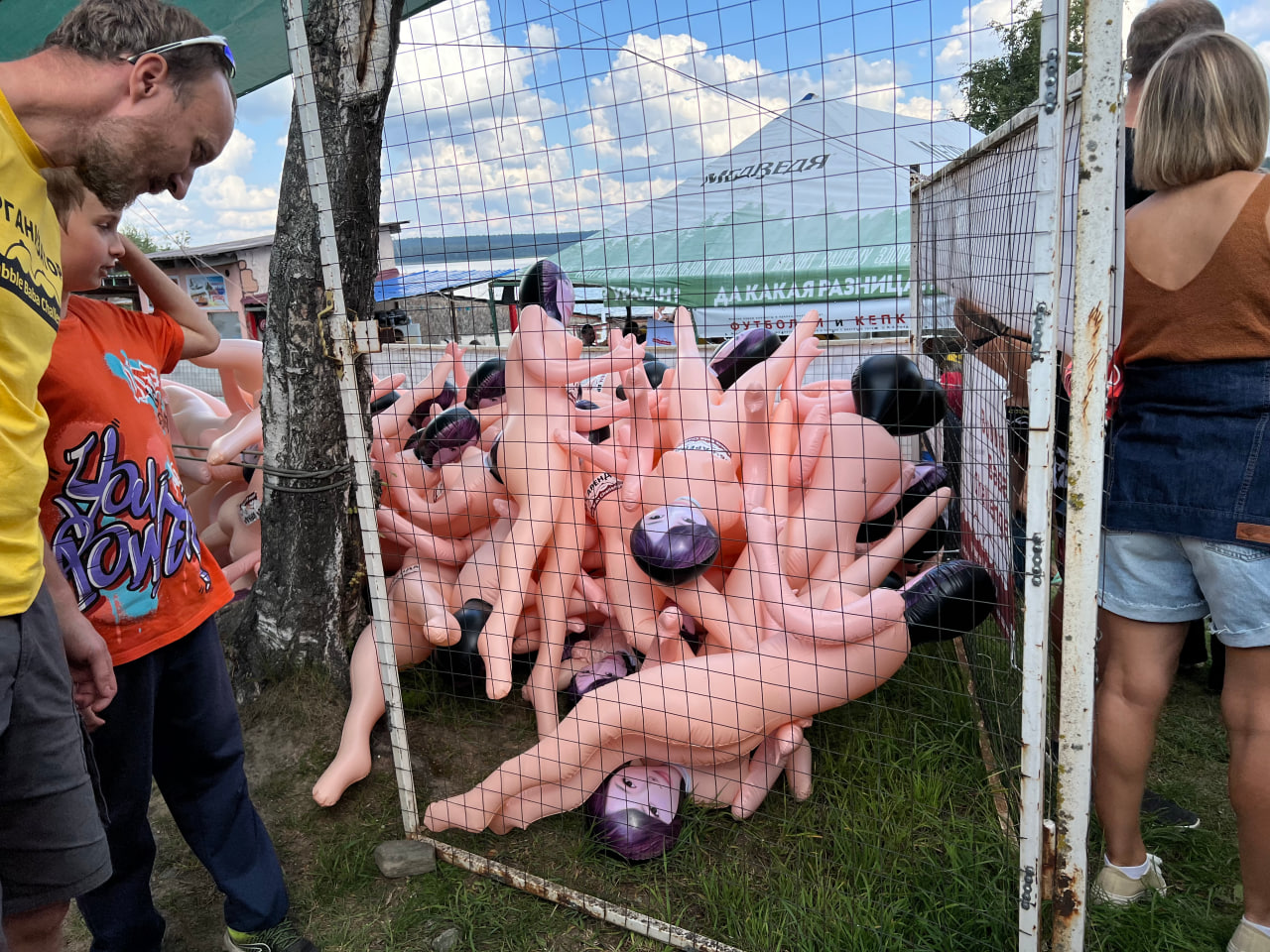
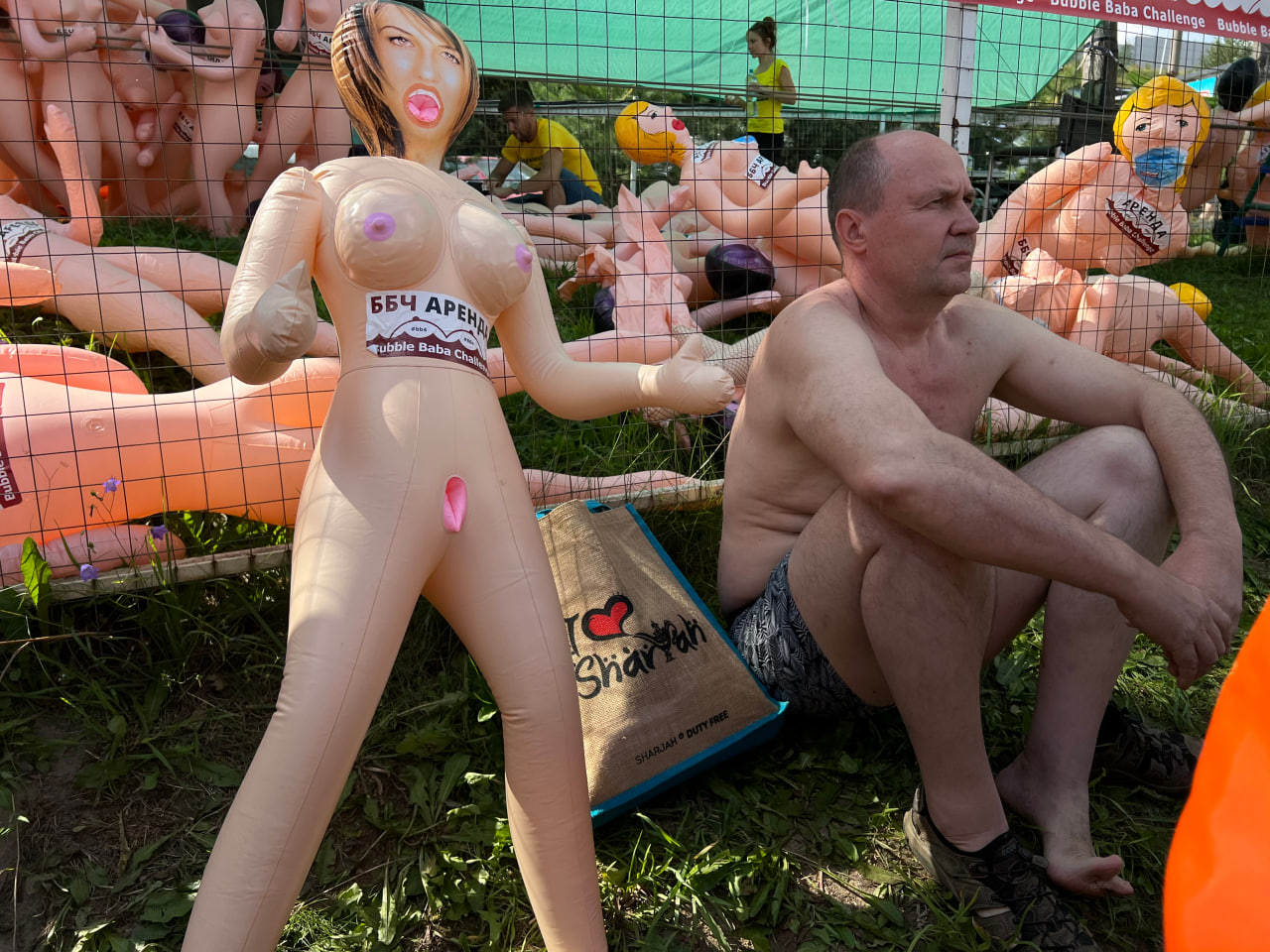
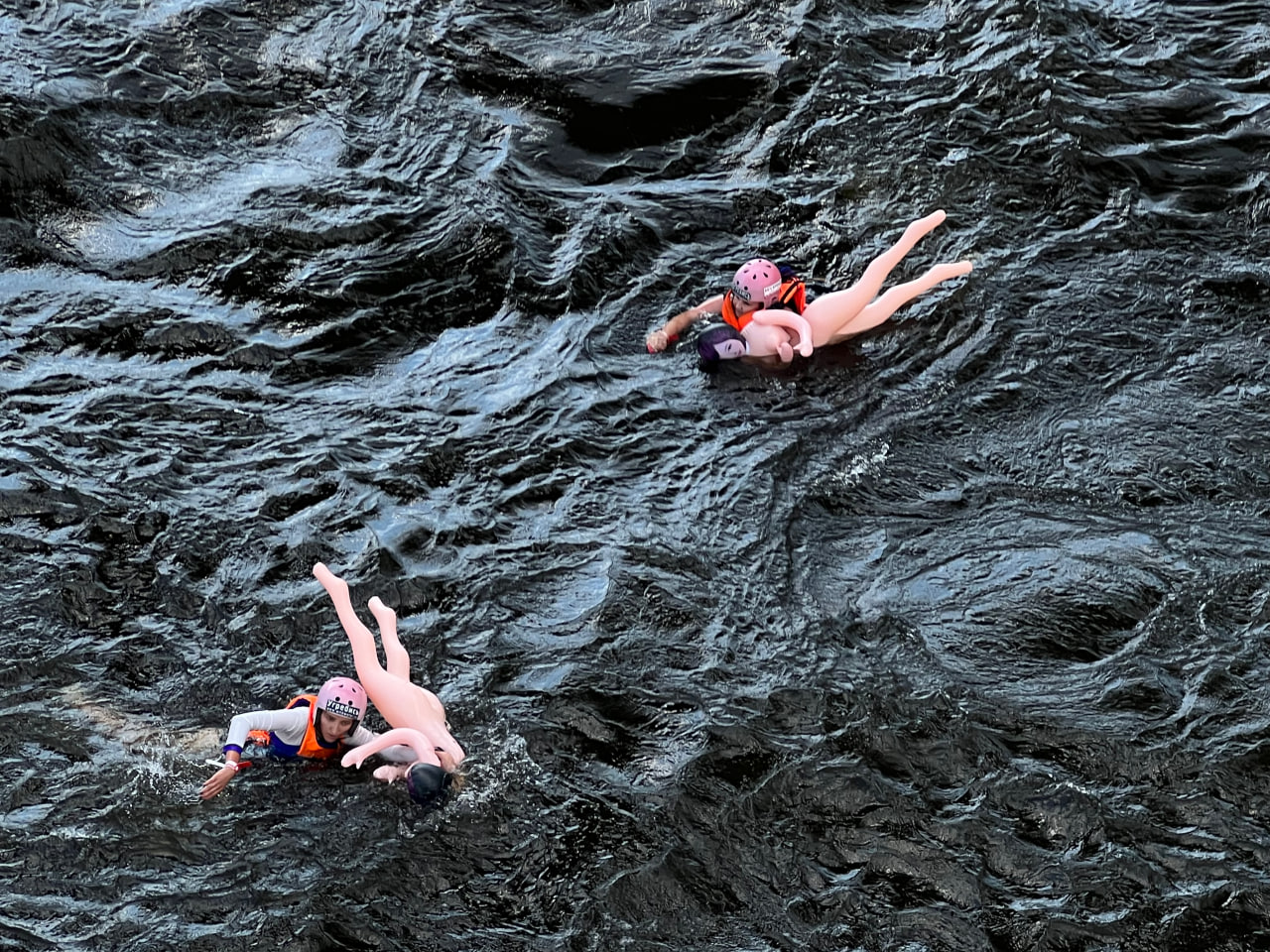
This past weekend, reports Bumaga, local sporting enthusiasts took part in the Bubble Baba Challenge — 2023 [sic, in English], “an event held in the rapids of [the] Vuoksi River whereby contestants race in the water using sex dolls as flotation devices.” The event took place in Kiviniemi, aka Losevo, in the occupied Karelian Isthmus, approximately 60 miles north of Petersburg.

Photos by Pavel Daisi for Bumaga (@paperpaper_ru)

Shameless

“Underwear and swimsuits from 900 rubles.” An image from a circular I got this morning from Russian online retailer Ozon

We are not ashamed

I’ve been doing my favorite thing for almost the whole month—hanging out with ordinary Russians, not only in Moscow, but also in the regions—in my capacity as a sociologist, via focus groups. Ten random people are brought together, and we sit and simply talk “about life,” and I’m among them with a dictaphone. It’s the best format, and ordinary folk like it too.

Naturally, I was curious about people’s opinions about what was happening: their reactions were very different, expressing a whole range of emotions. In most cases, people sense the crisis, and they complain especially about prices… Although then they cheer up and say that “life is livable.” Some even argue that this is not a crisis, but that there are “certain crisis phenomena.” However, after thinking about it, they usually said that it would get worse; this is the easy part now, they said.

I won’t describe everything they said, because I want to get to the main point, the horrible point.

People voiced a variety of emotions (and I carefully monitor them: focus groups are not so much about information as about feelings, about which events excite people more): despair, apathy, depression, anger, patriotic enthusiasm, complacency, and braggadocio… Some still “believe in victory,” some already have doubts, but most are unable to articulate what “victory” would look like… But one emotion—and I conducted more than a dozen focus groups both in Moscow and in the back of beyond—was practically absent, manifested by no one.

I’m talking about shame. There was “we’ve been betrayed,” or “we can still win,” or even “we shouldn’t have started it at all,” but there was no shame. And this, in my opinion, is a very bad symptom, showing that society has not even started down the road to recovery yet. And it may well happen that they will lose and fall face first in the mud, but will still not understand a thing.

This is sad. I’m not trying to show off my own “moral rectitude.” I don’t claim to have it, of course: I’m just as much a bastard as my dear compatriots. My claim is purely pragmatic: if we are still not ashamed, it means that for the time being we are a long ways away from the only emotion that gives us a chance at rebirth—horror towards ourselves. While everyone continues to justify themselves (even if by citing their own weakness: “What can I do?”), the cart won’t budge an inch.

We know that no one ever feels sorry for anyone in Russia. We have always known this, and we didn’t need Sergey Shnurov to tell us that. But the complete absence of shame, and in its place, again, this incredibly vulgar self-pity, pity for us poor unfortunates, “the whole world is against us,” is still quite eye-opening. You listen to how enthusiastically folks pity the “Russian people,” and all you can do is feel gobsmacked. They screwed up completely, betrayed everyone, they are up to their elbows in blood, they can’t do anything, they don’t know how to do anything – but no, they don’t feel even a smidgen of shame.

Nothing’s going to change their minds. Indeed, this, apparently, is the Russian people’s principal tragedy.

Source: Alexei Roshchin (Facebook), 29 May 2023. Translated by the Russian Reader. Thanks to Julia Arkhipova for the heads-up.


I learned from reposts that a very young man, Evheny Osievsky, has died defending Bakhmut.

I didn’t know him at all, but for some reason I went to his page.

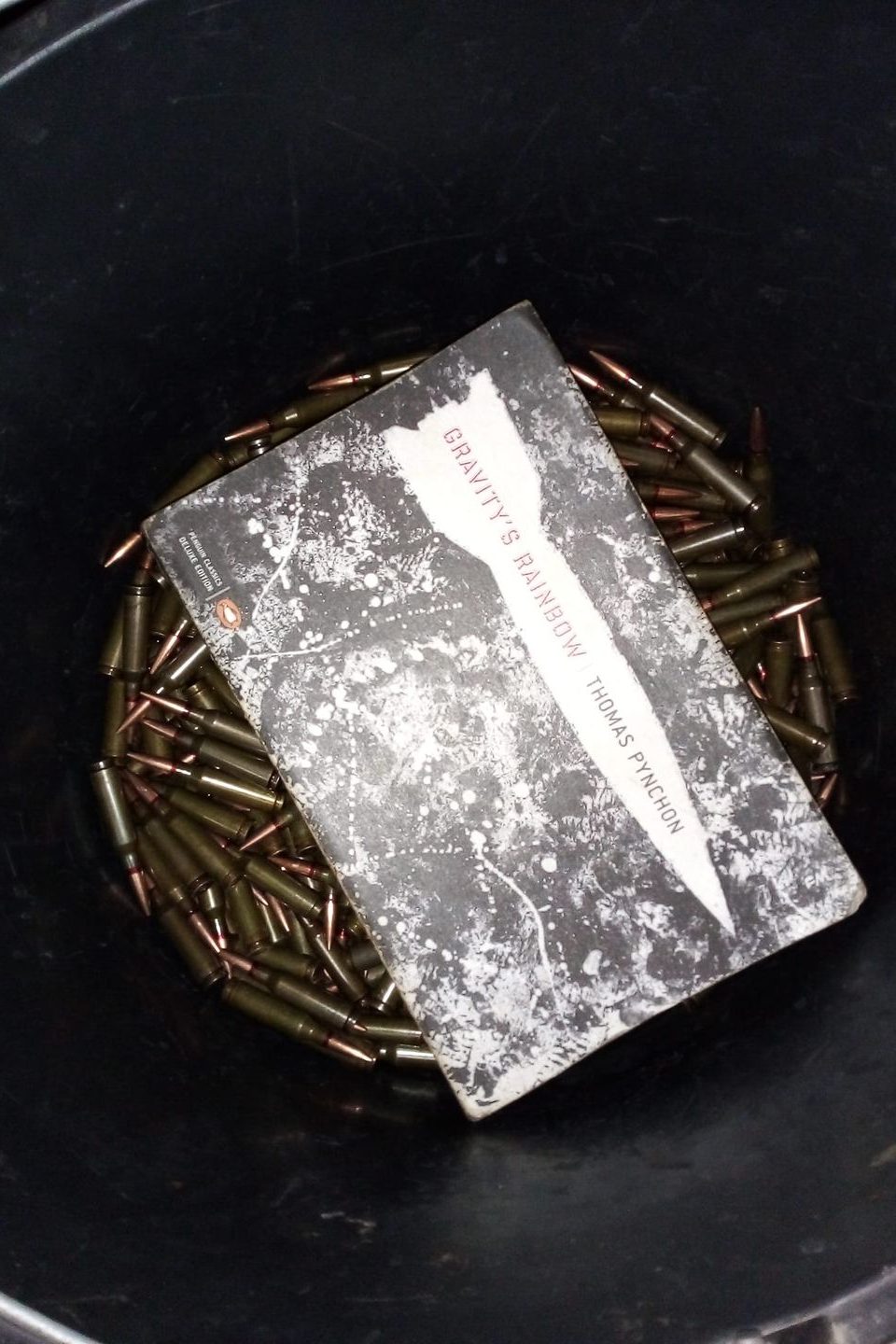
In the trenches he was reading Pynchon. He loved Lou Reed and Bob Fosse.

I would so like to have talked to him (if he would have agreed).

Pain and rage.

Evheny Osievsky April 12 · A book impressively unsuitable for reading in the army. But what difference does it make if “In each case the change from point to no-point carries a luminosity and enigma at which something in us must leap and sing, or withdraw in fright. Watching the A4 pointed at the sky—just before the last firing-switch closes—watching that singular point at the very top of the Rocket, where the fuse is… Do all these points imply, like the Rocket’s, an annihilation? What is that, detonating in the sky above the cathedral? beneath the edge of the razor, under the rose?”

Source: Anna Narinskaya (Facebook), 29 May 2023. Translated by the Russian Reader


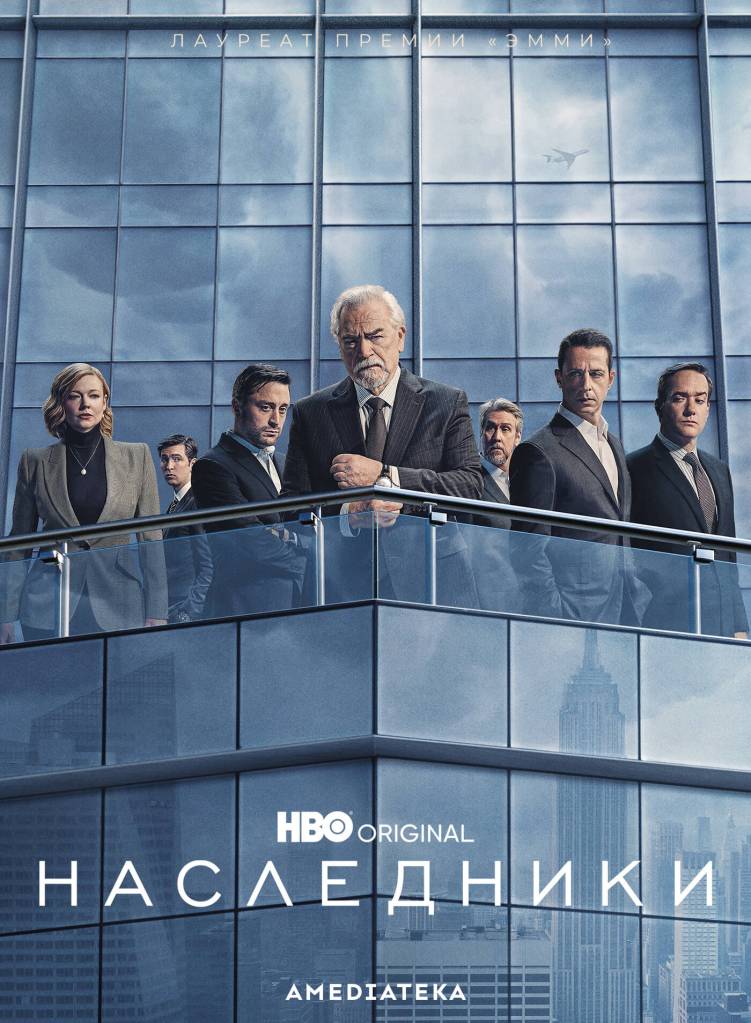
HBO and Russian streaming service Amediateka have made sure that wartime Russians are au courant when it comes to prestige television, as illustrated by this image from a circular I found in my mailbox the other day.

[…]

After witnessing the country’s crackdown on opposition activists and independent journalism — and the prosecution of hundreds of people who do not support the war or President Vladimir Putin — many emigres expect to encounter a dystopia when they arrive in Russia. 

The reality is more banal. 

“It’s corny, but the first thing that caught my eye after returning was that Twitter and Instagram don’t work without a VPN,” said Yulia, referring to Russia’s wartime ban on several foreign social media sites. 

“Moscow bars were packed with visitors even on Monday evenings,” added the 25-year-old screenwriter who returned in April after fleeing to Georgia last year. 

“Recently, my friend and I went out for a glass of wine. All the tables were occupied.”

[…]

Source: Kirill Ponomarev: “‘Almost Nothing Had Changed’: Anti-War Russians Risk First Trips Home Since Invasion,” Moscow Times, 28 May 2023

I Want My HBO (House of the Dragon)

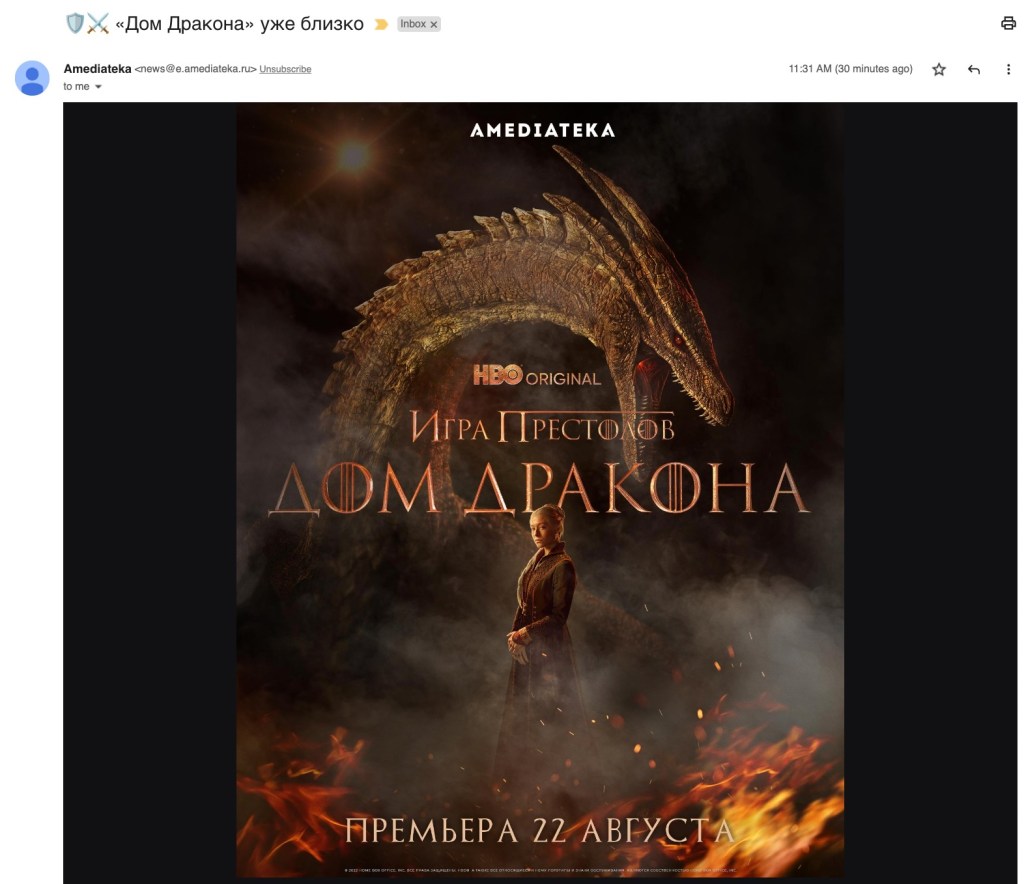
This newsletter from the Russian streaming service Amediateka showed up in my inbox a few minutes ago.

Game of Thrones: House of the Dragon. Premieres August 22

See “House of the Dragon” on Amediateka. We don’t want you to miss the biggest and most interesting premieres (“House of the Dragon,” the prequel to the great and mighty “Game of Thrones” is coming soon!), so we’re reminding you that we have a very useful newsletter. From which, however, you can unsubscribe. What you can definitely keep are the subscription promo codes*: a treasury of international TV series is now closer!

What is Amediateka? What does it have to do with HBO?

Russian streamer Amediateka has struck an exclusive deal that allows it to offer all series from WarnerMedia’s HBO Max, in addition to library content from the US studio.

The agreement, which is effective immediately, hands Amediateka shows including the reboot of cult TV series Gossip Girl, Steven Soderbergh’s film No Sudden Move, sci-fi series Raised By Wolves, Israeli war drama Valley Of Tears and teenage drama Genera+ion. 

HBO Max hit The Flight Attendant is also available, along with Sex And The City sequel And Just Like That…, with shows accessible on the streamer in Russia and the CIS.

Animal Kingdom11.22.63 and Person Of Interest are among library series available, along with documentaries including 15 Minutes Of ShamePersona: The Dark Truth Behind Personality Tests and docuseries Generation Hustle and the upcoming One Perfect Shot.

Tatyana Kalita, CEO of Amediateka parent Amedia TV, said the deal would provide “resonant and highly sought-after” shows to its audiences, adding that the streamer had enjoyed “stunning success” with the recent special episode Friends: The Reunion, which Amediateka exclusively released in Russia and CIS in May.

(Source: Richard Middleton, “Amediateka gets HBO Max shows exclusively in Russia and CIS,” Digital TV Europe, 3 August 2021)

But didn’t HBO’s parent company WarnerMedia stop doing business in Russia this spring to protest Russia’s brutal unprovoked invasion of Ukraine?

Major media companies continue to join the exodus from Russia, with Discovery and WarnerMedia making announcements on Wednesday about halting all programming in the country.

WarnerMedia, CNN’s parent company, previously paused the release of “The Batman” in Russia, citing the “humanitarian crisis in Ukraine.”

As of Wednesday the company is now “pausing all new business in Russia,” CEO Jason Kilar said in an internal memo. “This includes ceasing broadcast of our channels, halting all new content licensing with Russian entities, and pausing our planned theatrical and games releases.”

WarnerMedia had been broadcasting CNN and Cartoon Network in the country. CNN said on Tuesday that the network is not shutting down its Moscow bureau, “but we have ceased reporting from there until we have assessed the impact of this new law.” The law makes it a crime to disseminate what Russian authorities consider to be “fake” information about the invasion of Ukraine.

Discovery, which has 15 channels in the country, said Wednesday that the channels are going dark as well. “Discovery has decided to suspend the broadcast of all its channels and services in Russia,” the company said.

Discovery and WarnerMedia are preparing to merge this spring.

The statements are part of a much broader corporate shunning of Russia that has escalated in the two weeks since the Russian invasion of Ukraine began.

(Source: Brian Stelter, “WarnerMedia and Discovery join the stampede of businesses leaving Russia,” CNN Business, 9 March 2022)

Amediateka is currently offering a 12-month subscription to its streaming service at the bargain basement price of 2,499 rubles — or 41 dollars and some change. That’s for an entire year. In the US, WarnerMedia is currently offering a yearly, prepaid subscription to HBO Max for $69.99 with ads or $104.99 with no ads. ||| TRR