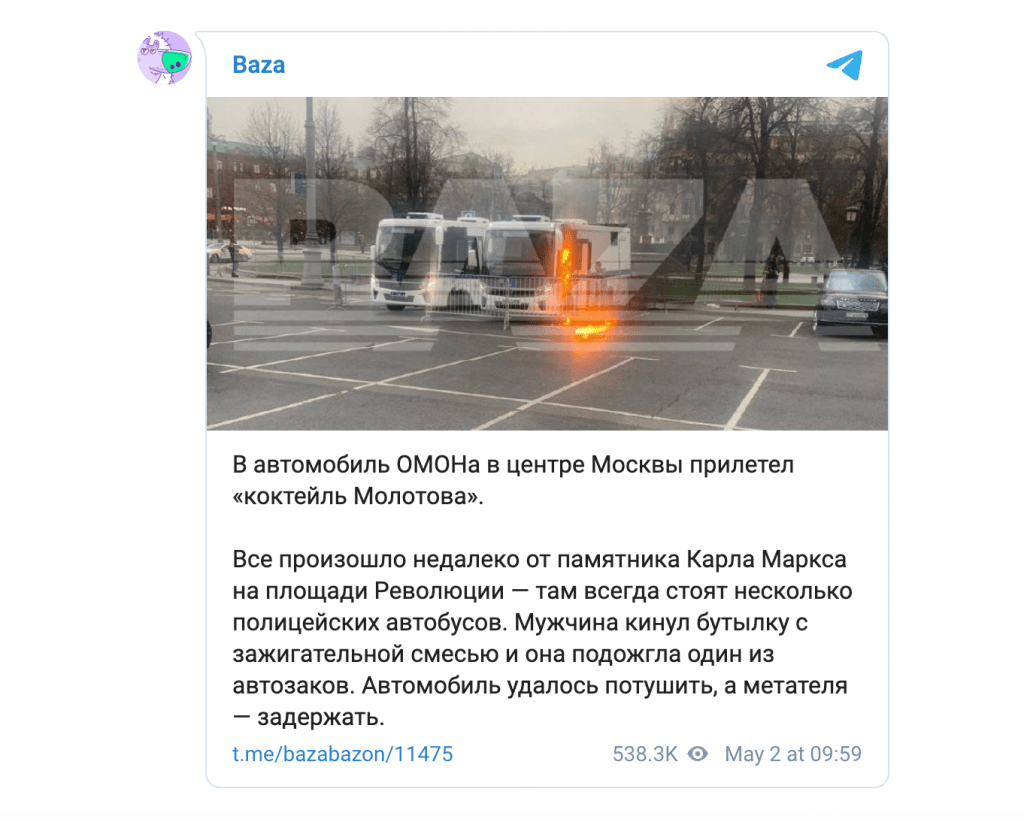
Baza and Mediazona have reported that a man who threw a Molotov cocktail at a riot police bus was detained in downtown Moscow on the evening of May 2. They have published photos from the scene of the incident and the suspect’s arrest.
“A Molotov cocktail flew into a riot police vehicle in the center of Moscow. It all happened not far from the Karl Marx monument on Revolution Square — there are always several police buses there. A man threw a Molotov cocktail and it set fire to one of the paddy wagons. The vehicle was extinguished, and the thrower was detained.” Source: Baza, Telegram, 2 May 2022
A video made by an eyewitness, which Mediazona has at its disposal, made it clear that the front side of the vehicle was charred. The witness specified that the bus “burned for a couple of minutes” before it was extinguished.
The attacker’s motives are unknown, and there was no information about him at the time that the news went to press. In March, a court in Moscow sentenced to two years in prison an anti-war protester who threw a Molotov cocktail at the police: the container did not break, the liquid did not ignite.
Source: Radio Svoboda, 2 May 2022. Translated by the Russian Reader
Vitaly Koltsov
A Molotov cocktail thrown at a paddy wagon in Moscow turned out to be an anti-war protest by an alumnus of the Faculty of Philosophy at the Russian State University for the Humanities.
Before the protest, Vitaly Koltsov posted a poem about fiery hearts lighting up the darkness. The man went to throw a Molotov cocktail in the center of the capital dressed in a suit and carrying a suitcase.
“If the day is extinguished forever, / Our glory will not fade / Death is given only once, / Let’s choose it to our liking / So as to see, at the end, / The desert illuminated / By our fiery hearts / By the rising sun,” the man wrote before attacking the paddy wagon.
Vitaly Koltsov is the father of three children and a graduate of the Faculty of Philosophy at the Russian State University for the Humanities. He has been charged under Article 317 of the Russian Federal Criminal Code (endangering the life of a law enforcement officer). He faces up to twenty years in prison if convicted.
Source: Astra, Telegram, 3 May 2022. Thanks to Marina Ken for the link. Translated by the Russian Reader
I’m sorry you did nothing with our message. As you will have noticed, all Russians will be held accountable for the genocide of the Ukraine people. We will destroy your economy and life in Russia will be set back 100 years. Many more than the present almost 25,000 death Russian soldiers will be killed. Russia will lose its youth. Every Russian will be treated as a potential criminal. This is what you wanted!
Free people in the World
Source: Email sent to avvakum (at) pm.me, 3 May 2022
Shot of a young woman using a smartphone and having coffee in the kitchen at home
I enraged this particular reader, apparently, by not “acting” on their previous letter, dated 4 March 2022, to wit:
Dear sir,
Please help to stop the genocide in Ukraine by Putin. We know this is not the will of the ma[j]ority of the Russian people. Ukrainian and Russian population are interrelated in many families. They should be brothers and sisters. War should not be something of the 21st century.
In the last 30 years there was cooperation in Europe and more understanding. The Russian economy was helped by efforts of many investors, business owners and countries. By this a backlog in welfare has diminished. The war started by Putin means that all the people in Russia will get poorer. And travel abroad is made impossible. Nobody wants Russian people anymore. Even if the killing is stopped. The committed war crimes and the grieve about lost ones will be in the memories for decades. Everything you have build up in welfare, relations or future will be lost for a very long time.
Do something against the killing of civilians in Ukraine! You are the ones that should and could do that! What would you tell your children when they ask you why you tolerated this war?
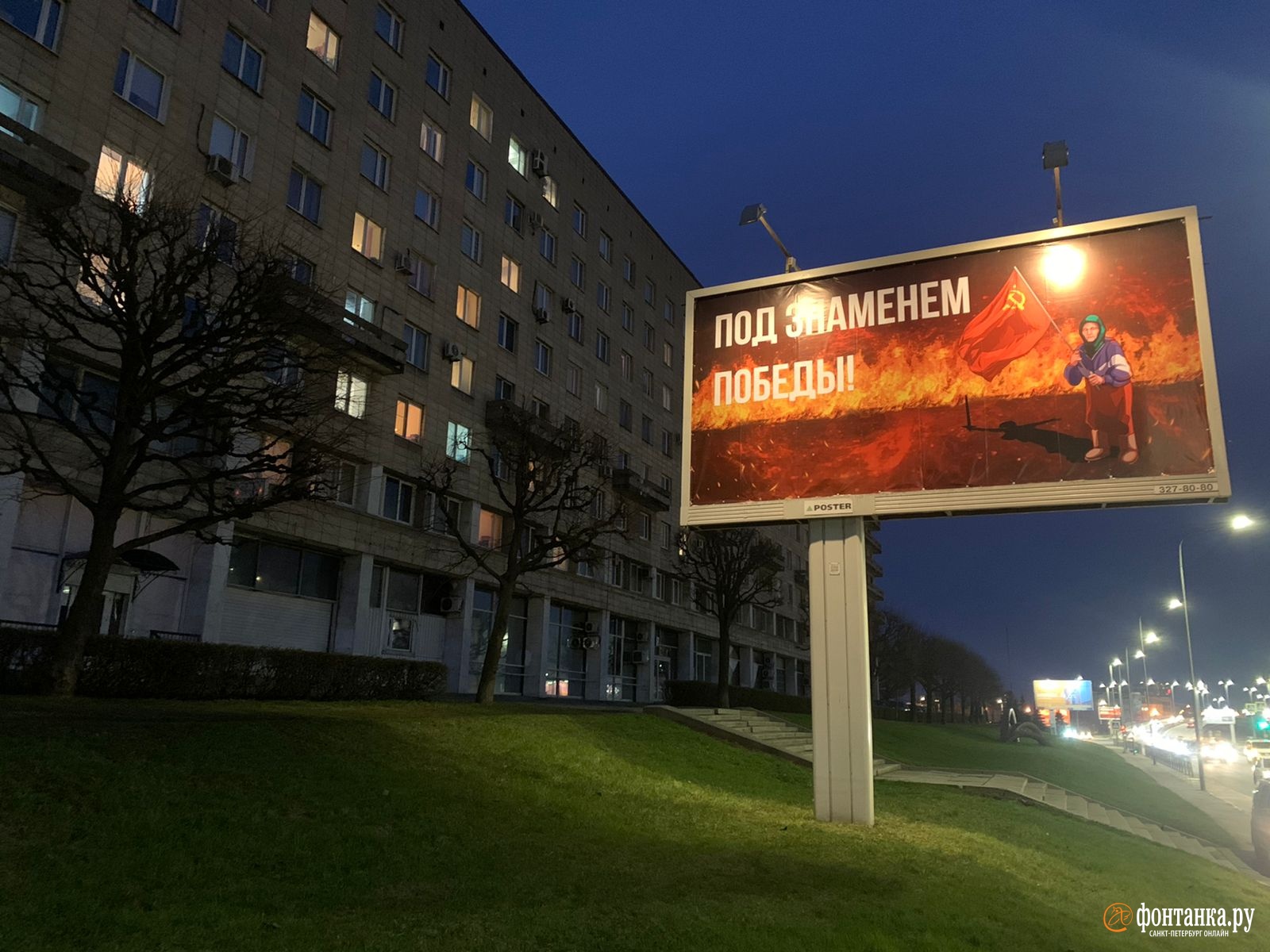
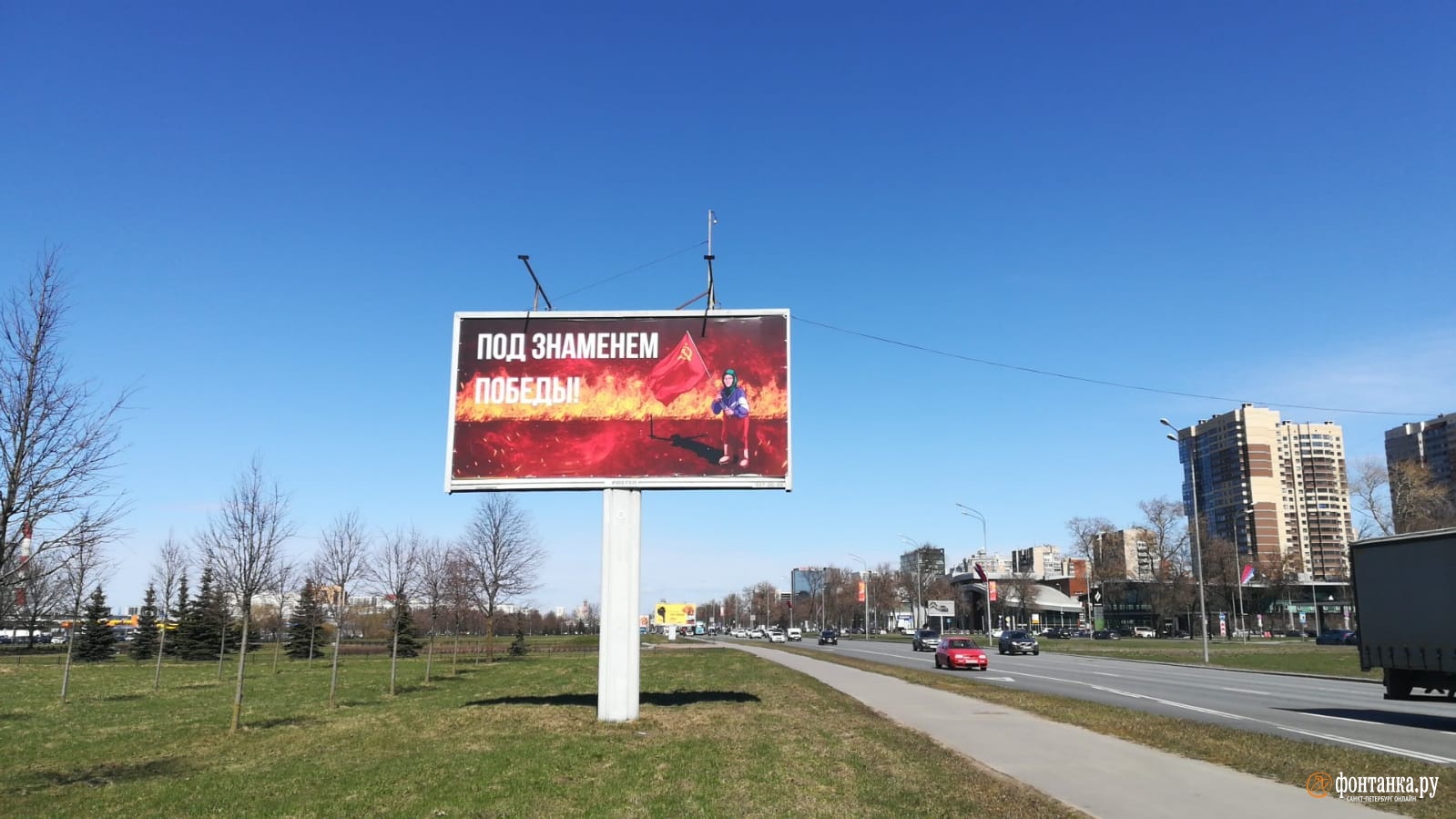
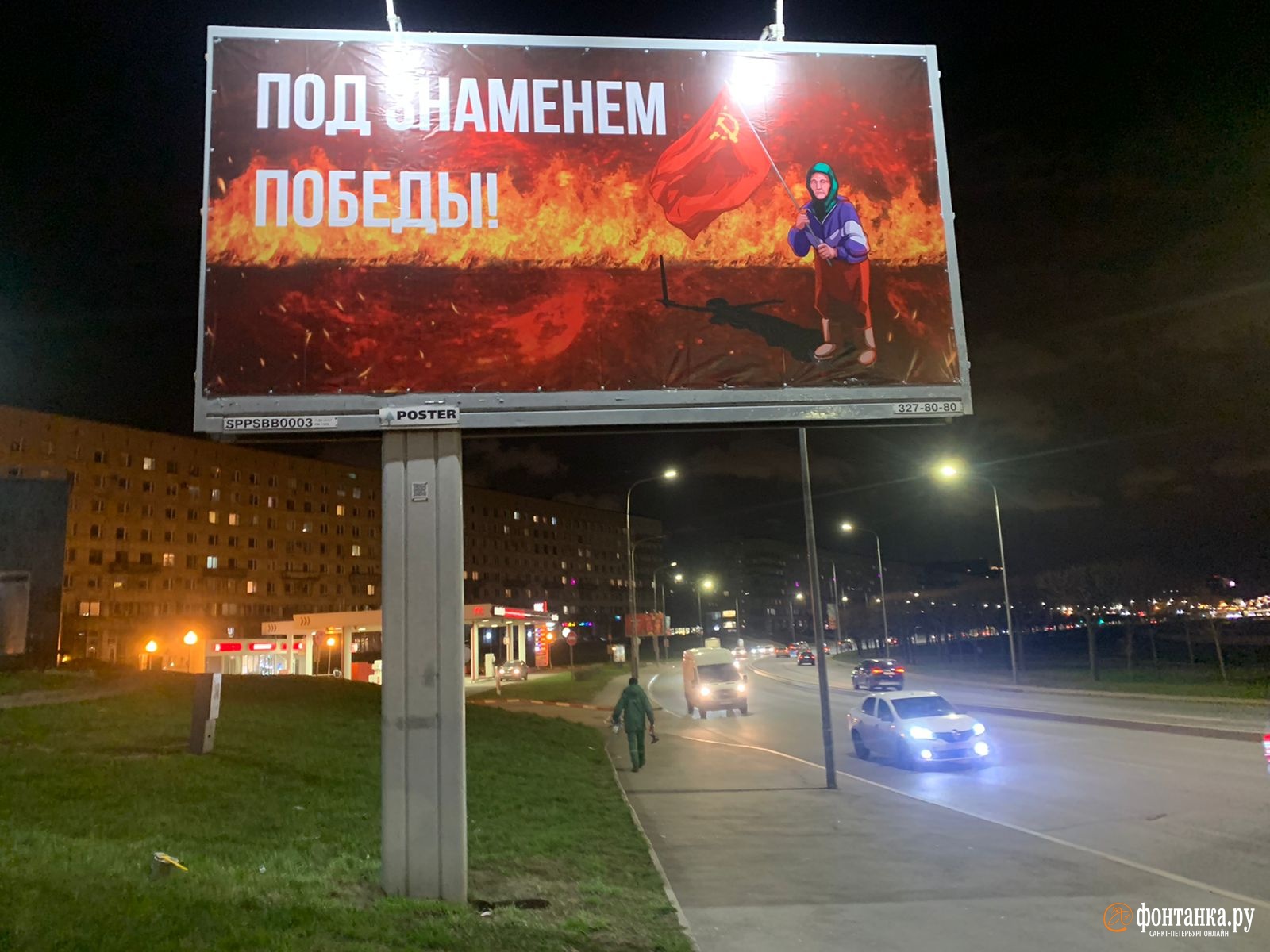
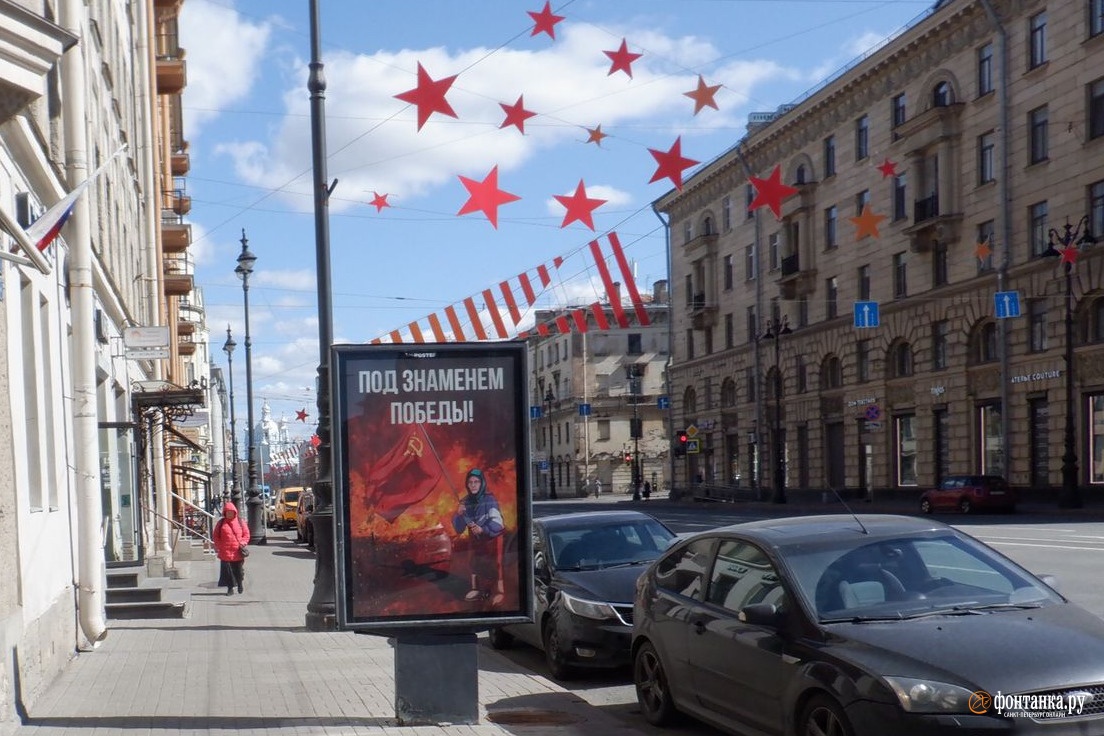
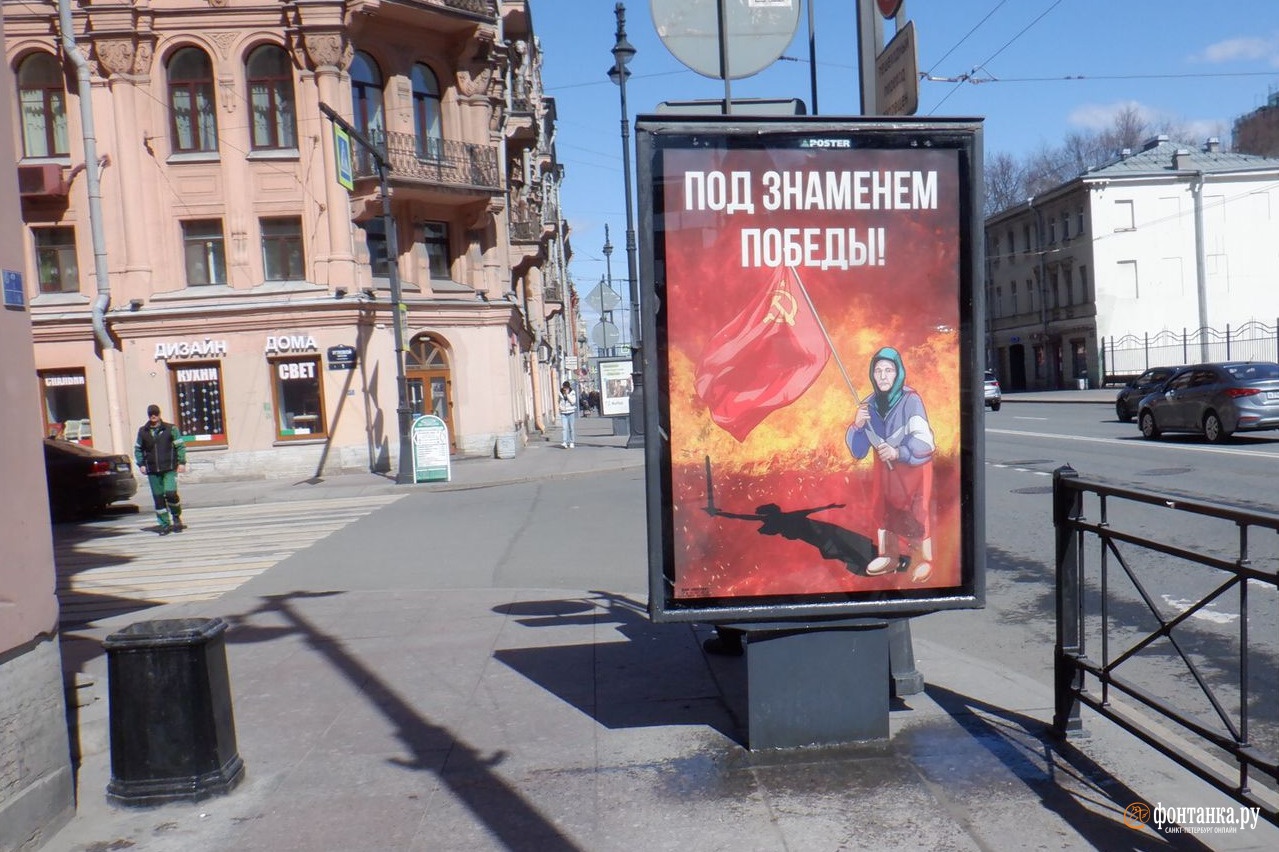
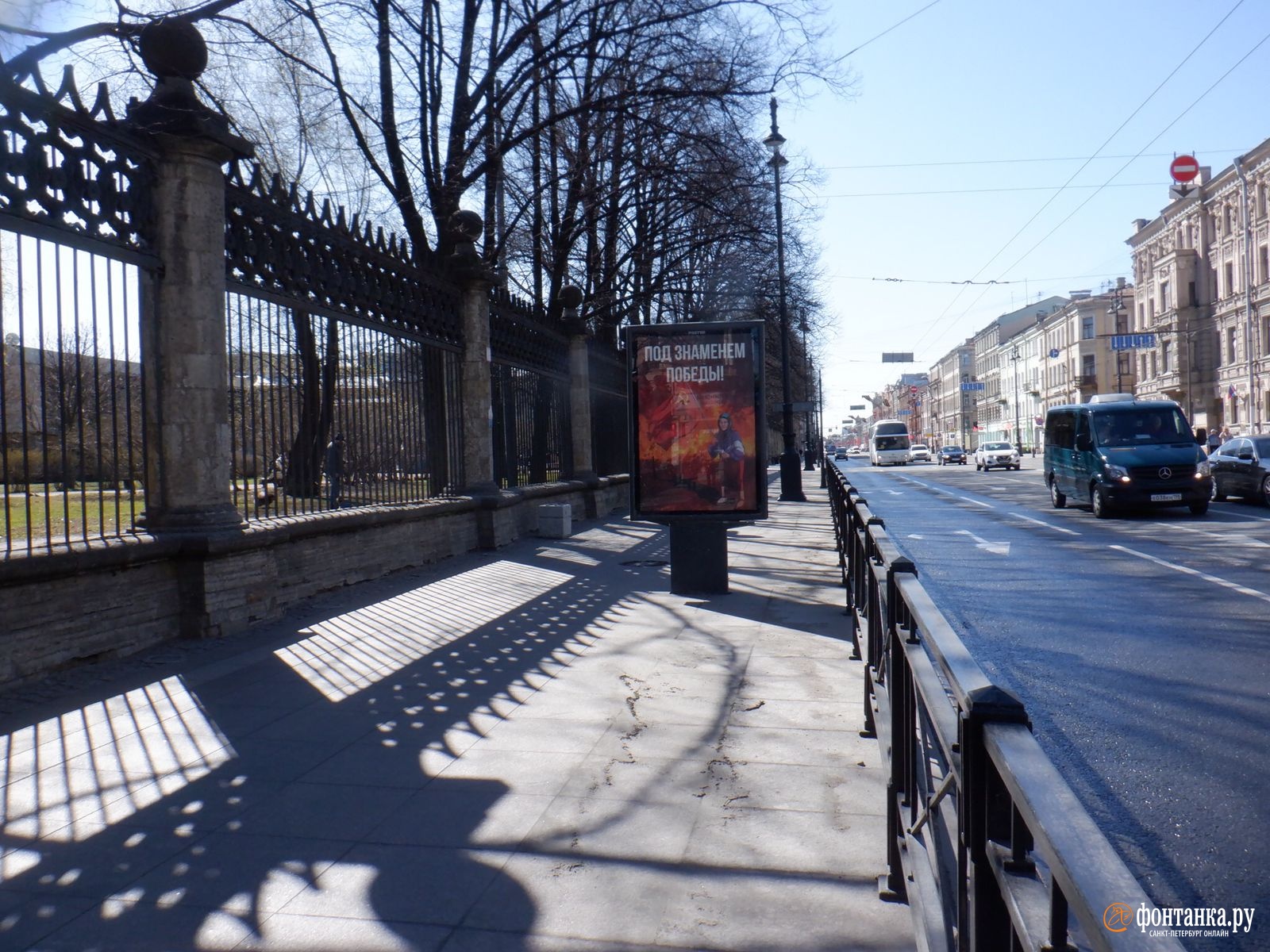
As of the morning of May 1, around a hundred billboards featuring the image of the iconic pensioner who gained famed after the events in Ukraine [sic] had been installed in different districts in Petersburg. Fontanka.ru has analyzed the scale of this visual statement. The news-related intrigue lies in the fact that state agencies have nothing to do with the campaign.
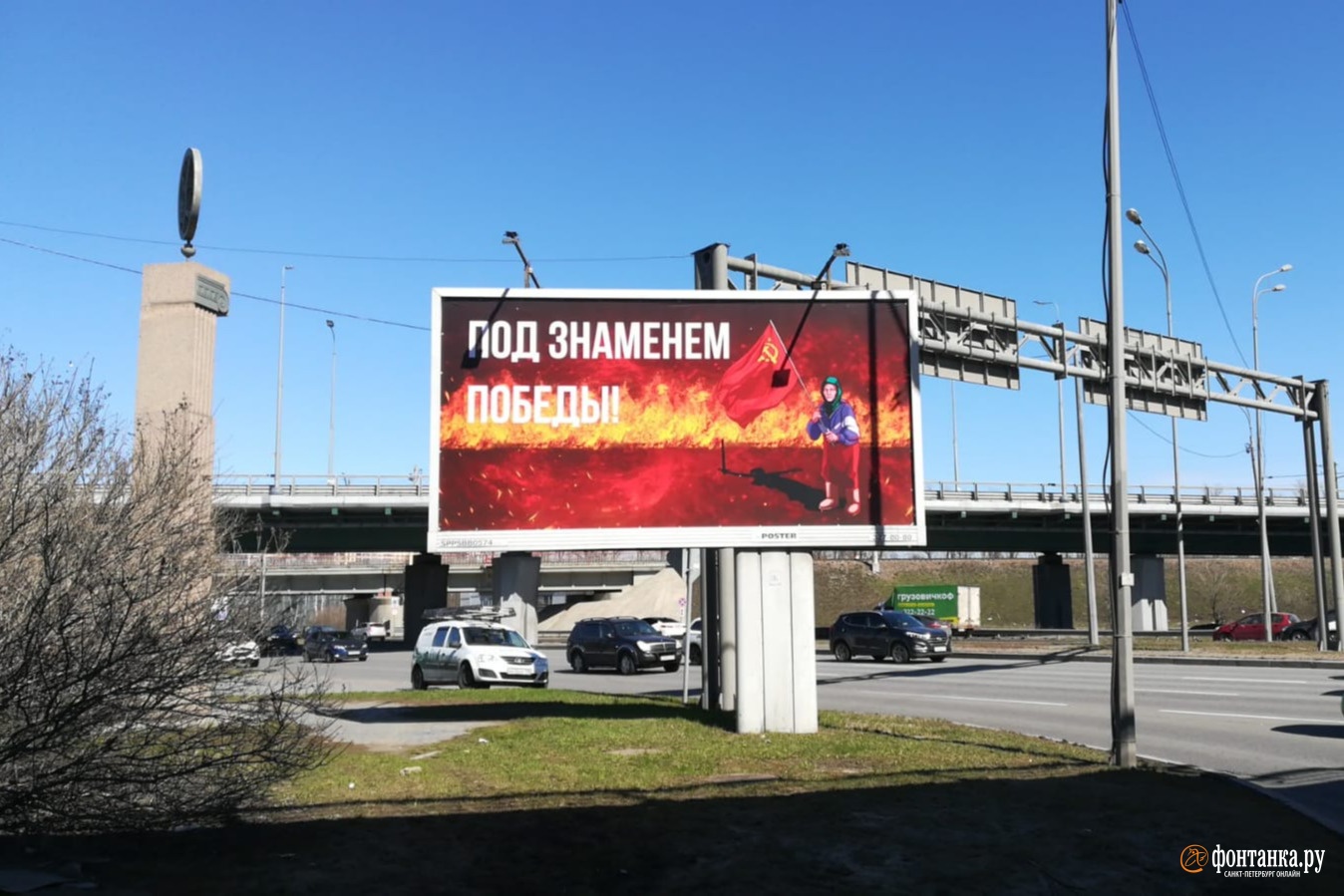
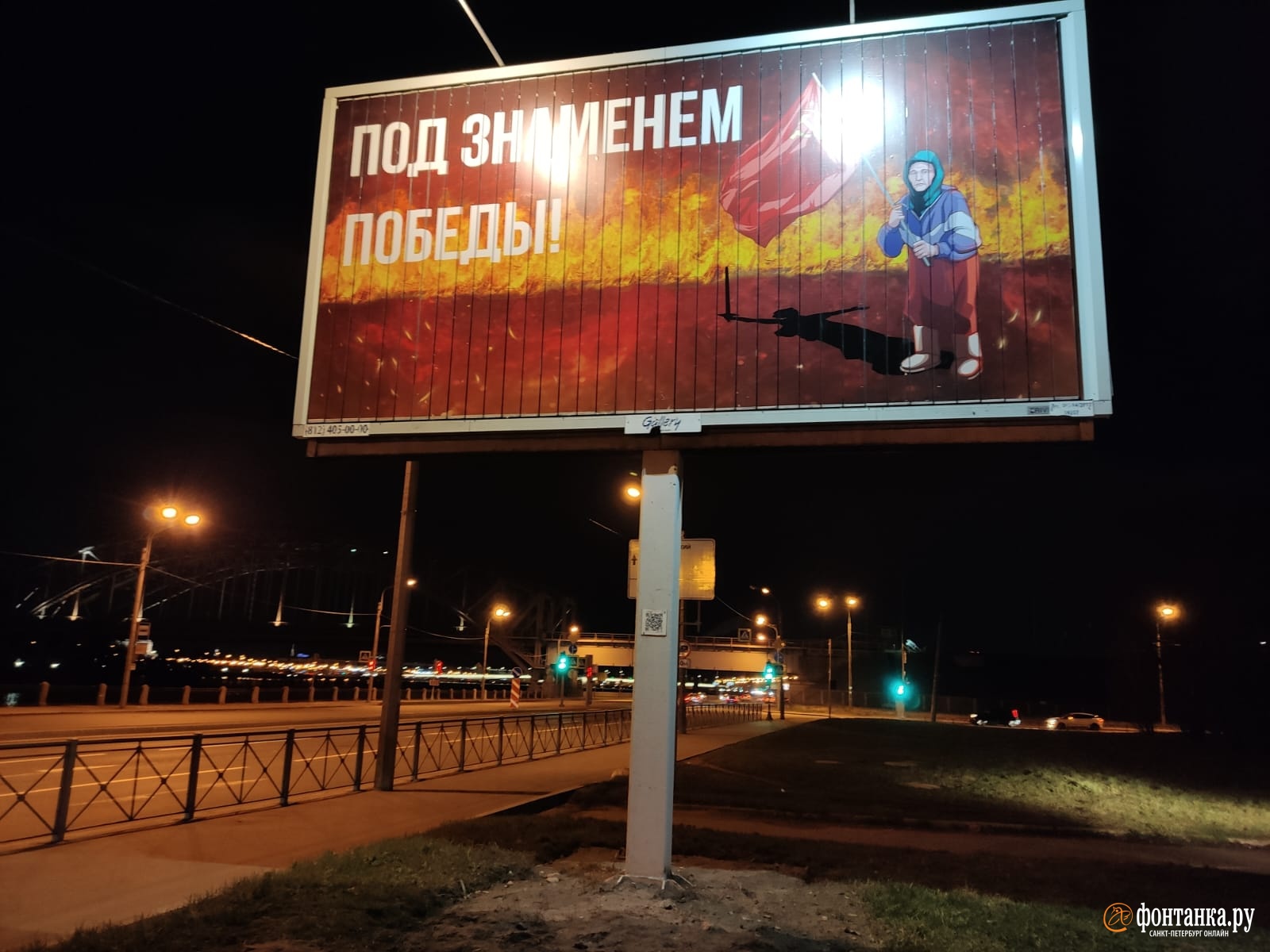
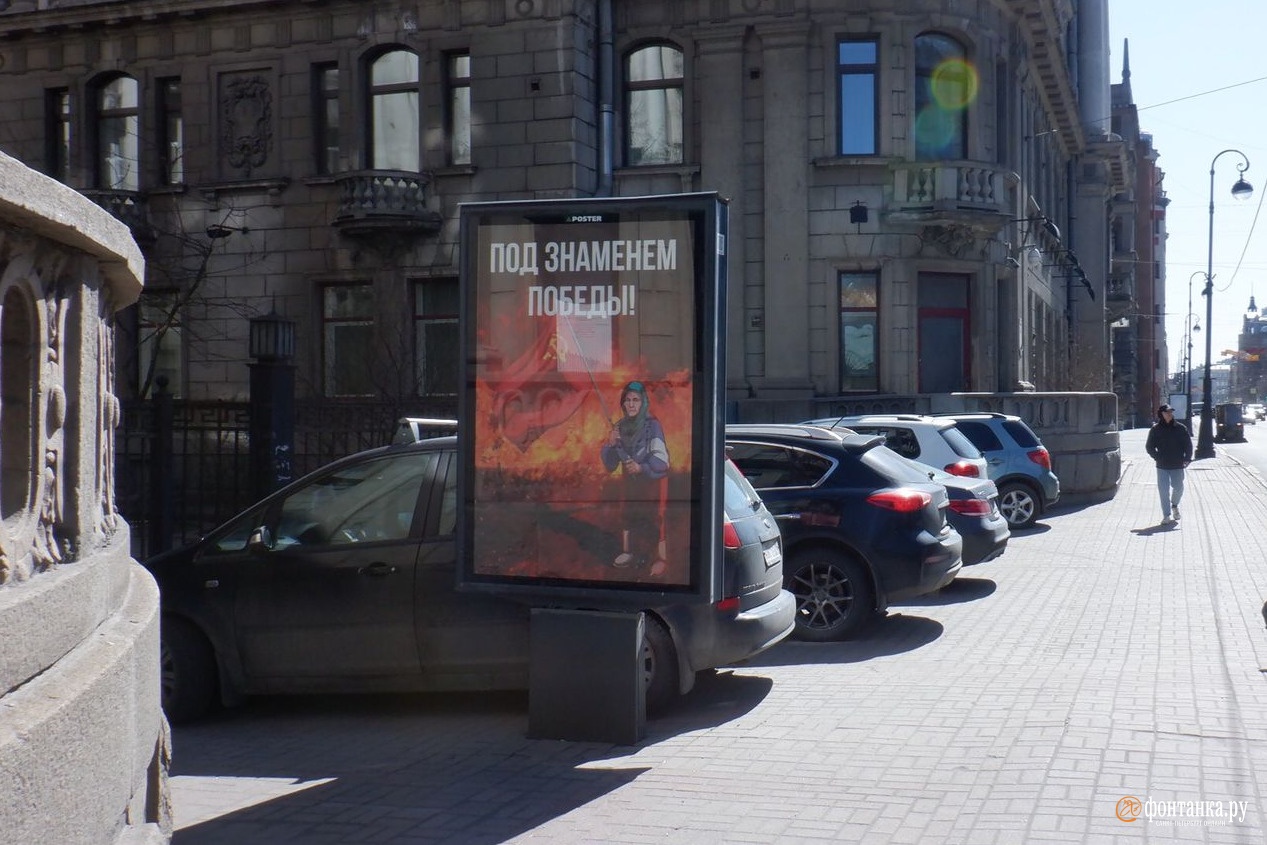
“Under the banner of victory!” All images courtesy of Fontanka.ru
In the early hours of May 1, identical posters bearing the image of the famous pensioner holding a Soviet banner were officially installed in about one hundred outdoor media displays in Petersburg.
News about the woman broke out back in April, when she went out with a red banner to greet servicemen in Ukraine, confusing them with Russian soldiers. Her age, her deed, the reaction of the Ukrainian soldiers, and the video that went viral on the Net immediately turned her into a symbol of victory. The old woman’s face has appeared on DPR postage stamps, graffiti artists began to draw her in different cities in Russia, and so on. Even the Russian Federation’s delegate at the UN Security Council talked about her.
Currently, the images of the heroic old woman have been installed in the Central, Admiralty, Petrograd, Vyborg, Maritime, Kalinin, and Moscow districts. These include both large billboards and typical demonstrative surfaces [sic] along the roadways.
The urban spaces chosen for this campaign can be analyzed. The images have been installed near places of authority: on Suvorov Prospekt, next to the Smolny [Petersburg city hall], the seat of the Leningrad Region government, and the Interior Ministry building; on Tapestry Street, near the FSB building; on Horse Guards Boulevard, near St. Isaac’s Cathedral; and around the monument to Alexander Nevsky, outside the Alexander Nevsky Lavra.
However, many similar phenomena [sic] have popped up on Moscow Prospekt, Pulkovo Highway, and the October and Vyborg embankments.
Fontanka.ru has learned that state (regional or federal) agencies did not pay for the campaign. Petersburg advertising market insiders, on terms of confidentiality, informed our correspondent that they had heard about the proposal from representatives of a private individual in mid-April. “It’s definitely a businessman. We are sure of this at least, since we called each other when we began receiving preliminary inquiries,” one of the insiders said.
As for the scale, according to the information we have obtained, the order received was for the placement of one hundred billboards at an approximate cost of around ten million rubles [approx. 139,000 euros]. “And that’s if they got a discount,” one source added. Several of our experts more or less agreed with this figure.
If someone in the advertising market has more accurate information, Fontanka.ru is ready to listen to it with a full guarantee of anonymity.
Source: Fontanka.ru, 1 May 2022. Translated by the Russian Reader
A Cult of Dementia
Putin’s red-brown ideology has taken the worst of Nazism and Bolshevism and mixed it with the cartoonish oligarchy from Dunno on the Moon. The final product has no equals anywhere in the world.
Just think about it. For several months now, Russian propaganda has been chewing over the image of a traitorous old Ukrainian woman who was waiting for the invaders with a Soviet flag. Compassionate Ukrainian soldiers gave her food, but took away her flag. That’s the whole story.
But no, the story didn’t end there. In Russia, the crazy old woman was made a real hero, and her image began to appear on buildings. But the occupiers have driven themselves into an ideological trap: no one except such “young Komsomol women” was looking forward to seeing them in Ukraine. The invaders were not greeted with flowers and bread, but were treated to Molotov cocktails and poisoned pies.
If you think about this story more deeply, the old lady with the Soviet flag perfectly reflects the main watchword of Putin’s Russia, its underlying doctrine, and the true purpose of invading Ukraine: our lives have sucked and we won’t let anyone else live either.
She is thus undoubtedly a hero to Russia, as is Pavlik Morozov. Russia has nothing to offer the world. It offers a rollback to the past and endless attempts to cash in on lost “greatness” instead of progress, old age instead of youth, betrayal instead of loyalty, and humiliation instead of pride. So, an old woman holding a Soviet flag is the most accurate symbolic depiction of modern Russia.
It’s funny, because the propagandists don’t care about Russian pensioners or about veterans of the Second World War. Old people in Russia live out their days (they live them out, they don’t live) in want and humiliation, in terrible conditions and hopelessness.
Source: Andrey Churakov, Facebook, 2 May 2022. Translated by the Russian Reader
Anti-war messages painted on depictions of soldier and little girl in Petersburg
In at least two places in Petersburg, someone has made a wall painting depicting a soldier kneeling before girl in pink clothes who is bandaging his hand. The letter Z — a symbol of support for Russia’s military actions in Ukraine — is painted on the soldier’s sleeve.
SOTA noticed that in one of these murals, in the Matveevsky Garden on the Petrograd Side, persons unknown had added a speech bubble so that the soldier says, “I killed your mom.”
A photo of the other depiction was taken at Lanskaya railway station by a female reader of Bumaga. There, the slogan “No war” had been written over the image, while the letter Z had been painted over.
Source: Bumaga, Telegram, 2 May 2022. Translated by the Russian Reader
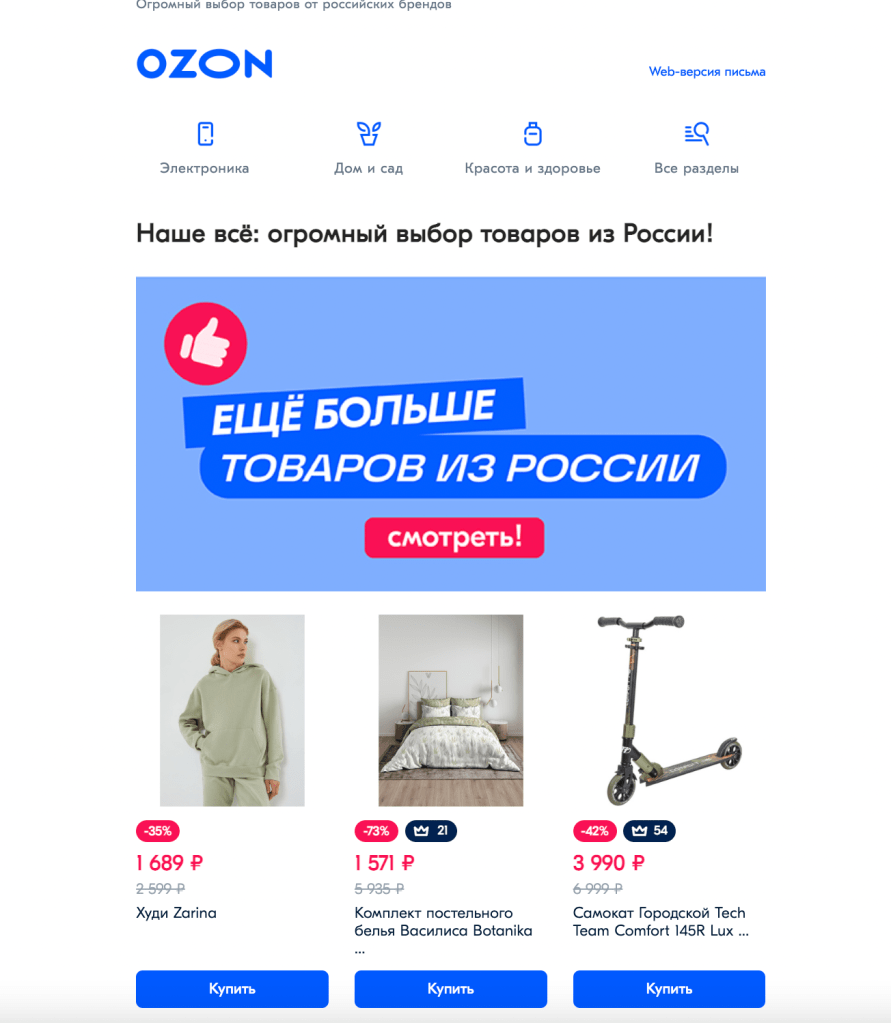
“Our everything: a huge selection of goods from Russia! Even more goods from Russia – look! [1.] Zarina hoodie, 1,689 rubles [approx. 21 euros]. [2.] Vasilisa Botanika bedding set, 1,571 rubles. [3.] Tech Team Comfort urban scooter, 3,990 rubles.” Source: Ozon email advertising circular, 2 May 2022. Ozon is a major Russian online retailer and is sometimes referred to as “the Amazon of Russia.” When I still lived in Russia, I regularly ordered books from them. In the first weeks of the war, they were pushing the imported western goods they still had in stock. ||| TRR
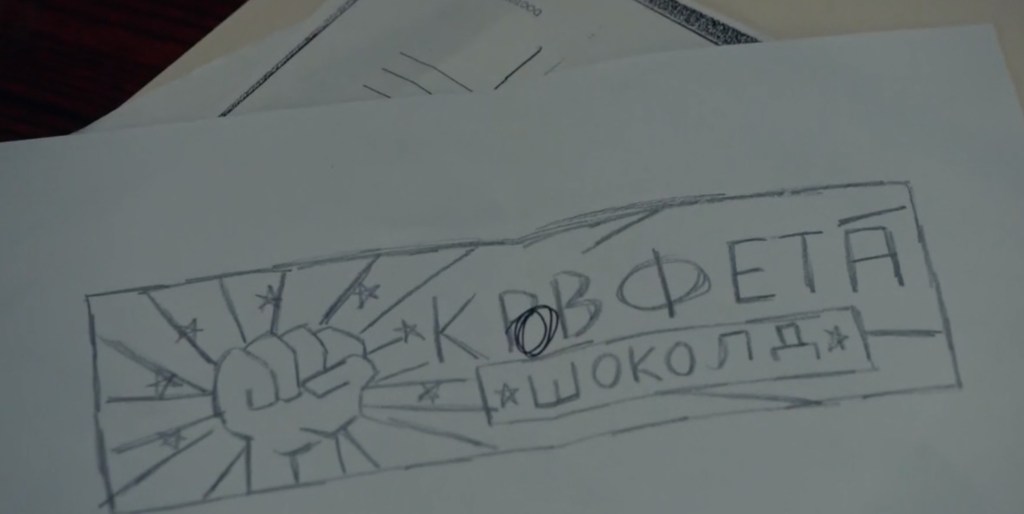
“It’s a Soviet-era candy bar made with cow’s blood.” Still from “Enervo,” Season 4, Episode 20 of The Rookie (ABC)
‘Following a drive during which we learned that Agent Fox is gay and Simone herself is bi, Fox tasked Clark with rifling through screens and screens of tipline calls possibly about the Russian, but “people person” Simone instead sneaked off to talk to locked-up Zeke, her former student, asking if he remembered anything else about the bomber. This led to Zeke sketching a Russian candy bar that the guy munched on, and that in turn — thanks to some Russian musicians that Simone’s dad Cutty sometimes jams with — led Simone to a store. Not waiting for Nolan to catch up, Simone approached and tried to chat up Gurin by herself, but that led to a brief brawl, where the Russian walloped the unarmed trainee hard, and then ran off.’
Source: Matt Webb Mitovich, “The Rookie: Grade Part 2 of the Spinoff Pilot, Tell Us If You’d Watch It,” TVLine, 1 May 2022. In Russian, konfeta means “candy,” and is derived from the Italian confetto. The Russian word for “blood” is krov’ (with a so-called soft v), not krov (as here, with a so-called hard v), which, on the contrary, means “roof” and, by extension, “shelter, a place to stay” (“a roof over one’s head”). So, in their misguided effort to confect “blood candy,” the writers of The Rookie actually conjured up a “roofy.” And the Russian word for “chocolate” is shokolad, not shokold, as here. But that mistake can be put down to Zeke’s “poor” memory. UPDATE (2 May 2022). My boon companion, who was born and raised in the Soviet Union, told me earlier today that she and other children were given sweet “Hematogen” nutrition bars to raise their hemoglobin levels, as she put it. These bars were sold in pharmacies and labeled as such, not as chocolate, candy or “krovfeta.” Adults did not eat Hematogen bars, she said, adding that she stopped eating them when she realized what was in them. In 2019, Vice published a provocatively titled article about Hematogen bars that might have inspired the writers at The Rookie. I’m happy to admit that, despite having lived in Russia twenty-some years, I’d never heard of them until today. ||| TRR
In late March, Petersburg artist Yevgenia Isayeva protested Russia’s war in Ukraine by performing an action entitled “My Heart Is Bleeding”: the young woman stood on the steps of the former City Duma, in the downtown, wearing a “bloody” white dress. The artist was jailed for eight days for her protest. Sever.Realii talked to Isayeva about her arrest and whether people who oppose the war should now leave the country.
Isayeva spread out a canvas on which the following message was written: “I feel that it is pointless to appeal to reason. Therefore, I appeal to your hearts. Women, children, old men and old women are dying every day in Ukraine from bombing, hunger, and the inability to get out from under the rubble or get medicines. Their graves, marked with homemade crosses, turn black in courtyards and playgrounds. There are thousands of people who have been wounded and mutilated, there are millions of broken lives. If you make excuses for this, then your heart has gone blind. Find the strength for mercy and compassion, do not support the bloodshed!”
The protest lasted only ten minutes. Isayeva was detained by the police, and subsequently she was jailed by the court for eight days on charges of disorderly conduct. She served her sentence in the special detention center on Zakharyevskaya Street in Petersburg.
Isayeva: “My Heart Is Bleeding” was for me a kind of essay in freedom. After February 24, I could not live normally. I felt bad, and for the first time in many years, I started having panic attacks again. And this gesture, in fact, helped me as a ritual – it was easier to go on.
Sever.Realii: Some people have gone on living as they used to live, doing their projects and trying not to notice what is happening, because rockets are not falling on houses here in Russia. How do you communicate with people whose heart does NOT bleed?
– I don’t communicate with people who are not close. I am a categorical person: it’s a matter of black and white for me now. My president was shot dead on a bridge seven years ago. (She means the opposition politician Boris Nemtsov – SR.) I have the sense that we are living an ancient or biblical myth, where there is a kind of crystallization, a highlighting of the truth – of relationships, of how we understand things, of the facts. I am sure that we will survive this horror. While before February 24 it seemed to me that all this would drag on forever, now I’m sure it won’t. Twenty-five percent of Russians do not support what is happening – that is almost thirty-five million people and it is quite a lot. Propaganda is trying to convince society that people like us are crazy. But I’m not crazy. And I told the police at the station that history would judge us and that this would happen quickly enough.
– Can art change anything in life?
– Artists are always troublemakers and disturbers of the peace, even when they later become classics. Take Dürer, for example. He was the first to make a self-portrait en face. Now it is taken for granted, but in fact it used to be that only the faces of saints were painted en face, not those of ordinary people. He was the first to portray himself like this. It was a provocation. Artists are the ones who establish the discourse and make you indignant, who make you think. Art and science look for answers to unanswered questions. It seems to me, of course, that the imagination is also very important: the system is manned by people with no imaginations, who are incapable of abstract thinking – and this is quite obvious. At the police station, they tried to convince me that what was happening was unilinear. I told them that there is your opinion, and there is mine, and it’s different, and that’s fine. And that basically it’s normal to live in a world in which there are different opinions – that’s what I think everyone needs to understand. My generation grew up amid this freedom.
– Is it possible to do certain projects in Russia now without being afraid?
– We are all like hostages of the system here, but if we give up, all this darkness and drabness will swallow us up and devour us. But there are absolute truths that we can and should talk about. Yes, to some extent, the theory of small deeds has failed – we did things, but we didn’t do enough, since now we are faced with all of this. So we have to do it now. Now is the best moment to do rather than giving up, to help each other, while self-flagellation and feeling guilty, in my opinion, are unproductive.
– What were conditions like at the temporary detention center?
– I was in a cell for two in the temporary detention center on Zakharyevskaya [in Petersburg’s Central District]. Compared to the police station, where I had spent two days, things were quite good there. My cellmate was a young woman who had been sentenced to administrative arrest over a fight with her husband; she had a black eye. She and her husband, who had been given ten days of administrative arrest, would shout back and forth to each other there. She had been jailed for seven days for their fight with each other. We had rec time in the yard. When we were walking with the other young women and talking, she would say, “My husband and I are doing our time here together.” The girls would immediately ask whether they had been detained together at an anti-war rally. She was embarrassed to tell the truth: she was the only non-political arrestee among us.
– Tell us about your family.
– On my mother’s side, we have our own plot at the Volkovo Cemetery. The oldest grave is that of Apollon Alexandrov, who died in 1866, but when he was alive he was something like a caretaker at the Alexandrinsky Theater. Basically, he was tangentially involved with art, and I have a long family history on my mother’s side. Some of my relatives are from Ukraine: for example, my ancestors include the famous artist Ivan Makukho–Makushenko, a People’s Artist of Ukraine. The surname was later split into Makukho and Makushenko. Among Dad’s ancestors (Yevgenia’s father is Maxim Isayev, an artist, director, actor, playwright, and co-founder of the AKHE Engineering Theater – SR) there is a Jewish line, whose graves are at the Transfiguration Cemetery. There is a family legend that a young woman, the daughter of a rich rabbi, and a revolutionary–minded poor Jewish boy ran away from Gomel to Petersburg and started that line. The family albums have been preserved at home: you look at pre–war photos and see how there are fewer and fewer men in the pictures: crackdowns and war took their toll, people disappeared and died. I have a very good sense of the two-hundred-year history of my family’s relations with Petersburg. Sitting in the temporary detention center, I read the essays of Joseph Brodsky. He had the idea that in Petersburg they show you the house where Dostoevsky lived, and then they show you Raskolnikov’s house: life equals literature. I lucked out with teachers at school: my literature teacher made sure that the poetry of the Silver Age has stayed with me. The romance with the city is part of my own myth. I draw Petersburg, I write about it. It is a friend, a lover, and a companion. I feel like I’m a part of it. So I don’t have the passionarity [sic] for emigration: there is no place like home.
– Have you asked yourself whether you should stay or leave?
– After the collapse of the Roman Empire came the Dark Ages, when literacy disappeared: everything was so badly destroyed that people forgot how to write, they forgot what these signs meant. But writing later re-emerged. It is very important now to carry the light through these Dark Times. Not everyone will leave [Russia]. There are children here, and they will grow into young people. I grew up in the culture of the nineties, when “freedom” was the watchword, and was greatly treasured. It is very important to sustain this freedom. Even if everything is banned, we must remain free.
Source: Sever.Realii (Radio Svoboda), 29 April 2022. Thanks to Comrade Koganzon for the link. Translated by the Russian Reader