Maria Kuvshinova: What Sentsov Could Die For

What Sentsov Could Die For
Maria Kuvshinova
Colta.Ru
May 25, 2018
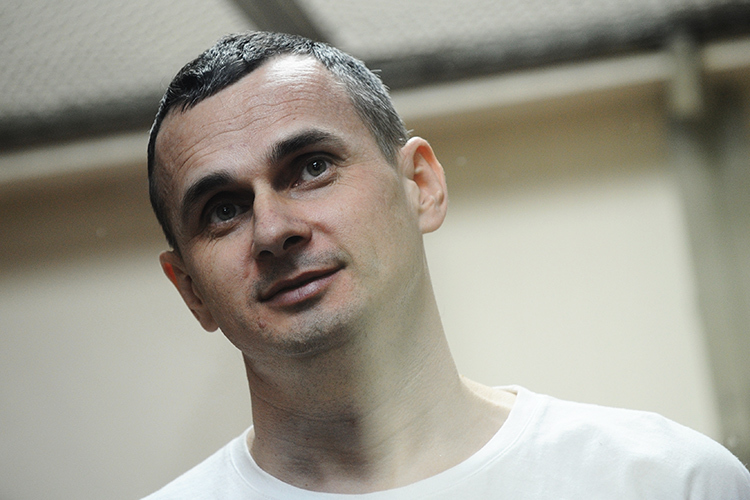
Detailed_pictureOleg Sentsov. Photo by Sergei Pivovarov. Courtesy of RIA Novosti and Colta.Ru 

On May 14, 2018, Oleg Sentsov went on an indefinite hunger strike in a penal colony located north of the Arctic Circle. His only demand is the release of all Ukrainian political prisoners in Russia. According to Memorial’s list, there are twenty-four such prisoners.

In August 2015, Sentsov was sentenced to twenty years for organizing a terrorist community and planning terrorist attacks. The second defendant in the case, Alexander Kolchenko, was sentenced to ten years in prison. Mediazona has published transcripts of the hearings in their trial. Around three hundred people have read them over the last three years. The transcripts make it plain the only evidence of the alleged terrorist organization’s existence was the testimony of Alexei Chirniy, who was not personally acquainted with Sentsov. It is police footage of Chirniy’s arrest while he was carrying a rucksack containing a fake explosive device that propagandists often pass off as police footage of Sentsov’s arrest.

Before his arrest, Sentsov was an Automaidan activist. In the spring of 2014, he organized peaceful protests against Crimea’s annexation by Russia.

“Yesterday’s ‘suicide bomber auto rally’ took place in Simferopol yesterday, but in quite abridged form,” Sentsov wrote on Facebook on March 12, 2014. “Only eight cars, six reporters with cameras, and twenty-five activists/passengers assembled at the starting point. I would have liked to have seen more. Unfortunately, most of the armchair revolutionaries who were invited were afraid to go. The traffic cops and regular police also showed up at the starting line, insisting we not leave for our own safety. We told them our protest was peaceful. We had no plans of breaking the rules, so we suggested they escort us to keep the peace for everyone’s sake.”

The second defendant, Kolchenko, admitted involvement in the arson of an office that was listed in the case file as belonging to the United Russia Party, but which in April 2014 was an office of Ukraine’s Party of Regions. The arson took place at night. It was meant to cause physical damage while avoiding injuring anyone.

The Russian authorities tried to prove both Sentsov and Kolchenko were linked with Right Sector, a charge that was unsubstantiated in Sentsov’s case and absurd in the latter case due to Kolchenko’s well-known leftist and anarchist convictions. Gennady Afanasyev, the second witness on whose testimony the charges against the two men were based, claimed he had been tortured and coerced into testifying against them.

Sentsov and Kolchenko’s show trial, like the show trials in the Bolotnaya Square Case, were supposed to show that only a handful of terrorists opposed the referendum on Crimea’s annexation and thus intimidate people who planned to resist assimilation. The Russian authorities wanted to stage a quick, one-off event to intimidate and crack down on anti-Russian forces. But two circumstances prevented the repressive apparatus from working smoothly. The first was that the defendants did not make a deal with prosecutors and refused to acknowledge the trial’s legitimacy. The second was that Automaidan activist Oleg Sentsov unexpectedly turned out to be a filmmaker, provoking a series of public reactions ranging from protests by the European Film Academy to questions about whether cultural producers would be capable of blowing up cultural landmarks. Segments of the Russian film community reacted to the situation with cold irritation. According to them, Sentsov was a Ukrainian filmmaker, not a Russian filmmaker, and he was not a major filmmaker. The owner of a computer club in Simferopol, his semi-amateur debut film, Gamer, had been screened at the festivals in Rotterdam and Khanty-Mansiysk, while release of his second picture, Rhino, had been postponed due to Euromaidan.

The Ukrainian intelligentsia have equated Sentsov with other political prisoners of the empire, such as the poet Vasyl Stus, who spent most of his life in Soviet prisons and died in Perm-36 in the autumn of 1985, a week after he had gone on yet another hunger strike. The Ukrainian authorities see Sentsov, a Crimean who was made a Russian national against his will and is thus not eligible for prisoner exchanges, as inconvenient, since he smashes the stereotype of the treacherous peninsula, a part of Ukraine bereft of righteous patriots. Sentsov’s death on the eve of the 2018 FIFA World Cup would be a vexing, extremely annoying nuisance to the Russian authorities.

Sentsov is an annoyance to nearly everyone, but he is a particular annoyance to those people who, while part of the Russian establishment, have openly defended him, although they have tried with all their might to avoid noticing what an inconvenient figure he has been. Although he was not a terrorist when he was arrested, he has become a terrorist of sorts in prison, because his trial and his hunger strike have been a slowly ticking time bomb planted under the entire four-year-long post-Crimean consensus, during which some have been on cloud nine, others have put down stakes, and still others have kept their mouths shut. Yet everyone reports on the success of their new endeavors on Facebook while ignoring wars abroad and torture on the home front. Sentsov represents a rebellion against hybrid reality and utter compromise, a world in which Google Maps tells you Crimea is Russian and Ukrainian depending on your preferences. To what count does “bloodlessly” annexed Crimea belong, if, four years later, a man is willing to die to say he does not recognize the annexation?

The success of Gamer on the film festival circuit, which made Sentsov part of the international film world, and his current address in a prison north of the Arctic Circle beg three questions. What is culture? Who produces culture? What stances do cultural producers take when they produce culture? There are several possible answers. Culture is a tool for reflection, a means for individuals and societies to achieve self-awareness and define themselves. It is not necessarily a matter of high culture. In this case, we could also be talking about pop music, fashion, and rap. (See, for example, the recent documentary film Fonko, which shows how spontaneous music making has gradually been transformed into a political force in post-colonial Africa.) On the contrary, culture can be a means of spending leisure time for people with sufficient income, short work days, and long weekends.

Obviously, the culture produced in Russia today under the patronage of Vladimir Medinsky’s Culture Ministry is not the first type of culture, with the exception of documentary theater and documentary cinema, but the founders of Theater.Doc have both recently died, while Artdocfest has finally been forced to relocate to Riga. The compromised, censored “cultural production” in which all the arts have been engaged has no way of addressing any of the questions currently facing Russia and the world, from shifts in how we view gender and the family (for which you can be charged with the misdemeanor of “promoting homosexualism”) to the relationship between the capitals and regions (for which you can charged with the felony of “calling for separatism”). Crimea is an enormous blank spot in Russian culture. Donbass and the rest of Ukraine, with which Russia still enjoyed vast and all-pervasive ties only five years ago, are blank spots. But cultural producers have to keep on making culture, and it is easier to say no one is interested in painful subjects and shoot a film about the complicated family life of a doctor with a drinking problem and a teetotalling nurse.

When we speak of the second type of culture—culture as leisure—we primarily have in mind Moscow, which is brimming over with premieres, lectures, and exhibitions, and, to a much lesser extent, Russia’s other major cities. So, in a country whose population is approaching 150 million people, there is a single international film festival staged by a local team for its hometown, Pacific Meridian in Vladivostok. All the rest are produced by Moscow’s itinerant three-ring circus on the paternalist model to the delight of enlightened regional governors. It matters not a whit that one of them ordered a brutal assault on a journalist, nor that another was in cahoots with the companies responsible for safety at the Sayano-Shushenskaya Dam, where 75 people perished in 2009. What matters is that the festival movement should go on. There is no room in this model for local cultural progress. There can be no free discussion generated by works of art when everyone is engaged in total self-censorship. After I went to Festival 86 in Slavutych, whose curators have been conceptually reassessing the post-Soviet individual and the post-Soviet space, I found it painful to think about Russian film festivals. This sort of focused conceptualization is impossible in Russia. It is of no interest to anyone.

There are two more possible answers to the question of what culture is. Culture is propaganda. Or, finally, culture is only the marquee on a commercial enterprise profiting at the taxpayer’s expense. It is not a big choice, and the kicker is that by agreeing today to be involved in churning out propaganda, milking taxpayers, supplying optional leisure time activities, producing censored works, and colonizing one’s own countrymen for the sake of money, status, and membership in a professional community, the people involved in these processes automatically stop making sense. It is naïve to think the audience has not noticed this forfeiture. It is no wonder the public has an increasingly hostile reaction to cultural producers and their work.

No one has the guts to exit this vicious circle even in protest at the slow suicide of a colleague convicted on trumped-up charges, because it would not be “practical.” The events of recent months and years, however, should have transported us beyond dread, since everyone without exception is now threatened with being sent down, the innocent and the guilty alike.

Post-Soviet infantilism is total. It affects the so-called intelligentsia no less than the so-called ordinary folk. Infantilism means being unable to empathize, being unable to put yourself in another person’s shoes, even if that person is President Putin, a man with a quite distinct sense of ethics, a man who has been studied backwards and forwards for twenty years. Apparently, the message sent to the creative communities through the arrest of Kirill Serebrennikov was not registered. If you want to be a dissident, start down the hard road of doing jail time for misdemeanor charges, facing insuperable difficulties in renting performance and exhibition spaces, becoming an outsider, and experiencing despair. If you want a big theater in downtown Moscow, play by the rules. Like your average late-Soviet philistine, Putin regarded the creative intelligentsia with respect at the outset of his presidential career. (See, for example, footage from his visit to Mosfilm Studios in 2003.) However, a few years later, he was convinced the creative intelligentsia was a rampantly conformist social group who would never move even a millimeter out of its comfort zone and would make one concession after another. A lack of self-respect always generates disrespect in counterparts.

By signing open letters while remaining inside the system and not backing their words with any actions whatsoever, the cultural figures currently protesting the arrests of colleagues are viewed by the authorities as part of the prison’s gen pop, while people who live outside Moscow see them as accomplices in looting and genocide. No one takes seriously the words of people who lack agency. Agency is acquired only by taking action, including voluntarily turning down benefits for the sake of loftier goals. The acquisition of agency is practical, because it is the only thing that compels other people to pay heed to someone’s words. I will say it again: the acquisition of agency is always practical. At very least, it generates different stances from which to negotiate.

Sentsov has made the choice between sixteen years of slow decay in a penal colony and defiant suicide in order to draw attention not to his own plight, but to the plight of other political prisoners. Regardless of his hunger strike’s outcome, he has generated a new scale for measuring human and professional dignity. It is an personal matter whether we apply the scale or not, but now it is impossible to ignore.

Thanks to Valery Dymshits for the heads-up. Translated by the Russian Reader
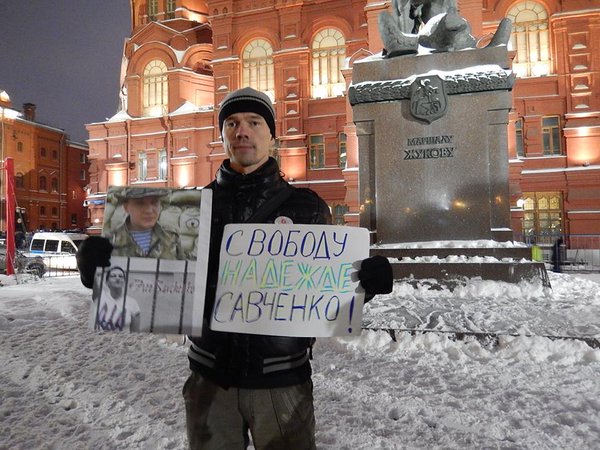
Maria Eismont: The Case of Ildar Dadin

Ildar Dadin, protesting the imprisonment of Ukrainian pilot Nadja Savchenko. Photo courtesy of Russian Avos
Ildar Dadin, protesting the imprisonment of Ukrainian fighter pilot Nadja Savchenko. Photo courtesy of Russian Avos

Maria Eismont
The Case of Ildar Dadin
Why Society Has Not Ignored a Story about Torture in Prison
Vedomosti
November 10, 2016

The controversy provoked by activist Ildar Dadin’s letter about the torture and abuse to which he and other prisoners have been subjected in the Segezha prison colony has been simmering for two weeks. The longer the topic of the inhumane treatment visited on people in penitentiaries occupies the media, including state TV channels, which have been forced to join the discussion of Dadin’s plight, the more likely society will be able to change things. Daily publications containing fresh testimonies about torture in Russian prisons have shown Dadin’s case is not unique. However, no controversies over violence in prisons have yet led to serious reforms of the penitentiary system or even a significant descrease in the number of “torture” colonies.

So what is different about the Dadin case? First, even Dadin’s ideological opponents have recognized him as a prisoner of conscience. Who seriously believes in the necessity of sending somone to prison for a series of peaceful solo pickets? Second, his obvious innocence in the eyes of the rank and filke attracts the attention of people unable to sympathize with criminals to torture in prisons. Third, Dadin has declared he is fighting not just for himself but for all convicts who are beaten and humiliated. He has conveyed via his lawyer that he has no wish to be transferred to another prison.

“He is convinced he has no right to be saved if he doesn’t help those who stay in the colony,” said Ksenia Kostromina, his attorney.

His conviction, bordering on obstinancy, his idealism on the verge of naïveté, and his sincere willingness to sacrifice himself to save others have made Dadin a much greater threat to the system than its consistent and predictable foes.

Dadin and the prison wardens are two different worlds, worlds that do not understand each other. And when Dadin speaks about constitutional rights from a libertarian viewpoint, the prison wardens think they are being mocked in a sophisticated way,” Igor Kalyapin, member of the Human Rights Council, told Vedomosti.

This difference in outlooks manifested itself recently in the trial of Nizhny Novgorod policemen accused of employing violence against detainees. (Ultimately, they got off with probationary sentences.) Their defense attorney assured the court they had in fact been “fulfilling the president’s May decrees,” while the accused themselves claimed they had been “defending the Motherland.”

Yet there are reasons to regard the situation with cautious optimism. One of them is the offer made to Anna Karetnikova, the most active member of the Moscow Public Monitoring Commission’s last three rosters, to work in the Federal Penitentiary Service. The second is the unexpected encounter between activists who had gathered outside the Federal Penitentiary Service’s central office, after the publication of Dadin’s letter, with Valery Maximenko, deputy head of the service, and his public promises to meet regularly with the activists to discuss pressing issues. The third is the proposal to hold primaries for the Public Monitoring Commissions, which could result in the return of prominent human rights activists to the commissions. All this will be possible if civil society maintains its interest in the topic.

Translated by the Russian Reader. Thanks to Comrade Uvarova for the heads-up.

The Zhanaozen Massacre: Four Years Later

Kazakhstan: who ordered the killings and tortures?
People and Nature
December 13, 2015

Who ordered police to shoot down oil workers demonstrating for fair living standards? Who organised the torture of activists in police cells?

Four years after police killed at least 16 demonstrators and injured 60 more in the oil city of Zhanaozen in western Kazakhstan, trade unionists and human rights campaigners are demanding answers.

They will spell out their calls for justice again on Wednesday this week, the fourth anniversary of the massacre, on December 16, 2011.

After the killings, some rank-and-file police officers who opened fire were jailed, and some local officials punished for corruption offences. But those who organised and instigated the crackdown have so far escaped justice.

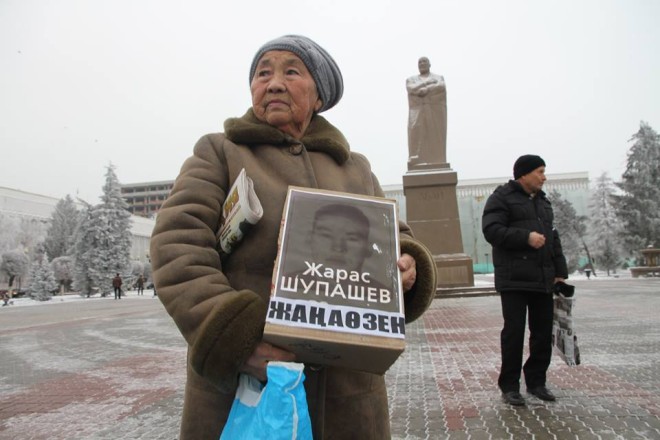
Demonstrators in Uralsk, Kazakhstan, on the third anniversary of the Zhanaozen massacre last year. Photo: R. Uporova/ Uralskaya Nedelya newspaper

Demonstrators in Uralsk, Kazakhstan, on the third anniversary of the Zhanaozen massacre last year. Photo: R. Uporova/ Uralskaya Nedelya newspaper.

The well-documented use of torture against trade union activists after the massacre has gone unpunished.

Demands for an independent international enquiry, by the United Nations and international trade union federations, have not been met.

In the Kazakh oil fields, workers have been told they will be sacked if they dare to mark the anniversary on Wednesday. Activists in Ukraine, Russia and elsewhere will demonstrate at Kazakhstan’s embassies. If you live in another country, you can mark the anniversary by sending a message of support or taking any other type of solidarity action. (See links at the end.)

Here is an update on the campaign for justice for those killed, injured and tortured while fighting for workers’ rights.

Justice for those killed and injured on 16 December 2011

Statements about the Zhanaozen killings by the Kazakh authorities contradict each other, contradict accounts by other witnesses, and are difficult to reconcile with video and audio recordings made on the day.

Trade unionists and international campaign organisations supporting the oil workers’ families fear that, by jailing a small number of officers – all of whom have now been released – the government hoped to cover up the chain of command that led to the killings.

Journalist Saniya Toyken, who is based in the Mangistau region (which includes Zhanaozen), this month explained in an article (link to Radio Azattyq site here, Russian only) that:

■ On 18 December 2011, two days after the Zhanaozen killings, Kazakh internal affairs minister Kalmukhanbet Kasymov denied that anyone had ordered police officers to open fire on peaceful demonstrators. He claimed that police were unarmed, but went to fetch Kalashnikov rifles and ammunition after disorder broke out.

■ On the same day, the Kazakh general prosecutor admitted that 15 people had been killed in the course of the forcible response to the oil workers’ demonstration. Ten days later, on 27 December 2011, the prosecutor announced that five officers would be charged for “exceeding their legal powers.” At a trial in April-May 2012, five officers were found guilty of “exceeding their legal powers with the use of firearms.” The indictment against one, police colonel Kabdygali Utegaliev (who received the heaviest sentence, of seven years), referred to him “giving an order to use weapons.”

■ At the trial it was stated that police lieutenant-colonel Bekzhan Bagdabaev, former head of the department for combating extremism of the department for internal affairs, had killed Zhanar Abdikarimova, a peaceful resident of Zhanaozen – and that the same bullet that killed Abdikarimova had also struck Rakhat Tazhmivanov and Rzabek Makhambet. The

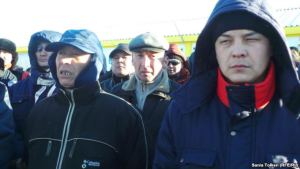
Oil workers at Munaifildservis in the Mangistau field at a meeting in February 2014. Photo: Saniya Toiken

Oil workers at Munaifildservis in the Mangistau field at a meeting in February 2014. Photo: Saniya Toiken

charges against three other officers (colonel Erlan Bakytkaliuly, senior lieutenant Rinat Zholdybaev and police captain Nurlan Esbergenov) mentioned deaths of, and injury to, specific victims.

■ Another victim, Bazarbai Kenzhebaev, died as a result of injuries received in police detention after the demonstration. Zhenisbek Temirov, who had been the officer in charge, was also jailed – again on charges of “exceeding his legal powers” – and made to pay 1 million tenge (about $5000) to Kenzhebaev’s family.

■ The verdicts were publicly questioned by Bagdabaev’s wife, Gulzhikhan, who in a media interview said that her husband had not opened fire and had been unjustly punished, whereas those who had used their weapons – and could be clearly seen doing so on videos – had not been brought to justice.

Relatives of massacre victims expressed dissatisfaction with the trial’s outcome, and demanded that charges of murder – rather than “exceeding legal powers” – be brought. In August 2012 they took an appeal to the regional cassation court (which re-examines legal issues, but not evidence). Judge Doszhan Amirov confirmed the trial decision but said that the question of murder charges “remained open.”

The relatives, and human rights organisations who supported them, reacted fiercely to a statement made during the officers’ trial that “unknown police officers used unregistered weapons without permission.”

Asel Nurgazieva, the legal representative of victims’ families, said: “How can police officers be described as ‘unknown’? This would mean that the whole state does not know who it employs and in whose hands it places weapons.”

Max Bokaev of the human rights campaign group Arlan, who acted as a trial observer, said in a recent interview with Toyken that while police officers’ faces were not visible in videos – which were in any case not used as evidence – their voices could be identified from sound recordings. “Now it will be complicated to ascertain who concretely shot and killed people, but those who gave the orders could be identified,” he said.

Ninel Fokina of the Helsinki committee in Almaty pointed out that there was no provision in Kazakh law for civil society to monitor the use of weapons by state agencies.

In addition to the shootings at Zhanaozen, firefighter Serik Kozhaev was killed, and 11 people injured, when police opened fire on demonstrators at the nearby railway station of Shetle on November 16, 2011. A week later, a local internal affairs ministry official, Serik Kozhaev, told journalists that police officers had fired on the crowd.

“That firefighter was on the other side [i.e. the demonstrators’ side]”, Kozhaev said. “Who opened fire? We did! We have the right to use service weapons in life-threatening situations.” Kozhaev claimed that some of the demonstrators were armed, but no evidence of this was brought to court.

One day, hopefully, our campaign efforts will lead to a genuine investigation of the killings. Then, a list of the senior security services officers responsible for the police action – compiled by Saniya Toyken, and reproduced below (“Officials with questions to answer”) – will come in useful.

Justice for trade unionists who were imprisoned and tortured

Security services officers who tortured trade unionists and their supporters  imprisoned after the Zhanaozen events have gone unpunished. These crimes have not even been investigated by the Kazakh authorities.

Thirty-seven Zhanaozen residents were tried in April-May 2012 for their part in the oil workers’ struggle, and 13 of them jailed. (More details here.) The trial judge passed numerous claims of torture, made in court, to the Mangistau district prosecutor’s office, which declined to open a criminal case, citing a lack of evidence. The office did not explain why it chose not to exercise its investigative function.

Kazakh human rights campaigner Erlan Kaliev, who acted as an observer at the oil workers’ trials, wrote on this site last year:

In court, the accused started publicly to deny the testimony that they had given during the investigation. They argued that they had been compelled to give that testimony under the strongest psychological and physical pressure from police officers. They spelled out concrete examples of how torture had been used against them.

The most common methods were suffocation with plastic bags; soaking with cold water at a temperature of minus 20 or minus 30 degrees; and hanging by the hair from the ceiling, as was the case with Roza Tuletaeva. The accused were made to stand for many hours, to sleep on the bare, or even iced-over, floor. They threatened to rape underage children, as became clear from the statements [in court] of Tanatar Kaliev and Roza Tuletaev. [Aleksandr] Bozhenko spoke of how they beat him mercilessly with switches [sheafs of branches] and jumped on him.

What’s more, all the victims gave the names of those who had treated them so brutally. They said that the perpetrators – police officers, prison staff or Committee of National Security operatives – very often made no attempt to cover up their identities. Their first names and surnames are in the court record. But there has been no investigation.

Victims of torture, listed in another recent article by Saniya Toyken (link here, Russian only), include:

■ Maksat Dosmagambetov, oil worker and trade union activist jailed at the 2012 trial and given conditional early release in February this year. He has cancer of his facial bones, apparently caused by the beating he received in police custody. In March, after his release, he travelled to South Korea for treatment. Dosmagambetov had pointed to a police officer and

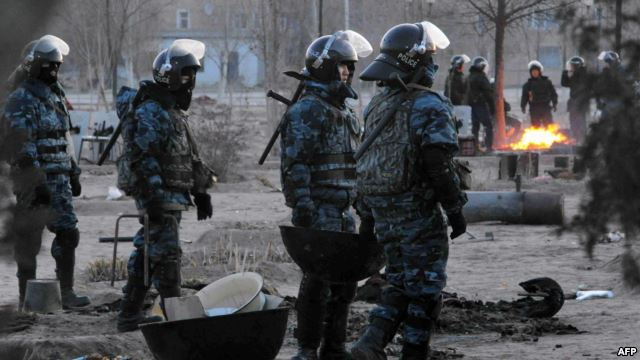
Police at Zhanaozen on 16 December 2011

Police at Zhanaozen on 16 December 2011

said: “You saw with your own eyes how they beat me and punctured my ears with a staple gun.” Another defendant, Tanatir Kaliev, repeated the claim. (Activists have not published the name of the officer, who has not been charged.)

■ Yesengeldy Abdrakhmanov, an unemployed man from Zhanaozen who was sentenced to three years’ imprisonment but released via an amnesty, told the court that he had contracted tuberculosis as a result of police torture. “I was stripped naked. They poured freezing water over me and beat me.”

■ Shabdol Otkelov, sentenced to five years, said in court that a security services officer “put a cellophane bag over my head and, stuffing it in to my mouth, forced me to confess to the preparation of explosives and to sign papers prepared by an investigator based in Astana [the capital of Kazakhstan].”

■ Roza Tuletaeva, a trade union activist who told the court she had been suffocated and hung by her hair, demanded that the tortures be investigated.

■ Kairat Adilov, sentenced to three years, told how an investigator put a gun to his head and threatened to shoot if he did not confess guilt.

■ Allegations of torture by police, prison officers and other security personnel were also made to the court by Ergazy Zhannyr, Serik Akzhigitov, Islam Shamilov, Bauyrzhan Telegenov, Zharas Besmagambetov, Samat Koyshybaev, Ertai Ermukhanov, Sisen Aspentaev, Zhenis Bopilov and Rasul Mukhanbetov.

■ Trial observers from Open Dialog say that, furthermore, six trial witnesses made allegations of torture in court. One, Aleksandr Bozhenko, who repeated the claims in television interviews, was murdered in unclear circumstances ten days later.

In 2013, Amnesty International accused Kazakhstan of “routinely” using torture, including in the Zhanaozen cases. (Amnesty report downloadable here.) Now some campaigners are calling for a “Zhanaozen list” of officials to be compiled, similar to the “Magnitsky list” drawn up by human rights activists in Russia, which led to the USA sanctioning security services officers involved in the ill-treatment and death in prison of lawyer Sergei Magnitsky.

Lyudmyla Kozlovska of the international campaign group Open Dialog, that has championed human rights cases in Kazakhstan, said in an interview with Saniya Toyken that putting together a list would take time. “The question of tortures is not being raised [by the authorities] in Kazakhstan, because it involves people at the highest levels of government.”

The UK connection

There are strong business links between the UK and Kazakhstan. BG Group (former British Gas, now merging with Shell) and other oil companies work there; Kazakh companies raise money through the London markets. Tony Blair, former prime minister, advised Kazakhstan’s government – including specifically encouraging them to hush up the Zhanaozen issue – and UK government ministers, together with Prince Andrew, keep the relationship sweet. GL, 13 December 2015.

■ Send solidarity messages via the Confederation of Labour of Russia (email ktr@ktr.su) and/or via the Justice for Kazakh oil workers facebook page, and/or via gabriel.levy.mail@gmail.com.

Kazakh oil workers information page

Kazakhstan: oil companies threaten activists

Officials with questions to answer

►Kalmukhanbet Kasymov, minister of internal affairs at the time of the Zhanaozen massacre, has twice been reappointed to that position. In 2014 he was awarded the Order of Honour, and in 2015 was given the rank of general-colonel.

►Amanzhol Kabylov, who was head of the department of internal affairs of Mangistau region, and was appointed commandant of Zhanaozen when the state of emergency was declared there after the massacre, has been promoted. He now works as the deputy chairman of the criminal investigation committee of the Astana police.

►Abkrasul Oteshov, former deputy head of the directorate of internal affairs in Zhanaozen, who was accused of torture at the oil workers’ trial, is currently deputy head of the directorate of internal affairs of Munailinsky district of Mangistau region. 

►Former head of the directorate of internal affairs of Zhanaozen, Mukhtar Kozhaev, has been promoted to a position as head of criminal police in Astana.

►Another deputy head of the directorate of internal affairs in Zhanaozen, Nuraly Barzhikov, who has said “I was on the square [where the shootings took place] and I used firearms,” remains at his post.

►Officer Marat Kyzylkuluky, who admitted using firearms, now works with the migration police in Zhanaozen.

►Colonel Ulykbek Myltykov, who said in court that he had not fired on fleeing demonstrators – and after being showed video vidence, said he “did not know why [officers] fired” – is currently head of the administrative police of the department of internal affairs of the Mangistau region.

►Former deputy head of the department of internal affairs of Mangistau region Erzhan Sadenov currently works as the head of the department of internal affairs transport division in Astana.  

__________

Kazakhstan: oil companies threaten activists
People and Nature
December 13, 2015

Oil company managers have warned workers not to demonstrate on the fourth anniversary of the Zhanaozen massacre, Kazakh opposition news sites reported last week.

A fresh wave of unrest is brewing in the oil field after the announcement of redundancies, caused by the falling oil price and company cutbacks. A Kazakh-Chinese drilling company laid off 200 people in August.

Activists jailed after the 2011 strikes – which ended with police killing at least 16, and wounding 60, when they opened fire on protestors on 16 December 2011 – are under special scrutiny. “The security services have

Roza Tuletaeva. Photo: Saniya Toyken

Roza Tuletaeva. Photo: Saniya Toyken

been active, and have carried out ‘preventive discussions’ with activists, especially those who have been released from prison,” Respublika newspaper reported.

“They have promised [the activists] that they will again be put behind bars, especially if they try to influence trade union elections, as happened on 21 November in Zhanaozen.”

Akzhanat Aminov, one of the activists who was jailed and conditionally released, has been given an additional one year suspended sentence. That was a response to his election in June this year as chairman of the trade union committee of Ozenmunaigaz, the largest state-owned oil production company, the socialismkz.info site reported.

Roza Tuletaeva, a prominent trade union activist who was jailed at the Zhanaozen trial, said last month in a telephone interview with Radio Azattyq that she is back at work in the well drilling division of Ozenmunaigaz. She expressed concern for the condition of Maksat Dosmagambetov, her fellow activist who is seriously ill following torture in detention. Roza added that she remains in touch with the 12 other workers jailed at the Zhanaozen trial.

While the Zhanaozen prisoners have now been released, the politician Vladimir Kozlov of the democratic movement Alga was last week denied conditional release terms. He was jailed in a general crackdown following the oil workers’ strikes, of which he was a prominent supporter. GL, 13 December 2015.

Editor’s Note. My profound thanks to Gabriel Levy for his permission to reproduce these articles here.