
What, really, have socialists learned from the Russian war on Ukraine? Has it changed our understanding of the way that imperialism works? Tell us we were right all along?
Reflecting on the first four years since the invasion, Oleksandr Kyselov, a Ukrainian socialist based in Sweden, wrote in February that Ukrainians found themselves “trying to safeguard our future free from foreign dictates, and simultaneously sacrificing any chances to actually have one”.
Subjected to polarising propaganda, exposed to the attacks by Russian ‘liberators’ on our homes and core infrastructure, watching arrogant sticky-fingered moralising elites surprisingly exempt from ‘common duty’, learning about a striking dependence of our ability to fight back on the political expediencies abroad, we may find out that a fragile ‘least unjust peace’ is the best we can get.
And still, even seeing all of this, too many of the European left are busy stretching familiar old frameworks over a changed world. As if continuing to hope that, should they just deny, condemn, and denounce loudly enough, selectively pontificating about internationalism while reinforcing the borders of their national units, they will be spared the new reality of the world.
This reinforced my scepticism about “the left” as a category. Its historic failure to consider, or draw lessons from, the tragedy of the Syrian revolution, emptied the term of much meaning. That’s how I saw it nine years ago, anyway – and Ukraine has made things worse.
This, in turn, raises another question. What about those sections of the “left” claiming to be Marxists? Can we seriously use the term “Marxist” to describe people who, during the largest military conflict of our lifetimes in Europe, have – as Kyselov puts it – kept denying, condemning and denouncing, in the hope of being “spared the new reality”?
I do not have a comprehensive answer to that. But here’s a contribution: comments on a lengthy article about “geopolitical fractures and the Marxist critique of imperialism” by Alex Callinicos, a well-known Marxist writer. I read it, hoping to find the theoretical underpinnings of the political stance of the Socialist Workers Party, of which Callinicos is a member, on the war. The SWP recognises Ukrainians’ right to resist the Russian invasion in words, but opposes it in practice (see Feature 5 below); since 2022, it has called for the withdrawal of Russian troops from Ukraine, but did not do so during the eight years (2014–22) that they propped up the tinpot Donbass dictatorships.
Callinicos deals with imperialism as a global phenomenon, referring as examples to the wars in Ukraine and Palestine. My comments focus only on Ukraine, and what that tells us about imperialism generally. Five features of his analysis stood out for me.
Feature 1. Callinicos dissolves the particular into the general.
Callinicos writes:
February 2022 [i.e. the all-out invasion of Ukraine] marked another, more threatening step-change in this conflict [between the western powers on one side and China-Russia on the other], with the outbreak of a major war on the European continent and the polarisation of the state system resulting from the mobilisation of [‘liberal internationalist’ scholar G. John] Ikenberry’s ‘global West’ behind Ukraine and China’s support for Russia. Rather than treat this fracturing of the international system as a series of discrete events, it is better to understand it as a developing global process of confrontation among the main imperialist powers. (My emphasis, SP.)
This is important, methodologically, in my view.
Surely the “global process of confrontation” is actually made up of “a series of discrete events”. Surely, our understanding of any global process has to be rooted in a convincing analysis of its parts. Instead of this, Callinicos proceeds from his understanding of the global process – a clash of imperialist camps – and, where the parts don’t fit, presents a flawed and inaccurate view of them.
Feature 2. Callinicos imagines an “expansion of Russian power” that does not accord with reality.
Callinicos sees Russia not as a declining empire, or as a subimperialist power with aspects of dependence on global capital, but as a would-be great power. He approvingly quotes Sergey Radchenko, who writes that “even though the Soviet Union collapsed under its own weight, its successor, Russia, still eyed a position of prominence in the global order”, and goes on to claim that Putin
[…] used Russia’s position in the global economy as one of the main energy producers to rebuild its military power and geopolitical influence externally.
Callinicos then surveys the activities of the Russian armed forces and the Wagner group in the Middle East and Africa, and asks, “What made possible this expansion of Russian power into MENA and beyond?” Answer: two “interconnected determinants”: (1) Russia exploited a gap left by the Obama administration’s efforts, after defeat in Iraq, to reduce US involvement in the Middle East; (2) regional powers based in the Middle East (Israel, Saudi Arabia and others) have become more self-assertive “with the emergence of new centres of capital accumulation in the region”; “global energy production adds a further dimension to these interstate manoeuvres”; and “Russia figures as an important partner to Saudi Arabia in the OPEC+ cartel”.
This creates the impression that over the past two decades Russian imperialism has become stronger. In reality, the opposite is true.
First: Russia’s position as a big energy producer is in many respects a source of weakness, not strength. In the early 2000s, Russia consolidated its position in the global economy as a highly dependent exporter of oil, gas and metals. Low oil prices in the 1990s exacerbated the post-Soviet economic crisis; in 2000-08, Russian capitalism strengthened as those prices rose, but the 2008 crash, and falling prices, exposed its extreme vulnerability.
Azerbaijan and its oil had been lost to Russia in the 1990s; in the 2000s it was replaced as the economically dominant power in central Asia by China and the western powers. And it was losing ground to the European powers in Belarus, the Baltic states, and of course Ukraine. The Russian elite was well aware of this and obsessed throughout the 2000s about the dangers of dependence on oil revenues and the need to diversify the economy. That did not happen.
It could be argued that Russia’s dependence on commodities revenues was a key factor that eroded its “great power” status. To suggest, as Callinicos does, that its status as an energy producer enhanced that status is mistaken.
Second: as for Russia’s military adventures in the Middle East and Africa, look how they ended. Bashar al-Assad’s regime was toppled in Syria, in large part because Russia was unable and/or unwilling to provide the military support needed to protect him.
Putin faced the Maidan uprising in Ukraine in 2014 as the leader not of a power gaining in economic or political strength, but of a weakening power that had to compensate for its subordinate position in the global economy, and the fragility of its social base at home, by ramping up nationalist rhetoric and shifting towards a more authoritarian method of rule.
It is noteworthy that Rob Ferguson, another writer in SWP publications, does not share Callinicos’s eccentric view of Russian power. In 2022, he concluded, in an analytical article – with a measure of understatement, but still – that “Russia’s energy and raw material base was still insufficient to overcome the vast disparity in economic and military power with NATO – as well as China”. This, Ferguson argued, “intensified the pressure on the Russian state to demarcate its regional hegemony, putting the question of the states along the Eurasian faultline at the fore of Russia’s concerns”.[1]
Feature 3. Callinicos imagines western military support for Ukraine as a cause, not an effect.
Proceeding from the general (“global process of confrontation”) to the particular (“a discrete series of events”), Callinicos presents a version of one aspect of these events – western military support for Ukraine – that does not bear serious scrutiny. Referring to the all-out invasion of 2022, he writes:
The war itself thus represented a radicalisation of the global struggle that was already developing between Washington, Beijing and Moscow.
He then qualifies that statement, in three sentences that I deal with below (Feature 4), where he acknowledges that “traditional Great Russian nationalism” may have played a part in causing the war, but hastily insisting that it is “no simple struggle for self-determination”. And then he writes:
The US and other Western powers were heavily involved in training and supporting the Ukrainian military from 2014-15 onwards.
Then he quotes newspaper articles detailing cooperation between the Ukrainian intelligence services and the CIA in gathering intelligence on Russia. And then:
The massive surge in weapons supplies to Ukraine by the NATO powers and closely aligned states such as Australia must be seen in this context. From the Western side, the Ukraine conflict has been a proxy war waged to weaken and drain a potential challenger, an inter-imperialist conflict in the kind of terms that Lenin and Luxemburg characterised in the first world war.
This is playing ducks and drakes with reality. Its inclusion in a theoretical article shows how shaky its foundations are.
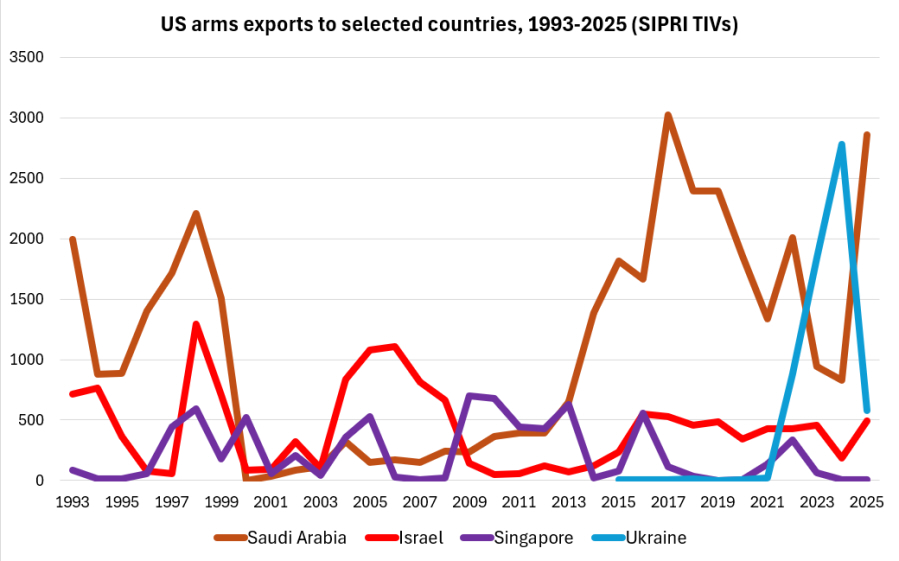
For a start, the intelligence operations referred to are only one part of a larger picture. From 2014 Ukraine was fighting a war, the prosecution of which required not just intelligence but heavy weapons. It received utterly negligible supplies of these from the western powers until 2022. As the chart shows, the Stockholm International Peace Research Institute registered US arms exports to Ukraine as zero until 2015. Note that the chart, sourced from SIPRI’s database, measures exports with the institute’s standard method, the trend-indicator value (TIV).[2] In 2015 US arms supplies to Ukraine were 4 TIVs, compared e.g. with 92 TIVs to Greece and 112 TIVs to Norway. In 2021, when all those CIA agents referred to were well aware of the Russian troop build-up on Ukraine’s border, US arms exports to Ukraine remained negligible: 20 TIVs compared with 39 TIVs to Canada and 139 TIVs to Singapore.
The graph shows US arms exports to Ukraine, with those to Saudi Arabia, Israel and Singapore included for comparison. The table shows the top 20 recipients of US arms exports in 1993–2025; even including three years of war (2022–25), Ukraine only gets to 16th place.

The negligible level of western arms supply to Ukraine between 2014 and 2021, when it was fighting a defensive war against a larger aggressor, was preceded by more than two decades during which (1) in 1994 the US helped to convince Ukraine to give up its nuclear arsenal, (2) NATO accepted eastern European countries into membership, and (3) NATO forces in Europe were substantially reduced from cold war levels (the number of US tanks in Germany fell from 5000 in 1990 to zero in 2013).
Callinicos says the US and UK are “training and supporting the Ukrainian military”, without saying that this “support” included starving Ukraine of weapons supplies. He refers to a “massive surge in weapons supplies”, but omits that this was a reaction to the 2022 invasion. Cause and effect are reversed. Such game-playing does not deserve to be taken seriously.
Feature 4. Callinicos refers only once, and in passing, to the social dynamics in Ukraine, and in Russia, during the period under discussion.
Having stated that the 2022 invasion was a “radicalisation of the global struggle”, the next three sentences read:
Pace the [“realist” scholars John] Mearsheimer and [Sebastian] Rosato, the Russian invasion seems [“seems”!] not to have been simply an instrumentally rational response to NATO expansion and Ukraine’s increasingly close alignment with the US, but arises also from an ideological investment, certainly on Putin’s part, in traditional Great Russian nationalism that denies Ukraine a distinct identity. The assertion of that identity informed the Ukrainian national mobilisation that helped to block and push back the initial advance on Kyiv. But this war is no simple struggle for self-determination.
This is the only reference to the Kremlin’s nationalism, and the only reference to Ukrainian society, in the entire article of 12,500+ words.
Callinicos does not even discuss the idea that the social turbulence reflected in the Maidan – from socially progressive, to pro-European, to outright reactionary – needs examining. Nor the social dynamics in Russia that have pushed the elite towards an authoritarian, near-fascist style of rule, and – in the view of many Marxist writers – towards all-out war.
Callinicos acknowledges that Ukraine’s assertion of “a distinct identity” “informed the national mobilisation”, but does not comment on what the significance of that might be, either historically or in the twenty-first century. He writes that the war is “no simple struggle for self-determination” (not many wars are “simple”), but only to return to his erroneous portrayal of the extent of western involvement.
This is where dissolving the particular into the general (see Feature 1 above) becomes a problem.
Would you look at Brexit as part of the “developing global process of confrontation among the main imperialist powers”, without also considering the social dynamics in the UK – the advance of neo-liberalism, the surge of right-wing populism, the travails of the labour movement, the effects of de-industrialisation and dependence on financial and service industries?
Would you look at the Malvinas war as part of the “developing global process of confrontation among the main imperialist powers”, without also considering the class struggles in Thatcher’s Britain and Galtieri’s Argentina?
What, then, is the credibility of an “analysis” of the Russian war on Ukraine that starts from a preconception about the “global process of confrontation”, and fails to mention the class struggle and other forms of social change in either Russia or Ukraine?
This approach says something about the development of Marxism, in my view. The stated aim of Callinicos’s article is to show how the Marxist critique of imperialism “can encompass empirically aspects of the present conjuncture that liberalism and realism are unable to account for”. He does not explain why the social forces at work in Ukraine, and in Russia, should not be treated as one of these aspects.
This not only holes his argument below the water-line in the ways I have mentioned. It also misses an important opportunity to engage with the body of serious Marxist scholarship – by Ilya Matveev (Russia), Daria Saburova (Ukraine), Yassin al-Haj Saleh (Syria), Kavita Krishnan and Rohini Hensman (India)[3] and many others – who see these social forces, and the Kremlin’s reaction to them, as central to the causes of the Russian war.
It would be a cheap shot to criticise Callinicos or anyone else for something they have not written, and that is not my point. Rather, that the reluctance to engage with other Marxists can only obstruct the development of Marxism as a living body of ideas.
Feature 5. Callinicos separates analysis from politics.
Of course many Marxists working in universities have in recent decades increasingly detached analysis of politically urgent issues from political commentary that might inform the labour movement and social movements. So this is a much wider problem than one for Callinicos alone. But in his article, published by a non-academic socialist journal, he takes this to an extreme.
The SWP, of which Callinicos is a member, (i) between 2014 and 2022, made no call for the withdrawal of Russian troops, and raised no challenge to those “lefts” who vigorously supported the Russian-backed tinpot dictatorships in the Donbas,[4] (ii) condemned the Russian invasion of 2022, but, along with post-Stalinists, portrayed NATO expansion as its primary cause, (iii) acknowledged the right of Ukrainians to defend themselves from invasion in words, but opposed it in practice, and (iv) supported calls in the UK labour movement to end arms supplies to Ukraine.

It is worth considering what the SWP actually means by the Ukrainian people’s “right to resist the invasion”, as a statement by the international network they belong to put it, since this is combined with a demand on western governments for “no arms shipments to Ukraine!”
How are people to resist an invasion, without arms from western governments? Some people favour arms provided by civil society (inevitably a tiny supply compared to what the state provides). And so Ukrainians living abroad, and civil society groups, have raised millions of euros to support civil defence (drone factories, medical supplies, etc). Trade unionists and e.g. anarchist groups participate – but the SWP does not.[5]
For some SWP members, the “right to resist the invasion” does not even extend as far as the right to ask for weapons, let alone to receive them.
For example, SWP members worked hard but unsuccessfully to defeat a resolution passed by the National Education Union conference in April last year, supporting not the export of arms to Ukraine by the UK government but “the right of Ukraine to self-defence and to resist Putin’s occupation, including the right to seek arms to defend itself”.
Similarly, when the Universities and Colleges Union conference decided in 2024 to endorse an appeal by the Confederation of Free Trade Unions of Ukraine to western governments to send military aid, SWP members sought through conference procedure to block that call from being heard.[6]
Of what does the “right to resist the invasion” consist, if not of the right to ask for weapons, be it from western governments, Ukrainians abroad, or anyone else? This is not just about politics, but about socialist morality.
Callinicos does not comment on this in his article. Its function, rather, is to provide these damaging, and I would say immoral, politics, with a “theoretical” justification: the fragile, general assertions about the “global process of confrontation”, the false picture of Russian imperialism, the reversal of cause and effect, and the blank spot where society should be.
In my view, the development of Marxism as a meaningful approach to the problems that capitalism is throwing at us in the twenty-first century will mean rejecting this kind of imposition of political dogma on to analysis – what Kyselov calls “stretching familiar old frameworks over a changed world”. 7 September 2026
□ Thanks to Links journal for reposting this article.
[1] Robert Ferguson, “Imperialism, war and the Eurasian faultline”, International Socialism 175, June 2022.
[2] SIPRI has over decades of research developed the TIV as a common unit, “based on the known unit production costs of a core set of weapons and intended to represent the transfer of military resources rather than the financial value of the transfer”. There is a full explanation here.
[3] See, for example, Ilya Matveev, “The War in Ukraine and Russian Capital: from military-economic to full military imperialism” (Alameda Institute, 2023) and “Between Political and Economic Imperialism: Russia’s Shifting Global Strategy” (Journal of Labour and Society, 2021); Daria Saburova, Travailleuses de la résistance. Les classes populaires ukrainiennes face à la guerre (Autonomies, 2024); Yassin al-Haj Saleh, “Why Ukraine is a Syrian Cause” (Dawn, 2022); Kavita Krishnan, “Our indifference to Ukraine did harm to our struggle in India”, Commons, 2023; Rohini Hensman, Indefensible: Democracy, Counterrevolution, and the Rhetoric of Anti-Imperialism (Haymarket, 2018).
[4] In 2014, Eamonn McCann, for many years a leading figure in the SWP’s sister organisation in Ireland, argued that, with regard to Ukraine, “If we have to take sides […] Ireland should side with the Russians”. For the SWP’s newspaper, war crimes by Russia and its allies, e.g. the shooting down of the MH17 civilian aircraft, were to be blamed on “imperialist rivalry” (see also here and here).
[5] I expressed my own view of these difficult issues e.g. here.
[6] For those interested in trade unions’ arcane conference procedures, see motion 29 (moved by pro-Ukrainian activists) and amendment 29A (moved by SWP members) here.


 ‘Ere, 2018. Graffiti found in Central Petersburg. Photo by the Russian Reader