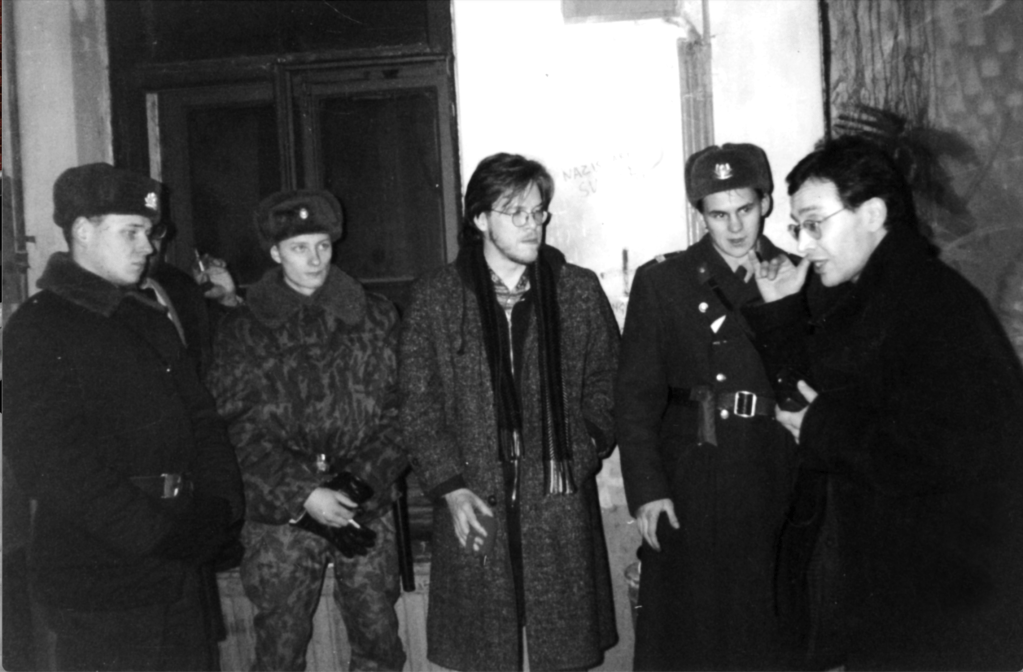
“Our characters find themselves trapped in confined spaces where both physical and emotional tensions escalate.”

“The Cop Party,” an early edition of The Russian Reader, which started life as a series of happenings.
Pushkinskaya 10 artists’ squat, Petersburg, circa 1995

What’s the point of this flash mob? The nostalgia of aging people for their own youth? The illusion of normality in a situation of growing abnormality? The illusion of solidarity in a situation where all sociability is disintegrating?

Source: Sergey Abashin (Facebook), 6 February 2024. Translated by 21 Jump Street


Hundreds of thousands of Instagram users responded to a recent prompt asking them to post pictures of their younger selves. Photo quality varies.

Most of the photos are slightly faded. The hairlines fuller. Some feature braces. Old friends. Sorority squats and college sweethearts. Caps and gowns. Laments about skinny jeans and other long lost trends.

This week, Instagram stories the world over have been awash with nostalgic snapshots of youthful idealism — there have been at least 3.6 million shares, according a representative for Meta — as people post photos of themselves based on the prompt: “Everyone tap in. Let’s see you at 21.”

The first post came from Damian Ruff, a 43-year-old Whole Foods employee in Mesa, Ariz. On Jan. 23, Mr. Ruff shared an image from a family trip to Mexico, wearing a tiny sombrero and drinking a Dos Equis. His mother sent him the photo, Mr. Ruff said in an interview. It was the first time they shared a beer together after he turned 21.

“Not much has changed other than my gray hair,” he said. “I see that person and go, ‘Ugh, you are such a child and have no idea.’”

Mr. Ruff created the shareable story template with the picture — a feature that Instagram introduced in 2021 but expanded in December — and watched it take off.

“The amount of people that have been messaging me and adding me on Instagram out of nowhere, like people from around the world, has been crazy,” Mr. Ruff said.

[…]

Source: Sopan Deb, “‘Let’s See You at 21’ Puts Fun Spin on the Unrelenting March of Time,” New York Times, 1 February 2024


Maybe it’s not all so bad, and millions of people just wanted someone to see them as young and hot 21-year-old guys and girls who had everything ahead of them, all doors were open, and there were no obstacles to achievement. It’s good if these photos amuse them, rather than drive them to despair, if the person in the photo hasn’t achieved what he or she dreamed of at 21.

On the other hand, by scrolling through their Facebook feed with the “I am 21” flash mob, users see hundreds and thousands of photos of unknown people in foreign cities that mean nothing to them. What is the practiccal point of this flash mob? For users of Facebook, who have been posting numerous photos for years, there is no point.

Psychologists have long ago explained why people dump so many photos, including selfies, onto social networks: they have a need for constant approval and a desire to escape from unpleasant reality into a beautiful and easy virtual world where everything is fine. They’re also a means of communicating, showing off, and flirting. And if the “retro,” “things used to be better,” or “how young we were” option is enabled, nostalgic group sobs, likes, and reposts are guaranteed.

“We don’t think about artificial intelligence when we post our photos on social media, simply because the vast majority of us have no idea how neural networks are trained, or how algorithms work. We just wonder why topical ads jump out at us immediately when we think of something, but then we forget about it. Artificial intelligence isn’t Skynet from the Terminator movies at this point, but it’s something we’re going to be dealing with more and more. And protecting our personal information should worry us more than before,” says data science expert Yevgeny Galin. “Putting personal photos in the public domain is no toy or form of entertainment. We don’t know who could use them and for what purposes. I have no doubt that those purposes are illegal. And I wouldn’t count on social networks being conscientious about privacy policies. There’s nothing private on the internet. Facebook is already pretty good at recognizing faces and tagging people in photos.”

Training AI to recognize faces even in poor-quality black-and-white photos from the last century is proceeding by leaps and bounds. In many countries, identifying individuals with street surveillance cameras is already almost permitted by the constitution. And artificial intelligence is dependably replenishing the database of inhabitants of cities, countries, and continents. After all, it is so easy, especially if people post info about themselves on the World Wide Web.

Public figures who post their photos may well be involved in some kind of scam using deepfake technology.

Yes, we may be once bitten, twice shy, but caution in this case can’t hurt.

Source: Dina Vishnevski, “I’m 21: Facebook’s nostalgic flash mob is just a simulator for AI,” kp.ua, 7 February 2024. Translated by 21 Jump Street
There Is Power in a Union

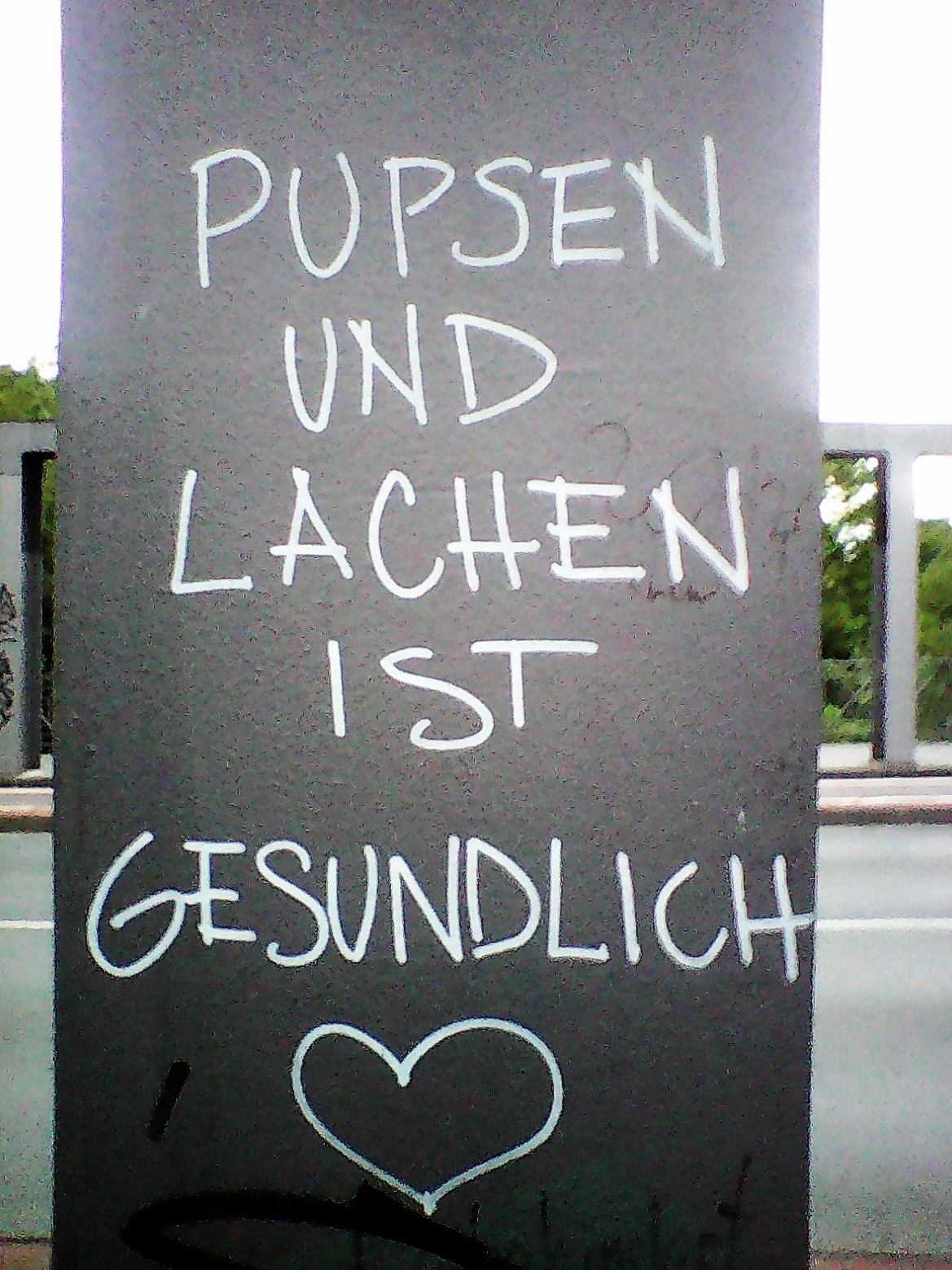
fart and laugh.jpg“Farting and laughing are healthy.” A life-affirming message photographed by me on the Langenscheidtbrücke in Berlin-Schöneberg, 16 June 2019.
It’s funny to read one of the most celebrated, successful Russian-to-English translators in the world complaining that an equally celebrated, successful scholar of Russian history wrote a less than glowing profile of a famous writer whose works they have translated and published to great acclaim and universal gratitude, and calling for an online campaign against the famous scholar and their allegedly retrograde views.

It’s funny because there is a whole other world of less celebrated, less acclaimed translators who have other, more mundane problems to deal with, such as getting paid fairly for their work or, sometimes, getting paid at all, and having their work stolen by unscrupulous publishers and other clients.

Just minutes ago, I was informed that the people who shanghaied me yesterday (Saturday) into consulting and commenting on someone else’s (extraordinarily bad) translation of a text and asked me to do this before Monday would not pay me the modest fee of 105 euros I asked for two and half hours of intense work commenting on the very bad translation of the odious text they sent me. They want to pay me 32 euros per the number of characters in the source text, although I made it clear that were this an ordinary translating or proofreading job, my minimum fee would be 40 euros in any case.

photo_2019-06-15_10-45-35If you read Russian you will understand why I was extremely dispirited to consult on a wretched translation of this source text with no notice and basically no deadline this past weekend. And then the people who asked me to do this thought it should cost them next to nothing.

A few weeks ago, I was perusing the memoirs of a famous anti-Putin dissident, translated into English and published, nearly two years ago, by the world’s largest general-interest paperback publisher.

I was curious to see who translated the book, but no translator is identified by name anywhere in the book. Oddly, however, the publishers had included a plainly false statement in the front matter: “The moral rights of the translators have been asserted.”

How could that be if none of them was identified by name? How could that be if one of them, as it turned out, to my surprise, was me?

You see, I translated a book of memoirs by the same author a few years ago. The book was never published, however — supposedly, because of a nasty conflict with the publisher.

But now this new book has been published (to great acclaim, of course) and, while it is mostly a new book, whoever really wrote it or ghost-wrote it or edited it has inserted chunks of my old, previously unused translation into the new book.

I haven’t gone through the book with a pencil yet to underline and figure out how many such passages there are, but they are there.

In what sense, then, were my or anyone else’s “moral rights” “asserted”? Neither they nor I was identified in any way as being among the translators. I was not paid by the publisher for my work. I was not sent a copy of the book by the publisher.

The same publisher, by the way, had to be forced by the organizing committee of a prestigious literary prize for books about Russia to send me copies of a book I translated that was awarded the prize last year.

In the front matter of this book, I am clearly identified as the translator. I am also identified as the copyright holder of the translation published therein. But until last year, when I won the prize, I had never seen a copy of the book.

Nor has the world’s most powerful English-language publisher ever contacted me about royalties, although per our contract they are owed to me. I am reasonably sure that a decent amount of royalties have piled up by now. Even if they haven’t, they should give me an accounting.

I would say that I really have these royalties coming given that both the world’s most powerful English-language publisher and the US publisher that sold them my translation for a song (after having pleaded poverty and paid me a miserable fee) themselves refused to send me copies of the book. They only did so after pressure was brought to bear on them by influential outsiders.

***********

I would call on more celebrated translators to band together with less celebrated translators to defend the rights of translators great and small.

What I wrote at the beginning of this post was probably wrong. I would be irritated, too, if a celebrated scholar wrote a damning review of a writer whose work I promoted by producing the very best translations of it I possibly could.

But there are translators whose work is ripped off and left unpaid. It comes with the territory, but it shouldn’t. Translators worldwide should organize national and international unions to ensure the fair treatment of translators and their work by publishers and other people who commission translations. When publishers and other clients step way out of line, these unions could intercede forcefully and effectively on behalf of their members.

As it is right now, when clients try and throw me under the bus, I either raise a ruckus on my lonesome or I lump it. I usually do both, usually to no effect. Since many outsiders to the craft do not deem translation “real work” anyway, they are only too happy not to pay you for your efforts.

There is power in a union, however, and there really is strength in numbers.

— Thomas Campbell, the editor of the Russian Reader and other blogs since 2007, and a freelance translator since 1996

P.S. Out of curiosity, I just counted (with a little help from WordPress) the number of words I have published on this website since I launched it in 2007: 1,409,036. Apparently, the median length of a book is 64,000 words. In the last twelve years, then, I have translated (mostly) and written the equivalent of twenty-two books and published them on this website.

Discussing the rates professional translators charge, Job Monkey writes, “The average rate per word is 10 to 20 cents, depending on the type of document to be translated, the language combination, the amount of work involved, the subject matter and the deadline.”

For the sake of the argument, let’s forget all other factors and pay me ten imaginary cents per word for my work on the Russian Reader. If someone were to pay me, the bill would be a hefty $140,903.60.

This is not taking into account the work I did on a website that mostly eclipsed the Russian Reader for over five years, Chtodelat News (740 posts between February 18, 2008, and May 4, 2013) and the work I still do, not often enough, on my “relaxation” blog about Finland, Living in FIN, which mostly functions as a platform for my translations of modern Finnish poetry. 

Of course, I don’t expect anyone to pay me $140,000 or even a fraction of it for work that I made myself do, but even things that are not bought and paid have value. So it is all the more vital that translators (all of whom, in my experience, do a lot of pro bono work for good causes) are paid fairly and promptly when they do work expressly for money.

Finally, you can support the work I do on this website by looking in the left sidebar, where you will find PayPal and Ko-Fi donation buttons. I appreciate all the support I get from my fellow Russian readers. It is what keeps me going.