Russia Is Not a Land of Opportunity for Central Asians

Tajikistan has condemned what it called an “ethnic hatred” attack in Russia after a 10-year-old boy from a Tajik family was stabbed to death at a school near Moscow, in a rare public rebuke aimed at a key partner for labor migration and security ties. The killing happened on December 16 in the village of Gorki-2 in the Odintsovo district of the Moscow region, according to Russia’s Investigative Committee, which said a minor attacked people at an educational institution, killing one child and injuring a school security guard.

A video of the attack circulated on Russian social media after the incident. According to reporting by Asia-Plus, footage published by the Telegram channel Mash shows the teenage assailant approaching a group of students while holding a knife and asking them about their nationality. The video then shows a school security guard attempting to intervene before the attacker sprays him with pepper spray and stabs him. The assailant subsequently turns the knife on the children, fatally wounding the 10-year-old boy.

statement released by Tajikistan’s interior ministry said it feared the case could “serve as a pretext for incitement and provocation by certain radical nationalist groups to commit similar crimes.” Tajikistan’s response also drew attention after the foreign ministry said the attack was “motivated by ethnic hatred.” Dushanbe subsequently summoned the Russian ambassador to protest the attack, handing him a missive “demanding that Russia conduct an immediate, objective, and impartial investigation into this tragic incident.”

The condemnation is particularly notable as Tajikistan rarely issues public criticism of Russia, which remains its main destination for migrant labor and a key security partner.

According to Russian media, the attacker, who has admitted their guilt, subscribed to neo-Nazi channels and had sent his classmates a racist manifesto entitled “My Rage,” in which he expressed hostility toward Jews, Muslims, anti-fascists, and liberals, a few days before the incident.

Tajik migrants form one of the largest foreign labor communities in Russia and across Central Asia. Millions of Tajik citizens work abroad each year, most of them in Russia, sending remittances that are a critical source of income for families at home. According to the World Bank, remittances account for roughly half of Tajikistan’s gross domestic product in some years, making labor migration a cornerstone of the country’s economy. Many Tajik migrants work in construction, services, and transport, often in precarious conditions and with limited legal protections. The killing comes as Central Asian migrants in Russia face growing pressure to enlist in the war in Ukraine, with coercion through detention, deportation threats, and promises of legal status having been reported.

The killing has also renewed scrutiny of rising xenophobia in Russia, particularly toward migrants from Central Asia. The Times of Central Asia has previously reported an increase in hate speech, harassment, and violent attacks targeting migrants, especially following major security incidents. Human Rights Watch has warned that Central Asian migrants in Russia face growing discrimination, arbitrary police checks, and racially motivated abuse, trends that have intensified in recent years amid heightened nationalist rhetoric.

Source: Stephen M. Bland, “Tajikistan Condemns Fatal Stabbing of Boy in Russia Citing Ethnic Hatred,” Times of Central Asia, 17 December 2025


It’s curious. I looked through some of the [social media] pages of Russia’s [most prominent] political émigrés—[Ilya] Yashin, [Vladimir] Kara-Murza, [Ekaterina] Schulmann, [Leonid] Volkov, [Elena] Lukyanova, [Dmitry] Bykov, [Marat] Gelman, [Boris] Zimin, [Boris] Akunin—but I couldn’t find a word about the violent death of a Tajik boy in a school near Moscow. They have expressed no sympathy, voiced no criticism of racism and xenophobia. It seemingly should be their direct obligation to speak out on this issue. But for some reason, mum’s the word. I also looked at the Telegram channels of the leading official anthropologists, and there is a mysterious muteness among them too. Surely it is their professional duty not to remain silent on such a matter. They even published a book called Tajiks and themselves speak everywhere of interethnic harmony. But in this case, it’s as if they’ve dummied up.

Source: S.A. (Facebook), 18 December 2025. Translated by the Russian Reader


As FB is reminding, there were times I believed I could protect my non-Slavic looking friends, lovers, relatives, foreign students and migrant workers from the nazis marching in the streets, from the nazis working as policemen, from the general xenophobia and unsensibility by magic tricks of art.

Source: Olga Jitlina (Facebook), 18 December 2025
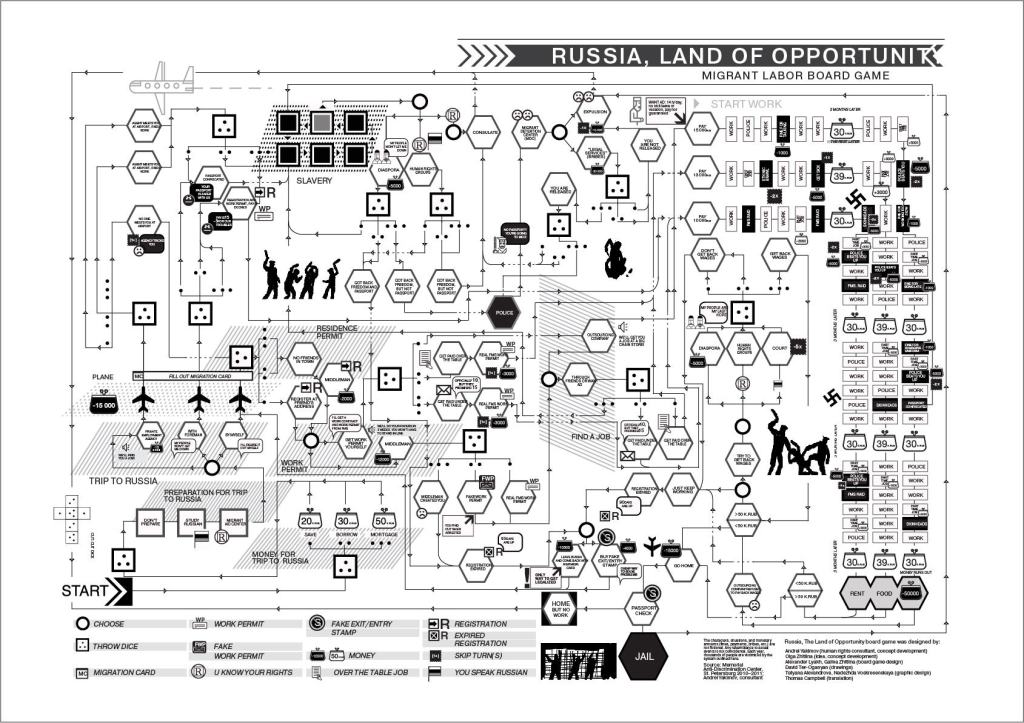

Thomas Campbell just translated our migrant labor board game Russia – The Land of Opportunity!!!

Russia – The Land of Opportunity board game is a means of talking about the possible ways that the destinies of the millions of immigrants who come annually to the Russian Federation from the former Soviet Central Asian republics to earn money play out.

Our goal is to give players the chance to live in the shoes of a foreign worker, to feel all the risks and opportunities, to understand the play between luck and personal responsibility, and thus answer the accusatory questions often addressed to immigrants – for example, “Why do they work illegally? Why do they agree to such conditions?”

On the other hand, only by describing the labyrinth of rules, deceptions, bureaucratic obstacles and traps that constitute immigration in today’s Russia can we get an overall picture of how one can operate within this scheme and what in it needs to be changed. We would like most of all for this game to become a historical document.

Source: Olga Jitlina (Facebook), 17 December 2011


Life for migrant workers is Russia is becoming increasingly difficult after stringent new controls introduced over the past year. These include a registry of “illegal” migrants, restrictions on enrolling migrant children in schools, new police powers to deport people without a court order, and a compulsory app for all new migrants in Moscow and the surrounding region to track their movements.

Working in Russia was already less appealing because of the war in Ukraine and the weakening rouble. Now, with these new restrictions, a growing number of young people from Central Asia are starting to look elsewhere — including to countries in Europe — in search of better opportunities.

Dreaming of Europe in Moscow

Like 89% of young Kyrgyzstanis, 25-year-old Bilal* had always dreamed of working abroad.

Young people in Kyrgyzstan grow up in an environment where leaving the country to find work is common, widespread, economically essential, and socially accepted — and where the domestic economy still cannot offer comparable opportunities.

The average monthly salary in the country is about 42,000 soms (around $480), while in Russia, for example, wages in manufacturing can reach 150,000 rubles (nearly $2,000). Unlike most of his peers, Bilal never planned to work in Russia. “Because many of our people face racism there,” he explains.

Europe was his dream, but without connections getting a job offer from an EU employer seemed nearly impossible. So Bilal turned to “intermediaries” — fellow Kyrgyzstanis who had established ties with European companies that were constantly seeking workers. They advised him to travel to St. Petersburg, where, they said, it would be easier to prepare the paperwork and apply for a visa.

But it was the height of the COVID-19 pandemic. Many Schengen countries had stopped issuing visas and temporarily shuttered their consulates. Bilal didn’t want to return home empty-handed, so he decided to stay in Russia — “not by choice,” as he puts it.

“At first I worked illegally at a ski resort. Mostly we chopped firewood and cleared snow around the cabins. They paid us in cash,” he says.

Two months later, Bilal moved to Moscow and obtained a patent — the work permit that allows citizens of visa-free countries to be legally employed in Russia. He found a job as a courier for Yandex.

Bilal speaks excellent Russian — something he says explains why, unlike many of his friends, he didn’t encounter xenophobia all that often. But conflicts still happened. “You’d run into people who’d say, ‘Migrants, coming here in droves…’ Especially when a customer had put down the wrong address and the delivery got messed up — somehow it was always the migrant’s fault.”

Bilal left Russia two months before the full-scale invasion of Ukraine. “Back then it wasn’t like it is now,” he recalls. “Yes, the police would stop you on the street, but they’d take some money and let you go. Now my friends talk about Amina (a Russian mobile app for monitoring migrants), about police rounding people up, and about being sent to the war.”

He decided to set his sights on Europe instead.

Watched and bullied

In Russia, the path to legal employment for migrant workers runs through a processing centre known as Sakharovo — located about 60 kilometres from Moscow and notorious for its massive queues, where people often wait for hours. The perimeter is guarded by armed security forces, and inside migrants undergo procedures such as blood and urine tests to screen for “socially significant diseases”. Those who manage to obtain their documents can work legally, but that doesn’t protect them from future problems.

Russians often refuse to rent apartments to migrants. Schools and kindergartens decline to accept migrant children, citing “lack of space,” while the adults themselves face workplace “raids” or frequent “document checks” on the street or on public transport. Even Russia’s war in Ukraine has become a tool for pressuring them: many migrants are pushed to join the military in exchange for various “bonuses,” such as fast-tracked citizenship.

After the attack on Crocus City Hall — which authorities say was carried out by four Tajik citizens —the security services launched large-scale raids. Tajikistan’s government, fearing a surge in xenophobic incidents, even advised its citizens not to leave their homes.

Lawmakers soon joined in. Over the past year, they have restricted the ability to obtain residency through marriage, granted the Interior Ministry the power to deport migrants without a court ruling, required migrant children to pass a Russian-language exam before being admitted to school, and created the Registry of Monitored Persons — a database of foreign nationals who supposedly lack legal grounds to stay in Russia. There are already known cases of people being added to the list by mistake, and effectively losing the right to move freely around the country after their bank accounts were frozen, and their driving permits revoked.

Officials have justified all these measures as necessary to fight illegal migration and prevent crime. In July, the Interior Ministry reported a rise in crimes committed by migrants, but migrants still make up only a small fraction of overall crime statistics. A study by the “To Be Exact” project found that adult Russian men are statistically more likely to commit crimes than migrant workers.

On September 1, a new pilot project went into effect: migrants from Uzbekistan, Tajikistan, Kyrgyzstan, Armenia, Kazakhstan, Georgia, Azerbaijan, Moldova, and Ukraine who are living in Moscow or the Moscow region must install a mobile app called “Amina.” Authorities openly acknowledge that the app’s main purpose is to continuously track users’ locations.

The app that doesn’t work

If a phone fails to transmit location data to Amina for more than three working days, the participant is automatically removed from the system. If the migrant cannot fix the issue quickly, they risk being added to the “monitored persons” registry — which can lead to frozen bank accounts, job loss, or even expulsion from university.

Imran, a 27-year-old Tajik citizen, is worried: “Location services on my phone are on, and Amina shows that everything is being transmitted, but several times a day I get notifications saying the app isn’t receiving my location. The app works terribly. And I have no idea what consequences this could have for me.”

Users report constant problems with Amina. Some can’t get past the first screen; others say the app won’t accept their photo; still others receive alerts that their data failed verification. But the most common issues are related to location tracking.

In comments on RuStore (Russia’s internal apps store), representatives of the developer respond that “specialists are constantly working to improve the app’s stability” and advise users to contact technical support. But migrants complain about waiting on the line for hours.

Anton Ignatov, the director of the Sakharovo centre, claims the programme will improve public safety and help “prevent violations by unscrupulous individuals”. He cites situations in which migrants buy a work patent — a permit to work — for a short period and then disappear “into the shadows,” “vanishing somewhere in the industrial zones of Moscow and the region”.

Such cases do happen, and the most obvious reason is money. Since January 1, the monthly payment for a work patent in Moscow and the Moscow region has been 8,900 roubles (about $115). For many migrants working in low-paid jobs — for example, in construction or warehouse work — this is a significant share of their income, pushing some into the informal economy.

Another factor is wage delays in the sectors where migrants from Central Asian countries most often work. Mukhammadjon from Uzbekistan, works on a construction site outside Moscow, hasn’t been paid in two and a half months. A month ago, he stopped paying for his patent — simply because he had no money left. He sees no tools to defend himself.

Employers, meanwhile, benefit from hiring such vulnerable workers: they can avoid paying social contributions, hand out wages in cash, and rely on employees who are willing to work overtime for low pay.

Getting a job is becoming harder

Kudaibergen, 32, from Kyrgyzstan, worked at a warehouse on the outskirts of Moscow — “to support my family”, he says. His employer provided hostel-style housing for migrant warehouse workers.

“OMON came to our building. They treated us like they were arresting dangerous terrorists. They showed up with batons and tasers, as if storming the place. They drove us all outside. We stood by the door with our hands behind our backs for about two hours while they checked everyone’s documents,” he recalls. “Some guys didn’t understand Russian well — it was very hard for them. If they didn’t understand something, they were beaten. […] Thank God, my documents were in order.”

Russian authorities typically insist that such inspections are carried out strictly within the law and that no unlawful actions are taken against migrants. As evidence, the Interior Ministry points out that migrants rarely file complaints with the police afterward.

As the new year approached — 2025 — the checks intensified, Kudaibergen says. Because of all the new rules and the overall treatment of migrants, he realized that working in Russia had become too difficult, so he returned home.

“But I still have to provide for my family,” he adds. “I’m thinking about Europe now. I ask friends and acquaintances how to leave. But I don’t know if it will work out. They say getting a visa is very hard.”

Gulnura, 35, a mother of three, had lived in Russia with her husband for more than ten years. In the spring of 2025, she flew with her children to her native Kyrgyzstan for a short break. Only after arriving did she learn about the new requirement obliging migrant children to pass a Russian-language exam in order to enroll in school. Her children speak Russian fluently, yet even before the rule change they hadn’t been admitted — schools said there were “no available places”.

“We originally planned to return to Moscow. But my friends who are still there complain that they can’t get their kids into school,” Gulnura says. “One friend has been collecting documents since April, but the school won’t accept them. Another managed to get her child to the test, but after the exam they sent a rejection: ‘Your child doesn’t know Russian well enough.’ Her daughter was born and raised in Moscow, speaks Russian fluently, went to kindergarten and prep classes, reads and writes.”

“Requiring language proficiency provides a pretext for an already widespread practice of arbitrarily refusing to admit migrant children to schools across Russia,” says Sainat Sultanaliyeva of Human Rights Watch. “By depriving migrant children of access to education, Russian authorities are effectively taking away the life opportunities schooling provides. Banning them from school undermines long-term social integration, increases the risk of harmful child labour, and heightens the danger of early marriage.”

Gulnura decided not to return to Russia with her children. “My husband is still in Moscow for now. He’ll come when everything is ready here, when he has work. But we — me and the kids — we’ve come back for good. It’s become impossible to live there.”

A chance to get into Europe

Despite numerous accounts of migrants becoming disillusioned with Russia, it’s impossible to say definitively whether labour migration has decreased in recent years: the available statistics are fragmented, and data from different government agencies often contradict one another.

The picture is further complicated by the Interior Ministry’s decision to stop publishing key data, as well as several changes to the methodology of migration accounting, which make year-to-year comparisons unreliable.

In 2024, researchers at the Higher School of Economics concluded that labour migration to Russia had fallen to its lowest level in a decade.

Since then, the number of entries into the country has grown, but the average annual presence of legal labour migrants has remained stable at around 3–3.5 million — noticeably lower than in previous years.

Rossiyskaya Gazeta writes that foreign workers are less willing to come to Russia for two reasons: tougher migration policies and declining incomes. With the rouble’s depreciation, earnings in dollar terms have fallen by roughly a third.

Yet Russia still remains the most popular destination for labour migrants from nearly all Central Asian countries.

In second place for migrants from Uzbekistan, Tajikistan, and Kyrgyzstan is Kazakhstan, where most work in construction, wholesale and retail trade, and various service industries.

Third is Turkey, where Central Asian migrants are employed in manufacturing — especially textiles and clothing — as well as construction, hospitality, and seasonal agriculture.

South Korea recruits migrant labor for factories, agriculture, construction, and the fishing and seafood-processing industries.

But for many — like Bilal, who left Russia behind — the dream is still to secure a job offer in Europe. In the end, he managed to do so through the same intermediaries he had relied on earlier, paying them $2,000, he says. They helped arrange an invitation from a logistics company.

“If you don’t have work experience in Europe, it’s hard at first to get a job with a good trucking company. There are bad employers who take advantage of newcomers not knowing their rights. They might underpay you or force you to work overtime. At the same time, the police keep a very close eye on work-and-rest rules and can fine you, so nobody wants to break the law. By law, if your driving time is up, you have to stop and rest,” Bilal says, recalling his first job at a Slovak company.

After gaining some experience, he moved to another company, where he now earns around €2,500 a month.

According to the International Road Transport Union (IRU), more than half of European transport companies cannot expand their business because of a shortage of qualified drivers. Across the EU, Norway, and the UK, more than 233,000 truck drivers are currently required. The crisis is deepened by the fact that the profession is aging rapidly, and young people are not drawn to it, despite decent pay.

Ukrainian citizens once made up a significant share of long-haul drivers in the EU, but because of the war many had to return home for military service. In addition, some European employers terminated contracts with Russian and Belarusian citizens (or their visas weren’t renewed), forcing them to return home as well.

In Slovakia, where Bilal is officially employed, the shortage reached 12,000 drivers last year. As a result, the country simplified visa procedures for several nations — including Kyrgyzstan, Tajikistan, Kazakhstan, Turkmenistan, and Ukraine — for applicants willing to work in freight transport.

Poland actively issues work permits to citizens of Uzbekistan and Kazakhstan; the Czech Republic attracts workers from Uzbekistan and Kyrgyzstan by fast-tracking work visas; Lithuania also issues visas to those seeking jobs as drivers.

In 2023, the number of first-time work permits issued in the EU to citizens of Kazakhstan, Uzbekistan, Kyrgyzstan, and Tajikistan rose by 30%, 39%, 50%, and 63% respectively compared to the previous year.

But Bilal believes that even with the current labour shortages, getting into Europe from Central Asia is still far from easy. “If you don’t have people here who can recommend you to a company, it’s a difficult process for ordinary working people,” he says.

All the more so because public frustration over migration has been growing across Europe in recent years, pushing some governments to tighten rules for third-country nationals — even in sectors suffering from labour shortages.

Bilal likes living in Europe. He’s satisfied with the good pay and the way people treat him — especially Italians and the French.

He describes his job as demanding. “We spend more time away from home than at home. Years go by, and people hardly see their families,” he says.

Bilal himself doesn’t yet have a wife or children. In a few years, he’ll be eligible to apply for permanent residency in Slovakia, but he hasn’t decided whether he’s ready to spend his whole life driving long-haul trucks across Europe.

*The protagonist’s name has been changed at his request. With contributions from Almira Abidinova and Aisymbat Tokoeva. Read this story in Russian here. English version edited by Jenny Norton.

Source: “Why Central Asian migrant workers are giving up on Russia,” BBC News Russian (Substack), 18 December 2025.

501 Days

The criminal war as such does not outrage them. The war itself completely suits them all. They love this war. They just don’t like that their slave husbands are kept at the front for too long without leave.

How did that line go? Whether you like it or don’t like it, bear with it, my beauty.

Source: KOLOKOL XXI (Telegram), 8 July 2023. Translated by the Russian Reader. Specifically, the women in this video appeal to Vladimir Putin ask that men who are mobilized to fight in Ukraine (as their husbands and sons were, allegedly, in September 2022) should spend no more than six months at the front and should be relieved by “trained reserves as soon as possible”: “Our men need R&R. Send our men back home,” says one of the women. The woman shown holding a baby, at the end of the video, suggests that the mobilized men be relieved by some of the “over four and a half million professionals” serving in the Emergencies Ministry, the Interior Ministry (i.e., the police), and the regular army. Nevertheless, the women unambiguously voice their support for the “special military operation,” while claiming that their own “lives are hell.”


Vladimir Putin visiting a training ground for mobilized soldiers. Source: Russian Defense Ministry via Republic

Russian troops at the front are severely depleted due to the lack of rotation, which in turn is caused by a shortage of reserves, according to the Institute for the Study of War (ISW) in the United States. Meanwhile, the deputy chairman of the Russian Security Council, Dmitry Medvedev, radiates optimism on this score. At a meeting to discuss reinforcing the Russian armed forces with contract soldiers, held the other day, Medvedev claimed that, according to the Defense Ministry, over 185,000 men had enlisted in the Russian army over the past six months, during the period 1 January to 4 July 2023.

Data from various sources suggest that a significant portion of Russia’s current contingent of “contract soldiers” consists not so much of men who for one reason or another (usually financial, less often ideological) actually have volunteered to go to fight in Ukraine, as of men who have been turned into mercenaries under contract in a “voluntary-compulsory” manner.

We have already reported that, judging by Rosstat’s numbers on migration flows in the Russian Federation in 2022, Tajik nationals have been forced to “volunteer” in this fashion. And this includes not only Tajiks who, by an unfortunate coincidence, came to Russia to work in 2022 and now can only come return to Russia via the front line in Ukraine, and from there go home either in a plastic bag or in a wheelchair. Attempts are underway to make “volunteers” of Tajiks who have not left their country and had no plans to leave, but who are forcibly mobilized into the Russian army by the government of their native Tajikistan.

It seems, however, that although the Russian leadership is running out of Tajiks, it intends to keep fighting for a long time. For this reason, it could find no better solution than to forcibly reclassify young men already conscripted in Russia itself as “contract soldiers.” This campaign, apparently, has also enjoyed only fair to middling success. Moreover, so much so that the authorities are now not only forcing mostly previously untouchable young Muscovites to join the army (and in the current circumstances this actually means sending them to the front), but even those residents of the capital who have papers certifying them as unfit for military service on medical grounds.

The Telegram channel of the human rights organization Soldiers’ Mothers of St. Petersburg relates the story of nineteen-year-old Muscovite Andrei B. Armed with medical certificates that should have enabled him to receive a reprieve from the army (in particular, he needs surgery due to a joint disease), Andrei and his lawyers went to the military enlistment office in Moscow’s Izmailovsky District. However, the enlistment officers immediately confiscated Andrei’s [internal] passport, forbade him from using his phone, and kicked his lawyers out into the street. Basically, Andrei was forcibly captured by the Russian National Guard and held by its officers inside the military enlistment office. Summoned by Andrei’s lawyers, the police who arrived at the scene assisted the Guardsmen, rather than the young man, who was being held by force. Andrei became ill when his blood sugar spiked. An ambulance crew summoned by the lawyers were not allowed to attend to the young man.

Consequently, according to the post on Soldiers’ Mothers Telegram channel, “assisted by the Russian National Guard, the young man, who could barely stand on his feet, was escorted to the assembly point, where neither his mother nor his lawyers were admitted. Unfortunately, it proved impossible to secure the young man’s release from the assembly point.”

According to Soldiers’ Mothers, such cases are widespread. On the same day, a dozen more young Muscovites were sent to the assembly point from this same enlistment office alone.

In fact, we are witnessing the next wave of a covert “partial mobilization.”

There are two significant points about this story. The first is that nearly all the forcibly mobilized young men had medical reprieve certificates and went to the military enlistment offices with their lawyers, who, in turn, had been provided to them by human rights organizations. In this regard, the naivety of human rights activists, including the Committees of Soldiers’ Mothers, and commentators of this story on social media, who have been outraged by the “violations of the rights” of young men thus “shanghaied” into the army, cannot help but astonish us.

The second point is that the large-scale dispatch of Muscovites into combat suggests that the regime has fewer and fewer human resources available to it. The quality of these mobilizable reserves is questionable, however.

Bloomberg identifies convicts and Kadyrov’s Chechen fighters as two other additional sources for replenishing the Russian army’s manpower.

Of course, the Russian Defense Ministry can continue to recruit convicts, but the numbers and quality of these soldiers will steadily decrease. This is simply because the numbers of murderers, robbers, and rapists who have already been killed or seriously injured, and whom Prigozhin prioritized over other residents of prisons and penal colonies, since they had the specific relevant “background,” have for obvious reasons greatly decreased. As we recall, Prigozhin himself claimed that 20,000 Wagner fighters, half of whom were ex-convicts, had been killed in the battles for Bakhmut alone.

The number of Chechen soldiers whom Kadyrov is willing to send to the front is also limited, since he has to maintain significant forces in Chechnya itself, both to protect his own clan from possible uprisings, and in case of “unforeseen” circumstances during which the federal center would be greatly weakened and he would finally deem it possible to declare himself an independent sovereign. Whatever the case, Kadyrov has cited two figures: 7,000 of his loyalists already in the combat zone and an additional 2,400 men undergoing training. Slim pickings, as the saying goes.

The quality of these “TikTok warriors” is also questionable. Not because Chechens don’t know how to fight. They do know how to fight, as they proved in both Chechen wars, in 1994–1996 and 1999–2004. But this is not their war.

Sooner or later, a significant percentage of Russian soldiers will reach the same conclusion.

Source: Alexander Zhelenin, “Hidden mobilization wave reaches Moscow as quality of Russian army’s manpower continues to decline,” Republic, 8 July 2023. Translated by the Russian Reader. The emphasis, above, is the author’s.


Men in military uniforms robbed a magic store in Belgorod.

Yesterday afternoon, two men in camouflage who had allegedly returned from the war zone entered the store, Promagia, on People’s Boulevard. The shopkeepers claim that the two men introduced themselves as “Wagnerians.” Video footage of the incident shows that one of the men sported a Wagner PMC patch on his rucksack.

Footage of the alleged incident at the Promagia magic store in Belgorod, as posted on Telegram

According to the shopkeepers, at first the military men tried to extort money: allegedly, the previous tenant was in debt to them. When the shopkeepers explained that they were new tenants, the men in uniform did not calm down and stole a pendant on a chain from the counter before snatching another item from a shopkeeper’s hands. When they were told they had to pay for the items, one of the “Wagnerians” replied that he had “given himself a gift.”

Police later arrived at the store to document the theft by the military men. The police told the shopkeepers that information about the same two soldiers had been reported by other shops.

Source: News Flash — Belgorod (Telegram), 9 July 2023. Translated by the Russian Reader. Thanks to News.ru for the tip. It is possible that this incident was cooked up and leaked into the media as part of the regime’s current smear campaign to discredit Yevgeny Prigozhin and the Wagner Group. But given that they are ruthless fascist thugs themselves, it is just as possible that two “Wagnerians” did rob the magic store on People’s Boulevard in downtown Belgorod. Stranger things have happened.

“You’ll Be Gone in Three Minutes. I’m Going to Kill You”

“You’ll Be Gone in Three Minutes. I’m Going to Kill You”
Elena Srapyan, Civic Assistance Committee
refugee.ru
April 12, 2016

On Friday, April 8, between Novye Cheryomushky and Kaluzhskaya subway stations in Moscow, an elderly man fired a trauma pistol several times into the head of a man of non-Slavic appearance. The wounded man is now in the intensive care ward of City Clinic Hospital No. 1 in serious condition. The Civic Assistance Committee has taken charge of the victim’s legal defense.

сулаймон саидов
Sulaimon Saidov

On the evening of Friday, April 8, Sulaimon Saidov, a 38-year-old Tajik national, was traveling home from work to Tyoply Stan. He was accompanied by his 19-year-old nephew Mukhammajon Khakimov, who had recently arrived in Moscow from Tajikistan. Saidov has lived in Moscow for over thirteen years. Like most of his relatives, with whom he rents a small flat in Tyoply Stan, he works in construction. The job enables Saidov to feed his four children.

This time, the trip home on the subway proved disastrous. It all began quite casually. At Profsoyuznaya station, a drunken middle-aged man who could barely stand on his feet burst into the subway car. He immediately spotted Khakimov. He went right up to him, pushing him and shouting.

“Who the hell are you? Where are you from? What are you doing here?” he asked Khakimov.

Khakimov modestly replied he was from Tajikistan.

The assailant called Tajiks “black monkeys,” swore, and demanded that uncle and nephew immediately leave the car because it was “only for [ethnic] Russians.” Khakimov went over to his uncle, seeking protection. Saidov stood up, pushed his frightened nephew behind him, and tried to calm him.

“The man is just drunk. Don’t look at him. Don’t pay any attention,” he said.

Staring point blank at Saidov, the assailant said, “You’ll be gone in three minutes. I’m going to kill you.”

As Saidov relates it, he felt no danger: the threat from the elderly, frail-looking man seemed too absurd. Even when he spotted a pistol in the assailant’s hands, he did not believe it. He thought it was a toy. However, the pistol was real, a trauma pistol, and the assailant began firing.

He managed to squeeze off several shots at both Tajiks. He missed Khakimov, but he hit Saidov three times in the head and once in the stomach. At short range, the shots could have been deadly. One of the bullets entered Saidov’s eye and damaged the sclera, while another left a huge wound in his skull.

Saidov realized he had to fight for his life. He felt no pain. In a state of shock, he grabbed for the assailant’s pistol and managed to wrest it from his hands. At that moment, the doors of the subway car opened, and assailant and victim found themselves on the platform of Kaluzhskaya subway station. According to police, there was no CCTV camera in the car, but on the station’s cameras what happened looks like a fight. Rushing to the scene, police detained the man holding the pistol: Saidov. Police grabbed him, wrested the weapon from him, and put his hands behind his back. Only when bystanders shouted that he was the victim was Saidov released.

The assailant managed to escape the scene, but was detained quite soon thereafter. When witnesses identified the attacker on video surveillance recordings at the station, it turned out the man’s face was familiar to police. After the pistol was fingerprinted, there could be no doubt: the assailant was 58-year-old local resident Sergei Tsaryov, who had been detained at the same subway station a week earlier.

Tsaryov was brought in literally minutes later. However, police were unable to talk with him for a long time. The man was so drunk he could not answer clearly. At the same time, relatives of the victim were giving testimony in another office. Saidov was almost immediately taken away by ambulance. His injuries were so severe that doctors feared for his life.

Saidov’s cousin Dilshod Saidov, who speaks Russian well, soon arrived at the scene. At the time, Police Captain Ilyinsky was questioning relatives and witnesses, and drawing up an incident report. Dilshod Saidov assisted the captain by translating for Khakimov. But when Ilyinsky read the interview record aloud, Saidov was struck by the differences between it and Khakimov’s testimony. Saidov began verifying the interview record phrase by phrase. According to the text, it was Khakimov who had got a rise out of the passenger with whom Sulaimon Saidov had later fought.

“As if Mukhammajon had provoked the assailant by the mere fact of his existence,” said an indignant Dilshod Saidov. “I had to fight for every word in his testimony: that alone took two hours. They also tried to give me a hard time. They said, ‘Who the hell are you? Let’s check you out.’ Only I wasn’t scared. I’m a regular guy: all my papers are in order. Yeah, the night at the police station was just awful.”

But most importantly, the ambulance doctors managed to get Sulaimon Saidov to City Hospital No. 1 quickly, where he immediately underwent surgery. Thanks to the efficiency and professionalism of his doctors, Saidov survived.

Saidov’s family are alsop grateful to a young female witness who went with them to the police station and stayed there to the end. Unfortunately, they were unable to exchange telephone numbers. The police were vigilant and made sure that communication between them was impossible.

Saidov’s relatives stood watch outside the intensive care ward all through the evening of April 8 and the early hours of April 9.

“I was at work when it happened,” says Dilafruz Sharapova, a close friend of the victim’s. “I called Sulaimon, but he didn’t answer. That usually doesn’t happen, and I got scared right away. Then his nephew picked up the phone. First he said  they were just on the subway. He didn’t want to scare me. When I got home, his cousin called and told me everything. I remember I immediately said to him, ‘Come and get me, and let’s go to the hospital.’ I couldn’t just sit there, you know? We arrived at the hospital, and I waited so long for the doctors to say at least something that it was frightening. I was able to see him only a day later. The operation was over, and the danger had passed. Things will probably be rough for us now, because he won’t be able to work. But I’m not thinking about that for the time being. I am only worried for him. I can’t think about anything else.”

The doctors are now optimistic in their prognoses. Although Saidov suffered a severe bruise to the crown of his head, the brain was not affected. Saidov remembers everything perfectly, and has no problems speaking. The biggest worry is his eye, but the doctors hope to be able to save it despite the damage to the sclera. Perhaps another operation, a more expensive one, will be necessary. The Civic Assistance Committee plans on announcing a fundraiser for Saidov when details have become clear and his relatives have received the necessary medical documents.

The Civic Assistance Committee is defending the interests of the victim, Sulaimon Saidov, in the case.

“For the incident to be qualified correctly it is vital that our lawyer begin working as quickly as possible,” said Marina Leksina, head of the project for the victims of hate crimes. “Because we already have cause to assume that they will try to acquit the assailant by presenting Sulaimon as an active party to the conflict. From what Sulaimon has told us, the attack was motivated only by xenophobia. It was direct aggression, which the assailant accompanied with corresponding language.”

Representing the victim will be Filipp Shishov, an attorney for Memorial Human Rights Center’s Migration and Law Network. Shishov previously represented Maratbek Eshankulov, the young man who unable to return home for four years because of the “dissimilar” photograph in his passport.

Photo courtesy of the Civic Assistance Committee. Translated by the Russian Reader

Deported Mother Returns to Tajikistan with Baby Son’s Body

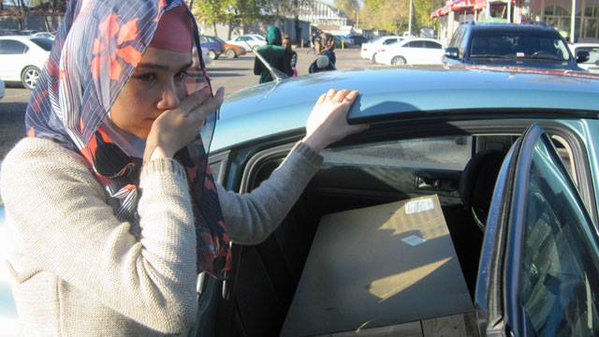
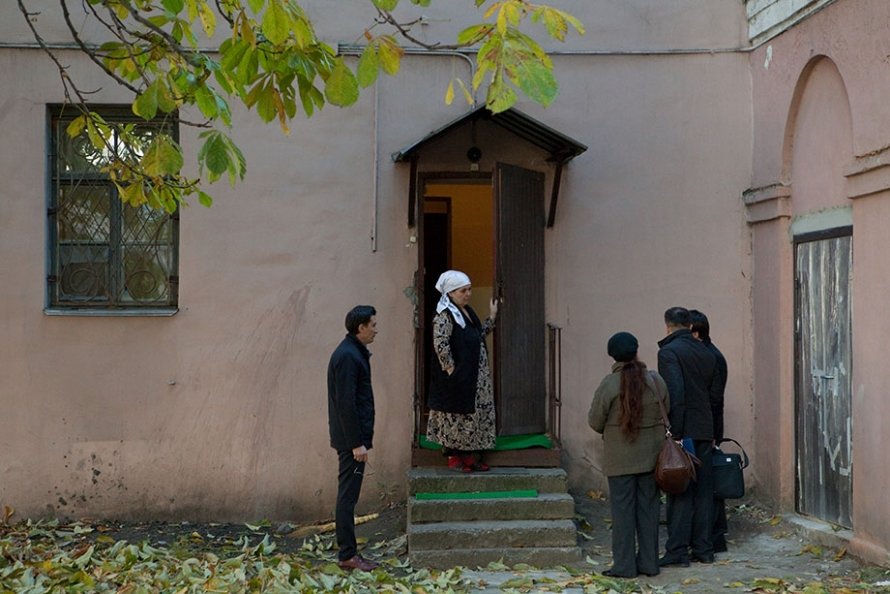
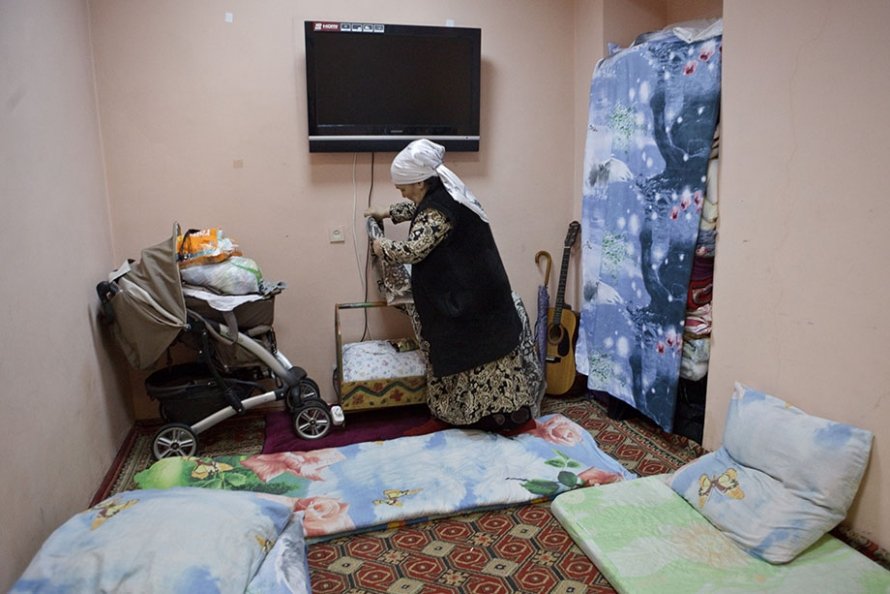
Yunusova after arriving in Tajikistan with the body of her five-month-old son Umarali Nazarov. Photo courtesy of Gogol's Wives
Zarina Yunusova after arriving in Tajikistan with the body of her five-month-old son Umarali Nazarov, who died in unexplained circumstances while in the custody of Petersburg police and medics. Photo courtesy of Gogol’s Wives

Mother of Deceased Tajik Baby Leaves Petersburg, Taking His Body with Her 
November 16, 2015
Mediazona

Zarina Yunusova, expelled from Russia by order of the court, has left Petersburg, writes Fontanka.Ru. Yunusova had been recognized as the injured party in the investigation into the wrongful death of her five-month-old son Umarali.

In the early hours of November 16, Yunusova left Petersburg’s Pulkovo Airport on Flight SZ204, bound for Dushanbe, the family’s lawyer, Oleg Barsukov, informed online news website Fontanka.Ru.

Yunusova took the child’s body with her in order to perform a forensic medical examination on it and bury the child there. Barsurkov noted that no problems had arisen while arranging for transport of the body.

Earlier, the October District Court in Petersburg had reaffirmed the decision to expel Yunusova from Russia since she was in the country illegally.

Face-to-face confrontations between Yunusova and police and Federal Migration Service officers had been scheduled for November 16 and 17 in Petersburg.

Five-month-old Umarali Nazarov died on October 14 at Tsimbalin Children’s Hospital, where he had been sent by police after local FMS detained him during a raid on the family’s home. According to the forensic examination [allegedly performed in Petersburg], Nazarov died of acute cardiopulmonary failure.

According to FlashNord news agency, citing relatives who attended the funeral, Nazarov has been buried in the Tajik village of Boboi Vali. The news agency did note whether a forensic medical examination had been performed before the funeral, as had been planned after the body arrived in Tajikistan. 

Translated by the Russian Reader. Thanks to Comrade GV for the heads-up

__________

Our Swimmer

Do Tajik lives matter in Petersburg? The official answer has so far been a resounding no. (And the “grassroots” answer has been a resounding yawn, actually).

Well, now that that pesky Zarina Yunusova and her creepy little dead baby are out of our hair, we can move on with our more important “European” lives, which here in the former capital of All the Russias are entirely built, swept and cleaned, and stocked and supplied with all the essentials for a pittance by expendable, utterly disempowered insectoid others like Zarina’s husband and Umarali’s father Rustam.

I don’t have the foggiest why anyone who lives in such a backward cesspool can imagine they have anything meaningful or helpful to say about the actual Europe and its alleged “Muslim,” “refugee,” “terrorist,” etc., problem, but as many of us know, nattering on endlessly and furiously about the “fate of Europe” is almost a national sport among the Tajik-loathing Russian jabberwockies.

Why Such Hatred? (The Death of Umarali Nazarov)

Откуда такая ненависть?
Why Such Hatred?
Nina Petlyanova
October 22, 2015
Novaya Gazeta Saint Petersburg

The parents of a dead five-month-old child from Tajikistan do not understand

When a Tajik family was in the process of being expelled from Petersburg, their baby son was taken from its mother. Umarali Nazarov (born May 20, 2015) spent almost five hours at a police station [on October 13, 2015]. He was in the hands of strangers, and deprived of food and warm clothes. No one was allowed to dress or feed the baby. He screamed and cried. The baby was then taken to hospital, where he died the same night. The causes of death are still unknown. The Investigative Committee opened a criminal case only a week later.

Federal Migration Service (FMS) employees, police officers, and doctors are suspected of “negligent homicide owing to the improper discharge by a person of his professional duties.” However, neither the boy’s parents nor members of the Petersburg Tajik diaspora believe the guilty parties will be found and punished. Moreover, Umar’s father and mother, Rustam Nazarov and Zarina Yunusova, are themselves currently under suspicion. Police have carried out searches at the flat where they live. The authorities are now attempting to prosecute the couple for allegedly failing to discharge the duties of bringing up a minor.”

Federal Children’s Ombudsman Pavel Astakhov, Petersburg Governor Georgy Poltavchenko, and the Tajikistan Embassy in Russia have promised to monitor the investigation.

FMS officers raided the flat rented by the Nazarovs at Lermontov Prospect, 5, at around ten in the morning on October 13. The head of the family, Mehriniso Nazarova, the mother of five children (ranging in age from seven to twenty-seven), had already accompanied her youngest son, a first former, to school and had gone to work: she washes dishes at a café near the house. Nazarova’s 17-year-old son Daler and 21-year-old daughter-in-law Zarina were at the flat with Umar. Zarina’s husband, 25-year-old Rustam Nazarov, works at a construction site and was also not nearby when the FMS paid its visit.

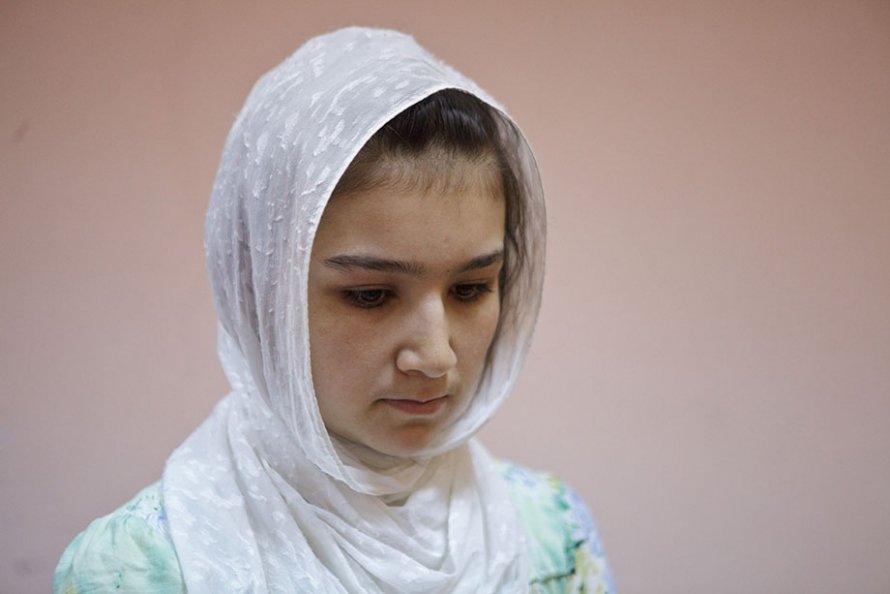
Zarina Yunusova

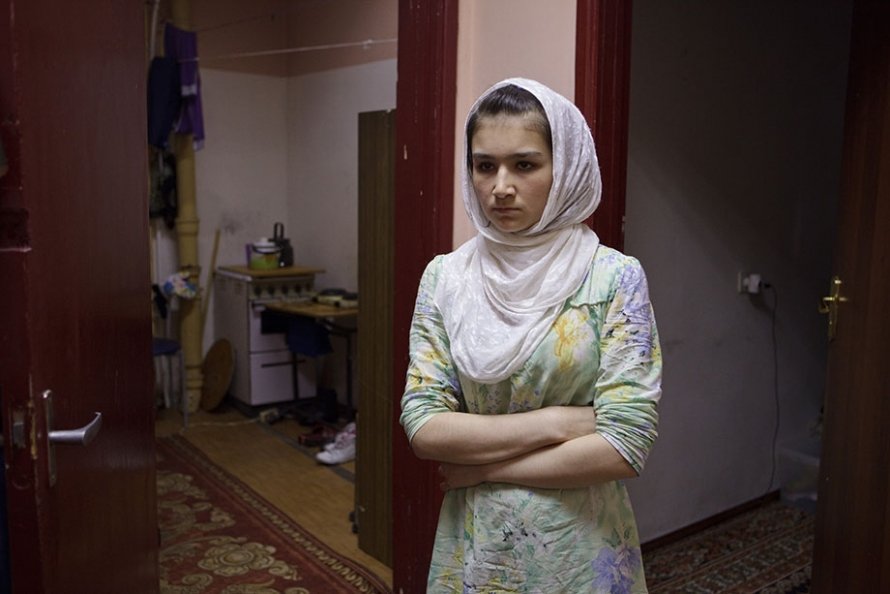
Zarina does not speak Russian at all. Her account of what happened is translated by her mother-in-law.

“Three unknown men burst into the flat. They grabbed Daler, Zarina, and the baby. Although Daler is a minor,” Mehriniso adds, “and they had no right to touch him. They were all taken to a police station. They were not even allowed to dress Umar: he was taken as he was, in a blue woolen unitard. They didn’t even let them put a hat on him.”

“Around 10:30 a.m., I got a call from Daler,” continues Nazarova. “He said they were at Police Precinct No. 1. I hurried there, grabbing a bottle of milk formula for the baby at home on the way there. I was at the police station around twelve. I went up to the on-duty window, and they kicked me out into the hall. I could hear Umar screaming. The child was screaming and crying the whole time at the precinct. I begged and pleaded to feed him. The formula was still warm. An on-duty officer took the bottle from me and put it in the window. I was crying and saying, “He is tiny and hungry.’ ‘I could care less,’ the policeman replied. There was a young woman there, a senior lieutenant: I begged her. No one fed the child.  They mocked and laughed at me: ‘We don’t understand you; we need a translator.’ They called me a wog [chernozhopaya] and said, ‘Wogs have no rights.'”

Around 2:30 p.m., according to Nazarova, an ambulance arrived at the police station, and the police handed the baby over to medics.

“I was scared,” says Nazarova. “I asked the doctors what was a happening with my baby. Had he fallen ill? He had never been ill. Just the day before, he had been healthy. I begged them to hand over my boy or take me along! But two women in white jackets pushed me away, got into the vehicle, and drove away.”

“Come tomorrow”
Zarina and Daler were delivered to court around 3 p.m. They were tried by 9 p.m. Each was fined 5,000 rubles and ordered to leave Russia in fifteen days.

As soon as they left the court, the Nazarovs rushed to the police station to find out where the child was. They were told he was at Tsimbalin Children’s Hospital and to pick him up the next day. The parents did not accept this and said they were coming right away.

“It’s already late, they won’t let you in,” the police objected.

The Nazarovs called the hospital and were told the same thing: “Come tomorrow.”

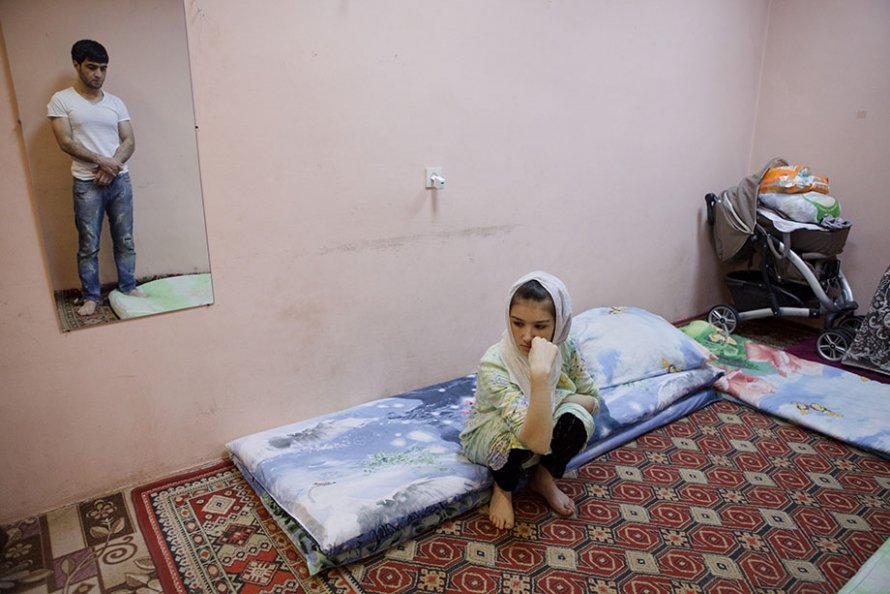
Rustam Nazarova and Zarina Yunusova

“Around 8 a.m., Mom took my youngest brother, a first former, to school,” says Rustam Nazarov. “We called a taxi to go to the hospital and pick up Umar. But right then we got a telephone call: ‘You need not come: your son has died.'”

The family was at the hospital within half an hour. But they were too late: the baby had already been transported to the morgue. Nazarov went there. At the morgue, however, he was not shown the child. Nazarov began going to the morgue every day.  It was only on the fourth day, after the autopsy, that he was able to take a look at his son.

“I didn’t even recognize him,” admits Nazarov.

Routine and lawful
As the FMS Petersburg and Leningrad Region Office explained to Novaya Gazeta, the raid had been routine. At the request of the district administration, several addresses were checked that day.  District officials had informed the FMS about the Nazarovs. The illegal immigrants were living, allegedly, in a resettled house with no water or electricity.

Rustam Nazarov looks out the window of the ostensibly resettled house at Lermontov Prospect, 5

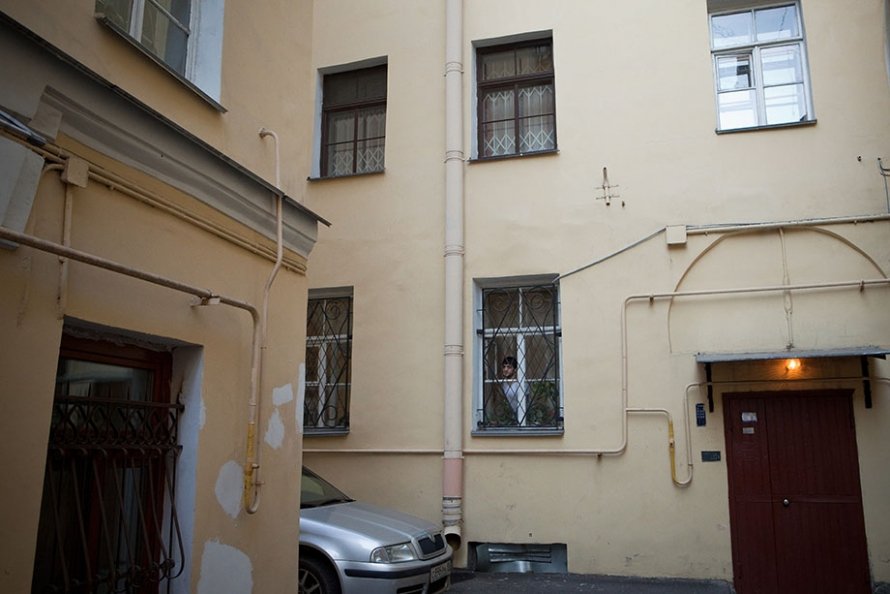
Novaya Gazeta‘s correspondents spent half a day in the two-room flat the Nazarovs rent for 25,000 rubles [approx. 360 euros] a month. The place has water and electricity, and is so warm that all the vent panes in the windows are opened. We saw offices on the first floor of the building, and quite habitable flats on the upper floors.

“The citizen of Tajikistan discovered at Lermonotov, 5, could not explain her relationship to the child, so he was also taken to the police station,” Darya Kazankova, press secretary for the FMS Petersburg and Leningrad Region Office told Novaya Gazeta. “However, FMS staff do not work with minors and children, so we handed both [Daler and Umar] over to juvenile affairs inspectors and subsequently dealt only with Yunusova.”

Kazankova insists the FMS officers had an interpreter with them. Zarina did not notice any interpreter.

Zarina Yunusova’s papers are really not in order. The young woman arrived in Petersburg from Tajikistan little over a year ago to be treated for infertility. The treatments were successful. The long-awaited Umar was born on May 20, Rustam’s birthday. It was a gift for both the mom and the dad.

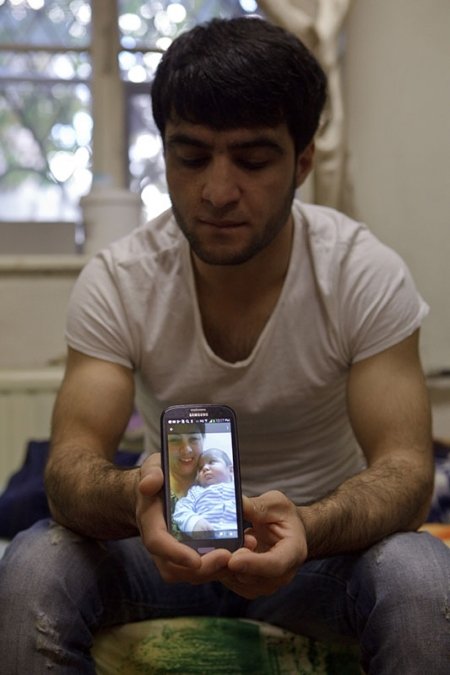
Rustam Nazarov shows a picture of his son on his mobile phone

“According to the law on immigrants [Federal Law No. 115, July 25, 2002], foreign citizens can stay temporarily in Russia without a visa for no longer than ninety days [if they are from countries whose citizens do not require a visa to enter the Russia — RR],” explained Tajik diaspora lawyer Uktam Akhmedov in an interview with Novaya Gazeta. Akhmedov is now defending the Nazarov family in all legal proceedings. “But when the ninety days ran out and legally she should have gone back to Tajikistan, Zarina was pregnant. The doctors did not recommend traveling. Besides, pregnancy is a reasonable excuse for staying. We are going to challenge the court’s decision to expel her,” said Akhmedov.

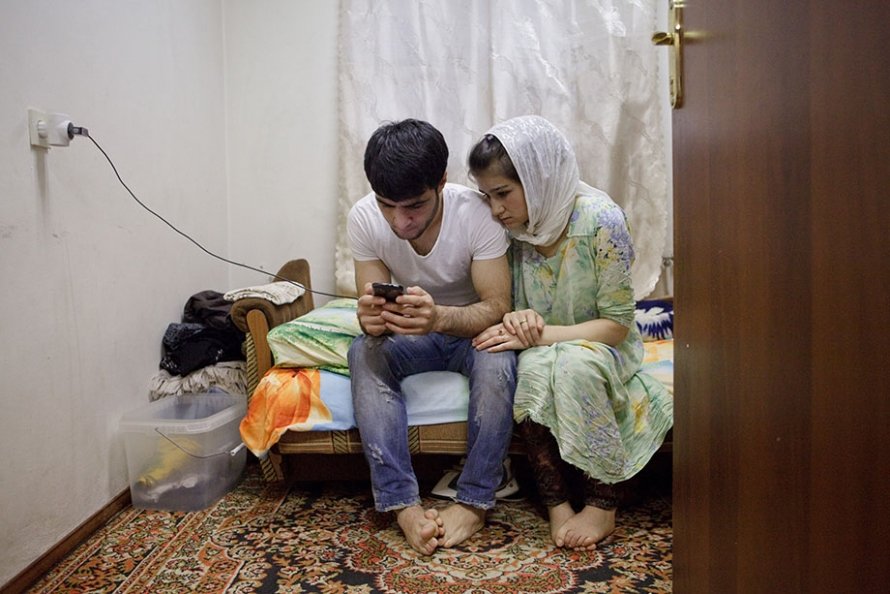
Rustam and Zarina looking at pictures of their son

The case will not be solved soon
The five-month-old child’s death has shocked the Petersburg Tajik diaspora.

“Every day since October 14, between fifty and eighty people have gathered outside Police Precinct No. 1,” Uktam Akhmedov told Novaya Gazeta. “The most massive grassroots gathering happened on October 17 at the Tajikistan Consulate in Petersburg. Around a hundred people came. They demanded justice and punishment for the perpetrators. People were very agitated. We could hardly contain their emotions.”

Assistant Consul Manouchehr Hamzayev came out to address the protesters. He asked them not to engage in provocations and promised to keep them updated.

Umar’s grandmother Mehriniso Nazarova meets workers from the Tajikistan Embassy in Russia

On October 18, the Tajik diaspora sent official appeals to Russian Human Rights Ombudsman Ella Pamfilova and Petersburg Governor Georgy Poltavchenko.

On October 19, Pavel Astakhov reacted to the incident in the Northern Capital. Besides a surprised entry on Twitter (“A five-month-old baby has died suddenly”), he asked the Interior Ministry and the Prosecutor General’s Office to “conduct a thorough investigation of the actions of the FMS and police.”

On October 20, the Petersburg Office of the Investigative Committe’s Central Investigation Department opened a criminal case under Article 109.2 of the Russian Federal Criminal Code (“Negligent homicide owing to the improper discharge by a person of his professional duties”).

“According to the preliminary investigaton, the boy died in the early hours of October 14 from an acute respiratory viral infection,” the Central Investigation Department informed Novaya Gazeta. “But the forensic examination will ultimately establish the cause of death.”

Doctors at Tsimbalin Children’s Hospital, where the city prosecutor’s city has been carrying out an inspection since October 20, declined to comment. According to Novaya Gazeta‘s sources, doctors have explained to investigators that the child had many diagnoses [sic], and in addition, he had been born prematurely.

The parents do not deny this. Umar had been born in the thirty-fourth week with a weight of 2,2000 grams. But he had been steadily growing and gaining weight. By five months he had weighed about eight kilos. The Nazarovs likewise claim the child had regular visits from the district nurse, and had been examined by doctors at a clinic. They had not referred Umar to any specialists: no serious ailments had been detected.

Looking for a bomb in a cradle
On October 21, the day after the criminal case was opened, the Interior Ministry’s Petersburg and Leningrad Region Office took countermeasures.

“Police officers are conducting a preliminary investigation concerning the deceased boy’s parents, in whose actions there is evidence of a crime as stipulated by Article 156 of the Russian Federal Criminal Code (“Failure to discharge the duties of bringing up a minor”),” the regional office of the Investigative Committee’s Central Investigation Department informed Novaya Gazeta.

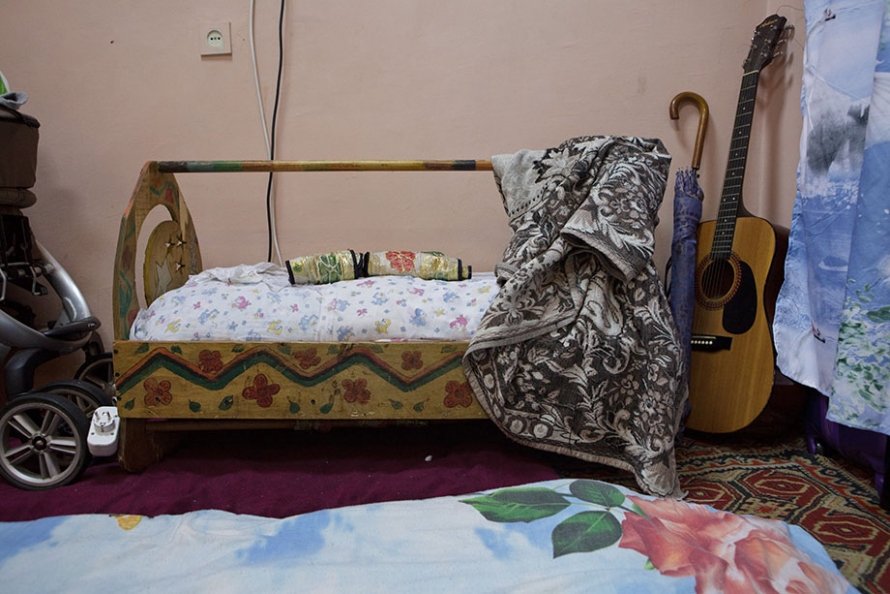
“Now they come here and do searches nearly every day,” the Nazarov brothers tell us. “Two times they came with dogs. Why? Are they looking for a bomb in the cradle?”

“Why such hatred? Why such hatred?” Rustam repeats like a mantra and waits for a response.

Zarina says nothing and cries.

Mehriniso Nazarova next to her grandson Umar’s cradle

Mehriniso is not crying. She is sobbing over the cradle, which Rustam built for his son and which she just cannot bear to remove from the room.

“This city has now taken a second boy from me.”

The Nazarovs have lived in Petersburg for fifteen years. In 2004, persons unknown armed with knives attacked Mehriniso’s 12-year-old-son near their house. He died from stab wounds to the chest and neck. The child’s murder remains unsolved to this day.

Translated by the Russian Reader. Photos by Elena Lukyanova

See also: “Tajikistanis Hold Gathering Outside Consulate in Petersburg over Death of Detained Immigrants’ Son,” Rosbalt, October 17, 2015 (in Russian)