This Russian Life: Alexandra Karaseva’s Election Day Molotov Cocktail

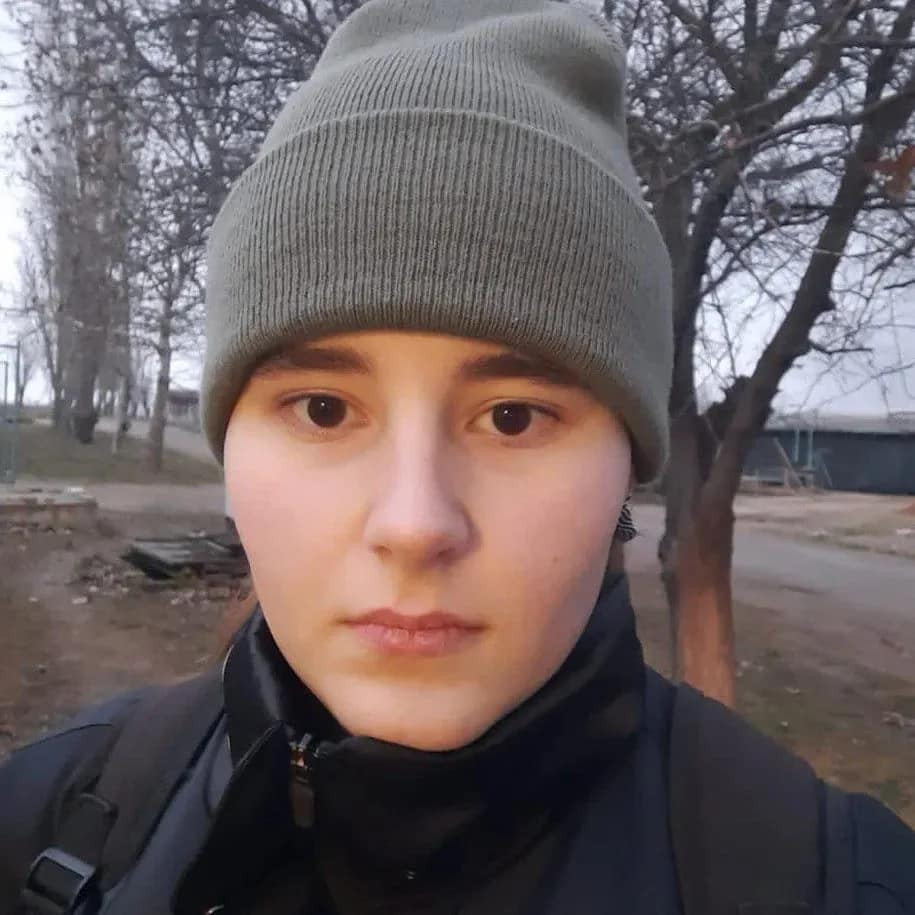
Alexandra Karaseva. Photo from social media account via Bumaga

During the three days of the [presidential] election in Russia, the Interior Ministry reports, twenty-one criminal cases were launched over attempts to set fires at polling stations or spoil ballots with brilliant green dye solution. Twenty-one-year-old student Alexandra Karaseva was remanded in custody to a pretrial detention centre after being arraigned on just such charges.

According to police investigators, on 15 March, Karaseva threw a Molotov cocktail at a polling station poster on the porch of School No. 358. No one was injured.

Bumaga explored what we know about Alexandra Karaseva, why she might have committed the arson attack, and what defendants charged with obstructing the work of polling places face.

In St. Petersburg, 21-year-old Alexandra Karaseva was remanded in custody to a pretrial detention centre. Investigators allege that she threw a Molotov cocktail at a polling station

Around three p.m. on the first day of voting, 15 March, a young woman ran up to the porch of School No. 358, in Petersburg’s Moscow District, and threw a Molotov cocktail at the wall, as seen in surveillance footage.

The school housed two election precincts—No. 1395 and No. 1396. The attempted arson only left traces of soot on the upper part of the information sign bearing the elections logo and on the wall of the school. No one was injured and the operation of the polling station was unaffected.

The aftermath of the 15 March arson attempt on the porch of School No. 358 in Petersburg. Photo courtesy of Bumaga

The young woman tried to run away but was immediately detained by one of the witnesses. After the incident, the media and the municipal courts press service revealed the suspect’s identity: 21-year-old Alexandra Karaseva. According to the media, the young woman told the police that she had been promised payment for the arson, and that she had received the assignment from a certain “Ukrainian Telegram channel.”

Karaseva was charged with “obstructing the exercise of voting rights” and faces up to five years in prison if convicted. According to police investigators, unidentified persons had inveigled Karaseva “into a criminal plan” over the telephone. The arson attack’s goal was to disrupt the work of polling stations, the investigators claim.

The next day, 16 March, Petersburg’s Moscow District Court remanded Karaseva in custody to a pretrial detention centre. The young woman had pleaded guilty, but asked to be placed under house arrest.

She danced, wasn’t interested in politics, and had financial troubles: how Alexandra Karaseva is described by her acquaintances

Karaseva moved to Petersburg from the Amur Region about four years ago, according to her social media accounts. In 2020, she graduated from school in Blagoveshchensk and enrolled in the computer science and applied mathematics program at Saint Petersburg State University of Economics.

Karaseva had been dancing from the age of five, and at the university she was actively involved in extracurricular activities, her acquaintances told Bumaga. In the autumn of 2023, [the university’s website] mentioned her as a fourth-year student who was a choreographer for the university’s dance team. She worked on a performance celebrating the fifth anniversary of the National Guard department at the Military Institute’s Logistics Academy.

“We worked together on a student talent show. She was responsible for staging the team’s dance numbers. She led a very active lifestyle and was involved in extracurricular activities. She cared about people who needed help. She used to work as a choreographer for children’s dance groups,” said Alisa, a female university acquaintance of Karaseva’s.

While studying at the University of Economics, Karaseva lived at the Inter-University Student Campus (ISC) near the Park Pobedy metro station and competed in the 2023 Miss and Mister ISC contest. According to another university acquaintance of Karaseva’s (who wished to remain anonymous), Karaseva was often short of money, so she took various part-time jobs.

“Frankly, this situation has been a huge shock to me,” said the acquaintance. “Never in my life would I have believed that Sasha could do such a thing. As long as I have known her, she never raised the topic of politics. I’m pretty sure she didn’t do it out of choice. It was probably out of desperation. She was either conned or had money problems.

A few months ago, Karaseva had transferred to the Herzen Russian State Pedagogical University, according to Channel 78. One of Karaseva’s acquaintances also told Bumaga that Karaseva was no longer enrolled at the University of Economics. Officials at the Herzen told Fontanka.ru that a young woman with the same name had recently been expelled from the pedagogical university for skipping classes.

Karaseva’s immediate family members ignored our requests to comment on the story.

Over three day, twenty-one criminal cases were launched in Russia for arson attempts and the pouring of brilliant green dye solution on ballots at polling stations. Some suspects report they were promised payment

Sixty-one criminal cases relating to the presidential election were launched in Russia over the three days of voting, First Deputy Interior Minister Alexander Gorovoy reported on the evening of 17 March. Twenty-one of these cases involved arson attempts at polling stations and attempts to spoil ballot boxes with brilliant green dye solution: they were charged as “obstruction of voting rights.”

In addition to Karaseva, people in other regions of Russia also brought Molotov cocktails and brilliant green dye solution to polling stations. Most cases were recorded on the first day of voting. Here are just a few of them:

  • A criminal case was launched against a 58-year-old resident of Kogalym who set fire to her ballot and ballot box at a polling station.
  • Charges were filed against a resident of Volzhsky, in the Volgograd Region, who poured brilliant green dye solution on a ballot box and the ballots in it. The woman herself said that she had been offered a “monetary reward of thirty [thousand rubles]” for spoiling the ballot box.
  • 20-year-old Alina Nevmyanova, who poured green paint into a ballot box at a polling station in Moscow on 15 March 15, was remanded in custody to a pretrial detention centre. According to Baza, the young woman “had received instructions from someone over the phone.”
  • A Moscow pensioner by the name of Petrukhina, who suffers from cancer and who, according to Mediazona, set fire to voting booths, was placed under house arrest.

In most cases, the suspects in these criminal cases have repented and admitted their guilt. In some cases, they reported that they did it for the money, while eyewitnesses claim that the defendants were allegedly instructed by phone before attempting arson or spoiling ballots with brilliant green dye solution. The details in many of the incidents are still emerging, however.

No Ukrainian organizations have claimed responsibility for the incidents that took place during the Russian elections.

Since the beginning of the full-scale war in Ukraine, acts of sabotage in Russia have been widespread, and they are often committed for payment or after conversations with phone scammers. In Petersburg, they most often have involved arson attacks on military infrastructures, such as military enlistment offices and railroad relay boxes. According to police investigators, the relay box arsonists have usually been hired by persons unknown through Telegram channels for job seekers. For example, the first person convicted of sabotage in Petersburg, Vyacheslav Zaitsev, who was eighteen at the time of his arrest, agreed to destroy a relay box on the railroad in return for ten thousand rubles [approx. 100 euros]. He was sentenced to eight years in prison.

Zhumagul Kurbanova, a 66-year-old employee of a Pyaterochka convenience store in Petersburg, told police officers that she had received a phone call from a certain “Alexander Fyodorovich,” who convinced her to set fire to the door of the military enlistment office on English Avenue, as there were allegedly fraudsters operating there. Kurbanova was sentenced to ten years in prison.

The State Duma has proposed increasing the punishment for attempts to disrupt elections to eight years in prison. Currently, people who torch and vandalize ballot boxes face a maximum of five years in prison

Shortly after a dozen cases of inept “sabotage” at polling stations were recored in Russia on the first day of the election, State Duma deputies proposed toughening the punishment for attempting to disrupt elections by “generally dangerous means” by up to eight years’ imprisonment. Yana Lantratova (A Just Russia–For Truth), a member of the Duma committee investigating foreign interference in Russia’s internal affairs, reported that a bill to this effect was being drafted.

Currently, Article 141.2 of the Russian Federal Criminal Code—”obstructing the exercise of voting rights or the work of election commissions by conspiring to influence the outcome of the vote”—carries a maximum sentence of five years’ imprisonment. Attempts to set fire to polling stations or pour brilliant green dye solution on ballot boxes most often triggered charges of violating this particular article.

Source: “Desperate, deceived, and hard up for money: 21-year-old Alexandra Karaseva threw a Molotov cocktail at a school on election day—now she faces up to five years in prison,” Bumaga, 19 March 2024. Translated by the Russian Reader
A Hostage of the Putin Regime: The Case of Ekaterina Kishchak

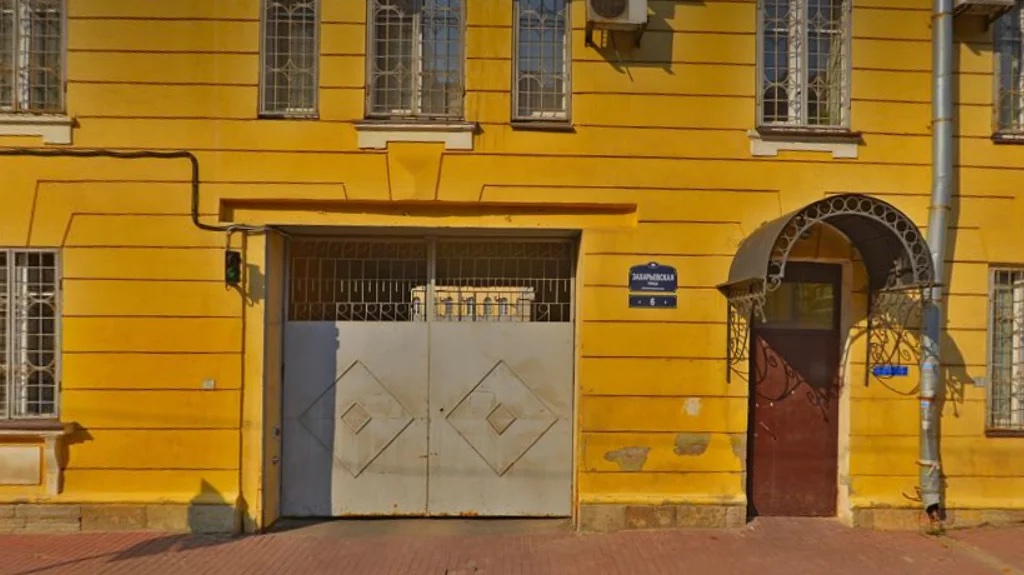
The special detention center at Zakharyevskaya 6 in downtown Petersburg. Image courtesy of Yandex Maps via mr7.ru

Police have detained Ekaterina Kishchak, a 20-year-old resident of Crimea, a citizen of Ukraine and Russia, and the daughter of Yuri Kishchak, a suspect in the bombing of a power line in the Leningrad Region. The young woman is currently at a special detention center in St. Petersburg, said lawyer Vitaly Cherkasov.

Ekaterina’s relatives turned to the lawyer for help. They said that on May 4, the young woman and her boyfriend, Dilyaver Gafarov, were supposed to cross the Russian-Georgian border at Upper Lars to go on holiday in Georgia. At the border checkpoint, the young woman texted to her father, who is living in Belgium, that they were on the verge of crossing the border, after which she stopped answering his calls.

Only fifteen days later, on May 19, did Ekaterina get in touch with her family. In a conversation with her father, she said that she had been detained at the border with Georgia and jailed for fifteen days—that is, until May 21. After this conversation, Ekaterina’s father had a heart attack and underwent surgery.

Ekaterina’s sister, Anna Petrishina, wrote to the Russian Federal Prosecutor General Igor Krasnov asking that the lawyer be notified if the young woman faced criminal charges, or to place her on the federal wanted list if law enforcement agencies were not involved in her disappearance. The letter states that, over the phone, Ekaterina claimed that the police officers who detained her “only ask[ed] questions about her father,” and said that if he did not return to Russia, she and her boyfriend “[would] be tried for his deeds.”

Ekaterina Kishchak. Photo courtesy of Vitaly Cherkasov, as posted on his Facebook page on 5 June 2023

Later, Ekaterina wrote to her father again. According to the lawyer, the young woman said that she had been “taken to St. Petersburg to be arraigned in his criminal case.” Ekaterina’s message was answered by her father’s wife, who replied that she would not pass on her stepdaughter’s message because it would only worsen her husband’s condition.

A lawyer from the Krasnodar Territory who was first engaged by the young woman’s relatives went to Vladikavkaz and discovered that Ekaterina and Dilyaver had been jailed for fifteen days on charges of “disorderly conduct”(per Article 20.1 of the Russian Federal Administrative Offenses Code). It also transpired that the detained young man had telephone his father on May 23 and informed him that the couple had been jailed a second time.

Yesterday, June 3, Cherkasov learned that Ekaterina and her boyfriend were in custody in the special detention center at 6 Zakharyevskaya Street in St. Petersburg—again on charges of disorderly conduct, per the decision of the city’s Smolny District Court. The lawyer attempted to meet with the young woman, but Ekaterina filed a written refusal to communicate with the human rights advocate.

“What happened there made me realize that FSB officers had arrived at the special detention center. I was asked for my identity card again, although they had already made a photocopy of it. When I had waited an hour, I approached the officer on duty and asked why it was taking so long. He replied, ‘Wait, they’re writing a statement in there.’ I was surprised: who did he mean by ‘they’ if I was waiting only for Ekaterina?

“An hour and a half later, the same officer appeared in the visiting room and bashfully handed me a statement, written in Ekaterina’s hand, that she did not want to communicate with me until the end of her stay at the special detention center.

“I asked the on-duty officer the standard question: did he understand that she had been pressured into [writing the statement]? He looked down and said that he had nothing to do with it, thus letting me know that he was carrying out someone else’s instructions,” Cherkasov told mr7.ru.

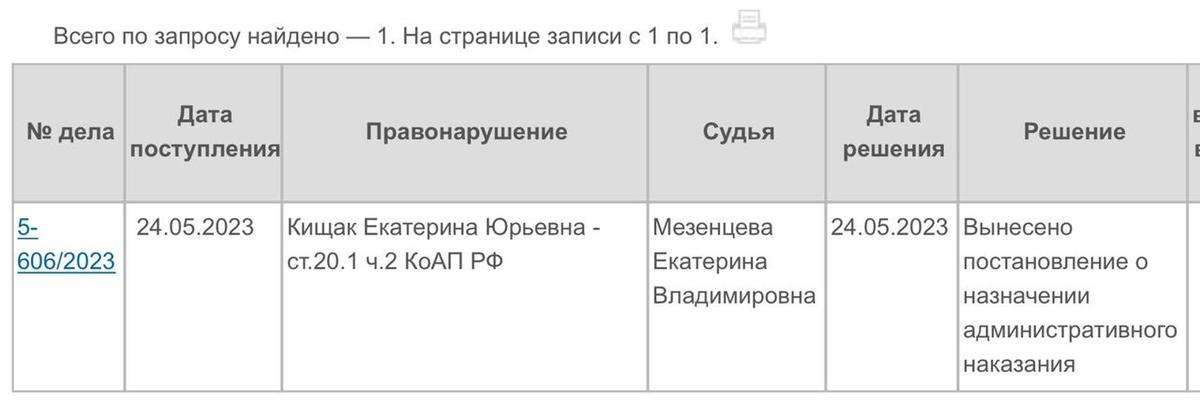
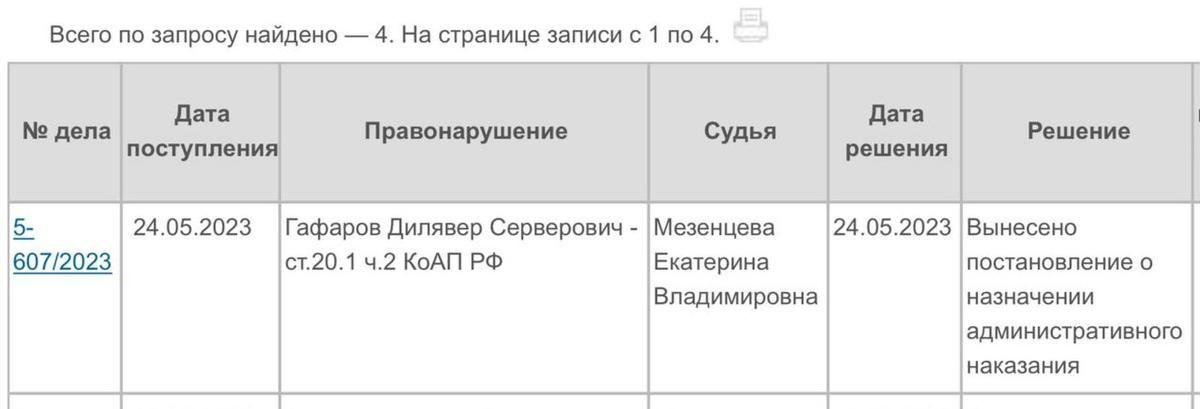
The lawyer plans to familiarize himself with the administrative case against Ekaterina Kischak in the Smolny District Court. There is information on the court’s website that the young woman and her boyfriend were convicted on May 24 by decision of Judge Ekaterina Mezentseva under Article 20.1.2 of the Russian Federal Administrative Offenses Code (i.e., “disorderly conduct involving disobeying a legitimate demand by an officer of the state”).

Screenshots of the Smolny District Court’s website, showing that Kishchak and Gafarov were convicted on 24 May 2023 by Judge Ekaterina Mezentseva of violating Article 20.1.2 of the Russian Administrative Offenses Code and sentenced to “administrative punishment.” Courtesy of mr7.ru

“We need to understand how, having arrived in St. Petersburg involuntarily, in fact, under the escort of regional FSB officers, Ekaterina and her boyfriend could have engaged in disorderly conduct,” the lawyer said.

You will recall that, on May 25, the FSB reported that it had detained two Ukrainian nationals: 44-year-old Alexander Maystruk aka Mechanic, and 48-year-old Eduard Usatenko aka Max. Yuri Kishchak aka YBK, a 59-year-old Ukrainian and Russian national who is currently in Belgium, was put on the wanted list.

The FSB claims that, in September 2022, the Foreign Intelligence Service of Ukraine (SZRU) recruited the three suspects to sabotage upwards of thirty pylons on the high-voltage power lines running from the Leningrad and Kalinin nuclear power plants (the latter is located in the Tver Region).

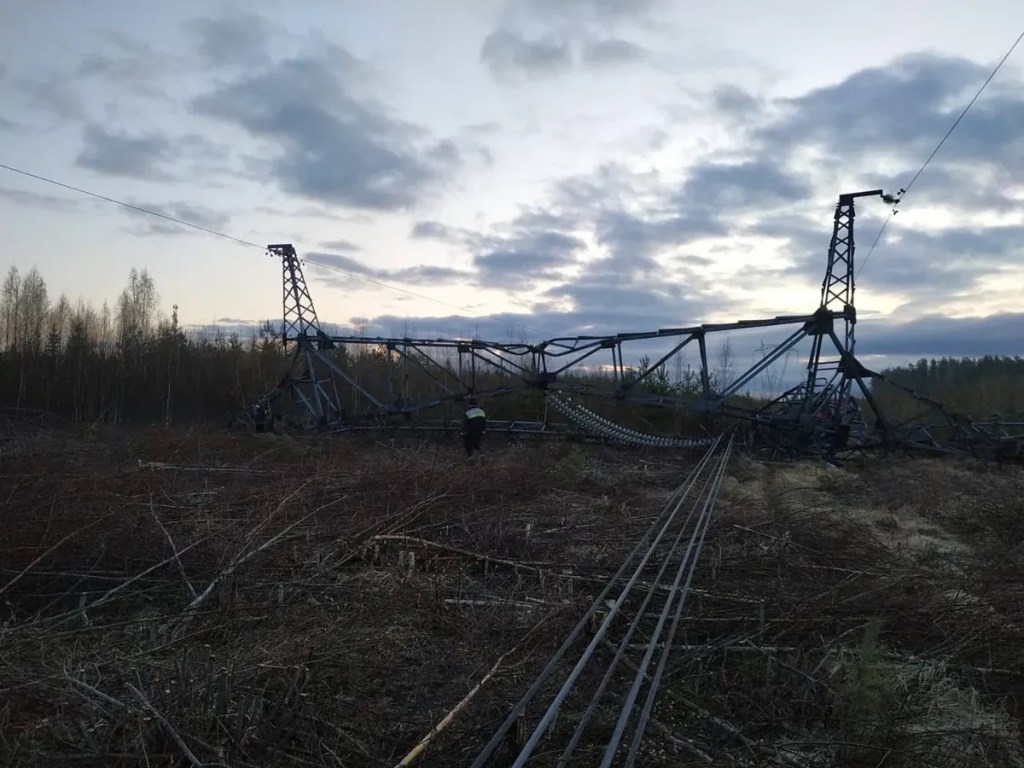
According to the FSB, on the Leningrad NPP power line the saboteurs managed to blow up one pylon and rig four pylons with explosives, while on the Kalinin NPP power line they planted IEDs under seven pylons. One of the pylons in the Leningrad Region collapsed due to the blast, but no one was injured, and the power supply was not disrupted.

The high-voltage power line allegedly damaged by a bomb blast on 1 May 2023
Source: Leningrad Region Governor Alexander DroZdenko [sic] (Telegram), via mr7.ru

Source: “Daughter of suspect in bomb blast on power line in Leningrad Region sent twice to special detention center for ‘disorderly conduct,'” mr7.ru, 4 June 2023. Translated by the Russian Reader. Thanks to Vitaly Cherkasov for the heads-up. This post was updated on 5 June 2023 to include the photograph of Ms. Kishchak, above, which was not part of the original article on mr7.ru.

The Subversive Community

The Russian Federal Criminal Code: “Original edition: Beware of fakes!” Image courtesy of the Russian State Duma’s website

The State Duma adopted in their third and final reading amendments to the Criminal Code that stipulate life sentences for “subversive activities,” reports the lower house’s website.

There was already an article in the Criminal Code that outlawed sabotage. It stipulated a life sentence only if someone was killed as a result (per Article 281.3).

The deputies decided to add three new articles (281.1, 281.2 and 281.3) to the Criminal Code. They have introduced such crimes as “creating a subversive community” and being involved in such a community, “facilitating subversive activities” and “training” to commit sabotage, and “promoting” and “condoning” sabotage.

As punishment, prison terms of eight to twenty years or life sentences are stipulated in all cases, except for aiding and abetting sabotage.

As in the case of the other articles in the Criminal Code dealing with terrorism and extremism, exemption from criminal liability is stipulated if an individual informs the authorities or “otherwise contributes” to the prevention of sabotage and “subversive activities.”

The deputies also included “promoting,” “condoning,” or “supporting” sabotage in the list of aggravating circumstances in the commission of other crimes (per Article 63 of the Criminal Code).

Other bills in this raft of legislation would allow the authorities to place people suspected or accused of violating the new articles on Rosfinmonitoring’s financial watch list and block their bank accounts, as well as enable the authorities to block websites containing instructions for “making ammunition for firearms.”

The set of four bills was introduced on December 8 by a group of more than 380 deputies. [There are 450 seats in the State Duma.] The first reading was held on December 14, and the text of the bills had not been amended as of the second reading on December 20.

Source: “State Duma passes law on life sentences for ‘facilitating’ sabotage,” Mediazona, 21 December 2022. Translated by TRR


I can’t stand it, I know you planned it
I’m gonna set it straight, this Watergate
I can’t stand rocking when I’m in here
‘Cause your crystal ball ain’t so crystal clear
So while you sit back and wonder why
I got this fucking thorn in my side
Oh my God, it’s a mirage
I’m tellin’ y’all, it’s a sabotage

So, so, so, so listen up ’cause you can’t say nothin’
You’ll shut me down with a push of your button?
But you, I’m out and I’m gone
I’ll tell you now, I keep it on and on

‘Cause what you see you might not get
And we can bet, so don’t you get souped yet
You’re scheming on a thing that’s a mirage
I’m trying to tell you now, it’s sabotage

Why

Our backs are now against the wall?
Listen all y’all, it’s a sabotage

I can’t stand it, I know you planned it
I’m gonna set it straight, this Watergate
Lord, I can’t stand rockin’ when I’m in this place
Because I feel disgrace because you’re all in my face
But make no mistakes and switch up my channel
I’m Buddy Rich when I fly off the handle
What could it be? It’s a mirage
You’re scheming on a thing, that’s sabotage

Source: Musixmatch. Song written by Michael Louis Diamond, Adam Nathaniel Yauch and Adam Horovitz

He Is Trying to Scare Us, and We Are Frightened

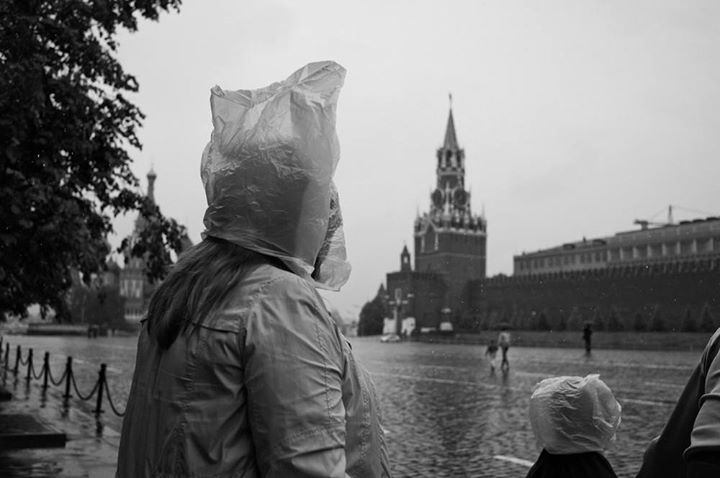
Photo by Aleksey Myakishev. Courtesy of http://shattenbereich.livejournal.com/1208934.html
Photo by Aleksey Myakishev. Courtesy of shattenbereich.livejournal.com

When Will We Hear “Shoot Them like Mad Dogs”?
Boris Vishnevsky
echo.msk.ru
January 13, 2016

“Enemies of the people,” “traitors,” “nothing is sacred,” “dancing to tune of western intelligence services,” “tried, with maximum severity, for sabotage.”

These are not snippets from a 1937 edition of Pravda or a speech made at a Party meeting during the same period.

This is how Ramzan Kadyrov, head of the Republic of Chechnya, speaks of the opposition to Vladimir Putin and his regime.

For a complete resemblance to Stalin’s time all we are lacking are references to “monsters,” “humanity’s garbage,” and a “despicable bunch of scoundrels,” and demands to “wipe them off the face of the earth” and “shoot them like mad dogs.”

But never say never. We might hear these phrases soon as well.

Equating the opposition with a hostile force is a key feature of a totalitarian regime, which Russia is building at an accelerated pace.

In a normal country, after making such statements, Kadyrov, Jr., would be booted out of office overnight, at least.

In a normal country, however, he never would have been able to take office.

Boris Vishnevsky (Yabloko Party) is a deputy in the Saint Petersburg Legislative Assembly.

Translated by the Russian Reader

 

mad-dog
Photo courtesy of allcatslookmad.com

Putin ally says opposition should be tried as enemies of the people
Andrew Osborn
Reuters
January 13, 2016

MOSCOW (Reuters) – One of Russian leader Vladimir Putin’s most high-profile allies has accused the opposition of trying to exploit the economic crisis to destabilize the country, using Stalin-era rhetoric to suggest unnamed individuals be put on trial for sabotage.

Ramzan Kadyrov, the Kremlin-backed leader of Chechnya, called the liberal opposition, which has only one lawmaker in the 450-seat parliament, enemies of the people, a phrase recalling language used during the reign of terror unleashed by Soviet leader Josef Stalin in the 1930s.

“Representatives of the so-called … opposition are trying to profit from the difficult economic situation,” Kadyrov told reporters, according to a statement issued by his office late on Tuesday.

“Such people need to be regarded as enemies of the people and traitors. They should be put on trial, with maximum severity, for sabotage.”

Opposition figures and rights activists said they were alarmed by his words with some suggesting the police should look into them.

Mikhail Kasyanov, one of the opposition’s leaders and a former prime minister, said: “There is no such concept in our constitution, but from Soviet history it is widely known that in Stalin’s time that is what they called anyone who thought differently … and that such people were liquidated.”

Battered by low oil prices, Western sanctions and a falling ruble, real incomes are on the slide in Russia for the first time in Putin’s 15 years in power, presenting the Kremlin with a challenge of how to stop discontent bubbling over.

Kadyrov made his remarks ahead of a Russia-wide parliamentary election in September amid so far only limited signs of social discontent.

Sergei Ivanov, Putin’s chief-of-staff, said on Tuesday “radicals and extremists” must be prevented from getting into parliament in that vote, raising fears among the opposition that they will find it harder to contest such elections.

Kadyrov, leader of Chechnya since 2007 and Putin’s most high-profile ally in the mostly Muslim North Caucasus area of southern Russia, did not name the opposition figures he thought should be put on trial.

Starved of access to state media and restricted by strict laws on protests, Russia’s liberal opposition is still reeling from the murder last year of Boris Nemtsov, one of its leaders.

One of the suspects awaiting trial for carrying out Nemtsov’s murder, Zaur Dadayev, used to serve in Chechnya’s police and was described by Kadyrov after the killing as a “true patriot of Russia.”

Nemtsov’s daughter has said she wants police to question Kadyrov in connection with the case. Kadyrov told a Russian radio station in October the idea he was a suspect was “total nonsense.”