Dankhaiaa Khovalyg: Russia’s Asian Republics Speak

Dankhaiaa Khovalyg. Photo: Rinchinaaa/Baikal People

‘I was made from Russian anyway,’ 28-year-old Dankhaiaa Khovalyg writes in her story ‘Ayalga,’ published in early 2022. Its female protagonist tells a psychologist how she feels like a stranger in her own country. When Dankhaiaa was a teenager, she deliberately detached herself from her native culture. She was proud to speak Russian without an accent, and dreamt of leaving Kyzyl ‘to be with her own people’ in Moscow.

During her eight years in Moscow, Dankhaiaa was involved in decolonial activism, researched her own painful background, and launched a project about indigenous people from Russia’s six ethnic Asian regions —the podcast re.public_speaking.

Alina Golovina, a Baikal People correspondent based in Buryatia, spoke with Khovalyg about why it is important to talk about trauma, where decolonization begins, and whether Russia’s ethnic republics can unite for their own benefit. At Danhkaiaa’s suggestion, they spoke to each other using the informal second-person pronoun ty.

As soon as I would lеave home, the world would crash down on me with all its xenophobia

— Tell me about yourself, Dankhaiaa.

— I was born and raised in Kyzyl. After graduating from school, I went to study in Moscow and lived there for eight years. I worked as a client manager in an IT company and was involved in feminist activism. In 2021, I quit my job and realized my childhood dream: I enrolled in literature classes and took up writing. Since March 2022, I have been living in Berlin and doing podcasts and anti-war activism.

— You told me that up to ninety percent of the indigenous people in Tuva speak Tuvan and consider it their native tongue. Why have you prioritized Russian? Is it a problem?

— I’m a city girl: I grew up in Kyzyl. I was sent to a Russian-language kindergarten and, later, to a Russian-language class at school. That was how my mother showed that she cared about me: Russian-speaking classes were considered tonier. I was a bookworm and was engrossed in Russian literature. Unfortunately, I didn’t have access to a large amount of foreign literature at school, and at that moment, eighty percent of me certainly consisted of this great and beautiful Russian literature by the so-called Tolstoyevskys. I read all of that stuff and would dream of going to Moscow. I was a little proud that I spoke such beautiful Russian. Basically, I went through all that internalized colonial chauvinist crap that life was better there, that I was going to get out because I was more like them.

— Did it save you from ethnic discrimination? If not, when did you first encounter it?

— My experience of discrimination actually began long before I moved to Moscow. My mother found opportunities using travel vouchers to send me to summer camps in Krasnodar Territory, Khakassia, and other regions. I was eleven and twelve years old at the time. It didn’t matter whether I traveled five hundred kilometers from home or several thousand, because everywhere I went I encountered phenomenal bullying. I was labeled ‘China girl’ and ‘black.’ No one asked me to dance at dance parties. I was either totally ignored or talked to condescendingly and peppered with passive-aggressive insults. I had lived in my native Tuva in a groovy, comfortable bubble: most people spoke Tuvan, and we didn’t encounter any racism there. But as soon as I would leave home, the world would crash down on me with all its xenophobia. Whereas in Tuva I was considered pretty, smart, and cool, everything and everyone at those camps made it clear to me that I was second-rate.

— How did this affect you?

— These contrasts generated very unhealthy takeaways in my head: that Tuva’s overall level [of development] was much lower than the rest of Russia’s. This absolutely perverted assumption made me, as a teenager, condescend to Tuvan culture and my Tuvan side. It is quite painful for me to remember the instances when relatives addressed me in Tuvan, but I would reply in Russian, saying that I didn’t understand them, although that was a lie. Those memories now make me feel bitter. I feel sorry for that teenage girl.

— What happened later in life? How did Moscow welcome you?

— I often encountered micro-aggressions in public places. For example, I would be standing in the queue at a store, and a huge Russian guy would push me aside and go in front of me. There was no explicit verbal indication that this was because I was non-Russian, but I think this wouldn’t hae happened if I had been of Slavic appearance. I repeatedly had big problems finding a place to live because of my name and my appearance. Or, for example, I would be climbing the stairs to my floor, and neighbors descending the stairs would say, ‘The churkas have come and taken over the place’ when they would see me. They would not say it to my face, but under their breath as it were, and when they were already a flight below me, so I couldn’t even shout back at them as it happened. I would just stand there for a while, frozen on the steps. You always deal with this alone because when you are with your husband or a group of people, those very same neighbors keep their mouths shut. Every such episode of chauvinism really demoralized me, although I didn’t express it outwardly. Because no matter who I would tell, they would say, ‘Oh, don’t pay attention! Rise above it! We don’t stoop to their level.’ I swear that there has never been an instance when someone just shared my indignation for a second.

— Have you experienced physical violence? Have you been attacked?

— I didn’t encounter any actual boneheads (far-right skinheads): I moved to Moscow in 2013, by which time the most ardent supporters of that ideology had been jailed. The cases of physical violence that happened to me are difficult to categorize. The first time it happened was when I was in my first year at university. I was traveling from my part-time job in an empty train carriage to my dormitory. I had leaned my head against the window and fallen asleep with my legs stretched out. I woke up to an old man kicking me and saying, ‘Move your damn feet.’ I did and asked him what was the matter, and he said he wanted to sit down. I suggested he sit down in one of the other free seats, upon which he started kicking me again, saying that I was a churka and if I gave him any guff, he would beat the shit out of me. It was so horrible, because the old man spoke softly and looked like a harmless creature. I didn’t leave because I didn’t want to look weak. He stared at me point-blank the whole way and commented that I behaved very freely in Russia. It was forty minutes of violence.

The second incident happened on Leninsky Prospekt near the Oktyabrskaya subway station. It was summer, I was walking with headphones on in a crowd of people, listening to music. I noticed out of the corner of my eye that a man was walking in my direction and looking at me intently. Over the years, you develop something like a muscle that reacts to unwanted attention and makes you tense up and pull yourself together as if you’re getting ready to react. When the man walked by, he hit me over the head with a bottle. I fell down. He walked on. So there I was, lying propped up on my elbows, looking at the man walking away, and all the other people just passed me by. I thought at the time that it could have been a scene from a film, because only in a film can you get hit and nobody comes up and asks how you’re doing or tries to help you. And there were a lot of little situations — elbowing, pushing, kicking. Several times when I was putting away my dirty tray at a food court, I was told, ‘Hey, clean this up.’

Continue reading “Dankhaiaa Khovalyg: Russia’s Asian Republics Speak”
The Meaning of Easter: “The Rest Is Hell”

Alexander Beglov, the governor of St. Petersburg, congratulated all Orthodox Christians on yesterday’s Easter holiday during his weekly program on Radio Russia, wishing them peace and health.

“Easter is a symbol of the victory of life over death, light over darkness, good over evil. Today, our soldiers are defending by force of arms the ideals of goodness and justice, and protecting the historical truth and our culture,” the official added.

In his opinion, it was observance of the ancient Christian traditions that made Russia “strong and invincible.”

Announcing his upcoming trip to the St. Petersburg Days celebration in Belarus, Beglov said that both countries opposed fascism. This year, the city will be sending its largest delegation in the history of Petersburg-Belarusian bilateral relations to the neighboring state.

In his Easter address yesterday, Beglov remembered Mariupol.

Source: “Beglov links Eastern holiday to actions of Russian in SMO zone,” ZAKS.ru, 17 April 2023. Translated by TRR


“Christ is risen!”: the traditional Russian Easter greeting, as seen here on a card I received yesterday.

Basically, what I want to say is that I have been incredibly lucky when it comes to people. It is the only real thing, the future. The rest is hell.

Source: An Easter greeting sent to me by an old friend and lifelong resident of St. Petersburg. Translated by TRR


Petersburg mayor [sic] Alexander Beglov and the head of the city’s parliament [sic] Alexander Belsky addressed the residents of the Northern Capital on the occasion of the Orthodox holiday of Easter. The speeches made by the politicians were quoted by the press service for the Smolny.

Beglov and Belsky spent last night at a service in Our Lady of Kazan Cathedral.

Metropolitan Varsonofy conducted the service. Addressing the residents of St. Petersburg, the mayor [sic] recalled the special military operation.

“Today our country is undertaking a special mission. Our military has been facing difficult trials in the name of justice and the future of our children. Our hearts are with them. Our prayers are for them!” the governor said.

In his address, Beglov mentioned Mariupol, St. Petersburg’s sister city, as well as the involvement of Russians in the SMO.

“Our Church prays for them, for the soldiers, for all who are united with us in our values,” Beglov concluded.

Source: “Beglov remembers Mariupol while congratulating Petersburgers on Easter,” ZAKS.ru, 16 April 2023. Translated by TRR

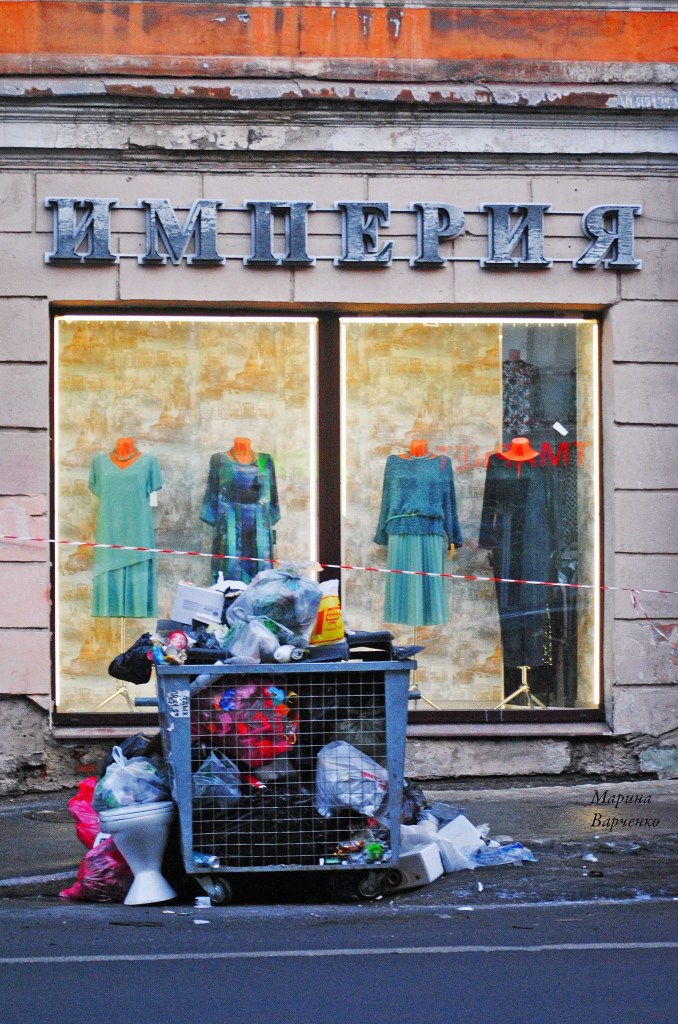
Empire

“Empire”

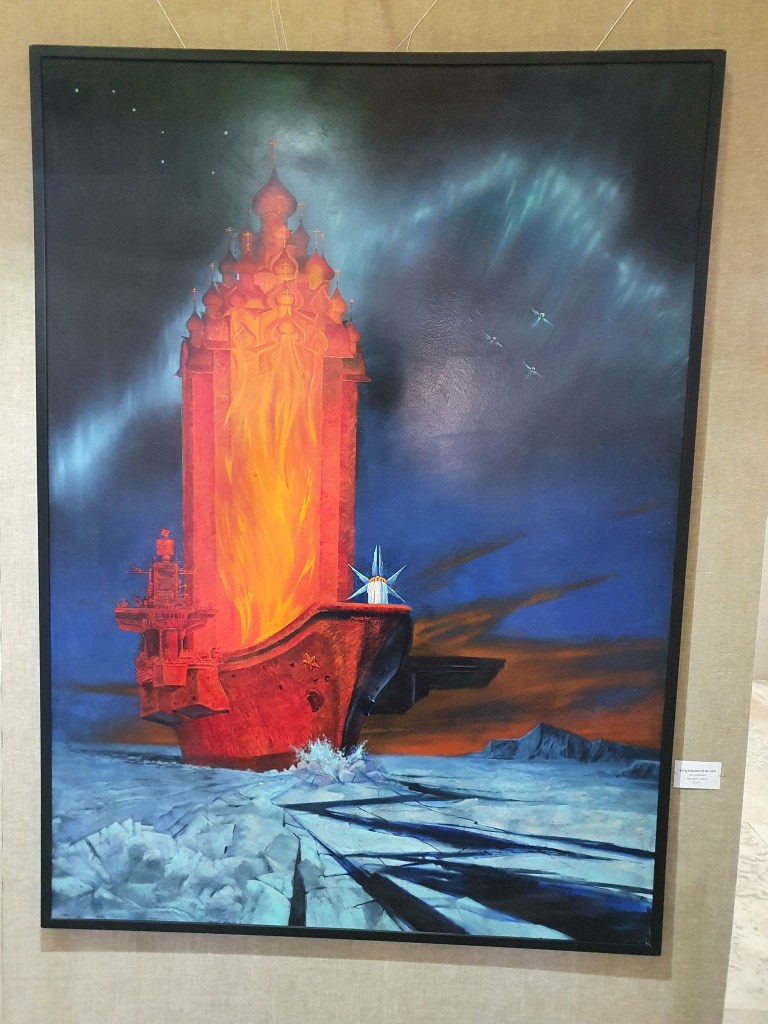
Today, on Razyezhaya, I came across a simply perfect illustration of what we’re living through.

Source: Marina Varchenko, Facebook, 25 December 2022. Razyezhaya is a street in central Petersburg that I know like the back of my hand since I lived nearby for many years. ||| TRR


These comments by Mira Tai were published by Doxa, the Russian online student magazine that has become a prominent voice against the war.

Hello! It’s Mira.

The full-scale Russian invasion of Ukraine has compelled many people, who live in Russia but are not ethnic Russians [russkie], to think about how we actually became the “small peoples of Russia” [a widely used term for the non-Russian nationalities that make up about one fifth of Russia’s population]. We saw many parallels between the way that the “Russian world” is trying to swallow up independent Ukraine, and the way that the ethnic republics “voluntarily became part of Russia” previously.

We have seen how the state, in which openly-declared nationalists hold leading posts in government bodies, justifies the massacre of citizens of a neighbouring country as “denazification”. We have seen how the propaganda machine is speaking openly about the renaissance of a gigantic centralised empire, in which there is no identity except Russian, and no other language than Russian.

These months have made all of us pose a mass of difficult questions, to ourselves and to each other. And no matter how hard the Russian propaganda machine tries to ridicule or denigrate this process, it will not be stopped and not be turned back – because we have changed. The surge of anger among non-Russian people has gone too far. The genie will not be put back in the bottle.

And the further it goes, the more astonishing it becomes that the majority of prominent Russian liberals and representatives of the “anti-Putin resistance”, continue to ignore what is happening. A great example is the new educational project, “Renaissance” [“Vozrozhdenie”], which opened today [23 December] and which has been loudly advertised on Ekaterina Schulmann’s Youtube channel over the last few months.

For the project, nine men and Ekaterina Schulmann invite people to take courses on the theory of democracy, capitalism and protest, the history of Christianity, and so on. They promise that in future this knowledge will facilitate the working-out of “a strategy for the Russian state, rebuilt and reborn as the inheritor of Russian, European and world culture”. Judging by the visual images chosen – golden-haired young women in Monomakh caps [the crown symbol of the pre-1917 Russian autocracy], gold leaf and portraits of monarchs – the school’s founders are especially inspired by the aesthetics of the Russian empire.

In a video in the section “About Us”, the word “civilisation” appears together with a picture of a young, rouged Ekaterina the Second [usually Catherine the Great in English-language history books] – the empress who first seized Crimea and began the process of genocide against the Crimean Tatars. That same Ekaterina, whose army slaughtered the population of whole towns in the name of the country’s “growth”.

And so in the tenth month of the full-scale Russian attack on Ukraine, we continue to witness how Russian liberals ignore any consideration of decolonisation. They do not even pose questions about the ideas and interests of those who have not been, and do not want to be, “inheritors of Russian culture”. They have not been troubled by doubts about the abstract liberal ideals of “democracy, freedom and peace”; they have no hesitation in proposing “Europe” as the source of progress, as opposed to the east. One of the courses offered by “Renaissance” is titled, in the best traditions of orientalism: “The East: a delicate matter”. …

People who can today link the word “civilisation” with portraits of Ekaterina the Second and festive, gold-trimmed panoramas of Moscow and St Petersburg, and who can promise the “renaissance of Russia”, must be blind and deaf to the suffering, and the hatred, of the Chechen people, who were subjected to genocide by the nearly-democratic Moscow of the 1990s. Blind and deaf to the hatred, and suffering, of the Ukrainian people, subjected to genocide by the authoritarian Moscow of 2022. Blind and deaf to the hatred, and suffering, of everyone whose first language definitely should not have to be Russian. And this lack of feeling is monstrous.

□ These comments appeared in Doxa’s Anti-War Digest on 23 December. I have translated them, because I think they offer useful starting-points for discussion about “decolonisation” of Russia that has begun not only among anti-war Russians, but also among those elsewhere who take the side of Ukrainian resistance. With Mira Tai, we witness “how Russian liberals ignore any consideration of decolonisation” – and, I would add, some self-proclaimed socialists do the same. One such is the writer and publicist Boris Kagarlitsky, who is to teach courses for “Renaissance,” and appears in its introduction video. He expressed opposition to this year’s invasion, but only after years of support for Russia’s imperial adventure in Ukraine since 2014 (for which he was criticised on this blog and elsewhere). SP.

□ To read more about Doxa in English, see an interview with Doxa activists just published by the Ukrainian socialist journal Spil’ne (Commons), and these speeches from the dock by Doxa editors Armen Aramyan, Volodya Metelkin, and Natasha Tyshkevich. They were tried on criminal charges last year, after publishing a video that discussed whether teachers should discourage students from attending demonstrations to support Alexei Navalny, the anti-corruption campaigner. (Doxa’s new website is in Russian.)

□ You can also read in English about anti-war activism in Russia on the Feminist Anti-War Resistance Facebook page. The Russian Reader is an essential source, as is OpenDemocracyPosle reflects the view of Russian socialist activists.

Source: “Russia. Renaissance is not going to happen,” People and Nature, 28 December 2022. Thanks to Simon Pirani for his kind permission to reprint this here.

It Does Hurt to Dream

“Russian angel carrier, Artillery Museum, Saint Petersburg.” Source: Pavel Pryanikov, Facebook, 6 November 2022

Alexander Kharichev, head of the Presidential Department for Supporting the Work of the State Council, and three other experts have published a scholarly article entitled “Perception of basic values, factors, and structures of Russia’s socio-historical development, as based on research and testing.” As part of the study, seventy people from the student bodies of Moscow State University and the Higher School of Economics and the teaching staff of a conference in Sevastopol [sic] were interviewed. Among the metaphors of the future they proposed was the burnt second volume of Dead Souls; among the concepts of the modern state, “the Motherland with a laser sword”; among the concepts of the future, “Russia as the world’s ‘guardian of good” and “Pasty” [sic: “Pirozhok”]. The authors concluded that the dominant value for the Russian family is the people of Russia, which itself is a “family of families.”

Mr. Kharichev’s co-authors were Andrei Shutov, dean of the faculty of political science at Moscow State University; Andrei Polosin, doctor of political science and head of Rosatom’s regional interaction department; and Ekaterina Sokolova, deputy executive director for strategy and forecasting at the Expert Institute for Social Research. The article was published in October in the Journal of Political Studies.

The study was conducted by means of group discussions from March to May. The seventy participants answered questions about what Russian statehood is, what would happen to the country in ten years, what our future is, and a number of others.

Based on the discussions, the researchers formed a five-level “pentabasis”: person—family—society—state—country. Dominant values were formed for each level. For the country, [this dominant value] is patriotism; for the state, it is trust in the institutions of power; for the family, it is the people of Russia; for society, it is harmony; for the person, it is creativity. “The thesis was voiced that European society is individualistic, whereas our main value is family + family with friends, which leads to the emergence of the thesis ‘family as a level.’ The dominant value: the people of the Russian Federation as a family of families. Stimulating the birth rate and the concept of a ‘big family,’ the article says [just as incoherently in the original as in this translation].

  • Metaphors of Russia’s future. “The state as a novel” (written collectively by citizens, it has alternative endings); “the Russian future as the second part of Dead Souls, burned by Gogol,” “the state as the Firebird.”
  • Concepts of the modern state.[The] Motherland with a laser sword” (a source of pride for the Russian spirit and a guide to the future), “the friendly service state.”
  • Messianic concepts of the future state. “Russia as a ‘prophet country’ (opposed to the Grand Inquisitor), “Russia as the world guardian, the ‘guardian of good.'”
  • Idealistic concepts of the future state. “Wondrous City” ([i.e., promoting] inclusivity, coexistence, acceptance of others as equals; “in no case to be confused with the term ‘tolerance'”), “Pasty” (harmoniously combines different things).
  • Mechanistic concepts of the future state. “Kaleidoscope” (a multifaceted future), “a medium-sized magnet state” (generates a field for a particular community).

The study participants concluded that the person in the “Russia of the Future” is “proud of his country, influential and highly employable, financially secure, [and] free within certain community rules.” According to the authors of the article, the ideas of self-realization in the Russian Federation are very different from those common in the Western world.

“In the Russian case, self-realization or mission means that an individual contributes to the country’s development. Capitalizing [on one’s] mission is an optional stage,” the authors write.

Source: Leonid Uvarchev, “Alexander Kharichev from the presidential administration wrote an article about imagining Russia’s future,” Kommersant, 7 November 2022. Translated by the Russian Reader

“Why Our Cause Is Just”: Medvedev’s National Unity Day Telegram

Dmitry Medvedev. Photo courtesy of his Telegram channel

WHY OUR CAUSE IS JUST
Answers to simple questions on National Unity Day

What are we fighting for? Russia is a huge, rich country. We don’t need foreign territories; we have plenty of everything. But there is our land, which is sacred to us, on which our ancestors lived and on which our people live today. And which we will not surrender to anyone. We are defending our people. We are fighting for all of our own people, for our land, for our thousand-year history.

Who is fighting against us? We are fighting against those who hate us, who ban our language, our values, and even our faith, who spread hatred towards the history of our Fatherland.

A part of the dying world is against us today. It consists of a bunch of crazy Nazi drug addicts, the common people they have drugged and intimidated, and a large pack of barking dogs from the western kennel. They are joined by motley pack of grunting piggies and narrow-minded philistines from the disintegrated western empire with saliva running down their chins due to degeneration. They have no faith and ideals, except for the harmful vices they have contrived and the standards of doublethink they impose, which deny the morality bestowed on normal people. Therefore, by rising up against them, we have gained sacred power.

Where are our former friends? We have been abandoned by some frightened partners — and I could not give a flying crap about them. That means they were not our friends, but just random fellow travelers, clingers, and hangers-on.

Cowardly traitors and greedy defectors have bugged out for the back of beyond — may their bones rot in a foreign land. They are not among us, but we have become stronger and purer.

Why were we silent for a long time? We were weak and devastated by hard times. And now we have shaken off the sticky sleep and dreary gloom of the last decades, into which the death of the former Fatherland had plunged us. Other countries have been waiting for our awakening, countries raped by the lords of darkness, slaveholders and oppressors who dream of their monstrous colonial past and long to preserve their power over the world. Many countries have long disbelieved their nonsense but are still afraid of them. Soon they will wake up once and for all. And when the rotten world order collapses, it will bury all its arrogant priests, bloodthirsty adepts, mocking henchmen, and tongue-tied mankurts under the multi-ton pile of its own debris.

What is our weapon? There are various weapons. We have the capacity to dispatch all our enemies to a fiery hell, but that is not our mission. We listen to the Creator’s words in our hearts and obey them. These words give us a sacred purpose. The goal is to stop the supreme ruler of hell, no matter what name he uses – Satan, Lucifer, or Iblis. For his goal is destruction. Our goal is life.

His weapon is an elaborate lie.

But our weapon is the Truth.

That is why our cause is just.

That is why the victory will be ours!

Happy Holidays!

Source: Dmitry Medvedev, Telegram, 4 November 2022. Mr. Medvedev, the former Russian president, has 910,612 subscribers on Telegram. For reactions to his National Unity Day post, see Asya Rudina, “‘Iblis crept up unnoticed’: Bloggers on Dmitry Medvedev’s creative work,” Radio Svoboda, 7 November 2022 (in Russian). Translated by Your Answer Needs Demented Examples Xavier, with a little assistance from the Russian Reader. For an alternative vision of Russian patriotism, also prompted by the November 4 National Unity Day holiday, see Kirill Medvedev (no relation), “‘If There Is No People, There Is No Left Either’: Progressive History and Patriotism from Below,” Posle, 2 November 2022. I can endorse neither of these visions, alas. ||| TRR

V (Z) Day in Petersburg

Footage of Victory Day celebrations on Palace Square in Petersburg, 9 May 2022

Victory over fascism was celebrated in Petersburg to the song “I Am Russian.” Alexander Beglov, the city’s governor, spoke at Palace Square.

Congratulating the citizens of Petersburg on May 9, [Beglov] recalled the “fight against fascism and Nazism today.”

“Our soldiers in Ukraine are defending Donbas. They are defending us, our historical memory, and the heroic deeds of our grandfathers. Our president, the son of a front-line soldier, has stood up against the Nazis. He has united us all. We are united, we are strong, and we will win!” he said.

After his congratulations, a military ensemble came on stage to sing the song “I Am Russian.” During its performance, footage of either actual military operations or exercises by the Russian Army was shown on a big screen.

Source: Rotunda, 9 May 2022. Video courtesy of a Rotunda reader. Translated by the Russian Reader


“I’m Proud That I’m [an Ethnic] Russian.” A poster for a concert at the Gavrila Derzhavin Estate Museum on the Fontanka River Embankment in Petersburg, on 22 May 2022. The concert will be performed by the Boris Troyanovsky Great Russian Orchestra, under the direction of Anna Drozdovich. Thanks to Marina Varchenko for the snapshot.

Recommended Newsletters

Recommended Newsletters

SOCIETY
Newsletter of the “For Morality!” Foundation

The newsletter highlights the work of the “For Morality!” Foundation and talks about the implementation of such projects as the “Morality Is the Strength of the Nation” lecture course for schoolchildren, promotion of the concept of the Russian national idea and other areas of activity.

Subscribe

THE WORLD OF WOMEN
About the little that a woman needs in life

About the little that a woman needs in life. Style, fashion, success. Fitness as a way of life. Psychology of relationships.

Subscribe

Your troubles

Any problems that have worried you, your troubles that have caused anxiety and pain are a reason to seek help. I’ll do what I can to help! I will suggest how to act in this or that life situation. Dr. Vladimir Stepanovich Khoroshev.

Subscribe

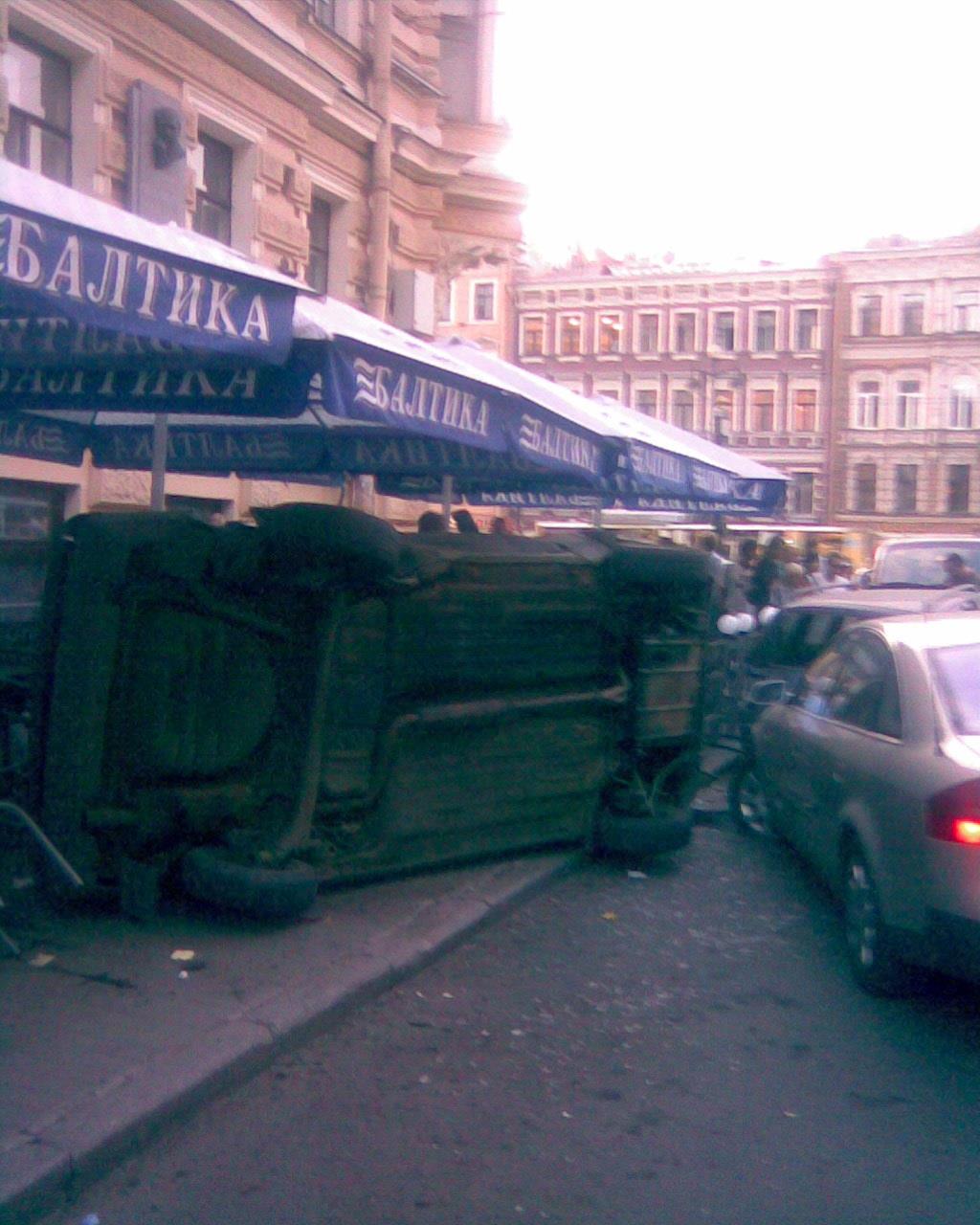
Source: Subscribe.Ru “News” mailing list for 15 November 2021. Archival photo of a car crash at a summer beer garden on Pushkinskaya Street in Petersburg [circa 2003] by the Russian Reader. Translated by the Russian Reader

Death to F—-ts

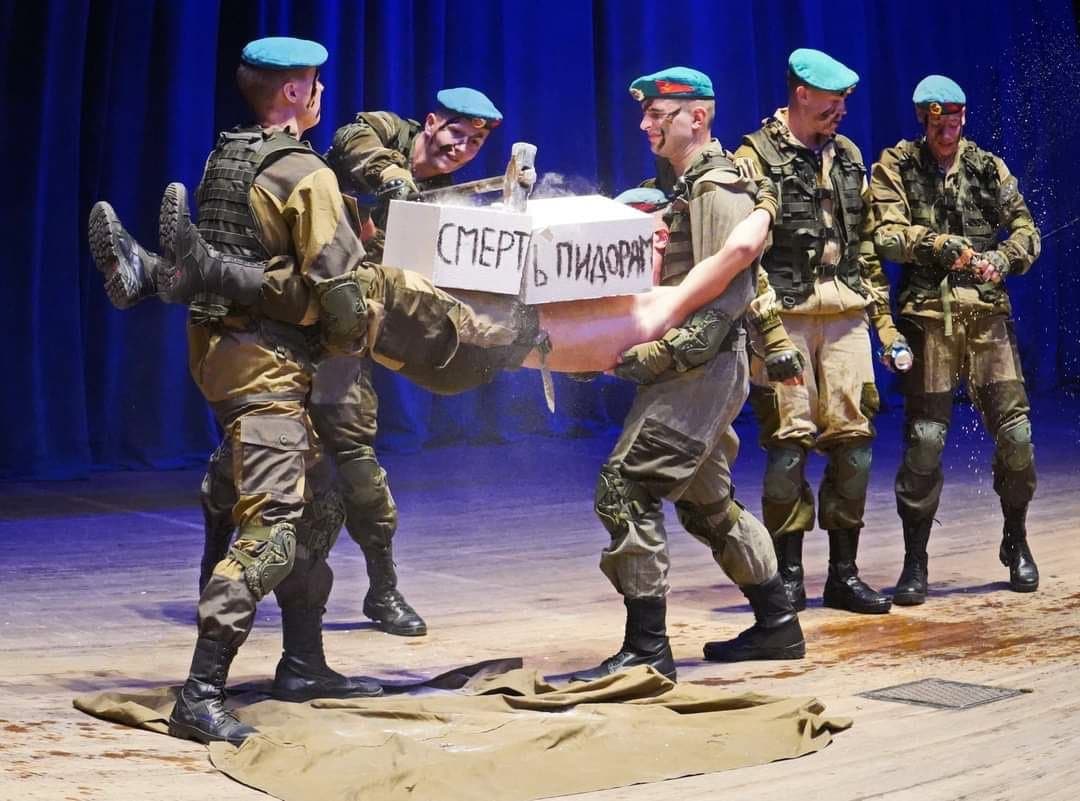
“Death to faggots.” Photo courtesy of Baza via Mediazona

Performers at show in honor of Yaroslavl patriotic club’s 20th anniversary smash stage prop with the inscription “Death to faggots” using sledgehammer 
Mediazona
August 31, 2021

During a performance by the military patriotic club Paratrooper in Yaroslavl, the regional news website 76.ru has reported, the performers used a sledgehammer to smash a stage-prop brick inscribed with the phrase “Death to faggots.”

According to the website, a performance in honor of the club’s 20th anniversary was held at the Dobrynin Palace of Culture in Yaroslavl on August 29. The performers took their comrade, placed a prop shaped like a white brick, inscribed with the phrase “Death to faggots,” on him and smashed it with a sledgehammer.

Andrei Palachev, the head of Paratrooper, explained to 76.ru that the club members had been joking.

“The kids just decided to make a joke and drew this inscription at the last moment. Faggots have no business being in Russia at all. […] And why should [the performers] be punished? They just don’t like fudge packers, and I don’t like them either. The family should be traditional: a boy and a girl, and not all this faggotry,” Palachev said.

Igor Derbin, the palace of culture’s director, stressed that this part of the performance had not been vetted with him.

“We are outraged. Initially, the event was supposed to be pleasant and joyful. We weren’t expecting their stunt. It was not planned in advance or agreed upon, because they knew that we would not allow it. By doing what they did, they canceled all the good impressions made by the event,” he added.

Taras Sidorin, the head of the Yaroslavl branch of the veterans organization Defender, said that he had filed a complaint with the police about the incident. “We consider such outburst incitement to murder. […] There were small children in the audience. This behavior is simply unacceptable,” he said.

Translated by the Russian Reader

BARS: Pro-EU Monarchist Stencilers

Court Hands Down Sentences in BARS Trial: From Three to Eight Years in Prison
OVD Info
April 17, 2020

In a circuit session at the Baltic Fleet Court, the Second Western Military District Court has sentenced the defendants in the trial of the Baltic Vanguard of the Russian Resistance (BARS) to up to eight years in prison, reports Mediazona, citing attorney Mikhail Uvarov from the Agora human rights group.

barsNikolai Sentsov and Alexander Orshulevich. Photo by Oleg Zurman. Courtesy of Mediazona and OVD Info
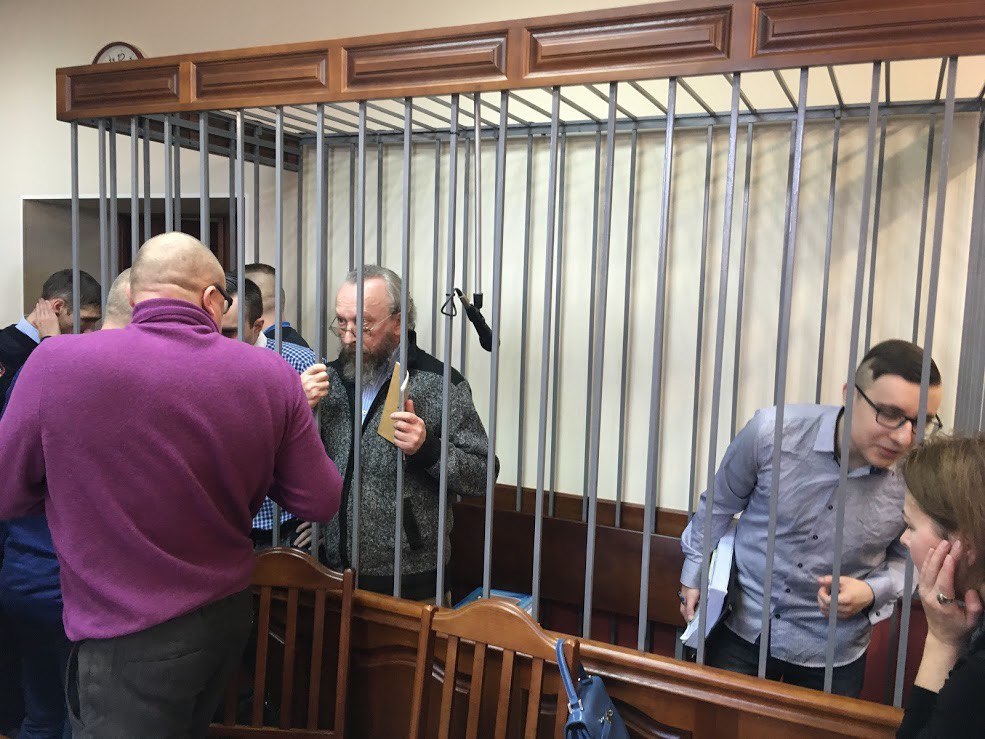
Alexander Orshulevich was sentenced to eight years in a medium-security penal colony, while Alexander Mamayev and Igor Ivanov were sentenced to six years. Although Nikolai Sentsov was sentenced to three years in a work-release colony, he was freed in the courtroom for time served in remand prison.

Orshulevich, Mamayev, and Ivanov were found guilty of making public calls to engage in terrorist and extremist activity, punishable under Articles 205.2 and 280.1, respectively, of the Russian Criminal Code. Orshulevich was also found guilty of creating an extremist community (Article 282.1.1), and Mamayev and Ivanov were found guilty of involvement in a terrorist community (Article 282.1.2). Sentsov was charged only with possession of firearms and explosives, punishable under Articles 222.1 and 222.1.1, respectively.

The prosecutor’s office had asked for sentences between six and ten years in prison for the accused men, who denied all wrongdoing.

abars-2Alexander Mamayev and Igor Ivanov. Photo by Oleg Zurman. Courtesy of Mediazona and OVD Info

According to investigators, the members of BARS, a monarchist organization, were planning to forcibly annex Kaliningrad Region to the European Union .  To achieve their goals, according to investigators, the accused were planning to use stencils to paint extremist inscriptions on walls. The defense claimed that these stencils were planted by law enforcement officers during searches.

Initially, all four men were charged with “extremism,” but then the indictment was changed to more serious charges—organizing and being involved in a “terrorist community.”  Orshulevich was then indicted on five charges. In early April, the court reclassified the charges: three of the defendants now faced “extremist community” charges, while Sentsov faced only the possession charge.

Orshulevich, who is accused of organizing BARS, said that during the search of his flat, police put a plastic bag over his head and roughed him up.

Translated by the Russian Reader

Nikolay Mitrokhin: The Woman in Black

min
Mother Superior Ksenia (Chernega). Photo courtesy of Monasterium.ru

The Woman in Black
Nikolay Mitrokhin
Grani.ru
March 2, 2017

The fantastic story of how a small Moscow monastery has contrived to sue the state and take over a huge wing of the Fisheries Research Institute forces us to take a closer look at at a church official who has long remained partly in the shadows, Mother Superior Ksenia (Chernega), abbess of the selfsame St. Alexius Convent that sued the state and, simulaneously, head of the Moscow Patriarchate’s legal department. Chernega is not entirely unknown to the public. She has often been quoted in official reports of restitution of large pieces of real estate to the Russian Orthodox Church (ROC). However, as holder of a “boring” post, she has not been particularly prominent in the public eye.

And that’s too bad. Chernega is not only one of the most influential women in the ROC (in 2013, she took fourth place in an internal church rating) but also a successful raider who skillfully manipulates clerics and laymen alike. The adjudged research institute, a huge building that incorporated part of the foundations and a wall of a demolished church, is the most striking but hardly the largest victory in her career. The 46-year-old Oksana Chernega (her name until 2009, a name she still uses in secular contexts) is probably the longest-serving staff member of the Moscow Patriarchate’s legal office. She has worked there since 1993, while also working in secular law schools, achieving professorial rank. She became a leading authority on church law in the early 2000s. Generations of politicians and MPs have come and gone, but Chernega has the whole time testified at hearings of the relevant parliamentary committees and governmental review boards, lobbying the laws the ROC has wanted passed.

Her main achievement has been the law, signed by President Medvedev in late 2010, “On the Transfer of Religious Assets in State or Municipal Ownership to Religious Organizations.” It is this law under which movable and immovable property has been transferred to the ROC the past six years. Yet the Church has behaved capriciously, taking only what looks good or has real value. The Perm Diocese is unlikely to restore to its former use the huge military institute that took over what used to be its seminary: there are catastrophically few people who want to go into the priesthood, and the poor diocese is incapable of maintaining the enormous premises. But how sweet it is to get a huge building on the river embankment in the city center as a freebie. Whatever you do with it you’re bound to make money.

But not everything has been had so smoothly. The property the ROC has set its sights on has owners, and they are capable of mounting a resistance. That is when Chernega takes the stage. When she announces the Church has set its sights on a piece of real estate, it is usually a bad sign. The day before yesterday, it was St. Isaac’s Cathedral, yesterday it was the Andronikov Monastery, today it is the Fisheries Research Institute. What will it be tomorrow? Anything whatsoever.

On the eve of March 8 [International Women’s Day] and amidst the debates on feminism in Russia, it would seem that Chernegas has pursued a successful, independent career as a woman in the Church.  But it’s not as simple as all that.

It is well known in ecclesiastical circles that Chernega acts in tandem with a notable priest, Artemy Vladimirov. He is not only confessor at the St. Alexius Convent but is also well known throughout the Church. A graduate of Moscow State University’s philolology department and rector of All Saints Church (a neighbor of the convent and the reclaimed fisheries institute), Vladimirov is a glib preacher who specializes in denouncing fornication; he is, therefore, a member of the Patriarchal Council on Family and Motherhood. The council has become a haven for the Church’s choicest monarchistically inclined conservatives, including Dmitry Smirnov, who has led an aggressive campaign against Silver Rain radio station, Konstantin Malofeev, Igor Girkin‘s ex-boss and, concurrently, an expert on web-based pedophilia, and the wife of Vladimir Yakunin, former director of Russian Railways, a billionaire, and former KGB officer.

Vladimirov vigorously espouses monarchist views and has made a huge number of basically stupid public statements, such as the demand to remove a number of works by Chekhov and Bunin from the school curriculum and a call to campaign against Coca-Cola. Such radicalism is not rare in the ROC, however, Since the late 1990s and the publication of the novel Celibacy by church journalist Natalya Babasyan, Vladimirov has served as a clear example for many observant and quasi-observant Orthodox believers of where the line should be drawn in interactions between a priest and his flock, especially his young, female parishioners.

Because of this reputation, Vladimirov has remained in the background even during periods when the grouping of monarchists and Russian nationalists to which he has belonged has had the upper hand in the ROC. But if you can’t do something directly, you can do it indirectly, and Oksana Chernega has come in very handy in this case. As is typical of a young woman in the modern ROC, she is utterly dependent on her confessor. During the late 1980s and early 1990s, Orthodox fundamentalists and monarchist heterosexuals developed a curious lifestyle. Young and handsome, usually university grads with the gift of gab, and often married, many of them newly arrived in the Church, they formed small “communities” consisting of young women, communities with unclear or flexible status in terms of ecclesiastical law.

In theory, a convent is established by order of a bishop, and a married or elderly priest is appointed as the convent’s confessor. He does not live on the convent’s grounds and is present there during “working hours,” when he has to serve mass and take confession from the women who inhabit the convent. As part of the so-called Orthodox revival, a monk or a young priest who had “complicated” relations with his wife would first form a group of female “adorers” in the church, later organizing them into a “sisterhood” and then a “convent community,” which he would settle in a building reclaimed from local authorities, sometimes the site of a former convent, sometimes not. He would immediately take up residence there himself in order to “revive Orthodoxy” and denounce fornicators and homosexuals in the outside world. The record holder in this respect was Archimandrite Ambrosius (Yurasov) of the Ivanovo Diocese, who built a huge convent in Ivanovo, where he officially lived in the same house as the mother superior and yet never left the apartments of the rapturous Moscow women whom he had pushed to come live with him after they had bequeathed their dwellings to the convent.

For those who did not want to leave the capital even nominally, historical buildings in the city center were found. That, for example, was the story of the ultra-fundamentalist Abbot Kirill (Sakharov), who took over St. Nicholas Church on Bersenevka opposite the Kremlin. There, according to a correspondent of mine, “the Old Believer girls creatively accessorized their robes with manicures.” In Petersburg, the so-called Leushinskaya community, led by the main local monarchist Archpriest Gennady Belobolov, has been “restoring” a church townhouse for twenty years. However, the archpriest himself lives on site, while his wife raises their children somewhere else in town. It is a good arrangement for a young man from the provinces: come to the capital, occupy a large building in the city center under a plausible pretext, and shack up there with attractive and spiritually congenial sisters in the faith while putting on shows at press conferences stacked with selected reporters and confessing pious female sponsors who are thrilled by their pastor’s superficial strictness and inaccessibility.

So in this system of interwoven personal and political interests how could one not help out a dear friend? The affairs of the alliance between Vladimirov and Chernega, especially when it comes to dispensing other people’s property, are so broad and varied that observers sometimes wonder whether it isn’t time for police investigators to have a crack at them.

However, the couple’s activities are not limited to Moscow. Gennady Belovolov, with whom they organized an “evening in memory of the Patriarch” in 2009, involving a “boys’ choir from the Young Pioneer Studio” and other young talents, has recently been having obvious problems with the diocesan authorities. On January 17 of this year, he was removed from his post as abbot of the church townhouse he had been “restoring.” Like the majority of such priests, he regarded the property he was managing as personal property: “When I read the document [dismissing him from his post], I realized that now all my churches and parishes were not mine, that now I could not serve in them. I remember the feeling I experienced. No I was no one’s and nobody, a pastor without a flock, a captain without a ship, a father without a family.” It transpired, however, that Belovolov, as an organizer of the apartment museum of St. John of Kronstadt, an important figure for the modern ROC, had registered it as private property, either as his own or through frontmen.

Where do you think the part of the church community sympathetic to Belovolov’s plight would want to transfer such a managerially gifted and cultured pastor, a pastor capable of creating a little museum and one who knows a thing or two about restoration? To St. Isaac’s Cathedral, of course, and the post of sexton, the chief steward of the church and its property. What would Chernega, who is coordinating the legal aspects of transferring such a huge chunk of public property, have to do with this? Formally, of course, nothing, and it isn’t a sure bet that the appointment will take place, just as it’s not a sure bet the ROC will get its hands on the entire cathedral.

Translated by the Russian Reader