Ilya Kalinin: Petropatria

Smash & Vengerov & Bobina, feat. Matua & Averin & Kravets, “Oil”

__________

[…]

Extractive nationalism is a machine for turning the nation into a resource for the imaginary regeneration of empire (whose present prospects are, nevertheless, ever more real). Hence the demographic policies of the 2000s, the concept of the “Russian world” (now also equipped with the right to intervene militarily on behalf of compatriots abroad), and the precedent of territorial expansion. In this case, there is another, geopolitical aspect to the resource state’s demodernization: a return to the imperial idea, which ignores both the postmodernist model of globalization and the modernist model of the nation-state. (Although the new empire has been assembled under the quasi-national cover of the “Russian world,” the Russian language, and Russian culture, thus papering over the conflict between the national and the imperial.) The conversion of fossil fuels into one of the main instruments in the war for imperial influence is only the most brutal and aggressive version of the total resource-driven mentality we are discussing.

Thus, the logic of the resource state is deeper than Alexander Etkind writes.* It is not merely that the elite triggers demodernization, turning the populace into an object of paternalistic care based on the charitable redistribution of income derived from the sale of natural resources. It also has to do with the fact that the “modernization project,” the official agenda of the 2000s and 2010s, consists in transforming the populace itself into a natural resource, as it comes to be seen in terms of the same pragmatic struggle for limited resources.

“There is increasing competition for resources. And I want to assure you, dear colleagues, and emphasize that [it is a competition] not just for metals, oil, and gas, but primarily for human resources, for intelligence. Who shoots ahead, and who remains an outsider and inevitably loses their independence, will depend not only on economic potential, but first and foremost on the will of every nation, on its intrinsic energy; as Lev Gumilev said, on its passionarity.”**

We are confronted here with a typical example of translating the discourse of nation into the organicist language of energy resources. Victory in international competition is vouchsafed to those who realize that not only natural but also symbolic resources (“spiritual bonds”) are limited and also need to be placed under state control. If Russia’s economic potential is based on metals, oil, and gas, its human resource consists in the capacity for appropriating “intrinsic energy,” the “will of the nation.” Thus the Russian state’s superextractivity can be described not only as the economic exploitation of “natural resources […] almost without the populace’s involvement” (Etkind, p. 164) but also as the political exploitation of the populace, turned into raw material for the reproduction of the elite.

The values to which the elite appeals in its search for national identity—the historical past, Russian culture, the Russian language—are turned into the exact same sort of raw materials.*** Its ideological obsession with “spiritual principles,” “historical origins,” “tradition,” and “cultural foundations” is defined by the selfsame chthonic horizon of the earth’s depths as the mineral resources on which the elite’s material prosperity and political stability objectively depend. The dialectic of current Russian (de)modernization involves making Russia’s future dependent on intensively exploiting its past (represented as its natural or cultural heritage). A resource is a condensation of the past; it inhabits the present in concentrated form.

The constructed “national tradition” and de(modernization) are deployed in keeping with a simplified version of the Marxist dogma of base and superstructure. In our case, the base is occupied by resources (mineral resources fuel the economy, while the resources of national tradition drive ideology and cultural policy), while the superstructure emerges through modernizing technology for exploiting these same resources. That is why, in a resource state, modernization inevitably devolves into demodernization—a circular movement that over the longer term will increasingly deplete material resources and thus become more dependent on symbolic resources. Hence the increasingly strident attempts to put them under state control: as the final victory of the resource-driven mentality approaches, the struggle for resources has only exacerbated. Natural resources, public institutions, people, and values are converted into raw materials for strengthening the current political order’s stability.

In the end, extractive nationalism itself is a resource for the production of raw petropatriotism. The petropatria is a homeland for the petromacho in which everyone else has to live as well, that same populace for whom it is time to make their choice between their country and oil.

Source: Ilya Kalinin, “Petropatria. Rodina ili neft’” [Petropatria: homeland or oil], Neprikosnovennyi zapas 95 (3) (2014)

* Alexander Etkind, “Petromacho, ili Mekhanizmy demodernizatsii v resursnom gosudarstve” [Petromacho, or demodernization mechanisms in the resource state], Neprikosnovennyi zapas 88 (2) (2013): 156–167.

** President Putin’s Address to the Russian Federal Assembly, December 12, 2012.

*** Cf. Ilya Kalinin, “Boi za istoriiu: proshloe kak ogranichennyi resurs” [The history wars: the past as a limited resource], Neprikosnovennyi zapas 78 (4) (2011): 330–340; Ilya Kalinin, “Proshloe kak organichennyi resurs: istoricheskaia politika and ekonomika renty” [The past as a limited resource: historical policy and the rent economy], Neprikosnovennyi zapas 88 (2) (2013): 200–214; an expanded version of the article can be found on the website Polit.ru.

Editor’s Note. For another take on the topic of Russian history as a limited resource, see Vasily Zharkov, “Enslaved by History,”
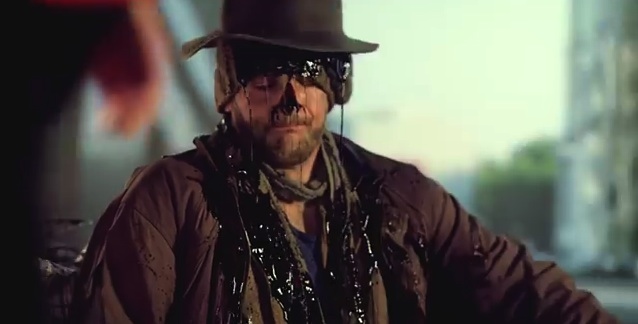
Still image from the finale of video "Oil." Courtesy of YouTube
Still image from the finale of the video “Oil.” Courtesy of YouTube

Halluci Nation

BabiBadalov8light

__________

Maybe there is no direct connection, but soon after the first article, below, ran in The Moscow Times, the following message appeared on the newspaper’s web site: “Due to the increasing number of users engaging in personal attacks, spam, trolling and abusive comments, we are no longer able to host our forum as a site for constructive and intelligent debate. It is with regret, therefore, that we have found ourselves forced to suspend the commenting function on our articles. The Moscow Times remains committed to the principle of public debate and hopes to welcome you to a new, constructive, forum in the future.” When I glanced at the comments to this article, it did seem that a lively “debate” was underway, but I no longer read such things to preserve what is left of my mental well-being. The emphasis, below, is mine.

Russia’s Empire State of Mind
Pyotr Romanov
October 26, 2014
The Moscow Times

Following World War I, the Russian Empire bid farewell to Poland, Finland, the Baltic states and Bessarabia [in modern Moldova]. The Soviet Union later regained only some of that territory — and yet that did not prevent the world from continuing to view the Soviet Union as an empire. After the collapse of the Soviet Union, Russia decreased in size even more than it had after World War I, and yet many today continue referring to it as an empire.

I recently read an impassioned plea on Facebook from several Ukrainians that God call down on Russia a host of biblical chastisements and hasten its demise. In their view, the only way to escape the claws of the Russian bear is to kill the animal. At the same time, they have no intention of fighting the beast themselves, convinced that Europe and the U.S. alone have the power and the responsibility to vanquish the foe.

In other words, they prefer that others break their bones in the bear’s den so they can mount the pelt over their fireplace. I somehow doubt that the rational West finds that prospect very attractive.

In fact, a number of historical figures dreamed of dismembering Russia. Peter the Great’s arch-rival King Charles XII of Sweden held that dream even before Russia formally declared itself an empire. The French ambassador in Stockholm at that time said, “The king will make peace with Russia only after he has arrived in Moscow, toppled the tsar from his throne, divided the state into small principalities and summoned the boyars to divvy up the kingdom into their personal provinces.”

In hindsight, knowing how the Swedes suffered defeat at the Battle of Poltava, it is tempting to assess such a claim as pompous bravado. However, that was a serious plan that the Swedish king and his allies had discussed on more than one occasion. Charles really did plan to install his own puppet ruler on the Russian throne. He dreamed of Pskov, Novgorod and all of northern Russia as Swedish possessions. He planned to allot all of Ukraine and the Smolensk region to Polish King Stanislaw Leszczynski. Charles agreed to give Russia’s southern lands to the Turks and Crimean Tatars. There are countless other similar stories in history — but where are all those dreamers today?

However, this is not the main point. I see no reason to blame my ancestors for their imperialist actions. Russians have no more to feel ashamed of in this regard than do the British, Germans, Spaniards and French. All of their imperialist pasts were dictated by fate, God, geopolitical factors and their national character — that with which it is absolutely pointless to fight.

The collapse of the Russian Empire deeply troubled many of its citizens, and the later collapse of the Soviet Union gave them a disturbing sense of deja vu. Even today, millions of Russians wax nostalgic for the past — particularly for the Soviet Union — recalling much that was also good from that time.

This is the second time in a century that Russia has gone through such painful “withdrawal symptoms” while overcoming its imperialist mentality. Russians have nothing of which to feel ashamed: the same process was no less painful for other “imperial” nations.

Of course, modern Russia is not an empire, and it is unbecoming to act like a broken record, continually repeating the same old cliches. It is just that the process of adapting to the new realities is not moving as quickly as some in the West — and also in Russia, by the way — would like it to. But it is impossible to hurry it along.

It is decidedly easier for a tiny little ship of a state such as Monaco to make a sea change than it is for a massive ocean liner such as religiously diverse, multiethnic and multicultural Russia. A little patience is needed.

I understand that what seems fast by historical standards might appear painfully slow to people. History is measured in ages, but individuals measure time in terms of a single lifespan. Nonetheless, it takes nine months for a baby to come into this world, and no amount of impatient fingernail-biting will change that.

Making a baby come into the world any sooner is not the healthiest option either. In the same way, it does no good to keep impatiently tugging on Russia’s sleeve. Every fruit has its given period of maturation. When the time comes, Russia will let go of the last vestiges of its imperial past.

Until then, praying for God to curse Russia with a swarm of locusts or the 10 plagues of Egypt is not only unseemly, but also a bit archaic and completely meaningless.

Pyotr Romanov [sic] is a journalist and historian. 

___________

Post-imperial melancholy has also got the unnamed editorial writer (the West’s most beloved Russian “leftist”?)  at Russian “leftist” web site Rabkor.ru waxing poetical in the vozhdist mode in the run-up to November 4, National Unity Day.

The West intends to play hardball in its long negotiations with Moscow. Zeal and rigidity might betray it, and then events will not go as planned. That has already happened in Ukraine. However, the US and the EU understand that Russian liberals have increased their grip on power and will stubbornly seek a compromise. Dmitry Medvedev has already said that a “reset of relations” requires a return to the “zero position,” meaning normal trade without sanctions. The ruling class will do anything for its sake, particularly if its position is complicated by economic problems. If solving the problem with Western Europe and the US requires presenting Putin’s head on a platter, then that it is how the problem will be solved.

But Russia is not a banana republic or a tiny country in Eastern Europe, where you can just organize a color revolution by gathering several thousand “civil society” activists on a central square. And so only Putin himself can remove Putin’s head for the US, and not only through his own carelessness.

Patriots stubbornly dream of persuading the current president to become like Stalin or Ivan the Terrible. Members of the liberal intelligentsia scare each other and the gullible western public with this same prospect. However, with each passing day, our ruler [sic] becomes like a completely different predecessor, Mikhail Gorbachev, who was also, incidentally, a politician who banked on compromises.

The growing prospect of a “liberal putsch” becomes more apparent with each passing day. The final act has not started, but the play is already underway. Liberals are making ritual sacrifices. They are sacrificing the exchange rate of the ruble and social policies. They are sacrificing Novorussia [Novorossiya]. They are sacrificing the country’s dignity. They are destroying the possibility of Russian society’s development. They are even willing to sacrifice the one who protected the system for many years. Only none of this will bear fruit, because only a different course can save Russia from economic disaster.

And let no one be deceived: if the liberal coup becomes a reality, its authors will quickly discover how correct the thesis “Ukraine is not Russia” was. Unlike its neighboring country, Russia, with the exception of the capital, will turn into one solid Donbass.

The preceding was an excerpt from “Who Will Bring Them Putin’s Head?”, published on October 20, 2014, by Rabkor.ru. You can read the entire editorial in English here, as translated by other, less shaky hands.

__________

After a friend mailed me the following “news” item, he wrote, “This is how the whole ‘television—Levada—television’ scheme works.” As Kirill Rogov has argued, many people will tell pollsters what authoritarian state television has told them to think, especially when it comes to things that don’t really matter to them, like musician Andrei Makarevich’s alleged “treason.” It’s no wonder that one of the world’s leading offshore Putin apologists was worried, last year, when it seemed as if the state was cracking down on the Levada Center. He needn’t have worried. My friend titled his email to me, “Levada will receive the Stalin Prize posthumously.” That about sums it up.

Almost Half of Russians Consider Makarevich a Traitor to the Motherland 
October 27, 2014 | Gazeta.ru

Almost half of Russians believe that when he performed in Slovyansk, which is occupied [sic] by the Ukrainian army, musician Andrei Makarevich betrayed the interests of the motherland, according to the results of a survey conducted by the Levada Center.

45% of those polled agreed with the statement “Makarevich betrayed the interests of Russia, and now the public does not want to go to his concerts.” However, among Muscovites there was a high percentage (32%) inclined to believe that Makarevich “acted in good conscience” and that he had been the target of a defamation campaign. 28% of respondents admit that Makarevich behaved unpatriotically, but that administrative resources have been used to disrupt his concerts in various Russian cities.

The percentage of those supporting Makarevich and condemning the defamation campaign was quite low—13%. Respondents with a higher education were generally more supportive of what the musician did than Russians with less than a secondary education.

The poll was conducted among 1,630 people aged eighteen years or older in 134 municipalities in forty-six regions of the country.

Earlier, Makarevich recorded a song about how he has been hounded. On October 27, news came of another cancellation of one of the musician’s concert, this time in Kurgan.

__________

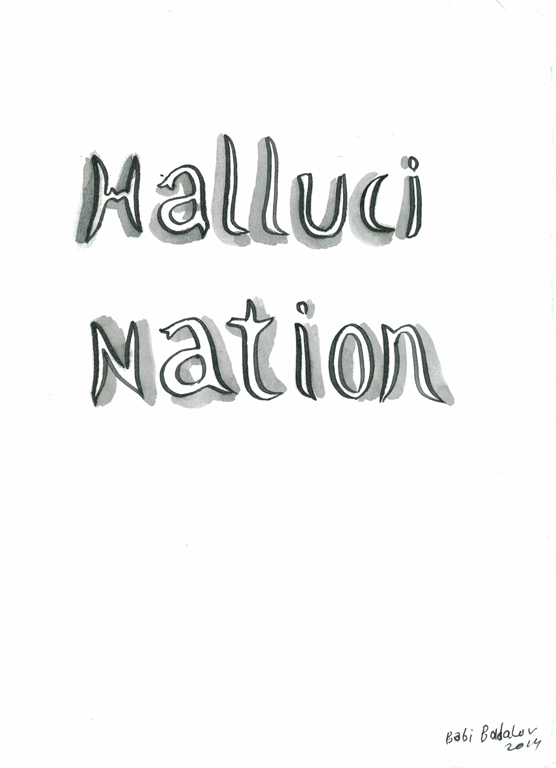
Image (above): Babi Badalov, Halluci Nation (Orna-mental poetry), 2014; ink on paper, 26.5 x 19 cm. Courtesy of La Galerie Jérôme Poggi, Paris, and the artist.

Kirill Buketov: The Gendarme’s Return

The Gendarme′s Return: On the Nature of Russian Imperialism

Stalinists of all stripes have been praising Russia’s actions in Ukraine as an attempt to restore the Soviet Union or create an altogether new entity capable of opposing the might of the United States and the imperialism of Western Europe. Their arguments smack of nothing but sheer stupidity.

What Putin has done in South-Eastern Ukraine has simply been to send Russia back some two hundred years into the past by restoring the country’s status as the “Gendarme of Europe,” a moniker the Russian Empire earned in the nineteenth century after dispatching a one hundred forty thousand man strong punitive expedition to crush the 1848–1849 democratic revolution in Hungary.*

The ruling elites of the west and the east have been trying to use the conflict to their advantage. Yet while western imperialism is quite pragmatic, motivated by the desire to secure control of resources, Russian imperialism’s rationale is fundamentally different.

Russia does not need control over other people’s resources: it has quite enough of its own. But to be able to go on controlling them and disposing of these resources as it will, the Russian oligarchical elite requires strictly authoritarian rule. Anything that threatens to undermine the regime is, therefore, suppressed quickly and ruthlessly, be it freedom of the press, the movement for fair elections or the right of NGOs to operate freely. And the emergence of alternative systems, states whose governance is based on democracy, in immediate geographical proximity to Russia, does undermine Putin’s regime, for they can nourish and inspire the dissident movement and popular unrest within Russia itself.

This is why Russia provides huge loans to Lukashenko’s authoritarian regime and severely punishes those countries where it suspects the beginnings of democratic rule. Thus, Moldova was punished, in its time, with the secession of Transnistria. More recently, Georgia paid with the annexation of South Ossetia and Abkhazia, and now the Ukrainian Maidan has been punished with the loss of Crimea.

 30331

The Gendarme’s logic at work: “Punish and let others beware.” This was the motto of the nineteenth-century Russian emperors when they sent punitive expeditions to Europe.

At the same time, Russia has little use for these territories: it has more than its fair share of economically depressed regions. It is the logic of the Gendarme that is at work here: “Punish and let others beware!” And it wants to weaken these countries: without their annexed territories, democratic governments will be unable to build sustainable economies. Heaven forbid that uncorrupt, free, and democratic countries should emerge along unwashed Russia’s borders.

This was what motivated the nineteenth-century Russian emperors when they sent punitive expeditions to Europe. Their Stalinist successors adhered to the same logic when they suppressed popular uprisings in Eastern and Central Europe in the twentieth century, but the Soviet Union, at least rhetorically, tried to imagine itself as a non-capitalist society. Today’s Russia in no way represents an alternative to the capitalist system. It differs from the major capitalist powers only in terms of the monstrous levels of hyper-exploitation to which its workers are subjected, a state of affairs maintained by a blatantly repressive system of labor relations.

 Kirill Buketov


* A gendarmerie is a military force charged with police duties among civilian populations.

____

This comment was originally published in Russian at gaslo.info. It was translated into English by the author, and has been slightly edited by The Russian Reader and published here with Mr. Buketov′s kind permission.