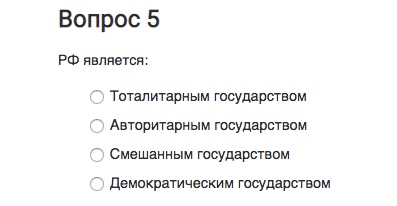
Four and half years ago, I had to renew my Russian permanent residence permit. The procedure had changed considerably since the last time I’d applied for the permit. Among the changes were two written exams that applicants were now required to pass — a Russian language exam and a Russian civics exam. I decided to study for them by doing practice exams which I found online. One of the civics question was “Question 5,” screenshotted above. It’s a multiple choice question. The examinee must decide whether the “RF” (the Russian Federation) is a) a totalitarian state, b) an authoritarian state, c) a hybrid state, or d) a democratic state. To be honest, I no longer remember whether this particular question came up in the actual exam, which I passed with flying colors. But I thought that you, my readers, might find it productive to ponder this question while reading the following three items, ripped straight from this week’s headlines in the Russian media. At the end of this post, you’ll see what the “right” answer was (in 2018, at least) and the answer I tried to give when taking the online practice quiz. ||| TRR
The Ministry of Culture of the Russian Federation has identified 17 priority topics for state financial support of film production in 2023.
The procedure and conditions for selection competitions in 2023 will be announced at the end of December 2022.
“We publish a list of topics before the start of competitions for financing production, hoping that filmmakers will take into account the priorities of state support for film production when developing projects. The Ministry of Culture continues to support such important topics for society as the protection of family values, patriotic education, preservation of the traditions of Russia’s regions, the success of domestic science, and popularization of the professions of engineer and teacher. Given modern realities, we consider it necessary to focus as well on countering attempts to falsify history and modern manifestations of the ideology of Nazism, to talk about the heroism and dedication of Russian soldiers during the special operation and the work of front-line brigades and volunteers,” said Olga Lyubimova, Minister of Culture of the Russian Federation.
Some priority topics have been established pursuant to the Decrees of the President of the Russian Federation: “On the Approval of the Foundations of State Policy for the Preservation and Strengthening of Traditional Russian Spiritual and Moral Values,” dated 09.11.2022, No. 809; “On the Announcement of the Decade of Childhood in the Russian Federation,” dated 29.05.2017, No. 240; “On the Announcement of the Decade of Science and Technology in the Russian Federation,” dated 25.04.2022, No. 231; and “On Holding the Year of the Teacher and Mentor in the Russian Federation,” dated 27.06.2022, No. 401.
The list of priority topics includes:
1. Russia’s culture. The preservation, creation and dissemination of traditional values.
2. The decade of childhood. Families and children, their protection and support.
3. Russian science: innovations, technologies, priorities.
4. Historical cinema. History lessons, memory lessons. Countering attempts to falsify history. Russia’s peacekeeping mission of Russia. Russia’s historical victories. The eightieth anniversary of the Victory in the Great Patriotic War. The Soviet soldier’s mission of liberation Generational conflict, generational continuity.
5. Russia as a modern, stable and secure state that provides opportunities for growth and self-realization.
6. The heroes among us. Stories of modern Russia’s outstanding individuals. Popularizing the teaching profession. School and college as important stages in social adaptation and personal orientation. The role of teachers and mentors in shaping the individual.
7. Motivating young people to master manual trades and engineering jobs. Improving the social status of the manual worker and the engineer, of research and innovation.
8. Film chronicle. The current state, culture and traditions of Russia’s regions. Development of the Far East and the Arctic. The life of small towns and villages, life in the provinces. Little Russia as a historical region of Russia.
9. Adaptations of works of Russian classical literature, including with the use of animation.
10. Films about outstanding figures in history, culture, science and sports. Popularizing the medical profession. Films about sporting achievements and victories.
11. Countering modern manifestations of the ideology of Nazism and fascism. Popularizing heroism and the dedication of Russian soldiers during the special military operation.
12. Popularizing service in the Russian Armed Forces of Russia. Society’s unanimous support of the army (front-line brigades and volunteers). Strengthening the status of the military profession as based on historical events and recent history.
13. The spiritual, moral and patriotic education of Russian citizens. Countering extremism. Images and models of behavior and creative motivation for modern youth. Spiritual leaders. The volunteer movement in Russia and the CIS countries as an international popularization of volunteerism.
14. The neocolonial policy of the Anglo-Saxon world. The degradation of Europe. The formation of a multipolar world.
15. Society without borders: the self-realization of people with disabilities. Volunteering in Russia. Active longevity.
16. Films about teenagers. Formation of values in life and guidelines while growing up. Disorientation in public space, information overload, forming one’s own way of thinking.
17. Modern society. Moral and ethical choice. Civic engagement. Social unity.
Source: “The Ministry of Culture of Russia has identified priority topics for state support of film production in 2023,” Ministry of Culture of the Russian Federation, 30 November 2022. Thanks to Radio Svoboda for the link. Translated by the Russian Reader
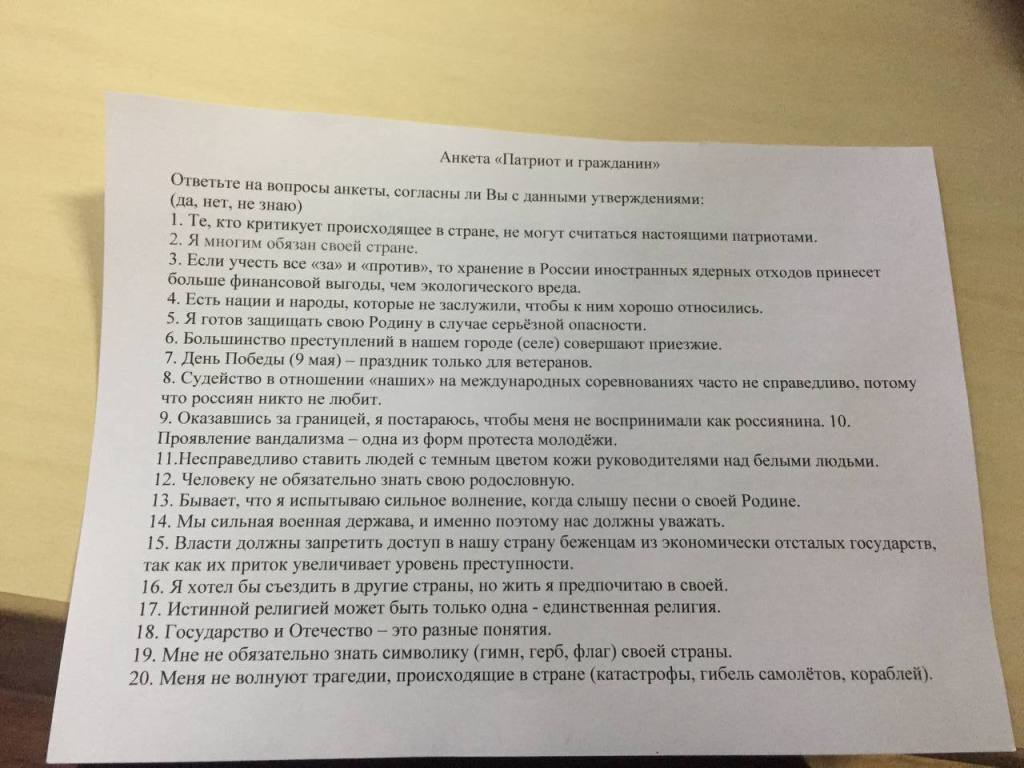
At a secondary school in the Leningrad Region, the Agalatovo Education Center, students were quizzed about racism, Russophobia and the emotions provoked by songs about the Motherland. A photo of the questionnaire, entitled “Patriot and Citizen,” was sent to Rotunda by the parents of one of the schoolchildren. Here are some of statements the children had to evaluate by answering “yes,” “no,” or “I don’t know.”
🇷🇺 Those who criticize what is happening in the country cannot be considered real patriots.
🇷🇺 I owe a lot to my country.
🇷🇺 Sometimes I get very excited when I hear songs about my Motherland.
🇷🇺 We are a strong military power, and that is why we should be respected.
🇷🇺 If I go abroad, I will try not to be seen as Russian.
🇷🇺 I am ready to defend my Motherland in case of serious danger.
🇷🇺 Most of the crimes in our city (village) are committed by outsiders and immigrants.
🇷🇺 Our athletes are often judged unfairly at international competitions, because no one likes Russians.
🇷🇺 If we take into account all the pros and cons, the storage of foreign nuclear waste in Russia brings more financial benefits than it does environmental harm.
🇷🇺 There are nations and peoples who do not deserve to be treated well.
🇷🇺 Vandalism is one of the forms of youth protest.
🇷🇺 It is unfair to put people with dark skin in charge of white people.
🇷🇺 There can be only one true religion.
🤦 The school confirmed to Rotunda that they had conducted such a survey. They agreed to communicate with us only by mail. In a written response signed by the vice principal, they claimed that the questionnaire was needed “as background for a faculty meeting.” The school did not answer questions about how correctly or adequately the questionnaire was worded. Rotunda was unable to contact the school’s principal, Svetlana Sergiyenko. She is a supporter of the United Russia party and has run for election several times on the party’s ticket.
📌 The questionnaire itself seems to have been found by the educators on the internet. In 2014, Belarusian media reported that a similar survey (only with Belarus instead of Russia) was conducted in schools in Minsk.
Source: “Schoolchildren in Leningrad region surveyed on whether they’re ashamed to be Russian,” Rotunda (Telegram), 28 November 2022. Thanks to Leda Garina for the heads-up. Translated by the Russian Reader
There is a belief that the Russian elite under President Vladimir Putin has only ever been interested in money. Yet Putin’s militant, anti-liberal, anti-Western, isolationist, paternalistic, and harshly authoritarian regime has always had an ideology.
This ideology is not systematized, but it does exist, and snippets of it can be found throughout Putin’s speeches, articles, and interviews. Now the war in Ukraine has necessitated a more articulated ideology, however.
The initiative to systematize and codify Putinism has led to a presidential decree listing Russia’s “traditional spiritual and moral values,” as well as the development of a new ideological curriculum for colleges.
It is no longer enough to indoctrinate children in kindergartens and schools. It is now time to unify the worldviews of college students, and, by extension, those of their professors, whose ranks will inevitably be purged. A similar course taught during the Soviet era was known as “Scientific Communism.”
The name for this new curriculum is “Fundamentals of Russian Statehood,” though it might as well be called “Scientific Putinism.” It is composed of four units: “History” – historical policy as the imposition of a mythologized official version of history, which is one of the instruments for manipulating the mass consciousness of Russians; “Cultural Codes” or the “traditional spiritual and moral values,” around which Putin has ordered federal and regional governments to unify; “Russia and the World” — a justification of isolationism, anti-Westernism, and jingoism; and “Vision for the Future,” which sets out what the state hopes to achieve beyond victory in Ukraine and the destruction of the “fifth column.”
The curriculum justifies the cult of the eternal leader and doubles down on the idea that Russia is fighting the forces of evil in Ukraine in an effort to “de-satanize” the country. However, at the same time, Scientific Putinism lacks key components such as development goals or a vision for Russia’s future, focusing as it does almost exclusively on the past.
During Dmitry Medvedev’s presidency, there were teams working on a future-oriented ideology and making road maps based on the idea that Russia would fast-track the modernization of the state and society. Putin’s ideology, however, is one that fundamentally opposes modernization.
Putin has successfully convinced a significant portion of the population that Russia must regain its status as a great power, and that Russia is under attack by both the liberal West and traitors at home. As the regime has grown more authoritarian, its ideology has also become more archaic, its propaganda more obtrusive, and any hopes of modernization have dwindled.
An ideology that consists of historical, cultural, and religious myths, bogus traditions, and resentment seeks to legitimize an authoritarian regime and delegitimize those who oppose it.
Such an ideology makes it possible to label nonconformists as enemies, and to divide people into “us” and “them.” The division into “us” and “them” doesn’t just provide a marker for self-identification, it also serves to convince the public that there is a certain majority from which they should not stray.
In the past, the only requirement for being part of the “us” was passive, silent, conformist support. Today, however, this is not enough: Russians must surrender their very bodies to be cannon fodder in the supreme leader’s holy war against the “satanic” forces of the West. This is no longer authoritarianism; it is totalitarianism.
Imperialism and colonialism are key components of Putinism and key factors in the war. There is nothing new about this ideology; it comes almost verbatim from Stalinism and from earlier Eurasian and Slavophile narratives.
The war is being passed off as striving to restore historical fairness, as defensive and preventive, and as liberation. According to Putin, the land of the empire must be “returned and reinforced.”
In just a few years, the regime has evolved from a cult of the victory of 1945 to a cult of war itself, and Putin has managed to persuade a large segment of Russian society that the “special military operation” of 2022 is a natural continuation of World War II. In essence, it is an existential war between Russian and Western civilizations.
Putin has started to refer to Russia as an entire civilization. The state is not just sacred and worthy of the ultimate sacrifice; it is also a separate and superior civilization with a “thousand-year history” and its own special path.
Within this history, cultural codes are being passed down from generation to generation as part of the country’s political DNA. This state-civilization has its own pantheon of heroes unchanged from the Soviet era: Alexander Nevsky, Ivan the Terrible, Peter the Great, Joseph Stalin, and Yuri Gagarin.
This state-civilization has always been under attack by enviers and foes, making its state of permanent conflict critical, and not simply limited to the battlefield. The state must win in all aspects — in culture and in sports, in the construction of Olympic facilities, and in the war against Ukraine and the West.
To defend the sovereignty of this state-civilization, the Kremlin is counting on the security services, or siloviki, who have been given additional funding and are reinforced by spin doctors and so-called “journalists” in the Kremlin’s service.
The Culture Ministry, the communications watchdog Roskomnadzor, and the Russian Orthodox Church are becoming de facto siloviki themselves, enjoying as they do the right to block or ban media, restrict the sales of books by authors who oppose the war, and decide who can perform on theater stages.
The ideology has become corporeal, bolstered by political and military acts, such as the annexation of Crimea and the “special military operation.” In short, the special ideological operation is ongoing, and it seems to be faring rather better than the military one.
This article was originally published by the Carnegie Endowment For International Peace.
Source: Andrei Kolesnikov, “Scientific Putinism: Shaping Official Ideology in Russia,” Moscow Times, 27 November 2022. Thanks to Mark Teeter for the heads-up.

Back in the summer of 2018 I tried to answer Question 5 truthfully, replying that the Russian Federation was an “authoritarian state.” But the right answer, then, was “democratic state,” as it turned out. Again, I don’t remember now whether this question was on the actual civics exam that I took, but there were several other “ideological” questions like it, which I would have answered “incorrectly,” thus jeopardizing my chances to get a residence permit, if I hadn’t been schooled in advance by the practice quizzes I’d found online. ||| TRR