Textbook Wars: Moscow’s Former Colonies Strike Back

Researchers at INION RAN analyzed depictions of Russia in the history textbooks of CIS and Middle Eastern countries. They found that these textbooks in post-Soviet countries mostly portray Russia as a colonial power.
Photo: Valery Matytsin/TASS, via RBC

The Institute of Scientific Information for Social Sciences of the Russian Academy of Sciences (INION RAN) has drafted a study edited by Vladimir Avatkov, head of the Institute’s Middle and Post-Soviet East Department, on how Russia is depicted in history textbooks in the countries of the Middle and post-Soviet East, as well as in China.

Most of these textbooks portray Russia as a colonial state which has oppressed the peoples in the annexed territories and damaged their culture, Razil Guzayerov, one of the co-authors of the study and a junior researcher in INION’s Middle and Post-Soviet East Department, told RBC. He noted, however, that often much less attention is paid to Russia’s contribution to the growth of these countries.

According to the authors of the study, “the promotion of false and distorted events in history textbooks shapes a negative attitude towards Russia, and in the future may become the basis for the growth of xenophobia and Russophobia.”

What RAN researchers read about Russia in CIS textbooks

“Colonial politics” in Kazakhstan

According to INION’s analysis, the authors of Kazakh textbooks for eighth graders view the Russian Empire as a country which sought to use Kazakhstan as a platform for its military and economic interests. They note that the Russian Empire’s policy of “military and colonial expansion” was the key element of its relations with the hinterlands. It aimed at establishing control over the new territories, exploiting their resources, and managing their populations.

In a textbook for colleges and universities, the authors criticize the policies of the Soviet regime. They pay special attention to the famine of 1921 in Kazakhstan, brought on by crop failure and drought. The authors note that the prodrazverstka, which by late 1920 had extended to all agricultural products, was regarded by the local population as robbery, leading to growing discontent. The famine, the textbook authors point out, seriously impacted the population of Kazakhstan, triggering mass hunger riots and deaths. According to their data, the population of the region decreased by more than two million people compared to 1914.

In a history textbook for tenth graders, the Russian Empire’s policy towards Kazakhstan is described by the author [sic] with terms like “territorial expansion,” “protectorate,” and “colonial politics.” The textbook characterizes the policy of the Russian Empire in Kazakhstan as “aggressive and ineffective,” citing as an example Prime Minister Pyotr Stolypin’s resettlement policy, which, according to the authors [sic], led to social conflicts and popular uprisings.

“Invasion” of Azerbaijan with the aid of ”traitorous forces”

The establishment of Soviet power in Azerbaijan is referenced in that country’s textbooks as a “military invasion,” which was carried out with the support of “traitorous forces.” Uprisings against the Soviet regime and its “exploitative policy” are described in detail. The authors emphasize that the Azerbaijan SSR was established not by the Azerbaijani people but by Soviet Russia, and that the entire Soviet system was “aimed at satisfying Russia’s interests and ensuring its hegemony.”

“History textbooks for general education institutions in Azerbaijan imagine Russia as a colonial empire. The entire history of Russia is covered as the seizure and occupation of lands with subsequent exploitation of the local population. It is important to note that such anti-colonial discourse is especially exacerbated in new textbooks,” the authors of the collection [sic] write. “The current period of relations between Russia and Azerbaijan is presented in more neutral tones, although Moscow is occasionally accused of supporting Armenia and creating the Karabakh issue.”

Russia is identified in textbooks as the cause of the Karabakh conflict and other negative events in the nineteenth and twentieth centuries. Thus, the ninth-grade textbook The Hstory of Victory describes the coming to power of the “pro-Armenian” General Secretary Mikhail Gorbachev, under whom “the separatists ratcheted up their activities.” The authors of the textbook explain the success of “Armenian separatists” in terms of Moscow’s active support.

The INION researchers also note that the authors of some textbooks seek to introduce a divide between the central and local authorities in the Soviet Union. Thus, in these textbooks, life in the Azerbaijan SSR runs its normal course: while the local government carries out industrialization and raises the standard of living, the central government creates misfortunes for the republic.

The authors of the study detect a tendency towards a strengthening anti-colonial discourse around the Russian Empire and the Soviet Union, a negativization [sic] of the entire historical period which “will eventually cause Azerbaijani youth to reject our countries’ common past.”

“Identity damage” and despotism in Uzbekistan

In a basic history textbook for students at the Academy of the Uzbekistan Interior Ministry, the authors describe the annexation of Central Asia as a violent conquest. They also “refute the opinion of historians that the policies of Tsarist Russia in colonized Turkestan had progressive consequences.” The authors challenge arguments about the construction of railroads, telegraphs, and industrial enterprises in Central Asia.

The textbook argues that any imperialist state “attempts to justify its wars of conquest by various propaganda myths, such as that it brings progress and civilization to the conquered peoples and liberates them from despotism, and they voluntarily join the metropole.” The Russian Empire in this context appears to be just such an “imperialist” state.

The textbook offers a harshly negative characterization of the period when Central Asia was part of the Russian Empire and the Soviet Union. With a few exceptions, such as education, the textbook’s main thrust is that Russia damaged both Uzbekistan’s national identity and its economic prospects.

Eradicating the Basmachi and transiting to a settled way of life in textbooks in Kyrgyzstan and Tajikistan

According to INION’s analysis, textbooks in Kyrgyzstan and Tajikistan describe Russia’s influence more positively. Textbooks in Kyrgyzstan thus indicate that relations between Russia and Kyrgyz tribes evolved in different ways at different times — from moderately hostile attitudes to petitions by the Kyrgyz to join the Russian Empire. The authors positively assess Kyrgyzstan’s accession to the USSR, which enabled the Kyrgyz to grow their economy, education system, and industry, and marked the final transition to a settled way of life.

The Soviet period is generally not regarded and, most importantly, not depicted in a negative way by [the country’s] scholars, the researchers point out.

Tajik history textbooks positively assess the actions of Soviet Russia during the civil war in the country [sic]. They point out that Soviet troops were the main force protecting the local populace. The textbooks also note Russia’s contribution to the growth of science in Tajikistan.

In general, Tajik historians assess positively the rise of the Communists to power in Russia, which subsequently led to the attainment of independent statehood by the Tajik nation. And yet, Russia during the Tsarist period is assessed negatively as an imperialist power. Soviet policy is evaluated positively for “eradicating the Basmachi,” and for contributing to Tajikistan’s agriculture, industrialization, culture, and education. Although “individual problematic points” are also noted, they are described as inevitable parts of a complex historical process.

What RAN researchers read about Russia in Israeli and Iranian textbooks

Israeli textbooks describe the Russian Empire and the Soviet Union as anti-Semitic states, while many positive aspects of bilateral relations between Israel and the USSR, especially during the Jewish state’s emergence, are ignored, according to INION.

Russian policy in Iran is often associated with interference in the country’s internal affairs and support for regimes favorable to the empire. Iranian historians present Russia as an aggressor implementing a policy of “expansion” into territories formerly belonging to Persia. The authors also draw attention to the consequences of the Russo-Persian Wars for the mindset of the Iranian people. They see these wars as emblematic of colonial domination and loss of sovereignty.

A textbook for eleventh graders ambiguously assesses the founding of the Tudeh Party of Iran, whose purpose, according to the authors, was anti-government agitation and the forcible secession of Southern Azerbaijan and the country’s northern regions. The textbook notes that the party, which was supported by the Soviet Union, was a factor of destabilization in Iranian society, causing tension and threatening civil war.

Moscow’s provision of arms, military specialists and technical support to the Iraqi army, including Soviet military equipment and missiles, is seen as a factor that complicated the Iran-Iraq conflict and caused great harm to Iran.

According to Murad Sadygzade, president of the Center for Middle East Studies and guest lecturer at the Higher School of Economics, such descriptions of events in history textbooks are not distortions of events, but their interpretation from the position of the losing countries.

“In fact, there were three bordering empires — the Russian, Persian and Ottoman empires — which divided territories between them. Textbooks in these countries describe the events from their own point of view. Of course, they may present Russia as a conqueror. But we can say that this is their position as the losing party. This does not mean that these countries have a drastically negative attitude toward Russia and its people,” Sadygzade says.

Sadygzade argues that Russophobia in the countries of the post-Soviet space and the Middle East is not promoted through [the writing and teaching of] history. Rather, “there are only some figures who try to present it in such a way so as to drive a wedge between countries.”

Diplomatic disputes over textbooks

In August, the Russian Foreign Ministry criticized an Armenian history textbook for the eighth grade, saying that it “depicted events in the South Caucasus during the late eighteenth and early nineteenth centuries in a distorted manner.”

The Foreign Ministry detected an attempt to revise the outcome of the Russo-Persian War of 1826-1828. “The Treaty of Turkmenchay is labeled as nothing other than the ‘annexation’ of Eastern Armenia. Such a framing is capable of causing consternation for any historian,” the ministry said. It noted that the treaty, which ended the Russo-Persian War of 1826–1828, has so far been regarded as having “colossal significance for the future restoration of Armenian statehood.” Moscow viewed this interpretation as “another shameless attempt” to rewrite the common history “in the best traditions of Western propaganda and political engineering.”

As a result, the authors promised to make changes to this chapter of their textbook.

On September 26, Konstantin Zatulin, first deputy head of the State Duma Committee on CIS Affairs, Eurasian Integration and Relations with Compatriots Abroad, voiced concern about the way Russian history was portrayed in foreign textbooks. “I am certainly concerned, as we all are, about the interpretations that are permitted everywhere and anywhere outside of Russia, when it is depicted in a different way than we would like in the national versions of the history of the newly independent states,” he said during a discussion of a draft law on an agreement that would establish an international educational center for gifted children in Tajikistan. According to Zatulin, the Education Ministry and the Foreign Ministry were obliged to respond to all “unfriendly phenomena” in neighboring countries.

RBC sent a request to the Foreign Ministry and Rossotrudnichestvo to provide their own assessments of INION’s finding.

Source: Margarita Grosheva, “RAN researchers describe ‘negative images’ of Russia in CIS textbooks,” RBC, 28 September 2024. Translated by the Russian Reader
Fifty Members of the Russian Academy of Sciences: “We Urge the Court to Release Azat Miftakhov”

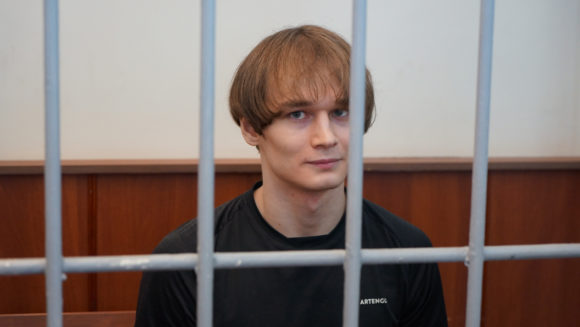
Azat Miftakhov during a hearing at the Golovinsky District Court in Moscow. Photo: N. Demina. Courtesy of Troitsky Variant

[Original letter: https://trv-science.ru/2021/01/free-azat-letter-rs/]

The trial of Azat Miftakhov is of the utmost concern to us, his mathematician colleagues.

Azat Miftakhov, a PhD student in the Faculty of Mechanics and Mathematics at Moscow State University, was detained by security forces in the early hours of 1 February 2019 and has been in custody for almost two years. The charges against him have changed, and the only remaining charge (breaking a window in an office of the political party United Russia) is based only on the testimony of secret witnesses. According to reports by lawyer Svetlana Sidorkina and the Public Monitoring Commission, Azat was tortured in the interim before his arrest was formalised in the late evening of 2 February 2019. However, as far as we know, a criminal investigation into Azat’s allegations of torture has not been launched.

In prison, Azat has written two scientific papers, one of which was published in the Bulletin of the Polish Academy of Sciences. The other was submitted to an international scientific journal.

All petitions to release Azat from pre-trial detention in favor of milder measures of pre-trial restraint were rejected by the court. The punishment already borne by Azat does not appear to be commensurate with the crime he is alleged to have committed, and the sentence of six years in a penal colony requested for him by the state prosecutor provokes our indignation.

We urge the court to release Azat Miftakhov.

[Signatories]

V.M. Alpatov, RAS Academician
A.E. Anikin, RAS Academician
Yu.D. Apresyan, RAS Academician
L.Y. Aranovich, RAS Corresponding Member
P.I. Arseev, RAS Corresponding Member
L.D. Beklemishev, RAS Academician
A.A. Belavin, RAS Corresponding Member
E.L. Berezovich, RAS Corresponding Member
E.A. Bonch-Osmolovskaya, RAS Corresponding Member
A.B. Borisov, RAS Corresponding Member
S.A. Burlak, RAS Professor
A.I. Bufetov, RAS Professor
V.A. Vasiliev, RAS Academician
M.M. Glazov, RAS Corresponding Member
N.P. Grintser, RAS Corresponding Member
A.V. Dvorkovich, RAS Corresponding Member
A.S. Desnitskii, RAS Professor
A.V. Dybo, RAS Corresponding Member
V.E. Zakharov, RAS Academician
A.V. Ivanchik, RAS Corresponding Member
A.I. Ivanchik, RAS Corresponding Member
V.V. Izmodenov, RAS Professor
Yu.Yu. Kovalev, RAS Corresponding Member
A.A. Kotov, RAS Corresponding Member
Z.F. Krasil’nik, RAS Corresponding Member
Ya.V. Kudriavtsev, RAS Professor
E.A. Kuznetsov, RAS Academician
I.Yu. Kulakov, RAS Corresponding Member
A.G. Litvak, RAS Academician
A.A. Maschan, RAS Corresponding Member
O.E. Melnik, RAS Corresponding Member
R.V. Mizyuk, RAS Corresponding Member
A.M. Moldovan, RAS Academician
I.I. Mullonen, RAS Corresponding Member
A.K. Murtazaev, RAS Corresponding Member
A.A. Pichkhadze, RAS Corresponding Member
V.V. Pukhnachev, RAS Corresponding Member
В.I. Ritus, RAS Corresponding Member
N.N. Rozanov, RAS Corresponding Member
A.A. Saranin, RAS Corresponding Member
G.S. Sokolovsky, RAS Professor
O.N. Solomina, RAS Corresponding Member
S.M. Stishov, RAS Academician
S.V. Streltsov, RAS Corresponding Member
S.M. Tolstaya, RAS Academician
A.L. Toporkov, RAS Corresponding Member
F.B. Uspenski, RAS Corresponding Member
E.A. Khazanov, RAS Academician
A.V. Chaplik, RAS Academician
E.M. Churazov, RAS Academician
D.G. Yakovlev, RAS Corresponding Member

The verdict in Azat Miftakhov’s trial is scheduled to be announced at the Golovinsky District Court in Moscow on Monday, January 18, 2021. Thanks to MV for bringing this letter to my attention. || TRR

The Showdown at Petersburg’s Zubov Institute

Editor’s Note. The latest news from the front lines in the confrontation between the Russian Institute of Art History (Zubov Institute) in Petersburg and the Russian Federal Ministry of Culture is that Jamilya Kumukova, chair of the trade union committee at the Institute, has been threatened with firing in the run-up to a protest rally scheduled for July 9.

_____

(Original at www.anticapitalist.ru)

An Academic Treasure Trove Doesn’t Want to Be a Klondike for Bureaucrats

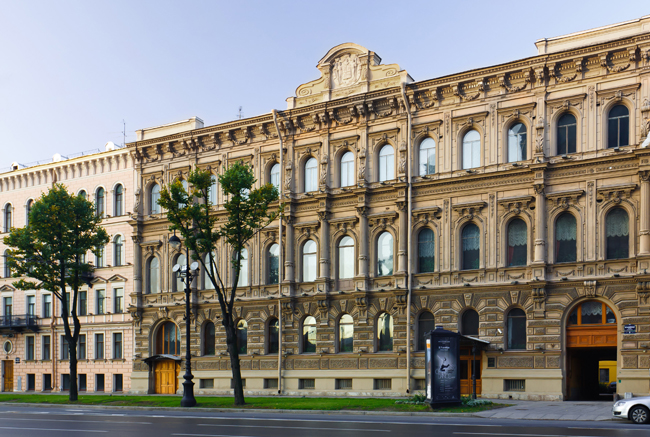
A fight has erupted in Petersburg over the Russian Institute of Art History [also known as the Zubov Institute and abbreviated “RIII” in Russian]. The Ministry of Culture has been carrying out a hostile takeover of the institute in an attempt to get its hands on the institute’s premises, [a nineteenth-century mansion in downtown Petersburg]. Researchers and graduate students have been trying to fight off the siege.

1. zub-entrance

It all began in May 2012, when President Vladimir Putin signed a decree increasing salaries for scientists and scholars. The Ministry of Culture, which had just then been headed by Vladimir Medinsky, ordered the research institutes under its jurisdiction to increase salaries. But no funds for this increase were earmarked in the state budget. To fulfill the president’s decree, RIII director Tatyana Klyavina had to cut seventy-one positions. But that was only the beginning.

In 2013, the Ministry of Culture ordered yet another salary increase (of 28%), which would have meant dismissing a further fifteen employees. Klyavina refused to raise salaries through layoffs, for which she was subjected to a vigorous harassment campaign and eventually fired after leading the Institute impeccably for twenty-one years.

The Ministry of Culture got ready to celebrate. After all, by 2018, when salaries were slated to be increased to 200% of current levels, no one at all would have been left in the Institute. This meant it could already relocate the remaining miserable clutch of useless scholars to any old outbuilding, thus freeing the famous mansion with a view of St. Isaac’s Cathedral for more pressing needs, and merge the Institute itself with the first comer.

Today, the state has no use for research on Tchaikovsky, Scriabin, and Malevich. What it needs are people to carry out practical “monitoring” of Russian culture and compile exhibition booklets. It thus does not understand the essence and purpose of the research conducted at the institutes under its jurisdiction. Despite its incompetence, however, like a bull in a china shop it goes through the motions of “reform” and “modernization.” The main thing is not to deviate from the general line, and let the consequences be damned.

But whomever the Ministry sent to cajole the Institute’s indignant staff, it only aggravated the situation. After all, the RIII, which was founded in 1912 and in whose halls such renowned literary scholars, art historians, and musicologists as Yuri Tynyanov, Boris Eichenbaum, Boris Asafyev, Viktor Zhirmunsky, and Antonin Preobrazhensky worked, has experienced revolution, civil war, Stalin’s purges, and the Siege of Leningrad over its history. In the 1990s, it regained its autonomy and original name. The Institute’s staff has thus developed immunity to all manner of crackdowns and takeovers.

2. osminkin
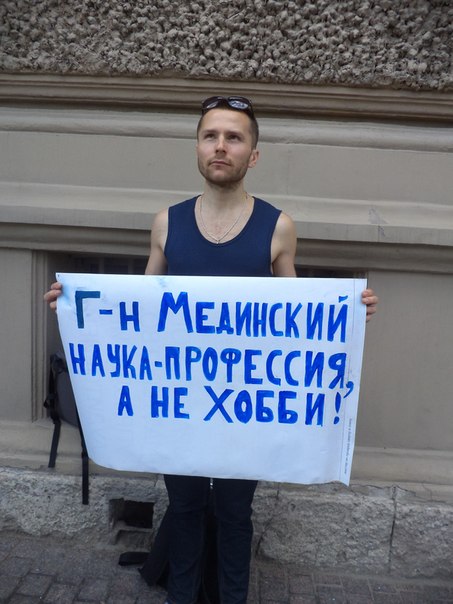
“Mr. Medinsky, research is a profession, not a hobby!”

Today, news from the Zubov Institute resembles reports from the front lines. Here is a brief chronicle of recent events.

On June 31, Culture Minister Medinsky descended on the RIII without warning. Locking himself in the director’s office, Mr. Medinsky refused to talk to staff, leaving Andrei Karpov, acting director of the Ministry’s oversight and personnel department, to act as his “hellhound” in the waiting room. Mr. Karpov, who currently heads the ministerial committee auditing the Institute, took his role as guard so seriously that he struck cinema department grad student Olga Yevseyeva, who had come to give the minister a letter written by the Institute’s graduate students.

On July 2, an emergency meeting of RIII staff took place. In the middle of the meeting, the new director, Olga Koch, appeared in the hall, accompanied by private security guards. The guards said they had been hired by the Institute’s new management to  protect historical valuables, although in the Institute’s hundred-year history not a single rare manuscript or musical score has ever disappeared from the building.

The art scholars unanimously stood up and turned their backs to Koch, stamping their feet and chanting, “Get out!” After the director ran out of the room as if she had been scalded, the assembly continued, adopting a strongly worded resolution. Here are its principal points:

1. We voice our lack of confidence in the ministerial commission headed by Andrei Karpov, who permitted himself to use force against a graduate student of the Institute.

2. We voice our indignation at Culture Minister Vladimir Medinsky’s arbitrary decision to shift the work of the Ministry’s departments to the Institute.

3. We protest against the transformation of the Institute into a high-security facility in connection with the hiring of a private security firm to work at the Institute.

4. We demand that Minister Medinsky retract his statement that the apartments in the wing of the Institute are “handed out right and left.”

5. We voice our lack of confidence in acting director Olga Koch, who publicly threatened staff with a “crackdown,” and we demand that the decree appointing her, dated June 18, be rescinded.

6. We are sending a telegram to Russian President Putin and Prime Minister Medvedev.

7. We voice our support for the Russian Academy of Sciences.

On July 3, graduate students from the RIII and the European University held a series of solo pickets in support of Institute staff and against the Ministry of Culture’s policies. The young people stood outside Petersburg city hall, the city’s legislative assembly, and the entrance to the Institute with placards reading, “Mr. Medinsky, research is a profession, not a hobby” (a play on Medinsky’s statement that the “government won’t be funding a hobby”), “Save the Zubov Institute!,” and “No to Mass Layoffs at the Zubov Institute.”

The graduate students handed out leaflets that read as follows:

For the second month running, we, researchers and graduate students at the Russian Institute of Art History, have been forced to defend our right to do research instead of doing that research. In May 2012, Russian President Vladimir Putin issued a decree ordering an increase in the wages of scientists and scholars to the average cost of living in their regions.

This good intention, however, was brought low by the total lack of additional funding. The new effective managers from the Ministry of Culture, led by Vladimir Medinsky, took the easy route and decide to fire everyone whose research was not sufficiently in demand. In their opinion, demand is nothing more than the amount of money earned. But the humanities cannot be reduced to a monetary equivalent.

By cutting back on basic research and firing specialists who are unique in their fields, Russia is rapidly turning into a peripheral power, capable only of supplying raw materials to more developed countries. What is more, it is forever losing access to the history of its art and culture, which means irrevocably losing its capacity for nurturing full-fledged individuals and citizens. So defending the Zubov Institute is for us today not just a matter of professional honor but also a civic duty.

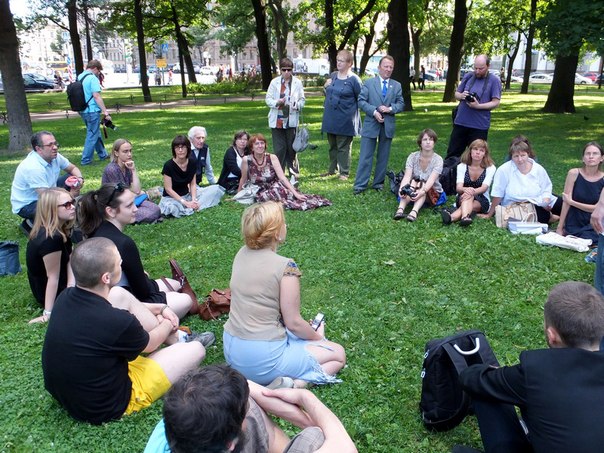
The same evening an open street conference in support of the Zubov Institute took place. It took the form of a Street University—lectures and meetings of students and teachers held outdoors and open to all comers. Street University was established in 2008 during the campaign against attempts to close the European University in Petersburg under false pretexts.

3. uu-zub
Street University in Defense of Zubov Institute, July 3, 2013

In that case, the authorities backed down, and the European University continued to operate in its old mansion on Gagarinskaya. What will happen in this case?

Both RIII staff and graduate students attended the conference, along with colleagues from friendly institutes. Tamara Ismagulova talked about the history of the Zubov Mansion, how the institute was established, and how it survived during the hard years of the Stalinist Thermidor. Yevgenia Hazdan talked about the journal Annals of the Zubov Institute, which was first published in the 1920s, lasting all of four years. Who would have thought that the recently revived journal might repeat the fate of its predecessor?

Sociologist Oleg Zhuravlev from the European University Institute in Florence argued that what is happening to the Zubov Institute is consistent with the overall trend in Europe of cutting spending on science and education, a trend that reveals the contradiction between democracy and the market economy.

Dmitry Golynko, from the contemporary artistic culture department, shared his recollections of the department’s work during the nineties, when the Institute was a hotbed for cutting-edge research in art. Pavel Arseniev and Roman Osminkin read poems, and at the evening’s conclusion a researcher from the musicology department even played several songs on the accordion, including “If I Had Mountains of Gold.” It was a quite symbolic coda, because the whole point of the conflict between the Ministry of Culture and the Zubov Institute is the Ministry’s insatiable desire to turn art scholarship into a gold mine.

5 July 2013 — Roman Osminkin, Russian Socialist Movement

_______

(Original at  www.colta.ru)

Dmitry Golynko-Volfson
3 July 2013
The Language of Violence: Scholarship and Power in the Russian Federation

Literally overnight, the Russian Institute of Art History (also know as the Zubov Institute for its founder, Count Valentin Zubov) was transformed from a quiet academic oasis (as Petersburgers are used to seeing it) into the epicenter of a scandal, a tense standoff between the academic community and managers from the Ministry of Culture. At the Ministry’s behest, Tatyana Alexeevna Klyavina, who for over twenty years had skillfully and competently managed the Institute, preserving its pleasant working environment and atmosphere of unconditional mutual respect, was fired. Thanks to her efforts, both during the momentous nineties and the stable (and allegedly sated, but in reality very sparingly state-subsidized) noughties, the RIII’s team of researchers had been able to focus on basic academic research without personally worrying about urgent economic problems. In addition, her tenure was focused on making sure the Institute maintained a well-calibrated balance between classical, traditional art scholarship and experimental, innovative, future-oriented research. Tatyana Alexeevna was also the long-time chair of the contemporary artistic culture department, which I had the good fortune to join in 1995. In the nineties, the department was a unique place where cutting-edge research in postmodernist theory was combined with the direct involvement of researchers in shaping the new culture and new art of the legendary post-perestroika period.

Открытие выставки "Тициан" в Москве
Culture Minister Vladimir Medinsky

The confrontation between Institute staff and the Ministry slowly but relentlessly escalated throughout the first six months of this year (after the newly appointed Minister Vladimir Medinsky had announced plans to reform the research institutes under his jurisdiction). The showdown between researchers and bureaucrats shifted into an active phase after Klyavina was fired, and Olga Koch, former rector of the Saint Petersburg University of Culture and Art, was named acting director. Institute staff was openly hostile to Koch’s top-down appointment and refused to cooperate with her on any issues related to academic planning. In addition, at meetings of the academic council and the staff union, which were open to the press, they passed toughly worded resolutions and proposed strategic methods for resolving the conflict (from shifting the Institute to the jurisdiction of the Russian Academy of Sciences to putting it under the care of the municipal government).

The conflict reached an obvious climax on Friday, June 28. As a result of a visit by Culture Minister Medinsky to the RIII that was deliberately kept secret from the Institute’s researchers, a monstrously absurd “brawl” took place in the waiting room of the director’s office, which was widely reported in print and online media. Unfortunately, I witnessed this shameful episode. Since the minister had locked himself in the director’s office and refused to meet with research staff, who were demanding an explanation, his aide, Andrei Karpov, acting head of the Ministry’s oversight and personnel department, began using brutal methods to pacify the researchers besieging the office—simply put, he started pushing them. In particular, this portly gentleman, intending to slam shut the door to the waiting room, pushed Olga Yevseyeva, a graduate student in the cinema department, and Anna Nekrylova, deputy director for research, who had come to Olga’s rescue, in front of numerous witnesses and the press. (Medical personnel at an emergency room attested the injuries they received.)

After the battle, Vladimir Medinsky “went out to the people” after all, reassuring staff that the Institute would be preserved, and Count Zubov’s mansion, a tasty morsel for developers, would not be expropriated. However, it was clear that a point of no return had been passed. The already difficult dialogue between scholars and culture bureaucrats had moved from the mild, evasive language of administrative accommodation, persuasion, and intimidation to the jargon of institutional violence (or “mythical violence,” to borrow Walter Benjamin’s term). Olga Serebryanaya has offered a curious analysis of this incident from the standpoint of Hannah Arendt’s theory of violence. She writes, “Medinsky does not explain his position or try to convince the researchers that he is right; [instead] he sets a limit on their involvement.” (It is telling that Medinsky pointedly refused to take a letter from the graduate student body delivered to him by Olga Yevseyeva.)

Ex-Zubov Institute Director Tatyana Klyavina

In addition to a painful emotional state, this protracted conflict has caused staff to have well-founded, troubling doubts about the Institute’s immediate future. These doubts have to do with both practical, administrative and financial, matters (whether salaries will be paid on time) and more abstract, theoretical questions — how the Institute’s academic and research policy will shape up, and what the scenario and trajectory for future fundamental changes is. In fact, the reorganization of the Zubov Institute, which has caused a flurry of discontent, is a consequence of the revamping of the entire system of the humanities in Russia, a painful revamping carried out by the authorities that, according to many experts and observers, seriously threatens to destabilize (if not destroy) this system. Against the backdrop of the massive public campaign currently unfolding in support of the Russian Academy of Sciences, the tense situation around the Zubov Institute is a vivid symptom of the communicative impasse and total absence of feedback between basic science and scholarship and the state agencies supervising it.

Over the past six months, the Ministry of Culture has changed directors in four of the five institutes under its jurisdiction. We have to assume that it is planning (and already eagerly implementing) a radical renovation of the entire infrastructure of academic art scholarship, its transition into the realm of the strictly practical and utilitarian. But what are the criteria and parameters of this renovation, aside from the rather vague demands for efficiency and optimization, regularly voiced by officials? In December 2012, the Ministry of Culture circulated a proposal for staff at its research institutes to include in their scholarly work the “creation of calculation methods, cumulative indices based on the use of expert assessments, for determining the effectiveness of institutions working in the field of the performing arts and folk art.” The Ministry of Culture envisions the future of art scholarship as part of a major government contract that would stipulate the specific cognitive services academic researchers provide to the state. The state commission launched by the Ministry of Culture suggests that a researcher’s routine work will range from calculating efficiency indices and optimization coefficients (thus equating the researcher to an economic consultant) to drafting concepts for the long-term development of the industry under the auspices of “national projects” (thus saddling the researcher with the role of manager).

6. institut
Russian Institute of Art History (Zubov Institute)

Hardly anyone today would dispute the fact that the humanities in Russia are in need of an urgent and comprehensive transformation. But the direction of such reforms should still be determined by taking into account the interests, opinions, and wishes of the humanities scholars themselves, rather than by the impulsive decisions of state officials, which paradoxically combine neoliberal technocracy with elements of Soviet economic planning. Apparently, the only chance to settle the administrative conflict that has now broken out at the Zubov Institute is to organize a dialogue between researchers and the authorities not in the “brawling” mode, but as a conceptual and ideological debate. If the authorities nevertheless do not dare to listen respectfully to the academic community and sit down to constructive negotiations with it, then I am afraid the dark and dismal prospects now looming on the horizon will become quite inevitable realities. The research institutes, the cognitive factories where academic researchers, despite many years of precarity, have been diligently engaged in producing new meanings and promoting knowledge, will gradually and inevitably be dismantled. Fighting today to save the Zubov Institute and other research institutes under the Ministry of Culture’s jurisdiction also means fighting for (the seemingly long ago reclaimed) freedom and autonomy of the humanities.

____

Footage by Sergey Yugov of the Street University in defense of the Zubov Institute, held on July 3, 2013. More footage from the event can be found here, here, here, here, and here.