I gave a talk at an online event on the war in Ukraine, arranged by the Future of the Left group on Monday. The meeting was shorter than planned, due to technical problems. Only two of the advertised speakers made it: Richard Sakwa, emeritus professor of Russian and European politics at Kent university, and me. Sakwa focused on the western powers’ failure to uphold principles of sovereign internationalism in the post-cold-war period, and concluded by opposing military aid to Ukraine. Against that, I put the case for supporting Ukrainian resistance as a matter of internationalist principle. I said that I think such discussions should continue. Here’s a recording of the session. Simon Pirani.
Here is a text, based on my talk. It is aimed mainly at the bogus “anti imperialism” widespread in the left, and among Future of the Left’s supporters, rather than at anything Sakwa said.
Thanks for inviting me to join the panel. It’s worth reflecting on what good panels like this, or gatherings like this, can possibly do. As a socialist, I believe that effective change is caused by the labour movement and social movements acting independently of the state. So I will say what I think the labour movement could or should do, and what people here could or should do, rather than declaiming principles with no reference to implementation.
My main point is that we should build solidarity with Ukrainian resistance to Russian aggression. That is rejected by some people in the labour movement, and I think we have to find ways of discussing these differences on life and death issues.
Character of the Russian war
Russia is a weakened empire desperately trying to restore its imperial status. It emerged from the break-up of the Soviet Union as an economically subordinate power, supplying the world capitalist economy with raw materials and pumping oligarchs’ wealth into the world financial system. Under Putin, since 2000, it has sought to make up for economic weakness by military means.
In the second Chechen war, Russia pulverised Chechnya and its population, rather than allow aspirations for national autonomy or independence to take root. Russia invaded Georgia in 2008, and intervened in Syria in 2015, to support a dictator who drowned citizens in blood rather than allow them any democratic freedoms.
The strongest imperialist powers tolerated all of this. Despite all their denials, they essentially had Russia act as the gendarme of capital in its sphere of influence.
Russia’s pretensions to imperial status have been most evident in its interventions in Ukraine. Ukraine is one of Russia’s oldest colonies; denying Ukrainian national rights was always integral to Russian imperial thinking; and of course before the invasion in February Putin made a speech claiming that historically Ukraine is not a nation.
The imperialist character of Russia’s war on Ukraine is evident from the military methods used. This is an imperialist force seeking to subjugate an enemy population.
Putin said Russian soldiers would be greeted with flowers, and there is not a single recorded case of that. There are plenty of examples of Ukrainians trying to resist the Russian army with their bare hands.
There have been massacres of civilians; rape used as a weapon; torture; forcible conscription; forcible deportation – all methods perfected by the British empire in the 18th and 19th centuries. As was the method of forcing into the army men from the poorest regions, disproportionately from ethnic minorities.
The targeting of politicians, journalists and activists in occupied areas seems more like the US empire in the 20th century.
I recommend the two reports on violations of international human rights law by the Organisation for Security and Cooperation in Europe (here and here). They spare no detail on alleged war crimes by Ukrainian soldiers, particularly against Ukrainians accused of collaborating with Russia. But they also conclude that the vast majority of war crimes have been committed by the Russian side. The vast majority.
An investigation team set up by the UN last week gave an initial report to the Human Rights Council that reached similar conclusions.
All this makes nonsense of the claims made by some people in the labour movement, that it is a war between two equal sides.
Why in February did Ukrainians, whatever their dissatisfaction with their own government – and I can assure you, there was plenty of that – volunteer in huge numbers? Why the contrast between that, and the situation in Russia, where last week’s mobilisation announcement is ripping at the social fabric?
Ukrainians are resisting an imperialist assault, and so the labour movement should provide practical, material solidarity to the working class communities bearing the brunt of this invasion.
Trade unionists from the UK, from France and from Austria, have organised convoys of aid to workers in the front line areas. My question to people here is: do you support such initiatives?
Do you agree that Ukrainians have the right to defend themselves with arms? I do, in the same way as I believe that Palestinians faced with the apartheid Israeli occupation have that right.
Role of NATO
Obviously, NATO has supplied Ukraine with substantial quantities of weapons in the last six months and this will surely continue. In their view, their gendarme has gone rogue and needs to be brought back under control.
But these arms supplies, like the applications by Sweden and Finland to join NATO, are more results of the invasion of Ukraine than causes.
To conclude from this that NATO expansion was the cause of the invasion is one-sided, false logic.
An honest assessment of Russia’s relationship with the NATO powers would show that NATO expansion into eastern Europe belongs to the 1990s. Russia was weak, and was being economically integrated into the world capitalist economy. The last big group of eastern European countries applied to join NATO in 1999 and actually joined in 2004.
What has happened since then? The Russian state, buoyed by the oil boom of the 2000s, has sought to control its sphere of influence with little interference by the NATO powers.
Just look at their limited reaction to Russia’s intervention in Ukraine in 2014. There were economic sanctions, which were very painful for Russian businesses. But these were linked only to the annexation of Crimea, not to Russian support for the separatists in the Donbas.
Clearly Germany and France, which both had substantial investments in, and trade with, Russia, were anxious to find a compromise. NATO continued after 2014, as it had before, to refuse to start a membership action plan for Ukraine. Germany only changed its Russia policy in February, a day before the invasion, with the cancellation of the Nord Stream 2 gas pipeline.
Analytically, I would define Putin’s Russia as a creature of those powers, a creature of world capitalism, not an opposite to them.
“Proxy war”
The false claim that NATO expansion caused Russia to invade Ukraine is linked to the false political proposition that Ukrainians are fighting a “proxy war” for NATO, and that the labour movement can not therefore support Ukrainian resistance.
The Future of the Left web site says: “Putin is no friend of the working class – but neither are Zelensky or NATO. […] Although the direct fighting in Ukraine is between the Russian and Ukrainian states, [no mention here of Ukrainian people, only the state, SP …] many see this war, in effect, as a proxy war between Putin and the US.”
This false logic could be applied to any number of situations.
Spain in 1936. Here’s how the argument looks: “Franco is no friend of the working class – but neither are the Republican government or the Allied powers. […] Although the direct fighting is between nationalists and Republicans, many see this war as one between the Axis and the Allies.” No room for the International Brigades there.
Vietnam in 1972. Here’s how the argument looks: “The US is no friend of the working class – but neither are the Soviet and Chinese leaders. […] Although the direct fighting is by the Vietnamese people, many see this as a proxy war between Moscow and Washington.” Not much room there for supporting Vietnamese resistance. (Both quotes are invented by me, to make my point.)
In my view, many wars – all these included – have combined elements of resistance to imperialism or fascism, and clashes between imperialist powers. The only difference in Ukraine in 2022 is that we are dealing with Russian imperialism, not German, American or British imperialism.
And in the labour movement we now see a bogus, western-centred form of “anti imperialism”: people who believe, crudely, that the main enemy is US imperialism and my enemy’s enemy is my friend.
This thinking just serves the Kremlin. It is ruinous to international solidarity, just as ruinous as the support given by elements in the labour movement to Tony Blair’s imperialist adventure in Iraq.
The so-called “republics” in the Donbass
A key claim of Kremlin propaganda is that the invasion in February was motivated by a desire to defend Russian-speaking Ukrainians from Ukrainian nationalism.
Just how sincere the Kremlin is about this can be judged by the number of Russian-speaking Ukrainians who the Russian army have killed, raped and driven from their homes.
Nevertheless, the claim is still made, and we hear echoes of it in the labour movement.
We need to look back at least to 2014. The Maidan uprising, a truly mass movement, was politically confused and complex but was directed above all against the government of Viktor Yanukovich, and the Party of Regions that represented eastern Ukrainian capital – the owners of mines, steelworks and other industries.
That party spared no effort to sow division between Ukrainians on the basis of language.
In response to the Maidan uprising, that party encouraged the anti-Maidan movement that sought autonomy for eastern regions, and that had support from substantial numbers of working class people. Note that at that time, when sociologists could still make reasonable guesses about what people in Donbas wanted, it was autonomy, not separation, that was supported by a significant minority.
Right-wing Ukrainian nationalism stoked up these divisions from the other side.
But these tensions were turned into military conflict by the Russian army, fighting alongside extreme Russian nationalist and fascist volunteers. They put in place the two “republics”, under which the economy of those areas was trashed and half the population left. Tinpot dictatorships were established without the most elementary observance of civil, democratic or labour rights.
To select from this complexity the fact that working-class people supported the anti-Maidan movement, and offer this as a reason to deny Ukrainians the right to resist aggression, is beyond absurd.
There is an analogy with Ireland. Working-class Protestants long formed the support base not only for Orange political parties but for armed loyalist paramilitaries. Traditionally, socialists understood that the power underpinning all this was British imperialism. We did not parrot calls for a Unionist six-county state, or pretend that working-class attitudes to that state weakened the case for a united Ireland. We called for the withdrawal of British troops.
Conclusion
As things stand, in the labour movement, bogus “anti imperialism” is undermining the internationalist principles on which the Chartists supported Irish liberation in the 1840s and which many of us here supported Vietnamese liberation in the 1970s. These principles should guide our actions now with regard to Ukraine.
More about Ukraine
□ The Ukraine Information Group, set up by a small group of labour movement activists in the UK (including me), is now distributing a weekly email bulletin, with links to sources of reliable information and informed comment on Ukraine in English. Please subscribe!
□ The Ukraine Solidarity Campaign, which coordinated trade union efforts for a motion at the Labour party conference
□ What’s the future of Russia’s Ukraine war – Volodya Artiukh on OpenDemocracy
□ Taras Bilous, Ukrainian socialist, commented on twitter last week about the causes of the Russian invasion in February
□ Putin’s little helpers undermine solidarity – People & Nature, 29 December 2021
About the photos
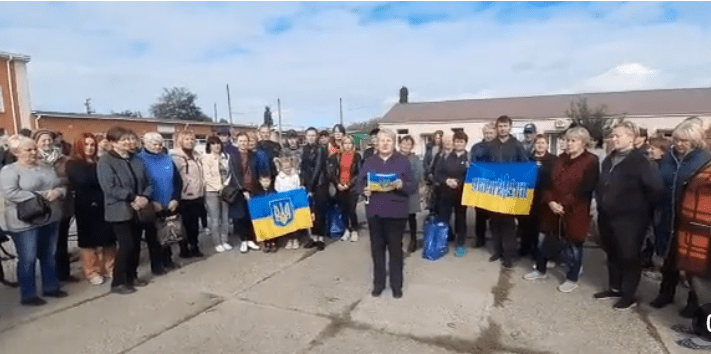
The first photo is of a rally at the weekend in Snihurivka, Mykolaiv region, that was occupied by Russian forces in March. A declaration was read out condemning the occupation. It stated that those present would not take part in the fake “referendum”, did not want to accede to the Russian Federation, and considered themselves Ukrainians. This is a still from a short film broadcast on the Telegram channel of Denis Kazansky, a journalist based in the area. He commented: “That’s the real position of residents of the occupied areas of Ukraine. Just compare that video with the disgraceful methods used by the occupiers to try to get people to vote.”
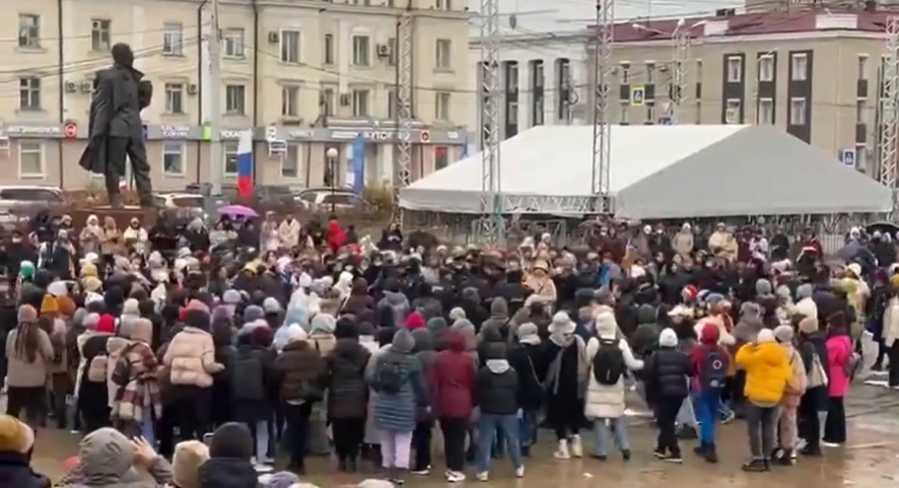
The second photo is of a demonstration in Yakutia, in Siberia, against the Kremlin’s mobilisation order. Women performed a traditional round dance, the Osuohai, surrounding a group of policemen and shouting “no to genocide!” and “no to war”. The police were repeatedly obstructed but in the end left and made several arrests. The Public Chamber of Yakutia, in a 1984-style revision of reality, stated that there had been no anti-war protest, only a “blessing by mothers for the return of their husbands and sons alive”. This is a still from a film shared by Feminist Antiwar Resistance.
Source: “Ukraine: bogus ‘anti-imperialism’ serves the Kremlin,” People and Nature, 28 September 2022. Thanks to Simon Pirani for his kind permission to republish his essay here.